


Abstract
High-performance electrode materials are crucial to the practical application of supercapacitors. The composite of bimetallic sulfides with carbon-based materials has been verified as an effective approach to improve charge storage capacity. Herein, the nickel cobalt sulfide/reduced graphene oxide (NiCo2S4/rGO) composites were prepared via a facile one-pot hydrothermal route, in which NiCo2S4 nanostructures were in situ anchored onto the 2D reduced graphene oxide (rGO) matrix. The nucleation and growth of the sulfide and the simultaneous reduction of GO to rGO were achieved. The loading amount of NiCo2S4 was found to significantly regulate the microscopic morphology of NiCo2S4 grown on the rGO sheets. As the content of NiCo2S4 increased, the morphology of NiCo2S4 transformed from spherical nanoparticles to a nearly cubic structure. Benefiting from the incorporation of pseudocapacitive NiCo2S4 and the conductive network of rGO, the as-prepared NiCo2S4/rGO composite electrodes exhibited significantly enhanced capacitance performance. Impressively, the optimized NiCo2S4/rGO-2 electrode delivered a prominent specific capacitance of 1165 F g−1 at 1 A g−1 and about 80% capacitance retention over 2000 cycles. Furthermore, an asymmetric supercapacitor (NiCo2S4/rGO-2//AC) was assembled with NiCo2S4/rGO-2 as the positive electrode and activated carbon (AC) as the negative electrode, which delivers an outstanding energy density of 30.9 Wh kg−1 under a power density of 739.3 W kg−1. This work demonstrates the great potential of NiCo2S4/rGO composites as high-efficiency electrode materials for advanced energy storage devices.
1. Introduction
Driven by the fast development of portable electronic devices, electric vehicles, and smart grid infrastructure over the past decades, there is a growing need for energy storage systems with superior performance and dependable stability. Within diverse energy storage techniques, lithium-ion batteries and supercapacitors have emerged as two dominant paradigms due to their unique advantages. Lithium-ion batteries, characterized by high energy density, are widely used in large-scale energy storage applications. Supercapacitors, as a new electrochemical energy storage system, possess outstanding power density, ultrafast charge and discharge kinetics, and outstanding cycling performance. They demonstrate significant application promise in emergency power supplies, rail transit, renewable energy grid integration, etc. [1,2,3]. As the core components of supercapacitors, electrode materials directly determine the electrochemical properties of such devices. According to the different charge storage mechanisms, supercapacitor electrode materials could be divided into two main types. One is electric double-layer capacitive (EDLC) materials that store charge through electrostatic interaction at the electrode/electrolyte interface. Carbon-based materials, including graphene, activated carbon, and carbon nanotubes, are typical examples of EDLC materials [4,5,6]. The other type is pseudocapacitive materials. These materials realize charge storage via fast and reversible Faraday redox reactions on the electrode surface, mainly including conductive polymers and transition metal oxides/sulfides [7,8,9]. EDLC materials generally have a larger specific surface area and excellent conductivity, but their specific capacitance remains relatively low. Pseudocapacitive materials, due to their abundant redox-active sites, can provide higher specific capacitance and thus serve as a pivotal avenue for improving the capacitance and energy density of supercapacitors [10].
Among the numerous pseudocapacitive electrode materials, transition metal sulfides have drawn widespread attention owing to their abundant valence states and high conductivity [11,12,13]. Typical single-metal sulfides such as NiS and CoS, although having good mechanical stability and thermal stability, provide limited oxidation-reduction activity from a single metal site and suffer from insufficient conductivity and susceptibility to agglomeration during cycling [14,15]. In contrast, bimetallic sulfides including NiCo2S4 can benefit from the synergistic effect of dual metal ions and provide more abundant oxidation-reduction reaction sites and higher intrinsic conductivity, effectively improving the inherent defects of single-metal sulfides [16,17,18]. However, NiCo2S4 still generates structural collapse due to volume expansion and active material shedding during long-term charge/discharge operation, resulting in unsatisfactory long-term cycling stability [19].
To enhance the overall electrochemical performance of bimetallic sulfide electrodes, a widely adopted design strategy involves integrating them with highly conductive carbon-based materials to construct hierarchical composite architectures [20]. Graphene, as a typical 2D carbon material, has excellent electronic conductivity, ultrahigh specific surface area, and good mechanical strength. It not only acts as a conductive scaffold to accelerate electron transmission, but also effectively buffers the volume changes in pseudocapacitive materials during charging and discharging, inhibiting the agglomeration and shedding of active substances [21]. The multi-component characteristics of composite materials not only optimize the interfaces for electron transmission and ion diffusion, but also provide more redox-active sites, thereby enhancing the specific capacitance of electrodes. Fan et al. [22] prepared hierarchical porous NiCo2S4-rGO composites that achieved a high capacitance of 1107 F g−1 at 1 A g−1, together with favorable cycling stability with 90% capacitance retention. Ahamed et al. [23] synthesized a NiCo2S4/RGO nanocomposite that presented a specific capacitance of 1505 F g−1 and a capacitance retention of 85.6% over 5000 cycles. Beyond compositional engineering, precise microstructural control is equally critical. Currently, the preparation of NiCo2S4 is mostly carried out by solvothermal routes. By adjusting reaction parameters (e.g., temperature, time, precursor concentration), various morphologies such as nanoparticles, nanowires, nanosheets, and flower-like hierarchical structures can be obtained [24,25,26]. Among them, hierarchical porous materials provide more electrochemical active sites and shorten the ion diffusion path, facilitating the rapid penetration of electrolytes. However, the NiCo2S4/rGO composite material still has some issues, such as easy self-aggregation of NiCo2S4 nanoparticles and rGO, weak interface bonding, uncontrollable growth of NiCo2S4 on the graphene surface, and insufficient porosity resulting in a low ion transport rate.
To further address the agglomeration of NiCo2S4 nanoparticles and rGO and regulate the growth of NiCo2S4 nanoparticles, we directly used graphene oxide as the two-dimensional substrate. The oxygen functional groups on the substrate surface served as anchoring points, guiding the precursors to nucleate preferentially on the surface of the layered structure, thereby achieving the in situ controllable growth of NiCo2S4. The simultaneous nucleation-growth of bimetallic sulfides and the reduction in graphene oxide were achieved through a one-step hydrothermal method. This preparation method is mild and does not require complex post-treatment, effectively inhibiting the spontaneous agglomeration of bimetallic sulfide particles and alleviating the self-stacking of rGO, fully leveraging the synergistic energy storage advantages. The microscopic morphology of NiCo2S4 particles was regulated by the initial feeding mass. The morphology of NiCo2S4 can transform from spherical to nearly cubic. The crystalline structure and chemical composition were investigated by XRD, Raman spectroscopy, and XPS spectroscopy. BET measurement was adopted to characterize the specific surface area and pore size distribution. After the introduction of pseudocapacitive NiCo2S4, NiCo2S4/rGO electrodes exhibited enhanced capacitance performance in contrast to pristine rGO (86 F g−1). Among them, the NiCo2S4/rGO-2 composite electrode presented an excellent specific capacitance of 1165 F g−1 at 1 A g−1, and capacitance retention remained about 80% over 2000 cycles. Furthermore, an asymmetric supercapacitor (NiCo2S4/rGO-2//AC) was assembled with NiCo2S4/rGO-2 as the positive electrode and activated carbon (AC) as the negative electrode, which delivers an outstanding energy density of 30.9 Wh kg−1 under a power density of 739.3 W kg−1.
2. Materials and Methods
2.1. Materials
Graphite powder (325 mesh), concentrated sulfuric acid (98%H2SO4), potassium hydroxide (KOH, AR), nickel nitrate hexahydrate (Ni(NO3)2·6H2O, 99%), cobalt nitrate hexahydrate (Co(NO3)2·6H2O, 99%), and thiourea (CH4N2S, 99%) were purchased from Macklin Biochemical Technology Co., Ltd., Shanghai, China.
2.2. Synthesis of NiCo2S4/rGO
Graphene oxide (GO) powder was synthesized previously via the modified Hummers’ approach [27]. Under ultrasonication, 150 mg of GO was dispersed in 30 mL of deionized water for 2 h. Subsequently, three groups consist of 1 mmol of Ni(NO3)2·6H2O, 2 mmol of Co(NO3)2·6H2O, and 5 mmol of CH4N2S; 2 mmol of Ni(NO3)2·6H2O, 4 mmol of Co(NO3)2·6H2O, and 10 mmol of CH4N2S; 5 mmol of Ni(NO3)2·6H2O, 10 mmol of Co(NO3)2·6H2O, 25 mmol of CH4N2S were added to the above GO dispersion solution, respectively. After 20 min of ultrasonic dispersion, the mixture was then placed in an autoclave and maintained at 180 °C for 12 h. Once the reaction finished, the supernatant was filtered, and the collected solid product was subjected to freeze-drying for 4 h. This process resulted in three different proportions of NiCo2S4/rGO composites, sequentially labeled as NiCo2S4/rGO-1, NiCo2S4/rGO-2, and NiCo2S4/rGO-3. The mass loadings of NiCo2S4 in the NiCo2S4/rGO-1, NiCo2S4/rGO-2, and NiCo2S4/rGO-3 were approximately 32%, 47%, and 72% estimated by product mass. The feed ratios of precursors for rGO and NiCo2S4/rGO samples are listed in Supplementary Table S1.
2.3. Material Characterization
The surface morphology of the samples was characterized using a scanning electron microscope (SEM, SU8010,Hitachi High-Tech Corporation, Tokyo, Japan). Structural characterizations were carried out using X-ray diffraction (XRD, Smart Lab, Rigaku Corporation, Tokyo, Japan, 10~80°, 5°/min) and Raman spectroscopy (Raman, Senterra, Bruker Optik GmbH, Ettlingen, Germany, 532 nm laser). BET tests (Micromeritics ASAP 2460, Micromeritics Instrument Corporation, Norcross, GA, USA) were conducted to acquire the specific surface area and pore size information. The surface binding energy states were analyzed using X-ray photoelectron spectroscopy (XPS, ESCALAB 250Xi, Thermo Fisher Scientific, Waltham, MA, USA).
2.4. Electrochemical Measurements
The electrochemical performance of the sample electrodes was measured via cyclic voltammetry (CV), galvanostatic charge/discharge (GCD), electrochemical impedance spectroscopy (EIS), and cycling stability tests on an electrochemical workstation (CHI600E, China). In a three-electrode configuration, the working electrode was fabricated by mixing as-prepared electrode materials, carbon black, and PVDF in a wt ratio of 80:10:10 to form a slurry and then coated onto nickel foam with an active material loading of 1 mg/cm2. The Hg/HgO electrode served as the reference electrode, and the platinum plate as the counter electrode in a 6 M KOH solution. CV tests were measured over a potential window of −0.1 to 0.4 V at scan rates of 5, 10, 20, 30, 50, and 100 mV/s. GCD measurements were conducted within the operating potential window of 0~0.3 V at current densities of 1, 2, 3, 5, and 10 A g−1. EIS spectra were collected from 0.01 Hz to 100 kHz with an amplitude of 5 mV. Cycling measurements involved 2000 repeated GCD cycles at 10 A g−1. In a two-electrode configuration, the asymmetric supercapacitors (ASC) were assembled using NiCo2S4/rGO-2 as the positive electrode and activated carbon (AC) as the negative electrode in 6 M KOH solution. Nickel foam served as the current collector, while a cellulose membrane was adopted as the separator. CV curves were measured within the potential range of 0~1.5 V at scan rates of 5, 10, 20, 30, 50, and 100 mV/s. GCD measurements were conducted within the operating potential window of 0~1.5 V at current densities of 1, 2, 3, 5, and 10 A g−1.
3. Results and Discussion
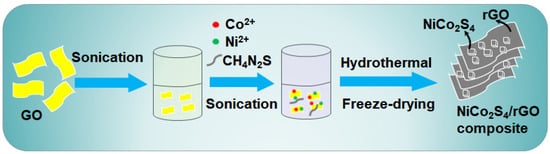
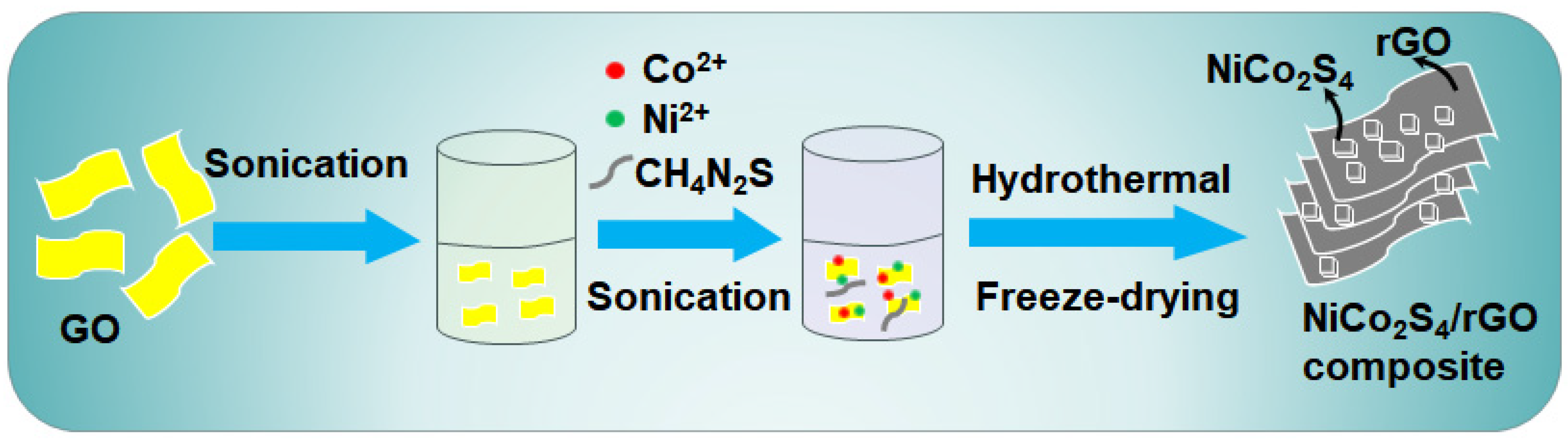
Figure 1 illustrates the schematic fabrication procedure of the NiCo2S4/rGO composite. GO sheets were first ultrasonically dispersed. With the addition of metal ions, plenty of Ni2+ and Co2+ ions combined with the negatively charged groups on the surface of GO through electrostatic interaction. Ni2+ and Co2+ metal ions were evenly dispersed and anchored on the surface of the GO sheet structure. NiCo2S4 was produced in the hydrothermal reaction system and grew directionally on the surface of the sheets. The GO could be reduced to rGO during hydrothermal treatment without the addition of an external chemical reducing agent. This originates mainly from the thermal dehydration and decomposition of oxygen-containing functional groups (carboxyl groups, epoxy, hydroxyl) on GO sheets under high temperature and pressure. The hydrothermal process can simultaneously reduce GO to form a continuous conductive network and obtain NiCo2S4/rGO composite material.
Figure 1.
Schematic preparation route of NiCo2S4/rGO composite.
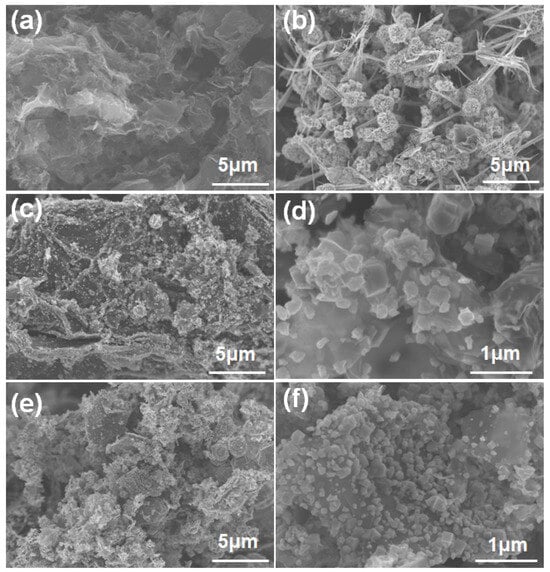
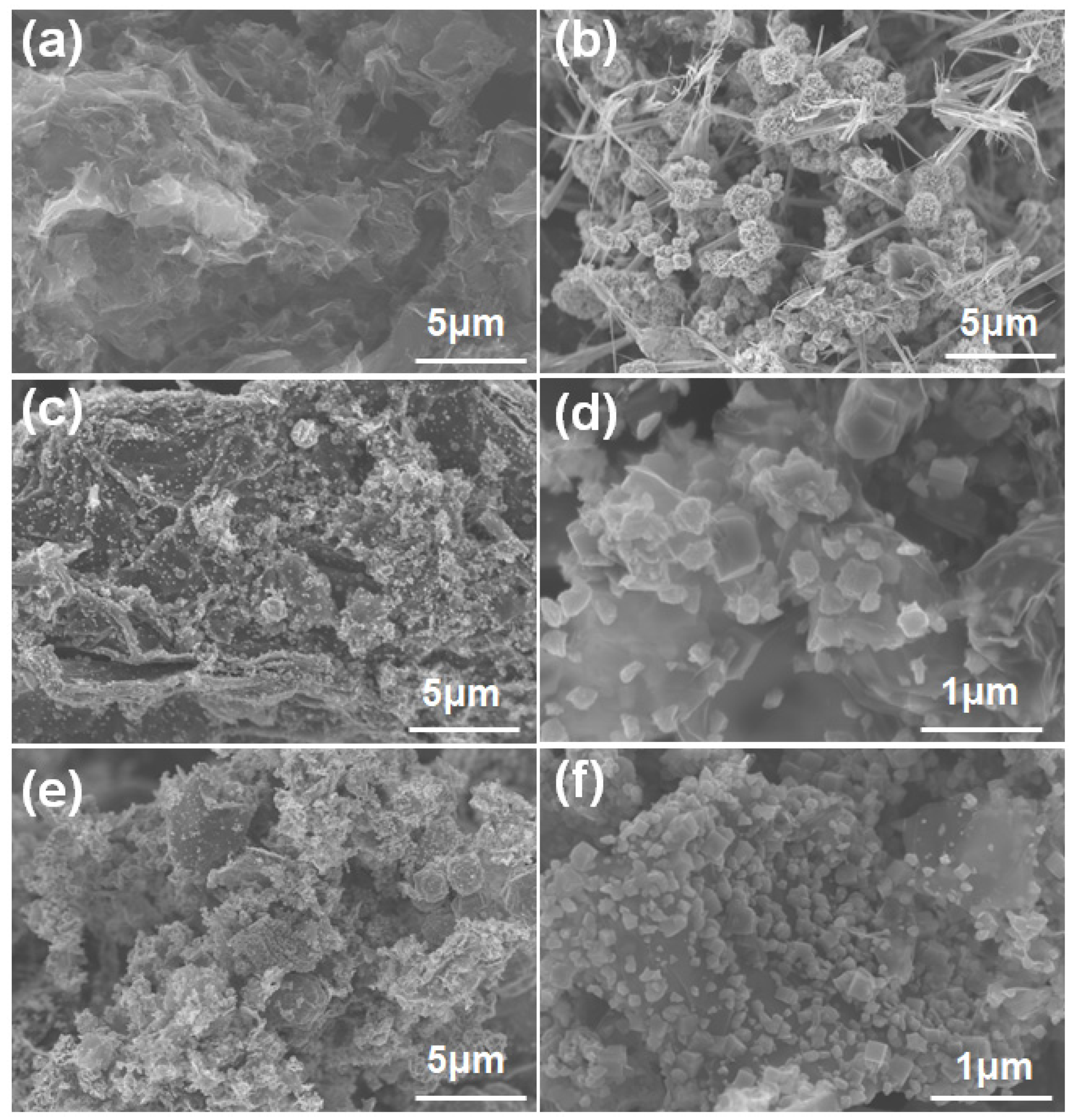
The SEM micrographs of rGO and NiCo2S4/rGO composites are demonstrated in Figure 2. Figure 2a shows lamellar morphology with irregular wrinkles and interlayer porosity in rGO. As depicted in Figure 2b, the surface of the NiCo2S4/rGO-1 composite is covered with NiCo2S4 particles. NiCo2S4 exhibits a spherical aggregation structure with diameters ranging from approximately 500 nm ~2 μm. Figure 2c,d present the SEM images of the NiCo2S4/rGO-2 composite. In contrast to the NiCo2S4/rGO-1 composite, NiCo2S4 grown on rGO in the NiCo2S4/rGO-2 composite shows a transformation from spherical to nearly cubic morphology and exhibits distinct changes in size and morphology characteristics. Furthermore, as can be observed from Figure 2e,f, the morphology of NiCo2S4 in the NiCo2S4/rGO-3 composite is still mainly near-cubic. However, both the lateral dimensions and thickness of the NiCo2S4 bulk particles decrease compared with those in the NiCo2S4/rGO-2 composite. This is attributed to the highest precursor loading in this sample, resulting in denser nucleation and closer inter-particle packing of NiCo2S4. Consequently, the overall specific surface area of the NiCo2S4/rGO-3 composite is lower than that of the NiCo2S4/rGO-2 composite, which may lead to inferior electrochemical properties.
Figure 2.
SEM images of rGO (a), NiCo2S4/rGO-1 (b), NiCo2S4/rGO-2 (c,d), and NiCo2S4/rGO-3 (e,f).
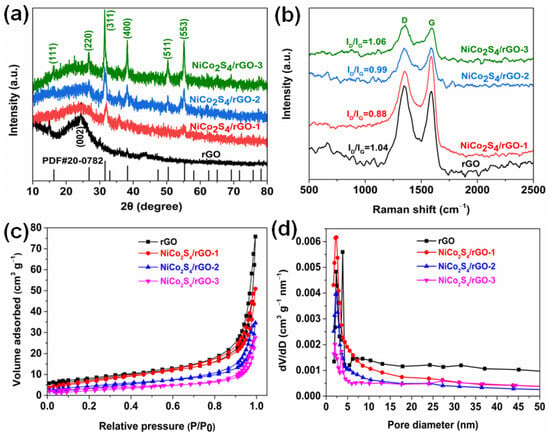
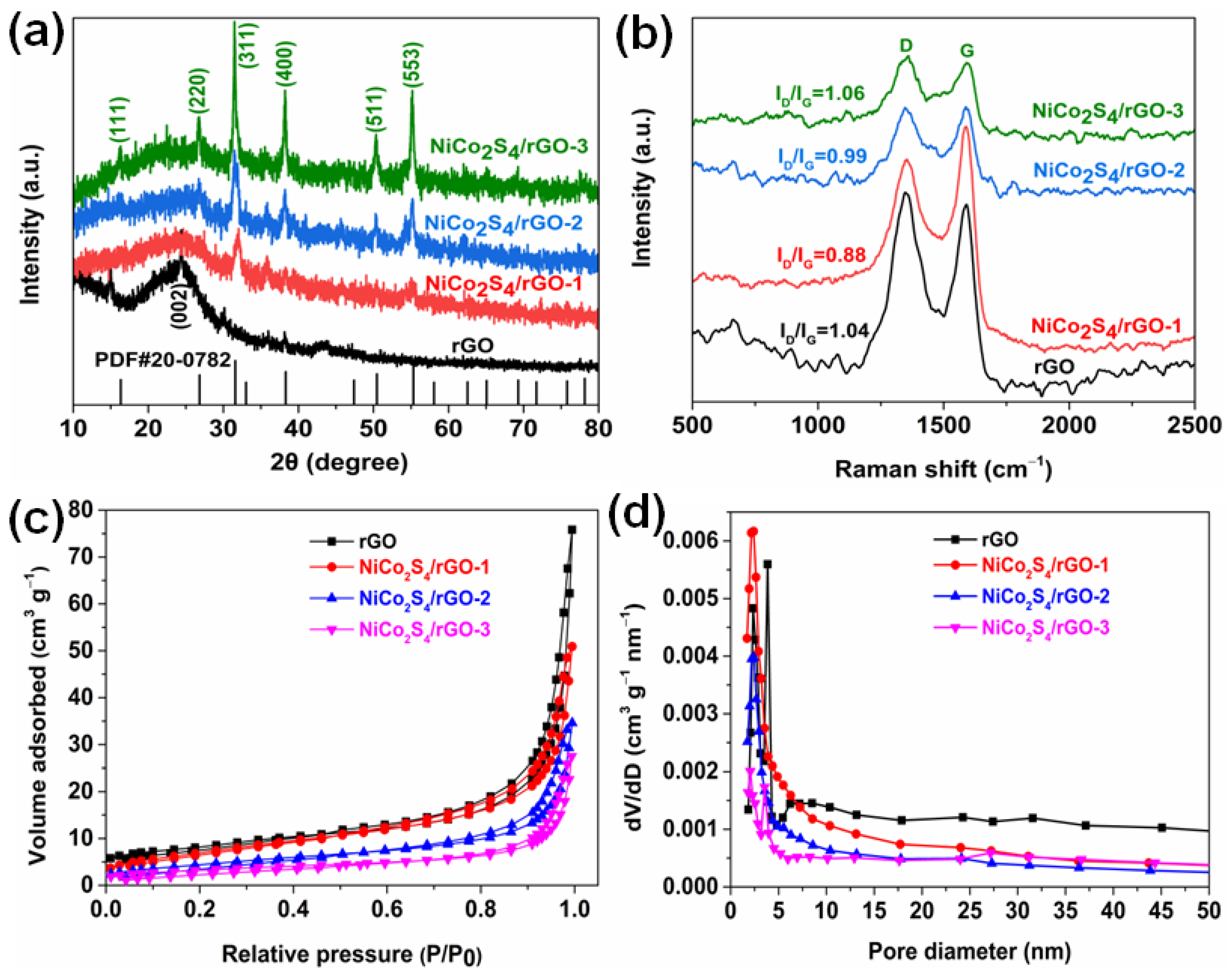
The powder XRD pattern was utilized to identify the crystalline phase of the as-prepared materials. As shown in Figure 3a, a relatively prominent diffraction peak of rGO appears at around 24.4°, corresponding to the (002) crystal plane, indicating that GO has undergone reduction. The peak of the (002) crystal plane of rGO has significantly weakened in the diffraction patterns of NiCo2S4/rGO-1, NiCo2S4/rGO-2, and NiCo2S4/rGO-3 composites. This arises because the layer surface is covered with NiCo2S4 particles. Strong diffraction peaks can be detected at 2θ angles of 16.3, 26.8, 31.5, 38.3, 50.3, and 55.2°, corresponding to the (111), (220), (311), (400), (511), and (440) crystal planes of the cubic-structured NiCo2S4 phase (JCPDS: 20-0782), respectively [28,29]. These NiCo2S4 successfully grow on the surface of rGO and form the NiCo2S4/rGO composite materials. As the content of NiCo2S4 increases, the diffraction peak position of NiCo2S4 in the composite sample remains unchanged while its intensity increases accordingly. Figure 3b demonstrates the Raman spectra of rGO and NiCo2S4/rGO composites. The characteristic D and G bands are located at around 1350 and 1590 cm−1. The D band originates from out-of-plane vibrations associated with structural defects, whereas the G band corresponds to the E2g symmetric vibration of graphitic sp2-hybridized carbon [30]. The intensity ratio of ID/IG is applied to quantitatively evaluate the defect level of carbon material [31]. The ID/IG of rGO, NiCo2S4/rGO-1, NiCo2S4/rGO-2 and NiCo2S4/rGO-3 are 1.04, 0.88, 0.99 and 1.06, respectively. For NiCo2S4/rGO-1 and NiCo2S4/rGO-2, the surface coverage of NiCo2S4 can repair some intrinsic defects, while in NiCo2S4/rGO-3, the large aggregation of NiCo2S4 induces more structural defects. Figure 3c presents the N2 adsorption/desorption isotherms of rGO and NiCo2S4/rGO composites. These isotherms exhibit typical type-IV profiles with hysteresis loops, revealing the mesoporous characteristics of the rGO and NiCo2S4/rGO composite materials. The BET surface area of rGO, NiCo2S4/rGO-1, NiCo2S4/rGO-2 and NiCo2S4/rGO-3 are 28.8, 25.7, 16.1 and 11.8 m2/g, respectively. As the amount of NiCo2S4 grown on the layered surface increases, its BET surface area decreases. Figure 3d illustrates the pore size distribution of the as-prepared samples. The pore size distribution of the NiCo2S4/rGO-1 and NiCo2S4/rGO-2 composites is predominantly centered at 2.2 nm and 2.4 nm. Whereas the pore size distribution of NiCo2S4/rGO-3 is centered at 2.0 and 3.5 nm, and that of pristine rGO is 2.3 nm and 3.9 nm. The nanoporous architecture facilitates electrolyte ion infiltration and expands the electrochemically active surface area, thereby enhancing charge storage capacity [32].
Figure 3.
XRD patterns (a), Raman spectra (b), N2 absorption/desorption isotherms (c), and pore size distribution (d) of rGO and NiCo2S4/rGO composites.
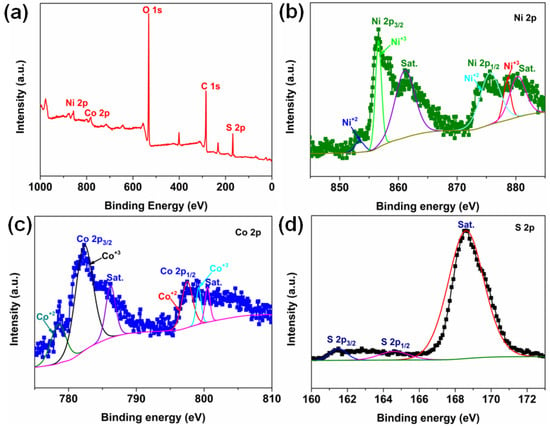
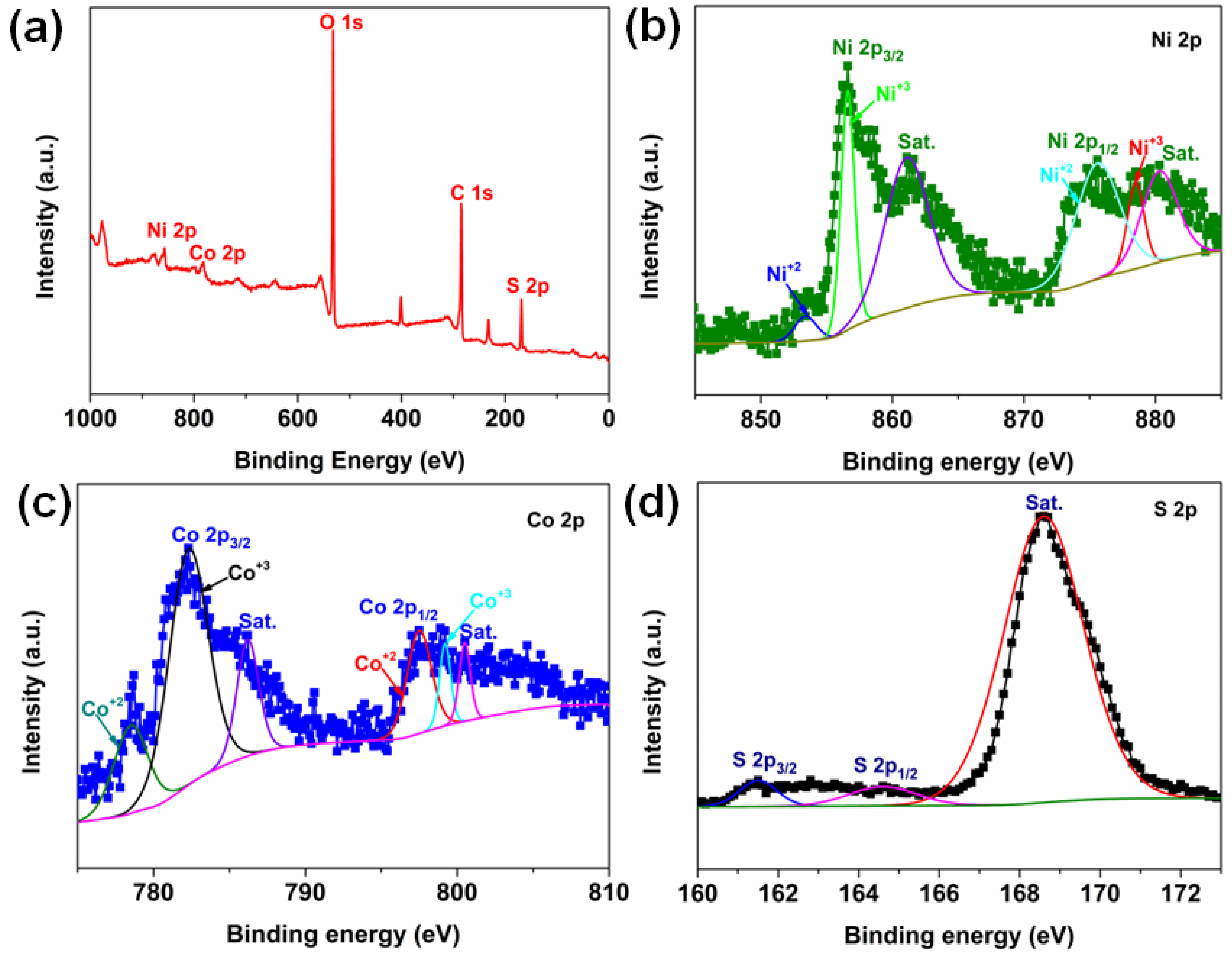
The surface binding energy states of NiCo2S4/rGO-2 were analyzed by XPS, as shown in Figure 4. The XPS survey spectra in Figure 4a proved the coexistence of Co, Ni, S, O, and C elements. The relatively high peak intensity of the O element arises from the incompletely reduced oxygenated groups in rGO and the surface-adsorbed water. Figure 4b is the high-resolution XPS spectrum of Ni 2p. The spectra show that the two main peaks at 853.4 and 875.6 eV correspond to Ni2+, while the two peaks at 856.6 and 878.5 eV belong to Ni3+. Moreover, the peaks at 861.1 and 880.3 eV correspond to characteristic satellite peaks [33]. According to the Co 2p XPS spectra in Figure 4c, the peaks at 778.5 and 797.5 eV originate from Co2+, and another group at 782.3 and 799.2 eV belongs to Co3+. Moreover, the binding energies of 786.2 and 800.5 eV are attributed to the satellite peaks. As for the high-resolution XPS spectra of S 2p shown in Figure 4d, two peaks located at 161.5 and 164.6 eV correspond to S 2p3/2 and S 2p1/2, which are characteristic of metal sulfides (Co-S, Ni-S) [34]. The binding energy of 168.6 eV is identified as a shake-up satellite peak. Results show that the surface region of NiCo2S4/rGO-2 contains chemical components of Ni2+, Ni3+, Co2+, Co3+, and S2−. This is consistent with the structure of CoNi2S4, and these ions ensure the progress of the Faraday redox reaction.
Figure 4.
XPS survey spectra (a) and high-resolution XPS (b–d) of Ni 2p, Co 2p, and S 2p for the NiCo2S4/rGO-2 composite.
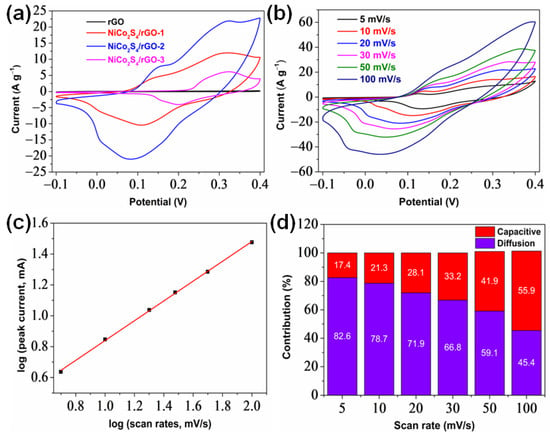
The electrochemical performances of rGO and NiCo2S4/rGO electrodes were measured using a three-electrode system configuration with 6 M KOH aqueous electrolyte. Figure 5a compares the CV curves of each electrode within the voltage range of −0.1 to 0.4 V at the same scan rate of 20 mV/s. Distinct redox peaks can be observed for the NiCo2S4/rGO electrodes, revealing that the energy storage mainly depends on the pseudocapacitive behavior. Based on the size of the closed area of the CV curve, the NiCo2S4/rGO-2 electrode delivers the largest integral area, indicating that its capacitance is the largest. The CV curves of the NiCo2S4/rGO-2 electrode at various scan rates ranging from 5 to 100 mV/s are shown in Figure 5b. All CV curves maintain a similar shape. With the increase in scan rate, clear redox peaks still appear, and there is no obvious polarization, demonstrating superior reversibility and prominent pseudocapacitive features of the electrode [35]. The specific capacitance of the NiCo2S4/rGO-2 electrode estimated from CV curves at various scan rates is presented in Supplementary Figure S1. The NiCo2S4/rGO-2 electrode exhibits a specific capacitance of 816, 666, 507, 429, 339, 254 F g−1 at scan rates of 5, 10, 20, 30, 50, 100 mV/s, respectively. To clarify the charge storage mechanism of the NiCo2S4/rGO material, a quantitative kinetic analysis was conducted on the CV curves of NiCo2S4/rGO-2 at various scan rates. The relationship between the anode/cathode peak current (i) and scan rate (v) of the CV curves at various scan rates is calculated by the formulas (1) and (2) [36,37].
where a is a constant related to the electrode property and b is the kinetic index determined by the slope of the fitting line of logi-logv. The b value of 0.5 corresponds to the diffusion-control process. For the surface-control kinetics, the value is equal to 1.0. In Figure 5c, logi–logv displays the well-fitting line, and the b value of the NiCo2S4/rGO-2 electrode is 0.64. This result reveals that the charge storage mechanism of the material is governed by a combined effect of diffusion and surface capacitive processes.
i = avb
logi = loga + blogv
Figure 5.
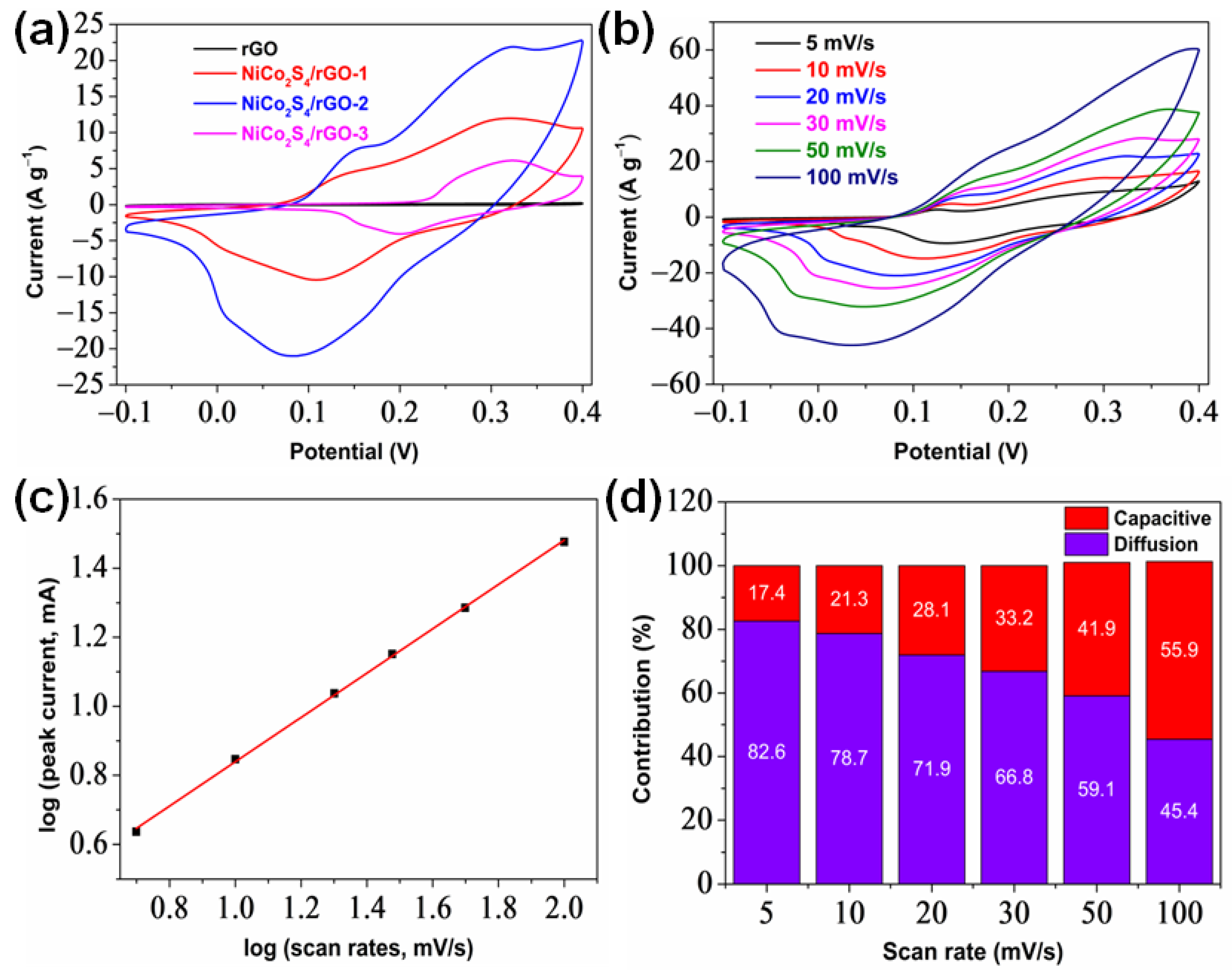
CV curves (a) of rGO and NiCo2S4/rGO electrodes at 20 mV/s, CV curves (b) of the NiCo2S4/rGO-2 electrode at 5-100 mV/s, linear relationship between anodic peak current and scan rates for the NiCo2S4/rGO-2 electrode (c), and capacity contribution (d) of the NiCo2S4/rGO-2 electrode.
For a quantitative analysis of charge storage, the capacitance contributions of surface control and diffusion control to the total stored charge are quantified through formula (3) [38].
where k1v and k2v1/2 are ascribed to the current contributions from the capacitive and diffusion processes, respectively.
i(v) = k1v + k2v1/2
Figure 5d shows the capacity contribution of the NiCo2S4/rGO-2 electrode under various scan rates. At 5 mV/s, the diffusion-controlled contribution to the total capacitance of the NiCo2S4/rGO-2 electrode accounted for 82.6%, whereas the surface-controlled (capacitive) contribution constituted 17.4%. Upon increasing the scan rate from 5 to 100 mV/s, the surface-controlled contribution increases to 55.9%. This synergistic energy storage mechanism, comprising both diffusion-controlled and surface-controlled processes, endows the composite electrode with the ability to deliver high specific capacitance and favorable rate performance.
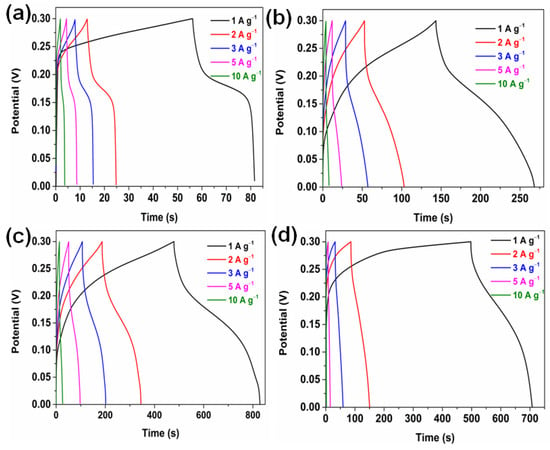
The GCD measurement was carried out to assess the charge-storage features and specific capacitance of the as-prepared electrodes. The GCD curves of the rGO, NiCo2S4/rGO-1, NiCo2S4/rGO-2 and NiCo2S4/rGO-3 electrodes at different current densities of 1, 2, 3, 4, 5 and 10 A g−1 are displayed in Figure 6a–d. All the GCD curves exhibit a nearly symmetric and triangular shape and still retain their original shape under high current density, indicating excellent rate capability. The shape of the charge/discharge curve also shows its pseudocapacitive characteristics, which are derived from the introduction of NiCo2S4 and unreduced oxygen-containing groups. Even within a narrow voltage range of 0.3 V, the electrodes exhibit excellent specific capacitance. Moreover, the NiCo2S4/rGO-2 electrode exhibits a notably extended discharge duration relative to the other electrodes, which confirms its superior specific capacitance among these electrodes.
Figure 6.
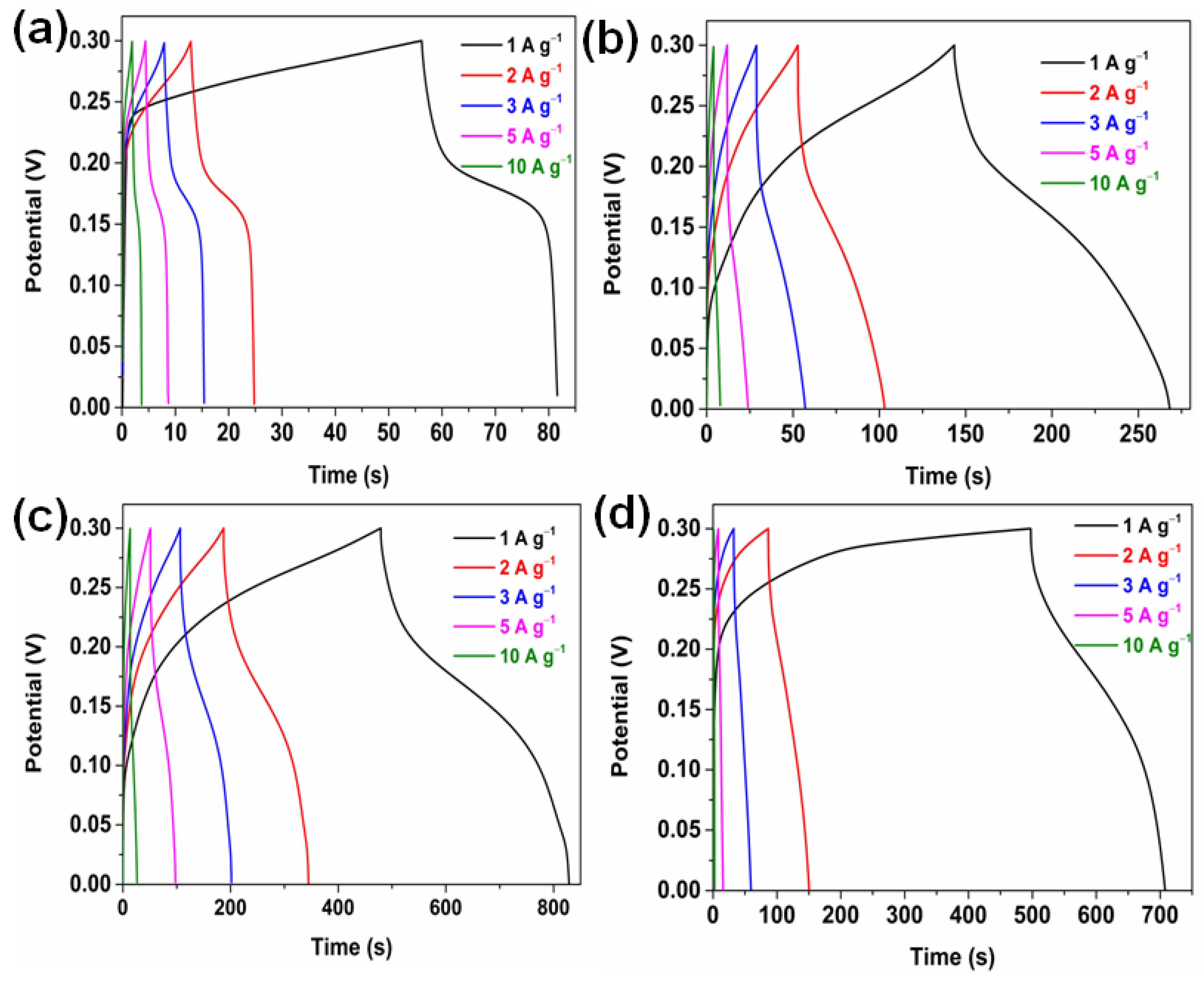
GCD curves of rGO (a), NiCo2S4/rGO-1 (b), NiCo2S4/rGO-2 (c), and NiCo2S4/rGO-3 (d) at different current densities.
The specific capacitance (C, F g−1) of the electrodes was calculated using formula (4) based on the GCD curve recorded at different current densities [39].
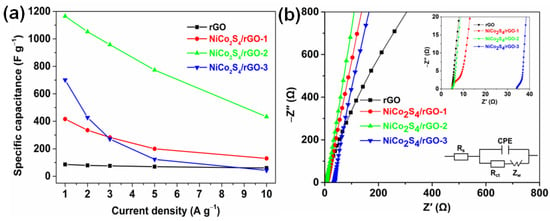
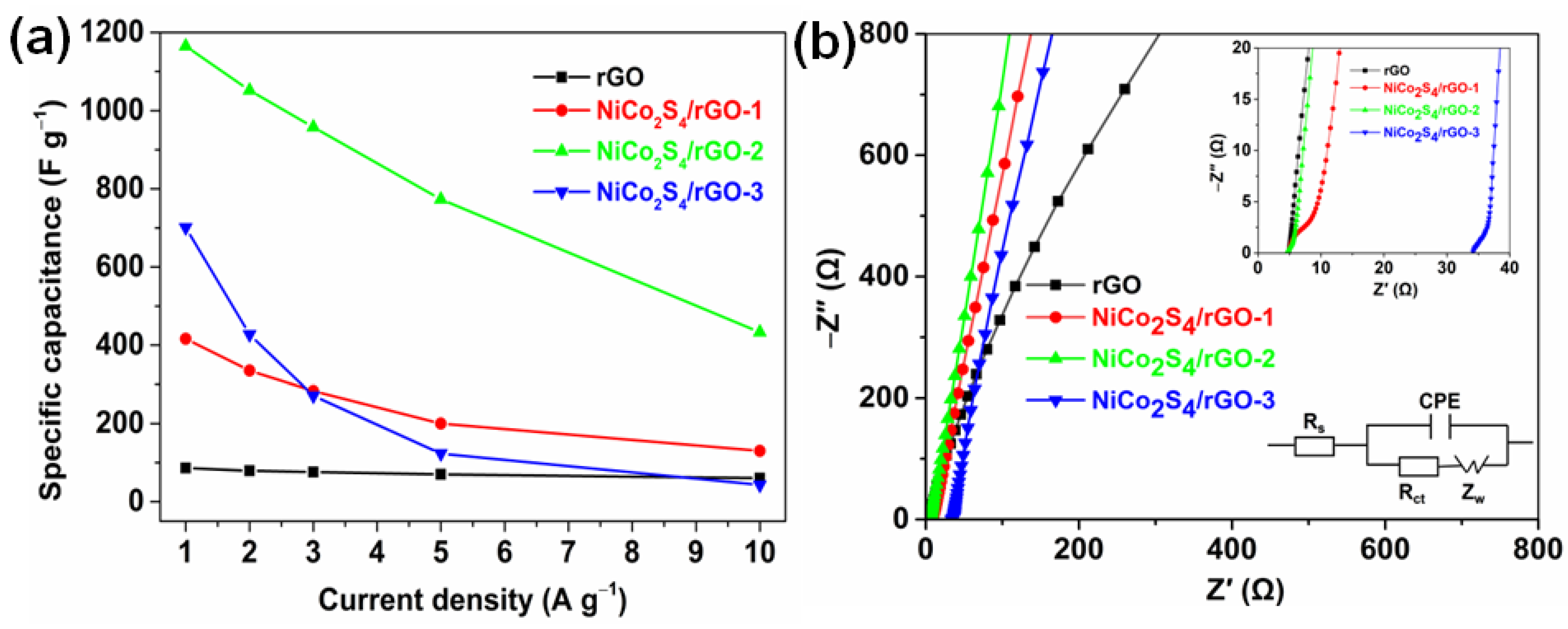
where I/m represents the current density (A g−1). t is the discharge time (s) determined by the GCD curve. V is the operating voltage window (V). Figure 7a shows the specific capacitance of four electrode materials at different current densities. Among them, NiCo2S4/rGO-2 electrode delivers a maximum specific capacitance of 1165 F g−1 at 1 A g−1 superior to NiCo2S4-based electrodes in the recent literature (NiCo2S4/rGO, 1072 F g−1 at 1 A g−1 [40], NiCo2S4@NiFe-LDH, 827 F g−1 at 1 A g−1 [41], NiCo2S4/MoS2/MWCNT, 1090 F g−1 at 1 A g−1 [42], NiCo2S4/rGO, 963F g−1 at 1 A g−1 [43]). In contrast, rGO, NiCo2S4/rGO-1, and NiCo2S4/rGO-3 exhibit the specific capacitances of 86, 416, and 701 F g−1 at 1 A g−1, respectively. Compared with pure rGO, the introduction of NiCo2S4 significantly enhances the specific capacitance of NiCo2S4/rGO-2, indicating that the two components in the composite material exert a better synergistic effect. Furthermore, the specific capacitance of NiCo2S4/rGO-2 is superior to that of NiCo2S4/rGO-1 and NiCo2S4/rGO-3, which can be explained by (i) a larger specific surface area than NiCo2S4/rGO-3, facilitating greater electroactive site availability, and (ii) a higher content than NiCo2S4/rGO-1, which enhances the pseudocapacitive contribution and overall charge storage capability. Notably, NiCo2S4/rGO-3 exhibits a pronounced decline in specific capacitance with the increase in current density. The high content of NiCo2S4 particle aggregation increases the resistance to ion diffusion, slows down the ion transmission rate, and the internal NiCo2S4 cannot participate in redox reactions, leading to a rapid decline in the specific capacitance of the NiCo2S4/rGO-3 composite material. The EIS Nyquist plots in Figure 7b reveal the absence of discernible semicircular features in the high-frequency region for all prepared electrode materials, suggesting low charge-transfer resistance and favorable electronic conductivity. The slope of the Warburg line in the low-frequency region is inversely proportional to the ionic diffusion resistance at the electrode–electrolyte interface. Steeper slopes correspond to lower diffusion resistance and thus enhanced ion transport kinetics. All three NiCo2S4/rGO composite electrodes exhibit significantly steeper low-frequency slopes than pristine rGO, indicating accelerated electrolyte ion diffusion and superior charge-transfer capability consistent with their improved electrochemical performance [18,44]. Furthermore, the X-intercept of the EIS curve corresponds to the internal resistance (Rs). Notably, Rs values differ markedly among composites: NiCo2S4/rGO-2 exhibits an Rs of 4.6 Ω, whereas NiCo2S4/rGO-3 displays a higher value of 34.1 Ω, suggesting inferior charge transmission performance. The fitted numerical values of Nyquist plots for rGO and NiCo2S4/rGO samples are provided in Supplementary Table S2.
Figure 7.
Specific capacitance vs. current density (a), Nyquist plots (inset: enlarged image in the high-frequency region and the equivalent circuit model) of rGO and NiCo2S4/rGO electrodes (b).
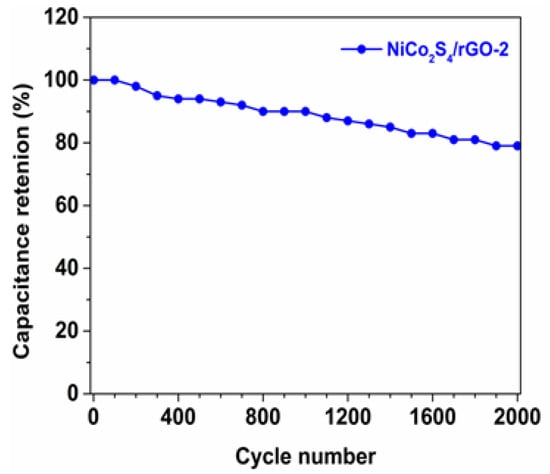
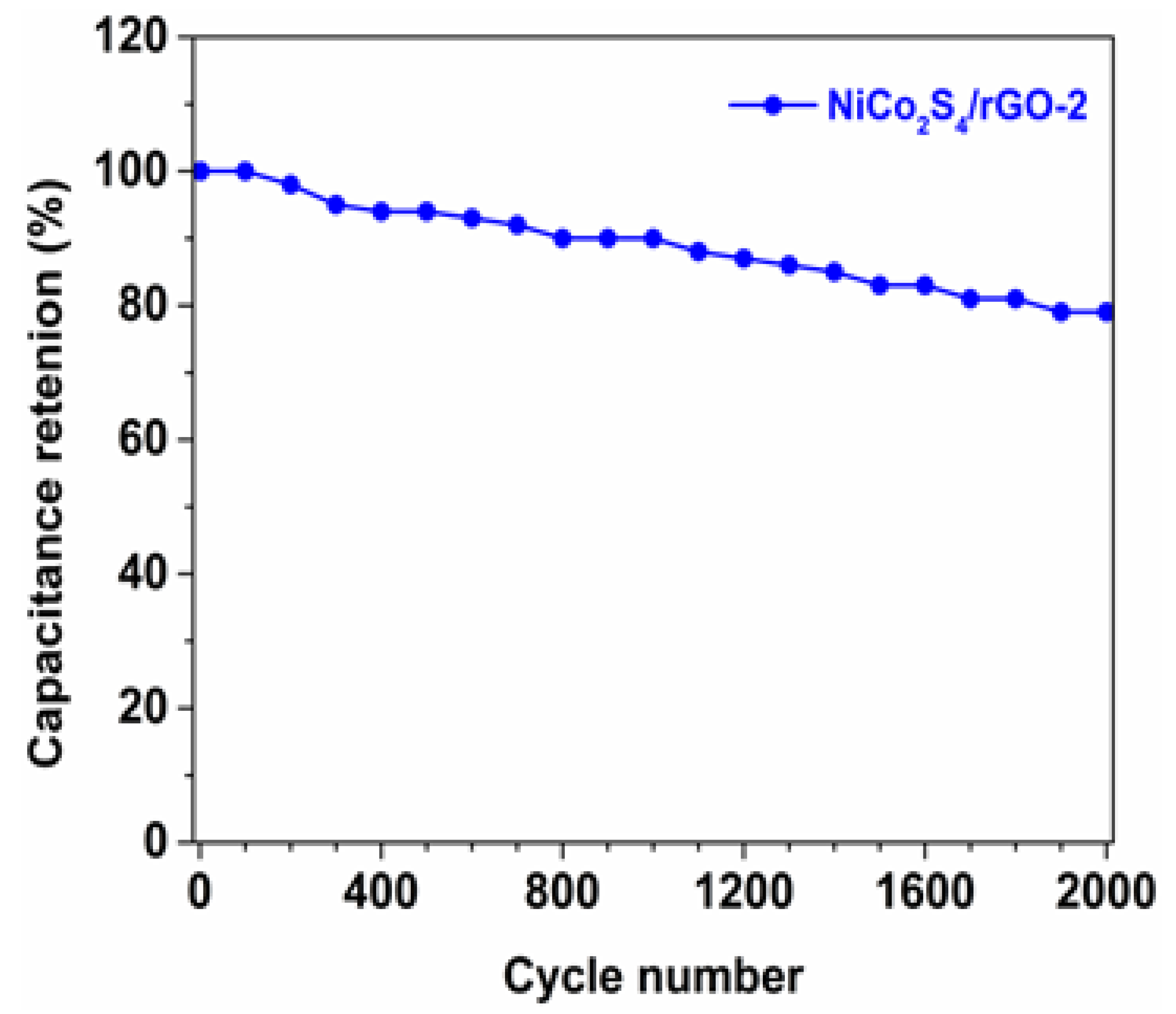
Cycle stability, a critical metric for practical electrode longevity, was evaluated via GCD tests at 10 A g−1 over 2000 cycles. The capacitance retention of the NiCo2S4/rGO-2 electrode gradually declines with cycling but remains at about 80% after 2000 cycles in Figure 8, confirming its relative structural integrity and sustained electrochemical activity under operational conditions. The rGO sheet substrate effectively buffers the volume expansion of NiCo2S4 during charge–discharge and provides a continuous conductive network to reduce the internal resistance and accelerate ion/electron transport. Moreover, rGO restrains the agglomeration of NiCo2S4 nanoparticles and alleviates the dissolution of electrode materials in alkaline solution, which endows the composite electrode with favorable long-term cycling stability.
Figure 8.
Cycling performance of NiCo2S4/rGO-2 electrode.
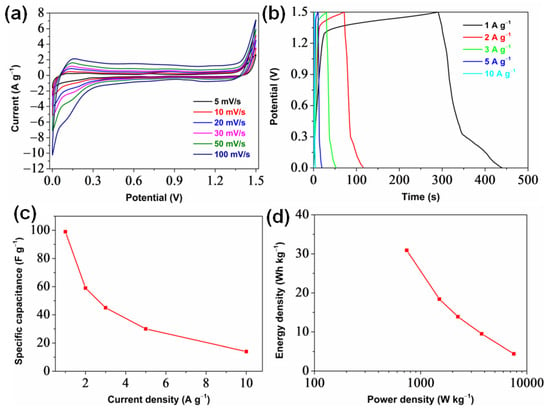
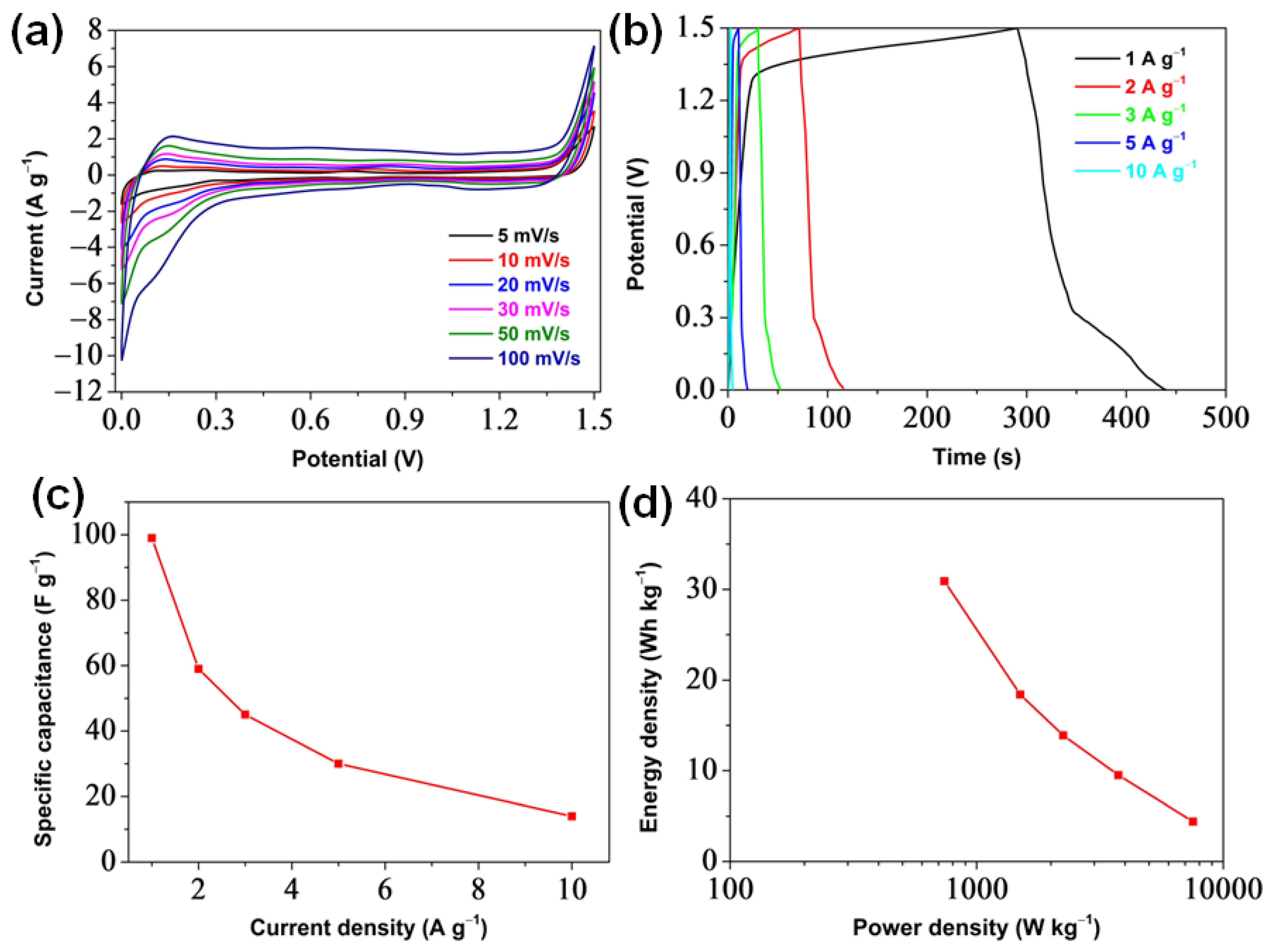
To explore the practical application potential of the as-prepared electrode material, asymmetric supercapacitors (NiCo2S4/rGO-2//AC) were fabricated by employing NiCo2S4/rGO-2 as the positive electrode and AC as the negative electrode in a two-electrode configuration. Figure 9a presents the CV curves, which exhibit a pair of distinct oxidation-reduction peaks under different scan rates, proving that the energy storage mechanism of the device is mainly based on Faraday redox reactions. The curves have not undergone significant distortion, revealing desirable kinetic reversibility of the device. The corresponding GCD curves are shown in Figure 9b. The charge–discharge curves show obvious Faraday voltage platforms, which are consistent with the oxidation-reduction signals of the CV. When the current density rises from 1 A g−1 to 10 A g−1, the charging/discharging time shortens, and the polarization degree gradually increases. The specific capacitance calculated from the GCD curve is displayed in Figure 9c, and the specific capacitance of the device can reach 99 F g−1 at 1 A g−1. When the current density increases to 10 A g−1, the capacity decreases to 14 F g−1. The energy density (E) and power density (P) of the NiCo2S4/rGO-2//AC device are calculated according to the formula (S2, S3) in the Supplementary Materials. The Ragone plot is shown in Figure 9d. At a power density of 739.3 W kg−1, this asymmetric device achieves the highest energy density of 30.9 Wh kg−1. When the power density is increased to 7542.9 W kg−1, the energy density drops to 4.8 Wh kg−1. The NiCo2S4/rGO-2//AC delivers a maximum energy density of 30.9 Wh kg−1 superior to the recent literature (NiCo2S4/MoS2/MWCNT//AC, 23.73 Wh kg−1 at 749.5 W kg−1 [42], NiCo2S4//CF, 28.8 Wh kg−1 at 878.3 W kg−1 [45], NiCo2S4//AC, 22.83 Wh kg−1 at 327.1 W kg−1 [46], NiCo2S4@RGO//AC, 21.9 Wh kg−1 at 417.1 W kg−1 [47]), demonstrating the application potential of NiCo2S4/rGO-2 composite material in supercapacitors.
Figure 9.
CV curves (a), GCD curves (b), specific capacitance vs current density (c), and Ragone plot (d) of NiCo2S4/rGO-2//AC.
4. Conclusions
In summary, the NiCo2S4/rGO composites were developed by a simple one-step hydrothermal route. The high NiCo2S4 content induces morphological evolution toward a near-cubic architecture grown on the rGO sheets and also introduces structural defects. When NiCo2S4 is added at an optimal loading level, it can significantly enhance the specific capacitance of the composite electrode, reduce internal resistance, and increase electrochemical active sites for redox reactions. The optimized NiCo2S4/rGO-2 electrode delivers a high specific capacitance of 1165 F g−1 at 1 A g−1, with a capacitance retention of around 80% over 2000 galvanostatic charge–discharge cycles. Its superior energy storage performance stems from a synergistic mechanism combining diffusion-controlled and surface-controlled processes, which simultaneously endows the material with high specific capacitance and favorable rate performance. Furthermore, for potential practical application, the as-assembled asymmetric supercapacitors NiCo2S4/rGO-2//AC demonstrate a maximum energy density of 30.9 Wh kg−1 at a power density of 739.3 W kg−1. The fabrication strategy is facile, allows for controllable morphology, and achieves high capacitance, presenting significant potential for developing advanced energy storage materials.
Supplementary Materials
The following supporting information can be downloaded at: https://www.mdpi.com/article/10.3390/jcs10110627/s1, Figure S1: The specific capacitance of NiCo2S4/rGO-2 electrode at different scan rates; Table S1: Feed ratios of precursors for rGO and NiCo2S4/rGO samples.; Table S2: The values of fitted EIS parameters for rGO and NiCo2S4/rGO samples.
Author Contributions
Conceptualization, X.D. and X.G.; methodology, X.G.; software, X.D.; validation, X.D., K.Z.; formal analysis, F.M. and Y.Z.; data curation, X.D.; writing—original draft preparation, X.D.; writing—review and editing, X.S. and X.G.; supervision, X.S.; funding acquisition, X.G. All authors have read and agreed to the published version of the manuscript.
Funding
This research was funded by the Undergraduate Innovation and Entrepreneurship Training Program Project of Pingdingshan University, China (No. 109192026035).
Data Availability Statement
The raw data supporting the conclusions of this article will be made available by the authors on request.
Conflicts of Interest
The authors declare no conflicts of interest.
References
- Zhao, J.; Burke, A.F. Review on Supercapacitors: Technologies and Performance Evaluation. J. Energy Chem. 2021, 59, 276–291. [Google Scholar] [CrossRef] [Scilit]
- Wen, K.; Wang, K.; Mei, H.; Jiang, M.; Zhang, Y.; Chen, Z.; Zheng, Y.; Li, M. Synergistic Interfacial Blocking and Water Activity Suppression in Water-in-Salt Electrolytes toward High-Energy Aqueous Supercapacitors. J. Phys. Chem. Lett. 2026, 17, 8493–8505. [Google Scholar] [CrossRef] [Scilit]
- Zhang, J.; Zhang, G.; Zhou, T.; Sun, S. Recent Developments of Planar Micro-Supercapacitors: Fabrication, Properties, and Applications. Adv. Funct. Mater. 2020, 30, 1910000. [Google Scholar] [CrossRef] [Scilit]
- Kothandam, G.; Singh, G.; Guan, X.; Lee, J.M.; Ramadass, K.; Joseph, S.; Benzigar, M.; Karakoti, A.; Yi, J.; Kumar, P.; et al. Recent Advances in Carbon-Based Eelectrodes for Energy Storage and Conversion. Adv. Sci. 2023, 10, 2301045. [Google Scholar] [CrossRef] [Scilit]
- Islam, M.; Hossain, M.S.; Adak, B.; Rahman, M.M.; Moni, K.K.; Nur, A.S.M.; Hong, H.; Younes, H.; Mukhopadhyay, S. Recent Advancements in Carbon-Based Composite Materials as Electrodes for High-Performance Supercapacitors. J. Energy Storage 2025, 107, 114838. [Google Scholar] [CrossRef] [Scilit]
- Allah, S.; Al-Marzouqi, A.; Hassan, F.; Aslam, M.; Riaz, A.; Hussain, I. Controlled Morphological Synthesis of Carbon Nanotube-Enhanced Bismuth Metal-Organic Frameworks: A Promising Electrode Material for Supercapacitors. Electrochimi. Acta 2025, 531, 146454. [Google Scholar] [CrossRef] [Scilit]
- Wang, J.; Dong, S.; Ding, B.; Wang, Y.; Hao, X.; Dou, H.; Xia, Y.; Zhang, X. Pseudocapacitive Materials for Electrochemical Capacitors: From Rational Synthesis to Capacitance Optimization. Natl. Sci. Rev. 2017, 4, 71–90. [Google Scholar] [CrossRef] [Scilit]
- Liu, S.; Song, C.; Zhang, W.; Zhang, T.; Shao, W.; Weng, Z.; Yao, M.; Huang, H.; Jian, X.; Hu, F. Optimizing Solvated Anion Accessibility and Pseudocapacitive Charge Storage in Carbon Cathode toward High-Energy Sodium-Ion Capacitor. Chem. Eng. J. 2022, 450, 138103. [Google Scholar] [CrossRef] [Scilit]
- El-Sayed, N.S.; Al Kiey, S.A. Nickel Manganese Oxide@ Reduced Graphene Oxide Nanocomposites Reinforced Hydrogels for High Performance Supercapacitors: Fabrication, Characterization, and Electrochemical Performance Evaluations. J. Power Sources 2026, 676, 239797. [Google Scholar] [CrossRef] [Scilit]
- Yao, T.; Wang, H.; Qin, Y.; Shi, J.W.; Cheng, Y. Enhancing Pseudocapacitive Behavior of MOF-Derived TiO2-x@Carbon Nanocubes via Mo-Doping for High-Performance Sodium-Ion Capacitors. Compos. Part B-Eng. 2023, 253, 110557. [Google Scholar] [CrossRef] [Scilit]
- Tsyganov, A.; Grapenko, O.; Korotaev, E.; Shindrov, A.; Alferov, A.; Gorokhovsky, A.; Gorshkov, N. Pseudocapacitive Behavior of Blade-Coated Mo1.33CTx i-MXene Electrodes in Aqueous Electrolytes. Nanomaterials 2025, 15, 1593. [Google Scholar] [CrossRef] [Scilit]
- Tsyganov, A.; Zotov, I.; Korotaev, E.; Terebina, E.; Khailova, E.; Gorokhovsky, A.; Gorshkov, N. Rapid Low-Temperature Synthesis of Ti3C2Tx MXene via NH4HF2-NH4F Eutectic Molten Salt for Energy Storage Applications. J. Ind. Eng. Chem. 2026, 162, 594–605. [Google Scholar] [CrossRef] [Scilit]
- Yang, G.; Yang, Y.; Li, Y.; Song, F.; Chen, Q. A Double-Confined Strategy for Enhancing the Pseudocapacitance Performance of Nickel-Based Sulfides-Unveiling Aqueous Pseudocapacitive Energy Storage Mechanism. J. Colloid. Interf. Sci. 2025, 686, 1089–1104. [Google Scholar] [CrossRef] [Scilit]
- Ali, S.; Bakhtiar, S.U.H.; Ismail, A.; Ismail, P.M.; Hayat, S.; Zada, A.; Wu, X.; Alodhayb, A.N.; Zahid, M.; Raziq, F.; et al. Transition Metal Sulfides: From Design Strategies to Environmental and Energy-Related Applications. Coord. Chem. Rev. 2025, 523, 216237. [Google Scholar] [CrossRef] [Scilit]
- Sarbishei, A.R.; Masoudpanah, S.M.; Hasheminiasari, M.; Sanei, S.A. In-Situ Solvothermal Synthesis of Free-Binder NiCo2S4/Nickel Foam Electrode for Supercapacitor Application: Effects of CTAB Surfactant. Electrochem. Commun. 2024, 169, 107838. [Google Scholar] [CrossRef] [Scilit]
- Reddy, N.P.; Naik, R.J.; Ahn, C.H.; Dhanalakshmi, R.; El-marghany, A.; Ouladsmane, M.; Park, S.H. Interfacial Engineering of NiCo2S4/Graphene Quantum Dots for Enhanced Charge Transport and High-Performance Asymmetric Supercapacitors. J. Phys. Chem. Solids 2026, 219, 114015. [Google Scholar] [CrossRef] [Scilit]
- Chen, X.; Chen, D.; Guo, X.; Wang, R.; Zhang, H. Facile Growth of Caterpillar-like NiCo2S4 Nanocrystal Arrays on Nickle Foam for High-Performance Supercapacitors. ACS Appl. Mater. Interfaces 2017, 9, 18774–18781. [Google Scholar] [CrossRef] [Scilit]
- Qin, L.; Cui, Z.; Hou, Z.; Li, Y. Synthesis and Characterization of A NiCo2S4 and Mesoporous Carbon Nanocomposite for Energy Storage. J. Energy Storage 2024, 97, 112873. [Google Scholar] [CrossRef] [Scilit]
- Zhao, J.; Wang, Y.; Qian, Y.; Jin, H.; Tang, X.; Huang, Z.; Lou, J.; Zhang, Q.; Lei, Y.; Wang, S. Hierarchical Design of Cross-Linked NiCo2S4 Nanowires Bridged NiCo-Hydrocarbonate Polyhedrons for High-Performance Asymmetric Supercapacitor. Adv. Funct. Mater. 2023, 33, 2210238. [Google Scholar] [CrossRef] [Scilit]
- Geng, P.; Zheng, S.; Tang, H.; Zhu, R.; Zhang, L.; Cao, S.; Xue, H.; Pang, H. Transition Metal Sulfides Based on Graphene for Electrochemical Energy Storage. Adv. Energy Mater. 2018, 8, 1703259. [Google Scholar] [CrossRef] [Scilit]
- Wang, X.; Deng, C.; Hong, X.; Dong, W.; Liang, B. Controllable Synthesis of NiCo2O4, NiCo2O4/Graphene Composite and Their Electrochemical Application in Supercapacitors. J. Energy Storage 2022, 55, 105837. [Google Scholar] [CrossRef] [Scilit]
- Fan, Y.M.; Liu, Y.; Liu, X.; Liu, Y.; Fan, L.Z. Hierarchical Porous NiCo2S4-rGO Composites for High-Performance Supercapacitors. Electrochim. Acta 2017, 249, 1–8. [Google Scholar] [CrossRef] [Scilit]
- Ahamed, A.J.; Kanagambal, P. Design and Fabrication of Reduced Graphene Oxide (RGO) Incorporated NiCo2S4 Hybrid Composites as Electrode Materials for High Performance Supercapacitors. Chem. Phys. Impact 2024, 9, 100675. [Google Scholar] [CrossRef] [Scilit]
- Liu, L.; Zuo, S.; Wang, H. Review of NiCo2S4-Based Electrode Nanomaterials for Supercapacitors. ACS Appl. Nano Mater. 2024, 7, 15903–15922. [Google Scholar] [CrossRef] [Scilit]
- Liang, X.; He, H.; Yang, X.; Lü, W.; Wang, L.; Li, X. In-Situ Growth of Bimetallic Sulfide NiCo2S4 Nanowire on Carbon Cloth for Asymmetric Flexible Supercapacitors. J. Energy Storage 2021, 42, 103105. [Google Scholar] [CrossRef] [Scilit]
- Zhao, Y.; Han, S.; Liu, H. Flower-Like NiCo2S4/rGO Composites Directly Grown on Ni Foam as Highly Efficient Electrode for Long Cycling Stability Supercapacitor. Indian J. Chem. 2024, 63, 782–790. [Google Scholar] [CrossRef] [Scilit]
- Du, X.; Ran, Y.; Shi, X.; Cao, K.; Han, Y. Facile Fabrication of Reduced Graphene Oxide/Boron Nitride Hybrid Films as Supercapacitor Electrodes with Enhanced Areal Capacitance. Mat. Sci. Eng. B-Adv. 2026, 323, 118746. [Google Scholar] [CrossRef] [Scilit]
- Bi, T.; Jiang, J.; Lei, Y.; Zheng, X.; Jia, Z.; Wei, Z.; Yang, H. Improving Supercapacitive Performance of CNTs/NiCo2S4 Composites by Interface Regulation. Appl. Surf. Sci. 2020, 530, 147317. [Google Scholar] [CrossRef] [Scilit]
- Xu, J.; Yang, Y.; Chu, H.; Tang, J.; Ge, Y.; Shen, J.; Ye, M. Novel NiCo2S4@Reduced Graphene Oxide@Carbon Nanotube Nanocomposites for High Performance Supercapacitors. RSC Adv. 2016, 6, 100504–100510. [Google Scholar] [CrossRef] [Scilit]
- Chi, C.; Liu, Z.; Wang, G.; Qi, B.; Qiu, Z.; Yan, Y.; Huangfu, C.; Lu, X.; Yang, X.; Gong, M.; et al. Graphene Oxide Block Derived Edge-Nitrogen Doped Quasi-Graphite for High K+ Intercalation Capacity and Excellent Rate Performance. Adv. Energy Mater. 2023, 13, 2302055. [Google Scholar] [CrossRef] [Scilit]
- Korucu, H. Multi Response Optimization of Synthesis of Boron Compounds by Dopting to Graphene Oxide in the Modified Hummers Method. Mat. Sci. Eng. B-Adv. 2025, 311, 117839. [Google Scholar] [CrossRef] [Scilit]
- Zhou, S.; Tan, L.; Zhu, T.; Zhu, H.; Guo, J.; Li, X.; Dong, Z.; Zhang, Q.; Cong, Y. Engineering Optimal Pore Architecture and Defect-Rich Structure in Pitch-Derived Carbon for Efficient Sodium-Ion Storage. Chem. Eng. J. 2025, 520, 166230. [Google Scholar] [CrossRef] [Scilit]
- Vanasundari, K.; Mahalakshmi, G.; Ravichandran, K. Constructions of NiCo2S4@rGO Composite for Use as A Low-Cost Counter Electrode Material in Dye-Sensitised Solar Cells. J. Mater. Sci.-Mater. Electron. 2024, 35, 1654. [Google Scholar] [CrossRef] [Scilit]
- Fang, W.; Hu, H.; Jiang, T.; Li, G.; Wu, M. N-and S-Doped Porous Carbon Decorated with In-Situ Synthesized Co-Ni Bimetallic Sulfides Particles: A Cathode Catalyst of Rechargeable Zn-Air Batteries. Carbon 2019, 146, 476–485. [Google Scholar] [CrossRef] [Scilit]
- Dhavale, R.P.; Parale, V.G.; Teli, A.M.; Gupta, N.K.; Patil, U.M.; Choi, H.; Patil, A.M.; Phadtare, V.D.; Ransing, A.A.; Park, H.H. Reduced Graphene Oxide-Sodium Manganese Oxide Nanowire Nanocomposite Aerogels for Asymmetric Supercapacitors: Impact of Composite Concentration. ACS Appl. Mater. Interfaces 2025, 17, 25193–25205. [Google Scholar] [CrossRef] [Scilit]
- Prasannakumar, A.T.; Rohith, R.; Manju, V.; Mohan, R.R.; Varma, S.J. Graphene Nanoflake-Self Stabilized Dispersion Polymerized PANI Hybrids as Efficient, Binder-Free Electrode Materials for High-Performance Flexible Symmetric Supercapacitors. J. Electroanal. Chem. 2024, 952, 117952. [Google Scholar] [CrossRef] [Scilit]
- Khedulkar, A.P.; Dang, V.D.; Pandit, B.; Bui, T.A.N.; Tran, H.L.; Doong, R.-A. Flower-Like Nickel Hydroxide@Tea Leaf-Derived Biochar Composite for High-Performance Supercapacitor Application. J. Colloid Interface Sci. 2022, 623, 845–855. [Google Scholar] [CrossRef] [Scilit]
- Chang, Y.; Shi, H.; Yan, X.; Zhang, G.; Chen, L. A Ternary B, N, P-Doped Carbon Material with Suppressed Water Splitting Activity for High-Energy Aqueous Supercapacitors. Carbon 2020, 170, 127–136. [Google Scholar] [CrossRef] [Scilit]
- Wang, X.; Zheng, W.; Zhao, H.; Li, J.; Chen, S.; Xu, F. Robust and High-Wettability Cellulose Separators with Molecule-Reassembled Nano-Cracked Structures for High-Performance Supercapacitors. Nano-Micro Lett. 2025, 17, 153. [Google Scholar] [CrossRef] [Scilit]
- Abdel-Salam, A.I.; Attia, S.Y.; El-Hosiny, F.I.; Sadek, M.A.; Mohamed, S.G.; Rashad, M.M. Facile One-Step Hydrothermal Method for NiCo2S4/rGO Nanocomposite Synthesis for Efficient Hybrid Supercapacitor Electrodes. Mater. Chem. Phys. 2022, 277, 125554. [Google Scholar] [CrossRef] [Scilit]
- Rabbani, S.S.; Mustafa, H.; Zafar, A.; Javaid, S.; Bakar, M.A.; Nisar, A.; Liu, Y.; Karim, S.; Sun, H.; Hussain, S.; et al. Nickel Foam Supported Hierarchical NiCo2S4@NiFe LDH Heterostructures as Highly Efficient Electrode for Long Cycling Stability Supercapacitor. Electrochim. Acta 2023, 446, 142098. [Google Scholar] [CrossRef] [Scilit]
- Subramani, S.; Tamilselvan, A.; Rajamanickam, G.; Karuppannan, A. Enhanced Electrochemical Proficiency of NiCo2S4/MoS2/MWCNT Hybrid Electrodes for Superior Energy Storage Applications. Langmuir 2025, 41, 19550–19561. [Google Scholar] [CrossRef] [Scilit]
- Hsiang, H.I.; She, C.H.; Chung, S.H. Materials and Electrode Designs of High-Performance NiCo2S4/Reduced Graphene Oxide for Supercapacitors. Ceram. Int. 2021, 47, 25942–25950. [Google Scholar] [CrossRef] [Scilit]
- Zhang, W.; Li, X.; Gu, Z.; Kang, H.; Li, Z.; Yang, B.; Li, Z. Self-Supporting Hierarchical Porous NiCo2S4/RGO/CNTs Nanohybrids with Abundant Exposed Electroactive Redox Sites for Excellent Hybrid Supercapacitor. J. Alloys Compd. 2023, 969, 172298. [Google Scholar] [CrossRef] [Scilit]
- Ma, Z.; Sun, Z.; Jiang, H.; Li, F.; Wang, Q.; Qu, F. Nanoporous Electrospun NiCo2S4 Embedded in Carbon Fiber as An Excellent Electrode for High-Rate Supercapacitors. Appl. Surf. Sci. 2020, 533, 147521. [Google Scholar] [CrossRef] [Scilit]
- Wang, H.; Liang, M.; Ma, C.; Shi, W.; Duan, D.; He, G.; Sun, Z. Novel Dealloying-Fabricated NiCo2S4 Nanoparticles with Excellent Cycling Performance for Supercapacitors. Nanotechnology 2019, 30, 235402. [Google Scholar] [CrossRef] [Scilit]
- Wang, F.; Li, G.; Zhou, Q.; Zheng, J.; Yang, C.; Wang, Q. OneStep Hydrothermal Synthesis of Sandwich-Type NiCo2S4@Reduced Graphene Oxide Composite as Active Electrode Material for Supercapacitors. Appl. Surf. Sci. 2017, 425, 180–187. [Google Scholar] [CrossRef] [Scilit]
Disclaimer/Publisher’s Note: The statements, opinions and data contained in all publications are solely those of the individual author(s) and contributor(s) and not of MDPI and/or the editor(s). MDPI and/or the editor(s) disclaim responsibility for any injury to people or property resulting from any ideas, methods, instructions or products referred to in the content. |
© 2026 by the authors. Licensee MDPI, Basel, Switzerland. This article is an open access article distributed under the terms and conditions of the Creative Commons Attribution (CC BY) license.