


Abstract
This study aimed to investigate the application and perceptions about the use of immersive technology-based training in manufacturing contexts. This study employed a quantitative approach surveying a total of 1000 manufacturing professionals in Australia regarding their perceptions of workplace training, as well as immersive-based training, using self-report questionnaires. Descriptive statistics, Pearson correlation analysis, and structural equation modelling were employed for statistical analyses using R software. In the structural equation model, controlling for demographic variables, perceived benefits of workplace training were positively associated with positive anticipation, perceived usefulness, and perceived ease of use of immersive technologies in workplace training. In contrast, perceived value of learning through workplace training was associated only with perceived ease of use of immersive technologies in workplace training. This study suggests general optimistic views toward immersive workplace training in the Australian manufacturing sector, particularly the extent to which they perceive workplace training as beneficial rather than aligned with individuals’ value. Given the ongoing need for continuous skill development in manufacturing, the increasing reliance on immersive technologies for training purposes, and promising outcomes associated with such approaches, increasing acceptance of immersive technology-based training warrants consideration.
1. Introduction
Immersive technologies are progressing rapidly in both their development (e.g., becoming more interactive and capable) and their application (i.e., being implemented across diverse contexts for a range of purposes) [1,2,3]. The term immersive technologies often serve as an umbrella encompassing augmented reality (AR), virtual reality (VR), and mixed reality (MR). As immersive technologies continue to evolve and incorporate new features and capabilities, conceptualizations and definitions of immersive technologies have also changed over time, and recent studies have attempted to more clearly define what constitute immersion [4,5]. Although there is not yet a universally agreed-upon definition or clear boundaries delineating immersive technologies, the term is commonly used to refer to technologies that create immersive experiences for users, including but not limited to AR, VR, and MR [1]. These technologies comprise a set of methods and tools designed to engage users in virtual or augmented environments by stimulating their senses through audiovisual effects and interactive content. Immersive technologies blur the boundary between the physical and virtual worlds, creating a sense of immersion through exposure to multisensory information. Although immersive technologies differ along the reality-virtuality continuum (e.g., AR overlays virtual objects onto real-world scenes, whereas VR often involves fully virtual environments) and in the intensity of users’ sense of presence within virtual environments during use, all of these technologies incorporate some degree of virtuality [1,6,7,8]. Consistent with existing literature, the term immersive technologies is used in this article to refer to technologies that create immersive experiences, as defined above, such as AR, VR, and MR.
Immersive technologies have attracted considerable attention over a relatively short period and have been applied across a range of contexts (e.g., education, medical practice, tourism) for various purposes (e.g., knowledge transfer, training) [8,9,10]. A substantial body of research has reported promising potential associated with the use of immersive technologies and has drawn on various theoretical frameworks to account for these effects [11]. For instance metaverse-based immersive and gamified training has been reported to be positively associated with enhancement in organizational learning and skill development [12]. Drawing on Experiential Learning Theory, immersive technologies have been suggested to provide experiential learning opportunities by enabling users to directly engage with tasks and activities, which can enhance learning and subsequent performance in real-world tasks [13,14] as well as helping individuals visualize abstract concepts and simulate real-world situations [15]. Similarly, from the perspective of Flow Theory, immersive technologies have been suggested to facilitate flow states through heightened enjoyment and low perceived risk during use, which can, in turn, improve concentration, learning experiences, and subsequent task performance in real-world contexts [16,17].
Among various sectors, manufacturing has been one of the key domains in which immersive technologies have been adopted. This is unsurprising, as industries have, in many cases, been early adopters of emerging technologies [18]. In manufacturing settings, immersive technologies are now being used across a wide range of functions including design, fault detection, data calculation, and processing [19,20]. Immersive technologies are also used across different organizational functions in manufacturing companies. For example, in engineering departments, technologies such as MR and VR are used to support product design, prototyping, and digital twin visualizations [21,22]. In operations, AR and VR are used to assist assembly and maintenance tasks [23]. In health and safety functions, AR, VR, and games are used to simulate hazardous environment and provide a risk-free environment for training [24].
Immersive technologies are also increasingly used in workforce training and development and utilized to train employees on complex procedures, decision making, and equipment operations in a hands-on and scalable manner. For instance, previous studies have reported that AR can be used as an effective tool to train assembly workers [25]. Furthermore, recent reviews suggest that immersive technologies can be used in industrial training to provide not only an interactive learning experience but also more effective learning overall [26].
Workforce training in manufacturing represents a critical element of building high-functioning and successful professionals and organizations [27,28]. High-quality workplace training, alongside professionals’ satisfaction with their training experiences, is strongly associated with a positive organizational climate and with the development of both individuals and industries [29]. Effective workplace training can provide professionals with essential knowledge, enhance self-efficacy, improve productivity, reduce errors and burnout, and increase perceptions of organizational support [27,28,30,31,32]. Moreover, workplace training can enhance the quality and standards of work overtime and may also yield positive intergenerational effects, such as higher qualifications and improved work preparedness among subsequent generations [33]. Indeed, workforce training plays an important role in the functionality, satisfaction, and sustainability of both professionals and organizations, and has long been recognized as a strategic priority across diverse industrial sectors.
Traditional training modalities, particularly lecture-based formats, can be limited in their ability to engage professionals or accurately represent real workplace conditions and challenges. Consequently, immersive technology-based training has attracted growing interest within manufacturing contexts as a complementary form of skills development [34,35,36,37,38]. Furthermore, when traditional training modalities are unable to deliver the required level of practical or experiential learning, immersive technology-based training becomes particularly valuable. For example, by training in a VR environment, professionals can experientially engage with role expectations, task demands, and potential hazards within a controlled and safe training context [39,40,41]. Prior research suggests that immersive technology-based training, in some cases, has the potential to be more effective and beneficial than traditional training methods. For instance, training delivered through immersive technologies has been found to be associated with faster task completion times and fewer task-related errors among professionals across different industries compared to traditional training approaches [42,43,44,45,46].
Considering the reported promising outcomes of immersive technology-based training in industry, such training can serve as a valuable support for both professionals’ and organizations’ performance and success. However, at the outset, it is important that professionals accept these types of training, that is, that they are sufficiently motivated to learn and willing to engage with them. This is a significant consideration, as prior research has documented that the acceptability of technology-based interventions across various contexts is influential for their applicability and practicality [47,48,49]. The Technology Acceptance Model [50] suggests that individuals’ perceptions of a technology’s usefulness (i.e., the degree to which a person believes that using a particular technology would provide benefits, such as improved performance) and ease of use (i.e., the degree to which a person believes that using a particular technology would be free of effort) influence their acceptance of the technology and their willingness to use it. Accordingly, more positive perceptions of a technology, including immersive technologies, can increase its acceptance and use [51,52]. Relevantly, prior research in manufacturing contexts has highlighted the importance of professionals’ technology acceptance for the practicality of technology-supported learning [11,53]. Recent studies have continued to validate technology acceptance models in the understanding of immersive training systems [54,55]. For example, Alshammari and Al-Mamary (2025) [56] found that professionals across various industries who hold more positive perceptions of artificial intelligence-powered cybersecurity training tools (perceiving them as easy to use) reported stronger inclinations to adopt such tools. In this vein, within the context of immersive technology-based training, identifying factors associated with positive perceptions of such training represents a reasonable line of inquiry, as it can help clarify which aspects require attention to enhance the acceptability of immersive technology-based training among industry professionals.
One important factor in shaping individuals’ positive perceptions of immersive technology-based training can be their overall view of workplace training as useful and valuable. When individuals perceive training as beneficial, they are more likely to hold favourable perceptions of technology-based training in particular. Drawing on theoretical frameworks such as the Hierarchical Attitude Structure and the Value–Attitude–Behaviour Hierarchy (VAB) [57,58], specific perceptions and attitudes are cognitively and affectively grounded in broader evaluative orientations (i.e., general perceptions and attitudes). These models suggest that specific perceptions and attitudes are often embedded within higher-order, more generic, and more abstract evaluative structures. For instance, a general value or perception, such as holding a biospheric value orientation (i.e., a self-transcendence value orientation that involves valuing nature and other species for their own sake and perceiving the Earth’s living system as inherently important rather than merely instrumental for human benefit), can be associated with related, more specific attitudes, such as pro-environmental attitudes. These specific attitudes can, in turn, be linked to corresponding behavioural intentions or enacted behaviours, such as recycling or thrifting [59]. Prior research has suggested the explanatory utility of the hierarchical model (i.e., generic values, perceptions, and attitudes → specific perceptions and attitudes) across several contexts [60,61,62,63,64,65].
Conceptual Development
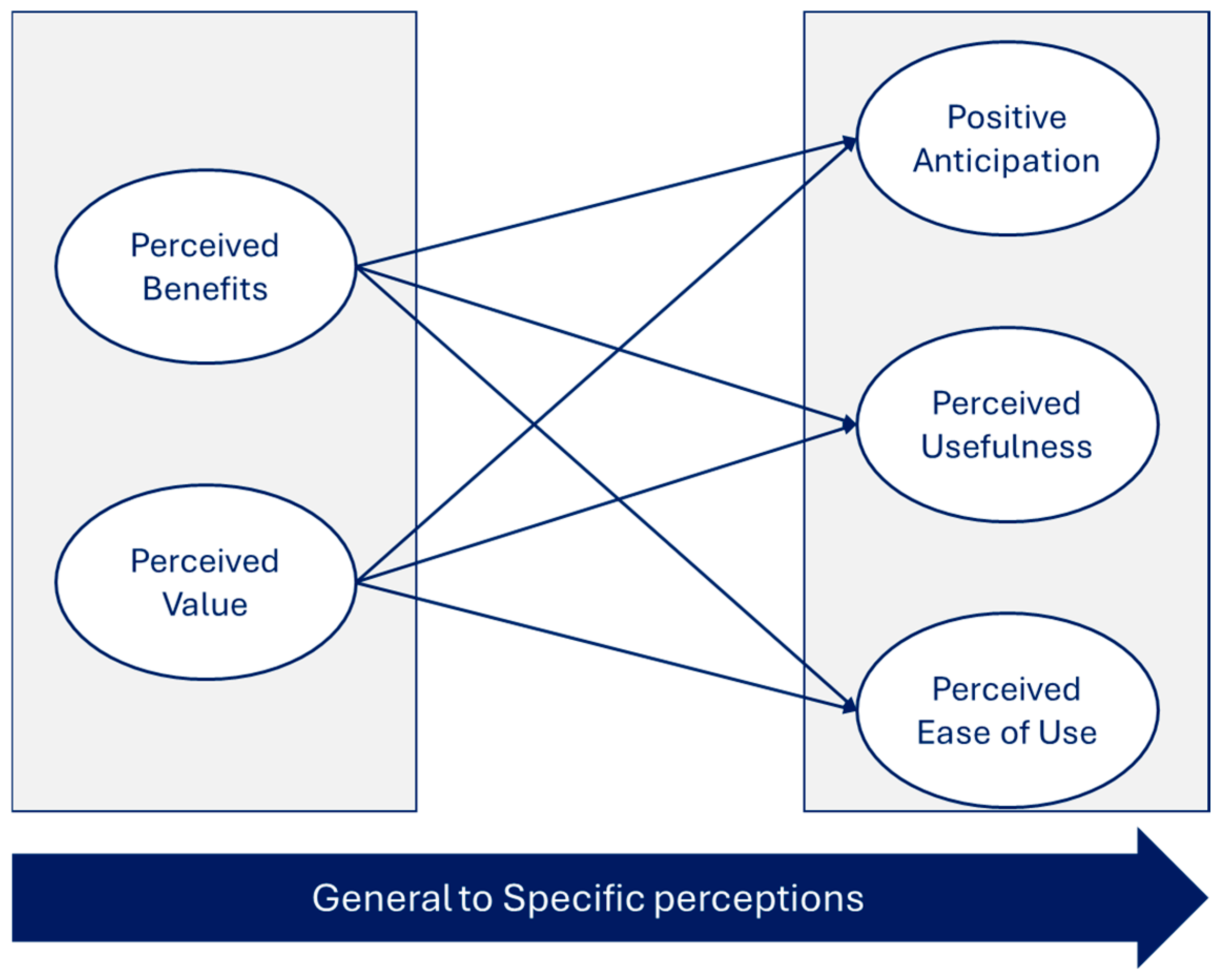
In the context of manufacturing, general perceptions toward workplace training (e.g., perceiving training courses in industry as useful in general) have been suggested as informative factors that can provide insight into more specific outcomes (e.g., well-being, job self-efficacy, job satisfaction) [66,67]. Considering these suggestions and inspired by VAB hierarchical models of perceptions, the present study aimed to investigate how general perceptions, including perceived benefits of workplace training (i.e., the extent to which professionals generally perceive industry training as beneficial) and perceived value of learning through workplace training (i.e., the extent to which professionals generally perceive learning through workplace training as valuable), are related to specific perceptions including positive anticipation (i.e., the extent to which professionals expect favourable outcomes from immersive technology-based training), perceived usefulness (i.e., the extent to which professionals perceive immersive technology-based training as useful), and perceived ease of use (i.e., the extent to which professionals perceive immersive technology-based training as easy to use).
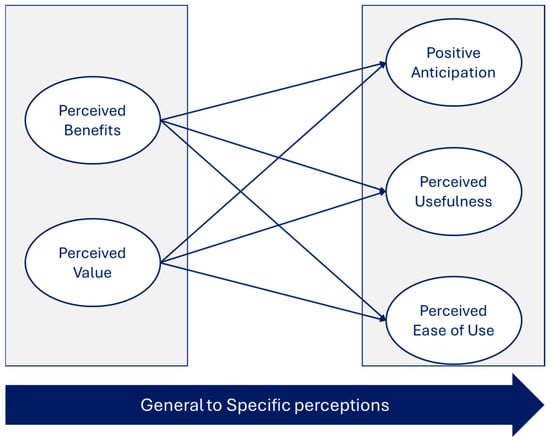
To examine whether the way professionals perceive workplace training in general is associated with how they perceive immersive technology-based training in particular, the present study explores the associations between general perceptions of workplace training and more specific perceptions of immersive technology-based training (Figure 1). We expect that stronger positive general perceptions of workplace training are associated with stronger positive specific perceptions toward immersive technology-based training. This investigation could clarify key factors influencing professionals’ acceptance of immersive technology-based training. This is particularly important given the rapid pace of skill demands, the increasing integration of immersive technologies within manufacturing training, and the potential benefits such training approaches can offer [68,69,70,71]. Therefore, identifying potential determinants associated with professionals’ openness to immersive technology-based training appears warranted and can open the door to a deeper understanding of the acceptance of immersive technology-based training in manufacturing contexts.
Figure 1.
Conceptual model of the present study.
2. Materials and Methods
2.1. Data Collection and Participants’ Profile
The target population of this study comprised of professionals working in manufacturing companies in Australia. To be eligible to participate in this study, the participants should have met the following criteria:
- Employment within a company engaged in manufacturing in sectors such as heavy industry, light industry, chemicals and pharmaceuticals, textiles and apparel, food and beverage, construction materials, packaging and paper, energy and electronics, or biotechnology and advanced materials.
- The company provided employee training and development internally or via outsourcing.
Data collection was conducted by a third-party panel company (PureSpectrum, NSW 2008, Australia) between September and October 2025, and a total of 1000 clean and validated data records were obtained. Data were collected using Qualtrics platform. After data collection, a two-stage data cleaning procedure was implemented. In the first stage, incomplete responses and cases flagged by Qualtrics’ built-in quality checks as potential bot activity or low-quality responses were removed. In the second stage, one of the authors manually reviewed the remaining responses and cases exhibiting illogical or inconsistent response patters were excluded as well. These indicators included irrelevant answers to open-ended questions, as well as inconsistencies between responses to multiple-choice items and corresponding text-entry questions. The survey also included a short video demonstrating the applications of immersive technologies in advanced manufacturing training settings. The video presented examples of AR and VR supported workforce training in manufacturing process and was included to establish a minimum consistent baseline understanding of immersive technologies among participants before they completed the survey. The same video was shown to all participants regardless of their company, role, industry, and background to ensure a consistent introduction to the study context.
Of the participants, 65 (6.5%) were aged 18–24, 375 (37.5%) were aged 25–34, 371 (37.1%) were aged 35–44, 144 (14.4%) were aged 45–54, 37 (3.7%) were aged 55–64, six (0.6%) were aged 65–74, and two (0.2%) were aged 75–84. In terms of gender identity, 335 participants (33.5%) self-identified as female, 663 (66.3%) as male, and one (0.1%) as non-binary. One participant (0.1%) preferred not to disclose their gender. Regarding educational attainment, three participants (0.3%) reported having less than a high school education, 123 (12.3%) had completed high school or an equivalent qualification, 400 (40.0%) held an undergraduate degree, 396 (39.6%) held a postgraduate degree, and 78 (7.8%) held a doctoral degree. All participants gave their informed consent before taking part in the survey, and the study received approval from the Human Research Ethics Committee at the authors’ affiliated university.
2.2. Measures
Drawing on relevant theoretical frameworks, primarily the Technology Acceptance Model [50,51,52], which provides a basis for understanding perceptions of and behavioural intentions toward technologies, including immersive technologies, and informed by existing questionnaires used in prior research the study items were developed. More specifically, perceived benefits construct was measured using seven items taken from Newman et al. (2011) [72]. Perceived value construct was measured with three items taken from Newman et al. (2011) [72]. Positive anticipation construct was measured with four items taken from Hong et al. (2008) [73]. Perceived usefulness (with six items) and perceived ease of use (with six items) constructs were measured using adapted from Davis (1989) and Hong et al. (2008) [50,73]. All variables were measured on a five-point Likert scale (1 = strongly disagree, 5 = strongly agree). All measures demonstrated good internal consistency (Table 1).
Table 1.
Descriptive statistics and internal consistency estimates of the study variables.
It is important to mention that the labels for two variables from the adapted scales have been slightly modified to suit the current research context. The variable “Perceived Value,” was originally labelled as “motivation to learn” by Newman et al. (2011) [72]. In this study, our main focus was the contrast between this variable and perceived benefits. Reviewing the items in both scales revealed that perceived benefits relate more to immediate, practical perceptions of technology at work (e.g., how the technology can help improve job performance). By contrast, what we now call perceived value refers to a person’s internal or intrinsic appreciation for the training itself (how much they care about the training programmes). Additionally, the variable “positive anticipation” was initially referred to as “positive enjoyment” by Hong et al. (2008) [73]. For the purposes of this study, it has been revised to “positive anticipated experience” to better reflect the current study’s context. In Hong et al. (2008)’s [73] research, the survey was conducted after participants had interacted with a technology, whereas the present study did not involve direct exposure to a technology in an experimental setting. Therefore, the focus here is on participants’ anticipation of enjoyment or experience. As such this adjustment was made to enhance both conceptual and contextual accuracy.
2.3. Statistical Analysis
Descriptive statistics, internal consistency estimates, Pearson correlation analyses, and structural equation modelling (SEM) using a maximum likelihood (ML) estimator were conducted. In the model, perceived benefits of workplace training (perceived benefits) and perceived value of learning through workplace training (perceived value) were specified as latent predictor variables. Age, gender, and education were included as observed control variables. Positive anticipation of using immersive technologies in workplace training (positive anticipation), perceived usefulness of immersive technologies in workplace training (perceived usefulness), and perceived ease of use of immersive technologies in workplace training (perceived ease of use) were specified as latent outcome variables. To control for age, gender, and education, dummy variables were created for each following the standard K-1 coding process for categorical variables which is a common approach in social sciences research using SEM [74]. The youngest age group (i.e., 18–24) for age, the female group for gender, and the lowest education category (i.e., less than high school) for education served as the reference groups (an approach which is common and widely acceptable in SEM research). The model fit was evaluated using commonly applied indices [75,76]: the Comparative Fit Index (CFI; ≥0.95 for good fit, ≥0.90 for acceptable fit), the Tucker–Lewis Index (TLI; ≥0.95 for good fit, ≥0.90 for acceptable fit), the Standardised Root Mean Square Residual (SRMR; ≤0.08 for good fit), and the Root-Mean-Square Error of Approximation (RMSEA; ≤0.06 for good fit, ≤0.08 for acceptable fit) with its 90% confidence interval (CI). All statistical analyses were conducted in R (version 4.5.1).
3. Results
The mean, standard deviation, skewness, and kurtosis values, as well as internal consistency estimates for the study variables, are presented in Table 1.
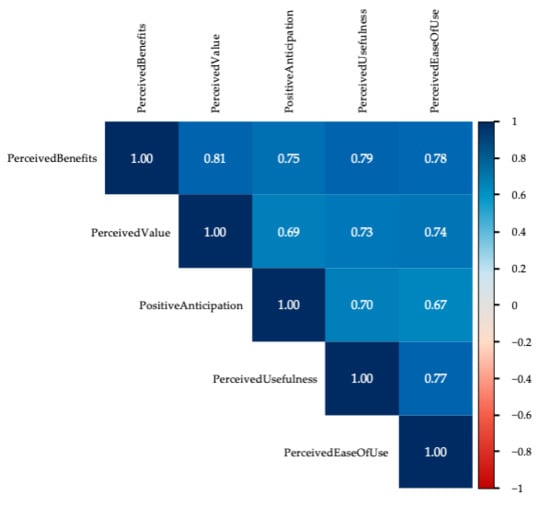
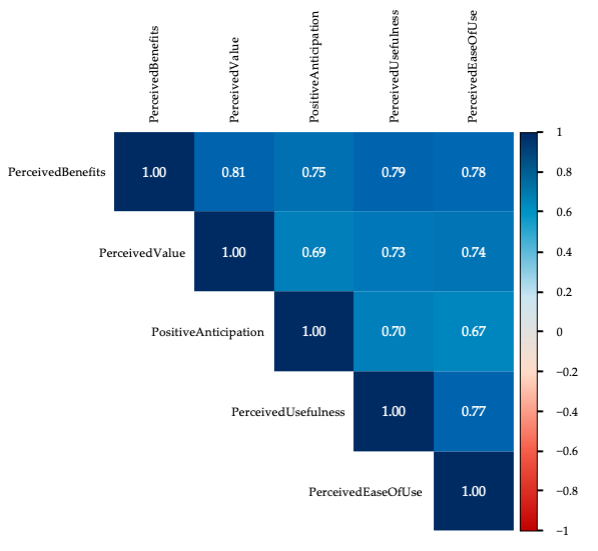
The Pearson correlation coefficients for the study variables are presented in Figure 2. All variables were positively correlated with each other (ps < 0.01). Accordingly, all variables were included in the structural model. Prior to model estimation, variance inflation factors (VIFs) were examined. All VIF values were below the recommended threshold (≤5), suggesting no concerns regarding multicollinearity [77].
Figure 2.
Correlation plot of the study variables.
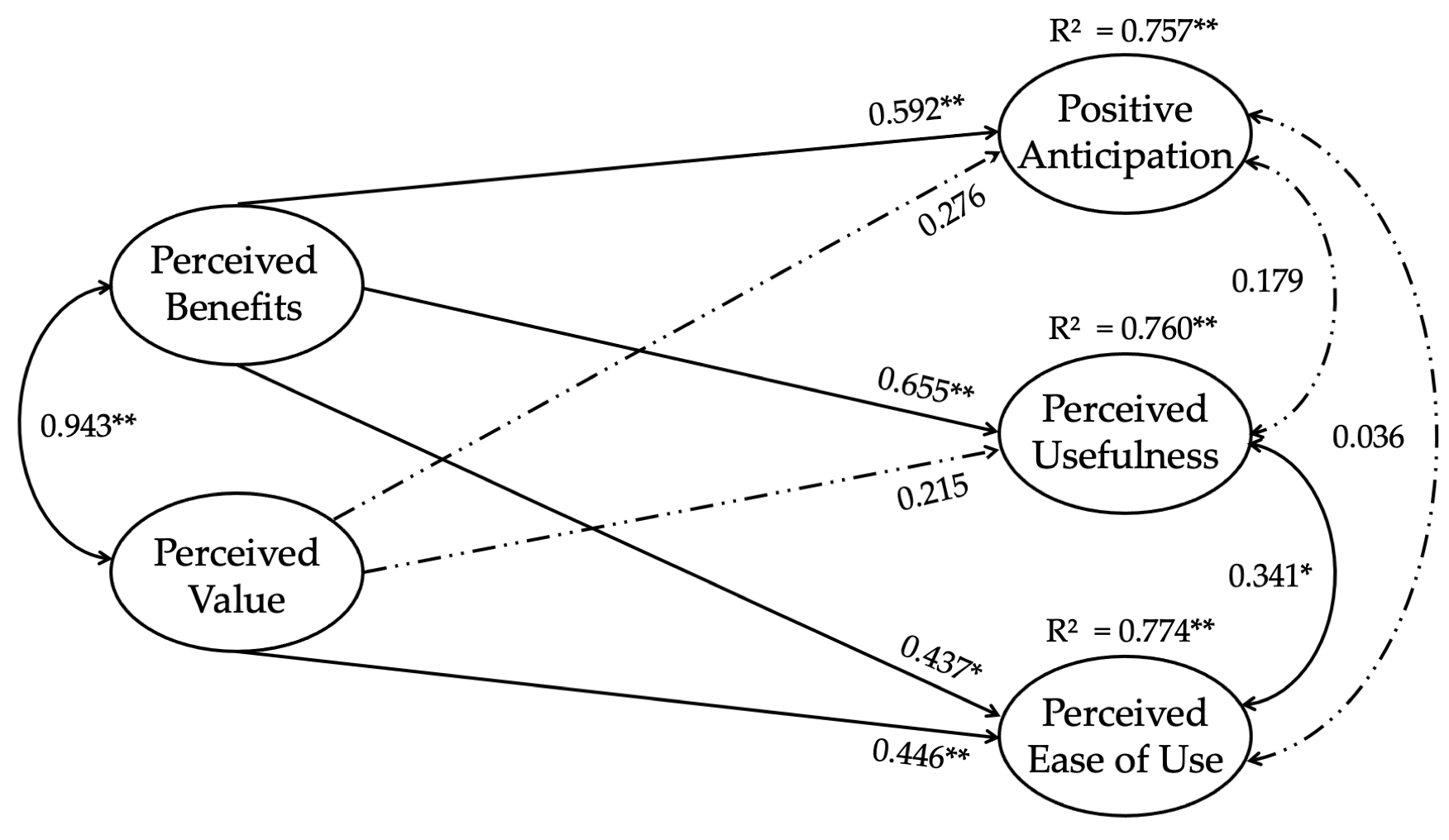
The conceptual model presented in the Conceptual Development section (Figure 1) was tested empirically and demonstrated good fit to the data (χ2 = 1252.168, df = 588, p < 0.01, CFI = 0.958, TLI = 0.953, RMSEA = 0.034 [90% CI: 0.033–0.039], SRMR = 0.044). Figure 3 presents the statistically tested version of the model. Controlling for age, gender, and education, perceived benefits of workplace training and perceived value of learning through workplace training explained substantial proportions of variance in positive anticipation of using immersive technologies in workplace training (R2 = 0.757), perceived usefulness of immersive technologies in workplace training (R2 = 0.760), and perceived ease of use of immersive technologies in workplace training (R2 = 0.774).
Figure 3.
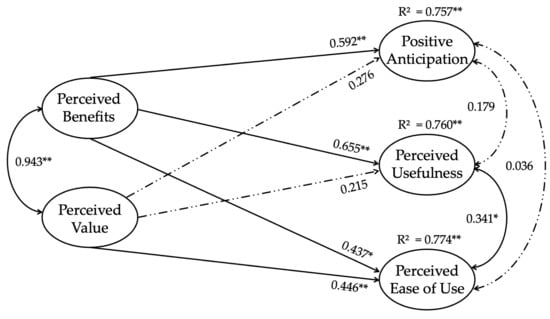
Structural equation model of the study. Note. * p < 0.05; ** p < 0.01. Dashed arrows represent nonsignificant (p > 0.05) associations. One-headed arrows represent regressions, while double-headed arrows represent correlations. Age, gender, and education were controlled for in the model. “Perceived Benefits” refers to perceived benefits of workplace training. “Perceived Value” refers to perceived value of learning through workplace training. “Positive Anticipation” refers to positive anticipation of using immersive technologies in workplace training. “Perceived Usefulness” refers to perceived usefulness of immersive technologies in workplace training. “Perceived Ease of Use” refers to perceived ease of use of immersive technologies in workplace training.
Positive anticipation of using immersive technologies in workplace training. The model explained a large proportion of variance in positive anticipation of using immersive technologies in workplace training (R2 = 0.757). Controlling for age, gender, and education, perceived benefits of workplace training was positively and significantly associated with positive anticipation of using immersive technologies in workplace training (β = 0.592, p < 0.01). In contrast, perceived value of learning through workplace training was positively but not significantly related to positive anticipation (β = 0.276, p = 0.135).
Perceived usefulness of immersive technologies in workplace training. The model explained a significant proportion of variance in perceived usefulness of immersive technologies in workplace training (R2 = 0.760). Controlling for age, gender, and education, perceived benefits of workplace training was positively and significantly associated with perceived usefulness of immersive technologies in workplace training (β = 0.655, p < 0.01). In contrast, perceived value of learning through workplace training showed a positive but nonsignificant association with perceived usefulness (β = 0.215, p = 0.139).
Perceived ease of use of immersive technologies in workplace training. The model explained a substantial proportion of variance in perceived ease of use of immersive technologies in workplace training (R2 = 0.774). Controlling for age, gender, and education, both perceived benefits of workplace training (β = 0.437, p < 0.05) and perceived value of learning through workplace training (β = 0.446, p < 0.01) were positively and significantly associated with perceived ease of use of immersive technologies in workplace training.
Figure 3 statistically illustrates the associations of perceived benefits of workplace training and perceived value of learning through workplace training with positive anticipation of using immersive technologies in workplace training, perceived usefulness of immersive technologies in workplace training, and perceived ease of use of immersive technologies in workplace training, while controlling for age, gender, and education. A quantitative summary of the structural model results, including the standardized regression coefficients and corresponding significance levels, is presented in Table 2.
Table 2.
Descriptive summary of the results.
4. Discussion
In today’s world, where skill demands are continually changing and professionals are required to engage in ongoing learning regardless of seniority, acceptance of immersive technology-based training represents an important consideration. This issue is particularly important given the increasing use of immersive technologies for training purposes within manufacturing contexts given growing evidence suggesting promising outcomes associated with such approaches [68,69,70,71]. Greater acceptance of these training approaches can facilitate more effective learning among professionals and enhance the overall effectiveness of immersive training programs [50,52,78], which could ultimately benefit both professionals and industries.
To help improve understanding of potential determinants associated with the acceptance of immersive technology-based training among manufacturing professionals, the present study investigated whether general positive perceptions toward workplace training are associated with specific positive perceptions of immersive technology-based training (positive general perceptions toward training → positive specific perceptions toward immersive technology-based training). Consistent with hierarchical models of perceptions [57,58] and relevant empirical evidence suggesting that specific perceptions and behaviours are cognitively and affectively rooted in broader, more generic perceptions and values [60,61,62,63,64,65], our findings suggest that more positive general perceptions of workplace training are associated with more specific favourable perceptions of immersive technology-based training. This pattern is aligned with prior suggestions that how professionals perceive training in general can be informative for understanding more specific outcomes, including specific perceptions [66,67]. However, it is important to note that our results showed that not all general perceptions appear to exert the same degree of association, with some potentially contributing more strongly than others.
Perceived benefits of workplace training, as a general perception, was positively and significantly associated with positive anticipation of using immersive technologies in workplace training, as a specific perception and a component which can indicate acceptance of immersive technology-based training. In contrast, perceived value of learning through workplace training, as another general perception, was not significantly associated with positive anticipation. These findings suggest that professionals who view workplace training as beneficial to their immediate job tasks are more inclined to look forward to, or feel optimistic about, engaging with new training modalities such as immersive technologies. In other words, external motivators such as how the use of the technology can enhance job performance, seem to be a stronger than internal intrinsic motivators in enhancing individuals’ willingness to participate or uptake immersive technologies in workplace training.
Research suggests that perceptions of the benefits associated with a given target (e.g., a product) play an important role in shaping positive anticipation toward that target, as well as related behavioural intentions (e.g., the contribution of perceived economic benefits to positive attitudes and behaviours among consumers in the rental industry; Ahn, 2024). This implies that when workplace training is perceived as beneficial overall, immersive technology-based training may be interpreted as an additional or enhanced means of delivering those benefits, which may, in turn, foster greater positive anticipation. Interestingly, the absence of a significant association between perceived value of learning through workplace training and positive anticipation of using immersive technologies in workplace training suggests that valuing learning in the workplace may not necessarily translate into anticipatory enthusiasm toward a specific training, such as immersive technology-based training. Research suggests that general values and perceptions can vary in the strength of their links to more specific perceptions and behavioural intentions (e.g., consumers holding biospheric values, as a general orientation, may exhibit stronger specific positive perceptions and higher consumption of seaweed food products compared to consumers with other value orientations) [61]. This indicates that positive anticipation of using immersive technologies in workplace training may be more closely tied to pragmatic, outcome-oriented evaluations of training (i.e., perceived benefits) rather than to broader perceptions about the inherent value of learning itself or the perceived value of learning through workplace training.
In addition, perceived benefits of workplace training, as a general perception, was positively and significantly associated with perceived usefulness of immersive technologies in workplace training, as a specific perception and a component which can indicate acceptance of immersive technology-based training. In contrast, perceived value of learning through workplace training, as another general perception, was not significantly associated with perceived usefulness. These findings are similar to those observed for positive anticipation of using immersive technologies in workplace training. These findings suggest that professionals who generally view workplace training as beneficial may be more likely to appraise immersive technology-based training as useful. When workplace training, overall, is perceived as effective in delivering benefits (e.g., improved skills), immersive technology-based training may be interpreted as a complementary or enhanced means of realizing these benefits, which may, in turn, increase their perceived usefulness. Research shows that when people believe a technology provides real benefits, they are more likely to view it as useful and to evaluate its overall value more positively (e.g., in the context of evaluating and using ride-hailing services) [79]. It can therefore be concluded that the more professionals perceive workplace training as beneficial in general, the more likely they may perceive specific forms of training, such as immersive technology-based training, as useful, given the expectations they hold, which may be rooted in previous rewarding experiences with workplace training. The non-significant association between perceived value of learning through workplace training and perceived usefulness of immersive technologies in workplace training suggests that valuing learning in general (i.e., an overall positive evaluation of learning and learning through workplace training) may not necessarily translate into positive judgments about the practical utility of a specific training modality, such as immersive technology-based training. In other words, professionals who place greater value on learning through workplace training are not necessarily more likely to perceive immersive technology-based training as useful. Rather, it seems that perceiving immersive technology-based training as useful may be more strongly grounded in professionals’ general evaluations of the benefits of workplace training than in their broader evaluative orientation toward learning itself.
Moreover, perceived benefits of workplace training, as well as perceived value of learning through workplace training, as general perceptions, were positively and significantly associated with perceived ease of use of immersive technologies in workplace training, which represents a specific perception and a component which indicate acceptance of immersive technology-based training. Regarding these findings, the first point to note is that perceived ease of use may not always be consistently associated with perceived positive anticipation, perceived usefulness, or other acceptance-related and positive perceptions [80]. Our findings suggest that, with respect to perceived ease of use of immersive technologies in workplace training, both professionals’ general evaluations of the benefits of workplace training and their general valuation of learning through workplace training may be influential. Considering that immersive technologies are often designed to simplify procedures and tasks, professionals who perceive workplace training as beneficial in general, as well as those who value learning through workplace training, may be more likely to consider immersive technology-based training as easy to use. Therefore, given that ease of use is a defining characteristic of immersive technologies and that immersive technology-based training is often perceived as easy to use [81], particularly when compared with traditional training methods, professionals tend to evaluate immersive technology-based workplace training as easy to use regardless of how they generally view workplace training.
From a Technology Acceptance Model (TAM) perspective, the findings of this study provided additional insight into acceptance of immersive technologies in training among manufacturing workforce is shaped. According to TAM, perceived usefulness and ease of use are among the most important factors that determine acceptance of technologies and their subsequent outcomes. In this study, perceived benefits of training were positively associated with both perceived usefulness and ease of use of immersive technologies suggesting that individuals who generally perceive training as beneficial (from a utilitarian perspective) are more likely to perceive immersive training as useful and easy to use. Additionally, perceived value of training was positively associated with perceived ease of use suggesting that individuals who inherently value training more, are more likely to perceive immersive technology-based training more manageable. Similar results are reported in previous studies in other contexts where individuals with higher perceived intrinsic motivation have reported higher levels of ease of use when it comes to new technologies [82]. However, unlike previous TAM studies in which the relationship between perceived benefits and ease of use of technologies and their value is measured and reported [83,84], this study provides a more holistic understanding of the contextual value (value of training) that is carried over to the perceived ease of use of technology. As such, collectively it appears that the general perceptions of workplace training are key antecedents of main TAM components.
5. Implications and Conclusions
The findings of this study can contribute to a clearer understanding of factors that may help increase manufacturing professionals’ openness toward immersive technology-based training (i.e., acceptance). In an era marked by rapid technological advancement and continuously evolving skill demands, individuals are increasingly required to engage in lifelong learning to stay relevant in their jobs. Among available training modalities, immersive technologies are being progressively adopted for training in manufacturing and have demonstrated promising learning and performance outcomes. Therefore, understanding the factors that may underpin individuals’ acceptance of immersive technology-based training in manufacturing is both timely and necessary. The present study suggests that individuals’ general positive perceptions of workplace training are associated with their specific favourable perceptions of immersive technology-based training. The results contribute to the emerging empirical literature on the acceptance of immersive technologies in training, as well as to the broader literature on contemporary training modalities, areas in which empirical evidence remains relatively limited. In addition, these findings provide empirical support for hierarchical models of perceptions, which suggest that specific evaluations are rooted in broader, more general perceptions. Consistent with hierarchical models of perceptions, these findings indicate that acceptance of novel, technology-driven training approaches may not occur in isolation but may instead be cognitively and affectively grounded in broader evaluations of workplace training. However, not all general perceptions appear to exert equivalent influence. Perceptions emphasizing the benefits of workplace training seem to play a more crucial role in shaping positive perceptions (i.e., acceptance) of immersive technology-based training. These findings contribute to the Technology Acceptance Model literature by suggesting that general workplace training perceptions can serve as antecedents of perceived usefulness and perceived ease of use in immersive technology-based training contexts.
This pattern of findings is consistent with theoretical and empirical frameworks differentiating extrinsic motivations, which emphasizes the instrumental value of an activity and its separable outcomes such as rewards, and intrinsic motivations, which emphasize the inherently satisfying and rewarding nature of the activity itself [85]. The present study suggests that, in the context of forming positive attitudes toward immersive technology-based training, perceptions, motivations, and evaluations that are more extrinsically oriented may be especially influential. Drawing on these findings, fostering more positive perceptions of workplace training in general could represent a potential pathway for enhancing their openness toward immersive technology-based training. Such openness can facilitate more effective learning among individuals and enhance the overall effectiveness of immersive training programs, which could ultimately benefit both professionals (e.g., higher-quality and more efficient learning) and industries (e.g., more functional training systems, a more effectively functioning workforce).
Beyond their theoretical implications, these findings also carry practical relevance, particularly for training providers and industry stakeholders. When the objective is to increase professionals’ engagement with immersive technology-based interventions, efforts may be directed toward strengthening positive general attitudes toward workplace training, especially those centred on its perceived benefits. By targeting these broader evaluative frameworks, organizations may be better positioned to enhance the alignment between professionals and immersive technology-based training models. This alignment may yield a range of advantages, including improved functionality of training systems, greater openness among professionals to innovative training approaches, and an enhanced capacity for professionals to derive maximum value from immersive learning opportunities. Ultimately, these benefits may extend beyond individuals and organizations to broader societal outcomes, for example through the development of more competent workforce, more effectively functioning industries, and, indirectly, healthier, more resilient, and economically stable societies [86].
From a practical perspective, organizations are recommended to align their immersive trainings with specific training needs rather than adopting a universal approach. For instance, VR due to providing an alternative risk-free environment can be more suitable for safety training while AR can be more appropriate for maintenance and inspection training where visual real-time guidance during task execution can be specifically beneficial. Similarly, MR and simulated systems may be more useful in supporting complex troubleshooting and decision-making situations. In addition, consistent with the findings of this study, organizations seeking to introduce immersive technologies in training should first invest in forming positive perceptions regarding workplace training in general and do not assume the introduction of immersive technologies by itself will lead to sustainable motivation and acceptance in employees when it comes to training. Therefore, a phased long-term investment to enhance employees’ perceptions about value and benefits of workplace training followed by introduction of immersive training seems to be the most effective approach.
6. Limitations and Future Research
This study is not without limitations. First, the present study was not designed to focus on a specific industry within manufacturing sector or particular occupation. For example, professionals in technology-intensive industries, such as electronic companies, may be more open to and hold more positive perceptions of technology-based training. Second, another limitation relates to the age distribution of the sample. Although participants were recruited from a broad range of manufacturing occupations and demographics, the sample was disproportionately composed of younger individuals with fewer participants being above 45 years old. Therefore, this study’s findings may not precisely reflect the perception of older professionals regarding the use of immersive technologies in training.
Third, a further limitation relates to the study eligibility criteria. For the purposes of this study, the participants were recruited from organizations that provided employee training either internally or through outsourcing. Therefore, individuals who engage in self-directed learning and training are not represented in the sample. Since training experience, internal motivations, and perceptions may differ between when organizations support training compared to when individuals engage in training themselves, caution should be exercised when generalizing the findings of the current study to all manufacturing professionals.
Fourth, this study did not directly assess participants’ prior experience with immersive technologies including whether they have been engaged with technologies such as AR and VR in training and other settings. Previous experience may influence perceived usefulness, ease of use and anticipated experience. Therefore, future research could measure factors related to previous experience and exposure of individuals through factors such as prior experience, frequency of use, and level of expertise to evaluate if the results could be generalized. Lastly, greater control over potential confounding variables is warranted in future research. For example, individual differences in personality traits such as openness to experience, which has been linked to technology acceptance [87], may influence professionals’ perceptions of immersive technology-based training.
Author Contributions
A.T.—Review and editing, data collection through third-party company, data preparation, write-up. A.B.—review and editing, write-up. M.S.—review and editing. A.S.—review and editing. R.S.—Data analysis, first draft write-up. All authors have read and agreed to the published version of the manuscript.
Funding
This project received grant funding from the Australian Government.
Data Availability Statement
The data that support the findings of this study are available from the corresponding author upon reasonable request.
Acknowledgments
During the preparation of this manuscript/study, the authors used Microsoft Co-pilot Enterprise for the purposes of grammar correction, and enhancing readability. The authors have reviewed and edited the output and take full responsibility for the content of this publication. The study was approved by Flinders University Human Research Ethics Committee (HREC ID 8324).
Conflicts of Interest
The authors declare no conflict of interest.
Abbreviations
The following abbreviations are used in this manuscript:
| VR | Virtual Reality |
| AR | Augmented Reality |
| MR | Mixed Reality |
| VAB | Value–Attitude–Behaviour Hierarchy |
| SEM | Structural Equation Modelling |
| ML | Maximum Likelihood |
| CFI | Comparative Fit Index |
| TLI | Tucker–Lewis Index |
| SRMR | Standardized Root Mean Square Residual |
| RMSEA | Root-Mean-Square Error of Approximation |
| CI | Confidence Interval |
| VIF | Variance Inflation Factors |
References
- Benaben, F.; Congès, A.; Fertier, A. A prospective vision of the evolution of immersive technologies: Towards a definition of metaverse. Technovation 2025, 140, 103154. [Google Scholar] [CrossRef] [Scilit]
- He, X.; Xue, J.; Ji, Y. Mapping the Landscape of Immersive Technologies Integrating Narrative: Bibliometric Insights from CiteSpace. Int. J. Hum.-Comput. Interact. 2026, 42, 1371–1393. [Google Scholar] [CrossRef] [Scilit]
- Partarakis, N.; Zabulis, X. A review of immersive technologies, knowledge representation, and AI for human-centered digital experiences. Electronics 2024, 13, 269. [Google Scholar] [CrossRef] [Scilit]
- Rubio-Tamayo, J.L.; Gertrudix Barrio, M.; García García, F. Immersive environments and virtual reality: Systematic review and advances in communication, interaction and simulation. Multimodal Technol. Interact. 2017, 1, 21. [Google Scholar] [CrossRef] [Scilit]
- Lee, H. A unified conceptual model of immersive experience in extended reality. Comput. Hum. Behav. Rep. 2025, 18, 100663. [Google Scholar] [CrossRef] [Scilit]
- Cummings, J.J.; Bailenson, J.N. How immersive is enough? A meta-analysis of the effect of immersive technology on user presence. Media Psychol. 2016, 19, 272–309. [Google Scholar] [CrossRef] [Scilit]
- Tang, Y.M.; Ng, G.W.Y.; Chia, N.H.; So, E.H.K.; Wu, C.H.; Ip, W.H. Application of virtual reality (VR) technology for medical practitioners in type and screen (T&S) training. J. Comput. Assist. Learn. 2021, 37, 359–369. [Google Scholar] [CrossRef] [Scilit]
- Tang, Y.M.; Chau, K.Y.; Kwok, A.P.K.; Zhu, T.; Ma, X. A systematic review of immersive technology applications for medical practice and education-trends, application areas, recipients, teaching contents, evaluation methods, and performance. Educ. Res. Rev. 2022, 35, 100429. [Google Scholar] [CrossRef] [Scilit]
- Pratisto, E.H.; Thompson, N.; Potdar, V. Immersive technologies for tourism: A systematic review: EH Pratisto et al. Inf. Technol. Tour. 2022, 24, 181–219. [Google Scholar]
- Tene, T.; Marcatoma Tixi, J.A.; Palacios Robalino, M.d.L.; Mendoza Salazar, M.J.; Vacacela Gomez, C.; Bellucci, S. Integrating immersive technologies with STEM education: A systematic review. Front. Educ. 2024, 9, 1410163. [Google Scholar] [CrossRef] [Scilit]
- Suh, A.; Prophet, J. The state of immersive technology research: A literature analysis. Comput. Hum. Behav. 2018, 86, 77–90. [Google Scholar] [CrossRef] [Scilit]
- Loia, F.; Capolupo, N.; Adinolfi, P. Training me softly. Metaverse-based immersive and gamified learning through a knowledge management perspective. J. Knowl. Manag. 2025, 29, 1465–1489. [Google Scholar] [CrossRef] [Scilit]
- Huang, T.-C.; Chen, C.-C.; Chou, Y.-W. Animating eco-education: To see, feel, and discover in an augmented reality-based experiential learning environment. Comput. Educ. 2016, 96, 72–82. [Google Scholar] [CrossRef] [Scilit]
- Ursachi, T.M.; Brezoaie, R.E.; Dascalu, M.I. Emerging Technologies in Immersive Learning: A Systematic Review of Trends, Challenges, and Opportunities. In Proceedings of the 2025 IEEE 2nd International Conference on Blockchain, Smart Healthcare and Emerging Technologies (SmartBlock4Health), Bucharest, Romania, 19–20 June 2025. [Google Scholar]
- Joronavalona, R.; Rohaeti, E.; Laksono, E.W.; Notiavina, A.A. Immersive and experiential learning: A review of project-based learning and virtual reality in chemistry education. J. Pendidik. Mat. Dan Sains 2025, 13, 311–320. [Google Scholar] [CrossRef] [Scilit]
- Chang, K.-E.; Chang, C.-T.; Hou, H.-T.; Sung, Y.-T.; Chao, H.-L.; Lee, C.-M. Development and behavioral pattern analysis of a mobile guide system with augmented reality for painting appreciation instruction in an art museum. Comput. Educ. 2014, 71, 185–197. [Google Scholar] [CrossRef] [Scilit]
- Zwoliński, G.; Kamińska, D. Flowing Through Virtual Realms: Leveraging Artificial Intelligence for Immersive Educational Environments. In Artificial Intelligence in Education. Posters and Late Breaking Results, Workshops and Tutorials, Industry and Innovation Tracks, Practitioners, Doctoral Consortium and Blue Sky; Springer Nature: Cham, Switzerland, 2024. [Google Scholar]
- Chesbrough, H.; Crowther, A.K. Beyond high tech: Early adopters of open innovation in other industries. R D Manag. 2006, 36, 229–236. [Google Scholar] [CrossRef] [Scilit]
- Amaizu, G.C.; Njoku, J.N.; Lee, J.-M.; Kim, D.-S. Metaverse in advanced manufacturing: Background, applications, limitations, open issues & future directions. ICT Express 2024, 10, 233–255. [Google Scholar] [CrossRef] [Scilit]
- Govindarajan, U.H.; Trappey, A.J.; Trappey, C.V. Immersive Technology for Human-Centric Cyberphysical Systems in Complex Manufacturing Processes: A Comprehensive Overview of the Global Patent Profile Using Collective Intelligence. Complexity 2018, 2018, 4283634. [Google Scholar] [CrossRef] [Scilit]
- Sekhar, K.C.; Ingle, R.B.; Banu, E.A.; Rinawa, M.L.; Prasad, M.M.; Boopathi, S. Integrating VR and AR for enhanced production systems: Immersive technologies in smart manufacturing. In Human-Machine Collaboration and Emotional Intelligence in Industry 5.0; IGI Global Scientific Publishing: Hershey, PA, USA, 2024; pp. 90–112. [Google Scholar]
- Rudek, M.; Valle, A.P.R.; Bertolin, R. Enhancing Manufacturing Simulation: A Computer Vision Approach with Immersive Technologies and Digital Twins. In Intelligent Production and Industry 5.0 with Human Touch, Resilience, and Circular Economy; Springer Nature: Cham, Switzerland, 2025. [Google Scholar]
- Subramanian, S.; Sampath, B.; Loganathan, D.P.E.; Natarajan, E.; Radhakrishnan, E. The integration of augmented and virtual reality in modern manufacturing. In Manufacturing Strategies and Systems; CRC Press: Boca Raton, FL, USA, 2025; pp. 156–173. [Google Scholar]
- Reis, V.; Duarte, J. Immersive Tools in Safety Training: A Short Review. In Occupational and Environmental Safety and Health VII: Volume 2: Ergonomics and Biomechanics, Occupational Psychosociology and Human Factors; Baptista, J.S., Melo, R.B., Carneiro, P., Castelo Branco, J., Costa, N., Duarte, J., Guedes, J.C., Perestrelo, G., Eds.; Springer Nature: Cham, Switzerland, 2026; pp. 351–368. [Google Scholar]
- Malega, P.; Kováč, J.; Leščinský, M.; Sabol, R. Augmented Reality as a Tool for Training Assembly Line Workers. Appl. Sci. 2026, 16, 2175. [Google Scholar] [CrossRef] [Scilit]
- Cordeiro, A.; Ferreira, Y.; Leite, R.; Almeida, L.; Catapan, M.; Siqueira, A.; Silva, T.; Winkler, I. Immersive technologies for evaluating industrial safety training in high-risk environments: A review on opportunities and challenges. Front. Virtual Real. 2025, 6, 1726058. [Google Scholar] [CrossRef] [Scilit]
- McCarty, A.J.; Skibniewski, M.A.J. Understanding the value of training in the professional workplace: A literature review. Int. J. Contin. Eng. Educ. Life Long Learn. 2015, 25, 347–358. [Google Scholar] [CrossRef] [Scilit]
- Percival, J.C.; Cozzarin, B.P.; Formaneck, S.D. Return on investment for workplace training: The C anadian experience. Int. J. Train. Dev. 2013, 17, 20–32. [Google Scholar] [CrossRef] [Scilit]
- Kennett, G. The impact of training practices on individual, organisation, and industry skill development. Aust. Bull. Labour 2013, 39, 112–135. [Google Scholar]
- Colligan, M.J.; Cohen, A. The role of training in promoting workplace safety and health. In The Psychology of Workplace Safety; American Psychological Association: Washington, DC, USA, 2004. [Google Scholar]
- Schmidt, S.W. The relationship between satisfaction with workplace training and overall job satisfaction. Hum. Resour. Dev. Q. 2007, 18, 481–498. [Google Scholar] [CrossRef] [Scilit]
- Shiri, R.; El-Metwally, A.; Sallinen, M.; Pöyry, M.; Härmä, M.; Toppinen-Tanner, S. The role of continuing professional training or development in maintaining current employment: A systematic review. Healthcare 2023, 11, 2900. [Google Scholar] [CrossRef] [Scilit] [PubMed]
- Zabel, C.; Kopf, E. Intergenerational effects of further vocational training in Germany. Community Work Fam. 2018, 21, 581–598. [Google Scholar] [CrossRef] [Scilit]
- Zahid, F.; Ali, S.S.A.; Aromoye, I.A. Exploring the Potential Benefits and Overcoming the Constraints of Virtual and Augmented Reality in Operator Training. Transp. Res. Procedia 2025, 84, 625–632. [Google Scholar] [CrossRef] [Scilit]
- Devagiri, J.S.; Paheding, S.; Niyaz, Q.; Yang, X.; Smith, S. Augmented Reality and Artificial Intelligence in industry: Trends, tools, and future challenges. Expert Syst. Appl. 2022, 207, 118002. [Google Scholar] [CrossRef] [Scilit]
- Hoedt, S.; Claeys, A.; Van Landeghem, H.; Cottyn, J. Evaluation framework for virtual training within mixed-mo del manual assembly. IFAC-PapersOnLine 2016, 49, 261–266. [Google Scholar] [CrossRef] [Scilit]
- Mula, J.; Sanchis, R.; de la Torre, R.; Becerra, P. Extended reality and metaverse technologies for industrial training, safety and social interaction. IFAC-PapersOnLine 2024, 58, 575–580. [Google Scholar] [CrossRef] [Scilit]
- Yang, Y.; Deb, S.; He, M.; Kobir, M.H. The use of virtual reality in manufacturing education: State-of-the-art and future directions. Manuf. Lett. 2023, 35, 1214–1221. [Google Scholar] [CrossRef] [Scilit]
- Best, P.; Marshall, G.; Cushnan, J.; McCafferty, P.; Booth, N. Immersive virtual environments as a tool to improve confidence and role expectancy in prospective social work students: A proof-of-concept study. Soc. Work Educ. 2025, 44, 617–635. [Google Scholar] [CrossRef] [Scilit]
- De Lorenzis, F.; Pratticò, F.G.; Repetto, M.; Pons, E.; Lamberti, F. Immersive Virtual Reality for procedural training: Comparing traditional and learning by teaching approaches. Comput. Ind. 2023, 144, 103785. [Google Scholar] [CrossRef] [Scilit]
- Tang, M.; Nikolaenko, M.; Boerwinkle, E.; Obafisoye, S.; Kumar, A.; Rezayat, M.; Lehmann, S.; Lorenz, T. Evaluation of the Effectiveness of Traditional Training vs. Immersive Training: A Case Study of Building Safety and Emergency Training. In International Conference on Extended Reality; Springer: Berlin/Heidelberg, Germany, 2024. [Google Scholar]
- Abidi, M.H.; Al-Ahmari, A.; Ahmad, A.; Ameen, W.; Alkhalefah, H. Assessment of virtual reality-based manufacturing assembly training system. Int. J. Adv. Manuf. Technol. 2019, 105, 3743–3759. [Google Scholar] [CrossRef] [Scilit]
- Maio, R.; Santos, A.; Marques, B.; Ferreira, C.; Almeida, D.; Ramalho, P.; Batista, J.; Dias, P.; Santos, B.S. Pervasive Augmented Reality to support logistics operators in industrial scenarios: A shop floor user study on kit assembly. Int. J. Adv. Manuf. Technol. 2023, 127, 1631–1649. [Google Scholar] [CrossRef] [Scilit]
- Moghaddam, M.; Wilson, N.C.; Modestino, A.S.; Jona, K.; Marsella, S.C. Exploring augmented reality for worker assistance versus training. Adv. Eng. Inform. 2021, 50, 101410. [Google Scholar] [CrossRef] [Scilit]
- Rakesh, I.V.; Markande, A.; Dheeraj, R.; Anand, V.; Jha, S. Demonstration of Robotic Welding Operation Using Immersive Augmented Reality Experience. In International Conference on Industry 4.0 and Advanced Manufacturing; Springer: Berlin/Heidelberg, Germany, 2024. [Google Scholar]
- Shankhwar, K.; Chuang, T.-J.; Tsai, Y.-Y.; Smith, S. A visuo-haptic extended reality–based training system for hands-on manual metal arc welding training. Int. J. Adv. Manuf. Technol. 2022, 121, 249–265. [Google Scholar] [CrossRef] [Scilit]
- Kim, J.-H.; Kim, J.; Youn, B.-Y. Using a technology acceptance model to explore the intention to use digital health technologies among people with disabilities: Cross-sectional survey study. J. Med. Internet Res. 2025, 27, e79595. [Google Scholar] [CrossRef] [Scilit] [PubMed]
- Lee, Y.-H.; Hsieh, Y.-C.; Ma, C.-Y. A model of organizational employees’e-learning systems acceptance. Knowl.-Based Syst. 2011, 24, 355–366. [Google Scholar] [CrossRef] [Scilit]
- Ramsey, A.; Lord, S.; Torrey, J.; Marsch, L.; Lardiere, M. Paving the way to successful implementation: Identifying key barriers to use of technology-based therapeutic tools for behavioral health care. J. Behav. Health Serv. Res. 2016, 43, 54–70. [Google Scholar] [CrossRef] [Scilit] [PubMed]
- Davis, F.D. Perceived usefulness, perceived ease of use, and user acceptance of information technology. MIS Q. 1989, 13, 319–340. [Google Scholar] [CrossRef] [Scilit] [PubMed]
- Marangunić, N.; Granić, A. Technology acceptance model: A literature review from 1986 to 2013. Univers. Access Inf. Soc. 2015, 14, 81–95. [Google Scholar] [CrossRef] [Scilit]
- Nilashi, M.; Abumalloh, R.A. i-TAM: A model for immersive technology acceptance. Educ. Inf. Technol. 2025, 30, 7689–7717. [Google Scholar] [CrossRef] [Scilit]
- Lee, Y.-H.; Hsieh, Y.-C.; Chen, Y.-H. An investigation of employees’ use of e-learning systems: Applying the technology acceptance model. Behav. Inf. Technol. 2013, 32, 173–189. [Google Scholar] [CrossRef] [Scilit]
- Rios, O.L.; Lechuga, M. Technological Acceptation Model for Processes Improvement: An Innovative Educational Experience Using Virtual Reality. In Proceedings of the 2025 5th Asia Conference on Information Engineering (ACIE), Phuket, Thailand, 10–12 January 2025. [Google Scholar]
- Li, P.; Zhang, X.; Hu, X.; Xu, B.; Zhang, J. Theoretical model and practical analysis of immersive industrial design education based on virtual reality technology. Int. J. Technol. Des. Educ. 2025, 35, 1543–1570. [Google Scholar] [CrossRef] [Scilit]
- Alshammari, M.M.; Al-Mamary, Y.H. User acceptance of AI-powered training: Extending the technology acceptance model (TAM). Future Bus. J. 2025, 11, 239. [Google Scholar] [CrossRef] [Scilit]
- Homer, P.M.; Kahle, L.R. A structural equation test of the value-attitude-behavior hierarchy. J. Personal. Soc. Psychol. 1988, 54, 638. [Google Scholar] [CrossRef]
- Kernan, J.B.; Trebbi, G.G., Jr. Attitude dynamics as a hierarchical structure. J. Soc. Psychol. 1973, 89, 193–202. [Google Scholar] [CrossRef] [Scilit] [PubMed]
- Milfont, T.L.; Duckitt, J.; Wagner, C. A cross-cultural test of the value–attitude–behavior hierarchy. J. Appl. Soc. Psychol. 2010, 40, 2791–2813. [Google Scholar] [CrossRef] [Scilit]
- Cheung, M.F.; To, W.M. An extended model of value-attitude-behavior to explain Chinese consumers’ green purchase behavior. J. Retail. Consum. Serv. 2019, 50, 145–153. [Google Scholar] [CrossRef] [Scilit]
- Govaerts, F.; Olsen, S.O. Consumers’ values, attitudes and behaviours towards consuming seaweed food products: The effects of perceived naturalness, uniqueness, and behavioural control. Food Res. Int. 2023, 165, 112417. [Google Scholar] [CrossRef] [Scilit] [PubMed]
- Latif, K.; Pitafi, A.H.; Malik, M.Y.; Latif, Z. Individual cultural values and consumer animosity: Chinese consumers’ attitude toward American products. Sage Open 2019, 9, 2158244019871056. [Google Scholar] [CrossRef] [Scilit]
- Ma, C.-C.; Chang, H.-P. The effect of novel and environmentally friendly foods on consumer attitude and behavior: A value-attitude-behavioral model. Foods 2022, 11, 2423. [Google Scholar] [CrossRef] [Scilit] [PubMed]
- Vaske, J.J.; Donnelly, M.P. A value-attitude-behavior model predicting wildland preservation voting intentions. Soc. Nat. Resour. 1999, 12, 523–537. [Google Scholar] [CrossRef] [Scilit]
- Wang, L.; Zhang, Q.; Wong, P.P.W. Purchase intention for green cars among Chinese millennials: Merging the value–attitude–behavior theory and theory of planned behavior. Front. Psychol. 2022, 13, 786292. [Google Scholar] [CrossRef] [Scilit] [PubMed]
- Heyes, J.; Stuart, M. Does training matter? Employee experiences and attitudes. Hum. Resour. Manag. J. 1996, 6, 7–21. [Google Scholar] [CrossRef] [Scilit]
- Nor, N.I.Z.; Smith, A. Attitudes to training and their relation to the wellbeing of workers. J. Educ. Soc. Behav. Sci. 2018, 27, 1–19. [Google Scholar] [CrossRef] [Scilit][Green Version]
- Baceviciute, S.; Cordoba, A.L.; Wismer, P.; Jensen, T.V.; Klausen, M.; Makransky, G. Investigating the value of immersive virtual reality tools for organizational training: An applied international study in the biotech industry. J. Comput. Assist. Learn. 2022, 38, 470–487. [Google Scholar] [CrossRef] [Scilit]
- Ra, S.; Shrestha, U.; Khatiwada, S.; Yoon, S.W.; Kwon, K. The rise of technology and impact on skills. Int. J. Train. Res. 2019, 17, 26–40. [Google Scholar] [CrossRef] [Scilit]
- Radhakrishnan, U.; Koumaditis, K.; Chinello, F. A systematic review of immersive virtual reality for industrial skills training. Behav. Inf. Technol. 2021, 40, 1310–1339. [Google Scholar] [CrossRef] [Scilit]
- Rostova, O.; Shirokova, S.; Shmeleva, A. Application of immersive technologies to improve the effectiveness of training and staff performance. In Digital Transformation: What Is the Impact on Workers Today? Springer: Berlin/Heidelberg, Germany, 2023; pp. 197–209. [Google Scholar]
- Newman, A.; Thanacoody, R.; Hui, W. The impact of employee perceptions of training on organizational commitment and turnover intentions: A study of multinationals in the Chinese service sector. Int. J. Hum. Resour. Manag. 2011, 22, 1765–1787. [Google Scholar] [CrossRef] [Scilit]
- Hong, S.-J.; Thong, J.Y.; Moon, J.-Y.; Tam, K.-Y. Understanding the behavior of mobile data services consumers. Inf. Syst. Front. 2008, 10, 431–445. [Google Scholar] [CrossRef] [Scilit]
- Muthén, B.O. Beyond SEM: General Latent Variable Modeling. Behaviormetrika 2002, 29, 81–117. [Google Scholar] [CrossRef] [Scilit]
- Bentler, P.M. Comparative fit indexes in structural models. Psychol. Bull. 1990, 107, 238. [Google Scholar] [CrossRef] [Scilit] [PubMed]
- Brown, T.A. Confirmatory Factor Analysis for Applied Research; Guilford Publications: New York, NY, USA, 2015. [Google Scholar]
- Menard, S. Applied Logistic Regression Analysis; SAGE Publications: Thousand Oaks, CA, USA, 2001. [Google Scholar]
- Lee, J.J.; Ceyhan, P.; Jordan-Cooley, W.; Sung, W. GREENIFY: A Real-World Action Game for Climate Change Education. Simul. Gaming 2013, 44, 349–365. [Google Scholar]
- Lu, K.; Wang, X. Analysis of Perceived Value and Travelers’ Behavioral Intention to Adopt Ride-Hailing Services: Case of Nanjing, China. J. Adv. Transp. 2020, 2020, 4380610. [Google Scholar] [CrossRef] [Scilit]
- Ma, Q.; Liu, L. The technology acceptance model: A meta-analysis of empirical findings. J. Organ. End User Comput. (JOEUC) 2004, 16, 59–72. [Google Scholar]
- Bačnar, D.; Barić, D.; Ogrizović, D. Exploring the perceived ease of use of an immersive VR engine room simulator among maritime students: A segmentation approach. Appl. Sci. 2024, 14, 8208. [Google Scholar] [CrossRef] [Scilit]
- Bastari, A.; Eliyana, A.; Syabarrudin, A.; Arief, Z.; Emur, A.P. Digitalization in banking sector: The role of intrinsic motivation. Heliyon 2020, 6, e05801. [Google Scholar] [CrossRef] [Scilit] [PubMed]
- Tu, J.-C.; Jia, X.-H. A Study on Immersion and Intention to Pay in AR Broadcasting: Validating and Expanding the Hedonic Motivation System Adoption Mode. Sustainability 2024, 16, 2040. [Google Scholar] [CrossRef] [Scilit]
- Chairina, R.R.L. The effect of perceived usefulness and perceived ease of use on perceived value and actual usage of technology on the online service of Pt. Garuda Indonesia Tbk. J. Res. Bus. Manag. 2021, 9, 59–65. [Google Scholar]
- Ryan, R.M.; Deci, E.L. Self-determination theory and the facilitation of intrinsic motivation, social development, and well-being. Am. Psychol. 2000, 55, 68–78. [Google Scholar] [CrossRef] [Scilit] [PubMed]
- D’Souza, R.M.; Strazdins, L.; Lim, L.L.; Broom, D.H.; Rodgers, B. Work and health in a contemporary society: Demands, control, and insecurity. J. Epidemiol. Community Health 2003, 57, 849–854. [Google Scholar] [CrossRef] [Scilit] [PubMed]
- Grassini, S.; Thorp, S.O.; Ree, A.S.; Sevic, A.; Cipriani, E. Distinct predictors of positive attitudes toward artificial intelligence and general technology: Big five traits, gender, and age. Behav. Inf. Technol. 2025, 1–14. [Google Scholar] [CrossRef] [Scilit]

Disclaimer/Publisher’s Note: The statements, opinions and data contained in all publications are solely those of the individual author(s) and contributor(s) and not of MDPI and/or the editor(s). MDPI and/or the editor(s) disclaim responsibility for any injury to people or property resulting from any ideas, methods, instructions or products referred to in the content. |
© 2026 by the authors. Licensee MDPI, Basel, Switzerland. This article is an open access article distributed under the terms and conditions of the Creative Commons Attribution (CC BY) license.