


Abstract
Small and Midsized Manufacturers (SMM) face challenges as they adopt digital technologies to transform their production environment. A Manufacturing Execution System (MES) requires timely accurate data from shop floor processes to efficiently control production operations. An Industrial Internet of Things (IIoT) platform of sensors provides MES software with operational information through a communications network to enable data-driven decision-making. A midsized manufacturer in southeastern Pennsylvania provides comprehensive thermoformed and injected molded products for diverse markets. Their production equipment includes light and heavy gauge thermoforming, polymer calendaring, and Computer Numerical Control (CNC) part trimming equipment supported by air compressors, vacuum pumps, and water chillers. This project partnered a manufacturer with researchers to deploy engineering and information science students to access, catalog, and characterize shop floor Programmable Logic Controllers (PLC) inputs and outputs. Utilizing this critical PLC data, the expert lead team determined quality-critical parameters, machine counters, and fault codes essential for process optimization.
1. Introduction
The objective of this work was to develop and validate a structured framework for preparing a manufacturing shop floor for digital transformation within small and midsized manufacturer (SMM) environments. The framework was designed to improve core manufacturing capabilities: production-line characterization, machine instrumentation, sensor and I/O cataloging, tag mapping, data repository design, secure connectivity, and dashboard-based operational monitoring. Rather than proposing a generic digitalization concept, the study contributes a practical, repeatable method for converting manual, fragmented shop-floor data into structured manufacturing information that can support process control, quality monitoring, downtime analysis, and continuous improvement.
Digitalization and digital transformation are related but distinct concepts [1,2]. Digitalization refers to the adoption of digital technologies to improve or automate existing manufacturing processes, whereas digital transformation encompasses broader organizational changes that leverage these technologies to improve operations, decision-making, and business value [2]. The study focused on integrating Industry 4.0 technologies, including Industrial Internet of Things (IIoT) systems, Manufacturing Execution Systems (MES), and Programmable Logic Controller (PLC) data acquisition, to enable real-time monitoring and data-driven decision-making.
The goals of this research were to (1) address the common barriers to technology adoption faced by SMM, such as limited data infrastructure, system integration challenges, and resource constraints, (2) establish a secure and scalable data architecture by incorporating cybersecurity principles based on established standards, (3) provide an experiential learning opportunity for students to seek hands-on opportunities to increase practical skills in smart manufacturing, data analytics, and industrial systems.
Student participation supported implementation of the framework and provided a practical workforce-development context, but the study’s main contribution is the industrial method itself: a transferable sequence for production-line characterization, sensor and I/O cataloging, tag mapping, data-architecture design, network integration, cybersecurity planning, and dashboard development. Ultimately, the 8-step framework developed in this study is intended to serve as a transferable model that can be applied to similar manufacturing environments to support broader adoption of digital transformation practices.
The primary contribution of this study is not the invention of new isolated Industry 4.0 tasks, but the validation of a structured and transferable implementation framework that sequences those tasks into a practical shop-floor preparation process for SMM. Although individual activities such as line mapping, sensor cataloging, data storage design, wireless networking, cybersecurity planning, and dashboard development are established practices, this study contributes a validated method for integrating them into one staged workflow that can be executed with limited resources and adapted to different production environments. The framework was validated through its application in a live manufacturing pilot, where each step produced concrete technical deliverables and partial or full implementation evidence. The resulting evidence shows that the framework can be replicated across additional lines because its steps are modular, ordered by dependency, and supported by standard industrial methods rather than site-specific custom software.
2. Background
2.1. Barriers to Technology Adoption in SMMs
Why is digital transformation challenging for SMMs? There are significant hurdles SMMs face in adopting Industry 4.0 technologies, despite the widely recognized benefits of digital transformation. Existing literature consistently identifies a combination of technical, organizational, and economic barriers that limit the implementation of smart manufacturing systems at the shop floor level.
There are several critical technical barriers that hinder such digital transformation that are primarily centered on infrastructure limitations, data management challenges, and system complexity. For example, there exist legacy systems and infrastructure constraints. Many SMMs rely on outdated, rigid equipment with limited processing power and insufficient digital infrastructure. This creates an environment where the modernization process for the shop floor is inherently slow and difficult [3,4]. Another technical barrier is data reliability and fragmentation. Disconnected systems and inconsistent data collection most often lead to unreliable inputs and poor decision-making, thus limiting the value of advanced technologies [4,5]. Interoperability and Lack of Standards can also cause issues, as there can be an absence of common standards and reliance on proprietary vendor systems that create integration challenges and costly vendor lock-in [3,6]. There is also increased connectivity exposure for SMMs to cyber risks, while complex and sometimes opaque technologies reduce trust and slow adoption [7,8]. And finally, organizations wishing to conduct such a transformation face a shortage of skilled workers in data analytics, automation, and digital systems that hinders implementation and long-term success [4,6,9].
SMM owners most often operate with tighter budgets than their larger counterparts; thus, upgrading equipment, software, and infrastructure is difficult because of limited access to capital [9,10]. There is also uncertainty about the return on investment (ROI). For example, uncertainty about which Industry 4.0 technologies are most appropriate for each industrial sector continues to concern managers and render investment decisions in these technologies challenging [11].
Economic barriers are widely regarded as the most critical constraints to smart manufacturing adoption, as they directly limit a firm’s ability to address technological and organizational challenges. High initial capital investment in equipment, software, and digital infrastructure presents a significant obstacle, particularly for SMMs with limited financial flexibility [7]. Uncertainty as regards Return on Investment (ROI) further discourages adoption as benefits are often not immediately clear, difficult to quantify, and relatively slow to materialize [8,11]. Insufficient financial resources and budget constraints restrict SMMs’ capacity to undertake high-risk, large-scale transformation projects [8]. Additionally, ongoing maintenance and operational costs, including system upkeep, training, and upgrades, create continuous financial pressure [6,9,12]. Challenges with external funding, such as limited government incentives and delays in funding allocation, further hinder progress [8].
2.2. Secure and Scalable Data Architecture
What does a technically sound solution look like? The successful implementation of Industry 4.0 technologies in manufacturing depends on the development of secure and scalable data architectures that enable seamless communication across different levels of the automation hierarchy. Essentially, the structure should contain these components:
IT architecture: Underpins digital transformation by enabling integration across technologies. A clear reference architecture ensures flexible, service-oriented systems, typically structured in layers: edge, infrastructure, platform, and application [3,7,10].
Scalability and processing power: Advanced data-driven technologies like AI and Big Data demand capabilities beyond legacy systems. Cloud-enabled architecture provides enhanced processing power and storage for real-time data analysis, while also enabling scalable expansion through software rather than costly hardware upgrades [3,10,13,14].
Security and trustworthy environments: As operational networks connect to the internet, cybersecurity becomes essential. Effective architectures embed security across all layers to ensure a trustworthy environment that protects data, safeguards trade secrets, and maintains reliable operations [3,4,7,8,10,14].
Seamless communication across the hierarchy: Industry 4.0 shifts from rigid, isolated architectures to integrated data systems. Vertical integration enables two-way information flow between shop floor devices and management, while enhanced connectivity supports real-time monitoring and links physical and virtual systems [2,5,6,10,11,13].
2.3. Experiential Learning in Smart Manufacturing
How do we prepare employees to implement that solution? In parallel with technological advancements, there is an increasing need to develop a workforce equipped with practical skills in smart manufacturing, data analytics, and industrial systems. The sources emphasize a significant Industry 4.0 skills gap, where current workforce capabilities fall short of evolving demands [7,15]. There is a growing need for practical, hands-on training alongside theoretical knowledge, particularly in areas like smart manufacturing technologies, data analytics, and industrial systems integration [16]. As digital transformation advances, specialized technical and problem-solving skills become increasingly critical, making continuous upskilling essential for organizations to remain competitive [8].
3. Methods
This study used a single-site, applied case-study design to validate an eight-step framework for preparing a manufacturing shop floor for digital transformation in a small and midsized manufacturer (SMM). The partner company was selected because it was actively pursuing IIoT-enabled monitoring, had a thermoforming production environment with recurring manual data collection practices, and had leadership support for a pilot implementation that could generate both technical deliverables and educational outcomes. The selected production area included multiple thermoforming machines with legacy sensing and control infrastructure, making it a representative environment for evaluating a staged digital-transformation preparation method. The study focused on one pilot line and related equipment, with additional machines added as the work progressed when access and downtime permitted.
3.1. Case Study Protocol
The project followed a structured case-study protocol organized around the eight-step framework. The protocol was executed over a staged implementation timeline in which process mapping preceded sensor cataloging, sensor cataloging preceded I/O and logic mapping, logic mapping preceded data-structure design, and connectivity, cybersecurity, and dashboard design followed as the data pipeline matured. Field activities were coordinated with production schedules so that mechanical upgrades, wiring, and controls work were completed during approved downtime windows.
The implementation scope included seven thermoforming machines in the pilot area, including Sencorp machinery (SencorpWhite, Hamilton, OH, USA). The pilot line was chosen because it had clear production flow, identifiable analog-to-digital upgrade opportunities, and a direct need for continuous machine-data capture. The PLC environment used Siemens equipment (Siemens, Munich, Germany) with the existing operator interface. These platforms were retained during the pilot to minimize disruption and to ensure that the method could be evaluated under realistic SMM constraints rather than through a wholesale system replacement.
Interns and project staff cataloged 1000 sensors and I/O points across the pilot scope. For 148 key parameters, the team recorded the signal type, address, voltage or current range, manufacturer/model, measurement range, and sinking/sourcing configuration when available. Tag mapping was completed by matching PLC addresses and sensor labels to process functions and then tracing each signal to its corresponding equipment state, machine sequence, or quality-related process variable. The resulting mapping was documented in tables and logic diagrams for review by plant experts and controls personnel.
Data storage was designed as a staged repository structure for machine sensory data and derived reporting tables. The structure separated raw acquisition data, mapped machine tags, transformed reporting tables, and dashboard-ready outputs to preserve traceability from device-level signals to production metrics. Where relevant, naming conventions and table relationships were aligned with the manufacturer’s MES or IoT platform requirements.
Quality-critical parameters were defined through expert consultation using three criteria: (1) the parameter had a demonstrated relationship to product quality, throughput, or equipment performance; (2) the parameter could be observed consistently with available sensors or controllable logic; and (3) the parameter could support operational decision-making, troubleshooting, or future analytics. Parameters were excluded if they lacked actionable value, could not be measured reliably, or duplicated another signal already captured in the data model. Table 1 summarizes the structured protocol described.
Table 1.
Case Study Structured Protocol.
Undergraduate interns participated as part of a university-industry fellowship model that supported data collection, documentation, and prototype development under faculty and company supervision. Their participation enabled completion of the implementation tasks, but the present study does not evaluate educational outcomes using pre/post testing, reflection instruments, or formal competency rubrics. Accordingly, the educational component is treated as an implementation context and partnership benefit rather than a primary dependent variable.
Undergraduate interns initially documented a production line process as a pilot by creating a flow chart that itemized the manufacturing steps involved. With the discrete steps defined, various machinery sensors were cataloged. Each sensor’s identification included the quantity being measured, the manufacturer, model number, measurement range, digital or analog input, voltage range, current range, and sinking or sourcing configuration. The sensor input next was correlated to the various process outputs, including input and output addresses, as well as logic and sequencing.
Production process outputs were categorized similarly to the inputs. The voltage and current of each output were quantified, along with the manufacturer and model number. The logic between inputs and outputs was summarized using flow and logic diagrams, while the characterization of the input sensors and the outputs was summarized in charts.
Electromechanical and information science interns examined the available cataloged input/output parameters with guidance from the manufacturer’s numerous process experts from the production facility. Consultation was also made on the proper storage mechanism and database structure for data acquired. The data was then analyzed to determine quality-critical machine parameters, counters and fault codes predictive of machine health, and additional data-driven analytics influencing process optimization.
A local IIoT network was integrated into the pilot production line to automate data collection from machinery sensor devices. The setup of such a network involved the installation of appropriate wireless network access points and connections to the manufacturer’s corporate network for data storage and analysis. Analysis of the streaming data was displayed on dashboards to provide supervisory feedback on production line metrics.
The information sciences students also assisted with the deployment of wireless devices on machinery and consultation on the proper security of the IoT network through supervisory control and data acquisition (SCADA) cybersecurity protocols and standards.
The improvement process results will be extended to additional production lines using the proven implementation framework. After the preparation phase is completed, the manufacturer is planning to adopt digital transformation across this entire facility as well as at other production locations.
3.2. Project Leadership and Supervisory Structure
The undergraduate fellowship and manufacturer professional partnership was organized under an industry-led supervisory model anchored by two senior company professionals with complementary and non-overlapping responsibilities. The Industrial Systems Engineer and leader of the Advanced Manufacturing Engineering (AME) Department served as project lead and primary intern supervisor. Her technical focus was machine data identification: working with controls engineering teams to identify relevant machine data points and perform the tag mapping necessary to route sensor signals into the manufacturer’s digital infrastructure. The Director of Analytics and Digital Intelligence was responsible for ensuring that the resulting data tables were consistent, correctly mapped, and governed in a manner that would allow the broader organization to use the data reliably and with integrity. Together, they structured the fellowship into two parallel technical tracks—electromechanical instrumentation and cybersecurity and manufacturing data analytics—each contributing to the manufacturer’s overarching Industry 4.0 transformation. Regular communication among the supervisors and the student interns ensured that controls-level tagging decisions and data governance requirements remained aligned throughout the fellowship period.
3.3. Operational Technology Tasks—Machine Instrumentation and Sensor Integration
The electromechanical intern pair employed a staged systems-engineering methodology to advance the manufacturer’s machine data acquisition capabilities across its thermoforming production lines. Their approach for future sensor integration began in an environmentally clean room used for fabricating medical products that housed three simpler light-gauge thermoformer units and progressed to a more complex upgrade effort on a fourth unit. On the fourth unit in this production area, the interns designed and executed a mechanical installation enabling pressure and vacuum transmitters to replace analog gauge readings previously captured manually on paper. All work followed a deliberate sequencing discipline: mechanical components were installed first, cabinet wiring was staged, labeled, and verified as non-powered, and all electrical work was reserved for scheduled windows of machine downtime to ensure safe execution. The upgrade was scoped for integration with the manufacturer’s IoT platform, with Human Machine Interface (HMI) and PLC programming designated as a downstream controls-team deliverable following transmitter wiring completion.
3.4. Information Technology Tasks—Cybersecurity Architecture and Manufacturing Data Analytics
The information sciences intern pair pursued parallel but complementary methodological tracks within the manufacturer’s digital transformation program. The Cybersecurity Architecture intern grounded his work in established industry frameworks—the NIST Cybersecurity Framework, CISA guidelines, and the MITRE ATT&CK for ICS matrix—to systematically identify vulnerabilities within the manufacturer’s Operational Technology (OT) environment. His methodology extended from governance document authorship through quantitative risk modeling, culminating in the development of a Physics-Aware Digital Twin built on a cloud data warehouse using ensemble machine learning algorithms (Random Forest, XGBoost) and temporal feature engineering applied to hundreds of thousands of raw PLC sensor reads. The Manufacturing Data Analytics intern employed a reverse-engineering methodology to deconstruct existing data visualization reports, mapping data structures to reconstruct equivalent reporting dashboards within the manufacturer’s IoT platform. Both interns operated with a high degree of technical autonomy, supplementing their undergraduate coursework with independent research into vendor-specific tooling and industrial data standards.
3.5. Implementation Applicability
Validation of the framework was based on implementation evidence rather than statistical testing. A step was considered validated when it produced a usable technical artifact, such as a flowchart, I/O catalog, logic diagram, data table structure, wireless network deployment, cybersecurity architecture, or dashboard prototype. Each artifact was reviewed with company personnel for functional accuracy and fit with the existing production environment. The framework was considered transferable because the sequence of tasks was driven by implementation dependencies common to SMM environments, not by proprietary software or unique machine hardware.
This methods protocol was designed to be repeatable across SMM environments because it begins with production characterization and progresses through increasingly specific layers of instrumentation, data modeling, network integration, cybersecurity, and visualization. While the exact equipment, software, and database choices may differ from site to site, the implementation logic remains consistent: understand the process, identify measurable signals, map those signals to functional outputs, structure the data, secure the network, and present the results in usable dashboards. The detailed intern-role descriptions are supportive context rather than the primary method and can be found in the Appendix A as Table A1, Table A2, Table A3 and Table A4 without loss of methodological clarity.
4. Results
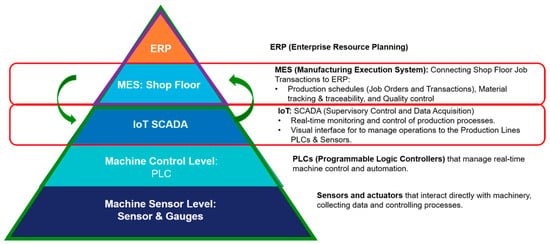
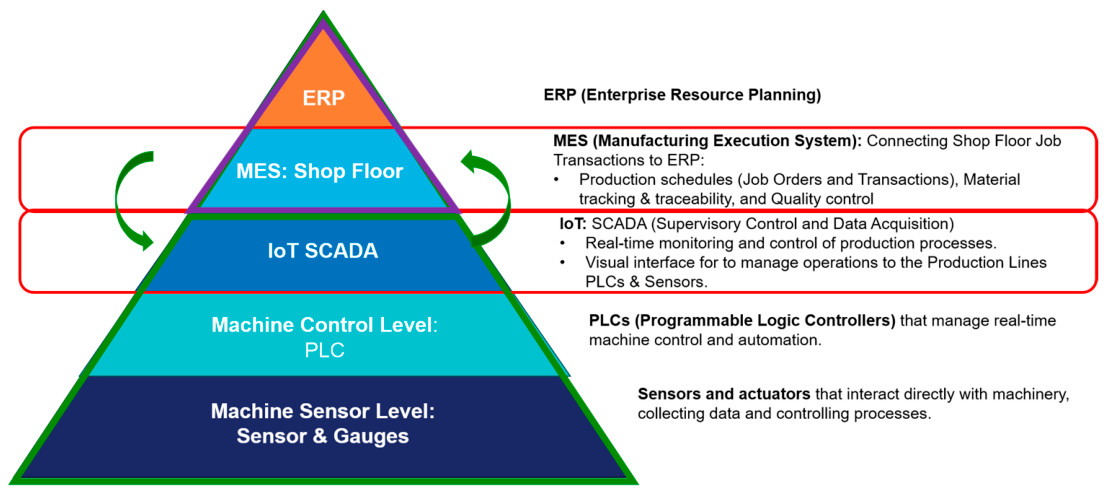
This research utilized a multi-step implementation framework using the traditional automation pyramid (Figure 1) as its conceptual model. Conceptually aligned with the functional hierarchy described in ANSI/ISA-95 (IEC 62264-1) [17,18], the automation pyramid spans machine-level sensing and control through manufacturing execution to enterprise management, and the proposed framework progresses across these levels to support digital transformation. Table 2 describes the implementation framework that was validated. The manufacturer improved their data-driven decision-making in using digital technologies to satisfy customers’ demanding expectations.
Figure 1.
Implementation Levels Corresponding to Automation Pyramid (adapted from [13]).
Table 2.
Implementation of Framework Steps.
This implementation framework corresponds to all levels of the automation pyramid, from machine sensing and control (Steps 2–3) to SCADA/IoT data acquisition (Steps 5–6) and MES/ERP functions for process management and production monitoring (Steps 1, 4, and 8). Cybersecurity (Step 7) supports all levels, creating an integrated architecture for digital transformation.
The electromechanical interns advanced machine data acquisition capabilities through targeted upgrades on multiple thermoforming systems. Mechanical upgrades on three production lines enhanced sensor integration and future digital data collection. Analog gauges, previously recorded on paper, were converted to pressure and vacuum digital transmitters, positioning the machinery for integration with a data collection system once tags are assigned. This upgrade directly supported the project’s goals of improving data availability for machine learning, advanced troubleshooting, and process optimization, while also establishing a scalable approach for similar systems across the clean room and light-gauge thermoforming areas. Following cabinet wiring, the controls team programmed the HMI and PLC to interpret transmitter signals and push the data to the server. Upon successful validation of the upgrade, this standardized approach will be expanded to additional light-gauge lines, further reinforcing the project’s educational and operational impact.
The undergraduate interns supported the manufacturer’s digital transformation through complementary efforts in cybersecurity and manufacturing data analytics. Tasks focused on strengthening the cybersecurity posture of industrial control systems (ICS) and IoT-enabled manufacturing equipment. This work developed a comprehensive cybersecurity policy tailored specifically to the manufacturer’s operational technology environment, drawing from existing internal documentation and the updated NIST Cybersecurity Framework. A developed risk matrix used an algorithm-driven tool to quantify cybersecurity risk by combining severity and likelihood scores informed by recent industry incidents and the manufacturer’s current mitigation strategies. This analysis identified the need for improving network anomaly detection, a formal incident response protocol, and a crisis management plan. A second focus supported the migration of operational reporting to the manufacturer’s new MES platform. Reports currently used by operations and production were reverse-engineered to map Intelligent Data Object (IDO) data structures to recreate these reports within the new MES environment. This effort ensured continuity of reporting, reduced disruption during system transition, and provided hands-on experience with manufacturing data models, analytics logic, and cross-functional collaboration between IT and operations. Figure 1 illustrates how this work was reflected in the automation pyramid.
4.1. Project Leadership—Execution
The supervisory model produced a cohort whose collective output spanned machine instrumentation, cybersecurity governance, procurement strategy, and manufacturing analytics—a breadth of Industry 4.0 application that benefited directly from the joint academic-industry supervisory structure. Controls engineering and tag mapping work provided the foundational data identification layer upon which the electromechanical and information sciences intern-tracks depended, while oversight of data table consistency and governance ensured that the data flowing from newly instrumented machines would be correctly structured and usable across the organization. Structured onboarding—including safety orientation, production floor familiarization, and tailored job descriptions aligned to each intern’s academic trajectory—enabled them to become productive contributors within their first weeks. The internship approach demonstrated that close faculty-industry coordination can yield professional deliverables of value to manufacturing operations, with each intern’s work product becoming a documented asset in the manufacturer’s digital transformation roadmap.
4.2. Operational Technology Tasks—Execution
By the conclusion of the fellowship period, the two interns had completed mechanical upgrade preparations on four clean room light-gauge thermoformers. The planning and documentation for a fifth unit was finalized and pending only the arrival of additional hardware. The centerpiece result was the successful mechanical installation of pressure and vacuum transmitter infrastructure for a thermoformer, a machine that had previously relied exclusively on manual analog gauge readings. Cabinet wiring was staged, labeled, and verified as safe for installation during the next planned downtime, positioning the machine for full digital integration without requiring additional production interruptions. Upon completion of control team wiring and HMI/PLC programming, this thermoforming unit will push live pressure and vacuum data to the IoT platform server, enabling machine learning applications, advanced troubleshooting, and process optimization. The standardized upgrade approach developed by the interns is directly scalable to additional light-gauge thermoforming lines across the clean room and light-gauge production areas.
4.3. Information Technology Tasks—Execution
One intern produced a suite of cybersecurity governance deliverables including a comprehensive Cybersecurity Policy tailored to the manufacturer’s OT environment, an Incident Response and Crisis Management Plan, and a custom MITRE-mapped Risk Assessment Matrix implemented as an algorithm-driven Excel tool quantifying risk by combining severity and likelihood scores. He additionally conducted a cost–benefit analysis comparing remote connection devices against the existing centralized jump box architecture and recommended that large-scale deployment based on cost and marginal security benefit not be utilized. A 10-year Total Cost of Ownership procurement analysis further identified a Zero-Trust Network Access (ZTNA) solution projected to deliver a significant cost reduction over legacy VPN hardware—a figure that represents only the procurement savings and does not include the avoided costs of a successful intrusion through a compromised VPN endpoint, which for a midsized manufacturer could include extended production downtime, intellectual property theft, and regulatory exposure. His internship deliverable was a prototype digital twin for the thermoforming line, synchronizing thermal inertia and machine physics with developing predictive ML logic to establish an analytics framework. In parallel, the other intern’s effort resulted in the successful mapping of data structures and reconstruction of key operational reports within the IoT platform environment, ensuring continuity of production reporting during the manufacturer’s system migration.
4.4. Implementation Framework Validation
The framework was validated through a real-world pilot implementation in a midsized manufacturing environment as shown in Table 3. Validation did not consist of a controlled laboratory comparison; instead, it relied on applied engineering evidence that the eight steps could be executed in sequence to prepare a shop floor for digital transformation. Validation evidence included: (1) production-line flowcharts documenting operations, (2) cataloged PLC and sensor inputs/outputs, (3) logic and signal mapping diagrams, (4) identification of quality-critical process parameters with process experts, (5) creation of a data repository structure for sensory data, (6) installation of a local wireless network for data acquisition, (7) development of a cybersecurity architecture aligned with NIST-based security-by-design principles, and (8) prototype dashboards for production monitoring. The pilot also demonstrated feasibility across multiple thermoforming machines, including completed mechanical upgrade preparation and staged wiring for sensor integration.
Table 3.
Validation of Framework Steps.
The case-study protocol produced a complete implementation chain from process mapping through dashboard development, demonstrating that the framework is operationally feasible in a live SMM environment and can be adapted to similar facilities with comparable legacy infrastructure. The framework is transferable because it is organized around generic implementation dependencies common to many SMM environments: process characterization must precede sensor mapping, sensor mapping must precede data modeling, data modeling must precede networking and dashboarding, and cybersecurity controls must be designed alongside connectivity. The framework therefore provides a repeatable implementation sequence that can be adapted to different machines, lines, and facilities without requiring the same equipment, software vendor, or database platform.
5. Discussion
5.1. Project Leadership—Reflection
The fellowship’s supervisory model offers a replicable template for university-industry partnerships in advanced manufacturing contexts. The functional division between two senior professionals proved particularly effective: one professional’s controls engineering and tag mapping expertise ensured that the right machine data points were identified and correctly routed into the digital infrastructure, while the other professional’s governance focus ensured that the data arriving in the manufacturer’s analytics environment was consistent, well-mapped, and fit for organizational use. This pairing of machine data identification with data governance represents a model worth replicating in future cohorts, as both functions are necessary for digital transformation efforts to produce durable, trustworthy data assets rather than isolated sensor streams. Academic effort was thereby translated into durable organizational assets rather than isolated exercises. A professional’s involvement as Director of Analytics and Digital Intelligence ensured that the machine data integration work undertaken by both the electromechanical and information sciences interns was oriented toward the manufacturer’s enterprise data infrastructure goals, providing a unifying strategic lens across the two technical tracks. A key insight from this structure is that intern productivity is substantially elevated when work assignments derive from active organizational initiatives rather than purpose-built student projects, as interns gain authentic stakes in outcomes. Future cohorts would benefit from even earlier pre-scoping engagement between supervisors, particularly for tracks—such as controls programming and PLC integration—where intern progress is gated by upstream organizational decisions including tag assignment and downtime scheduling.
5.2. Operational Technology Tasks—Reflection
The instrumentation work completed by two electromechanical interns represents a meaningful step in the manufacturer’s transition from manual data recording to continuous digital monitoring on its thermoforming lines. The staged methodology they employed—mechanical installation first, electrical work deferred to verified safe conditions—reflects sound engineering practice and constituted an important professional competency developed within an active production environment. The scalability of their fifth unit’s approach is particularly significant: by establishing a repeatable upgrade template for analog-to-digital sensor conversion, the interns created a pathway for systematically expanding digital coverage across the manufacturer’s broader thermoforming portfolio. Future work should prioritize completing the fifth unit’s wiring and validating the IoT platform data pipeline before expanding the template, ensuring that lessons from this first full integration cycle inform subsequent deployments. More broadly, the involvement of electromechanical students in OT instrumentation work highlights a valuable pedagogical opportunity: hands-on Industry 4.0 sensor integration is an increasingly critical competency for engineering technology graduates entering advanced manufacturing environments.
5.3. Information Technology Tasks—Reflection
The information science track demonstrated the value of embedding students with relevant prior domain expertise within technically demanding industry roles. One intern’s military intelligence and security analysis background amplified the scope of deliverables achievable within a single fellowship term, enabling him to produce research-grade artifacts, including a Physics-Aware Digital Twin, that move the manufacturer from preventative maintenance toward predictive maintenance. His governance deliverables, grounded in NIST and MITRE frameworks and adapted to the manufacturer’s specific OT environment, provided a durable cybersecurity foundation that extends well beyond the fellowship period. The other intern’s manufacturing data analytics work addressed a practical continuity risk that frequently accompanies enterprise system migrations: the loss of institutional reporting knowledge embedded in legacy platforms. By reconstructing operational dashboards within the IoT platform before the legacy data visualization environment is retired, the fellowship directly reduced transition risk for the manufacturer’s operations and production teams. Together, the two IT interns’ contributions illustrate how a coordinated cohort model—pairing security architecture with manufacturing data analytics—can address critical digital transformation challenges facing a modern industrial manufacturer.
6. Conclusions
This study’s contribution is the validation of a repeatable eight-step preparation framework for SMM digital transformation, demonstrated through concrete shop-floor deliverables and a pilot implementation that can be transferred to similar manufacturing environments. The state-related grant that partially funded this project had a set of goals that were achieved through a partnership between academia and industry. This innovation project provided process expert supervision for four undergraduate engineering and information science students to catalog and analyze production data in collaboration with a Pennsylvania manufacturing company. The undergraduate interns investigated digital technologies in the shop floor environment by immersion in an on-site manufacturing plant to increase their interest in a manufacturing career. The manufacturing company provided real-world applications for improving the production process of thermoformed and injected molded polymer products to demonstrate to students the value of manufacturing in Pennsylvania’s economy. The midsized manufacturer gained insight into the benefits of Industry 4.0 productivity gains through digital transformation of production processes to improve their competitive position in the marketplace. The Manufacturing Innovation and Learning Laboratory at the lead author’s institution coordinates faculty expertise with other regional manufacturers to enhance their operations with academic research and industry best practices. The preparation plan for digital transformation validated under this proposal is applicable to other SMMs in the southeastern region of Pennsylvania to assist in overcoming barriers to adopting innovative technologies.
The internship collaboration also demonstrated a practical model for engaging students in an active industrial environment while supporting a real manufacturer’s digital-transformation objectives. Although this project created hands-on learning opportunities, the present manuscript does not claim measured educational impact. A limitation of this study is that student learning outcomes were not formally measured; future work could examine educational impact using reflection logs, supervisor assessments, skills rubrics, or pre/post competency instruments.
While this study engaged student interns in an industry-academic partnership, such a collaboration is not necessary to implement this framework. The interns’ roles as defined in the appendix could be translated into employee competencies and organizational capabilities that SMMs require for preparation tasks. Employees who are more familiar with the plant, the products, and the nuances of the production processes are well positioned for a successful digital transformation.
Author Contributions
Conceptualization, T.S. and E.C.; methodology, M.B. and E.C.; software, J.D. and E.C.; validation, M.B. and E.C.; formal analysis, T.S. and J.D.; investigation, T.S. and J.D.; resources, J.D.; data curation, E.C.; writing—original draft preparation, T.S. and J.D.; writing—review and editing, M.B. and E.C.; visualization, T.S. and M.B.; supervision, M.B. and E.C.; project administration, T.S.; funding acquisition, T.S. All authors have read and agreed to the published version of the manuscript.
Funding
This research was partially funded by the Pennsylvania Department of Community and Economic Development, PA Manufacturing Fellows Initiative grant number 1060189-498528.
Data Availability Statement
The data presented in this study are available on request from the corresponding author. The data are not publicly available due to company privacy restrictions.
Conflicts of Interest
Author Erin Connelly was employed by the company Brentwood Industries, Inc. The remaining authors declare no conflicts of interest. The funders had no role in the design of the study; in the collection, analyses, or interpretation of data; in the writing of the manuscript; or in the decision to publish the results.
Abbreviations
The following abbreviations are used in this manuscript:
| AME | Advance Manufacturing Engineering |
| CNC | Computer Numerical Control |
| ERP | Enterprise Resource Planning |
| HMI | Human Machine Interface |
| ICS | Industrial Control Systems |
| IDO | Intelligent Data Object |
| IIoT | Industrial Internet of Things |
| I/O | Input/Output |
| IoT | Internet of Things |
| IT | Information Technology |
| KPI | Key Performance Indicator |
| MES | Manufacturing Execution System |
| ML | Machine Learning |
| NIST | National Institute of Standards and Technology |
| OEE | Overall Equipment Effectiveness |
| OT | Operational Technology |
| PLC | Programmable Logic Controller |
| ROI | Return on Investment |
| SCADA | Supervisory Control and Data Acquisition |
| SMM | Small and Midsized Manufacturers |
| SOP | Standard Operating Procedure |
Appendix A
The project team for this work was composed of university faculty, company experts, and undergraduate students. The university faculty brought functional skills in project management, smart manufacturing technology, cybersecurity risk evaluation and mitigation, and data science methods. The company experts brought industrial experience in manufacturing operations, fabrication processes, engineering design, quality assurance, automation control, and data analytics. The undergraduate students brought theoretical knowledge in electromechanical systems, networking/cybersecurity, and information science technology. Descriptions of each recruited intern’s duties, responsibilities, and skills are listed respectively in Table A1, Table A2, Table A3 and Table A4. This team possessed the diverse proficiency required to prepare a production shop floor for digital transformation.
Table A1.
Machine Instrumentation Intern.
Table A2.
Sensor Integration Intern.
Table A3.
Cybersecurity Architecture Intern.
Table A4.
Manufacturing Data Analytics Intern.
References
- Vrana, J.; Singh, R. Modeling digital penetration of the industrialized society and its ensuing transfiguration. Digit. Soc. 2023, 2, 54. [Google Scholar] [CrossRef] [Scilit]
- Vrana, J.; Singh, R. Digitization, Digitalization, Digital Transformation, and Beyond. In Handbook of Nondestructive Evaluation 4.0, 2nd ed.; Meyendorf, N., Ida, N., Singh, R., Vrana, J., Eds.; Springer: Cham, Switzerland, 2025; pp. 145–170. [Google Scholar]
- Ponnoju, S.; Bruch, J.; Ashjaei, M.; Satka, Z. Software-defined Automation in Industrial Production: Drivers of Transformation. IOP Conf. Ser. Mater. Sci. Eng. 2026, 1342, 12032. [Google Scholar] [CrossRef] [Scilit]
- Zhang, N.; Ye, J.; Zhong, Y.; Chen, Z. Digital Transformation in the Chinese Construction Industry: Status, Barriers, and Impact. Buildings 2023, 13, 1092. [Google Scholar] [CrossRef] [Scilit]
- Intalar, N.; Chumnumporn, K.; Jeenanunta, C.; Tunpan, A. Towards Industry 4.0: Digital transformation of traditional safety shoes manufacturer in Thailand with a development of production tracking system. Eng. Manag. Prod. Serv. 2021, 13, 79–94. [Google Scholar] [CrossRef] [Scilit]
- Alcácer, V.; Rodrigues, C.; Carvalho, H.; Cruz-Machado, V. Tracking the maturity of industry 4.0: The perspective of a real scenario. Int. J. Adv. Manuf. Technol. 2021, 116, 2161–2181. [Google Scholar] [CrossRef] [Scilit] [PubMed]
- Ahlskog, M.; Granlund, A.; Badasjane, V.; Bruch, J.; Sauter, B. Approaching digital transformation in the manufacturing industry challenges and differing views. Int. J. Manuf. Res. 2023, 18, 415–433. [Google Scholar] [CrossRef] [Scilit]
- Sayem, A.; Biswas, P.K.; Khan, M.M.A.; Romoli, L.; Dalle Mura, M. Critical Barriers to Industry 4.0 Adoption in Manufacturing Organizations and Their Mitigation Strategies. J. Manuf. Mater. Process. 2022, 6, 136. [Google Scholar] [CrossRef] [Scilit]
- Bello, K.A.; Kanakana-Katumba, M.G.; Maladzhi, R.W. ADOPTING SMART MANUFACTURING: SPECIFIC NEEDS AND CHALLENGES OF SMALL, MEDIUM, AND MICRO ENTERPRISES (SMMES). S. Afr. J. Ind. Eng. 2024, 35, 245–256. [Google Scholar] [CrossRef] [Scilit]
- Zhou, J.; Wang, G.; Diao, Z. Enabling digital transformation of traditional enterprises through industrial internet platforms: A study from an ecosystem perspective. Eng. Constr. Archit. Manag. 2026, 33, 413–434. [Google Scholar] [CrossRef] [Scilit]
- Baierle, I.C.; da Silva, F.T.; de Faria Correa, R.G.; Schaefer, J.L.; Da Costa, M.B.; Benitez, G.B.; Benitez Nara, E.O. Competitiveness of Food Industry in the Era of Digital Transformation towards Agriculture 4.0. Sustainability 2022, 14, 11779. [Google Scholar] [CrossRef] [Scilit]
- Dohale, V.; Ambilkar, P.; Bilolikar, V.; Narkhede, B.E.; Kumar, A.; Kumar, A. Evaluating circular economy and smart technology adoption barriers in the Indian textile and apparel industries using neutrosophic ISM. Ann. Oper. Res. 2025, 355, 211–251. [Google Scholar] [CrossRef] [Scilit]
- Liu, J. A Study on the Dynamic Mechanism and Synergistic Effects of Enterprise Participation in University-Industry Collaboration (UIC) Under Digital Transformation: Based on Symbiosis Theory. Syst. Pract. Action Res. 2026, 39, 5. [Google Scholar] [CrossRef] [Scilit]
- Wahlgård, M.; Chari, A.; Muhammad, A.S.; Johansson, B.; Syberfeldt, A.; Stahre, J. AI-Driven Changeover Optimisation in Discrete Manufacturing: A Production Line-Based Analysis of Technology Readiness in Bearing Production. IOP Conf. Ser. Mater. Sci. Eng. 2026, 1342, 12028. [Google Scholar] [CrossRef] [Scilit]
- Speicher, T.; DeFranco, J.; Stricker, C.; Kumara, S.; Bilén, S. Digital twin technology for engineering education: An experiential learning case study. Ind. High. Educ. 2026, 1–10. [Google Scholar] [CrossRef] [Scilit]
- Tihinen, M.; Pikkarainen, A.; Joutsenvaara, J. Digital Manufacturing Challenges Education—SmartLab Concept as a Concrete Example in Tackling These Challenges. Future Internet 2021, 13, 192. [Google Scholar] [CrossRef] [Scilit]
- Vrana, J.; Singh, R. Value Creation in NDE 4.0: What and How. In Handbook of Nondestructive Evaluation 4.0, 2nd ed.; Meyendorf, N., Ida, N., Singh, R., Vrana, J., Eds.; Springer: Cham, Switzerland, 2025; pp. 171–200. [Google Scholar]
- ISA-95; Enterprise-Control System Integration. International Society of Automation: Research Triangle Park, NC, USA, 2026.

Disclaimer/Publisher’s Note: The statements, opinions and data contained in all publications are solely those of the individual author(s) and contributor(s) and not of MDPI and/or the editor(s). MDPI and/or the editor(s) disclaim responsibility for any injury to people or property resulting from any ideas, methods, instructions or products referred to in the content. |
© 2026 by the authors. Licensee MDPI, Basel, Switzerland. This article is an open access article distributed under the terms and conditions of the Creative Commons Attribution (CC BY) license.