1. Introduction
Qualified processes and certified parts are essential for the successful application of metal AM components in critical industries such as aerospace, oil and gas, high-tech/high-spec manufacturing, defense, and automotive sectors. The main objective of this review is to provide a comprehensive overview of defect formation mechanisms in metal AM processes, the associated quality requirements for critical applications, and the role of advanced in situ process monitoring and non-destructive inspection (NDI) techniques in achieving process qualification and part certification. In situ process monitoring and non-destructive inspection are crucial aspects for assuring the structural integrity, dimensional accuracy, and repeatability of metal AM products, while also enabling traceability and compliance with stringent industry standards [
1]. These approaches facilitate early defect detection, process control, and feedback-driven optimization, thereby reducing reliance on destructive testing and post-process inspection. By linking defect formation mechanisms to quality requirements and suitable NDI methodologies, this review aims to support the development of robust qualification frameworks and accelerate the industrial adoption of metal AM for safety-critical components.
AM has many advantages compared to conventional manufacturing process for metallic parts, namely [
2]:
Single-piece fabrication of complex components;
Fabrication of part geometries that would normally be too complicated, expensive, or impossible to fabricate with conventional subtractive methods;
Reduced need for casting or forging;
Addition of part complexity with minimal additional expense;
Direct fabrication of parts.
However, these advantages impose challenges from an inspection perspective when the metal AM part must be validated for quality assurance and airworthiness. Complex geometry (e.g., thickness variations, embedded features, and organic part design) and material properties (e.g., surface finish, dissimilar metals, and microstructure non-uniformity) are two categories of factors that can limit the inspection capability and possibility [
3,
4]. This paper aims to address these challenges by presenting a structured and system-oriented review of defect formation mechanisms in metal AM and their implications for inspection, qualification, and certification of safety-critical components. Rather than evaluating non-destructive inspection techniques in isolation, the review emphasizes their role within an integrated quality assurance framework that spans process physics, in situ monitoring, ex situ inspection, and data-driven decision-making. The scope of the paper covers both established and emerging NDI techniques applicable to metal AM, including X-ray computed tomography, ultrasonic testing, infrared thermography, acoustic emission, and electromagnetic methods. These techniques are discussed with respect to their sensitivity to typical AM-induced defects, such as porosity, lack of fusion, cracking, and geometrical deviations, as well as their limitations when applied to complex geometries and heterogeneous microstructures.
Apart from conventional capability-based comparisons, particular emphasis is placed on the digitalization of NDI alongside its convergence with intelligent manufacturing paradigms. This emphasis stems from a clear research gap: even though individual NDI techniques for metal AM have been extensively reviewed, the literature nevertheless lacks a coherent perspective connecting inspection capabilities to the broader digital quality ecosystem essential for industrial qualification. The paper underlines the extent to which advanced signal and image processing, and machine learning-based defect characterization, in conjunction with multi-sensor data fusion, enable the transformation of inspection data into implementable quality intelligence. These topics are incorporated given that current AM inspection workflows generate large, heterogeneous datasets, the value of which cannot be fully exploited without intelligent processing and fusion methods—a limitation repeatedly identified in recent reviews. Dedicated attention is directed toward the embedding of NDI data within digital twin frameworks, whereby inspection results are coupled with in situ monitoring data together with physics-based models to support closed-loop process control and probabilistic defect assessment, plus certification-ready quality evidence. Digital twin integration is specifically addressed insofar as it represents the most promising route to bridge the persistent gap between offline NDI results and real-time process control, an aspect that remains underdeveloped in the existing AM qualification literature. Via the linking of defect development mechanisms, inspection technologies, and digital quality architectures, this review intends to provide a holistic perspective on the qualification of metal AM processes. The combined treatment of these three domains is justified by the fact that they are typically discussed in isolation, although industrial qualification, on the other hand, demands their explicit interconnection. The insights presented are intended to support researchers and manufacturing engineers, along with certification authorities, in transitioning from inspection-centric quality control to predictive, adaptive, and data-oriented quality assurance strategies suitable for industrial-scale and safety-critical metal AM applications.
2. Defect Formation Mechanisms and Quality Requirements
An overview of defects is given [
5,
6,
7]. Dutton et al. and Subeshan et al. present a summary of all important AM flaws that can be incorporated during manufacturing [
5,
8]. This summary includes broad descriptions on the process cause and the effect of the defect.
Table 1 depicts this summary in a schematic form. Montazeri et al. also gives a table with typical sizes of the defects relevant to the metal AM products shown in
Table 2 [
9].
The applicability of NDT methods varies significantly throughout AM processes as well as defect types. X-ray computed tomography (XCT) provides the most comprehensive detection of internal defects (porosity and lack-of-fusion, coupled with cracks) in powder bed fusion (PBF) parts, with resolution down to tens of micrometers, yet is limited by part size in addition to density. Ultrasonic testing (UT), especially phased array variants, is better suited to larger DED along with WAAM components, even though coarse and anisotropic microstructures might reduce sensitivity. Surface-based methods including dye penetrant (PT) and magnetic particle (MT), in conjunction with eddy current testing (ECT), remain effective for surface-connected cracks; however, they cannot resolve internal flaws. In situ techniques (melt-pool monitoring and thermography, together with acoustic emission) enable real-time process feedback, yet provide indirect defect indications instead of definitive characterization.
From a qualification perspective, XCT as well as UT are the most mature and are increasingly embedded within AM-specific standards (e.g., ASTM E3166 and ISO/ASTM 52905), whereas in situ along with emerging methods still lack validated acceptance criteria as well as probability-of-detection data. Taken together, no single technique is universally applicable; a multi-modal approach—tailored to part geometry, material, and defect type, in addition to qualification requirements—is crucial for reliable AM component inspection.
It should be further noted that the defects that can be found in metal AM products can be categorized in AM-unique and non-unique groups. The latter group of defects can be (partly) covered with existing standards for welded parts, whilst the AM-unique group must be addressed by new standards to be developed in the future [
5].
Table 1 presents a schematic overview of the AM-unique and non-unique defect groups and their relationship to the existing and to-be-developed standards.
It is also noted that the authors often refer to defects on the surface or in the subsurface region. Surface defects are defects that are visible from the outside. However, providing a precise and universally accepted definition of subsurface defects remains difficult, which may explain why such a definition has not yet been clearly established in the literature. For example, in the absence of a unified definition, ASTM [
10] mentions examples of a subsurface defect on a specimen at a 0.040-inch (1.025 mm) depth. There are other reports where subsurface pores are found from 50 to 500 μm depths [
11,
12].
3. Conventional Non-Destructive Testing Methods and Limitations
Various technologies have been developed for process control and NDT of final products in engineering applications. These technologies enable defect detection without compromising the integrity of complex materials [
13]. In other words, NDT allows for the detection of defects without altering or damaging the shape of the material. The ability to test without damaging the product ensures its usability after testing. Furthermore, detecting errors in the production process prevents major problems in the future, resulting in cost savings. Structural weaknesses or defects can be detected early, minimizing safety risks. Therefore, it is widely used for quality assurance and integrity assessment of engineering components [
14,
15]. When NDT was first developed, it was intended for parts with non-complex shapes and homogeneous microstructures [
16]. These methods are used to detect volumetric or surface discontinuities in materials according to specific standards, and to evaluate their dimensions and properties. These methods are predominantly employed within the manufacturing, aerospace, automotive, energy, shipbuilding, and construction sectors. Apart from these traditional heavy industries, the integration of advanced NDT has become increasingly necessary in particular fields, including biomedical engineering for the certification of patient-specific orthopedic implants, the tool and die industry for the verification of geometrically complex conformal cooling channels, and the high-end luxury sector, wherein it guarantees the structural strength of complex jewelry along with accuracy watch components.
AM is an innovative manufacturing technology that enables the production of more complex and customized parts compared to traditional manufacturing methods. AM productions exhibit manufacturing defects such as complex internal architectures, high surface roughness, and non-homogeneous microstructures [
17]. These defects present challenges for NDT. The limitations of traditional NDT methods have become more pronounced, especially with the development of complex manufacturing technologies such as AM. Traditional techniques such as radiography, ultrasonic testing, and liquid penetrant testing have limitations due to the complex forms of microstructural heterogeneity that arise with additive manufacturing. Ultrasonic testing leads to high dispersion of sound waves and an increased signal-to-noise ratio, reducing the accuracy of defect detection [
18]. Furthermore, porosity, interlayer adhesion defects, and high surface roughness, frequently encountered in additive manufacturing, make it difficult for liquid penetrant or magnetic particle testing to distinguish true discontinuities on the surface.
Radiographic tests, on the other hand, may be insufficient due to the orientation of narrow and deep internal defects characteristic of additive manufacturing, which prevents the complete characterization of volumetric defects [
19]. Developments have primarily focused on evaluating geometric accuracy, internal defects, surface roughness, internal stresses, etc. In this context, the inherent limitations of traditional NDT methods, such as operator dependency and sensitivity to material thickness, combined with the layered structure dynamics offered by additive manufacturing, increase the need for more advanced and digitally based inspection technologies in the certification processes of these parts.
3.1. Visual and Surface Inspections
Visual inspection, commonly used to identify cracks and surface defects, is essentially the simplest NDT method. Visual inspection is generally used with microscopy techniques to detect defects in AM-produced samples [
17,
20]. Visual inspection is limited to surface defects [
21]. Nowadays, flexible fiberoscopes are mostly used for detailed post-production visual inspection. This limitation is particularly critical for AM components, where defects are often internal due to layer-by-layer production [
11,
22]. The high surface roughness of AM parts can mask small surface defects and lead to misinterpretations [
23]. Consequently, visual and surface inspections are insufficient for quality control of AM components used in load bearing or safety-critical applications. Defects such as filament droplets, missing walls, and layer separation can occur in AM-produced materials. Different NDT methods should be used to identify these defects. Furthermore, camera and laser-based visual inspections can be improved with machine learning- or artificial intelligence-based evaluations.
3.2. Penetrant and Magnetic Particle Testing
These two methods, which are traditional non-destructive testing methods, are used in industry to identify surface and near-surface defects. Both are important in quality control processes due to their advantages of rapid applicability and low cost. PT is a method that uses a special penetrant liquid to make invisible discontinuities on the material surface visible. In this non-destructive testing method, a low-viscosity penetrant liquid infiltrates into the visible discontinuities on the surface, and after a certain period, the defects begin to appear. Liquids that can be seen under ultraviolet light or a specific type of light are used to visualize defects. However, the method is only suitable for observing discontinuities that are visible on the surface; it cannot be used for internal defects located below the surface. Also, it is important that the surface quality of the material is good, smooth and clean, as it does not give accurate results on very rough or porous surfaces. Magnetic particle testing (MPT) is used to identify surface and near-surface defects in ferromagnetic materials through magnetic flux leakage [
24,
25]. Defective areas or areas with density differences absorb radiation heterogeneously, while defect-free areas allow energy to pass through. This technique offers high reliability with easy interpretation of results. Both methods are well-established in conventional manufacturing industries and offer relatively low inspection costs. However, the applicability of PT to AM components is significantly hampered by surface roughness and partially fused powder particles that can trap penetrant liquids and lead to false indications. Furthermore, most typical defects in additive manufacturing components occur within the component itself. Similarly, magnetic particle testing is limited by material dependence and shallow inspection depth, restricting its effectiveness in detecting volumetric defects specific to AM processes.
Magnetic Testing (MT) is a method applied only to ferromagnetic materials and utilizes the principle of magnetic flux leakage. When a magnetic field is applied to the part, if there is a discontinuity on or just below the part surface, magnetic flux lines create a leakage at that point. Fine iron oxide powders sprinkled on the surface are attracted to this leakage area, revealing the shape and size of the defect. Unlike PT, the MT method can detect discontinuities that are not visible on the surface but are located just below the surface (up to a few millimeters deep). However, the success of the MT method largely depends on the direction of the magnetic field; the highest sensitivity is achieved when the discontinuity is perpendicular to the flux lines, while parallel-aligned defects may be missed. Furthermore, the need for demagnetization to remove the remaining magnetic field (remanence) on the part after testing adds an extra step and cost to the application process. Moreover, neither PT nor MPT can examine closed internal features such as internal cooling channels and lattice structures, which are commonly integrated into AM designs to improve functional performance. Therefore, despite their capacity to detect porosity and interlayer problems, they have many limitations and their implementation in AM is quite complex [
18,
26,
27]. In conclusion, while PT and MT methods remain the gold standard for surface defect detection in mass-produced and welded parts, the geometric complexity introduced by modern manufacturing technologies pushes the operational limits of these methods and makes inspection reliability more dependent on operator experience.
3.3. Conventional Ultrasonic and Radiographic Testing
Ultrasonic testing is a non-destructive testing technique that uses high-frequency sound waves to detect defects in materials. It relies on the propagation and reflection of high-frequency acoustic waves. The waves are generated by a transducer placed on the surface of the material being tested. The transducer converts the electrical energy from the generator into sound waves that propagate through the material. If there are any defects in the material, these defects reflect some of the sound waves back to the transducer [
28]. RT is performed using X-ray or gamma radiation to create internal images based on changes in material density [
29]. As the radiation beams propagate through the material, they are absorbed at different rates depending on density differences, and the image captured by the detector provides information about internal defects. Although these methods allow for subsurface inspection, their effectiveness is reduced in AM components due to microstructural defects. Radiographic testing is effective for detecting volumetric porosity, but resolution limitations arise, especially in thick or geometrically complex AM parts [
30].
A significant limitation of conventional NDT techniques in additive manufacturing applications is their inadequacy in relation to the size of typical AM-induced defects. Microporosity, micro-cracks, and lack-of-fusion defects are generally below the detection limits of conventional UT and radiotherapy (RT) systems [
31]. Furthermore, complex internal geometries such as lattice structures and conformal cooling channels restrict probe placement and line-of-sight access, limiting inspection coverage and reliability. Due to these limitations, the inadequacy of conventional NDT methods for quality assurance of additive manufacturing components is becoming apparent, and the need for high-resolution inspection approaches is increasing [
18,
27,
32].
4. Advanced Non-Destructive Testing Techniques for Metal AM
4.1. X-Ray Computed Tomography
In the last five years, X-ray computed tomography (XCT) has been acclaimed as a key NDT method for metal additive manufacturing, notably through volumetric inspection of internal flaws in laser powder bed fusion (LPBF), directed energy deposition (DED), and wire arc additive manufacturing (WAAM) materials. Several publications highlight the proficiency of XCT in revealing and measuring the internal porosity, lack-of-fusion defects, and interconnected void networks of specimens made from the alloys AlSi10Mg, Ti-6Al-4V, Invar 36, 316L stainless steel, Inconel 625, and 17-4PH stainless steel [
33,
34]. The effectiveness of XCT for these materials is fundamentally governed by their X-ray attenuation coefficients, which depend on material density and effective atomic number. For instance, whereas low-density alloys including AlSi10Mg permit high-contrast imaging of internal porosity at reduced energy levels, high-density materials such as Inconel 625 along with 316L stainless steel exhibit pronounced X-ray absorption. This elevated absorption frequently necessitates higher tube voltages in order to achieve adequate penetration, which may introduce challenges including beam-hardening artifacts together with diminished sensitivity to small lack-of-fusion defects. By understanding these material-specific attenuation characteristics, XCT parameters can be systematically optimized to characterize complex defect networks across diverse alloy families, ranging from lightweight aluminum to dense nickel-based superalloys [
35]. To date, XCT has been extensively employed as a “truth” method for defect identification in AM parts to establish correlations between defect episodes and process parameters, thus stimulating the development of optimization strategies for scanning, energy density, and thermal management, in both powder bed and energy-based deposition systems.
Besides simple porosity statistics, the trend in XCT application is now shifting towards its use in in situ and time-resolved experiments. This way of working enables direct observation of mechanical loading-induced or post-processing defect changes. These studies offer a clear understanding of the mechanisms that the voids undergo during their growth, coalescing, and closure; thus, the internal defect features are directly connected to the fatigue and fracture properties of AM metals [
36,
37]. The above-mentioned research shows that XCT allows for non-destructive visualization of damage progression and, therefore, it is a significant step forward in defect-informed performance modeling as it substitutes reliance on fractography after failure.
Most of the time, the main topic of the different pieces of literature is how sensitive the metrics of defects derived from XCT are to the methods of image processing and segmentation. Some research works indicate that the porosity volume fraction, pore size distribution, and defect morphology can differ significantly depending on the type of segmentation used, thus exposing the uncertainties driven by the analysis in CT-based NDT [
38]. To overcome this issue, recently, the studies have been increasingly inclined to use machine learning- and deep-learning-based segmentation methods that allow for defect identification in large XCT datasets in a more consistent and scalable manner [
39].
XCT has now been integrated into qualification, metrology, and certification frameworks and has also been utilized for probability-of-detection (POD) analyses, CAD-to-XCT geometric registration, and comparison to conventional coordinate measurement systems [
26]. Together, these works position XCT as a must-have NDT tool for metal additive manufacturing. However, they also highlight the necessity of standardizing scanning parameters, developing robust segmentation pipelines, and establishing defect-based acceptance criteria as prerequisites for the implementation of XCT in safety-critical aerospace, biomedical, and precision engineering fields.
4.2. Advanced Ultrasonic and Acoustic Methods
Advanced ultrasonic and acoustic methods, such as phased-array ultrasonics and acoustic emission monitoring, can go deep into materials and are very sensitive to flaws inside and cracks that form early. These methods are therefore ideal for monitoring the structural health of additively manufactured metal components after they have been built and while they are in use [
13]. Mishurova et al. used synchrotron XCT and acoustic/elastic property measurements to investigate pore evolution during HIP of additively manufactured Ti-6Al-4V. While XCT clearly showed defective shrinkage, ultrasonic wave speed changes during HIP indicated densification and pore closure. The study found that using ultrasonic techniques as indirect NDT indicators of residual porosity and densification can expedite the evaluation of HIP’s efficacy in titanium AM components [
37].
4.3. Infrared Thermography
Infrared thermography can be used to monitor the process of melting and solidification because it is contactless and can detect heat variations over a large area. Therefore, it can detect subsurface cracks, as well as improper layer bonding and occurrences of the process, through temperature anomalies [
11]. Infrared (IR) thermography has undergone significant advancements over the last five years, turning from a mere extra post-build inspection method to an in-process (NDT) and evaluation (NDE) technique for metal additive manufacturing (AM), especially for laser powder bed fusion (LPBF/PBF-LB/M), directed energy deposition (DED), and wire arc additive manufacturing (WAAM). Duarte et al. (2021) provide an initial consolidation of the field through a benchmarking study of various NDT methods including infrared thermography, eddy current testing, ultrasonic testing, and X-ray computed tomography (µCT) on a complex LPBF stainless steel component with both engineered and natural defects. Their overall results show that thermography can serve as a fast, non-contact screening method for surface and near-surface defect identification, while µCT is still required for accurate volumetric defect quantification. This synergistic role of thermography with CT is well demonstrated in their defect detectability comparison, where the thermographic indications are matched with the CT-verified porosity. The paper sets a recurring motif in the later literature: thermography yields the best results when it is integrated in a multi-modal inspection approach [
40].
Several analyses are based upon only using active thermography to advance the defect detectability in laser powder bed fusion (LPBF) parts. One such study was by D’Accardi et al. (2021) [
41], who illustrated that externally stimulated thermography can find and target pores in metal AM materials. They also showed that thermal contrast depends heavily on defect size, shape, and depth. In a subsequent more in-depth work, D’Accardi et al. (2022) [
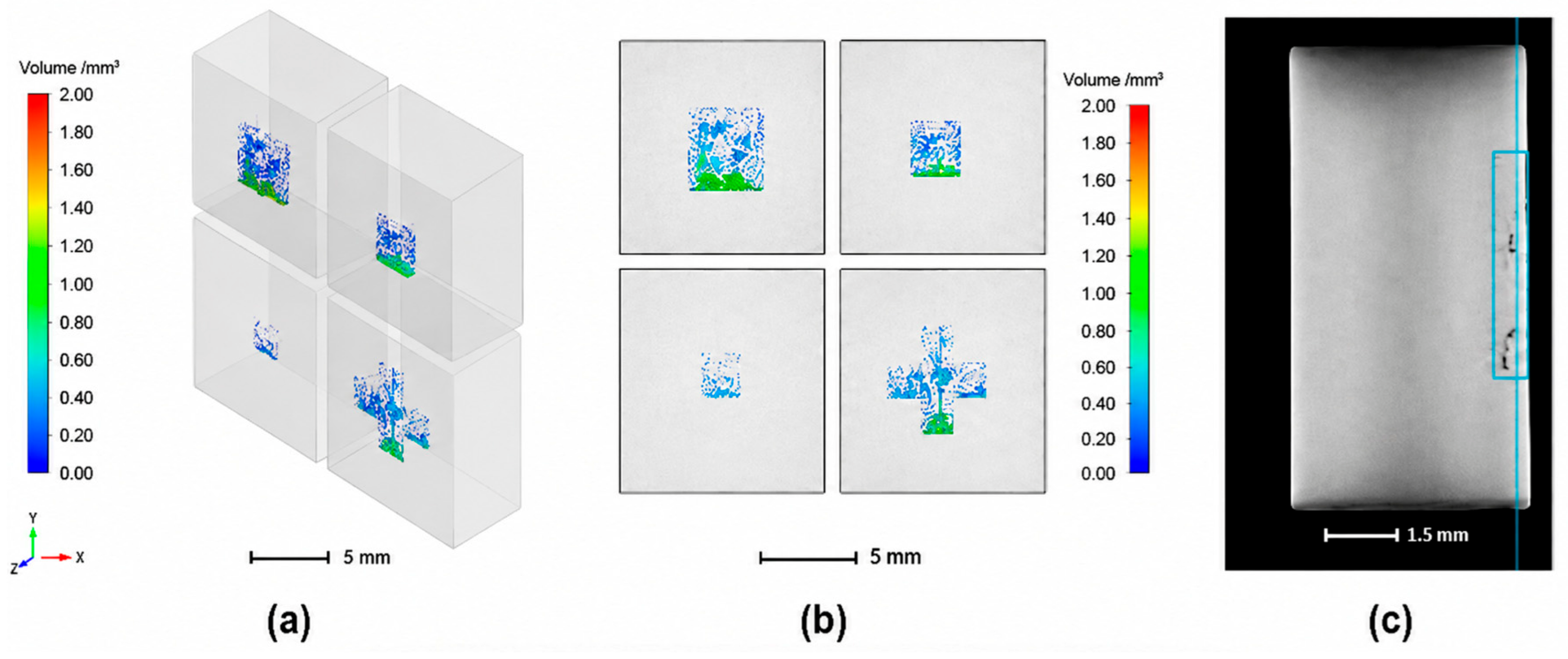
41] aligned active thermography with eddy current testing for lack-of-fusion and keyhole defect detection by employing µCT as a standard. The results of this study reveal that thermography is highly sensitive to thermally insulating discontinuities that are close to the surface. On the other hand, deeper defects show diminished contrast due to the limitation. The latter are illustrated by means of thermographic phase images and CT slice comparisons side-by-side (
Figure 1) [
41], which essentially confirm that thermography is most suitable for identifying near-surface defects and process qualification rather than deep volumetric inspection.
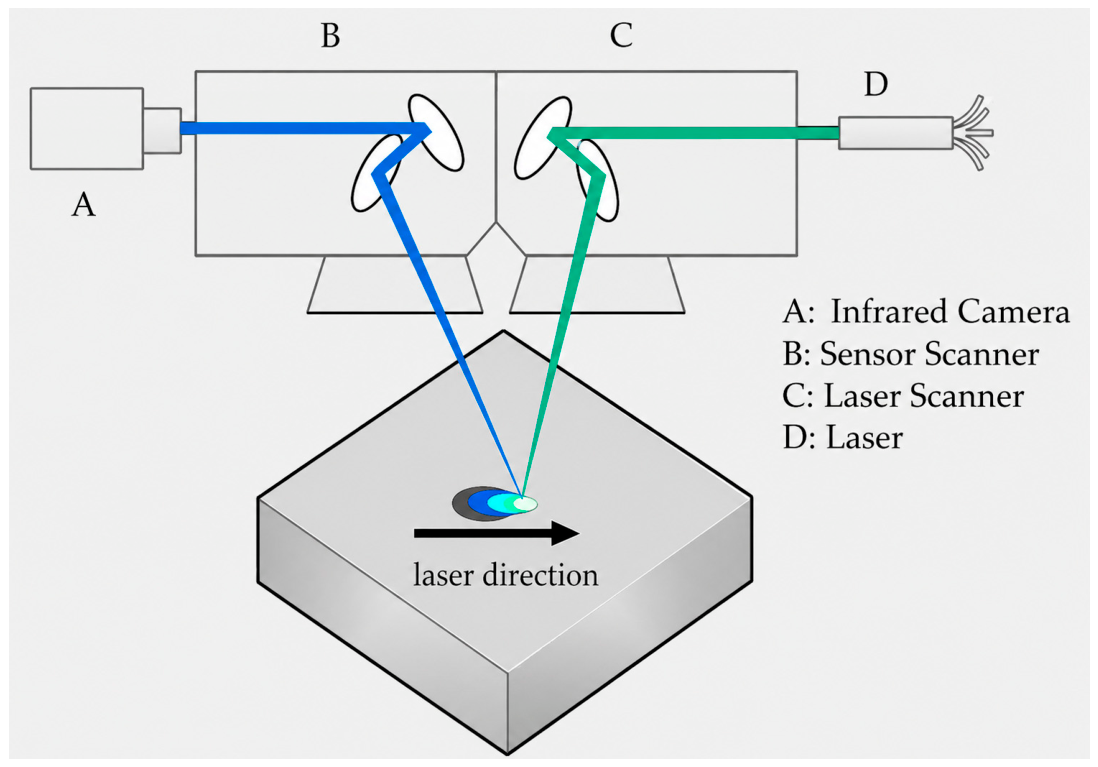
The use of thermography for in situ process monitoring has seen a key methodological development with the incorporation of advanced thermography manufacturing systems (AMSs). Höfflin et al. (2022) [
42] developed synchronized path infrared thermography (SPIT) which employs a galvanometer-driven optical system to enable the infrared (IR) camera to follow the laser scan path in real time. The separation of the laser galvanometer, the sensor galvanometer and IR camera and their respective times of synchronization with one another are presented in a schematic form in
Figure 2. This figure by Höfflin et al. (2022) [
42] is one of the most widely referenced thermography figures in laser powder bed fusion (LPBF) research. The use of the SPIT system allowed for the collection of both high-time resolution and high-spatial resolution measurements of the melt pool and the heat-affected zone while still providing coverage of the entire build area for LPBF manufacturing. In subsequent research, it was demonstrated that the processing laser could be used as the active excitation source for the collection of thermal responses due to subsurface defects during fabrication in situ [
43,
44].
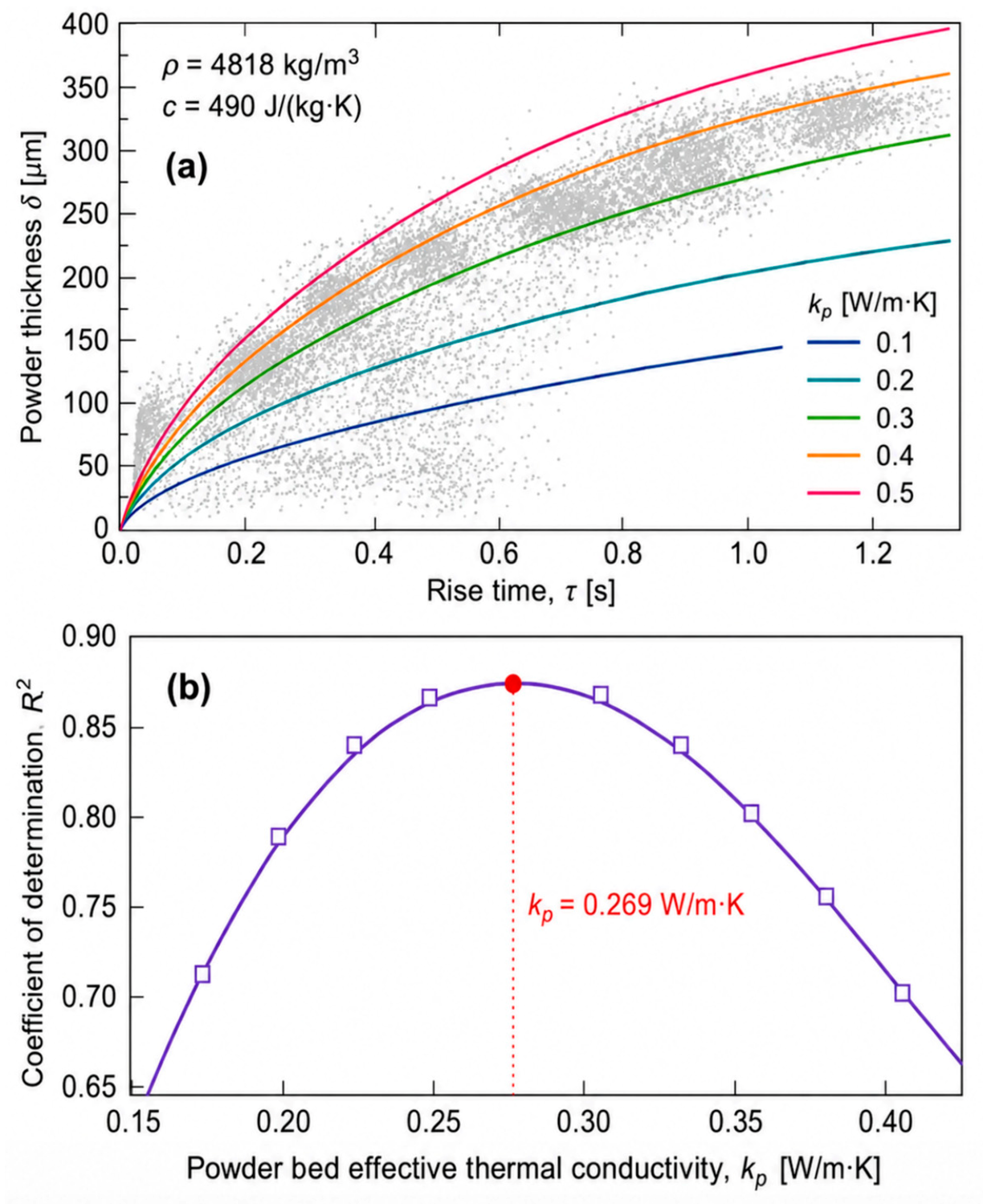
In parallel with detecting defects in AM parts, one research effort leverages thermographic measurements to potentially obtain information about the powder bed or process state variables that are related to characteristics known to promote defect formation. Liu et al. (2022) demonstrate that transient thermal signals measured immediately after re-coating the powder correlate with the local powder layer thickness in LPBF. Since the non-uniformity of the powder layer is an established cause for lack-of-fusion defects, this application of thermography represents a departure from identifying existing defects towards preventative method diagnostics. Liu et al. (2022) illustrate the correlation between the decay rate of the measured surface temperature and the local powder layer thickness through the use of spatially resolved thermograms with corresponding thickness maps (
Figure 3) [
45]. The same authors later extended their work with lock-in thermography to evaluate the thermal diffusivity and thickness of the powder layer with improved robustness in a noisy process.
Machine learning is being applied to convert (or classify) large and complex datasets of thermographs into predictive quality indicators or metrics due to the increasing size and complexity of thermographic datasets. Ref. [
46] developed a deep learning framework to predict the porosity of components produced by laser powder bed fusion (LPBF) by using multiple successive layers of thermographic features. The results of the study show the predictive accuracy is significantly improved through the integration of the thermal history of multiple layers, demonstrating the cumulative effects of the thermal history on the properties of parts produced with metal additive manufacturing.
Thermography serves an essential function in monitoring temperatures, maintaining the integrity of a melt pool, and mitigating defects in the direct energy deposition process. Ref. [
47] demonstrated that when comparing different laser-based methods of depositing metal, thermal gradient distributions exhibited greater applicability in identifying the stability of a process than just observing peak temperatures. Ref. [
48] extended the capability of detecting defects by creating a multi-axis infrared monitoring system for direct energy deposition, allowing for multiple plan-view images of thermal data to be combined and used to monitor the geometry of the melt pool and identify any real-time anomalies. Although not part of the same study as the previous references, D’Accardi (2024) monitored direct laser metal deposition online to demonstrate its capability to detect anomalies in real time and as a component of future closed-loop control applications [
41].
Using Joule-heating or thermal heating thermography, the surface roughness and build orientation effect on defect detectability for electron beam powder bed fusion (EB-PBF) components has been investigated [
49,
50]. The signal-to-noise ratio associated with non-surface defects due to the harsh processing environment has been improved by combining pulse phase thermography with magnification of thermal motion using DED [
51]. The use of infrared thermography in WAAM has evolved from simply being used as a method of inspection, towards being used both for process control and real-time feedback. For example, He et al. provide an example of using an infrared image to control process parameters of a WAAM process in real time using thermal data obtained during the deposition process to ensure consistent deposition conditions. Additionally, experimental thermographic data have been utilized in conjunction with numerical thermal simulations to validate and calibrate predictive models based on actual thermal data collected during the WAAM process of SS308L materials [
52,
53]. The literature from 2021 to 2025 present a clear evolution of infrared thermography in metal additive manufacturing from qualitative inspection after manufacturing, to real-time and in situ defect detection, and eventually to quantitative process diagnostics, predictive modeling based on machine learning, and ultimately closed-loop controller [
40,
42,
46].
4.4. Eddy Current and Electromagnetic Testing
Eddy current and electromagnetic testing methods excel in detecting near-surface defects, surface-breaking cracks, and changes in electrical conductivity. This makes them ideal for quick inspections of conductive metal AM parts and for spotting surface or subsurface material inconsistencies [
15]. In situ layer-wise monitoring for powder bed fusion by way of ECT is a well-established mechanism of use. ECT data was positively correlated with representative densities for common alloys in the laser powder bed fusion process (i.e., 316L and AlSi10Mg) by [
54], demonstrating that ECT can be used as a proxy to detail densification/porosity tendencies during both the qualification process and ongoing parameter development. Continuing this vein, the authors mounted ECT to a recoater control and demonstrated how proper processing of ECT signals allows for separation of components of conductivity from lift-off/standoff/geometry effects so that small density changes from layer to layer can be detected during vertical build height evolution of builds utilizing ECT (using the previous denser). As part temperature can influence conductivity and thereby influence ECT signals, an additional follow-on study developed a method for compensating ECT signals for temperature variations using temperature compensation logic, increasing confidence when using ECT over multiple build heights or thermal stages, according to [
54].
4.5. Optical and Laser-Based In Situ Monitoring
In the end, metal AM process monitoring by means of optical and laser-based in situ techniques, for example, multi-sensor setups including high-speed imaging, photodiodes, and coaxial melt-pool sensors, provides direct information on melt-pool dynamics, spattered particles, and layer-wise defects. The feedback thus obtained can be used immediately to control the process and avoid the occurrence of defects during the building process [
11].
Farag et al. evaluated various eddy current probes (including absolute and reflection probes) on laser additively manufactured stainless steel and Ti-6Al-4V that contained seeded subsurface defects [
55]. Both probe types successfully detected subsurface defects, including notches as well as blind holes (<1 mm deep), in both materials. This detection capability is fundamentally associated with the skin effect, whereby the operating frequency of the probes was optimized in order to ensure that the standard depth of penetration exceeded the defect depth. Moreover, the pronounced electromagnetic contrast between the defect (air-filled) and the conductive matrix facilitates a substantial perturbation in the induced currents, thereby providing an adequate signal-to-noise ratio even for features situated just below the surface.
In addition, they reported that defects could be masked by noise from surface roughness (caused by AM) but that adding a thin electrically insulating compliant material to the probe interface reduced surface roughness-induced signal ripple and improved the interpretation of the defect signal. As an example of their ex situ ground-truthing technique, they provided a CT image of a notch embedded within the material that could not be seen on the surface (
Figure 4). This is an excellent reference to use when encouraging people to detect defects below the surface of rough (AM-manufactured) surfaces [
55].
Increased emphasis has been placed on probe engineering and physics-based optimization, primarily because defects created during the AM process that interest us tend to be very small and shallow (pores, lack-of-fusion zones, and micro-cracks), and they are often paired with lift-off modifications. Farag et al. present an eddy current probe design that has been developed and optimized using electromagnetic finite element modeling and then validated experimentally using seeded defects [
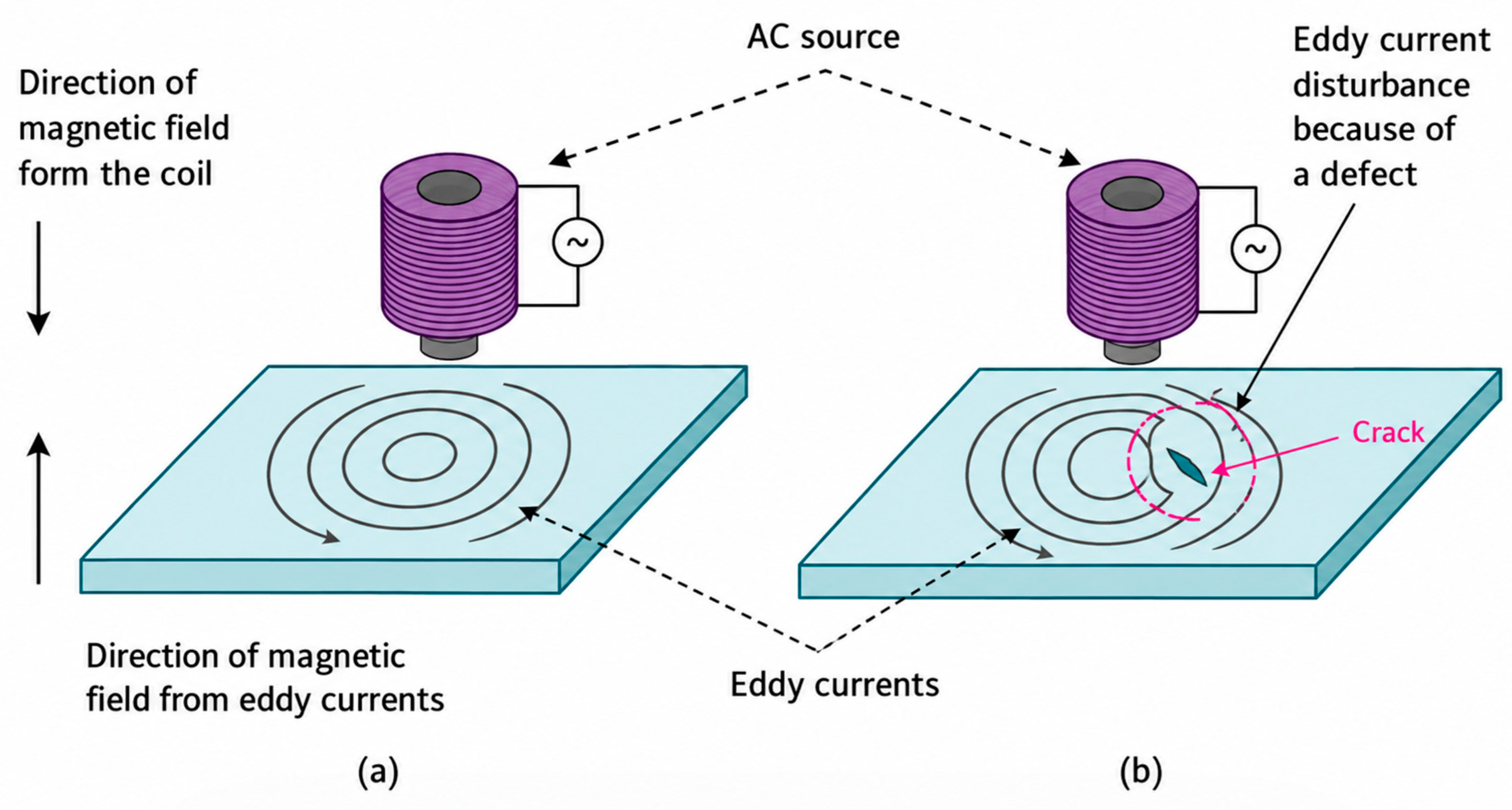
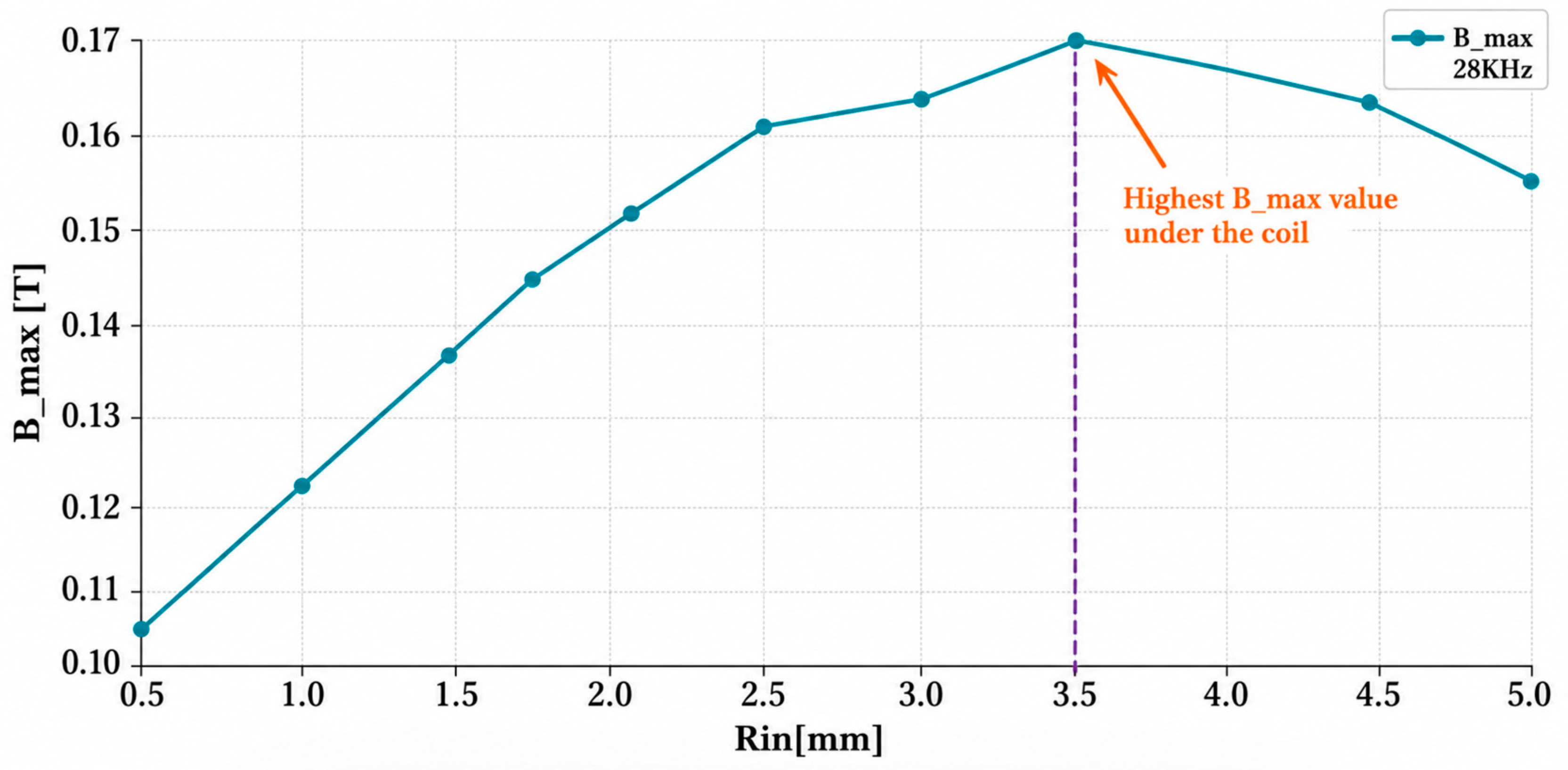
56]. They propose that the ability to detect defects is predominantly dependent on coil geometry and frequency (as dictated by skin depth), and they demonstrate the ability to detect very small features that are very close to the surface (i.e., blind holes in the order of several tenths of millimeters). The main introduction chart is a conceptual representation of how a defect disturbs eddy current flow (
Figure 5), while the design workflow includes a parameter sweep in which the inner radius of the coil is found to influence the magnetic field strength (
Figure 6). Both figures help in describing why a probe design has been selected, rather than confirming that it will work [
56].
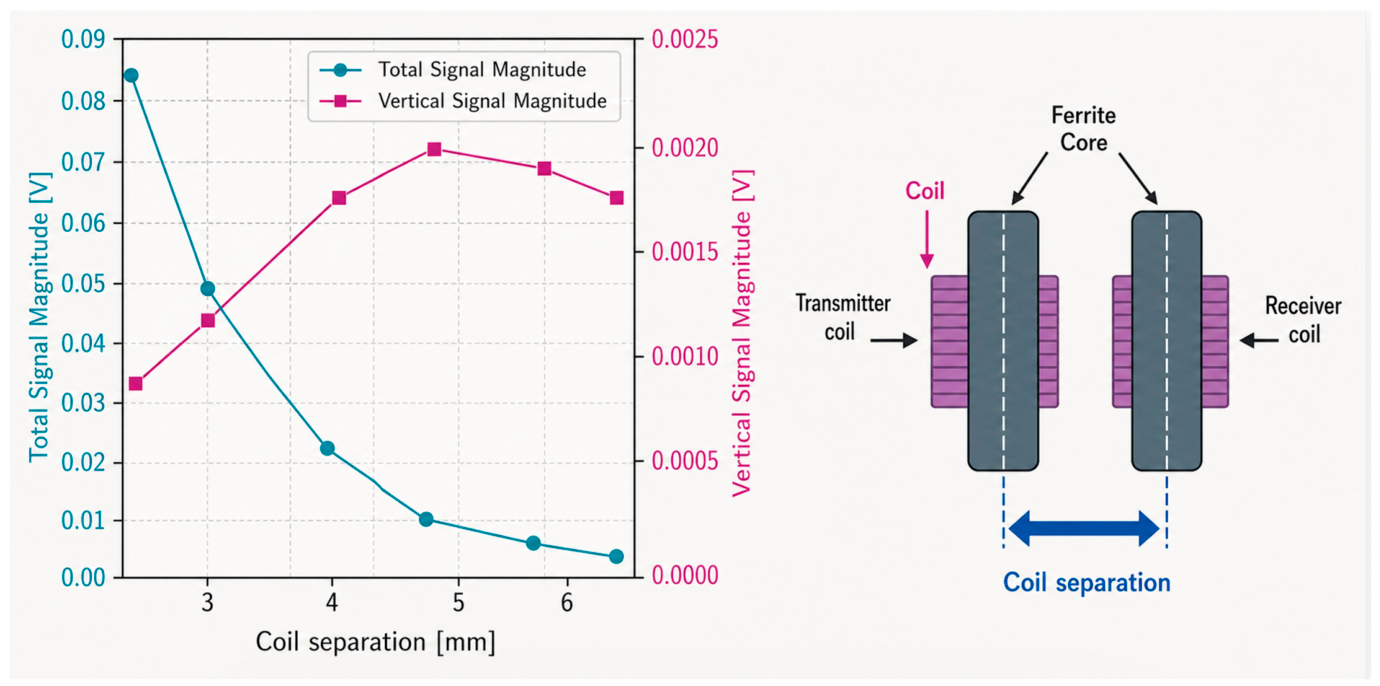
The titanium alloy used in aerospace applications is the focus of another closely related investigation, in which the inspection purpose is to locate voids below the surface of these types of materials as small as a sub-millimeter (mm) in size and close to the surface (<1 mm below the surface). Ref. [
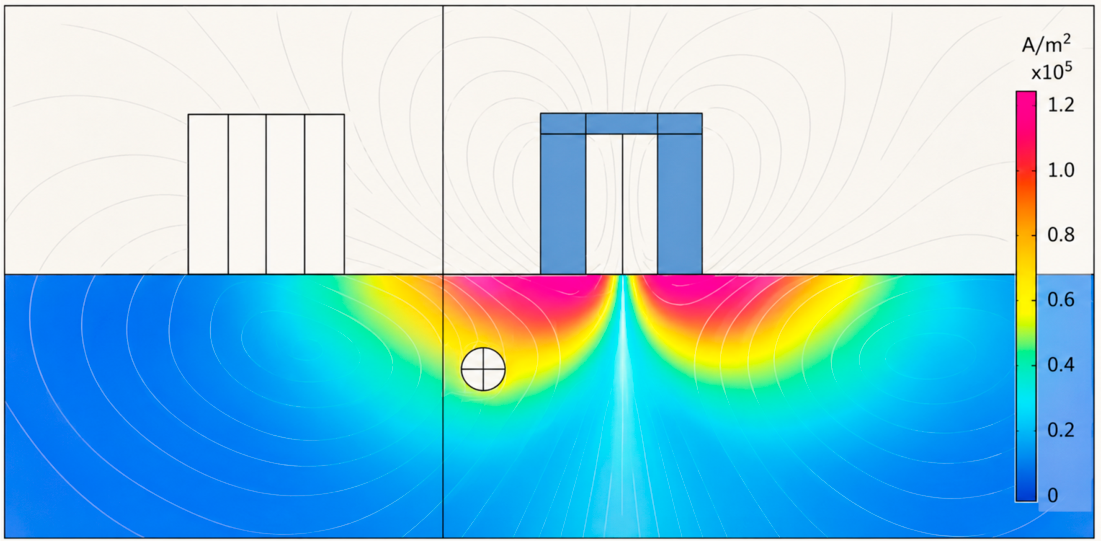
57] created a transmit–receive eddy current probe that was guided by finite element analysis (FEA) and tested on additively manufactured Ti-5V-5Al-5Mo-3Cr parts. The authors defined their design challenge as being to identify 500-micrometer-diameter flaws that are located approximately one millimeter into the sample material. The authors found that the transmitted eddy current probe could detect a significant number of the void defects around which the eddy currents were created. In addition, there are some practical limits that limit detectable voids: if the defect is located near the edge of the probe, there are problems associated with the loss of detection signal caused by a rough manufacturing surface finish. The use of multiple frequencies of excitation signal improves the S/N ratio for voids located on rough surfaces. Halliday et al. show that the design rationale developed with the aid of FEA provides a quantitative approach to correlating defect geometry with coil response (
Figure 7) and present visual examples of how eddy current, along with eddy current density, surrounding a void measured in terms of radius from the edge of the void and depth from the surface of the material can be tested (
Figure 8) [
57].
In addition to using electromagnetic methods for “probe-over-part” inspection, they are now being employed to evaluate feedstock quality and material state for metals used in AM. For example, in a recent study by [
58], it was shown how eddy current measurements could be used to determine the ferritic content of reused batches of 316L powder. The researchers designed a new container that would allow the measurements to be made on practical batch sizes. This is significant for AG/QA because reusing powder can alter both its magnetic and phase constituent properties and therefore can impact performance and the repeatability of the AM process. The authors further emphasized how the measurement signals were, in the frequency range studied, not significantly impacted by the presence of oxides, thus providing greater relevance to the practical use of these types of measurements [
58]. Within the last five years, the use of broader electromagnetic NDT methods has included the use of magnetic Barkhausen Noise Analysis (BNA) to establish any link between microstructure and residual stress within the material. In a recent study by Staub et al., the researchers evaluated BNA as a means of investigating LPBF maraging steel and performed a thorough evaluation of how BNA data could be used as a means to relate process parameters and the evolution of the residual stress state of the material, suggesting the potential that BNA could be a valuable electromagnetic tool for qualifying AM processes and providing a screening method for stress-related properties [
59].
Monu et al.’s review ties together the above trends in their groupings of applications for eddy current which range from in situ monitoring (sensing integrated within the process) and density proxies, to ex situ inspection (surface defects that are near to the surface, as well as geometry-related effects), and finally, to open challenges (surface condition of the part, calibration transferability across machines/alloys, the impact of eddy current on temperature and microstructure, and the development of a pathway for standardization). This review will be very helpful in creating an introduction or “research gap” for a grant proposal or manuscript [
60]. All these mutually complementary NDT methods allow for the building of inspection strategies that work at multiple scales and stages, leading to a very substantial increase in the identification of metal AM manufactured part defects, understanding of the processes, and their qualification for safety-critical applications.
5. Data Analytics and Digitalization in AM Quality Control
5.1. Image and Signal Processing Techniques
Advanced NDT (non-destructive testing) methods, when used on metal additive manufacturing (AM), result in massive, varied, and complex datasets. In these datasets, the information about defects is not easily visible or understandable directly from the raw data. The process of building up the material layer by layer, the complex shapes, the rough surface finish, and the strong microstructural anisotropy (directional dependence of properties) of the metal AM product are factors that significantly reduce the signal quality. These factors lower the signal-to-noise ratio (SNR), cause the defect to be morphologically distorted, and introduce systematic bias in defect sizing. Hence, the detection of defects and their characterization in a reliable manner largely depends on robust image and signal processing techniques that can transform raw NDT data into quantitative defect descriptors. These descriptors can be used for component qualification and for assessing the structural integrity of the component [
34,
61].
Also, the conditions of industrial inspections bring trade-offs among inspection volume, acquisition time, and spatial or temporal resolution. For example, in X-ray computed tomography (XCT), if you increase the scan volume or the size of the part, that means the voxel dimensions have to be bigger, which can hide small defect features down to the voxel size and decrease the probability of detection (POD). Similarly, ultrasonic and acoustic-based inspections face challenges where scattering, attenuation, and mode conversion further make the interpretation of the raw signals difficult. Along with these, these constraints require very advanced processing methods to successfully get the defect-related parameters from complex and noisy NDT datasets [
62].
5.1.1. Nature of NDT Data in Metal AM
Typically, XCT produces 3D volumetric datasets made up of voxels whose gray-scale intensities represent the local X-ray attenuation coefficients. These datasets offer ways to visualize internally and non-destructively, as well as quantitatively assess internal defects such as pores and lack of fusion (LoF), as well as keyhole-type feature identification with spatial resolutions that range from sub-micrometers to several tens of micrometers depending on part size, material density and acquisition parameters. Nonetheless, XCT image quality is fundamentally limited by the resolution–volume trade-off, that is, where a bigger component size or density leads to a coarser voxel resolution and lower contrast, especially for thin or irregular defect features.
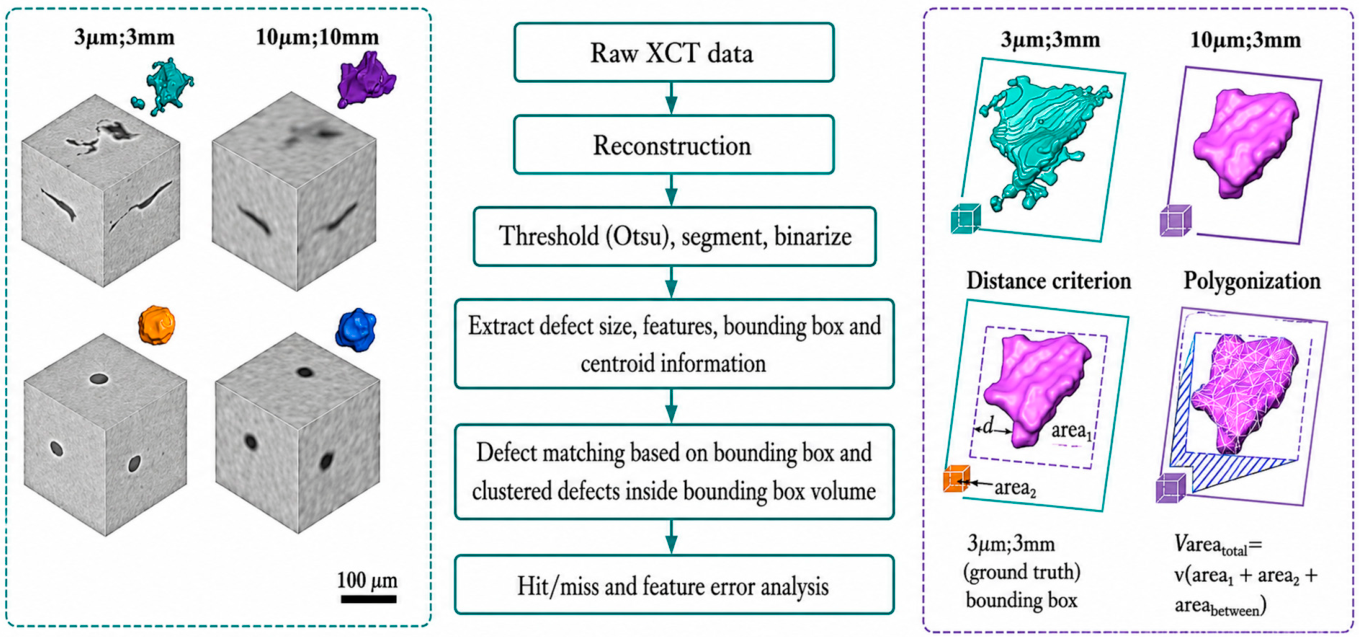
Figure 9 depicts the XCT image processing workflow from reconstruction to defect matching for POD and feature error evaluation [
62].
The primary signal type produced through ultrasonic testing (UT) is a time-domain signal recorded as an A-scan. These signals may be assembled together spatially to generate composite representations known as B- and C-scans. In the case of components produced using the metal additive manufacturing (AM) process, ultrasonic wave propagation is affected by microstructural heterogeneity induced by the process, crystallographic anisotropy resulting from the process, and gradients in residual stresses. These phenomena create greater scattering of ultrasonic waves and increased attenuation of ultrasonic signals compared with conventional manufacturing, which in turn produces lower signal-to-noise ratios (SNRs) and makes it more difficult to discriminate between defects than with conventional manufacturing methods, particularly when using in situ or high-temperature inspection techniques [
13,
62]. Thermal infrared (IR) thermography produces transient thermal field datasets that reflect temperature changes on the surface or just underneath due to heat being added externally or internally. The ability of thermography to detect defects is limited by heat diffusing away from a defect and the thermal properties of the material being inspected. Therefore, previous experimental investigations have shown that when using typical pulsed thermography configurations applied to AM, defects that are less than approximately 1 mm to 1.5 mm may not be detected [
61].
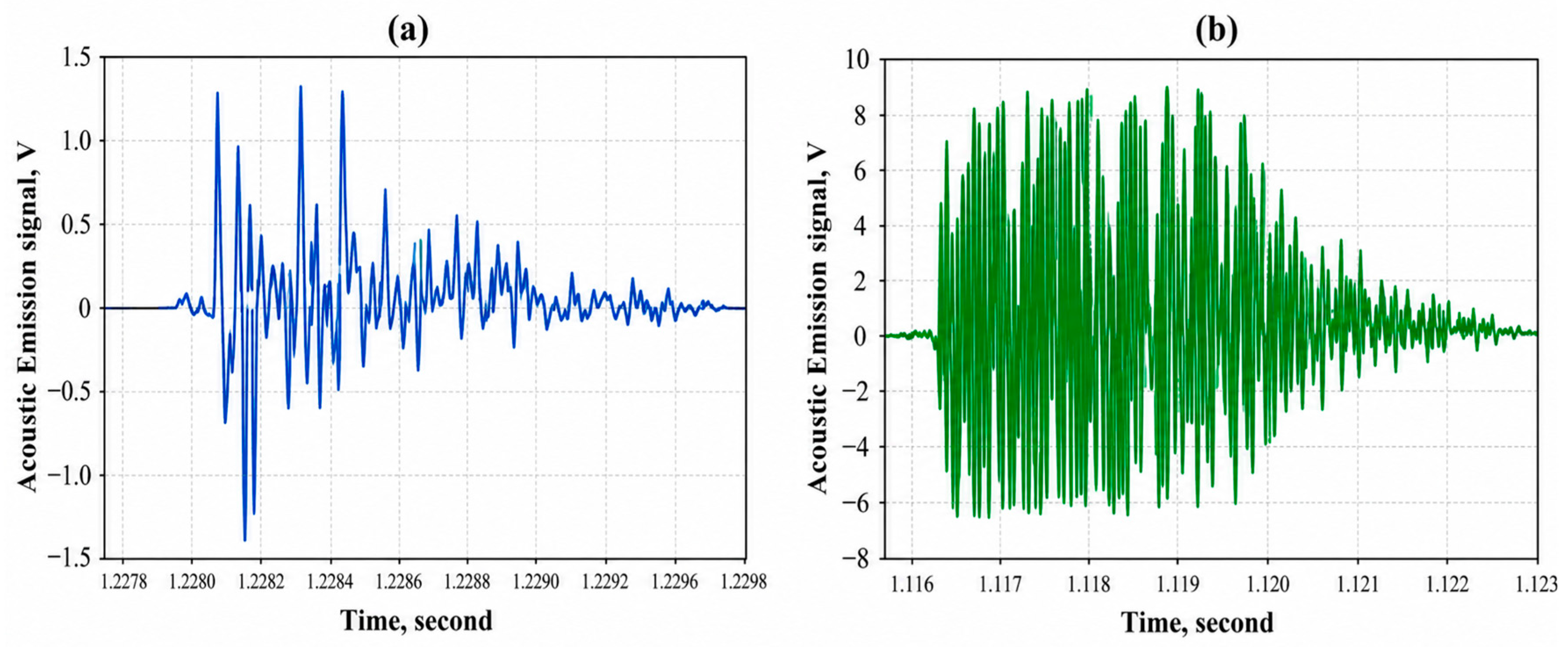
Acoustic emission (AE) monitoring produces high-frequency waveform data linked to sudden energy release events like crack initiation, plastic deformation, and lack-of-fusion formation during the AM process, etc. Indeed, AE is well matched for real-time monitoring applications; however, the generated data streams are highly non-stationary and easily contaminated by background noise, which calls for sophisticated signal processing techniques to enable meaningful defect-related interpretation.
Figure 10 shows sample acoustic emission waveforms published by Lyu et al. (2022) displaying the unique signal characteristics of pore-related and crack-related occurrences during laser metal deposition [
61]. In summary, the wide diversity of NDT data types in metal AM including volumetric XCT images, time-domain ultrasonic signals, transient thermal fields, and high-frequency AE waveforms emphasizes the inherent complexity of AM inspection data and underscores the need for advanced image and signal processing techniques to enable consistent and quantitative defect characterization across modalities [
35,
61].
5.1.2. Image Processing for XCT-Based Defect Detection
Image segmentation represents a central challenge in XCT-based defect analysis. Threshold-based segmentation methods are widely employed due to their computational simplicity but are highly sensitive to voxel size, noise level, and operator-selected threshold values. Region-growing and morphological operations are often applied to refine segmented defect regions; however, these approaches may still inadequately represent complex defect geometries. Experimental studies have demonstrated that thin interconnecting ligaments in LoF defects may be entirely lost when voxel dimensions approach the minimum defect thickness, resulting in substantial underestimation of defect size or complete missed detection [
62]. Quantitative defect characterization using XCT typically involves metrics such as porosity volume fraction, pore or defect size distributions, and shape descriptors including sphericity and aspect ratio. Beyond these quantitative metrics, XCT offers several distinct advantages for additive manufacturing. Unlike traditional cross-sectional microscopy, XCT is non-destructive, allowing for the subsequent mechanical testing or functional use of the inspected part. A primary advantage is its ability to visualize internal features and complex cooling channels that are inaccessible to other NDT methods. Furthermore, it enables nominal–actual comparisons, where the reconstructed 3D volume is overlaid with the original CAD model to evaluate dimensional accuracy and part distortion. Most importantly, XCT provides the spatial location and clustering information of defects; understanding whether pores are concentrated near the surface or distributed in the bulk is essential for predicting the fatigue behavior and long-term reliability of the component [
64]. While near-spherical gas-induced pores are relatively insensitive to moderate resolution degradation, irregular LoF defects exhibit pronounced sensitivity to voxel size and scan resolution. Comparative investigations show that reducing voxel size from approximately 10 µm to 3 µm significantly improves POD and sizing accuracy for irregular defects, whereas coarser scans may artificially fragment a single LoF defect into multiple smaller features or eliminate thin ligaments altogether [
62].
Relative to conventional cast materials, defect populations in AM components are highly anisotropic, process-dependent, and spatially correlated with melt-pool dynamics. This increased complexity renders XCT image processing for AM significantly more challenging, as assumptions of defect regularity or isotropy are often invalid, thereby necessitating carefully designed processing workflows to avoid non-conservative defect assessment [
35].
Raw XCT datasets typically contain noise and beam-hardening artifacts, as well as reconstruction-induced distortions that must be mitigated prior to defect analysis. As illustrated in
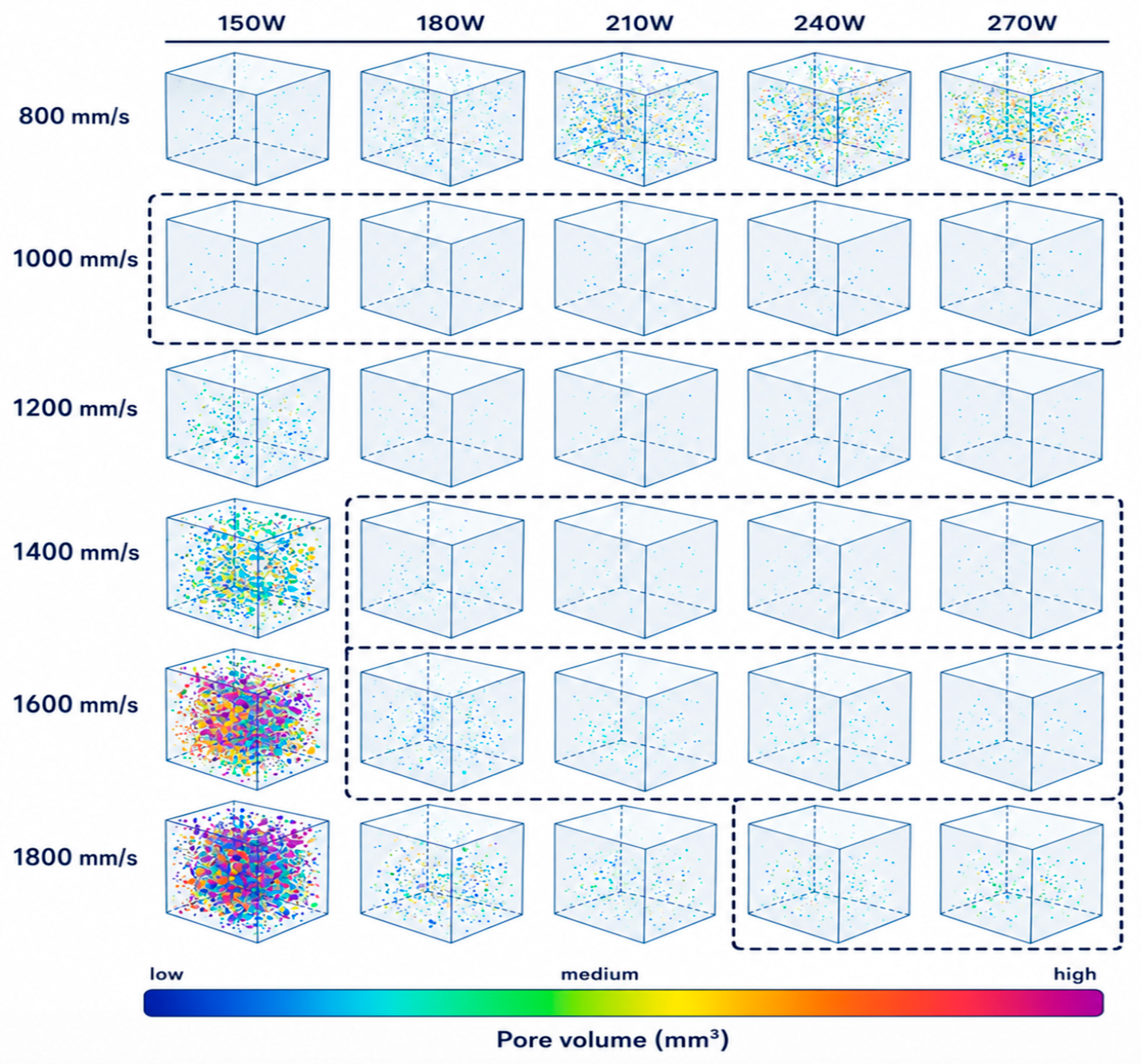
Figure 11, XCT reconstructions of Ti-6Al-4V samples produced under different laser power conditions exhibit pronounced variations in density distribution and pore volume, highlighting the sensitivity of defect representation to reconstruction quality and processing conditions. Common preprocessing steps include spatial filtering, gray-value normalization, and beam-hardening correction to enhance contrast and suppress false segmentation at material void interfaces. These procedures are particularly important for dense alloys such as Inconel 718 and Ti-6Al-4V, where strong X-ray attenuation gradients are known to amplify noise and significantly bias defect detection in the absence of correction [
65].
5.1.3. Signal Processing for UT and AE
Ultrasonic and acoustic emission inspection of metal additive manufacturing (AM) components requires signal processing because of their inherently low signal-to-noise ratio and the non-stationary character of the data being acquired. In order to decompose ultrasonic signals into frequency components that correspond to the material’s microstructure and defect interactions, rapid Fourier transformation (FFT) and wavelet transformation are two time–frequency analysis techniques typically employed. The use of wavelet-based methods makes it easier to analyze transient ultrasonic signals produced by scattering and mode conversion in the AM microstructure [
61,
66]. The feature extraction procedure applied when analyzing processed signals typically utilizes characteristics such as signal amplitude, energy content, time-of-flight, and frequency band characteristics to identify and localize defects, size defects, and create 2D and 3D pseudo images (B-scan and C-scan). Recent work indicates that advanced techniques such as variational mode decomposition (VMD) can provide significantly improved signal-to-noise ratios (SNRs) when compared to conventional wavelet-based techniques, therefore improving the visibility of defects in AM components in laser ultrasonic inspection results [
66]. The factors affecting the ultrasonic performance of a metal AM component are the microstructural anisotropy, the presence of residual stress gradients, and the rough condition of the surface. Each of these will contribute to an enhancement of ultrasonic attenuation and scattering effects. The contribution of these issues will be even more evident during real-time monitoring due to the elevated temperature of the workpiece [
13,
61].
5.1.4. Limitations of Conventional Processing
Despite significant advances, conventional image and signal processing pipelines within AM-related NDT remain subject to be affected by several limitations. In XCT analysis, manual threshold selection introduces strong operator dependence, leading to considerable variability in defect sizing and POD, particularly when defect dimensions approach voxel resolution. Similar subjectivity arises in ultrasonic signal interpretation through the selection of filtering parameters and feature thresholds [
61,
62].
Another problem is the scalability factor. Industrial XCT inspection of big AM parts is restricted by the fact that scans take time and require a lot of computations; on the other hand, sophisticated ultrasonic imaging methods such as phased array and total focusing require a lot of processing power which might hamper their real-time applicability. Altogether, these limitations prevent the large-scale implementation of fully quantitative and automated NDT workflows in large-scale AM production facilities [
13]. In summary, the sensitivity of traditional processing methods to user-defined parameters, the limited ability of these methods to deal with AM-specific defect morphologies, and the lack of scalability make the case for exploring more automated and data-driven approaches which will be presented in the following parts of this review [
35].
5.2. Machine Learning Applications in AM–NDT
The constraints associated with conventional image and signal processing approaches discussed in
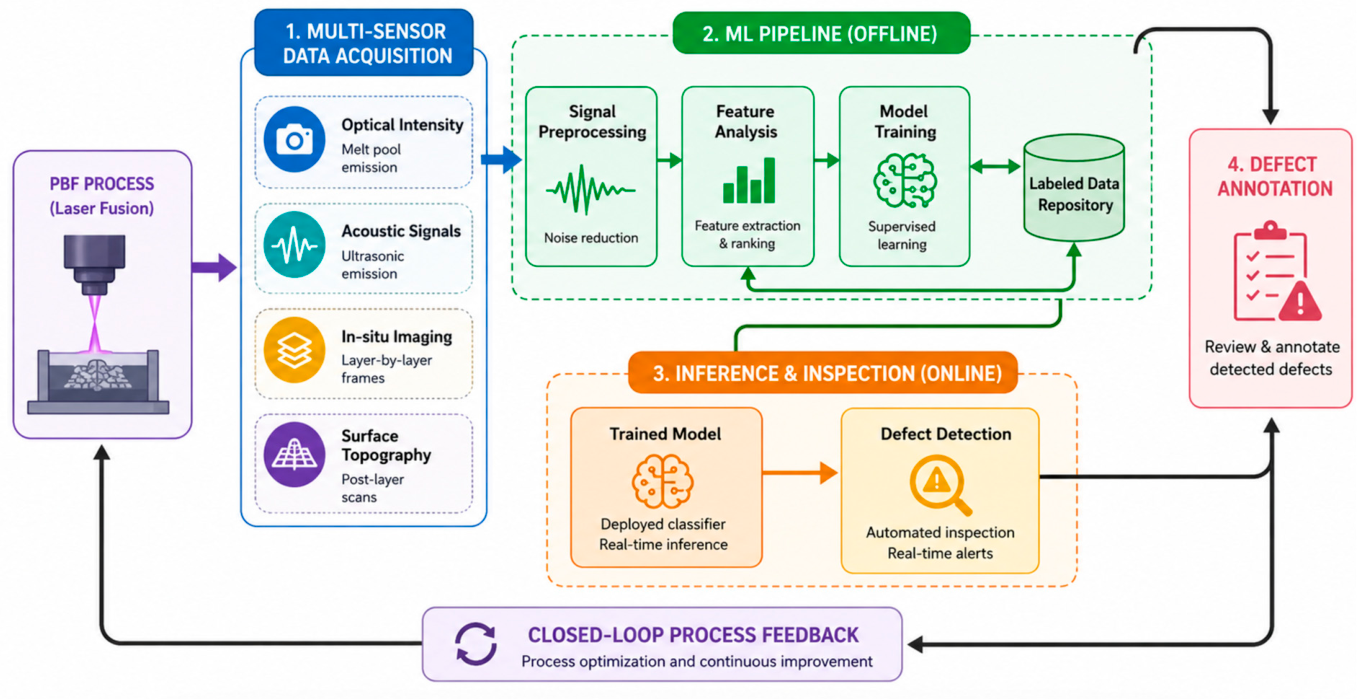
Section 5.1, including dependence on user-defined parameters, limited scalability, and insufficient robustness to complex defect morphologies, have driven increasing interest in machine learning techniques for additive manufacturing non-destructive testing (AM-NDT). As shown schematically in
Figure 12, ML-based AM-NDT frameworks integrate heterogeneous in situ sensor data across multiple scales through data preparation, feature extraction, and learning-based modeling to enable automated defect labeling and feedback-driven quality control. ML methods enable automated extraction of discriminative patterns from high-dimensional NDT datasets and support scalable, data-driven inspection workflows capable of managing the volume and heterogeneity of XCT, ultrasonic, thermal, and in situ monitoring data generated in metal AM processes. By capturing nonlinear relationships among process signatures and defect characteristics, ML-based approaches reduce reliance on the use of heuristic rules and manual interpretation, consequently enhancing consistency, objectivity, and repeatability [
67,
68].
5.2.1. Motivation for ML in AM–NDT
Metal AM processes produce large-scale datasets derived from both ex situ inspection and in situ monitoring systems. Ex situ techniques such as XCT generate volumetric datasets containing millions of voxels, while in situ sensors capture melt-pool emissions, layer-wise thermal images, acoustic signals, and optical signatures at high temporal resolution. Manual analysis of such datasets is impractical and prone to operator bias, especially when defect morphologies overlap and alternately evolve gradually across successive layers [
69]. ML techniques overcome these challenges by enabling automated defect classification, which directly enhances the final accuracy by mitigating operator-induced variability and subjective interpretation errors. This shift from manual to automated analysis provides a substantial statistical enhancement in the reproducibility of NDT results. Furthermore, deep learning-based pipelines—such as convolutional neural networks (CNNs)—are capable of processing high-dimensional data at scales impossible for human inspectors, significantly improving the probability of detection (PoD) while maintaining a low False Call Rate (FCR). By leveraging these models, quality assurance transitions from a qualitative assessment to a probabilistic and evidence-based framework, providing a more rigorous statistical foundation for part certification in metal AM. In addition, ML-based frameworks facilitate the integration of multi-sensor data streams, which is increasingly necessary for closed-loop quality control as well as adaptive process optimization in industrial AM environments [
68].
5.2.2. Supervised Learning for Defect Classification
Supervised learning methods represent one of the most established ML paradigms in AM NDT and the primary goal for defect classification tasks where labeled datasets are available. Typical input features include image-based descriptors extracted from XCT or optical data, for example, pore size, sphericity, aspect ratio, and texture metrics, in addition to signal-based features derived from ultrasonic, acoustic emission, or spectroscopic measurements, encompassing frequency-domain energy, attenuation characteristics, and statistical descriptors. Classical algorithms, including support vector machines (SVMs), random forest classifiers, and k-nearest neighbor (k-NN) methods, have shown strong performance for distinguishing defect types, for instance, gas porosity, lack-of-fusion defects, and keyhole-induced voids [
70].
For instance, ML-enhanced XCT frameworks have shown that incorporating defect morphology descriptors into supervised classifiers can significantly improve volumetric defect classification accuracy while reducing inspection time by exploiting lower-resolution XCT data. Likewise, studies involving spectroscopic and ultrasonic NDT have reported classification accuracy exceeding 95% when supervised ML models are trained with selected signal features. These methods are highly suitable for accepting and rejecting decision-making in industrial inspection scenarios, where interpretability as well as limited labeled data are critical considerations [
71,
72].
5.2.3. Deep Learning for Image-Based NDT
Deep learning (DL), particularly convolutional neural networks (CNNs), has emerged as a powerful tool in AM-NDT regarding its ability to learn hierarchical feature representations directly from raw image and signal data. As depicted in
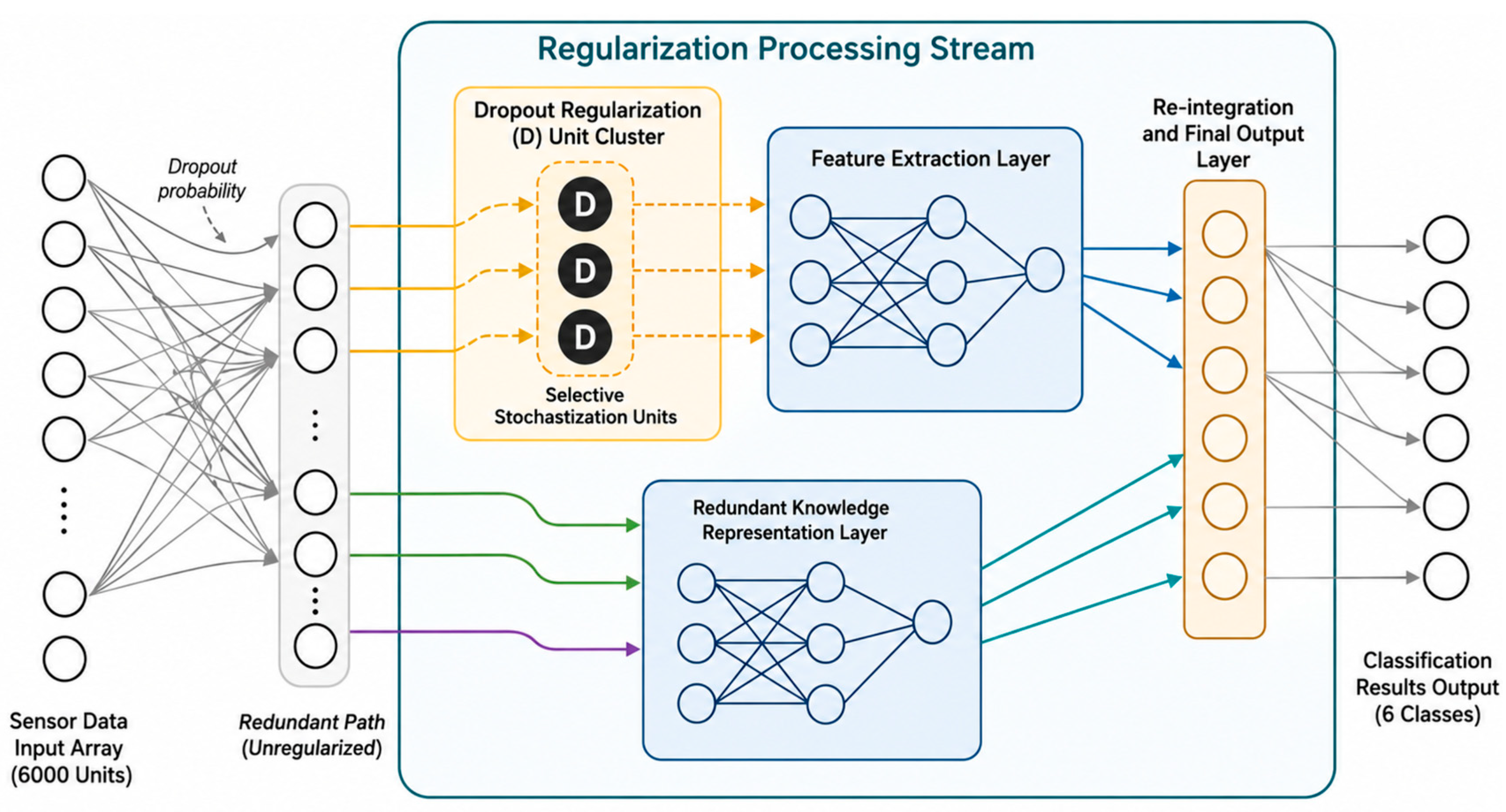
Figure 13 and summarized in
Table 3, the adopted DNN architecture consists of a high-dimensional input layer followed by multiple fully connected hidden layers incorporating dropout regularization, together with optimized learning parameters (e.g., learning rate and cost function), to achieve robust feature abstraction and defect classification in image-based NDT applications. CNN-based models have been successfully applied to XCT slices for automated pore detection, ultrasonic C-scan images for subsurface defect identification, and thermographic image sequences for monitoring melt-pool stability and thermal anomalies. Compared with traditional ML approaches, DL methods eliminate the need for manual feature engineering and are well suited for enabling the capture of complex spatial correlations associated with irregular defect morphologies in AM components [
72].
Notwithstanding these advantages, DL approaches introduce new challenges, such as the requirement for large, well annotated training datasets and significant computational resources for model training as well as inference. Labeling volumetric XCT data and high-frequency in situ image streams remains labor-intensive, and class imbalance can adversely affect model performance. Nevertheless, recent investigations demonstrate that DL-based reconstruction and enhancement techniques can substantially accelerate XCT inspection while preserving defect detectability, thereby improving scalability for industrial deployment [
73].
5.2.4. Machine Learning for In Situ Monitoring
Beyond the scope of post-build inspection, ML plays a critical role in in situ monitoring of metal AM processes. Real-time data streams from melt-pool sensors, layer-wise thermal cameras, acoustic emission systems, and optical monitoring platforms provide continuous indicators of process stability as well as defect formation [
67]. ML models trained on these signals have been applied to early defect prediction, anomaly detection, and process parameter optimization throughout fabrication. Recent and ongoing review studies demonstrate that ML-based monitoring frameworks are capable of identifying process deviations related to phenomena, for instance, balling, lack of fusion, and keyhole instability, before defects become embedded in the final component. By correlating sensor signatures with build quality metrics, these approaches enable adaptive control strategies designed to mitigate defect formation [
68,
74]. These capabilities are essential for achieving closed-loop quality assurance and improving first-time-right manufacturing throughout safety-critical AM applications.
5.2.5. Challenges and Reliability Concerns
Despite many improvements, there are still numerous reasons why industries would be reluctant to adopt ML-based AM-NDT systems at a broader scale. In
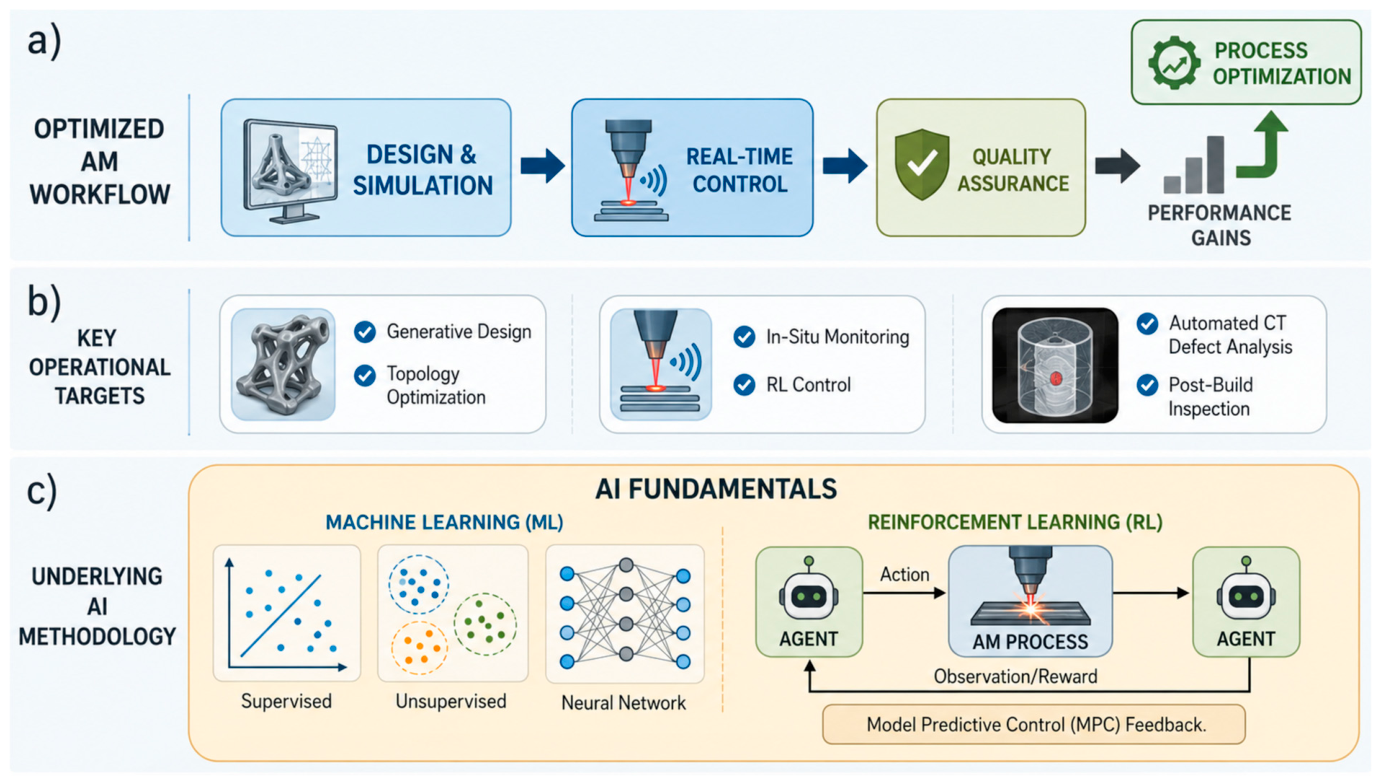
Figure 14, these reasons are presented as challenges in each step of the ML-based AM workflow, including data preprocessing, in situ defect detection with different sensing modalities, quality assessment after the process, and reinforcement learning-based control of the manufacturing process with the help of a feedback loop; meanwhile, at the same time, reliability, interpretability, and certification-related issues remain. The generalization of models over different machines, materials, and operating parameter spaces is one of the biggest problems because models that are trained on limited or very specific datasets typically overfit and perform unreliably when faced with new conditions that have never been seen before. In addition to this, certification and validation in highly regulated sectors require the decision to be transparent and explainable, and this is very hard to do when using black-box deep learning models. Also, there is a variation brought about by defects in data quality, inconsistency in sensor calibration, and the lack of common benchmark datasets for systematic evaluation of ML algorithms. Addressing such issues entails well-designed validation methods, physics-based ML frameworks, and hybrid methods that combine domain knowledge with data-driven learning, thereby improving reliability, interpretability, and trustworthiness in AM-NDT applications [
68,
74].
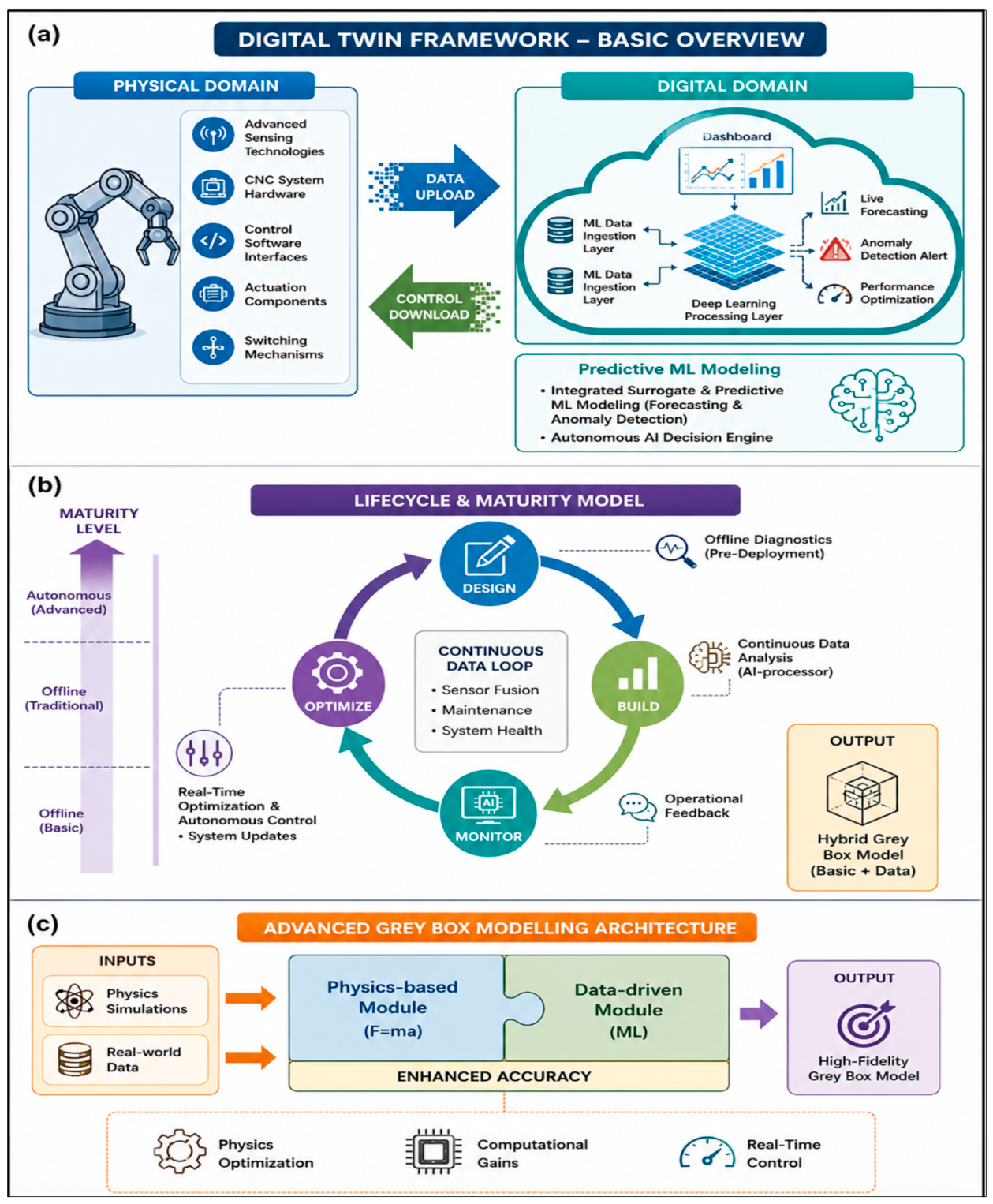
5.3. Digital Twin and Simulation Integration
Digital twin (DT) frameworks are a new way of connecting and linking the physics of the additive manufacturing process, non-destructive testing data from multiple modalities, and predictive simulations as one system in real time via a cyber–physical closed-loop system. The digital twin architecture, as depicted in
Figure 15, allows for real-time bidirectional data transfer between both the physical AM system and its virtual counterpart through the integration of sensor feedback from physical and analytical tools through monitoring and diagnosis to provide closed-loop control down to the part level. Unlike static process models or separate methods for inspection, DTs allow for the continued synchronization of the actual build with its virtual equivalent, enabling evaluations of how the defect evolves, how the process becomes unstable, and how the build quality degrades, all at a part-specific, time-resolved level [
63]. This capability is critical for aerospace and other safety-critical applications, where component qualification demands traceable relationships between process history and internal integrity, as well as structural performance, instead of reliance on post hoc inspection alone [
75,
76].
5.3.1. Concept of Digital Twin in AM Quality Control
In the context of AM quality control, a digital twin is typically defined as a dynamic digital representation of the manufactured component and its production process, continuously updated using data streams from design, sensing, and inspection stages. Compared with conventional CAD models or offline simulations, DTs explicitly integrate (i) component geometry; (ii) process parameters such as laser power, scan speed, and hatch spacing; (iii) evolving thermal history and microstructural state; and (iv) defect initiation and propagation mechanisms within a unified computational framework [
63,
77]. This integrated representation enables prediction of as-built properties rather than nominal design intent.
The literature differentiates between digital models, digital shadows, and full digital twins according to the degree of data connectivity and bidirectional information flow. In AM quality control, a full DT is defined by real-time or near-real-time updating of the virtual model using sensor and inspection data, allowing the digital representation to capture part-specific deviations rather than population-averaged behavior [
76]. This distinction is particularly important for safety critical components, where localized defects and spatial heterogeneity dominate fatigue and fracture behavior.
5.3.2. Integration of NDT Data into Digital Twins
The incorporation of NDT data constitutes the foundation of DT-based quality assessment in metal AM. XCT is widely employed to populate digital twins with high-resolution geometric and porosity information, enabling voxel-level mapping of internal defects, pore morphology, and spatial distribution. These datasets are commonly used to calibrate, validate, or update DT predictions of internal quality, particularly for lack-of-fusion and keyhole-induced porosity [
75]. Ultrasonic testing (UT) and other volumetric NDT techniques are increasingly integrated to complement XCT, especially for large or geometrically complex components where XCT inspection volume or resolution becomes impractical [
78]. UT-based defect characterization provides additional constraints for DT updating by linking signal attenuation, reflection behavior, or velocity changes to internal flaw populations.
In situ monitoring data including optical, infrared, acoustic, and melt-pool sensing enable real-time updating of DT states during fabrication. Multi-sensor data fusion strategies have demonstrated that correlating in situ sensor features with spatial build coordinates allows DTs to generate localized quality maps throughout the component volume, reducing dependence on destructive validation [
79]. In such frameworks, the DT operates within a feedback loop defined by printing → monitoring → NDT → digital twin updating → process correction, enabling adaptive parameter control and early defect mitigation rather than post-process rejection [
80].
5.3.3. Predictive Quality Assessment
A principal advantage of DT integration is its ability to support predictive quality assessment by coupling inspection data with physics-based or surrogate models to estimate performance-critical properties. Residual stress prediction represents one of the most extensively investigated applications, as thermal gradients and solidification dynamics strongly influence distortion, cracking susceptibility, and dimensional accuracy in metal AM. DT frameworks allow residual stress predictions to be continuously refined through the incorporation of in situ thermal measurements and post-build validation data [
80].
Fatigue life estimation represents one of the most critical applications of DT in metal AM, particularly for aerospace components, where stringent safety requirements and the dominant role of internal defects in governing crack initiation behavior make accurate life prediction essential. By embedding defect descriptors derived from XCT or UT into DT, fatigue models can be updated to reflect part-specific defect populations instead of conservative, design-level assumptions [
78]. This capability is especially relevant for aerospace structures, where overly conservative design margins directly translate into weight and performance penalties, and where part-specific qualification can yield substantial benefits. Probabilistic DT formulations further extend this capability by accounting for model uncertainty and process variability, as well as measurement noise, consequently enabling uncertainty-aware qualification and risk-informed decision-making [
81]. From a certification standpoint, and particularly within the highly regulated aerospace sector, DT-enabled predictive assessment supports a transition from purely inspection-driven qualification toward evidence-based certification, in which traceable links among process history, defect evolution, and predicted performance are maintained throughout the component lifecycle [
75].
5.3.4. Current Limitations and Research Gaps
Despite successful progress, several challenges continue to limit the industrial implementation of DT-enabled AM quality control. High computational cost remains a primary barrier, particularly for high-fidelity thermo-mechanical or microstructure-resolved simulations required for accurate DT updating [
63]. Although surrogate and decreased-order models can reduce this burden, their generalizability across different machines, materials, and geometries remains insufficiently validated. The absence of standardized data formats and interoperable data models represents an additional obstacle. Integrating heterogeneous datasets from in situ sensors, XCT, UT, and process logs into a unified DT architecture is largely application-specific, constraining scalability and cross-platform adoption [
82]. Furthermore, the availability of large, high-quality validation datasets is limited, especially for safety-critical aerospace components. Many DT demonstrations rely on laboratory-scale specimens, whereas full-scale components introduce increased inspection complexity and signal degradation [
78]. Finally, certification acceptance remains an open challenge, as regulatory frameworks have yet to fully incorporate DT-based evidence into formal qualification pathways, demonstrating the need for continued collaboration among researchers, industry stakeholders, and certification authorities [
76].
6. Industrial Implementations and Case Studies
During the past decade, there has been noticeable movement from the experimental stage of additive manufacturing in the aerospace and large energy sectors into the development and use of functional components. Throughout the process of non-destructive testing, there must be a non-destructive means of quality control. The approach utilized in the development and use of metallic additive manufacturing represents the power of advanced inspection systems in the integration process. One such example would be GE Aviation, where the fuel nozzles in the Leap aircraft engine are made using the additive manufacturing process. Here, instead of using a single inspection process, GE has adopted an end-to-end, multi-layer inspection process [
83]. In this process, the melting pool and temperatures are compared between the old and the now-used process, and any changes in movement, which could mean a problem, are recorded. CT scans are used in the process, whereby the performance inside the nozzle, focusing on the fuel flow channels designed in jet engines, is evaluated. Some internal aspects, in this case fuel flow, cannot be accurately measured using other tools, and the CT scans help verify the integrity and the lack of grouping in porosity, which means the clusters, though critical, are important overall. The combination of all the inspection tools would help cut the scrap re-acceptance rate and would help the fuel nozzles meet the same quality characteristics as the conventional fuel nozzles. The GE’s additive division has successfully utilized CT scanning and real-time melt-pool monitoring to produce large structural brackets and heat-exchange components. As outlined in GE additive’s industry reports, some additive manufacturing heat-exchanger passages exhibited early signs of uneven powder distribution, identified through layer-by-layer thermal monitoring. Upon comparing this data with CT scan findings, the quality assurance team confirmed the presence of minor porosity clusters within the internal channels. This combined inspection approach enabled GE to modify laser exposure settings and lower the occurrence of internal defects in subsequent builds [
83].
Airbus has adopted the same process and workflow when the production increases. In the field of airlifts and defense transportation, Airbus prints components like brackets and bespoke parts with thin ribs and complex organismic geometries and/or lattice structures, important in terms of reducing the weight and at the same time maintaining the aircraft integrity. The high-resolution CT scans are utilized in the product testing and are also employed in the back loop in the design process. The designers make use of the computer-aided design process and CT scans to analyze the effect of the heat dissipation changes on the geometrics. Airbus utilizes monitoring systems, measuring heat radiation from the laser energy and then making a comparison among the different layers to detect discrepancies in the production process [
84]. Airbus, an aerospace company, maintains the process traces in the form of digital traces and then applies the results in the scaled model [
85].
Lu & Wong (2017) [
18] state that Airbus has started additive manufacturing for cabin brackets, interior wing mounts, and bespoke structural fittings. Airbus applied advanced CT scanning and thermal monitoring not only to find defects but also as part of a design feedback loop. Specifically, in one extensive analysis, it was found that the CT scans highlighted anomalies in heat dispersion across thin ribbed units. Consequently, it was found that engineers modified their CAD designs and laser energy input, demonstrating how inspection results could create redesigns or improvement, not simply act as a post-processing step in the process of manufacture.
Rolls-Royce has a reputation for having comprehensive testing procedures in place for turbine blades and engine components. Metal turbine blades undergo rigorous stress and temperature variations, and any minute flaws can cause the component’s lifespan to be reduced. Rolls-Royce takes a blend of CT scans, ultrasonic testing, and eddy scans together to identify micro-cracks and thickness differences. On the other hand, they also combine the inspection results with simulations to create virtual models, also referred to as twins, in an exercise that enables the company to predict the performance of undetected flaws in real time, as Lu & Wong (2018) reported in [
84]. In general, there appears to be a trend where a single technology alone is no longer sufficient. An increasingly substantial number of companies are adopting multi-layer quality assurance strategies that integrate real-time measurements, real-time images, and simulations. Improved inspection technologies increase the strength and viability of additive manufacturing’s suitability in the development and manufacture of high-quality and reliable components fit for high-risk sectors. There now appears in the industry to be a definitive recognition that advanced NDT has ceased to be an additive technology and has become an essential prerequisite in the continued development of additive metal technologies.
Wu et al. (2024) discuss why multi-technology inspections of this class are applied by turbine manufacturers such as Rolls-Royce to their rotating parts. A few small discrepancies in the thickness of a cooling passage on the walls of turbine blades that had not been caught initially by CT scans were discovered using ultrasonic testing, the company said. Through Eddy Current Mapping, Rolls Royce was able to develop a comprehensive internal defect profile which they could then use to improve the accuracy of their predictive digital twin simulations [
78].
7. Challenges, Gaps, and Future Directions
Even though there have been huge advances, some critical problems that limit the quick certification and use of additive manufacturing in the aerospace and energy industry persist. One challenge that has emerged is striking a balance between the resolution level and the inspection speed. A CT scan remains the most useful method for scanning internal structures, but high-resolution scans on high-density metal parts could require several hours to complete. Technologies for rapid scans exist, albeit at the expense of resolution, and ultrasonic or thermographic scans could evaluate the surface and internal structure much more quickly, though the resolution would depend on component complexity including the complex channels and lattice structure of the component [
86]. The second of these problems is that of uncontrolled process variability arising from additive manufacturing. Even under favorable conditions, the melted puddle might randomly differ slightly from print to print in temperature, powder distribution, and exposure from the laser. These irregularities could lead to defects like lack of fusion, keyhole porosity and gas entrapment whose development and formation would be unpredictable. And detection tools in situ will spot such examples, leading to a lot of data. The development of processing tools for any such information to produce transparent, reliable and indicative signs about the quality of prints is still in the works. An examination of machine learning based on decoding the signals from the sensors, the performance of which depends on quality and the availability of data not always available in most industries, has already been done [
18]. That process to develop certifications and standards also seems to be a huge gap. The components that are derived from additive technologies cannot fail the way manufacturing would, by casting and forging, but the existing frameworks and regulations are still based on the latter. These government bodies normally request company representatives to test their components and prove that they function under strict conditions.
The acceptance conditions of additive technologies are still not fully developed in some cases, and consequently the engineering designers need to be quite cautious in their inspection conditions. Despite the mentioned limitations, a few promising trends exist in the area that could dramatically alter the quality monitoring process over the next few years. The primary area where a great deal of progress could occur in the coming years is the use of feedback printing models, where AI models predict what goes into the process and determine the power, the path of scans, and the cooling process. In theory, this might prevent defect formation rather than predicting defect formation during building. Finally, the main issue in this field that could lead to tremendous progress in several years is multi-sensor fusion. One area of long-term potential in this space is in the domain of digital traceability. In the future, there will also be the use of blockchain to store the results of the inspection and compare parameters, powder processes, and geometry on each part. The future of metal additive manufacturing systems depends on NDT technologies combined with process understanding. Researchers are now on the path to realizing that, in the medium to long term, metal additive manufacturing systems will help spot and avoid process flaws through continued advances in technology.
8. Discussions
A review of common manufacturing flaws in metal AM products reveals that these flaws are adequately defined by existing publications and standards. The standard ISO/ASTM DTR 52905 separates flaws into typical and non-typical AM categories and additionally suggests how requirements for common AM flaws might be incorporated into current inspection standards, although several aspects still remain to be clearly defined. From the literature assessing NDI approaches for metal AM products, it is evident that the most important factors influencing the viability of NDI techniques are geometrical complexity, defect type, and defect depth. A central observation is that no single inspection technique can address the full range of flaws encountered in metal AM products, which constitutes one of the most critical issues in AM qualification today.
The capacity of metal additive manufacturing to produce intricately shaped components that cannot be manufactured using conventional techniques is one of its main advantages. However, since most traditional NDI approaches require direct access to the region of interest, this geometric freedom simultaneously creates a significant inspectability challenge. This trade-off between design freedom and inspectability is a fundamental limitation that must be addressed at both the design and qualification stages, ideally through a Design-for-Inspection (DfI) philosophy.
Among the available techniques, CT scanning and PCRT stand out as inspection methods capable of detecting defects deep within the material without requiring physical access to the surface. CT scanning is particularly useful for assessing surface quality and identifying voids or porosity in metal AM products. Nevertheless, its detection capability is strongly affected by specimen size, X-ray camera resolution (larger specimens lead to larger voxels and therefore lower resolution), and defect geometry (planar flaws and cracks remain difficult to detect). PCRT, on the other hand, is comparatively simple to implement on small and geometrically complex parts and is well suited for high-volume production scenarios; however, it requires a sufficient number of accepted and rejected reference samples for model training and is unable to localize defects precisely. These limitations highlight the need for complementary, multi-modal inspection strategies rather than reliance on any single method.
Ultrasonic inspection offers deep penetration into metallic materials and is therefore effective for relatively simple geometries, but its applicability becomes restricted as part complexity increases due to the requirement for direct line-of-sight access. Electromagnetic methods can provide precise measurement of surface and subsurface defects, provided that the probe can access the region of interest. Together, these observations underline a critical issue: the inspection capability for metal AM components is currently dictated as much by part geometry and accessibility as by the intrinsic sensitivity of the NDI method itself.
A further critical aspect concerns the rapid advancement of NDI numerical simulation. Commercially available simulation tools now cover ultrasonic, X-ray, eddy current, and thermographic techniques, allowing designers to evaluate, in advance, whether a proposed component can be inspected with the required level of accuracy. Validated simulations can also generate additional data to support probability-of-detection (POD) analyses, thereby reducing the number of physical tests required for certification and strengthening the business case for inspection simulation. Despite this progress, the integration of simulation results into qualification frameworks, together with machine learning, digitalization, and digital twin-based approaches, still requires further standardization and industrial validation. This represents one of the most pressing open challenges for the field.
9. Conclusions
This review examined the current state of non-destructive inspection (NDI) for metal additive manufacturing products, with particular attention paid to defect types, inspection capabilities, and the path toward industrial qualification. The main conclusions can be summarized as follows:
Common AM flaws are reasonably well defined in the literature and standards (notably ISO/ASTM DTR 52905), but the integration of AM-specific defect requirements into existing inspection standards remains incomplete.
No single NDI technique can address the full spectrum of defects in metal AM components; method selection must be guided by geometrical complexity, defect type, and defect depth.
CT scanning and PCRT enable subsurface defect detection without surface access, but each has notable limitations regarding resolution, defect localization, and required reference data.
Ultrasonic and electromagnetic methods remain valuable for accessible geometries, while the geometric freedom of AM continues to challenge their applicability for complex parts.
NDI numerical simulation has matured rapidly and offers significant potential to support inspection design, POD assessment, and certification, particularly when combined with machine learning, digitalization, and digital twin frameworks.
Overall, the future qualification and certification of metal AM components will depend on the convergence of multi-modal NDI, simulation-based inspection design, and digital quality architectures. A clear industrial roadmap is therefore needed, addressing standardized data interoperability, validated ML-based defect characterization, digital twin-based qualification protocols, and alignment with emerging international standards such as ISO/ASTM 52905 and ASTM E3166. Such a coordinated effort is essential to enable robust, scalable, and certifiable inspection of metal AM products in safety-critical industrial applications.




 ,
,