
Article

Effect of Aluminum Powder Agglomeration on the Foaming of Al-TiH2 Bulk Foamable Precursors

Department of Mechanical Engineering, San Diego State University, 5500 Campanile Drive, San Diego, CA 92182, USA
*
Author to whom correspondence should be addressed.
J. Manuf. Mater. Process. 2026, 10(5), 176; https://doi.org/10.3390/jmmp10050176 (registering DOI)
Submission received: 4 May 2026 / Revised: 13 May 2026 / Accepted: 14 May 2026 / Published: 16 May 2026

Abstract

The powder metallurgy route (PM route) for producing aluminum closed-cell foams has recently attracted significant scientific and industrial interest. The process involves mixing a blowing agent powder (e.g., TiH2) with aluminum powder, then compacting the mixture to produce a high-density bulk foamable precursor (BFP). The BFP is then heated above the melting point of aluminum, where the hydrogen released from TiH2 particles forms bubbles in the molten aluminum, which become closed pores (cells) upon solidification. Despite metal powder agglomeration being an important factor in powder metallurgy research that can significantly influence processing, it has surprisingly received little to no attention in the powder-based foaming of metals. To the best of our knowledge, this paper is the first to address aluminum powder agglomeration within the context of powder-based metallic foams. Results show that significant aluminum powder agglomeration not only leads to an inhomogeneous distribution of the TiH2 particles within the BFP, but also to the formation of locally higher than nominal concentrations of TiH2 particle-rich regions, which greatly influence foaming characteristics. The work, for the first time, highlights the need to seriously consider metal-powder agglomeration (even partial agglomeration) in future foaming research via the PM route, and its effect on foaming characteristics.

1. Introduction

Aluminum is considered a lightweight metal due to its low density (2.7 g/cm3). This, together with other properties, makes it suitable for many automotive and aerospace applications [1]. Aluminum foams have an order or even orders of magnitude lower densities, and offer unique properties including shock, energy and sound absorption, buoyancy, thermal insulation, and crash worthiness [2].
Closed-cell metallic foams contain isolated (non-interconnected) pores. The processing of such foams can take place either when the metal is initially in the molten state (the melt route) or when the metal is in powder form (the Powder Metallurgy route, PM route) [3]. The latter was comprehensively reviewed in 2023 by one of the present authors [2], during which a number of yet-to-be-explored research areas were identified. The PM route involves mixing and/or milling the metal powder with a blowing agent powder (i.e., gas-releasing powder), such as titanium dihydride (TiH2), then compacting the powder mixture into a high-density compact called a bulk foamable precursor (BFP) and foaming it in a furnace at a temperature at or above the metal’s melting point [4]. The hydrogen gas released by the blowing agent forms bubbles in the molten metal, which, after solidification, become pores or closed cells, resulting in a closed-cell metallic foam. Recently, one of the authors introduced foamable precursor ‘particles’ rather than BFPs. These particles are considered self-foaming, with powder sizes down to the microscale, which, when used in the PM route, result in aluminum foams with advantageously rounded pores [5,6,7].
Research efforts in the PM route (which have mostly been on aluminum [2]) so far include investigations into the effect of the blowing agent powder type, its particle size, oxide content, and volume fraction on the foaming characteristics, mechanisms of pore formation, pore coalescence, and pore collapse [8,9,10,11,12,13,14]. However, the effect of aluminum powder agglomeration on the foaming behavior of aluminum via the PM route remains surprisingly unexplored. Metal powder agglomeration can not only become an issue as particle size is reduced, but can also occur at least partially in even coarser (>45 µm) metal powder [15]. Since even coarse powders typically have a particle-size distribution, some particles may still be small enough for agglomeration to become a problem, and moisture can cause agglomeration even in coarse powders. This means that many of the studies so far conducted may have involved some degree of metal powder agglomeration, which may have affected the research outcome without being assessed. Since metal powder agglomeration is a well-studied phenomenon in general powder metallurgy research, as it affects processing [15], it follows that it should also be seriously considered in powder-based metal foaming. Indeed, powder agglomeration may potentially lead to an imbalance in phase distributions within a BFP and may affect pore evolution during foaming. Hence, investigating the effect of ‘metal’ powder agglomeration on metal foaming via the PM route is currently needed. As such, this paper provides a first insight into the effects of aluminum powder agglomeration on foaming, which we hope will inform future research in the area. The effect of BFP relative density (ρr) on foaming is also investigated.

2. Experimental Procedures

2.1. Raw Materials and Compaction

Two aluminum powders were investigated: a commercially pure fine aluminum powder (1–5 µm, Atlantic Equipment Engineers, Upper Saddle River, NJ, USA) (99.9 wt.% purity) and a relatively coarser commercially pure aluminum powder (−325 mesh, Atlantic Equipment Engineers, Upper Saddle River, NJ, USA) (99.9 wt.% purity). The coarser powder was analyzed using a Coulter LS 100 Q Particle size analyzer (BECKMAN COULTER, Miami, FL, USA) and determined to have a D10 of 6.35 µm, a D50 (median particle size) of 16.08 µm, and a D90 of 33.29 µm, with a mean particle size of 14.75 µm. This powder will, for the rest of this paper, be referred to as 6–33 µm Al powder. The blowing agent used was TiH2 (−200 mesh, Atlantic Equipment Engineers, Upper Saddle River, NJ, USA) (99.7 wt.%). 1.5 vol.% TiH2 was mixed (using a rotary mixer (Glas-Col, Terre Haute, IN, USA) at 80 rpm for 30 min) separately with each aluminum powder and then degassed (at 250 °C for 2 h and maintained in vacuum until room temperature). The degassing process was conducted to remove any adsorbed moisture on the powder surfaces, which would otherwise evaporate during foaming and skew the results. It also allows agglomeration to be attributed solely to particle-size effects. Compositional analysis using energy dispersive X-ray spectroscopy (EDX) revealed that the oxygen content of the 1-5 µm powder was 19.07% atomic %, while that of the 6–33 µm aluminum powder was 2.67% atomic %. This corresponds to oxide contents of 26.04 wt.% and 3.39 wt.%, respectively, based on stoichiometric calculations for Al2O3. This is consistent with the general expectation that the oxide content of aluminum powders decreases with increasing particle size, due to a decrease in the powder’s surface area [12]. Both mixtures were subsequently compacted at varying compaction pressures to produce BFPs with different relative densities (ρr). Relative densities were determined by dividing the experimental density by the theoretical density of an aluminum + 1.5 vol% TiH2 mixture (2.7157 g/cm3). For the 1–5 µm and the 6–33 µm powders, BFPs with ρr of 92.6 ± 0.7%, 90.0 ± 0.3%, 84.0 ± 0.5%, and 93.2 ± 0.9%, 89.8 ± 0.2%, and 83.6 ± 0.6%, respectively, were produced. A subset of samples was used for BFP characterization, and another for the foamed sample characterization. The data for each set of specific samples was averaged and reported in the relevant figures.
For each relative density, the mixed powder was placed in a 19 mm diameter compaction die and compacted into disc-shaped powder compacts, referred to herein as BFPs.

2.2. Foaming and Characterization

The BFPs were placed inside a hollow steel tube (Figure 1), which was internally coated with boron nitride aerosol (ZYP Coatings, Olathe, KS, USA) as a release agent to facilitate the removal of the foamed sample from the steel tube after foaming. Two 0.15 mm-thick MinGraph 2010B Flexible graphite sheets (Mineral Seal Corporation, Tucson, AZ, USA) were placed above and below the BFP inside the tube to protect it from oxidation during foaming. A 0.2 mm steel foil, cut to size, was placed at the bottom of the tube to secure the BFP. The tube was then inserted into a steel base positioned at the center of the vertical tube (melting) furnace, preheated to 800 °C, and left for 10 min. The tube was removed and then allowed to cool to room temperature. The temperature and time were chosen based on preliminary foaming experiments. After cooling, the foamed samples were removed from the tube and characterized. The densities and porosity of the foamed samples were measured in accordance with ASTM Standard C830-00 [16]. Samples were then cross-sectioned longitudinally along the center and ground to an 800-grit finish. The porous ground samples were painted black, then reground to 800-grit for stereomicroscopy and imaging. The black paint inside the pores helps define them and reduces light reflection. Some samples were then polished using 15 µm, 6 µm, and 1 µm diamond suspensions for SEM imaging with an FEI Quanta 450 FEG Scanning Electron Microscope (FEI Company, Hillsboro, OR, USA). EDS/EDX data were captured with an Oxford INCA Energy Dispersive Spectrometer (50 mm SDD crystal, Abingdon, UK). ImageJ (Version 1.54, National Institutes of Health (NIH), Bethesda, MD, USA) was used for quantitative microscopy analysis. To determine the localized concentration of TiH2, the SEM micrographs were divided into 500 µm × 500 µm grids. The TiH2 fractional area (i.e., TiH2 content) was calculated for each grid cell; these quantified local concentrations were used to determine the coefficient of variance and create a histogram for spatial distribution analysis of local concentration for each BFP type; agglomerate (TiH2-free regions) sizes were also determined. Vickers microhardness testing was conducted using a 300 g load (Wilson Instruments, Pasadena, CA, USA). For hardness testing, samples were indented 3–6 times, and an average and standard deviation were reported.

3. Results and Discussion

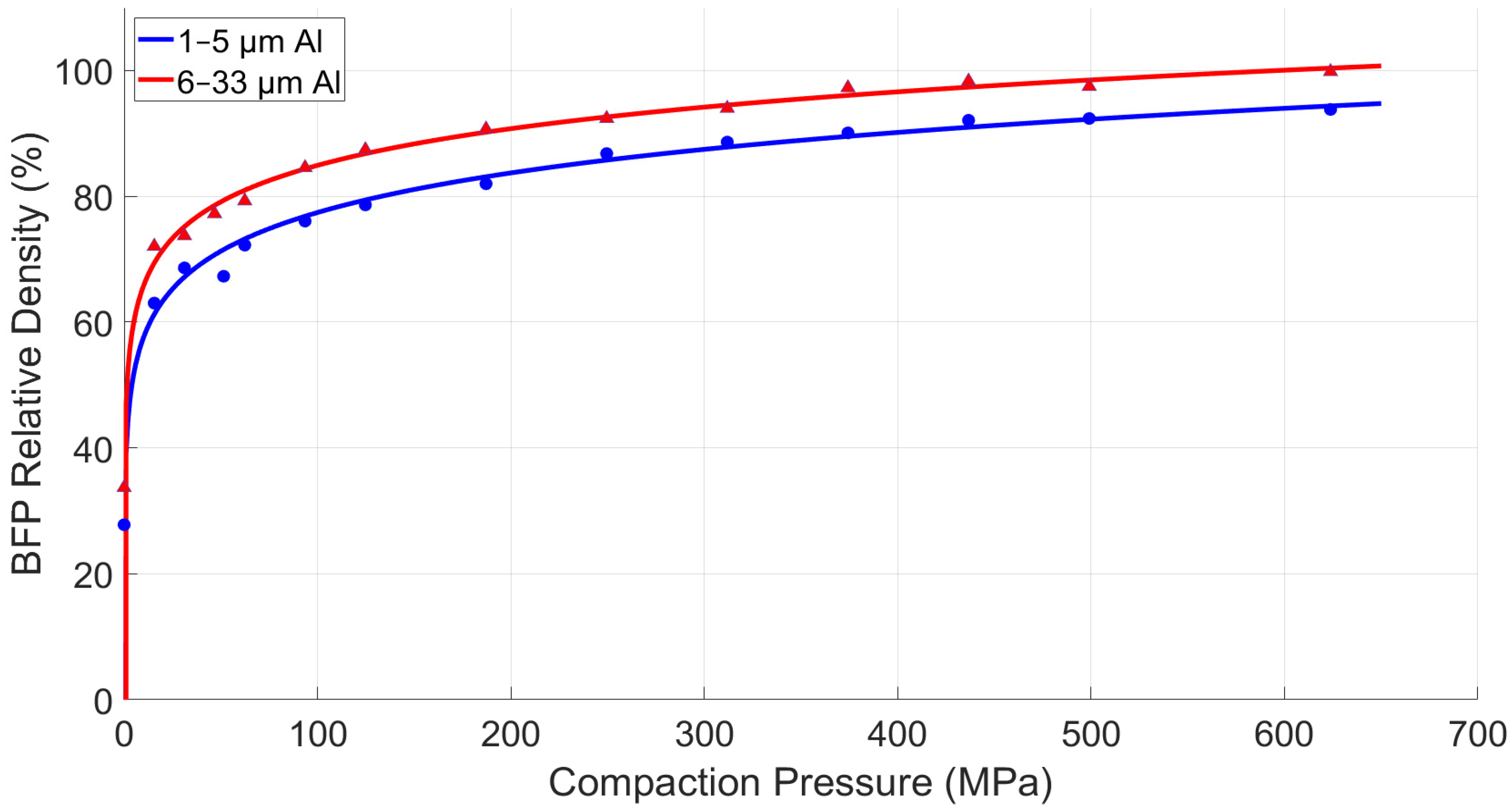
Figure 2 shows the compaction curves generated for both aluminum particle sizes. As expected, the apparent density (at zero pressure) is higher for the 6–33 µm Al than the 1–5 µm Al powder. This is a direct result of the higher surface area of the 1–5 µm Al powder, which increases friction between powders, thereby negatively affecting powder packing. Moreover, at any given compaction pressure, the 6–33 µm aluminum powder densifies more than the 1–5 µm counterpart. It is well known that during compaction, smaller metallic particles tend to work harden at a faster rate than larger particles, which makes smaller particles harder and more difficult to compact [15]. Agglomeration and increased oxide content in smaller-particle-size aluminum could also contribute to the behavior.
The compaction data for both particle sizes were found to adhere to the following powder compaction model [15].
ρ r = A P B C
where ρ r is the BFP relative density (100 × actual density/theoretical density), P is the applied compaction pressure, and A, B, and C are constants. A, B, and C were determined to be 2.34, 0.33, and 1.95 for the 1–5 µm Al and 13.4, 0.006, 12.9 for the 6–33 µm Al, respectively, using MATLAB (R2025b).
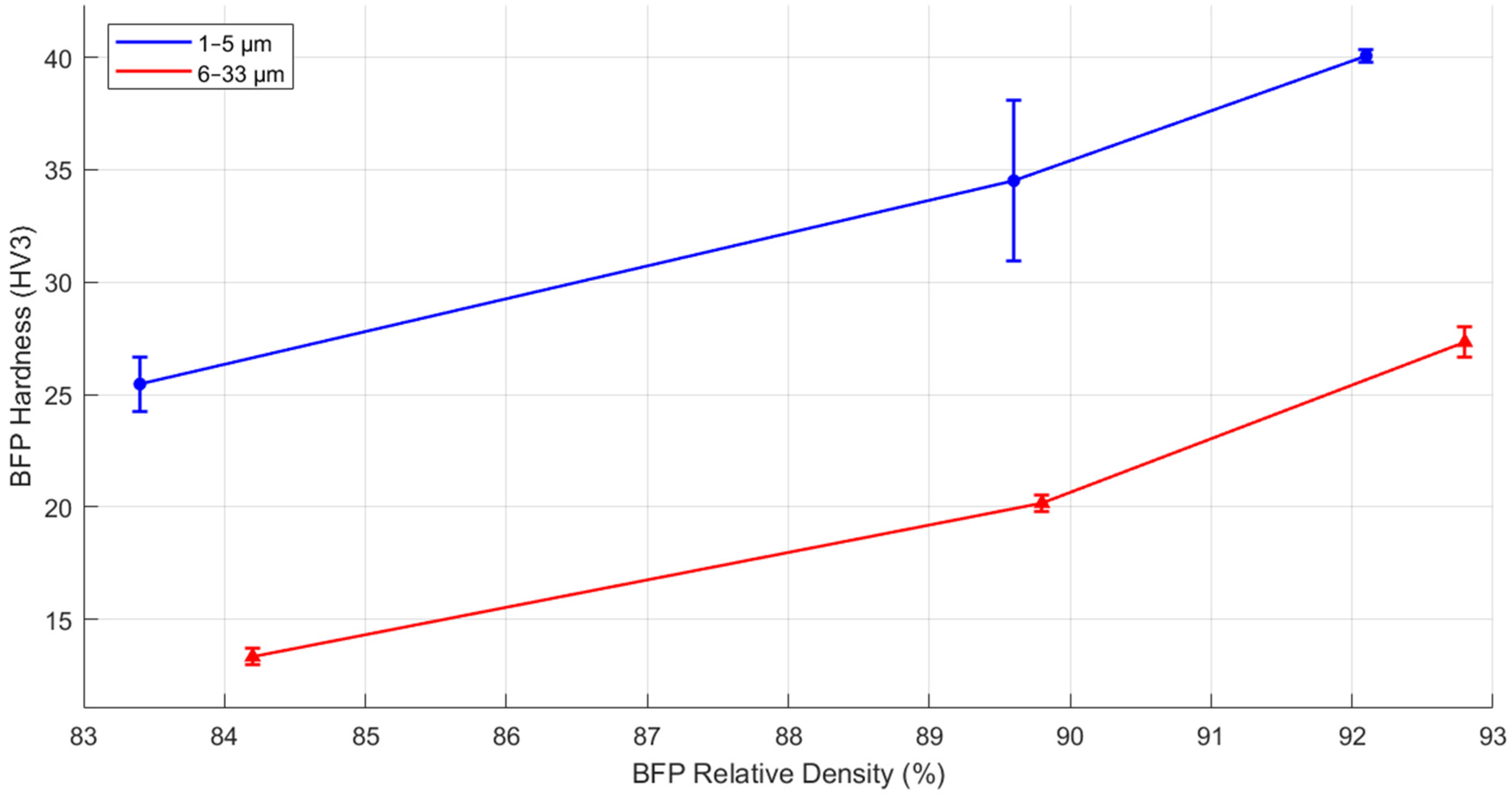
As seen in Figure 3, the BFP hardness increases with an increase in BFP relative density, as expected for both the 1–5 µm and 6–33 µm Al-TiH2 BFPs. This is primarily due to a reduction in porosity. The figure also shows the superior hardness of the 1–5 µm Al-TiH2 BFPs across all investigated relative densities compared with the 6–33 µm Al-TiH2 BFPs. This is a result of the higher work hardening rate of the 1–5 µm Al powder and the higher level of oxides.
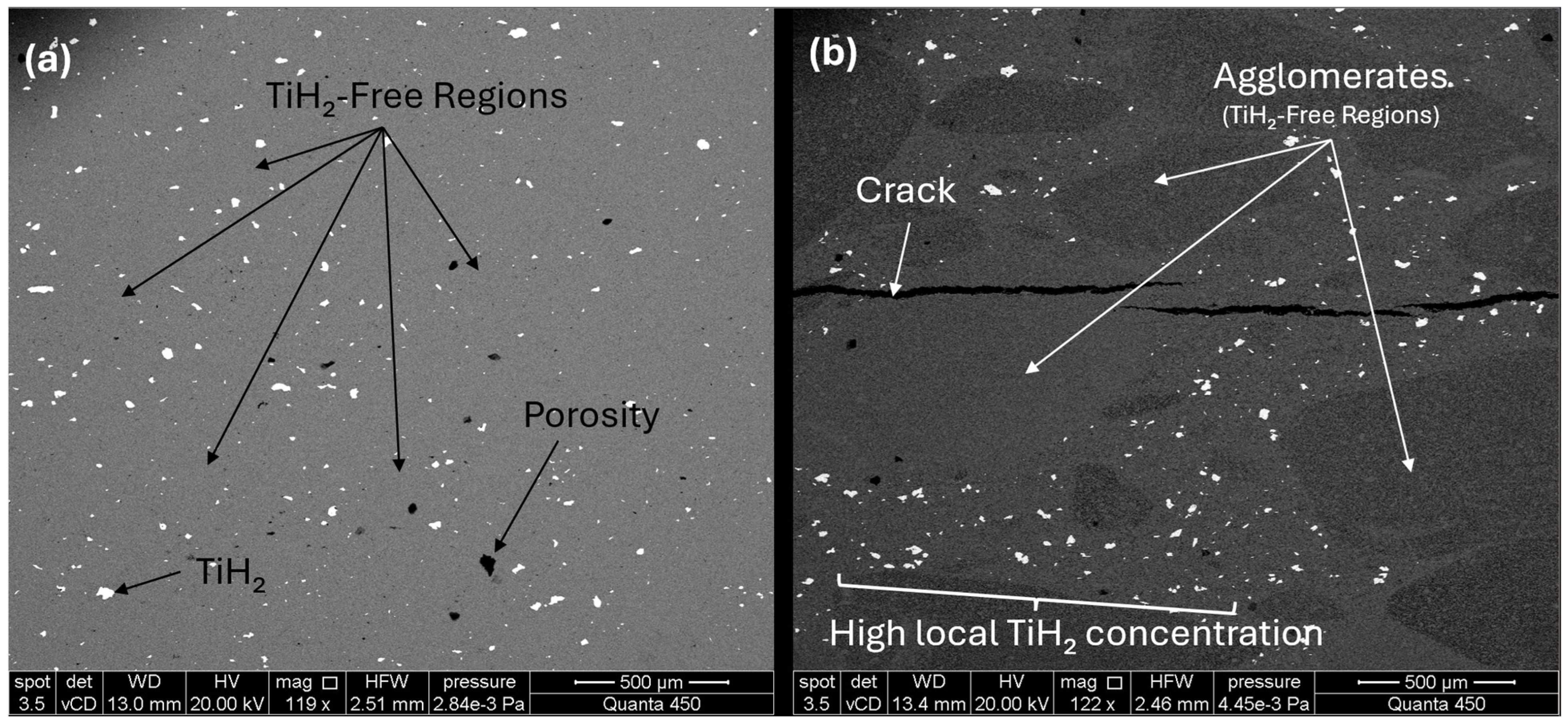
Figure 4a shows the 6–33 µm Al-TiH2 BFP microstructure with titanium dihydride (TiH2) particles (white), appearing more homogeneously dispersed compared with the 1–5 µm Al-TiH2 BFP microstructure (Figure 4b). Although small levels of aluminum powder agglomeration are seen in Figure 4a (i.e., TiH2-free regions), a much more severe level is found in the 1–5 µm Al-TiH2 BFP microstructure, leading to a severe level of inhomogeneous distribution of TiH2 particles. Image analysis reveals the approximate average TiH2-free region sizes to be 407 µm and 235 µm for the 1–5 µm and 6–33 µm Al powders, respectively. Additionally, agglomerates in the 1–5 µm compact reach up to 1650 µm, while those in the 6–33 µm compact reach only up to 625 µm. The effect of aluminum powder agglomeration on foaming is tangible and must be considered in all aluminum foam processing using the PM route.
Cracks were observed only in the 1–5 µm Al-TiH2 BFPs, which may be due to several factors, including the work hardening of the 1–5 µm Al powder, which makes it less ductile [15]. Fine powders are also known to trap air, and increased compaction pressure leads to increased gas pressure, resulting in cracking [17]. Finally, the increased oxide content and agglomeration of the 1–5 µm aluminum powder may have also contributed to crack formation. Notably, the cracks increased in severity with compaction pressure, only in the 1–5 µm Al-TiH2 BFPs.
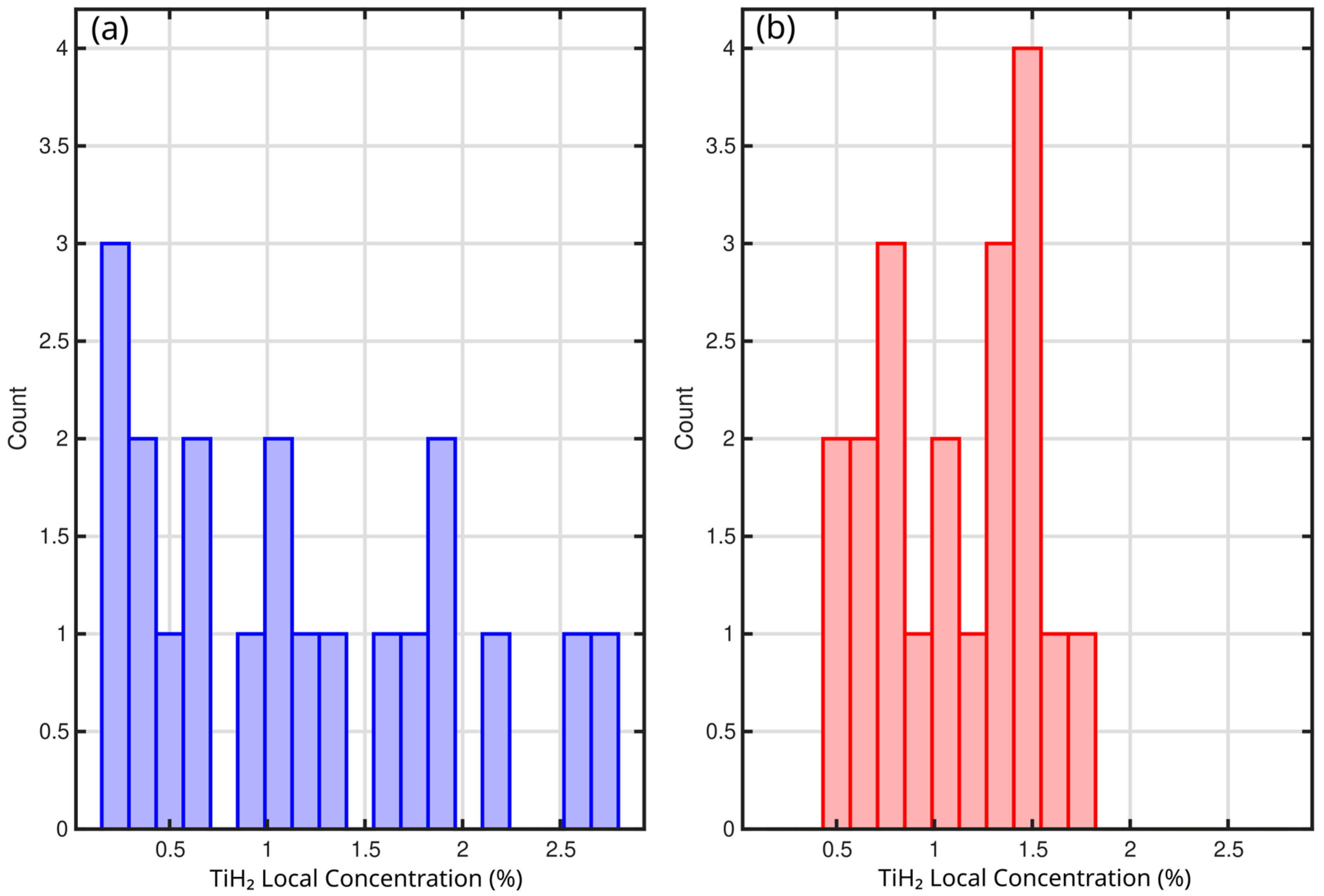
Figure 5 demonstrates how the localized concentration of TiH2 is much more uniformly distributed in the 6–33 µm Al-TiH2 BFP compared to the 1–5 µm Al-TiH2 BFP. Moreover, we observe that the greatest abundance of TiH2 is at the nominal concentration of 1.5% TiH2 (the mode), with a coefficient of variance of 0.35 for the 6–33 µm Al-TiH2 BFP. On the other hand, for the 1–5 µm Al-TiH2 BFP, a significant number of regions have local concentrations greater than 2.5% TiH2. Even more regions have very low concentrations, less than 0.5% TiH2. Overall, the 1–5 µm Al-TiH2 BFP local concentrations have a coefficient of variance of 0.70, indicating that TiH2 homogeneity is negatively affected by the reduced aluminum particle size due to increased aluminum powder agglomeration.
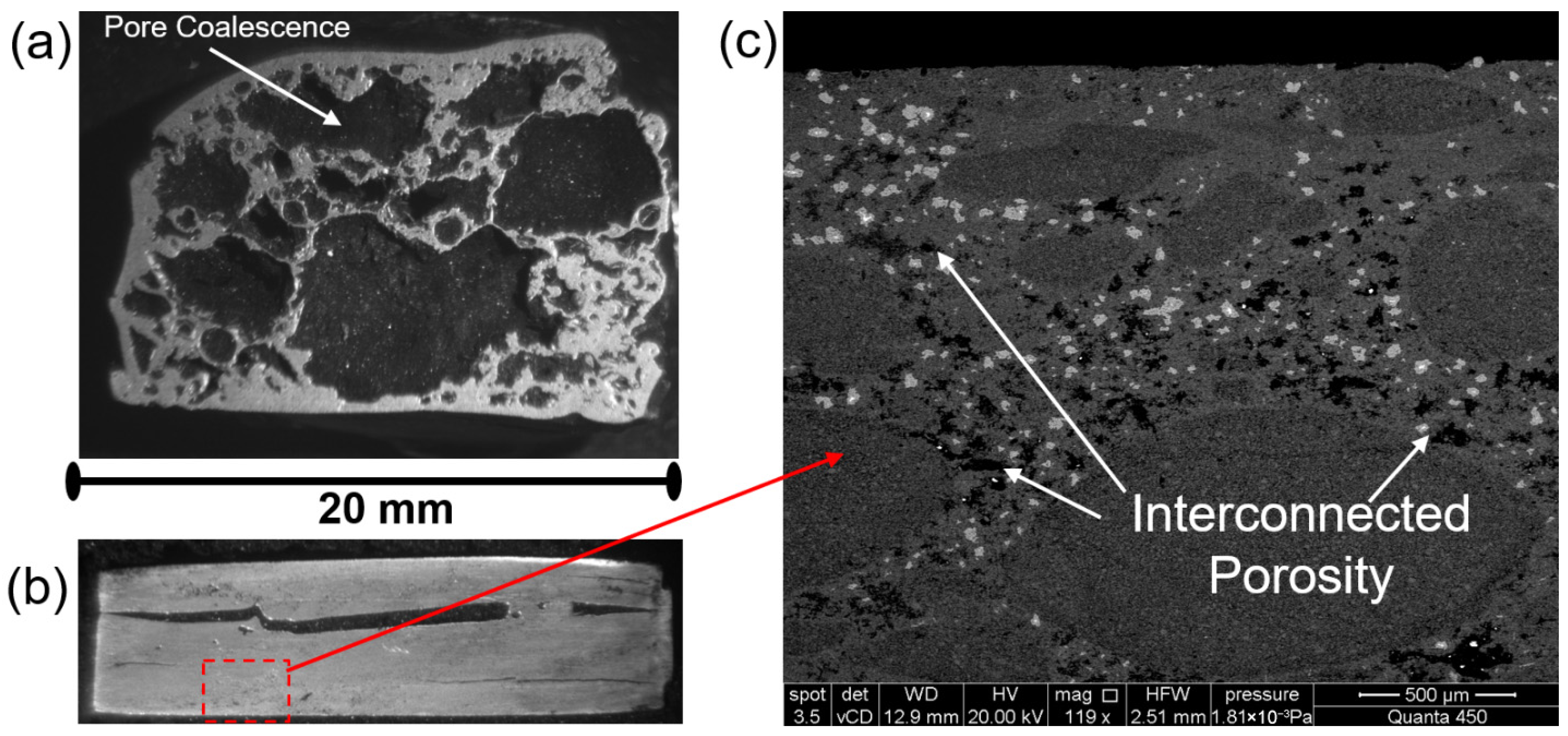
Figure 6a shows macrographs of the foamed 6–33 µm Al-TiH2 BFP, where pore expansion and pore coalescence are evident. On the contrary, Figure 6b shows no evidence of foaming for the 1–5 µm Al-TiH2 BFP, in addition to the presence of large cracks. Interestingly, after the attempted foaming, the lateral cracks in the 1–5 µm Al-TiH2 BFPs were also observed to be thicker than those in the original BFP (Figure 4b), likely due to pressure from released hydrogen gas at high temperatures. The presence of these cracks may have also facilitated the escape of the released hydrogen prior to foaming. The presence of considerable TiH2-free agglomerate regions in the 1–5 µm Al-TiH2 BFP microstructures resulted in a much higher concentration of TiH2 particles within the agglomerate-free regions. Figure 6c clearly shows that at this higher TiH2 concentration, the generated pores are interconnected, providing an additional pathway for hydrogen to escape and resulting in poor foaming. Recent work has shown that TiH2 interparticle spacing affects foaming characteristics [18]. The higher TiH2 concentration in certain regions of the microstructure will lead to a smaller interparticle spacing, ultimately facilitating the generation of interconnected porosity upon hydrogen release in those regions.
It is well known that a low BFP relative density indicates the presence of interconnected/open porosity [2,15]. Since TiH2 starts releasing hydrogen above 350 °C [19], as the BFP is heated to the foaming temperature, some hydrogen would be prematurely released and escape through the interconnected porosity, leading to poor foaming.
Table 1 shows the effect of BFP relative density and aluminum particle size on total porosity after foaming. The total porosity in the foam was higher for the 6–33 µm Al-TiH2 samples than for the 1–5 µm Al-TiH2 samples at BFP relative densities greater than 90%. This difference is primarily attributed to the presence of cracks within the 1–5 µm Al-TiH2 BFPs, and interconnected porosity as discussed previously, which allowed hydrogen to escape during heating before reaching the foaming temperature.
At BFP ρr < 95%, poor foaming is expected due to the presence of interconnected porosity within the BFP [2]. The foamed 6–33 µm Al-TiH2 BFP (93.2% ρr) resulted in the highest total porosity ~57%, as shown in Table 1, which agrees with previously published works [2,12] in terms of total porosity. However, at the lowest BFP relative density investigated (<85%), the foamed 1–5 µm Al-TiH2 BFP has a higher total porosity compared to the foamed 6–33 µm Al-TiH2 BFP. This may be due to the slightly higher BFP ρr of the 1–5 µm Al-TiH2 foamed BFP compared to the 6–33 µm Al-TiH2 foamed BFP, in addition to interconnected porosity produced from the inhomogeneously distributed TiH2, as discussed previously. An increase in ρr of the 1–5 µm Al-TiH2 foamed BFP, however, resulted in a decline in total porosity, primarily due to the observed cracks in the BFPs, which increased in severity from the lowest to the highest BFP relative densities investigated, leading to poor foaming.

4. Conclusions

  • Al powder agglomeration was present in both aluminum powder sizes investigated, but substantially more exaggerated in the 1–5 µm Al powder, which resulted in a severe inhomogeneous distribution of the TiH2 blowing agent within the BFP’s microstructure.
  • The inhomogeneous distribution of TiH2 particles 1–5 µm Al-TiH2 BFP led to increased local TiH2 content, within the microstructure promoting the formation of interconnected porosity during heating, which aided the escape of hydrogen gas rather than its use for foaming.
  • Powder agglomeration, air entrapment, surface oxide content, and the higher work hardening rate of the 1–5 µm Al powder resulted in BFP cracks, presenting another pathway for the escape of hydrogen during foaming.
  • An increase in BFP relative density only resulted in an increase in pore content after foaming for the 6–33 µm Al-TiH2 BFPs.
The results highlight the importance of metal powder agglomeration and the need to consider it in all future foaming by the PM route. The authors’ ongoing work includes investigating wet-processing techniques to reduce metal powder agglomeration and their effects on foaming.

Author Contributions

Conceptualization, K.M.; Formal analysis, D.M. and O.O.; Investigation, D.M. and O.O.; Resources, K.M.; Data curation, D.M. and O.O.; Writing—original draft, D.M. and O.O.; Writing—review and editing, D.M., O.O. and K.M.; Visualization, D.M. and O.O.; Supervision, K.M.; Project administration, K.M.; Funding acquisition, K.M. All authors have read and agreed to the published version of the manuscript.

Funding

This research received no external funding.

Data Availability Statement

The raw data supporting the conclusions of this article will be made available by the authors on request.

Acknowledgments

We thank Elisa Torresani for her assistance with scanning electron microscopy. We would also like to acknowledge all our undergraduate student members of the Advanced Materials Processing Laboratory, including J. Cortez-Ortega, P. Kodheli, L. Manwaring-Mueller, F. Meager, M. Miner, A. Rahn, A. Swindell, R. Seifert, K. Vu, and I. Younis.

Conflicts of Interest

The authors declare no conflicts of interest.

References

  1. Morsi, K. An Engaging Approach to the Science and Engineering of Materials: The SPHERE; Springer Nature: Cham, Switzerland, 2026. [Google Scholar]
  2. Behymer, N.; Morsi, K. Review: Closed-Cell Metallic Foams Produced via Powder Metallurgy. Metals 2023, 13, 959. [Google Scholar] [CrossRef]
  3. Ji, C.; Huang, H.; Wang, T.; Huang, Q. Recent Advances and Future Trends in Processing Methods and Characterization Technologies of Aluminum Foam Composite Structures: A Review. J. Manuf. Process. 2023, 93, 116–152. [Google Scholar] [CrossRef]
  4. García-Moreno, F. Commercial Applications of Metal Foams: Their Properties and Production. Materials 2016, 9, 85. [Google Scholar] [CrossRef] [PubMed]
  5. Mudge, A.; Morsi, K. Fabrication of Uniform and Rounded Closed-Cell Aluminum Foams Using Novel Foamable Precursor Particles (FPPs). Metals 2024, 14, 120. [Google Scholar] [CrossRef]
  6. Key, D.; Daoush, W.M.; Morsi, K. Processing of Microscale Aluminum Foamed Particles. Mater. Perform. Charact. 2020, 9, 442–451. [Google Scholar] [CrossRef]
  7. Morsi, K.; Daoush, W.M. Al–TiH2 Composite ‘Particles’ as Foaming Precursors for Metallic Foams. Scr. Mater. 2015, 105, 6–9. [Google Scholar] [CrossRef]
  8. Bisht, A.; Gangil, B.; Patel, V.K. Selection of Blowing Agent for Metal Foam Production: A Review. J. Met. Mater. Miner. 2020, 30, 1–10. [Google Scholar] [CrossRef]
  9. Rodinger, T.; Ćorić, D.; Alar, Ž. The Influence of Foaming Agents on Aluminium Foam Cell Morphology. Metals 2023, 13, 1146. [Google Scholar] [CrossRef]
  10. García-Moreno, F.; Kamm, P.H.; Neu, T.R.; Bülk, F.; Mokso, R.; Schlepütz, C.M.; Stampanoni, M.; Banhart, J. Using X-Ray Tomoscopy to Explore the Dynamics of Foaming Metal. Nat. Commun. 2019, 10, 3762. [Google Scholar] [CrossRef] [PubMed]
  11. Proa-Flores, P.M.; Mendoza-Suarez, G.; Drew, R.A.L. Effect of TiH2 Particle Size Distribution on Aluminum Foaming Using the Powder Metallurgy Method. J. Mater. Sci. 2012, 47, 455–464. [Google Scholar] [CrossRef]
  12. Papantoniou, I.G.; Pantelis, D.I.; Manolakos, D.E. Powder Metallurgy Route Aluminium Foams: A Study of the Effect of Powder Morphology, Compaction Pressure and Foaming Temperature on the Porous Structure. Procedia Struct. Integr. 2018, 10, 243–248. [Google Scholar] [CrossRef]
  13. Asavavisithchai, S.; Kennedy, A.R. The Effect of Oxides in Various Aluminium Powders on Foamability. Procedia Eng. 2012, 32, 714–721. [Google Scholar] [CrossRef]
  14. Leszczyński, B.; Gancarczyk, A.; Wróbel, A.; Piątek, M.; Łojewska, J.; Kołodziej, A.; Pędrys, R. Global and Local Thresholding Methods Applied to X-Ray Microtomographic Analysis of Metallic Foams. J. Nondestruct. Eval. 2016, 35, 35. [Google Scholar] [CrossRef]
  15. German, R.M. Powder Metallurgy and Particulate Materials Processing: The Processes, Materials, Products, Properties and Applications; Metal Powder Industries Federation: Princeton, NJ, USA, 2005. [Google Scholar]
  16. ASTM C830-00; Standard Test Methods for Apparent Porosity, Liquid Absorption, Apparent Specific Gravity, and Bulk Density of Refractory Shapes by Vacuum Pressure. ASTM International: West Conshohocken, PA, USA, 2016. [CrossRef]
  17. Williams, J. Trapping of Gases in Cold-Compacted Powders. J. Iron Steel Inst. 1952, 19–24. [Google Scholar]
  18. Behymer, N. The Space between Us: An Initial Investigation of Titanium Hydride Interparticle Spacing Influence Using the Powder Compact Melt Foaming Process. Master Thesis, San Diego State University, San Diego, CA, USA, 2023. [Google Scholar]
  19. von Zeppelin, F.; Hirscher, M.; Stanzick, H.; Banhart, J. Desorption of Hydrogen from Blowing Agents Used for Foaming Metals. Compos. Sci. Technol. 2003, 63, 2293–2300. [Google Scholar] [CrossRef]
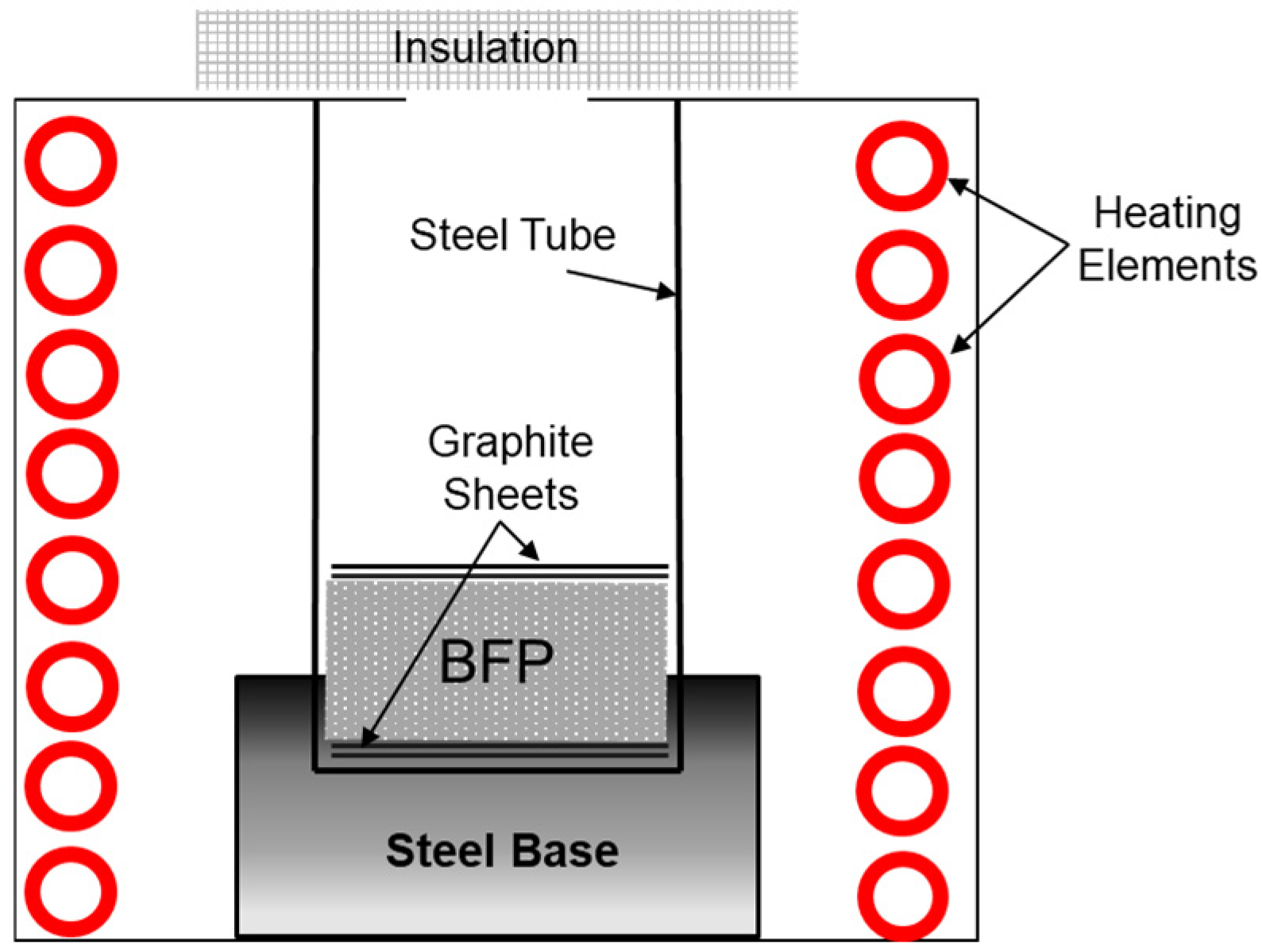
Figure 1. Experimental setup showing the tube inserted inside the steel block within the furnace.
Jmmp 10 00176 g001
Figure 2. Compaction curve for aluminum powders investigated.
Jmmp 10 00176 g002
Figure 3. Vickers Microhardness of BFPs, with standard deviation error bars.
Jmmp 10 00176 g003
Figure 4. Backscattered scanning electron micrographs of the microstructures of (a) 6–33 µm Al-TiH2 BFP (95.1% ρr), (b) 1–5 µm Al-TiH2 BFP (92.2% ρr). The figure shows aluminum powder agglomerate regions (TiH2-free regions).
Jmmp 10 00176 g004
Figure 5. Histograms of TiH2 local area concentration for (a) 1–5 µm Al-TiH2 BFP (92.2% ρr) and (b) 6–33 µm Al-TiH2 BFP (95.1% ρr), using 500 µm × 500 µm grids.
Jmmp 10 00176 g005
Figure 6. Macrographs of (a) 6–33 µm Al foam (92.7% BFP relative density), (b) 1–5 µm Al foam showing enlarged crack (93.3% BFP relative density), (c) SEM image of the microstructure of figure (b) showing the confinement of porosity in localized regions surrounded by aluminum agglomerates.
Jmmp 10 00176 g006
Table 1. Total Foam Porosity.
Aluminum PowderRelative Density of BFP (%)
± S.D.
Foam Porosity (%)
± S.D.
1–5 µm92.6 ± 0.716.08 ± 1.73
90.0 ± 0.315.73 ± 0.17
84.0 ± 0.519.84 ± 4.42
6–33 µm93.2 ± 0.957.07 ± 6.53
89.8 ± 0.226.17 ± 4.79
83.6 ± 0.612.55 ± 0.05
Disclaimer/Publisher’s Note: The statements, opinions and data contained in all publications are solely those of the individual author(s) and contributor(s) and not of MDPI and/or the editor(s). MDPI and/or the editor(s) disclaim responsibility for any injury to people or property resulting from any ideas, methods, instructions or products referred to in the content.