


Abstract
The formation of TiB reinforcement during the sintering of Ti–TiB2 powder mixtures depends on reaction kinetics and processing conditions, which influence the phase composition available for subsequent thermomechanical treatment. This study presents a reproducible computational assessment of TiB formation in a nominal Ti–5 wt.% TiB2 composite subjected to vacuum sintering for 4 h at 1050, 1150, 1200, 1250, and 1350 °C. A published two-pathway Avrami kinetic model was implemented and evaluated against 25 reported conversion observations, yielding a root-mean-square error of 0.0419 and a mean absolute error of 0.0312 in the conversion fraction. Under the original kinetic parameters, the model predicts nearly complete TiB2 conversion at all five temperatures after 4 h. Stoichiometric mass balance indicates a theoretical maximum of approximately 8.44 wt.% TiB and 91.56 wt.% residual Ti matrix. A kinetic sensitivity analysis was conducted to examine the influence of reduced effective reaction rates on the predicted phase fractions. The results demonstrate that the nominal sintering conditions alone are insufficient to establish a unique phase composition when the kinetic parameters are transferred to powders with different particle sizes and compaction histories. The proposed computational framework provides a transparent basis for evaluating reaction-related processing uncertainties and identifying conditions requiring experimental verification before hot rolling. The analysis does not independently establish densification, reinforcement morphology, or mechanical properties, and its applicability to the investigated powder system remains subject to material-specific validation.
1. Introduction
Titanium and titanium-based materials have attracted research attention as structural materials because of their low specific gravity and high-temperature and chemical resistance. The main disadvantages of pure titanium‚ such as low wear resistance and limited stiffness‚ may negatively affect the use of titanium in structural applications requiring high loads. Various reinforcing materials can improve titanium composite properties. Among these reinforcing materials‚ TiB-reinforced titanium composites have been studied for their thermal and other advantageous properties [1,2,3]. Recent reviews have further highlighted the importance of powder metallurgy in the production of titanium matrix composites. The selection of powder characteristics, consolidation conditions, and reinforcement distribution strongly influences the resulting microstructure and mechanical response. Although powder-based processing offers considerable flexibility in controlling composite composition, residual porosity, particle interfaces, and incomplete densification remain important challenges [4,5,6,7].
In situ formation of TiB through reaction of titanium with titanium diboride is one way to add reinforcement to powder materials. Reaction of titanium with TiB2 and other titanium produces TiB‚ according to the reaction Ti + TiB2 → 2TiB. Initial amounts of TiB2 cannot be used to predict the amount of TiB produced. The phases present in reacted materials depend on the extent of reaction. Properties of reacted materials‚ including reinforcement distribution and porosity‚ depend on the extent of reaction and other processing factors. Research on Ti-TiB2 powders has contributed data on reactions and sintering that can aid the processing of composite materials. The influence of consolidation conditions on titanium matrix composites has been investigated using hot pressing, spark plasma sintering, and plasma-activated sintering [8,9,10]. These processing methods affect densification and the development of reinforcement-containing microstructures. Studies of TiB-reinforced titanium composites have also demonstrated that the arrangement, size, and orientation of reinforcing phases influence the mechanical response [11,12,13,14,15]. Consequently, the evaluation of processing conditions requires consideration of both phase composition and microstructural characteristics.
The transformation of TiB2 into TiB during sintering has been investigated using reaction kinetic models. A two-pathway Avrami model was developed to describe TiB2 conversion through reaction mechanisms associated with metallic- and oxide-affected interfaces [16]. The mathematical foundations of this approach are related to the classical Avrami theory of phase transformations [17,18,19]. Computational studies of TiB-reinforced titanium composites have also examined the relationship between reinforcement architecture and mechanical behaviour [20]. However, reaction kinetic calculations alone cannot determine the complete microstructural and mechanical response of a composite.
Reaction kinetics factors affect sintering process parameters. Surface conditions at particle interfaces play a role in several proposed reaction mechanisms for TiB formation. An Avrami-type two-mechanism model for sintering transformation of TiB2 to TiB‚ including the influence of oxides at particle interfaces‚ is presented for TiB formation [16]. The model can be used to understand the relationship between sintering time and temperature and the extent of TiB2-to-TiB conversion. Disadvantages of using the model for other systems include the fact that model parameters were developed based on experiments with a particular powder and sintering method. Further testing is needed to evaluate whether the model can predict conversion fractions for other particle sizes and compaction and sintering conditions and to draw conclusions about other materials.
The combination of powder consolidation and thermomechanical processing has been investigated as a means of controlling the microstructure of titanium matrix composites. Previous research has examined vacuum sintering followed by hot rolling of TiB-reinforced titanium materials [21]. Related investigations have considered reactive hot rolling, spark plasma sintering followed by deformation, and changes in TiB whisker orientation during hot working [22,23,24]. More recent studies have explored networked reinforcement structures and multiscale microstructural development to improve the balance between strength and ductility [25,26,27]. These findings indicate that the selection of sintering conditions should account for subsequent deformation behaviour as well as reinforcement formation.
The sintering process and other thermomechanical processes can pose problems for titanium matrix composites intended for sheet applications. The sintering and hot rolling of TiB-reinforced titanium sheet have been investigated [21]. Hot rolling after sintering can influence the microstructure and properties of the matrix and reinforcement in a finished composite sheet. Other factors in addition to TiB reinforcement can inhibit the successful conversion of a sintered alloy into a sheet. Other inhibiting factors include porosity and other matrix and reinforcement microstructural characteristics and other hot-working characteristics of titanium. Therefore‚ a kinetic analysis of TiB formation is not a complete analysis of microstructure and properties.
Another limitation of computational modelling is that some studies predict phase transformations and material properties using assumed values of density and other parameters without providing adequate references. Although such studies can offer valuable insights into material behaviour, the resulting property predictions may remain uncertain. A higher TiB2 content does not necessarily lead to improved density or mechanical strength. Therefore, reliable predictions of material properties require independently justified constitutive relationships or experimental evidence. Assumptions concerning density, porosity, and mechanical behaviour should be clearly distinguished from calculated results.
Recent investigations have continued to explore the influence of intragranular reinforcement, TiB architecture, and alternative fabrication techniques on the performance of titanium matrix composites [28,29,30]. Additional studies have examined the dispersion of nanoscale TiB and microstructural evolution during hot deformation [31,32]. Although these investigations provide valuable information about reinforcement behaviour, the transferability of reaction kinetic parameters between different powder systems remains insufficiently established. In particular, changes in particle size, interfacial conditions, and compaction history may affect the relationship between sintering temperature, holding time, and TiB2 conversion. This study aimed to explore this phenomenon through computational modelling of TiB formation during vacuum sintering of titanium powder with 5 wt.% TiB2. Five nominal sintering temperatures (1050, 1150, 1200, 1250, and 1350 °C) were evaluated computationally for an isothermal holding period of 4 h. A computational model incorporating a previously developed two-reaction system and stoichiometric mass balances was used to predict the quantities of Ti‚ TiB‚ and remaining TiB2 formed at each temperature. Model results are compared to previously published results‚ and a parametric study examines the impact of uncertainty in reaction-rate parameters.
The primary value of this work is to provide direct information about the transferability of kinetic behaviour to other processing conditions and the relationship between composition and conversion for TiB2. Unlike previous investigations of TiB-reinforced titanium composites produced by vacuum sintering and hot rolling [21], the present study focuses on reaction kinetics, theoretical phase composition, and the uncertainty associated with transferring kinetic parameters between different powder systems. Instead‚ the goal of this work is to draw conclusions from kinetic and composition models and to distinguish those conclusions from others that would need additional validation based on microstructure or mechanical properties.
The goal of this study is to confirm the selected model of kinetics‚ measure the amount of TiB2 reacted at different temperatures and times‚ estimate the properties of the phases formed‚ perform a sensitivity analysis to measure how changes in reaction parameters affect the reaction‚ and summarise and discuss the limitations of applying the results of this study in setting sintering conditions before hot rolling. Results of this study will be useful to other researchers‚ who can use and test them in their own studies of other materials.
2. Computational Modelling Framework
2.1. Material System and Processing Conditions
The computational study considered a titanium-based powder mixture containing 95 wt.% commercially pure titanium and 5 wt.% titanium diboride (TiB2). The nominal particle-size limits were below 45 μm for titanium and below 10 μm for TiB2. These specifications define the investigated material system and should not be interpreted as experimentally characterised particle-size distributions.
The processing conditions were selected to represent a powder-metallurgy route consisting of powder mixing, uniaxial compaction, vacuum sintering, and potential subsequent hot rolling. The nominal mixing duration was 6 h under argon, while the compaction pressure and holding time were 600 MPa and 60 s, respectively. Five isothermal sintering temperatures were considered—1050, 1150, 1200, 1250, and 1350 °C—each with a holding time of 4 h.
The specimens were designated S1050, S1150, S1200, S1250, and S1350 according to their nominal sintering temperatures. Hot rolling at 950 °C with a total thickness reduction of 70% was retained as a proposed downstream processing condition. No physical powder processing, sintering, rolling, or mechanical testing was performed within the present computational study.
The selected conditions are summarised in Table 1.
Table 1.
Nominal material specifications and processing conditions considered in the computational study.
The processing specifications provide the conditions for the parametric analysis. Since the kinetic parameters were obtained from a different powder system, these nominal conditions do not establish equivalence between the original experimental material and the composite considered here.
2.2. Computational Workflow and Model Assumptions
The computational framework consisted of four main stages: evaluation of TiB2 conversion kinetics, calculation of phase masses, comparison with published conversion observations, and assessment of kinetic-parameter sensitivity.
The initial powder composition and sintering temperature were used as model inputs. The reaction model calculated the converted fraction of TiB2 as a function of temperature and holding time. Stoichiometric mass balance was then applied to determine the remaining TiB2, the newly formed TiB, and the residual titanium matrix.
The calculation assumed that TiB2 conversion could be represented by the selected kinetic equation and that the principal reaction was
For the purpose of phase mass calculations, the model neglected material losses, secondary reaction products, and changes in overall specimen mass. These assumptions provide a closed mass balance but do not establish that secondary phases or oxygen-related effects would be absent in a real specimen.
The kinetic calculation describes chemical conversion rather than densification. Consequently, relative density, pore morphology, matrix grain size, TiB whisker dimensions, crystallographic texture, and mechanical properties were not calculated from the reaction model. These characteristics require separate constitutive relationships or experimental information.
2.3. TiB2-to-TiB Reaction Kinetics
The transformation of TiB2 into TiB was represented using the published two-pathway Avrami kinetic model [16]. The model distinguishes reaction contributions associated with metallic interfaces and oxide-affected interfaces.
The overall conversion fraction was expressed as
Here, is the converted fraction of the initial TiB2, t is the isothermal holding time in minutes, T is the absolute temperature in kelvin for the kinetic-rate equations, is the metallic-interface contribution, and are the kinetic coefficients, and and are the corresponding Avrami exponents.
The adopted exponents were
For temperatures above the titanium α-to-β transformation temperature, the metallic-pathway kinetic coefficient was calculated as
The oxide-associated coefficient was expressed as
The temperature-dependent metallic-interface contribution was defined as
In these expressions, denotes temperature in degrees Celsius, whereas T in Equations (4) and (5) is expressed in kelvin. The kinetic coefficients are used consistently with time expressed in minutes.
The selected sintering temperatures correspond to absolute temperatures of 1323.15, 1423.15, 1473.15, 1523.15, and 1623.15 K. The holding time of 4 h was converted to 240 min.
For the investigated temperature range, the metallic-interface contribution equals unity at 1150 °C and above. At 1050 °C, the adopted expression gives . The model therefore predicts a contribution from the oxide-associated pathway only at the lowest investigated temperature.
The model parameters are summarised in Table 2.
Table 2.
Parameters adopted for the two-pathway TiB2 conversion model.
The kinetic coefficients were transferred without refitting to the nominal powder system considered in this study. Their use beyond the experimental conditions for which they were established is treated as an extrapolation rather than an independently validated prediction.
2.4. Stoichiometric Phase Composition Model
The reaction extent calculated from Equation (2) was converted into phase masses using conservation of titanium and boron.
A reference mass of 100 g of initial powder mixture was adopted, comprising 95 g of titanium and 5 g of TiB2.
The molar masses were taken as 47.867 g mol−1 for Ti, 10.81 g mol−1 for B, and 69.487 g mol−1 for TiB2. The molar mass of TiB was therefore 58.677 g mol−1.
The amount of TiB2 consumed at a conversion fraction was calculated as
The remaining TiB2 mass was
According to the reaction stoichiometry, the mass of TiB formed was
The mass of titanium consumed by the reaction was
The residual titanium matrix mass was calculated as
Mass conservation requires
For complete conversion, , the initial 5 g of TiB2 produces approximately 8.44 g of TiB and consumes approximately 3.44 g of titanium. The remaining matrix mass is approximately 91.56 g.
These calculations establish that an initial addition of 5 wt.% TiB2 does not correspond to a final reinforcement content of 5 wt.% TiB.
The calculated phase fractions describe mass composition only. They do not provide the volume fractions without additional phase-density information, nor do they determine reinforcement morphology or spatial distribution.
2.5. Model Verification and Sensitivity Analysis
The numerical implementation of the reaction model was checked by comparing the calculated conversion fractions with 25 conversion observations reported in the original study [16].
For N observations, the root-mean-square error was calculated as
The mean absolute error was calculated as
Here, and denote the calculated and reported conversion fractions for observation i, respectively.
The implementation reproduced the published conversion data with an RMSE of approximately 0.0419 and an MAE of approximately 0.0312, using the temperature conversion T(K) = T(°C) + 273.15. These error values quantify agreement with the source dataset and should not be interpreted as independent validation for the powder composition and processing conditions examined in the present study.
The adopted kinetic parameters produce conversion fractions approaching unity after 240 min throughout the investigated temperature range. Under these conditions, the original model cannot establish meaningful differences in final TiB2 conversion among the five sintering temperatures.
The computational procedure was implemented in Python (version 3.12) using NumPy (version 2.1.0) and pandas (version 2.2.3). The published dataset comprising 25 conversion observations at 800, 900, and 1000 °C was transcribed from the source study and used to assess numerical agreement with the adopted kinetic formulation. Temperatures were converted to kelvin using T(K) = T(°C) + 273.15, while holding time was expressed in minutes. The calculated conversion fractions were subsequently used to determine theoretical phase mass fractions and evaluate sensitivity to the assumed reaction-rate scaling factors. The calculation scripts and tabulated numerical outputs are provided as Supplementary Materials to facilitate reproducibility.
To investigate sensitivity to kinetic transfer, the reaction-rate coefficients were modified using a dimensionless scaling factor s:
The modified conversion fraction was then calculated as
The reference case corresponds to s = 1. Values below unity represent hypothetical reductions in effective reaction rates, which may arise from differences in particle size, interfacial conditions, or other processing-related factors.
The scaling factor is not presented as an experimentally determined material parameter. Its purpose is to quantify how the calculated phase composition changes when the transferred reaction rates differ from those of the published source system.
For any selected value of s, Equations (7)–(12) were applied to the resulting conversion fraction to calculate the corresponding phase masses.
2.6. Scope and Limitations of the Computational Model
The framework provides quantitative information about the quantities and types of products formed during the reaction of TiB2 under various kinetic conditions. The primary advantage of the framework is that the quantitative information provided comes from equations and other information about the reaction system.
However‚ the kinetic data used in this study were generated for a different powdered material system than the nominal Ti-5 wt.% TiB2 studied in this work. Other particle sizes and compaction pressures and lower sintering temperatures were used in the earlier study. Experimental confirmation of the kinetic data is lacking at sintering temperatures of 1050–1350 °C.
The model does not account for other processes‚ including alpha case and grain growth in titanium‚ particle coarsening‚ recrystallization‚ and texture and porosity evolution in the reinforcing material. Cooling and phase transformation from alpha to beta in titanium can affect the microstructure of the titanium matrix. These effects are not included in the reaction model.
Hot rolling at 950 °C to a 70% nominal thickness reduction is considered a subsequent process in this analysis. Rolling force and fibre orientation‚ remaining porosity‚ and other properties due to hot rolling cannot be evaluated with this analysis.
Therefore‚ outputs of the simulation can be used to describe kinetics and stoichiometry but not other process–structure–property relationships. Sensitivity analysis methods can help assess uncertainty in extrapolated kinetic parameters‚ and additional testing of materials would be necessary to establish the actual microstructure and mechanical properties.
3. Results and Discussion
3.1. Verification of the TiB2 Conversion Model
Before applying the kinetic model to the selected sintering conditions, its numerical implementation was evaluated against the 25 conversion observations described in Section 2.5. The comparison covered three temperatures (800, 900, and 1000 °C) and different isothermal holding periods.
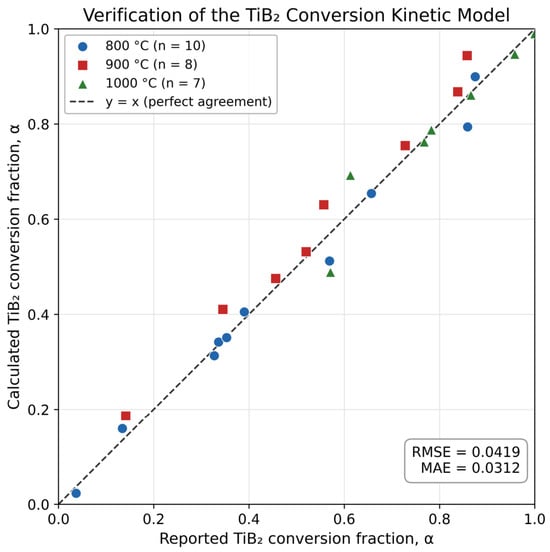
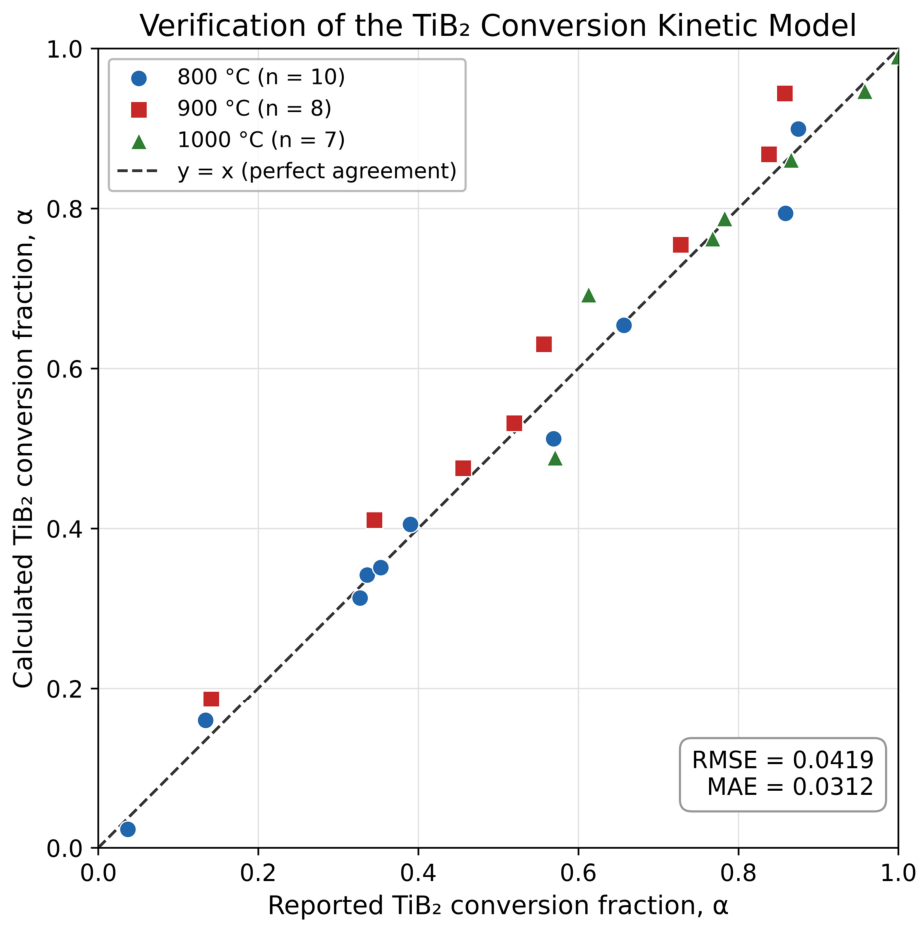
The calculated conversion fractions followed the general evolution reported in the source dataset. The overall root-mean-square error (RMSE) was 0.0419, while the mean absolute error (MAE) was 0.0312. These values indicate that the numerical implementation reproduces the published kinetic relationship with moderate deviations from the reported observations.
The comparison between calculated and reported conversion fractions is presented in Figure 1.
Figure 1.
Comparison between reported and calculated TiB2 conversion fractions used to verify the kinetic model implementation.
The agreement with the source observations provides a check of the implemented equations and numerical parameters. However, the reference model was developed for powder and compaction conditions different from those considered in the present study. Agreement with the original dataset therefore does not establish predictive accuracy for the nominal Ti–5 wt.% TiB2 composite investigated here.
3.2. Predicted TiB2 Conversion Under the Selected Sintering Conditions
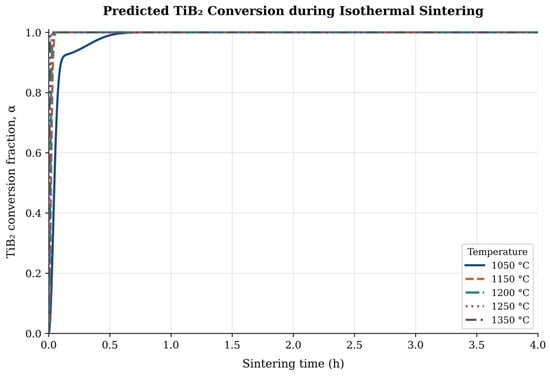
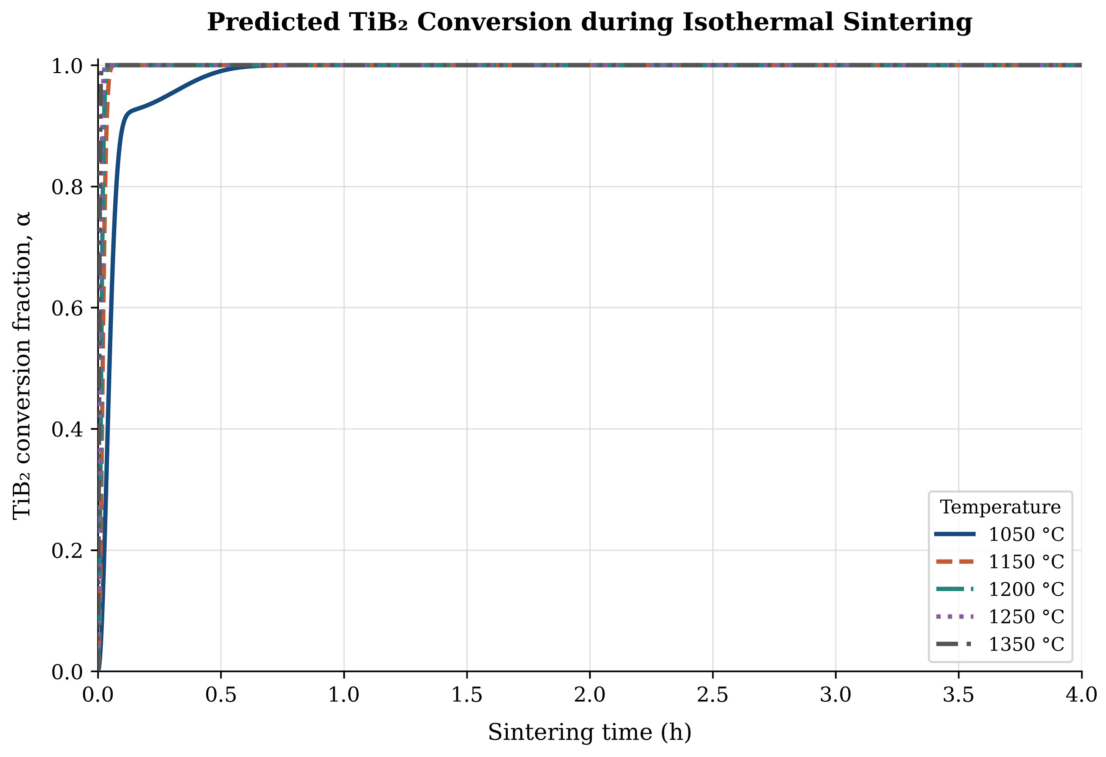
The verified implementation was used to calculate TiB2 conversion at 1050, 1150, 1200, 1250, and 1350 °C for a holding period of 240 min. The predicted conversion histories are presented in Figure 2.
Figure 2.
Calculated TiB2 conversion fraction as a function of isothermal holding time at five sintering temperatures, using the unmodified published kinetic parameters.
The calculated conversion increased rapidly with holding time, particularly at the higher temperatures. For all five conditions, the predicted conversion approached unity before the end of the 4 h holding period.
Table 3 summarises the calculated final conversion fractions.
Table 3.
Predicted TiB2 conversion after 4 h of sintering using the original kinetic parameters.
The nearly identical final conversion fractions indicate that the selected kinetic model does not provide a basis for ranking the five temperatures according to TiB2 conversion after 4 h. Temperature affects the predicted reaction rate, but the calculated final conversion is saturated throughout the investigated range.
This result has an important implication for process selection. A higher sintering temperature cannot be considered preferable solely because it is expected to produce a larger final TiB fraction. Once conversion approaches completion, other phenomena, including densification, grain growth, reinforcement coarsening, and possible microstructural degradation, become more relevant to the assessment of processing conditions. These effects are outside the scope of the adopted kinetic model.
Furthermore, the rapid conversion predicted at elevated temperatures reflects extrapolation of the published rate equations beyond their original calibration range. The results should therefore be interpreted as conditional model outputs rather than confirmed reaction histories for the investigated powder mixture.
3.3. Calculated Phase Composition and Mass Balance
The predicted conversion fractions were used to calculate the theoretical phase composition according to Equations (7)–(12). The initial composition consisted of 95 g of titanium and 5 g of TiB2 per 100 g of powder mixture.
For complete TiB2 conversion, the stoichiometric calculation gives approximately 8.44 g of TiB and 91.56 g of residual titanium. The calculated phase composition is presented in Table 4.
Table 4.
Theoretical phase composition after 4 h of sintering under the unmodified kinetic model.
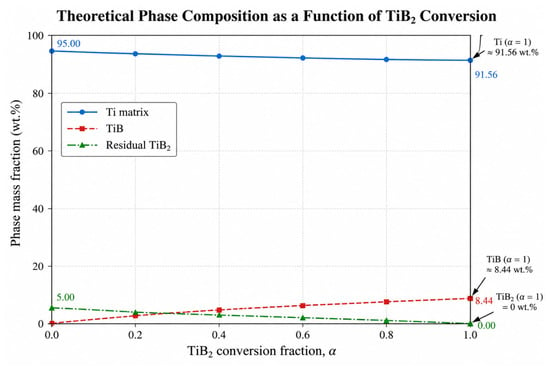
The stoichiometric calculations show that the final mass fraction of TiB exceeds the initial TiB2 content because titanium from the matrix is consumed during the reaction. For the nominal Ti–5 wt.% TiB2 mixture, complete conversion yields approximately 8.44 wt.% TiB and 91.56 wt.% residual titanium. These values represent theoretical phase mass fractions under the assumed reaction mechanism rather than experimentally measured compositions.
Relationships between TiB2 conversion and phase mass are presented in Figure 3.
Figure 3.
Predicted variations in mass fractions of Ti‚ TiB‚ and unreacted TiB2 with the converted mass fraction of TiB2.
Figure 3 illustrates the relationship between TiB2 conversion and the theoretical phase mass fractions. As conversion increases, the TiB fraction rises, while the fractions of residual TiB2 and unreacted titanium decrease in accordance with the reaction stoichiometry. The calculation does not provide information about TiB whisker dimensions, orientation, spatial distribution, or phase volume fractions. These characteristics require additional material-specific information and cannot be inferred directly from the calculated mass composition.
3.4. Sensitivity of TiB2 Conversion to Effective Reaction Rates
The kinetic sensitivity analysis examined the influence of reduced effective reaction rates on the predicted TiB2 conversion. The rate scaling factor s was varied from 1 to 10−6, while the sintering temperatures and holding time remained unchanged. The scaling factors represent hypothetical kinetic scenarios rather than experimentally calibrated parameters for the investigated powder mixture.
The resulting conversion fractions after 4 h are summarised in Table 5.
Table 5.
Sensitivity of TiB2 conversion fraction to the effective reaction-rate scaling factor after 4 h of sintering.
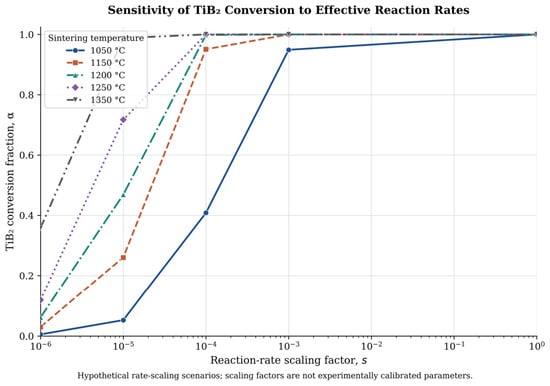
The sensitivity results show that the predicted conversion depends strongly on the effective reaction rates. At the reference value s = 1, all temperatures produce nearly complete conversion. When the rates are reduced by several orders of magnitude, substantial differences between sintering temperatures emerge.
At , for example, the predicted conversion increases from approximately 0.409 at 1050 °C to nearly complete conversion at 1250 °C and above. At , the calculated conversion ranges from approximately 0.052 at 1050 °C to 0.988 at 1350 °C.
The dependence of conversion on temperature and rate scaling is illustrated in Figure 4.
Figure 4.
Sensitivity of predicted TiB2 conversion after 4 h to the effective reaction-rate scaling factor at different sintering temperatures.
The sensitivity analysis demonstrates that uncertainty in the effective reaction-rate coefficients can substantially influence the predicted TiB2 conversion and the resulting theoretical phase composition. The scaling factors used in this analysis are hypothetical and were not calibrated for the nominal Ti–5 wt.% TiB2 powder mixture. Consequently, the calculated conversion fractions should be interpreted as conditional scenarios rather than experimentally validated predictions. Material-specific kinetic measurements are required to determine which scenario, if any, represents the actual sintering behaviour.
3.5. Implications of the Paper’s Findings for Sintering and Hot-Rolling Processes
The S1250 condition was considered as a potential precursor state for subsequent hot rolling at 950 °C with a nominal thickness reduction of 70%. However, the present computational framework does not evaluate the mechanical response during rolling or establish the suitability of S1250 relative to the other sintering conditions.
Under unadjusted kinetic conditions‚ nearly full conversion of TiB2 was achieved at all sintering temperatures of 1050‚ 1150‚ 1200‚ 1250‚ and 1350 °C. There is nothing to suggest from a phase composition analysis that sintering at 1250 °C is better than sintering at 1050‚ 1150‚ 1200‚ or 1350 °C.
Sensitivity analysis indicates that higher conversion may be achieved at a sintering temperature of 1250 °C compared to lower temperatures when reaction rates are reduced considerably. Conclusions about the best sintering temperature to use‚ drawn from sensitivity analysis results‚ vary with assumptions about factors affecting reaction rates.
A set of suggested hot-rolling sintering parameters would require additional information on relative density and porosity of titanium and other matrix properties‚ as well as information on the shape and properties of TiB particles present. Hot-rolling properties of a titanium composite would vary with hot-rolling temperature and other variables‚ such as the distribution and cooling rate of reinforcing particles.
Previous studies have investigated vacuum sintering followed by hot rolling of titanium and TiB-reinforced composites. The current study builds on previous research by examining uncertainty in predictions of reaction kinetics and predicted phases. Other properties of the hot-rolled composites‚ such as the orientation of reinforcements and other mechanical properties‚ were not measured in this study.
Therefore‚ S1250 can be selected for additional experimental work‚ but it is not recommended as the optimal processing condition based on the current work.
3.6. Reliability and Limitations of This Tool’s Predictions
The results demonstrate that a published kinetic model can be applied to predict the phase composition in Ti-TiB2 samples. The kinetic model can be used with stoichiometric mass balances.
The main source of uncertainty is uncertainty about applying the kinetics measured under the conditions of the original experiments to the standard powder parameters and other processing conditions in the current study. Differences in oxide levels‚ particle size‚ and other factors affecting particle–particle contact and green density in the current study will likely affect reaction kinetics.
The model cannot predict the relative density‚ apparent porosity‚ hardness‚ tensile strength‚ and elongation of the material. These properties cannot be determined from the amount of TiB2 formed. Numerical values for these properties that have been cited in the literature cannot be presented as results of the current computational framework unless other applicable models are available.
Simulated microscopic and diffraction images cannot be used as evidence of microscopic and compositional characteristics observed in experiments. More modelling and information about assumptions used in the simulations would be needed to make predictions about TiB morphology‚ matrix grain structure‚ or X-ray diffraction patterns that might be observed in future experiments.
The present study involves reaction kinetics and mass balance and parametric sensitivity analysis. Results of the study provide guidance on conclusions that can and cannot be made about process behaviour based solely on these analyses and need to be confirmed through experiments.
Future experimental investigations should quantify TiB2 conversion under the proposed sintering conditions and characterise the resulting phase composition, porosity, titanium matrix grain structure, and TiB reinforcement morphology. These measurements would support material-specific calibration of the kinetic model and provide a basis for evaluating subsequent hot-rolling behaviour.
4. Conclusions
This study performed a modelling analysis of TiB formation during vacuum sintering of a powder mixture containing 5 wt.% TiB2 and titanium at sintering temperatures from 1050 to 1350 °C. A previously published two-pathway Avrami model and mass balance and sensitivity analyses of stoichiometry were used to evaluate the effects of sintering variables and other factors on the degree of conversion of TiB2 to TiB and other expected phases in the sintered product.
The main findings are summarised below:
- The numerical powder kinetics model was evaluated against 25 powder conversion measurements from the original study. The RMSE and MAE obtained from the comparison with the published conversion observations were 0.0419 and 0.0312, respectively. The numerical model results match those of the original study but have not been validated with other materials.
- The unmodified kinetic equation predicts that TiB2 will be nearly fully converted within 4 h of sintering at all tested sintering temperatures‚ 1050‚ 1150‚ 1200‚ 1250‚ and 1350 °C. The conversion values predicted by the unmodified kinetic equation would be unhelpful in selecting an ideal sintering temperature from the tested temperatures.
- Stoichiometric analysis indicates that the final composition of the Ti-5 wt.% TiB2 sample‚ if fully reacted‚ would be 8.44 wt.% TiB and 91.56 wt.% titanium. Therefore‚ the original TiB2 content of the mixture cannot be relied upon to estimate the TiB content of the final product.
- The sensitivity analysis demonstrated that the predicted TiB2 conversion depends strongly on the assumed effective reaction-rate coefficients. At a rate scaling factor of s = 10−5, the calculated conversion after 4 h ranged from approximately 0.052 at 1050 °C to 0.988 at 1350 °C. These results demonstrate the uncertainty associated with transferring kinetic parameters between different powder systems. The applied scaling factors are hypothetical and do not represent experimentally determined material properties.
- The present computational results do not establish 1250 °C as the optimal sintering temperature for subsequent hot rolling. Under the unmodified kinetic model, all investigated temperatures yield nearly complete TiB2 conversion after 4 h. Selection of suitable sintering conditions therefore requires additional information on densification, porosity, matrix grain structure, TiB morphology, and thermomechanical behaviour.
The purpose of this work was to establish a protocol for analysing kinetics data from other published studies of TiB2 powder reactions along with stoichiometric and sensitivity analyses. Advantages of the protocol include improved knowledge of problems related to extrapolating kinetics data between powder systems and improved estimates of uncertainties in predicted reaction products.
Future work should involve experiments to measure TiB2 transformations and volume fractions under proposed processing conditions and make other kinetic-parameter adjustments based on powder characteristics. Other modelling work could study other densification and microstructure-related phenomena. Additional hot-rolling tests at 950 °C with 70% reductions in nominal thickness could help evaluate the effects of sintering and reinforcement microstructure on part properties.
Supplementary Materials
The following supporting information can be downloaded at: https://www.mdpi.com/article/10.3390/jmmp10110480/s1: Python scripts used for the computational implementation of the two-pathway Avrami kinetic model, tabulated TiB2 conversion data used for model verification, calculated phase compositions, and numerical results of the kinetic sensitivity analysis.
Author Contributions
Conceptualisation, A.A. and A.U.; methodology, G.Y.; software, K.T.; validation, A.M., A.A. and T.I.; formal analysis, K.A.; investigation, A.A.; resources, K.T.; data curation, A.U.; writing—original draft preparation, K.T.; writing—review and editing, G.Y. and Z.S.; visualisation, K.A.; supervision, A.A. and Z.S.; project administration, T.I.; funding acquisition, A.M. All authors have read and agreed to the published version of the manuscript.
Funding
This research received no external funding.
Data Availability Statement
The input data, Python scripts, and numerical results supporting the findings of this study are provided in the Supplementary Materials. The experimental conversion data used for model verification were obtained from the previously published study cited in Section 2.5. No new experimental data were generated in the present study.
Acknowledgments
The authors acknowledge the institutional support provided for this research.
Conflicts of Interest
The authors declare no conflicts of interest.
Abbreviations
The following abbreviations are used in this manuscript:
| Ti | Titanium |
| TiB | Titanium monoboride |
| TiB2 | Titanium diboride |
| XRD | X-ray diffraction |
| SEM | Scanning electron microscopy |
| EDS | Energy-dispersive X-ray spectroscopy |
| SE | Secondary electron |
| BSE | Backscattered electron |
| HV | Vickers hardness |
| HV1 | Vickers hardness measured at a 1 kgf test load |
| RD | Rolling direction |
| UTS | Ultimate tensile strength |
| SD | Standard deviation |
| ANOVA | Analysis of variance |
References
- Hayat, M.D.; Singh, H.; He, Z.; Cao, P. Titanium metal matrix composites: An overview. Compos. Part A Appl. Sci. Manuf. 2019, 121, 418–438. [Google Scholar] [CrossRef] [Scilit]
- Jiao, Y.; Huang, L.; Geng, L. Progress on discontinuously reinforced titanium matrix composites. J. Alloys Compd. 2018, 767, 1196–1215. [Google Scholar] [CrossRef] [Scilit]
- Tjong, S.C.; Mai, Y.W. Processing-structure-property aspects of particulate-and whisker-reinforced titanium matrix composites. Compos. Sci. Technol. 2008, 68, 583–601. [Google Scholar] [CrossRef] [Scilit]
- Shetty, R.; Hegde, A.; Shetty SV, U.K.; Nayak, R.; Naik, N.; Nayak, M. Processing and mechanical characterisation of titanium metal matrix composites: A literature review. J. Compos. Sci. 2022, 6, 388. [Google Scholar] [CrossRef] [Scilit]
- Tabie, V.M. Properties of particle-reinforced titanium matrix composites produced by powder metallurgy—Current research. J. Eng. Appl. Sci. 2025, 72, 53. [Google Scholar] [CrossRef] [Scilit]
- Fang, Z.Z.; Paramore, J.D.; Sun, P.; Chandran, K.R.; Zhang, Y.; Xia, Y.; Cao, F.; Koopman, M.; Free, M. Powder metallurgy of titanium–past, present, and future. Int. Mater. Rev. 2018, 63, 407–459. [Google Scholar] [CrossRef] [Scilit]
- Wang, Z.; Tan, Y.; Li, N. Powder metallurgy of titanium alloys: A brief review. J. Alloys Compd. 2023, 965, 171030. [Google Scholar] [CrossRef] [Scilit]
- Murali, P.; Chattopadhyay, K.; Jindal, V. Effect of hot-pressing sintering temperature and pressure on the densification and properties of Ti-TiB composites. J. Alloys Metall. Syst. 2024, 8, 100132. [Google Scholar] [CrossRef] [Scilit]
- Namini, S.A.; Azadbeh, M. Microstructural characterisation and mechanical properties of spark plasma-sintered TiB 2 -reinforced titanium matrix composite. Powder Metall. 2017, 60, 22–32. [Google Scholar] [CrossRef] [Scilit]
- Sun, Y.; Zhang, J.; Luo, G.; Shen, Q.; Zhang, L. Microstructure and mechanical behaviors of titanium matrix composites containing in situ whiskers synthesized via plasma activated sintering. Materials 2018, 11, 544. [Google Scholar] [CrossRef] [Scilit] [PubMed]
- Li, S.; Wang, X.; Le, J.; Han, Y.; Zong, N.; Wei, Z.; Huang, G.; Lu, W. Towards high strengthening efficiency by in-situ planting nano-TiB networks into titanium matrix composites. Compos. Part B Eng. 2022, 245, 110169. [Google Scholar] [CrossRef] [Scilit]
- Liu, L.; Li, S.; Li, S.; Liu, H.; Wang, S.; Hui, D.; Zhang, X.; Kariya, S.; Issariyapat, A.; Umeda, J.; et al. Microstructure and mechanical properties of nano TiB whisker-reinforced titanium matrix composites using atomized Ti–TiB composite powder as raw materials. Compos. Part B Eng. 2025, 298, 112392. [Google Scholar] [CrossRef] [Scilit]
- Huang, L.J.; Wang, S.; Dong, Y.S.; Zhang, Y.Z.; Pan, F.; Geng, L.; Peng, H.X. Tailoring a novel network reinforcement architecture exploiting superior tensile properties of in situ TiBw/Ti composites. Mater. Sci. Eng. A 2012, 545, 187–193. [Google Scholar] [CrossRef] [Scilit]
- Kurita, H.; Suzuki, S.; Kikuchi, S.; Yodoshi, N.; Gourdet, S.; Narita, F. Strengthening mechanism of titanium boride whisker-reinforced Ti-6Al-4V alloy matrix composites with the TiB orientation perpendicular to the loading direction. Materials 2019, 12, 2401. [Google Scholar] [CrossRef] [Scilit] [PubMed]
- Ozerov, M.S.; Klimova, M.V.; Stepanov, N.D.; Zherebtsov, S.V. Microstructure evolution of a Ti/TiB metal-matrix composite during high-temperature deformation. Mater. Phys. Mech. 2018, 38, 54–63. [Google Scholar] [CrossRef] [PubMed]
- Angel, D.A.; Miko, T.; Kristaly, F.; Benke, M.; Gacsi, Z.; Kaptay, G. Complex Avrami kinetics of TiB2 transformation into TiB whiskers during sintering of Ti-TiB2 nanocomposites. J. Alloys Compd. 2022, 894, 162442. [Google Scholar] [CrossRef] [Scilit]
- Avrami, M. Kinetics of phase change. I General theory. J. Chem. Phys. 1939, 7, 1103–1112. [Google Scholar] [CrossRef] [Scilit]
- Avrami, M. Kinetics of phase change. II transformation-time relations for random distribution of nuclei. J. Chem. Phys. 1940, 8, 212–224. [Google Scholar] [CrossRef] [Scilit]
- Avrami, M. Granulation, phase change, and microstructure kinetics of phase change. III. J. Chem. Phys. 1941, 9, 177–184. [Google Scholar] [CrossRef] [Scilit]
- Liu, X.; Su, Y.; Zhang, X.; Chai, X.; Li, M.; Qiu, C.; Yang, J.; Huang, G.; Zhuo, Y.; Cui, B.; et al. Microscopic structural modeling and mechanical behavior of titanium boride reinforced titanium matrix composites with network configuration. J. Alloys Compd. 2025, 1031, 180981. [Google Scholar] [CrossRef] [Scilit]
- Zhou, Y.; Yang, F.; Chen, C.; Shao, Y.; Lu, B.; Sui, Y.; Guo, Z. Mechanical property and microstructure of in-situ TiB/Ti composites via vacuum sintering and hot rolling. J. Alloys Compd. 2022, 911, 165042. [Google Scholar] [CrossRef] [Scilit]
- Wang, Q.; Zhang, Z.H.; Liu, L.J.; Jia, X.T.; He, Y.Y.; Sun, Y.H.; Cheng, X.W. Fabrication of TiB-reinforced titanium matrix composite via spark plasma sintering and vertical bidirectional reactive hot rolling. Mater. Charact. 2023, 206, 113450. [Google Scholar] [CrossRef] [Scilit]
- Tabrizi, S.G.; Sajjadi, S.A.; Babakhani, A.; Lu, W. Influence of spark plasma sintering and subsequent hot rolling on microstructure and flexural behavior of in-situ TiB and TiC reinforced Ti6Al4V composite. Mater. Sci. Eng. A 2015, 624, 271–278. [Google Scholar] [CrossRef] [Scilit]
- Ma, F.; Liu, P.; Li, W.; Liu, X.; Chen, X.; Zhang, K.; Pan, D.; Lu, W. The mechanical behavior dependence on the TiB whisker realignment during hot-working in titanium matrix composites. Sci. Rep. 2016, 6, 36126. [Google Scholar] [CrossRef] [Scilit] [PubMed]
- Sun, G.D.; Cheng, J.J.; Zheng, Z.K.; Zhang, J.L.; Su, X.W.; Zhang, P.F.; Li, M.J.; Xu, J.J.; Mao, X.Q.; Dong, L.L.; et al. Achieving high strength and ductility of titanium matrix composite reinforced with networked TiB via SPS sintering of core-shell powder and accumulative hot rolling. Int. J. Plast. 2024, 183, 104166. [Google Scholar] [CrossRef] [Scilit]
- Wang, Y.; Zhang, H.; Cheng, X.; Mu, X.; Xiong, N.; Feng, K.; Duan, H. Enhancing the strength and ductility of network titanium matrix composites by utilizing nano-sized TiB and La2O3 distributed at grain boundaries and within grains. Mater. Sci. Eng. A 2025, 927, 147948. [Google Scholar] [CrossRef] [Scilit]
- Wang, Y.; Zhang, H.; Cheng, X.; Mu, X.; Li, Y. Constructing multi-scale microstructure via hot rolling treatments of achieving ultra-high strength-ductility synergy of discontinuously reinforced titanium matrix composites. Compos. Part A Appl. Sci. Manuf. 2025, 199, 109238. [Google Scholar] [CrossRef] [Scilit]
- Feng, K.; Zhang, H.; Cheng, X.; Fan, Q.; Mu, X.; Sun, Y.; Xiong, N.; Wang, H.; Duan, H.; Wang, Y. Improving strength-ductility synergy of titanium matrix composites containing nitrogen via the introduction of intragranular nano-TiB. Compos. Part A Appl. Sci. Manuf. 2025, 188, 108551. [Google Scholar] [CrossRef] [Scilit]
- Wang, S.; Jin, J.; Liu, W.; An, Q.; Zhang, R.; Huang, L.; Wang, T.; Cui, X.; Geng, L. High temperature performance of TiB/(Ti-6.5 Al-2Zr-1Mo-1V-0.5 Si) composites affected by the TiB architecture. Compos. Part A Appl. Sci. Manuf. 2023, 174, 107735. [Google Scholar] [CrossRef] [Scilit]
- Liu, C.; Jin, K.H.; Ye, J.; Gao, X.; Wei, X.; Zhang, Z.; Peng, H.X. Additive manufacturing of (TiB+ TiC)/Ti6Al4V composites with tailored network reinforcement architecture. Compos. Commun. 2023, 40, 101611. [Google Scholar] [CrossRef] [Scilit]
- Wang, S.; Chen, X.; Jin, J.; Sun, F.; Lu, W.; Geng, L. Dispersion of nano-TiB in Ti64 based composite through plasma rotating electrode process followed by spark plasma sintering. Trans. Nonferrous Met. Soc. China 2025, 35, 3751–3760. [Google Scholar] [CrossRef] [Scilit]
- Zherebtsov, S.; Ozerov, M.; Klimova, M.; Moskovskikh, D.; Stepanov, N.; Salishchev, G. Mechanical behavior and microstructure evolution of a Ti-15Mo/TiB titanium–matrix composite during hot deformation. Metals 2019, 9, 1175. [Google Scholar] [CrossRef] [Scilit]

Disclaimer/Publisher’s Note: The statements, opinions and data contained in all publications are solely those of the individual author(s) and contributor(s) and not of MDPI and/or the editor(s). MDPI and/or the editor(s) disclaim responsibility for any injury to people or property resulting from any ideas, methods, instructions or products referred to in the content. |
© 2026 by the authors. Licensee MDPI, Basel, Switzerland. This article is an open access article distributed under the terms and conditions of the Creative Commons Attribution (CC BY) license.