


Highlights
What are the main findings?
- ERM-Track predicts trajectory-specific disturbance means and uncertainties from IMU, joint-state, and trajectory histories instead of applying one globally shared motion correction to all targets.
- CF-TUR estimates observation reliability and separately controls the bounded write strengths of the motion state and identity memory.
What are the implications of the main findings?
- On the 6488-frame sealed holdout set, ERM-Track achieves 64.34% HOTA, 66.28% AssA, and 73.42% IDF1, while tying for the lowest IDSW with 28 switches.
- Aunified onboard timing protocol gives an average latency of approximately 29 ms/frame on a Jetson Orin NX 16 GB platform, equivalent to a reciprocal processing rate of approximately 34.5 FPS.
Abstract
Image disturbances caused by platform ego-motion are coupled with true target motion under the dynamic viewpoints of unmanned ground vehicles (UGVs), resulting in trajectory-prediction drift, association mismatches, and persistent contamination of identity information by unreliable observations. This paper proposes ERM-Track, a disturbance-aware and reliability-guided online multi-object tracking framework. I2DF-Mamba uses a causal dual-stream Mamba encoder to integrate IMU, joint-state, and trajectory histories and predicts a trajectory-specific image-disturbance distribution. The predicted disturbance mean and uncertainty are mapped explicitly from normalized/log-scale disturbance coordinates to the detection-observation space. CF-TUR then estimates observation reliability through reliable–contaminated posterior fusion and causal evidence accumulation and generates separate bounded write gains for the motion state and identity memory. On the 6488-frame sealed holdout set of the additionally annotated CEAR data, ERM-Track obtains 64.34% HOTA, 66.28% AssA, and 73.42% IDF1, with 28 identity switches. Three-seed backbone replacement experiments show that Mamba provides the highest mean HOTA among the evaluated causal encoders. Post hoc isotonic calibration reduces ECE from 0.4752 to 0.0478, with only marginal changes in the tracking metrics. The complete pipeline reaches 69.50 FPS on an RTX 4080 workstation and an onboard mean latency of approximately 29 ms on a Jetson Orin NX, corresponding to a reciprocal processing rate of approximately 34.5 FPS.
1. Introduction
Multiple-object tracking (MOT) continuously localizes multiple targets in a scene while maintaining their identity consistency, thereby providing fundamental information for robotic environment perception, behavior understanding, and autonomous decision-making [1,2]. Public benchmarks such as MOT17 and DanceTrack have established unified evaluation protocols [3,4], while HOTA comprehensively evaluates tracking performance in terms of detection, association, and localization [5]. Existing methods have achieved favorable performance under fixed cameras or relatively stable imaging conditions. However, when unmanned ground vehicles (UGVs) walk, turn, or traverse uneven terrain, body pitch, roll, periodic oscillations, and foot-end impacts cause the onboard camera to operate under a persistently nonstationary dynamic viewpoint. Under these conditions, changes in target position and scale on the image plane are jointly affected by true target motion and platform ego-motion, which can lead to trajectory prediction drift, association mismatches, and degraded identity continuity.
Existing online MOT methods mainly improve data association through motion prediction, appearance representation, and the utilization of low-confidence observations. SORT constructs an efficient tracking-by-detection pipeline using state prediction and the Hungarian algorithm [6]. DeepSORT further introduces deep appearance metrics to improve identity recovery after occlusion [7]. ByteTrack improves trajectory continuity by associating low-confidence detections [8], whereas OC-SORT uses historical observations to correct state deviations caused by occlusion and nonlinear motion [9]. TrackTrack improves online identity preservation from the perspectives of trajectory matching and initialization [10]. Although these methods improve association performance in complex scenes [11,12,13,14], their motion states are generally established under relatively stable imaging conditions or a unified observation model.
To address viewpoint changes caused by moving cameras, BoT-SORT integrates camera motion compensation, motion states, and appearance features [15], whereas UCMCTrack adopts uniform camera-motion compensation to reduce the effect of global viewpoint changes [16]. Deep OC-SORT and Hybrid-SORT improve association performance in challenging scenes through adaptive re-identification and weak-cue fusion, respectively [17,18]. In addition, MOTR and related Transformer trackers use cross-frame trajectory queries or temporal attention for continuous state modeling [19,20,21], Mamba provides an efficient structure for causal sequence modeling [22], and proprioceptive sensing has been used to improve the robustness of mobile-platform ego-state estimation [23]. UAV-oriented trackers further combine motion compensation, occlusion reasoning, and appearance modeling under aerial viewpoints [24,25,26]. These studies provide a foundation for dynamic-view tracking and multisource temporal modeling, but they do not jointly address trajectory-level disturbance differences, disturbance uncertainty, and their coupling with observation-state updates.
In summary, online MOT under the dynamic viewpoint of an unmanned ground vehicle (UGV) still faces two key challenges: First, existing camera-motion compensation methods usually apply a unified deterministic transformation to all targets in the same frame. Such methods cannot adequately describe trajectory-level image disturbances caused by differences in target position, scale, and trajectory history, nor can they explicitly represent the uncertainty of disturbance prediction. Second, successful data association does not necessarily indicate that the current observation is equally suitable for updating the motion state and identity memory. Rapid turns, acceleration, body impacts, target occlusion, and appearance contamination may affect detection locations and identity features in different ways, while fixed or shared update rules may continuously write abnormal information into the trajectory state. Therefore, an online tracking method is required to model trajectory-level ego-motion-to-image disturbances and their uncertainty, and to separately control motion-state and identity-memory updates according to observation quality.
To address these issues, this paper proposes ERM-Track, a disturbance-aware and reliability-guided multi-object tracking method for unmanned ground vehicles (UGVs) under dynamic viewpoints. First, an I2DF-Mamba trajectory-conditioned ego-motion-to-image disturbance modeling module is constructed. The module jointly encodes IMU history, joint-state history, and trajectory-state history using a causal dual-stream Mamba architecture, and it combines target position, scale, and predicted state to generate a corresponding disturbance context for each trajectory in the same frame. The predicted disturbance mean is explicitly mapped from normalized/log-scale disturbance coordinates to the detection-observation space to calibrate the innovation between the detection observation and trajectory prediction, while disturbance uncertainty is mapped to the same observation coordinates and used to parameterize the subsequent reliability likelihood. Second, a CF-TUR reliability-aware differentiated trajectory update mechanism is designed. The mechanism estimates observation reliability from the calibrated innovation, disturbance uncertainty, detection confidence, appearance quality, and trajectory lifecycle state through a reliable–contaminated observation posterior, causal evidence accumulation, and update-versus-retain supervision, and it separately generates bounded write gains for the motion state and identity memory. During online inference, these gains directly control deterministic box-state and identity-memory interpolation, while observation reliability and disturbance uncertainty further form a trajectory risk that continuously adjusts data association and trajectory lifecycle management.
To evaluate the proposed method, target boxes, trajectory identities, and multisensor temporal alignment information are supplemented on the original CEAR acquisition sequences to form an additionally annotated version for MOT experiments [27]. The training set is used for parameter learning, and the development set is used for model selection, random-seed reproducibility, ablation studies, calibration analysis, and mechanism analysis. After the model structure, training configuration, and evaluation thresholds are frozen, final comparisons with SORT, ByteTrack, OC-SORT, TrackTrack, and BoT-SORT are conducted on the sealed holdout set. All methods in the main comparison share the same frozen detection inputs and are evaluated using a unified TrackEval protocol. In addition, the cross-dataset transfer performance of the visual association pathway is evaluated on DanceTrack through an RGB-only VisualProxy. Controlled experiments further compare a lightweight causal disturbance baseline, established global motion compensation, and alternative causal sequence encoders, and analyze trajectory continuity, runtime decomposition, and active-track scaling.
The main contributions of this paper are summarized as follows:
(1) A trajectory-conditioned ego-motion-to-image disturbance modeling method is proposed. I2DF-Mamba jointly encodes IMU, joint-state, and trajectory histories through a causal dual-stream architecture, generates a corresponding disturbance context for different targets in the same frame, and predicts a mixture distribution describing both disturbance mean and uncertainty. The normalized center displacement and logarithmic scale changes are explicitly mapped to the detection-observation space, so that trajectory-specific disturbance information can be incorporated into subsequent reliability estimation without mixing incompatible coordinate representations.
(2) A reliability-aware differentiated trajectory update mechanism is proposed. CF-TUR estimates observation reliability using a reliable–contaminated observation posterior and causal evidence accumulation, separately adjusts the bounded write amplitudes of the motion state and identity memory, and further controls data association and trajectory lifecycle management through trajectory risk. The formal online update is implemented as deterministic state and identity interpolation, which separates observation-likelihood uncertainty from recursively propagated state covariance while preserving causal reliability-guided control.
(3) Mutually isolated training, development, and sealed holdout protocols are established on the additionally annotated CEAR data. The method is systematically evaluated through a main comparison on the sealed holdout set, three-random-seed reproducibility, core-module ablation, disturbance-representation analysis, reliability calibration, lightweight and backbone comparisons, established global-motion-compensation analysis, trajectory-continuity diagnostics, runtime decomposition, active-track scaling, RGB-only cross-dataset transfer, and qualitative analysis.
The remainder of this paper is organized as follows: Section 2 introduces state prediction and observation innovation in online MOT, together with the selective state-space model. Section 3 details the overall ERM-Track framework, I2DF-Mamba, and CF-TUR. Section 4 presents the experimental settings, comparison results, ablation and mechanism analyses, runtime efficiency, and qualitative results. Section 5 discusses the main experimental findings, operating characteristics, and deployment scope. Section 6 concludes the paper.
2. Preliminaries
To provide a clearer description of the subsequent ERM-Track framework, this section first introduces state prediction and observation innovation in online MOT, followed by the selective state-space model used for temporal information encoding.
2.1. State Prediction and Observation Innovation in Online MOT
Online MOT generally follows the tracking-by-detection paradigm. A target detector first obtains target observations in the current frame. The target states in the current frame are then predicted from historical trajectories, and data association is used to determine the correspondence between detections and historical trajectories [6].
Let the state of trajectory i at frame be . Its predicted state at frame t can be expressed as
where denotes the state-transition operator, and denotes the predicted trajectory state in the current frame.
Let the state of detection j in the observation space be . The observation innovation between this detection and predicted trajectory i can be expressed as
where denotes the mapping operator from the trajectory-state space to the detection-observation space, and denotes the state deviation between the detection observation and trajectory prediction.
In conventional online tracking, observation innovation is generally combined with detection-box overlap and appearance-feature similarity to construct the association cost. After matching, the detection observation is used to correct the predicted trajectory state and update the motion state, identity feature, and lifecycle information of the trajectory.
Under a fixed viewpoint, observation innovation is mainly caused by target motion and detection errors. Under the dynamic viewpoint of an unmanned ground vehicle (UGV), however, walking, turning, and body vibration introduce additional displacements on the image plane. Consequently, the observation innovation contains both true target motion and image disturbances caused by platform ego-motion. Directly using an uncalibrated observation innovation may therefore reduce the accuracy of trajectory prediction and data association. This motivates explicitly separating the trajectory-conditioned disturbance component before reliability estimation and state writing.
2.2. Selective State-Space Model
A state-space model describes the temporal evolution of sequence information through a hidden state. For input sequence , hidden state , and output feature , the discrete state-space model can be expressed as
where , , and denote the discrete state-transition matrix, input-mapping matrix, and hidden-state-to-output mapping matrix, respectively. Because the current hidden state depends only on the previous hidden state and the current input, this recurrence satisfies the causal constraint of online sequence modeling.
Conventional state-space models usually share fixed parameters across different time steps and are therefore unable to dynamically select the information that should be retained according to the input content. Mamba introduces a selection mechanism into the state-space model, allowing the model parameters to vary with the current input [22]. Its recurrent form can be expressed as
where , , and are state-space parameters dynamically generated from the current input. Through input-dependent state updating, the model retains historical information relevant to the current task and suppresses sequence content with limited contribution.
Compared with self-attention mechanisms that explicitly compute pairwise relationships between sequence elements, Mamba performs sequence modeling through recurrent scanning, with computational complexity that increases approximately linearly with sequence length. In addition, the output at time t depends only on the current and historical inputs, making it suitable for causal encoding of online temporal information such as IMU, joint-state, and trajectory histories. In ERM-Track, this property is used to represent the evolving effect of platform motion and trajectory history without introducing future observations into online inference.
3. ERM-Track Method
This section presents the proposed ERM-Track method in detail. The method mainly consists of the I2DF-Mamba trajectory-conditioned ego-motion-to-image disturbance modeling module and the CF-TUR reliability-aware differentiated trajectory update module. First, I2DF-Mamba jointly encodes the platform ego-sensor history and trajectory-state history to predict a corresponding image-disturbance distribution for each trajectory. The predicted disturbance mean is mapped to the detection-observation space to calibrate the observation innovation, and the disturbance uncertainty is mapped to the same coordinate system to parameterize the subsequent reliability likelihood. CF-TUR then estimates observation reliability from the calibrated observation information and separately controls the updates of the motion state and identity memory. Finally, observation reliability and disturbance uncertainty jointly form a trajectory risk for adjusting data association and trajectory lifecycle management.
3.1. Overall Framework
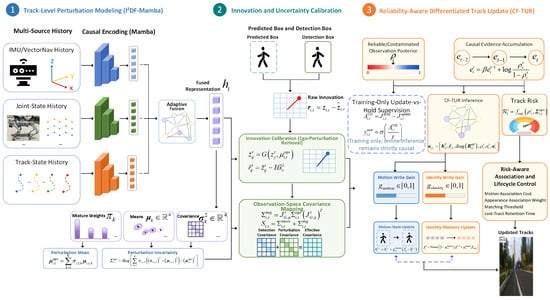
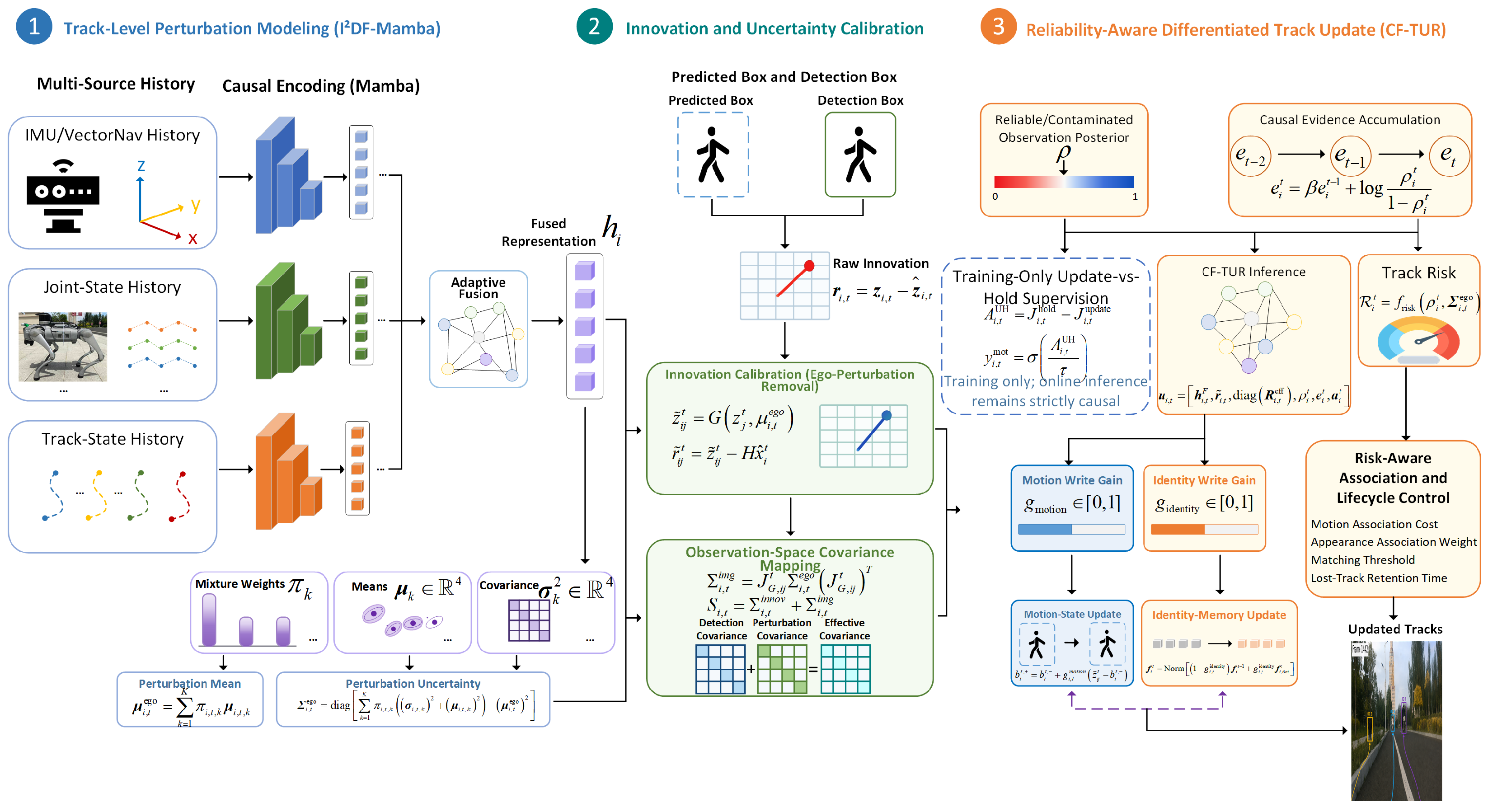
ERM-Track adopts an online tracking-by-detection framework, as illustrated in Figure 1. The inputs include the current-frame detections, historical trajectory states, and IMU and joint-state sequences causally aligned with the image timestamps. The outputs include the target identities in the current frame and the updated trajectory states. To address the simultaneous changes in detection-box position, scale, and observation quality caused by UGV walking, turning, and body impacts, two core mechanisms are introduced into the conventional detection–association–update pipeline: trajectory-conditioned ego-motion-to-image disturbance modeling, and reliability-aware differentiated trajectory updating.
Figure 1.
Overall framework of ERM-Track.
At frame t, the system first constructs IMU, joint-state, and trajectory-state histories of length L. I2DF-Mamba uses these causal temporal inputs to predict an image-disturbance mixture distribution for each trajectory. The distribution expectation is mapped to the observation coordinates and used to calibrate the innovation between the detection observation and trajectory prediction, while the distribution covariance is transformed to the same observation coordinates and used in reliability-likelihood construction. CF-TUR then combines the calibrated innovation, disturbance uncertainty, detection confidence, appearance quality, and trajectory lifecycle state to estimate the reliability of the current observation and separately generate write gains for the motion state and identity memory. Finally, observation reliability and disturbance uncertainty are jointly used to form a trajectory risk, which continuously adjusts the motion-association cost, appearance-association weight, matching threshold, and retention time of temporarily unmatched trajectories to complete online matching, differentiated state updating, and trajectory lifecycle maintenance.
3.2. I2DF-Mamba Trajectory-Conditioned Ego-Motion-to-Image Disturbance Modeling
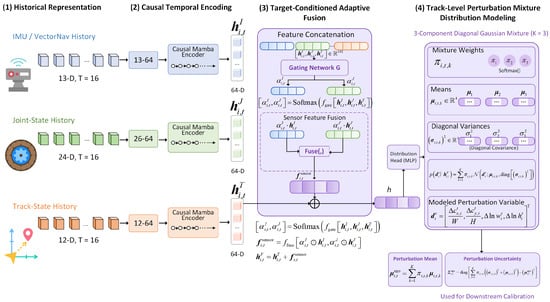
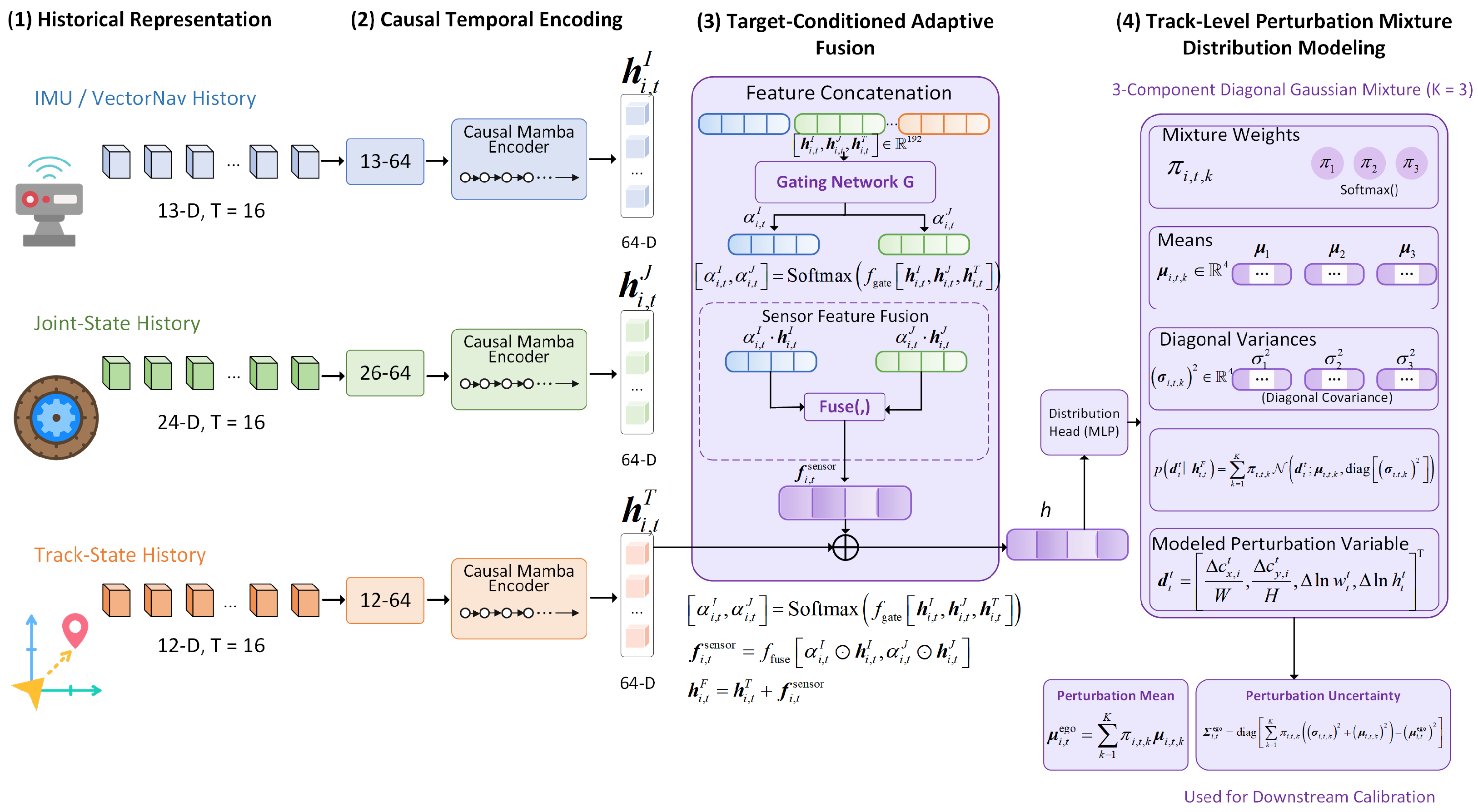
Image changes caused by UGV ego-motion exhibit evident temporal and nonstationary characteristics. Even under the same platform motion state, different targets may present different apparent displacements because of differences in image position, scale, and historical motion state. A unified global compensation cannot adequately describe such trajectory-level differences. Therefore, I2DF-Mamba conditions the trajectory-level effect of ego-motion on the image plane on the ego-motion history, trajectory-state history, and the current target position, scale, and predicted state, and outputs the disturbance mean and uncertainty in the form of a mixture distribution. The module is illustrated in Figure 2.
Figure 2.
I2DF-Mamba trajectory-conditioned ego-motion-to-image disturbance modeling mechanism.
3.2.1. Normalized Image-Disturbance Representation
Image changes caused by UGV ego-motion are reflected not only in detection-box center displacement but also in target-scale changes. To uniformly describe disturbances under different image sizes and target scales, the normalized image disturbance affecting trajectory i at frame t is defined as
where and denote the horizontal and vertical disturbance components of the detection-box center, respectively; W and H denote the image width and height, respectively; and and denote the logarithmic scale changes in detection-box width and height, respectively. This representation jointly describes center displacement and scale variation, while normalization by the image dimensions reduces the influence of different imaging resolutions on the disturbance magnitude.
3.2.2. Multisource Causal Encoding and Trajectory-Conditioned Fusion
Platform ego-sensors describe the global motion state, but the image effect of the same motion state differs across trajectories. I2DF-Mamba therefore first uses independent causal Mamba encoders for the IMU, joint-state, and trajectory histories, and then adaptively determines the fusion weights of the two ego-sensor streams conditioned on the trajectory state. Let denote the current trajectory context, including the predicted image location and scale together with velocity-related and lifecycle variables used to characterize the current trajectory state.
Let the IMU, joint-state, and trajectory histories of length L be independently encoded by causal Mamba encoders to obtain , , and , respectively. The fusion weights for adaptively selecting ego-sensor information according to the trajectory state are defined as
After the fusion weights of the two ego-sensor streams are obtained, the trajectory-conditioned fused feature is represented as
where and denote the fusion weights of the IMU and joint-state streams, respectively; and denote the weight-prediction network and sensor-fusion network, respectively; ⊙ denotes element-wise multiplication; provides the current location-, scale-, motion-, and lifecycle-related trajectory context; and denotes the fused feature after trajectory conditioning. Because both the fusion weights and the fused representation depend on the state of each trajectory, different trajectories in the same frame can obtain different disturbance representations from the same ego-sensor sequences.
3.2.3. Disturbance-Distribution Prediction and Observation-Space Calibration
Image disturbances caused by platform walking, turning, and impacts may exhibit multiple motion modes and heteroscedastic characteristics that vary over time and across trajectories. To jointly describe the multimodality and uncertainty of the disturbance, the trajectory-level image disturbance is modeled as a mixture distribution composed of K diagonal Gaussian components:
where , , and denote the mixture weight, four-dimensional mean, and variance of the kth component, respectively. In this paper, .
According to the mixture distribution, the disturbance expectation for each trajectory is calculated as
Furthermore, the total diagonal covariance of the mixture distribution is expressed as
Here, and denote the expectation and total covariance of the trajectory-level ego-motion-to-image disturbance, respectively. The total covariance includes both the uncertainty within each Gaussian component and the mean differences among components.
Because Equation (5) defines center displacement in normalized image coordinates and scale change in logarithmic coordinates, the predicted disturbance must first be mapped to the detection-observation space before it is combined with the tracker innovation. Let the observation of detection j be . The disturbance-corrected observation is defined as
The calibrated observation innovation is then
The disturbance covariance is mapped to the same observation coordinates through the Jacobian of Equation (11). With
the first-order observation-space disturbance covariance is
It is combined with the innovation-noise term only for reliability-likelihood evaluation:
Thus, I2DF-Mamba not only predicts the trajectory-specific disturbance expectation but also explicitly estimates its uncertainty. The disturbance mean corrects the observation in the coordinate system used by the tracker, while the mapped covariance provides probabilistic information for subsequent reliability estimation. The covariance in Equation (15) is an observation-likelihood covariance rather than a recursively propagated posterior state covariance.
3.3. CF-TUR Reliability-Aware Differentiated Trajectory Update
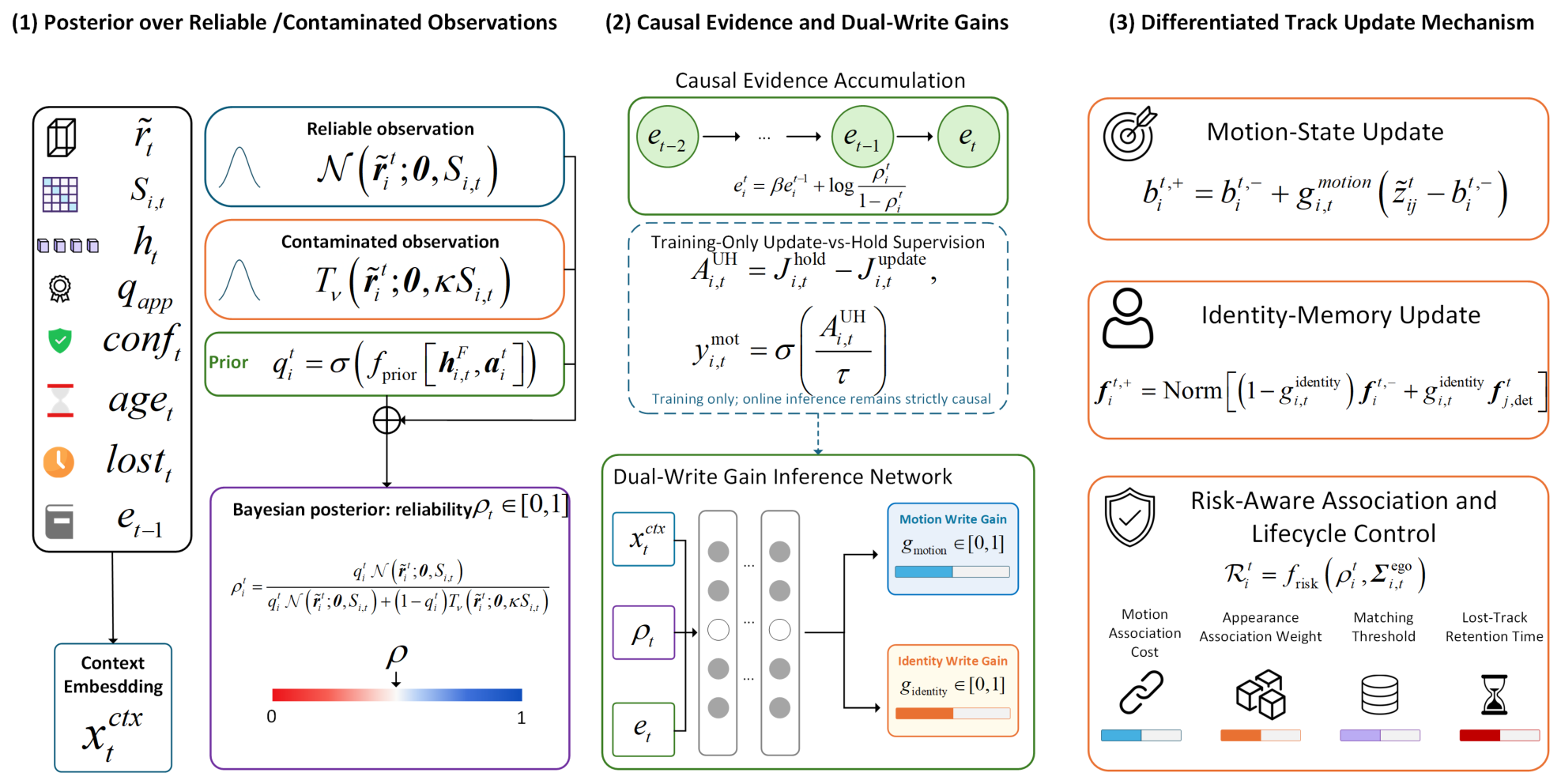
Abnormal observations under dynamic viewpoints may be caused by body impacts, detection-box jitter, target occlusion, or appearance contamination. Conventional trackers generally update the motion state and identity feature together after successful matching. However, the motion state and identity memory do not necessarily require the same update strength for a given observation. To address this issue, CF-TUR estimates observation reliability through a reliable–contaminated observation posterior, causal evidence accumulation, and update-versus-retain supervision, and it separately controls the write amplitudes of the motion state and identity memory. The mechanism is illustrated in Figure 3.
Figure 3.
CF-TUR reliability-aware differentiated trajectory update mechanism.
3.3.1. Reliable–Contaminated Observation Posterior
Successful data association only indicates that the current detection and trajectory satisfy the matching condition; it does not guarantee that the detection location and appearance feature are uncontaminated. To distinguish normal observations from heavy-tailed abnormal observations, CF-TUR constructs a reliable–contaminated observation posterior using a reliable Gaussian model and a contaminated Student-t model.
First, a reliable-observation prior is predicted from the fused feature and auxiliary state. The reliable Gaussian model and heavy-tailed contaminated model are then combined through posterior fusion:
Here, denotes the reliable-observation prior; consists of appearance quality, detection confidence, trajectory age, the number of consecutive lost frames, and residual magnitude; denotes instantaneous reliability; denotes a Student-t distribution with degrees of freedom; and denotes the contamination-scale coefficient. The Gaussian branch describes observations consistent with the current trajectory model, whereas the Student-t branch accommodates heavy-tailed abnormalities. In this way, reliability is determined jointly by the calibrated geometric evidence, disturbance uncertainty, and auxiliary trajectory quality rather than by detection confidence alone.
3.3.2. Causal Evidence Accumulation and Update-Versus-Retain Supervision
First, to reduce the influence of single-frame noise on the update strategy, the instantaneous reliability is recursively accumulated as causal reliability evidence:
where denotes the current accumulated reliability evidence, denotes the evidence at the previous time step, and denotes the historical-evidence retention coefficient. The accumulation suppresses isolated reliability fluctuations while preserving a causal summary of recent observation quality.
Second, during training, the subsequent costs of two candidate recursions—namely, writing the current observation and retaining the historical state—are compared to construct update-versus-retain supervision:
where and denote the subsequent costs of retaining the historical state and writing the current observation, respectively; indicates that writing the current observation is more beneficial; denotes the soft supervision for motion writing; and is the temperature coefficient. Equation (18) provides the explicit future-cost supervision for the motion-writing branch. The identity-writing gain is produced by a separate output head and is optimized jointly within CF-TUR rather than by reusing as an identity target. The future window is used only to construct training supervision. Online inference still uses only current and historical information and, therefore, remains strictly causal.
3.3.3. Dual Write Gains and Deterministic State Interpolation
The motion state and identity memory have different state semantics. Positional disturbances mainly affect motion estimation, whereas occlusion, false detections, and appearance contamination may cause more persistent changes in identity features. CF-TUR therefore does not use a shared update gate but separately predicts a motion-state write gain and an identity-memory write gain.
CF-TUR outputs two continuous write gains according to observation reliability, accumulated evidence, calibrated innovation, and trajectory state:
where
denotes the dual-gain prediction network, and and denote the motion-state and identity-memory write gains, respectively. The two gains share the same input context but form differentiated responses through independent output channels, and both are bounded in .
For a successfully matched trajectory–detection pair, the formal motion-state update is implemented directly in box-observation coordinates. Let denote the predicted box state before writing the current observation. The updated box state is
The identity memory is updated independently as
where denotes the historical identity memory, denotes the appearance feature of the current detection, and denotes feature normalization. The uncertainty in Equation (15) affects the reliability posterior and the resulting write gains, whereas the reported inference path does not recursively propagate a reliability-scaled posterior state covariance. This distinction keeps the probabilistic role of disturbance uncertainty in reliability estimation separate from the deterministic state interpolation used during online trajectory updating.
3.3.4. Trajectory-Risk Adjustment
Observation reliability and disturbance uncertainty are further combined with trajectory lifecycle information to form a trajectory-risk variable. The risk value characterizes how strongly the current observation should influence association and how conservatively a temporarily unmatched trajectory should be retained. Rather than introducing a separate discrete decision stage, the risk is used as a continuous control quantity for the motion-association cost, appearance-association weight, matching threshold, and retention time.
When observation reliability is high and disturbance uncertainty is low, the tracker relies more strongly on the current observation and uses the nominal association and lifecycle settings. When reliability decreases or the predicted disturbance becomes uncertain, the relative contributions of motion and appearance evidence and the retention variables are adjusted continuously. Because the risk is computed only from current and historical information, this adjustment does not introduce future observations into inference. In combination with the dual write gains, the resulting pipeline links disturbance representation, reliability estimation, data association, state writing, and trajectory lifecycle management within one causal online framework.
4. Experiments and Result Analysis
4.1. Experimental Settings
4.1.1. UGV Platform and Multisensor Data
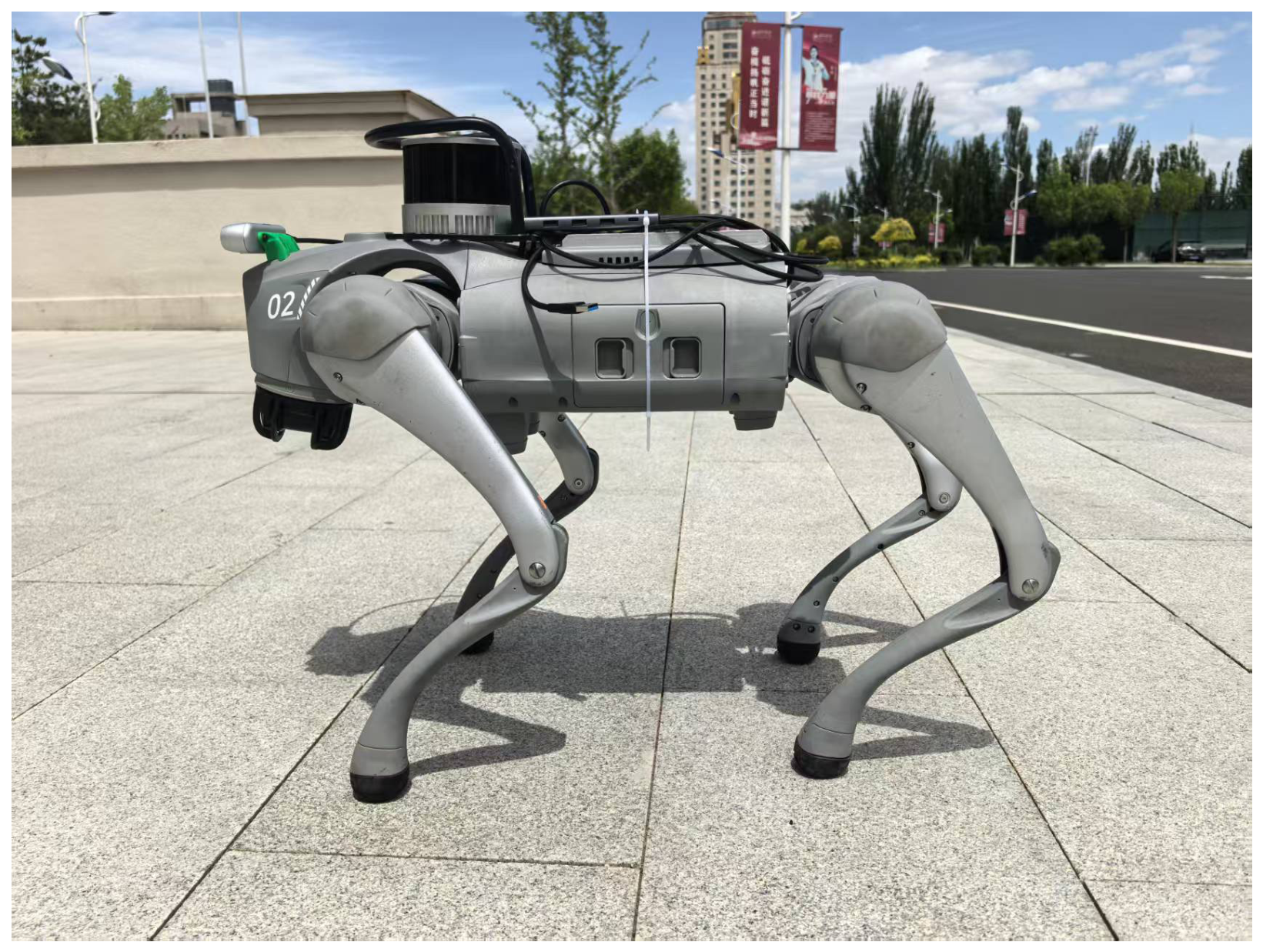
The additionally annotated CEAR source sequences were acquired on a Mini Cheetah quadruped platform with synchronized RGB and proprioceptive sensing [27]. RGB observations provide target detections and appearance crops, whereas the IMU and joint-state streams describe platform motion and the associated viewpoint disturbance. All streams were aligned by image timestamps, and only current and historical samples were used. The onboard implementation was evaluated separately on a Unitree Go2 EDU platform (Unitree Robotics, Hangzhou, China) carrying an NVIDIA Jetson Orin NX 16 GB module (NVIDIA Corporation, Santa Clara, CA, USA); Figure 4 shows this deployment platform. The onboard system retained its factory-installed operating-system image.
Figure 4.
Go2 EDU UGV platform used for onboard implementation and runtime validation.
4.1.2. Data Partition and Isolation Protocol
After multimodal eligibility screening, the additionally annotated CEAR data were divided into 8887 training frames, 1975 development frames, and 6488 sealed holdout frames. The complete corpus contained 17,350 frames, 45,412 valid target boxes, and 119 identities. The splits were mutually isolated by frame index, RGB content hash, target identity, and sensor time window. Table 1 summarizes the experimental partition.
Table 1.
Formal experimental partition of the additionally annotated CEAR data.
The holdout split was not used for model selection, threshold adjustment, or calibration fitting. All mechanism analyses were conducted on DEV, while the sealed holdout was used only for the final frozen comparison.
4.1.3. Metrics and Evaluation Protocol
HOTA, DetA, AssA, IDF1, MOTA, IDSW, and Frag were computed with one fixed TrackEval configuration and an IoU matching threshold of 0.5. All methods in the sealed-holdout comparison used identical frozen detections. Three-seed results use seeds 42, 43, and 44 and report the sample standard deviation. The sealed-holdout table reports the pre-specified one-shot comparison, whereas stochastic variation and controlled mechanism comparisons are characterized separately on DEV.
4.1.4. Implementation Details
The temporal history length was fixed to . The IMU, joint-state, and trajectory streams contained 13, 24, and 12 input dimensions, respectively, and each causal encoder produced a 64-dimensional representation before trajectory-conditioned fusion. The Mamba encoders used two Mamba layers with state dimension 16 and convolution width 4. The disturbance head used the three-component mixture in Equation (8). The controlled three-seed training and backbone-replacement experiments used AdamW with an initial learning rate of , cosine decay, batch size 128, gradient clipping at 1.0, and 1200 optimization steps. The Mamba, LSTM, and causal Transformer variants shared the same inputs, fusion module, disturbance heads, losses, CF-TUR module, and selection rule. Frozen detections were generated once with YOLO11s at an input size of 640 pixels, a confidence threshold of 0.25, an NMS IoU threshold of 0.70, and class indices , and were then reused without method-specific threshold adjustment. No independent ReID network was used. Instead, 128-dimensional appearance descriptors were extracted from YOLO11s layer 16 by ROIAlign and used consistently throughout the tracking experiments. The reliability model used , , and . The temperature coefficient was fixed to only when constructing the training soft labels in Equation (18) and was not used during formal online inference. These settings were kept fixed across random seeds and evaluation splits.
The workstation software environment used Ubuntu 24.04 LTS and Python 3.12.3 (Python Software Foundation; https://www.python.org/, accessed on 2 August 2026), with PyTorch 2.11.0 (https://pytorch.org/, accessed on 2 August 2026), CUDA 12.8, and cuDNN 9.19.0 (NVIDIA Corporation, Santa Clara, CA, USA). I2DF-Mamba used mamba-ssm 2.3.2.post1 (https://github.com/state-spaces/mamba, accessed on 2 August 2026) and causal-conv1d 1.6.2.post1 (https://github.com/Dao-AILab/causal-conv1d, accessed on 2 August 2026). Frozen YOLO11s detections were generated using Ultralytics 8.4.50 (Ultralytics Inc., Frederick, MD, USA), and reliability calibration used scikit-learn 1.9.0 (https://scikit-learn.org/, accessed on 2 August 2026). The retained appearance-extraction environment contains torchvision 0.26.0 (https://github.com/pytorch/vision, accessed on 2 August 2026). Tracking metrics used the bundled TrackEval 1.0.dev1 implementation in Deep-OC-SORT (repository revision 6bb51d0 (https://github.com/GerardMaggiolino/Deep-OC-SORT/tree/6bb51d027b137233f5c520b6fcc4f2ae387a6ba9/external/TrackEval, accessed on 2 August 2026)).
To maintain a single frozen-detection interface, the quantitative main comparison was restricted to trackers that can be evaluated under this common input protocol. Deep OC-SORT and Hybrid-SORT were retained as methodological context for adaptive appearance and weak-cue association, while end-to-end Transformer trackers, including MOTR and MOTRv2 [19,28], were treated as architectural references because their jointly optimized detection–tracking formulations do not share the same frozen-detection interface used in the main comparison. UCMCTrack was also examined as a ground-plane camera-motion-compensation reference. Its formulation requires a validated sequence-specific camera-to-ground transformation or homography. Such calibration is not available for the evaluated downtown sequence, and cross-sequence or manually approximated geometry was therefore not used for quantitative reporting. BoT-SORT, with its official sparse-optical-flow GMC, was retained as the established frame-level motion-compensation reference that does not require this unavailable sequence-specific ground-plane calibration.
4.2. Baseline Comparison on the Sealed Holdout Set
ERM-Track achieves the highest HOTA, AssA, and IDF1 and ties BoT-SORT for the lowest IDSW. The gains are concentrated in association quality and identity preservation, which are the primary targets of I2DF and CF-TUR. The BoT-SORT entry uses its official sparse-optical-flow global motion compensation, providing an established frame-level motion-compensation reference. Table 2 is the single frozen evaluation on the sealed holdout; no statistical-significance claim is inferred from this table alone, and three-seed uncertainty is reported on DEV in Section 4.3 and Section 4.4.
Table 2.
Comparison on the sealed holdout set (%).
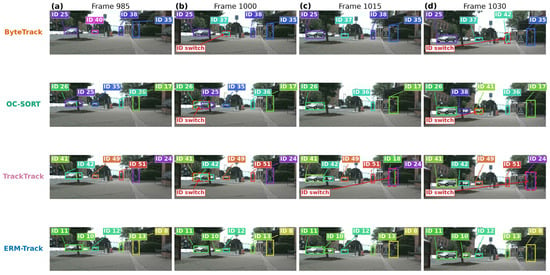
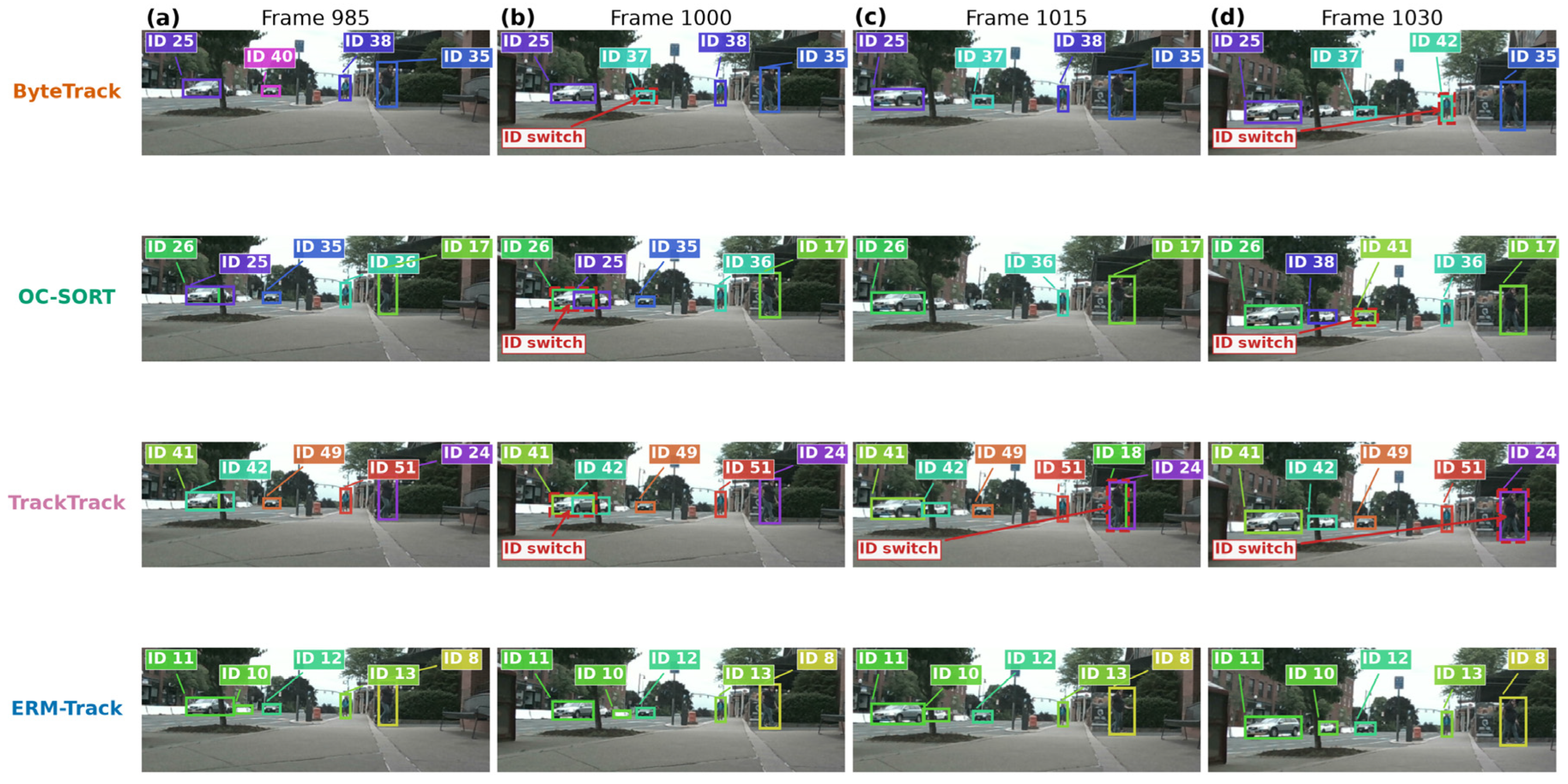
Figure 5 provides a qualitative comparison under dynamic viewpoints.
Figure 5.
Qualitative comparison under dynamic viewpoints: (a) frame 985; (b) frame 1000; (c) frame 1015; (d) frame 1030. Rows show ByteTrack, OC-SORT, TrackTrack, and ERM-Track, respectively. Colored boxes and ID labels distinguish tracked targets within each method, and red callouts mark identity switches. IDs and colors are not shared across methods.
Trajectory Continuity and Interruption Recovery
Because Frag counts interruptions in matched trajectories, it is complemented by event-level continuity measurements on DEV. An interruption is considered to be recovered when the ground-truth trajectory is matched again before its final visible frame. Same-ID recovery denotes restoration with the preceding predicted identity, different-ID recovery denotes restoration under a new predicted identity, and permanent loss denotes the absence of a later valid match. Recovery, same-ID recovery, different-ID recovery, and permanent loss are normalized by the total number of interruption events; consequently, the same-ID and different-ID recovery ratios sum to the overall recovery ratio.
Although the aggregate Frag count is higher for ERM-Track, Table 3 shows that its interruptions are predominantly temporary: 90.71% are subsequently recovered, 73.73% recover the same predicted identity, 16.97% resume under a different identity, and only 9.29% become permanent losses. ERM-Track also produces a longer mean track lifetime, higher continuity, higher matched-frame coverage, and greater utilization of eligible detections than the BoT-SORT reference.
Table 3.
DEV trajectory-continuity diagnostics.
A cause-level analysis of 229 DEV interruptions is summarized in Table 4. The categories in Table 4 are assigned post hoc from the frozen DEV predictions and TrackEval matching results and are used only for error attribution; they are not available to, or used by, the online tracker. Most interruptions occur when no detection is eligible under the fixed TrackEval matching condition, followed by wrong association, localization mismatch after output correction, and geometric-gate rejection. This analysis indicates that the aggregate fragmentation behavior is primarily associated with temporary observation availability rather than a discrete CF-TUR hold operation.
Table 4.
Primary causes of DEV interruption events.
A minimal structural sensitivity was further evaluated by allowing one frame of causal coasting when a trajectory remained unmatched after the tracker’s own online association and gating stage. Averaged over three seeds, this change reduced Frag by 2.67 and FN by 16.33 without changing IDSW, but it increased FP by 47 and changed HOTA, AssA, and IDF1 by , , and percentage points, respectively. The original lifecycle rule is therefore retained, while recovery-aware continuation remains a direction for improving observation continuity without increasing false positives.
4.3. Random-Seed Reproducibility
The three complete-model checkpoints and prediction files are independently generated and distinct. The resulting HOTA values remain within a narrow interval, and the subsequent ablations are therefore reported as the three-seed mean ± sample standard deviation. Table 5 reports the three-seed results.
Table 5.
Complete-model results on DEV under three random seeds (%).
4.4. Ablation and Mechanism Analysis
4.4.1. Core-Module Ablation
Table 6 summarizes the core-module ablations. For every configuration A0–A5, the three runs use independently generated checkpoints and prediction files; identical metric entries therefore do not indicate reused outputs. The complete configuration obtains the highest mean HOTA, AssA, IDF1, and MOTA and the lowest mean IDSW. The paired mean HOTA differences between the full model and the five ablations range from 0.180 to 0.224 percentage points. These small mean differences across independently generated runs support the combined processing chain from trajectory-conditioned disturbance representation to reliability-guided differentiated state writing. Trajectory continuity is analyzed separately in Table 3, because Frag reflects a distinct aspect of tracking behavior.
Table 6.
Core ablation results on DEV over three random seeds (%). Standard deviations are shown with three-decimal precision; exact zeros denote identical metric values across independently generated predictions.
4.4.2. Disturbance-Representation Granularity
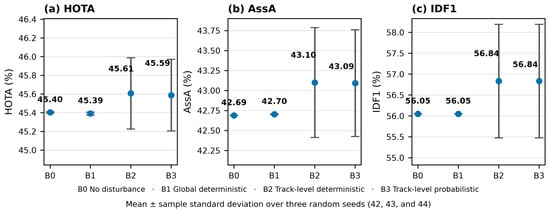
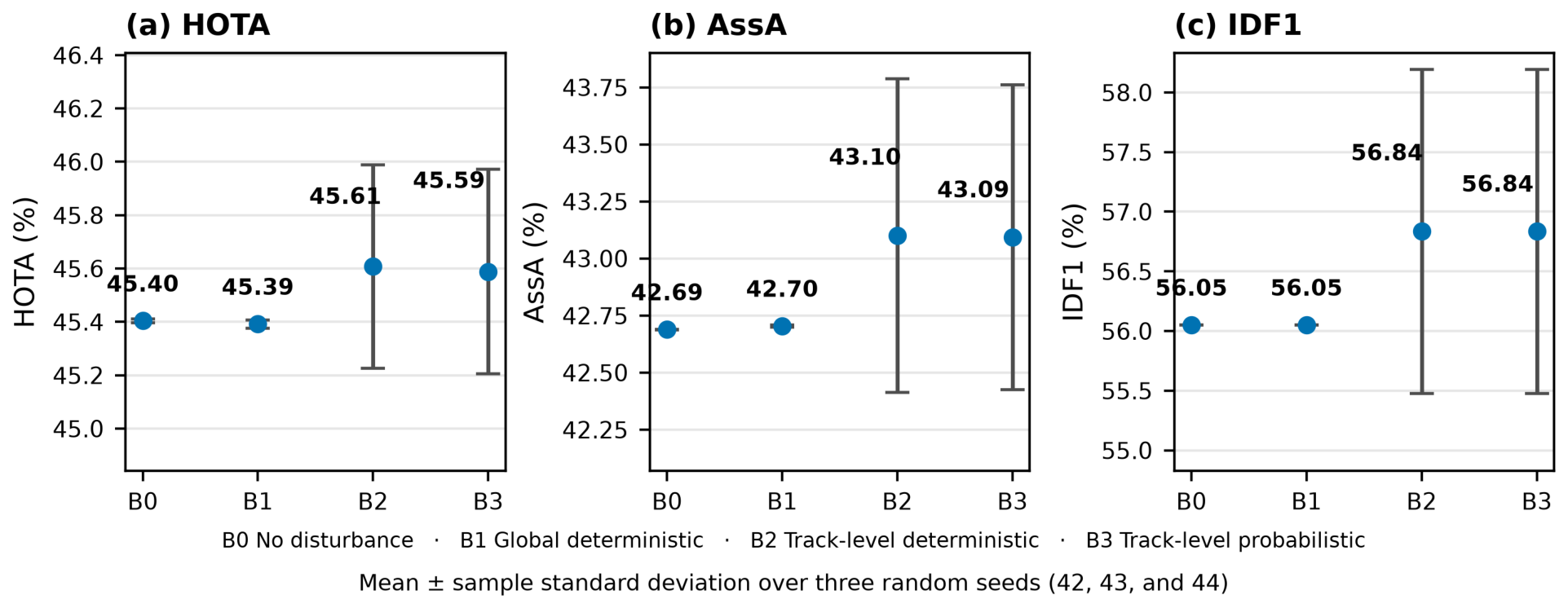
Trajectory-level deterministic and uncertainty-aware variants yield higher association metrics than no-disturbance and globally shared disturbance configurations. This result supports target-conditioned disturbance modeling: the same platform motion does not induce an identical observation displacement for all image locations and target scales. Figure 6 shows the comparison.
Figure 6.
Analysis of I2DF disturbance-representation granularity.
4.4.3. Differentiated Write Responses
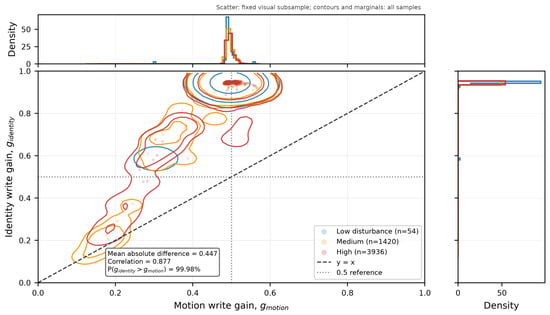
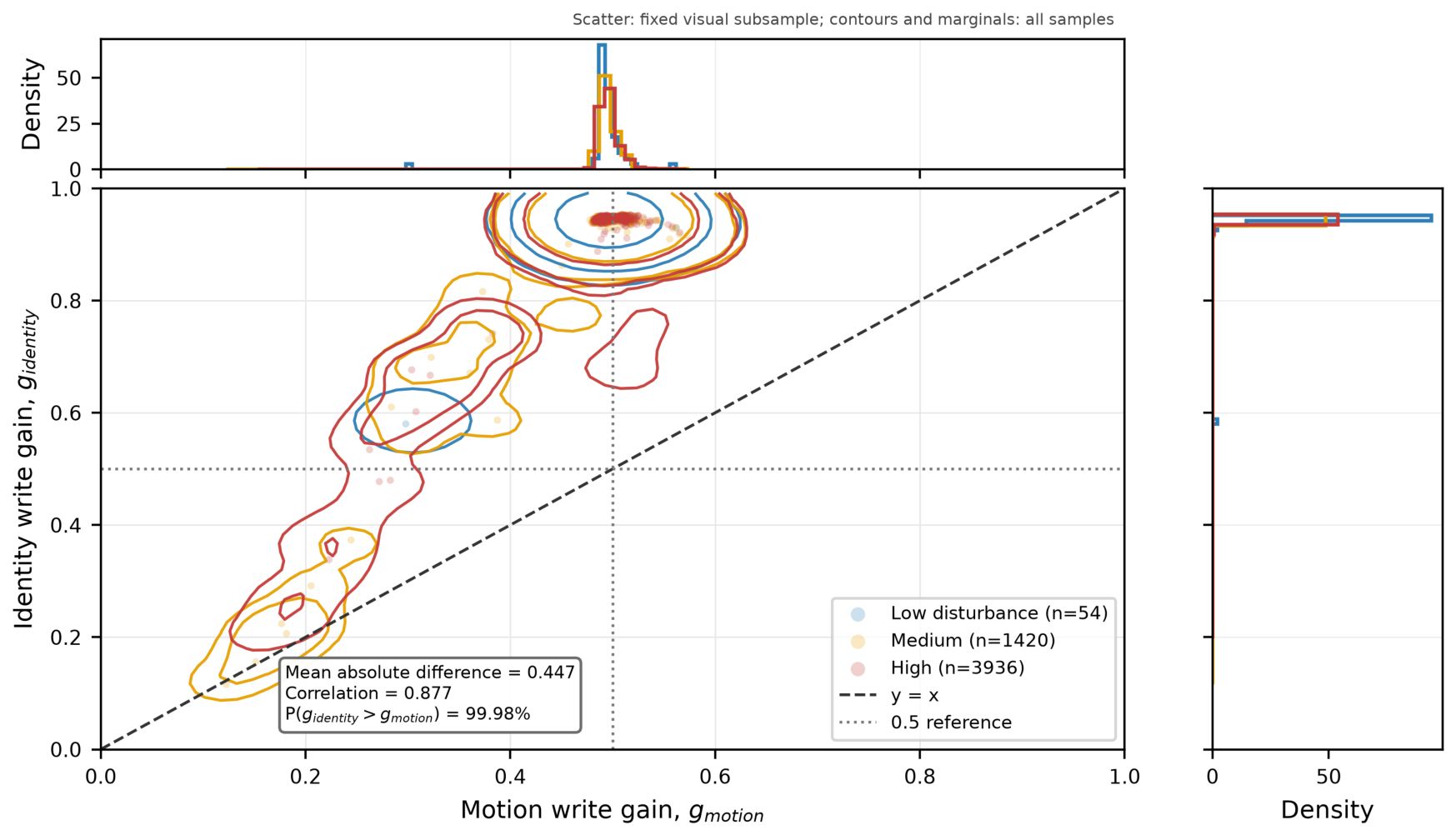
Figure 7 shows the joint distribution of the motion and identity write gains. The mean absolute difference between the two gains is 0.447, their correlation coefficient is 0.877, and 99.98% of the samples have an identity-write gain larger than the motion write gain. The gains therefore share a common reliability context while retaining distinct response ranges for the two state semantics.
Figure 7.
Joint distribution of the CF-TUR motion and identity write gains. Blue, orange, and red indicate the low-, medium-, and high-disturbance groups, respectively. The dashed diagonal denotes equal write gains, and the dotted lines mark a gain of 0.5.
4.4.4. Reliability Calibration
The original reliability output was used as a continuous control signal. To examine its numerical calibration, temperature scaling and isotonic regression were fitted on a separate training-calibration subset and evaluated on DEV. Table 7 reports the three-seed results.
Table 7.
Post hoc reliability calibration and tracking response on DEV.
Isotonic calibration markedly reduces ECE and Brier error while leaving the association metrics and IDSW nearly unchanged. NLL remains sensitive to the calibration mapping, indicating that the numerical benefit is specific to the reported calibration criteria rather than uniform across all probability scores. The marginal tracking response supports the use of reliability primarily as a continuous control variable.
4.4.5. Causal Encoder Comparison
To isolate the choice of causal sequence encoder, Mamba was replaced by capacity-matched causal LSTM and causal Transformer backbones while retaining the dual streams, trajectory conditioning, disturbance heads, losses, CF-TUR, and training schedule. Table 8 reports the comparison.
Table 8.
Three-seed causal-backbone comparison on DEV.
Mamba obtained the highest three-seed mean HOTA and association metrics among the evaluated causal encoders, exceeding the LSTM and causal Transformer by 0.290 and 0.251 HOTA percentage points, respectively. These margins are modest and remain within the observed seed-to-seed variation. The LSTM gives the lowest latency in the evaluated short-history setting, whereas Mamba remains faster than the causal Transformer. Mamba was therefore retained as the best-performing tested causal realization of I2DF under the present configuration, rather than being interpreted as having a universal accuracy or runtime advantage. The comparison also shows that the trajectory-conditioned formulation remains effective across different causal encoders.
4.4.6. Lightweight Disturbance Baseline
A causal ridge-disturbance (CRD) baseline replaces the learned sequence model with a compact ridge mapping and a fixed residual covariance while preserving the downstream tracking protocol. Table 9 reports the comparison.
Table 9.
Lightweight disturbance-model comparison on DEV. I2DF-Mamba reports the three-seed mean, whereas CRD is deterministic under its fixed ridge fit.
The lightweight CRD model establishes an efficient causal reference using the same sensor and tracking interface. I2DF-Mamba obtains higher three-seed mean HOTA, AssA, and IDF1 together with a lower mean IDSW, while CRD retains the smaller computational footprint. The comparison quantifies the additional benefit of nonlinear trajectory-conditioned temporal modeling beyond a fixed linear disturbance mapping.
4.4.7. Established Global Motion Compensation
The main-table BoT-SORT configuration uses its official sparse-optical-flow global motion compensation. A controlled DEV comparison with identical frozen detections quantifies the effect of this established frame-level component. The results are reported in Table 10.
Table 10.
BoT-SORT global-motion-compensation analysis on DEV.
Sparse-optical-flow GMC improves HOTA by 8.81 percentage points and reduces IDSW by 37. The additional tracker latency is approximately 1.84 ms/frame. This confirms that frame-level camera-motion compensation is a strong reference, while I2DF addresses the complementary problem of target-specific disturbance variation and uncertainty.
4.5. DEV–Holdout Difficulty Comparison
The absolute HOTA level is higher on the sealed holdout than on DEV for all protocol-compatible trackers. Table 11 compares the split-level gaps using the same frozen detections within each split.
Table 11.
Cross-method DEV-to-holdout HOTA comparison (percentage points).
The ERM-Track gap of 18.31 points closely follows the five-baseline mean gap of 18.59 points and is therefore not method-specific. The DEV split also contains more frozen detections per frame (4.43 versus 3.23), lower median detection confidence (0.639 versus 0.757), smaller median box area (388 versus 1072 pixels2), and more active tracks per frame (2.94 versus 2.44). These split-level properties are consistent with the lower absolute DEV scores. Mechanism and ablation conclusions are consequently interpreted within DEV, while the sealed holdout remains the independent final comparison.
4.6. Runtime Efficiency and Onboard Validation
The workstation pipeline was profiled end to end on an Intel Core i9-13900K CPU (Intel Corporation, Santa Clara, CA, USA) and an NVIDIA GeForce RTX 4080 GPU (NVIDIA Corporation, Santa Clara, CA, USA) at resolution in FP32. The onboard implementation was evaluated on a Jetson Orin NX 16 GB platform under a unified end-to-end timing protocol, yielding an average latency of approximately 29 ms/frame. Table 12 summarizes the runtime results.
Table 12.
End-to-end runtime of ERM-Track.
For the workstation, throughput was measured from completed-frame wall-clock time. For the onboard platform, the processing rate is the reciprocal of the mean end-to-end latency. Reporting the timing convention explicitly avoids combining independently measured latency and throughput quantities.
The synchronized diagnostic measurements in Table 13 use component-specific timing boundaries and need not sum exactly to the normal end-to-end wall-clock time. Because no independent ReID network is used, the appearance entry denotes ROIAlign and descriptor preparation from YOLO11s layer 16; the resulting 128-dimensional appearance descriptor is part of the normal end-to-end pipeline.
Table 13.
Diagnostic workstation timing decomposition.
Table 14 reports latency at different active-track counts.
Table 14.
Latency scaling with the number of active trajectories.
Within the observed DEV range, trajectory histories are processed as a batched GPU tensor, and latency changes only slightly from one to five active trajectories. The stress tests show that the predictor remains within a compact latency range even at substantially larger track counts.
4.7. RGB-Only Cross-Dataset Transfer
An RGB-only VisualProxy removes IMU and joint-state inputs and retains the visual association pathway. It is used as a pathway-transfer diagnostic on DanceTrack rather than as an equivalent replacement for the complete multisensor model.
Table 15 reports the RGB-only transfer comparison. The metric-complete Seed-43 VisualProxy run reaches the highest DetA and IDF1 in the listed comparison and an HOTA close to that of ByteTrack. Across seeds 42–44, its HOTA is %, indicating greater initialization sensitivity after the IMU and joint-state cues are removed. This result does not by itself establish overfitting to CEAR; rather, it shows that the multisensor benefit does not transfer unchanged to the RGB-only pathway. The experiment is therefore interpreted as a pathway-transfer diagnostic rather than an equivalent replacement for the complete I2DF mechanism.
Table 15.
Metric-complete Seed-43 RGB-only VisualProxy comparison on DanceTrack (%).
4.8. Qualitative Results
4.8.1. Identity Switches, Fragmentation, and Complete Misses
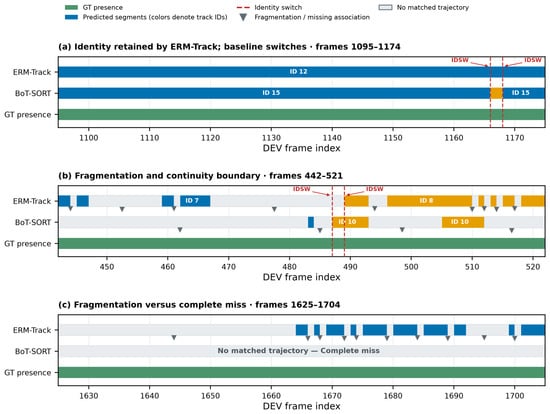
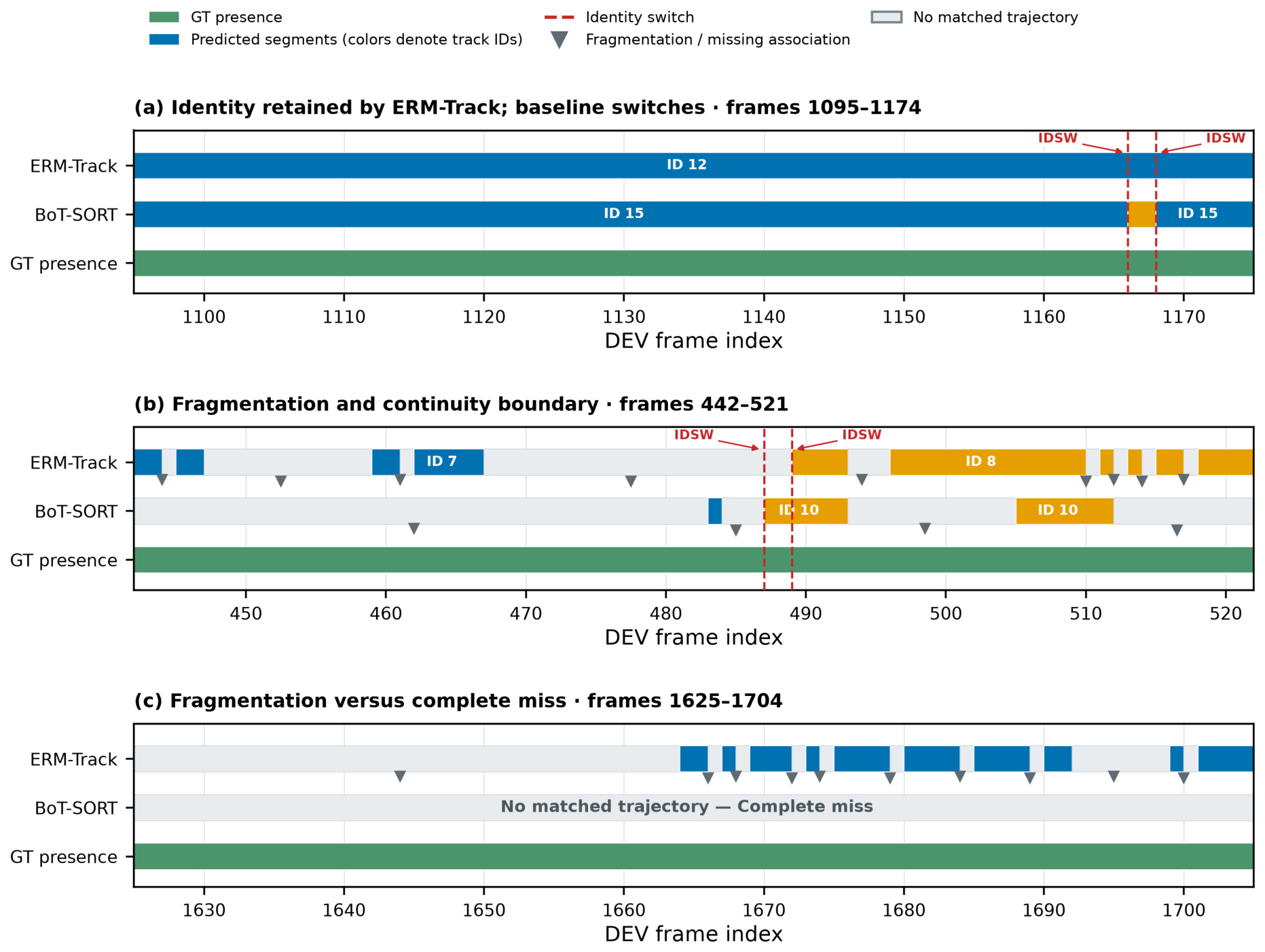
Figure 8 complements the aggregate metrics by distinguishing identity switches, recovered trajectory interruptions, and complete misses. It is based on DEV and is used for mechanism visualization. To preserve the pre-specified sealed-holdout protocol, no post hoc event selection or case-level extraction was performed on the holdout, which remained restricted to its aggregate final evaluation.
Figure 8.
DEV identity-continuity timelines illustrating an identity switch, a recovered interruption, and a complete miss. Colors and numerical IDs are valid only within each method and case.
4.8.2. Representative Dynamic-View Scenes
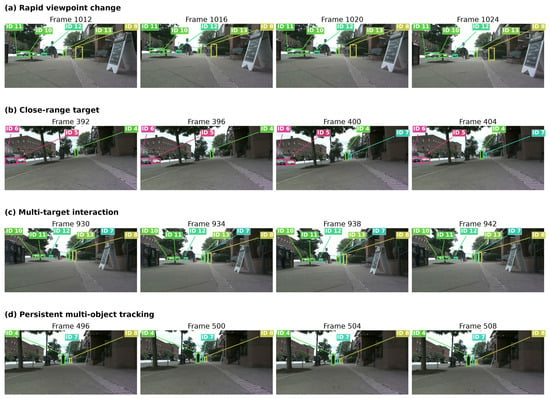
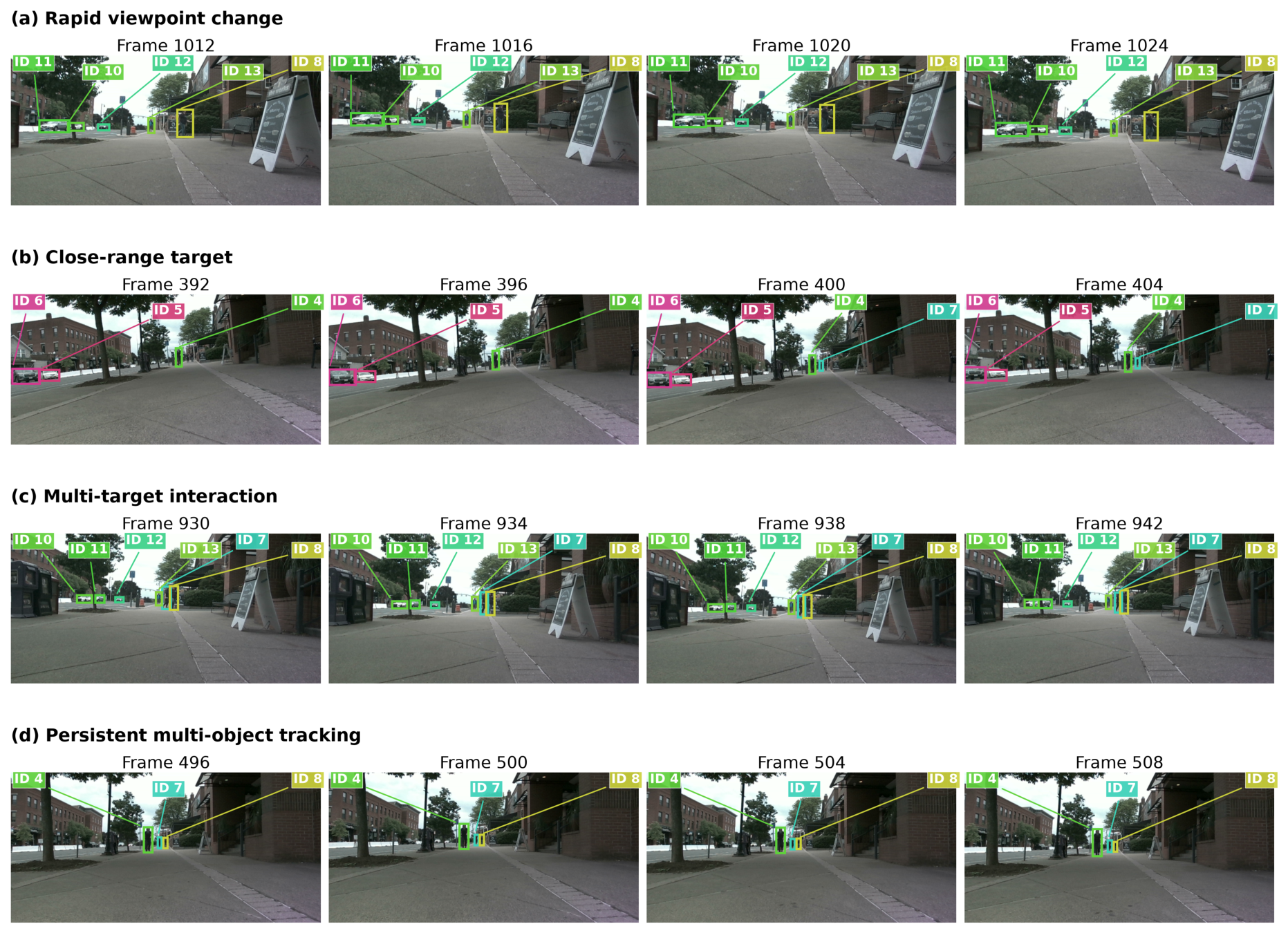
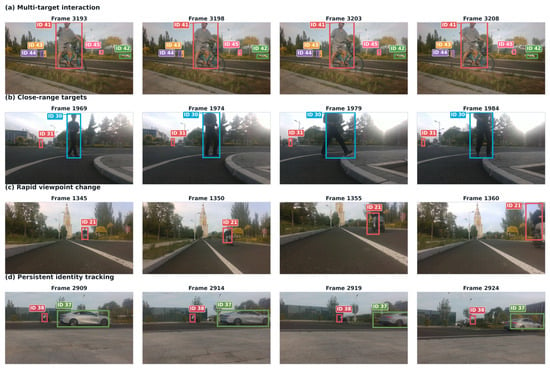
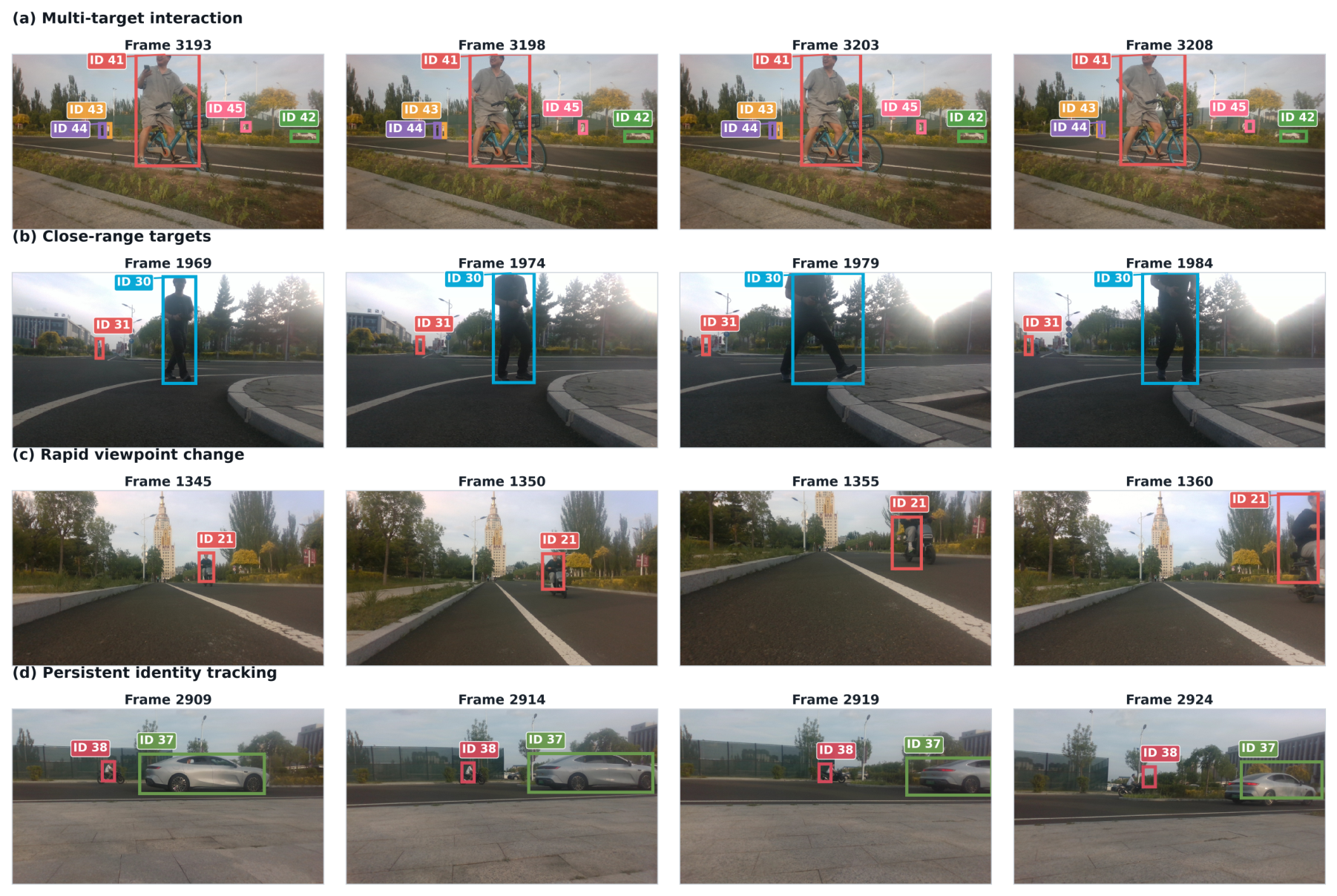
The qualitative results cover rapid camera rotation, substantial target-scale changes, close target proximity, backlighting, and mixed road-user interactions. Figure 9 presents the representative DEV results. These cases illustrate how the disturbance-conditioned and reliability-guided modules operate under different visual and motion conditions. The additional sequences shown in Figure 10 are used only for qualitative visualization and are not included in the formal TRAIN/DEV/sealed-holdout protocol or the quantitative comparisons.
Figure 9.
Representative DEV results involving (a) rapid viewpoint changes, (b) close-range targets, (c) multi-target interactions, and (d) persistent multi-target tracking. Colored boxes and ID labels distinguish trajectories within each sequence.
Figure 10.
Representative results on additional UGV sequences: (a) interactions involving cyclists; (b) close-range pedestrians under backlighting; (c) rapid viewpoint changes; (d) persistent identity tracking of coexisting road users. Colored boxes and ID labels distinguish trajectories within each sequence.
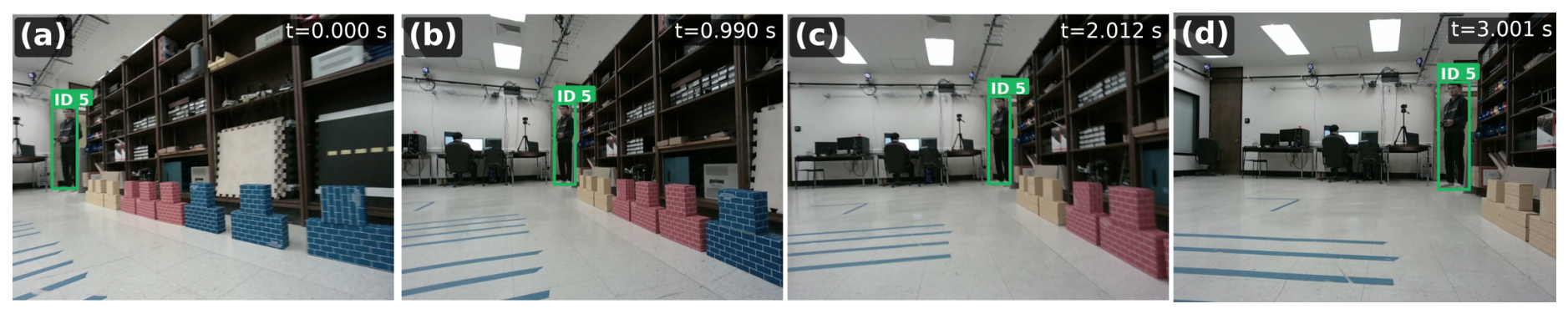
Figure 11 shows the visualization results for an indoor CEAR sequence.
Figure 11.
Visualization results for an indoor sequence from the CEAR dataset: (a) s; (b) s; (c) s; (d) s. The green bounding box and ID label mark the tracked target, which retains ID 5 in all four displayed frames.
5. Discussion
5.1. Trajectory-Conditioned Disturbance Modeling
The results support trajectory-conditioned disturbance representation. Frame-level global compensation is effective, as demonstrated by the BoT-SORT GMC analysis, but it applies one transformation to the complete frame. I2DF complements this mechanism by modeling how target position, scale, and history alter the apparent disturbance experienced by each trajectory. The CRD and causal-backbone comparisons separate the contribution of the disturbance formulation from that of the temporal encoder. Mamba provides the highest three-seed mean HOTA among the evaluated causal backbones, although its margin over LSTM and the causal Transformer is modest and lies within the observed seed variability. It is therefore retained as the best-performing tested causal realization under the present configuration, rather than as evidence of a universal backbone advantage. The close results of the alternative encoders further indicate that the trajectory-conditioned formulation is not tied to a single causal backbone.
5.2. Reliability-Guided State Writing
CF-TUR uses a common reliability context but produces different write amplitudes for the motion state and identity memory. The joint gain distribution and shared gain ablation support this differentiated response. Isotonic mapping substantially reduces ECE and Brier error without materially changing the tracking behavior, while the NLL response remains dependent on the calibration mapping. Reliability is therefore interpreted primarily as a continuous state-control signal, with post hoc calibration used when ECE- or Brier-oriented probability interpretation is required.
5.3. Trajectory Continuity
The sealed-holdout results combine low IDSW with a comparatively high Frag count. The DEV event analysis provides a more detailed interpretation: most interruptions are recovered, the same predicted identity is restored in a large majority of all interruption events, and the permanent-loss rate is lower than that of the BoT-SORT reference. The dominant interruption source is the temporary absence of an eligible observation. A one-frame causal coasting variant reduces Frag and FN only modestly while increasing FP and slightly decreasing the main tracking metrics, so it is not adopted in the reported tracker. These findings motivate recovery mechanisms that improve observation continuity without sacrificing precision.
5.4. Deployment Scope
The workstation and onboard measurements confirm real-time operation under the evaluated configurations. Batched trajectory processing limits the growth of wall-clock latency across the active-track range encountered in the experiments. The formulation can also be adapted to other mobile platforms: wheel odometry and steering states can replace articulated joint states on wheeled UGVs, while flight-state and inertial streams can serve as the platform branch for aerial systems. Such transfer preserves the trajectory-conditioned principle while requiring platform-specific sensor normalization, motion-distribution adaptation, and direct validation.
6. Conclusions
This paper presents ERM-Track for online multi-object tracking under dynamic UGV viewpoints. I2DF-Mamba integrates causal ego-sensor and trajectory histories to predict trajectory-specific disturbance means and uncertainties. The disturbance mean and covariance are explicitly mapped to the detection-observation space before reliability evaluation. CF-TUR combines a reliable–contaminated observation posterior with causal evidence and independently bounded motion and identity-write gains, implemented as deterministic state interpolation. On the sealed holdout set, ERM-Track obtains the highest HOTA, AssA, and IDF1 among the compared methods and ties for the lowest IDSW. Three-seed ablations, lightweight and backbone comparisons, calibration experiments, continuity analysis, established GMC evaluation, DEV–holdout composition analysis, and active-track runtime scaling provide complementary evidence for the proposed formulation. The complete pipeline retains real-time operation on both the evaluated workstation and the onboard platform.
Author Contributions
Conceptualization, Z.Z.; Methodology, Z.Z.; Software, Z.Z.; Validation, Z.Z.; Formal analysis, Z.Z.; Investigation, Z.Z. and Y.Q.; Resources, Y.Q.; Data curation, J.L. and J.S.; Writing—original draft preparation, Z.Z.; Writing—review and editing, Y.Q.; Visualization, J.L. and J.S.; Supervision, Y.Q.; Project administration, J.L. and J.S.; Funding acquisition, Y.Q. All authors have read and agreed to the published version of the manuscript.
Funding
This research was funded by the National Natural Science Foundation of China (Grant No. 62363029), the Natural Science Foundation of Inner Mongolia (Grant Nos. 2025MS06038 and 2026MS0302), the Science and Technology Plan Project of Inner Mongolia Autonomous Region (Grant Nos. 2025KYPT0042 and 2026KYPT0071), the Inner Mongolia Autonomous Region “Yingcai Xingmeng” Engineering Team Project (2025TEL07), and the Innovation Team Project of the Education Department of Inner Mongolia Autonomous Region (Grant No. NMGIRT2508).
Data Availability Statement
The CEAR source dataset is described in Ref. [27]. The additional tracking annotations, split manifests, and evaluation assets supporting this study are available from the corresponding author upon reasonable request, subject to the license and distribution conditions of the underlying dataset.
Conflicts of Interest
The authors declare no conflicts of interest.
References
- Luo, W.; Xing, J.; Milan, A.; Zhang, X.; Liu, W.; Kim, T.-K. Multiple object tracking: A literature review. Artif. Intell. 2021, 293, 103448. [Google Scholar] [CrossRef] [Scilit]
- Emami, P.; Pardalos, P.M.; Elefteriadou, L.; Ranka, S. Machine learning methods for data association in multi-object tracking. ACM Comput. Surv. 2020, 53, 69. [Google Scholar] [CrossRef] [Scilit]
- Dendorfer, P.; Ošep, A.; Milan, A.; Schindler, K.; Cremers, D.; Reid, I.; Roth, S.; Leal-Taixé, L. MOTChallenge: A benchmark for single-camera multiple target tracking. Int. J. Comput. Vis. 2021, 129, 845–881. [Google Scholar] [CrossRef] [Scilit]
- Sun, P.; Cao, J.; Jiang, Y.; Yuan, Z.; Bai, S.; Kitani, K.; Luo, P. DanceTrack: Multi-object tracking in uniform appearance and diverse motion. In Proceedings of the IEEE/CVF Conference on Computer Vision and Pattern Recognition, New Orleans, LA, USA, 19–24 June 2022; pp. 20993–21002. [Google Scholar]
- Luiten, J.; Ošep, A.; Dendorfer, P.; Torr, P.; Geiger, A.; Leal-Taixé, L.; Leibe, B. HOTA: A higher order metric for evaluating multi-object tracking. Int. J. Comput. Vis. 2021, 129, 548–578. [Google Scholar] [CrossRef] [Scilit] [PubMed]
- Bewley, A.; Ge, Z.; Ott, L.; Ramos, F.; Upcroft, B. Simple online and realtime tracking. In Proceedings of the 2016 IEEE International Conference on Image Processing; IEEE: Piscataway, NJ, USA, 2016; pp. 3464–3468. [Google Scholar]
- Wojke, N.; Bewley, A.; Paulus, D. Simple online and realtime tracking with a deep association metric. In Proceedings of the 2017 IEEE International Conference on Image Processing; IEEE: Piscataway, NJ, USA, 2017; pp. 3645–3649. [Google Scholar]
- Zhang, Y.; Sun, P.; Jiang, Y.; Yu, D.; Weng, F.; Yuan, Z.; Luo, P.; Liu, W.; Wang, X. ByteTrack: Multi-object tracking by associating every detection box. In Computer Vision—ECCV 2022; Springer: Cham, Switzerland, 2022; pp. 1–21. [Google Scholar]
- Cao, J.; Pang, J.; Weng, X.; Khirodkar, R.; Kitani, K. Observation-centric SORT: Rethinking SORT for robust multi-object tracking. In Proceedings of the IEEE/CVF Conference on Computer Vision and Pattern Recognition, Vancouver, BC, Canada, 18–22 June 2023; pp. 9686–9696. [Google Scholar]
- Shim, K.; Ko, K.; Yang, Y.; Kim, C. Focusing on tracks for online multi-object tracking. In Proceedings of the Computer Vision and Pattern Recognition Conference, Nashville, TN, USA, 11–15 June 2025; pp. 11687–11696. [Google Scholar]
- Zhang, Y.; Wang, C.; Wang, X.; Zeng, W.; Liu, W. FairMOT: On the fairness of detection and re-identification in multiple object tracking. Int. J. Comput. Vis. 2021, 129, 3069–3087. [Google Scholar] [CrossRef] [Scilit]
- Fischer, T.; Huang, T.E.; Pang, J.; Qiu, L.; Chen, H.; Darrell, T.; Yu, F. QDTrack: Quasi-Dense Similarity Learning for Appearance-Only Multiple Object Tracking. IEEE Trans. Pattern Anal. Mach. Intell. 2023, 45, 15380–15393. [Google Scholar] [CrossRef] [Scilit] [PubMed]
- Du, Y.; Zhao, Z.; Song, Y.; Zhao, Y.; Su, F.; Gong, T.; Meng, H. StrongSORT: Make DeepSORT Great Again. IEEE Trans. Multimed. 2023, 25, 8725–8737. [Google Scholar] [CrossRef] [Scilit]
- Yu, E.; Li, Z.; Han, S.; Wang, H. RelationTrack: Relation-Aware Multiple Object Tracking with Decoupled Representation. IEEE Trans. Multimed. 2023, 25, 2686–2697. [Google Scholar] [CrossRef] [Scilit]
- Aharon, N.; Orfaig, R.; Bobrovsky, B.Z. BoT-SORT: Robust associations multi-pedestrian tracking. arXiv 2022, arXiv:2206.14651. [Google Scholar]
- Yi, K.; Luo, K.; Luo, X.; Huang, J.; Wu, H.; Hu, R.; Hao, W. UCMCTrack: Multi-object tracking with uniform camera motion compensation. Proc. AAAI Conf. Artif. Intell. 2024, 38, 6702–6710. [Google Scholar] [CrossRef] [Scilit]
- Maggiolino, G.; Ahmad, A.; Cao, J.; Kitani, K. Deep OC-SORT: Multi-pedestrian tracking by adaptive re-identification. In Proceedings of the 2023 IEEE International Conference on Image Processing; IEEE: Piscataway, NJ, USA, 2023; pp. 3025–3029. [Google Scholar]
- Yang, M.; Han, G.; Yan, B.; Zhang, W.; Qi, J.; Lu, H.; Wang, D. Hybrid-SORT: Weak cues matter for online multi-object tracking. Proc. AAAI Conf. Artif. Intell. 2024, 38, 6504–6512. [Google Scholar] [CrossRef] [Scilit]
- Zeng, F.; Dong, B.; Zhang, Y.; Wang, T.; Zhang, X.; Wei, Y. MOTR: End-to-end multiple-object tracking with Transformer. In Computer Vision—ECCV 2022; Springer: Cham, Switzerland, 2022; pp. 659–675. [Google Scholar]
- Xu, Y.; Ban, Y.; Delorme, G.; Gan, C.; Rus, D.; Alameda-Pineda, X. TransCenter: Transformers with dense representations for multiple-object tracking. IEEE Trans. Pattern Anal. Mach. Intell. 2023, 45, 7820–7835. [Google Scholar] [CrossRef] [Scilit] [PubMed]
- Hu, M.; Zhu, X.; Wang, H.; Cao, S.; Liu, C.; Song, Q. STDFormer: Spatial-Temporal Motion Transformer for Multiple Object Tracking. IEEE Trans. Circuits Syst. Video Technol. 2023, 33, 6571–6594. [Google Scholar] [CrossRef] [Scilit]
- Gu, A.; Dao, T. Mamba: Linear-time sequence modeling with selective state spaces. In Proceedings of the First Conference on Language Modeling, Philadelphia, PA, USA, 7–9 October 2024. [Google Scholar]
- Santana, H.M.S.; Soares, J.C.V.; Nisticò, Y.; Meggiolaro, M.A.; Semini, C. Proprioceptive state estimation for quadruped robots using invariant Kalman filtering and scale-variant robust cost functions. In Proceedings of the 2024 IEEE-RAS 23rd International Conference on Humanoid Robots; IEEE: Piscataway, NJ, USA, 2024; pp. 213–220. [Google Scholar]
- Yuan, Y.; Wu, Y.; Zhao, L.; Chen, J.; Zhao, Q. DB-Tracker: Multi-Object Tracking for Drone Aerial Video Based on Box-MeMBer and MB-OSNet. Drones 2023, 7, 607. [Google Scholar] [CrossRef] [Scilit]
- Li, X.; Zhu, R.; Yu, X.; Wang, X. High-Performance Detection-Based Tracker for Multiple Object Tracking in UAVs. Drones 2023, 7, 681. [Google Scholar] [CrossRef] [Scilit]
- Dang, Z.; Sun, X.; Sun, B.; Guo, R.; Li, C. OMCTrack: Integrating Occlusion Perception and Motion Compensation for UAV Multi-Object Tracking. Drones 2024, 8, 480. [Google Scholar] [CrossRef] [Scilit]
- Zhu, S.; Xiong, Z.; Kim, D. CEAR: Comprehensive event camera dataset for rapid perception of agile quadruped robots. IEEE Robot. Autom. Lett. 2024, 9, 8999–9006. [Google Scholar] [CrossRef] [Scilit]
- Zhang, Y.; Wang, T.; Zhang, X. MOTRv2: Bootstrapping End-to-End Multi-Object Tracking by Pretrained Object Detectors. In Proceedings of the IEEE/CVF Conference on Computer Vision and Pattern Recognition (CVPR), Vancouver, BC, Canada, 18–22 June 2023; pp. 22056–22065. [Google Scholar]

Disclaimer/Publisher’s Note: The statements, opinions and data contained in all publications are solely those of the individual author(s) and contributor(s) and not of MDPI and/or the editor(s). MDPI and/or the editor(s) disclaim responsibility for any injury to people or property resulting from any ideas, methods, instructions or products referred to in the content. |
© 2026 by the authors. Licensee MDPI, Basel, Switzerland. This article is an open access article distributed under the terms and conditions of the Creative Commons Attribution (CC BY) license.