


Highlights
What are the main findings?
- Triangle attributes make the first evaluated rigid-transformation hypotheses much more informative than blind random triples.
- Under composite degradation conditions, TARA maintains a more balanced precision–recall behavior than topology matching and all-to-all registration baselines.
What are the implications of the main findings?
- Sparse UAV radar reports can be associated before long tracks or visual evidence are available.
- The framework is most useful as an early target-level association module under partial overlap, missed detections, and clutter conditions.
Abstract
In multi-UAV airborne radar sensing, target-level fusion cannot start until detections reported in different UAV coordinate frames have been associated. This paper focuses on a single-epoch case: two UAV-mounted radars observe a common target group, but the reported point sets are sparse, unordered, only partially overlapping, and corrupted by angular noise, missed detections, and additional observations. In this setting, appearance cues, long tracks, and dense point-cloud neighborhoods are absent, so the association problem is mainly a sparse geometric registration problem. We propose a Triangle Attribute-Guided Robust Association (TARA) framework. TARA describes each target triple by its absolute scale and two normalized side-length ratios. These attributes are not used as final identity labels. Instead, they retrieve, verify, and rank plausible cross-view triangle pairs, from which a fixed number of rigid-transformation hypotheses are estimated. The best coarse transformation is then refined by the trimmed ICP, and the final correspondences are obtained by gated one-to-one matching in the aligned frame. The ablation results show why the attribute-guided step matters. With only 100 evaluated hypotheses, TARA reaches 93.7% in the medium setting, while blind RANSAC needs about 10,000 random hypotheses to reach comparable accuracy. In composite degradation tests, TARA obtains mean -scores of 98.7%, 94.2%, 69.3%, and 69.1% from low to extreme conditions. The advantage is clearest when clutter, missing detections, and angular uncertainty appear together because the triangle attributes make the limited hypothesis budget much less likely to be spent on geometrically implausible triples.
1. Introduction
In a cooperative UAV radar system, two platforms may observe the same target group but report it in different local coordinate frames. The local detections cannot be fused directly: before estimating a common target state, the system must decide which detections correspond to the same physical object. This association step is easy to hide when images, long tracks, or dense point clouds are available, but it becomes a separate problem when each UAV provides only a single sparse set of range–azimuth–elevation detections.
Existing multi-UAV perception studies have addressed related issues at other processing levels. Related multi-UAV studies have considered moving-vehicle tracking, collaborative search, formation control, wireless data harvesting, and swarm formation [1,2,3,4,5]. Passive radar sensors mounted on multiple UAVs have been jointly controlled to improve multi-target tracking coverage with limited fields of view [6]. Multi-UAV visual systems have used secondary cross-view matching and hybrid fusion to recover objects affected by occlusion and projection misalignment [7]. These works show the value of distributed sensing, but they also rely on information that is not present in a single-epoch target-level radar report.
Airborne radar provides direct range and angular measurements and remains valuable when visual appearance is unreliable or unavailable. Existing work has addressed several stages of the airborne-radar processing chain. High-resolution radar measurements have been combined across multiple feature dimensions for small-UAV target recognition [8]. Trajectory-prediction integration has been introduced to improve ship detection by airborne scanning radar at low signal-to-clutter ratios and with non-stationary sea clutter [9]. Image registration of Doppler-beam-sharpening data has also been used to relocate ground-moving targets observed by lightweight UAV-borne radar [10]. These methods use feature fusion, temporal integration, or image registration inside the radar-processing chain. The present work starts later in that chain: local detection has already been performed, and only target coordinates remain.
This paper considers a different stage of the cooperative sensing pipeline. Each UAV has already produced a set of range–azimuth–elevation detections, which are converted into target-level Cartesian reports in the local radar frame. The association module therefore receives neither raw radar images nor appearance and spectral features. Instead, its input consists of two sparse, unordered point sets with partial overlap, measurement uncertainty, missed detections, and additional observations. Before target-level measurements can be fused or used for cooperative tracking, detections corresponding to the same physical target must be identified across the two UAV reports.
This data condition rules out several otherwise natural choices. Image-based matching needs repeatable visual or semantic features. Track association needs a history long enough for prediction and gating. Local topology can change when one target is missed or when a false detection enters the neighborhood. The standard ICP still needs a reasonable initial pose, while blind RANSAC spends many samples on point triples that cannot correspond across the two views. Dense point-cloud descriptors are also poorly defined for a few dozen isolated radar targets. We therefore formulate cross-UAV target association as sparse rigid registration followed by one-to-one matching. Once the rigid transform is estimated, identity can be decided in a shared coordinate frame. The bottleneck is not the final nearest-neighbor assignment but finding an informative initial transformation from two sparse and partially overlapping point sets.
TARA addresses this bottleneck by changing how the minimal triples are chosen. For each global target triangle, the longest edge records absolute scale, and the two normalized side-length ratios record shape. These quantities are invariant to the unknown rigid transformation. TARA uses them to retrieve and rank plausible cross-view triangle pairs before estimating rigid hypotheses. The triangle is therefore a proposal mechanism for alignment, not an identity descriptor for its three vertices.
The main contributions are summarized as follows:
- We formulate single-epoch cross-UAV radar target association as sparse rigid registration followed by gated one-to-one correspondence assignment. The formulation matches the information available after local radar detection: target coordinates but no appearance, no established trajectories, and no reliable dense neighborhoods.
- We developed an attribute-guided hypothesis-generation strategy based on global target triangles. Absolute scale and normalized shape attributes are used for indexed retrieval, exact verification, and ranking, so that the limited hypothesis budget is spent first on geometrically plausible triples.
- We evaluated the method through descriptor-cue ablation, random-budget comparison, parameter sensitivity, isolated degradation factors, composite scenarios, scaling tests, and representative success and failure cases. The experiments are used not only to report accuracy but also to identify when triangle guidance helps and when it can still fail.
2. Related Work
Target association in multi-UAV cooperative sensing can be approached using appearance, temporal motion, or relative geometry. The appropriate source of evidence depends strongly on the sensing modality and the stage of the processing chain. In the setting considered here, each UAV provides only a single-epoch set of target-level radar detections. The observations are sparse, unordered, and appearance-free. This section therefore reviews related work according to whether the required information remains available under this data condition.
UAV cooperative detection and radar perception. Multi-UAV systems have been studied for cooperative detection, tracking, and sensor management. Guan et al. developed a joint optimization control method for passive multi-sensor UAV networks, where limited fields of view affect multi-target tracking and fusion performance [6]. In camera-based cooperative detection, Zhou et al. proposed MCD-Net, which uses secondary matching and hybrid fusion to reduce cross-view projection errors and recover occluded objects [7]. These studies show that multi-platform sensing can supplement incomplete local observations, but they also highlight the need to establish consistency between platform-dependent reports before fusion.
Related cooperative-localization studies are also relevant to the present problem setting. Localization, coordinated trajectory planning, cooperative search, and information-fusion methods improve multi-UAV consistency through shared observations and communication constraints [11,12,13,14,15,16,17,18]. They address the upstream platform-alignment problem rather than target-level identity assignment, but they make clear why synchronization, navigation accuracy, and calibration quality matter for any downstream cross-UAV association method based on rigid geometry.
Recent UAV radar studies have concentrated mainly on detection, recognition, tracking, geolocation, and target association [19]. Jiang et al. fused multiple high-resolution radar feature dimensions for small-UAV target recognition [8]. Zhang et al. integrated trajectory prediction into airborne scanning-radar ship detection to mitigate low signal-to-clutter ratios and non-stationary sea clutter [9]. Liu et al. used Doppler-beam-sharpening image registration to relocate ground-moving targets for a lightweight UAV-borne radar system [10]. These methods exploit radar images, echo-derived features, or temporal accumulation. By contrast, the present work begins after local detection: only target coordinates reported by two radars are available, and the task is to determine cross-UAV target identity.
Appearance-based cross-view association. Visual target association is commonly formulated as re-identification or feature matching. Siamese, attention-based, and cross-domain networks learn appearance embeddings from image patches or video sequences [20,21,22,23,24,25]. Multi-UAV cooperative detection extends this idea by matching and projecting object- or background-level features between views [7]. Such methods can exploit texture, shape, semantic context, or vehicle parts to distinguish identities. Their key assumption, however, is unavailable for the radar reports studied here: target-level range–angle detections do not retain repeatable visual appearance.
Trajectory-based multi-sensor association. Trajectory and track-to-track association methods use temporal continuity, kinematic prediction, statistical gating, assignment, and cross-covariance correction [26,27,28,29,30,31,32]. They are well suited to multi-frame tracking systems after stable local tracks have been established. Temporal prediction can also assist radar detection in difficult clutter conditions [9]. Nevertheless, trajectory-based evidence is not available in the single-epoch initialization problem considered in this paper. Requiring a long observation history would delay association and could prevent early target-level fusion.
Topology-based association. Topology-based methods avoid appearance features by characterizing the relative layout of multiple targets. Reference-topology and spatiotemporal topology methods construct local relationships that are less sensitive to global translation and have been extended to multi-radar and asynchronous association [33,34,35,36,37,38,39]. The Triangular Topological Sequence (TTS) method constructs Delaunay-based triangular neighborhoods and compares local sequences for multi-UAV target association [39]. These approaches are useful when appearance is unavailable, but the descriptor attached to an individual target depends on its observed neighborhood. Missed targets, additional detections, or partial fields of view can therefore alter the local topology and reduce descriptor repeatability.
Point-set registration. Registration methods estimate a geometric transformation before assigning point identities. The ICP provides accurate local refinement but is sensitive to the initial pose [40]. RANSAC-based registration obtains global hypotheses from minimal correspondence sets, although blind sampling becomes inefficient when the inlier ratio is low [41]. Four-point congruent-set methods search for rigidly consistent coplanar structures and provide another global-registration strategy [42,43]. Feature-based and learned registration methods, including FPFH, SHOT, 3DMatch, FCGF, and Transformer-based descriptors, rely on repeatable local neighborhoods in dense point clouds [44,45,46,47,48,49]. These neighborhoods are weak or absent in sparse target reports. The use of radar-image registration for target relocation further indicates that registration is a natural tool for reconciling radar observations [10], but target-level sparse-set registration requires different primitives and correspondence generation.
Taken together, existing studies leave a gap between target-level association and conventional point-set registration. Appearance-based methods require visual or semantic observations; trajectory-based methods require established temporal histories; and local-topology methods attach identity evidence to neighborhoods that may change with missed or additional detections. Registration-based methods avoid these requirements, but blind minimal-set sampling becomes inefficient when the cross-set correspondence space is dominated by incorrect combinations, while dense point-cloud descriptors are poorly defined for isolated radar targets.
TARA addresses this gap by using triangles in a different role from topology-based association. The TTS treats a triangular neighborhood as an identity descriptor and directly compares target-centered structures. TARA instead uses global target triples to generate rigid-transformation hypotheses; target identities are assigned only after the two radar reports have been aligned. Compared with blind three-point RANSAC, the triangle attributes provide an ordering of the hypothesis space. Compared with four-point congruent-set methods, the proposed primitive uses three points and does not require a coplanar four-point configuration. The methodological novelty is therefore not the use of triangles alone but the combination of attribute-indexed retrieval, exact scale–shape verification, ranked hypothesis generation, and coarse-to-fine refinement for sparse radar target sets.
3. Materials and Methods
This section presents the Triangle Attribute-Guided Robust Association framework. TARA follows a coarse-to-fine strategy: global triangle attributes first organize the cross-view transformation-hypothesis space and the trimmed ICP then refine the selected transformation, and one-to-one assignment determines the final target identities.
The use of triangles differs from topology-based association. A triangle in TARA does not identify its three constituent targets directly; instead, a cross-view triangle pair proposes a rigid transformation between the two UAV coordinate frames. The method also differs from blind RANSAC because candidate triples are not sampled uniformly from the complete combination space. Scale and normalized-shape attributes are used to retrieve and rank plausible pairs before transformation estimation. Compared with four-point congruent-set registration, the proposed primitive requires only three non-collinear targets and does not impose a coplanar four-point construction. The contribution of the trimmed ICP is deliberately limited to local refinement after a viable coarse alignment has been obtained. Accordingly, the hypothesis stage is best viewed as a deterministic traversal of a ranked candidate list, not as conventional random RANSAC.
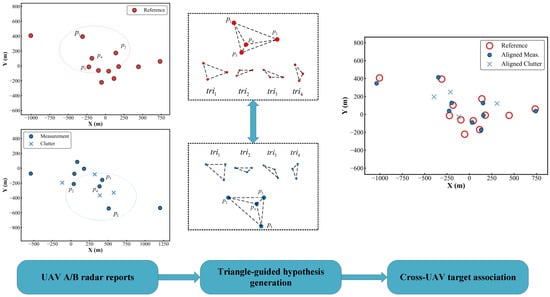
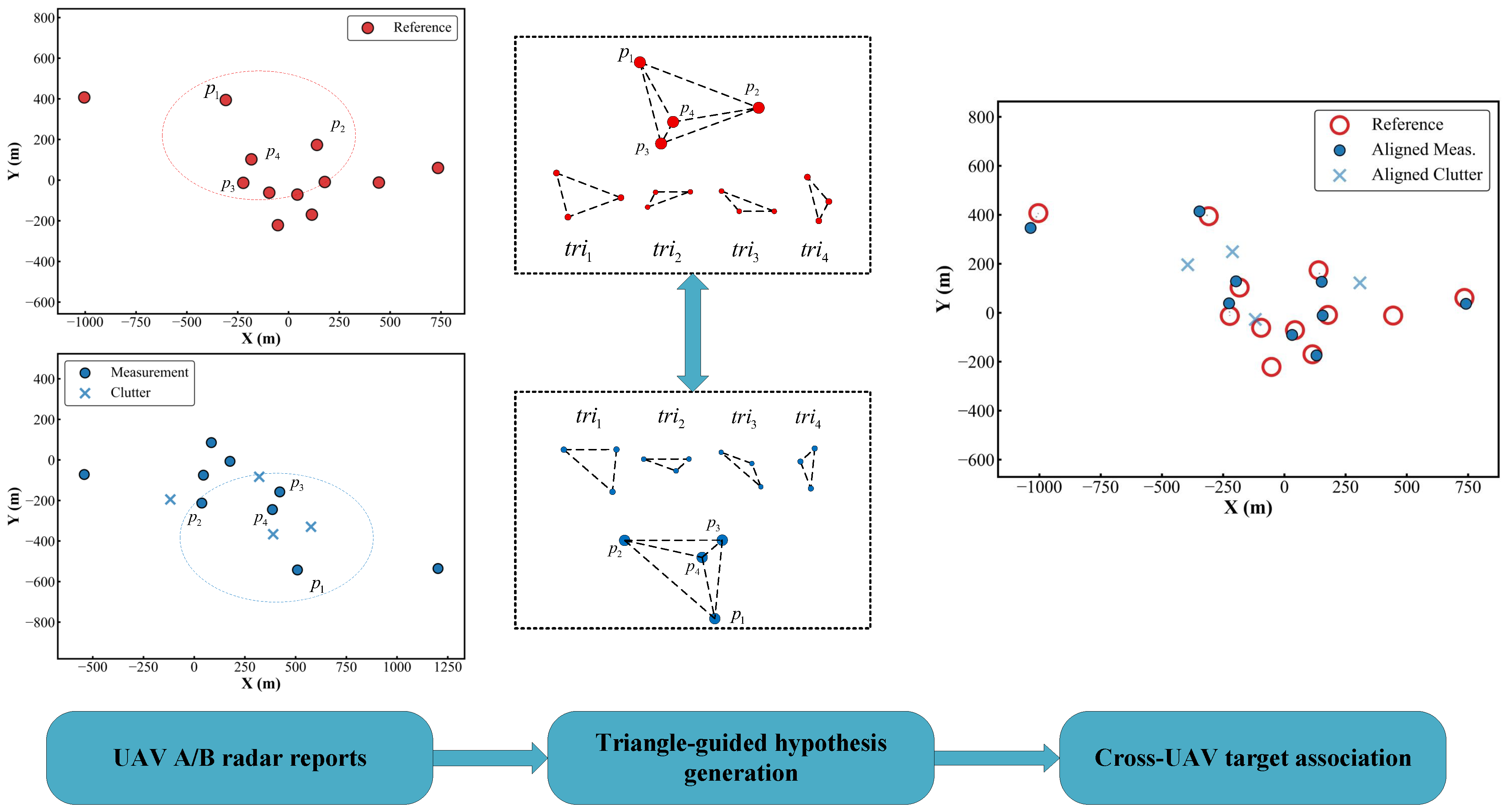
Figure 1 summarizes the proposed cross-UAV association workflow. The input is a pair of sparse radar target sets generated by two UAVs in different local coordinate systems. Triangle attributes are used to guide the search for a rigid transformation between the UAV reports, rather than serving as the final identity descriptor. After alignment, target correspondences are determined by gated nearest-neighbor matching in the reference UAV coordinate frame.
Figure 1.
Overview of the proposed multi-UAV radar target association framework. Two UAV-mounted radars observe the same target group from different viewing geometries and generate sparse, unordered, and partially overlapping target sets in their local coordinate frames. TARA estimates the cross-UAV rigid transformation through triangle attribute-guided hypothesis generation and then assigns target correspondences in the aligned frame.
3.1. Problem Formulation
Consider two UAVs equipped with airborne radar sensors. At a given observation epoch, UAV A and UAV B observe the same target group from different positions and viewing angles. Each UAV reports a set of range–azimuth–elevation detections in its own radar coordinate frame. Because the UAVs have different fields of view and observation geometries, the two reports may contain only partially overlapping target sets. Some common targets may be missed by one UAV, and additional detections may appear in only one report.
For the i-th detection of UAV u, , the radar measurement is
It is converted into a local Cartesian point as
where denotes radar-induced measurement perturbation.
Let UAV A be the reference node and UAV B be the floating node. Their observed target point sets are
Thus, and represent two UAV-mounted radar reports of the same target group. They are sparse, unordered, partially overlapping, and may have different cardinalities because of field-of-view differences, incomplete detections, and additional observations.
For commonly observed targets, the two local point sets satisfy
where and denote the true rigid transformation from to , is the unknown correspondence index, and is the index set of commonly detected targets. Therefore, the association problem is formulated as estimating
That is, the input is a pair of unlabeled radar point sets , and the output is the rigid transformation and the cross-view correspondence set .
Given a candidate transformation , the nearest reference point of is
The consensus set is defined as
The coarse registration objective is to find the transformation with the maximum consensus:
3.2. Triangle Attribute Descriptor and Candidate Matching
The proposed method uses global triangle primitives to generate transformation hypotheses between two UAV radar reports. Compared with local-neighborhood topology, global triangle sampling does not require complete local adjacency and is therefore more suitable when the two UAVs observe only partially overlapping target groups.
Given the source point set , a triangle primitive is defined as
Its three edge lengths are
To avoid degenerate triangles, the triangle area is required to satisfy
The edge lengths are sorted in descending order:
The triangle attribute descriptor is defined as
Here, represents the absolute scale of the triangle, while and describe the normalized shape. Since Euclidean distances are invariant under rigid transformation conditions, both absolute edge length and normalized shape information are retained, and the triangle attribute remains unchanged after rigid transformation. This invariance makes it suitable for cross-view matching under unknown rotation and translation conditions.
After sampling triangle primitives from and , the descriptor sets are denoted as
For a source triangle and a reference triangle , the proposed method does not use a single weighted descriptor distance. Instead, a dual-gating strategy is adopted to ensure that candidate triangles are consistent in both absolute scale and normalized shape. The scale consistency is first measured by the relative longest-edge difference:
Then, the shape consistency is measured by the larger deviation of the two normalized edge ratios:
A triangle pair is retained as a candidate match only when both gates are satisfied:
where and are the scale and shape thresholds, respectively. Compared with a weighted-sum descriptor distance, this dual-gating rule avoids the compensation effect between heterogeneous attributes: a large scale error cannot be offset by a small shape error, and vice versa. This separation also makes the later ablation more interpretable because the contribution of scale filtering and shape filtering can be examined independently. Only triangle pairs satisfying both constraints are used for subsequent hypothesis generation.
Efficient candidate retrieval. To keep the triangle stage bounded, at most non-degenerate triangles are retained from each point set. When fewer valid triangles exist, all valid triangles are used. Rather than comparing every triangle from against every triangle from , a three-dimensional descriptor hash index is built on the reference descriptor set . The hash key is a tuple , where and are the quantization steps. For each source triangle descriptor , the hash index queries the bin corresponding to its descriptor plus neighboring bins within the tolerance ranges implied by and . Each queried bin may return multiple candidates; the per-source-triangle candidate count is capped to . After hash retrieval, the exact scale and shape gates are applied to the returned candidates. The remaining triangle pairs are sorted by descriptor residual, and only the top pairs are retained for hypothesis generation. This avoids scanning all triangle pairs and keeps the later SVD hypothesis stage fixed.
3.3. Coarse-to-Fine Registration and Association Decision
Traditional RANSAC randomly samples a minimal correspondence set to estimate a transformation. When the inlier ratio is low, the required number of iterations increases rapidly:
where p is the desired confidence, w is the inlier probability, and s is the size of the minimal sample. For 3D rigid registration, . TARA samples hypotheses from the filtered triangle match set , thereby increasing the probability of drawing geometrically valid triples.
For a candidate triangle pair
one feasible ordered vertex correspondence is written as
A rigid transformation hypothesis is estimated by
This rigid alignment problem is solved using the SVD-based absolute orientation solution. The hypothesis is evaluated on the entire source point set using the consensus set , and the hypothesis with the largest inlier set is selected as .
Starting from , the trimmed ICP is used only as a refinement step. At iteration k, each transformed source point is matched to its nearest neighbor in , and the squared residual is
After sorting all residuals in ascending order, only the smallest
pairs are retained, where is the assumed overlap ratio. The transformation is updated by
where denotes the retained low-residual correspondence set. The iteration terminates when the residual decrease is smaller than a threshold or the maximum iteration number is reached.
The final refined transformation is denoted as
The final target association is obtained by nearest-neighbor matching with distance gating, followed by a greedy one-to-one assignment step that resolves competing candidate matches:
From this candidate set, all pairs are sorted by residual distance in ascending order. Starting from the closest pair, each accepted correspondence removes both constituent points from further consideration. If a later candidate shares either the same source point or the same reference point with an already accepted pair, it is skipped. This ensures that every matched source point is assigned to at most one reference point, and every reference point receives at most one assignment. The final one-to-one correspondence set is
where denotes the assigned reference index and is the index set of successfully matched source points. When multiple source points compete for the same reference point, the pair with the smaller residual distance is retained; ties are resolved by retaining the pair that appears first in the sorted order.
The complete procedure is summarized in Algorithm 1.
| Algorithm 1 Triangle Attribute-Guided Registration for Target Association |
|
4. Results
4.1. Experimental Settings
The experiments simulated the situation targeted by the method: two UAV-mounted radars observed the same target group from different viewpoints, and each radar output only a target-level range–azimuth–elevation report. The detections were converted to sparse Cartesian point sets in the two local radar frames. The algorithm received these two unlabeled sets; ground-truth identities were used only for evaluation. The simulation is intended to represent report-level airborne radar association over a sea-surface target group, rather than ideal dense point-cloud registration.
Target generation. Ground-truth sea-surface targets were generated with positions drawn uniformly from [−10,000, 10,000] m in the horizontal plane (). A minimum inter-target distance of was enforced. The target number N was varied across experiments (10, 20, 35, or 50).
UAV radar geometry. Each UAV was placed at a random horizontal position and altitude (10,000, 50) m. Radar orientation was randomized with yaw and pitch and roll , ensuring substantially different viewing geometries between the two UAVs.
Measurement model. True targets within range were measured in spherical coordinates with independent Gaussian noise: range , azimuth and elevation . The angular noise was a controlled variable (–). Measurements were converted to Cartesian coordinates in each UAV’s body frame.
Incomplete detections. Each target was detected with probability (default 0.95). The missing rate was a controlled variable (–).
Additional observations. False detections were added at ratio relative to true detections: half were ghost targets (perturbed true detections), and half were below-horizon clutter (elevation ). The clutter ratio was controlled (–).
Partial overlap. Field-of-view differences and independent detection drops naturally produce partially overlapping target sets. No artificial masking was applied.
Rigid-transformation model. For commonly observed targets, the two local point sets satisfy . This rigid-body model requires approximately synchronized observations, limited target motion within one epoch, and pre-calibrated UAV sensor frames. Synchronization offsets, navigation errors, mounting misalignment, and multipath effects can degrade the rigid assumption; this limitation is revisited in the discussion.
Monte Carlo trials. Composite scenarios and the random-budget ablation used 50 trials per condition. Parameter sensitivity used 20 trials. The noise and clutter curves were used as trend checks with one generated case per point, while the missing-rate curve used 20 trials. A fixed global seed (20250509) kept the input cases identical across methods.
A predicted correspondence is correct if the two associated detections originate from the same ground-truth target. The following metrics are reported:
Here, is the accepted-match ratio (AMR), defined as the number of predicted correspondences divided by the number of truly common targets. AMR is reported together with precision and recall to show whether a method is conservative, over-associative, or balanced.
Runtime is reported in milliseconds on a single CPU core (C++ Release build). The results are given as mean ± standard deviation; 95% confidence intervals are computed as , so the comparison is interpreted together with uncertainty rather than by mean values alone.
Four methods are compared: TARA, TEASER [50], the TTS [39], and Simplified-4PCS [42,43]. They represent the closest alternatives available for this data type: local topology matching, robust registration from all-to-all putative correspondences, and congruent-set registration.
Fairness guarantees. (i) All methods receive the same reference and target point sets in every trial. (ii) Ground-truth target identities are used only for evaluation. (iii) No method receives ground-truth correspondences. (iv) TEASER uses all-to-all putative correspondences ( pairs) constructed from the raw point sets without external prior. (v) Runtime is measured on the same hardware under identical conditions. (vi) Parameters are kept fixed across all experiments unless explicitly varied.
Excluded methods. FPFH [44] and SHOT [45] require dense local neighborhoods, which do not exist in these sparse target reports. Learned descriptors such as 3DMatch [46], FCGF [47], and PREDATOR [48] are tied to training data and sensor characteristics outside the present simulation. RET-based association [34,35,36] is also not included because it assumes multi-frame track information.
Key parameters are listed in Table 1.
Table 1.
Key parameter settings.
These parameters were fixed before the final comparison experiments. The area and longest-edge constraints remove degenerate triangles; , , , , , and control the size of the retrieved triangle-candidate pool; and and cap the ranked candidate list and the number of evaluated rigid hypotheses. The same TARA setting was used in the composite comparison. The parameter-sensitivity analysis later examines whether the selected configuration lies in a stable operating range rather than at a single sharp optimum.
4.2. Algorithm Validation and Ablation Tests
Component ablation.
The ablation was designed around one question: with the same number of rigid hypotheses, does triangle-attribute guidance choose better triples than blind sampling? We used the medium setting (, , , ) and 50 Monte Carlo trials:
Guided-100.
Full descriptor-guided hypothesis generation using both scale and shape-ratio cues, followed by the evaluation of the top 100 hypotheses.
ScaleOnly-100.
A scale-only variant using the maximum triangle side length for hashing, gating, and ranking.
RatioOnly-100.
A shape-ratio-only variant using the two normalized side-length ratios for hashing, gating, and ranking.
RandomRANSAC-.
Blind random RANSAC with {100, 500, 1000, 2000, 5000, 10,000, 20,000} randomly sampled triangle hypotheses and no descriptor ranking.
All descriptor-guided variants evaluated exactly rigid-transformation hypotheses and shared the same pre-extracted triangle sets. Random RANSAC was then allowed to increase its budget, so the comparison separated candidate quality from the number of hypotheses evaluated. The results are listed in Table 2 and plotted in Figure 2.
Table 2.
Hypothesis-generation ablation for TARA for the medium-degradation setting. Guided variants evaluate the same 100 rigid hypotheses, while RandomRANSAC variants increase the number of blind sampled hypotheses (, , , ; 50 MC trials).
Figure 2.
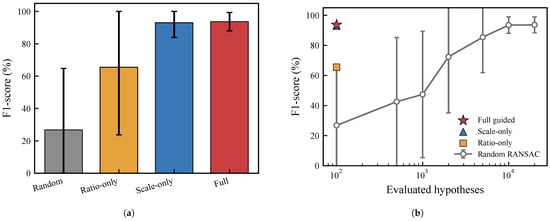
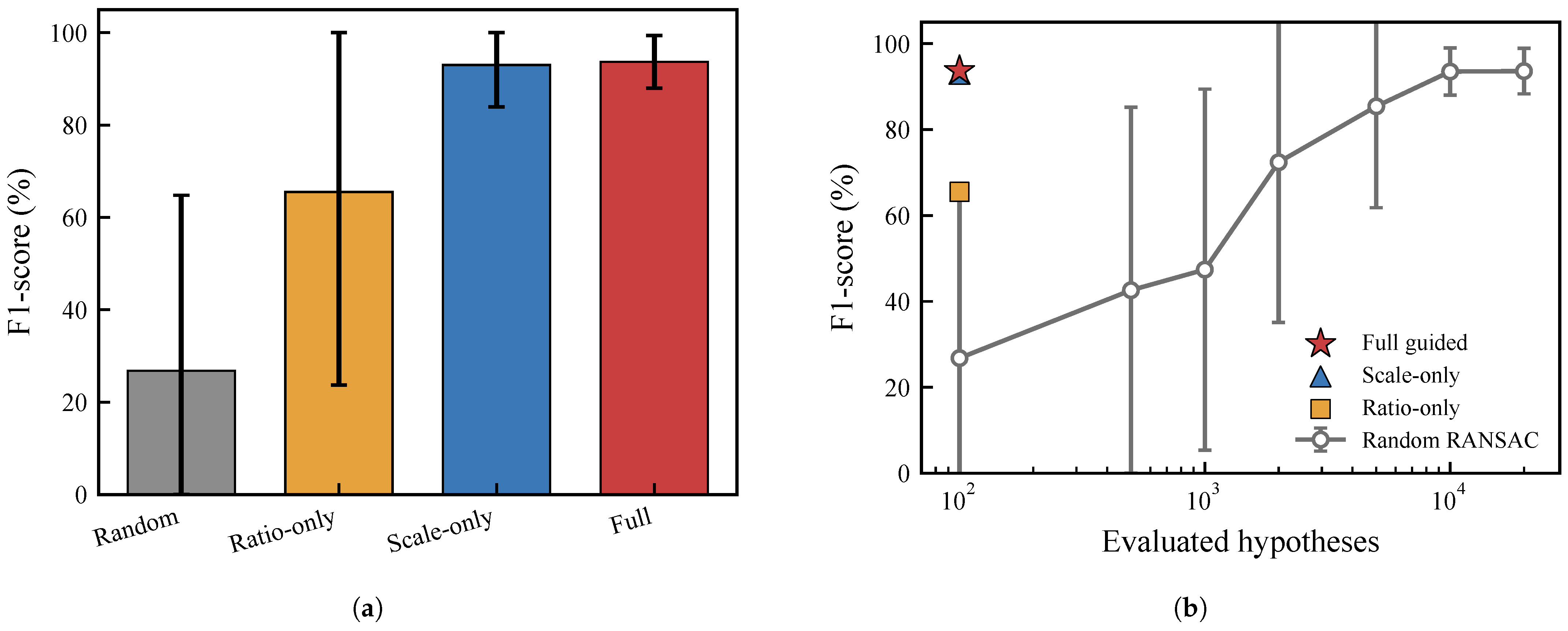
Ablation of TARA hypothesis generation: (a) contribution of triangle scale and shape-ratio cues under a fixed 100-hypothesis budget; (b) comparison with blind RandomRANSAC as its hypothesis budget increases. The medium-degradation setting is used (, , , ; 50 MC trials).
Role of attribute-guided hypothesis selection. With only 100 evaluated hypotheses, RandomRANSAC-100 reaches , while Guided-100 reaches . The difference is not caused by a larger refinement budget because both variants evaluate the same number of rigid transformations. It comes from the triples entering that budget. Random RANSAC needs about 10,000 hypotheses to reach a similar value, and at that point its runtime is ms compared with ms for Guided-100.
Scale versus shape-ratio information. The scale cue carries most of the discrimination in this geometry. ScaleOnly-100 already reaches , close to Guided-100. RatioOnly-100 falls to because many sparse target triples share similar normalized shapes even when their absolute sizes differ. The ratio cue is still useful but mainly as a secondary check: adding it to scale slightly improves the mean and success rate ( vs. , vs. ).
Accuracy–runtime trade-off. Increasing the random budget improves accuracy, but the improvement is bought by evaluating many more transformations. RandomRANSAC-5000 is still below Guided-100 ( vs. ), and RandomRANSAC-10000 reaches comparable accuracy only after a longer run. The useful claim here is therefore specific: triangle guidance makes a small hypothesis budget more productive; it does not remove the cost of registration itself.
Based on this behavior, the full scale + ratio configuration was retained as the default TARA setting. The ablation also clarifies the role of the two cues: scale provides the main separation, and shape ratios reduce some accidental scale-only matches.
Parameter sensitivity.
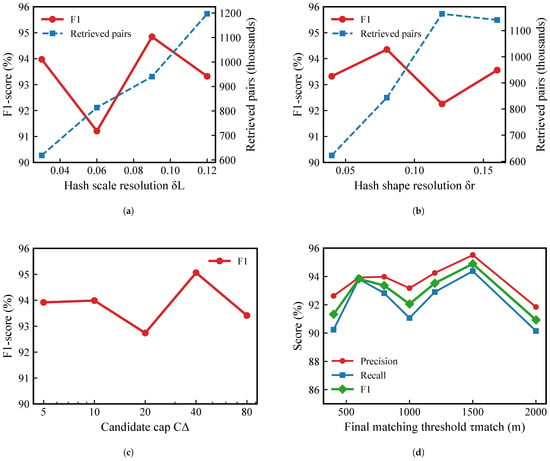
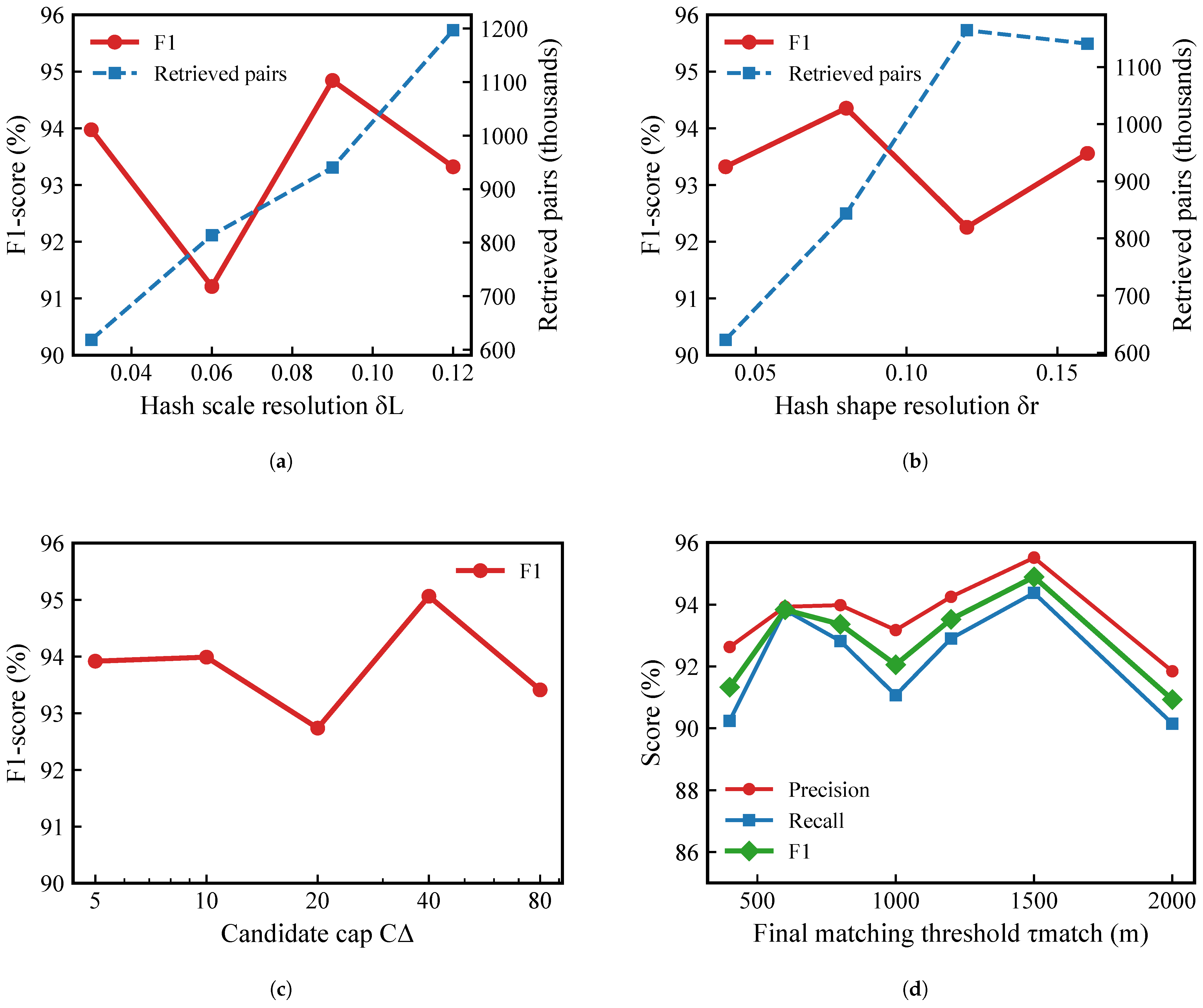
Figure 3 checks the parameters that control descriptor indexing, local candidate retention, and final matching. The goal is not to tune the paper around the single best point in the sweep but to check whether the fixed configuration sits in a stable range.
Figure 3.
Parameter sensitivity under medium degradation conditions: (a) scale-index resolution; (b) shape-index resolution; (c) per-triangle candidate cap; (d) final matching threshold.
The scale-index resolution and shape-index resolution change how coarsely nearby triangle descriptors are grouped. Across the tested values, the mean -score stays roughly between 91% and 95%, while the retrieved-pair count changes more clearly. The non-monotonic accuracy response is expected: finite triangle sampling and trial-specific geometric ambiguity also affect which candidates appear in the ranked pool. The selected values and are therefore used as workable fixed settings, not as retrospectively optimized values.
Changing the per-triangle cap from 5 to 80 has only a small effect on the final -score. In this medium setting, useful candidates usually appear near the beginning of each local ranked list, so a very large local cap is unnecessary.
The final matching threshold behaves as a precision–recall control. A strict threshold rejects noisy but correct correspondences, while a loose threshold accepts nearby false pairs. In the tested range, 1500 m gives the best mean -score in the medium-degradation setting and is therefore used as the default TARA matching threshold in Table 1. Smaller values remain close in performance but are slightly more conservative.
Individual degradation tests.
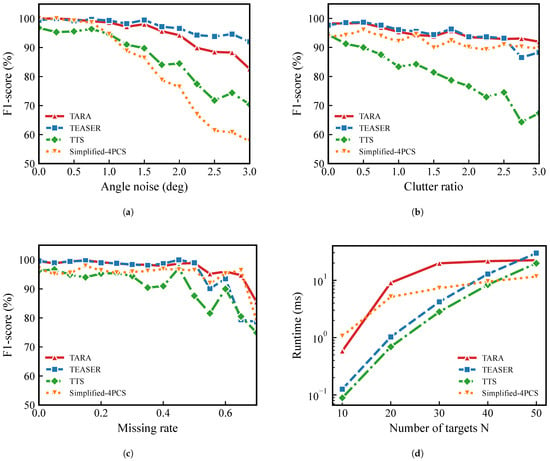
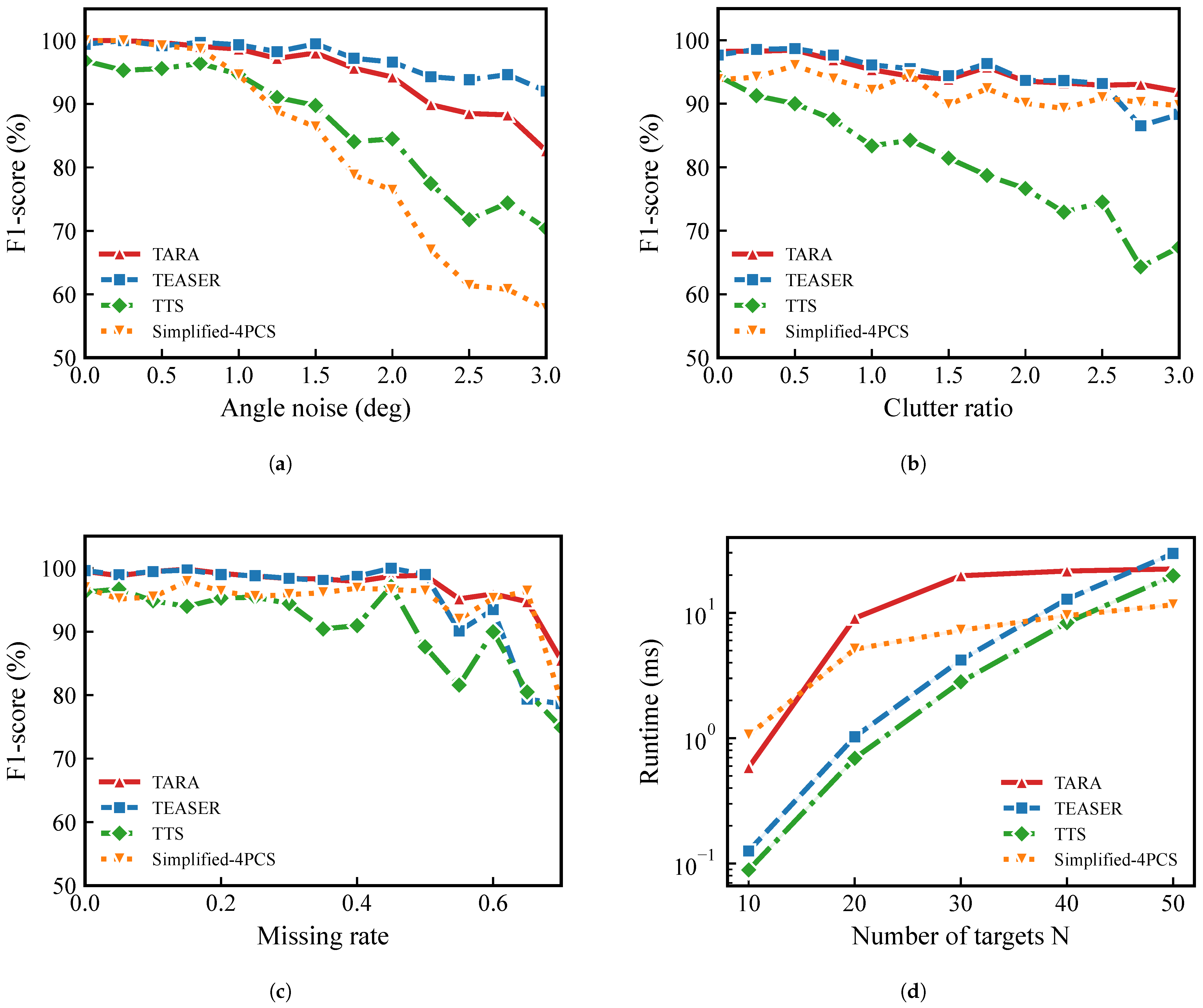
The single-factor tests varied one condition at a time: angular noise , clutter ratio , missing rate , and target-set size N. The corresponding curves are shown in Figure 4. These curves are not intended to replace the composite scenarios; they are used to identify which degradation source changes each method’s behavior.
Figure 4.
Comparison with individual degradation factors and increasing target-set size: (a) angular noise; (b) clutter ratio; (c) missing detections; (d) runtime scaling with target-set size.
When only angular noise is increased, all methods are near ceiling below . At larger noise levels, TARA and TEASER decline more slowly than the TTS and Simplified-4PCS. This result is useful because it limits the claim: TARA is not uniformly best for every isolated noise source; its advantage becomes clearer when angular uncertainty is combined with clutter and incomplete overlap.
Clutter mainly increases the number of plausible but wrong geometric relations. The TTS is affected strongly because its local neighborhoods change when extra detections are inserted. TARA and TEASER are more stable, although the finite samples do not produce perfectly monotonic curves.
For missing detections, moderate loss does not immediately destroy registration because several non-degenerate common triangles remain available. Once the common-target set becomes too small, however, failures tend to appear abruptly. This is consistent with the minimal-set nature of the problem: below a certain amount of shared geometry, no ranking strategy can reliably recover the transform.
Runtime increases with target count. TARA reaches 26.4 ms at under baseline conditions, while TEASER and the TTS reach 36.0 ms and 23.8 ms, respectively. Simplified-4PCS is faster in this fixed-budget implementation (13.8 ms at ), but its recall is lower in the composite tests. The runtime result is therefore interpreted together with association quality rather than as a standalone ranking.
4.3. Comparative Experiments
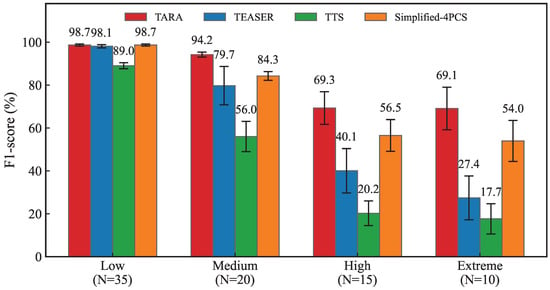
The composite scenarios combine the factors above rather than varying them independently. The low case uses many targets and mild degradation; the medium and high cases reduce the number of targets while increasing angular noise, clutter, and missing detections; the extreme case maintains high-degradation noise and clutter levels but further reduces the target count. Table 3 reports Precision, Recall, , and accepted-match ratio for all methods, and Figure 5 shows the corresponding confidence intervals.
Table 3.
Composite-scenario results (mean ± std, 50 trials). AMR denotes the accepted-match ratio .
Figure 5.
Composite-scenario -score (95% CI) under low, medium, high, and extreme degradation conditions.
The exact scenario settings are Low (, , , ), Medium (, , , ), High (, , , ), and Extreme (, same degradation as High, ). The plotted 95% confidence intervals are used as the main uncertainty summary because the difficult scenarios contain noticeable trial-to-trial variability.
In the low-degradation scenario, TARA, TEASER, and Simplified-4PCS are all near ceiling, with -scores around 98%. This is expected: many common targets and mild noise leave enough correct minimal sets for several registration strategies. The TTS is lower because its target-centered topology is still affected by clutter and missing detections.
The medium scenario separates the methods more clearly. TARA reaches , while TEASER and the TTS drop to and , respectively. Simplified-4PCS keeps high precision but lower recall (), which means that it often accepts only a subset of the true correspondences. TARA’s result is more balanced: both precision and recall remain above 93%, so the method is not gaining accuracy simply by rejecting difficult matches.
Under high and extreme degradation, all methods become less stable, but the failure modes differ. TEASER and the TTS still output many matches, as indicated by their accepted-match ratios, but a large fraction of those matches are wrong. Simplified-4PCS remains conservative and therefore loses recall. TARA also fails in some trials, especially when too few common targets remain, yet its mean stays higher than the baselines in the high setting. The extreme setting should be read with its large standard deviation in mind; it is an information-limited case rather than a smooth extension of the high setting.
The transformation-error statistics in Table 4 explain part of this behavior. In the low and medium scenarios, successful registration produces similar rotation and translation errors across TARA, TEASER, and Simplified-4PCS. The difference is therefore mainly in how often each method reaches a good alignment. In the high scenario, TEASER has a much larger median rotation error (), which is consistent with many accepted but incorrect correspondences. TARA’s median error remains lower (, 319 m), while Simplified-4PCS lies between the two. The TTS is not included in this table because it does not explicitly estimate a rigid transformation.
Table 4.
Rigid-transformation errors under composite degradation conditions (median [IQR]).
To summarize the methodological differences observed in the comparison experiments, Table 5 contrasts the geometric primitives, candidate construction strategies, transformation estimation procedures, and final association rules of the closest methods.
Table 5.
Summary of the geometric evidence and association mechanisms used by the closest methods.
4.4. Analysis and Discussion
Computational efficiency and scalability.
Enumerating all triangle pairs from two point sets of size N has a worst-case search space. TARA does not attempt to exhaust this space. It caps the triangle pool at per set, uses a three-dimensional descriptor hash index for local retrieval, applies exact scale and shape gates, keeps at most local candidates for each source triangle, and retains at most ranked triangle pairs. Only the first pairs are converted into SVD rigid-transformation hypotheses.
For the scale most relevant to this paper, the raw triangle count is still moderate. When , one point set contains triangles; two full sets would therefore produce about cross-view triangle pairs before any filtering. At , the corresponding count is triangles per set, which would expand to about raw pairs. The proposed index-and-rank stage is introduced precisely to avoid treating this growing pair space as an exhaustive engineering workload.
The measured runtime should be interpreted with these caps in mind. At , TARA reaches 26.4 ms. TEASER and the TTS reach 36.0 ms and 23.8 ms, respectively, while the fixed-budget Simplified-4PCS implementation reaches 13.8 ms. Thus, TARA is not the fastest method in every setting. Its advantage is the association quality obtained with a small, ordered hypothesis budget, especially under composite degradation conditions.
Qualitative registration analysis.
Successful case.
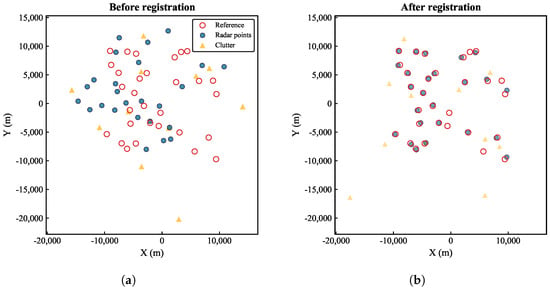
The successful example in Figure 6 shows the intended behavior of the pipeline. Before registration, the two reports are offset by the unknown inter-UAV pose. After TARA alignment, most radar points fall close to their reference counterparts, so the final gated matching step can assign identities without using target appearance or track history.
Figure 6.
Representative successful registration in the medium-degradation scenario: (a) point sets before registration; (b) point sets after TARA registration. The aligned radar points closely overlap the reference targets after registration, indicating correct cross-view association.
Failure case.
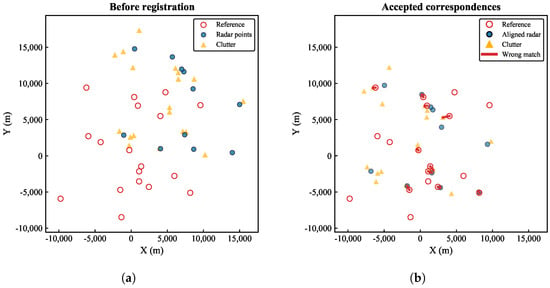
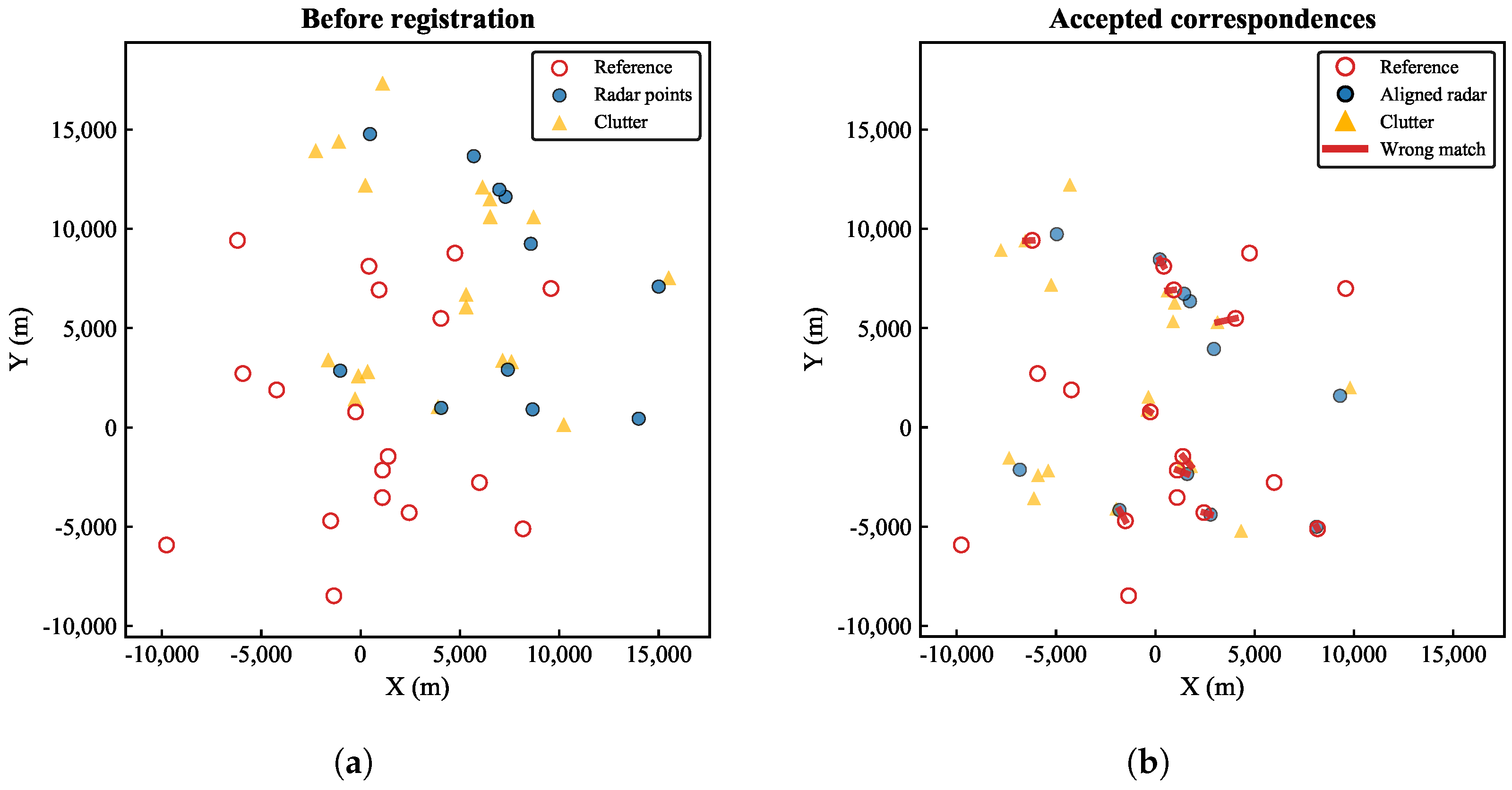
The failure example in Figure 7 is included because the composite-scenario results have non-negligible trial-level variation. The selected case is not simply missing all useful geometry: other baselines succeed on the same input, while TARA returns . This makes it useful for inspecting a failure of the triangle-ranking mechanism itself.
Figure 7.
Representative failure case under medium degradation conditions with elevated noise and clutter (N = 18, , , ): (a) point sets before registration; (b) accepted correspondences after TARA registration. The trial contains clutter and partial overlap, and the accepted correspondences are incorrect.
In this trial, several incorrect triangle pairs have near-identical scale and shape attributes. They enter the ranked candidate list before the correct alignment and lead the later nearest-neighbor assignment to a wrong consensus. Baseline methods that are less dependent on triangle-ranking, such as TEASER and Simplified-4PCS, succeed on the same input, so the failure is not caused by a complete lack of information.
Failure conditions.
The recurring failure conditions are: too few common targets, near-symmetric layouts that produce similar triangle attributes, strong angular noise, and high clutter ratios that create false triangles with coincidentally matching scale and shape.
Practical assumptions and limitations.
The rigid-transformation model assumes approximately synchronized UAV observations, limited target motion within one epoch, and pre-calibrated sensor mounting. Residual navigation error, mounting misalignment, and multipath can introduce non-rigid residuals that are not captured by the six-degree-of-freedom model. In practical multi-UAV radar systems, these effects are coupled: pose bias changes the apparent inter-target geometry, synchronization error changes the observed target state, and multipath may introduce structured rather than Gaussian residuals. When these effects become comparable to the matching threshold, triangle invariance weakens, and the final distance gate may either reject correct pairs or retain false ones.
Possible mitigations include time interpolation between asynchronous measurements, navigation or calibration compensation, and multi-epoch consistency checks. If too few common targets or degenerate layouts are detected, the safer action is to defer association until another observation epoch is available. The present validation is simulation-based and should therefore be read as mechanism-level evidence rather than field-level verification.
5. Conclusions
This paper studied single-epoch cross-UAV target association for airborne radar sensing. The problem was formulated as sparse rigid registration followed by gated one-to-one matching. TARA uses triangle scale and shape attributes to order the rigid-hypothesis space before trimmed ICP refinement, so it can work with target-level radar reports that have no appearance features, established tracks, or dense local neighborhoods.
The ablation shows that the main gain comes from choosing better triples for the fixed hypothesis budget. Guided-100 reaches with 100 evaluated hypotheses, whereas blind RANSAC needs about 10,000 random hypotheses to reach a similar result. The scale cue is the main discriminator in the tested geometry, and the shape-ratio cue acts as a secondary stabilizer. In composite scenarios, TARA obtains mean -scores of 98.7%, 94.2%, 69.3%, and 69.1% from low to extreme degradation. The method is strongest in medium and high composite settings, where clutter, missed detections, and angular noise jointly make blind or local-topology association unreliable. It is not failure-free: near-congruent target layouts and strong clutter can still move incorrect triangle pairs ahead of the correct one.
Future work will focus on hardware-in-the-loop or field-collected data and on multi-epoch consistency checks. Those extensions are needed before the method can be treated as a complete operational association module rather than a validated geometric mechanism.
Author Contributions
Conceptualization, X.G. and J.L.; methodology, X.G. and J.L.; software, J.L.; validation, X.G. and H.Z.; formal analysis, X.G. and J.L.; investigation, X.G.; data curation, X.G.; writing—original draft preparation, X.G. and J.L.; writing—review and editing, X.G. and H.Z.; visualization, J.L.; supervision, X.G.; project administration, X.G. All authors have read and agreed to the published version of the manuscript.
Funding
This work is supported by the National Natural Science Foundation of China (No. 62373031).
Data Availability Statement
The data generated and analyzed during this study, including the processed point clouds, ground-truth correspondences, generation parameters for the main experimental settings, and the source code, are available from the corresponding author upon reasonable request.
Conflicts of Interest
The authors declare no conflicts of interest.
References
- Yeom, S.; Nam, D.H. Moving Vehicle Tracking with a Moving Drone Based on Track Association. Appl. Sci. 2021, 11, 4046. [Google Scholar] [CrossRef] [Scilit]
- Zheng, Y.J.; Du, Y.C.; Ling, H.F.; Sheng, W.G.; Chen, S.Y. Evolutionary Collaborative Human-UAV Search for Escaped Criminals. IEEE Trans. Evol. Comput. 2019, 24, 217–231. [Google Scholar] [CrossRef] [Scilit]
- Wang, J.; Han, L.; Dong, X.; Li, Q.; Ren, Z. Distributed sliding mode control for time-varying formation tracking of multi-UAV system with a dynamic leader. Aerosp. Sci. Technol. 2021, 111, 106549. [Google Scholar] [CrossRef] [Scilit]
- Bayerlein, H.; Theile, M.; Caccamo, M.; Gesbert, D. Multi-UAV path planning for wireless data harvesting with deep reinforcement learning. IEEE Open J. Commun. Soc. 2021, 2, 1171–1187. [Google Scholar] [CrossRef] [Scilit]
- Ali, Z.A.; Zhangang, H. Multi-unmanned aerial vehicle swarm formation control using hybrid strategy. Trans. Inst. Meas. Control 2021, 43, 2689–2701. [Google Scholar] [CrossRef] [Scilit]
- Guan, X.; Lu, Y.; Ruan, L. Joint Optimization Control Algorithm for Passive Multi-Sensors on Drones for Multi-Target Tracking. Drones 2024, 8, 627. [Google Scholar] [CrossRef] [Scilit]
- Zhou, H.; Yang, Z.; Ma, A.; Zhang, W.; Zhang, H.; Niu, Y. MCD-Net: Robust Multi-UAV Cooperative Detection via Secondary Matching and Hybrid Fusion for Occluded Objects. Drones 2025, 9, 739. [Google Scholar] [CrossRef] [Scilit]
- Jiang, W.; Liu, Z.; Wang, Y.; Lin, Y.; Li, Y.; Bi, F. Realizing Small UAV Targets Recognition via Multi-Dimensional Feature Fusion of High-Resolution Radar. Remote Sens. 2024, 16, 2710. [Google Scholar] [CrossRef] [Scilit]
- Zhang, F.; Xia, Z.; Jin, S.; Liu, X.; Zhao, Z.; Zhang, C.; Fu, H.; Xing, K.; Liu, Z.; Xue, C.; et al. Ship Target Feature Detection of Airborne Scanning Radar Based on Trajectory Prediction Integration. Remote Sens. 2025, 17, 3858. [Google Scholar] [CrossRef] [Scilit]
- Liu, W.; Chen, Z.; Jiang, Z.; Li, Y.; Liu, Y.; Bu, X.; Liang, X. Ground-Moving Target Relocation for a Lightweight Unmanned Aerial Vehicle-Borne Radar System Based on Doppler Beam Sharpening Image Registration. Electronics 2025, 14, 1760. [Google Scholar] [CrossRef] [Scilit]
- Zhang, Z.; Xu, X.; Cui, J.; Meng, W. Multi-UAV Area Coverage Based on Relative Localization: Algorithms and Optimal UAV Placement. Sensors 2021, 21, 2400. [Google Scholar] [CrossRef] [Scilit] [PubMed]
- Wang, X.; Yang, L.T.; Meng, D.; Dong, M.; Ota, K.; Wang, H. Multi-UAV Cooperative Localization for Marine Targets Based on Weighted Subspace Fitting in SAGIN Environment. IEEE Internet Things J. 2021, 9, 5708–5718. [Google Scholar] [CrossRef] [Scilit]
- Bai, G.B.; Liu, J.H.; Song, Y.M.; Zuo, Y.J. Two-UAV Intersection Localization System Based on the Airborne Optoelectronic Platform. Sensors 2017, 17, 98. [Google Scholar] [CrossRef] [Scilit] [PubMed]
- Wu, S.; Xu, W.; Wang, F.; Li, G.; Pan, M. Distributed Federated Deep Reinforcement Learning Based Trajectory Optimization for Air-Ground Cooperative Emergency Networks. IEEE Trans. Veh. Technol. 2022, 71, 9107–9112. [Google Scholar] [CrossRef] [Scilit]
- Lin, B.; Wu, L.; Niu, Y. End-to-End Vision-Based Cooperative Target Geo-Localization for Multiple Micro UAVs. J. Intell. Robot. Syst. 2022, 106, 13. [Google Scholar] [CrossRef] [Scilit]
- Su, K.; Qian, F. Multi-UAV Cooperative Searching and Tracking for Moving Targets Based on Multi-Agent Reinforcement Learning. Appl. Sci. 2023, 13, 11905. [Google Scholar] [CrossRef] [Scilit]
- Wu, P.; Li, Y.; Xue, D. Multi-Target Tracking with Multiple Unmanned Aerial Vehicles Based on Information Fusion. Drones 2024, 8, 704. [Google Scholar] [CrossRef] [Scilit]
- Wang, R.; Xu, C.; Li, R.; Duan, S.; Zhang, X. Cooperative Localization and Mapping Based on UWB/IMU Fusion Using Factor Graphs. IEEE Sens. J. 2024, 24, 21931–21940. [Google Scholar] [CrossRef] [Scilit]
- Huang, H.; Ma, H.; Zhao, C.; Mao, X. Multitarget Association Method Based on Velocity and Azimuth Information for Multistatic Passive Radar. IEEE Sens. J. 2025, 25, 28687–28704. [Google Scholar] [CrossRef] [Scilit]
- An, N.; Yan, W.Q. Multitarget Tracking Using Siamese Neural Networks. ACM Trans. Multimed. Comput. Commun. Appl. 2021, 17, 1–16. [Google Scholar] [CrossRef] [Scilit]
- Zagoruyko, S.; Komodakis, N. Learning to compare image patches via convolutional neural networks. In Proceedings of the IEEE Conference on Computer Vision and Pattern Recognition (CVPR), Boston, MA, USA, 7–12 June 2015; pp. 4353–4361. [Google Scholar] [CrossRef] [Scilit]
- Chung, D.; Tahboub, K.; Delp, E.J. A Two Stream Siamese Convolutional Neural Network for Person Re-identification. In Proceedings of the IEEE International Conference on Computer Vision (ICCV), Venice, Italy, 22–29 October 2017; pp. 1992–2000. [Google Scholar] [CrossRef] [Scilit]
- Zhang, H.; Cao, H.; Yang, X.; Deng, C.; Tao, D. Self-Training with Progressive Representation Enhancement for Unsupervised Cross-Domain Person Re-Identification. IEEE Trans. Image Process. 2021, 30, 5287–5298. [Google Scholar] [CrossRef] [Scilit] [PubMed]
- de Oliveira, I.O.; Fonseca, K.V.O.; Minetto, R.A. A Two-Stream Siamese Neural Network for Vehicle Re-Identification by Using Non-Overlapping Cameras. In Proceedings of the IEEE International Conference on Image Processing (ICIP), Taipei, Taiwan, 22–25 September 2019; pp. 669–673. [Google Scholar] [CrossRef] [Scilit]
- Pang, H.; Xuan, Q.; Xie, M.; Liu, C.; Li, Z. Research on Target Tracking Algorithm Based on Siamese Neural Network. Mob. Inf. Syst. 2021, 2021, 6645629. [Google Scholar] [CrossRef] [Scilit]
- Rakai, L.; Song, H.; Sun, S.; Zhang, W.; Yang, Y. Data Association in Multiple Object Tracking: A Survey of Recent Techniques. Expert Syst. Appl. 2022, 192, 116300. [Google Scholar] [CrossRef] [Scilit]
- Kanyuck, A.J.; Singer, R.A. Correlation of Multiple-Site Track Data. IEEE Trans. Aerosp. Electron. Syst. 1970, AES-6, 180–187. [Google Scholar] [CrossRef] [Scilit]
- Bar-Shalom, Y. On the track-to-track correlation problem. IEEE Trans. Autom. Control 1981, 26, 571–572. [Google Scholar] [CrossRef] [Scilit]
- Bar-Shalom, Y.; Daum, F.; Huang, J. The Probabilistic Data Association Filter. IEEE Control Syst. Mag. 2009, 29, 82–100. [Google Scholar] [CrossRef] [Scilit]
- Chang, C.; Youens, L. Measurement correlation for multiple sensor tracking in a dense target environment. IEEE Trans. Autom. Control 1982, 27, 1250–1252. [Google Scholar] [CrossRef] [Scilit]
- Tokta, A.; Hocaoglu, A.K. Sensor Bias Estimation for Track-to-Track Association. IEEE Signal Process. Lett. 2019, 26, 1426–1430. [Google Scholar] [CrossRef] [Scilit]
- Angle, R.B.; Streit, R.L.; Efe, M. Multiple Target Tracking With Unresolved Measurements. IEEE Signal Process. Lett. 2021, 28, 319–323. [Google Scholar] [CrossRef] [Scilit]
- Tian, W.; Wang, Y.; Shan, X.; Yang, J. Track-to-Track Association for Biased Data Based on the Reference Topology Feature. IEEE Signal Process. Lett. 2014, 21, 449–453. [Google Scholar] [CrossRef] [Scilit]
- Qi, L.; He, Y.; Dong, K.; Liu, J. Multi-radar Anti-bias Track Association Based on the Reference Topology Feature. IET Radar Sonar Navig. 2018, 12, 366–372. [Google Scholar] [CrossRef] [Scilit]
- Sönmez, H.H.; Hocaoğlu, A.K. Asynchronous Track-to-Track Association Algorithm Based on Reference Topology Feature. Signal Image Video Process. 2021, 16, 789–796. [Google Scholar] [CrossRef] [Scilit]
- Zhang, Y.; Liu, M.; Liu, X.; Wu, T. A Group Target Tracking Algorithm Based on Topology. J. Phys. Conf. Ser. 2020, 1544, 012025. [Google Scholar] [CrossRef] [Scilit]
- You, S.; Yao, H.; Xu, C. Multi-Object Tracking with Spatial-Temporal Topology-Based Detector. IEEE Trans. Circuits Syst. Video Technol. 2022, 32, 3023–3035. [Google Scholar] [CrossRef] [Scilit]
- Li, X.; Wu, L.; Niu, Y.; Jia, S.; Lin, B. Topological Similarity-Based Multi-Target Correlation Localization for Aerial-Ground Systems. Guid. Navig. Control 2021, 1, 2150016. [Google Scholar] [CrossRef] [Scilit]
- Li, X.; Wu, L.; Niu, Y.; Ma, A. Multi-Target Association for UAVs Based on Triangular Topological Sequence. Drones 2022, 6, 119. [Google Scholar] [CrossRef] [Scilit]
- Besl, P.J.; McKay, N.D. A Method for Registration of 3-D Shapes. IEEE Trans. Pattern Anal. Mach. Intell. 1992, 14, 239–256. [Google Scholar] [CrossRef] [Scilit]
- Fischler, M.A.; Bolles, R.C. Random sample consensus: A paradigm for model fitting with applications to image analysis and automated cartography. Commun. ACM 1981, 24, 381–395. [Google Scholar] [CrossRef] [Scilit]
- Mellado, N.; Aiger, D.; Mitra, N.J. Super Simplified-4PCS Fast Global Pointcloud Registration via Smart Indexing. Comput. Graph. Forum 2014, 33, 205–215. [Google Scholar] [CrossRef] [Scilit]
- Aiger, D.; Mitra, N.J.; Cohen-Or, D. 4-Points Congruent Sets for Robust Pairwise Surface Registration. ACM Trans. Graph. 2008, 27, 85. [Google Scholar] [CrossRef] [Scilit]
- Rusu, R.B.; Blodow, N.; Beetz, M. Fast Point Feature Histograms (FPFH) for 3D Registration. In Proceedings of the 2009 IEEE International Conference on Robotics and Automation, Kobe, Japan, 12–17 May 2009; pp. 3212–3217. [Google Scholar] [CrossRef] [Scilit]
- Salti, S.; Tombari, F.; Di Stefano, L. SHOT: Unique Signatures of Histograms for Surface and Texture Description. Comput. Vis. Image Underst. 2014, 125, 251–264. [Google Scholar] [CrossRef] [Scilit]
- Zeng, A.; Song, S.; Nießner, M.; Fisher, M.; Xiao, J.; Funkhouser, T. 3DMatch: Learning Local Geometric Descriptors from RGB-D Reconstructions. In Proceedings of the 2017 IEEE Conference on Computer Vision and Pattern Recognition (CVPR), Honolulu, HI, USA, 21–26 July 2017; pp. 199–208. [Google Scholar] [CrossRef] [Scilit]
- Choy, C.; Park, J.; Koltun, V. Fully Convolutional Geometric Features. In Proceedings of the 2019 IEEE/CVF International Conference on Computer Vision (ICCV), Seoul, Republic of Korea, 27 October–2 November 2019; pp. 8957–8965. [Google Scholar] [CrossRef] [Scilit]
- Huang, S.; Gojcic, Z.; Usvyatsov, M.; Wieser, A.; Schindler, K. PREDATOR: Registration of 3D Point Clouds with Low Overlap. In Proceedings of the IEEE/CVF Conference on Computer Vision and Pattern Recognition, Nashville, TN, USA, 20–25 June 2021; pp. 4265–4274. [Google Scholar] [CrossRef] [Scilit]
- Wang, C.; Zheng, Z.; Zha, B.; Li, H. Fast Robust Point Cloud Registration Based on Compatibility Graph and Accelerated Guided Sampling. Remote Sens. 2024, 16, 2789. [Google Scholar] [CrossRef] [Scilit]
- Yang, H.; Shi, J.; Carlone, L. TEASER: Fast and Certifiable Point Cloud Registration. IEEE Trans. Robot. 2021, 37, 314–333. [Google Scholar] [CrossRef] [Scilit]

Disclaimer/Publisher’s Note: The statements, opinions and data contained in all publications are solely those of the individual author(s) and contributor(s) and not of MDPI and/or the editor(s). MDPI and/or the editor(s) disclaim responsibility for any injury to people or property resulting from any ideas, methods, instructions or products referred to in the content. |
© 2026 by the authors. Licensee MDPI, Basel, Switzerland. This article is an open access article distributed under the terms and conditions of the Creative Commons Attribution (CC BY) license.