


Highlights
What are the main findings?
- A unified generalized composite fading framework is developed for single-scattering single-shadowing, double-scattering single-shadowing, and double-scattering double-shadowing drone-to-ground channels, enabling closed-form and integral-form performance analysis.
- The proposed model is physically consistent with experimentally validated channel models, with results matching previously reported measurement-based studies.
What are the implications of the main findings?
- The framework provides a flexible and analytically tractable tool for evaluating reliability and performance of UAV-assisted communication systems in realistic urban environments.
- The results support the design and optimization of beyond-5G and 6G drone-enabled networks, particularly in scenarios with nonlinear propagation and complex composite fading conditions.
Abstract
This paper investigates the performance of drone-to-ground (D–G) communication links under generalized composite fading conditions in urban environments. A unified analytical framework based on single-scattering single-shadowing (SS–SS), double-scattering single-shadowing (DS–SS), and double-scattering double-shadowing (DS–DS) fading models is adopted to accurately characterize the combined effects of multipath scattering, shadowing, and propagation nonlinearity, while also encompassing experimentally validated D–G channel models as special cases. Novel closed-form and integral-form expressions for end-to-end SNR statistics are derived, enabling the evaluation of outage probability (OP), average bit error rate (BER), and ergodic capacity (C). The analysis further provides physical insights into the influence of fading severity, nonlinearity, and shadowing parameters through a comparative investigation of the SS–SS, DS–SS, and DS–DS models. All analytical results are verified through extensive Monte Carlo simulations. Numerical results confirm the accuracy and flexibility of the proposed framework, highlighting its potential application in the analysis, optimization, and design of beyond-5G and future 6G drone-assisted wireless networks.
Keywords:
5G; 6G; composite fading; fox H-function; performance analysis; UAV-to-ground; urban environment 1. Introduction
The rapid evolution of 5G systems and the emergence of 6G non-terrestrial networks (NTNs) have positioned drones as key enablers of next-generation wireless communications [1,2]. Due to their flexibility, mobility, and capability to provide on-demand coverage, drones are increasingly integrated into 6G architectures to support coverage extension, resilient connectivity, and seamless interaction with satellite and high-altitude platforms [3,4]. In this context, drones-to-ground (D-G) communication channels represent a fundamental component of future wireless ecosystems [5].
A distinctive characteristic of UAV-assisted communication systems is the strong dependence of channel conditions on flight altitude, mobility patterns, and surrounding environment geometry. Unlike terrestrial systems, UAV links experience rapid transitions between LoS and NLoS conditions, non-stationary propagation, and altitude-dependent shadowing effects. These properties make classical channel models insufficient for accurately capturing D-G propagation behavior. Consequently, these challenges motivate the development of physically meaningful and experimentally grounded composite fading models that can describe UAV channels under realistic deployment scenarios, including urban sensing, emergency communications, and aerial base station operations.
The reliable design and deployment of drone-assisted communication systems critically depend on accurate modeling of the propagation channel. Unlike conventional terrestrial links, D-G channels exhibit highly dynamic and complex propagation conditions, including rapid transitions between line-of-sight (LoS) and non-line-of-sight (NLoS) states, strong Doppler effects, non-stationarity, and composite fading phenomena. Recent measurement campaigns and research studies have demonstrated that D-G channels are strongly influenced by multiple scattering clusters and shadowing effects arising from both aerial and ground environments [5,6,7,8]. In particular, the interaction between multipath propagation and large-scale attenuation leads to composite fading behavior that requires more advanced statistical modeling. This has motivated the development of generalized fading models and various composite distributions that better capture the nonlinear and heterogeneous nature of wireless propagation in three-dimensional environments [9,10].
Among these approaches, special attention has been given to models based on the product of random variables, where small-scale fading and shadowing are represented as independent stochastic processes. In this context, recently proposed double-scattering single-shadowing (DS-SS) and double-scattering double-shadowing (DS-DS) models have been experimentally validated for D-G channels [11,12]. Notably, the considered DS–SS and DS–DS composite fading models are not purely theoretical constructs, but are directly grounded in experimentally validated D-G channel measurements reported in the literature. In particular, the models in [11,12] have been shown to accurately capture real propagation conditions through measurement campaigns, thereby providing a strong physical basis for their adoption.
The DS-SS and DS-DS modeling paradigms have been successfully applied to various performance analyses, including outage probability, bit error rate, capacity evaluation, and second-order statistics such as the level crossing rate (LCR) and average fade duration (AFD) [11,12,13,14,15,16]. Diversity techniques for these models are also investigated in [17,18], along with the impact of interference on system performance [19]. Furthermore, these models and distributions have been extensively employed to support sensing-assisted communication frameworks, reconfigurable intelligent surface-assisted UAV systems, and the analysis of corridor-based networks, thereby demonstrating their versatility and strong relevance for emerging 5G and 6G applications [20,21,22,23].
In addition, recent studies have generalized the DS–DS modeling framework by considering products of generalized-Gamma and inverse-Gamma random variables, providing improved flexibility in modeling fading severity [24]. Furthermore, ref. [24] investigated the performance of D–G communication systems and derived analytical performance expressions in terms of Meijer–G functions for specific values of the nonlinearity parameter . Adopted from the generalized – fading model, the parameter acts as a statistical shape parameter that can be estimated from measurement data through standard statistical fitting procedures, enabling the representation of propagation environments that deviate from conventional fading assumptions. Unlike classical fading models, the – distribution captures nonlinear propagation effects arising from heterogeneous scattering, blockage, beam misalignment, and frequent LoS/NLoS transitions while encompassing several widely used fading distributions as special cases. Moreover, the recent studies have demonstrated that the – model provides excellent agreement with measurement data and, in many propagation scenarios, achieves comparable or even superior fitting accuracy to more complex composite fading models while preserving analytical tractability [25,26]. Consequently, it has attracted considerable attention in UAV communications, particularly in UAV-assisted THz and mixed THz–RF systems, where it effectively characterizes the small-scale fading behavior of highly dynamic aerial channels [27,28].
Accordingly, the generalized-Gamma/inverse-Gamma composite fading model provides enhanced flexibility for representing dense urban propagation environments characterized by severe blockage, heterogeneous scattering, and pronounced nonlinear propagation effects. At the same time, it preserves sufficient analytical tractability to enable closed-form performance analysis. Notably, for the special case , the proposed generalized model reduces exactly to the experimentally validated DS–SS and DS–DS channel models reported in [11], thereby preserving both physical consistency and analytical generality. Furthermore, the experimental campaign reported in [11] considered an airship moving at a constant speed of 6.2 m/s. However, modern UAV platforms typically operate at considerably higher velocities, resulting in more dynamic propagation conditions and stronger temporal channel variations. Consequently, generalized-Gamma/inverse-Gamma composite fading models provide a more flexible statistical framework for accurately characterizing these rapidly varying propagation environments while remaining fully consistent with experimentally validated channel models.
Motivated by these observations, this paper proposes a unified generalized composite fading framework for D–G communication channels that encompasses the single-scattering single-shadowing (SS–SS), double-scattering single-shadowing (DS–SS), and double-scattering double-shadowing (DS–DS) propagation scenarios within a common analytical framework. A complete statistical characterization of the received signal-to-noise ratio (SNR) is developed by deriving closed-form expressions for the probability density function (PDF) and cumulative distribution function (CDF). Based on these statistical results, closed-form expressions for key performance metrics, including the outage probability (OP), average bit error rate (BER), and ergodic capacity (C), are obtained in terms of Fox’s H-functions. To facilitate practical implementation, equivalent integral-form representations are also derived, enabling efficient numerical evaluation when (particularly multivariate) Fox’s H-functions are not directly supported by standard mathematical software. Finally, all analytical results are validated through extensive Monte Carlo simulations, demonstrating excellent agreement with the theoretical analysis.
Moreover, the proposed analytical framework can be directly applied to various UAV communication scenarios, enabling the optimization of UAV placement, transmission power, and link reliability through OP and BER analysis under realistic fading conditions. In addition, the derived ergodic capacity expressions provide valuable insights into achievable data rates in complex urban environments, supporting the design and performance evaluation of future 6G UAV-assisted networks.
2. System Model and Considered Composite Fading Cases
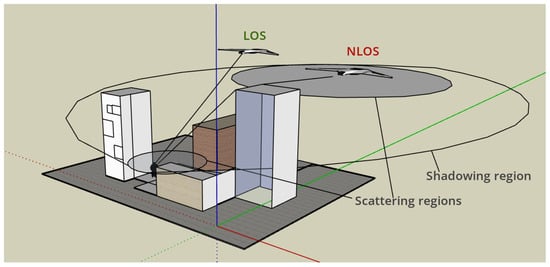
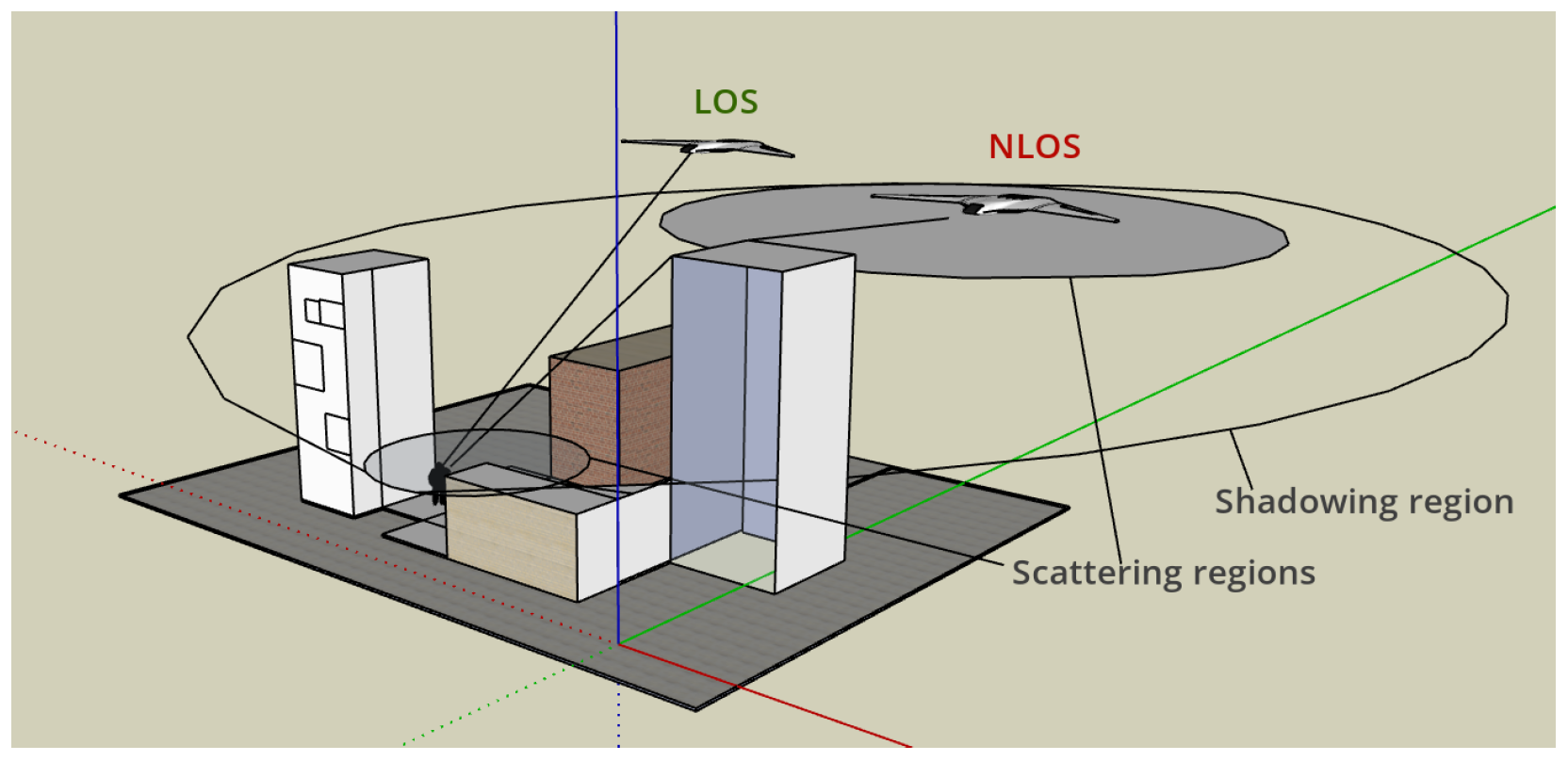
The considered urban D-G communication scenario, depicted in Figure 1, illustrates both LOS and NLOS propagation conditions in the presence of buildings and obstacles, where the received signal is affected by pronounced scattering regions (due to reflections from surrounding structures) and shadowing regions (caused by large-scale obstructions). In such environments, accurate modeling requires composite fading distributions that jointly capture small-scale and large-scale effects. Specifically, the SS–SS model represents scenarios with a single dominant scattering mechanism and one shadowing process, typically corresponding to mild urban conditions. The DS–SS model extends this by incorporating multiple independent scattering effects while still assuming a single dominant shadowing component, which is suitable for denser urban environments with richer multipath. Finally, the DS–DS model provides the most general representation, accounting for multiple scattering and multiple shadowing processes, thus accurately describing highly complex NLOS conditions. Importantly, these models are well aligned with experimental measurements reported in the literature, confirming their capability to realistically capture the propagation characteristics of D-G channels in urban environments.
Figure 1.
Illustration of the considered D-G communication scenario with LOS and NLOS propagation conditions in a composite urban environment.
In this section, we introduce a unified composite fading framework for D-G propagation channels by combining generalized-Gamma random variables, which account for nonlinear multipath fading effects, and inverse-Gamma random variables, which describe large-scale shadowing fluctuations. The adopted formulation is sufficiently general to encompass several practically relevant scenarios, ranging from relatively mild composite fading conditions to highly severe propagation environments characterized by multiple scattering clusters, blockage, and strong shadowing variations.
The proposed generalized composite fading framework is applicable to a broad range of practical UAV-assisted communication scenarios. These include UAV-V2V networks, aerial base stations for temporary coverage extension, emergency and disaster-relief communications, smart-city monitoring, environmental sensing, edge computing, and beyond-5G/6G integration of tersestial and non-terrestrial networks [29,30,31,32,33,34]. In such applications, communication links are frequently affected by varying levels of multipath scattering, shadowing, and mobility-induced channel fluctuations. Therefore, accurate statistical channel models are essential for reliability assessment, link-budget design, resource allocation, and quality-of-service provisioning in realistic drone-to-ground environments. Moreover, recent advances in deep reinforcement learning have demonstrated the growing importance of AI-driven optimization in wireless communications [35], especially in UAV-assisted networks [36].
The instantaneous received signal-to-noise ratio (SNR), denoted by , is modeled as a product of two independent components,
where represents the small-scale multipath fading component, while accounts for large-scale shadowing effects. This multiplicative formulation naturally arises in composite fading environments, where rapid signal fluctuations due to multipath propagation are superimposed on slower variations caused by shadowing.
To obtain a flexible yet analytically tractable model, the multipath component is described using a generalized-Gamma distribution. Specifically, the generalized-Gamma random variable is constructed as a nonlinear transformation of an underlying Gamma-distributed random variable, i.e., (Equation (12), [37]),
where is the nonlinearity parameter controlling the deviation from classical fading conditions. In this formulation, can be interpreted as the instantaneous SNR of a Nakagami-m fading channel, whose probability density function (PDF) is given by (Equation (2), [11])
where denotes the multipath fading severity parameter and is the corresponding average power. This construction provides a clear physical interpretation: the generalized-Gamma model extends the classical Nakagami-m fading by introducing a nonlinear transformation that enables additional control over fading severity and tail behavior, which is particularly important in complex UAV propagation scenarios. The fading severity parameters characterize the richness of the multipath environment, where larger values correspond to milder fading conditions typically associated with stronger LoS components, higher elevation angles, and reduced blockage, while smaller values represent more severe fading conditions encountered in dense urban and NLoS environments.
Similarly, the shadowing component is modeled using an inverse-Gamma distribution, capturing slow variations of the received signal power. Its PDF is given by (Equation (3), [11])
where is the shadowing severity parameter and is the associated scale parameter. The inverse-Gamma shadowing parameters quantify shadowing severity; larger values indicate stronger shadowing fluctuations caused by building density and frequent LoS/NLoS transitions, whereas smaller values correspond to more stable propagation conditions.
The adopted generalized-Gamma/inverse-Gamma framework thus provides a unified and flexible representation of composite drone propagation channels. An important special case is obtained for , where the transformation in (2) becomes linear, and the generalized-Gamma distribution reduces to the classical Nakagami-m based D-G models. Consequently, the proposed framework encompasses previously studied D-G composite fading models as special cases representing one of the most commonly adopted approaches for modeling SS–SS, DS–SS, and DS–DS scenarios, due to their analytical tractability and agreement with experimental channel measurements reported in the literature. Measurement-based studies have confirmed that D-G channels exhibit a multiplicative structure involving small-scale fading and large-scale shadowing components, which justifies the product-form modeling approach adopted in this work. Furthermore, the considered SS–SS, DS–SS, and DS–DS configurations directly correspond to different levels of environmental complexity observed in practice, ranging from mild scattering conditions to highly obstructed urban scenarios. Therefore, the proposed unified formulation not only provides mathematical generality but also preserves a clear physical interpretation aligned with experimental findings.
Table 1 provides a comparative overview of representative composite D-G channel models available in the literature, focusing on SS–SS, DS–SS, and DS–DS formulations for urban environments. The comparison highlights the evolution from conventional Nakagami-m/inverse-Gamma models toward the proposed generalized –/inverse-Gamma framework.
Table 1.
Comparison of representative composite SS–SS, DS–SS, and DS–DS drone-to-ground channel models for UAV communication systems.
2.1. Single-Scattering Single-Shadowing (SS-SS) Model
The SS-SS model represents the simplest composite fading case considered in this work. It is obtained by combining one generalized-Gamma multipath component and one inverse-Gamma shadowing component. This model is appropriate for channels in which the received signal undergoes a single dominant scattering mechanism together with moderate large-scale shadowing fluctuations. In practical D–G propagation, this case can be used as a baseline model for scenarios with limited environmental complexity, weaker blockage effects, and relatively smooth channel variations.
2.1.1. PDF of the SS–SS Fading Model
By applying the transformation of random variables for the product , the PDF of is obtained using the standard product distribution formula
where,
By substituting the PDFs given in (3) and (4), the resulting expression can be written in the following single-integral form
where we assume and , where represents the average received SNR. By applying standard mathematical manipulations together with the transformation properties (Equation (1.39), [38]) and (Equation (2.3), [38]), respectively, the closed-form expression for the PDF can be straightforwardly obtained in terms of the Fox–H function
2.1.2. CDF of the SS–SS Fading Model
The CDF of the considered SS-SS fading model can be obtained directly from
The CDF in integral-form can be expressed by directly substituting the single-integral PDF representation from (10), yielding the following equivalent double-integral form:
2.2. Double-Scattering Single-Shadowing (DS-SS) Model
The instantaneous SNR in the considered DS–SS scenario is given as the product
where and follows the inverse-Gamma distribution.
2.2.1. PDF of the DS–SS Fading Model
The PDF of is obtained using the transformation method as
where
After substituting (3) and (17) into (16) and applying (Equation (3.469.9), [39]), the PDF of is obtained as
where .
Similarly, the PDF of is obtained via convolution as
After substituting the PDFs of and , and rearranging terms, we obtain
where .
By applying the change of variables , the integral is transformed into
Next, by applying (Equation (1.128), [38]), (Equation (1.39), [38]) and Chapter 2.3 of [38], the PDF of the DS–SS model is obtained as
2.2.2. CDF of the DS–SS Fading Model
The CDF of the DS-SS model is obtained by integrating the PDF as in (12). The CDF in terms of the Bessel-K function can be expressed as the following double integral:
2.3. Double-Scattering Double-Shadowed (DS–DS) Model
In this subsection, we derive the PDF and CDF of DS–DS composite fading model. Similarly, The instantaneous received SNR is modeled as
where
The generalized-Gamma random variables are expressed as nonlinear transformations of Gamma (Nakagami-m) random variables (2), so that the overall model becomes
2.3.1. PDF of the DS–DS Fading Model
The PDF of is given in (18). Similarly, by applying the same transformations as applied for derivation of (18), the PDF of is obtained as
Since , the PDF is obtained via Mellin convolution
2.3.2. CDF of the DS–DS Fading Model
The CDF of the end-to-end SNR is obtained by integrating the PDF with respect to as in (12). Substituting the PDF in its Bessel-K integral form, the CDF of DS-DS model can be written as the following double-integral expression:
where and .
2.4. Performance Analysis
The considered SS-SS, DS-SS, and DS-DS models are employed in this work to evaluate several first-order performance measures, including the OP, average BER and ergodic capacity (C). The outage probability quantifies the probability that the instantaneous SNR falls below a prescribed threshold and is therefore directly related to link reliability. The BER reflects the average detection performance of the communication system under the considered composite fading conditions, while the ergodic capacity measures the long-term achievable transmission rate.
For all considered models, the OP is obtained from the CDF as
where denotes the outage threshold. The average BER is evaluated using the unified representation
where the parameters p and q depend on the modulation format. The ergodic capacity is defined as
where B denotes the system bandwidth.
2.5. Performance Analysis of the SS-SS Channel Model
In this subsection, the OP, average BER, and ergodic capacity of the SS–SS composite fading model are derived in both integral and closed forms.
2.5.1. Outage Probability of the SS–SS Model
2.5.2. Average BER of the SS–SS Model
The average bit error rate (BER) is obtained in both integral and closed forms from (35) using a unified CDF-based approach. The integral-form expression is derived by substituting (13), while the closed-form expression is obtained using (34). The parameters p and q depend on the employed modulation scheme (e.g., for coherent BPSK: ; for coherent BFSK: ).
2.5.3. Ergodic Capacity of the SS–SS Model
The ergodic capacity is defined in (36). By substituting (10) into (36), the integral-form expression of the ergodic capacity for the SS–SS model is obtained as
Using the equivalence between the Meijer–G and Fox’s H-functions [38] and (Equation (eq.07.34.03.0456.01), [40]), the logarithmic function can be expressed as
Then, by applying the Mellin transform identity for the product of two Fox’s H-functions (Chapter 2, Section 2.1, [38]), the integral in (40) can be evaluated in closed form. Therefore, the ergodic capacity of the SS–SS model is obtained as
The appearance of the bivariate Fox’s H-function is a direct consequence of the non-identical argument structures of the involved functions. As a result, the Mellin transform cannot be reduced to a single contour integral, leading naturally to a bivariate representation.
2.6. Performance Analysis of the DS-SS Channel Model
This subsection presents the performance analysis of the DS–SS composite fading model in terms of OP, average BER, and ergodic capacity.
2.6.1. Outage Probability of the DS–SS Model
2.6.2. Average BER of the DS–SS Model
2.6.3. Ergodic Capacity of the DS–SS Model
The average channel capacity in its integral-form of the DS-SS composite fading channel can be obtained by substituting (20) in (36)
The obtained expression is given in terms of the bivariate Fox’s H-function.
2.7. Performance Analysis of the DS-DS Channel Model
In this subsection, closed-form and integral-form expressions for the main performance metrics of the DS–DS composite fading model are presented.
2.7.1. Outage Probability of the DS–DS Model
2.7.2. Average BER of the DS–DS Model
2.7.3. Ergodic Capacity of the DS–DS Model
3. Numerical Results
Numerical results for the outage probability (OP), bit error rate (BER), and ergodic capacity (C) are presented for the SS–SS, DS–SS, and DS–DS models.
The numerical results are obtained by evaluating both the derived closed-form expressions and their equivalent integral-form representations using Wolfram Mathematica. While Fox’s H-functions and bivariate Fox’s H-functions provide compact analytical representations, all considered performance metrics are also expressed in equivalent integral forms that can be efficiently evaluated using standard adaptive numerical integration techniques. To verify the analytical derivations, extensive Monte Carlo simulations are performed for all considered performance metrics. Excellent agreement between the analytical and simulation results is observed over the entire range of investigated parameters, confirming both the accuracy and numerical stability of the proposed framework. Overall, the presented numerical analysis demonstrates the capability of the proposed model to accurately characterize a wide range of UAV propagation scenarios.
Table 2 summarizes the main numerical scenarios considered in this section, including the adopted fading and shadowing parameters, the investigated performance metrics, and the purpose of each figure. The selected parameter sets include both illustrative configurations used to examine the impact of nonlinearity, fading severity, shadowing severity, and channel complexity, as well as configurations adopted from experimentally validated D-G channel models. In all presented figures, the analytical results are accompanied by Monte Carlo simulations for the corresponding models, performance metrics, and parameter settings.
Table 2.
Summary of numerical scenarios and model parameters.
Figure 2 shows that the OP decreases with increasing average SNR. Larger values of improve performance, while increasing channel complexity (SS–SS → DS–SS → DS–DS) leads to degradation due to stronger composite fading. Moreover, for the considered parameter set, the nonlinearity and propagation conditions captured by have a more dominant influence on system performance than the increased scattering and shadowing parameters introduced by the composite fading model.
Figure 2.
Outage probability for the SS–SS, DS–SS, and DS–DS models for different values of .
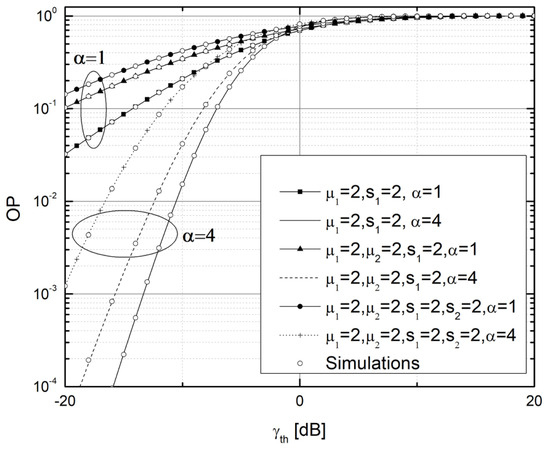
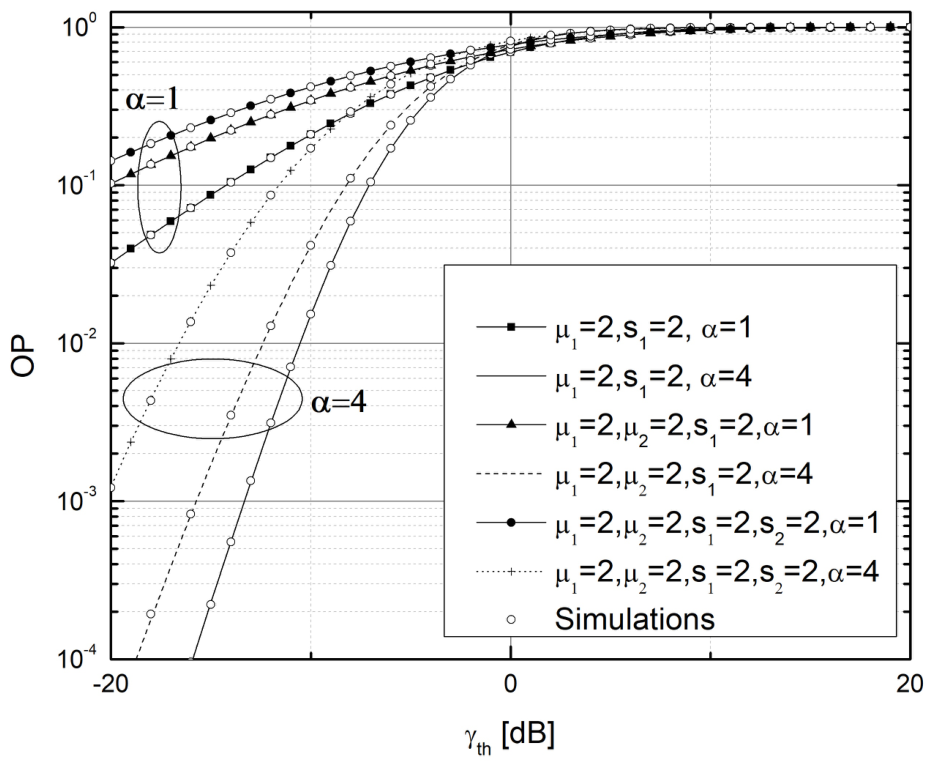
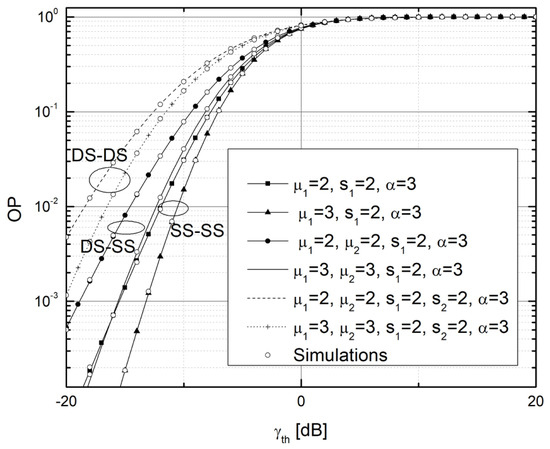
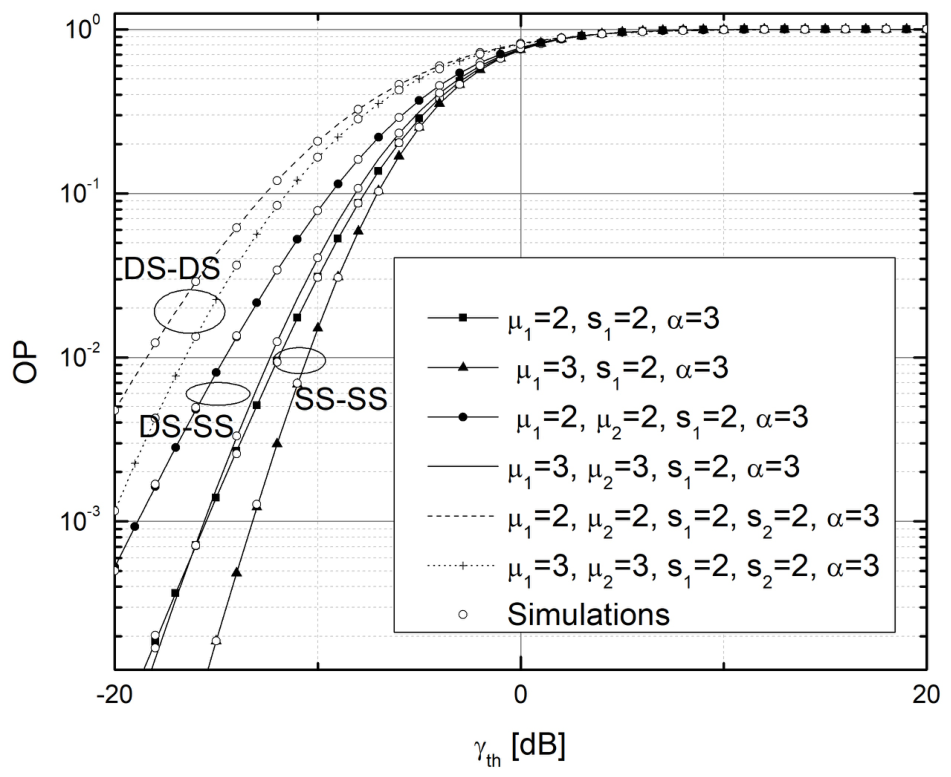
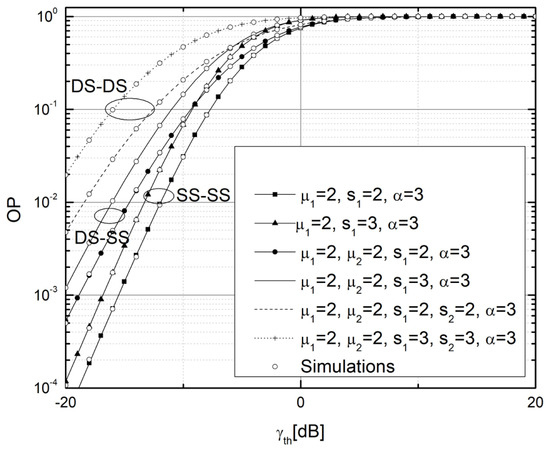
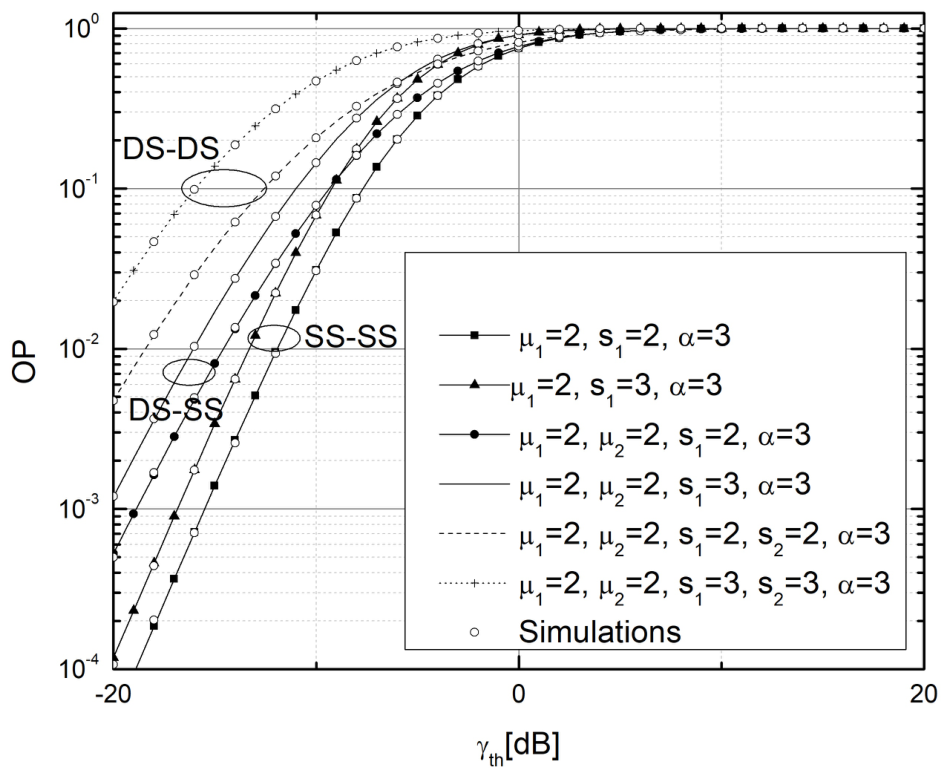
Figure 3 and Figure 4 confirm an excellent agreement between analytical and simulation results. Increasing fading parameters improves performance, while larger shadowing parameters degrade performance due to stronger shadowing effects. The SS–SS model achieves the best performance, while DS–DS represents the most severe case.
Figure 3.
Outage probability versus threshold SNR for different fading conditions with .
Figure 4.
Outage probability versus threshold SNR for different shadowing conditions with .
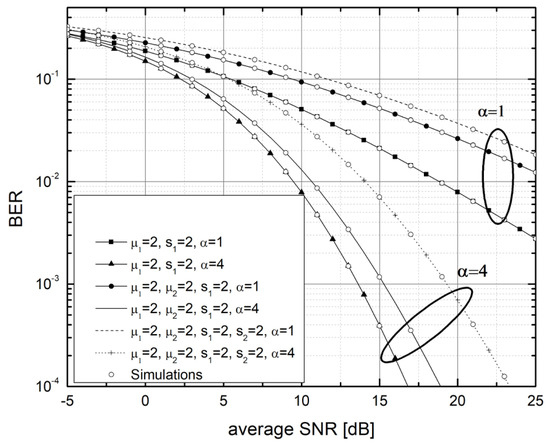
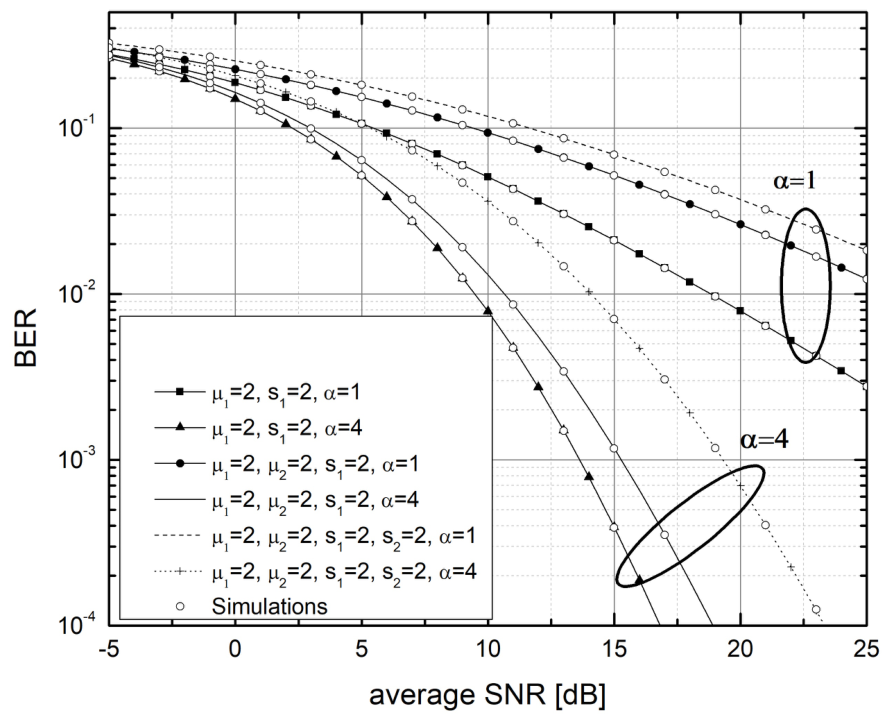
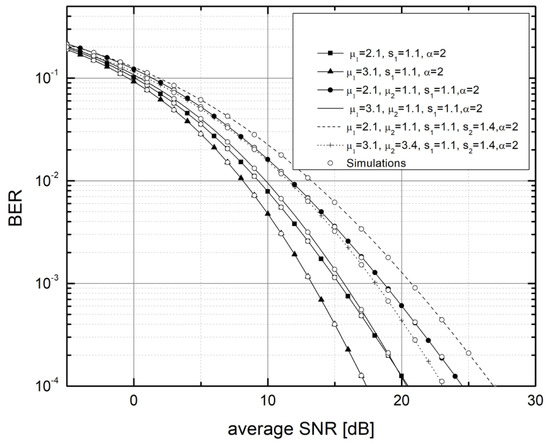
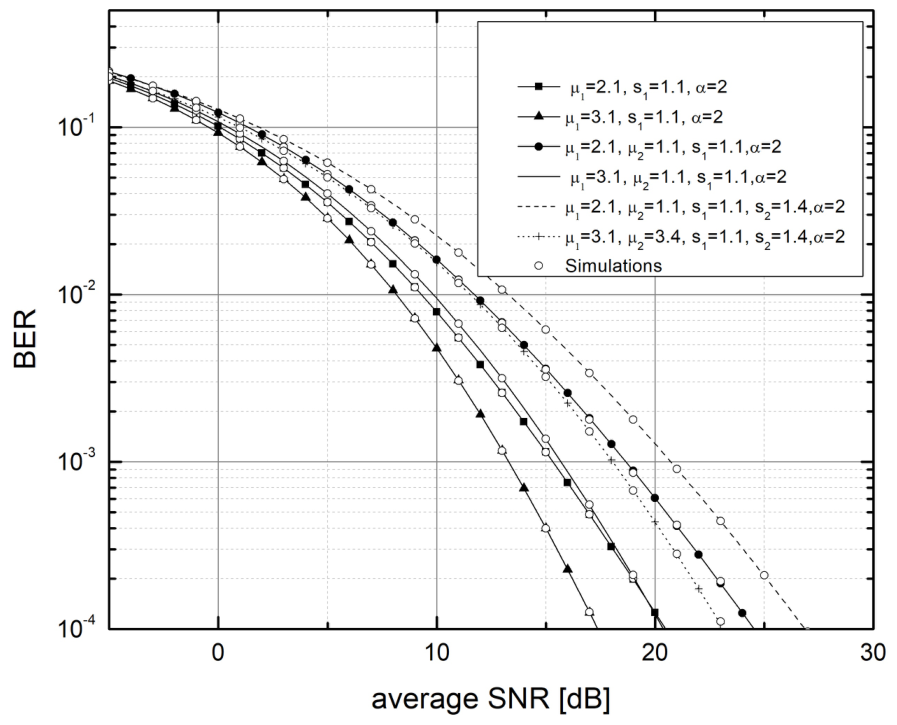
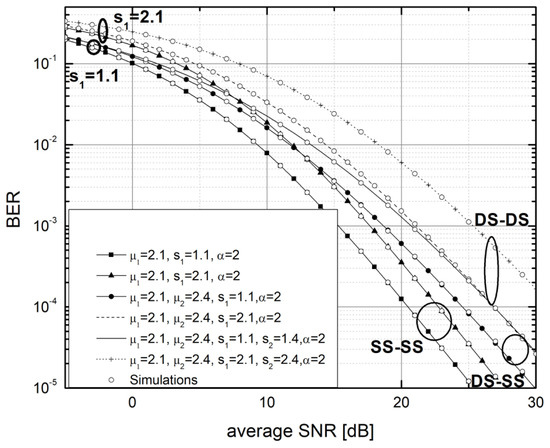
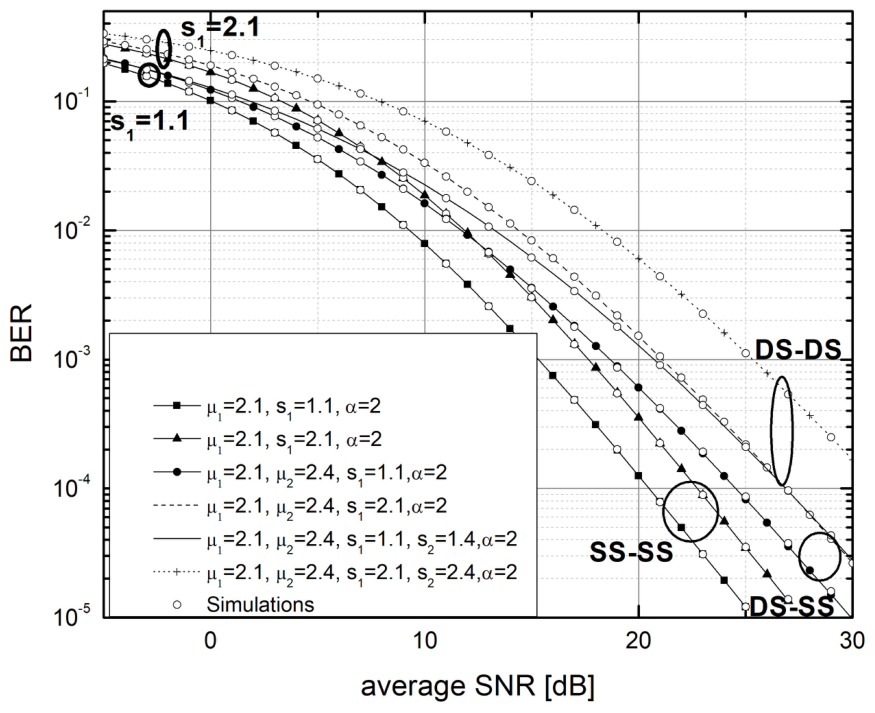
The BER results in Figure 5, Figure 6 and Figure 7 follow the same trends. All BER results are presented for coherent BPSK modulation, i.e., and . The BER decreases with increasing SNR and improves as the nonlinearity parameter and fading severity parameters increase. In contrast, stronger shadowing conditions (corresponding to lower values of ) and increased channel complexity lead to BER degradation. Shadowing effects dominate at low SNR, whereas fading models are more pronounced at high SNR. For the special case and parameter settings aligned with (Figure 2, [11]), the BER results for the DS–SS and DS–DS models coincide with previously published and experimentally validated results (see Figure 6), confirming the correctness of the proposed framework. Specifically, for the DS–SS model, two parameter configurations are considered with fixed and , while the shadowing parameter takes values and . For the DS–DS model, the same fading parameters and are used, whereas the shadowing parameters are varied through two representative pairs, namely and .
Figure 5.
BER performance of the SS–SS, DS–SS, and DS–DS models for different values of .
Figure 6.
BER performance of the SS–SS, DS–SS, and DS–DS models for different multipath fading parameters.
Figure 7.
BER performance of the SS–SS, DS–SS, and DS–DS models for different shadowing parameters.
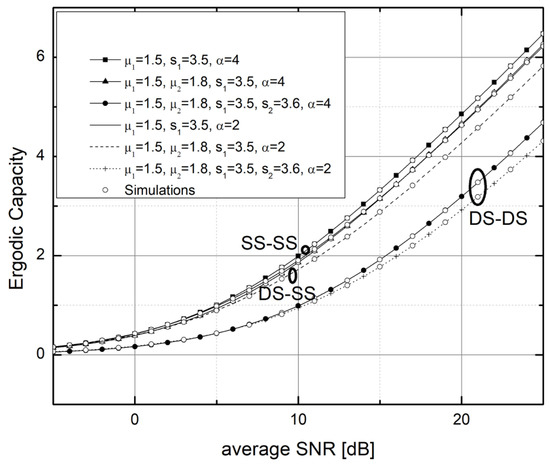
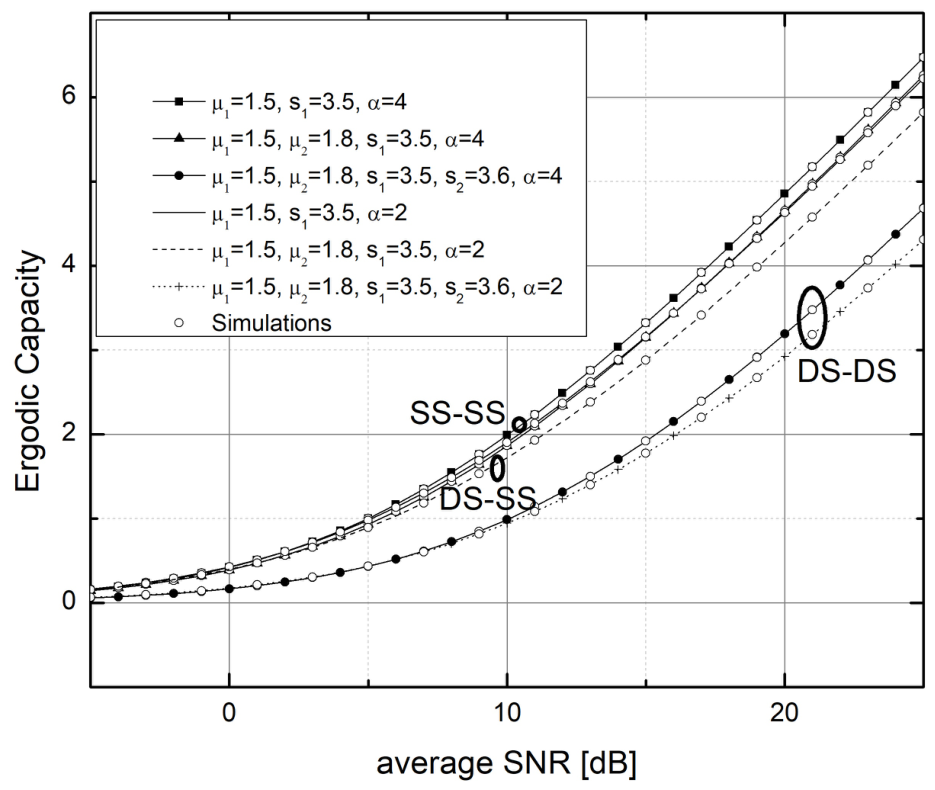
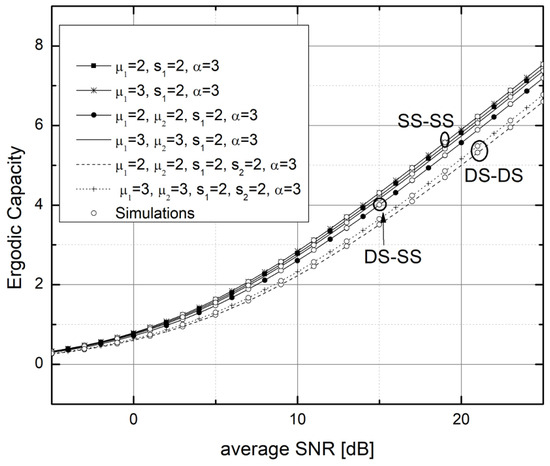
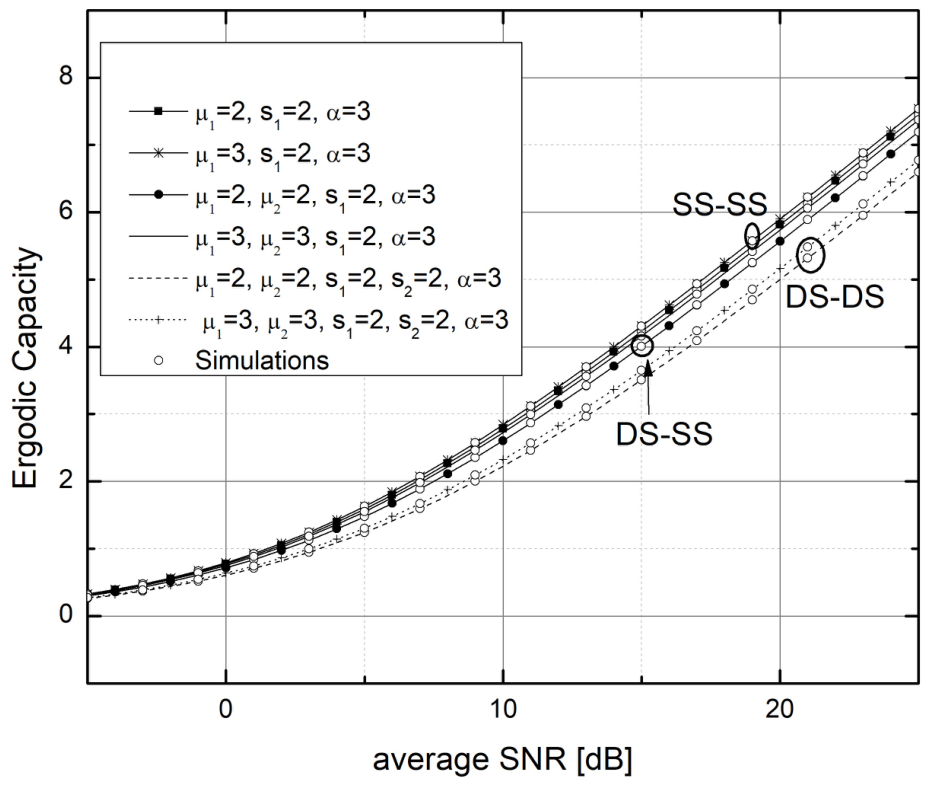
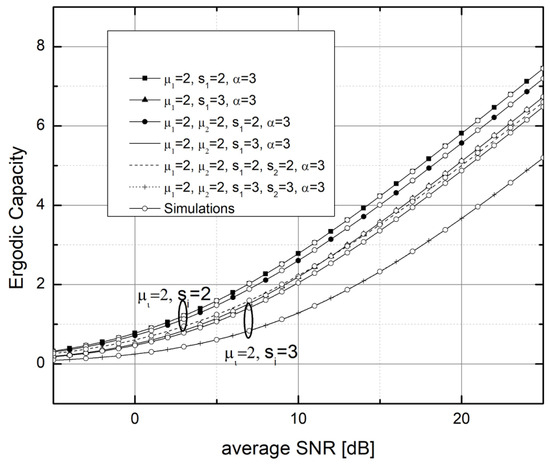
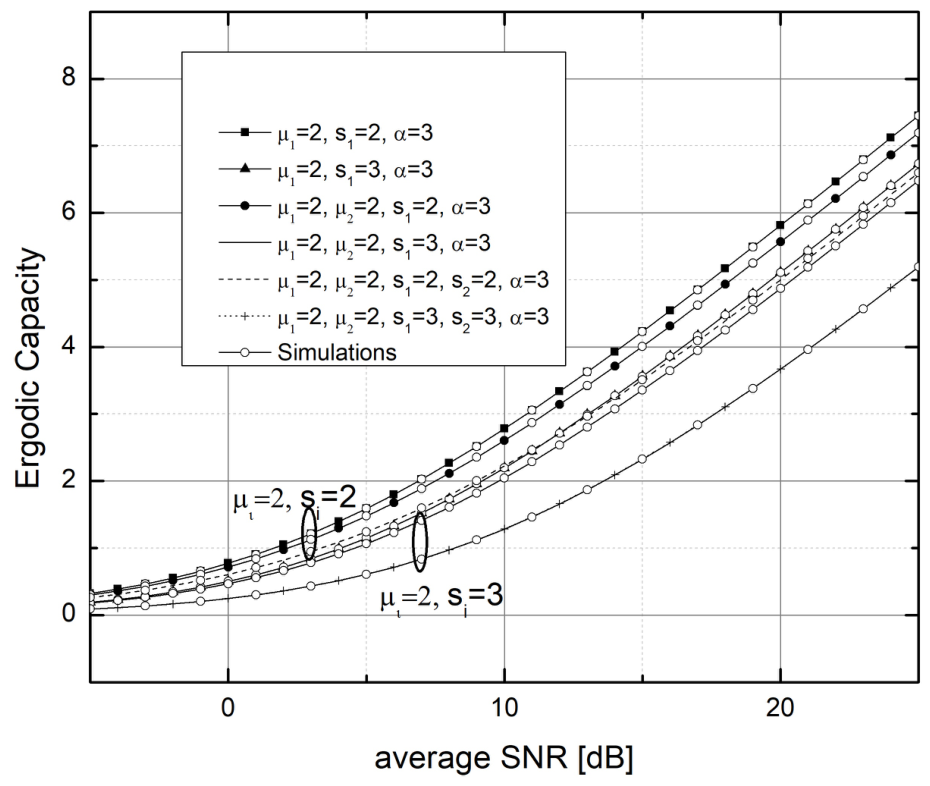
The ergodic capacity results in Figure 8, Figure 9 and Figure 10 show that capacity increases with SNR and , while increasing channel complexity reduces achievable rates. As expected, the ergodic capacity increases with increasing multipath fading severity parameters, reflecting less severe fading conditions and improved channel quality. In contrast, increasing the shadowing severity parameters leads to a reduction in ergodic capacity. Moreover, the obtained results indicate that the adopted channel model (SS–SS, DS–SS, or DS–DS) has a more pronounced impact on the ergodic capacity than observed variations of the nonlinearity parameter and the multipath fading severity parameters. On the other hand, the shadowing severity parameter variations exhibit an even stronger influence on the capacity than the channel model itself for the considered parameter ranges, highlighting the dominant role of shadowing effects in determining the achievable throughput. Similar to the previous observations, for the special case and the same system parameters as in Figure 3 of [11], the obtained results for the DS–SS and DS–DS models are in excellent agreement with experimentally validated results. The considered parameter sets are , , for the DS–SS model, and , , , for the DS–DS model.
Figure 8.
Ergodic capacity versus average SNR for different .
Figure 9.
Ergodic capacity versus average SNR for different multipath fading parameters.
Figure 10.
Ergodic capacity versus average SNR for different shadowing fading parameters.
A quantitative comparison of the considered models reveals that the impact of channel complexity becomes increasingly pronounced as the performance requirements become more stringent. As observed from Figure 3 and Figure 4, for an outage probability of approximately , the DS–DS model requires about 5–7 dB higher average SNR than the SS–SS model, while the DS–SS model exhibits intermediate performance. Similarly, the BER results shown in Figure 5 indicate that, at an average SNR of approximately 20 dB, the BER of the DS–DS model is nearly one order of magnitude higher than that of the SS–SS model. Furthermore, the ergodic-capacity results in Figure 10 demonstrate that increasing channel complexity from SS–SS to DS–DS leads to a capacity reduction of approximately 1 bit/s/Hz in the medium-to-high SNR region. The results also show that stronger shadowing conditions and lower values of the nonlinearity parameter further amplify these performance losses. Therefore, although fading severity, shadowing severity, and nonlinearity significantly affect system performance, the adopted composite fading structure itself (SS–SS, DS–SS, or DS–DS) remains one of the dominant factors governing link reliability and achievable transmission rates in UAV-to-ground communication systems.
Connection to Experimental D-G Channel Models
The proposed analytical framework is closely related to experimentally validated D-G channel models reported in the literature. In particular, the DS–SS and DS–DS models have been confirmed through measurement campaigns to accurately represent composite fading effects in urban environments.
The generalized formulation introduced in this work preserves this physical consistency while extending the model to account for nonlinear propagation effects through the parameter . As a result, the framework provides a bridge between experimentally grounded models and analytically tractable generalized fading representations.
4. Conclusions
A unified composite fading framework for D–G communication channels has been developed, encompassing the SS–SS, DS–SS, and DS–DS propagation scenarios within a common analytical formulation based on generalized-Gamma and inverse-Gamma random variables. Closed-form and integral-form expressions for the SNR statistics and key performance metrics, including the outage probability (OP), average bit error rate (BER), and ergodic capacity (C), have been derived, enabling efficient performance evaluation under generalized propagation conditions. Extensive Monte Carlo simulations have been carried out for all considered scenarios and performance metrics, demonstrating excellent agreement with the analytical results and thereby validating the accuracy of the proposed analysis.
The proposed framework generalizes previously reported composite fading models and, for the special case , reduces to the classical Nakagami-m/inverse-Gamma formulation. Under this condition, the obtained BER and ergodic capacity results for the DS–SS and DS–DS models coincide with previously published and experimentally validated results, further confirming the correctness, physical consistency, and generality of the proposed framework.
The numerical analysis shows that system performance improves with increasing fading severity parameters , whereas larger shadowing parameters lead to performance degradation due to stronger shadowing effects. Moreover, increasing channel complexity (SS–SS → DS–SS → DS–DS) results in reduced reliability, while the nonlinearity parameter provides additional modeling flexibility and has a pronounced impact on system performance.
Overall, the proposed framework provides a flexible and analytically tractable tool for modeling and performance evaluation of UAV communication systems operating in realistic propagation environments relevant to 5G-Advanced and future 6G networks.
Future research will focus on the experimental validation and measurement-based estimation of the nonlinearity parameter , together with the fading severity and shadowing parameters considered in the proposed model. In particular, future measurement campaigns will investigate their relationships with physical propagation characteristics, including UAV altitude, carrier frequency, elevation angle, blockage density, urban morphology, and LoS/NLoS propagation conditions. Furthermore, the proposed framework will be extended to incorporate second-order channel statistics, enabling the investigation of Doppler effects, UAV velocity, and carrier frequency on channel dynamics and providing deeper physical insight into the environmental dependence of the adopted fading and shadowing parameters. Future work will also address dynamic UAV channel modeling by incorporating LoS/NLoS transitions, UAV mobility, altitude-dependent propagation characteristics, and imperfect channel state information (CSI), including channel estimation errors, pilot overhead, and mobility-induced channel aging. Finally, the proposed framework can serve as a foundation for the performance evaluation of emerging B5G/6G UAV communication systems, including multi-UAV networks, RIS-assisted UAV communications, and UAV-assisted THz networks operating in realistic urban environments.
Author Contributions
Conceptualization, Č.S. and D.Đ.; methodology, D.S.; software, D.Đ.; validation, Č.S. and D.Đ.; formal analysis, Č.S.; investigation, Č.S., D.Đ. and A.M.; resources, D.S.; data curation, D.S. and A.M.; writing—original draft preparation, Č.S., D.S. and A.M.; writing—review and editing, Č.S. and A.M.; visualization, D.S.; supervision, Č.S.; project administration, Č.S. All authors have read and agreed to the published version of the manuscript.
Funding
The authors gratefully acknowledge the financial support provided by the Serbian Ministry of Science, Technological Development and Innovation under Contract No. 451-03-65/2024-03/200123. This work was also partially supported by the University of Priština in Kosovska Mitrovica, Faculty of Science and Mathematics, Serbia, through the project IJ-2302 (“Optimization of Neural Networks”).
Data Availability Statement
The authors confirm that the data supporting the results of this work are provided within the paper.
Acknowledgments
The authors acknowledge the support of the COST Action CA22168. The authors would like to thank the anonymous reviewers for their constructive comments and valuable suggestions, which helped improve the quality and clarity of this manuscript. C. Stefanovic dedicates this paper to Vera and Jelena.
Conflicts of Interest
The authors declare that they have no conflict of interest or competing interest.
References
- Geraci, G.; Garcia-Rodriguez, A.; Azari, M.M.; Lozano, A.; Mezzavilla, M.; Chatzinotas, S.; Di Renzo, M. What Will the Future of UAV Cellular Communications Be? A Flight from 5G to 6G. IEEE Commun. Surv. Tutor. 2022, 24, 1304–1335. [Google Scholar] [CrossRef] [Scilit]
- Amponis, G.; Lagkas, T.; Zevgara, M.; Katsikas, G.; Xirofotos, T.; Moscholios, I.; Sarigiannidis, P. Drones in B5G/6G Networks as Flying Base Stations. Drones 2022, 6, 39. [Google Scholar] [CrossRef] [Scilit]
- Mohsan, S.A.H.; Khan, M.A.; Noor, F.; Ullah, I.; Alsharif, M.H. Towards the Unmanned Aerial Vehicles (UAVs): A Comprehensive Review. Drones 2022, 6, 147. [Google Scholar] [CrossRef] [Scilit]
- Benaya, A.M.; AlHajri, M.I.; Ismail, M.H.; Hassan, M.S.; Landolsi, T. Outage Analysis of THz-Enabled IRS-Assisted Multi-User Space–Air–Ground Integrated Networks. IEEE Open J. Commun. Soc. 2025, 6, 2599–2615. [Google Scholar] [CrossRef] [Scilit]
- Khawaja, W.; Guvenc, I.; Matolak, D.W.; Fiebig, U.-C.; Schneckenburger, N. A Survey of Air-to-Ground Propagation Channel Modeling for Unmanned Aerial Vehicles. IEEE Commun. Surv. Tutor. 2019, 21, 2361–2391. [Google Scholar] [CrossRef] [Scilit]
- Cui, Z.; Briso-Rodríguez, C.; Guan, K.; Calvo-Ramirez, C.; Ai, B.; Zhong, Z. Measurement-Based Modeling and Analysis of UAV Air–Ground Channels at 1 and 4 GHz. IEEE Antennas Wirel. Propag. Lett. 2019, 18, 1804–1808. [Google Scholar] [CrossRef] [Scilit]
- Seah, S.J.; Leow, C.Y.; Nalinggam, R.; New, W.K.; Alam, R.; Jong, S.L.; Lam, H.Y.; Almasoud, A.M. Empirical Channel Models for UAV Communication: A Comparative Study. IEEE Access 2024, 12, 96740–96756. [Google Scholar] [CrossRef] [Scilit]
- Aoki, K.; Honda, K. Measurement and Analysis of the Rician K-Factor for Low-Altitude UAV Air-to-Ground Communications at 2.5 GHz. Drones 2025, 9, 86. [Google Scholar] [CrossRef] [Scilit]
- Ni, H.; Zhu, Q.; Hua, B.; Mao, K.; Pan, Y.; Ali, F.; Chen, X. Path Loss and Shadowing for UAV-to-Ground UWB Channels Incorporating the Effects of Built-Up Areas and Airframe. IEEE Trans. Intell. Transp. Syst. 2024, 25, 17066–17077. [Google Scholar] [CrossRef] [Scilit]
- Tang, Y.; Khan, S.; Ansari, I.S. RIS Equipped AAV Swarm: Shadowed Aerial-to-Ground Channel Characterization. IEEE Trans. Veh. Technol. 2025, 74, 16864–16878. [Google Scholar] [CrossRef] [Scilit]
- Bithas, P.S.; Nikolaidis, V.; Kanatas, A.G.; Karagiannidis, G.K. UAV-to-Ground Communications: Channel Modeling and UAV Selection. IEEE Trans. Commun. 2020, 68, 5135–5144. [Google Scholar] [CrossRef] [Scilit]
- Bithas, P.S.; Nikolaidis, V.; Kanatas, A.G. A New Shadowed Double-Scattering Model with Application to UAV-to-Ground Communications. In Proceedings of the IEEE Wireless Communications and Networking Conference (WCNC), Marrakesh, Morocco, 15–18 April 2019; pp. 1–6. [Google Scholar] [CrossRef] [Scilit]
- Dixit, D.; Kumar, N.; Sharma, S.; Bhatia, V.; Panic, S.; Stefanovic, C. On the ASER Performance of UAV-Based Communication Systems for QAM Schemes. IEEE Commun. Lett. 2021, 25, 1835–1838. [Google Scholar] [CrossRef] [Scilit]
- Polus, R.; D’Amours, C. Capacity Analysis of UAV-to-Ground Channels with Shadowing: Power Adaptation Schemes and Effective Capacity. IEEE Open J. Veh. Technol. 2024, 5, 71–77. [Google Scholar] [CrossRef] [Scilit]
- Polus, R.; D’Amours, C. Error Probability of Shadowed UAV-to-Ground Channels with Phase Noise. IEEE Commun. Lett. 2024, 28, 692–696. [Google Scholar] [CrossRef] [Scilit]
- Stefanovic, C.; Panic, S.; Bhatia, V.; Kumar, N. On Second-Order Statistics of the Composite Channel Models for UAV-to-Ground Communications with UAV Selection. IEEE Open J. Commun. Soc. 2021, 2, 534–544. [Google Scholar] [CrossRef] [Scilit]
- Polus, R.; D’Amours, C. On the Performance of MRC Receivers in UAV-to-Ground Channels with Shadowing. IEEE Wirel. Commun. Lett. 2023, 12, 1249–1253. [Google Scholar] [CrossRef] [Scilit]
- Polus, R.; D’Amours, C. Performance Analysis of Selection Combining over UAV-to-Ground Channels with Shadowing. In Proceedings of the IEEE 97th Vehicular Technology Conference (VTC2023-Spring), Florence, Italy, 20–23 June 2023; pp. 1–5. [Google Scholar] [CrossRef] [Scilit]
- Polus, R.; D’Amours, C. On the Reliability of Interference-Limited Systems over UAV-to-Ground Channels with Shadowing. In Proceedings of the IEEE 10th World Forum on Internet of Things (WF-IoT), Ottawa, ON, Canada, 10–13 November 2024; pp. 637–642. [Google Scholar] [CrossRef] [Scilit]
- Bithas, P.S.; Efthymoglou, G.P.; Kanatas, A.G.; Maliatsos, K. Joint Sensing and Communications in Unmanned-Aerial-Vehicle-Assisted Systems. Drones 2024, 8, 656. [Google Scholar]
- Bithas, P.S.; Kanatas, A.G.; Maliatsos, K. Performance Analysis of Sensing-Assisted Communications in Aerial-to-Ground Networks. IEEE Open J. Veh. Technol. 2025, 6, 1140–1151. [Google Scholar]
- Armeniakos, H.K.; Nikolaidis, V.; Bithas, P.S.; Maliatsos, K.; Kanatas, A.G. Performance Analysis and Experimental Validation of UAV Corridor-Assisted Networks. IEEE Trans. Commun. 2026, 74, 3830–3844. [Google Scholar] [CrossRef] [Scilit]
- Bithas, P.S.; Ropokis, G.A.; Karagiannidis, G.K.; Nistazakis, H.E. UAV-Assisted Communications with RIS: A Shadowing-Based Stochastic Analysis. IEEE Trans. Veh. Technol. 2024, 73, 10000–10010. [Google Scholar]
- Stefanovic, C.; Garcia Armada, A.G. Performance Analysis of Double-Scattered Double-Shadowed Channel Model for UAV-to-Ground Systems. In Proceedings of the IEEE Global Communications Conference (GLOBECOM), Rio de Janeiro, Brazil, 4–8 December 2022; IEEE: Piscataway, NJ, USA, 2022; pp. 4479–4484. [Google Scholar]
- Anjos, A.A.D.; Tenkorang, G.K.; Martins, F.C.; Leonardo, E.J.; Yacoub, M.D. Suitability of α–μ for Composite Fading Modeling. IEEE Trans. Antennas Propag. 2024, 72, 3670–3679. [Google Scholar] [CrossRef] [Scilit]
- Papasotiriou, E.N.; Boulogeorgos, A.-A.A.; Haneda, K.; de Guzman, M.F.; Alexiou, A. An Experimentally Validated Fading Model for THz Wireless Systems. Sci. Rep. 2021, 11, 18717. [Google Scholar] [CrossRef] [Scilit] [PubMed]
- Saber, M.J.; Hasna, M.; Badarneh, O.S. THz-Enabled UAV Communications under Pointing Errors: Tractable Statistical Channel Modeling and Security Analysis. IEEE Open J. Veh. Technol. 2025, 6, 801–812. [Google Scholar] [CrossRef] [Scilit]
- Yadav, A.; Mallik, R.K. UAV-Assisted Mixed THz–RF Relaying under Transceiver Fluctuations. IEEE Open J. Veh. Technol. 2026, 7, 751–765. [Google Scholar] [CrossRef] [Scilit]
- Chang, H.; Bian, J.; Wang, C.-X.; Bai, Z.; Zhou, W. A 3D non-stationary wideband GBSM for low-altitude UAV-to-ground V2V MIMO channels. IEEE Access 2019, 7, 70719–70732. [Google Scholar]
- Kishk, M.; Bader, A.; Alouini, M.-S. Aerial base station deployment in 6G cellular networks using tethered drones: The mobility and endurance tradeoff. IEEE Veh. Technol. Mag. 2020, 15, 103–111. [Google Scholar] [CrossRef] [Scilit]
- Xu, H.; Wang, L.; Han, W.; Yang, Y.; Li, J.; Lu, Y.; Li, J. A survey on UAV applications in smart city management: Challenges, advances, and opportunities. IEEE J. Sel. Top. Appl. Earth Obs. Remote Sens. 2023, 16, 8982–9010. [Google Scholar] [CrossRef] [Scilit]
- Al-Bakhrani, A.A.; Li, M.; Obaidat, M.S.; Amran, G.A. MOALF-UAV-MEC: Adaptive Multiobjective Optimization for UAV-Assisted Mobile Edge Computing in Dynamic IoT Environments. IEEE Internet Things J. 2025, 12, 20736–20756. [Google Scholar] [CrossRef] [Scilit]
- He, Y.; Huang, F.; Wang, D. PP-RCR: A Position-Probability-Resource Cooperative Routing Algorithm for Air-to-Ground Integrated Mobile Ad Hoc Networks in Emergency Rescue Scenarios. IEEE Wirel. Commun. Lett. 2026, 15, 1906–1910. [Google Scholar] [CrossRef] [Scilit]
- Harounabadi, M.; Heyn, T. Toward integration of 6G-NTN to terrestrial mobile networks: Research and standardization aspects. IEEE Wirel. Commun. 2023, 30, 20–26. [Google Scholar] [CrossRef] [Scilit]
- Hao, H.; Xu, C.; Zhang, W.; Yang, S.; Muntean, G.-M. Task-Driven Priority-Aware Computation Offloading Using Deep Reinforcement Learning. IEEE Trans. Wirel. Commun. 2025, 24, 8114–8128. [Google Scholar] [CrossRef] [Scilit]
- Kurunathan, H.; Huang, H.; Li, K.; Ni, W.; Hossain, E. Machine Learning-Aided Operations and Communications of Unmanned Aerial Vehicles: A Contemporary Survey. IEEE Commun. Surv. Tutor. 2024, 26, 496–533. [Google Scholar] [CrossRef] [Scilit]
- Yacoub, M.D. The α-μ Distribution: A Physical Fading Model for the Stacy Distribution. IEEE Trans. Veh. Technol. 2007, 56, 27–34. [Google Scholar]
- Mathai, A.M.; Saxena, R.K.; Haubold, H.J. The H-Function: Theory and Applications; Springer: New York, NY, USA, 2009. [Google Scholar] [CrossRef] [Scilit]
- Gradshteyn, I.S.; Ryzhik, I.M. Table of Integrals, Series, and Products; Academic Press: New York, NY, USA, 2000. [Google Scholar]
- Wolfram Research, Inc. Meijer G-Function; Wolfram Research, Inc.: Champaign, IL, USA, 2010; Available online: https://functions.wolfram.com/HypergeometricFunctions/MeijerG/ (accessed on 17 May 2026).

Disclaimer/Publisher’s Note: The statements, opinions and data contained in all publications are solely those of the individual author(s) and contributor(s) and not of MDPI and/or the editor(s). MDPI and/or the editor(s) disclaim responsibility for any injury to people or property resulting from any ideas, methods, instructions or products referred to in the content. |
© 2026 by the authors. Licensee MDPI, Basel, Switzerland. This article is an open access article distributed under the terms and conditions of the Creative Commons Attribution (CC BY) license.