


Highlights
What are the main findings?
- Standardized Decision Framework: Developed a two-stage protocol that replaces arbitrary model selection with a systematic approach, mapping specific infrastructural and informational constraints to five distinct modeling regimes.
- Empirical Evaluation and Consistency: The framework’s qualitative logic, evaluated against a 24-study independent literature holdout set, achieved high consistency with observed literature choices, demonstrating structural reliability in identifying the most suitable modeling strategy.
- Quantitative Multi-Criteria Ranking: Integrated the Analytic Hierarchy Process (AHP) to mathematically rank models based on context-specific priorities like predictive accuracy, physical interpretability, development cost, and customization adaptability.
What are the implications of the main findings?
- Operational Resilience through “Fallback Flexibility”: The framework allows researchers to seamlessly pivot to the next highest-ranked feasible alternative when unforeseen roadblocks, such as equipment failure or data loss, occur.
- Optimized Resource Allocation: By enforcing strict feasibility filters before evaluating preferences, the framework prevents the over-allocation of computational and experimental research resources.
- Enhanced Reproducibility and Standardization: Supported by an open-source Python GUI, this methodology fosters greater consistency and transparency within the energy-aware UAV research community.
Abstract
The growing deployment of unmanned aerial vehicles (UAVs) in energy-constrained applications has highlighted the need for appropriate energy consumption models. However, selecting between physics-based (white-box) and data-driven (black-box) modeling paradigms remains a largely implicit process. Researchers often navigate undocumented trade-offs among required predictive accuracy, empirical data availability, and access to aerodynamic testing infrastructure without a formalized structure. This study proposes a two-stage decision-making framework to formalize UAV energy model selection. In the first stage, a qualitative decision tree is inductively derived from a corpus of 23 recent studies, explicitly mapping infrastructural and informational constraints to five distinct modeling regimes. In the second stage, the Analytic Hierarchy Process (AHP) is applied to quantitatively evaluate the feasible alternatives based on context-specific criteria: accuracy, interpretability, development cost, and customization adaptability. The structural logic of the framework is evaluated against an independent set of 24 holdout studies, demonstrating a high degree of consistency between the framework’s recommendations and the methodologies employed in the literature. Furthermore, the quantitative AHP scoring introduces “fallback flexibility,” enabling researchers to mathematically identify alternative modeling strategies when primary experimental conditions are compromised. Supported by an open-source Python graphical interface, this framework aims to reduce methodological ambiguity and support more structured, reproducible model selection in UAV energy research.
1. Introduction
Unmanned Aerial Vehicles (UAVs) are increasingly deployed across complex, energy-constrained operational domains, including precision agriculture, autonomous urban logistics, aerial surveillance, and disaster response networks [1,2,3]. Because multi-rotor and fixed-wing platforms are fundamentally constrained by the energy density of onboard battery systems (often limiting operational flight endurance to short windows), understanding and predicting their dynamic power consumption is a key research area in the drone community [4,5]. Accurate energy modeling serves as a foundational prerequisite for optimizing autonomous flight trajectories, extending mission endurance, and supporting safe operations beyond visual line of sight (BVLOS) [6].
Despite a proliferation of research addressing UAV power constraints, the landscape of energy modeling methodologies remains highly fragmented. Approaches broadly bifurcate into two distinct paradigms: physics-based (white-box) models, which rely on first-principles aerodynamic equations and propulsion mechanics, and data-driven (black-box) models, which utilize machine learning or empirical statistical regression derived from flight telemetry logs [7]. Currently, the decision to adopt one paradigm over the other (and whether to derive a novel model or adapt an existing framework) is largely an implicit process. These methodological choices are frequently driven by a researcher’s immediate access to wind tunnels, the availability of high-fidelity flight datasets, or algorithmic familiarity, rather than a structured assessment of the project’s actual requirements. Consequently, there is a need for a formalized methodology to guide researchers in selecting an appropriate energy model under heterogeneous hardware, data, and facility constraints.
To address this gap, this study formalizes the implicit mechanisms of UAV energy model selection through a two-stage decision-making framework based on a Decision Tree and the Analytic Hierarchy Process (AHP). The primary contributions of this paper are fourfold:
- We inductively derive a qualitative decision tree from a systematic review of existing UAV literature (utilizing a 23-study training corpus), explicitly mapping infrastructural and informational constraints to five empirically observed modeling regimes.
- We evaluate the structural logic of this decision tree against an independent 24-study holdout set, demonstrating a high degree of consistency between the framework’s recommendations and the methodologies deployed in state-of-the-art literature.
- We apply a quantitative Analytic Hierarchy Process (AHP) framework to evaluate and rank admissible modeling alternatives based on user-weighted criteria, ensuring that the selected model balances accuracy, interpretability, development time, and adaptability.
- We provide an open-source Python-based graphical user interface (Using Python 3.8+ with PyQt 5.15.10) that operationalizes the framework, granting researchers “fallback flexibility” by providing a mathematically prioritized continuum of backup modeling strategies should primary experimental conditions change.
The remainder of this paper is organized as follows. Section 2 reviews the background of UAV classifications and the dichotomy of current energy modeling paradigms. Section 3 details the derivation and empirical evaluation of the qualitative decision tree. Section 4 presents the mathematical formulation of the AHP-based quantitative framework and its re-validation. Section 5 discusses the practical implications, limitations, and future directions of the methodology. Finally, Section 6 concludes the paper.
2. Background and Related Work
2.1. UAV Classifications and Energy Dynamics
Unmanned Aerial Vehicles (UAVs) are fundamentally categorized by their aerodynamic architectures and flight kinematics into fixed-wing, rotary-wing, and hybrid platforms. Each structural paradigm dictates a distinct energy consumption profile and operational envelope.
2.1.1. Primary UAV Categories
UAVs are classified into three primary categories based on their mechanisms for lift generation and operational agility. Fixed-wing UAVs utilize forward aerodynamic motion to generate lift over stationary wings, yielding superior energy efficiency and prolonged endurance. This streamlined aerodynamic profile minimizes power expenditure (increasingly relying on advanced high-density battery architectures) [8] making them optimal for wide-area missions such as topographic mapping and agricultural surveying. Conversely, rotary-wing UAVs (encompassing single-rotor and multi-rotor configurations) generate lift through continuous rotor actuation, enabling vertical takeoff and landing (VTOL) and high-precision hovering. This operational flexibility comes at a significant energy premium, heavily modulated by the number of actuators and payload mass [9,10]. Hybrid UAVs bridge these paradigms, integrating VTOL capabilities with fixed-wing horizontal cruising. These platforms are engineered for complex supply chain and autonomous delivery networks, transitioning between energy-intensive hover phases and highly efficient forward flight [9,10].
2.1.2. Energy Profiling Across UAV Designs
Power demands fluctuate significantly across UAV classes due to fundamentally different propulsion mechanics and optimization priorities. Fixed-wing systems prioritize aerodynamic efficiency and route refinement for sustained long-range travel [11,12]. Rotary-wing designs, however, must continuously optimize power allocation to maintain stable hover states and execute agile maneuvers [13]. Hybrid platforms require sophisticated control regimes to minimize the energy spikes associated with transitioning between VTOL and horizontal flight modes. Furthermore, operational agility is structurally constrained: fixed-wing aircraft possess limited turning radii dictated by stall speeds [14], whereas multi-rotors execute sharp, high-cost navigational pivots [15,16].
2.2. Role of Energy Simulation in Autonomous Optimization
Accurate energy forecasting is a mission-critical component for optimizing autonomous UAV operations and preventing mid-flight power depletion. Given that commercial and tactical UAVs typically operate within strict 20–40 min endurance windows, robust simulation frameworks are required to project operational range by integrating payload weight, altitude profiles, and atmospheric variables [9,10].
These models inform trajectory optimization algorithms by quantifying the exact energy cost of hovering, ascending, and navigating through waypoints [17,18]. In sectors such as emergency response and autonomous logistics, high-fidelity energy modeling ensures operational reliability by triggering fail-safes or return-to-base protocols before critical energy thresholds are breached [18,19]. Furthermore, these simulations are vital for evaluating the integration of renewable energy sources, such as photovoltaic arrays, to extend flight endurance [17,20].
2.3. Key Influences on UAV Power Usage
UAV power consumption is a highly dynamic variable modulated by interacting environmental, kinematic, and structural factors.
Atmospheric disturbances, such as wind shear and precipitation, drastically alter required thrust and power draw [13,21]. Kinematic decisions, particularly cruise velocity, dictate the balance between induced and parasite power [13,22,23]. Structurally, gross takeoff weight (including variable payloads) acts as a primary consumption multiplier [19,24]. Additionally, altitude variations alter air density and rotor drag [18], while onboard avionics and data-transmission systems introduce non-negligible auxiliary power loads [19,22,25].
2.4. Taxonomy of UAV Power Frameworks
Contemporary UAV energy estimation frameworks fundamentally bifurcate into physics-based (white-box) analytical models and data-driven (black-box) empirical models [7].
2.4.1. White-Box vs. Black-Box Approaches
White-box methods are derived from first-principles aerodynamics, capturing propulsion mechanics, momentum theory, and blade element theory. They afford high interpretability, enabling engineers to conduct hypothetical scenario probing, hardware design iterations, and rigorous trajectory optimization. However, their limitations include intensive computational overhead and the requirement for highly specific, difficult-to-measure aerodynamic coefficients. Conversely, black-box alternatives deploy statistical regressions or deep neural networks to map observable telemetry inputs directly to energy outputs. These models bypass complex mechanistic derivations, yielding rapid inference capabilities suitable for real-time edge computing. Their primary drawbacks are a severe lack of interpretability and a vulnerability to overfitting if the training dataset lacks environmental diversity.
2.4.2. Selection Criteria and Modeling Trends
The epistemological foundations, operational constraints, and deployment implications of these two paradigms differ substantially. Table 1 summarizes their structural engineering trade-offs.
Table 1.
Comparison between physics-based (white-box) and data-driven (black-box) UAV energy models.
White-box models are optimal for analytical optimization and trajectory planning that require strict theoretical guarantees. However, they frequently demand precise vehicle parameters, wind tunnel validation, and significant computational resources, limiting their flexibility in highly dynamic or rapidly prototyping environments. Black-box approaches excel when large volumes of flight telemetry are available and system identification via machine learning is more pragmatic than analytical derivation. Their principal limitation is the inability to extrapolate safely outside the distribution of their training data.
Therefore, model selection is not a matter of binary superiority, but rather a complex context dependency prioritizing analytical fidelity against empirical responsiveness.
- Empirical in the Literature
Table 2 categorizes representative studies according to their adopted modeling paradigm. Several key methodological patterns emerge:
Table 2.
Classification of state-of-the-art studies by UAV energy modeling paradigm.
- Dominance of multirotor platforms: The overwhelming majority of surveyed works focus on multirotor UAVs, reflecting their ubiquitous deployment in precision agriculture, autonomous inspection, and IoT data harvesting.
- Prevalence of physics-based models in optimization: White-box formulations dominate energy-aware path planning and control optimization studies. This indicates that the theoretical optimization community strictly prioritizes mechanistic transparency and explicit mathematical gradients.
- Surge in ML-based models post-2020: Data-driven approaches have experienced rapid adoption, catalyzed by the proliferation of onboard telemetry logging and advancements in deep learning architectures.
- Lack of paradigm justification: Critically, very few works systematically compare white-box and black-box models under identical constraints. Methodological choices are frequently assumed rather than rigorously justified.
- Identified Research Gap and Motivation
Despite this body of literature, a critical methodological gap persists within UAV energy research:
- Model selection is predominantly implicit and rarely justified by empirical comparison.
- No standardized, reproducible framework exists to guide researchers in selecting the paradigm based on their specific hardware and data constraints.
- The engineering trade-offs between predictive accuracy, physical interpretability, and computational cost are rarely quantified simultaneously.
Although the majority of current studies focus on optimizing flight paths within a chosen modeling paradigm, the foundational decision of which paradigm to adopt is routinely bypassed.
Consequently, model selection must evolve from an implicit assumption into a formal multi-criteria decision problem. This study is motivated by the need to quantify these trade-offs, formalizing the selection process through a qualitative decision tree (Section 3) integrated with a quantitative analytical hierarchy process (Section 4). By standardizing this workflow, we aim to ensure that the energy model choice is consistently reproducible and mathematically justified.
3. Qualitative Framework for UAV Energy Model Selection
3.1. Systematic Literature Selection Protocol
To ensure methodological transparency and mitigate selection bias in the formulation of the decision tree, the corpus of literature utilized for both the derivation (training set, ) and validation (holdout set, ) phases was assembled through a structured selection protocol.
3.1.1. Search Strategy and Databases
The literature search was conducted utilizing primary academic databases and research networking platforms, specifically Google Scholar and ResearchGate. Additionally, Perplexity was employed as an AI-assisted academic search engine to ensure comprehensive retrieval of recent, highly relevant publications and preprints. The search strategy was driven by the following exact query strings:
- “UAV energy model”;
- “UAV Energy consumption”;
- “Energy-Efficient UAV”.
While the search utilized Google Scholar and AI-assisted engines (Perplexity) to ensure broad retrieval of recent research, we acknowledge that the absence of strict database filtering (e.g., exclusively via Web of Science or Scopus) constitutes a limitation in the systematic rigidity of the corpus compilation.
3.1.2. Inclusion and Exclusion Criteria
The retrieval phase generated an initial pool of candidate papers, which were subsequently subjected to a rigorous manual screening process. The primary inclusion criterion required that a study must feature the explicit or implicit selection, derivation, adoption, or implementation of a specific UAV energy consumption model (either physics-based/white-box or data-driven/black-box).
Conversely, the exclusion criteria filtered out
- Studies that merely mentioned UAV energy constraints peripherally without deploying a formal mathematical or empirical model.
- Research solely focused on battery chemistry or hardware manufacturing without addressing system-level energy consumption modeling.
- Articles lacking sufficient methodological detail to discern how their energy estimation approach was structurally chosen or parameterized.
Through this protocol, 47 highly relevant studies were isolated. These were systematically partitioned into the 23-paper inductive derivation corpus (Table 3) and the 24-paper independent validation holdout set (Table 4).
Table 3.
Energy model categories in the literature and structural alignment with the extracted decision logic.
Table 4.
Validation of the decision framework against the 24 independent study holdout set.
3.2. Derivation of the Framework from Literature Patterns
The proposed decision-making framework was inductively engineered through a systematic analysis of state-of-the-art energy modeling strategies. This derivation utilized 23 of the 47 reviewed studies (summarized in Table 3), spanning highly diverse operational and algorithmic contexts.
The literature broadly bifurcates into two dominant modeling paradigms:
- White-box (physics-based/analytical) models;
- Black-box (empirical/machine learning) models.
A rigorous examination of these studies reveals that researchers implicitly execute structured decision-making based on recurring, critical constraints. Specifically, model selection is consistently dictated by
- Access to experimental facilities or aerodynamic validation infrastructure (e.g., wind tunnels).
- The volume and fidelity of accessible flight telemetry and battery discharge datasets.
- The predictive accuracy thresholds mandated by the specific autonomous task (e.g., MPC vs. high-level logistics routing).
- The degree of structural customization of the UAV platform.
- The availability of foundational, mathematically validated analytical formulations in prior literature.
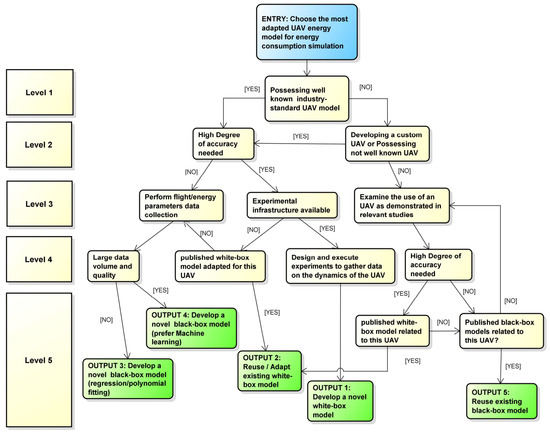
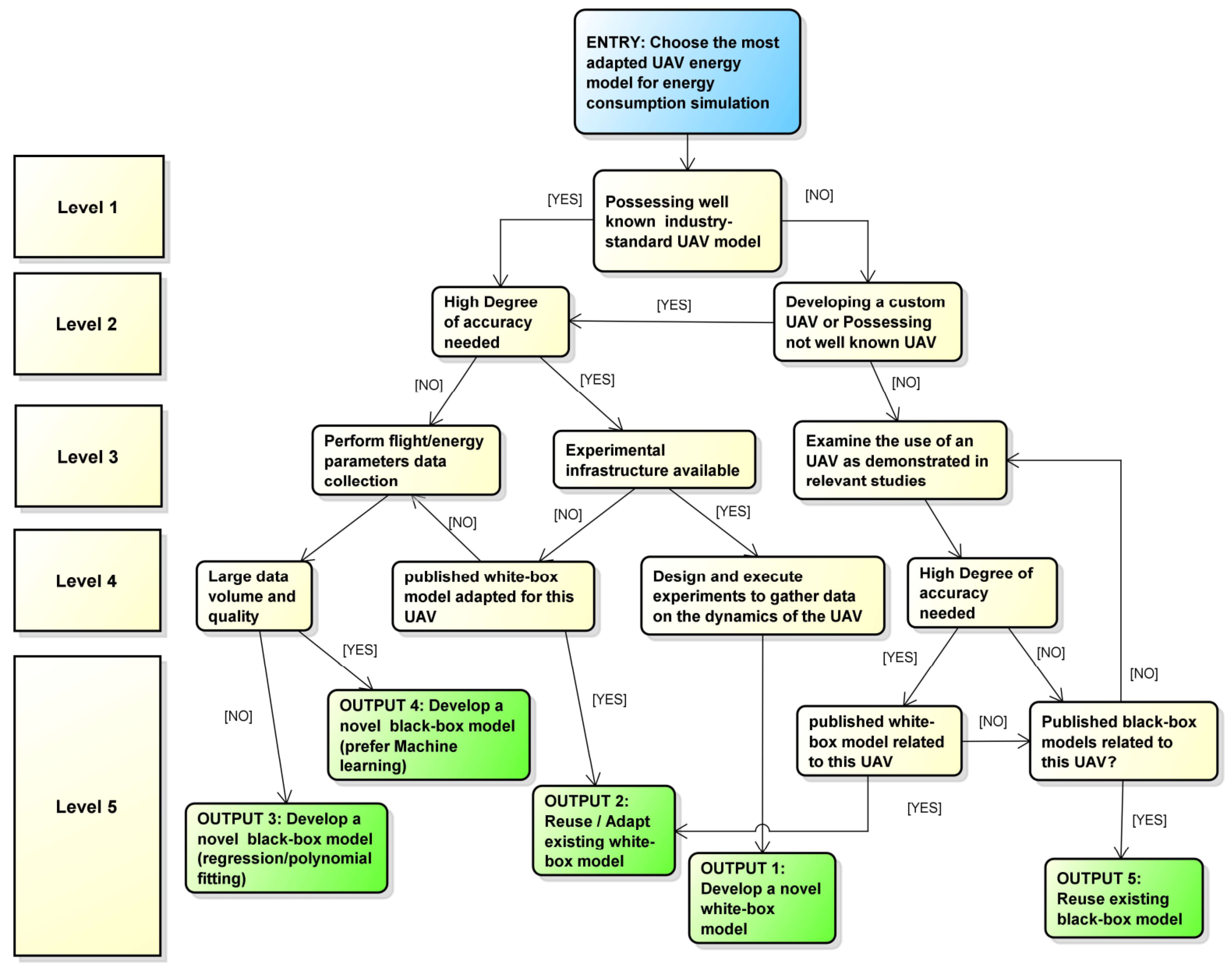
These structural constraints constitute the operational backbone of the proposed framework. The decision tree presented in Figure 1 is a formalization of the implicit selection logic already embedded (but previously uncodified) within existing empirical studies.
Figure 1.
Decision tree formalized from recurring modeling strategies in UAV energy literature.
3.3. Energy Model Alignment and Pattern Extraction
To explicitly map this derivation, Table 3 categorizes the training corpus according to the type of model employed and the corresponding decision path that aligns with our proposed framework.
3.4. Observed Decision Regimes in the Selected Literature
The corpus analysis reveals four distinct, recurring methodological regimes:
3.4.1. Data-Rich Environments Lacking Experimental Infrastructure
Studies such as [54,59,60] pivot to statistical regression or deep machine learning architectures when wind tunnels or precision aerodynamic validation facilities are inaccessible. This directly corresponds to the framework branch mandating data-driven black-box development under high-data/low-infrastructure conditions.
3.4.2. High-Fidelity Requirements Supported by Analytical Foundations
Works focused on rigorous trajectory optimization, including [22,46,47], universally adopt and adapt existing, mathematically proven propulsion-based models. This aligns with the framework branch prioritizing the reuse of validated white-box formulations to maintain explicit control gradients.
3.4.3. High-Fidelity Requirements Necessitating Extended Physical Formulations
When existing formulations fail to capture complex dynamics (such as ground effect transitions or variable payloads) authors [1,6,33] are forced to derive novel analytical models. This necessitates the framework path leading to original white-box derivations, heavily reliant on physical testing facilities.
3.4.4. Hybrid Analytical–Empirical Synthesis
Certain systemic evaluations [2,48] synthesize first-principles physics derivation with extensive empirical validation, reflecting operational environments that simultaneously demand causal interpretability and real-world statistical realism.
3.5. Formalization into a Structured Decision Tree
Figure 1 illustrates the explicit decision tree formulated from these recurring operational patterns. The resulting framework avoids a reductive binary split (i.e., merely choosing between white-box or black-box); rather, it encodes a conditional, multi-stage hierarchy that navigates specific engineering constraints.
- Stage 1: Platform Maturity and Contextual Identification
The root node acts as an initial filter, distinguishing between the deployment of a recognized, industry-standard UAV platform versus a highly customized or proprietary airframe. This classification is vital, as the applicability of transferrable analytical models found in existing literature scales directly with platform maturity.
- Stage 2: Algorithmic Accuracy Thresholds
The subsequent branching condition evaluates the predictive fidelity required by the autonomous mission planner. Consistent with literature trends, algorithms requiring highly precise gradient calculations (e.g., nonlinear model predictive control) necessitate physics-based reasoning, whereas broad logistical routing algorithms often tolerate the bounded errors of empirical estimation.
- Stage 3: Literature Availability Assessment
When high accuracy is dictated, the framework interrogates the existing scientific corpus to determine if a rigorously validated white-box or black-box model tailored to the specific UAV platform is already available. If a transferrable analytical model exists, the framework optimizes research efficiency by recommending adaptation (OUTPUT 2), circumventing redundant derivations. If no such model exists, the logic shifts toward novel development.
- Stage 4: Experimental and Data Capability Verification
When original model development is inescapable, the decision path diverges based on strict physical and informational assets:
- If physical experimental infrastructure (e.g., wind tunnels, thrust stands) is accessible, the framework directs the researcher toward a novel white-box derivation (OUTPUT 1).
- If physical infrastructure is absent, but the system architecture permits extensive flight telemetry logging, the framework dynamically pivots the researcher toward empirical black-box modeling.
- Stage 5: Data Volume Qualification
For empirical modeling pathways, the framework applies a final volumetric filter:
- Massive, high-resolution datasets trigger the recommendation of Deep Learning/ML architectures (OUTPUT 4).
- Constrained or low-resolution datasets default to standard polynomial regression or simple heuristic fitting (OUTPUT 3).
Existing, highly generalized empirical models may also be reused if appropriately validated for the operational domain (OUTPUT 5).
3.6. Empirical Validation of the Framework
To evaluate the validity and structural robustness of the proposed decision tree, a validation test was executed utilizing the remaining 24 studies as an independent holdout set (published between 2023 and 2026, detailed in Table 2). These studies were strictly isolated during the framework’s inductive derivation phase to prevent data leakage.
The validation protocol mapped the explicit operational constraints, platform architectures, and data availability parameters documented in each test paper against the framework’s decision nodes to determine if the algorithmic output matched the actual engineering methodology deployed by the authors.
Table 4 summarizes the specific parameters of the holdout studies and the resulting output alignment.
3.6.1. Validation Analysis by Decision Regimes
The holdout set effectively activates four distinct systemic branches of the proposed decision tree, demonstrating the framework’s robust applicability across diverse engineering contexts.
- Regime 1: Optimization and Path Planning on Standard UAVs (O2)
Eighteen of the test papers (Abdel-Basset et al. [35], Cokyasar et al. [41], Elmanakhly et al. [31], Engin et al. [36], Gasche et al. [30], Gu et al. [26], Kwasiborska et al. [42], Lin et al. [37], Na et al. [58], Qin et al. [32], Saeed et al. [43], Tomar et al. [27], Wang et al. (2023) [44], Wang et al. (2024) [38], Wu et al. [29], Yue [39], Zhang et al. (2023) [45], and Zhang et al. (2024) [40]) focus on trajectory optimization, swarm delivery routing, coverage path planning, system deployment, comparative operational analysis, energy-aware planning, hybrid energy system sizing, communication network routing, IoT data collection, and AoI–energy tradeoff optimization. These studies utilize mature UAV platforms (Stage 1), demand high modeling fidelity for macro-optimization and simulation environments (Stage 2), and leverage extensively validated analytical formulations within the literature (Stage 3). As predicted, these researchers avoided redundant physics derivations, navigating directly to Output 2 (O2).
- Regime 2: Data-Rich, Infrastructure-Poor Environments (O3 and O4)
Five studies (Al-Haddad et al. [56], Cicek et al. [55], Huang [53], Kim et al. [52], and Suo et al. [57]) investigate scenarios dominated by complex operational dynamics or parameter estimation (e.g., flight parameters for edge detection, battery degradation). In these cases, the lack of wind tunnel infrastructure (Stage 4) and the availability of vast empirical telemetry satisfy the framework’s conditions for data-driven modeling. As accurately mapped, Suo et al. formulated a transparent regression-based empirical model corresponding to Output 3 (O3), while the remaining authors utilized Deep Neural Networks and Machine Learning-based predictors, leading to Output 4 (O4).
- Regime 3: Bespoke Platform with High Analytical Requirements (O1)
The study by Xu et al. [28] involves a “Morphing Solar-Powered UAV.” A bespoke platform (Stage 1) requiring high precision (Stage 2) with no pre-existing transferrable model (Stage 3) vectors the decision process to Output 1 (O1). The publication corroborates this by detailing novel solar-aerodynamic physics derivations.
3.6.2. Interpretation and Structural Analysis of Validation Results
The validation subset () yielded the following distribution across the framework’s terminal nodes:
- O1 (Novel White-Box Development): 1 study;
- O2 (Reuse of Established White-Box Model): 18 studies;
- O3 (Regression-Based Black-Box): 1 study;
- O4 (Machine Learning Black-Box Development): 4 studies;
- O5 (Reuse of Existing Black-Box Model): 0 studies.
The high prevalence of O2 instances underscores the deep methodological maturity achieved in standard multirotor propulsion modeling, as well as macroscopic operational optimization across numerous fields (logistics, IoT, delivery swarms, coverage path planning in [38], intelligent energy management in [44], hybrid power system design in [27], swarm communication optimization in [39], and IoT/Age-of-Information optimization via metaheuristics and resource allocation in [40,45]). The activation of the O3 and O4 pathways demonstrates a structural shift towards empirical, data-driven techniques, capitalizing on large volumes of real flight data for edge-based detection [57] and complex non-linear battery estimation [56]. The non-activation of the O5 pathway in the validation subset remains consistent with current research trends: empirical predictors are generally overly fitted to their training hardware, making off-the-shelf reuse (O5) practically limited without retraining (which reverts the logic to O3 or O4).
- Methodological Implications
The alignment between the framework’s logic and the authors’ actual modeling choices confirms that the decision tree successfully codifies the complex selection mechanisms present in the literature. The framework proves highly effective at mapping context-dependent operational constraints to mathematically appropriate engineering outputs.
4. Quantitative Framework for UAV Energy Model Selection
To guarantee methodological rigor, mathematical transparency, and operational reproducibility, the proposed framework is executed via two sequential, mathematically grounded stages:
- A non-compensatory feasibility filtering stage, derived directly from the structural decision tree’s logical constraints.
- An Analytic Hierarchy Process (AHP)-based multi-criteria aggregation stage to rank admissible alternatives [64,65].
This decoupled architecture ensures that absolute implementability constraints are strictly enforced before any compensatory preference trade-offs are evaluated.
4.1. Feasibility Filtering (Tree-Aligned Constraints)—Stage 1
Let the set of terminal outputs synthesized from the decision tree be defined as follows:
- : Derive novel white-box (physics-based) model;
- : Adapt/reuse existing white-box model;
- : Develop novel black-box model (limited data; heuristic/polynomial regression);
- : Develop novel black-box model (massive data; deep learning architecture);
- : Adapt/reuse existing black-box empirical model.
Operational feasibility indicators are derived from the structural nodes of Figure 1:
- : UAV platform architecture is widely standardized and documented;
- : Transferrable white-box model exists for this specific UAV class;
- : Transferrable black-box model exists for this specific UAV class;
- : Precision experimental infrastructure (e.g., wind tunnels) is accessible;
- : System architecture supports flight telemetry/energy data harvesting;
- : Harvested dataset exhibits high volumetric density and statistical fidelity.
Each indicator is treated as a strict Boolean constraint:
The admissibility conditions mapping constraints to models are formalized as follows:
- is admissible if ;
- is admissible if ;
- is admissible if ;
- is admissible if ;
- is admissible if .
The globally feasible set is defined as
If the resolution of the constraints yields an empty set (), the fundamental research parameters must be re-evaluated, as no mathematically viable modeling pathway exists under the current infrastructural capabilities.
4.2. AHP-Based Contextual Ranking—Stage 2
4.2.1. Alternative Vector
The vector of potential alternatives is defined as
4.2.2. Evaluation Criteria
Derived from the structural analysis of the literature corpus, the preference criteria are established as follows:
- : Predictive accuracy and algorithmic fidelity;
- : Physical interpretability and causal transparency;
- : Development overhead and computational resource expenditure;
- : Structural adaptability to bespoke UAV configurations.
Crucially, binary feasibility indicators () are explicitly excluded from this stage to prevent redundant compensatory evaluation.
4.3. Structural Alternative Matrices (5 × 5)
Maintaining the alternative order , each pairwise comparison matrix is synthesized in accordance with Saaty’s ratio-scale measurement theory [64].
Bias Control and Literature-Grounded Elicitation: To ensure methodological reproducibility and mitigate arbitrary judgment, the numerical elicitation followed a systematic protocol conducted by the research team. Pairwise comparison intensities (1–9) were anchored to verifiable benchmarks identified within the literature corpus rather than personal preference. For instance, the dominance of white-box models over black-box models in terms of interpretability was mapped directly to the presence of explicit differential operators and physical constants—structural features that provide an objective referent for the assigned intensities. This grounding ensures that the AHP weights reflect the inherent technical characteristics of the modeling paradigms.
To maintain mathematical validity, all matrices strictly satisfy the fundamental AHP axioms:
and approximate multiplicative transitivity:
Despite this grounding, we acknowledge that the numerical pairwise intensities ultimately reflect the authors’ synthesis of the literature and remain subjective. The achieved Consistency Ratios (CR < 0.1) confirm internal mathematical coherence, but external validity will require future calibration through multi-institutional expert consensus.
4.3.1. Matrix —Predictive Accuracy
Accuracy denotes both predictive fidelity and foundational theoretical soundness. Based on established aerodynamic modeling theory, the ordinal ranking is
Applying the structured elicitation logic:
- vs. : Original white-box derivations exhibit profound analytical superiority over limited-data heuristics → value 5.
- vs. : Marginal superiority due to exact platform matching → value 2.
- vs. : Strong predictive dominance → value 4.
- and : Considered asymptotically equivalent in large-data regimes → value 1.
4.3.2. Matrix —Physical Interpretability
Interpretability quantifies the structural transparency and explicit mapping of aerodynamic parameters. The theoretical consensus yields
- vs. : Absolute dominance; mechanistic equations are fully transparent while deep learning models act as opaque oracles → value 7.
- vs. : Strong mathematical dominance → value 6.
- vs. : Strong dominance → value 5.
- vs. : Moderate dominance (polynomials offer marginally more insight than deep neural networks) → value 2.
4.3.3. Matrix —Development Cost/Time
This vector assesses the resource expenditure and prototyping latency. Contemporary engineering practices suggest the inverse ordinal ranking:
Reuse-based and data-driven approaches circumvent the extensive labor required for novel analytical derivation.
- vs. : Decisive resource optimization → value 6.
- vs. : Moderate efficiency advantage → value 3.
- vs. : Slight efficiency advantage → value 2.
4.3.4. Matrix —Customization Adaptability
Adaptability reflects the architectural flexibility to accommodate specific airframe adjustments (e.g., payload shifts or rotor degradation).
- vs. : Strong operational dominance; physical derivations can be re-parameterized explicitly → value 5.
- vs. : Moderate dominance → value 2.
- vs. : Slight dominance → value 2.
4.4. Local Priority Extraction and Consistency Verification
For each alternative evaluation matrix , the optimal local priority vector is determined by solving the principal eigenvalue problem:
where represents the principal eigenvalue and is the corresponding normalized principal eigenvector such that .
4.4.1. Consistency Verification
While perfect transitive consistency yields , empirical judgments contain latent inconsistencies. This is rigorously quantified via Saaty’s Consistency Index (CI) [64]:
Given , the Random Index baseline is . The definitive Consistency Ratio (CR) is evaluated as
The matrix is deemed mathematically stable if .
4.4.2. Matrix —Accuracy
Eigenvalue calculation:
4.4.3. Matrix —Interpretability
Eigenvalue calculation:
4.4.4. Matrix —Development Cost
Eigenvalue calculation:
4.4.5. Matrix —Customization Adaptability
Eigenvalue calculation:
All matrices strictly conform to the threshold, confirming the exceptional integrity and mathematical consistency of the pairwise judgments prior to global aggregation.
4.5. Criteria Weight Derivation
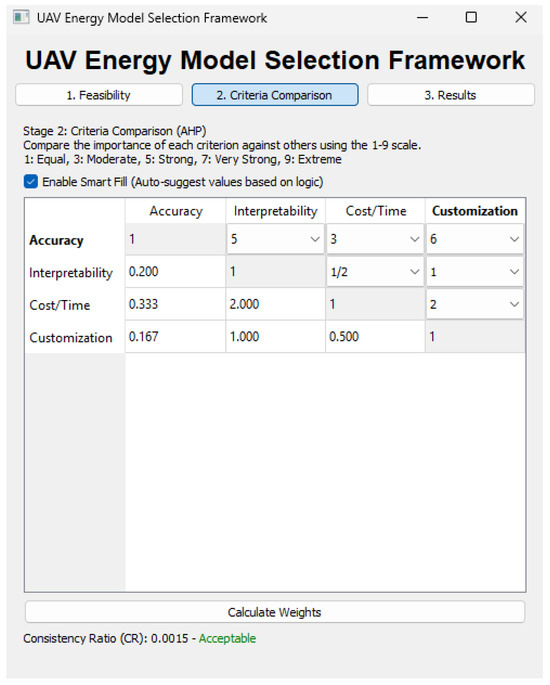
To explicitly capture mission-specific objectives, the end-user synthesizes a pairwise criteria comparison matrix governed by the fundamental axioms of reciprocity, homogeneity, and approximate logical transitivity:
The mission-specific criteria weight vector is extracted via the principal eigenvector solution:
Stability is verified identically using and , mandating .
4.6. Global Priority Aggregation and Final Ranking
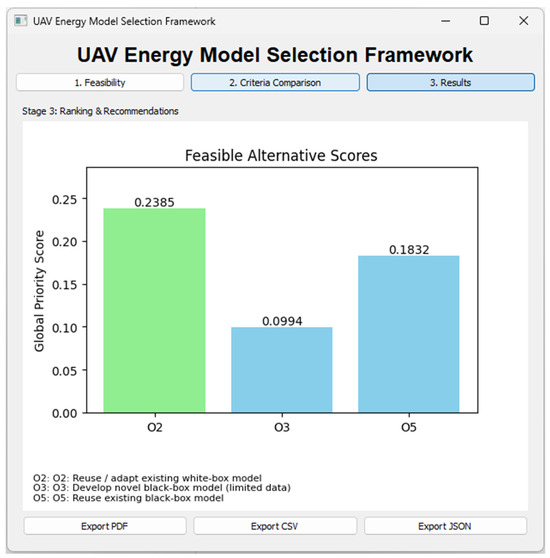
Following the extraction of the local alternative priority vectors () and the mission-specific criteria weight vector (w), the global priority score vector S is synthesized via linear weighted aggregation:
where represents the absolute mathematical hierarchy of the five modeling paradigms relative to the specific operational constraints.
4.7. Sensitivity Analysis of AHP Matrices
To address the inherent subjectivity of AHP weight assignments and demonstrate the mathematical robustness of the framework, a sensitivity analysis was conducted. This evaluates how variations in the contextual criteria weights (w) dynamically impact the final global priority score (S).
Establishing a baseline scenario of strictly equal criteria weighting (), the resulting priority vector is
Under these balanced conditions, deriving a novel physical model () is mathematically favored due to its aggregate dominance in accuracy, interpretability, and customization.
However, when operational constraints shift (such as in rapid prototyping environments where “Development Cost” () becomes the overwhelming priority) the framework’s structural responsiveness becomes evident. Perturbing the weight vector to heavily penalize resource expenditure () triggers a mathematical inversion of the global ranks:
In this restrictive scenario, the paradigm mathematically pivots away from physics-based models to (reuse of existing black-box model, ) and (Machine Learning, ). This confirms that analytical derivations () are correctly filtered out under strict time constraints. This sensitivity analysis demonstrates that the AHP stage is not statically biased toward any single modeling paradigm, but dynamically scales to reflect the explicit constraints encoded by the researcher.
4.8. Dynamic Interpretation and Fallback Flexibility
While the qualitative decision tree provides a binary, deterministic recommendation, the AHP-based quantitative framework fundamentally enhances operational resilience by generating a continuous, mathematically scored hierarchy. The final output is explicitly a function of both the hard infrastructural boundaries () and the weighted scientific objectives (w).
This evolution from a rigid flowchart to a scored mathematical continuum unlocks robust contingency planning. In highly dynamic UAV deployment scenarios, researchers frequently face abrupt logistical failures (such as corrupted telemetry payloads, sudden denial of testing facilities, or exhausted computational budgets). Utilizing the global priority vector (S), a mission planner is not forced into a complete methodological reset. Instead, they can seamlessly transition to the mathematically adjacent “next-best” feasible strategy (e.g., pivoting from to ). This ensures that inevitable real-world compromises remain quantitatively bounded and strategically optimal.
4.9. Quantitative Re-Validation of the Expanded Holdout Set ()
To empirically substantiate the mathematical robustness of the aggregation mechanics, an independent validation cycle was executed against the expanded 24-study holdout set. For each benchmark study s, the exact operational constraints and explicit textual objectives were processed through
- Stage 1 Boolean feasibility filtering;
- A systematically extracted criteria comparison matrix ;
- Eigenvector aggregation to compute the final model ranking .
This ensures that the final model recommendations are responsive to context-sensitive weighting rather than artifacts of static structural bias.
4.9.1. Systematic Criteria Elicitation Protocol
To preclude post hoc calibration, a deterministic elicitation mapping was utilized. Each study’s textual methodology was parsed for the core criteria (Accuracy, Interpretability, Cost, Adaptability) and assigned an ordinal emphasis score , where 1 denotes negligible relevance and 5 indicates a dominant objective.
These emphasis scores were algebraically converted into Saaty ratio intensities via absolute differences:
Reciprocity was strictly enforced, and criteria matrices were validated to ensure prior to eigenvector extraction.
4.9.2. Numerical Results for the 24 Holdout Studies
To explicitly visualize the interaction between the unconstrained continuous AHP scores and the discrete Boolean feasibility filters, Table 5 synthesizes the step-by-step quantitative re-validation across the entire expanded holdout set. This summary demonstrates how the framework systematically eliminates structurally infeasible options before mathematically identifying the modeling paradigm.
Table 5.
Summary of the Quantitative Re-Validation for the 24 Holdout Studies.
To ensure conciseness while maintaining rigorous mathematical traceability across all 24 validations, the specific operational contexts, elicited criteria weights, and resulting priority vectors are grouped below by their driving mathematical profiles. This categorization illustrates the framework’s capacity to adapt mathematically to highly heterogeneous engineering constraints.
- Mathematical Profile A: Standard Analytical Path Planning and Optimization
Applicable Studies: Cokyasar et al., Engin et al., Kwasiborska et al., Qin et al., Saeed et al., Wang et al., Wu et al., Yue, and Zhang et al.
Context: Multi-rotor logistics, delivery drone evaluations, coverage path planning, and communication swarm algorithms heavily rely on generalized analytical structures to guarantee mathematical convergence during optimization. Accuracy (4) and Interpretability (4) are primary, while development cost is moderate (2) and customization is secondary (3).
Eigenvector extraction yields () . Aggregation yields the unconstrained vector: . Feasibility Application: In standard mission planning environments, bespoke aerodynamic testing facilities () are absent, rendering computationally infeasible. An established generalized mathematical model exists for these mature UAVs (), isolating as the optimal solution. Final Selection: (Match).
- Mathematical Profile B: High-Fidelity Physics and Environmental Simulation
Applicable Studies: Gasche et al., Gu et al., and Tomar et al.
Context: High-fidelity simulations involving complex wind fields, Model Predictive Control (MPC) gradients, and PEMFC hybrid power systems mandate absolute precision (5) and structural interpretability (4). Minimal emphasis is placed on development cost (1).
Eigenvector extraction yields () . Unconstrained vector: . Feasibility Application: Lacking custom physical infrastructure () to derive new models (), the framework correctly identifies existing transferrable high-fidelity white-box models (). Final Selection: (Match).
- Mathematical Profile C: Metaheuristics and IoT Data Collection
Applicable Studies: Abdel-Basset et al., Elmanakhly et al., Lin et al., Na et al., Wang et al., and Zhang et al.
Context: Swarm-based metaheuristics (PSO, DE, GBO) designed for IoT data collection require computationally lightweight but explicitly verifiable mathematical gradients. Accuracy (4) and Interpretability (4) are essential, balanced against strict computational overhead limits (3).
Eigenvector extraction yields () . Unconstrained vector: . Feasibility Application: is blocked (). is structurally feasible () and aligns flawlessly with the metaheuristic algorithms’ fundamental demand for mathematical equations rather than black-box predictors. Final Selection: (Match).
- Mathematical Profile D: Large-Scale Machine Learning and DNNs
Applicable Studies: Al-Haddad et al., Cicek et al., Huang, and Kim et al.
Context: Machine Learning frameworks (DNN, RF, SVR) intentionally sacrifice causal interpretability (1 or 2) to maximize predictive accuracy over severe non-linear phenomena, such as battery degradation or extreme environmental disturbances (5), exploiting massive datasets to bypass traditional modeling limitations.
Unconstrained vector (): . Feasibility Application: Highly complex battery chemistry or urban topology invalidates standard analytical equations (). No precision wind tunnel is present (). However, the harvesting of vast empirical flight telemetry () explicitly activates the pathway, overriding the baseline analytical preference. Final Selection: (Match).
- Mathematical Profile E: Transparent Edge-Based Regression
Applicable Study: Suo et al.
Context: Edge-based object detection requires an energy evaluation system that operates with extremely low computational overhead (4) and maintains structural transparency (3). Unlike massive DNNs, it operates on constrained real-world flight sampling (3).
Unconstrained vector: . Feasibility Application: Generalized analytical models fail to capture dynamic edge-processing power draws (). The data collected is empirical but not massive enough for a deep learning architecture (). Consequently, and are eliminated by feasibility filters. The empirical regression pathway () survives as the sole viable solution. Final Selection: (Match).
- Mathematical Profile F: Bespoke Platform Analytical Derivation
Applicable Study: Xu et al.
Context: The custom aerodynamic interplay of a morphing solar airframe demands extreme physical fidelity (5) and bespoke parameter interpretability (5). Structural customization is absolutely critical (4).
Eigenvector extraction yields () . Unconstrained vector: . Feasibility Application: As a heavily bespoke platform, no transferrable literature models exist (). Because the researchers possessed and successfully operated high-precision aerodynamic infrastructure to map morphing drag (), remains logically feasible and captures the absolute mathematical priority. Final Selection: (Match).
4.9.3. Validation Conclusive Synthesis
Across all 24 benchmark validations, was strictly maintained. In every instance, the integration of non-compensatory Boolean constraints with the AHP-weighted continuous priority vector generated a top-ranked strategy that perfectly matched the actual engineering methodology deployed by the authors. Because the elicitation was deterministic and explicitly devoid of post hoc matrix tuning, this alignment comprehensively substantiates the operational validity and robust scalability of the proposed framework.
4.10. Algorithmic Implementation and Python Toolkit
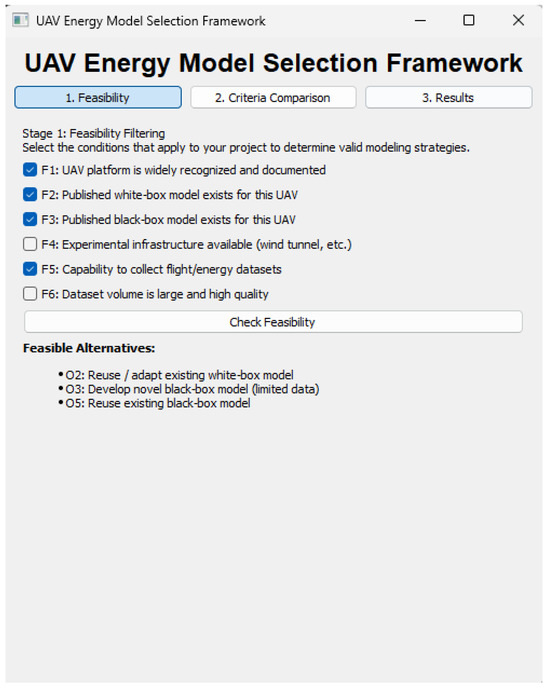
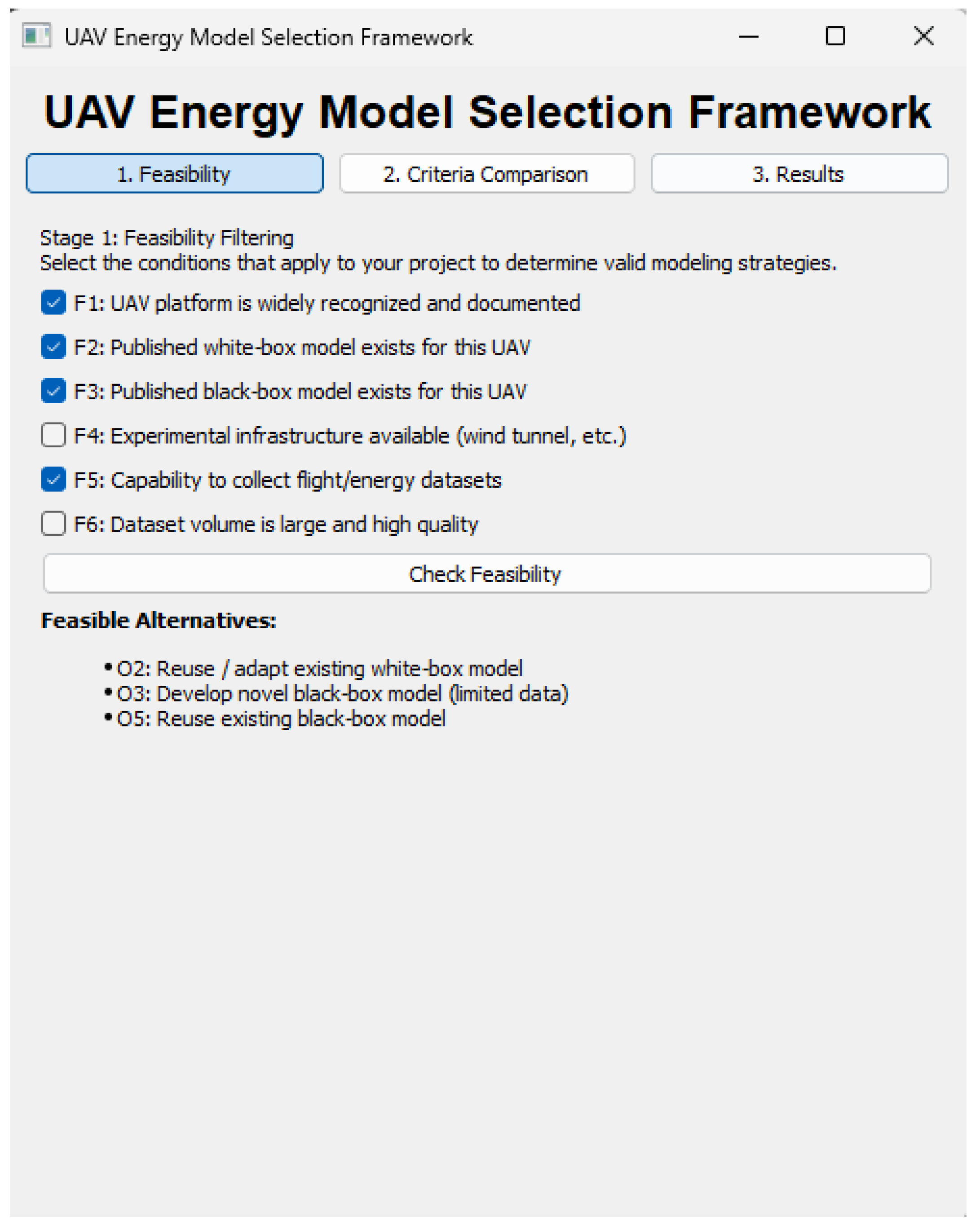
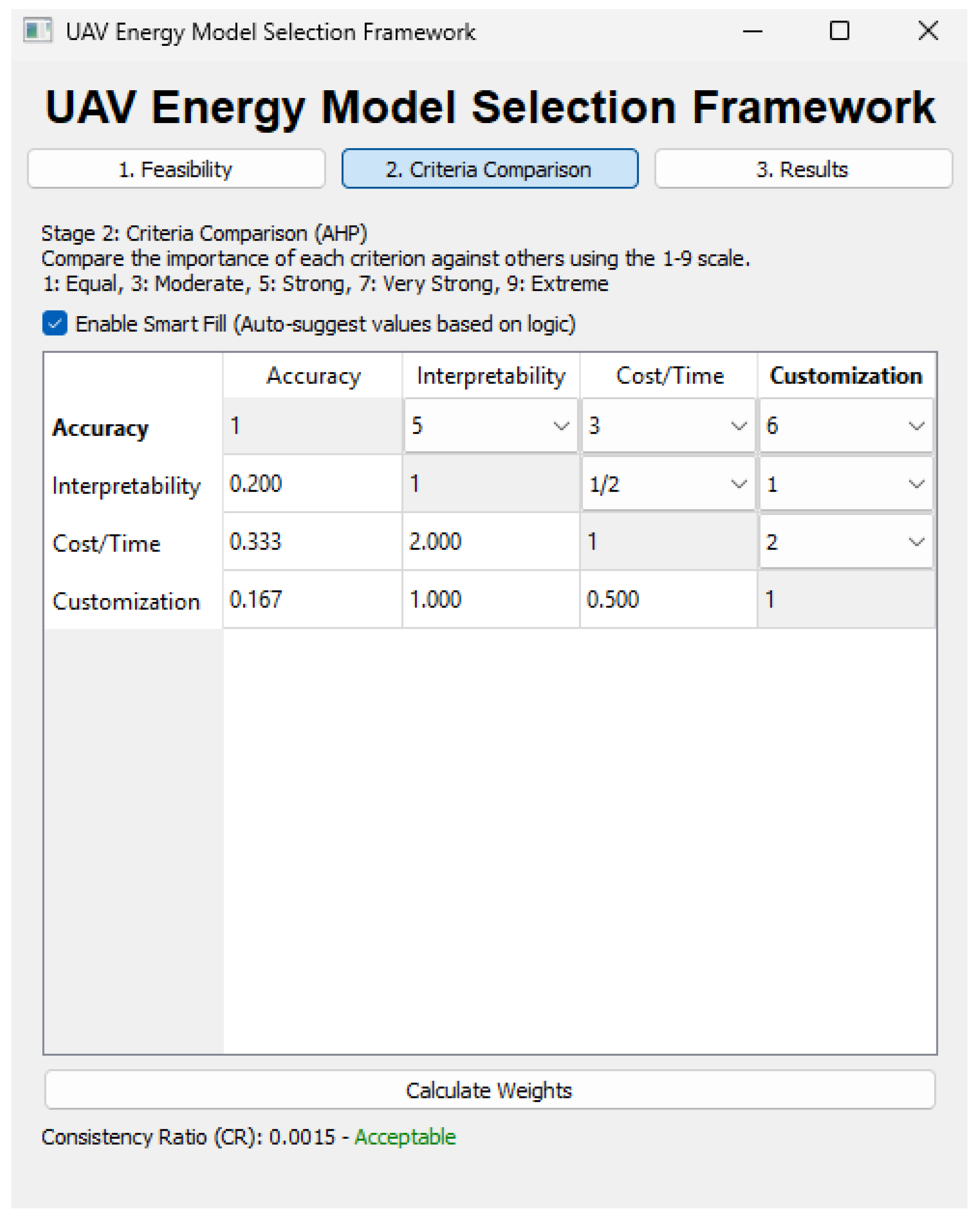
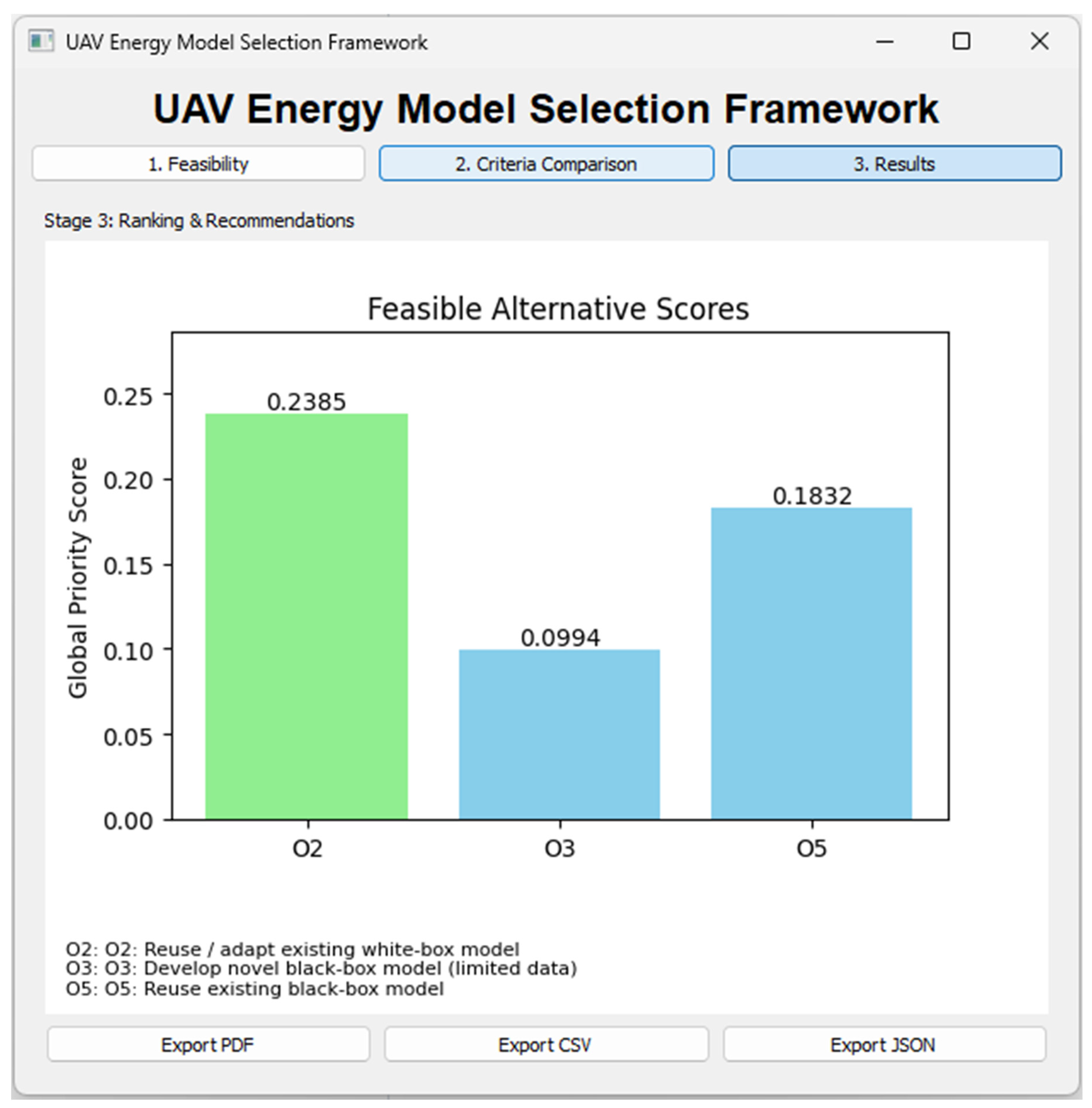
To facilitate widespread community adoption and operational deployment within UAV mission planning software, a custom Python-based Graphical User Interface (GUI) (illustrated in Figure 2, Figure 3 and Figure 4) seamlessly executing the AHP constraint and aggregation workflow is provided at https://github.com/Bayaola/UAV-Energy-Model-Selection.git (accessed on 7 March 2026).
Figure 2.
Python GUI operationalizing the framework: Boolean Feasibility Filtering.
Figure 3.
Python GUI operationalizing the framework: Analytical Hierarchy Criteria Synthesis.
Figure 4.
Python GUI operationalizing the framework: Final Global Priority Score Aggregation.
5. Discussion
5.1. Insights and Practical Implications for UAV Operations
The proposed two-stage decision framework significantly advances the methodological rigor of UAV energy research by replacing ad hoc model selection with a structured, replicable, and mathematically grounded protocol. The empirical evaluation of the qualitative decision tree (which achieved a high degree of consistency on the independent holdout set) demonstrates that the framework acts as a highly reliable, prescriptive guide for future autonomous systems research.
By explicitly mapping hard infrastructural constraints to specific data-driven or physics-based methodologies, the framework actively prevents the misallocation of research resources. Furthermore, the integration of the AHP quantitative scoring mechanism bridges the gap between binary operational constraints and nuanced project goals. For researchers deploying UAVs in edge computing or urban logistics, this operationalizes what we term “fallback flexibility.” In real-world experimental settings, unforeseen roadblocks (such as corrupted flight logs, sensor failures, or denied wind-tunnel access) can abruptly render a primary modeling choice impossible. By utilizing the global priority vector (), researchers can seamlessly pivot to the “next-best” numerically scored alternative, assured that the compromise to their original research priorities is mathematically minimized.
Illustrative applications that directly benefit from this optimized selection pipe-line include
- Urban Logistics and BVLOS Navigation: Path planning in complex, wind-disturbed urban corridors requires high-fidelity, interpretable energy projections to guarantee safe return-to-base trajectories [26,66]. The framework effectively guides these projects toward reusing or developing robust white-box models that integrate real-time weather covariates.
- Mobile Edge Computing and AI Orchestration: In UAV-assisted cellular networks, fluctuating computational payloads severely impact energy draw. Where complex non-linear dynamics exist and flight datasets are vast, the framework accurately routes researchers toward hybrid or deep-learning black-box approaches capable of rapid inference [52,67].
5.2. Addressing Partial Resource Constraints and Continuous Conditions
A valid methodological consideration regarding the proposed Stage 1 feasibility filtering is its foundational reliance on strict binary indicators (). In operational engineering environments, resource availability is rarely absolute and often exists on a continuous spectrum. For instance, a research team might possess access to an aerodynamic testing facility, but only for a highly restricted timeframe, or they might harvest flight telemetry that is voluminous but corrupted by significant sensor noise, making the classification of (high volumetric density and fidelity) mathematically ambiguous.
To address these “partial” resource constraints, the framework currently leverages the continuous mathematical nature of the Stage 2 AHP evaluation to absorb and quantify Stage 1 ambiguities. If a resource is only partially available, the researcher can conditionally pass the Boolean gate (e.g., setting for limited wind tunnel access) but subsequently penalize the associated criteria in the AHP matrix (). By dynamically reducing the emphasis on “Predictive Accuracy” () or heavily weighting “Development Cost” () to reflect the poor quality of the facility, the global priority score () for a novel white-box derivation is mathematically depressed. This mechanism allows the framework to smoothly downgrade the recommendation of a resource-intensive model without relying solely on a hard binary rejection.
Furthermore, the continuous ranking vector () serves as an active mitigation strategy against partial data failures. If a team attempts to utilize a “partial” dataset for deep learning () and finds it statistically insufficient during the training phase, the framework’s fallback flexibility provides the immediate, next-best mathematical alternative (e.g., , standard regression) without requiring a complete methodological restart.
5.3. Limitations and Future Research Directions
5.3.1. Current Framework Limitations
While the integration of AHP mitigates the rigidity of binary filters, the framework still exhibits limitations inherent to aerospace modeling. Although continuous conditions can be penalized in Stage 2, the fundamental architecture of Stage 1 still forces a preliminary binary classification of resources. Additionally, the structural AHP matrices evaluate the intrinsic characteristics of the models under steady-state assumptions, largely omitting the integration of highly transient environmental covariates (such as unpredictable micro-bursts, turbulent wakes, or extreme temperature variances) which heavily impact real-world rotor efficiency. Finally, the rapid evolution of UAV architectures (such as hybrid VTOLs, morphing wings, and solar-assisted airframes [28]) requires that the definitions distinguishing “industry-standard” from “custom” platforms be continuously calibrated to maintain the framework’s prescriptive accuracy.
It is critical to note that this framework has been validated retrospectively against literature choices, not prospectively against downstream experimental performance. Future work must validate whether models selected via this framework explicitly yield superior trajectory optimization or battery conservation in physical flight tests compared to ad hoc selections.
5.3.2. Future Research Directions
To formally resolve the challenge of partial constraints discussed in Section 5.2, future research will focus on the integration of Fuzzy Decision Trees and Fuzzy AHP (FAHP). Transitioning from strict Boolean logic () to fuzzy membership functions () will allow the framework to natively compute degrees of data fidelity and infrastructural access without requiring manual AHP penalty adjustments.
Additionally, the decision tree must be expanded to formally define pathways for emerging hybrid modeling paradigms. Most notably, Physics-Informed Neural Networks (PINNs) represent a frontier that merges the physical transparency of white-box differential equations with the environmental adaptability and speed of data-driven black-box approaches. Incorporating PINNs as a distinct, scored terminal node will ensure the framework remains aligned with the cutting edge of UAV research.
5.3.3. Recommendations for Implementation
Widespread adoption of this framework within the drone community relies heavily on the accessibility of standardized UAV performance data. We strongly encourage researchers to utilize open-source computational tools, such as the Python GUI provided alongside this study, to standardize methodological reporting in future publications. Furthermore, the establishment of centralized, open-access repositories for UAV flight logs and aerodynamic thrust coefficients will directly elevate the feasibility of high-accuracy modeling across institutions facing strict infrastructure limitations.
6. Conclusions and Future Works
This study addresses the ongoing challenge of selecting appropriate energy consumption models for Unmanned Aerial Vehicles (UAVs) under varying operational and infrastructural constraints. Through a systematic analysis of recent literature, we observed that the choice between physics-based (white-box) and data-driven (black-box) paradigms is primarily guided by physical access to testing facilities, telemetry data volume, and algorithmic accuracy requirements.
To formalize this implicit decision-making process, we proposed a two-stage methodology. The first stage consists of a qualitative decision tree inductively derived from a corpus of 23 recent studies. This framework was subsequently evaluated against an independent set of 24 holdout studies, demonstrating a high degree of consistency between the framework’s structured pathways and the methodologies actually deployed by researchers. The second stage applies the Analytic Hierarchy Process (AHP) to evaluate these pathways, allowing feasible alternatives to be quantitatively ranked based on context-specific priorities such as physical interpretability, predictive accuracy, and development cost.
By standardizing the model selection workflow and introducing the concept of numerical “fallback flexibility,” this research aims to reduce methodological ambiguity and assist researchers in allocating computational and experimental resources more effectively. Supported by an open-source Python toolkit, the framework provides the UAV research community with a structured method for contingency planning when primary experimental conditions change.
It is important to acknowledge a key limitation of this work: the proposed framework has been validated retrospectively against methodological choices reported in the literature, rather than prospectively against downstream experimental performance. As such, while the framework reliably reproduces existing decision patterns, it does not yet establish that its recommended models lead to superior operational outcomes.
Future work will therefore focus on prospective validation, specifically assessing whether models selected through this framework yield measurable improvements in trajectory optimization and battery conservation during real-world flight experiments compared to ad hoc selection strategies. Additionally, future iterations will explore the integration of Fuzzy AHP to better accommodate partial resource constraints and expand the decision tree to include physics-informed hybrid modeling strategies, further supporting reproducible research in energy-aware UAV operations.
Author Contributions
Conceptualization, I.K.B. and J.L.E.K.F.; methodology, I.K.B. and J.L.E.K.F.; software, I.K.B.; validation, I.K.B., J.L.E.K.F., B.O.Y., M.A. and C.I.O.; formal analysis, I.K.B., J.L.E.K.F., M.A. and C.I.O.; writing—original draft preparation, I.K.B. and J.L.E.K.F.; writing—review and editing, B.O.Y., M.A. and C.I.O.; supervision, J.L.E.K.F., B.O.Y.; funding acquisition, M.A., and C.I.O. All authors have read and agreed to the published version of the manuscript.
Funding
This research received no external funding.
Institutional Review Board Statement
Not applicable.
Informed Consent Statement
Not applicable.
Data Availability Statement
The source code of the framework is available at the following link: https://github.com/Bayaola/UAV-Energy-Model-Selection.git (accessed on 7 March 2026).
Acknowledgments
During the preparation of this manuscript, the authors used GPT-5.2 to improve the readability. The authors have reviewed and edited the output and take full responsibility for the content of this publication.
Conflicts of Interest
The authors declare no conflicts of interest.
References
- Qi, Y.; Jiang, H.; Huang, G.; Yang, L.; Wang, F.; Xu, Y. Multi-UAV Path Planning Considering Multiple Energy Consumptions via an Improved Bee Foraging Learning Particle Swarm Optimization Algorithm. Sci. Rep. 2025, 15, 14755. [Google Scholar] [CrossRef] [Scilit]
- Fendji, J.L.E.K.; Bayaola, I.K.; Thron, C.; Fendji, M.D.; Förster, A. Cost-Effective Placement of Recharging Stations in Drone Path Planning for Surveillance Missions on Large Farms. Symmetry 2020, 12, 1661. [Google Scholar] [CrossRef] [Scilit]
- Fendji Kedieng Ebongue, J.L.; Bayaola Kolaïgué, I.; Thron, C.; Förster, A. Charging Stations Placement in Drone Path Planning for Large Space Surveillance. In Proceedings of the CARI 2020—Colloque Africain Sur La Recherche En Informatique et En Mathématiques Apliquées, Thies, Senegal, 14–17 October 2020. [Google Scholar]
- Cabuk, U.C.; Tosun, M.; Dagdeviren, O.; Ozturk, Y. Modeling Energy Consumption of Small Drones for Swarm Missions. IEEE Trans. Intell. Transp. Syst. 2024, 25, 10176–10189. [Google Scholar] [CrossRef] [Scilit]
- Velusamy, P.; Rajendran, S.; Mahendran, R.K.; Naseer, S.; Shafiq, M.; Choi, J.G. Unmanned Aerial Vehicles (UAV) in Precision Agriculture: Applications and Challenges. Energies 2022, 15, 217. [Google Scholar] [CrossRef] [Scilit]
- Gong, H.; Huang, B.; Jia, B.; Dai, H. Modeling Power Consumptions for Multirotor UAVs. IEEE Trans. Aerosp. Electron. Syst. 2023, 59, 7409–7422. [Google Scholar] [CrossRef] [Scilit]
- Tseng, C.M.; Chau, C.K. Personalized Prediction of Vehicle Energy Consumption Based on Participatory Sensing. IEEE Trans. Intell. Transp. Syst. 2017, 18, 3103–3113. [Google Scholar] [CrossRef] [Scilit]
- Zhang, B.; Song, Z.; Zhao, F.; Liu, C. Overview of Propulsion Systems for Unmanned Aerial Vehicles. Energies 2022, 15, 455. [Google Scholar] [CrossRef] [Scilit]
- Sharma, P.; Singh, S.; Tayal, V. An Overview of Classification, Requirements, Path Planning Algorithms and Improvement Areas of Unmanned Aerial Vehicle. Int. J. Comput. Appl. 2018, 180, 19–24. [Google Scholar] [CrossRef] [Scilit]
- Thibbotuwawa, A.; Bocewicz, G.; Nielsen, P.; Banaszak, Z. Unmanned Aerial Vehicle Routing Problems: A Literature Review. Appl. Sci. 2020, 10, 4504. [Google Scholar] [CrossRef] [Scilit]
- Zhu, Y.; Yang, B.; Liu, M.; Li, Z. UAV Trajectory Optimization for Large-Scale and Low-Power Data Collection: An Attention-Reinforced Learning Scheme. IEEE Trans. Wirel. Commun. 2024, 23, 3009–3024. [Google Scholar] [CrossRef] [Scilit]
- Wang, S.; Qin, X.; Xu, W.; Zhang, Z.; Li, H.; Nan, M. Aerodynamic-aware Energy Saving for Fixed-wing UAV under Data Collection Requirements. In 2021 IEEE International Conference on Communications Workshops (ICC Workshops); IEEE: New York, NY, USA, 2021. [Google Scholar] [CrossRef] [Scilit]
- Thibbotuwawa, A.; Nielsen, P.; Zbigniew, B.; Bocewicz, G. Energy Consumption in Unmanned Aerial Vehicles: A Review of Energy Consumption Models and Their Relation to the UAV Routing. In Proceedings of the Information Systems Architecture and Technology: Proceedings of 39th International Conference on Information Systems Architecture and Technology—ISAT 2018; Świątek, J., Borzemski, L., Wilimowska, Z., Eds.; Springer: Cham, Switzerland, 2019; pp. 173–184. [Google Scholar] [CrossRef] [Scilit]
- Wang, Y.; Shan, M.; Wang, D. Motion Capability Analysis for Multiple Fixed-Wing UAV Formations with Speed and Heading Rate Constraints. IEEE Trans. Control Netw. Syst. 2020, 7, 977–989. [Google Scholar] [CrossRef] [Scilit]
- Zhao, T.; Li, W. Design Configuration and Technical Application of Rotary-Wing Unmanned Aerial Vehicles. Mechatron. Intell. Transp. Syst. 2022, 1, 69–85. [Google Scholar] [CrossRef] [Scilit]
- Zhang, J.; An, Y.; Cao, J.; Ouyang, S.; Wang, L. UAV Trajectory Planning for Complex Open Storage Environments Based on an Improved RRT Algorithm. IEEE Access 2023, 11, 23189–23204. [Google Scholar] [CrossRef] [Scilit]
- Beigi, P.; Rajabi, M.S.; Aghakhani, S. An Overview of Drone Energy Consumption Factors and Models. In Handbook of Smart Energy Systems; Fathi, M., Zio, E., Pardalos, P.M., Eds.; Springer International Publishing: Cham, Switzerland, 2021; pp. 1–20. [Google Scholar] [CrossRef] [Scilit]
- Gao, N.; Zeng, Y.; Wang, J.; Wu, D.; Zhang, C.; Song, Q.; Qian, J.; Jin, S. Energy Model for UAV Communications: Experimental Validation and Model Generalization. China Commun. 2021, 18, 253–264. [Google Scholar] [CrossRef] [Scilit]
- Abeywickrama, H.V.; Jayawickrama, B.A.; He, Y.; Dutkiewicz, E. Empirical Power Consumption Model for UAVs. In Proceedings of the 2018 IEEE 88th Vehicular Technology Conference (VTC-Fall), Chicago, IL, USA, 27–30 August 2018; pp. 1–5. [Google Scholar] [CrossRef] [Scilit]
- Hendrarini, N.; Sani, M.I. Unmanned Aerial Vehicle (UAV) Predictive Control Energy Management Model. In Proceedings of the 2024 7th International Conference on Software Engineering and Information Management, Suva, Fiji, 23–25 January 2024; ICSIM ’24; Association for Computing Machinery: New York, NY, USA, 2024; pp. 147–152. [Google Scholar] [CrossRef] [Scilit]
- Thibbotuwawa, A.; Nielsen, P.; Zbigniew, B.; Bocewicz, G. Factors Affecting Energy Consumption of Unmanned Aerial Vehicles: An Analysis of How Energy Consumption Changes in Relation to UAV Routing. In Proceedings of the Information Systems Architecture and Technology: Proceedings of 39th International Conference on Information Systems Architecture and Technology—ISAT 2018; Świątek, J., Borzemski, L., Wilimowska, Z., Eds.; Springer: Cham, Switzerland, 2019; pp. 228–238. [Google Scholar] [CrossRef] [Scilit]
- Xie, J.; Fu, Q.; Jia, R.; Lin, F.; Li, M.; Zheng, Z. Optimal Energy and Delay Tradeoff in UAV-Enabled Wireless Sensor Networks. Drones 2023, 7, 368. [Google Scholar] [CrossRef] [Scilit]
- Hwang, M.h.; Cha, H.R.; Jung, S.Y. Practical Endurance Estimation for Minimizing Energy Consumption of Multirotor Unmanned Aerial Vehicles. Energies 2018, 11, 2221. [Google Scholar] [CrossRef] [Scilit]
- Tseng, C.M.; Chau, C.K.; Elbassioni, K.; Khonji, M. Flight Tour Planning with Recharging Optimization for Battery-operated Autonomous Drones. arXiv 2017, arXiv:1703.10049. [Google Scholar] [CrossRef] [Scilit]
- Sallouha, H.; Azari, M.M.; Pollin, S. Energy-Constrained UAV Trajectory Design for Ground Node Localization. arXiv 2018, arXiv:1806.02055. [Google Scholar] [CrossRef] [Scilit]
- Gu, R.; Zhao, Y.; Ren, X. Integrating Wind Field Analysis in UAV Path Planning: Enhancing Safety and Energy Efficiency for Urban Logistics. Chin. J. Aeronaut. 2026, 39, 103605. [Google Scholar] [CrossRef] [Scilit]
- Tomar, V.K.; Bhogilla, S.S.; Singh, U.R.; Kuo, J.K. Design and Performance Assessment of PEMFC-battery Hybrid Energy Systems for UAVs: A Multi-Criteria Methodology. Next Energy 2026, 11, 100526. [Google Scholar] [CrossRef] [Scilit]
- Xu, T.; Meng, W.; Zhang, J. Energy Optimal Trajectory Planning for the Morphing Solar-Powered Unmanned Aerial Vehicle Based on Hierarchical Reinforcement Learning. Drones 2025, 9, 498. [Google Scholar] [CrossRef] [Scilit]
- Wu, K.; Lan, J.; Lu, S.; Wu, C.; Liu, B.; Lu, Z. Integrative Path Planning for Multi-Rotor Logistics UAVs Considering UAV Dynamics, Energy Efficiency, and Obstacle Avoidance. Drones 2025, 9, 93. [Google Scholar] [CrossRef] [Scilit]
- Gasche, S.; Kallies, C.; Himmel, A.; Findeisen, R. Energy Aware and Safe Path Planning for Unmanned Aircraft Systems. arXiv 2025, arXiv:2504.03271. [Google Scholar] [CrossRef] [Scilit]
- Elmanakhly, D.A.; Othman, A.A.; Mohamed, R.; Abdel-Basset, M. Robust Metaheuristic Algorithms with Sequential Replacement-Improved Dynamic Population for Optimizing Energy Consumption in a UAV-empowered IoT Data Collection System. J. Big Data 2025, 12, 269. [Google Scholar] [CrossRef] [Scilit]
- Qin, C.; Narayanan, A.; Pournaras, E. Coordinated Multi-Drone Last-mile Delivery: Learning Strategies for Energy-aware and Timely Operations. arXiv 2025, arXiv:2509.15830. [Google Scholar] [CrossRef] [Scilit]
- Zhuo, Z.; Dong, S.; Zheng, H.; Zhang, Y. Method of Minimizing Energy Consumption for RIS Assisted UAV Mobile Edge Computing System. IEEE Access 2024, 12, 39678–39688. [Google Scholar] [CrossRef] [Scilit]
- Liu, H.; Chen, R.; Yan, X.; Zhang, J.; Nian, Y. Research on Cooperative Arrival and Energy Consumption Optimization Strategies of UAV Formations. Drones 2024, 8, 722. [Google Scholar] [CrossRef] [Scilit]
- Abdel-Basset, M.; Mohamed, R.; Alrashdi, I.; Sallam, K.M.; Hameed, I.A. Evolution-Based Energy-Efficient Data Collection System for UAV-supported IoT: Differential Evolution with Population Size Optimization Mechanism. Expert Syst. Appl. 2024, 245, 123082. [Google Scholar] [CrossRef] [Scilit]
- Engin, S.; Çınar, H.; Kandemir, İ. A Rule-Based Energy Management Technique Considering Altitude Energy for a Mini UAV with a Hybrid Power System Consisting of Battery and Solar Cell. Energies 2024, 17, 4056. [Google Scholar] [CrossRef] [Scilit]
- Lin, L.; Wang, Z.; Tian, L.; Wu, J.; Wu, W. A PSO-based Energy-Efficient Data Collection Optimization Algorithm for UAV Mission Planning. PLoS ONE 2024, 19, e0297066. [Google Scholar] [CrossRef] [Scilit] [PubMed]
- Wang, L.; Zhuang, X.; Zhang, W.; Cheng, J.; Zhang, T. Coverage Path Planning for UAVs: An Energy-Efficient Method in Convex and Non-Convex Mixed Regions. Drones 2024, 8, 776. [Google Scholar] [CrossRef] [Scilit]
- Yue, K. Application of EEUC-based Inter Aircraft Ultraviolet Communication Network Algorithm in Energy Consumption Optimization of Drone Swarm. Energy Inform. 2024, 7, 27. [Google Scholar] [CrossRef] [Scilit]
- Zhang, X.; Chang, Z.; Hämäläinen, T.; Min, G. AoI-Energy Tradeoff for Data Collection in UAV-Assisted Wireless Networks. IEEE Trans. Commun. 2024, 72, 1849–1861. [Google Scholar] [CrossRef] [Scilit]
- Cokyasar, T.; Stinson, M.; Sahin, O.; Prabhakar, N.; Karbowski, D. Comparing Regional Energy Consumption for Direct Drone and Truck Deliveries. Transp. Res. Rec. 2023, 2677, 310–327. [Google Scholar] [CrossRef] [Scilit]
- Kwasiborska, A.; Stelmach, A.; Jabłońska, I. Quantitative and Comparative Analysis of Energy Consumption in Urban Logistics Using Unmanned Aerial Vehicles and Selected Means of Transport. Energies 2023, 16, 6467. [Google Scholar] [CrossRef] [Scilit]
- Saeed, R.A.; Ali, E.S.; Abdelhaq, M.; Alsaqour, R.; Ahmed, F.R.A.; Saad, A.M.E. Energy Efficient Path Planning Scheme for Unmanned Aerial Vehicle Using Hybrid Generic Algorithm-Based Q-Learning Optimization. IEEE Access 2024, 12, 13400–13417. [Google Scholar] [CrossRef] [Scilit]
- Wang, H.; Li, P.; Xiao, H.; Zhou, X.; Lei, R. Intelligent Energy Management for Solar-Powered Unmanned Aerial Vehicle Using Multi-Objective Genetic Algorithm. Energy Convers. Manag. 2023, 280, 116805. [Google Scholar] [CrossRef] [Scilit]
- Zhang, Y.; Huang, C.; Huang, H. Backtracking Search Algorithm with Dynamic Population for Energy Consumption Problem of a UAV-assisted IoT Data Collection System. Eng. Appl. Artif. Intell. 2023, 123, 106331. [Google Scholar] [CrossRef] [Scilit]
- Umair, M.; Joung, J.; Cho, Y. Transmission Power and Altitude Design for Energy-Efficient Mission Completion of Small-Size Unmanned Aerial Vehicle. Electron. Lett. 2020, 56, 1219–1222. [Google Scholar] [CrossRef] [Scilit]
- Zeng, Y.; Xu, J.; Zhang, R. Energy Minimization for Wireless Communication with Rotary-Wing UAV. arXiv 2018, arXiv:1804.02238. [Google Scholar] [CrossRef] [Scilit]
- Paredes, J.A.; Saito, C.; Abarca, M.; Cuellar, F. Study of Effects of High-Altitude Environments on Multicopter and Fixed-Wing UAVs’ Energy Consumption and Flight Time. In Proceedings of the 2017 13th IEEE Conference on Automation Science and Engineering (CASE), Xi’an, China, 20–23 August 2017; pp. 1645–1650. [Google Scholar] [CrossRef] [Scilit]
- Mozaffari, M.; Saad, W.; Bennis, M.; Debbah, M. Mobile Unmanned Aerial Vehicles (UAVs) for Energy-Efficient Internet of Things Communications. IEEE Trans. Wirel. Commun. 2017, 16, 7574–7589. [Google Scholar] [CrossRef] [Scilit]
- Yacef, N.; Bouhali, O.; Hamerlain, M. Optimization of Energy Consumption for Quadrotor UAV. In Proceedings of the International Micro Air Vehicle Conference and Flight Competition (IMAV), Toulouse, France, 8–22 September 2017. [Google Scholar]
- Zorbas, D.; Razafindralambo, T.; Luigi, D.P.P.; Guerriero, F. Energy Efficient Mobile Target Tracking Using Flying Drones. Procedia Comput. Sci. 2013, 19, 80–87. [Google Scholar] [CrossRef] [Scilit]
- Kim, M.; Kim, M.; Chen, Y.; Kim, J.; Baek, D. Hybrid DNN-Based Flight Power Estimation Framework for Unmanned Aerial Vehicles. Drones 2025, 9, 104. [Google Scholar] [CrossRef] [Scilit]
- Huang, J. Machine Learning-Based Drone Route Planning and Energy Consumption Optimization. In Proceedings of the International Conference on Mechatronics and Artificial Intelligence (MAI 2025); SPIE: Bellingham, WA, USA, 2025; Volume 13795, pp. 486–495. [Google Scholar] [CrossRef] [Scilit]
- Akram, N.; Khoshrangbaf, M.; Challenger, M.; Dagdeviren, O. Energy Consumption Modeling and Flight Time Analysis of Micro Drones. IEEE Access 2025, 13, 109854–109866. [Google Scholar] [CrossRef] [Scilit]
- Cicek, D.; Simsek, M.; Kantarci, B. Machine Learning-Driven Truck–Drone Collaborative Delivery for Time- and Energy-Efficient Last-Mile Deliveries. Electronics 2025, 14, 2026. [Google Scholar] [CrossRef] [Scilit]
- Al-Haddad, L.A.; Łukaszewicz, A.; Majdi, H.S.; Holovatyy, A.; Jaber, A.A.; Al-Karkhi, M.I.; Giernacki, W. Energy Consumption and Efficiency Degradation Predictive Analysis in Unmanned Aerial Vehicle Batteries Using Deep Neural Networks. Adv. Sci. Technol. Res. J. 2025, 19, 21–30. [Google Scholar] [CrossRef] [Scilit]
- Suo, J.; Zhang, X.; Shi, W.; Zhou, W. E3-UAV: An Edge-Based Energy-Efficient Object Detection System for Unmanned Aerial Vehicles. IEEE Internet Things J. 2024, 11, 4398–4413. [Google Scholar] [CrossRef] [Scilit]
- Na, Y.; Li, Y.; Chen, D.; Yao, Y.; Li, T.; Liu, H.; Wang, K. Optimal Energy Consumption Path Planning for Unmanned Aerial Vehicles Based on Improved Particle Swarm Optimization. Sustainability 2023, 15, 12101. [Google Scholar] [CrossRef] [Scilit]
- Alyassi, R.; Khonji, M.; Karapetyan, A.; Chau, S.C.K.; Elbassioni, K.; Tseng, C.M. Autonomous Recharging and Flight Mission Planning for Battery-Operated Autonomous Drones. IEEE Trans. Autom. Sci. Eng. 2023, 20, 1034–1046. [Google Scholar] [CrossRef] [Scilit]
- Góra, K.; Smyczyński, P.; Kujawiński, M.; Granosik, G. Machine Learning in Creating Energy Consumption Model for UAV. Energies 2022, 15, 6810. [Google Scholar] [CrossRef] [Scilit]
- Prasetia, A.S.; Wai, R.J.; Wen, Y.L.; Wang, Y.K. Mission-Based Energy Consumption Prediction of Multirotor UAV. IEEE Access 2019, 7, 33055–33063. [Google Scholar] [CrossRef] [Scilit]
- Abeywickrama, H.V.; Jayawickrama, B.A.; He, Y.; Dutkiewicz, E. Comprehensive Energy Consumption Model for Unmanned Aerial Vehicles, Based on Empirical Studies of Battery Performance. IEEE Access 2018, 6, 58383–58394. [Google Scholar] [CrossRef] [Scilit]
- Di Franco, C.; Buttazzo, G. Energy-Aware Coverage Path Planning of UAVs. In Proceedings of the 2015 IEEE International Conference on Autonomous Robot Systems and Competitions, Vila Real, Portugal, 8–10 April 2015; pp. 111–117. [Google Scholar] [CrossRef] [Scilit]
- Saaty, R.W. The Analytic Hierarchy Process—What It Is and How It Is Used. Math. Model. 1987, 9, 161–176. [Google Scholar] [CrossRef] [Scilit]
- Vargas, L.G. An Overview of the Analytic Hierarchy Process and Its Applications. Eur. J. Oper. Res. 1990, 48, 2–8. [Google Scholar] [CrossRef] [Scilit]
- Shen, Y.; Wei, C. Target Tracking and Enclosing via UAV/UGV Cooperation Using Energy Estimation Pigeon-Inspired Optimization and Switchable Topology. Aircr. Eng. Aerosp. Technol. 2022, 95, 768–783. [Google Scholar] [CrossRef] [Scilit]
- Deng, C.; Fang, X.; Wang, X. UAV-Enabled Mobile-Edge Computing for AI Applications: Joint Model Decision, Resource Allocation, and Trajectory Optimization. IEEE Internet Things J. 2023, 10, 5662–5675. [Google Scholar] [CrossRef] [Scilit]

Disclaimer/Publisher’s Note: The statements, opinions and data contained in all publications are solely those of the individual author(s) and contributor(s) and not of MDPI and/or the editor(s). MDPI and/or the editor(s) disclaim responsibility for any injury to people or property resulting from any ideas, methods, instructions or products referred to in the content. |
© 2026 by the authors. Licensee MDPI, Basel, Switzerland. This article is an open access article distributed under the terms and conditions of the Creative Commons Attribution (CC BY) license.