


Highlights
What are the main findings?
- A gain-adaptive fault-tolerant controller is developed to compensate for actuator faults and model uncertainties in high-speed UAV formation.
- A cascaded event-triggered mechanism reduces update frequency for both control commands and adaptive laws, alleviating communication and computation loads.
What are the implications of the main findings?
- The integrated framework enhances robustness and resource efficiency, enabling reliable UAV formation control under real-world constraints.
- The approach reduces onboard burden and actuator wear, providing a foundation for extending to complex heterogeneous multi-agent systems.
Abstract
This paper presents a robust adaptive fault-tolerant control (FTC) strategy for the path-following maneuvering of a high-speed unmanned aerial vehicle (UAV) formation system. The designation integrates an actuator gain-adaptive mechanism which is capable of compensating partial loss of effectiveness and bias faults, with a cascaded event-triggered mechanism (ETM) that regulates both control-command updates and adaptation loops. To handle strong coupling and modeling uncertainties in the UAV dynamics, unknown nonlinear terms are approximated using a fuzzy logic system (FLS), and dynamic surface control (DSC) is employed to avoid differential explosion. A boundary-regulated intermediate control term further enhances robustness against time-varying gains. The cascaded ETM reduces communication and computation by enforcing update thresholds on control inputs and parameter-update signals. Lyapunov analysis establishes semi-global uniform ultimate boundedness of all closed-loop signals. Comparative simulations indicate improved tracking accuracy and reduced channel load relative to representative baselines.
1. Introduction
In recent decades, UAVs have seen rapid deployment across agriculture, civil engineering, inspection, and defense [1,2,3,4]. A demanding and fast-developing topic is the coordinated control of high-speed multi-UAV formations, in which vehicles must track prescribed paths while maintaining formation geometry under aggressive maneuvers. High-speed flight amplifies nonlinear dynamics and coupling, and raises vulnerability to actuator faults, which challenges both accuracy and robustness [5,6,7]. Within the engineering practice, the fault-tolerant performance of the control module and the transmission efficiency of multi-port signals in a UAV system are key technical items for solving these problems, and they have broad prospects for development.
Intelligent UAV manipulation systems rely on an integrated architecture for control [8,9,10,11,12,13,14]. The FTC, which uses adaptive methods to compensate for actuator faults like effectiveness loss and bias [15,16], is crucial for safety. However, under fast time-varying conditions, the adaptive mechanisms can react too slowly, compromising tracking performance and even threatening stability during high-speed operations [17]. This limitation can potentially lead to the performance degradation or instability, highlighting the necessity for the development of more responsive fault-tolerant schemes.
High-frequency updates of control commands create several distinct bottlenecks. These include increased onboard computational burdens, accelerated mechanical actuator wear, and the potential introduction of chattering [18,19,20,21]. When control and adaptive parameters are refreshed at every sampling instant, the actuation channel operates at high duty cycles, which increases mechanical wear, thermal stress, and energy consumption, and may introduce chattering [22,23]. Onboard computation is also taxed by the continuous evaluation of adaptive laws, fuzzy logic approximators, and dynamic filters, especially under high-speed flight conditions, where short sampling periods are required [24,25]. Event-triggered control, realized through an ETM, has therefore been adopted so that updates are issued only when a triggering condition is met [26,27,28]; however, most existing studies trigger only the control commands, while parameter-adaptation and approximation-boundary updates remain continuously active.
Moreover, the interaction between aggressive fault tolerance and resource-efficient communication is particularly acute for the high-speed UAV formation. The system must be robust enough to handle the faults and disturbances without resorting to the conservative control strategy that compromises agility, while simultaneously being parsimonious in its usage of communication and computation. Existing studies have failed to effectively integrate these critical aspects, thereby creating a gap in addressing the dual requirements of high performance and efficiency in high-speed flight applications. To bridge this gap, an integrated framework is proposed in which the gain-adaptive FTC is cohesively combined with the cascade ETM that is synergistically applied to both control and adaptation channels. In addition, while recent finite-horizon FTC approaches and nonlinear disturbance observers have shown efficacy in handling actuator degradation, they typically operate under continuous communication assumptions. The cascade ETM proposed specifically targets the reduction in communication burden in multi-UAV formations without compromising the transient response to faults.
Building upon prior studies [29,30,31,32] and the aforementioned challenges, this paper introduces a fault-tolerant control strategy for a high-speed UAV formation system. The main innovations defining the contributions of these research efforts are presented as follows:
- A gain-adaptive fault-tolerant control algorithm is developed in which a boundary-regulated intermediate control term works with nonlinear approximation and dynamic filtering to provide online compensation for concurrent actuator faults and model uncertainties, enabling precise following for high-speed multi-UAV formations.
- A cascaded ETM is constructed for multi-port resource management; event triggering is applied to both control commands and adaptive laws, which reduces update frequency and alleviates channel and computation burdens without sacrificing performance.
2. Problem Formulation and Preliminaries
This article adopts the following notational conventions. For a scalar quantity, denotes its absolute value, while for a vector, signifies its Euclidean norm. The estimated value of a variable is marked by a hat, as in , and its corresponding estimation error, defined as , is denoted by a tilde. The operator constructs a diagonal matrix from a given vector, and an overline, , is used to represent the upper bound of a quantity.
2.1. Nonlinear Model for the UAV
In this section, combining dynamic physical property, the mathematical model is introduced in (1).
where and express the one-dimensional and two-dimensional state information, along with 6-DOF in direction. The target platform considered in this study is a quadrotor UAV configured in a standard ‘X’ arrangement, with four rotors symmetrically distributed around the center of mass. means the additional mass transformation matrix, with m and d indicating the mass and diagonal diameter and denoting the rotary inertia of the UAV. describes the geometric transformation matrix, with , , , . describing the actuator gain, and T standing for rotor control input, presented as
where are the rotor speeds of four rotors. expresses the nonlinear term of the control system. represents the external environment disturbance.
To facilitate subsequent planning and control design, the following useful assumptions are introduced.
Assumption 1.
The fluctuations of interferences in the studied environment are bounded. That is, the external environmental disturbance term can be considered as a bounded variable, which satisfies .
Assumption 2.
While this study focuses primarily on the dynamic tracking performance and communication efficiency during maneuvers, it is acknowledged that energy consumption remains a critical constraint for long-endurance missions. The proposed framework is therefore best suited to time-critical high-speed operations, where maneuver accuracy and fault tolerance take precedence over energy-optimal planning.
2.2. Virtual Guidance Planning
The guidance principle proposed in this section is operated by the virtual aircraft (VA), which can generate the reference path guiding the navigation of the UAV. Similarly, the same holds true for the virtual formation architecture. The guidance principle is operated by a VA, which generates the reference path for the UAV. In a formation context, multiple virtual aircraft are deployed. These virtual followers are guided by a designated leader virtual aircraft, which manages the overall path planning and formation geometry. The 4-DOF kinematic model for the leader VA in the horizontal plane is designed as
where ; , , and are the surge, sway velocity, and yaw angular velocity. denotes the azimuth angle of VA relative to the UAV, which can be calculated by
where and stand for the position errors between the UAV and VA. Furthermore, the desired roll angle and pitch angle can be obtained as (6) by nonlinear decoupling for the azimuth angle and geometric transformation formula.
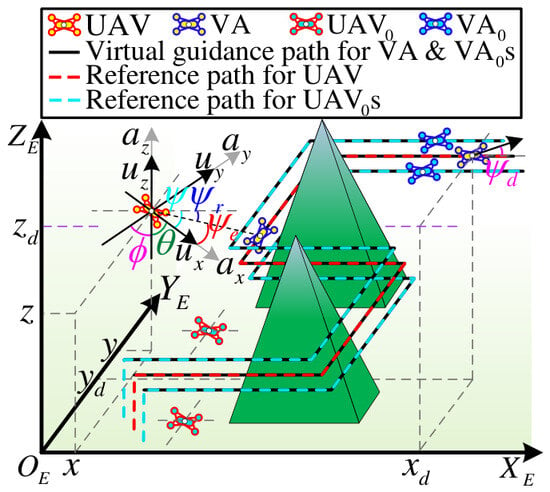
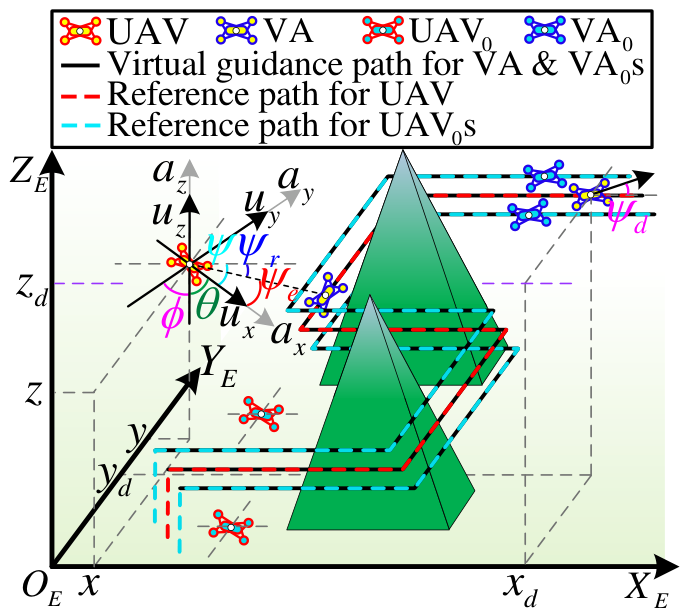
Therefore, the reference signals of the guidance system are derived as . Figure 1 presents the three-dimensional visualization concept information of the UAV formation architecture and guidance system.
Figure 1.
Integrated concept information of the state and guidance.
2.3. Fault Model for Control System of the UAV
In the UAV control system, actuator asymmetry and partial loss of effectiveness are common. Rather than treating these effects as mere disturbances, we chose to embed resilience at the design stage via FTC. The cornerstone is an explicit actuator-fault parametrization. Furthermore, the degradation of actuator is modeled with a multiplicative fault ratio applied to its commanded input of under-captured or over-driven, and the ratio parameter is used in estimation and control reallocation. The fault ratio is formally defined as
where expresses the fault ratio parameter and , ; , represents the bias fault parameter and .
From (7), the faulty system can be summarized into three situations. Firstly, when and , the system shows a partial failure phenomenon, indicating a partial loss of effectiveness of the control order. Secondly, when and , there is biased value noise in the faulty system, and the additional compensation control thresholds are needed to stabilize it. Finally, when and , the system exhibits a partial deviation fault. At this point, it is rational to design an adaptive control gain to enhance the robustness of the actuator system.
2.4. Event-Triggered Mechanism
Continuous high-frequency control updates risk accumulating computational burden and accelerating actuator wear, especially when triggered by insignificant state fluctuations. To counter this, an ETM is employed. Its core principle is sparsification: by monitoring the information that depends on the triggering condition, and enforcing a update threshold, the ETM transforms persistent high-rate commands into intermittent, step-form updates. This mechanism filters out negligible fluctuations and restricts actuation to necessary instances, thereby reducing computational overhead, curtailing unnecessary actuator activity, and extending service life while preserving closed-loop stability and performance.
Due to the diversity of control signal ports, a cascade ETM can be introduced to apply above signal processing principle to multiple control modules. Considering the simplicity of design expression, the triggered control signal can be initially replaced by variable for description. is defined as
The trigger condition moment is designed as
where stands for the threshold parameter defined in . Based on the trigger rule (9), the response state exhibited by the control signals can be expressed as when , satisfying and , and when , satisfying and , where denotes the boundary parameter.
Therefore, according to the above analysis, the relationship between actual input and trigger order can be obtained as
In this article, this trigger mode is applied to the proposed control inputs and subsequent designed adaptive laws.
3. Control Design and Stability Analysis
3.1. Fault-Tolerant Controller and Adaptive Law
An adaptive fault-tolerant control algorithm is indicated in this section. Combining the motion state model and reference signals of the UAV, the state errors needing to be stabilized by the control system are defined as
where describes the virtual control law. Take the derivatives of the state errors as
To stabilize the one-dimensional error , one can design a virtual control law as
where expresses the virtual control parameter, which is a positive definite matrix.
To avoid the complexity explosion problem caused by the derivative of virtual control laws, a first-order filter is introduced based on the DSC technology to perform order reduction processing. Thus, the filter and its error are defined as
where represents the time constant, and . The derivative of filter error is given as
where means the bias value of the filter and .
Remark 1.
To mitigate the potential instability in internal model control caused by uncertain nonlinearities, one can employ FLS theory. This method harnesses adaptive parameter approximation to manage the aforementioned uncertainties. Consequently, the signal defuzzification function [33] is formulated as follows:
in this formulation, ; and denote the membership functions. The corresponding fuzzy basis function is then designed as
Then, we define
Therefore, the approximation function is obtained as
Theorem 1.
For any continuous function defined on a compact set with , there exists an arbitrarily small positive constant ε, such that the following inequality holds:
The optimal parameter vector is defined as
Using the aforementioned formulation, the nonlinear terms are approximated by
where and denote the fuzzy approximation gain and fuzzy basis function and describes the fuzzy approximation error. To summarize, the FLS is adopted for the following reasons: (i) the structure of FLS, with its fuzzy rule base and membership functions, allows for a straightforward incorporation of linguistic prior knowledge about the UAV dynamics; (ii) the linearly parameterized form of the FLS output facilitates a seamless integration into the Lyapunov-based adaptive backstepping design, yielding simple and computationally efficient adaptive laws for the weight parameters; (iii) compared to ESO, which typically requires high-gain tuning that may amplify measurement noise, the FLS-based adaptive approximation provides a smoother compensation signal.
Substituting the control input (7), nonlinear term (22), and derivative of the virtual control law (14) (15) into (12) yields
Furthermore, the fault term can be expressed as
To address the adverse effects of unstable control gain existing in the actuator system, an intermediate control item is introduced to perform robust boundary-adaptive processing on it. Then, the relevant equivalent transformation expression can be calculated as
where indicates the transition parameter, and stands for the fault-tolerant control input.
Similarly to the stabilization approach used for , it is necessary to design a controller and adaptive laws for two-dimensional state errors. Hence, one yields
with
where is the positive definite control parameter matrix, and , , , and are the positive definite design constant matrix.
Remark 2.
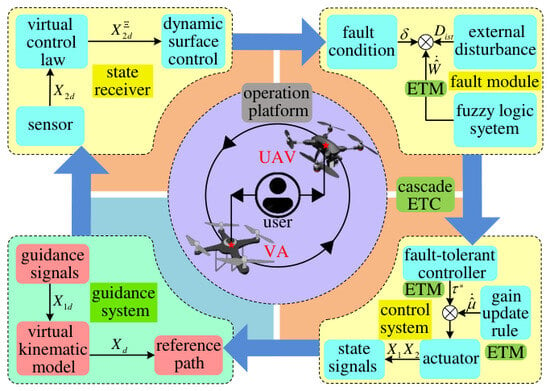
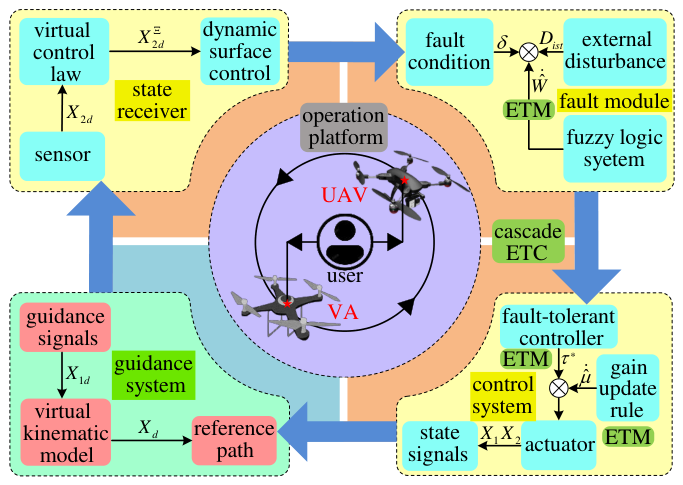
This section develops a Lyapunov-based backstepping control framework for UAV dynamics, structured around three coordinated components: the fault-tolerant controller, adaptive fuzzy approximator, and online actuator gain update rule. The framework is designed to explicitly address key performance challenges such as actuator failures, external disturbances, and residual approximation errors, thereby ensuring stable and robust tracking under system uncertainties. Parameter selection plays a critical role in balancing robustness and computational efficiency. Appropriately tuned control and adaptation gains enhance the practical effectiveness of the fault-tolerant strategy, while reducing unnecessary updates and simplifying the overall controller structure. The relevant control process is shown in Figure 2.
Figure 2.
Control process for the core architecture of UAV operation.
3.2. Stability Analysis
As stated by the above fault-tolerant control algorithm design, the Lyapunov theory is utilized to conduct stability analysis for the relevant control variables, and their convergence within closed-loop control system is proved. Thus, the Lyapunov function is designed as
where .
Differentiating (29), one can obtain
Substituting the designed virtual control law (13), the actual control input, the adaptive laws for the FLS weights, and the fault parameters (27) into the derivative of the Lyapunov function (30) yields
These can be simplified and organized (31) to obtain
According to Young’s inequality, the following inequalities are useful for the stability analysis:
where denotes the positive definite constant matrix.
Hence, the inequality of the time derivative for the Lyapunov function can be rewritten as
where ; .
Theorem 2.
On account of the conducted theoretical derivation, the time integral for (35) can be expressed as . Finally, one can deduce that, when the control parameters are designed reasonably and , the Lyapunov function can ensure convergence to an arbitrarily small value . Given the previous analysis for Remark 2 and the above verification, the error variables within the closed-loop control system are concluded as the features of semi-global uniform ultimate bounded (SGUUB). In addition, to exclude Zeno behavior, it is shown that both the control input and adaptive parameter channels guarantee a strictly positive lower bound on inter-event times. This follows from the boundedness of the relevant signal derivatives and the triggering threshold, ensuring that an infinite number of triggers cannot occur in finite time.
Remark 3.
The ultimate bound in the Lyapunov analysis depends on the initial conditions, which is characteristic of SGUUB stability and reflects the practical reality that transient performance and steady-state accuracy are influenced by the quality of initial parameter estimates.
4. Numerical Examples
This section presents the numerical simulations of path-following for a UAV formation system, conducted within the MATLAB platform. Comparative experiments on tracking error are included to further validate the effectiveness and superiority of the proposed control scheme.
4.1. Path-Following for the High-Speed UAVs
In this subsection, a path-following simulation example is carried out with external disturbances and internal system uncertainties, based on the relevant reference information and control parameters. In detail, the corresponding initial guidance signals of the leader VA are presented as , . The reference yaw angular velocity is designed as
Moreover, the initial state signals for the leader UAV are described as , , , . The designed parameters for the control system are summarized in Table 1.
Table 1.
Corresponding control parameters.
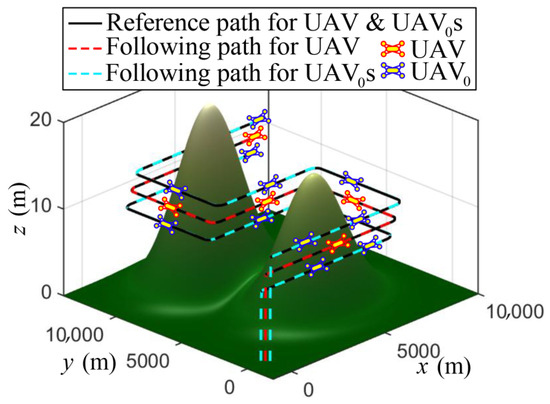
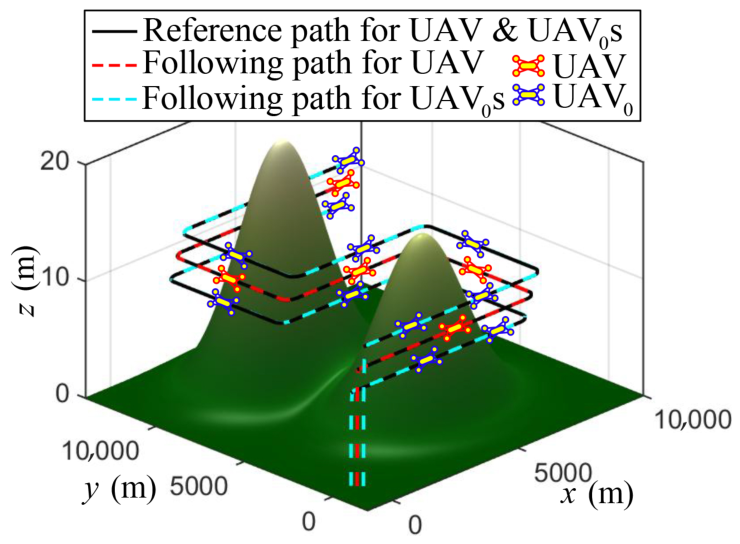
Figure 3, Figure 4, Figure 5, Figure 6, Figure 7, Figure 8 and Figure 9 indicate the simulation results of the proposed algorithm. Figure 3 exhibits the simulated path-following trajectories of a multi-UAV formation flying at high-speed around a virtual obstacle potential field. It can be observed that, even in the presence of strong model coupling and the characteristics of actuator fault during high-speed flight, the proposed algorithm ensures that all UAV trajectories stably and effectively converge to the predefined reference paths, thanks to its optimization and adaptive compensation mechanism.
Figure 3.
Trajectories of path-following for the UAVs.
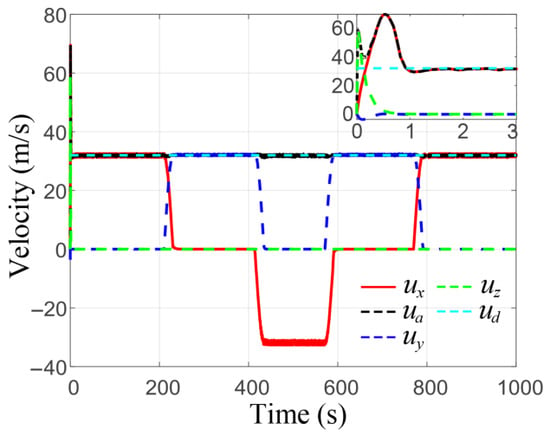
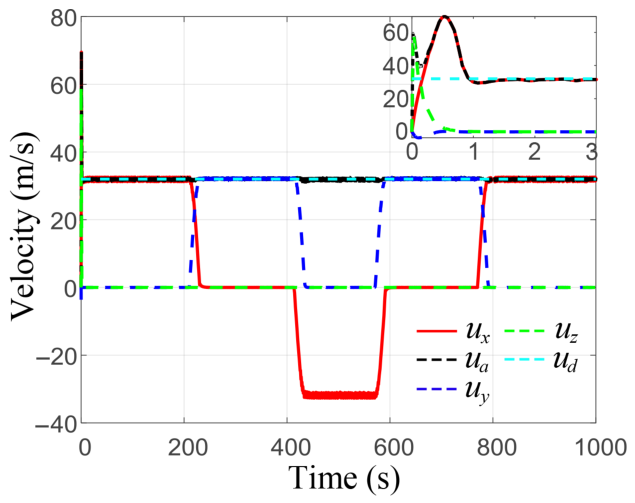
Figure 4.
Flight speed and desired surge velocity for the UAVs.
Figure 5.
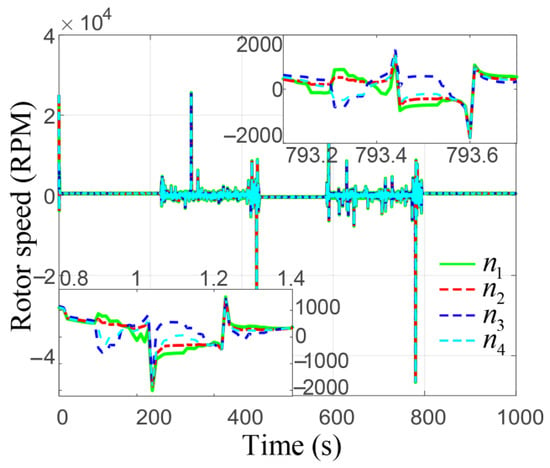
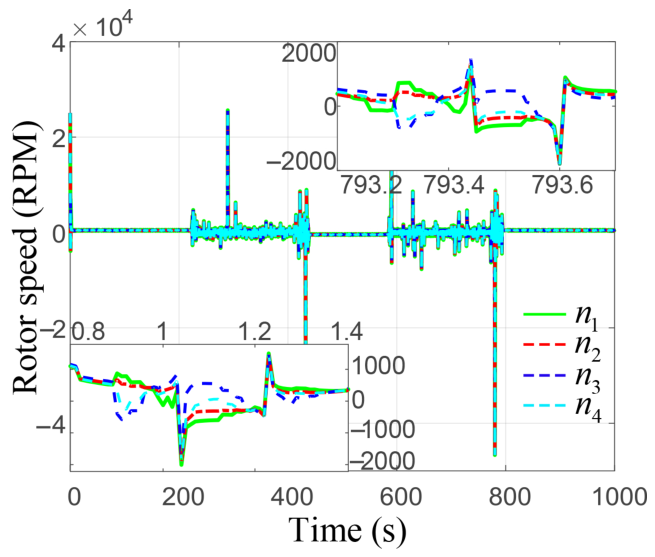
Rotor speeds for the UAV with the proposed algorithm.
Figure 6.
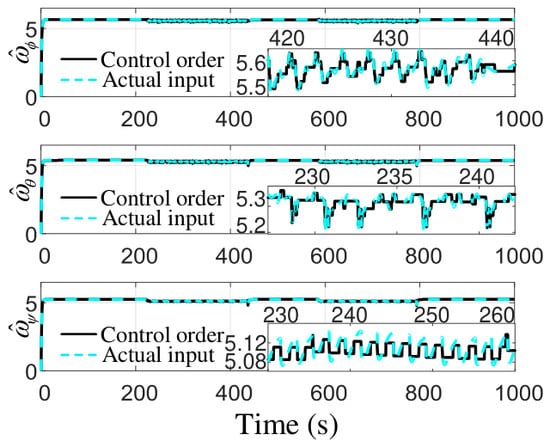
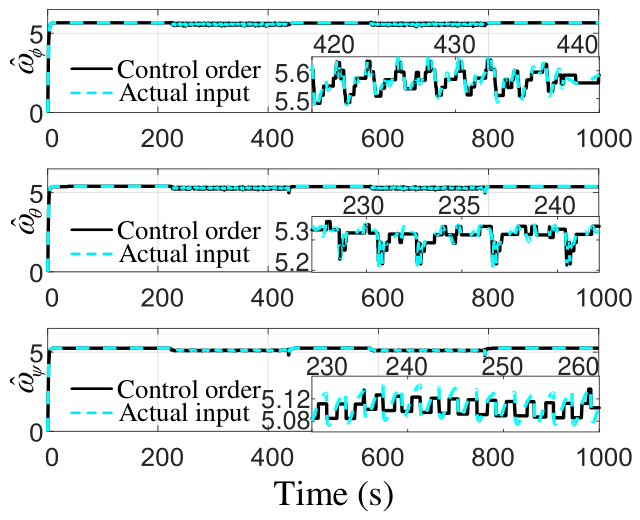
Fuzzy approximation adaptive laws within the position loop of UAV.
Figure 7.
Fuzzy approximation adaptive laws within the attitude loop of UAV.
Figure 8.
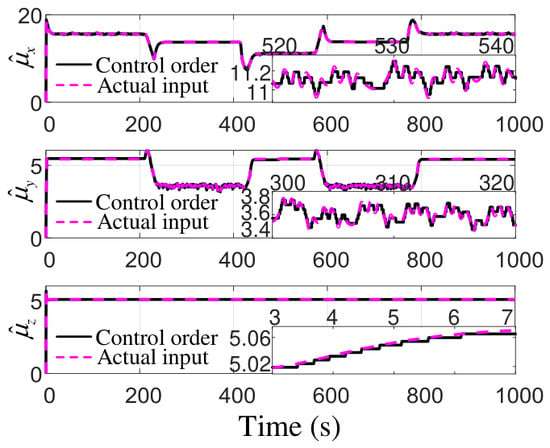
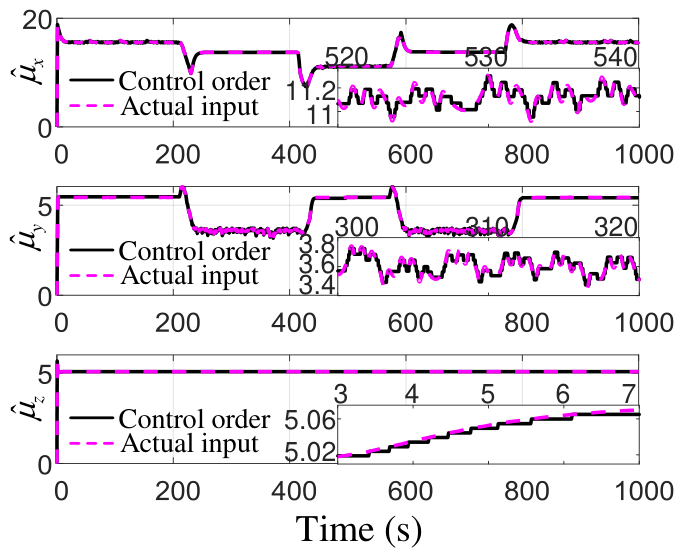
Gain-adaptive laws within the position loop of UAV.
Figure 9.
Gain-adaptive laws within the attitude loop of UAV.
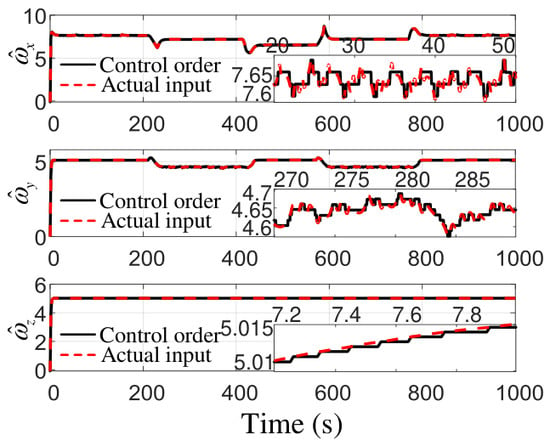
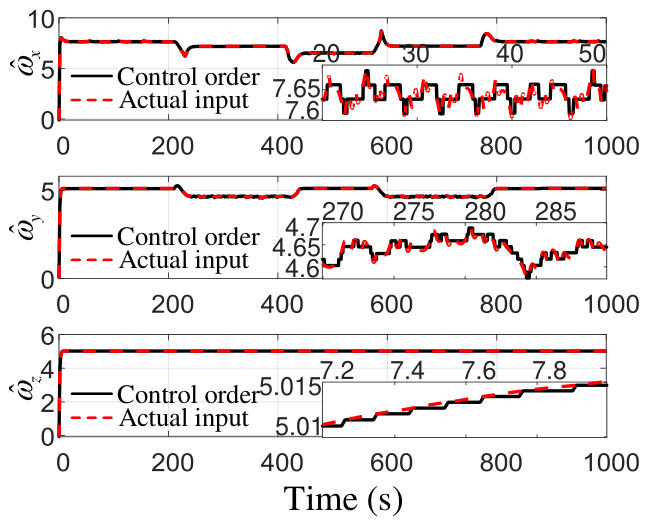
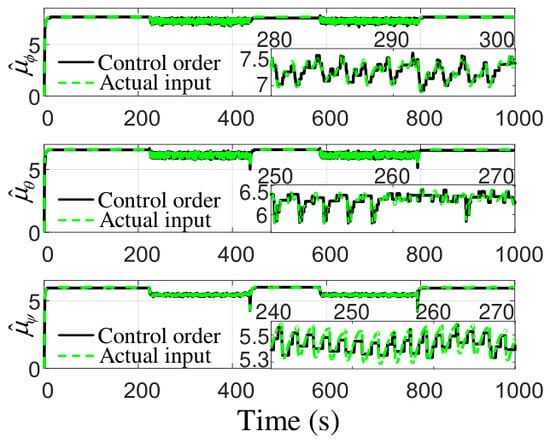
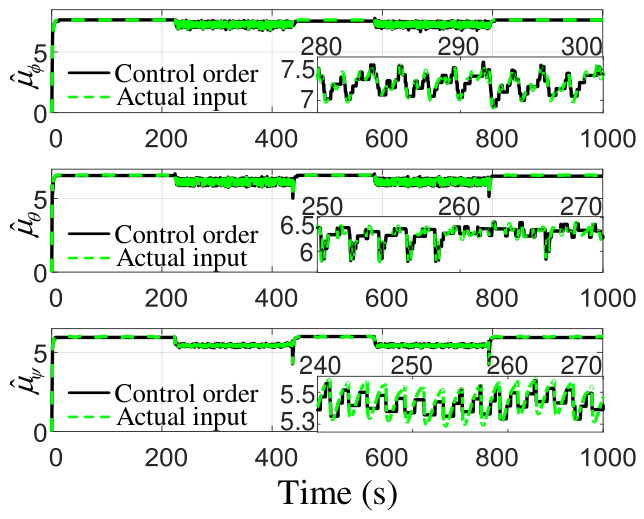
Figure 4 presents the tracking performance of the leader UAV’s velocity along its body axes and its resultant speed against the desired surge velocity during path following. As shown in the figure, the actual velocities precisely follow the commanded values. The smooth and regular variation in these velocities during maneuvers validates the strong robustness of the proposed algorithm for the high-speed UAV control system. Additionally, under the corrective action of the fault-tolerant controller, the rotor speeds of the main actuators are regulated, with their fluctuations remaining confined to a reasonable range in Figure 5. As can be seen in Figure 6, Figure 7, Figure 8 and Figure 9, the fuzzy approximation adaptive laws and gain-adaptive laws with the control orders and actual inputs are represented, generated by cascade event-triggered mechanism. It is evident that the post-trigger step control signals, compared to the pre-trigger continuous signals, reduce the reception frequency of amplitude variations in the transmitted signal, thereby effectively mitigating channel load and resource occupancy.
The performance of the proposed controller is characterized by high tracking accuracy, with steady-state position and attitude errors converging to negligibly small bounds that satisfy the precision requirements for high-speed formation flight. Furthermore, the controller maintains bounded tracking errors even under composite time-varying external disturbances, demonstrating robust disturbance rejection capability.
Remark 4.
The simulation scenario validates the core contribution under representative condition, including time-varying actuator faults, composite external disturbances emulating wind gusts and sensor noise, and communication constraints addressed by the dual-channel event-triggered mechanism. Nevertheless, extended validation involving abrupt fault transients, extreme wind profiles, and communication delays would further strengthen practical relevance, and these are identified as topics of focus for future work.
4.2. Comparative Simulation
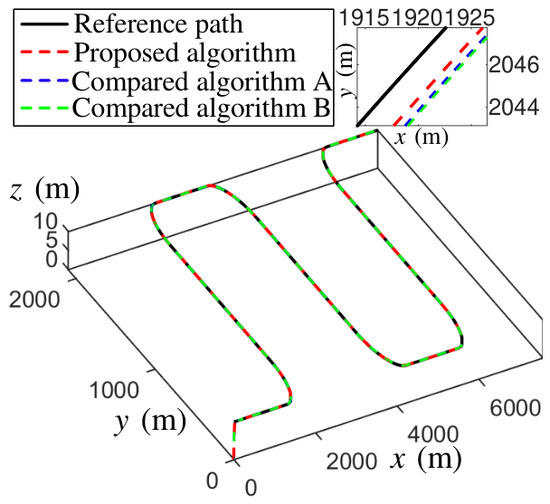
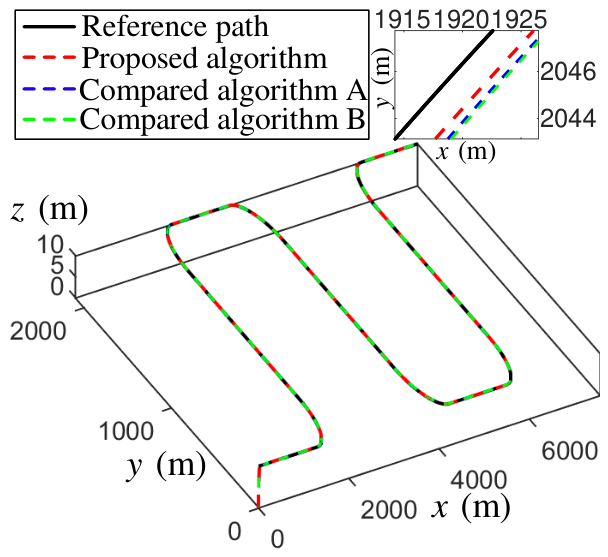
To further demonstrate the superiority of the proposed algorithm, a comparative experiment of rectangular path-following was conducted using a single UAV controlled by three distinct algorithms: the proposed algorithm, a comparative algorithm (A) employing radial basis neural network control [34], and another comparative algorithm (B) based on distributed control [35].
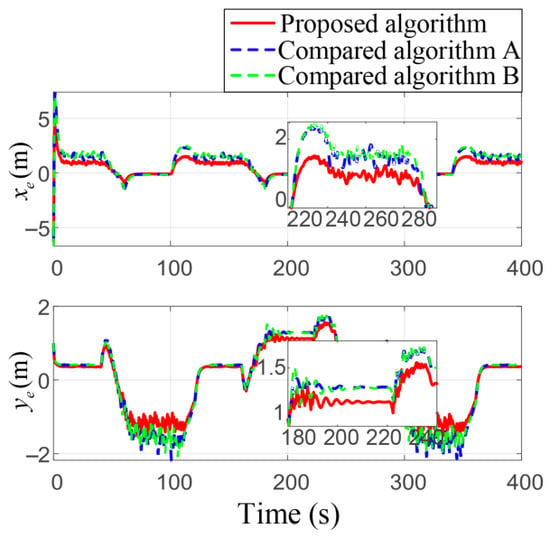
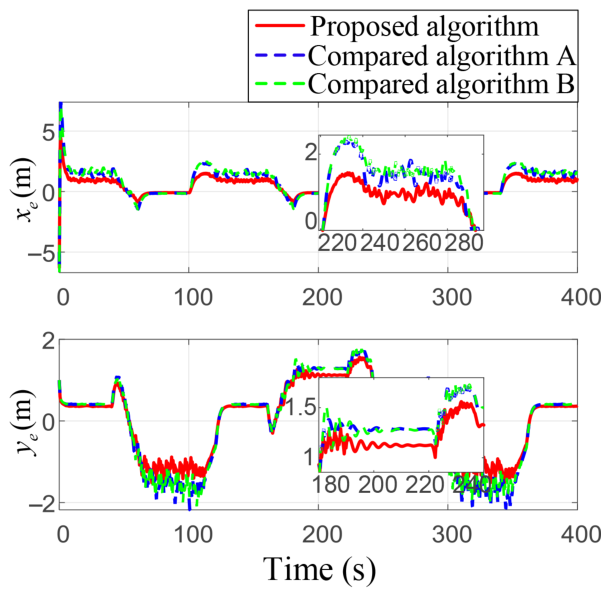
Figure 10 and Figure 11 present the comparative results of their tracking performance and control error accuracy, respectively. As shown in Figure 10, the proposed algorithm exhibits superior convergence and a more accurate trajectory compared to another algorithms, closely adhering to the reference path. Furthermore, the tracking error comparison in Figure 11 provides compelling supplementary evidence. The proposed method confines the tracking errors within a significantly smaller bound than the others, thereby satisfying the exceptional precision and robustness control requirements for high speed UAV formation. It is worth noting that the external disturbance term injected during these simulations was configured as a composite time-varying signal with both low-frequency drift and high-frequency noise components, thereby simulating the bounded effects of moderate atmospheric turbulence and wind gusts. The convergence of tracking errors observed in Figure 11 thus substantiates the controller’s inherent robustness to such bounded environmental perturbations without requiring an explicit stochastic wind model.
Figure 10.
Comparison of the following trajectories with three algorithms.
Figure 11.
Comparison of the tracking errors with three algorithms.
5. Conclusions
This paper has solved the path-following control problem for the high-speed UAV formation under actuator fault and resource constraint. The core contributions are a gain-adaptive fault-tolerant controller that dynamically compensates for faults and uncertainties, and a cascade event-triggered mechanism that reduces resource consumption by triggering both control orders and adaptation update signals. Theoretical and experimental results demonstrate the closed-loop system’s stability and superior performance. As the present study is confined to numerical simulations due to platform limitations, forthcoming efforts will concentrate on experimental verification and the adaptation of the control law to heterogeneous UAV teams.
Author Contributions
H.Z.: Conceptualization, software, validation, writing—review, editing. G.Z.: Methodology, software, formal analysis, writing—original draft, project administration, funding acquisition. H.X.: Validation, formal analysis, writing—review, editing. J.L.: Project administration, funding acquisition, writing—review, editing. All authors have read and agreed to the published version of the manuscript.
Funding
This research was funded by the National Excellent Youth Science Fund of China (52322111), the National Natural Science Foundation of China (52571329, 52501375), the Scientific Research Innovation Capability Support Project for Young Faculty (SRICSPYF-BS2025121), the Youth Talent Support Program of Liaoning Province (XLYC2203129), the National Key Laboratory of Unmanned Aerial Vehicle Technology (WRFX-202509), the China Postdoctoral Science Foundation (2025M771628), the Postdoctoral Fellowship Program of CPSF (GZC20251126), the Natural Science Foundation of Liaoning Province (2025-BS-0209), and the Research Project on Undergraduate Teaching Reform in Regular Higher Education of Liaoning Province (20256YBXM1359).
Data Availability Statement
The original contributions presented in this study are included in the article. Further inquiries can be directed to the corresponding author.
Acknowledgments
The authors would like to express their gratitude to the National Natural Science Foundation of China for their support. Special thanks are also extended to the reviewers and editors for their diligent efforts in reviewing this manuscript. All individuals acknowledged in this section have provided their consent to be.
Conflicts of Interest
The authors declare no conflicts of interest.
References
- Allred, B.; Martinez, L.; Fessehazion, M.; Rouse, G.; Koganti, T.; Freeland, R.; Eash, N.; Wishart, D.; Featheringill, R. Time of day impact on mapping agricultural subsurface drainage systems with UAV thermal infrared imagery. Agric. Water Manag. 2021, 256, 107071. [Google Scholar] [CrossRef] [Scilit]
- Lyu, C.; Lin, S.; Lynch, A.; Zou, Y.; Liarokapis, M.X.; Shen, Z. UAV-based deep learning applications for automated inspection of civil infrastructure. Autom. Constr. 2025, 177, 106285. [Google Scholar] [CrossRef] [Scilit]
- Manikandan, K.; Sriramulu, R. ASMTP: Anonymous secure messaging token-based protocol assisted data security in swarm of unmanned aerial vehicles. Int. J. Netw. Manag. 2024, 34, e2271. [Google Scholar] [CrossRef] [Scilit]
- Mohsan, S.A.H.; Khan, M.A.; Noor, F.; Ullah, I.; Alsharif, M.H. Towards the unmanned aerial vehicles (UAVs): A comprehensive review. Drones 2022, 6, 147. [Google Scholar] [CrossRef] [Scilit]
- Mao, B.; Wu, X.; Liu, H.; Xu, Y.; Lu, J. Adaptive fuzzy tracking control with global prescribed-time prescribed performance for uncertain strict-feedback nonlinear systems. IEEE Trans. Cybern. 2024, 54, 5217–5230. [Google Scholar] [CrossRef] [Scilit] [PubMed]
- Wang, Q.; Li, X.; Yang, F.; Gao, T. UAV-WPT system based on novel magnetic structure and model predictive control. Sensors 2023, 23, 6859. [Google Scholar] [CrossRef] [Scilit] [PubMed]
- Zhang, G.; He, Y.; Dai, B.; Gu, F.; Han, J.; Liu, G. Robust control of an aerial manipulator based on a variable inertia parameters model. IEEE Trans. Ind. Electron. 2021, 67, 9515–9525. [Google Scholar] [CrossRef] [Scilit]
- Shi, Z.; Shi, G.; Zhang, J.; Wang, D.; Xu, T.; Ji, L.; Wu, Y. Design of UAV flight state recognition system for multisensor data fusion. IEEE Sens. J. 2024, 24, 21386–21394. [Google Scholar] [CrossRef] [Scilit]
- Wu, H.; Duan, H. Hierarchical pigeon inspired optimization based multi-UAV obstacle avoidance control. Ocean Eng. 2025, 159, 109963. [Google Scholar] [CrossRef] [Scilit]
- Liu, K.; Zheng, J. UAV trajectory planning with interference awareness in UAV-enabled time-constrained data collection systems. IEEE Trans. Veh. Technol. 2024, 73, 2799–2815. [Google Scholar] [CrossRef] [Scilit]
- Zhang, G.; Sun, Z.; Li, J.; Huang, J.; Qiu, B. Iterative learning control for path-following of ASV with the ice floes auto-select avoidance mechanism. IEEE Trans. Intell. Transp. Syst. 2025, 26, 13927–13938. [Google Scholar] [CrossRef] [Scilit]
- Gupta, N.; Agarwal, S.; Mishra, D.; Kumbhani, B. Trajectory and resource allocation for UAV replacement to provide uninterrupted service. IEEE Trans. Commun. 2023, 71, 7288–7302. [Google Scholar] [CrossRef] [Scilit]
- Xu, X.; Sun, B.; Xiao, Y. A novel reconfigurable UAV design and control based on the parallel linkage. Comput. Electr. Eng. 2024, 119, 109557. [Google Scholar] [CrossRef] [Scilit]
- Dai, X.; Xiao, Z.; Jiang, H.; Lui, J.C.S. UAV-assisted task offloading in vehicular edge computing networks. IEEE Trans. Mob. Comput. 2024, 23, 2520–2534. [Google Scholar] [CrossRef] [Scilit]
- Nguyen, N.P.; Pitakwachara, P. Integral terminal sliding mode fault tolerant control of quadcopter UAV systems. Sci. Rep. 2024, 14, 10786. [Google Scholar] [CrossRef] [Scilit] [PubMed]
- Saied, M.; Shraim, H.; Francis, C. A review on recent development of multirotor UAV fault-tolerant control systems. IEEE Aerosp. Electron. Syst. Mag. 2024, 39, 146–180. [Google Scholar] [CrossRef] [Scilit]
- Zhang, H.; Ma, J.; Zhang, J.; Wang, L. HIGHSTAR: High-Speed and efficient online autonomous UAV exploration. IEEE Trans. Autom. Sci. Eng. 2025, 22, 20770–20787. [Google Scholar]
- Zhang, Y.; Liu, Y.; Li, X.; Chang, H.; Huang, J.; Bian, J.; Wang, C. A novel space-time-frequency non-stationary UAV-to-USV channel model for mmWave maritime communications. IEEE Wirel. Commun. Lett. 2025, 14, 3515–3519. [Google Scholar] [CrossRef] [Scilit]
- Xin, Z.; Liu, Y.; Xing, J.; Huang, J.; Bian, J.; Zhang, Y. A novel multimodal fusion sensing-based channel prediction method for UAV communications. IEEE Internet Things J. 2025, 12, 3948–3960. [Google Scholar] [CrossRef] [Scilit]
- Ye, R.; Peng, Y.; Al-Hazemi, F.; Boutaba, R. A robust cooperative jamming scheme for secure UAV communication via intelligent reflecting surface. IEEE Trans. Commun. 2024, 72, 1005–1019. [Google Scholar] [CrossRef] [Scilit]
- Gashaw, H.; Wubben, J.; Calafate, C.T.; Granelli, F. Impact of urban environments on FANET communication: A comparative study of propagation models. Ad Hoc Netw. 2025, 168, 103695. [Google Scholar] [CrossRef] [Scilit]
- Guo, M.; Zhou, X.; Guo, C.; Liu, Y.; Zhang, C.; Bai, W. Adaptive federated filter-combined navigation algorithm based on observability sharing factor for maritime autonomous surface ships. J. Mar. Eng. Technol. 2024, 23, 98–112. [Google Scholar] [CrossRef] [Scilit]
- Srivastava, P.; Kiran, M.P.R.S. An optimal transmit power allocation scheme using UAV position estimation in MmWave NTNs. Veh. Commun. 2025, 54, 100934. [Google Scholar] [CrossRef] [Scilit]
- Zhang, X.; Han, Q.; Zhang, B. An overview and deep investigation on sampled-data-based event-triggered control and filtering for networked systems. IEEE Trans. Ind. Inform. 2017, 13, 4–16. [Google Scholar] [CrossRef] [Scilit]
- Zhang, G.; Li, Z.; Li, J.; Zhang, W.; Qiu, B. Prescribed performance path following control for rotor-assisted vehicles via an improved reinforcement learning mechanism. IEEE Trans. Neural Netw. Learn. Syst. 2025, 36, 17395–17405. [Google Scholar] [CrossRef] [Scilit]
- Dong, Z.; Shi, S.; Zhen, Z. Asynchronously integral event-triggered formation tracking in UAV swarm systems featuring switching directed topologies. IEEE Trans. Control Netw. Syst. 2025, 12, 1251–1263. [Google Scholar] [CrossRef] [Scilit]
- Yao, F.; Ren, H. Distributed event-triggered sliding-mode control of second-order multi-UAV system with a dynamic leader. Neurocomputing 2025, 638, 130189. [Google Scholar] [CrossRef] [Scilit]
- Jang, D.; Yoo, J. Event-triggered control with reliable gaussian process learning for remote UAV control. Control Eng. Pract. 2025, 165, 106576. [Google Scholar] [CrossRef] [Scilit]
- Aspragkathos, S.N.; Karras, G.C.; Kyriakopoulos, K.J. Event-triggered image moments predictive control for tracking evolving features using UAVs. IEEE Robot. Autom. Lett. 2024, 9, 1019–1026. [Google Scholar] [CrossRef] [Scilit]
- Yan, H.; Bao, W.; Li, X.; Zhu, X.; Zhang, Y.; Wang, J.; Liu, L. Fault-tolerant scheduling of heterogeneous UAVs for data collection of iot applications. IEEE Robot. Autom. Lett. 2024, 11, 26623–26644. [Google Scholar] [CrossRef] [Scilit]
- Li, S.; Wang, S.; Zhang, Y.; Wang, X.; Zhang, Y.; Wu, W.; Chen, R.; Mu, R. Distributed bearing-based fault-tolerant formation control of fixed-wing UAV swarm with prescribed performance. Aerosp. Sci. Technol. 2026, 168, 110897. [Google Scholar] [CrossRef] [Scilit]
- Yang, S.; Pan, Y.; Cao, L.; Chen, L. Predefined-time fault-tolerant consensus tracking control for multi-UAV systems with prescribed performance and attitude constraints. IEEE Trans. Aerosp. Electron. Syst. 2024, 60, 4058–4072. [Google Scholar] [CrossRef] [Scilit]
- Chang, W.; Li, Y.; Tong, S. Adaptive fuzzy backstepping tracking control for flexible robotic manipulator. IEEE-CAA J. Autom. Sin. 2021, 8, 1923–1930. [Google Scholar] [CrossRef] [Scilit]
- Li, D.; Zhou, J.; Huang, J.; Zhang, D.; Li, P.; Law, R.; Wu, E.Q. State prediction and anti-interference-based flight path-following for UAVs. IEEE Trans. Intell. Transp. Syst. 2023, 24, 15236–15247. [Google Scholar] [CrossRef] [Scilit]
- Muslimov, T.Z.; Munasypov, R.A. Adaptive decentralized flocking control of multi-UAV circular formations based on vector fields and backstepping. ISA Trans. 2020, 107, 143–159. [Google Scholar] [CrossRef] [Scilit] [PubMed]

Disclaimer/Publisher’s Note: The statements, opinions and data contained in all publications are solely those of the individual author(s) and contributor(s) and not of MDPI and/or the editor(s). MDPI and/or the editor(s) disclaim responsibility for any injury to people or property resulting from any ideas, methods, instructions or products referred to in the content. |
© 2026 by the authors. Licensee MDPI, Basel, Switzerland. This article is an open access article distributed under the terms and conditions of the Creative Commons Attribution (CC BY) license.