


Highlights
What are the main findings?
- A priority-aware layered offloading framework is proposed for UAV-assisted wireless edge networks, where base and enhancement task layers are sequentially processed to guarantee reliability and timeliness.
- A joint optimization of communication and computation resources, as well as TDMA-based time allocation, is formulated and convexified through epigraph and perspective transformations. Closed-form water-filling solutions for power and CPU resources are derived analytically, while time allocation is obtained via an efficient iterative algorithm guaranteed to converge at the KKT point.
What are the implications of the main findings?
- The proposed framework achieves globally optimal resource allocation while satisfying user-priority and reliability constraints, offering a benchmark for practical UAV edge computing systems.
- Analytical and simulation results confirm that the approach significantly reduces end-to-end latency and improves reliability compared to baseline offloading and uniform allocation schemes, demonstrating its applicability to real-time emergency and disaster-response scenarios.
Abstract
In disaster scenarios where communication infrastructure is damaged, Unmanned Aerial Vehicle (UAV)-assisted wireless networks can provide temporary connectivity and hence the indispensable mobile edge computing functionality. However, limited resources on UAVs require prioritization of critical data in such scenarios. This research addresses reliable transmission and task offloading by modeling user tasks as layered compositions, where the base layer is essential and enhancement layers are optional. TDMA-based prioritization is employed to ensure reliable decoding of high-priority layers of the computational tasks (i.e., intra-user priority) along with inter-user priority needed for urgent users like rescue teams. Under these reliability constraints, this work formulates a joint communication–computation optimization problem to allocate transmission power and UAV CPU cycles efficiently in order to minimize total weighted offloading latency. The original problem is non-convex; thus, we leverage epigraph and perspective functions to recast the problem into a convex one. We also derive analytically, using the KKT conditions, the optimal water-filling-like solutions for the reformulated problem. The numerical results show that, at a signal-to-noise ratio of 5 dB, the proposed algorithm achieves relative latency reductions vs. the baseline algorithms (39.99% reduction vs. Equal Allocation, 49.99% reduction vs. Enhancement First, and 69.99% reduction vs. No Priority), which reflect considerable latency reduction with priority-aware offloading.
1. Introduction
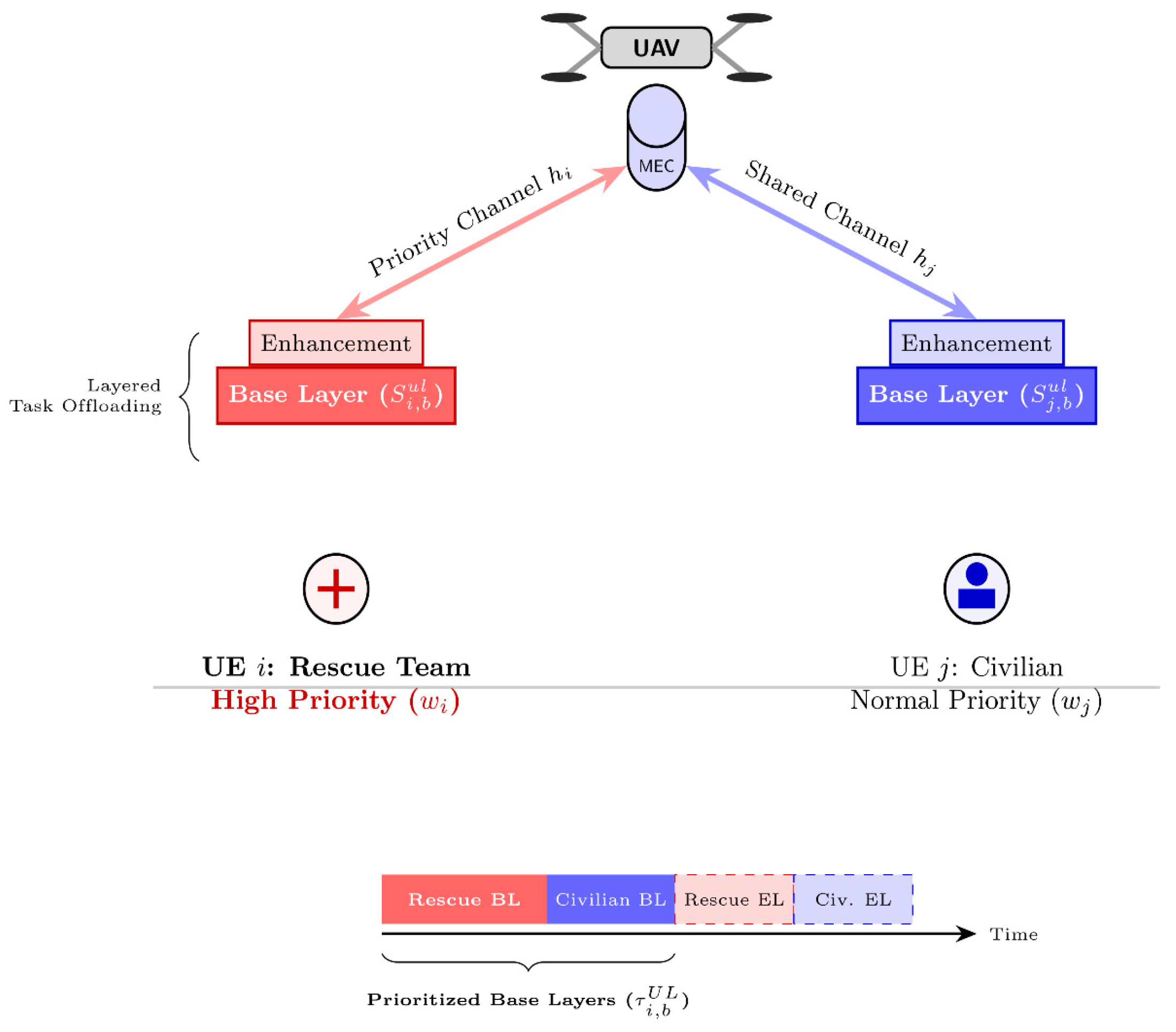
Unmanned Aerial Vehicle (UAV)-assisted radio transmission is an effective solution for emergency situations in post-disaster scenarios such as collapse of communication and computing infrastructure due to military operations or natural disasters (e.g., wildfires, floods, and earthquakes) [1]. Such a life-saving technique is vital in establishing the required urgent basic uplink (UL)/downlink (DL) wireless connections and more importantly in the provisioning of multi-access edge computing (MEC) capability. A UAV typically hovers above disturbed and affected zones to provide the required radio communication and MEC services [1,2]. Upon establishing the radio connection, each ground user offloads a computational task to the nearby UAV using time division multiple access (TDMA). The result of execution is then sent to the user after the UAV has processed the task (see Figure 1).
Unlike standard MEC servers, the UAV has limited on-board power and processing resources [3], making it challenging to support all user tasks simultaneously and reliably. Additionally, all users compete for the shared wireless communication resources (e.g., power or spectrum), but not all of them face the same level of emergency situations [4]. For example, a rescue team needs image analysis and processing to quickly locate victims (high priority), while another team, e.g., the second respondent, may need less critical processing (low priority), i.e., inter-user priority. In addition to that, per-user (or intra-user) priority is also required since mobile application typically comprises both base layer (BL) representing critical data and enhancement layers (ELs), which are optional as depicted graphically in Figure 1. This two-layer paradigm is the core of the proposed layered offloading scheme as discussed in the upcoming sections.
Several existing systems treat tasks as indivisible units, neglecting the importance of prioritizing essential task components under resource constraints in a post-disaster scenario [1]. Therefore, this research addresses the problem of reliably offloading layered tasks—comprising critical and optional parts—over UAV-assisted wireless networks while prioritizing user scheduling over shared wireless network. The proposed scheme, entitled “Reliable Layered Transmission (RLT)”, has two novel features: (i) dividing task’s data into multiple layers with different priorities, where base layer is the most critical (e.g., location or low-resolution image of a survivor) while the other enhancement layers are optional, and (ii) assigning different weights for various users (inter-user priority), e.g., for rescue teams or emergency users. It also optimizes the total offloading latency by performing joint communication and computation resource allocation to ensure reliable transmission and processing of the most critical task layers of prioritized users.
Figure 1.
Basic model for the proposed priority-aware UAV-assisted MEC system. Both inter-user (layer 1) and intra-user (layer 2) priorities are shown with TDMA scheduling.
The structure of this paper is as follows. Related works are highlighted in Section 2. Channel model and UL/DL communication and computation models are all presented in Section 3, and the optimization problem formulation is also discussed in Section 3. In Section 4, the solution analysis is introduced through three lemmas. After that, Section 5 discusses the obtained results to show the effectiveness of the proposed algorithm compared to several baseline algorithms; finally, the conclusion for this paper is given in Section 6.
2. Related Works
The last few years have witnessed the development of MEC-enabled UAV network as a new technology to enhance computational processes, reduce delay, and support the application of real-time services in volatile and highly mobile wireless networks. Studies [5,6] have improved task offloading, computed task efficiency and energy consumption in UAV networks. However, their work did not focus on task priorities.
While studies [1,7] have focused on resource allocation and task offloading in UAV using joint optimization, their work does not support real-time offloading and is not scalable. Although the study [8] has developed a user-density-based framework for real-time offloading models using UAV networks, but it is dedicated to sporting events only and not for general use.
Ref. [9] introduced an architecture designed using deep reinforcement learning (DRL) for joint computation offloading and resource allocation in multi-user MEC systems in an attempt to reduce the weighted sum of delay and energy cost. While their algorithm is appropriate for dynamic workload adaptation, their assumption involves ground MEC end points as static systems and does not facilitate adaptation in dynamic systems that could be applicable in UAV communication systems. In similar vein, ref. [10] examined optimal power and time allocation schemes in orthogonal and NOMA/NOMA-assisted multiple access communication in MEC systems. The theoretical derivation in this study presumes major reductions in energy cost, which is only applicable in small systems whose communication channel is static.
Some research surveys have also provided a comprehensive overview of the communication systems of MEC and UAVs separately in the past. Ref. [11] discussed multi-access computing (MEC) architectures and offloading methods, emphasizing the importance of reducing access time and conserving energy, although it is still a conceptual study and lacks UAV integration. In contrast, the review conducted by [12] included an analysis of FANET networks that addressed the networking difficulties specific to FANET networks, including those related to multi-drone communication, routing protocols, and mobility management, although it lacked any form of edge computing or computation offloading.
According to refs. [13,14], the combined studies have shifted the focus of MCC design from single-user and uplink-only resource usage to comprehensive allocation and scheduling but they do not support UAV. However, a previous study [15] developed a framework to improve energy and security of offloading for UAV systems that suffer from weak performance in disaster coverage and [16] developed a framework to enhance reliability in MCC over a fading channel using superposition coding, but it was not compatible with the UAVs.
Ref. [17] addressed an offloading model for various IoT tasks using logic-based Benders decomposition for task offloading in dynamic scenarios. Although this method nearly achieves optimal task latencies in offloading strategies, centralized processing complexity makes this work less suitable in highly dynamic or mobile networks like UAV communication networks. In contrast to research related to MECs, a comprehensive review of UAVs for photogrammetry and 3D mapping tasks was conducted by [18], focusing on fixed-wing UAVs in civil missions and failing to consider real-time processing.
Moreover, the study of [19] improved reliability using federated learning in multi-UAVs that enable a wireless network at the same time and suffer from delayed convergence, requiring high computational capabilities. Ref. [20] used deep RL to optimize UAV’s path based on the user location to reduce the ignoring of the importance of prioritizing tasks.
The work in [21] surveys UAV-assisted URLLC architectures for 6G systems. It covers finite block length theory, cross-layer design, and URLLC mechanisms. The paper concludes that UAVs and URLLC mechanisms can provide mission-critical 6G services. It is also noted that UAV-assisted URLLC is still a new area of research and that energy efficiency is a problem that still needs to be addressed. The authors of [22] address the problem of improving the performance of advanced multi-UAV-assisted MEC. It formulates a multi-objective optimization problem to improve both latency and power consumption and to maximize the number of tasks to be performed in an advanced multi-UAV-assisted MEC. Additionally, the work in [23] proposes a robust optimization approach to address the security challenges of multi-UAV-enabled computing networks in the presence of CSI uncertainty. The proposed approach minimizes power consumption while meeting quality of service and security requirements. A three-sided matching algorithm with an optimized topology for a multi-UAV-assisted MEC architecture with collaborative task offloading is presented in [24]. This architecture enables maximum profit for the service provider and maximum user satisfaction. In [25], a classification model based on data-driven methods has been proposed to determine the feasibility and reliability of a UAV mission in modern power and energy systems. The results show that the model can classify the reliability of a mission with high accuracy.
This paper fills the gap of prioritization of critical data and also the optimal allocation of radio and processing resources due to limited resources for UAVs by answering the following two questions:
- (a)
- How to reliably prioritize task offloading in a post-disaster scenario via UAV-based MEC networks?
- (b)
- How to efficiently allocate both radio and processing resources in such a network to achieve optimal utility, namely, minimizing the sum of total end-to-end offloading latency?
3. System Model
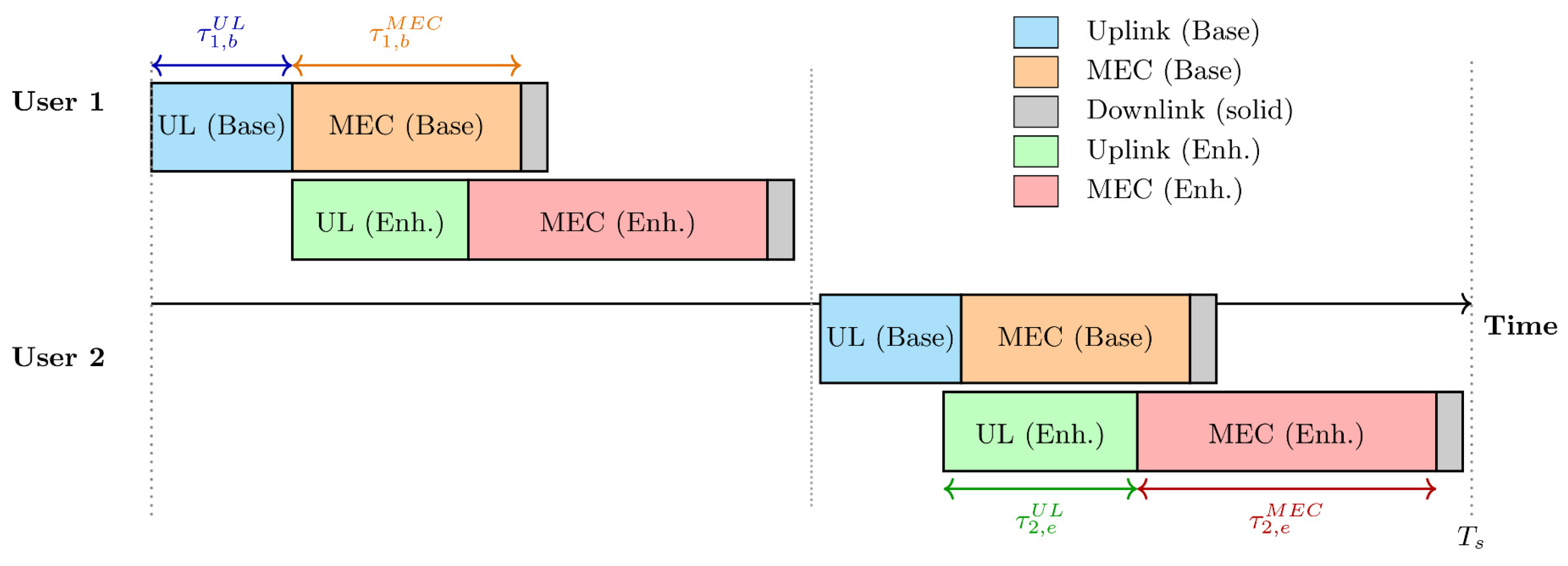
Suppose a single UAV is modeled as quasi static and hovering over a disaster zone at a fixed location for each TDMA scheduling frame (see Figure 2), then a snapshot-based optimization is introduced. However, this does not imply that the UAV remains stationary throughout its flight. In fact, in moving situations, the aforementioned optimization process can be applied sequentially at any given moment, according to the UAV’s updated position, so that it remains applicable for a non-stationary UAV scenario. The UAV acts as an aerial MEC server, establishing both uplink and downlink wireless links via TDMA. There are a total of ground users deployed in the area, where the user is located at location For a clearer presentation, the channel model is presented in Section 3.1, while Section 3.2 and Section 3.3 are dedicated to the UL/DL communication and MEC computation models, respectively.
Figure 2.
TDMA timeframe for proposed priority-aware offloading scheme. The figure shows the layered transmission for two ground users, where each occupies a fraction of the TDMA frame. Priority is assured for the base layer bits of each ground user.
3.1. Channel Model
Consider a general model for composite UAV channel with power gain defined by:
where is the path loss-based distance (linear scale), refers to shadowing (linear scale), and refers to channel coefficient under a small-scale Rician fading model. The PL itself is given by
where refers to the path loss exponent (2 for LoS, >2 for NLoS) [26], is the distance between UAV and user (meter), and refers to a reference distance (1 m). The shadowing components is
is the standard deviation of shadowing (dB), and points to zero-mean gaussian random variable (dB). Finally, small-scale fading has the following mathematical formula:
is the LOS part, is the imaginary unit , points to the real part of a multipath, and indicates the imaginary part of a multi-path.
, where is the Rician factor.
The Rician factor on a linear scale is given by: .
The real and imaginary parts of a multipath are modeled as a Gaussian random variable with normal distribution as indicated in (6):
3.2. Communication/Computation Model
Considering the task offloading of ground user in a UAV-assisted mobile edge computing system, each user has an input task size (bits) sent to UAV via a UL connection, and similarly, bits of data encoding the result of execution are sent to DL. Each offloaded bit utilizes the computational load of (CPU cycles), where denotes the computational complexity measured in CPU cycles/bit.
If a multi-UAV setup is considered, the inclusion of inter-UAV interference introduces coupling between resource allocation variables across UAVs, rendering the problem non-separable and generally non-convex. Distributed coordination mechanisms, such as interference pricing or dual decomposition, would be required to maintain tractability. Such extensions are left for exploration in future research, and a single UAV is assumed in this model.
3.2.1. UL Communication Model
We consider a practical scenario where the mobile applications can be partitioned into the base layer (BL) and enhancement layer (EL). In this method, the BL gives the minimum quality of service that is guaranteed to all critical users to receive an essential quality of service (e.g., a certain minimal data rate, reliability, emergency messages or low-resolution videos). The EL, on the other hand, provides superfluous service quality, which can be opportunistically granted to the users based on residual resource availability above and beyond the base layer utilization. A hierarchical prioritization is obtained as the base layer and serves the critical users, and by dividing the rest of the resources among them and the enhancement layer, it guarantees basic service while providing the best possible overall user experience.
The total number of offloaded bit sent to UL consists of a sum of both BL and EL input task sizes as follows:
where represents the number of transmitted bits during the BL offloading, and represents the number of offloading bits during the EL.
The achievable uplink rate (in bps) for sending to UAV is given by:
where is the UL transmission bandwidth allocated for a BL task, represents the fraction of UL TDMA frame allocated to prioritize BL task transmission (unitless) as depicted in Figure 2, refers to the noise (Watt/HZ), points to UL channel gain, and is the BL transmit power of the user device (Watt).
Similarly, the rate (in bps) needed for sending in the UL direction reads:
where represents the fraction of UL TDMA frame allocated to prioritize EL task transmission (unitless), is the UL transmission bandwidth allocated for EL, and is the transmit power of the user device during EL offloading (Watt).
The UL time (seconds) for task uploading reads:
which depends on the total input task size (in bits), transmit power (Watt) and total UL transmission rate.
3.2.2. UAV Computation Model
The computation time (seconds) required to execute the offloaded task of user at UAV MEC server is given by:
which depends on the input task size and the computation complexity (CPU cycles/bit). Fmax is the CPU frequency of the UAV processor (cycles/s), while is a fraction of CPU frequency allocated to the users with constraints (unitless), , For a clearer presentation, note that in (10) and (11) generally refers to the number of bits transmitted to offload the execution of either BL or EL, i.e., or , respectively.
3.2.3. DL Communication Model
Similar to UL, the downlink rate (in bps) needed to send the output bits, encoding the results of execution from the UAV to user , is mathematically stated as:
where represents the transmission bandwidth of the UAV, is the DL bandwidth, refers to the fraction of DL TDMA frame allocated to task downloading (unitless), denotes the noise (Watt/HZ), and denotes the DL channel gain.
Hence, the DL transmission time (seconds) is:
which is a function of the output task size (the number of downloading bits) and DL transmission rate in bps, given in (12).
Finally, the total offloading time for each task is given as:
3.3. Problem Formulation
The goal of this section is to formulate a priority-aware joint communication and computation resource allocation under UAV-enabled offloading. The objective is to reduce the total weighted sum offloading delay for critical users under power and resource constraints. It is mathematically stated as P.1:
S.t:
reveals two types of priorities: the first is priority between users based on user weights, while the second is the intra-user priority based on layered transmission (BL and EL).
The constraint (C.1) ensures that the BL rate is greater than or equal to the given minimum rate for priority assurance; (C.2) gives per user layered transmission; (C.3) ensures the BL task is fully uploaded and executed before EL for the user in a post-disaster scenario as it clear in Figure 2 (C.4) indicates the power of both BL/EL is greater than or equal to zero; (C.5) ensures the power of BL and EL is smaller than or equal to the total uplink power; (C.6) refers to the total CPU frequency constraint, with per-user share allocated to the users being naturally non-negative; and (C.7) indicates that the UAV power for users is smaller than or equal to the maximum download power.
Noteworthily, intra-user priority is enforced via (C.1)–(C.3) while inter-user priority is embedded in the objective function.
4. Solution Analysis
The presence of the time allocation variables together with the logarithmic rate functions (8), (9) and (12) renders the optimization problem (P.1) as non-convex due to the coupling of variables in the objective function. Such problems are known to be NP-hard in general; hence, obtaining its global optimal solution is computationally infeasible [27]. Accordingly, in this section, we recast the problem into a convex one using the following series of transformations in Lemma 1 to Lemma 4. In what follows, we drop additional subscripts and make the dependence on variables implicit for mathematical simplicity.
Lemma 1.
Perspective and Epigraph Reformulation.
Let The function
is jointly concave in for .
Proof.
Since is concave and non-decreasing in , its perspective is concave by the perspective transformation property of concave functions [27]. Hence, is concave. □
With epigraph reformulation, the uplink latency constraint (10) can be equivalently written as:
where is an auxiliary variable such that . This is non-convex because it multiplies the variable with a concave function . To resolve this, we define a reciprocal variable and rewrite the constraint (16) as:
Lemma 2.
The constraint in (17) is convex in
Since is concave, the right-hand side is concave. The left-hand side is affine. The set is convex because the sublevel set of a concave function is convex [27].
Using the above transformations, (P.1) can be equivalently written as:
Specifically, for each user i and layer j ∈ {, we introduce an epigraph variable such that ≤ . Using (10), this epigraph inequality can be written as . By defining the reciprocal variable , we obtain the convex constraint in (17), while the uplink-latency term in the objective becomes = /. This makes explicit that originates from the epigraph reformulation and that it is coupled to the communication variables only through the convexified constraint (17).
Constraints (C.1)–(C.7) in (P.1).
The Lagrangian of (P.2) is:
The stationarity conditions are obtained by taking the derivative of the Lagrangian with respect to the primal variables. For example,
Similarly, we obtain the stationarity conditions for the remaining variables (details are omitted for brevity), in particular, for the CPU allocation:
Substituting (20) back into the CPU constraint yields:
From the power stationarity condition, the optimal uplink power allocation (for each layer j) follows a water-filling structure:
These KKT conditions ensure that the resource constraints are active when optimal. The complementary slackness conditions include:
The convexified problem (P.2) ensures the existence of a globally optimal solution due to convexity of objective and constraints as well as the satisfaction of the KKT conditions. Accordingly, the problem admits analytical solutions for the transmit power (in both uplink and downlink despite the fact that downlink calculations are omitted due to space limitation) and CPU frequency allocations as formulated in (20) and (21), respectively. The time allocation, on the other hand, is obtained by solving the convex subproblem as detailed in Algorithm 1. This does not have closed-form expression due to the coupling of time variable across users. Nevertheless, global optimality is also guaranteed by the convexity of the subproblem, which is solvable in polynomial time via typical convex optimization techniques (like interior-point method). As a closing remark, it is worth mentioning that analytical solutions for power and CPU allocations along with the convexity of time allocation subproblem enable computationally efficient and practical on-board implementation of the proposed algorithm for real-time UAV-assisted MEC scenarios. However, the required repeated optimization of the considered snapshot-based UAV model incurs additional computational overhead and associated energy expenditure. Nevertheless, for a moderate number of users, solving the time-allocation convex subproblem, e.g., using interior-point methods, typically converges within tens of iterations, leading to a sub-millisecond execution time on the embedded processors in modern UAVs. The energy required to solve the convex optimization problem is negligible compared to radio transmission and UAV propulsion energy consumption as the optimization is not continuously executed but triggered at the beginning of each scheduling frame or when the channel state changes significantly.
| Algorithm 1. Layered Priority-Aware Offloading and Optimal Resource Allocation for UAV-enabled MEC Network. |
|
The proposed solution in Algorithm 1 alternates between closed-form updates and convex optimization. Specifically, the optimal transmit power (20) and CPU frequency allocations (21) are obtained in the closed form via KKT conditions, each requiring operations. The TDMA time-allocation subproblem is convex and solved using interior-point methods with worst-case complexity [27].
Overall, the computational complexity per iteration is , dominated by the time-allocation step. Due to the convexity of the reformulated problem and satisfaction of Slater’s condition, the proposed algorithm converges to the global KKT-optimal solution. The convergence rate follows , where denotes the target optimality gap. For a moderate number of users, the algorithm converges within a small number of iterations, making it suitable for the real-time UAV-assisted offloading of urgent base layer data.
5. Results and Discussion
To validate and assess the performance of the proposed scheme under a dynamic composite wireless channel of a UAV-assisted MEC system, we consider a simulation of 10 mobile users. While a considerable number of task offloading algorithms have been developed in the literature, many of them consider different optimization goals (e.g., energy minimization) or distinct system assumptions (e.g., non-layered tasks or fixed time division). A direct comparison with such benchmarks would not lead to fair and correct performance evaluation. Hence, the proposed priority-aware resource allocation framework is compared to three representative baseline schemes under the same system model and constraints, i.e., the Enhancement First, Equal Allocation, and No Priority, and under the same network conditions. The “Enhancement First”, the EL layer is offloaded first, representing the worst-case scenario, while in “Equal Allocation”, the power and processing resources are equally allocated among all users; in the “No Priority” scheme, as the name suggests, no prioritization is applied and the whole computation task is offloaded at once. Such parameters are carefully adopted from the indicated related work to reflect real-world deployment and to provide realistic approximation to the performance of the proposed scheme when configured in a real-world setup. The simulation parameters are listed in Table 1.
Table 1.
Simulation system’s parameters.
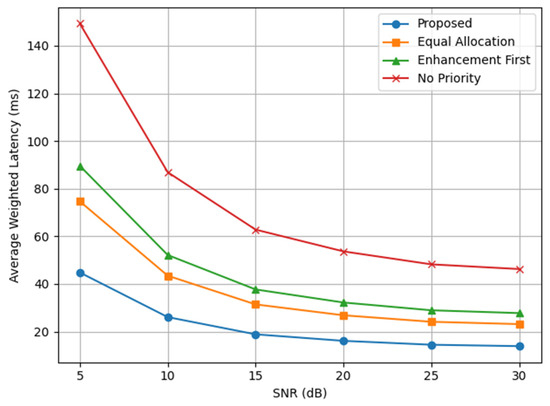
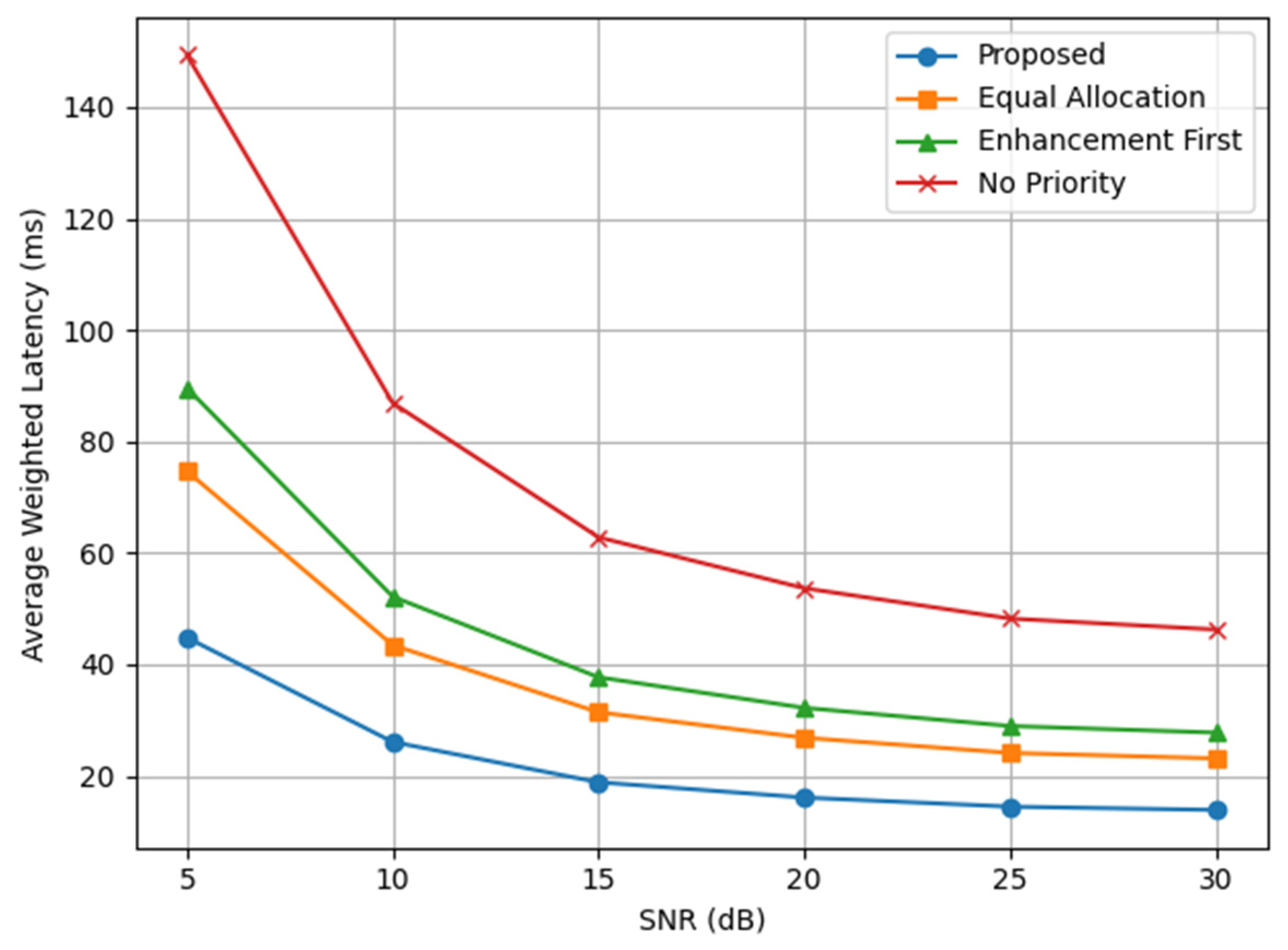
Figure 3 demonstrate the weighted overall latency across all users versus SNR for each of the three resource allocation schemes compared with the proposed algorithm. At a signal-to-noise ratio of 5 dB, the proposed algorithm achieves considerable latency reductions vs. the baseline algorithms (39.99% reduction vs. Equal Allocation, 49.99% reduction vs. Enhancement First, and 69.99% reduction vs. No Priority). These reductions in latency are attributed to the joint optimization of radio and computing resources in the proposed algorithm, reducing the overall latency through the dynamic adaptation of resource allocation to the MEC according to user priority and channel quality.
Figure 3.
Latency vs. SNR for priority-aware MEC offloading.
Besides reliability, the efficiency of the proposed priority-aware offloading scheme is confirmed by the fact that it achieves the lowest latency across all SNR values as is clear from the results in Table 2.
Table 2.
Results of SNR vs. latency for the proposed and baseline algorithms.
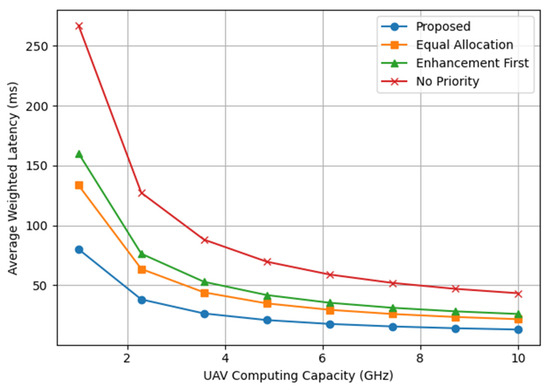
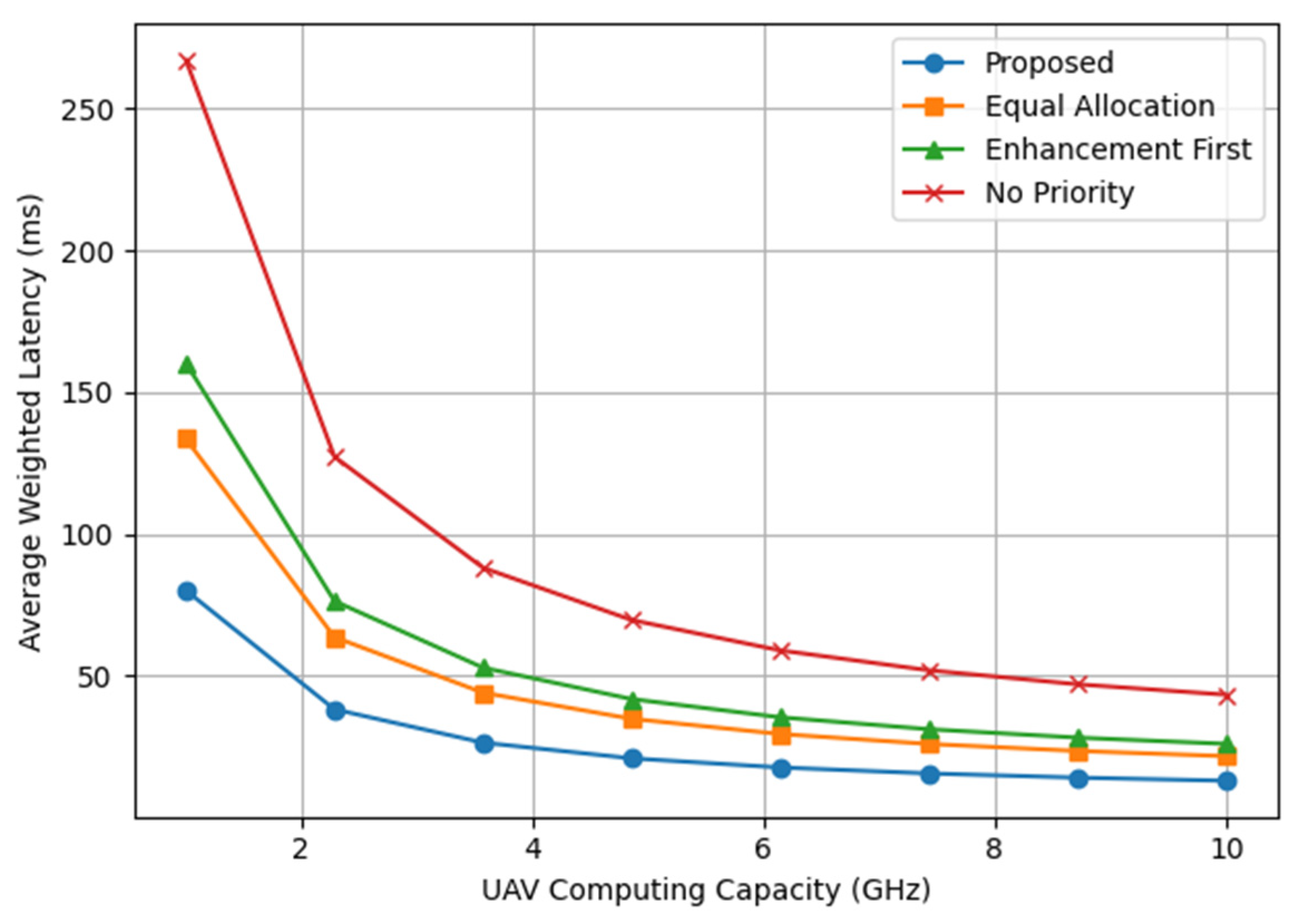
As a function of the processing capacity of UAV (), we plot again the total weighted offloading latency. It is obvious that, for all schemes in Figure 4, the total latency decreased gradually as the UAV’s computing capacity increased from 1 GHz to 10 GHz. With the increasing computing capacity of UAV, transmission time is not the only factor contributing to latency; channel randomness also affects it.
Figure 4.
Latency vs. UAV computing capacity for priority-aware MEC offloading.
At a low computing capacity of 1 GHz, the proposed algorithm shows a latency reduction compared to the baseline algorithms (40% reduction vs. Equal Allocation, 50% reduction vs. Enhancement First, and 70% reduction vs. No Priority) as is evident from the results in Table 3.
Table 3.
Results of UAV computing capacity vs. latency for the proposed and baseline algorithms.
Overall, the results confirm that the proposed priority-based framework offers better performance against resource scarcity with edge computing capability. This underscores its suitability for latency-critical applications in mobile edge computing networks assisted by UAVs as well as guaranteed reliability for BL execution.
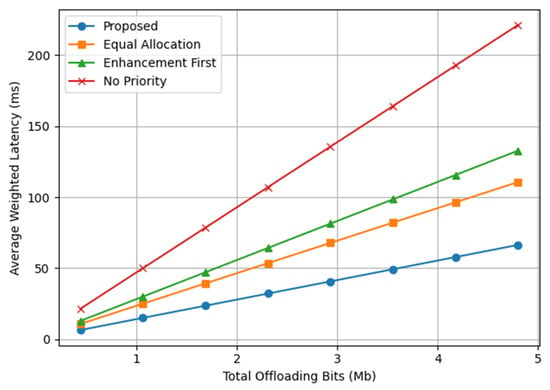
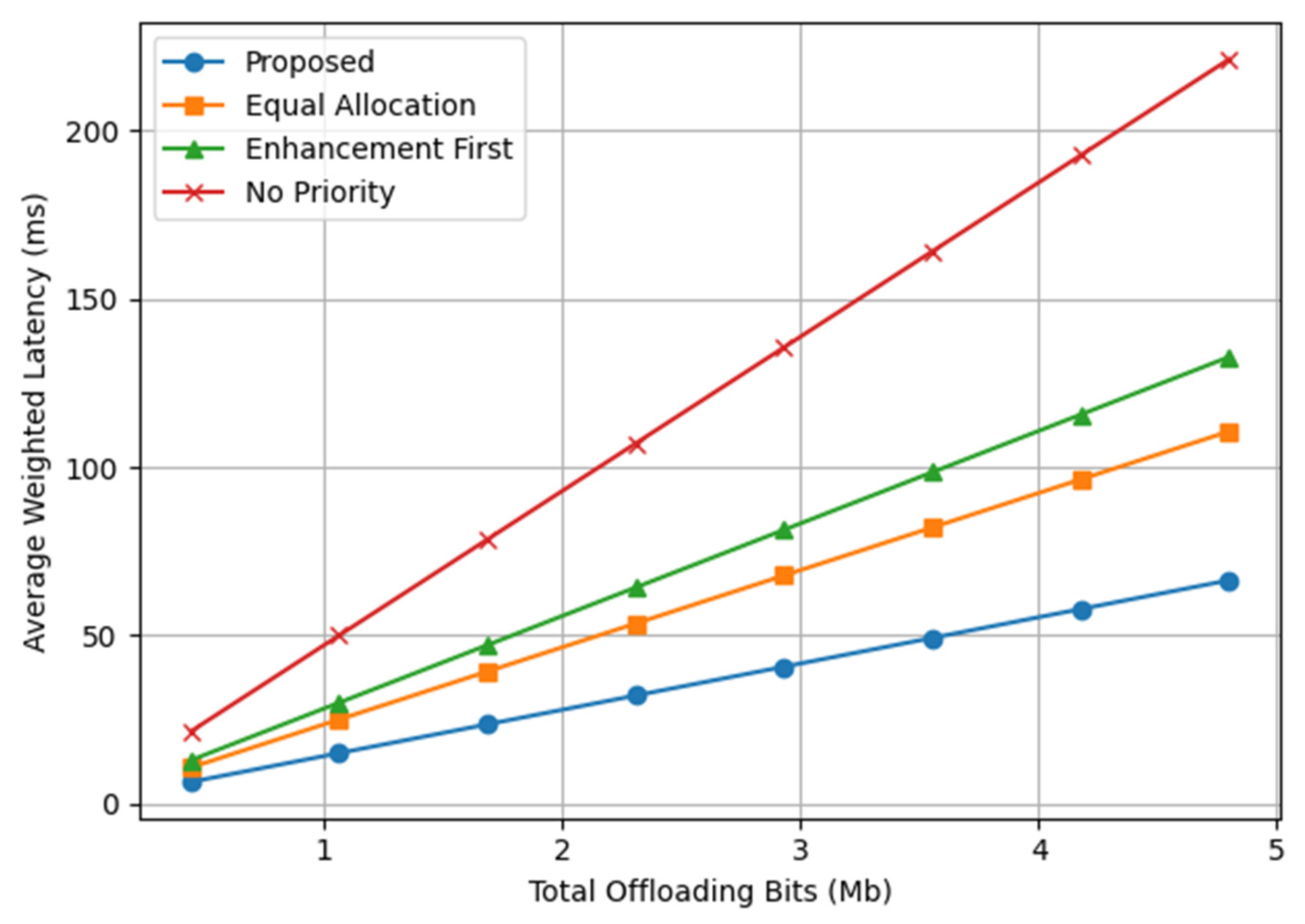
Figure 5 illustrates the variation in total latency as a function of the total input data size (measured in Mbits) for different data offloading algorithms. In all algorithms, latency increases almost always with data size. For moderate task sizes, such as 2.93 Mb, the proposed algorithm reduces the total latency by approximately 57.14% compared to average baseline algorithms.
Figure 5.
Latency vs. total offloading bits.
As the total bit size increases to 4.80 Mb, the latency becomes even more pronounced, with the proposed method maintaining, on average, a reduction of approximately 57.14% compared to conventional average baseline algorithms as is clear from the results in Table 4.
Table 4.
Results of total offloading bits vs. latency for the proposed and baseline algorithms.
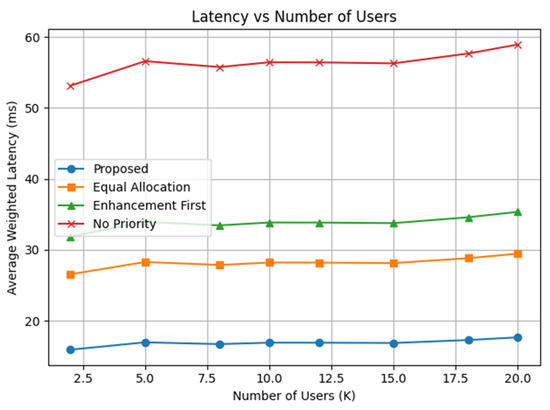
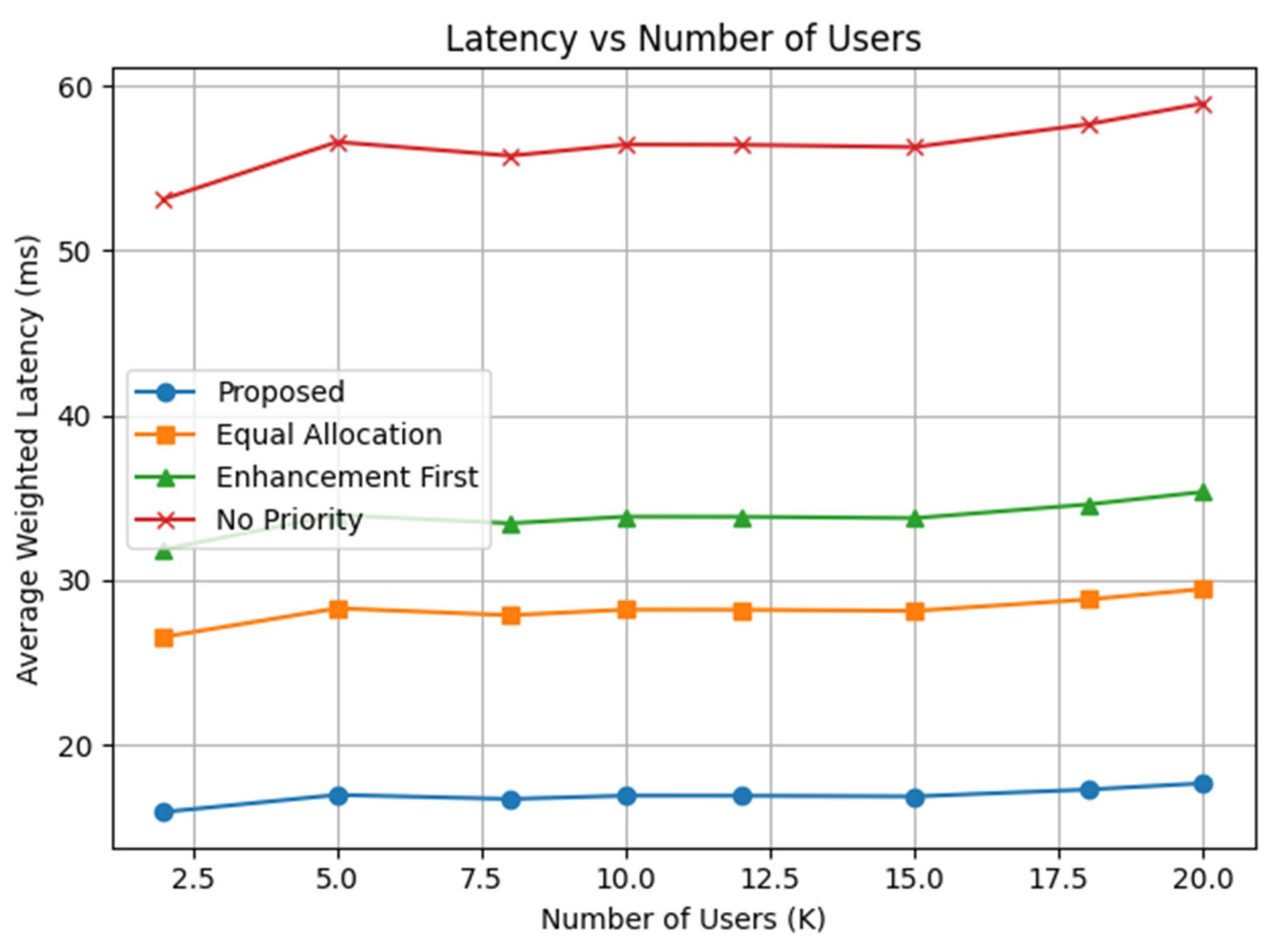
Figure 6 shows that the total latency increases with the number of users for all the resource allocation schemes, as they share the UAV’s computing resources and limited bandwidth and channel resources in both uplink and downlink.
Figure 6.
Latency vs. number of users.
With any given number of users (2–20), the proposed system offers a significant latency reduction than other average baseline schemes. For 10 users, the proposed algorithm reduces the total latency by approximately 57.132% compared to average baseline algorithms by prioritizing user resource allocation and minimizing offloading time as is evident from the results in Table 5.
Table 5.
Results of number of users vs. latency for the proposed and baseline algorithms.
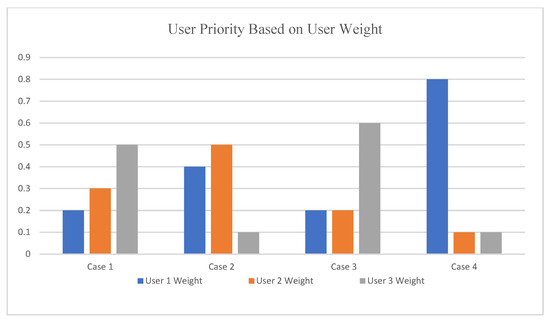
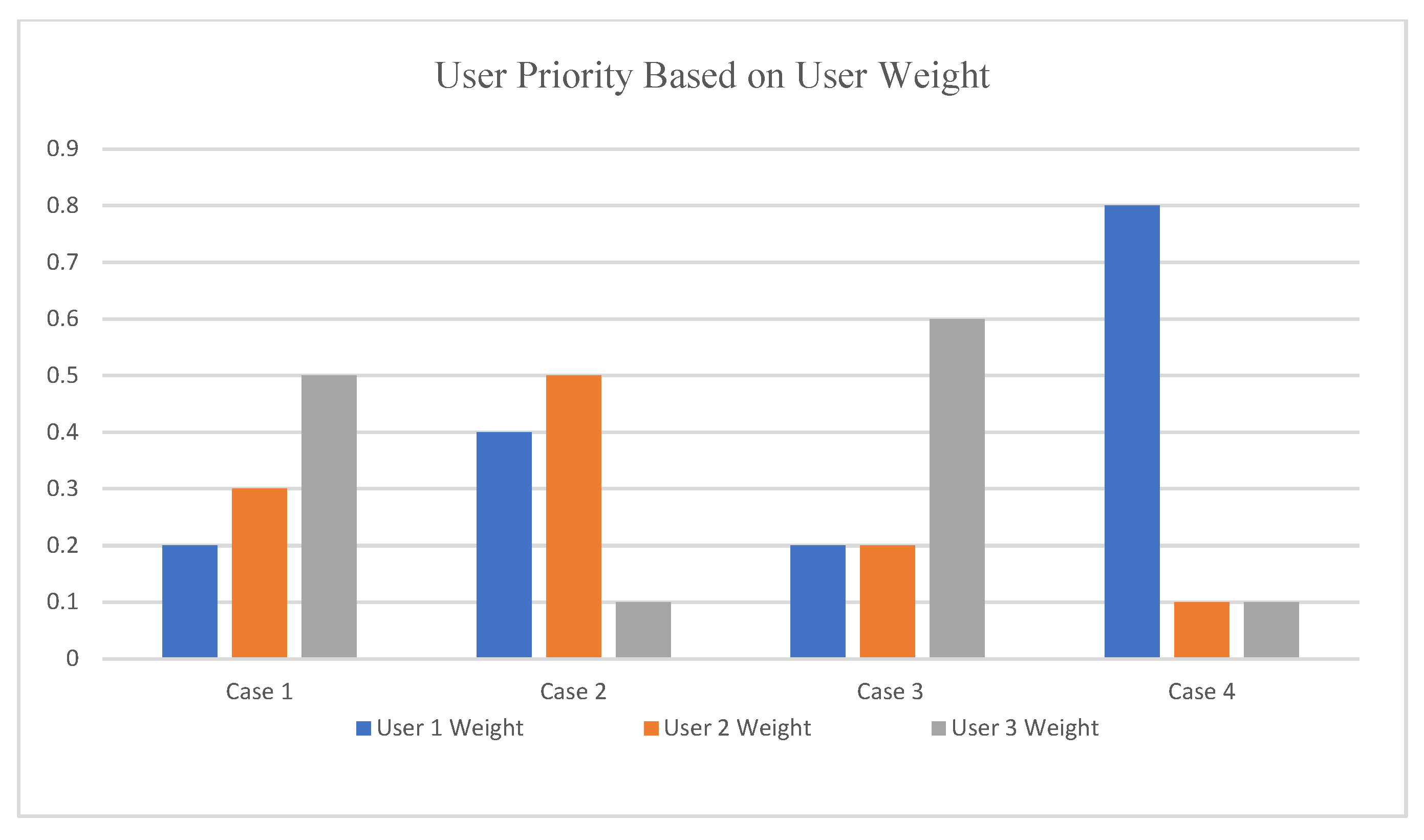
Figure 7 illustrates the latency behavior of the proposed algorithm across different user weighting scenarios in a three-user MEC system as reported in Table 6. This figure shows that the proposed algorithm clearly highlights latency differences between users and weighted states, and users with higher weights correspond to higher priority and consistently lower latency, while the latency of less important users increases slightly. This reflects the intelligent optimization behavior of the proposed model.
Figure 7.
User priority based on user weight for three users using the proposed algorithm.
Table 6.
Custom weight cases for three users.
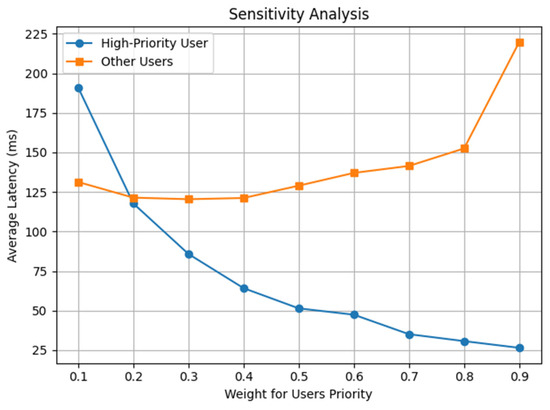
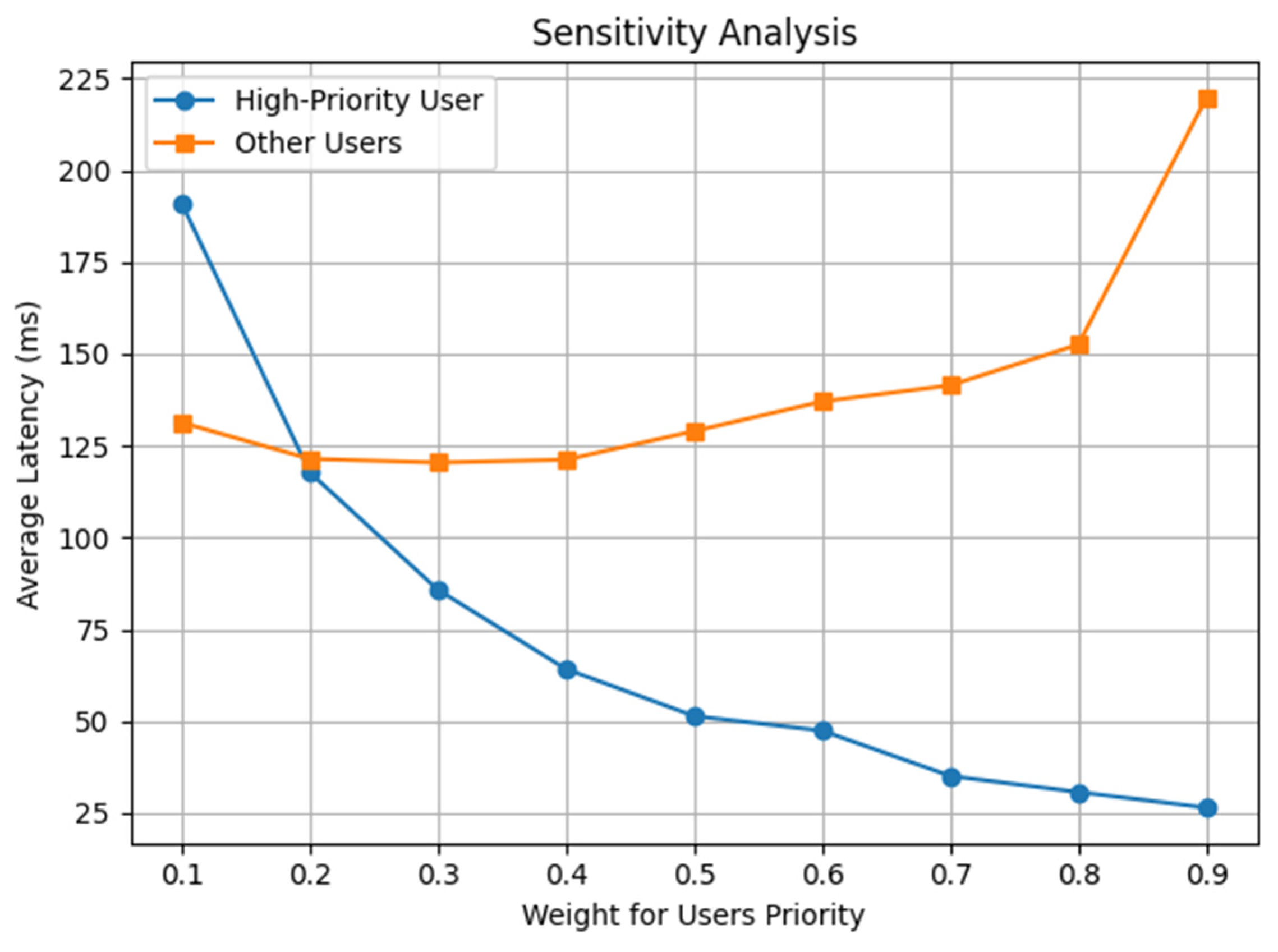
The selected priority weights, depicted in Table 6, are chosen to reflect different emergency levels among users, where larger weight values correspond to urgent users with critical data (e.g., rescue team’s information or survivor locations). These values are not necessarily associated with a specific emergency policy. To shed more light on this point, the sensitivity of the achievable latency as a function of different weight assignments is reported in Figure 8. The figure clearly shows that the proposed scheme allocates more transmission power, CPU frequency, and TDMA time slots toward the designated high-priority user. Consequently, the latency of other less-prioritized users increases due to the reduced resource share.
Figure 8.
As the priority weight increases, the optimization reallocates transmission power, CPU frequency, and TDMA time slots toward the high-priority user. Consequently, the latency of other users increases due to the reduced resource share.
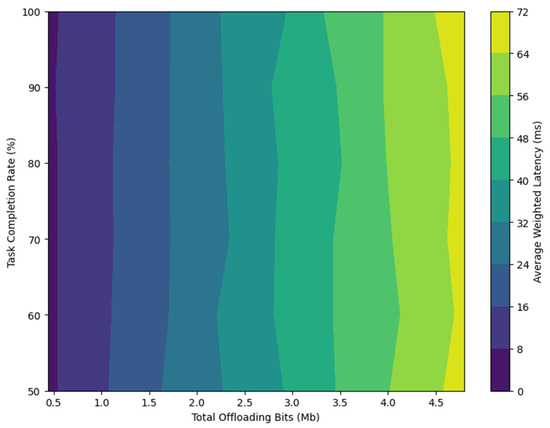
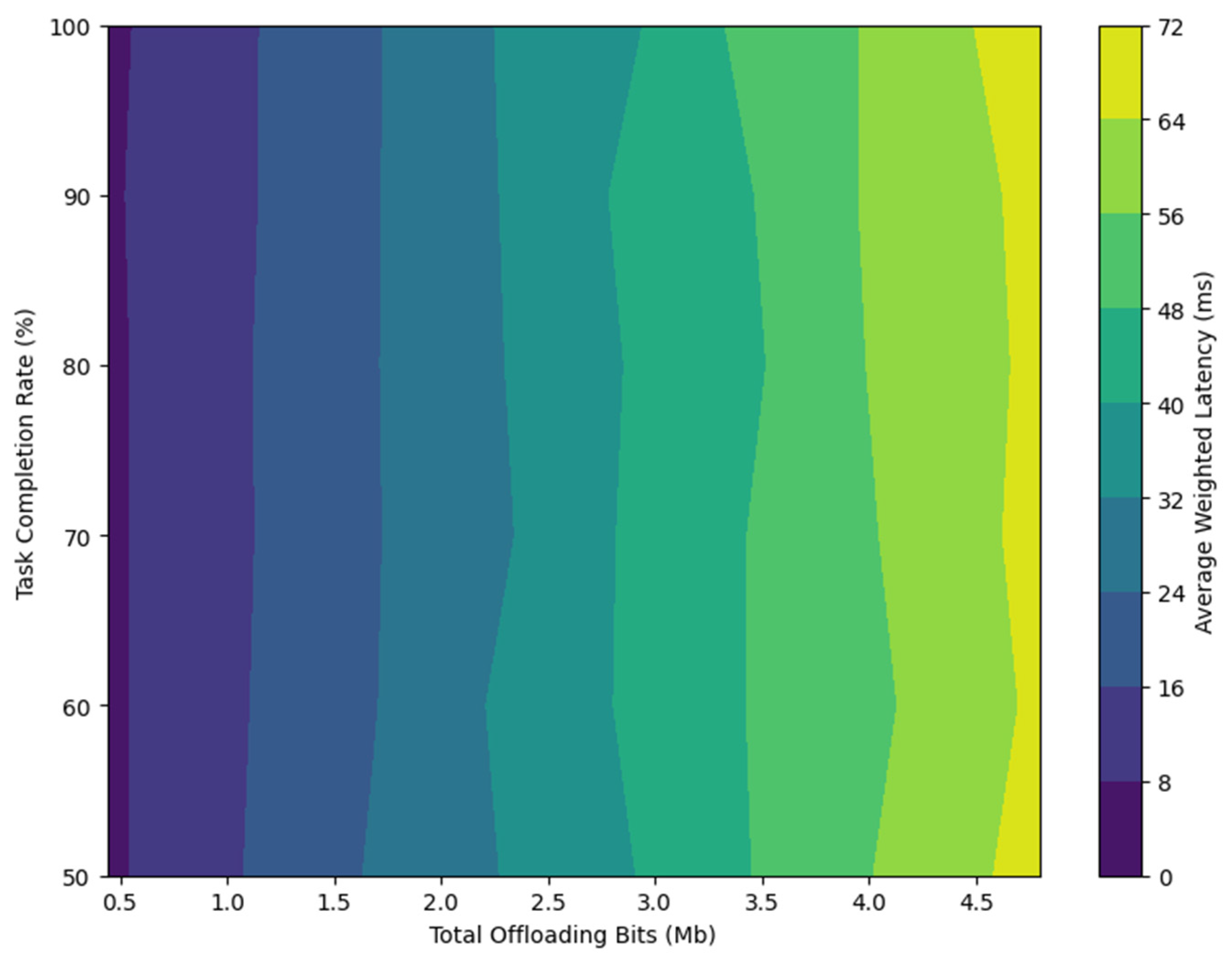
Figure 9 illustrates the impact of offloading bit size on the average weighted latency (ms) and task completion rate (%) in a composite fading channel. It is clear from the figure of the proposed approach that, as the number of bits allocated for offloading increases, the average weighted latency gradually rises due to the continuous increase in the workload on communication and computing. Simultaneously, the task completion rate gradually decreases. This indicates that the system maintains a smooth balance between the weighted latency and task completion rate metrics.
Figure 9.
Average weighted latency (ms) and task completion rate (%) based on total offloading bits (Mb).
6. Conclusions
In this paper, we study a UAV-assisted mobile edge computing (MEC) system for disaster relief, where a UAV provides computation and communication services to multiple ground users. Each user task is partitioned into a base layer (critical for reliability) and an enhancement layer (optional for improved quality). We formulate a joint optimization problem of communication and computation resources to minimize the weighted sum latency across all users while guaranteeing base layer priority through minimum rate constraints. The problem is shown to be non-convex in its native form. After appropriate transformations, we recast the problem into a convex one and then derive the optimal solution using the KKT conditions and obtain a water-filling-like closed form for power and processing capacity allocation. The numerical results show that the priority-aware joint resource allocation scheme outperforms several baseline schemes. At a signal-to-noise ratio of 5 dB, the proposed algorithm achieves relative latency reductions vs. the baseline algorithms (39.99% reduction vs. Equal Allocation, 49.99% reduction vs. Enhancement First, and 69.99% reduction vs. No Priority).
In future research, the study can be expanded to achieve path planning, cooperation between multiple mobile UAVs and incorporate more advanced prioritization techniques like NOMA-enabled offloading or superposition coding taking into account energy and latency constraints.
Author Contributions
A.R.D. and A.A.-S. have contributed equally to the conceptualization, implementation, analysis, and writing of this manuscript. All authors have read and agreed to the published version of the manuscript.
Funding
This research received no external funding.
Data Availability Statement
The data presented in this study are available on request from the corresponding author.
Conflicts of Interest
The authors declare no conflicts of interest.
Abbreviations
| Symbol | Description |
| The number of offloading bits during the BL and EL | |
| The time expression for task uploading and downloading | |
| Computation time, total offloading time | |
| The achievable uplink rate for sending and to UAV | |
| The DL rate from UAV to MU | |
| The number of downloading bits | |
| A fraction of CPU frequency allocated to the users with constraints | |
| MU | Mobile user |
| UAV | Unmanned Aerial Vehicle |
| The CPU frequency of UAV processor | |
| Refers to the fraction of DL TDMA frame allocated to task downloading (unitless) | |
| Represent the fraction of UL TDMA frame allocated to prioritize BL and EL task transmission (unitless) | |
| Maximum UL power, Maximum DL power | |
| UL transmission bandwidth allocated for BL and EL tasks | |
| The BL and EL transmit power of the user device (Watt) |
References
- Jeong, S.; Simeone, O.; Kang, J. Mobile Edge Computing via a UAV-Mounted Cloudlet: Optimization of Bit Allocation and Path Planning. IEEE Trans. Veh. Technol. 2018, 67, 2049–2063. [Google Scholar] [CrossRef] [Scilit]
- Zhang, P.; Su, Y.; Li, B.; Liu, L.; Wang, C.; Zhang, W.; Tan, L. Deep Reinforcement Learning Based Computation Offloading in UAV-Assisted Edge Computing. Drones 2023, 7, 213. [Google Scholar] [CrossRef] [Scilit]
- Kumar, K.; Liu, J.; Lu, Y.H.; Bhargava, B. A survey of computation offloading for mobile systems. Mob. Netw. Appl. 2013, 18, 129–140. [Google Scholar] [CrossRef] [Scilit]
- Li, H.; Jia, Z.; He, S.; Guo, K.; Wu, Q. Hierarchical Task Offloading for UAV-Assisted Vehicular Edge Computing via Deep Reinforcement Learning. arXiv 2025, arXiv:2507.05722. [Google Scholar] [CrossRef] [Scilit]
- Dehkordi, M.F.; Jabbari, B. Efficient and Sustainable Task Offloading in UAV-Assisted MEC Systems via Meta Deep Reinforcement Learning. arXiv 2025, arXiv:2504.00453. [Google Scholar] [CrossRef] [Scilit]
- Xiao, H.; Hu, X.; Zhang, W.; Wang, W.; Wong, K.K.; Yang, K. Energy-Efficient STAR-RIS Enhanced UAV-Enabled MEC Networks With Bi-Directional Task Offloading. IEEE Trans. Wirel. Commun. 2025, 24, 3258–3272. [Google Scholar] [CrossRef] [Scilit]
- Wu, H.; Yang, X.; Bu, Z. Deep Reinforcement Learning for Computation Offloading and Resource Allocation in Satellite-Terrestrial Integrated Networks. In Proceedings of the 2022 IEEE 95th Vehicular Technology Conference: (VTC2022-Spring), Helsinki, Finland, 19–22 June 2022. [Google Scholar] [CrossRef] [Scilit]
- Peng, C.; Wang, Q.; Zhang, D. Efficient dynamic task offloading and resource allocation in UAV- assisted MEC for large sport event. Sci. Rep. 2025, 15, 11828. [Google Scholar] [CrossRef] [Scilit] [PubMed]
- Li, J.; Gao, H.; Lv, T.; Lu, Y. Deep Reinforcement Learning based Computation Offloading and Resource Allocation for MEC. In Proceedings of the 2018 IEEE Wireless Communications and Networking Conference (WCNC), Barcelona, Spain, 15–18 April 2018. [Google Scholar]
- Ding, Z.; Xu, J.; Dobre, O.A.; Poor, H.V. Joint Power and Time Allocation for NOMA-MEC Offloading. IEEE Trans. Veh. Technol. 2019, 68, 6207–6211. [Google Scholar] [CrossRef] [Scilit]
- Mach, P.; Member, I.; Becvar, Z.; Member, I. Mobile Edge Computing: A Survey on Architecture and Computation Offloading. IEEE Commun. Surv. Tutor. 2017, 19, 1628–1656. [Google Scholar] [CrossRef] [Scilit]
- Gupta, L.; Ieee, S.M.; Jain, R.; Vaszkun, G. Survey of Important Issues in UAV Communication Networks. IEEE Commun. Surv. Tutor. 2015, 18, 1123–1152. [Google Scholar] [CrossRef] [Scilit]
- Al-Shuwaili, A.N.; Bagheri, A.; Simeone, O. Joint uplink/downlink and offloading optimization for mobile cloud computing with limited backhaul. In Proceedings of the 2016 Annual Conference on Information Science and Systems (CISS), Princeton, NJ, USA, 16–18 March 2016; pp. 424–429. [Google Scholar] [CrossRef] [Scilit]
- Al-shuwaili, A.; Simeone, O.; Bagheri, A.; Scutari, G. Joint Uplink/Downlink Optimization for Backhaul-Limited Mobile Cloud Computing with User Scheduling. IEEE Trans. Signal Inf. Process. Over Netw. 2017, 3, 787–802. [Google Scholar] [CrossRef] [Scilit]
- Bai, T.; Wang, J.; Ren, Y.; Hanzo, L. Energy-efficient computation offloading for secure uav-edge-computing systems. IEEE Trans. Veh. Technol. 2019, 68, 6074–6087. [Google Scholar] [CrossRef] [Scilit]
- Azimi, S.M.; Simeone, O.; Sahin, O.; Popovski, P. Ultra-Reliable Cloud Mobile Computing with Service Composition and Superposition Coding. In Proceedings of the 2016 Annual Conference on Information Science and Systems (CISS), Princeton, NJ, USA, 16–18 March 2016. [Google Scholar]
- Alameddine, H.A.; Sharafeddine, S.; Sebbah, S.; Ayoubi, S.; Assi, C. Dynamic Task Offloading and Scheduling for Low-Latency IoT Services in Multi-Access Edge Computing. IEEE J. Sel. Areas Commun. 2019, 37, 668–682. [Google Scholar] [CrossRef] [Scilit]
- Nex, F.; Remondino, F.; Nex, F. UAV for 3D mapping applications: A review. Appl. Geomat. 2014, 6, 1–15. [Google Scholar] [CrossRef] [Scilit]
- Yang, H.; Zhao, J.; Xiong, Z.; Lam, K. Privacy-Preserving Federated Learning for UAV-Enabled Networks: Learning-Based Joint Scheduling and Resource Management. IEEE J. Sel. Areas Commun. 2021, 39, 3144–3159. [Google Scholar] [CrossRef] [Scilit]
- Liu, Q.; Shi, L.; Sun, L.; Li, J.; Ding, M.; Shu, F.S. Path Planning for UAV-Mounted Mobile Edge Computing with Deep Reinforcement Learning. IEEE Trans. Veh. Technol. 2020, 69, 5723–5728. [Google Scholar] [CrossRef] [Scilit]
- Masaracchia, A.; Li, Y.; Nguyen, K.K.; Yin, C.; Khosravirad, S.R.; Da Costa, D.B.; Duong, T.Q. Comprehensive Survey UAV-Enabled Ultra-Reliable Low-Latency Communications for 6G: A Comprehensive Survey. IEEE Access 2021, 9, 137338–137352. [Google Scholar] [CrossRef] [Scilit]
- Sun, G.; Wang, Y.; Sun, Z.; Wu, Q.; Kang, J.; Niyato, D.; Leung, V.C. Multi-objective Optimization for Multi-UAV-assisted Mobile Edge Computing. IEEE Trans. Mob. Comput. 2024, 23, 14803–14820. [Google Scholar] [CrossRef] [Scilit]
- Mao, W.; Xiong, K.; Lu, Y.; Background, A. Energy Consumption Minimization in Secure Multi-antenna UAV-assisted MEC Networks with Channel Uncertainty. IEEE Trans. Wirel. Commun. 2023, 22, 7185–7200. [Google Scholar] [CrossRef] [Scilit]
- Barick, S.; Singhal, C.; Member, S. UAV-Assisted MEC Architecture for Collaborative Task Offloading in Urban IoT Environment. IEEE Trans. Netw. Serv. Manag. 2025, 22, 732–743. [Google Scholar] [CrossRef] [Scilit]
- Al-haddad, L.A.; Khalid, W.; Tariq, S.Z.; Mrah, M.M.; Flah, A.; Tazay, A.F.; Jaber, A.A. Reliability-oriented framework for UAV-based inspection missions in modern power and energy systems. Sci. Rep. 2026, 16, 958. [Google Scholar] [CrossRef] [Scilit]
- Rappaport, T.S. Wireless Communications: Principles and Practice, 2nd ed.; Cambridge University Press: Cambridge, UK, 2024. [Google Scholar]
- Optimization, C. Convex Optimization; Cambridge University Press: Cambridge, UK, 2004. [Google Scholar]
- Mao, Y.; Zhang, J.; Song, S.H.; Letaief, K.B. Power-Delay Tradeoff in Multi-User Mobile-Edge Computing Systems. In Proceedings of the 2016 IEEE Global Communications Conference (GLOBECOM), Washington, DC, USA, 4–8 December 2016. [Google Scholar]

Disclaimer/Publisher’s Note: The statements, opinions and data contained in all publications are solely those of the individual author(s) and contributor(s) and not of MDPI and/or the editor(s). MDPI and/or the editor(s) disclaim responsibility for any injury to people or property resulting from any ideas, methods, instructions or products referred to in the content. |
© 2026 by the authors. Licensee MDPI, Basel, Switzerland. This article is an open access article distributed under the terms and conditions of the Creative Commons Attribution (CC BY) license.