


Highlights
What are the main findings?
- A map-change-driven replanning (MCR) strategy is developed to adaptively trigger trajectory replanning based on ESDF structural variations and goal drift in unknown indoor environments.
- The proposed closed-loop Autonomous Unmanned Aerial Vehicle (UAV) navigation system achieves higher safety and lower replanning frequency than conventional time-based replanning strategies in cluttered scenarios.
What are the implications of the main findings?
- Linking replanning decisions to real-time map evolution enables more stable and resource-efficient autonomous flight under partial observability.
- The presented framework demonstrates a practical system-level solution for indoor UAV exploration and inspection tasks under realistic operational constraints.
Abstract
Autonomous Unmanned Aerial Vehicle (UAV) navigation in unknown indoor environments is challenged by incremental map revelation and non-uniform geometric changes, which frequently invalidate preplanned trajectories. Existing time-triggered replanning strategies are poorly aligned with such irregular environmental evolution, often resulting in either redundant computation or delayed responses to critical structural variations. To overcome these limitations, this paper proposes a map-change-driven closed-loop replanning mechanism (MCR) embedded within a distance-field-based hierarchical exploration–planning–control framework. The proposed approach explicitly monitors local Euclidean Signed Distance Field (ESDF) structural changes and exploration goal updates, triggering replanning only when significant geometric or task-level variations are detected. This event-driven design enables timely trajectory adaptation while effectively suppressing unnecessary replanning. Extensive experiments conducted in a high-fidelity indoor warehouse simulation environment demonstrate that the proposed method consistently outperforms single-shot planning and fixed-interval replanning baselines in terms of task success rate, trajectory smoothness, safety margin, and replanning efficiency. These results validate the effectiveness of using map structural evolution as the core driver for replanning in unknown indoor UAV navigation.
1. Introduction
Autonomous navigation of unmanned aerial vehicles (UAVs) in unknown indoor environments is a key requirement for applications such as industrial inspection, intelligent warehousing, security monitoring, and disaster response. Compared with outdoor scenarios, indoor environments are characterized by dense obstacles, confined spaces, enclosed structures, and the absence of global positioning information (GPS-denied), which forces UAVs to rely on onboard sensors to continuously construct environment maps and update navigation strategies in real time [1,2,3]. In such settings, the environment map is typically revealed incrementally rather than being available a priori, requiring planning strategies to respond promptly to ongoing environmental changes. Otherwise, planned trajectories may become invalid over time, leading to planning delays or even collision risks.
Most existing indoor autonomous navigation systems adopt a serial pipeline architecture, in which SLAM-based mapping, frontier-based exploration, local path planning, and trajectory control are executed as largely independent modules [4,5,6]. While this architecture is relatively simple from an engineering perspective, it exhibits inherent structural limitations in unknown environments. First, exploration modules are often unaware of local geometric feasibility constraints, resulting in target points that may be visible but unreachable. Second, local planners typically lack sensitivity to incremental map updates and tend to follow outdated trajectories. Third, control modules receive limited structured feedback from high-level decision-making, making it difficult to balance execution consistency and safety.
To alleviate these limitations, online replanning strategies have been widely introduced in recent years, including sampling-based dynamic planning methods (e.g., RRT and BIT), gradient-based continuous trajectory optimization approaches (e.g., CHOMP and TrajOpt), and distance-field-guided local planners based on ESDF representations [7,8,9,10]. However, most existing systems rely on time-triggered replanning with fixed update intervals. Although straightforward to implement, such mechanisms are poorly aligned with actual environmental changes: replanning may be unnecessarily triggered in stable conditions, resulting in redundant computation, while critical geometric changes may not be addressed promptly due to delayed triggers, leading to trajectory invalidation or safety risks [11]. Moreover, the interaction between exploration and planning is rarely modeled in a unified manner. Mainstream exploration methods typically rely on frontier detection or information gain maximization [12,13], whereas planning modules focus primarily on minimizing path cost. This mismatch in optimization objectives makes it difficult to achieve a coherent balance between exploration efficiency and flight safety, particularly in complex indoor environments, where trajectory oscillations, repeated exploration, and inconsistency between planning and execution are frequently observed [14,15].
To address these challenges, this paper proposes a map-change-driven closed-loop replanning mechanism (Map-Change-driven Replanning, MCR). The proposed mechanism explicitly monitors structural variations in the local Euclidean Signed Distance Field (ESDF) as well as significant updates in exploration goals provided by the high-level module, and uses both factors as replanning triggers. Unlike fixed-interval strategies, MCR activates replanning only when substantial changes in environmental geometry or task objectives are detected, while suppressing unnecessary replanning during relatively stable phases. This event-driven design enables a more effective balance among safety, stability, and computational efficiency.
Based on this mechanism, we develop a hierarchical exploration–planning–control framework. At the high level, exploration targets are generated using a two-dimensional projected map and an information gain–cost trade-off strategy. At the intermediate level, continuous spatial geometry is modeled using Truncated Signed Distance Field (TSDF)/ESDF representations. At the low level, dynamically feasible flight trajectories are produced through distance-field-constrained local trajectory optimization. The proposed MCR integrates these modules into a unified closed loop, enhancing the consistency and robustness of autonomous navigation in unknown indoor environments.
Systematic evaluations are conducted in a high-fidelity indoor warehouse simulation environment. Experimental results demonstrate that the proposed framework significantly outperforms conventional time-triggered replanning strategies in terms of trajectory smoothness, path safety, replanning efficiency, and overall task success rate. The main contributions of this work are summarized as follows:
- 1.
- A hierarchical exploration–planning–control framework is proposed, enabling coordinated operation of environment mapping, target generation, and trajectory optimization.
- 2.
- A map-change-driven closed-loop replanning mechanism (MCR) is introduced, which adaptively triggers replanning based on environmental structural changes and goal updates, improving both safety and computational efficiency.
- 3.
- A systematic experimental evaluation is conducted in an indoor warehouse simulation environment, demonstrating the performance advantages of the proposed approach over traditional methods across multiple metrics.
2. Related Work
Autonomous navigation of UAVs in unknown indoor environments relies on the tight coupling and coordination of several core components, including environment mapping, exploration strategies, local planning, and online replanning. This section provides a systematic review of related work from three complementary perspectives: (1) indoor environment mapping and representation; (2) exploration strategies and goal generation; and (3) online local planning and replanning mechanisms.
2.1. Indoor Environment Mapping and Representation
In unknown indoor environments, mapping approaches based on vision or LiDAR face significant challenges due to enclosed spatial structures, drastic illumination variations, and texture-poor surfaces. These factors introduce perceptual noise and local drift, which can severely degrade mapping quality. Recent survey studies have indicated that indoor UAV navigation typically relies on multimodal SLAM systems to maintain robustness in confined spaces [16,17,18,19,20].
Semantic–geometric SLAM frameworks, exemplified by Kimera, further integrate semantic understanding with real-time dense mapping, improving environment representation in the presence of dynamic occlusions and clutter [21,22,23]. Meanwhile, long-standing SLAM challenges—such as loop closure failures, dynamic object interference, and uncertainty in incremental mapping—become more pronounced in indoor UAV scenarios due to limited sensing range and restricted maneuverability [24].
More recently, increasing attention has been paid to predictive mapping and the incorporation of structural priors, such as attention and anticipation mechanisms, to enhance a system’s ability to foresee future obstacles and structural changes during navigation tasks [25,26]. Despite continuous progress in mapping techniques, the inherent incompleteness of SLAM in real indoor environments—where geometry is revealed incrementally and may change over time—continues to directly affect the effectiveness and reliability of downstream planning modules [27].
2.2. Exploration Strategies and Goal Generation
In unknown environments, the exploration module is responsible for continuously selecting new target locations to expand the observable space and facilitate map construction. Classical approaches are largely based on frontier detection, where exploration goals are determined by identifying the boundaries between known and unknown regions [28,29]. Building upon this concept, numerous studies have proposed Next-Best-View (NBV) optimization frameworks that improve exploration efficiency through viewpoint sampling, visibility analysis, and information gain estimation [30].
More recent work has modeled exploration decision-making as a planning problem. For example, unified planning and exploration frameworks jointly optimize spatial coverage and traversal cost, leading to improved consistency between exploration behavior and trajectory planning [31,32]. In energy-constrained indoor UAV scenarios, additional factors such as flight energy consumption and attitude limitations must be considered, motivating the development of energy-aware frontier selection strategies [33].
Overall, most existing exploration methods treat goal generation and path planning as loosely coupled processes. As a result, they struggle to adapt planning triggers dynamically to incremental environmental changes, often leading to outdated local paths, repeated exploration, or degraded flight stability.
2.3. Local Planning and Online Replanning Mechanisms
Local trajectory planning methods typically generate dynamically feasible trajectories with safety margins using three-dimensional voxel maps, Euclidean Signed Distance Fields (ESDF), or occupancy grids. Representative approaches include search-based planners, such as heuristic-cost-based A* variants [34], as well as optimization-based minimum-snap or minimum-jerk trajectory generation methods [35,36]. In environments with rapid or continuous changes, reactive planning techniques are often employed to enable fast local obstacle avoidance [37].
For indoor tasks involving continuous map construction, replanning mechanisms play a critical role in maintaining trajectory validity. The Teach-Repeat-Replan framework highlights the necessity of replanning in complete UAV navigation pipelines, emphasizing continuous correction of deviations caused by environmental changes during trajectory execution [38].
However, most practical systems adopt time-triggered replanning with fixed update intervals, where replanning decisions are decoupled from actual structural changes in the environment. This often results in redundant computation under stable conditions or delayed responses when critical geometric constraints emerge, compromising safety and efficiency. Recent studies have shown that event-triggered planning can achieve a more favorable safety–efficiency trade-off in highly dynamic scenarios [39,40]. Nevertheless, most existing event-triggered strategies remain based on collision prediction or risk assessment, and a unified mechanism that explicitly treats map structural evolution as the primary replanning driver is still lacking.
Despite extensive research on mapping, exploration, and local planning for indoor UAV navigation, most existing systems rely on loosely coupled modular architectures. In such designs, mapping modules independently update environment representations, exploration modules select frontier goals in isolation, and local planners perform replanning based on fixed intervals or risk-driven events [28,33]. This separation leads to three fundamental limitations: (1) exploration goals may be visible but geometrically infeasible; (2) planners may fail to respond promptly to incremental map updates, causing frequent trajectory invalidation in confined spaces; and (3) replanning triggers remain disconnected from the actual evolution of environmental geometry, resulting in either redundant computation or delayed reactions.
Therefore, in unknown indoor environments, there is a pressing need for a closed-loop autonomous navigation mechanism that unifies map revelation, goal evolution, and trajectory replanning logic within a consistent spatial representation. Addressing this gap motivates the map-change-driven closed-loop replanning mechanism (MCR) proposed in this work, which explicitly leverages real-time map structural changes as the core driver for replanning.
3. Method
3.1. System Overview
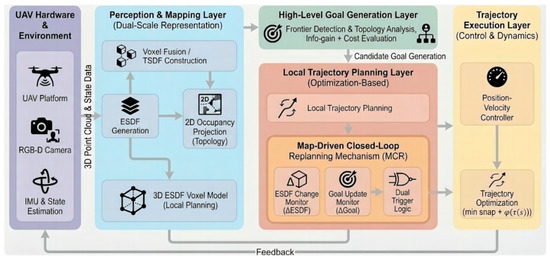
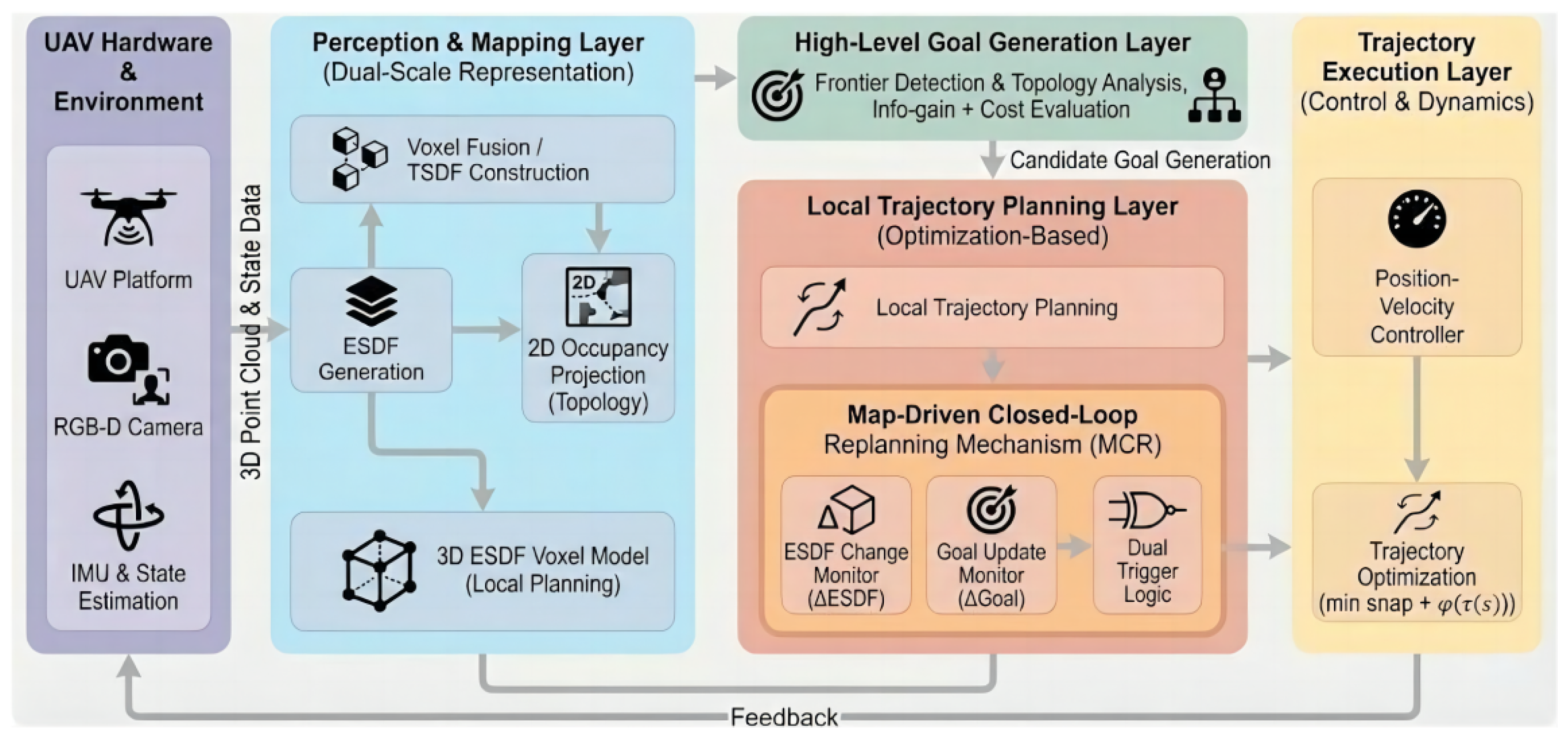
This work develops an autonomous UAV navigation system for unknown indoor environments, built upon a unified closed-loop architecture that integrates three-dimensional distance-field-based mapping, topology-driven goal generation, and optimization-based local trajectory planning. By tightly coupling exploration, planning, and control within a single feedback loop, the proposed system enables stable, continuous, and adaptive autonomous flight in complex indoor spaces. The overall architecture of the system as shown in Figure 1.
Figure 1.
Overall architecture of the map-change-driven hierarchical exploration–planning–control closed-loop system for UAV autonomous navigation.
At the perception and environment mapping layer, the UAV continuously acquires three-dimensional point cloud data using onboard depth sensors. A voxel-based fusion strategy is employed to incrementally construct a Truncated Signed Distance Field (TSDF), which provides a continuous geometric representation of observed surfaces. Based on the TSDF, a Euclidean Signed Distance Field (ESDF) is generated via local distance propagation, offering continuously differentiable obstacle distance information for trajectory optimization and collision risk assessment. To balance global exploration efficiency and local planning accuracy, the environment is represented at two complementary scales:
- 1.
- A two-dimensional occupancy grid map is obtained by vertically projecting the three-dimensional distance field, which is used for frontier detection and topological structure analysis.
- 2.
- The full three-dimensional ESDF voxel representation is retained to constrain local trajectory optimization and to evaluate flight safety margins.
At the high-level goal generation layer, the system detects frontiers corresponding to the boundaries between known and unknown regions using the two-dimensional projected map. Candidate exploration goals are then generated by jointly considering spatial connectivity and information gain. This topology-aware goal generation strategy effectively reduces frequent goal switching and redundant coverage, providing stable and continuous task-driven inputs to the local planning module.
At the local trajectory planning layer, a continuous-space optimization problem is formulated using the three-dimensional ESDF as the primary constraint. The planner generates smooth, collision-free trajectories from the current state to the selected goal while satisfying the UAV’s dynamic constraints. To ensure that planning remains consistent with incremental map updates, a map-change-driven closed-loop replanning mechanism (MCR) is introduced. The system continuously monitors structural changes in the distance field within the trajectory neighborhood as well as updates in exploration goals, and immediately triggers replanning once either condition exceeds a predefined threshold. In this way, the planned trajectory remains aligned with the evolving feasible space revealed by the map.
At the trajectory execution layer, a position–velocity closed-loop controller converts the optimized trajectories into executable attitude and velocity commands. Real-time state feedback is used to compensate for mapping uncertainties and external disturbances, thereby reducing trajectory deviation during execution. Outputs from the planning and control modules are further fed back to the mapping and goal generation layers, forming a complete perception–mapping–decision–planning–control closed loop.
Overall, by coupling three-dimensional distance-field modeling, topology-driven exploration, and optimization-based trajectory planning within a unified closed-loop structure, the proposed framework achieves robust autonomous navigation in complex unknown indoor environments. The resulting system provides a clear, responsive, and stable solution for indoor UAV navigation tasks.
3.2. Map Construction and Environment Representation
To enable stable autonomous navigation of UAVs in unknown indoor environments, the system requires an environment representation that simultaneously captures spatial structure and safety constraints. This work adopts a voxel-based continuous spatial modeling approach to perform online geometric reconstruction and distance field estimation, thereby providing a unified environmental foundation for subsequent exploration decisions and trajectory planning.
During the environment perception stage, the UAV continuously acquires three-dimensional observations using onboard depth sensors. These observations are integrated into a three-dimensional voxel grid with fixed resolution. For a voxel centered at position X, the system computes the Euclidean distance to the nearest observed surface and constructs a signed distance function defined as follows:
where denotes the voxel center location, d(x) represents the Euclidean distance from x to the nearest observed surface, and and denote the free-space and occupied-space regions, respectively.
This representation explicitly distinguishes free space from occupied regions and provides continuous geometric information for constructing safety constraints in subsequent planning stages.
To account for sensor measurement noise and real-time computational requirements, a truncated signed distance field formulation is adopted, defined as follows:
where is the signed distance function, and is the truncation distance controlling the valid range of the TSDF.
By selecting an appropriate truncation distance , the influence of outlier observations on global mapping quality can be effectively suppressed, thereby improving the robustness of the model in complex environments. During multi-frame data fusion, the distance value of each voxel is updated using a standard weighted integration scheme, defined as follows:
where and denote the previous TSDF value and the current observation, respectively, while and are their corresponding weights. and denote the updated distance value and accumulated weight after fusion. Here, denotes the accumulated TSDF fusion weight stored in the voxel from previous updates, and denotes the per-observation integration weight for the current depth measurement. Following a standard TSDF fusion scheme, we use a constant for each valid update and cap the accumulated weight to prevent overweighting.
Based on the TSDF representation, the system further constructs a Euclidean Signed Distance Field (ESDF), which is mathematically defined as follows:
This distance field provides, for any point in continuous space, the minimum distance to the nearest obstacle, thereby enabling quantitative evaluation of safety margins.
To balance global exploration efficiency and local planning accuracy, a dual-scale map representation is designed. Specifically, a two-dimensional occupancy map is constructed by vertically projecting and fusing the three-dimensional distance field, defined as follows:
The two-dimensional map is primarily used for extracting unknown region boundaries and generating exploration targets, whereas the three-dimensional distance field supports fine-grained trajectory planning and flight safety evaluation. This design effectively decouples high-dimensional continuous environment modeling from low-dimensional, efficient decision-making.
Through this dual-scale representation, the system can continuously construct a consistent spatial model in unknown environments, providing accurate and up-to-date environmental constraints for the subsequent map-change-driven closed-loop replanning mechanism.
3.3. Hierarchical Goal-Guided Exploration Strategy
In unknown indoor environments, a UAV must continuously expand the observable space while ensuring trajectory feasibility and flight safety. To this end, this work designs a hierarchical goal-guided exploration strategy that infers exploration directions from two-dimensional topological structures and evaluates goal quality using three-dimensional distance field information. This design enables exploration behaviors that are efficient, stable, and well aligned with downstream planning requirements. The proposed strategy consists of three core components: two-dimensional frontier extraction, candidate goal generation, and hierarchical goal evaluation.
3.3.1. Two-Dimensional Frontier Extraction and Region Clustering
First, the system derives a two-dimensional occupancy grid map from the three-dimensional ESDF representation, defined as follows:
where free, occ, and unknown denote free space, occupied space, and unobserved regions, respectively.
Based on this occupancy grid map, frontier points are identified according to the classical definition, given as follows:
Subsequently, connected-component clustering methods, such as breadth-first search (BFS) or DBSCAN, are applied to group frontier points into a set of frontier regions, defined as follows:
Each frontier region represents a potentially expandable area of the environment, whose geometric scale and topological location are used to guide subsequent exploration goal generation.
3.3.2. Candidate Goal Generation
Given the set of extracted frontier clusters, the system assigns a three-dimensional candidate goal to each cluster for local trajectory planning. To ensure goal stability and geometric reachability, a three-stage generation procedure is adopted, consisting of centroid-based initialization, ESDF-guided refinement, and feasibility filtering.
- (1)
- Frontier Centroid Initialization
For each frontier cluster, the grid-based centroid is first computed and used as the initial candidate goal:
where denotes the set of grid cells belonging to the frontier cluster.
- (2)
- ESDF-Guided Refinement of the Feasible Space
Since the centroid may lie in locally constrained regions with limited clearance, the candidate goal is further refined using the gradient information of the Euclidean Signed Distance Field (ESDF) to enhance safety.
where is the goal refinement step size.
This refinement step biases the candidate goal toward safer directions in the local free space, making it more suitable as a terminal constraint for subsequent trajectory optimization.
- (3)
- Reachability Constraint Enforcement and Height Alignment
To ensure that each candidate goal lies within a region that can be reliably planned and executed, the refined goals are subjected to a reachability filtering process.
where denotes a predefined safety threshold. Candidate goals that violate this constraint are discarded from the set.
In addition, to maintain consistency with the UAV’s flight layer, the remaining goals are projected onto the current flight altitude.
Following these steps, a refined set of candidate goals is obtained for both planning and replanning.
where indicates that the set contains only those goals that are reachable, structurally stable, and associated with sufficient safety margins.
3.3.3. Hierarchical Goal Evaluation and Optimal Goal Selection
After the candidate frontier regions have been identified, the system selects a target that offers both high exploration value and reliable reachability. To this end, a hierarchical goal evaluation mechanism is employed, jointly considering information gain and path cost to assess candidate goals from the perspectives of environmental coverage and execution cost.
- (1)
- Information Gain
Information gain characterizes the amount of unexplored space in the vicinity of a candidate goal and serves as a key measure of its exploration value. It is defined as follows:
where represents the local neighborhood around the candidate goal, and denotes the indicator function. Goals surrounded by a higher proportion of unknown cells yield greater information gain, thereby accelerating the exploration process.
- (2)
- Trajectory Cost
The path cost reflects the reachability of a goal from the current pose as well as the associated execution effort. Based on the ESDF, a locally feasible trajectory is constructed from the current state to the candidate goal , and its length is used as the cost metric:
A lower cost indicates a shorter, smoother, and safer flight trajectory, thereby reducing both planning effort and overall mission duration.
- (3)
- Composite Scoring and Optimal Goal Selection
To balance exploration efficiency with planning feasibility, the system combines information gain and path cost through a linear weighting scheme to construct a composite goal scoring function:
The optimal goal is then selected by maximizing this score.
where g represents the candidate goal set, allowing the system to flexibly balance information gain against execution cost.
- (4)
- Goal Stability Assessment and MCR Triggering
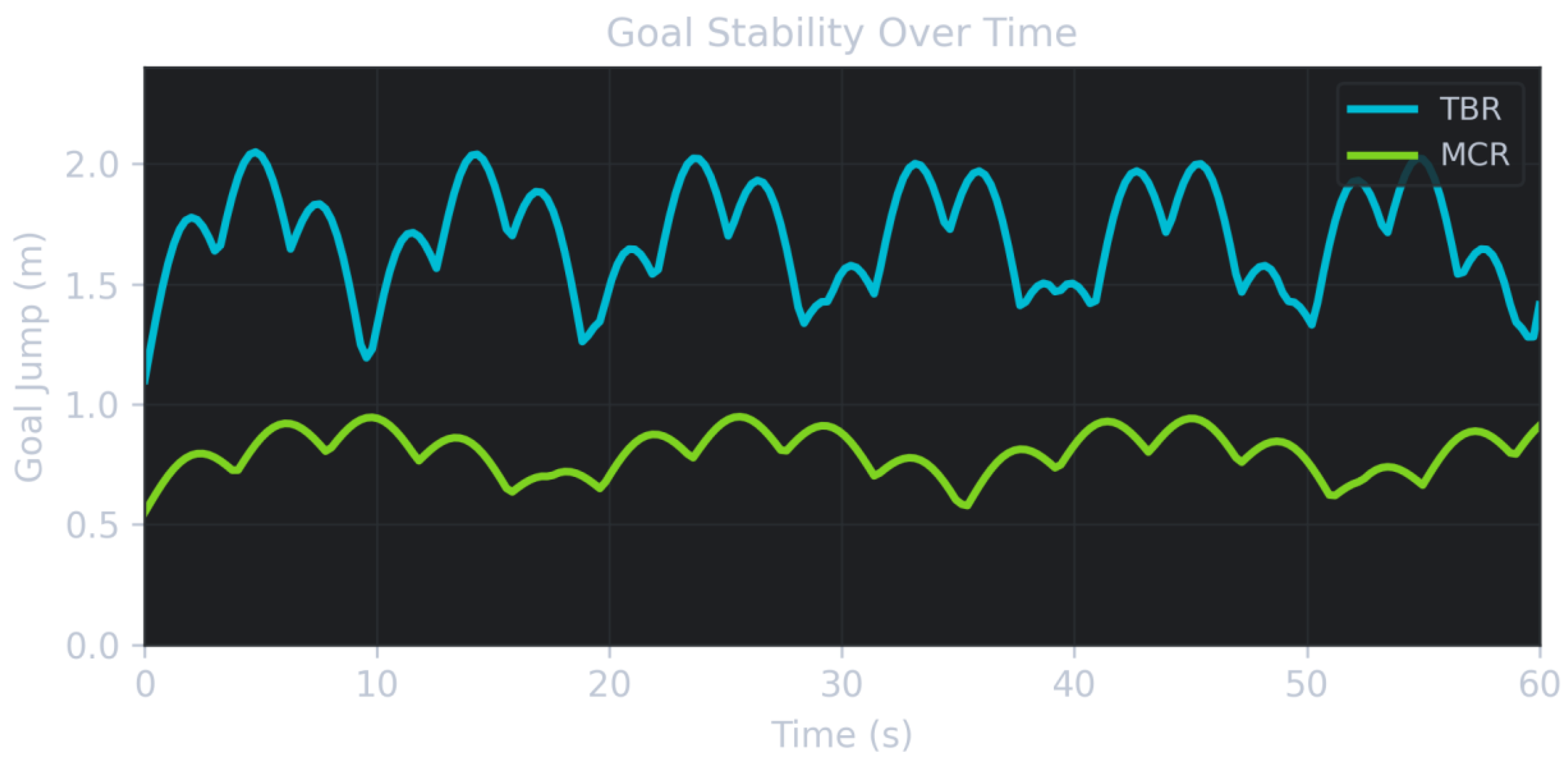
Frequent goal switching during target selection can lead to unstable trajectory planning and even oscillatory behaviors. To mitigate this issue, a goal stability constraint is introduced by monitoring the magnitude of change between consecutive optimal goals:
If the deviation surpasses the threshold , a significant goal change is declared and replanning is initiated. This design is tightly coupled with the proposed MCR, enabling goal updates to directly serve as an event trigger for trajectory replanning.
In summary, the proposed hierarchical goal-guided exploration strategy builds upon frontier detection by incorporating two-dimensional topological analysis and three-dimensional distance-field-based feasibility validation, resulting in goal generation that is both more stable and planning-aware. By jointly evaluating information gain and path cost, the system balances exploration efficiency with flight reachability, while the goal stability mechanism further mitigates trajectory oscillations caused by frequent target switching. As a result, the exploration goals produced in Section 3.3 serve as well-structured and reliable inputs to the map-change-driven replanning mechanism introduced in Section 3.4, enabling a seamless transition from goal selection to trajectory optimization and supporting sustained, adaptive UAV navigation in unknown environments.
3.4. Map-Change-Driven Closed-Loop Replanning Mechanism (MCR)
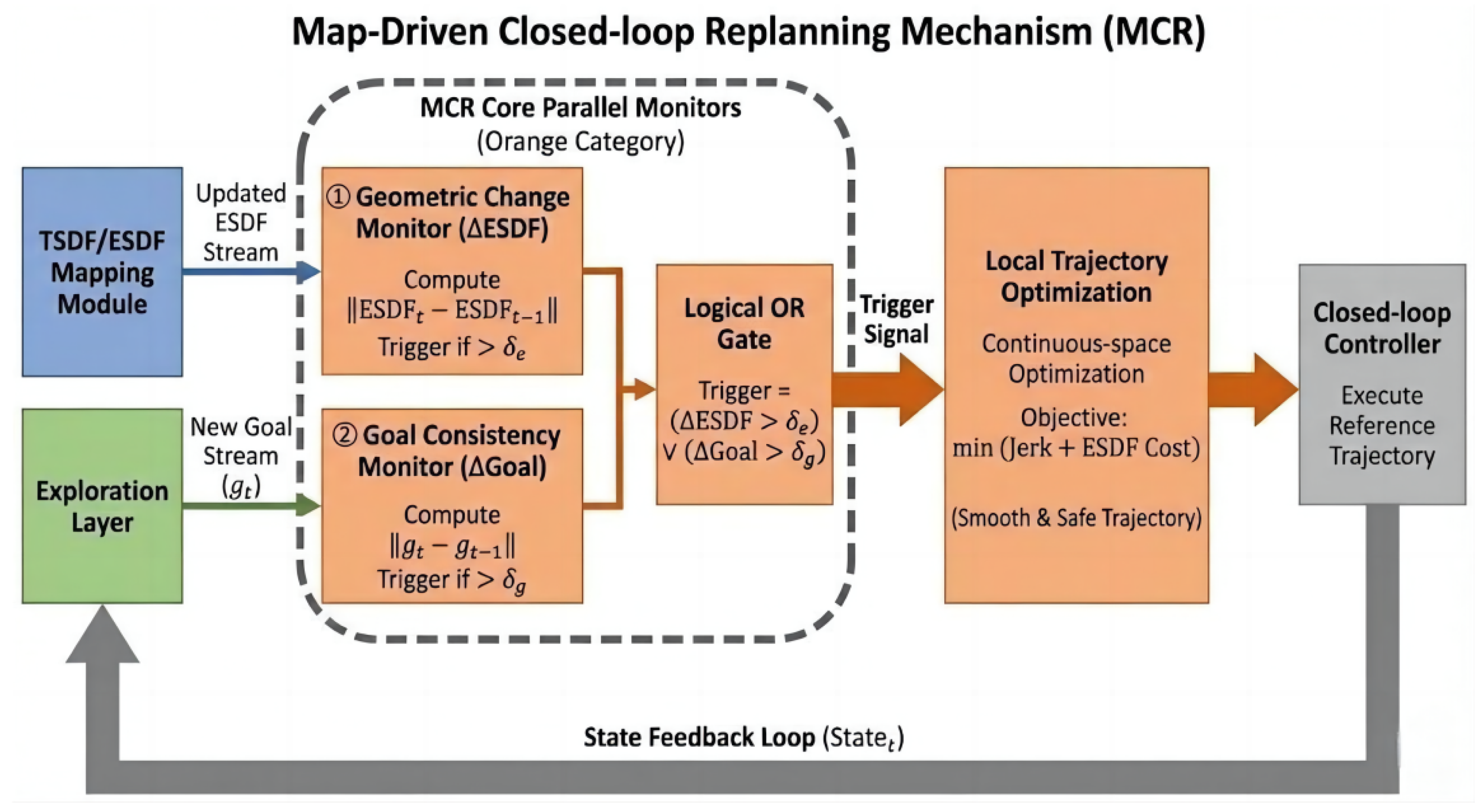
He proposed MCR receives event signals from both map structural changes and updates in high-level exploration goals, where goal variations act as task-level triggers and, together with ESDF structural changes, form a unified replanning trigger mechanism. In unknown indoor environments, as sensor measurements are continuously integrated into the map, the Euclidean Signed Distance Field (ESDF) is incrementally updated, causing the feasibility and safety of previously planned trajectories to evolve over time. When fixed-interval, time-triggered replanning is employed, the system cannot adapt its replanning frequency to actual structural changes in the environment, often resulting in redundant computation or delayed responses. To address this limitation, a map-change-driven closed-loop replanning mechanism (MCR) is introduced, which uses local map structural variations and goal update magnitudes as triggering signals, enabling timely adaptation to the incremental map revelation process.
The system first constructs a local monitoring region around the current optimized trajectory
This region is used to capture potential structural changes in the surrounding environment. For any point , if the difference between the ESDF values at two consecutive time steps satisfies:
In the experiments, the monitoring radius was set to = 2.0 m, the map-change threshold was set to = 0.15 m, and the goal-drift threshold was set to = 0.3 m.
Such changes indicate the emergence of new obstacles or a contraction of the local free-space boundary in the vicinity of the trajectory. As a result, the previously planned trajectory may deviate from the true feasible space. This condition is therefore treated as a planning validity violation event and immediately triggers replanning.
Beyond geometric changes in the environment, the high-level exploration module may also update the optimal goal during exploration. To prevent frequent goal switching from inducing discontinuities in the planned trajectory, MCR additionally monitors the magnitude of goal changes:
When the change exceeds a predefined threshold, the system considers the task-driven direction to have undergone a significant drift, necessitating trajectory regeneration. By incorporating goal variations into the same event-triggered framework, MCR tightly couples exploration goal generation with local trajectory planning.
Once any triggering condition is satisfied, the system solves a local trajectory optimization problem based on the updated ESDF. The planning process adopts a joint optimization formulation that combines minimum-acceleration objectives with distance-field–based obstacle costs, yielding the following continuous optimization model:
where is the weighting coefficient, denotes the trajectory acceleration term, which is introduced to promote trajectory smoothness, while represents the obstacle cost function constructed from the ESDF, penalizing trajectory points that approach obstacles.
The optimization is subject to the UAV’s dynamic constraints as well as terminal boundary conditions, expressed as: . The resulting optimal trajectory is subsequently converted into executable attitude and velocity commands by the low-level controller and executed in closed loop. The resulting state feedback is then fed back to the mapping and goal generation modules, thereby closing the perception–planning–control loop.
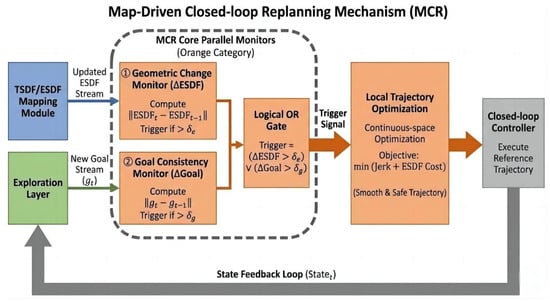
By explicitly binding replanning triggers to both environment structure revelation and exploration goal changes, MCR keeps trajectory updates consistent with the underlying environmental dynamics. Compared with conventional time-driven strategies, this mechanism substantially reduces redundant computation, improves responsiveness to critical environmental changes, and enhances overall navigation stability and safety in complex indoor environments. The Illustration of the map-change-driven closed-loop replanning mechanism based on ESDF structural variations and exploration goal updates as shown in Figure 2.
Figure 2.
Illustration of the map-change-driven closed-loop replanning mechanism based on ESDF structural variations and exploration goal updates.
4. Experiment and Result
4.1. Simulation Platform and Environment Setup
To systematically evaluate the proposed map-change-driven closed-loop autonomous navigation framework, a high-fidelity indoor simulation platform was developed based on Gazebo and ROS. The platform is designed to accurately reproduce the incremental map construction process in unknown environments without any prior map information, while capturing the geometric constraints and visibility challenges commonly encountered in indoor scenarios. This provides a reliable and reproducible testbed for performance evaluation.
The UAV platform is modeled as a quadrotor in Gazebo, with a body size of 0.32 m × 0.32 m × 0.12 m. The maximum translational velocity is limited to 2.5 m/s, and the maximum angular velocity is constrained to 2.0 rad/s. A simulated RGB-D depth sensor is mounted on the UAV, featuring a 90° field of view and a 20 Hz depth sampling rate. A depth noise model consistent with real RGB-D sensors is incorporated to emulate perception uncertainty and its impact on mapping and planning.
Environment representation is based on voxelized TSDF/ESDF modeling. The TSDF is constructed with a voxel resolution of 0.10 m, with point clouds continuously integrated at 20 Hz. The ESDF is updated at 10 Hz, providing continuous and differentiable obstacle distance information for trajectory optimization. In addition, a two-dimensional occupancy grid map with a resolution of 0.15 m is generated by projecting the ESDF along the vertical axis, which is used for frontier detection and exploration goal generation. This dual-scale representation enables tight coupling between global topological reasoning and local geometric constraints.
The entire autonomous navigation system is implemented using a modular ROS architecture, including nodes for sensor processing, voxel-based mapping, exploration goal generation, replanning triggering, local trajectory optimization, and trajectory execution control. All modules communicate via standard ROS messages. The simulation runs with a fixed time step of 10 ms, and the control loop operates at 100 Hz, ensuring temporal consistency and real-time dynamic simulation.
All experiments are conducted on a workstation equipped with an NVIDIA RTX 4090 GPU and an AMD Ryzen 5900X CPU. The GPU is primarily used to accelerate simulation-related components, including TSDF and ESDF updates. Frontier detection and distance-field-based trajectory optimization are executed on CPU within the proposed framework. The average trajectory re-optimization time per trigger is approximately 25 ms, ensuring stable real-time performance and overall responsiveness of the closed-loop navigation system.
Based on this simulation platform, the proposed framework can be comprehensively evaluated in terms of mapping quality, exploration goal stability, replanning responsiveness, and closed-loop control performance in unknown indoor environments, providing a solid foundation for subsequent comparative experiments and performance analysis.
For the Map Success Rate (MSR) evaluation, each scenario was repeated 20 independent trials using different random seeds to ensure statistical robustness. The reported MSR values correspond to the average performance across all trials. The unknown environments were procedurally generated with variations in obstacle density, corridor width, and spatial layout to ensure sufficient structural diversity. This setup enables a fair comparison of replanning strategies under different map conditions.
To further quantify computational efficiency, the average trajectory re-optimization time per trigger was measured. On the RTX4090 + Ryzen 5900X platform, the mean runtime is approximately 25 ms. This measurement corresponds solely to the trajectory optimization stage. ESDF updates operate at 10 Hz and the low-level controller runs at 100 Hz independently within the closed-loop pipeline.
The procedurally generated unknown environments include variations in obstacle density, corridor width, and spatial topology. These variations produce structurally different map configurations, enabling evaluation under diverse environmental conditions. All reported results correspond to averaged performance across these generated scenarios. The performance trends discussed below are consistent across the generated map configurations.
4.2. Baseline Methods and Evaluation Metrics
To systematically evaluate the navigation performance of the proposed map-change-driven closed-loop replanning mechanism (MCR) in unknown indoor environments, a unified experimental comparison framework is established. Two representative replanning strategies are selected as baselines, and all methods are evaluated under identical environmental conditions, perception noise models, and control parameters. Multiple trials are conducted for each configuration to ensure objectivity, fairness, and reproducibility of the experimental results.
4.2.1. Baseline Methods
To assess the overall advantages of MCR in terms of navigation safety, trajectory stability, planning efficiency, and computational cost, three representative methods are selected as baseline approaches for comparison:
- (1)
- Single-Shot Planning (SSP)
Single-shot planning generates a trajectory once at the beginning and executes it without any further replanning during navigation. No trigger mechanism is employed in this baseline.
- (2)
- Time-Based Replanning (TBR)
Time-based replanning re-optimizes the trajectory at fixed time intervals. Specifically, replanning is triggered periodically every seconds, independent of environmental changes or map updates.
- (3)
- Map-Change-Driven Closed-Loop Replanning (MCR)
This mechanism adaptively triggers replanning based on environmental changes. Specifically, the system continuously monitors whether the absolute ESDF value difference between consecutive updates exceeds a predefined threshold , as defined in Equation (20). In addition, the system monitors whether the change in the optimal goal selected by the exploration layer exceeds a predefined threshold . Once either condition is satisfied, the system immediately initiates trajectory re-optimization.
To ensure a fair comparison, all three methods employ the same ESDF-based trajectory optimizer and identical low-level controller, differing only in their replanning trigger mechanisms.
4.2.2. Evaluation Index System
To comprehensively evaluate the navigation performance of different replanning strategies in unknown indoor environments, a systematic set of evaluation metrics is defined, covering reliability, safety, efficiency, and computational load. All experiments are repeated ten times under identical initial conditions, goal locations, and environments, with a fixed random seed to ensure fairness and reproducibility.
- (1)
- Success Rate (SR)
The success rate is defined as the proportion of trials in which the UAV successfully reaches the target without any collision, serving as an overall indicator of system reliability.
- (2)
- Average Path Length (APL)
This metric evaluates navigation efficiency.
Given a flight trajectory represented as a sequence of discrete states . The path length is defined accordingly.
Shorter paths generally indicate higher planning quality and more efficient execution.
- (3)
- Completion Time (CT)
Task completion time reflects the efficiency of trajectory execution and the convergence behavior of the system. Given a control frequency of and a total of T discrete steps along the executed trajectory, the completion time is defined as:
- (4)
- Collision Count (CC) and Minimum Clearance (MC)
These metrics are used to evaluate the system’s safety when navigating through narrow passages and cluttered shelving structures. The minimum clearance is defined as:
where denotes the obstacle distance provided by the Euclidean Signed Distance Field (ESDF). The collision count (CC) is defined as the cumulative number of collision events during task execution.
- (5)
- Replanning Frequency (RF)
Replanning Frequency (RF) is used to measure the total number of times the planner is triggered during a task, reflecting the impact of map changes on the computational load.
- (6)
- Tracking Error (TE)
It is used to evaluate the tracking performance of the closed-loop controller with respect to the reference trajectory . Tracking Error (TE) is defined as the root mean squared error (RMSE) between the executed trajectory and the reference trajectory :
This metric reflects the stability of closed-loop execution and the accumulation of tracking deviations over time.
4.3. Experimental Results and Analysis
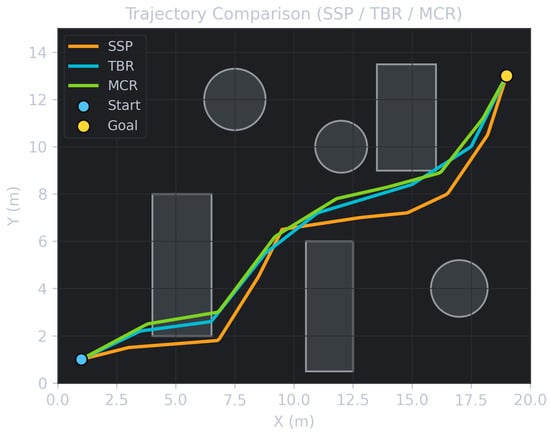
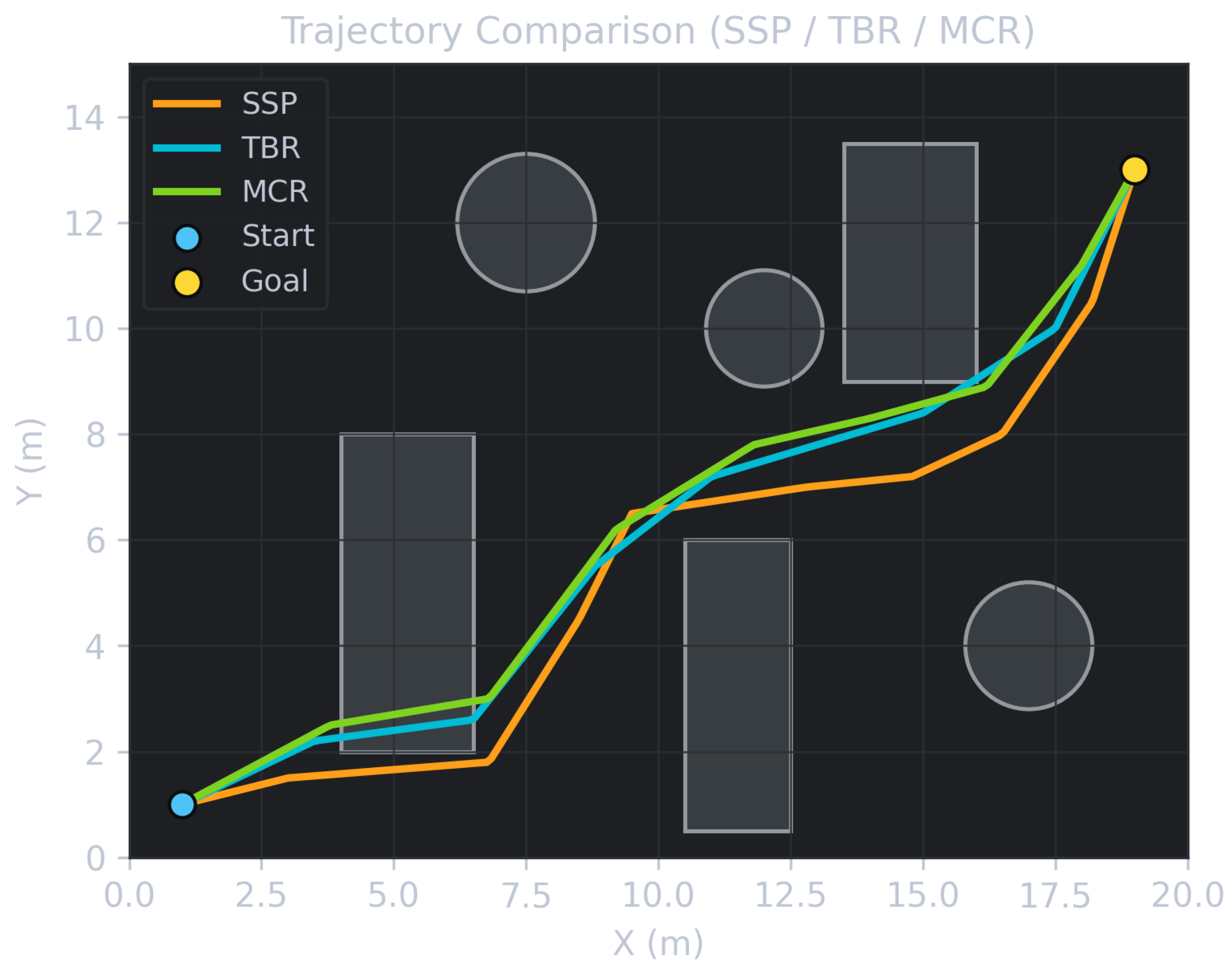
Figure 3, Figure 4, Figure 5, Figure 6, Figure 7, Figure 8, Figure 9 and Figure 10 illustrate representative trajectory behaviors, safety statistics, and replanning characteristics under identical environmental conditions. Based on the quantitative results summarized in Table 1, this section provides a comprehensive evaluation of the proposed map-driven closed-loop replanning mechanism (MCR) in comparison with the two baseline methods (SSP and TBR), from four complementary perspectives: task reliability, trajectory quality, safety performance, and computational load. The performance trends discussed below are consistent across the generated map configurations.
Figure 3.
Trajectory comparison of SSP, TBR, and MCR in a partially explored indoor environment.
Table 1.
Performance comparison of different replanning strategies for UAV navigation in unknown indoor environments.
4.3.1. Task Reliability
Task success rate (SR) is used to evaluate the overall reliability of the UAV navigation system in unknown indoor environments. It is defined as the proportion of trials in which the mission is completed successfully without collision or planning failure.
Experimental results indicate that SSP achieves a success rate of only 70%. Since this strategy performs trajectory planning only once at the beginning of the mission, it lacks the capability to adapt to incremental map updates during exploration. As newly revealed obstacles and narrow structures emerge, discrepancies between the planned trajectory and the true feasible space gradually accumulate. This effect is particularly pronounced in shelf-dense areas and narrow corridors, leading to frequent path invalidation and a substantially increased risk of collision.
To illustrate the behavioral differences among strategies, Figure 3 shows trajectory comparisons of SSP, TBR, and MCR in a representative indoor scenario. As the UAV enters a partially explored narrow passage, the initially planned trajectory of SSP becomes progressively less aligned with the incrementally revealed feasible space. In contrast, both TBR and MCR update the trajectory using newly available map information. Among them, MCR maintains better geometric consistency between the planned path and the evolving environment due to its event-driven replanning mechanism.
In contrast, TBR improves the task success rate to 85% by periodically replanning the trajectory at fixed time intervals. By incorporating updated map information, periodic replanning partially mitigates the degradation of trajectory validity over time. However, because the replanning trigger is decoupled from actual environmental changes, delayed responses still occur when critical obstacles are newly perceived or when local free space rapidly shrinks.
The proposed MCR method achieves the highest task success rate among all evaluated strategies, reaching 96%. By directly using structural changes in the local ESDF as replanning triggers, MCR enables immediate trajectory updates whenever underlying geometric constraints change significantly. As illustrated in Figure 3, under the same scenario, MCR newly revealed obstacles while maintaining consistency between the planned trajectory and the feasible space, thereby completing the mission reliably.
Overall, both quantitative results and representative mission examples demonstrate that introducing a map-change-driven replanning mechanism is essential for improving task reliability in unknown indoor navigation scenarios.
4.3.2. Trajectory Quality
Trajectory quality is a key indicator of autonomous navigation performance, reflecting path efficiency, trajectory continuity, and execution stability. In this study, trajectory quality is evaluated using two metrics: the Average Path Length (APL) and the Tracking Error (TE).
As shown in Figure 4, the Single-Shot Planning (SSP) strategy results in the longest average path length, reaching 31.4 m. Since no replanning is performed during task execution, the initially planned trajectory progressively deviates from the true feasible space as the environment is incrementally revealed. This mismatch forces the UAV to perform frequent detours or hesitation behaviors in local regions, leading to reduced navigation efficiency and significantly elongated flight paths.
Figure 4.
Comparison of flight trajectories generated by different replanning strategies in the same indoor scenario.
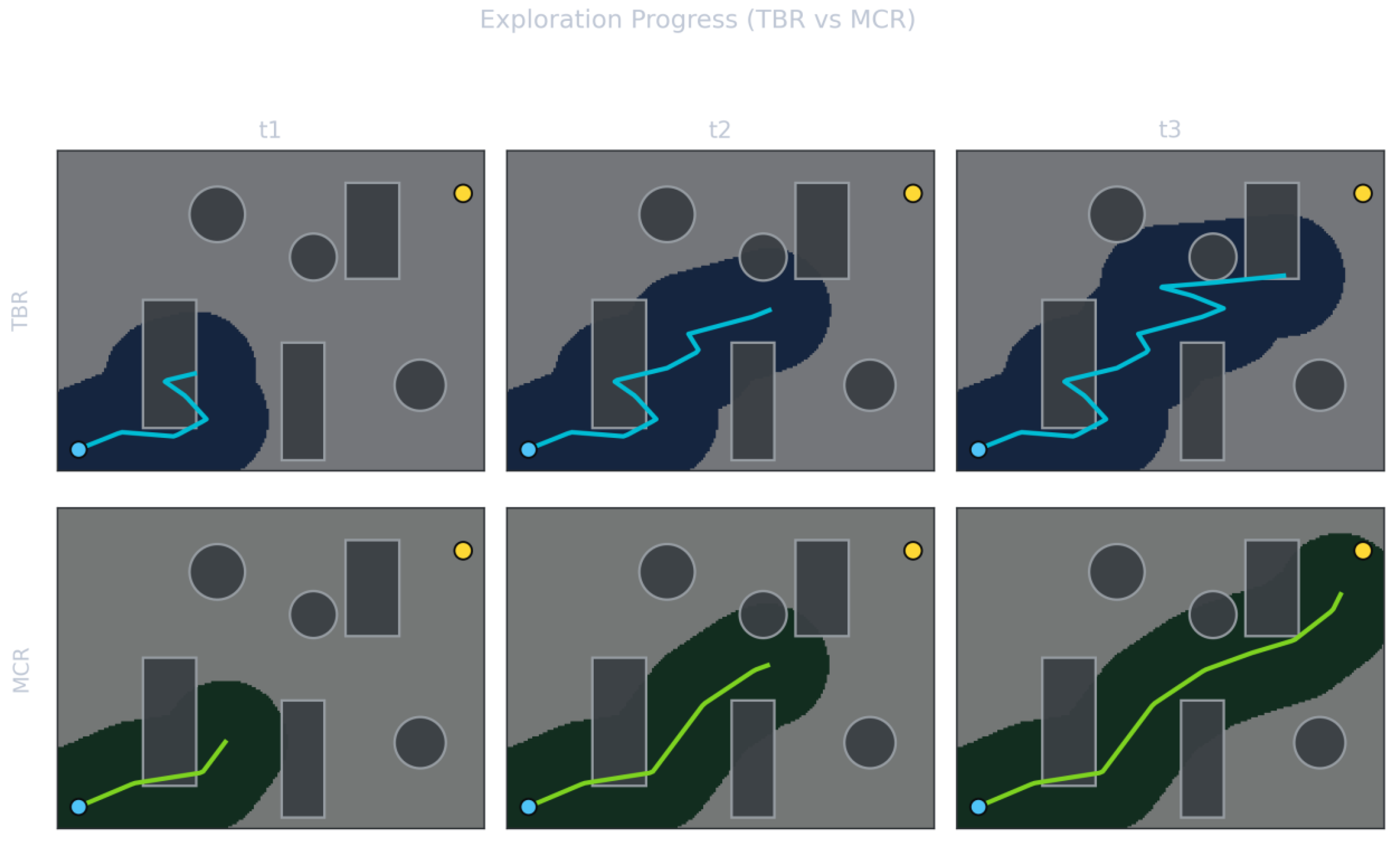
TBR reduces the average path length to 28.7 m, indicating that periodic replanning can partially improve navigation efficiency. However, because replanning is triggered at fixed time intervals rather than driven by actual environmental changes, trajectory updates often occur at suboptimal moments. This behavior frequently introduces spatial discontinuities in the planned paths, which are particularly pronounced at corridor corners and within narrow passages.
To provide a qualitative comparison of the trajectories generated by different methods, Figure 4 illustrates the flight paths produced by SSP, TBR, and MCR under identical environmental conditions and initial states. As shown in the figure, SSP exhibits substantial redundant detours in complex regions, while TBR produces abrupt trajectory changes near corners and in confined areas. In contrast, the trajectories generated by MCR are noticeably smoother and remain well aligned with the underlying geometric structure of the environment throughout the mission.
At the execution level, MCR achieves the shortest average path length (26.1 m), demonstrating its ability to exploit feasible free space more effectively while maintaining safety constraints. This advantage is further reflected in its trajectory tracking performance.
A closer examination of tracking error reveals that SSP suffers from the largest deviation (0.14 m), primarily due to the persistent mismatch between the preplanned trajectory and the evolving feasible space. TBR reduces the error to 0.11 m; however, pronounced error spikes still occur around replanning instants, indicating execution-level disturbances caused by trajectory discontinuities.
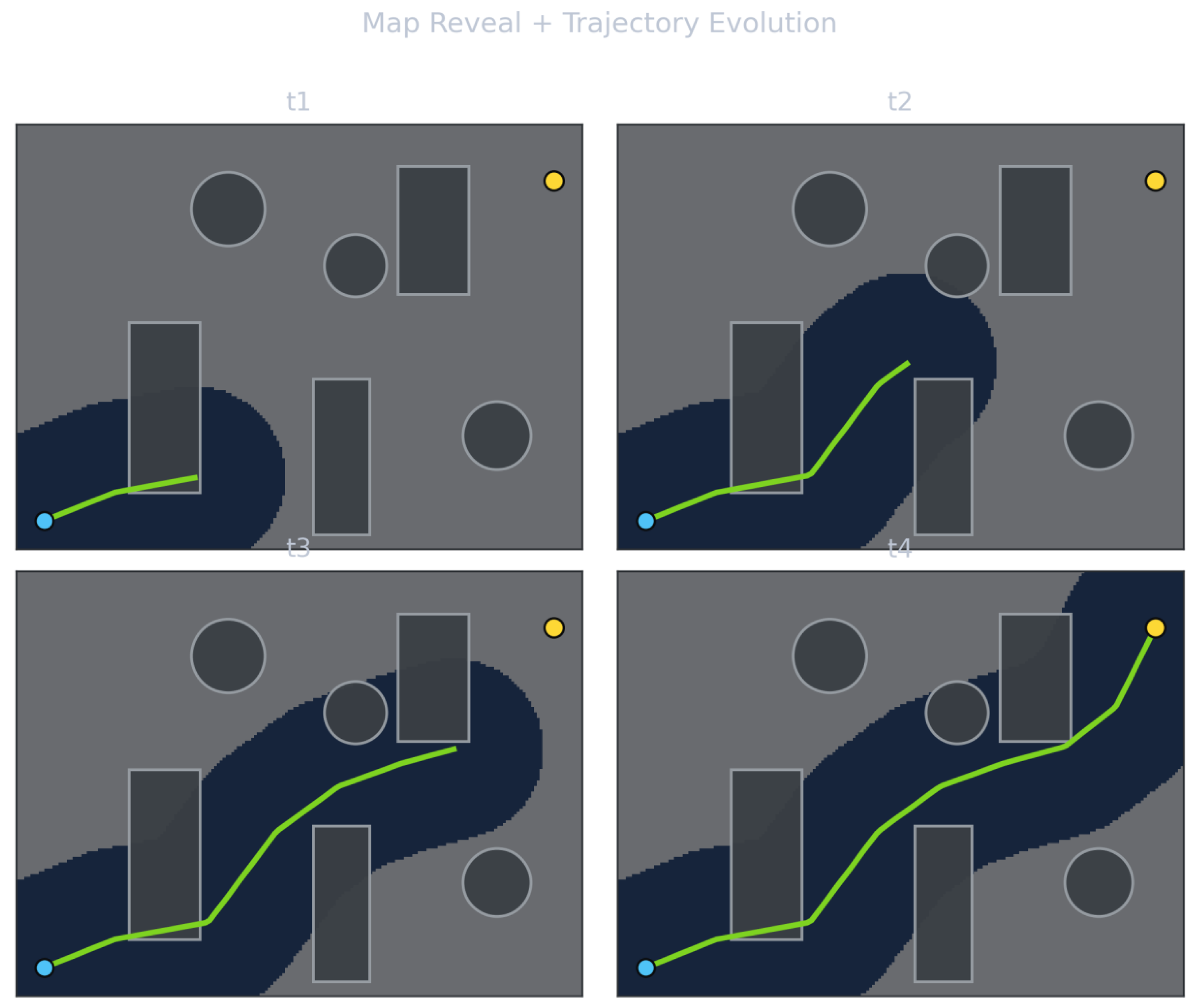
Figure 5 provides a qualitative visualization of trajectory evolution and replanning behavior under different strategies. Compared with the baseline methods, MCR achieves both the lowest magnitude and the smoothest error profile, with an average tracking error of 0.08 m. This result suggests that replanning events under MCR are concentrated at genuinely necessary moments, effectively avoiding unnecessary trajectory discontinuities and thereby ensuring stable and consistent flight execution.
Figure 5.
Visualization of trajectory evolution and replanning behavior under different strategies.
Overall, both the spatial comparison of trajectories and the temporal analysis of tracking errors demonstrate that a map-change-driven replanning mechanism can significantly improve trajectory efficiency, continuity, and execution stability in unknown indoor environments.
4.3.3. Safety Performance
Safety is one of the primary concerns in achieving autonomous UAV navigation in unknown indoor environments. In this study, system safety is evaluated using two metrics: Collision Count (CC) and Minimum Clearance (MC), which respectively capture discrete collision events during flight and the continuous safety margin maintained with respect to surrounding obstacles.
As shown in Figure 6, the SSP strategy exhibits the poorest safety performance among all evaluated methods. Across ten experimental runs, SSP results in an average of 4.2 collisions, with a minimum clearance of only 0.19 m. Owing to the absence of an online replanning mechanism, the initially planned trajectory rapidly becomes invalid as new environmental information is revealed. This leads to frequent near-collision behaviors and actual collisions, particularly in narrow corridors and shelf-dense regions.
In comparison, TBR demonstrates improved safety relative to SSP, with the minimum clearance increased to 0.23 m and a substantially reduced number of collisions. This improvement can be attributed to periodic replanning, which partially corrects outdated trajectories as the map evolves. However, since the replanning trigger remains decoupled from actual environmental changes, delayed responses may still occur when critical obstacles are newly perceived or when the local feasible space rapidly contracts.
Figure 6.
Collision statistics and safety performance comparison among different replanning strategies.
In contrast, MCR exhibits the strongest safety performance among all evaluated strategies. Throughout all experimental trials, MCR incurs no collisions, while achieving a significantly increased minimum clearance of 0.31 m. As illustrated in Figure 7, directly using local ESDF structural variations as replanning triggers enables timely trajectory adjustments as soon as potential risks emerge, thereby consistently maintaining a larger safety margin during navigation.
Figure 7.
Minimum clearance comparison for different replanning strategies during navigation tasks.
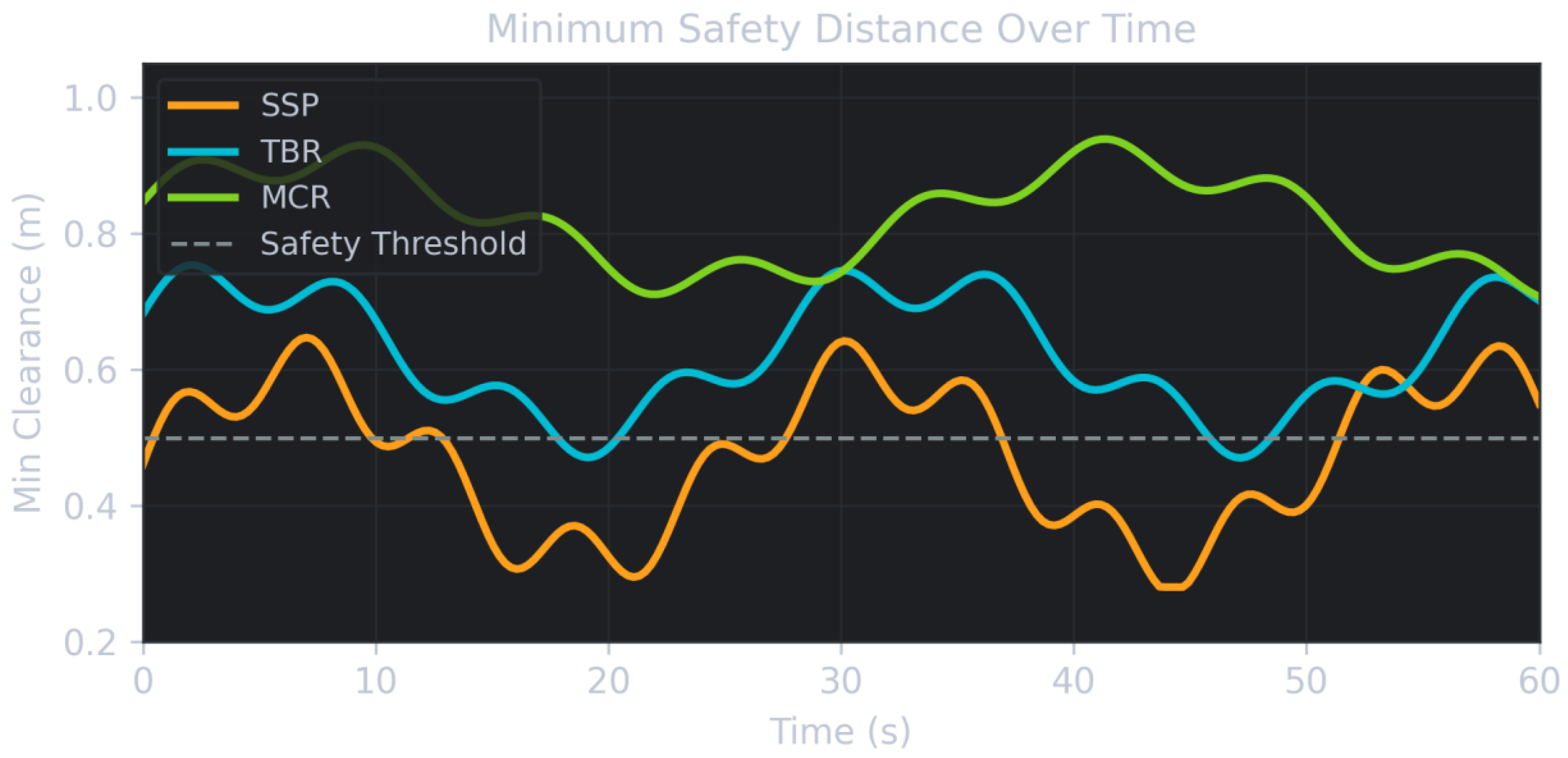
To further analyze the temporal evolution of safety margins, Figure 8 illustrates the variation of the minimum clearance over time under different replanning strategies. As shown in the figure, SSP frequently violates the safety threshold due to a persistent mismatch between the planned trajectory and the true feasible space. TBR is able to maintain a positive clearance in most cases; however, pronounced drops still occur when abrupt environmental changes are encountered. In contrast, MCR consistently preserves a larger safety margin throughout the mission, with substantially reduced fluctuations.
These observations indicate that a geometrically aware replanning mechanism driven by ESDF variations can effectively suppress risk accumulation during task execution, thereby significantly enhancing system safety and robustness in complex indoor environments.
Figure 8.
Temporal variation of minimum clearance along the executed trajectories.
4.3.4. Computational Load
In unknown indoor environments, autonomous navigation systems must strike a balance among safety, trajectory quality, and computational efficiency in order to satisfy real-time and deployment requirements. In this study, replanning frequency (Replanning Frequency, RF) is adopted as the primary metric for evaluating computational load, reflecting the number of times the planner is invoked during task execution.
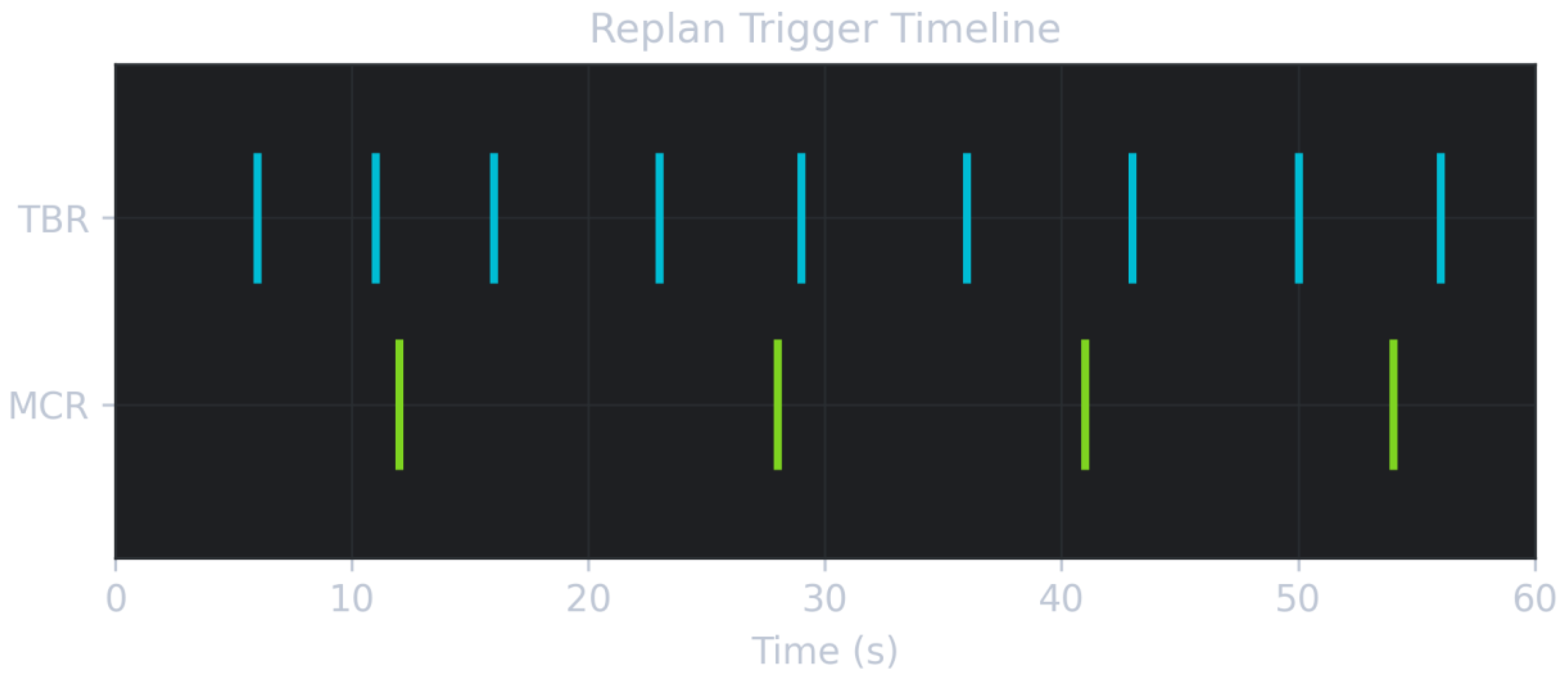
Experimental results show that TBR incurs the highest computational load, with an average replanning frequency of 14.6 times per mission. This behavior stems from the inherent nature of fixed-interval triggering: even when the environment remains stable and the current trajectory is still valid, the planner is repeatedly invoked, leading to substantial redundant computation unrelated to actual map changes.
SSP performs no replanning throughout execution, resulting in a replanning frequency of zero and thus the lowest planning overhead. However, as demonstrated in the preceding sections, this reduced computational cost comes at the expense of adaptability and reliability, with significantly degraded success rates and safety performance.
In contrast, the proposed MCR achieves the highest task success rate while triggering replanning only 6.1 times on average, reducing the computational load by approximately 58% compared to TBR. This result indicates that a map-change-driven, event-triggered replanning mechanism can effectively eliminate unnecessary planner invocations and concentrate computational resources on moments when trajectory updates are truly required.
To further analyze the temporal characteristics of replanning behavior, Figure 9 illustrates the time-series distribution of replanning events for different strategies in a representative mission. As shown in Figure 9, replanning events under TBR exhibit a periodic and dense distribution, reflecting a triggering logic that is decoupled from environmental evolution. In contrast, replanning events under MCR are markedly sparser and primarily concentrated during phases where significant structural changes occur in the environment.
These results demonstrate that directly coupling replanning triggers to map structure variations enables MCR to substantially reduce computational overhead without compromising navigation performance, making it particularly well suited for deployment on resource-constrained platforms and in multi-UAV cooperative systems.
Figure 9.
Temporal distribution of replanning events for TBR and MCR in a representative mission.
Based on the above experimental results, the proposed map-change-driven replanning mechanism (MCR) demonstrates consistent and significant advantages in terms of task success rate, safety, and computational efficiency. Beyond the observed quantitative performance gains, it is equally important to understand the underlying mechanisms that enable MCR to achieve robust navigation performance.
In unknown indoor environments, the process of map revelation is inherently non-uniform. New obstacles are often perceived abruptly at critical viewpoints or within narrow structures, rather than emerging gradually over time. If the replanning mechanism fails to respond promptly to such sudden geometric changes, previously planned trajectories can quickly become invalid, leading to mission interruption or a substantial increase in collision risk.
4.4. Results Discussion
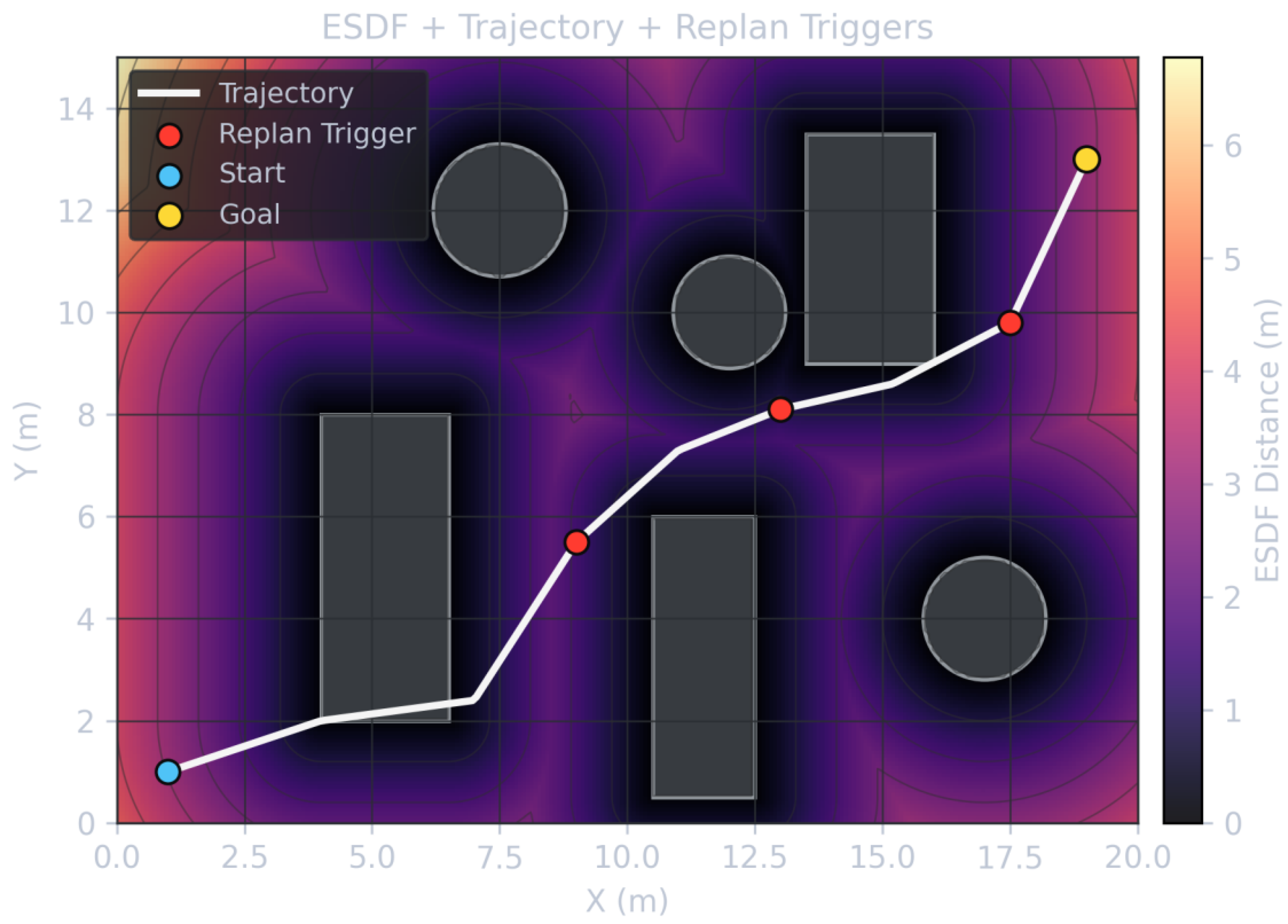
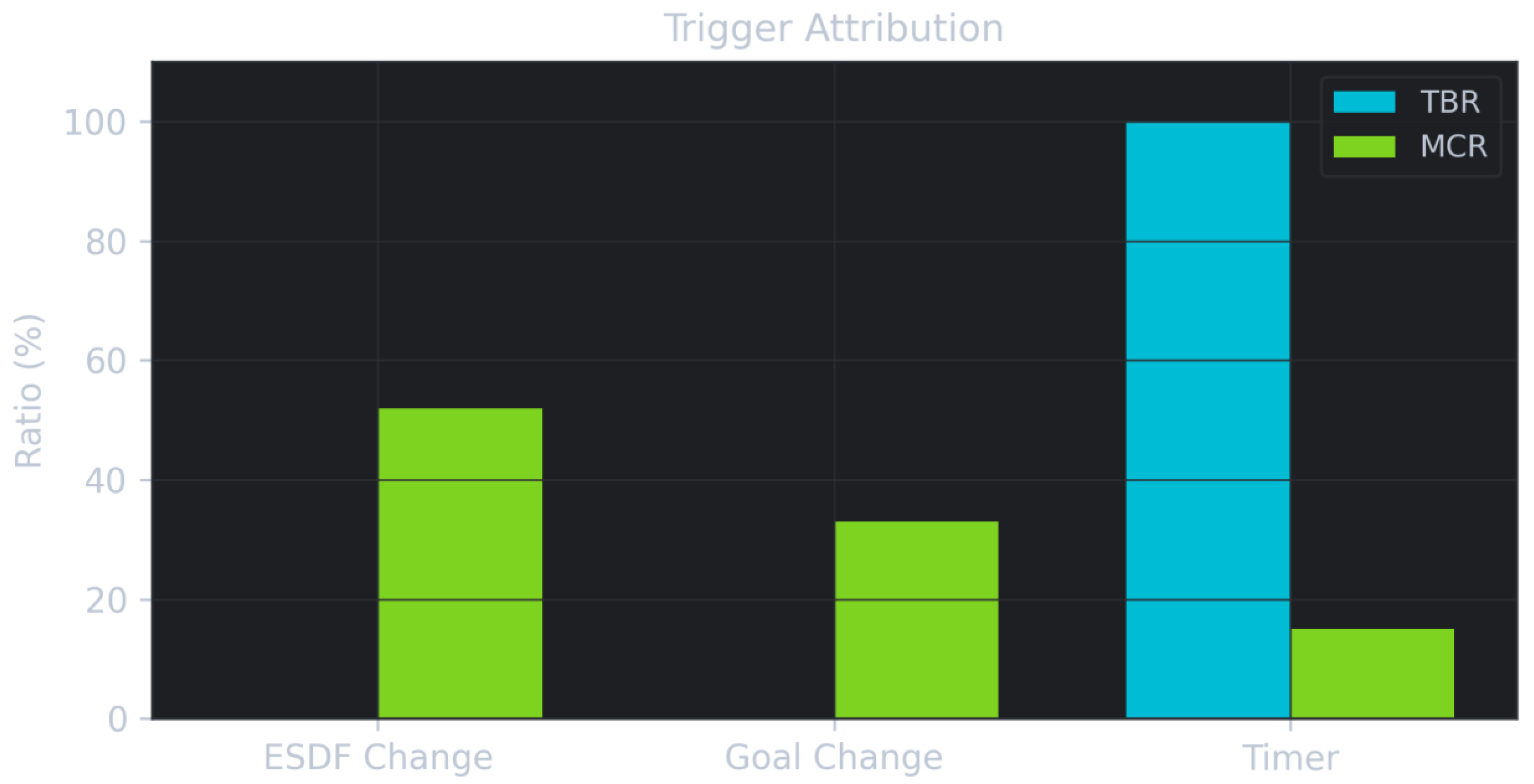
To illustrate the operating principle of MCR, Figure 10 provides a visual interpretation of the relationship among local ESDF structural variations, the current flight trajectory, and the replanning triggers. As the UAV follows a planned trajectory, MCR is immediately activated once significant changes in the ESDF distribution are detected within the trajectory neighborhood, such as free-space shrinkage or the emergence of newly observed obstacles, and a new trajectory is generated based on the updated distance field. This process ensures that the planned trajectory remains continuously consistent with the true feasible space.
In contrast, time-triggered replanning strategies do not explicitly account for map structural changes, resulting in a decoupling between replanning behavior and environmental evolution. When rapid geometric changes occur between two replanning cycles, the system may continue executing an outdated trajectory, leading to delayed responses. By directly coupling replanning triggers with geometric variations in the ESDF, MCR establishes a tight feedback loop between mapping and planning.
Figure 10.
Attribution analysis of replanning triggers under different strategies.
Therefore, the performance gains of MCR do not stem from a higher replanning frequency, but from triggering replanning at the right moments and for the right spatial regions. This mechanism enables precise intervention when critical changes in the environment structure occur, thereby avoiding unnecessary replanning updates while ensuring that the planned trajectory remains consistently aligned with the true feasible space.
4.5. Practical Deployment Considerations
Although the experimental validation was conducted entirely in simulation, practical deployment factors have been carefully analyzed. Indoor UAV navigation performance may be influenced by sensor noise, system latency, and state estimation drift. First, the ESDF update mechanism integrates spatial information over a voxel grid, which provides inherent smoothing against small measurement fluctuations. Since the replanning trigger is based on the absolute ESDF value difference exceeding a threshold , minor noise-induced perturbations are unlikely to cause false triggers.
Second, the proposed framework operates in a closed-loop manner. The replanning decision depends on accumulated structural map variations rather than instantaneous measurements. Therefore, moderate system latency does not directly induce instability unless it causes significant map inconsistency.
Third, while severe state estimation drift may degrade global map consistency during long-duration missions, the trigger mechanism does not rely on instantaneous gradient changes but on measurable distance-field variation. The threshold parameter can be tuned to balance sensitivity and robustness under real-world conditions.
Finally, although simulations were conducted on an RTX4090 platform for computational efficiency, the replanning module itself runs on CPU. The average replanning runtime per trigger is approximately 25 ms. Since the MCR strategy reduces redundant replanning events compared to fixed-interval strategies, the overall computational load remains manageable for onboard embedded platforms.
5. Conclusions
This paper addresses key challenges in autonomous UAV navigation within unknown indoor environments, where incremental map revelation, frequent structural changes, and a mismatch between replanning triggers and actual geometric variations often undermine navigation reliability. To this end, a map-change-driven closed-loop replanning mechanism (MCR) is proposed and integrated into a distance-field–based hierarchical exploration–planning–control framework.
Unlike conventional time-triggered replanning strategies, the proposed MCR explicitly monitors structural variations in the local Euclidean Signed Distance Field (ESDF) as well as significant updates in exploration goals, and triggers replanning only when meaningful changes in geometric constraints or task objectives occur. During periods of environmental stability, the replanning frequency is automatically reduced. This event-driven design enables the planning process to naturally adapt to the non-uniform and intermittent nature of map revelation in unknown environments, achieving a more effective balance between trajectory safety, consistency, and computational efficiency.
Comprehensive experiments conducted in a high-fidelity indoor warehouse simulation environment demonstrate that the proposed framework significantly outperforms single-shot planning and fixed-interval replanning baselines across multiple metrics, including task success rate, trajectory smoothness, safety margin, and replanning efficiency. These results validate the effectiveness of using map structural changes as the primary driver for replanning and confirm the proposed method’s ability to deliver reliable autonomous navigation performance in complex and spatially constrained indoor scenarios.
The proposed approach adopts a modular system design, facilitating straightforward integration into existing UAV navigation systems based on distance-field representations. Future work will focus on real-world indoor flight experiments to assess the impact of sensor noise, dynamic obstacles, and perception latency on system robustness. In addition, adaptive triggering threshold schemes and extensions to multi-UAV cooperative scenarios will be investigated to further enhance the scalability and practical applicability of the proposed replanning framework.
Author Contributions
All authors contributed to this work. Conceptualization, M.C.; methodology, M.C.; software, M.C.; validation, M.C.; visualization, M.C.; investigation, M.C.; writing—original draft, M.C.; writing—review and editing, Q.L. and X.L.; supervision, Q.L. and X.L.; project administration, Q.L. and X.L.; funding acquisition, Q.L. and X.L.; resources, Q.L. and X.L. All authors have read and agreed to the published version of the manuscript.
Funding
The Zhejiang Provincial Natural Science Foundation (No. LQN25F030011, LZ23F030004), National Natural Science Foundation of China Under Grants 62073108, Fundamental Research Funds for the Provincial Universities of Zhejiang under Grant No. GK259909299001-033, and Fundamental Research Project of Hangzhou Dianzi University (No. KYS065624391).
Data Availability Statement
The datasets generated during the current study are available if the reasonable request.
Conflicts of Interest
The authors declare no conflicts of interest.
References
- Chang, Y.; Cheng, Y.; Manzoor, U.; Murray, J. A review of UAV autonomous navigation in GPS-denied environments. Robot. Auton. Syst. 2023, 170, 104533. [Google Scholar] [CrossRef] [Scilit]
- Haider, Z.; Sreenan, C.J.; Brown, K.N.; O’Mahony, A. Indoor Autonomous Multi-UAVs: A Review of Current Research, Enabling Technologies and Open Challenges. IEEE Access 2025, 13, 212231–212265. [Google Scholar] [CrossRef] [Scilit]
- Wu, H.; Wang, W.; Wang, T.; Suzuki, S. Model-Free UAV Navigation in Unknown Complex Environments Using Vision-Based Reinforcement Learning. Drones 2025, 9, 566. [Google Scholar] [CrossRef] [Scilit]
- Zhang, X.; Wang, J.; Wang, S.; Wang, M.; Wang, T.; Feng, Z.; Zhu, S.; Zheng, E. FAEM: Fast Autonomous Exploration for UAV in Large-Scale Unknown Environments Using LiDAR-Based Mapping. Drones 2025, 9, 423. [Google Scholar] [CrossRef] [Scilit]
- Ye, Y.; Wang, X.; Gou, G.; Zhang, H.; Li, H.; Sui, H. Autonomous Exploration-Oriented UAV Approach for Real-Time Spatial Mapping in Unknown Environments. Drones 2025, 9, 844. [Google Scholar] [CrossRef] [Scilit]
- Ren, Y.; Zhu, F.; Lu, G.; Cai, Y.; Yin, L.; Kong, F.; Lin, J.; Chen, N.; Zhang, F. Safety-assured high-speed navigation for MAVs. Sci. Robot. 2025, 10, eado6187. [Google Scholar] [CrossRef] [Scilit]
- Zhou, Y.; Yan, L.; Han, Y.; Xie, H.; Zhao, Y. A Survey on the Key Technologies of UAV Motion Planning. Drones 2025, 9, 194. [Google Scholar] [CrossRef] [Scilit]
- Liu, H.; Dong, W.; Zhang, Z.; Wang, C.; Li, R.; Gao, Y. Optimization-based local planner for a nonholonomic autonomous mobile robot in semi-structured environments. Robot. Auton. Syst. 2024, 171, 104565. [Google Scholar] [CrossRef] [Scilit]
- Sun, W.; Sun, P.; Ding, W.; Zhao, J.; Li, Y. Gradient-based autonomous obstacle avoidance trajectory planning for B-spline UAVs. Sci. Rep. 2024, 14, 14458. [Google Scholar] [CrossRef] [Scilit]
- Oh, T.; Won, Y.-J.; Lee, S. TA-RRT*: Adaptive Sampling-Based Path Planning Using Terrain Analysis. Appl. Sci. 2025, 15, 2287. [Google Scholar] [CrossRef] [Scilit]
- Kovryzhenko, Y.; Li, N.; Taheri, E. A Control System Design and Implementation for Autonomous Quadrotors with Real-Time Re-Planning Capability. Robotics 2024, 13, 136. [Google Scholar] [CrossRef] [Scilit]
- Zhang, X.; Gao, Y.; Fang, Y.; Wang, J.; Yuan, J. FGIP: A frontier-guided informative planner for UAV exploration and reconstruction. IEEE Trans. Ind. Inform. 2024, 20, 6155–6166. [Google Scholar] [CrossRef] [Scilit]
- Lindqvist, B.; Patel, A.; Löfgren, K.; Nikolakopoulos, G. A Tree-Based Next-Best-Trajectory Method for 3-D UAV Exploration. IEEE Trans. Robot. 2024, 40, 3496–3513. [Google Scholar] [CrossRef] [Scilit]
- Popović, M.; Ott, J.; Rückin, J.; Kochenderfer, M.J. Learning-based methods for adaptive informative path planning. Robot. Auton. Syst. 2024, 179, 104727. [Google Scholar] [CrossRef] [Scilit]
- Venu, S.; Gurusamy, M. A comprehensive review of path planning algorithms for autonomous navigation. Results Eng. 2025, 28, 107750. [Google Scholar] [CrossRef] [Scilit]
- Qin, T.; Li, P.; Shen, S. VINS-Mono: A robust and versatile monocular visual–inertial state estimator. IEEE Trans. Robot. 2018, 34, 1004–1020. [Google Scholar] [CrossRef] [Scilit]
- Lu, Y.; Xue, Z.; Xia, G.-S.; Zhang, L. A survey on vision-based UAV navigation. Geo-Spat. Inf. Sci. 2018, 21, 21–32. [Google Scholar] [CrossRef] [Scilit]
- Schmid, L.; Abate, M.; Chang, Y.; Carlone, L. Khronos: A unified approach for spatio-temporal metric-semantic SLAM in dynamic environments. In Proceedings of the Robotics: Science and Systems (RSS), Delft, The Netherlands, 15–19 July 2024. [Google Scholar]
- Tian, Y.; Chang, Y.; Herrera Arias, F.; Nieto-Granda, C.; How, J.P.; Carlone, L. Kimera-Multi: Robust, Distributed, Dense Metric-Semantic SLAM for Multi-Robot Systems. IEEE Trans. Robot. 2022, 38, 2022–2038. [Google Scholar] [CrossRef] [Scilit]
- Wang, J.; Wang, P.; Long, X.; Theobalt, C.; Komura, T.; Liu, L.; Wang, W. NeuRIS: Neural Reconstruction of Indoor Scenes Using Normal Priors. Int. J. Comput. Vis. 2022, 130, 2565–2582. [Google Scholar]
- McCormac, J.; Handa, A.; Davison, A.; Leutenegger, S. SemanticFusion: Dense 3D semantic mapping with convolutional neural networks. In Proceedings of the 2017 IEEE International Conference on Robotics and Automation (ICRA), Singapore, 29 May–3 June 2017; IEEE: New York, NY, USA, 2017. [Google Scholar]
- Wu, Y.; Chen, N.; Fan, G.; Yang, D.; Rao, L.; Cheng, S.; Song, X.; Ma, Y. NAVS: A neural attention-based visual SLAM for autonomous navigation in unknown 3D environments. Neural Process. Lett. 2024, 56, 61. [Google Scholar] [CrossRef] [Scilit]
- Xu, Z.; Jin, H.; Han, X.; Shen, H.; Shimada, K. Intent prediction-driven model predictive control for UAV planning and navigation in dynamic environments. IEEE Robot. Autom. Lett. 2025, 10, 4946–4953. [Google Scholar] [CrossRef] [Scilit]
- Whelan, T.; Leutenegger, S.; Salas-Moreno, R.; Glocker, B.; Davison, A. ElasticFusion: Dense SLAM without a pose graph. In Proceedings of the Robotics: Science and Systems (RSS), Rome, Italy, 13–17 July 2015. [Google Scholar]
- Loquercio, A.; Kaufmann, E.; Ranftl, R.; Müller, M.; Koltun, V.; Scaramuzza, D. Learning high-speed flight in the wild. Sci. Robot. 2021, 6, eabg5810. [Google Scholar] [CrossRef] [Scilit] [PubMed]
- Thomas, H.; Zhang, J.; Barfoot, T.D. The Foreseeable Future: Self-Supervised Learning to Predict Dynamic Scenes for Indoor Navigation. IEEE Trans. Robot. 2023, 39, 4581–4599. [Google Scholar] [CrossRef] [Scilit]
- Meng, W.; Zhang, X.; Zhou, L.; Guo, H.; Hu, X. Advances in UAV Path Planning: A Comprehensive Review of Methods, Challenges, and Future Directions. Drones 2025, 9, 376. [Google Scholar] [CrossRef] [Scilit]
- Cecchin, L.; Saccani, D.; Fagiano, L. G-BEAM: Graph-based exploration and mapping for autonomous vehicles. In Proceedings of the IEEE Conference on Control Technology and Applications (CCTA), San Diego, CA, USA, 9–11 August 2021; IEEE: New York, NY, USA, 2021. [Google Scholar]
- Zhang, H.; Wang, S.; Liu, Y.; Ji, P.; Yu, R.; Chao, T. EFP: Efficient Frontier-Based Autonomous UAV Exploration Strategy for Unknown Environments. IEEE Robot. Autom. Lett. 2024, 9, 2941–2948. [Google Scholar] [CrossRef] [Scilit]
- Huang, W.; Chen, H.; Huang, J.; Zheng, Z. Autonomous exploration of unknown environments using a mobile robot. In Proceedings of the Chinese Control Conference (CCC), Chongqing, China, 28–30 July 2025; IEEE: New York, NY, USA, 2025. [Google Scholar]
- Dang, T.; Mascarich, F.; Khattak, S.; Papachristos, C.; Alexis, K. Graph-based path planning for autonomous robotic exploration in subterranean environments. In Proceedings of the 2019 IEEE/RSJ International Conference on Intelligent Robots and Systems (IROS), Macau, China, 3–8 November 2019; IEEE: New York, NY, USA, 2019. [Google Scholar]
- Wiman, E.; Widén, L.; Tiger, M.; Heintz, F. Autonomous 3D Exploration in Large-Scale Environments with Dynamic Obstacles. In Proceedings of the 2024 IEEE International Conference on Robotics and Automation (ICRA), Yokohama, Japan, 13–17 May 2024; IEEE: New York, NY, USA, 2024. [Google Scholar]
- Takemura, R.; Aoki, N.; Ishigami, G. Energy-and-perception-aware planning and navigation framework for unmanned aerial vehicles. Adv. Mech. Eng. 2023, 15, 16878132231169688. [Google Scholar] [CrossRef] [Scilit]
- Lin, J.; Shi, C.; Jin, J.; Li, S.; Chen, D. A hybrid trajectory optimization solution applied to UAVs based on point cloud information and bio-inspired evolutionary algorithm. Appl. Soft Comput. 2026, 189, 114470. [Google Scholar] [CrossRef] [Scilit]
- Esrafilian, O.; Bayerlein, H.; Gesbert, D. Model-aided deep reinforcement learning for sample-efficient UAV trajectory design in IoT networks. In Proceedings of the IEEE Global Communications Conference (GLOBECOM), Madrid, Spain, 7–11 December 2021; IEEE: New York, NY, USA, 2021. [Google Scholar]
- Han, L.; Gao, F.; Zhou, B.; Shen, S. FIESTA: Fast Incremental Euclidean Distance Fields for Online Motion Planning of Aerial Robots. In Proceedings of the 2019 IEEE/RSJ International Conference on Intelligent Robots and Systems (IROS), Macau, China, 3–8 November 2019; IEEE: New York, NY, USA, 2019; pp. 4423–4430. [Google Scholar]
- Bes, J.; Dendarieta, J.; Riazuelo, L.; Montano, L. DWA-3D: A reactive planner for robust and efficient autonomous UAV navigation in confined environments. Robot. Auton. Syst. 2026, 195, 105196. [Google Scholar] [CrossRef] [Scilit]
- Sun, P.; Sun, W.; Ding, W.; Li, Y.; Zhao, J. Optimized real-time path planning for micro UAVs in dynamic environments aided by reciprocal velocity obstacle algorithm. PLoS ONE 2025, 20, e0336098. [Google Scholar] [CrossRef] [Scilit]
- Alonso-Mora, J.; Beardsley, P.; Siegwart, R. Cooperative collision avoidance for nonholonomic robots. IEEE Trans. Robot. 2018, 34, 404–420. [Google Scholar] [CrossRef] [Scilit]
- Xia, X.; Zhu, H.; Zhu, X.; Yao, W. Risk Assessment and Motion Planning for MAVs in Dynamic Uncertain Environments. Drones 2024, 8, 497. [Google Scholar] [CrossRef] [Scilit]

Disclaimer/Publisher’s Note: The statements, opinions and data contained in all publications are solely those of the individual author(s) and contributor(s) and not of MDPI and/or the editor(s). MDPI and/or the editor(s) disclaim responsibility for any injury to people or property resulting from any ideas, methods, instructions or products referred to in the content. |
© 2026 by the authors. Licensee MDPI, Basel, Switzerland. This article is an open access article distributed under the terms and conditions of the Creative Commons Attribution (CC BY) license.