


Highlights
What are the main findings?
- This paper proposes a novel radio frequency (RF)-based multi-domain feature fusion method for UAV recognition in low-SNR scenarios. In the proposed method, a set of time-domain, frequency-domain, and time–frequency-domain features are extracted from each of the intrinsic mode functions (IMFs) obtained by variational mode decomposition (VMD) for discriminative feature representation.
- A two-stage ReliefF-based optimal feature selection scheme is proposed, which preserves key discriminative information while significantly reducing feature dimensionality and information redundancy.
What are the implications of the main findings?
- The multi-domain feature fusion and effective feature selection strategy enhance feature expression capabilities, enabling high-precision UAV identification even under low signal-to-noise ratio (SNR) environments.
- The proposed UAV recognition method provides a computationally efficient and easily deployable solution for low-altitude airspace safety monitoring.
Abstract
In recent years, unmanned aerial vehicle (UAV) technology has advanced rapidly, leading to its widespread deployment. However, this proliferation has been accompanied by a rise in unauthorized “black flight”, which poses a series of security risks to low-altitude airspace. Therefore, it is imperative to develop effective drone detection and identification techniques for airspace security management. This paper presents a radio frequency (RF)-based drone recognition method via variational mode decomposition (VMD) and multi-domain feature fusion. First, the collected RF signals exchanged between drones and their controllers are preprocessed using VMD. Subsequently, a multi-domain feature extraction method is introduced, which extracts time-domain, frequency-domain and time–frequency-domain features from the modes after VMD. To reduce feature dimensionality, a two-stage feature selection scheme based on ReliefF is then proposed. Finally, a support vector machine (SVM) is constructed for UAV classification. Experimental results on the open-source CardRF dataset show that the proposed method achieves superior performance compared to existing schemes, with an average identification accuracy of over 74.7% at SNRs greater than −10 dB.
1. Introduction
In recent years, the unmanned aerial vehicle (UAV) industry has experienced rapid development. UAVs have been widely used in various fields, including smart agriculture [1], public safety [2], military reconnaissance, rescue operations, and infrastructure inspection [3]. This wide range of applications has introduced considerable convenience into daily life and greatly improved the level of city intelligence [4]. However, some security and privacy issues caused by UAVs have occurred frequently, such as unauthorized operations, known as “black flights”, which pose significant threats to both public safety and the privacy of individuals. Therefore, there is an urgent need to develop effective detection and regulatory measures to mitigate the above risks.
Generally, the existing UAV detection techniques can be classified into four major types: radar-based [5,6,7], vision-based [8], acoustic-based [9,10,11], and radio frequency (RF)-based approaches. Radar-based detection methods have a higher cost in terms of price and are not convenient for deployment, especially in urban environments. Besides, consumer micro-drones typically have a small physical size and are often constructed from non-metallic materials, which result in a low radar cross-section (RCS), leading to lower detection performance. Vision-based UAV detection technologies are realized by analyzing the captured appearance features of UAVs using high-resolution cameras. However, the performance and effectiveness of these methods are easily affected by lighting conditions and visual background. Acoustic-based detection techniques detect drones by analyzing the sounds produced from the engine and high-speed rotating propellers to determine the existence of drones. Similar to vision-based methods, acoustic-based methods are sensitive to the environment; for example, ambient noise can disable the detection system. Moreover, the detection distance is limited due to signal attenuation. In contrast, RF-based detection techniques can work under all weather conditions for various scenarios and can even identify UAV types [12,13]. Thus, it can be regarded as one of the most promising and effective solutions.
The typical workflow of RF-based UAV classification methods comprises three main stages: signal preprocessing, feature extraction, and signal classification. Among the above stages, feature extraction plays a key role for performance improvement. In general, existing feature extraction approaches can be classified into three categories: time-domain feature extraction, frequency-domain feature extraction, and time–frequency-domain feature extraction. In [9], a drone detection method was presented by analyzing the fast Fourier transform (FFT) of drone–controller RF signals. In [10], a set of time-domain features were extracted and then fed into a random forest classifier for drone pilot identification. In [11], the short-time Fourier transform (STFT) was used to convert the RF signals into spectrograms, then a lightweight ResNet model was designed to classify those spectrograms. However, the features extracted in the above methods are limited to a single domain, primarily focusing on only time-domain, frequency-domain, or time–frequency-domain analysis, resulting in poor recognition performance.
To overcome the challenges of feature representation in complex electromagnetic environments, this paper presents a multi-domain feature fusion UAV RF signal identification scheme based on variational mode decomposition (VMD). Specifically, we extract a set of time-domain, frequency-domain, and time–frequency-domain features from the decomposed modes. Then, ReliefF is introduced to perform feature selection. Finally, the selected features are fed to a support vector machine (SVM) to classify different types of drones. This paper makes the following key contributions:
- VMD is introduced for decomposing the received drone RF signals into a specific number of modes for extracting the features.
- To effectively extract the discriminative features of RF signals, a multi-domain feature extraction method is proposed, where a set of time-domain, frequency-domain, and time–frequency-domain features are extracted from the decomposed modes for drone recognition.
- To select effective features, a two-stage ReliefF-based feature selection strategy is presented. Finally, various experiments on a public dataset are conducted, demonstrating the superiority of our proposed method, which achieves an average classification accuracy of 74.7% when SNR is −10 dB.
2. Related Works
In this section, we discuss the advantages and disadvantages of existing UAV detection methods. In radar-based techniques, the authors of [14] extracted the rotational features of UAV rotor blades from radar echo data and then fed them into a neural network for classification. However, this method suffers from significant performance degradation when detecting small UAVs. This is because such UAVs are often constructed from non-metallic composites, resulting in a very low RCS. In vision-based techniques, the authors of [15] used residual neural networks to classify captured UAV images, whereas the authors of [16] presented spectral repair networks to enhance recognition robustness under illumination interference. However, adverse weather, lighting, and other environmental conditions affect the performance of such methods. In acoustic-based techniques, the authors of [17] utilized time–frequency analysis to generate spectrograms and employed a long short-term memory (LSTM) network for classification. Although this approach performs well under specific environmental conditions, it is easily affected by background noise and propagation distance, which limits its practical application.
Recently, RF-based UAV detection/classification has attracted increasing attention in academic and industry domains. Various works extract unique characteristics, as fingerprints, from the RF communication signals exchanged between the drone and its remote controller for drone classification. In [18], a set of time-domain statistical features including slope, kurtosis, and skewness were extracted from RF signals as discriminative features for UAV detection. This method achieves a recognition rate of 82% within a distance of 3 km. In [19], the authors extracted fractal dimension, axial integral bispectrum, and quadratic integral bispectrum from time-domain RF signals. Then, these features were optimized through principal component analysis (PCA) and neighborhood component analysis (NCA) for dimension reduction. Finally, a k-nearest neighbor (KNN) classifier was trained for drone classification. In [20], a Markov-model-based naive Bayes classifier was presented to identify UAV controller signals against non-UAV ones. The above methods focus on extracting single-domain features of raw RF signals, which are sensitive to noise and interference. Thus, it is difficult for single-domain-based features to accurately describe the characteristics of drone RF signals in complex electromagnetic environments.
On the other hand, some scholars have analyzed drone RF signals from a time–frequency domain perspective, which include but are not limited to STFT, wavelet transform (WT), and Hilbert–Huang transform. The authors of [21] used the discrete Fourier transform (DFT) to convert time-domain signals into the frequency domain. Then, the spectrum sequences were fed into a convolutional neural network (CNN) for UAV classification. In [22], the UAV image transmission signal was converted into spectrograms using STFT, and those spectrograms were subsequently classified with CNN. To further improve recognition performance, the authors of [23] proposed a two-stage hierarchical drone identification framework based on RF machine learning. The proposed architecture significantly improves the identification ability of UAV signals with spectrograms. In [24] the spectrogram was divided into multiple sub-spectrograms, which can effectively suppress environmental noise and enhance the performance of ResNet-based UAV classification. In [25], an RF fingerprint recognition method based on a differential constellation trace figure (DCTF) was proposed. In [26], empirical mode decomposition (EMD) was employed to decompose the RF signal into multiple intrinsic mode functions (IMFs) for denoising, and a machine learning algorithm was applied for UAV classification.
Based on the above discussions, although the existing RF-based works have achieved certain success in UAV signal recognition, they mainly focus on extracting single-domain features (time-domain or frequency-domain) and lack in-depth exploration of multi-domain signal characteristics. Moreover, UAV communication signals are susceptible to channel fading and noise interference, especially in urban complex electromagnetic environments, which affects the stability and robustness of feature extraction. On the other hand, although deep learning models are capable of automatically extracting high-dimensional features, they depend heavily on extensive training data and substantial computational resources. This introduces difficulties for real-time deployment in UAV monitoring systems.
To address the issues mentioned above, this study aims to enhance RF-based UAV recognition performance. We propose an RF-based UAV identification method via VMD and multi-domain feature fusion. First, the collected RF signals are preprocessed using VMD. Subsequently, a multi-domain feature extraction method is introduced, which extracts time-domain features, frequency-domain features and time–frequency-domain features from the modes after VMD. Then, a ReliefF-based feature selection scheme is employed to select the most discriminative features. Finally, an SVM classifier is designed for drone type classification.
3. Proposed Method
3.1. System Model
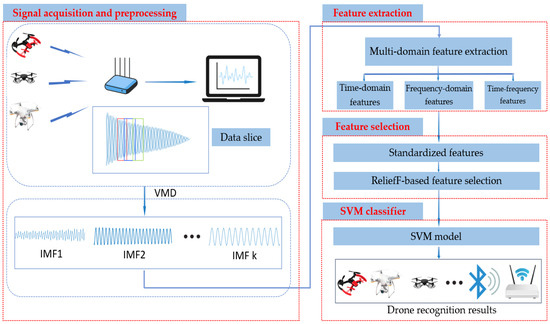
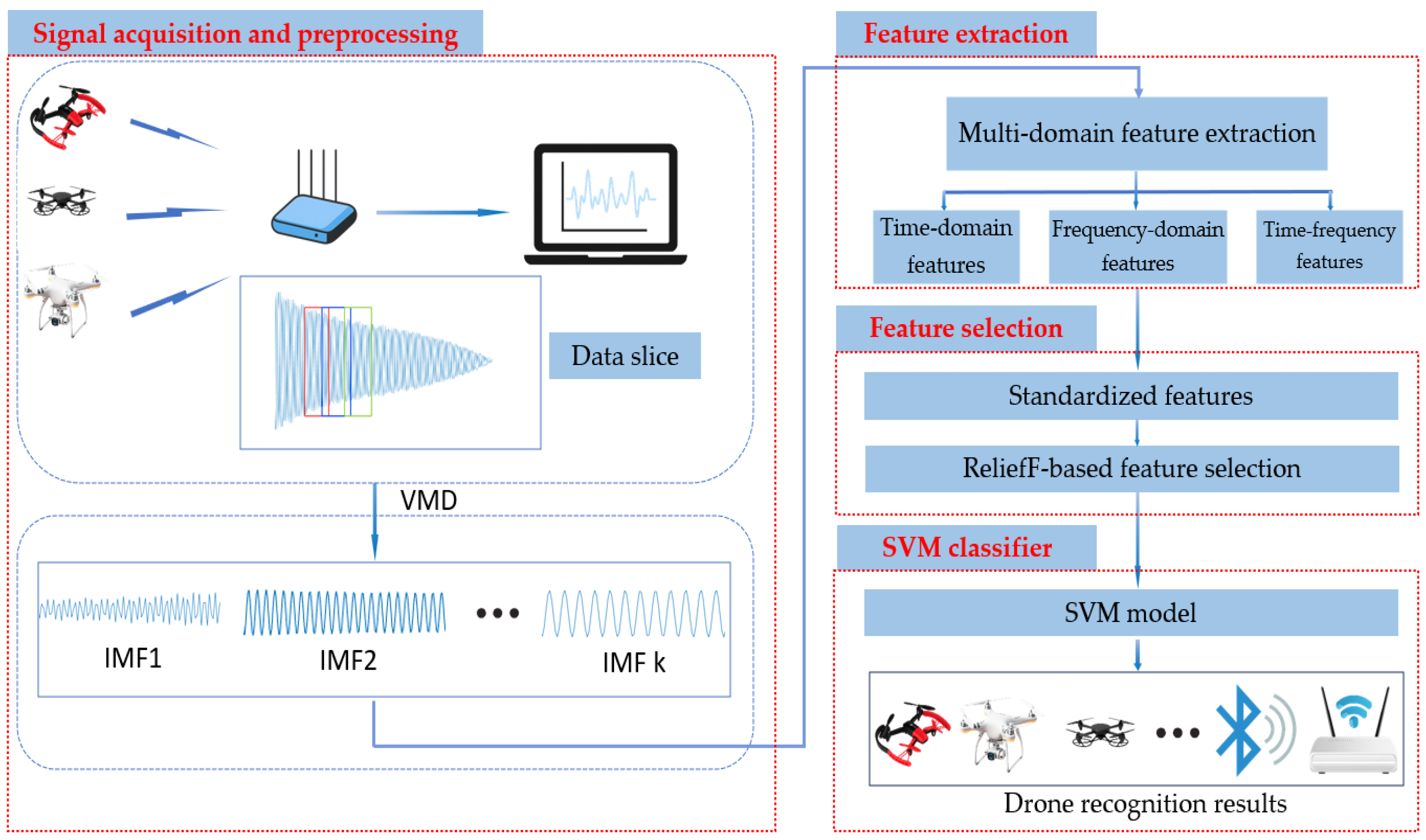
Figure 1 illustrates the overall framework of the proposed VMD–SVM method for drone recognition. The proposed framework consists of four main modules: drone RF signal acquisition and preprocessing, feature extraction, feature selection, and SVM-based classification. First, the RF signals emitted by various types of drones are collected and decomposed by VMD. Here, we set the model number K = 6, such that we can obtain six intrinsic mode functions (IMFs). Then, a set of time-domain, frequency-domain, and time–frequency-domain features are extracted from each IMF. To reduce the redundancy of feature information, the ReliefF algorithm is introduced to select the most discriminative features as the training subset. Finally, this subset is used for training an SVM classifier for drone classification.
Figure 1.
Framework of the proposed VMD–SVM.
3.2. VMD-Based RF Signal Decomposition
VMD is an adaptive signal decomposition technique that can decompose the signal into several band-limited modes non-recursively [27]. The principle of VMD lies in constructing and solving a constrained variational optimization problem, which is given as follows:
where is the partial derivative with respect to time t, is the Dirac function, uk(t) represents the time-domain expression of the k-th mode, and denotes the corresponding center frequency of uk(t).
To solve the optimization problem formulated in Equation (1), the Lagrange multipliers λ(t) and a quadratic penalty term α are introduced. Thus, the problem in (1) can be transformed into an unconstrained variational problem, which is rewritten as follows:
The optimization problem in Equation (2) is solved by using the alternating direction method of multipliers (ADMM) algorithm. For efficient signal reconstruction, the modes uk, the center frequencies wk, and the Lagrange multiplier λ(t) should be updated according to the following formulas:
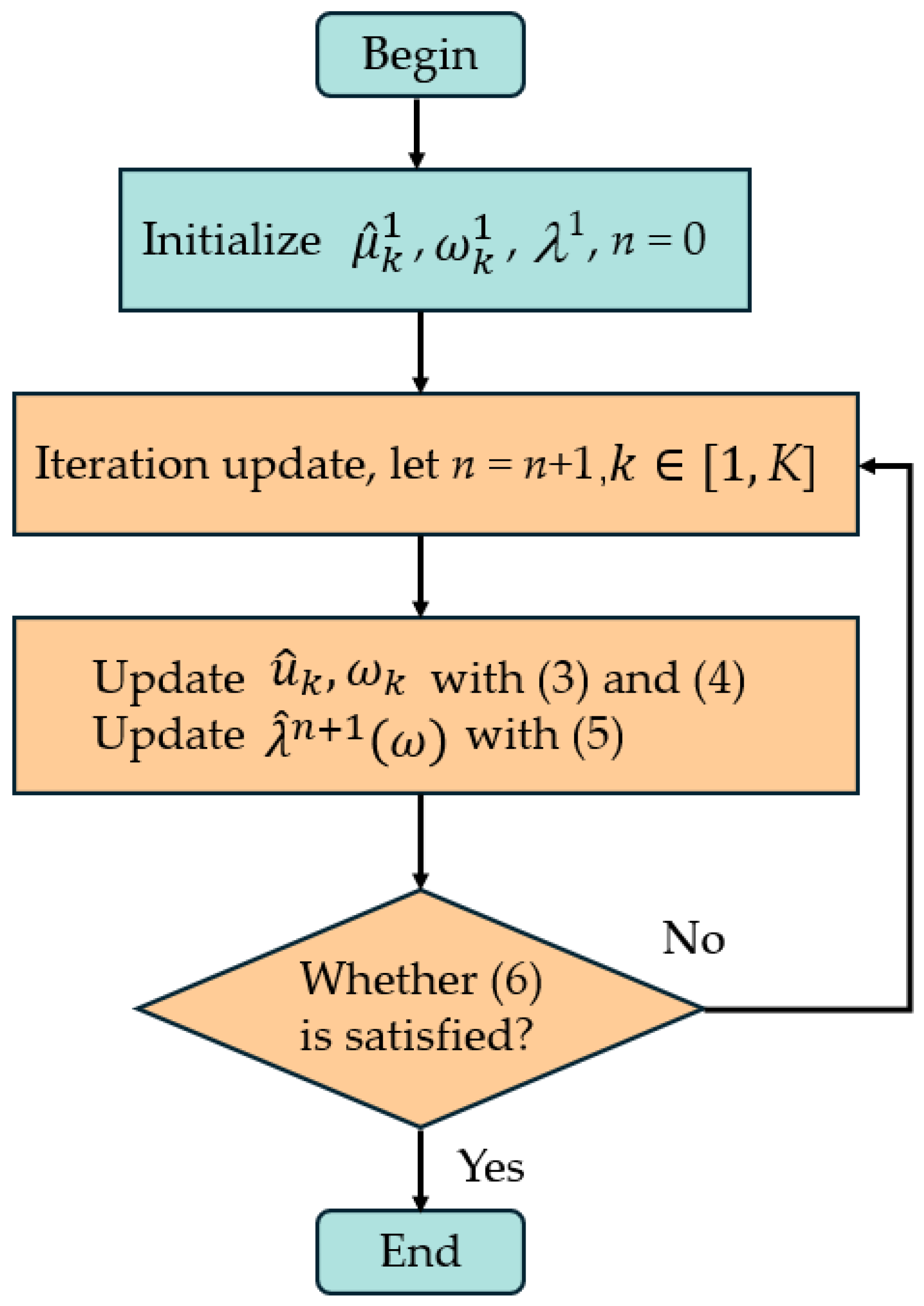
where , , and denote the Fourier transform result of , , and , respectively. The VMD algorithm iteratively repeats (3)–(5) until (6) is satisfied.
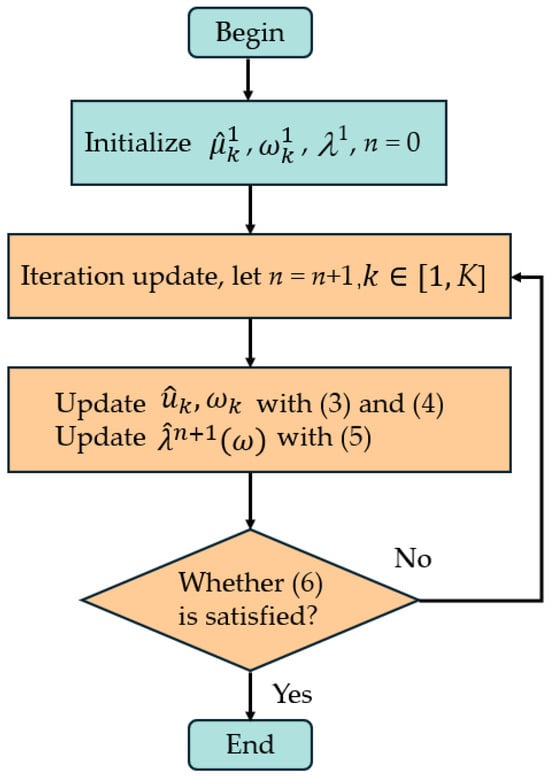
where is the predefined calculation error. To sum up, Figure 2 gives the flowchart of VMD.
Figure 2.
The flowchart in VMD.
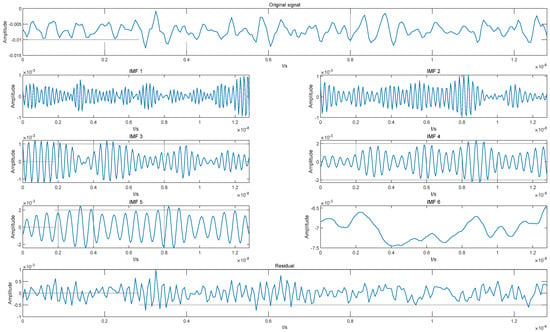
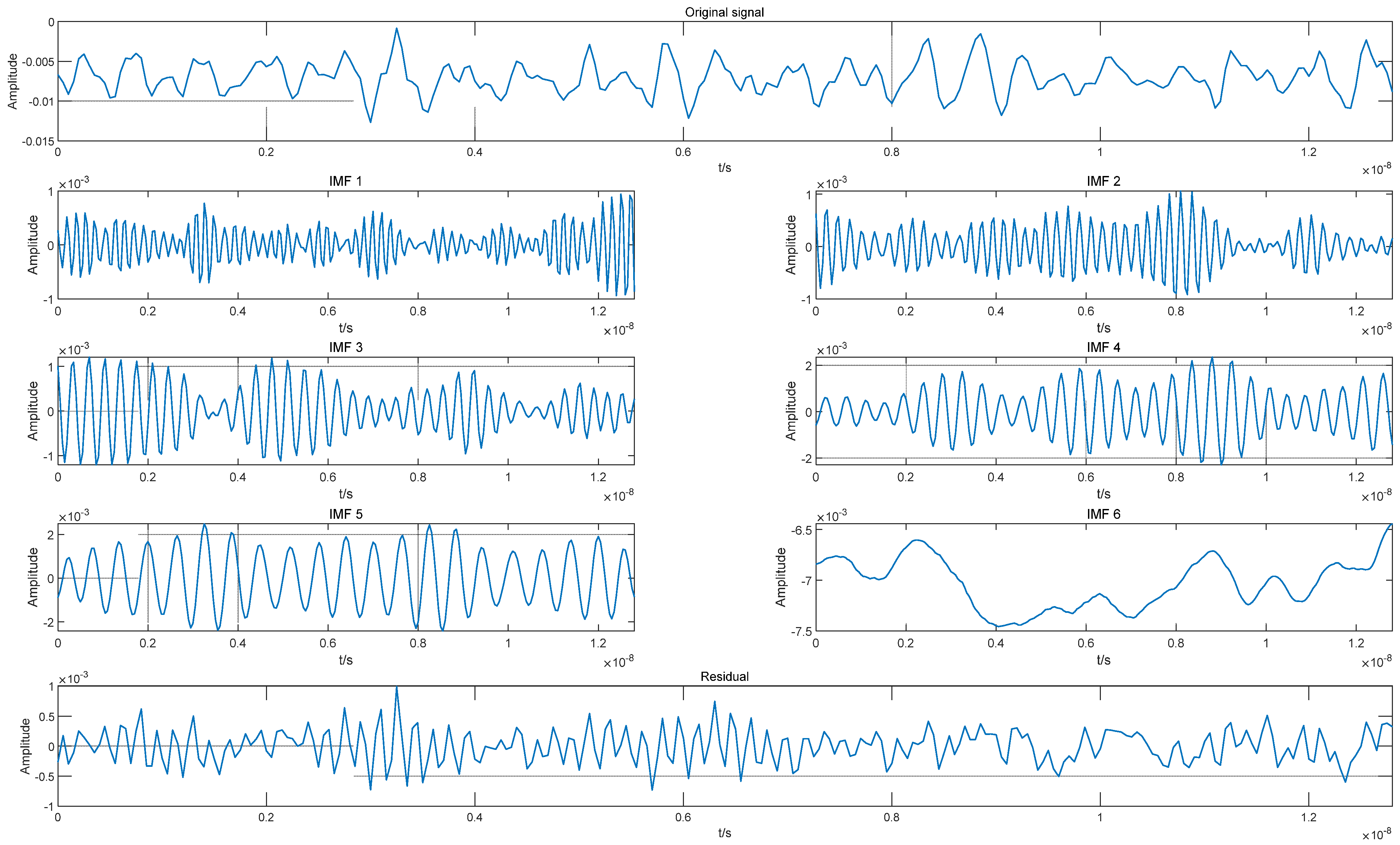
In this paper, we apply VMD to preprocess the received RF signals. In the VMD decomposition, we set K as the maximum decomposition number of IMFs. According to multiple experiments, K is set as 6. Thus, six IMFs can be obtained. Taking a sample BEEBEERUN in the public dataset CardRF as an example, the decomposition results are given in Figure 3. In Figure 3, we can see that the obtained IMFs are arranged from high frequency to low frequency.
Figure 3.
Decomposition results of the BEEBEERUN UAV signal.
3.3. Multi-Domain Feature Extraction from IMFs
Extracting discriminative features from the IMFs plays a key role in drone identification. Therefore, this section introduces a multi-domain feature extraction approach, which extracts time-domain, frequency-domain, and time–frequency-domain features from each IMF.
(1) Time-domain features: Time-domain features have been widely used in RF signal classification, which is a statistical tool to describe the temporal variations in signal waveforms. Once the drone RF signal exists, the amplitude of the acquired signal may change. Therefore, time-domain statistical features are of great importance for the identification of drone RF signals. In this paper, a set of nine time-domain statistical features are extracted, as shown in Table 1.
Table 1.
Time-domain features.
(2) Frequency-domain features: In the following subsection, we describe the frequency-domain features that are extracted from the discrete Fourier transform (DFT) results of IMFs. The frequency-domain features include mean frequency, spectral entropy, spectral distribution center, and spectral flatness. Here, Xn represents the amplitude of the n-th frequency bin and N denotes the number of points in the Fourier transform.
For computing the entropy of a spectrum, the energy of each frequency component of the spectrum is first calculated using the following equation:
Then, the energy proportion of each frequency component is obtained as follows:
Finally, the spectral entropy for each IMF was defined as set out below:
Spectral flatness is defined as the ratio of the geometric mean to the arithmetic mean of the spectrum, which measures the degree of closeness of the signal spectrum to the noise spectrum. The spectral flatness can be computed as follows:
The proposed 4-dimensional frequency-domain features are listed in Table 2.
Table 2.
Frequency-domain features.
(3) Time–frequency-domain features: In addition to time-domain and frequency-domain features, time–frequency-domain features are also important for signal classification. To characterize the time–frequency distribution of the signal, the STFT of signal at the w-th frequency for time m is expressed as follows:
where m is the time index, w is the frequency index, x[n] is the discrete time component after VMD, and w[m] is the discrete window function. The signal energy spectrum of each time-frequency information can be given by the following equation:
Here, to quantitatively describe the energy variation of a signal across different frequencies, time–frequency entropy is introduced into the time–frequency analysis. The energy spectrogram is divided into L blocks with equal areas, the energy in each block is Ei (i = 1, 2, …, L), and the energy of the whole time–frequency plane is E. Ei is normalized as follows:
The time–frequency entropy of the signal is defined as follows:
After extracting the aforementioned time-domain, frequency-domain and time–frequency-domain features of each IMF, these features are subsequently concatenated to form a high-dimensional representation, denoted as . Here, Fk denotes the feature vectors extracted from the k-th IMF.
3.4. ReliefF-Based Feature Selection
To reduce the dimensionality and redundancy of the extracted features, this section introduces a two-stage ReliefF-based feature selection scheme. ReliefF is a feature-weighting algorithm that assigns different weights to each feature by measuring its relevance to the target class and its ability to distinguish samples across different classes. The higher the weight value, the greater the ability of the corresponding feature to distinguish different signal categories, whereas a lower weight corresponds to weaker relevance [28]. Finally, features with weights exceeding the predefined threshold are retained as the final optimal features.
For handling multi-class classification problems, we assume that the class labels in the training dataset are C = {c1, c2, …, cL}. First, we randomly select a sample Ri from the training dataset according to the ReliefF algorithm, where i is the index of the randomly selected training sample. Next, the algorithm searches for k nearest neighbors of Ri within the same class, denoted as Hj (j = 1, 2, …, k), and simultaneously searches for k nearest neighbors of Ri from different classes, denoted as Mj (c) (j = 1, 2, …, k). Finally, the algorithm repeats these two steps m times. The weight of feature A is updated as follows [28]:
where m and t denote the number of iterations and the current iteration index, respectively. The function diff(A, R1, R2) represents the difference between samples R1 and R2 with respect to feature A, which is defined as follows:
Here, we set the threshold as the average value of all feature weights. If the feature weight is larger than the threshold, it will be selected as an effective feature. In the first stage, the selected feature subset, denoted as Fglobal, is given as follows:
where is the threshold and is the weight for feature A.
In the second stage, to further select class-specific discriminative features, we introduce a one-vs-rest binary classification strategy for each class. After applying the ReliefF algorithm for each class, we can obtain the weight of all features of class c. We then sort the weights in descending order, which can be expressed as follows:
where is the corresponding feature position index. For simplicity, we retain the top 10% of features, denoted as Fc, as the class discriminative feature. Finally, the optimal feature used for drone classification is denoted as follows:
3.5. UAV Recognition Using RBF–SVM
Support vector machine (SVM) is one of the most widely used supervised learning methods in pattern recognition [29]. Its core idea is to map the given data into a high-dimensional feature space via a nonlinear kernel function that satisfies the Mercer condition. The aim of SVM is to obtain an optimal separating hyperplane that maximizes the classification margin, thereby accurately dividing the training samples into two distinct classes. The classification problem can be expressed as follows:
where denotes the inner product,
represents the nonlinear mapping from Rn to R, w represents the weight, and b is the offset. The SVM is defined as follows:
where c is the penalty parameter and denotes the non-negative slack variable. Based on the Karush–Kuhn–Tucker (KKT) conditions, the solution of (21) is derived by solving its dual quadratic programming problem. Thus, the optimal classification function is derived as follows:
where denotes the Lagrange multipliers, represents the training sample labels, is the kernel function, and P is the number of support vectors. The optimal classification results can be obtained by solving the SVM model as a convex optimization problem. For kernel selection, the radial basis function (RBF) is chosen due to its better performance compared with other commonly used kernel functions. Hence, this study employs an RBF-based SVM for drone recognition. Besides, to handle the multiple categories, the SVM is trained with the one-vs-all learning scheme. The details of hyperparameter optimization can be found in [30].
4. Experimental Evaluation and Results
4.1. Dataset and Experimental Setup
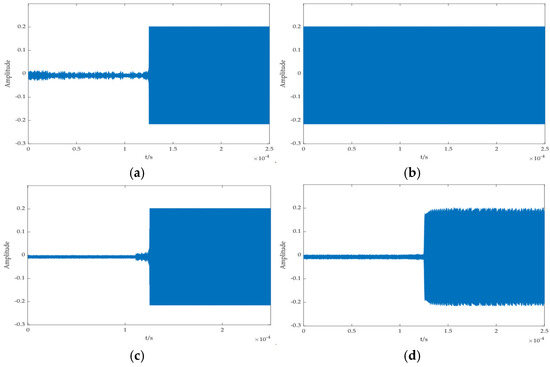
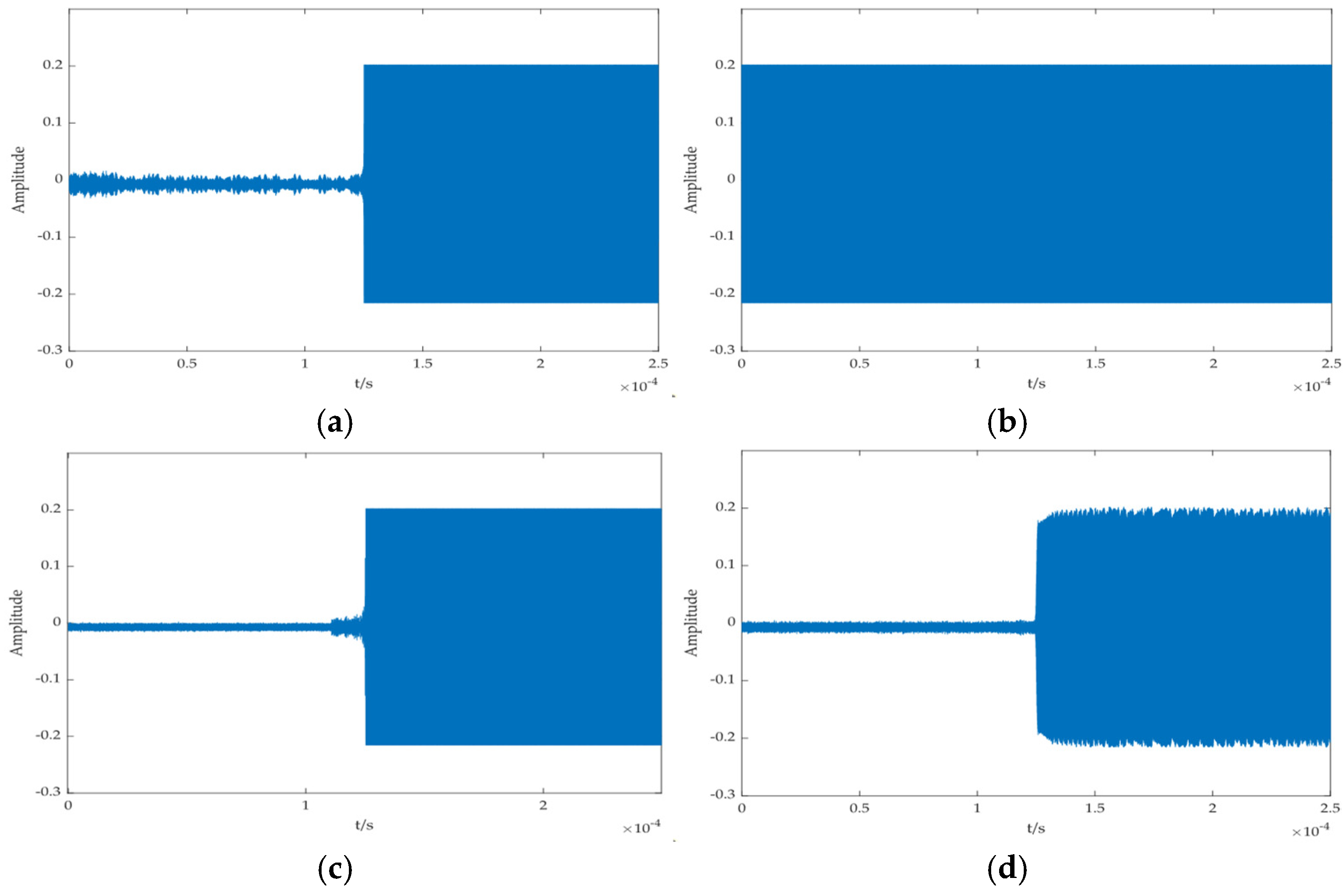
To evaluate the proposed drone recognition method, we used the publicly available drone RF signal dataset named CardRF [31] to validate its effectiveness and performance. This dataset contains the raw amplitude signals of various devices, including five types of UAVs, six types of UAV controllers, Bluetooth signals, and WiFi signals. All signals were sampled at 20 GSa/s, with each signal comprising five million sampling points. As in [31], the steady-state portion of the captured signals was extracted. Then, the extracted signal segment was divided into several slices, with each containing 10,000 sampling points. For illustration, Figure 4 shows the time-domain waveforms of the signals in CardRF. As shown in Figure 4, the steady-state signals of DJI_PHANTOM, DJI_MAVICPRO, and WiFi exhibit highly similar characteristics, which reduces inter-class discriminability. Therefore, it is crucial to extract effective features before training a classifier. Here, it should be noted that additive white Gaussian noise (AWGN) is added to the original RF signals to vary the SNR in the following experiments.
Figure 4.
The UAV RF signal of the CardRF dataset: (a) DJI_PHANTOM; (b) DJI_MAVICPRO; (c) WiFi; (d) Bluetooth.
4.2. Results of Proposed Method for UAV Recognition
VMD is first used to preprocess the RF signal of CardRF. Then, a series of IMFs can be obtained. Here, we set as 2000 and K as 6 in the VMD algorithm based on multiple experiments. In this paper, all IMFs are selected for feature extraction. To comprehensively characterize the features of drone signals from multiple perspectives, 9-dimensional time-domain, 4-dimensional frequency-domain, and 1-dimensional time-frequency domain features are extracted. Thus, the dimension of each signal slice is . As the extracted features are high-dimensional, they may include redundant information, thereby degrading classification accuracy and computational efficiency. To reduce the dimensionality of obtained features, we use the ReliefF algorithm for optimal feature selection.
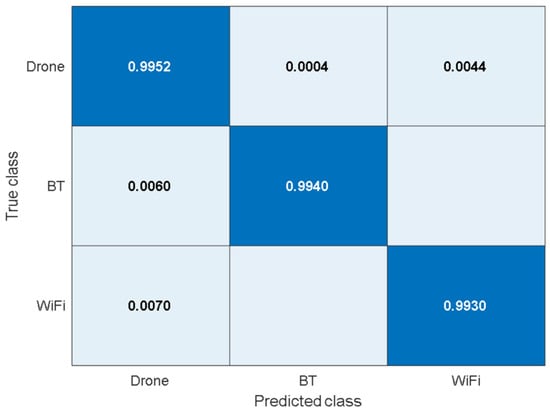
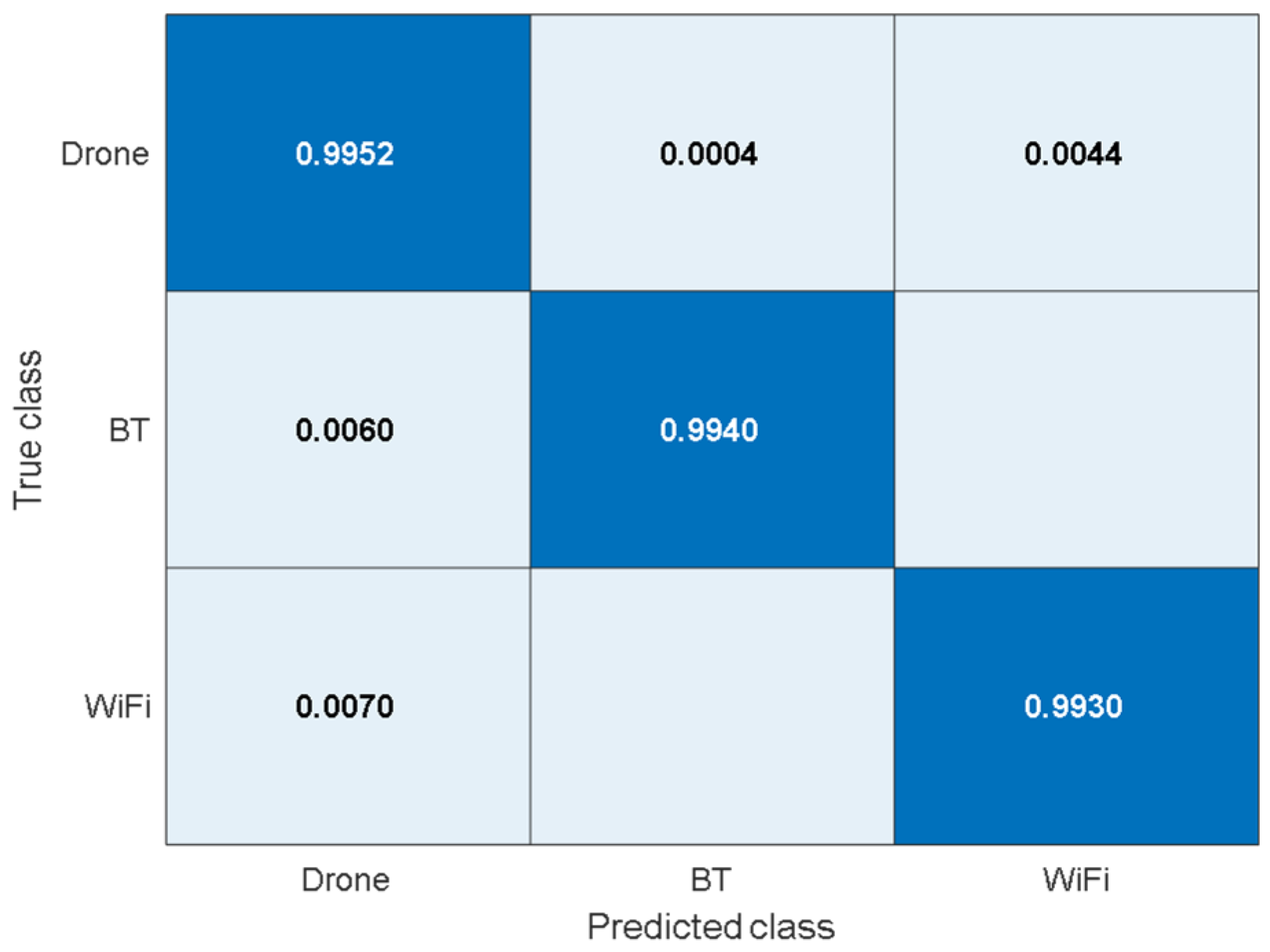
In this subsection, seven types of devices signal samples are used for feature extraction, which contain five types of UAVs (namely, DJI_M600, DJI_INSPIRE, DJI_MAVICPRO, DJI_PHANTOM, and BEEBEERUN), one Bluetooth (BT) device (IPhone6S), and one WiFi device (Cisco Linksys E3200, Cisco Systems, USA). Each type of signal produces 4000 samples, and seven types of signals produce a total of 28,000 samples. In addition, we randomly split the obtained sample set into training and testing sets at a ratio of 3:1. The classification confusion matrix for the three types of signals at 20 dB SNR is given in Figure 5.
Figure 5.
Confusion matrix for the three types of signal classification with SNR = 20 dB.
In Figure 5, we can see that the proposed approach performs better for UAV signal identification than BT and WiFi signals, with an average classification accuracy of 99.5%. Besides, only 0.48% of UAV signals are misclassified as WiFi or Bluetooth signals, which indicates its superiority for UAV signal classification under WiFi and Bluetooth interference scenarios.
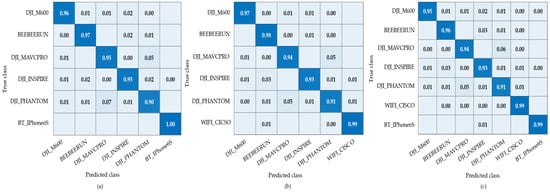
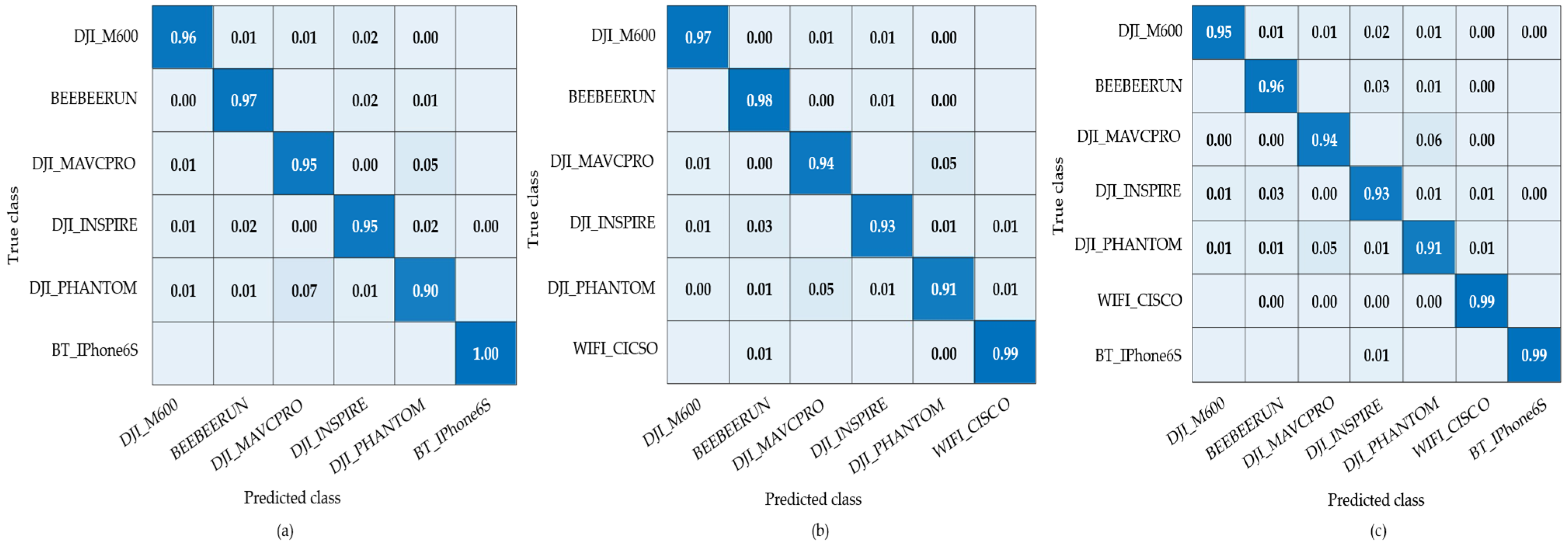
To exhibit the classification performance of the proposed method more comprehensively, Figure 6 shows the confusion matrix for various UAV classifications under different interference scenarios (i.e., BT, WiFi, and BT and WiFi interference). In Figure 6, it can be seen that misclassification mainly occurs among UAVs that come from the same manufacturer. In Figure 6a, 5% of signals from the DJI_MAVICPRO are misidentified as the DJI_PHANTOM. On the other hand, the proposed method achieves an accuracy of 99% for interference signal identification.
Figure 6.
Confusion matrices of UAV classification under different interferences: (a) Bluetooth interference; (b) WiFi interference; (c) Bluetooth and WiFi interference.
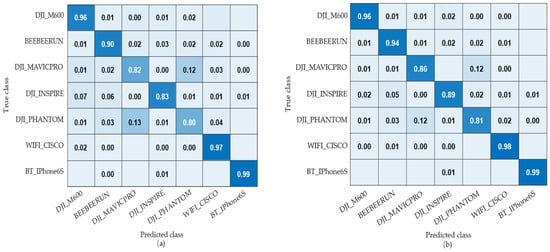
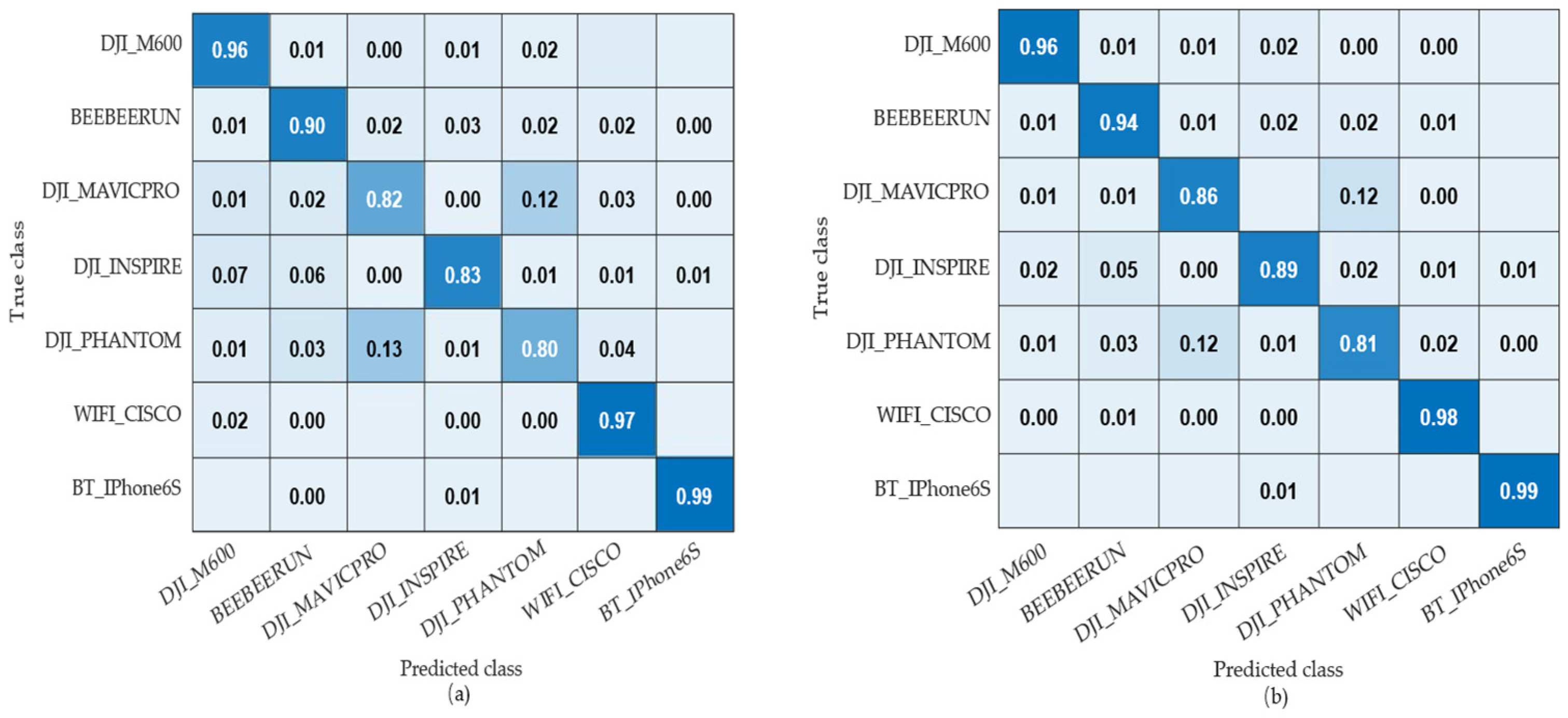
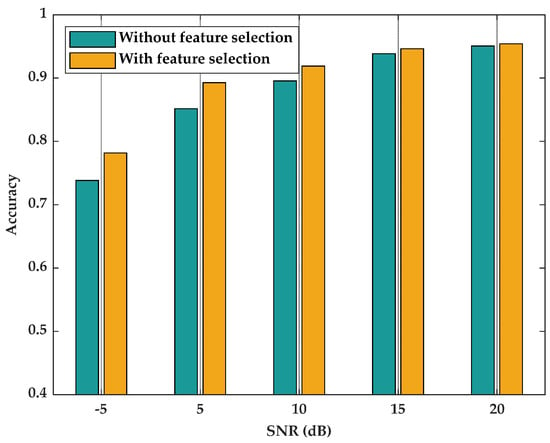
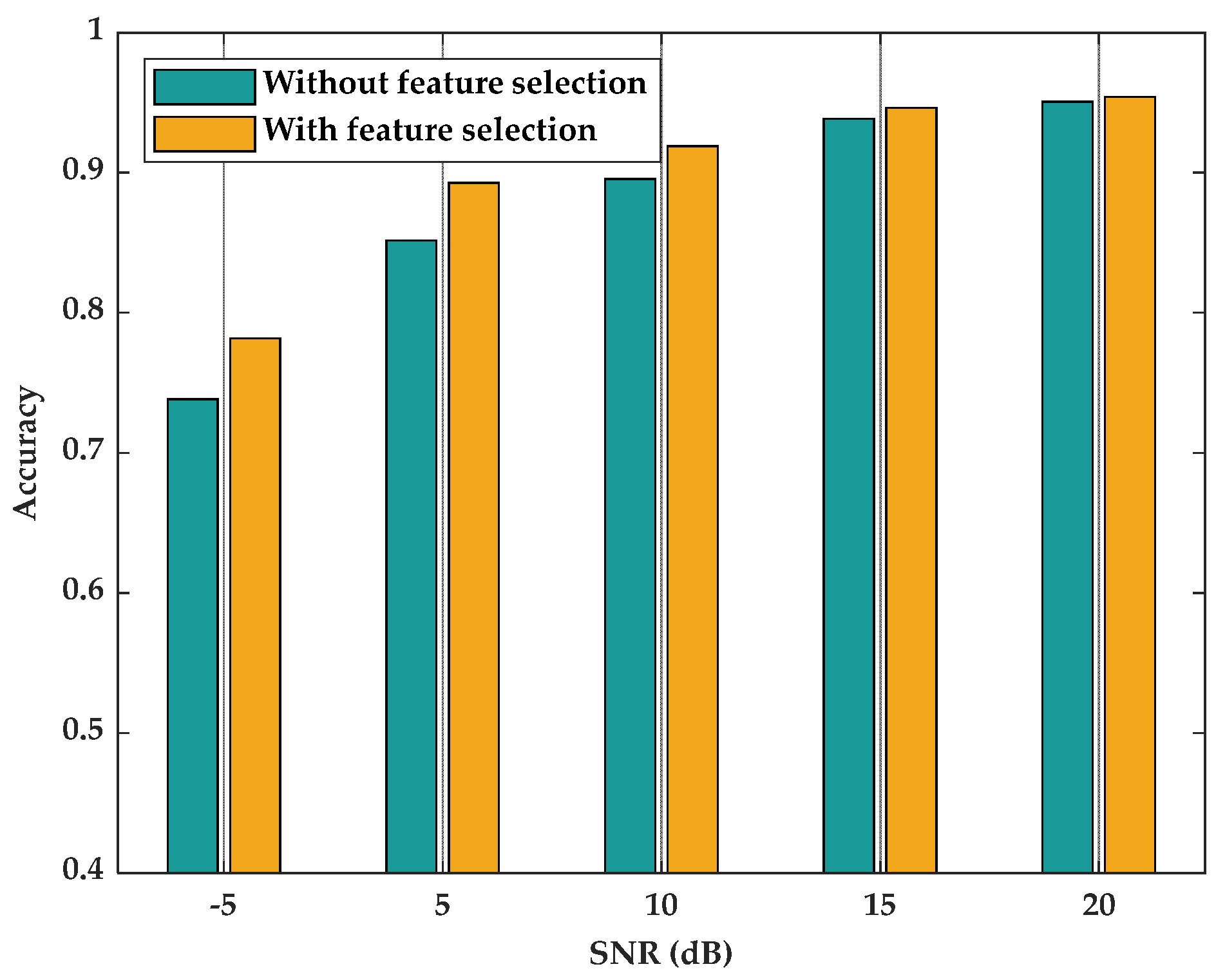
To validate the effectiveness of the proposed multi-domain feature selection method, the proposed method with and without feature selection is used for comparison. Figure 7 shows the confusion matrix for UAV classification at 10 dB SNR. From Figure 7, we can see that the proposed method with feature selection achieves better performance than that without feature selection, with average classification accuracies of 91.91% and 89.57%, respectively. Figure 8 presents the comparison results under different SNR levels. From Figure 8, we can see that the proposed method with feature selection improves the recognition accuracy at all SNR levels. It is worth noting that applying feature selection can significantly improve recognition accuracy under low-SNR conditions, which indicates its superiority.
Figure 7.
Confusion matrices of UAV classification at 10 dB SNR: (a) Without feature selection; (b) With feature selection.
Figure 8.
Comparison results at different SNRs.
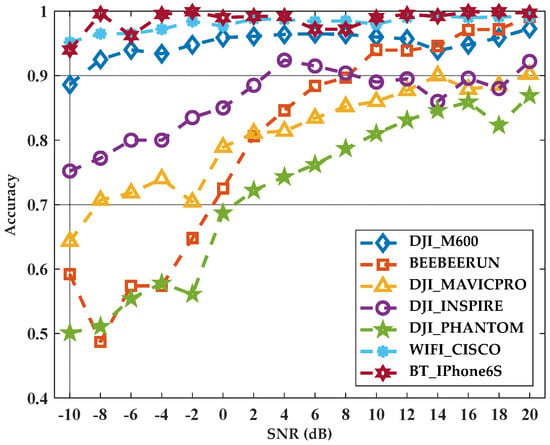
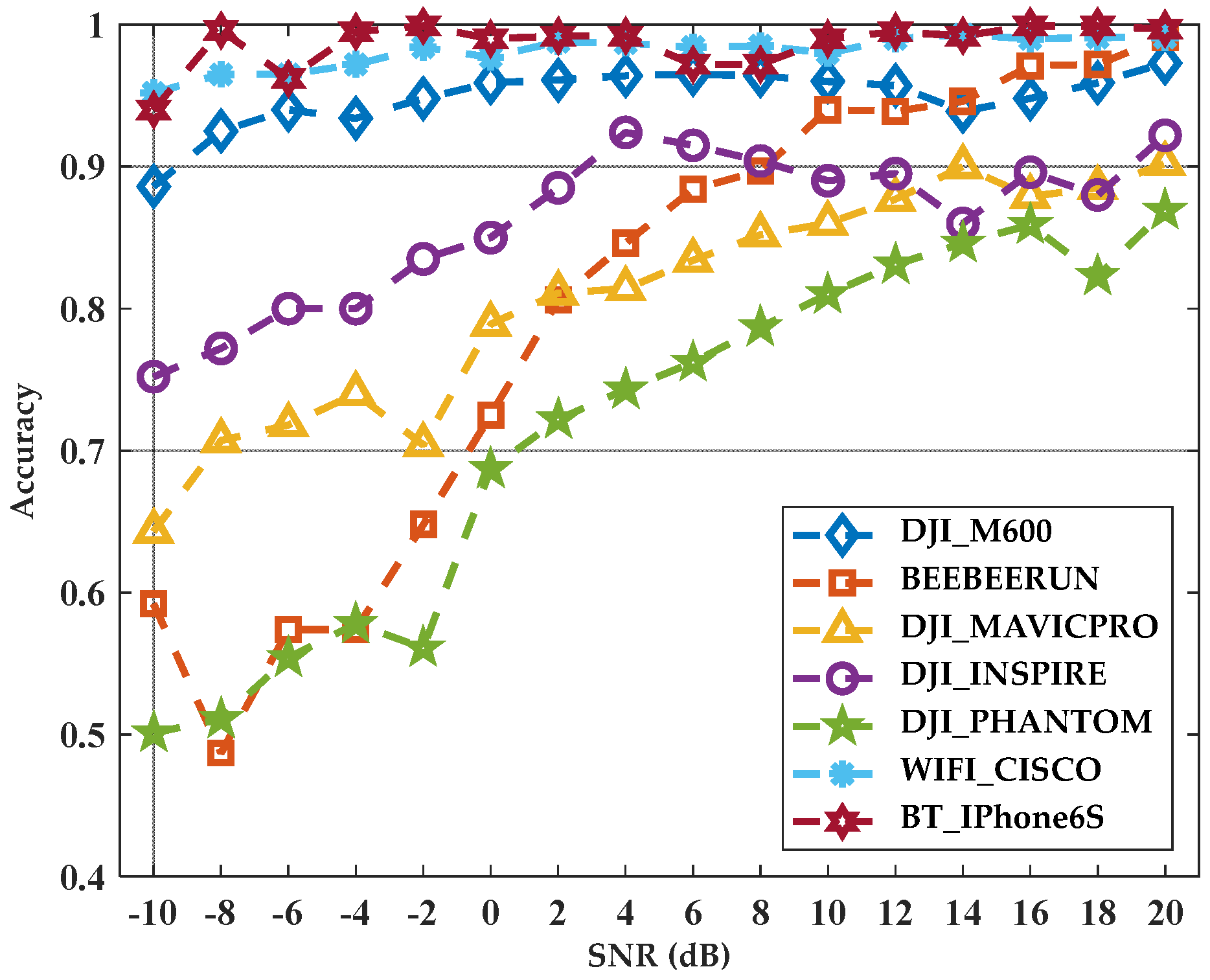
Additionally, to validate the performance of the proposed method for each type of signal recognition under different SNRs, Figure 9 shows the recognition results. In Figure 9, each of the accuracy points on all curves is the average value of 10 independent experiments at the corresponding SNR level. As can be seen from Figure 9, the accuracy of the proposed method for all signal types remains above 70% when SNR is greater than 0 dB. Moreover, the recognition accuracies for BEEBEERUN, DJI_MAVICPRO, and DJI_PHANTOM are relatively lower; this is because their steady-state segment signals show high similarity under low SNR levels, which results in lower recognition performance. Nevertheless, it still achieves an 88.6% recognition accuracy at −10 dB for DJI_M600. Furthermore, the recognition accuracies for signals collected from WIFI_CISCO and BT_IPhone6S remain above 99%, indicating that the proposed method maintains strong robustness and discriminative capability even in the presence of strong noise and complex electromagnetic environments.
Figure 9.
Classification accuracy of different signal types at various SNRs.
4.3. Comparison with Other Methods
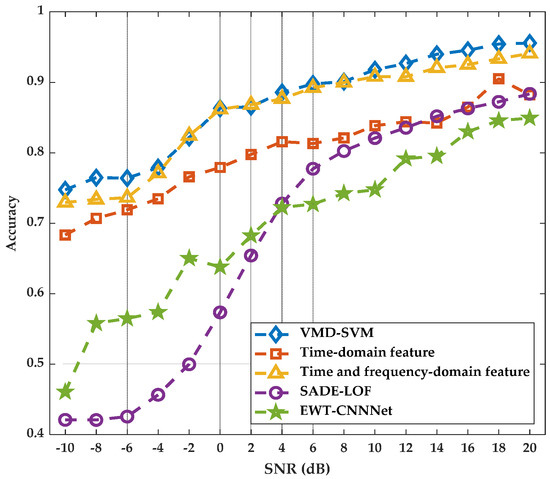
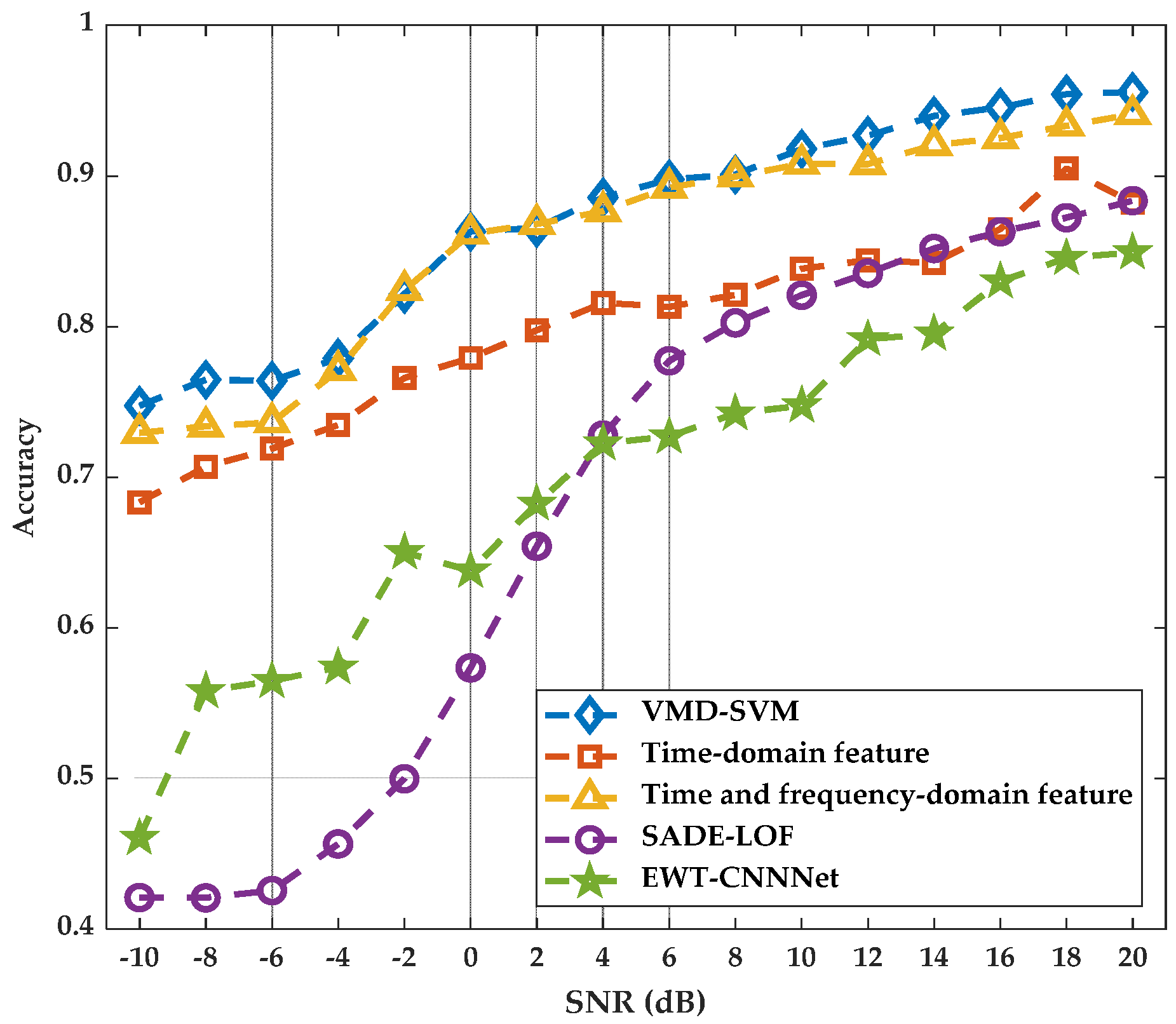
To assess the performance of our proposed VMD-SVM technique under different SNRs, we compare the VMD–SVM method using only time-domain features (denoted by time-domain feature) and the VMD–SVM method using fused time and frequency-domain features (denoted by time and frequency-domain feature) with existing methods in [31] (denoted by SADE-LOF) and [32] (denoted by EWT-CNNNet). Figure 10 shows the recognition accuracy of these methods from −10 dB to 20 dB. According to Figure 10, at all SNRs, the VMD–SVM performs better than the other methods. Especially in the low SNRs, the proposed method has a significant advantage, achieving an accuracy of 74.7% at −10 dB, which validates the effectiveness of our proposed method.
Figure 10.
Classification accuracy comparison at different SNRs.
4.4. Discussions
This subsection discusses the obtained results from three aspects. Firstly, three different domain feature fusions are used in this paper for UAV classification. Experimental results show that the proposed VMD–SVM based on combining time-domain, frequency-domain, and time–frequency-domain features achieves higher and more stable recognition performance under various SNRs compared to single-domain feature extraction methods. This indicates that feature information extracted from a single domain has low distinguishability, and that fusion with different domain features can effectively enhance both the discriminability and the stability of the feature representations.
Secondly, our proposed method can serve as a modular recognition component within an RF monitoring workflow consisting of signal acquisition and preprocessing, multi-domain feature extraction, feature selection, and classification. The feature selection mechanism not only reduces feature information redundancy but also achieves a balance between computational complexity and recognition accuracy. Thus, it provides a feasible solution for deployment on resource-constrained platforms and has the potential for engineering applications in typical security scenarios, such as airport perimeter monitoring, critical infrastructure protection (e.g., power plants and industrial facilities), and urban low-altitude airspace surveillance.
Finally, it should be noted that all experiments in this work were conducted on a single CardRF dataset. In future studies, the generalization of the proposed method will be planned to validate it under different electromagnetic environments to further enhance the performance of the VMD–SVM method.
5. Conclusions
This paper proposes a novel RF-based multi-domain feature fusion method for UAV recognition in low-SNR scenarios. The raw RF signals are first decomposed by using VMD. Then, a set of time-domain, frequency-domain and time–frequency-domain features are extracted from each of the IMFs. Subsequently, a feature selection strategy based on ReliefF is introduced for effective feature selection. Finally, an SVM classifier is constructed to perform drone type recognition. Experimental results show that under different SNR levels, the proposed method achieves superior recognition accuracy compared to other existing methods and the method based on single-domain features. Specifically, across the SNR range from −10 dB to 20 dB, VMD–SVM achieves an average recognition accuracy of 87%. At a low SNR, e.g., −10 dB, the proposed method achieves an accuracy of 74.7%, which is higher than the results of methods using only time-domain features and fusing time-domain and frequency-domain features by 6% and 2%.
Author Contributions
Conceptualization, Y.F. and Z.H.; methodology, Y.F.; validation, C.Z.; investigation, C.Z.; writing—original draft preparation, C.Z.; writing—review and editing, Y.F.; supervision, Z.H.; project administration, Y.F.; funding acquisition, Y.F. All authors have read and agreed to the published version of the manuscript.
Funding
This research was funded by the Natural Science Foundation of Sichuan Province under grant number 2025ZNSFSC0393.
Data Availability Statement
The CardRF dataset used to support this study is included in [28].
Conflicts of Interest
The authors declare no conflicts of interest.
References
- Huynh-The, T.; Pham, Q.V.; Nguyen, T.V.; da Costa, D.B.; Kim, D.S. RF-UAVNet: High-Performance Convolutional Network for RF-Based Drone Surveillance Systems. IEEE Access 2022, 10, 49696–49707. [Google Scholar] [CrossRef] [Scilit]
- Hua, F.; Ming, H. Radio Frequency Signal-Based Drone Classification with Frequency Domain Gramian Angular Field and Convolutional Neural Network. Drones 2024, 8, 511. [Google Scholar] [CrossRef] [Scilit]
- Liew, C.F.; Yairi, T. Companion Unmanned Aerial Vehicles: A Survey. arXiv 2020, arXiv:2001.04637. [Google Scholar] [CrossRef] [Scilit]
- Hoque, M.A.; Hossain, M.; Noor, S.; Islam, S.R.; Hasan, R. IoTaaS: Drone-Based Internet of Things as a Service Framework for Smart Cities. IEEE Internet Things J. 2021, 9, 12425–12439. [Google Scholar] [CrossRef] [Scilit]
- Li, C.J.; Ling, H. An Investigation on the Radar Signatures of Small Consumer Drones. IEEE Antennas Wirel. Propag. Lett. 2016, 16, 649–652. [Google Scholar] [CrossRef] [Scilit]
- Jian, M.; Lu, Z.; Chen, V.C. Drone Detection and Tracking Based on Phase-Interferometric Doppler Radar. In Proceedings of the 2018 IEEE Radar Conference (RadarConf18), Oklahoma City, OK, USA, 23–27 April 2018; pp. 1146–1149. [Google Scholar]
- Liang, C.; Cao, N.; Lu, X.; Ye, Y. UAV Detection Using Continuous Wave Radar. In Proceedings of the 2018 IEEE International Conference on Information Communication and Signal Processing (ICICSP), Singapore, 28–30 September 2018; pp. 1–5. [Google Scholar]
- Nan, H.; Fei, Y.; Yuan, L.; Yang, L.; Chao, L.; Shan, H.; Wei, B. A Lightweight Feature Enhancement Model for UAV Detection in Real-World Scenarios. Drones 2025, 9, 874. [Google Scholar] [CrossRef] [Scilit]
- Anwar, M.Z.; Kaleem, Z.; Jamalipour, A. Machine Learning Inspired Sound-Based Amateur Drone Detection for Public Safety Applications. IEEE Trans. Veh. Technol. 2019, 68, 2526–2534. [Google Scholar] [CrossRef] [Scilit]
- Yaacoub, M.; Younes, H.; Rizk, M. Acoustic Drone Detection Based on Transfer Learning and Frequency Domain Features. In Proceedings of the 2022 International Conference on Smart Systems and Power Management (IC2SPM 2022), Beirut, Lebanon, 10–12 November 2022; pp. 47–51. [Google Scholar]
- Jeon, S.; Shin, J.W.; Lee, Y.J.; Kim, W.H.; Kwon, Y.; Yang, H.Y. Empirical Study of Drone Sound Detection in Real-Life Environment with Deep Neural Networks. In Proceedings of the 2017 25th European Signal Processing Conference, Kos, Greece, 28 August–2 September 2017; pp. 1858–1862. [Google Scholar]
- Shi, Y.; Shan, T.; Dong, H. Integrated Detection of Weak Drone Signals: From Parameter Estimation to Sensitive Classification. Digit. Signal Process. 2026, 168, 105524. [Google Scholar] [CrossRef] [Scilit]
- Yousaf, J.; Zia, H.; Alhalabi, M.; Yaghi, M.; Basmaji, T.; Shehhi, E.A.; Gad, A.; Alkhedher, M.; Ghazal, M. Drone and Controller Detection and Localization: Trends and challenges. Appl. Sci. 2022, 12, 12612. [Google Scholar] [CrossRef] [Scilit]
- Rojhani, N.; Passafiume, M.; Sadeghibakhi, M.; Collodi, G.; Cidronali, A. Model-Based Data Augmentation Applied to Deep Learning Networks for Classification of Micro-Doppler Signatures Using FMCW Radar. IEEE Trans. Microw. Theory Techn. 2023, 71, 2222–2236. [Google Scholar] [CrossRef] [Scilit]
- Seidaliyeva, U.; Alduraibi, M.; Ilipbayeva, L.; Smailov, N. Deep Residual Neural Network-Based Classification of Loaded and Unloaded UAV Images. In Proceedings of the 2020 Fourth IEEE International Conference on Robotic Computing (IRC 2020), Virtual Conference, 9–11 November 2020; pp. 465–469. [Google Scholar]
- Hu, X.; Zhong, Y.; Wang, X.; Luo, C.; Zhao, J.; Lei, L.; Zhang, L. SPNet: Spectral Patching End-to-End Classification Network for UAV-Borne Hyperspectral Imagery with High Spatial and Spectral Resolutions. IEEE Trans. Geosci. Remote Sens. 2021, 60, 5503417. [Google Scholar] [CrossRef] [Scilit]
- Song, S.; Son, Y.; Kim, Y. Flying Drone Classification Based on Visualization of Acoustic Signals with Deep Neural Networks. In Proceedings of the 2020 International Conference on Information and Communication Technology Convergence (ICTC 2020), Jeju Island, Republic of Korea, 21–23 October 2020; pp. 546–548. [Google Scholar]
- Zhang, H.; Cao, C.; Xu, L.; Gulliver, T.A. A UAV Detection Algorithm Based on an Artificial Neural Network. IEEE Access 2018, 6, 24720–24728. [Google Scholar] [CrossRef] [Scilit]
- Nie, W.; Han, Z.C.; Zhou, M.; Xie, L.B.; Jiang, Q. UAV Detection and Identification Based on WiFi Signal and RF Fingerprint. IEEE Sens. J. 2021, 21, 13540–13550. [Google Scholar] [CrossRef] [Scilit]
- Ezuma, M.; Erden, F.; Anjinappa, C.K.; Ozdemir, O.; Guvenc, I. Micro-UAV Detection and Classification from RF Fingerprints Using Machine Learning Techniques. In Proceedings of the 2019 IEEE Aerospace Conference (AERO 2019), Big Sky, MT, USA, 2–9 March 2019; pp. 1–13. [Google Scholar]
- Allahham, M.S.; Khattab, T.; Mohamed, A. Deep Learning for RF-Based Drone Detection and Identification: A Multi-Channel 1-D Convolutional Neural Networks Approach. In Proceedings of the 2020 IEEE International Conference on Informatics, IoT, and Enabling Technologies (ICIoT’20), Doha, Qatar, 2–5 February 2020; pp. 112–117. [Google Scholar]
- Xue, C.; Li, T.; Li, Y.; Ruan, Y.; Zhang, R. Radio Frequency Identification for Drones Using Spectrogram and CNN. In Proceedings of the 2022 IEEE Global Communications Conference (GLOBECOM 2022), Rio de Janeiro, Brazil, 4–8 December 2022; pp. 4564–4569. [Google Scholar]
- Zhao, X.; Wang, L.; Wang, Q.; Wang, J. A Hierarchical Framework for Drone Identification Based on Radio Frequency Machine Learning. In Proceedings of the 2022 IEEE International Conference on Communications Workshops (ICC Workshops 2022), Seoul, Republic of Korea, 16–20 May 2022; pp. 391–396. [Google Scholar]
- Zhang, H.; Li, T.; Li, Y.; Li, J.; Dobre, O.A.; Wen, Z. RF-Based Drone Classification under Complex Electromagnetic Environments Using Deep Learning. IEEE Sens. J. 2023, 23, 6099–6108. [Google Scholar] [CrossRef] [Scilit]
- Peng, L.; Zhang, J.; Liu, M.; Hu, A. Deep Learning Based RF Fingerprint Identification Using Differential Constellation Trace Figure. IEEE Trans. Veh. Technol. 2019, 69, 1091–1095. [Google Scholar] [CrossRef] [Scilit]
- Xu, C.; He, F.; Chen, B.; Jiang, Y.; Song, H. Adaptive RF Fingerprint Decomposition in Micro UAV Detection Based on Machine Learning. In Proceedings of the 2021 IEEE International Conference on Acoustics, Speech and Signal Processing (ICASSP 2021), Toronto, ON, Canada, 6–11 June 2021; pp. 7968–7972. [Google Scholar]
- Dragomiretskiy, K.; Zosso, D. Variational Mode Decomposition. IEEE Trans. Signal Process. 2013, 62, 531–544. [Google Scholar] [CrossRef] [Scilit]
- Huang, Z.; Yang, C.; Zhou, X.; Huang, T. A Hybrid Feature Selection Method Based on Binary State Transition Algorithm and ReliefF. IEEE J. Biomed. Health Inform. 2019, 23, 1888–1898. [Google Scholar] [CrossRef] [Scilit] [PubMed]
- Moranduzzo, T.; Melgani, F. A SIFT-SVM Method for Detecting Cars in UAV Images. In Proceedings of the 2012 IEEE International Geoscience and Remote Sensing Symposium (IGARSS), Munich, Germany, 22–27 July 2012; pp. 6868–6871. [Google Scholar]
- Kun, L.; Peng, Y.; Ping, L.; Hong, H.; Ke, W. Radar Emitter Recognition Based on SIFT Position and Scale Features. IEEE Trans. Circuits Syst. II Exp. Briefs 2018, 65, 2062–2066. [Google Scholar]
- Medaiyese, O.O.; Ezuma, M.; Lauf, A.P.; Adeniran, A.A. Hierarchical Learning Framework for UAV Detection and Identification. IEEE J. Radio Freq. Identif. 2022, 6, 176–188. [Google Scholar] [CrossRef] [Scilit]
- Bremnes, K.; Moen, R.; Yeduri, S.R.; Yakkati, R.R.; Cenkeramaddi, L.R. Classification of UAVs Utilizing Fixed Boundary Empirical Wavelet Sub-Bands of RF Fingerprints and Deep Convolutional Neural Network. IEEE Sens. J. 2022, 22, 21248–21256. [Google Scholar] [CrossRef] [Scilit]

Disclaimer/Publisher’s Note: The statements, opinions and data contained in all publications are solely those of the individual author(s) and contributor(s) and not of MDPI and/or the editor(s). MDPI and/or the editor(s) disclaim responsibility for any injury to people or property resulting from any ideas, methods, instructions or products referred to in the content. |
© 2026 by the authors. Licensee MDPI, Basel, Switzerland. This article is an open access article distributed under the terms and conditions of the Creative Commons Attribution (CC BY) license.