


Highlights
What are the main findings?
- In the searching and tracking USV swarm task, an observation fusion mechanism with spatio-temporal decay is designed to improve the perception abilities of multi-UAVs.
- The proposed center-sub-critics deep deterministic policy gradient algorithm mitigates credibility imbalance and policy variance from both cause and effect sides through employing multiple center-critic networks coupled with sub-critic networks.
What are the implications of the main findings?
- The confidence probability map considering the distance timeliness of neighbor data can deliver more precise target locations to multi-UAVs in dynamic complex environments.
- The proposed algorithm provides a multiple unmanned systems cooperative trajectory planning scheme, improving the searching and tracking efficiency and fairness.
Abstract
This work proposes a multiple unmanned aerial vehicles (UAVs) cooperative trajectory planning scheme constructed by multi-agent reinforcement learning with hybrid critics, improving the searching and tracking efficiency and fairness when the dynamic unmanned surface vehicle (USV) swarm exceeds the number of UAVs. A confidence map of targets’ existence probability with spatio-temporal decay is first established through a local information fusion mechanism based on Bayesian update theory. It leads to a reformulation of the problem model into a communication-enhanced partially observable Markov decision process. To suppress policy variance and credibility imbalance of the multi-UAVs, a center-sub-critics deep deterministic policy gradient algorithm is then proposed, combining multiple centralized critics with decentralized critics. Meanwhile, a segmented reward function is designed to incentivize the UAV to revisit detected targets. Finally, the simulation results compared with diverse baseline algorithms demonstrate the efficacy and scalability of the proposed scheme in this paper.
1. Introduction
Recently, multi-target searching and tracking (MTST) has been a hot research issue, which can be widely used in various fields [1], such as security surveillance, military reconnaissance, and emergency communication. The increasing number of vessels navigating near public waters, including tourist motorboats, yachts, and a growing number of unmanned surface vehicles (USVs) deployed for scientific research and other purposes, has made the maritime environment increasingly complex. Consequently, the task of searching and tracking multiple moving targets on the sea surface is still gaining significant attention due to its high demand and high complexity. Whether cooperating with USVs for maritime rescue, environmental monitoring, and oceanographic surveys, or addressing non-cooperative targets such as illegal fishing and vessel traffic management, multi-target searching and tracking solutions hold broad practical motivation.
Benefiting from the inherent characteristics of lightweight, flexible, and low-cost UAVs, are being widely used to solve MTST problems. Limited by the energy and execution efficiency issues of a single UAV, multi-UAV tasks are preferred for MTST. Multi-UAVs can achieve efficient searching and tracking of multiple dynamic targets by implementing cooperative control strategies [2] through information interaction. The cooperative trajectory planning method of MTST is proved to be NP-hard [3]. Since the number and the movement of targets in the task area are unknown, MTST requires multi-UAVs to continuously explore the unknown area while tracking back the discovered targets to update their positions. In addition, the multi-UAVs need to plan the optimal detection trajectories cooperatively to minimize the duplicate path and realize the continuous and efficient searching and tracking of dynamic targets. This further raises the fairness definition in dynamic target searching and tracking tasks, namely ensuring all dynamic targets receive as equal attention as possible during the task duration, thereby minimizing disparities in the number of times each target is observed. A large number of linear programming and heuristic methods [4,5,6] have been applied to MTST. To reduce the energy consumption, Al-Turjman et al. [7] proposed an optimized placement approach to model the multi-agent coverage search problem as a numerical optimization model and solve it accurately. Zou et al. [8] predicted the target motion and guided the multi-agent movement through quad-tree and integer linear programming. Huang et al. [9] modeled the MTST problem as mixed-integer linear programming and achieved efficient cooperative searching by task decomposition and reorganization. Scherer et al. [10] designed heuristic operators for local and global paths, respectively, to reduce the delay of the searching task at a lower cost.
Inspired by natural biological clusters, a large number of swarm intelligence-based optimization algorithms have also been used in the MTST problem. Zhen et al. [11] improved the global planning ability of multi-agent to search and strike multi-target through distributed ant colony optimization (ACO). Pérez-Carabaza et al. [12] improved the ACO algorithm to deal with complex multi-target searching tasks by fusing heuristic operators and pheromones with a utility function. Phung et al. [13] encoded multi-agent trajectories as particle swarm optimization (PSO) to retain the community cognitive ability of agents and ultimately accomplish the MTST task. Xu et al. [14] introduced dynamic multi-swarm and comprehensive learning to enhance the performance of PSO in dynamic tracking problems. Duan et al. [15] proposed a dynamic discrete pigeon-inspired optimization method to solve the task planning problem of multi-agent cooperative searching. The above methods have excellent performance for MTST. However, their application in dynamic environments is limited [16] by the dependence on prior environmental knowledge and the constrained cooperation among multi-agents.
As an alternative way, deep reinforcement learning (DRL) has achieved notable success [17] in agent sequential decision and control by modeling problems with the Markov decision process (MDP). Multi-agent deep reinforcement learning (MADRL) focusing on more complex multi-agent systems is also emerging [18], which provides new ideas for solving MTST problems. MADRL allows multi-agent to explore collaborative relationships and executes distributed decisions through the paradigm termed centralized training with decentralized execution (CTDE) [19], significantly improving the scalability and fault tolerance of the algorithm. For fully cooperative multi-agent systems like MTST, MADRL facilitates cooperation mainly from two perspectives: centralized critic and value function decomposition. The centralized critic uses a global network that can collect multi-agent joint actions and observations to estimate the task’s cumulative reward expectation. Through this, the multi-agent proximal policy optimization (MAPPO) [20] and multi-agent deep deterministic policy gradient (MADDPG) [21] extend the PPO and DDPG to multi-agent systems. Decomposition of the value function distributes the joint action value into individual value for each agent, subsequently estimating the joint value by aggregating the local results through a specific strategy. The value-decomposition network (VDN) [22] utilizes a simple summation form, while QMIX [23] employs a monotonicity mixing network strategy.
Benefiting from the ability to efficiently execute complex decisions, researchers have applied MADRL to the multi-target searching and tracking field. Hou et al. [24] utilized MADDPG to split the task scene and improve the distributed cooperative searching capability of multi-agent. In order to ensure accurate position of multi-target, Zhang et al. [25] proposed double critic DDPG with Dempster–Shafer theory to describe uncertainty. Shen et al. [23] proposed the DNQMIX algorithm by adding a noise layer for QMIX to solve the trade-off between training speed and environmental realism. The aforementioned methods experience a loss in searching performance when dealing with dynamic targets. Zhou et al. [26] proposed the reciprocal reward multi-agent actor-critic framework to guide agents in handling dynamic targets. Aiming to increase the generalization of MADRL in the MTST task, Cao et al. [27] proposed a multi-criteria negative feedback hierarchical deep Q-network with a two-stage reward function. To enhance dynamic target tracking performance, Yue et al. [28] incorporated the VDN concept into the multi-agent soft actor- critic framework.
The issues of value overestimation and policy fluctuation in existing MADRL methods are particularly exacerbated in dynamic target search and tracking problems like those involving USV swarm. Moreover, the mathematical expressiveness of the target confidence maps employed in current methods is compromised in dynamic environments. Inspired by the related works, a multi-UAVs cooperative trajectories planning scheme based on MADRL with hybrid critics is proposed to address the limitations of MTST efficiency and fairness when the USV swarm is regarded as a target in multi-constraint environments. This work achieves the following primary contributions:
- Unlike prior studies [25,29] that ignore the distance timeliness of neighbor data, a local observation fusion rule with spatio-temporal decay is designed to improve the environmental perception of the multi-UAV system. With the update utilizing the rule, the target confidence map guides multi-UAVs to balance the searching and tracking of the USV swarm.
- In existing decentralized partially observable Markov decision processes (Dec- POMDP) [30,31], agents maintain independent observation spaces. This paper proposes a communication-enhanced POMDP with additional masking mechanisms to support variable-dimensional fusion communication observations, and the multi-UAV MTST problem is reformulated based on this model.
- Previous MADRL approaches [24,32] addressed value overestimation and policy collapse from either a causal or an outcome perspective. In contrast, the proposed center-sub-critics deep deterministic policy gradient (CSC-DDPG) algorithm mitigates credibility imbalance and policy variance from dual perspectives through employing multiple center-critic networks coupled with sub-critic networks.
2. System Model and Problem Formulation
In this section, the multi-UAV MTRT for the USV swarm problem is systematically modeled. We clarify the environment model and the UAV’s mathematical model studied in this paper, followed by a mathematical formulation of the MTRT objectives for further optimization analysis in subsequent sections.
2.1. Environment Model
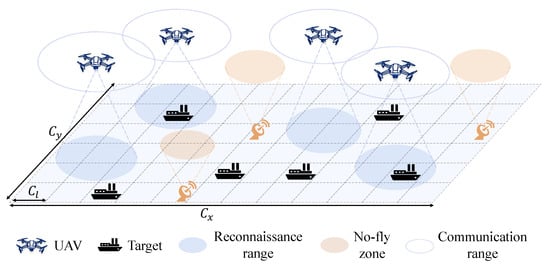
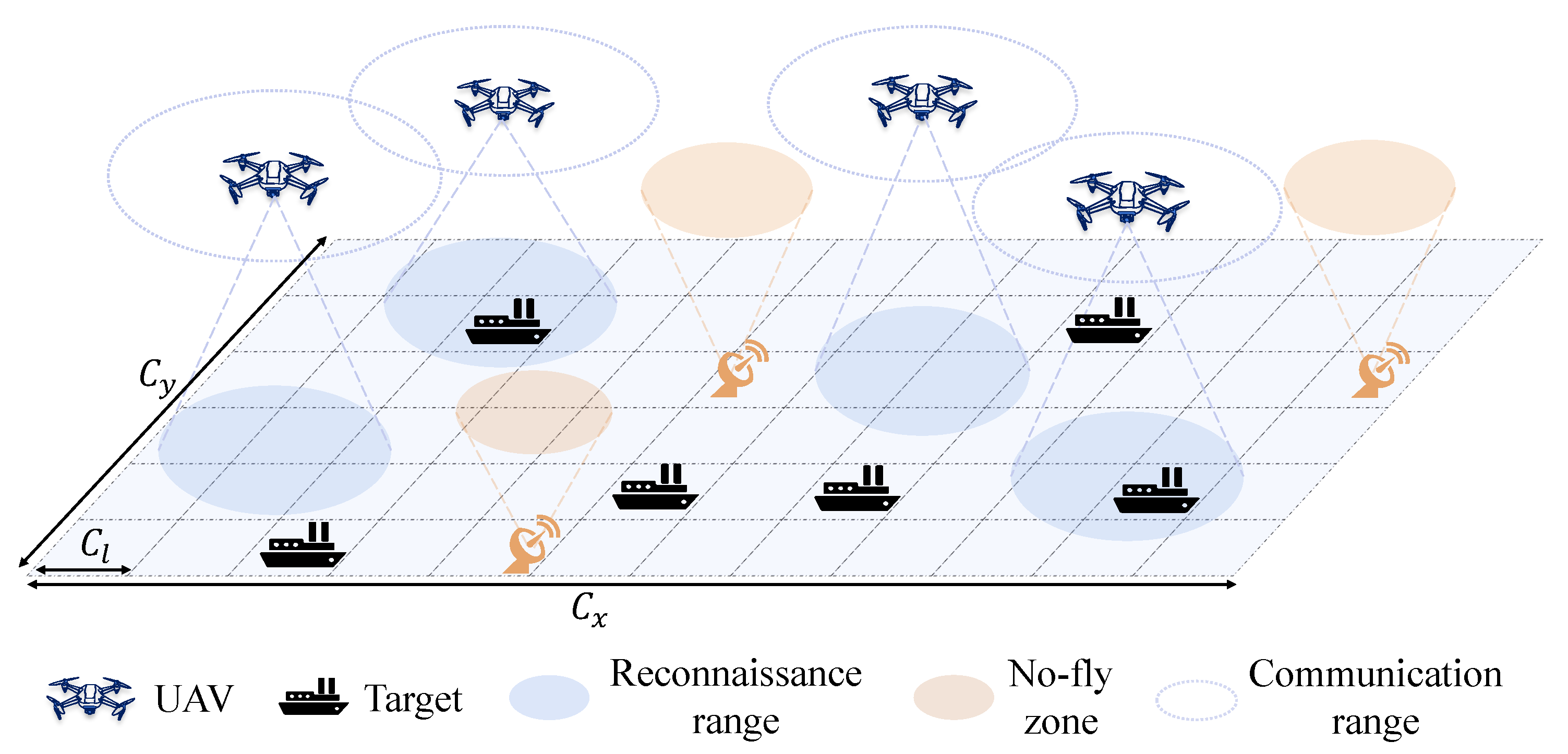
This study investigates MTST within a rectangular sea surface region of dimensions , whose spatial configuration is depicted in Figure 1. The region is divided into a grid map using squares with side length . A Cartesian coordinate system defines spatial positions, where the bottom-left cell serves as the coordinate origin. , where and correspond to the cell in column x and row y. Meanwhile, a binary state is used to encode the target existence status in , where signifies target existence and denotes target absence.
Figure 1.
The environment model of the multi-target searching and tracking by multi-UAVs.
The task timeline is discretized into T intervals of duration , with t indexing the current time step. It is assumed that there are USVs as targets with distributed positions , and each cell obeys the single-target occupancy principle. The USVs can move in a random direction with a fixed velocity within each time step. Concurrently, no-fly zones are arbitrarily positioned within . Each no-fly zone occupies a whole cell, with coordinates defined as . In addition, the multi-UAVs do not have any prior knowledge of the locations or numbers of USVs and no-fly zones.
2.2. UAV’s Mathematical Model
In MTST, both multi-UAVs and USV swarms are homogeneous. The UAVs do not need to identify targets, which makes more extensive and flexible cooperation among multi-UAVs possible. The multi-UAVs with UAVs operate at a common altitude. Their movement is constrained within a planar space congruent with . For UAV , let denote its planar coordinates, with the corresponding cell coordinate , where represents the discretization operator rounding down . The UAV kinematic model is simplified as a particle undergoing two-dimensional translation. Meanwhile, the multi-UAVs are subjected to a maximum velocity amplitude constraint and an axial maximum acceleration bound . Then the kinematic model of UAV is described in the form of
where , , and represent the acceleration, velocity, and position vector of at time step t, respectively. The function represents applying minimum and maximum value truncation to each element of the vector, while corresponds to the minimization operator between two scalars. Each UAV features a sensor with limited performance. It is assumed that, at a fixed altitude, the sensing range of the sensor of UAV forms a square region centered at with side length , where denotes the effective radius of the sensor. At time step t, can obtain the no-fly zones and target positions information in . To support the confidence map analysis, let encode detection results at time t of ; then signifies that the target is reconnoitered in , while indicates nothing found. Sensor performance is characterized by the true positive probability and the false alarm probability , accounting for sensor imperfections and environmental disturbances. In practical deployments, and are influenced by numerous environmental factors such as viewing occlusion and sea-clutter intensity. For analytical simplicity, and are simplified to fixed values primarily affected by the rated performance of the UAV sensor.
2.3. Confidence Map and Information Fusion
The perception of environments is represented by independently maintaining a confidence map of target existence probability decaying over time and distance for each UAV, called the spatio-temporal decay target confidence map (SDTCM). The SDTCM for UAV constitutes a probabilistic grid map, then represents the posterior probability of target existence in . We initialize the SDTCM of with a uniform prior distribution as , which reflects complete uncertainty about target distribution across . The UAV continuously updates by incorporating from successive time steps through Bayesian update theory, which is formulated as [33]
The belief update mechanism for in (2) exhibits nonlinear characteristics. Following the nonlinear mapping proposed in [34], one can reformulate (2) through , obtaining the equivalent representation of (2), yields to
Given the known sensor detection likelihood probability, the update for SDTCM in (3) demonstrates linear characteristics. This linear property substantially mitigates computational overhead in maintaining the SDTCM.
Operating with latency-free assumptions, the multi-UAVs possess communication capabilities with a bounded range to enhance cooperation. At time t, the communication neighbors for are defined as , where denotes the communication radius. Each UAV can exchange data bidirectionally with all , facilitating distributed information sharing across the multi-UAVs. During each time step t, performs the above information exchange within :
- Dissemination of self-position , detected no-fly zones, and detection result .
- Acquirement of neighbor UAV positions , neighbors detected no-fly zones, and detection results set .
In order to represent the spatio-temporal uncertainty of the environments and make efficient utilization of self and neighbor information, this paper designs a fusion mechanism based on spatio-temporal decay to update SDTCM . It can be expressed as
where denotes the time decay factor, and is the UAV number in . This distributed fusion mechanism enables autonomous maintenance of SDTCM while facilitating real-time awareness of neighbors. The synergistic integration of localized sensing and neighbor information achieves enhanced cooperative searching and tracking capability under joint constraints. Simultaneously, utilizing neighbor observations for probability updates within the independently maintained SDTCM reflects the real-world effect of corroborating evidence, while enabling more efficient responses to global state. The inherent conservatism of dual spatio-temporal decay ensures that posterior probabilities do not become unrealistically overconfident.
2.4. Problem Formulation
The optimization aim of multi-UAVs MTST for USV swarms is to simultaneously discover new targets while maintaining persistent tracking of detected USVs. Due to the indeterminate scale of the USV swarm within , it is necessary for continuous exploration to minimize the environment’s uncertainty. The spatial uncertainty within is quantifiable through Shannon’s information entropy of SDTCM, expressed as
where denotes the value of cell in global SDTCM , and it is updated by all UAVs without spatial decay. The reconnoitered state of target at time step t can be represented as
with . Then the optimization objective of MTST can be formulated as achieving maximization of the following functions
where represents the confidence threshold for target existence. We admit the existence of a target in cell when global SDTCM satisfies . This work addresses the multi-UAVs MTST problem under dynamic environments. The resultant MTST formulation under composite constraints is mathematically encapsulated in
where the Cartesian components and represent the acceleration vector of the UAV . The minimum separation thresholds and govern collision prevention between neighbor UAVs and no-fly zones B spatial relationships, respectively.
3. Multi-Agent Deep Reinforcement Learning-Based MTST Method
3.1. MADRL Based on Communication-Enhanced POMDP
The Dec-POMDP establishes a joint sequential decision-making task model in which agents utilize their own local observation in the multi-agent environment. However, Dec-POMDP is not adapted to the communication interaction of multi-agent. This paper extends it to the communication-enhanced POMDP model to express that agents can make decisions through local observation and fusion information in a distributed manner. Taking the MTST problem as an example, the communication-enhanced POMDP can be described as a tuple omitting the time subscripts, where
- is the set of UAVs in the multi-UAVs;
- S is the global state space of the environment, and denotes a specific global state;
- defines the joint action space, with corresponding to the action of ;
- is the joint communication observation space, where is the fusion communication observation of ;
- represents the global reward function for joint action of multi-UAVs;
- is the state transition probability function, which describes the probability of transferring to the next state after the joint action is executed;
- is the fusion observation function, denoting the fusion communication observation generated by after fusing local observation and neighbor information.
In each time step t, UAV obtains fusion observation via and performs action according to the policy to form the joint action , where is the joint policy. The global state for the next time step is then obtained by , while the global reward is acquired by . An optimal joint policy is the fundamental objective of MADRL to maximize the task cumulative reward
where is the reward discount factor over time. The action value function is given by
which expresses the cumulative reward expectation of executing the joint action with policy at state s. According to Bellman’s optimality principle [35], the optimal action value function can be described as
then the optimal joint policy can be formulated as
In communication-enhanced POMDP, obtains fusion observations via , so can be modified as while the joint policy is described as policy set utilizing joint communication observations.
3.2. Action and Observation Space Design
In order to improve the flexibility and scalability of the algorithm, a continuous action space is used to express the acceleration of the UAV. The UAV outputs the interval mapping of the acceleration by the policy at each time step t, and through obtains actual acceleration. Subsequently, and are acquired iteratively according to (1) and employed to update the environment state. Throughout the task duration T, generates a motion trajectory based on sequential decisions. Using continuous acceleration as the policy output can facilitate the training network to adapt to diversified flight control systems during real-world deployment.
The UAV outputs the action in each time step t based on the fusion observation . With the aim of increasing the effective information density, the observation space is composed of two-dimensional spatial information and one-dimensional structural information. By preprocessing the direct observation and communication data, the fusion communication observation is expressed as
where represents the data in a square region of centered on with a side length of , and is the observation radius of UAV. The remaining items are structural information, where denotes the normalized formulation of the position of . and denote the normalized relative positions of the neighbor UAVs and no-fly zones based on a mask mechanism, respectively. Owing to the limited communication range, the dimension of the fusion observation is variable over time. This contradicts the fixed dimension input requirement of the policy network, which further leads to the low scalability of the algorithm. A feature representation of observation space based on a mask mechanism is proposed to help. Suppose that the observation space is fixed to accept positions of nearby UAVs; if , then the normalized relative position of the neighbor UAVs based on the mask mechanism can be represented as
where , implying that the UAV is not concerned with the neighbor UAVs whose distance exceeds the communication radius . If , one can obtain
where is the set of communication neighbors sorted by the relative distance to . Then the nearest position is taken, i.e., . Similarly, can also be represented by the masking mechanism as shown in (14) and (15). The mask mechanism has solved the time-varying dimension problem through fixing the dimensions of and to and , respectively. Furthermore, the input quality of the observation is improved by relative position transformation and communication radius normalization, resulting in enhanced scalability of the algorithm. To prevent introducing artificial sequence information into the observations that could cause irreversible permutation sensitivity and bias in model training, the individual information within and processed through the masking mechanism is randomly shuffled before being combined into the final observations. Moreover, a one-hot encoding of each UAV’s unique ID is incorporated into its observation vector. This encoding enables individual identification within asymmetric spatial configurations and promotes the emergence of specialized, role-based cooperation among agents.
3.3. Reward Function Design
To enhance the distributed execution capability of UAVs, the global reward function is modified to the sum of independent reward functions of homogeneous UAVs, i.e., the global reward is the sum of independent reward of all UAVs at time step t. Following the optimization objectives and constraints defined in Section 2.4, each at time step t incorporates the following incentive components and penalty metrics.
(1) Centralized reward: The centralized reward assesses the overall contribution of the joint action to the cooperative tasks. The designed centralized reward includes the global spatial information entropy reduction reward and the USV swarm average detected rate increase reward, which can be described as
where and denote the weights of global spatial entropy and average target detected rate, respectively.
(2) Detected reward: To reward the detective operations to the USV swarm while promoting tracking behaviors, we formulate a two-phase detection reward structure designed as
where and denote respective phase reward weights, and the activation threshold for primary detection satisfies , establishing the hierarchical incentive requirement.
(3) Exploration Reward: The exploration reward mechanism drives UAVs towards sustained investigation of unknown regions. Affected by SDTCM time decay, the entropy of increases over time, resulting in a detection value again. We define the detection value threshold to denote a probability interval for possessing a detection value, then the exploration reward can be formulated as
where is the exploration reward weight.
(4) Boundary penalty: UAV mobility is strictly confined to the MTST task region . A boundary-approaching penalty mechanism governs UAV spatial deployment through a dual-modal reward structure, which is formulated as
The and are penalty coefficients of boundary proximity violations and egregious exits, respectively, while denotes the safety buffer distance from the boundary. The variable quantifies the minimum boundary separation of UAV at time step t.
(5) Collision Penalty: The collision penalty mechanism mitigates trajectory overlap risks and prohibits incursions into no-fly zones. This proximity-based penalty operates through exponential decay terms described as
where and govern multi-UAV and no-fly zone collision penalty weight, respectively. The formulation employs two distance metrics for UAV at time step t, where quantifies the spatial separation between UAV and , while measures the distance relative to no-fly zone .
The comprehensive reward function design integrates the above incentive and restraint components, thereby enabling the independent reward of UAV at time step t to be formulated as
Following the computation through the independent reward function , the multi-UAVs global reward emerges through summation of all independent incentives. This distributed reward aggregation mechanism preserves individual autonomy while ensuring cooperative objective alignment across the multi-UAVs.
3.4. Network Architectures of Actors and Center-Sub-Critics
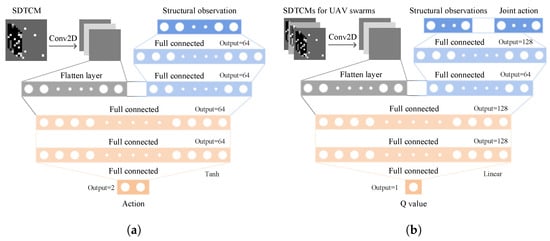
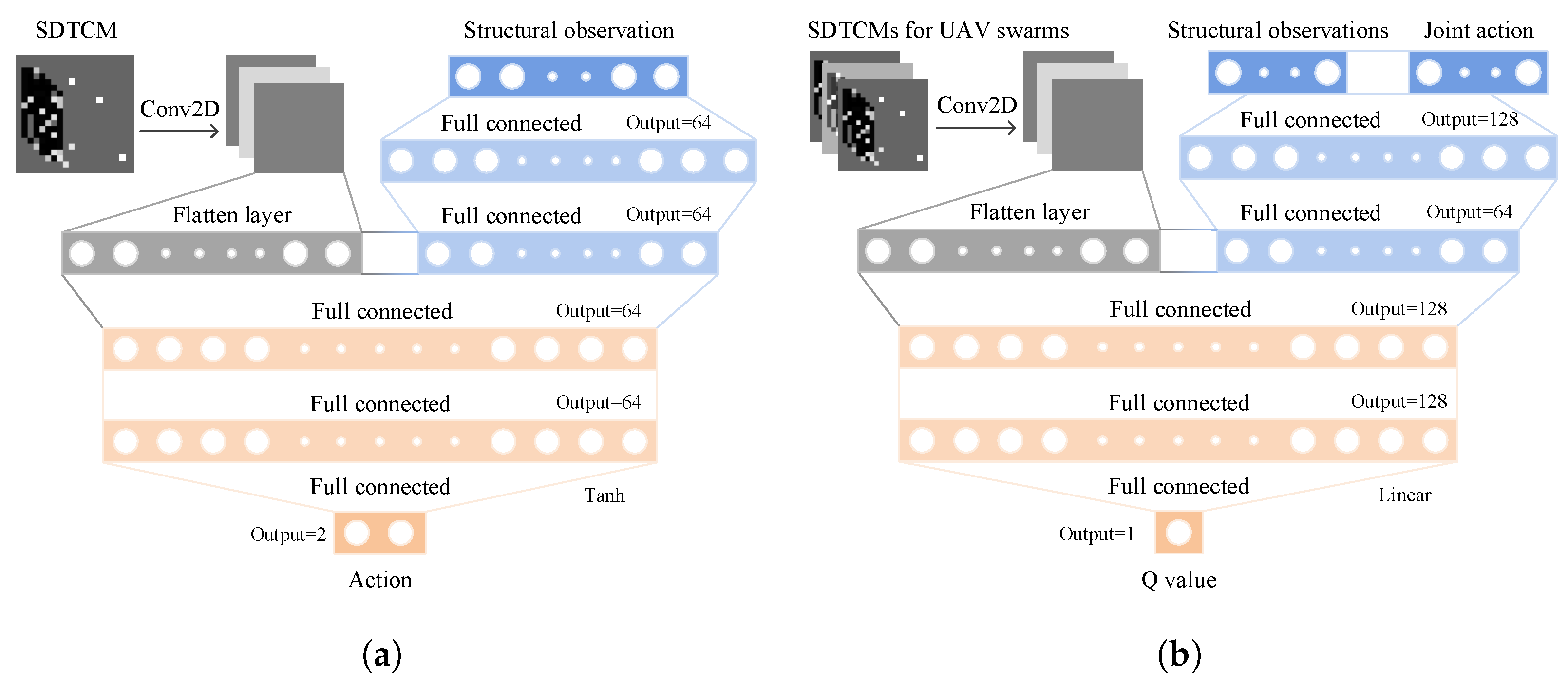
In pure cooperative scenarios such as multi-UAVs MTST, mainstream MADRL methodologies face dual challenges, i.e., the policy instability and collapse caused by training variance [36] and the value overestimation aggravated by imbalanced credit assignment among agents. To address these challenges, this work develops the CSC-DDPG algorithm featuring hybrid critic networks that combine multiple centralized critics and decentralized sub-critics. Building upon the AC foundation, the CSC-DDPG framework is derived from the CTDE paradigm. In CTDE, the centralized critic network integrates global state information during the training phase to assess joint action value, while decentralized actor networks generate deterministic policies using local observations during the execution phase. A neural network is employed within the actor model to approximate the optimal control policy for , where represents the policy network parameters. Using the fusion communication observation as input, the policy network generates the action taken under the strategy. The architecture of the policy network is depicted in Figure 2a.
Figure 2.
The architecture of CSC-DDPG networks. (a) Policy network. (b) Center-critic network.
To adapt to the multi-dimensional mixed observation space described in Section 3.2, the branch input network architecture is designed. The SDTCM two-dimensional local slices and structural vector groups, such as position and velocity from the fusion communication observations, are input into a branch convolutional neural network (CNN) and a branch multi-layer perceptron (MLP), respectively. The branch CNN extracts spatial features from the SDTCM slices and unfolds them into one-dimensional feature vectors, while the branch MLP preliminarily analyzes the mathematical relationships between the structural vector groups. The outputs of the branch network are then concatenated and input into a master MLP, which ultimately maps the concatenated feature vectors to the action space.
Guided by deterministic policy gradient principles [37], the policy network optimization objective maximizes the expectation
where signifies the probability distribution governing fusion communication observations , derived from the state transitions and fusion observation function. The action value function for UAV is represented by . Update for the parameter of policy network employs gradient ascent optimization. Under the assumption of a differentiable policy and action value function , the policy gradient follows from chain rule differentiation as
However, direct acquisition of the action-value function in (23) proves to be intractable, while MADDPG utilizes a centralized critic network implemented with deep neural networks to approximate ; CSC-DDPG improves through a hybrid framework. The proposed critic model synergistically couples independent sub-critic networks with a group of center-critic networks.
Inspired by the idea of decomposing the centralized value function into independent and distributed value functions in VDN, the sub-critic network serves a single UAV , where denotes its network parameters. This dedicated network processes the fusion communication observations and actions of to produce localized action value estimates. Mirroring the policy network implementation, each UAV autonomously maintains its own sub-critic network, focusing exclusively on evaluating self-action values. This distributed model mitigates non-uniform agent contribution issues inherent in the centralized-only critic model. Meanwhile, by avoiding more uncertain global information dependencies, the sub-critic networks can achieve reduced estimation variance. The sub-critic network follows the same architecture as the policy network shown in Figure 2a, except that its output layer produces a scalar Q-value and uses a linear activation function.
The utilization of sub-critic networks results in a fully decentralized scheme bearing resemblance to the independent DDPG (IDDPG) algorithm. IDDPG struggles to converge stably due to the dynamic strategies of other agents, hindering the learning of cooperative relationships. The center-critic network is introduced to directly address this challenge. The network architecture is illustrated in Figure 2b. Compared to the sub-critic network, the local SDTCM observations of the multi-UAVs are integrated at the input layer of the branch CNN, while the joint action vector is concatenated at the branch MLP input layer. The neuron count is correspondingly increased to accommodate the expanded input dimension. The CSC-DDPG framework incorporates center-critic networks , which possess the same architecture yet independent parameters, where and represent the network parameters. Each accepts the joint observation and joint action as inputs to produce an estimated joint action value. To derive the final centralized value assessment for the joint action, the multi-center-critic function utilizing the outputs can be expressed as
where denotes the set of center-critic networks parameters and . By averaging the value estimates that remain once the maximum is excluded, determines the final joint action value evaluation, directly alleviating the value function overestimation issue from an outcome perspective. The purpose of center-critic networks is to promote the cooperation abilities acquisition of policy networks through accurate joint action value estimation.
3.5. Center-Sub-Critics Deep Deterministic Policy Gradient
CSC-DDPG utilizes sub-critic networks and center-critic networks to jointly approximate the action value function of UAV , which can be expressed as
where denotes the multi-center-critic function weight. The gradient descent method is employed to optimize and . The target function is fitted by minimizing the temporal difference error (TD-Error), defined as the discrepancy between the current action value estimate and the next time step estimate combined with the action reward. For the center-critic parameters , the loss function can be described as
where indicates the subsequent state of the variables, while r represents the instantaneous joint reward acquired by the multi-UAVs. Correspondingly, the loss of is defined as
where indicates the immediate collective reward obtained by the UAV .
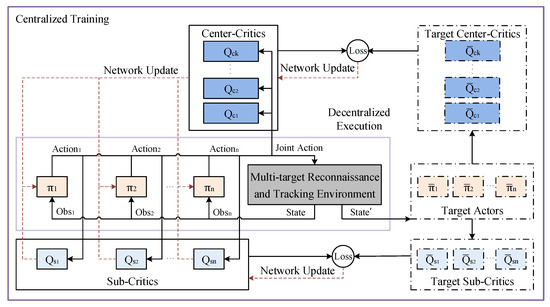
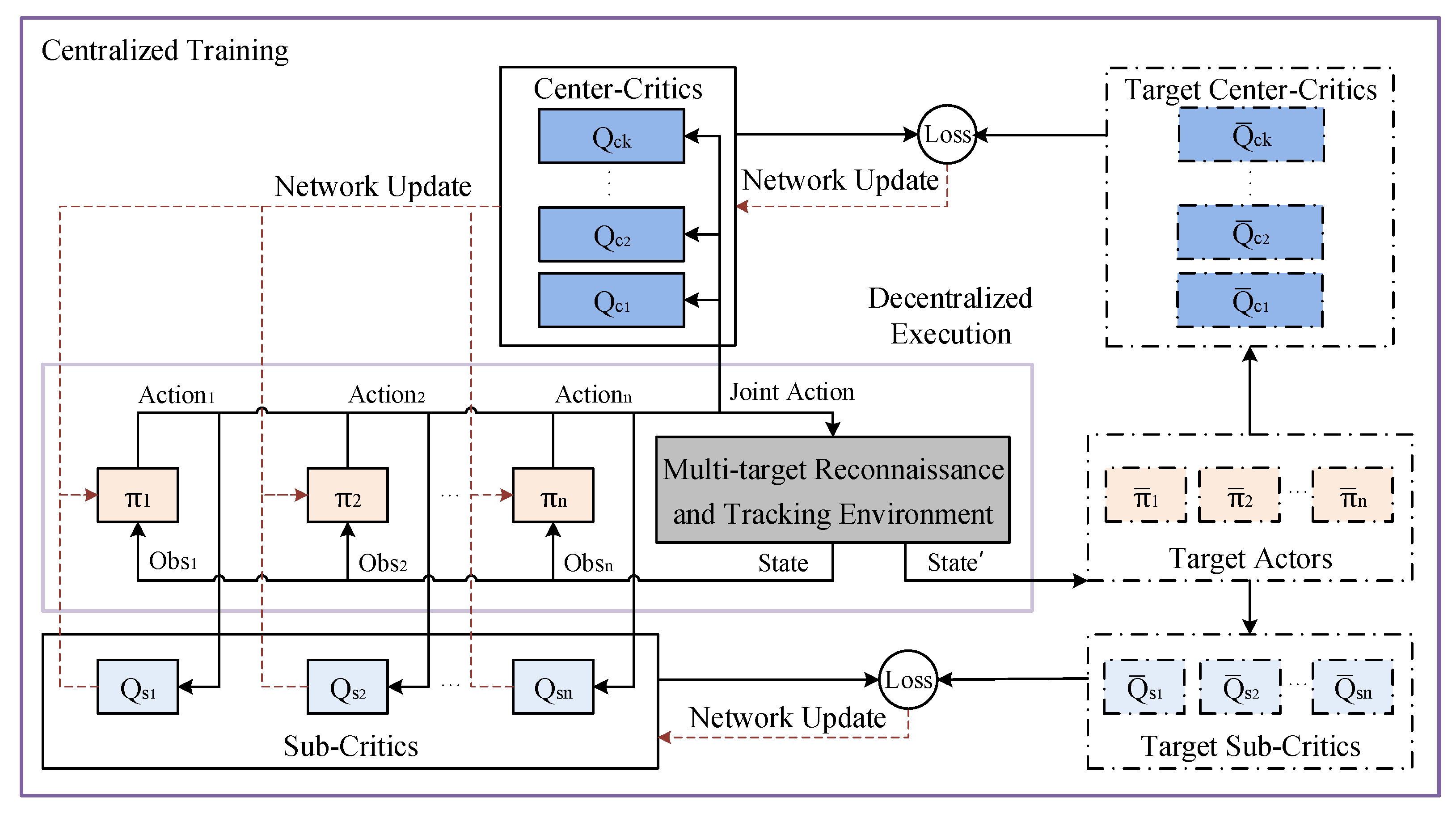
Figure 3 depicts the framework of the CSC-DDPG algorithm. To improve the stability of the target for action value estimation during the training phase, similar to DDPG, a series of target networks is configured for the policy and critic model. The target networks output the action value estimates for the next time step, which serves as the update target in TD-Error. The target networks achieve smooth and stable soft updates by summing the parameters of the current networks and the target networks with a tiny weight at each update time step.
Figure 3.
The framework of the proposed CSC-DDPG.
Given the homogeneity of the UAVs, both the policy network and the sub-critic network are shared across all agents. This sharing mechanism significantly reduces the computational load of the CSC-DDPG framework while also mitigating the non-stationarity issue inherent in MADDPG. During training, UAV experiences remain independent of agent identities, enabling cross-swarm experience sharing that critically augments training data diversity and elevates training efficiency. At each time step, experience data are stored in the replay buffer E. Network parameters undergo gradient update using samples randomly drawn from E per update cycle. The loss functions for the shared network , , and the center-critic networks are consequently rewritten as
where d refers to a set of experiences and represents the corresponding target network. Furthermore, during the training phase, Gaussian noise featuring linearly damped variance over time is introduced to the policy network outputs, enhancing the exploration capability of the deterministic policy approach while preventing convergence to the local optima. The pseudocode for the CSC-DDPG is detailed in Algorithm 1.
| Algorithm 1 CSC-DDPG for MTST |
|
4. Simulation Results
4.1. Simulation Parameters Setting and Hyperparameter Analysis
The CSC-DDPG algorithm workflow is implemented on a personal computer equipped with an RTX 4060 GPU. The task region is configured with and a grid size to facilitate practical implementation. A total of 4 UAVs, 4 no-fly zones, and 8 USV targets are randomly initialized within . The entire task duration was discretized into time steps. Other essential parameters are provided in Table 1.
Table 1.
Key simulation parameters.
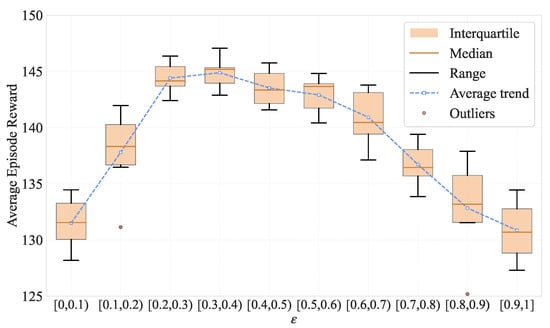
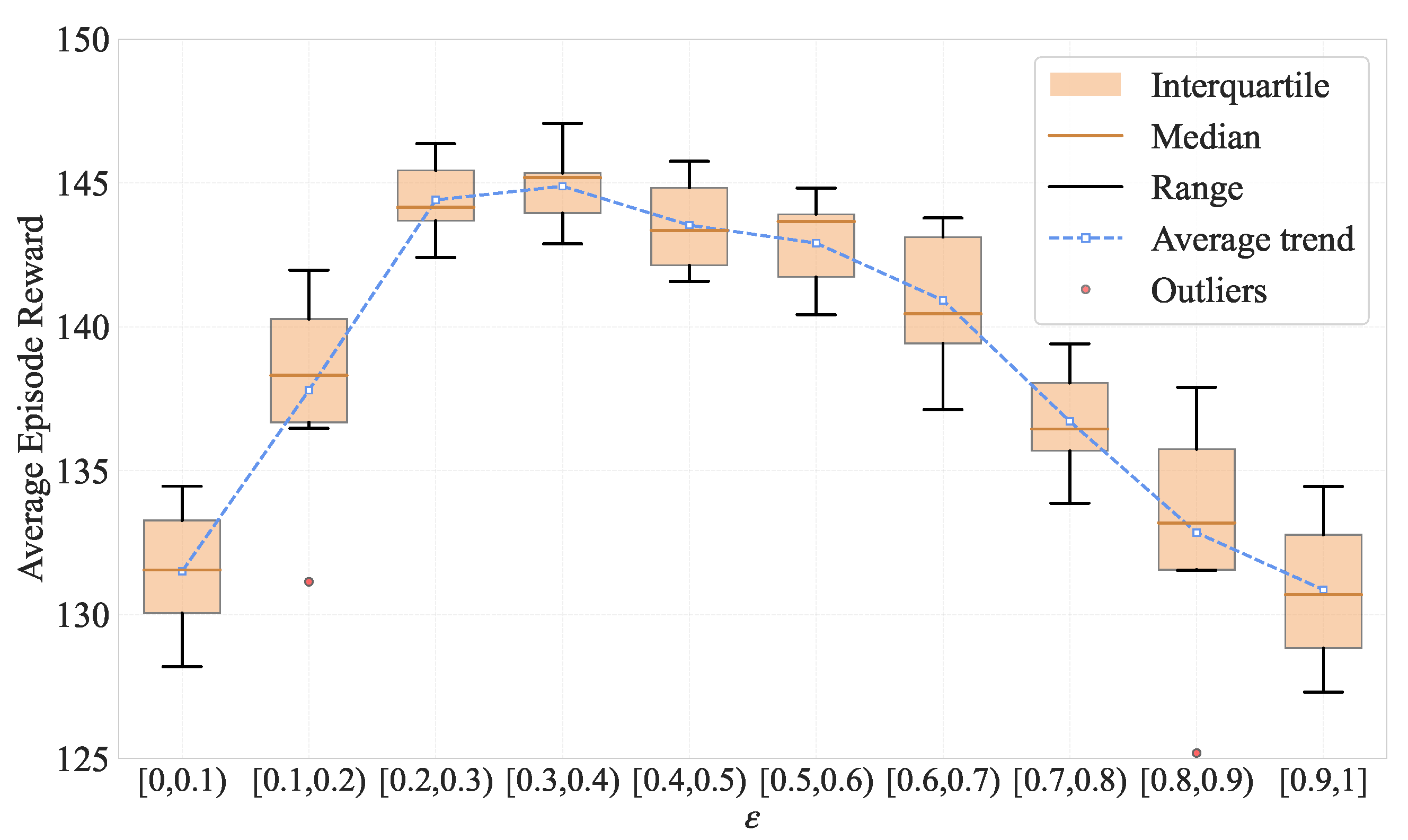
Regarding the selection of center-critic networks number , since the training phase requires removing the maximum Q-value while taking the average of the remaining outputs, must be greater than 2. However, excessive networks will increase the number of training parameters and even introduce greater variance in policy updates. This paper employs three center-critic networks to minimize computational overhead while implementing the CSC-DDPG framework. This paper utilizes the hyperparameter to balance the utility of the centralized critics and decentralized critics within CSC-DDPG, which serves as a key parameter for suppressing value overestimation and achieving a variance-bias trade-off. To determine an appropriate range for , [0, 1] is divided into ten intervals with a step size of 0.1. The training is carried out five times with random values in each interval. To analyze convergence and evaluate policy performance, the average episode reward for the final 20% of training steps was calculated, and a box plot of the statistics is shown in Figure 4.
Figure 4.
Variation in episode reward across multi-center-critic function weight .
As approaches 1, the center-critic networks play a dominant role, making the training framework more similar to MADDPG. Conversely, as approaches 0, the sub-critic networks take the lead, aligning the framework more closely with IDDPG. Analysis of the results in Figure 4 reveals that as increases, the average episode reward shows a declining trend in the later stages, with only a rapid rise observed in the early stages. This is related to the ability of the center-critic network to capture the joint actions of the multi-UAVs, enabling better learning of cooperative strategies. However, these joint actions also encompass a larger range of data variance, which further leads to strategy collapse and getting stuck in a local optimum. Conversely, on the one hand, when sub-critic networks predominantly assess the independent actions of multi-UAVs, each data variance of the sub-critic network originates solely from its own UAV action sampling. This mitigates evaluation instability, reducing the likelihood of policy collapse into suboptimal traps. On the other hand, excessive reliance on sub-critic networks amplifies state capture errors, as they focus solely on their own actions while neglecting how neighboring UAVs alter the global state. This is reflected in the interquartile range of Figure 4, where the interquartile range is larger when is closer to 0 than closer to 1. Additionally, note that the probability of outliers increases as approaches 1, which correlates with the further increased probability of policy collapse caused by the center-critic network.
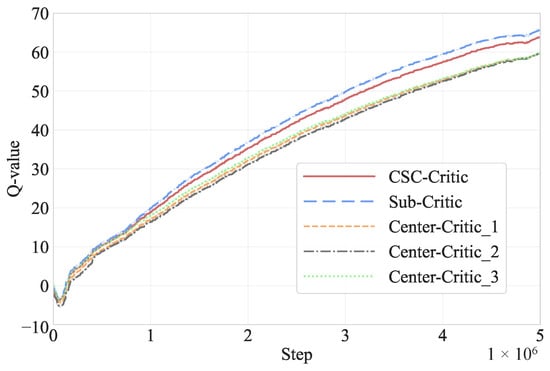
Building upon the preceding analysis, is chosen for the subsequent simulations in this work. Figure 5 illustrates how the Q-value estimates of the CSC network and its dependent center-critic and sub-critic networks evolve with training steps. It is evident that the Q-value of the CSC network is between those of the centralized critics and the decentralized critic, leaning closer to the decentralized part. Additionally, due to random parameter initialization, estimation bias exists among the center-critic networks during the early training phase. However, as the training progresses, the network parameters converge to be consistent, and this bias progressively diminishes.
Figure 5.
Variation of Q-value with the number of training steps.
4.2. Convergence Analysis
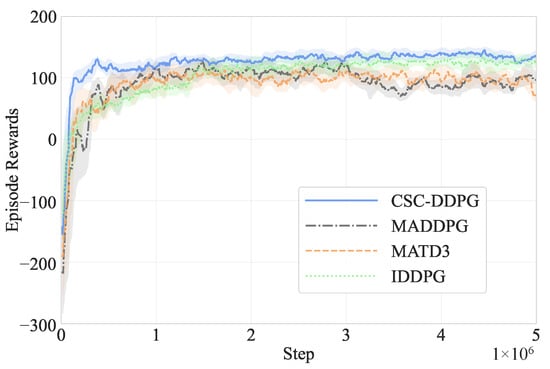
MADDPG, IDDPG, and the Multi-Agent Twin Delayed Deep Deterministic Policy Gradient (MATD3) were selected as baseline algorithms for comparative analysis of CSC-DDPG convergence. MATD3, a modification of TD3 [38] for multi-agent environments, employs two critic networks and a delayed policy update mechanism to improve MADDPG. Figure 6 shows the variation of the episode rewards with the training steps for the four algorithms. The dark lines represent the average of five training results, while the light shaded areas denote the corresponding standard deviation.
Figure 6.
Variation of episode reward with the training steps for CSC-DDPG and baselines.
It can be seen from Figure 6 that CSC-DDPG converges to a higher average reward and a lower policy variance, indicating that the proposed algorithm learned a more optimal and stable policy. Meanwhile, both MADDPG and MATD3 exhibited certain degrees of policy collapse. This stems from relying solely on the center-critic network while ignoring the negative contributions of suboptimal actions by individual agents. The suboptimal actions will increase the variance in policy updates, potentially leading to negative optimizations or even abrupt falls. Benefiting from the hybrid advantages, CSC-DDPG also outperforms baselines in convergence speed. Compared to IDDPG in particular, the introduction of center-critic networks enables the individual UAV to consider changes of the global state and execute more efficient actions, thereby acquiring higher-quality experience at the early stage of training. Simultaneously, the proposed method also mitigates the tendency of IDDPG to become trapped in local optima, demonstrated by CSC-DDPG converging to a higher episode reward.
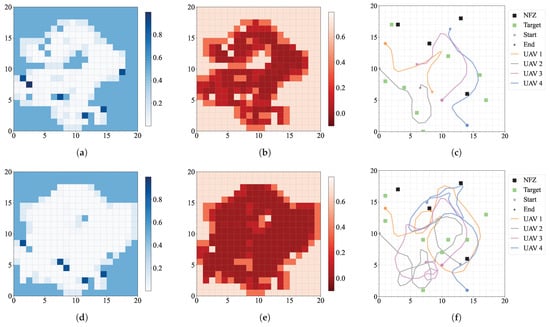
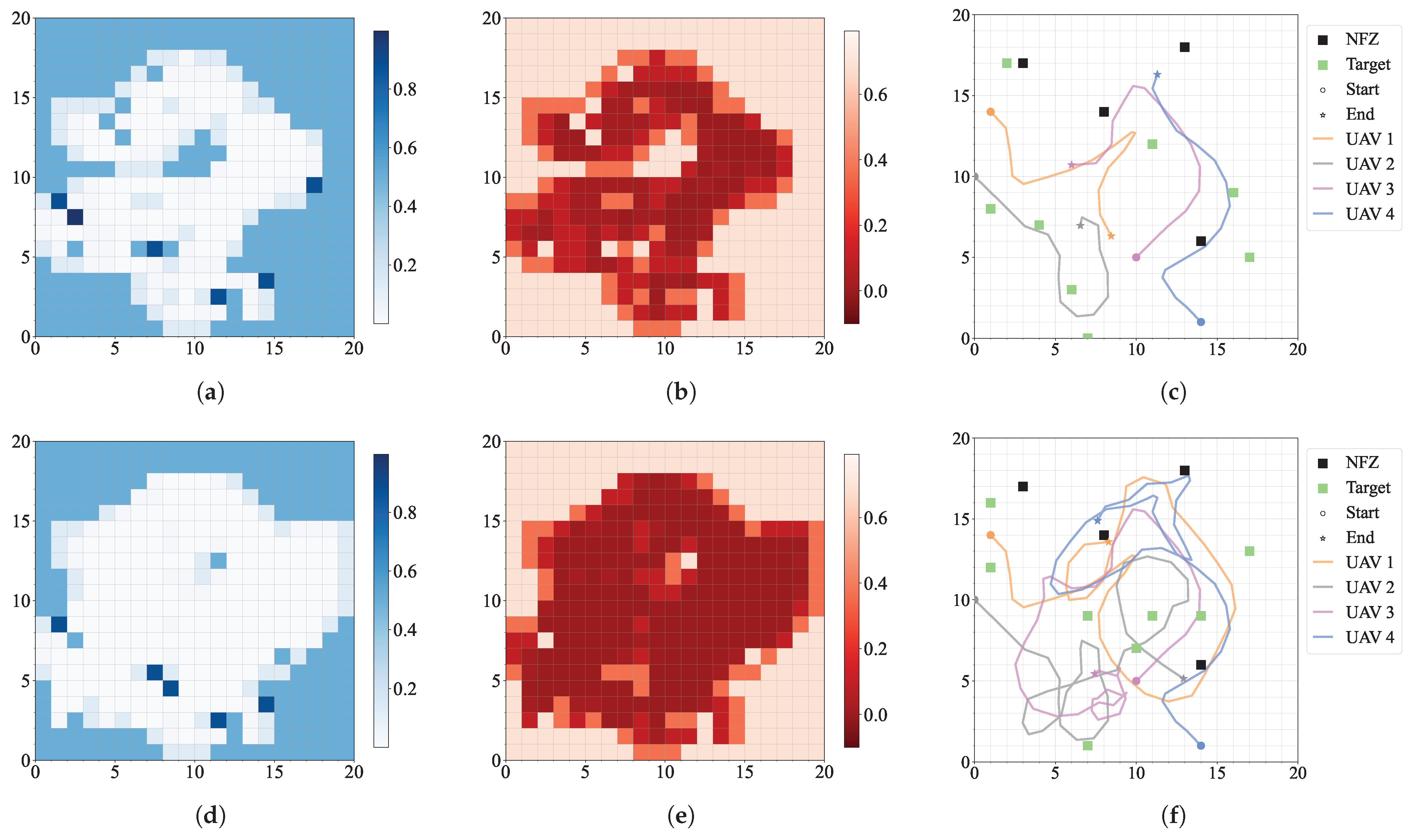
To validate the performance of the CSC-DDPG after convergence, the policy network is deployed, and the state of the task area at different time steps during a single episode is displayed. As shown in Figure 7, the first and second rows represent the state of the environment at steps 15 and 30, respectively. Figure 7a,d illustrate the evolution of the SDTCM, where darker areas indicate regions with higher USV existence probability, while lighter areas denote regions with lower probability. Due to the spatio-temporal decay of SDTCM, probability information gradually dilutes over time, guiding the UAV to revisit the detected targets. This also explains why the edge regions of the SDTCM predominantly appear blue. Figure 7b,e visualize the SDTCM information entropy. At step 15, numerous lighter grids represent unexplored areas. By step 30, the darker low-information areas have expanded further, and their edge information continues to guide the multi-UAVs to explore unknown regions. Figure 7c,f display the trajectory maps of the multi-UAVs. It can be seen that the majority of targets have been detected at step 15. Subsequently, while exploring unknown areas, the multi-UAVs repeatedly revisit detected USVs to update their position information.
Figure 7.
The changes of environment state with steps. (a) SDTCM at step 15. (b) Entropy at step 15. (c) Trajectories at step 15. (d) SDTCM at step 30. (e) Entropy at step 30. (f) Trajectories at step 15.
4.3. Performance Comparison Analysis
The performances of CSC-DDPG with non-reinforcement learning algorithms in multi-UAVs MTST for USV swarm are compared to demonstrate the efficacy of the proposed algorithm, while the generalization and scalability of CSC-DDPG in different scale environments are discussed. The selected comparison algorithms are cooperative multi-robot observation of multi-moving targets (CMOMMT), ACO, and random algorithms. CMOMMT [3,39,40,41] guides agent motion through the resultant force derived from target attraction and partner repulsion. CMOMMT is improved by generating reliable target attraction based on SDTCM while incorporating target existence probability and information entropy as force weights. The modified approach is termed CMOMMT with SDTCM (CMOMMT-M). Based on the idea of ACO, the action space of UAV is modified to discrete 8-directional actions. The pheromone table is designed as an grid action guidance map. At the same time, SDTCM and the locations of neighboring UAVs and no-fly zones serve as real-time dynamic heuristic information. Together with pheromones, these factors determine the action probability distribution of UAV, which is denoted as ACO with SDTCM (ACO-M). In the random algorithm, each drone obtains its action by randomly selecting a resultant force with constrained magnitude in any direction.
The performance evaluation metrics for the MTST task are defined as the average of the target detected rate, the standard deviation of the detected rate, and the sum or mean of grid information entropy. The target detected rate is calculated as the number of USVs detected times divided by the current time step. All metric data were obtained by averaging results from testing under 50 randomly initialized configurations of no-fly zones, targets, and multi-UAV positions. Scalability and generalization testing encompass two aspects: variations in UAV quantity and environmental scale. Once trained in the benchmark environment, the CSC-DDPG policy model is deployed in test environments of various configurations. No retraining is required for different configurations, and it is also a challenge for the generalization of CSC-DDPG when facing unknown environments.
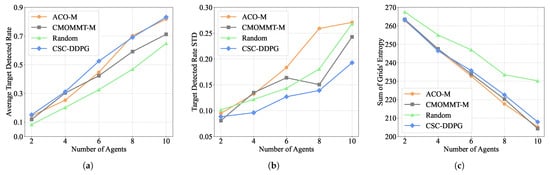
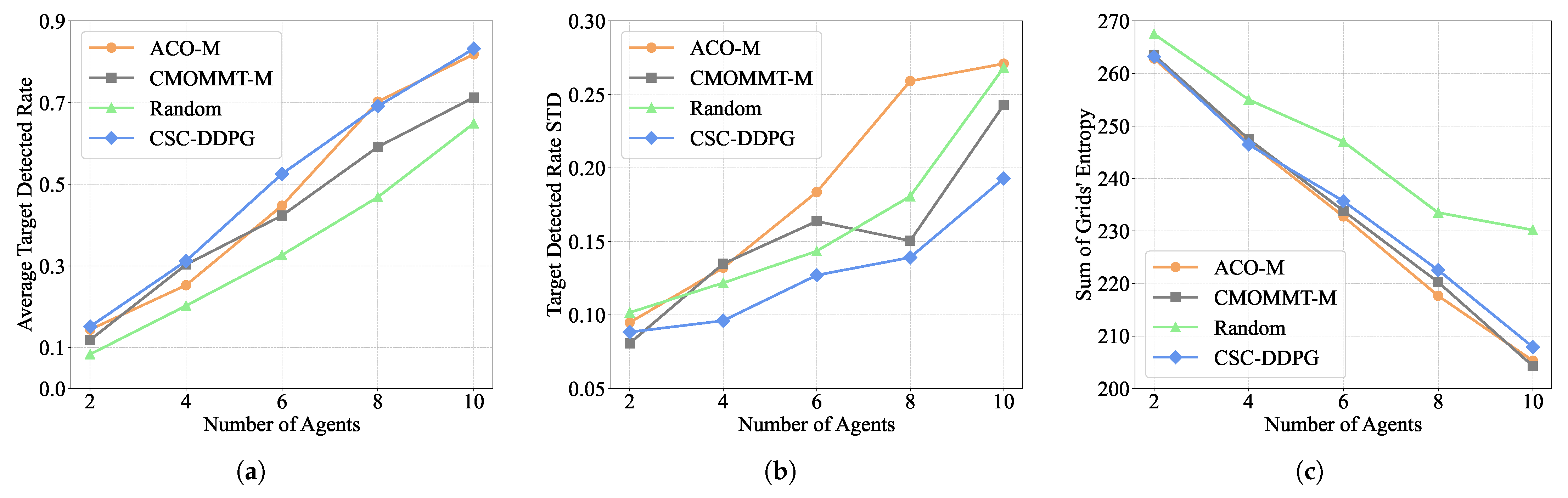
Firstly, based on the benchmark environment, different numbers of UAVs are deployed for algorithm comparison tests, observing the impact of multi-UAVs scale changes on performance metrics. As shown in Figure 8a,b, throughout the transition from under-saturation to over-saturation of multi-UAVs, CSC-DDPG consistently maintained the average detected rate within the top tier, performing on par with comparison algorithms. This validates the effectiveness and scalability of CSC-DDPG. The proposed algorithm demonstrates its advantage in terms of detected rate standard deviation, showing that the model can perform more uniform revisit detection on detected USVs across different numbers of UAVs. Focusing on ACO-M, non-reinforcement learning (non-RL) algorithms are observed to tend to be satisfied with continuously tracking the same USV to maintain decent detected rates while ignoring the fairness of importance among multi-UAVs.
Figure 8.
Variation of the performance metrics with the number of UAVs. (a) Average target detected rate. (b) Target detected rate STD. (c) Sum of grids’ entropy.
Figure 8c shows that all the algorithms except the random algorithm have carried out a considerable degree of autonomous exploration in unknown environments to reduce the environmental uncertainty.
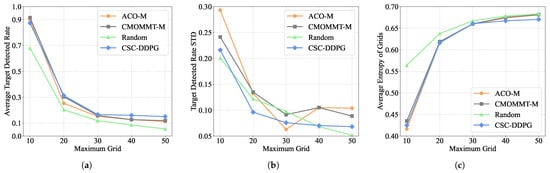
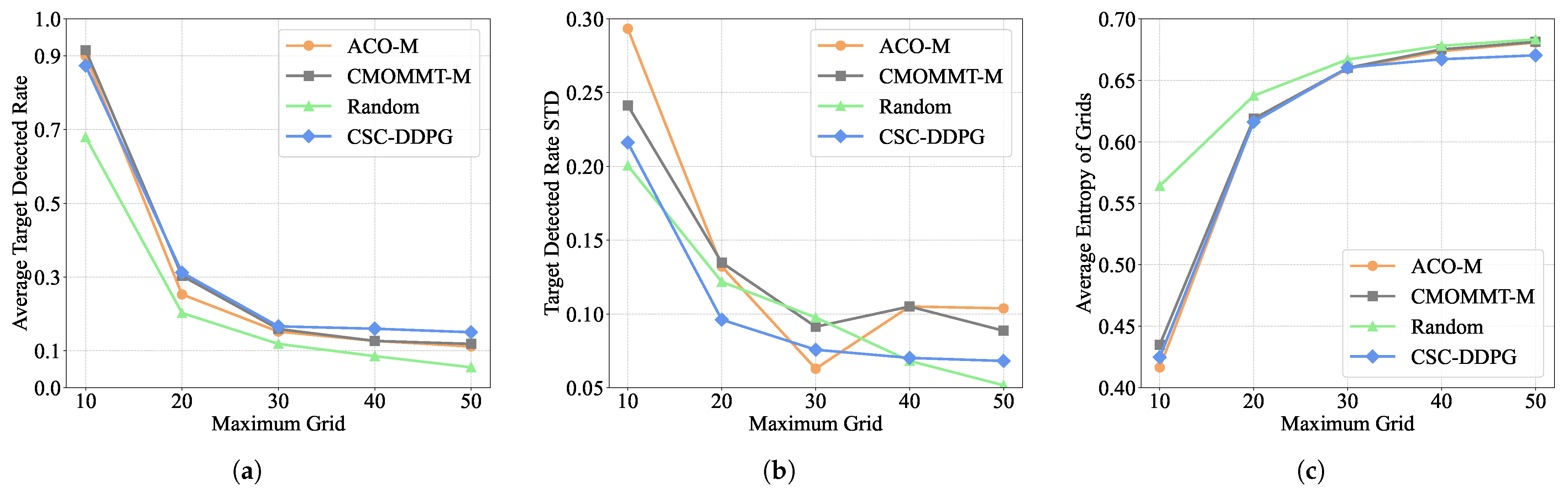
Subsequently, based on the benchmark environment, the number of UAVs remained constant while varying the side length of the square task area to explore the performance of multi-UAVs in smaller and larger environments. While changing the task area scale, the number of no-fly zones and USVs, and the maximum time step of one episode are scaled proportionally to match the benchmark environment. As shown in Figure 9a,b, the trained model maintains comparable target detection capabilities to the baseline algorithms when deployed in environments smaller or larger than the training environment. In extremely large-scale environments, it even slightly outperforms the baseline algorithms. Furthermore, CSC-DDPG consistently completes the MTST task with a lower detected standard deviation than the baseline algorithms across most environments, further validating the generalization and scalability of the proposed algorithm. It is noted that the random algorithm achieves lower detected standard deviation in the large-scale environment. This occurs because the fairness inherent to a random strategy, which lacks targeted intent, is amplified as the environment scale increases. Figure 9c illustrates that, compared to random algorithms, other algorithms exhibit purposeful environmental exploration behavior, rather than merely wandering around their initial positions. Additionally, CSC-DDPG achieves lower average grid information entropy in large-scale environments, demonstrating more intelligent multi-UAV coordination capability than the comparison algorithms by avoiding redundant inspection of areas recently explored by neighbor UAVs.
Figure 9.
Variation of the performance metrics with the scale of environment. (a) Average target detected rate. (b) Target detected rate STD. (c) Average entropy of grids.
5. Conclusions
A hybrid critics MARL framework is proposed in this paper to address the multi-UAVs MTST for USV swarm problem considering detection errors. The multi-UAVs information fusion mechanism is first established by Bayesian update, and based on this, the SDTCM is designed to support the fusion communication observation. Building upon communication-enhanced POMDP, the CSC-DDPG algorithm is introduced, which comprehensively utilizes multiple center-critic networks and local sub-critic networks to address variance-bias balance and overestimation in model training. Finally, through simulation comparisons with various RL and non-RL algorithms across environments of different scales, the efficacy and scalability of the proposed algorithm are verified, and the cooperative searching and tracking capabilities of the multi-UAVs system are improved. Future research will be carried out in more complex high-dimensional environments and real-world deployment experiments of multi-UAVs, in order to achieve contributions with greater practical engineering significance. The transition from simulation to real-world deployment, taking into account communication topology and latency, is the primary challenge that must be addressed. Developing dynamic models that track how UAV observation errors vary with environmental factors represents a key research direction for accelerating practical deployment in the future. In terms of theoretical research, the core hyperparameters and weights of adaptive learning represent future research directions.
Author Contributions
Conceptualization, Y.H.; methodology, Y.H.; software, Y.H.; validation, Y.H.; formal analysis, B.L.; investigation, Y.H.; resources, B.L.; data curation, Y.H.; writing—original draft preparation, Y.H. and B.L.; writing—review and editing, Y.H., X.M. and B.L.; visualization, Y.H. and X.M.; supervision, X.M.; project administration, X.M. and B.L.; funding acquisition, B.L. All authors have read and agreed to the published version of the manuscript.
Funding
This paper was supported in part by National Natural Science Foundation of China (62473249), Natural Science Foundation of Shanghai (23ZR1426600).
Data Availability Statement
Data are contained within the article. Further inquiries can be directed to the corresponding author.
Conflicts of Interest
The authors declare no conflicts of interest.
References
- Wei, D.; Zhang, L.; Liu, Q.; Chen, H.; Huang, J. UAV Swarm Cooperative Dynamic Target Search: A MAPPO-Based Discrete Optimal Control Method. Drones 2024, 8, 214. [Google Scholar] [CrossRef] [Scilit]
- Liu, H.; Li, B.; Ahn, C.K. Asymptotically Stable-Learning-Based Formation Control for Multiquadrotor UAVs. IEEE Internet Things J. 2025, 12, 24985–24995. [Google Scholar] [CrossRef] [Scilit]
- Parker, L.; Emmons, B. Cooperative multi-robot observation of multiple moving targets. In Proceedings of the International Conference on Robotics and Automation, Albuquerque, NM, USA, 20–25 April 1997; IEEE: New York, NY, USA, 1997; Volume 3, pp. 2082–2089. [Google Scholar]
- Gammell, J.D.; Strub, M.P. Asymptotically Optimal Sampling-Based Motion Planning Methods. Annu. Rev. Control. Robot. Auton. Syst. 2021, 4, 295–318. [Google Scholar] [CrossRef] [Scilit]
- Li, B.; Gong, W.; Yang, Y.; Xiao, B.; Ran, D. Appointed Fixed Time Observer-Based Sliding Mode Control for a Quadrotor UAV Under External Disturbances. IEEE Trans. Aerosp. Electron. Syst. 2022, 58, 290–303. [Google Scholar] [CrossRef] [Scilit]
- Zhong, X.; Huo, Y.; Dong, X.; Liang, Z. QoS-Compliant 3-D Deployment Optimization Strategy for UAV Base Stations. IEEE Syst. J. 2021, 15, 1795–1803. [Google Scholar]
- Al-Turjman, F.; Zahmatkesh, H.; Al-Oqily, I.; Daboul, R. Optimized Unmanned Aerial Vehicles Deployment for Static and Mobile Targets’ Monitoring. Comput. Commun. 2020, 149, 27–35. [Google Scholar] [CrossRef] [Scilit]
- Zou, J.; Shi, D. Fair Observation of Multiple Moving Targets in Cooperative Multi-UAV Systems. In Proceedings of the 2021 IEEE International Conference on Artificial Intelligence and Computer Applications (ICAICA), Dalian, China, 28–30 June 2021; IEEE: New York, NY, USA, 2021; pp. 562–568. [Google Scholar]
- Huang, H.; Savkin, A.V. Aerial Surveillance in Cities: When UAVs Take Public Transportation Vehicles. IEEE Trans. Autom. Sci. Eng. 2023, 20, 1069–1080. [Google Scholar] [CrossRef] [Scilit]
- Scherer, J.; Rinner, B. Multi-UAV Surveillance With Minimum Information Idleness and Latency Constraints. IEEE Robot. Autom. Lett. 2020, 5, 4812–4819. [Google Scholar] [CrossRef] [Scilit]
- Zhen, Z.; Chen, Y.; Wen, L.; Han, B. An intelligent cooperative mission planning scheme of UAV swarm in uncertain dynamic environment. Aerosp. Sci. Technol. 2020, 100, 105826. [Google Scholar] [CrossRef] [Scilit]
- Pérez-Carabaza, S.; Besada-Portas, E.; López-Orozco, J.A. Minimizing the searching time of multiple targets in uncertain environments with multiple UAVs. Appl. Soft Comput. 2024, 155, 111471. [Google Scholar] [CrossRef] [Scilit]
- Phung, M.D.; Ha, Q.P. Motion-encoded particle swarm optimization for moving target search using UAVs. Appl. Soft Comput. 2020, 97, 106705. [Google Scholar] [CrossRef] [Scilit]
- Xu, L.; Cao, X.; Du, W.; Li, Y. Cooperative path planning optimization for multiple UAVs with communication constraints. Knowl.-Based Syst. 2023, 260, 110164. [Google Scholar] [CrossRef] [Scilit]
- Duan, H.; Zhao, J.; Deng, Y.; Shi, Y.; Ding, X. Dynamic Discrete Pigeon-Inspired Optimization for Multi-UAV Cooperative Search-Attack Mission Planning. IEEE Trans. Aerosp. Electron. Syst. 2021, 57, 706–720. [Google Scholar] [CrossRef] [Scilit]
- Li, B.; Liu, H.; Ahn, C.K.; Gong, W. Optimized intelligent tracking control for a quadrotor unmanned aerial vehicle with actuator failures. Aerosp. Sci. Technol. 2024, 144, 108803. [Google Scholar] [CrossRef] [Scilit]
- Garaffa, L.C.; Basso, M.; Konzen, A.A.; de Freitas, E.P. Reinforcement Learning for Mobile Robotics Exploration: A Survey. IEEE Trans. Neural Netw. Learn. Syst. 2023, 34, 3796–3810. [Google Scholar] [CrossRef] [Scilit] [PubMed]
- Ning, Z.; Xie, L. A survey on multi-agent reinforcement learning and its application. J. Autom. Intell. 2024, 3, 73–91. [Google Scholar] [CrossRef] [Scilit]
- Oliehoek, F.A.; Spaan, M.T.J.; Vlassis, N. Optimal and approximate Q-value functions for decentralized POMDPs. J. Artif. Int. Res. 2008, 32, 289–353. [Google Scholar] [CrossRef] [Scilit]
- Yu, C.; Velu, A.; Vinitsky, E.; Gao, J.; Wang, Y.; Bayen, A.; Wu, Y. The surprising effectiveness of ppo in cooperative multi-agent games. Adv. Neural Inf. Process. Syst. 2022, 35, 24611–24624. [Google Scholar]
- Liu, J.; Wei, S.; Li, B.; Wang, T.; Qi, W.; Han, X.; Hou, G.; Li, K.; Lin, Y.; Xue, D.; et al. Dual-timescale hierarchical MADDPG for Multi-UAV cooperative search. J. King Saud Univ. Comput. Inf. Sci. 2025, 37, 142. [Google Scholar] [CrossRef] [Scilit]
- Gong, Z.; Xu, Y.; Luo, D. UAV Cooperative Air Combat Maneuvering Confrontation Based on Multi-agent Reinforcement Learning. Unmanned Syst. 2023, 11, 273–286. [Google Scholar]
- Shen, G.; Lei, L.; Zhang, X.; Li, Z.; Cai, S.; Zhang, L. Multi-UAV Cooperative Search Based on Reinforcement Learning with a Digital Twin Driven Training Framework. IEEE Trans. Veh. Technol. 2023, 72, 8354–8368. [Google Scholar] [CrossRef] [Scilit]
- Hou, Y.; Zhao, J.; Zhang, R.; Cheng, X.; Yang, L. UAV Swarm Cooperative Target Search: A Multi-Agent Reinforcement Learning Approach. IEEE Trans. Intell. Veh. 2024, 9, 568–578. [Google Scholar]
- Zhang, B.; Lin, X.; Zhu, Y.; Tian, J.; Zhu, Z. Enhancing Multi-UAV Reconnaissance and Search Through Double Critic DDPG With Belief Probability Maps. IEEE Trans. Intell. Veh. 2024, 9, 3827–3842. [Google Scholar] [CrossRef] [Scilit]
- Zhou, W.; Li, J.; Liu, Z.; Shen, L. Improving multi-target cooperative tracking guidance for UAV swarms using multi-agent reinforcement learning. Chin. J. Aeronaut. 2022, 35, 100–112. [Google Scholar] [CrossRef] [Scilit]
- Cao, X.; Luo, H.; Tai, J.; Jiang, R.; Wang, G. Multi-agent target search strategy optimization: Hierarchical reinforcement learning with multi-criteria negative feedback. Appl. Soft Comput. 2023, 149, 110999. [Google Scholar]
- Yue, L.; Yang, R.; Zuo, J.; Yan, M.; Zhao, X.; Lv, M. Factored Multi-Agent Soft Actor-Critic for Cooperative Multi-Target Tracking of UAV Swarms. Drones 2023, 7, 150. [Google Scholar]
- Liu, Y.; Li, X.; Wang, J.; Wei, F.; Yang, J. Reinforcement-Learning-Based Multi-UAV Cooperative Search for Moving Targets in 3D Scenarios. Drones 2024, 8, 378. [Google Scholar] [CrossRef] [Scilit]
- Tilak, O.; Mukhopadhyay, S. Partially decentralized reinforcement learning in finite, multi-agent Markov decision processes. AI Commun. 2011, 24, 293–309. [Google Scholar] [CrossRef] [Scilit]
- Wang, C.; Wang, J.; Zhang, X.; Zhang, X. Autonomous navigation of UAV in large-scale unknown complex environment with deep reinforcement learning. In Proceedings of the 2017 IEEE Global Conference on Signal and Information Processing (GlobalSIP), Montreal, QC, Canada, 14–16 November 2017; IEEE: New York, NY, USA, 2017; pp. 858–862. [Google Scholar]
- Shen, G.; Lei, L.; Li, Z.; Cai, S.; Zhang, L.; Cao, P.; Liu, X. Deep Reinforcement Learning for Flocking Motion of Multi-UAV Systems: Learn from a Digital Twin. IEEE Internet Things J. 2022, 9, 11141–11153. [Google Scholar] [CrossRef] [Scilit]
- Hou, Y.; Li, B.; Miao, X. Cooperative Target Search for UAV Swarm Based on Multi-Hybrid Critic DDPG. In Proceedings of the 2025 IEEE 23rd International Conference on Industrial Informatics (INDIN), Kunming, China, 12–15 July 2025; IEEE: New York, NY, USA, 2025; pp. 1–6. [Google Scholar]
- Dibangoye, J.S.; Amato, C.; Buffet, O.; Charpillet, F. Optimally solving Dec-POMDPs as continuous-state MDPs. J. Artif. Int. Res. 2016, 55, 443–497. [Google Scholar] [CrossRef] [Scilit]
- Sutton, R.S.; Barto, A.G. Reinforcement Learning: An Introduction; A Bradford Book: Cambridge, MA, USA, 2018. [Google Scholar]
- Oroojlooy, A.; Hajinezhad, D. A review of cooperative multi-agent deep reinforcement learning. Appl. Intell. 2023, 53, 13677–13722. [Google Scholar] [CrossRef] [Scilit]
- Silver, D.; Lever, G.; Heess, N.; Degris, T.; Wierstra, D.; Riedmiller, M. Deterministic policy gradient algorithms. In Proceedings of the 31st International Conference on Machine Learning, Beijing, China, 22–24 June 2014; ML Research Press: Norfolk, MA, USA, 2014; Volume 32, pp. I-387–I-395. [Google Scholar]
- Fujimoto, S.; van Hoof, H.; Meger, D. Addressing Function Approximation Error in Actor-Critic Methods. In Proceedings of the 35th International Conference on Machine Learning, Stockholm, Sweden, 10–15 July 2018; ML Research Press: Norfolk, MA, USA, 2018; Volume 80, pp. 1587–1596. [Google Scholar]
- Parker, L.E. Distributed algorithms for multi-robot observation of multiple moving targets. Auton. Robot. 2002, 12, 231–255. [Google Scholar] [CrossRef] [Scilit]
- Ding, Y.; Zhu, M.; He, Y.; Jiang, J. P-CMOMMT Algorithm For The Cooperative Multi-Robot Observation of Multiple Moving Targets. In Proceedings of the 6th World Congress on Intelligent Control and Automation, Dalian, China, 21–23 June 2006; IEEE: New York, NY, USA, 2006; Volume 2, pp. 9267–9271. [Google Scholar]
- Kolling, A.; Carpin, S. Cooperative observation of multiple moving targets: An algorithm and its formalization. Int. J. Robot. Res. 2007, 26, 935–953. [Google Scholar] [CrossRef] [Scilit]

Disclaimer/Publisher’s Note: The statements, opinions and data contained in all publications are solely those of the individual author(s) and contributor(s) and not of MDPI and/or the editor(s). MDPI and/or the editor(s) disclaim responsibility for any injury to people or property resulting from any ideas, methods, instructions or products referred to in the content. |
© 2026 by the authors. Licensee MDPI, Basel, Switzerland. This article is an open access article distributed under the terms and conditions of the Creative Commons Attribution (CC BY) license.