Proceeding Paper

AI-Enabled Student Support for Sustainable Well-Being and Academic Resilience †

by
Zekeriya Emre Erkal
* and
Bora Yıldız
Faculty of Economics, Department of Business Administration, Istanbul University, Istanbul 34126, Türkiye
*
Author to whom correspondence should be addressed.
Presented at the International Conference on Digital Transformation, Sustainability and AI, Kuwait, 4–5 February 2026.
Proceedings 2026, 142(1), 3; https://doi.org/10.3390/proceedings2026142003
Published: 3 June 2026

Abstract

While higher education institutions strive for academic excellence, they also bear the responsibility of caring for and ensuring the sustainable well-being of their students. After the COVID-19 pandemic, these institutions have transitioned to hybrid and digital education models and have begun to experience the opportunities and threats of digital learning ecosystems. With the introduction of AI technology, this transformation has taken on a new dimension: while students benefit from the flexibility, instant feedback, and personalized learning offered by AI tools, they have also begun to experience new challenges, including cognitive overload, digital fatigue, and social isolation. In this context, the aim of this research is to assess students’ overall psychological well-being and to provide a support system that promotes sustainable well-being by anticipating potential psychological strain and recommending necessary precautions. Accordingly, the purpose of this study, drawing on Self-Determination Theory and Conservation of Resources Theory, is to examine the direct effects of an AI-enabled student support system on sustainable well-being and academic engagement, as well as its indirect effects through self-efficacy and academic resilience. Data will be collected from undergraduate students from a public university in Istanbul. Data will be analyzed in the R statistical environment. We expect that academic resilience, and self-efficacy will mediate the relationship between an AI-enabled student support system and sustainable well-being. At the end of the study, we propose a conceptual model that can be tested empirically by further research. Managerial and further research directions, as well as limitations, are also discussed.

1. Introduction

The development of information technologies and the indispensable role of artificial intelligence technologies in life have gained significant momentum, especially after the COVID-19 period [1,2]. Numerous technologies, such as digital transformation, digital twins, big data, machine learning, data-driven decision-making, data-based prediction, the Internet of Things, and human–robot interaction/coworking, have become commonplace in this process and have significantly accelerated it [3,4,5]. Given the importance of these technologies, the public and private sectors have begun to use them extensively for a variety of reasons, including competitive pressures, technological investment requirements, and productivity motivations. In other words, this change and transformation have become essential for companies to achieve competitive advantage and sustainability. In this context, the use of these technologies has increased widely across sectors, including education, which has also been affected by this change [6,7,8].
The education sector has been among the most affected by the technologies mentioned above. The concepts of learning and teaching have been elevated to a new level, recognizing that education can be delivered regardless of location or environment [9,10]. Furthermore, the structure, process control, efficiency, and effectiveness of student support systems have also evolved due to these technologies. Essentially, adaptable learning environments, personalized learning methods, AI-supported advising, and predictive methods are assumed to make educational activities more inclusive, equitable, and diverse. However, despite these positive pedagogical aspects, the long-term impact of AI technologies on students’ psychological well-being and academic sustainability remains a matter of interest [11,12,13].
However, the assumption that AI-powered systems universally produce beneficial results may be theoretically flawed. For instance, recent studies address the undesirable effects of AI, including unethical and harmful outcomes [14,15,16]. Further, we clearly acknowledge that students can benefit from AI-powered systems, but they can also experience academic stress [17], cognitive overload and digital fatigue [18], metacognitive laziness [19,20], and social isolation [21,22]. We make it clear that our model highlights only positive outcomes when AI is applied appropriately and in ways that are sensitive to individual differences, as these benefits depend on correct, contextually relevant application. From a self-determination perspective [23], AI tools can enhance competence; however, if perceived as controlling, intrusive, or surveillance-oriented, they can also jeopardize autonomy. Similarly, while technology can help us use resources more efficiently, it can also pose risks, particularly when it creates performance pressure, requires constant monitoring, or relies on algorithmic evaluations. In such cases, AI-powered systems may inadvertently contribute to psychological strain, decreased intrinsic motivation, or technostress. Therefore, the effects of AI use may depend on contextual and perceptual boundary conditions such as students’ perceptions of autonomy, trust in technology, and institutional application practices.
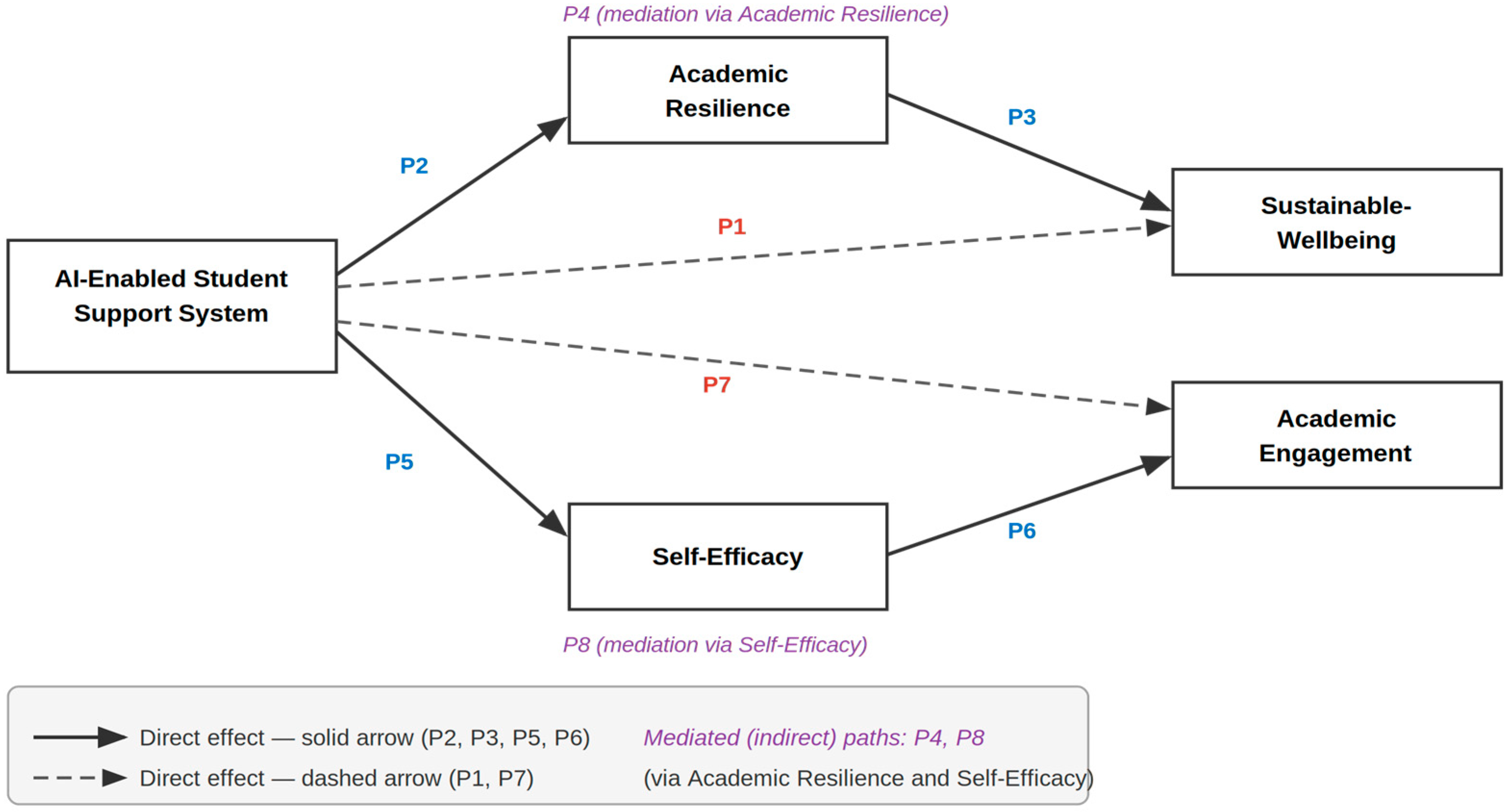
The purpose of this study is to conceptually examine potential outcomes by highlighting the benefits of AI-enabled student support systems and to propose a model for empirical research in this area. AI-enabled student support systems differ from traditional support systems not just in how much they help but also in how they work, using tools such as automated feedback, chatbots for questions, and algorithms that spot issues early [24,25,26,27,28,29]. Unlike static, predominantly human-mediated support models, these systems are characterized by continuous personalization and adaptability, enabling dynamically tailored learning pathways based on real-time behavioral and performance data. The ability to give immediate feedback is an important feature of AI that can help students feel more capable and boost their confidence and ability to handle challenges in online learning environments. Furthermore, the predictive capability embedded in AI systems—through data-driven modeling of academic and psychological indicators—allows institutions to anticipate potential academic risk and psychological strain proactively rather than respond reactively. This shift from reactive to predictive and personalized intervention represents the core theoretical distinction of AI-enabled support and forms the basis for linking technological functionality to sustainable well-being and long-term academic engagement. Based on self-determination theory [23], it is predicted that AI-enabled student support systems (e.g., automatic feedback tools, chatbot consultation systems, and early-detection algorithms) will increase students’ academic resilience, thereby positively impacting their sustainable well-being. Similarly, based on the conservation of resources theory [30,31], AI-enabled student support systems are predicted to reduce student burnout, thereby increasing academic engagement (Figure 1). In this respect, the proposed research propositions are as follows:
  • P1. AI-enabled student support systems positively affect sustainable well-being.
  • P2. AI-enabled student support systems positively affect academic resilience.
  • P3. Academic resilience positively affects sustainable wellbeing.
  • P4. Academic resilience mediates the positive relationship between AI-enabled student support systems and sustainable wellbeing.
  • P5. AI-enabled student support systems positively affect self-efficacy.
  • P6. Self-efficacy positively affects academic engagement.
  • P7. AI-enabled student support systems positively affect academic engagement.
  • P8. Self-efficacy mediates the positive relationship between AI-enabled student support systems and academic engagement.
Taken together, in this study, we seek to conceptually and theoretically examine the pivotal role of AI-enabled student support systems in fostering sustainable wellbeing, of which general self-esteem is a core component capturing the individual’s own capabilities, self-image, and the academic concept of self, and student’s social and emotional self-image [32] and academic engagement, defined as “the quality and quantity of students’ psychological, cognitive, emotional, and behavioral responses to the learning process” [33].

2. Methodology

The sample of this study will consist of 400 undergraduate students (grades 1–4) studying at a public university in Istanbul. We will contact students using a convenience sampling method and will ask them to participate via email from the course instructors. Within this scope, in the first step, 600 students will be emailed and asked to participate in the survey. To mitigate the risk of a low response rate, we have clarified our data collection strategy: contacting 600 students to reach a final sample of 400 and using instructor emails over a two-month period to encourage participation.
To collect data on the variables within the scope of the study, valid and reliable measures will be used. To measure the Academic Resilience, a 30-item scale [34] will be used. To measure Self-efficacy, an 8-item self-efficacy scale [35] will be used. The sustainable well-being scale will be measured with the 24-item BBC well-being scale [36]. To measure academic engagement, a 29-item academic engagement scale [37] will be used. Finally, AI-enabled student support systems will be measured using a 4-dimensional scale, adapted from various scales. All variables within the scope of the study will be measured on a 5-point Likert scale (1—Strongly disagree, 5—Strongly agree).
Analyses will be conducted using the R statistical environment [38]. Specifically, the libraries to be used are as follows: “psych” [39], “GPArotation” [40], “lavaan” [41,42], “semTools” [43], “nFactors” [44].
To test construct validity, exploratory and confirmatory factor analyses will be conducted [45,46]. On the other hand, the reliability analysis will be conducted to assess the internal consistency of the constructs, with a = 0.70 [47]. Finally, structural equation modeling will be used to test proposed hypotheses.

3. Conclusions

In this study’s model development process, the Self-Determination and Conservation of Resources theories have informed our propositions. Accordingly, the contributions of this study will be twofold. First, the positive association between AI-enabled student support systems and sustainable well-being, through enhanced academic resilience, will demonstrate AI’s significant role in students’ psychological well-being. This highlights the critical role of AI in supporting students’ psychological functioning. Based on this, AI-enabled support systems are likely to lead to higher academic engagement among students because they are sensitive to students’ individual needs and can personalize their interactions. Second, our conceptual model also implies that AI support systems that understand and meet personalized needs may increase students’ self-efficacy in overcoming specific challenges, thereby enhancing overall positive affect and academic engagement.
Although several studies caution that AI-enabled technologies may have destructive or undesirable effects, such as metacognitive laziness, lower levels of privacy and safety, and low levels of productivity [19,20,48,49], our theoretical assumptions suggest that when used appropriately and with sensitivity to individual differences, AI-enabled technologies can have positive contributions to human life, like sustainable wellbeing, strengthening academic engagement, academic resilience, and self-efficacy [50].
In light of the aforementioned explanations, the contribution of this research to the literature on AI-related technologies that are still in their nascent stages is as follows; contrary to popular belief, when AI technologies are used correctly, appropriately, and to meet individual needs, they may contribute to students’ engagement by increasing their academic self-efficacy, and the support systems in which these technologies are used contribute to academic development and sustainability by contributing to the psychological well-being of students.
Finally, as many studies have, this study has several limitations. First, the conceptual nature limits the testing and explanation of empirical relations. Therefore, future researchers are recommended to conduct quantitative or empirical studies to test our theory-driven research model by using the measurement tools and analytical methods. Second, we acknowledge that the conceptual nature of this paper currently limits empirical explanation and that our proposed sample is restricted to a single public university. The study sample is proposed to consist of public university students, which limits the generalization of the predicted results. It is recommended that future researchers examine differences between private and public universities to generalize their findings and achieve broader results. Although this study focuses on the positive and potentially beneficial aspects of artificial intelligence, the literature contains many studies that suggest negative impacts of AI. Therefore, we also recommend that future studies, to provide a more holistic perspective, specifically focus on issues such as procrastination and loss of motivation, which are considered the “dark side” of AI [51]. Finally, the study’s variables focused on the bright side of AI. Future research on the dark side of AI, such as laziness, inefficiency, procrastination, and loss of motivation, will contribute to a holistic understanding of AI technologies.

Author Contributions

Conceptualization, B.Y. and Z.E.E.; methodology, B.Y.; software, B.Y.; validation, Z.E.E. and B.Y.; formal analysis, B.Y.; investigation, Z.E.E. and B.Y.; resources, Z.E.E.; data curation, B.Y. and Z.E.E.; writing—original draft preparation, Z.E.E. and B.Y.; writing—review and editing, B.Y.; visualization, B.Y.; supervision, B.Y.; project administration, B.Y.; funding acquisition, Z.E.E. All authors have read and agreed to the published version of the manuscript.

Funding

This research received no external funding.

Institutional Review Board Statement

Ethical review and approval were waived for this study because the study is conceptual in nature and does not involve human participants or personal data at this stage.

Informed Consent Statement

Not applicable.

Data Availability Statement

No new data were created or analyzed in this study. Data sharing is not applicable to this proceedings paper.

Acknowledgments

During the preparation of this paper, the authors used ChatGPT 5.2 and Grammarly software (Version 1.167.0) to check grammar and improve readability. After using these tools, the authors reviewed and edited the content as needed and took full responsibility for the publication’s content.

Conflicts of Interest

The authors declare no conflict of interest.

References

  1. Wu, J.; Qu, X.; Sheng, L.; Chu, W. Uncovering the dynamics of enterprises digital transformation research: A comparative review on literature before and after the COVID-19 pandemic. Heliyon 2024, 10, e26986. [Google Scholar] [CrossRef]
  2. Kutnjak, A. COVID-19 accelerates digital transformation in industries: Challenges, issues, barriers and problems in transformation. IEEE Access 2021, 9, 79373–79388. [Google Scholar] [CrossRef]
  3. Li, S.; Gao, L.; Han, C.; Gupta, B.; Alhalabi, W.; Almakdi, S. Exploring the effect of digital transformation on Firms’ innovation performance. J. Innov. Knowl. 2023, 8, 100317. [Google Scholar] [CrossRef]
  4. Cheng, Y.; Zhou, X.; Li, Y. The effect of digital transformation on real economy enterprises’ total factor productivity. Int. Rev. Econ. Financ. 2023, 85, 488–501. [Google Scholar] [CrossRef]
  5. Demir, K.A.; Döven, G.; Sezen, B. Industry 5.0 and human-robot co-working. Procedia Comput. Sci. 2019, 158, 688–695. [Google Scholar] [CrossRef]
  6. Jimenez-Pitre, I.; Molina-Bolivar, G.; Pitre, R.G. Digital transformation in the education sector due to the impact of COVID-19. J. Lang. Linguist. Stud. 2022, 18, 75–87. [Google Scholar]
  7. Sairete, A.; Balfagih, Z.; Brahimi, T.; Mousa, M.E.A.; Lytras, M.; Visvizi, A. Artificial intelligence: Towards digital transformation of life, work, and education. Procedia Comput. Sci. 2021, 194, 1–8. [Google Scholar] [CrossRef]
  8. Quy, V.K.; Thanh, B.T.; Chehri, A.; Linh, D.M.; Tuan, D.A. AI and digital transformation in higher education: Vision and approach of a specific university in Vietnam. Sustainability 2023, 15, 11093. [Google Scholar] [CrossRef]
  9. Luckin, R.; Cukurova, M. Designing educational technologies in the age of AI: A learning sciences-driven approach. Br. J. Educ. Technol. 2019, 50, 2824–2838. [Google Scholar] [CrossRef]
  10. Mohebbi, A. Enabling learner independence and self-regulation in language education using AI tools: A systematic review. Cogent Educ. 2025, 12, 2433814. [Google Scholar] [CrossRef]
  11. Shoukat, W.; Rizwan, N.; Khan, M.T. The role of artificial intelligence (AI) tutors in personalized learning: Benefits and challenges. J. Soc. Signs Rev. 2025, 3, 1–13. [Google Scholar]
  12. Arora, A.K.; Kumar, A.; Tyagi, R.; Sharma, S.; Kumar, A.; Kumar, S. Future of Education with AI-Assisted Technologies. In Artificial Intelligence in Peace, Justice, and Strong Institutions; IGI Global Scientific Publishing: Hershey, PA, USA, 2025; pp. 169–190. [Google Scholar]
  13. Khaliq, A.; Muhammad, N.; Qamar, N. Enhancing Student Engagement and Academic Performance through AI-Based Tutoring Systems: A Comparative Study of Traditional vs. AI-Driven Education Models. Crit. Rev. Soc. Sci. Stud. 2025, 3, 824–834. [Google Scholar]
  14. Connell, J.B. Unethical and harmful effects of artificial intelligence on human interactions and well-being: What organizational consultants can do. Consult. Psychol. J. 2025, 77, 118–130. [Google Scholar] [CrossRef]
  15. Manu, M.; Makhija, F.; Bist, A.S.; Kharayat, P.S.; Singh, A.; Goyal, S. Unraveling the consequences of unethical act of use of artificial intelligence: A systematic review and meta-analysis. In 2024 4th International Conference on Advance Computing and Innovative Technologies in Engineering (ICACITE); IEEE: New York, NY, USA, 2024; pp. 1890–1894. [Google Scholar]
  16. Cao, L.; Chen, C.; Dong, X.; Wang, M.; Qin, X. The dark side of AI identity: Investigating when and why AI identity entitles unethical behavior. Comput. Hum. Behav. 2023, 143, 107669. [Google Scholar] [CrossRef]
  17. Zhang, S.; Zhao, X.; Zhou, T.; Kim, J.H. Do you have AI dependency? The roles of academic self-efficacy, academic stress, and performance expectations on problematic AI usage behavior. Int. J. Educ. Technol. High. Educ. 2024, 21, 34. [Google Scholar] [CrossRef]
  18. Ivanov, S. The dark side of artificial intelligence in higher education. Serv. Ind. J. 2023, 43, 1055–1082. [Google Scholar] [CrossRef]
  19. Fan, Y.; Tang, L.; Le, H.; Shen, K.; Tan, S.; Zhao, Y.; Shen, Y.; Li, X.; Gašević, D. Beware of metacognitive laziness: Effects of generative artificial intelligence on learning motivation, processes, and performance. Br. J. Educ. Technol. 2024, 56, 489–530. [Google Scholar] [CrossRef]
  20. Sabharwal, D.; Kabha, R.; Srivastava, K. Artificial Intelligence (AI)-Powered Virtual Assistants and their Effect on Human Productivity and Laziness: Study on Students of Delhi-NCR (India) & Fujairah (UAE). J. Content Community Commun. 2023, 17, 162–174. [Google Scholar]
  21. Klimova, B.; Pikhart, M. Exploring the effects of artificial intelligence on student and academic well-being in higher education: A mini-review. Front. Psychol. 2025, 16, 1498132. [Google Scholar] [CrossRef]
  22. Tian, J.; Zhang, R. Learners’ AI dependence and critical thinking: The psychological mechanism of fatigue and the social buffering role of AI literacy. Acta Psychol. 2025, 260, 105725. [Google Scholar] [CrossRef]
  23. Ryan, R.M.; Deci, E.L. Self-determination theory and the facilitation of intrinsic motivation, social development, and well-being. Am. Psychol. 2000, 55, 68. [Google Scholar] [CrossRef]
  24. Lee, Y.F.; Hwang, G.J.; Chen, P.Y. Impacts of an AI-based cha bot on college students’ after-class review, academic performance, self-efficacy, learning attitude, and motivation. Educ. Technol. Res. Dev. 2022, 70, 1843–1865. [Google Scholar] [CrossRef]
  25. Liu, H. Personalized learning support system for special education: A real-time feedback mechanism based on deep reinforcement learning. Front. Psychol. 2025, 16, 1658698. [Google Scholar] [CrossRef]
  26. Akintola, A.S.; Akintayo, M.; Kadri, T.; Oforgu, C.; Michael, M.; Nwanna, M. Adaptive AI systems in education: Real-time personalised learning pathways for skill development. J. Artif. Intell. Mach. Learn. Data Sci. 2025, 3, 2489–2494. [Google Scholar] [CrossRef] [PubMed]
  27. Rakhmetov, M.; Sadvakassova, A.; Saltanova, G.; Kuanbayeva, B.; Zhusupkalieva, G. Evaluation of an AI-Based Feedback System for Enhancing Self-Regulated Learning in Digital Education Platforms. Electron. J. E-Learn. 2025, 23, 126–141. [Google Scholar] [CrossRef]
  28. Prakash, J.; Swathiramya, R.; Balambigai, G.; Menaha, R.; Abhirami, J. AI-Driven Real-Time Feedback System for Enhanced Student Support: Leveraging Sentiment Analysis and Machine Learning Algorithms. Int. J. Comput. Exp. Sci. Eng. 2024, 10, 1567–1574. [Google Scholar] [CrossRef]
  29. Fu, C.; Damonte, J. Impact of ChatGPT on Educational Strategies for Future-Proof Business Data Analyst: Machine Learning Code Generation in Teaching and Learning. In Proceedings of the International Conference on Business Analytics in Practice (ICBAP 2024), Sharjah, United Arab Emirates, 8–11 January 2024. [Google Scholar] [CrossRef]
  30. Hobfoll, S.E. Conservation of resources: A new attempt at conceptualizing stress. Am. Psychol. 1989, 44, 513. [Google Scholar] [CrossRef]
  31. Hobfoll, S.E. Conservation of resources theory: Its implication for stress, health, and resilience. Oxf. Handb. Stress Health Coping 2011, 127, 147. [Google Scholar]
  32. Al-Kumaim, N.H.; Alhazmi, A.K.; Mohammed, F.; Gazem, N.A.; Shabbir, M.S.; Fazea, Y. Exploring the impact of the COVID-19 pandemic on university students’ learning life: An integrated conceptual motivational model for sustainable and healthy online learning. Sustainability 2021, 13, 2546. [Google Scholar] [CrossRef]
  33. Gunuc, S.; Kuzu, A. Student engagement scale: Development, reliability and validity. Assess. Eval. High. Educ. 2014, 40, 587–610. [Google Scholar] [CrossRef]
  34. Cassidy, S. The Academic Resilience Scale (ARS-30): A new multidimensional construct measure. Front. Psychol. 2016, 7, 1787. [Google Scholar] [CrossRef] [PubMed]
  35. Chen, G.; Gully, S.M.; Eden, D. Validation of a new general self-efficacy scale. Organ. Res. Methods 2001, 4, 62–83. [Google Scholar] [CrossRef]
  36. Kinderman, P.; Schwannauer, M.; Pontin, E.; Tai, S. The development and validation of a general measure of well-being: The BBC well-being scale. Qual. Life Res. 2011, 20, 1035–1042. [Google Scholar] [CrossRef]
  37. Freda, M.F.; Raffaele, D.L.P.; Esposito, G.; Ragozini, G.; Testa, I. A new measure for the assessment of the university engagement: The SInAPSi academic engagement scale (SAES). Curr. Psychol. 2023, 42, 9674–9690. [Google Scholar] [CrossRef]
  38. R Core Team. R: A Language and Environment for Statistical Computing; R Foundation for Statistical Computing: Vienna, Austria, 2025; Available online: https://www.R-project.org/ (accessed on 1 January 2026).
  39. Revelle, W. psych: Procedures for Psychological, Psychometric, and Personality Research, R package version 2.6.4, 2026; Northwestern University: Evanston, IL, USA, 2026. [Google Scholar]
  40. Bernaards, C.A.; Jennrich, R.I. Gradient Projection Algorithms and Software for Arbitrary Rotation Criteria in Factor Analysis. Educ. Psychol. Meas. 2005, 65, 676–696. [Google Scholar] [CrossRef]
  41. Rosseel, Y.; Jorgensen, T.D.; De Wilde, L. Lavaan: Latent Variable Analysis, R Package Version 0.6-20. 2025. Available online: https://cran.r-project.org/web/packages/lavaan/index.html (accessed on 12 December 2025).
  42. Rosseel, Y. lavaan: An R Package for Structural Equation Modeling. J. Stat. Softw. 2012, 48, 1–36. [Google Scholar] [CrossRef]
  43. Jorgensen, T.D.; Pornprasertmanit, S.; Schoemann, A.M.; Rosseel, Y. semTools: Useful Tools for Structural Equation Modeling. R Package Version 0.5-7. 2025. Available online: https://CRAN.R-project.org/package=semTools (accessed on 5 January 2026).
  44. Raiche, G.; Magis, D. nFactors: Parallel Analysis and Other Non-Graphical Solutions to the Cattell Scree Test. R Package Version 2.4.1.2. 2025. Available online: https://CRAN.R-project.org/package=nFactors (accessed on 1 January 2026).
  45. Hair, J.F., Jr.; Black, W.C.; Babin, B.J.; Anderson, R.E. Multivariate Data Analysis, 7th ed.; Prentice Hall: Upper Saddle River, NJ, USA, 2010. [Google Scholar]
  46. Schermelleh-Engel, K.; Moosbrugger, H.; Müller, H. Evaluating the fit of structural equation models: Tests of significance and descriptive goodness-of-fit measures. Methods Psychol. Res. Online 2003, 8, 23–74. [Google Scholar]
  47. Cronbach, L.J. Coefficient alpha and the internal structure of tests. Psychometrika 1951, 16, 297–334. [Google Scholar] [CrossRef]
  48. Fossen, F.; Sorgner, A. Mapping the future of occupations: Transformative and destructive effects of new digital technologies on jobs. Foresight STI Gov. 2019, 13, 10–18. [Google Scholar] [CrossRef]
  49. Zhong, L.; Chen, Y.; Zhao, Y.; Yue, Z. The Impact of Boredom on College Students’ Willingness to Use Generative Artificial Intelligence. Available online: https://www.researchsquare.com/article/rs-7370256/v1 (accessed on 8 January 2026).
  50. Yildiz, B.; Uzun, S.; Coskun, S. Drivers of Innovative Behaviors: The Moderator Roles of Perceived Organizational Support and Psychological Empowerment. Int. J. Organ. Leadersh. 2017, 6, 341–360. [Google Scholar] [CrossRef]
  51. Yıldız, H.; Yıldız, B. Intellectual Structure of Cyberloafing Studies in Workplace Setting. J. Glob. Strateg. Manag. 2025, 19, 87–108. [Google Scholar] [CrossRef]
Figure 1. Proposed Model.
Proceedings 142 00003 g001
Disclaimer/Publisher’s Note: The statements, opinions and data contained in all publications are solely those of the individual author(s) and contributor(s) and not of MDPI and/or the editor(s). MDPI and/or the editor(s) disclaim responsibility for any injury to people or property resulting from any ideas, methods, instructions or products referred to in the content.