


Antimicrobial peptides (AMPs) have been used by animals and plants for millions of years for defence against pathogens, and present important advantages as potential drugs, such as a broad spectrum of activity, no induction of resistances, and synergic action with conventional antibiotics [1].
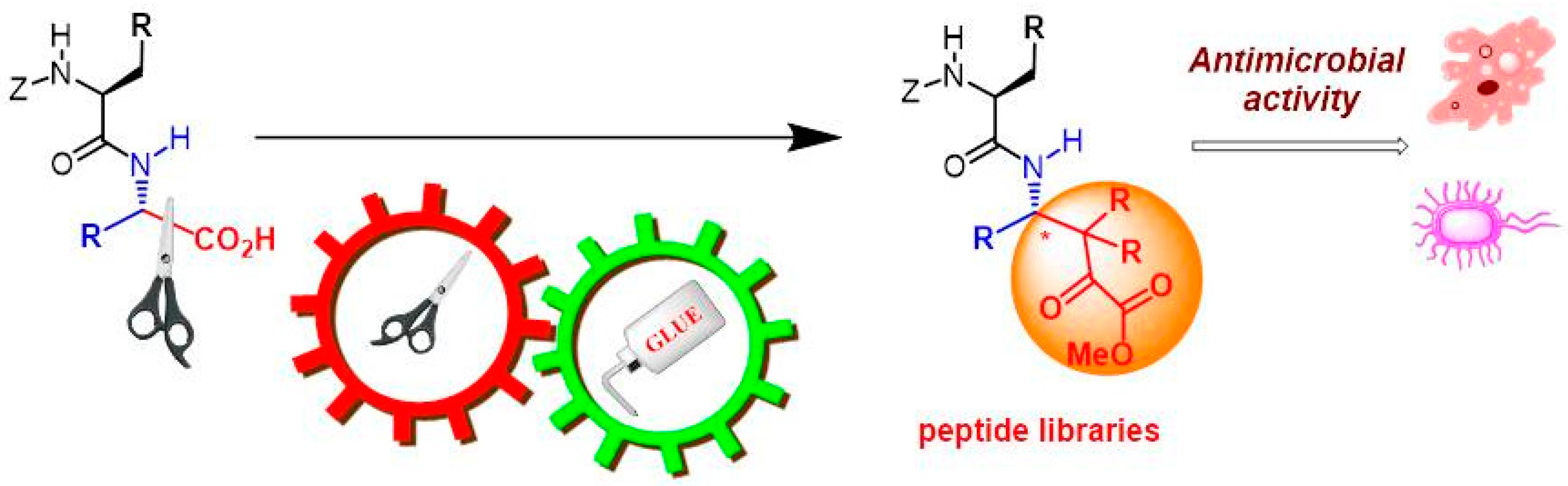
However, many natural antimicrobial peptides present problems due to in vivo degradation or biodisponibility issues. The production of synthetic analogues would allow the discovery of antimicrobials with improved selectivity, stability, and biodisponibility. The site-selective modification of peptides would allow the fast, efficient generation of libraries of such peptides from a few “parent” peptides, saving time and materials in the discovery processes [2].
We describe two “customizable units” that allow the production of peptides “à la carte”, with many different lateral chains and functional groups, and their evaluation as antimicrobials for human and animal health, and as crop protection agents.
Author Contributions
A.B. supervised the site-selective modification of peptides carried out by D.H., I.R.-E. and A.B.; C.G. supervised the chemistry carried out by C.G. and N.R.-P.; J.M.P.d.l.L. supervised the antimicrobial screenings. All authors have read and agreed to the published version of the manuscript.
Acknowledgments
This work was supported by the Research Program SAF-2013-48399-R, Plan Estatal de I+D, Ministerio de Economía y Competitividad, Spain, and European Social Funds (FSE). D.H. thanks CSIC (Spanish Research Council) her JAE postdoctoral research contract, and also thanks her current contract financed by Cabildo de Tenerife, Program TF INNOVA 2016-21 (with MEDI & FDCAN Funds).
Conflicts of Interest
The authors declare no conflict of interest.
References
- Kastin, A.J. Handbook of Biologically Active Peptides; Chapters 10 (systemins), 11 (defensins), 12 (cathelicidins), 45 (dermaseptins), 46 (temporins); Academic Press: San Diego, CA, USA, 2006. [Google Scholar]
- Romero-Estudillo, I.; Boto, A. Domino Process Achieves Site-Selective Peptide Modification with High Optical Purity. Applications to Chain Diversification and Peptide Ligation. J. Org. Chem. 2015, 80, 9379–9391. [Google Scholar] [CrossRef] [Scilit] [PubMed]
Publisher’s Note: MDPI stays neutral with regard to jurisdictional claims in published maps and institutional affiliations. |
© 2017 by the authors. Licensee MDPI, Basel, Switzerland. This article is an open access article distributed under the terms and conditions of the Creative Commons Attribution (CC BY) license (https://creativecommons.org/licenses/by/4.0/).