


Abstract
Despite the documented benefits of plant growth-promoting bacteria (PGPB), their application to optimize nitrogen (N) use efficiency in rice systems remains inconsistent under tropical field conditions. This study characterized the PGP potential of native isolates (in vitro biochemical characterization: growth in nitrogen-free culture medium, as well as production of indoleacetic acid and phytosiderophores). It evaluated the field performance (pot evaluation under open-field conditions and field validation trials of two strains: Bacillus cereus (Strain 59) and Lysinibacillus fusiformis (Strain 24)). Field trials conducted in Panama suggest that both strains could improve productivity; specifically, the combined application of B. cereus and urea achieved maximum yields in systems rich in organic matter (Cabuya), while a urea optimization trial conducted solely with L. fusiformis across a urea gradient (45.36, 90.72, and 136.08 kg/ha) based on plant height showed a consistent response to the urea dose, with improved plant growth at the intermediate dose relative to the lowest dose and the absolute control, although the full dose produced the tallest plants. Grain yield did not differ significantly between doses in this trial, and nitrogen use efficiency was not measured. These results identify native isolates as provisional biofertilizer candidates. Economic and environmental benefits, such as reduced production costs or nitrate leaching, were not measured and remain to be tested, and Strain 59 requires phenotypic safety testing before any practical use.
1. Introduction
As a cornerstone of global food security, rice (Oryza sativa L.) is an essential staple crop for human consumption, reaching an estimated worldwide production of 517 million in 2023 [1]. In Panama, this crop is a staple of the national diet; however, its production relies heavily on synthetic nitrogen (N) fertilization, which creates a critical economic and environmental dilemma. By the end of the 2020 agricultural season, the total cost of fertilization (paddy rice) reached USD 278.14 per hectare, with synthetic N application alone accounting for approximately USD 141.84 per hectare [2]. Beyond the financial burden, the indiscriminate use of urea leads to nitrate leaching into groundwater reserves, compromising aquifer quality and long-term soil functionality [3]. This may depend on the doses applied, climatic conditions of fertilizer application, physicochemical characteristics of the soil, and water management.
To address these challenges, many N management practices have been implemented to increase Nitrogen Use Efficiency (NUE) while reducing adverse environmental impacts. Among these, applying Plant Growth-Promoting Bacteria (PGPB) as biofertilizers have emerged as a promising biotechnological tool for agricultural sustainability [4,5]. Within this group, we can include Streptomyces sp. P4 [6,7]. Molecular studies have established the fact that many actinobacteria can occur as endophytes in various leguminous and non-leguminous plants without forming nodules. Endophytic actinobacteria that have been shown to exhibit a nitrogen-fixing ability include species of Arthrobacter, Agromyces, Corynebacterium, Mycobacterium, Micromonospora, Propionibacterium, and Streptomyces [8]. PGPB comprises a diverse group of microorganisms that enhance crop productivity through mechanisms such as biological nitrogen fixation (BNF), phosphate solubilization, and the synthesis of bioactive compounds like indole-3-acetic acid (IAA) and siderophores [9,10].
Despite the documented potential of species such as Bacillus cereus and Lysinibacillus sphaericus ZA9 to optimize root architecture and nutrient transport [11,12], their field efficacy in tropical agroecosystems remains inconsistent due to site-specific edaphoclimatic variables. Most studies rely on final yield metrics, often overlooking the continuous growth responses to microbial stimulation during critical phenological transitions. Bacillus can increase plant nitrogen content, which could reduce the need for excessive fertilizer application [n], and endophytic Bacillus are efficient phosphorus solubilizers that mobilize insoluble phosphate through several mechanisms [n, n]. Strains identified as B. cereus from Lippia origanoides showed nitrogen fixation, phosphate solubilization, siderophore production and ACC deaminase activity, and the population density of endophytes varies with bacterial species, host genotype, plant stage, inoculum density and environmental conditions [11]. B. cereus PR2, isolated from rice tissues, promoted rice growth in vitro through phosphate solubilization and siderophore production [13]. L. sphaericus ZA9 produced IAA, siderophores, HCN and hydrolytic enzymes, solubilized silicate, phosphate and potassium, and improved seedling vigor in cucumber and tomato in a greenhouse experiment [12]. In soybean, L. fusiformis produced more IAA than B. velezensis in vitro [14].
Therefore, this study evaluates the in vitro metabolic traits of these strains and their agronomic efficacy under field conditions. Building upon previous genomic characterization that established the plant-growth-promoting potential of these isolates [10], this research integrates in vitro metabolic trait measurements with serial plant height measurements across the crop cycle. We hypothesized that native Bacillus cereus and Lysinibacillus fusiformis support plant development and compensate for the nutritional deficit resulting from reduced nitrogen inputs. Therefore, the objective of this research was to characterize these native PGPB and evaluate their agronomic effect on rice productivity across contrasting organic and conventional agroecosystems in Panama.
2. Material and Methods
Several experiments were carried out: soil characterization, in vitro biochemical characterization, in vivo open-field conditions evaluation, and field validation trials.
2.1. Soil Characterization, Bacterial Strains, and Origin
Soil samples were collected from two contrasting rice production systems in Coclé, Panama: an organic rice plot in the Cabuya district (Antón) and a conventionally managed system at the Experimental Farm El Bajo (Río Hato). In each plot, soil was sampled at five points (upper left and right corners, lower left and right corners, and center) at a depth of 20 cm, approximately the depth reached by the roots. Previously, physicochemical analyses were carried out on both farms to determine their soil characteristics, as this is an important parameter for the possible inferences derived from this research; the protocol of Villarreal and Name (1996) was used for this purpose [15].
Initial soil microbial activity for both sites was assessed by measuring CO2 production and dehydrogenase activity to establish their baseline ecological conditions; both tests were performed following the protocol developed by Pepper and Gerba (2004) [16].
For bacterial isolation, soil samples were subjected to serial dilutions and inoculated onto nitrogen-free Ashby medium (28 °C, 24 h) to selectively target non-symbiotic nitrogen-fixing capacity. From this isolation process, five native bacterial strains, initially identified as Lysinibacillus fusiformis 18, Lysinibacillus fusiformis 24, Lysinibacillus fusiformis 38, Priestia flexa 52, and Bacillus cereus 59, were isolated from an organic rice plot in the Cabuya district (Antón) and preserved for biochemical screening. The taxonomic classification and whole-genome sequencing (WGS) of these isolates, which confirmed the presence of dedicated genes for nitrogen fixation (nif) and auxin biosynthesis, were previously established and published by Aguilar et al. (2025) [17]. To provide strain-specific biosafety evidence, the assembled genome of Strain 59 was additionally screened in this study for virulence-associated genes via Bakta v1.9.1v functional annotation (v5.0 database) and for acquired antimicrobial resistance genes via ResFinder [18,19]. Building upon their established genomic profiles, this study evaluates their quantitative in vitro metabolic traits and their agronomic in vivo validation as biofertilizers under field conditions.
2.2. In Vitro Biochemical Characterization
Indole-3-acetic Acid (IAA) production was quantified using the Salkowski colorimetric method. It is a rapid and inexpensive chemical technique used primarily to detect and quantify indole-3-acetic acid (IAA), the main plant growth hormone (auxin) produced by plants, fungi, and plant growth-promoting bacteria (PGPB). It was originally developed by E. Salkowski in 1885 to identify compounds with an indole ring and optimized by Gordon and Weber in 1951 for the specific quantification of IAA. The method is based on the oxidation of indole compounds in the presence of ferric ions (Fe3+) and a strong oxidizing acid. When the reagent reacts with IAA, the iron is reduced, forming a molecular complex that develops a characteristic pink to deep red color, the intensity of which is proportional to the hormone concentration [20]. A standard curve was generated using IAA concentrations ranging from 0 to 60 µg/mL (Sigma-Aldrich, Darmstadt, Germany). For quantitative estimation, isolates were cultured in TSB (tryptic soy broth) supplemented with 0.1 g/L L-tryptophan and adjusted to an initial concentration of 1 × 10⁶ CFU/mL. Cultures were incubated at 28 °C and 150 rpm, with three replicates per strain and time point. After incubation, 1.3 mL of each culture was centrifuged (9660× g for 5 min). One milliliter of the supernatant was mixed with 2 mL of Salkowski reagent and incubated in the dark for 30 min, after which the absorbance was measured at 530 nm [21,22]. The samples were diluted 1:10, with the aim of performing the measurement within the calibration range for the AIA standard curve.
Siderophore production was evaluated using the iron competition assay with the chrome azurol S (CAS) indicator dye, as described by Schwyn and Neilands (1987) [23]. Qualitative analysis involved monitoring strain growth and color changes on CAS agar at 3, 5, 7, 10, 12, and 14 days.
Quantitative estimation was performed using the supernatant of bacterial cultures grown in TSB medium for 96 h at 28 °C. Aliquots were collected at 24, 48, 72, and 96 h, and each aliquot was analyzed once (aliquots were drawn from a single culture per strain at each time point, including three replicates of each aliquot). After centrifugation (6708× g for 10 min), 0.5 mL of the cell-free supernatant was mixed with 0.5 mL of CAS reagent (Chrome Azurol S (CAS), iron (III), and the cationic surfactant hexadecyltrimethylammonium bromide (HDTMA) in a buffered solution). Optical density was measured at 630 nm after 20 min of incubation. Siderophore units were calculated as percent siderophore units (psu) using the formula: [(Ar − As)/Ar] × 100, where Ar is the reference absorbance (630 nm) and As is the sample absorbance. Quantitative siderophore measurements were performed on a single sample per strain and time point, without biological or technical replication; consequently, these values are reported as point estimates without an associated measure of variability and should be interpreted as preliminary.
To compare relative strain performance and support strain selection, raw values were standardized (column-wise Z-score) following completion of the biochemical assays and visualized as heatmaps, with strains hierarchically clustered by Euclidean distance and complete linkage (hclust, ggdendro, ggplot2; R version 4.3.0). This approach is widely used to summarize multi-trait PGPR data and identify functional profiles among strains [24].
2.3. Pot-Based Biometric Screening Evaluation Under Open-Field Conditions
The biological activity of five bacterial strains (previously selected through biochemical tests of plant growth-promoting activity, based on their non-symbiotic nitrogen fixation and their ability to produce IAA and siderophores) inoculated onto rice seeds was studied in pots at the Las Zanguengas Subcenter for Agricultural and Forestry Research and Innovation of the Panama Canal Watershed, located at (8° 57.55′ N, 79° 52.16′ W). The experiment was conducted under open-field conditions, with 10 seeds of the I-FL 069-18 variety per pot (25 cm high/20 cm wide); the rice seeds were immersed in 10 mL of tryptic soy broth inoculated with plant growth-promoting bacteria in a Petri dish at a concentration of 1 × 10⁶ CFU/mL, mixed with this medium for 5 min at a temperature of 28 °C, for the purpose of inoculating the seed before sowing in pots. Twenty days after sowing, the plants were thinned to two per hill. A completely randomized design with 13 treatments and 5 replicates was used (Table 1), in which five isolated bacterial strains were evaluated. For the non-fractional treatment N1, 0.033 g of urea was applied at 25 days; for the fractional treatment N2, three doses of 0.001 g were applied at 25, 40, and 55 days, respectively, during the vegetative growth stage, i.e., before the flowering stage. Due to the size of the pots, application was done manually. It is important to clarify that for these pot experiments, the same soil from the plot (Cabuya farm) was used where the five selected bacterial strains were previously isolated.
Table 1.
Open-field pot evaluation treatments. Experimental design and treatment descriptions for the open-field pot screening phase. Treatments include absolute control, nitrogen controls (N1: initial urea; N2: fractionated urea), and inoculation with five bacterial strains (18, 24, 38, 52, and 59) with and without N2 supplementation.
Plant height and the number of grains per plant (yield) were recorded. Plant height and grain yield were analyzed as described in Section 2.5. Subsequently, promising strains were selected based on their agronomic performance.
2.4. Field Validation Trials
Field experiments were conducted at two locations in Coclé, Panama. The experiment was carried out in the localities of Cabuya, a certified agroecological farm (8° 34.450′ N, 80° 8.967′ W), and in the Experimental Farm El Bajo, managed conventionally, not organically (8° 19.53′ N, 77° 6.79′ W).
Field-scale validation was conducted using two types of experiments. In Phase I (Table 2), the performance of the previously selected strains (B. cereus strain 59 and L. fusiformis strain 24) was comparatively evaluated at both locations over the same period. In Phase II, a specific trial was established at the Cabuya location to evaluate the efficacy of L. fusiformis using a synthetic nitrogen gradient (Table 3). The rice variety I-FL-69-18 was sown using direct seeding (5 seeds per hole) at a 25 × 25 cm spacing. Before sowing, seeds were inoculated with a bacterial suspension adjusted to 1 × 10⁶ CFU/mL. The experimental units consisted of 4 m2 plots arranged in a randomized complete block design (RCBD) with three replications. Plant height was recorded on four sampling dates (November to February). At each of the three intermediate dates, five plants per plot were measured (5 plants × 3 blocks × 6 treatments × 3 dates = 270 records), and at final harvest 20 plants per plot were measured (20 × 3 × 6 = 360 records), giving 630 height records in total. Individual plant identity was not recorded across dates, so the dataset consists of per-plot measurements taken on different dates and not of repeated measures on identified plants.
Table 2.
Phase I: Comparative field validation of the selected strains (B. cereus and L. fusiformis). Both strains were chosen based on better performance in the open-field pot evaluation. Treatments were arranged in a randomized complete block design (RCBD) with three replicates.
Table 3.
Phase II: Nitrogen optimization gradient trial. Details of the Urea gradient (kg/ha) applied exclusively to L. fusiformis (Strain 24) in the Cabuya site.
2.5. Statistical Analysis and Modeling of Plant Height over Time
Statistical analyses were performed in R version 4.3.0 [25]. Normality was assessed with the Shapiro–Wilk test on model residuals rather than on raw or pooled data (W = 0.984, p < 0.001), and variance homogeneity with Levene’s test (F5,714 = 7.84, p < 0.001), which indicated heteroscedasticity across treatments. Because these assumptions were violated, treatment differences in plant height, tillers, panicles, and filled and empty grain counts were evaluated with the Kruskal–Wallis H test followed by Dunn’s post hoc test with Bonferroni correction (rstatix package [n]; p < 0.05). Compact letter displays [n] were generated with the multcompView package [25].
A single-factor Kruskal–Wallis test cannot assess interactions, so the Strain × Nitrogen interaction on plant height was tested with a two-way ANOVA. Because height violated the normality and homoscedasticity assumptions, the interaction was also tested with the Scheirer–Ray–Hare test, a rank-based analogue of the two-way ANOVA [26].
Field-block yield data (three blocks per site) were analyzed with a one-way ANOVA followed by Tukey’s HSD within each site.
In the Phase II nitrogen-gradient trial, height was compared among treatments separately at each sampling date (Kruskal–Wallis with Dunn’s test). To examine whether treatment effects changed over time, a linear mixed-effects model (Height ~ Treatment × Month + (1|Block)) was fitted with the lme4 [n] and lmerTest [n] packages. Because individual plants were not identified across dates, block is the only random effect and within-plant correlation is not modeled, so the results are interpreted with caution.
3. Results
3.1. Soil Characterization
The results of the physicochemical analyses of the soil from Cabuya and El Bajo are presented in the supplementary tables (Supplementary Tables S1 and S2). A higher percentage of organic matter was determined in Cabuya (5.95) compared to El Bajo (0.86); furthermore, the aluminum content in the soil of El Bajo (17.30 cmol/kg) was higher than that quantified in Cabuya (0.20 cmol/kg). Regarding carbon dioxide production and dehydrogenase enzyme activity, the Cabuya farm showed higher values than El Bajo (Supplementary Tables S3 and S4). Overall, based on the physicochemical characteristics of the soil determined at both farms, the Cabuya farm presents better conditions for establishing rice cultivation.
3.2. Quantitative In Vitro PGP Trait Measurements
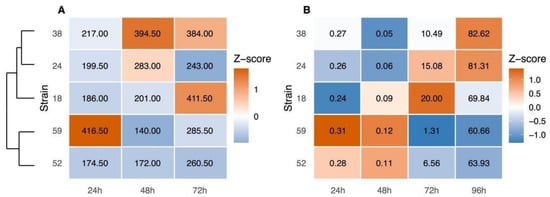
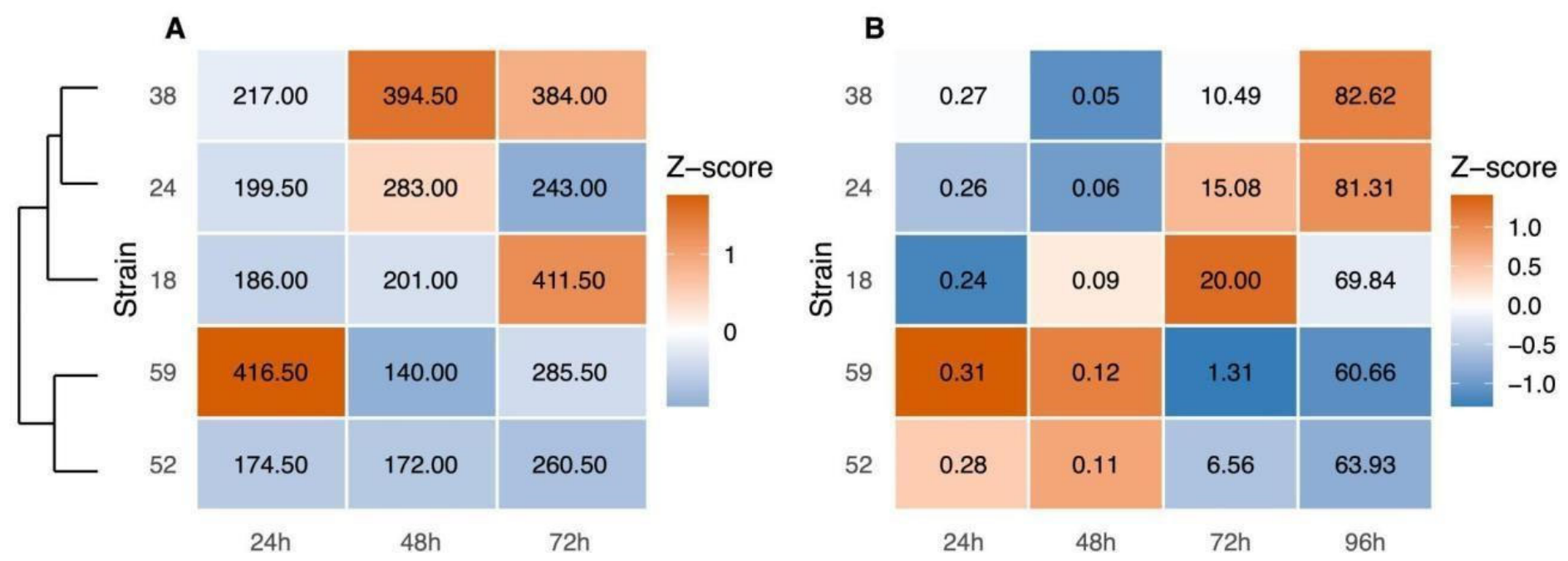
Quantitative assessment of plant growth-promoting (PGP) traits revealed distinct metabolic profiles and the time-point measurements (Figure 1) showed that Percent Siderophore Units (psu) were low at 24 and 48 h and higher at 72 and 96 h. Each strain and time point was measured once, without biological or technical replication, so these values are single determinations, and neither variability nor a production trend can be estimated. The highest values were recorded at 96 h for Strains 24 and 38 (81.31 and 82.62 psu, respectively; Table 4). In contrast, indole-3-acetic acid (IAA) production was strain-specific: Strain 59 reached its maximum concentration early, at 24 h (416.5 µg/mL), while Strain 18 showed a consistent upward trend, peaking at 72 h at 411.5 µg/mL (Figure 1 and Table 5). Hierarchical clustering within the heatmap grouped Strains 59, 24, and 38 on the basis of their early IAA and late siderophore values; because the siderophore data are unreplicated, this grouping is descriptive (Supplementary Table S5).
Figure 1.
Quantitative in vitro plant growth-promoting (PGP) trait measurements. (A) Indole-3-acetic acid (IAA) production and (B) siderophore production by five rice-associated bacterial strains, measured at 24–96 h post-incubation. Cell values are raw means for IAA (µg/mL) and single unreplicated determinations for siderophores (percent siderophore units, psu); fill color represents the Z-score standardized within each time point (column) to allow visual comparison of relative values at a given assay time. Row order (left dendrogram) reflects hierarchical clustering (complete linkage) of each strain’s combined IAA + Siderophore Z-score profile.
Table 4.
Quantitative in vitro siderophore production over time. Siderophore production by rice-associated bacterial strains was measured at 24, 48, 72, and 96 h post-incubation. Values are single determinations (no biological or technical replicates) of percent siderophore units (psu) determined via the CAS assay.
Table 5.
Indoleacetic acid (IAA) production by rice-associated bacteria. Data represent mean values (µg/mL) for strains 18, 24, 38, 52, and 59 at 24, 48, and 72 h of incubation in a medium supplemented with L-tryptophan. Measurements were performed via colorimetric spectrophotometry at 530 nm.
3.3. Open-Field Pot Evaluation
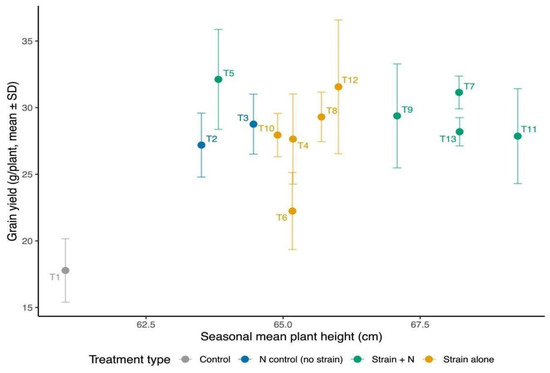
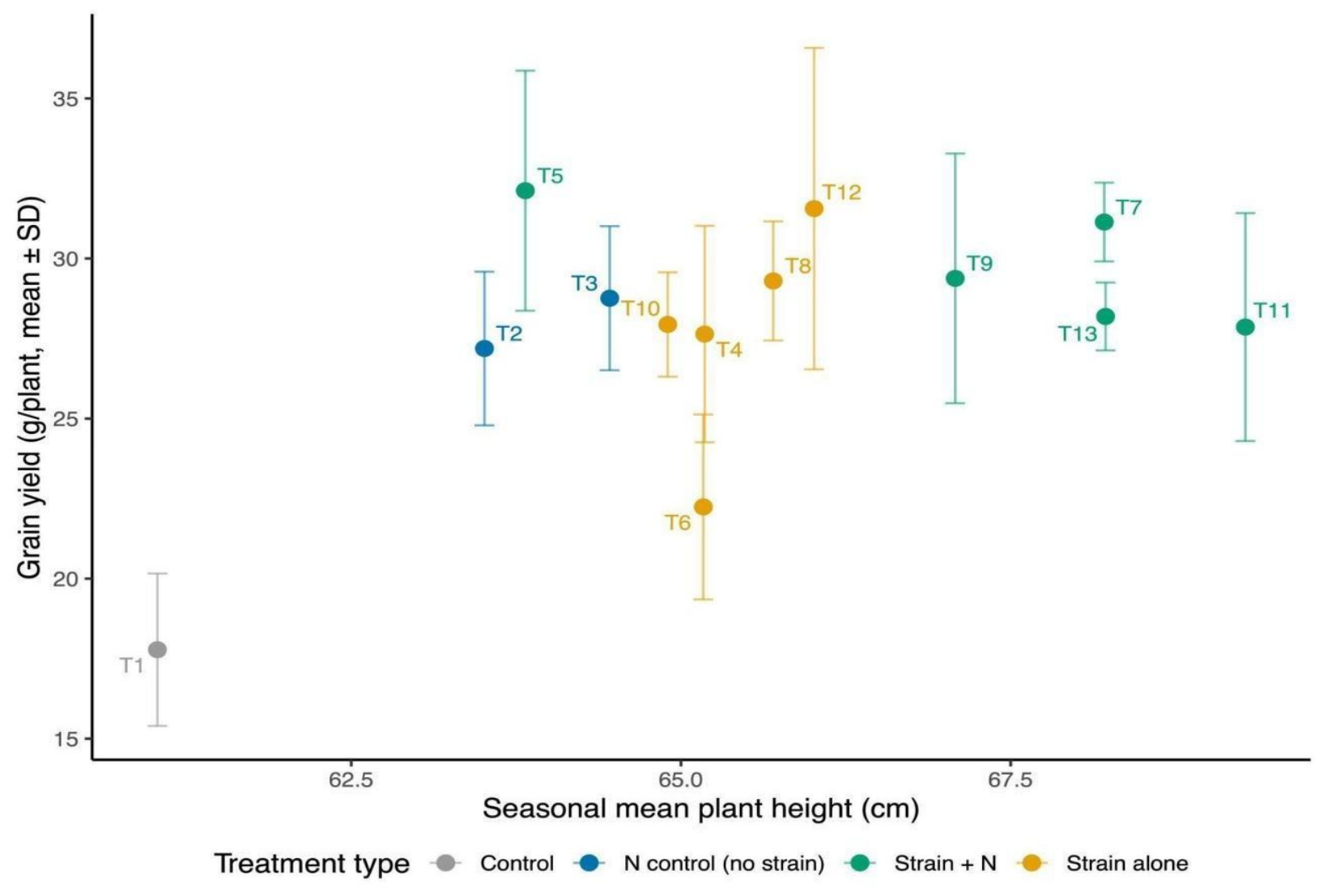
The biological efficacy of the isolates was evaluated through a multi-trait screening of 13 treatments (Table 1). Comparison of plant height and grain yield across treatments (Figure 2) showed that treatments combining bacterial inoculation with nitrogen supplementation (T5, T7, T9, T11, and T13) generally achieved higher grain yield than their corresponding single-factor treatments (strain alone or nitrogen alone) at comparable plant height. A two-way ANOVA testing the Strain x Nitrogen interaction on Phase I plant height showed no significant interaction (F2,714 = 2.43, p = 0.089, partial η2 = 0.007), while nitrogen alone had a large effect (p < 0.001, partial η2 = 0.148) and strain alone had none (p = 0.317). Given the heteroscedasticity of this variable (Levene’s test, p < 0.001), this result was also examined using the non-parametric Scheirer–Ray–Hare test, which likewise showed no significant Strain × Nitrogen interaction (H = 2.75, df = 2, p = 0.253). These results indicate that nitrogen availability, rather than strain identity, is the dominant driver of the height response, with no statistically supported interaction effect between the two factors. The absolute control (T1) produced both the shortest plants and the lowest grain yield, clearly separated from all inoculated and/or nitrogen-supplemented treatments (Supplementary Table S6). Based on this screening, Strains 59 (B. cereus) and 24 (L. fusiformis) were selected for field validation.
Figure 2.
Open-Field Pot Evaluation screening: plant height vs. grain yield across 13 treatments. Each point is one treatment (T1–T13, see Table S1 for full descriptions); color indicates treatment type (untreated control, nitrogen control without strain, strain alone, or strain + nitrogen). Error bars show ± SD of grain yield (n = 5 plants/treatment).
3.4. Comparative Field Efficacy of Selected Strains (Phase I)
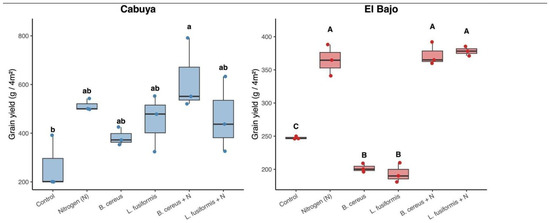
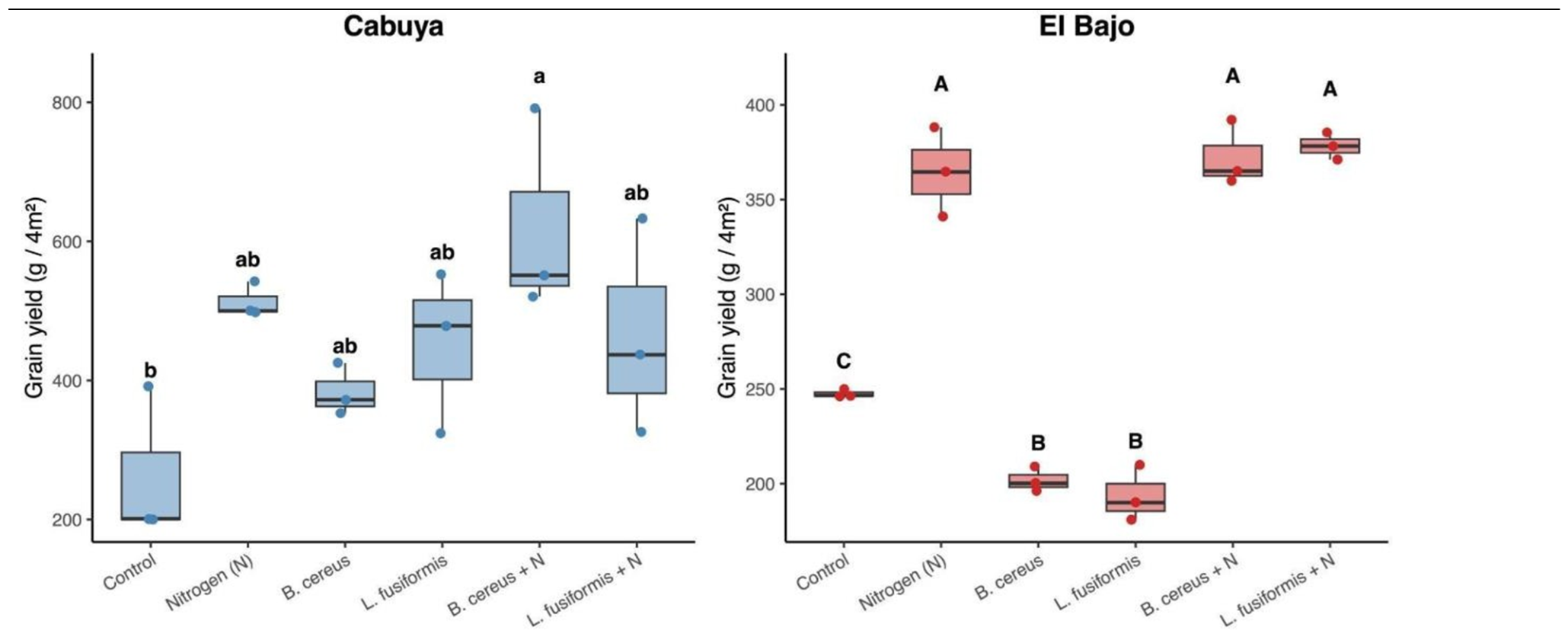
Before efficacy evaluations, the Shapiro–Wilk test indicated non-normality in plant height measurements and yield components (W = 0.84, p < 0.0001). This lack of normality and the inherent biological variability across replicate blocks are fully detailed in Supplementary Figures S1–S5. The integrated evaluation of the two selected strains showed plant and yield responses consistent with biofertilizer potential. As shown in Table 6, the inoculation of B. cereus + Nitrogen (TA3) and L. fusiformis + Nitrogen (TA4) had higher mean yields than the absolute control (TA6) at both sites. In the organic-rich site of Cabuya, B. cereus (Strain 59) was combined with nitrogen application and produced the highest mean yield observed in this trial, (621.10 g/4 m2; Figure 3). Yield components (tillers, panicles, and filled and empty grains per plant) for the Phase I treatments, with both sites combined, are provided in Supplementary Table S7. These results describe plant and yield responses at two sites; strain establishment and environmental resilience were not measured.
Table 6.
Final biometric values for the field-scale validation phase (Phase I). Height (cm, final harvest) and grain yield (g/4 m2) for six treatments comparing two rice-associated bacterial strains, with and without nitrogen supplementation, at two contrasting field sites. Values are mean ± SD (Height: n = 120 plants/treatment, pooled across sites; Yield: n = 3 field blocks/site). Different lowercase letters indicate significant differences in height (Kruskal–Wallis + Dunn’s test, Bonferroni correction, p < 0.05). Yield is reported separately per site due to substantially different variability between sites.
Figure 3.
Rice grain yield response across contrasting field environments. Blue boxes represent the organic-rich site (Cabuya) and red boxes the conventional clay site (El Bajo). Boxplots show median and interquartile range; dots (n = 3) are block replicates. Different letters indicate significant differences within each site (Tukey’s HSD, p < 0.05).
3.5. Nitrogen Optimization Gradient (Phase II)
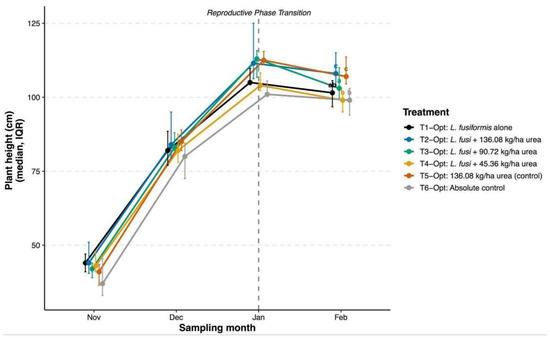
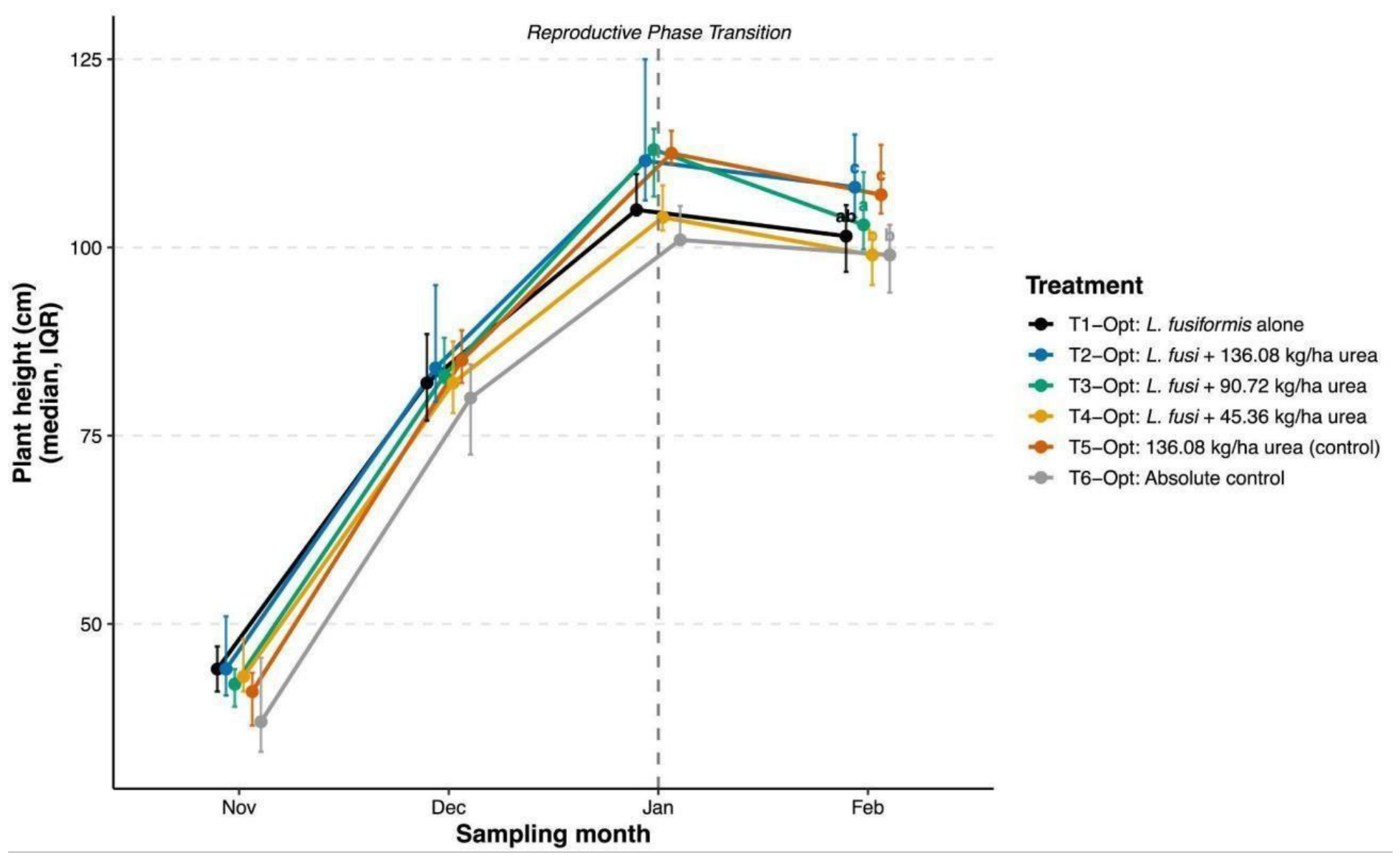
The secondary analysis focused on the response of L. fusiformis (Strain 24)-inoculated rice to a gradient of urea supplementation. As detailed in Table 7, plant height at final harvest differed significantly among urea doses (Kruskal–Wallis, p < 0.001): the full urea dose (136.08 kg/ha, TB2-Opt and TB5-Opt) produced the tallest plants, the absolute control and the lowest dose (45.36 kg/ha) the shortest, and the intermediate dose (90.72 kg/ha, TB3-Opt) produced plants of intermediate, statistically distinct height. To account for the non-independence of plants nested within field blocks, a linear mixed-effects model (Height ~ Treatment × Month + (1|Block)) was fitted. Individual plants were not tagged with a unique identifier trackable across all four sampling dates; therefore, the model could only account for non-independence at the block level, not within-plant correlation across time. Consequently, this dataset does not constitute a true longitudinal repeated-measures design: the same plants cannot be followed through time and within-plant correlation cannot be modeled, and this is a major limitation of the experiment that statistical adjustment cannot remove. The Treatment × Month interaction was significant (F15,604 = 2.21, p = 0.005), suggesting that treatment effects on height diverged over the growing season; because within-plant dependence could not be modeled, this result should be interpreted with caution. This dose-dependent pattern is consistent with the temporal trajectories in Figure 4, in which treatment divergence emerged at the reproductive phase transition and strengthened through final harvest. Grain yield at final harvest did not differ significantly among the six treatments (Kruskal–Wallis, p = 0.26); the present trial, with three field blocks per treatment, was therefore not sufficiently powered to resolve a yield response to urea dose, and this result should be interpreted as inconclusive rather than as evidence of equivalence among doses.
Table 7.
Final yield and biometric parameters for the Phase II nitrogen-optimization trial. Height (cm, final harvest, Cabuya site) is mean ± SD across 60 plants/treatment. Yield (g/4 m2 experimental unit; 64 plants/plot) is mean ± SD across 3 field blocks/treatment. Different lowercase letters indicate significant differences within each column (Kruskal–Wallis + Dunn’s test, Bonferroni correction, p < 0.05).
Figure 4.
Temporal trajectories of rice plant height under L. fusiformis inoculation and urea gradient (Phase II). Lines track median height per treatment across four sampling dates (Nov–Feb) at the Cabuya site (n = 630 per-plant measurements in total; individual plants were not tracked across dates); error bars span the interquartile range (Q25–Q75). Height is non-normally distributed at every date (Shapiro–Wilk p < 0.0001), so median/IQR is reported instead of mean/SD. The dashed vertical line marks the reproductive phase transition (January). Letters indicate significant pairwise differences at the February (final harvest) time point, matching Table 7. Grain yield was recorded only at final harvest (Table 7), not at each sampling date, and is therefore not part of this figure.
4. Discussion
4.1. Phytohormone Kinetics and the Hormonal Priming Effect
The temporal patterns of PGP traits in isolated strains may provide a guiding physiological basis for the observed growth differentiation. The marked early peak of indole-3-acetic acid (IAA) exhibited by strain 59 (B. cereus), reaching an average of 416.5 µg/mL in just 24 h (Table 5), exceeds the concentrations reported for many conventional biofertilizers [27]. High auxin levels during seedling establishment are known to trigger meristematic activity and root hair proliferation, optimizing the plant’s ability to explore the soil volume [3]. This early metabolic stimulus likely acts as a hormonal primer, potentially enabling the I-FL 069-18 variety to capture split nitrogen more efficiently before entering the rapid vegetative growth stage [4].
4.2. Siderophore Production and Possible Roles in Iron Competition
The highest siderophore values were recorded 96 h after incubation (81.3 and 82.6 psu for strains 24 and 38). Because these are single, unreplicated determinations, they cannot support conclusions about production kinetics or relative strain performance. Siderophore production may help survival under iron-limiting conditions, common in clayey rice soils such as those in El Bajo [28], but this was not tested here. In addition to contributing to direct plant nutrition, high-affinity siderophores act as biocontrol agents by sequestering iron, thereby restricting the growth of soil pathogens through competition for nutrients [12,29].
4.3. Data Integration and Field Sustainability
The integration of height and yield data (Figure 2) allowed the selection of promising strains based on their combined agronomic performance rather than on isolated traits, which would enable a comprehensive assessment of microbial influence on crop suitability. This methodology aligns with recent advances in horizontal data integration, where combining PGP biochemical traits with plant performance datasets is crucial for identifying suitable bioinoculants for cereal production [30]. The 630 serial height records, collected on four sampling dates and not as repeated measures of identified plants (see Section 3.5), are compatible with continued plant growth during the reproductive phase (Figure 4) but do not demonstrate it.
Monitoring this stage of development is relevant from an agronomic point of view, since native isolates adapted to local soil and climate conditions could eventually match the development vigor of full nitrogen fertilization even under reduced nutrient availability [31].
Specifically, in Phase II, plant height under the intermediate urea dose (90.72 kg/ha, TB3-Opt) was statistically distinguishable from both the full-dose and minimal-dose extremes, suggesting that L. fusiformis inoculation shifts the height response curve toward improved plant growth at intermediate nitrogen input levels, a pattern consistent with hormonal and nutrient-transport mechanisms described for other PGPB–rice associations [32]. This positive response in plant height may be related to bacterial regulation of plant genes involved in nutrient transport, root architecture modification, and hormonal signaling [33], although gene expression was not measured here. Because grain yield did not differ significantly among urea doses and NUE was not directly measured, the height response is described as improved plant growth at intermediate urea input and not as an NUE gain; this height-based finding should be considered preliminary and warrants confirmation with further field replication before informing dose reduction recommendations. Auxin and siderophore synthesis by high-performing strains such as B. cereus (strain 59) and L. fusiformis (strain 24) may possibly contribute to enhanced essential nutrient uptake (not measured in this study), a mechanism observed in other high-performing Bacillus rice inoculants [34].
Identifying Bacillus cereus as a plant growth-promoting bacterium requires careful consideration of its potential toxin production. While B. cereus is known to produce enterotoxins and emetic toxins, these traits are not universally present in all strains [35,36]. Strain-level differences in the presence and expression of toxin genes are well documented [37]. Further analysis is needed to establish its safe and reliable use. In addition, as recent research indicates, strain-specific safety assessments are essential for agricultural applications of B. cereus [38]. Before potential commercialization, a comprehensive risk assessment, including toxin analysis and virulence factor evaluation, is needed to assess biosafety [39]. To address this directly, the genome of Strain 59 was screened in silico for virulence-associated and antimicrobial resistance genes. The canonical B. cereus sensu lato enterotoxin gene complexes (hblA/B/C/D, nheA/B/C) and entFM were identified under regulatory control of the PlcR-PapR quorum-sensing system, a pattern near-ubiquitous across environmental and soil-derived B. cereus isolates. Critically, the emetic toxin gene cluster (ces, cereulide synthetase) was absent, and the cytotoxin K variant identified was CytK2, the lower-virulence paralog associated with reduced hemolytic activity compared to CytK1. Screening for acquired antimicrobial resistance genes (ResFinder) identified only blaZ-like beta-lactamase homologs and fosB1, both consistent with resistance determinants intrinsically and ubiquitously distributed across the B. cereus group; no transferable high-risk determinants (e.g., tetM, vanA/B, erm) were confirmed. These findings indicate a virulence and resistance gene profile typical of the species, without evidence of atypical or clinically concerning acquired traits, although phenotypic toxin expression assays were not performed in this study and remain a recommended step prior to large-scale field application. Strain 59 should therefore be regarded as a provisional candidate, and any statement about its use in practice or its commercialization is conditional on phenotypic safety testing (for example, toxin expression and cytotoxicity assays).
Regarding the quantified physicochemical properties of the soil, we hypothesize that plant growth-promoting bacteria may act in combination with soil organic matter to help mitigate the toxicity of high concentrations of aluminum (Al3+) in acidic soils. Free aluminum blocks cell elongation and destroys the root system of plants [16]. However, this study did not directly measure aluminum immobilization or plant aluminum uptake, and this mechanism remains to be tested. Furthermore, because each management system (organic vs. conventional) was represented by a single site, differences in plant elongation and grain yield between Cabuya and El Bajo cannot be attributed solely to management practice or to this hypothesized mechanism; site-specific soil properties are confounded with management system in this experimental design. Carbon dioxide production and dehydrogenase activity are the two most widely used biological indicators for measuring overall microbial activity and soil health. These two parameters are directly related: dehydrogenase is an intracellular enzyme that actively participates in cellular respiration, a process whose final product is carbon dioxide. When microorganisms decompose organic matter in the soil, they oxidize carbon to obtain energy through metabolic pathways regulated by dehydrogenase enzymes, releasing carbon dioxide in the process, which is also consistent with the results obtained in this study.
The highest yield was observed in Cabuya (621.10 g/4 m2 for T3). Because bacterial establishment and abundance in the soil were not measured, and each management system was represented by a single site, this observation is limited to the observed plant and yield responses and cannot be attributed to colonization by the isolates or to organic management. At El Bajo, yields of the inoculated treatments were equal to or numerically higher than those of the chemical nitrogen control (Figure 3); this single-site observation suggests a possible alternative that remains to be tested in replicated trials. Furthermore, isolating native PGPB from local agroecosystems may help use regional biodiversity, which may increase the likelihood of crop adaptation to adverse environmental conditions driven by climate change [40]. These findings are preliminary. Whether such strains can reduce nitrate leaching or maintain the productivity of the I-FL-69-18 variety at lower nitrogen input was not measured and could be addressed in future studies, in line with global strategies for sustainable agricultural intensification [41,42].
5. Conclusions
In conclusion, this study identifies Bacillus cereus (strain 59) and Lysinibacillus fusiformis (strain 24) as candidate plant growth-promoting rhizobacteria for rice production in Panama, based on their specific preliminary effects on plant height (growth over the crop cycle) and grain yield. Overall, field validation suggests that strain 59, combined with urea, could maximize grain yield, while strain 24 at an intermediate urea dose (90.72 kg/ha) produced plants taller than those at the lowest dose but shorter than those at the full dose. Further replicated trials are needed to determine if this translates into an equivalent benefit in grain yield with lower nitrogen application. These native plant growth-promoting rhizobacteria may offer a strategy, to be tested in future studies, for reducing urea inputs. No economic analysis was performed, and statistically equivalent grain yield at reduced nitrogen was not demonstrated, so lower production costs and maintained productivity remain potential benefits only. Strain 59 remains a provisional candidate pending phenotypic safety testing.
Supplementary Materials
The following supporting information can be downloaded at: https://www.mdpi.com/article/10.3390/nitrogen7040140/s1, Figure S1: Distribution of rice plant offsets number per plant across treatments and blocks; Figure S2: Distribution of panicles per plant across experimental units; Figure S3: Distribution of filled grains per plant during the harvest stage; Figure S4: Distribution of empty (chaffy) grains per plant; Figure S5: Raw distribution of total grain weight per plant; Table S1: Physicochemical analysis of the soil in Cabuya district; Table S2: Physicochemical analysis of the soil in Experimental Farm El Bajo; Table S3: CO2 production on soil in Cabuya district and Experimental Farm El Bajo (seven days); Table S4: Deshydrogenase activity of soil in Cabuya district and Experimental Farm El Bajo; Table S5: In vitro plant growth-promoting trait production by five rice-associated bacterial strains; Table S6: Open-field pot screening of 13 treatments; Table S7: Yield components by treatment (Phase I). Tables S1–S7 are provided in the Supplementary Tables file.
Author Contributions
Conceptualization, R.H., A.A.M. and J.L.C.; Data curation, C.A., J.L.C., R.H., B.B. and M.R.d.Á.; Formal analysis, R.H., M.R.d.Á. and C.A.; Funding acquisition, R.H., D.T. and J.G.M.; Investigation, C.A., R.H. and A.A.M.; Methodology, C.A., R.H., J.L.C., B.B., O.C., C.G., J.G. and A.M.; Project administration, R.H. and D.T.; Resources, A.A.M.; Supervision, A.A.M. and R.H.; Visualization, J.L.C. and C.A.; Writing—original draft, C.A. and R.H., M.R.d.Á., B.B. and J.L.C.; Writing—review and editing, C.A., R.H., J.L.C., B.B., O.C., C.G., J.G.M., A.M., A.A.M., M.d.V.C. and M.R.d.Á. All authors have read and agreed to the published version of the manuscript.
Funding
This research was funded by Secretaría Nacional de Ciencia, Tecnología e Innovación (SENACYT) (grant number FID23-030), Instituto de Innovación Agropecuaria de Panamá (IDIAP), and Agrobiológicos de Panamá (ABP).
Data Availability Statement
The original contributions presented in the study are included in the article and Supplementary Materials. Further inquiries can be directed at the corresponding author.
Conflicts of Interest
Authors Dora Tuñón and Johanna Gutiérrez Mela were employed by the company Agrobiológicos de Panamá S.A. The remaining authors declare that the research was conducted in the absence of any commercial or financial relationships that could be construed as a potential conflict of interest.
References
- FAO. Crop Prospect and Food Situation; Quaternary Global Report; Food and Agriculture Organization of the United Nations: Rome, Italy, 2023. [Google Scholar]
- Ministerio de Desarrollo Agropecuario (MIDA), Dirección de Agricultura. Costo de Producción Normativo de una Hectárea de Arroz Mecanizado en Secano; República de Panamá: Panama City, Panama, 2020.
- Abd El-Mageed, T.A.; Abd El-Mageed, S.A.; El-Saadony, M.T.; Abdelaziz, S.; Abdou, N.M. Plant growth-promoting rhizobacteria improve growth, morph-physiological responses, water productivity, and yield of rice plants under full and deficit drip irrigation. Rice 2022, 15, 16. [Google Scholar] [CrossRef] [Scilit] [PubMed]
- Bashan, Y.; de-Bashan, L.E. How the plant growth-promoting bacterium Azospirillum promotes plant growth—A critical assessment. Adv. Agron. 2010, 108, 77–136. [Google Scholar] [CrossRef] [Scilit]
- Glick, B.R. Plant growth-promoting bacteria: Mechanisms and applications. Scientifica 2012, 2012, 963401. [Google Scholar] [CrossRef] [Scilit] [PubMed]
- Soe, K.M.; Bhromsin, A.; Karladee, D.; Yamakawa, T. Effects of endophytic actinomycetes and Bradyrhizobium japonicum strains on growth, nodulation, nitrogen fixation and seed weight of different soybean varieties. Soil Sci. Plant Nutr. 2012, 58, 319–325. [Google Scholar] [CrossRef] [Scilit]
- Amaresan, N.; Kumar, K.; Naik, J.; Bapatla, K.; Mishra, R. Streptomyces in Plant Growth Promotion. In New and Future Developments in Microbial Biotechnology and Bioengineering; Elsevier: Amsterdam, The Netherlands, 2018. [Google Scholar] [CrossRef] [Scilit]
- Sellstedt, A.; Richau, K.H. Aspects of nitrogen-fixing Actinobacteria, in particular free-living and symbiotic Frankia. FEMS Microbiol. Lett. 2013, 342, 179–186. [Google Scholar] [CrossRef] [Scilit] [PubMed]
- Santos, M.S.; Nogueira, M.A.; Hungria, M. Outstanding impact of Azospirillum brasilense strains Ab-V5 and Ab-V6 on the Brazilian agriculture: Lessons that farmers are receptive to adopt new microbial inoculants. Rev. Bras. Cienc. Solo 2021, 45, e0200128. [Google Scholar] [CrossRef] [Scilit]
- Pardo-Díaz, S.; Romero-Perdomo, F.; Mendoza-Labrador, J.; Delgadillo-Duran, D.; Castro-Rincon, E.; Silva, A.; Rojas-Tapias, D.F.; Cardoso, E.; Estrada-Bonilla, A. Endophytic PGPB improves plant growth and quality, and modulates the bacterial community of an intercropping system. Front. Sustain. Food Syst. 2021, 5, 715270. [Google Scholar] [CrossRef] [Scilit]
- Chamorro-Anaya, A.M.; Peñafiel-García, C.E.; Martínez-Salgado, M.M. Bacillus cereus bacteria endófita promotora de crecimiento vegetal. Rev. Colomb. Biotecnol. 2020, 22, 101–111. [Google Scholar] [CrossRef] [Scilit]
- Longoria-Espinoza, R.M.; Leyva-Ruiz, C.; Zamudio-Aguilasocho, G.M.; Félix-Gastélum, R. Caracterización de bacterias endófitas promotoras de crecimiento vegetal en plantas de papa (Solanum tuberosum). Rev. Mex. Fitopatol. 2024, 42, 10. [Google Scholar]
- Naureen, Z.; Rehman, N.U.; Hussain, H.; Hussain, J.; Gilani, S.A. Exploring the potentials of Lysini-bacillus sphaericus ZA9 for plant growth promotion and biocontrol activities against phytopathogenic fungi. Front. Microbiol. 2017, 8, 1477. [Google Scholar] [CrossRef] [Scilit] [PubMed]
- Vitorino, L.C.; da Silva, E.J.; Oliveira, M.S.; Silva, I.O.; Santos, L.S.; Mendonça, M.A.C.; Oliveira, T.; Bessa, L.A. Effect of a Bacillus velezensis and Lysinibacillus fusiformis-based biofertilizer on phosphorus acquisition and grain yield of soybean. Front. Plant Sci. 2024, 15, 1433828. [Google Scholar] [CrossRef] [Scilit] [PubMed]
- Villarreal, J.; Name, B. Técnicas Analíticas del Laboratorio de Suelos del IDIAP; IDIAP: Divisa, Panamá, 1996; p. 126. [Google Scholar]
- Pepper, I.; Gerba, C. Enviromental Microbiology: A Laboratory Manual, 2nd ed.; Elsevier: Amsterdam, The Netherlands, 2004. [Google Scholar]
- Aguilar, C.; Herrera, R.; Causadías, J.L.; Bernal, B.; Chavarria, O.; González, C.; Gondola, J.; Moreno, A.; Martínez, A. Genomic Insights into Plant Growth-Promoting Traits of Lysinibacillus fusiformis and Bacillus cereus from Rice Fields in Panama. Microbiol. Res. 2025, 16, 95. [Google Scholar] [CrossRef] [Scilit]
- Beyvers, S.; Jelonek, L.; Goesmann, A.; Schwengers, O. Bakta Web—Rapid and standardized genome annotation on scalable infrastructures. Nucleic Acids Res. 2025, 53, 51–56. [Google Scholar] [CrossRef] [Scilit] [PubMed]
- Florensa, A.; Kaas, R.; Clausen, P.; Aytan-Aktug, D.; Aarestrup, F. ResFinder—An open online resource for identification of antimicrobial resistance genes in next-generation sequencing data and prediction of phenotypes from genotypes. Microb. Genom. 2022, 8, 000748. [Google Scholar] [CrossRef] [Scilit] [PubMed]
- Guardado, B.; Tuesta-Popolizio, D.; Lorenzo-Santiago, M.; Rodriguez-Campos, J.; Contreras-Ramos, S. Comparative study between Salkowski reagent and chromatographic method for auxins quantification from bacterial production. Front. Plant Sci. 2024, 15, 1378079. [Google Scholar] [CrossRef] [Scilit] [PubMed]
- Ozdal, M.; Ozdal, O.G.; Sezen, A.; Algur, O.F.; Kurbanoglu, E.B. Continuous production of indole-3-acetic acid by immobilized cells of Arthrobacter agilis. 3 Biotech 2017, 7, 23. [Google Scholar] [CrossRef] [Scilit] [PubMed]
- Glickmann, E.; Dessaux, Y. A critical examination of the specificity of salkowski reagent for indolic compounds produced by phytopathogenic bacteria. Appl. Environ. Microbiol. 1995, 61, 793–796. [Google Scholar] [CrossRef] [Scilit] [PubMed]
- Schwyn, B.; Neilands, J.B. Universal chemical assay for the detection and determination of siderophores. Anal. Biochem. 1987, 160, 47–56. [Google Scholar] [CrossRef] [Scilit] [PubMed]
- Wang, J.; Ma, L.; Pu, G.; Wang, J.; Zhang, R.; Wu, J. Multi-Trait Screening Identifies Cold-Adapted Soybean Rhizobia from Northeastern China as Candidate Inoculant Strains. Plants 2026, 15, 2251. [Google Scholar] [CrossRef] [Scilit] [PubMed]
- R Core Team. R: A Language and Environment for Statistical Computing; R Foundation for Statistical Computing: Vienna, Austria, 2023. [Google Scholar]
- Scheirer, C.J.; Ray, W.S.; Hare, N. The analysis of ranked data derived from completely randomized factorial designs. Biometrics 1976, 32, 429–434. [Google Scholar] [CrossRef] [Scilit]
- Ozdal, M.; Ozdal, O.G.; Sezen, A.; Algur, O.F. Biosynthesis of Indole-3-Acetic Acid by Bacillus cereus Immobilized Cells. Cumhur. Univ. Fac. Sci. Sci. J. 2016, 37, 1300–1949. [Google Scholar] [CrossRef] [Scilit]
- Zhou, H.; Ren, Z.; Zu, X.; Yu, X.; Zhu, H.; Li, X.; Zhong, J.; Liu, E. Efficacy of plant growth-promoting bacteria Bacillus cereus YN917 for biocontrol of rice blast. Front. Microbiol. 2021, 12, 684888. [Google Scholar] [CrossRef] [Scilit] [PubMed]
- Tortora, M.L.; Díaz-Ricci, J.C.; Pedraza, R.O. Azospirillum brasilense siderophores with antifungal activity against Colletotrichum acutatum. Arch. Microbiol. 2011, 193, 275–286. [Google Scholar] [CrossRef] [Scilit] [PubMed]
- Devarajan, A.K.; Truu, M.; Gopalasubramaniam, S.K.; Muthukrishanan, G.; Truu, J. Application of data integration for rice bacterial strain selection by combining their osmotic stress response and plant growth-promoting traits. Front. Microbiol. 2022, 13, 1058772. [Google Scholar] [CrossRef] [Scilit] [PubMed]
- Brasil, M.S.; Souza, M.S.; Guimarães, S.L.; Koswoski, J.; Batistela, M.W. Initial development of up-land rice plants inoculated with the MAY12 strain of Azospirillum spp. Cienc. Rural 2021, 51, e20200824. [Google Scholar] [CrossRef] [Scilit]
- Turino, M.; Valgas, R.; da Silva Martins, J. Coinoculation with Growth-Promoting Bacteria Increases the Efficiency of Nitrogen Use by Irrigated Rice. ACS Omega 2023, 8, 48719−48727. [Google Scholar] [CrossRef] [Scilit] [PubMed]
- Degon, Z.; Dixon, S.; Rahmatallah, Y.; Galloway, M.; Gulutzo, S.; Price, H.; Cook, J.; Glazko, G.; Mukherjee, A. Azospirillum brasilense improves rice growth under salt stress by regulating the expres-sion of key genes involved in salt stress response, abscisic acid signaling, and nutrient transport, among others. Front. Agron. 2023, 5, 1216503. [Google Scholar] [CrossRef] [Scilit] [PubMed]
- Façanha, A.C.; Oliveira, C.A.; Caetano, E.J.; Costa, E.I.; Nascente, A.S. Bacteria from the Brazilian Savanna as growth promoters in upland rice. Pesqui. Agropecu. Trop. 2025, 55, e83152. [Google Scholar] [CrossRef] [Scilit]
- Logan, N.A. Bacillus and Relatives in Foodborne Illness. J. Appl. Microbiol. 2012, 112, 417–429. [Google Scholar] [CrossRef] [Scilit] [PubMed]
- Adeleke, B.; Ayangbenro, A.; Babalola, O. Genomic Analysis of Endophytic Bacillus Cereus T4S and Its Plant Growth-Promoting Traits. Plants 2021, 10, 1776. [Google Scholar] [CrossRef] [Scilit] [PubMed]
- Kotiranta, A.; Lounatmaa, K.; Haapasalo, M. Epidemiology and Pathogenesis of Bacillus Cereus Infections. Microbes Infect. 2000, 2, 189–198. [Google Scholar] [PubMed]
- Cui, Y.; Märtlbauer, E.; Dietrich, R.; Luo, H.; Ding, S.; Zhu, K. Multifaceted Toxin Profile, an Approach toward a Better Understanding of probiotic Bacillus Cereus. Crit. Rev. Toxicol. 2019, 49, 342–356. [Google Scholar] [CrossRef] [Scilit] [PubMed]
- Mora, M.; Demanet, R.; Acuña, J.; Viscardi, S.; Jorquera, M.; Rengel, Z.; Durán, P. Aluminum-tolerant bacteria improve the plant growth and phosphorus content in ryegrass grown in a volcanic soil amended with cattle dung manure. Appl. Soil Ecol. 2017, 115, 19–26. [Google Scholar] [CrossRef] [Scilit]
- Rariz, G.; Ferrando, L.; Echegoyen, N.; Fernández-Scavino, A. Antagonism between Azospirillum bra-silense Az39 and Pseudomonas oryzihabitans, a seed-borne endophyte, in growing rice plants. Rev. Agron. Noroeste Arg. 2017, 37, 21–29. [Google Scholar]
- Hungria, M.; Campo, R.J.; Souza, E.M.; Pedrosa, F.O. Inoculation with selected strains of Azospirillum brasilense and A. lipoferum improves yields of maize and wheat in Brazil. Plant Soil 2010, 331, 413–425. [Google Scholar] [CrossRef] [Scilit]
- Cassán, F.; Coniglio, A.; López, G.; Molina, R.; Nievas, S.; de Carlan, C.; Donadio, F.; Torres, D.; Rosas, S.; Olivera Pedrosa, F.; et al. Everything you must know about Azospirillum and its impact on agriculture and beyond. Biol. Fertil. Soils 2020, 56, 461–479. [Google Scholar] [CrossRef] [Scilit]

Disclaimer/Publisher’s Note: The statements, opinions and data contained in all publications are solely those of the individual author(s) and contributor(s) and not of MDPI and/or the editor(s). MDPI and/or the editor(s) disclaim responsibility for any injury to people or property resulting from any ideas, methods, instructions or products referred to in the content. |
© 2026 by the authors. Licensee MDPI, Basel, Switzerland. This article is an open access article distributed under the terms and conditions of the Creative Commons Attribution (CC BY) license.