


Abstract
To promote the growth, photosynthetic capacity, yield and nitrogen use efficiency (NUE) of Zizania latifolia, optimizing the amount of nitrogen (N) fertilization applied is critical. We investigated the effects of different nitrogen application rates on the growth, development, photosynthetic characteristics, yield components and nitrogen partial factor productivity (NPFP) of Z. latifolia. The experiment was conducted under field conditions using five rates of N application (N1 = 196, N2 = 266, N3 = 336, N4 = 406, and N5 = 476 kg N ha−1). The results showed that increasing N application significantly enhanced plant height and tiller number, whereas leaf length and width were less responsive. Photosynthetic performance and yield increased initially and subsequently declined at the highest N treatment. The N4 treatment achieved the highest yield of 19.24 t ha−1 and the highest maximum net photosynthetic rate (25.5 μmol m−2 s−1). NPFP gradually decreased as N application increased, demonstrating diminishing returns under excessive N supply. The present study demonstrated that N application rate significantly modulated the growth, photosynthetic performance, yield formation, and NUE of Z. latifolia. Nitrogen addition improves plant growth and photosynthesis within an optimal range; further N increases fail to bring proportional yield gains and reduce NUE. The results provide a practical reference for developing more efficient and sustainable N management strategies for Z. latifolia production.
1. Introduction
Plants require N as an essential macronutrient to support growth and development. N plays a significant role in biomass accumulation, photosynthesis, yield formation, and quality of crops [1]. N is a large component of many proteins, nucleic acids, chlorophyll, and numerous other metabolic enzymes, and therefore, optimum nitrogen helps promote cell division, vegetative growth, and effective photosynthesis, which increases the productivity of crops and results in improved NUE [2]. In addition to crop productivity, N nutrition can positively influence nutritional value and economic quality of agricultural products by increasing protein content and optimizing yield-associated traits [3]. Conversely, N deficiency limits plant biomass production; inhibits chlorophyll production and photosynthesis; results in leaf yellowing; and ultimately reduces biomass and yield [4].
Although sufficient amounts of N are critical for crop production, applying too much N can hinder crop growth in several ways, for example, by causing too much vegetative growth, which increases pre-harvest maturity time (delays maturity), lodges the crop more easily, and reduces resistance to insects and diseases [5]. On the other hand, over-application of N also reduces NUE as a result of increased N losses via ammonia volatilization, nitrate leaching, and nitrous oxide (N2O) emissions, leading to both soil degradation and water pollution [6]. In order to achieve optimum yield and good quality, while at the same time minimizing the environmental impact and supporting a sustainable agriculture system, N should be applied to meet the crop’s needs at the time of application.
China is among the world’s leading producers and consumers of N fertilizers. Extensive use of N has greatly aided in enhancing crop yields and providing food security nationwide [7]. However, the high level of input used for an extended period has led to relatively low NUE and high environmental costs (e.g., soil acidification, nitrate leaching, eutrophication and greenhouse gas emissions) [8]. In spite of recent advances in fertilizer application management, excessive N application continues to be common across a number of intensive crop production systems [9]. Of the various approaches to achieving sustainable nutrient management, optimizing N application rates is considered one of the easiest and most effective ways to enhance both crop yield and NUE [10]. Proper N management supports high yield due to reduced loss of N from the crop to the environment [8,11]. The optimal N application rate will vary considerably depending on the crops involved due to differences in nutrient requirements among crops, environmental conditions, soil properties and the methodology used to produce the crop, so it is critical that N requirements for each crop are accurately quantified to develop effective N fertilization strategies.
Z. latifolia, known as water bamboo, is a type of aquatic vegetable that is economically important and grown in many parts of the world with a major concentration in China [12]. When an endophytic smut fungus called Ustilago esculenta infects the plant, the swollen stem becomes a tender, edible part of the plant that is sought-after for its unique taste and excellent nutritional profile (polysaccharides, amino acids, flavonoids, and phenolic compounds) [13]. Due to its expanding planting areas and new markets, Z. latifolia continues to grow in its significance as one of the leading aquatic vegetable crops in China [14].
Z. latifolia forms its edible swollen culm, commonly referred to as the edible gall, through a specific interaction with the endophytic fungus Ustilago esculenta [15]. The development and enlargement of the edible gall are therefore closely associated with the physiological status of the host plant and the plant–fungus interaction [16]. N is a major nutrient regulating plant growth and development and can influence photosynthetic capacity, N assimilation, biomass accumulation, and the allocation of assimilates among different plant organs [17]. Consequently, N availability may affect the physiological conditions associated with gall initiation and subsequent enlargement. Photosynthesis is particularly important because it provides the carbon assimilates required for plant growth and the development of economically important sink tissues [18]. However, the relationship between N supply, photosynthetic performance, and the development and yield of U. esculenta-induced edible galls remains insufficiently characterized. Therefore, examining plant growth, photosynthetic light-response characteristics, yield components, and NUE under different N application rates may provide a more comprehensive understanding of how nitrogen management affects the productivity of Z. latifolia.
Z. latifolia has a long growth period and requires high levels of N fertilizer to maximize stem development and yield [18]. A common practice in growing this species is for growers to apply N fertilizer at excessively high rates. This leads to excessive vegetative growth, decreased use of fertilizers, reduced quality of the final produce and significant environmental degradation [19]. Information is limited regarding the optimal nitrogen application rate that provides the best balance between plant growth, photosynthetic performance, yield and NUE despite the economic importance of this species [12].
Nitrogen management is influenced not only by crop responses to fertilizer application but also by interactions among crop N uptake, soil N transformations, environmental conditions, and potential N losses. Process-based modeling provides a complementary approach for integrating these processes and evaluating agricultural responses across different management and environmental scenarios. Recent modeling studies have demonstrated the potential of such approaches to assess trade-offs among crop productivity, nutrient losses, and changes in soil organic carbon and to improve the representation of spatial and temporal variability in soil N-related processes [20,21]. Although the present study focuses on field-based observations, integrating experimental data with process-based soil and crop models in future research could improve the broader applicability of N-management strategies for Z. latifolia.
Therefore, this study was conducted to assess the effect of varying rates of N application on various growth parameters—plant N content, photosynthetic performance, yield and NPFP—of Z. latifolia, with the goal of developing a N management strategy that maximizes production, improves fertilizer efficiency and lays the foundation for the sustainable production of Z. latifolia.
2. Materials and Methods
2.1. Plant Materials
The experimental material was a double-cropping Z. latifolia cultivar ‘Zhejiao No.3’, obtained from Huinong Water Bamboo Professional Cooperative, Jinyun County, Zhejiang Province, China. It is characterized by dwarf robust plants, heat tolerance and early gall formation. The fleshy gall is white and crisp, with summer and autumn harvests. The summer shoot harvest was conducted from mid-May to mid-June, while the autumn shoot harvest took place from mid- to late October to mid-November.
2.2. Experimental Site
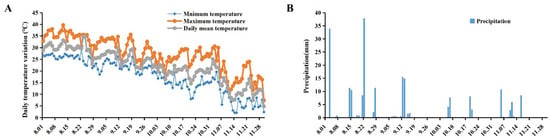
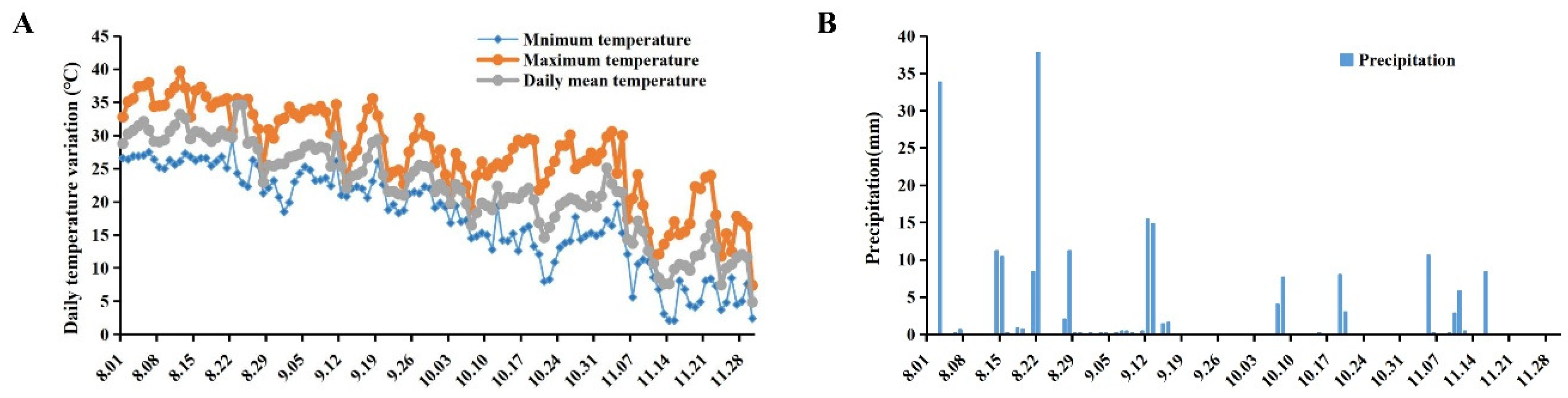
The field experiment was conducted from July to December 2023 at the aquatic vegetable experimental field of Yangzhou University (119.423282° E, 32.389204° N), Jiangsu Province, China. During the entire experimental time, the average air temperature was 22.1 °C, as recorded between 4.8 °C to 34.6 °C. The total amount of precipitation recorded for the experimental period was 204.2 mm, with 38 separate events being the total number of recorded precipitation events. The greatest amount of monthly precipitation occurred in August, when 117.6 mm was received that month. Daily temperature and precipitation during the experimental period were presented in Figure 1.
Figure 1.
Meteorological parameters during the course of experimentation. (A) Average air temperature as minimum, maximum and average per day. (B) Rainfall that occurred on site throughout the course of experimentation during the period of August through November 2023.
2.3. Experimental Design
The experiment was arranged in a randomized complete block design (RCBD) comprising five nitrogen (N) application treatments (N1–N5) with three replicates per treatment, resulting in a total of 15 experimental plots. Each plot measured 8 m × 6 m and contained 96 plants arranged at a spacing of 50 cm × 100 cm. Within each block, the five nitrogen treatments were randomly assigned to the experimental plots. The five treatments represented progressively increasing total seasonal nitrogen application rates of 196 (N1), 266 (N2), 336 (N3), 406 (N4), and 476 (N5) kg N ha−1. These rates represent the total seasonal N input supplied by both the basal compound fertilizer and supplemental urea-N topdressing. All treatments received the same basal fertilizer and equal amounts of phosphorus and potassium, whereas the amount of supplemental urea-N differed among treatments. Nitrogen fertilizer was applied in split doses according to the predetermined fertilization schedule (Table 1), with applications timed to different developmental stages to synchronize N availability with crop demand, thereby promoting N uptake and utilization while reducing potential nutrient losses. Detailed nitrogen application rates and fertilizer application schedules are presented in Table 1.
Table 1.
Schedule and amounts of nitrogen (N), phosphorus (P), and potassium (K) fertilizers applied under different N treatments during the experiment (kg ha−1).
2.4. Fertilizer Management
A combination of basal and topdressing fertilizers was applied. Before transplanting, 375 kg ha−1 of compound fertilizer (15% N, 15% P2O5, and 15% K2O) was applied uniformly to all plots as basal fertilizer. This application supplied 56 kg N ha−1, 25 kg P ha−1, and 47 kg K ha−1, respectively, after conversion of P2O5 and K2O to elemental P and K. The basal fertilizer was applied at the same rate to all nitrogen treatments. The remaining nitrogen required to achieve the five total seasonal N application rates was supplied as urea containing 46% N. The supplemental urea-N inputs were 140, 210, 279, 349, and 419 kg N ha−1 for N1, N2, N3, N4, and N5, respectively, resulting in total seasonal N inputs of 196, 266, 336, 406, and 476 kg N ha−1, respectively. Urea-N was applied in six split applications according to crop developmental stages: once during seedling establishment, twice during tillering, once immediately after tillering, and twice before harvest. The split applications were intended to synchronize N availability with crop demand and promote efficient N uptake and utilization. Superphosphate (12% P2O5) and potassium chloride (60% K2O) were used as additional sources of phosphorus and potassium, respectively. Phosphorus and potassium inputs were maintained at the same rates across all nitrogen treatments. The exact dates, fertilizer amounts, and nutrient inputs for each application are presented in Table 1. All nutrient application rates are reported on an elemental basis as kg N ha−1, kg P ha−1, and kg K ha−1.
2.5. Water Management
The depth of the water was adjusted according to the crop situation, maintain a water depth of 5 cm at transplanting; and increased to 10–15 cm after the fleshy stems begins swelling, and adjust it back to 3–5 cm during the harvesting period. Irrigation water was supplied as required to maintain an appropriate water layer throughout the growing period. Each plot was irrigated individually to prevent surface water flowing directly from one plot to another. To further minimize lateral movement of irrigation water and dissolved nutrients between neighboring treatments, adjacent plots were separated by waterproof boards buried approximately 40 cm below the soil surface. In addition, guard rows were established around each plot, and all plant sampling was performed on plants located in the central area of each plot to eliminate the edge effect.
2.6. Soil Sampling and Analysis
Prior to the transplant, a sampling strategy combining five sampling points was employed to collect soil samples from three depths (0–10 cm, 10–20 cm, and 20–30 cm). Soil samples were collected from the designated soil depths, air-dried at room temperature, gently crushed, and passed through a 2 mm sieve to remove plant residues, roots, and stones. A subsample was further ground and passed through a finer sieve where required for chemical analysis. Soil organic matter was determined using the potassium dichromate oxidation method and bulk density was measured using the core method. Available N was determined using the alkaline hydrolysis–diffusion method. Available P was extracted with sodium bicarbonate and determined colorimetrically, whereas available K was extracted with neutral ammonium acetate and quantified by flame photometry. Soil pH was determined potentiometrically using a soil-to-water suspension. All analytical results were expressed on a dry-soil basis. Soil nutrient tests were performed with an LD-TYC Soil Fertility Analyzer (Shandong Laien De Intelligent Technology Co., Ltd., Weifang, China) according to the manufacturer’s protocol. Five sampling points were selected within each experimental plot using a systematic distribution across the plot area, while avoiding the plot margins to minimize potential edge effects. Samples were collected from the five sampling points within each plot and pooled thoroughly to obtain one representative composite sample for each plot. The composite samples were subsequently used for the corresponding physiological analyses. The plot was considered the experimental unit, and the five sampling points represented subsamples within each plot rather than independent biological replicates.
2.7. Physical and Chemical Properties of Soil in the Experimental Site
The initial physicochemical characteristics of the experimental soil are presented in Table 2. In the surface samples of the soil (0–10 cm), the soil was slightly acidic (pH 6.3–6.5), and the organic matter and nutrient levels were relatively high; however, the level of soil organic matter and available nutrients decreased with increasing soil depth, while the bulk density slightly increased. The experimental soil was clay soil with great water-holding capabilities.
Table 2.
Physicochemical characteristics of the experimental soil before treatment application.
2.8. Growth Measurements
Ten days after the fourth topdressing of all five nitrogen treatments (N1–N5), three clumps with relatively uniform growth were selected in each plot for sampling and measurement of plant height, leaf length, leaf width and photosynthetic characteristics. Measurements were taken on the fourth fully expanded leaf down from the apical end of each plant.
2.9. Photosynthetic Measurements
- (a)
- Chlorophyll Content
A SPAD-502 chlorophyll meter (Konica Minolta, Inc., Osaka, Japan) was used to measure SPAD values at designated growth stages to track dynamic changes in leaf chlorophyll status during plant development. Measurements were performed following the method described by Wicharuck et al. [22]. The middle portion of functional leaves was selected as the measurement position. Three readings were taken on each leaf, and the average value was used for subsequent statistical analysis.
- (b)
- Gas Exchange Measurements
Photosynthetic light-response curves were measured in the field using a LI-6400 Portable Photosynthesis System (LI-COR Biosciences, Lincoln, NE, USA) following established procedures for photosynthetic gas-exchange measurements [23]. Measurements were conducted between 09:30 and 11:00 h under ambient field conditions and ambient CO2 concentration. For each measurement, the fourth fully expanded leaf from the top was selected, and the same leaf position was used consistently across all nitrogen treatments and replicates to minimize variation associated with leaf age and developmental stage. Photosynthetic responses were determined at 13 levels of photosynthetic photon flux density (PPFD): 2000, 1800, 1600, 1300, 1000, 800, 600, 400, 200, 100, 50, 25, and 0 μmol m−2 s−1 [23].
2.10. Yield and Yield-Related Traits
At harvest, five plants were randomly selected from each replicate plot to determine yield-related traits. The same sampling procedure was applied consistently across all nitrogen treatments and replicates. The sampled plants were assessed for total tiller number, effective tiller number, effective tiller percentage, sheathed gall weight, peeled gall weight, and edible shoot yield. Effective tillers were defined as tillers that produced marketable edible shoots. Gall maturity and harvest-related traits were assessed following established procedures for Z. latifolia [24]. Edible shoot yield was calculated from the measurements obtained from the five sampled plants and expressed as t ha−1. The five-plant sampling procedure was used as a standardized subsample to characterize plant-level yield components, with the same sampling intensity maintained across all treatments and replicates.
2.11. N Partial Factor Productivity
N partial factor productivity (NPFP) was calculated as
where Y represents edible shoot yield (kg ha−1), and F represents N fertilizer applied (kg N ha−1) [25,26].
2.12. Statistical Analysis
Our data sample comprised 3 biological replicates for each measurement, analyzed using SPSS v23.0 (IBM Corp., Armonk, NY, USA). One-way ANOVA was utilized to test for the significance of the procedure effect, and Duncan’s multiple comparison test was used to compare means of treatment groups at an alpha level of p < 0.05 for all analyses. The figures were prepared using GraphPad Prism v9 (GraphPad Software, Boston, MA, USA), Adobe Illustrator v2022 (Adobe Inc., San Jose, CA, USA) and Microsoft Excel v2021 (Microsoft Corporation, Redmond, WA, USA).
3. Results
3.1. Impact of Varying Rates of N Applications on Growth Characteristics in Z. latifolia
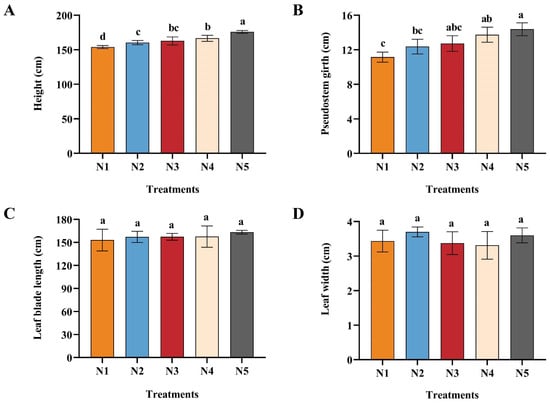
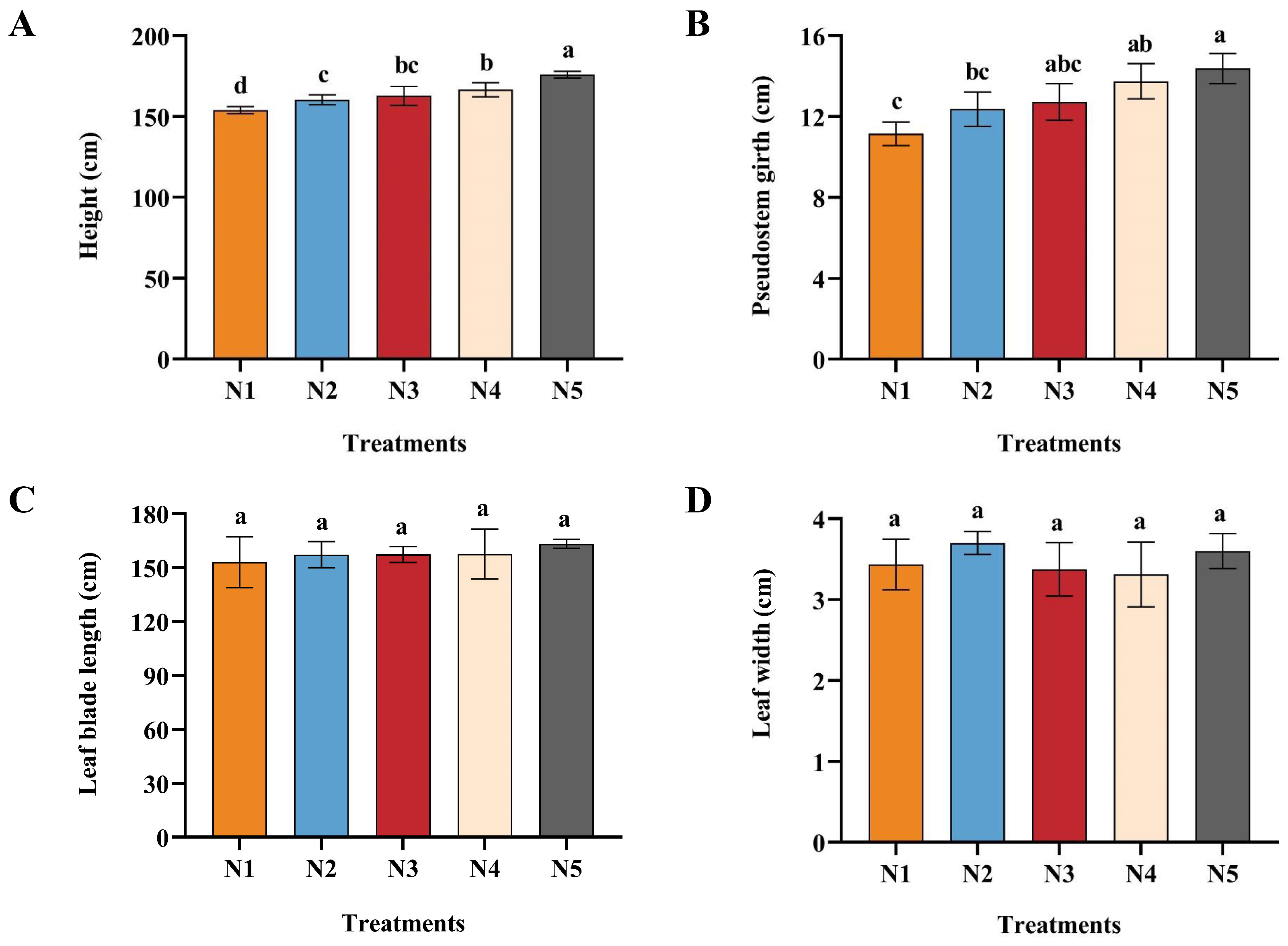
The effect of varying rates of N applications on growth characteristics in Z. latifolia was statistically significant (Figure 2). The plant height increased significantly as the rate of N application increased (Figure 2A). The lowest plant height observed was for the treatment N1 (155 cm), and the highest for N5 (about 177 cm) at p < 0.05; the average plant height of the N5-treated plants was significantly greater than those receiving the N1–N4 treatments, and there were no statistical differences in height between the N3 and N4 treatments. The application of N increased the girth of the pseudostem with increasing N level (Figure 2B). However, N1 treatment produced a smaller pseudostem girth (11.2 cm) than that produced with the application of the treatment N5 (14.3 cm). With respect to pseudostem girth, N4 and N5 treatments were statistically greater than N1, and there were no statistical differences between the intermediate treatments N2–N4. Leaf blade length did not change statistically due to N application (Figure 2C). The leaf length for all treatments trends toward increased length as the rate of application of N increases, but all treatments fall into the same statistical group (p > 0.05), indicating that leaf length was not responsive to the application of N levels. Similarly, leaf width was not statistically affected by N application (Figure 2D). Leaf width remained stable across all treatments (ranging from 3.3 to 3.7 cm), and there were no statistical differences in leaf width among treatments (p > 0.05). In summary, increasing N applications promoted greater plant height and pseudostem development but had no effect on leaf blade length or width.
Figure 2.
N application rates resulted in changes in plant height (A), pseudostem girth (B), leaf blade length (C), and leaf blade width (D) for the species Z. latifolia. N1 (orange), N2 (blue), N3 (red), N4 (light beige), N5 (dark grey) represent five nitrogen application treatments with total seasonal N inputs of 196, 266, 336, 406 and 476 kg N ha−1, respectively. Data are presented as mean ± SE, n = 3. Different lowercase letters indicate a statistically significant difference at p < 0.05 between means using Duncan’s Multiple Range Test for each factor.
3.2. Effects of Various Rates of N Application on Photosynthesis and Chlorophyll Content of Z. latifolia
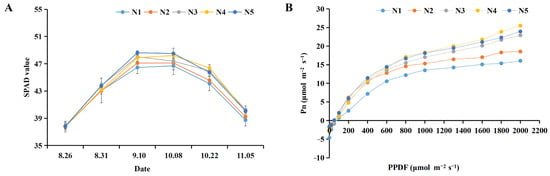
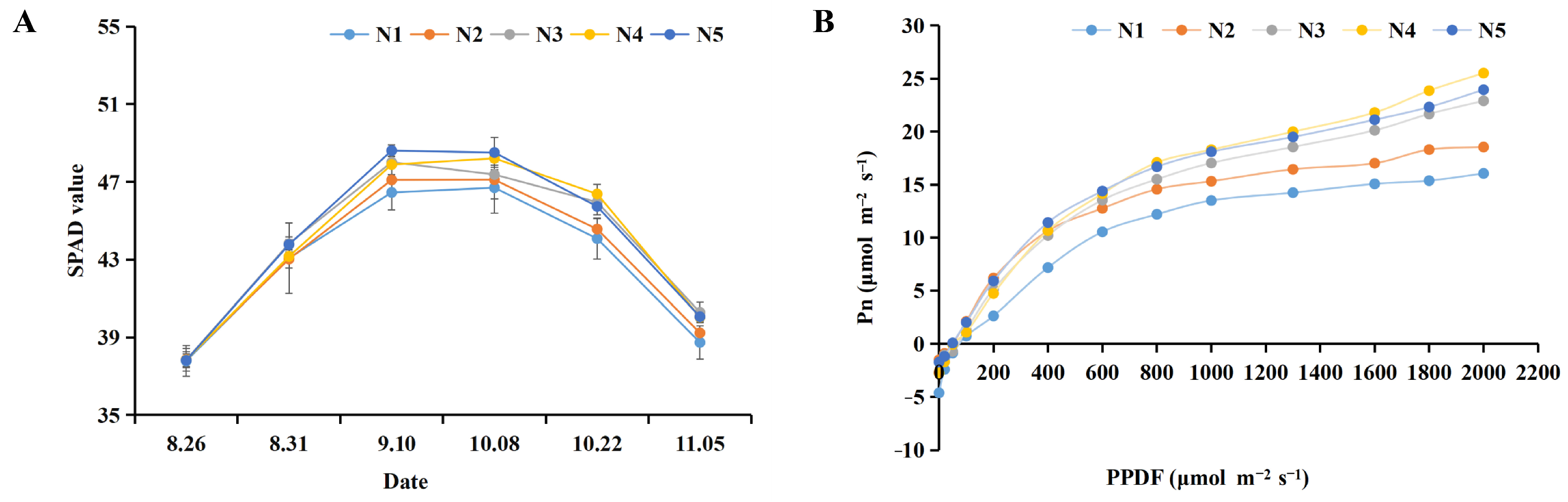
The chlorophyll content (SPAD value) and the photosynthetic ability of Z. latifolia (common water grass) were impacted by N fertilization (Figure 3). All N treatment groups showed the same kind of time-based changes in chlorophyll content (SPAD value) over the course of the growing season, with increases from late August to early September, peaks in early October, and declines toward early November (Figure 3A). N application levels greatly influenced the SPAD values of each N treatment; generally, higher N applications resulted in greater SPAD values than those of lesser N applications. The N4 and N5 treatments consistently had the highest levels of chlorophyll, while N1 had the lowest SPAD value. The greatest SPAD value was recorded at approximately 48–49 on 10 September and 8 October, with gradual decreases in the chlorophyll value as plants matured.
Figure 3.
The impact of different rates of N applications on both chlorophyll concentration (SPAD value) in Z. latifolia (A) and the light-response curves of net photosynthesis (Pn) (B). For SPAD (A), changes over time were measured during the growing season, while the relationships between Pn and PPFD (B) were determined. Results are presented as means ± SE (n = 3).
N application altered the photosynthetic response of Z. latifolia to increasing PPFD (Figure 3B). Across the measured PPFD range, Pn generally increased with increasing nitrogen supply, with the higher nitrogen treatments showing greater Pn values, particularly under higher light intensities. Pn increased with increasing PPFD and reached values exceeding 20 μmol CO2 m−2 s−1 at high PPFD, with the highest Pn observed under the N4 treatment (Figure 3B).
The accumulation of chlorophyll and the overall ability of Z. latifolia to photosynthesize were improved by applying moderate to high levels of N. Increasing the amount of N supplied improved photosynthesis; however, further enhancing N supply beyond the highest N application resulted in little to no improvement of photosynthesis.
3.3. Various Rates of N Application Significantly Impacted the Accumulation of N in the Leaves, Pseudostems, and Roots of Z. latifolia
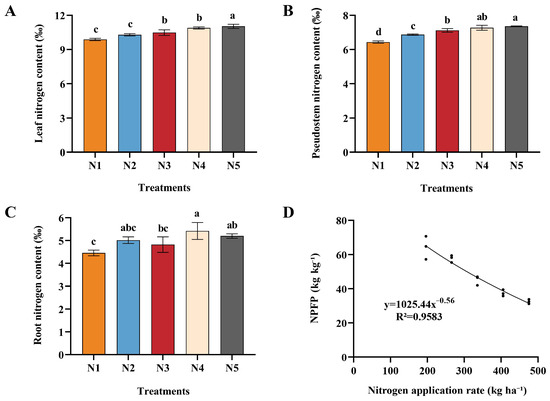
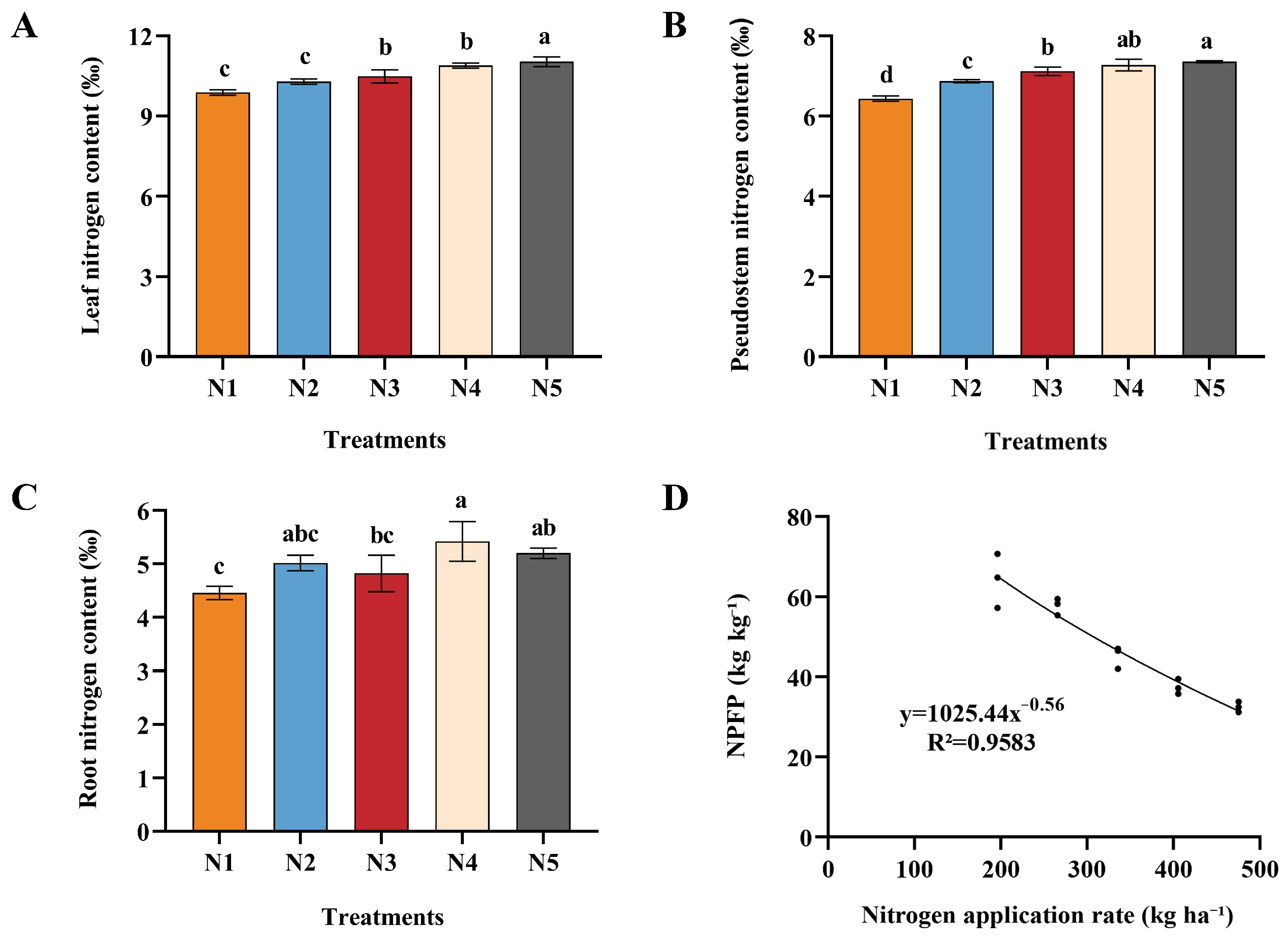
The N content of the leaves linearly increased as the N application rate increased (e.g., leaf N concentrations of ~9.9% at N1 and ~11.1% at N5). Leaf tissue concentration of N4 and N5 was significantly greater than that of N1 and N2 (p < 0.05), but no significant differences were observed between N4 and N5 (Figure 4A). Similarly, there were increases in pseudostem N as N application rates were increased. The lowest N concentration occurred at the N1 treatment (6.4%), while the greatest pseudostem N concentration was at N5 (7.3%). N concentrations of the N4 and N5 treatments were significantly greater than those of N1 and N2 treatments, indicating a greater accumulation of N in the edible pseudostem at greater N supply (Figure 4B). The concentration of N in the roots is also positively correlated with N fertilization. N concentrations in the roots were higher than in the N1 treatment for all other treatments and were maximal in the N4 treatment (~5.4%). No significant differences were found in N concentrations for the N2, N3, N4 or N5 treatments, suggesting that root N accumulation stabilized with moderate to high N application (Figure 4C).
Figure 4.
Summary of the effects of the N application rates on leaf N (A), pseudostem N (B), root N (C), and NPFP (D) of Z. latifolia. N1 (orange), N2 (blue), N3 (red), N4 (light beige), N5 (dark grey) represent five nitrogen application treatments with total seasonal N inputs of 196, 266, 336, 406 and 476 kg N ha−1, respectively. Data are presented as mean ± SE, n = 3. Different lowercase letters indicating significant differences between treatments using Duncan’s multiple range test (p < 0.05). The curve depicted in panel D represents fitted power regression calculated from the mean N application rate and NPFP (R2 = 0.9583).
In contrast, NPFP decreased significantly as N application increased. There was a significant negative polynomial relationship between NPFP and N application (y = 225.06x−0.56, R2 = 0.9583), suggesting that while higher N inputs resulted in greater N accumulation in the tissue, the yield produced per unit of N applied declines dramatically. The highest NPFP value occurred at the N1 treatment, while the lowest NPFP occurred at the N5 treatment (Figure 4D). While the application of increased N provided for greater vegetative accumulation of N, particularly in the leaves and pseudostems, the efficiency of N fertilizer use progressively diminished as N input rates increased. Therefore, it would appear that moderate N application rates would provide a better balance between N accumulation and fertilizer productivity.
3.4. Z. latifolia’s Yield and Components Were Affected by the N Fertilizer’s Application Rate
The number of tillers increased with increasing nitrogen application rate, although the magnitude of the response varied among treatments. The proportion of productive tillers also differed among nitrogen treatments. Yield increased from N1 to N4. The N4 treatment, which received 406 kg N ha−1, produced the highest yield of 19.24 t ha−1. However, the yield of N4 was not significantly different from that of N3, as both treatments were assigned to the same significance group. In contrast, N1 and N2 differed significantly, as indicated by their different significance letters. At the highest nitrogen rate (N5), yield declined relative to N4, indicating that additional nitrogen application did not further improve yield.
The tiller amount produced per plant increased in relation to the N application rate, with treatment N1 producing 11.67 and treatment N5 producing 16.00 tillers per plant (Table 3). The N5 treatment produced the highest number of tillers and had significantly more than N1 at the 95% confidence interval (p < 0.05). The percentage of productive tillers developed in an inverted-U fashion according to the N application rate. The largest proportion of productive tillers developed in N3, which produced 34.63%, followed by N4, which produced 32.03%. In comparison, N1 produced the smallest proportion of productive tillers (27.13%). In addition, the greater applications of N5 significantly affected productive tillering, with fewer productive tillers than lower applications.
Table 3.
Effects of different N application rates on yield and yield components of Z. latifolia.
Additionally, the weight of edible galls produced with each N treatment was also significantly affected. The N3 treatment produced the greatest weight of single-sheathed galls, with a weight of 182.24 g, compared with the N4 treatment, which broke 173.59 g and was significantly greater than N5, which weighed 155.45 g. The maximum weight of single-peeled galls, however, occurred in the N3 treatment (158.02 g), which was statistically similar to N4 (152.67 g) and significantly larger than N1, N2, and N5. For the single-peeled galls, the length of the single-peeled galls increased significantly from N1 (21.05 cm) to N3 (25.00 cm), while the length of the peeled galls from both N4 and N5 remained relatively unchanged. The girth of the peeled gall pseudostems (also known as peels) of the single peeled galls produced at N3 (15.38 cm) was significantly greater than that of N2 (15.04 cm) and significantly less than that of N5 (13.19 cm).
Yield increased with increasing nitrogen application rate from N1 to N4, reaching the highest value under N4. However, the yields under N3 and N4 were not significantly different, as indicated by the same significance letter. In contrast, the yields under N1 and N2 differed significantly. Yield subsequently declined under N5, indicating that further increases in nitrogen application did not result in additional yield. Moderate applications of N improved yields by producing productive tillers and weight of edible galls, whereas excessive applications promoted vegetative growth but reduced productive tillering and, therefore, marketable yield.
4. Discussion
N is a macronutrient; therefore, N has an important role in plant growth and productivity because it is found in many forms and compounds that are vital for the creation of chlorophyll, amino acids, proteins, nucleic acids, and an array of other enzymes necessary to carry out photosynthesis and carbon metabolism [27]. Therefore, N availability affects photosynthetic efficiency, biomass accumulation, overall yield, and the overall development of the leaves [28]. However, while N fertilization is important to achieve high levels of production, excess N applied in an increasingly concentrated farming system has led to a number of problems for the environment and farmers, including a lack of NUE, higher production costs, and various negative impacts on the environment, including leaching of nitrates into waterways, soil acidity problems, loss of NH3 and losses of N2O [6]. Therefore, optimizing N use is a crucial part of a successful balance between agricultural productivity and environmental sustainability.
Increasing N application significantly increased plant height, pseudostem girth, tiller number, tissue N concentration, and leaf chlorophyll content in Zizania latifolia. These responses are consistent with the established physiological role of N in supporting N uptake and assimilation, chlorophyll formation, photosynthetic capacity, and vegetative growth [29,30]. Evidence from primary experiments in rice also supports the positive relationship between N availability and vegetative development. For example, localized N supply increased dry-matter accumulation, N uptake, and yield, compared with farmer fertilizer practice [31]. Similarly, optimized N application improved tiller development and increased differentiated spikelets, filled spikelets, and grain yield compared with traditional N management [32]. In direct-seeded rice, tiller number at panicle initiation was strongly associated with N management, with regression models explaining variation across four experimental seasons [33]. Together, these findings provide quantitative evidence that N availability can influence N status, vegetative development, tiller formation, and biomass accumulation in grasses.
In the present study, however, N application did not significantly affect leaf length or width. This contrasting response indicates that different components of shoot architecture did not respond uniformly to increasing N availability. Rather than concluding that N preferentially regulates biomass production through shoot expansion, our results suggest that N availability was associated more strongly with plant height, pseudostem development, and tillering than with the dimensions of individual leaves under the conditions tested. Leaf length and width may be relatively constrained by cultivar characteristics and developmental regulation, while the physiological effects of N can also vary with plant developmental stage and the timing of N availability [34]. Once individual leaves approach their genetically determined dimensions, additional N may contribute more strongly to newly developing tillers and pseudostem development than to further expansion of existing leaves.
Nevertheless, organ-specific biomass partitioning, N assimilation rates, protein accumulation, and carbon allocation were not directly measured in the present study. Therefore, the observed relationships should be interpreted as associations rather than direct evidence of preferential N allocation toward shoot expansion. Cultivar characteristics and growth-stage-specific N requirements may also contribute to the differential responses of plant height, tillering, pseudostem development, and individual leaf dimensions. Future studies incorporating organ-specific biomass accumulation, N uptake and assimilation, and C–N allocation would help clarify the mechanisms underlying these responses.
There is a close correlation between leaf chlorophyll content and plant N levels due to a substantial amount of leaf N being allocated to chloroplast proteins and enzymes involved in photosynthesis. The incremental increases in SPAD value with each additional application of N indicate progressive increases in chlorophyll accumulation as the plants obtained better N nutrition. The increase in chlorophyll content resulted in increased maximum net photosynthetic rates, which demonstrates that the amount of N applied has a positive effect on the photosynthetic capacity of Z. latifolia (Figure 3). N increases chlorophyll production, Rubisco production, electron transport activity, and carbon dioxide assimilation, all of which promote carbon fixation and dry matter production [35]. There have also been reports of improvements in chlorophyll content and photosynthetic performance with optimized N inputs for maize and rice [36,37]. In addition to these findings, although chlorophyll content and tissue N content continued to increase following application of the greatest amount of N (N5), there were minimal improvements in photosynthetic performance compared to the application of N (N4) which suggests that once the leaf N exceeded the physiological requirements, photosynthesis became saturated. These results support previous research that excessive N does not have a proportional effect on improving photosynthetic efficiency, as most of the additional N is used to build structural or storage materials compared to being used to enhance photosynthetic processes [35,38].
The present study has demonstrated that N accumulation, chlorophyll content, photosynthesis, yield formation, and N use efficiency all share a close physiological relationship (Figure 3). The moderate N application (N4) resulted in SPAD values that were significantly increased, with the highest net photosynthesis, the highest percentages of productive tillers, the highest gall weight and the highest total yield (Table 2 and Table 3). This relationship implies that the increased N nutrition improved chlorophyll accumulation, which resulted in greater light interception and carbon assimilation. The excess carbon produced through photosynthesis was subsequently partitioned into the development and expansion of edible pseudostems, which increased the gall weight and thus the value of harvested yield (Table 3). The highest N treatment (N5) also resulted in a greater tissue N concentration and greater vegetative growth than the N4 treatment; however, no improvements were observed in either photosynthetic capacity or total yield. The excessive amount of N appears to have resulted in a decrease in the number of productive tillers and in the gall weight, indicating that excess N promotes an unnecessary amount of vegetative tissue at the cost of carbon being partitioned into the harvestable organs. Similar source-sink imbalances resulting from excessive N have also been reported for rice and many other cereal crops, where increased vegetative biomass is often coupled with reduced harvest index and lower NUE [39,40].
The response of total yield to nitrogen applications did not correspond uniformly with the response of individual yield components. Although N3 exhibited significantly greater single gall weight and productive tiller percentage than N4, N4 produced the highest numerical total yield. This apparent trade-off indicates that total yield was determined by the combined contribution of multiple yield components rather than by any single component. The higher yield under N4 may have resulted from a compensatory increase in the number of productive tillers and/or greater total assimilate allocation to edible galls, which offset the lower individual gall weight and productive tiller percentage observed under N4. Adequate nitrogen availability can enhance vegetative growth and photosynthetic capacity, thereby increasing the assimilate supply available for sink development. However, excessive nitrogen may alter assimilate partitioning between vegetative growth and reproductive or storage sinks. Therefore, the N4 treatment may have provided a more favorable balance between source capacity and sink development, resulting in the highest overall yield despite not maximizing every individual yield component.
The NPFP serves as an effective indicator of nitrogen use efficiency (NUE), correlating fertilizer input with resultant yield [6]. The research demonstrated that N partial factor productivities (NPFP) decreased with increasing rates of N application and significantly fitted a negative power relationship to N rate shown in Figure 4. The results demonstrate the common agricultural principle of diminishing returns for N applied to crops. For low rates of N applied, productivity from fertilizer applications was high relative to the amount of N applied because each unit of N applied resulted in reasonable increases in yield; however, due to a lack of available N supply, total yield was unable to increase beyond the limitations of N applied. Therefore, when a farmer applied high amounts of N, their NPFP was lowered by high amounts, and only marginal increases in biomass production and reduced marketable yield resulted from fertilizing higher than the amount crops required. This data indicates that it is economically inefficient and environmentally unacceptable to apply N fertilizer beyond the uptake of crops. The same decrease in NUE with high rates of N applied has been reported in cereal and vegetable crop production systems using several different species of cereal and vegetable crops and is believed to have occurred because of increased N loss through nitrate leaching, ammonia volatilization, and nitrous oxide emissions [41,42].
Recent evidence further supports the importance of nitrogen availability in regulating the growth and physiological performance of Z. latifolia. Zhang et al. [18] demonstrated that nitrogen deficiency markedly reduced plant growth, chlorophyll content, and photosynthetic performance and disrupted carbon–nitrogen metabolism and source–sink allocation during gall development. These findings are consistent with the positive response of growth and photosynthetic performance to increasing nitrogen availability observed in the present study. However, our results further indicate that the response was not proportional across the entire nitrogen gradient. Photosynthetic performance and yield increased up to an intermediate nitrogen supply but showed limited additional improvement or declined at the highest nitrogen rate. This suggests that once nitrogen availability becomes sufficient to support photosynthetic machinery and active growth, additional nitrogen may provide diminishing physiological benefits. The contrasting responses between nitrogen deficiency and excessive nitrogen supply therefore highlight the importance of maintaining an appropriate nitrogen supply to balance vegetative growth, photosynthetic carbon assimilation, and assimilate allocation to developing edible galls.
The plateau in photosynthetic performance at the higher nitrogen application rates suggests that the benefit of additional nitrogen became progressively smaller once an adequate nitrogen supply had been reached. At moderate nitrogen availability, increasing N can enhance the synthesis of chlorophyll, photosynthetic proteins, and other components of the photosynthetic apparatus, thereby increasing photosynthetic capacity. However, when nitrogen supply exceeds the requirement for active growth and photosynthetic machinery, additional absorbed N may be stored in plant tissues without generating a proportional increase in carbon assimilation. This phenomenon, commonly referred to as nitrogen luxury consumption, can result in increased tissue N accumulation while providing limited additional benefits to photosynthetic productivity. Moreover, excessive N supply may modify the allocation of absorbed nitrogen among leaves, stems, roots, and developing edible galls, potentially increasing vegetative N accumulation rather than proportionally enhancing productive sink development. Consequently, once nitrogen ceases to be the primary limiting factor, other constraints on photosynthesis and assimilate utilization may become increasingly important, resulting in a saturation or plateau in Pn despite further increases in N supply.
The declining NPFP with increasing nitrogen application provides further evidence that the marginal productivity of fertilizer N decreased at high application rates. Because NPFP represents yield produced per unit of applied N, additional N fertilizer will inevitably reduce this efficiency when yield does not increase proportionally with N input. Thus, the simultaneous occurrence of a plateau in photosynthetic performance and declining NPFP at high N rates suggests diminishing returns from excessive nitrogen application. From an agronomic perspective, these findings indicate that maximizing nitrogen input is not equivalent to maximizing nitrogen-use efficiency or yield, and that an appropriate N rate should balance sufficient nitrogen availability for photosynthetic activity and gall development with the risk of unnecessary N accumulation and reduced fertilizer-use efficiency.
Although the present study provides field-based evidence of the effects of different nitrogen (N) application rates on the growth, physiological characteristics, yield, and nitrogen-use efficiency of Z. latifolia, the observed responses were obtained under specific soil, climatic, cultivar, and management conditions. Therefore, extrapolation of these responses to other production environments should be made cautiously. Future research could complement field experiments with calibrated process-based soil–crop models to extend the current experimental framework and evaluate N-management scenarios beyond the conditions examined in a single field experiment. Such models could integrate N application with crop growth, soil N cycling and transformation, environmental conditions, and potential N losses, enabling assessment of trade-offs among crop productivity, N-use efficiency, nutrient losses, and soil carbon dynamics. Recent modeling studies have demonstrated the potential of process-based approaches to evaluate interactions among N fertilizer rates, crop yield, nutrient losses, and soil organic carbon [20], while highlighting the need for improved representation of plant–soil processes governing N losses in crop models [43]. In addition, process-based reactive-transport modeling has demonstrated that soil physical and geochemical heterogeneity can generate substantial spatial and temporal variation in N2O emissions, including localized hotspots and short-lived emission hot moments [21].
5. Conclusions
This study demonstrated that nitrogen application substantially affected the growth, photosynthetic performance, yield formation, and nitrogen-use efficiency of Zizania latifolia. Increasing nitrogen supply promoted plant growth, tillering, and photosynthetic performance, whereas the benefits diminished at the highest nitrogen rate. Among the treatments evaluated, N4 (406 kg N ha−1) produced the highest numerical yield (19.24 t ha−1), although its yield was not significantly different from that of N3. The highest observed net photosynthetic rate under N4 exceeded 20 μmol CO2 m−2 s−1, while nitrogen partial factor productivity decreased with increasing nitrogen input. Thus, within the range of rates evaluated, N4 was the highest-yielding treatment under the experimental conditions. However, because no zero-nitrogen control was included, N4 should not be interpreted as the absolute agronomic optimum or minimum N requirement. Further multi-rate, multi-season, and multi-location studies including a zero-N control are needed to establish the complete N-response curve and evaluate the stability of nitrogen management across environments.
Author Contributions
Conceptualization, Z.Z.; methodology, software and validation, L.X. and M.X.; formal analysis, C.H.; investigation, D.L. and J.Y.; resources, Z.Z.; data curation, L.X. and M.X.; writing—original draft preparation, M.J.A.; writing—review and editing, Z.Z.; visualization, L.X.; supervision, L.L.; project administration, Z.Z.; funding acquisition, Z.Z. All authors have read and agreed to the published version of the manuscript.
Funding
This study was supported by the National Natural Science Foundation of China (32573052) and the National Foreign Experts Program (Y20250054).
Data Availability Statement
Data is contained within the article.
Conflicts of Interest
The authors declare no conflicts of interest.
References
- Yu, Y.; Peng, X.; Zhu, H.; Jia, Z.; Ma, P.; Wang, C.; Wang, W.; Bian, X. Organ-specific growth-defense trade-offs in sweetpotato [Ipomoea batatas (L.) Lam.] under primary macronutrients deprivation: Distinct modulation of yield formation and chlorogenic acids metabolism by nitrogen, phosphorus, and potassium. J. Agric. Food Res. 2026, 29, 102997. [Google Scholar] [CrossRef] [Scilit]
- Noor, H.; Yan, Z.; Sun, P.; Zhang, L.; Ding, P.; Li, L.; Ren, A.; Sun, M.; Gao, Z. Effects of nitrogen on photosynthetic productivity and yield quality of wheat (Triticum aestivum L.). Agronomy 2023, 13, 1448. [Google Scholar] [CrossRef] [Scilit]
- Wang, Y.; Peng, Y.; Lin, J.; Wang, L.; Jia, Z.; Zhang, R. Optimal nitrogen management to achieve high wheat grain yield, grain protein content, and water productivity: A meta-analysis. Agric. Water Manag. 2023, 290, 108587. [Google Scholar] [CrossRef] [Scilit]
- Kundu, B.K.; Chutia, P.; Boro, K.; Regon, P.; Borgohain, P.; Dutta, A.K.; Agarwala, N.; Tanti, B. Optimizing nitrogen supply in IR64 rice (Oryza sativa L.) to enhance nitrogen use efficiency, growth, yield potential, and stress response. J. Plant Growth Regul. 2026, 45, 1512–1536. [Google Scholar] [CrossRef] [Scilit]
- Ren, H.; Liu, Z.; Wang, X.; Zhou, W.; Zhou, B.; Zhao, M.; Li, C. Long-term excessive nitrogen application decreases spring maize nitrogen use efficiency via suppressing root physiological characteristics. J. Integr. Agric. 2025, 24, 4195–4210. [Google Scholar] [CrossRef] [Scilit]
- Bhatt, R.; Kunal; Moulick, D.; Bárek, V.; Brestic, M.; Gaber, A.; Skalicky, M.; Hossain, A. Sustainable strategies to limit nitrogen loss in agriculture through improving its use efficiency—Aiming to reduce environmental pollution. J. Agric. Food Res. 2025, 22, 101957. [Google Scholar] [CrossRef] [Scilit]
- Zhang, K.; Zhu, L.; Sun, H.; Zhang, Y.; Zhang, K.; Bai, Z.; Wang, Z.; Liu, L.; Li, C. Research progress and application advances of controlled-release nitrogen fertilizers in crop production. Agriculture 2026, 16, 472. [Google Scholar] [CrossRef] [Scilit]
- Liu, Y.; Zhuang, M.; Liang, X.; Lam, S.K.; Chen, D.; Malik, A.; Li, M.; Lenzen, M.; Zhang, L.; Zhang, R.; et al. Localized nitrogen management strategies can halve fertilizer use in Chinese staple crop production. Nat. Food 2024, 5, 825–835. [Google Scholar] [CrossRef] [Scilit]
- Wu, Z.; Liang, H.; Liu, Z.; Du, H.; He, L.; Xie, Z.; Zhu, J.; Zheng, B.; Wan, W. Nitrogen dilemma in Chinese crop-livestock systems: Assessing mitigation potential and exploring optimization pathways from the perspectives of utilization efficiency and pollution hotspots. Agric. Syst. 2026, 233, 104642. [Google Scholar] [CrossRef] [Scilit]
- Fan, X.; Zhu, Y.; Jia, Y.; Du, P.; Wang, W.; Liu, J.; Lv, Z.; Liu, R.; Li, X. Optimizing drip irrigation and organic fertilizer management across diverse environments: Global patterns of nitrogen-driven production efficiency. Agric. Water Manag. 2026, 328, 110316. [Google Scholar] [CrossRef] [Scilit]
- Duan, J.; Liu, H.; Zhang, X.; Ren, C.; Wang, C.; Cheng, L.; Xu, J.; Gu, B. Agricultural management practices in China enhance nitrogen sustainability and benefit human health. Nat. Food 2024, 5, 378–389. [Google Scholar] [CrossRef] [Scilit]
- Xie, Y.-N.; Qi, Q.-Q.; Li, W.-H.; Li, Y.-L.; Zhang, Y.; Wang, H.-M.; Zhang, Y.-F.; Ye, Z.-H.; Guo, D.-P.; Qian, Q. Domestication, breeding, omics research, and important genes of Zizania latifolia and Zizania palustris. Front. Plant Sci. 2023, 14, 1183739. [Google Scholar] [CrossRef] [Scilit]
- Manathunga, K.K.; Gunasekara, N.W.; Meegahakumbura, M.K.; Ratnaweera, P.B.; Faraj, T.K.; Wanasinghe, D.N. Exploring endophytic fungi as natural antagonists against fungal pathogens of food crops. J. Fungi 2024, 10, 606. [Google Scholar] [CrossRef] [Scilit]
- Wu, W.; Han, Y.; Niu, B.; Yang, B.; Liu, R.; Fang, X.; Chen, H.; Xiao, S.; Farag, M.A.; Zheng, S. Recent advances in Zizania latifolia: A comprehensive review on phytochemical, health benefits and applications that maximize its value. Crit. Rev. Food Sci. Nutr. 2023, 64, 7535–7549. [Google Scholar] [CrossRef] [Scilit]
- Zhang, Z.; Shi, W.; Gu, J.; Song, S.; Xiao, M.; Yao, J.; Liu, Y.; Jiang, J.; Miao, M. Short day promotes gall swelling by a CONSTANS-FLOWERING LOCUS T pathway in Zizania latifolia. Plant J. 2024, 120, 1014–1031. [Google Scholar] [CrossRef] [Scilit]
- Tanaka, Y.; Ono, A.; Aoki, D.; Matsuda, R.; Kitsukawa, Y.; Choi, J.-H.; Xie, X.; Aime, M.C.; Kawagishi, H.; Suzuki, T. Transcriptomic resource and hormonal profiling of the smut fungus, Ustilago esculenta, coexisting with Zizania latifolia and forming Makomotake. Biosci. Biotechnol. Biochem. 2025, 89, 1293–1301. [Google Scholar] [CrossRef] [Scilit]
- Fañanás-Pueyo, I.; Carrera-Castaño, G.; Pernas, M.; Oñate-Sánchez, L. Signalling and regulation of plant development by carbon/nitrogen balance. Physiol. Plant. 2025, 177, e70228. [Google Scholar] [CrossRef] [Scilit]
- Zhang, S.; Zheng, L.; Zhang, J.; Guo, D.-P. Nitrogen deficiency restricts gall development by altering metabolic and hormonal networks in Zizania latifolia. Front. Plant Sci. 2026, 17, 1754728. [Google Scholar] [CrossRef] [Scilit]
- Saha, B.; Fatima, A.; Saha, S.; Sahoo, S.K.; Poddar, P. Environmental pollution due to improper use of chemical fertilizers and their remediation. In Environmental Contaminants; Apple Academic Press: Palm Bay, FL, USA, 2024; pp. 203–219. [Google Scholar]
- Li, Z.; Guan, K.; Zhou, W.; Peng, B.; Nafziger, E.D.; Grant, R.F.; Jin, Z.; Tang, J.; Margenot, A.J.; Lee, D.; et al. Comparing continuous-corn and soybean-corn rotation cropping systems in the U.S. central Midwest: Trade-offs among crop yield, nutrient losses, and change in soil organic carbon. Agric. Ecosyst. Environ. 2025, 393, 109739. [Google Scholar] [CrossRef] [Scilit]
- Jia, M.; Lapen, D.R.; Su, D.; Mayer, K.U. Multi-domain reactive transport modeling of GHG emissions from macroporous agricultural soils with a focus on N2O hotspots and hot moments. Water Resour. Res. 2025, 61, e2025WR040588. [Google Scholar] [CrossRef] [Scilit]
- Wicharuck, S.; Suang, S.; Chaichana, C.; Chromkaew, Y.; Mawan, N.; Soilueang, P.; Khongdee, N. The implementation of the SPAD-502 Chlorophyll meter for the quantification of nitrogen content in Arabica coffee leaves. MethodsX 2024, 12, 102566. [Google Scholar] [CrossRef] [Scilit]
- Busch, F.A.; Ainsworth, E.A.; Amtmann, A.; Cavanagh, A.P.; Driever, S.M.; Ferguson, J.N.; Kromdijk, J.; Lawson, T.; Leakey, A.D.B.; Matthews, J.S.A.; et al. A guide to photosynthetic gas exchange measurements: Fundamental principles, best practice and potential pitfalls. Plant Cell Environ. 2024, 47, 3344–3364. [Google Scholar] [CrossRef] [Scilit]
- Ding, C.; Ma, R.; Wang, L.; Lan, X.; Chen, L.; Zhu, J.; Wang, L. Fenaminosulf promotes growth and gall formation in Zizania latifolia through modulation of physiological and molecular pathways. Plants 2025, 14, 1628. [Google Scholar] [CrossRef] [Scilit]
- Irmak, S.; Mohammed, A.T. Maize nitrogen uptake and use efficiency, partial factor productivity of nitrogen, and yield response to different nitrogen and water applications under three irrigation methods. Irrig. Drain. 2024, 73, 64–88. [Google Scholar] [CrossRef] [Scilit]
- Shen, D.; Zhou, L.; Wang, K.; Ming, B.; Xie, R.; Xue, J.; Fang, L.; Zhang, T.; Wang, Z.; Yu, J.; et al. Optimizing nitrogen application frequency to enhance the post-flowering matter accumulation, yield and water/nitrogen use efficiency of densely planted and drip-irrigated maize. J. Sci. Food Agric. 2025, 105, 7073–7084. [Google Scholar] [CrossRef] [Scilit]
- Zayed, O.; Hewedy, O.A.; Abdelmoteleb, A.; Ali, M.; Youssef, M.S.; Roumia, A.F.; Seymour, D.; Yuan, Z.-C. Nitrogen journey in plants: From uptake to metabolism, stress response, and microbe interaction. Biomolecules 2023, 13, 1443. [Google Scholar] [CrossRef] [Scilit]
- Noor, H.; Ding, P.; Ren, A.; Sun, M.; Gao, Z. Effects of nitrogen fertilizer on photosynthetic characteristics and yield. Agronomy 2023, 13, 1550. [Google Scholar] [CrossRef] [Scilit]
- Yang, Z.; Yan, H.; Liu, H.; Yang, L.; Mi, G.; Wang, P. Enhancing crop nitrogen efficiency: The role of mixed nitrate and ammonium supply in plant growth and development. Biology 2025, 14, 546. [Google Scholar] [CrossRef] [Scilit]
- Reddy, M.B.; Sravani, P.; Kumar, S.; Rajawat, M.V.S.; Jaiswal, D.K.; Dhar, S.; Azman, E.A.; Garg, K.; Kumar, S. Nitrogen use efficiency reimagined: Advancements in agronomic, ecophysiological, and molecular strategies. J. Plant Nutr. 2025, 48, 1577–1603. [Google Scholar] [CrossRef] [Scilit]
- Hu, R.; Ding, Z.; Tian, Y.; Cao, Y.; Hou, J.; Wang, X. Localized nitrogen supply facilitates rice yield and nitrogen use efficiency by enabling root-zone nitrogen distribution and root growth. Front. Sustain. Food Syst. 2024, 8, 1326311. [Google Scholar] [CrossRef] [Scilit]
- Zhou, W.; Yan, F.; Chen, Y.; Ren, W. Optimized nitrogen application increases rice yield by improving the quality of tillers. Plant Prod. Sci. 2022, 25, 311–319. [Google Scholar] [CrossRef] [Scilit]
- Peng, B.; Wang, X.; Hu, X.; Liu, Y.; Liang, K.; Fu, Y.; Hu, R.; Li, M.; Ye, Q.; Yin, Y.; et al. Determining nitrogen topdressing rates in accordance with actual seedling density and crop nitrogen status in direct-seeded rice. J. Sci. Food Agric. 2024, 104, 2294–2302. [Google Scholar] [CrossRef] [Scilit]
- Guo, A.; Ren, H.; Yang, H.; Liang, Z.; Li, Y.; Dou, T.; Ma, Y.; Shen, H. Physiological and molecular mechanisms of nitrogen regulation on grain quality in cereal crops at later stages. Int. J. Mol. Sci. 2026, 27, 2125. [Google Scholar] [CrossRef] [Scilit]
- Sun, J.; Jin, L.; Li, R.; Meng, X.; Jin, N.; Wang, S.; Xu, Z.; Liu, Z.; Lyu, J.; Yu, J. Effects of different forms and proportions of nitrogen on the growth, photosynthetic characteristics, and carbon and nitrogen metabolism in tomato. Plants 2023, 12, 4175. [Google Scholar] [CrossRef] [Scilit]
- Chen, L.-H.; Xu, M.; Cheng, Z.; Yang, L.-T. Effects of nitrogen deficiency on the photosynthesis, chlorophyll a fluorescence, antioxidant system, and sulfur compounds in Oryza sativa. Int. J. Mol. Sci. 2024, 25, 10409. [Google Scholar] [CrossRef] [Scilit]
- Soualiou, S.; Duan, F.; Li, X.; Zhou, W. Nitrogen supply alleviates cold stress by increasing photosynthesis and nitrogen assimilation in maize seedlings. J. Exp. Bot. 2023, 74, 3142–3162. [Google Scholar] [CrossRef] [Scilit]
- Javed, T., II; Singhal, R.K.; Shabbir, R.; Shah, A.N.; Kumar, P.; Jinger, D.; Dharmappa, P.M.; Shad, M.A.; Saha, D. Recent advances in agronomic and physio-molecular approaches for improving nitrogen use efficiency in crop plants. Front. Plant Sci. 2022, 13, 877544. [Google Scholar] [CrossRef] [Scilit]
- Li, X.; Zhou, Y.; Shuai, P.; Wang, X.; Peng, S.; Wang, F. Source–sink balance optimization depends on soil nitrogen condition so as to increase rice yield and N use efficiency. Agronomy 2023, 13, 907. [Google Scholar] [CrossRef] [Scilit]
- Li, Y.; Liu, J.; Tang, J.; Zuo, Y.; Gao, A.; Gu, X.; Nangia, V.; Liu, Y. Under reduced nitrogen fertilizer conditions, increasing wheat planting density to enhance sink capacity for achieving high productivity. J. Integr. Agric. 2026, in press. [Google Scholar] [CrossRef] [Scilit]
- Valenzuela, H. Optimizing the nitrogen use efficiency in vegetable crops. Nitrogen 2024, 5, 106–143. [Google Scholar] [CrossRef] [Scilit]
- Ibn, R.A.; Ghosh, U.K.; Hossain, M.S.; Mahmud, A.; Saha, A.K.; Rahman, M.M.; Rahman, M.A.; Siddiqui, M.N.; Khan, M.A.R. Enhancing nitrogen use efficiency in cereal crops: From agronomy to genomic perspectives. Cereal Res. Commun. 2025, 53, 1–16. [Google Scholar] [CrossRef] [Scilit]
- Liu, H.; Grant, B.B.; Smith, W.N.; Porter, C.H.; Cammarano, D.; Vogeler, I.; Hoogenboom, G.; Pullens, J.W.M.; Olesen, J.E.; Bindi, M.; et al. Towards an improved representation of the relationship between root traits and nitrogen losses in process-based models. Agric. Syst. 2025, 228, 104400. [Google Scholar] [CrossRef] [Scilit]

Disclaimer/Publisher’s Note: The statements, opinions and data contained in all publications are solely those of the individual author(s) and contributor(s) and not of MDPI and/or the editor(s). MDPI and/or the editor(s) disclaim responsibility for any injury to people or property resulting from any ideas, methods, instructions or products referred to in the content. |
© 2026 by the authors. Licensee MDPI, Basel, Switzerland. This article is an open access article distributed under the terms and conditions of the Creative Commons Attribution (CC BY) license.