


Abstract
Optimization of nitrogen (N), phosphorus (P), and potassium (K) fertilization is important for tomato yield, nutrition status, and sustainable soil fertility. The use of grafted tomato seedlings has become quite widespread in greenhouse cultivation. Since tomato grafting changes the nutrient requirements, it is necessary to determine the appropriate amounts of fertilizer to apply. For this purpose, three different chemical fertilizer doses (F1: 50% less than the recommended NPK, F2: the recommended NPK, and F3: 50% more than the recommended NPK) were applied to two scions (P1: Anıt, P2: Bestona) and four rootstock scion combinations (P3: Anıt/Vividfort, P4: Anıt/Beaufort, P5: Bestona/Vividfort, P6: Bestona/Beaufort). After the 16-week growing period, soil electrical conductivity (EC), total nitrogen (TN), available phosphorus (av-P), exchangeable potassium (ex-K), calcium (ex-Ca), and magnesium (ex-Mg) concentrations increased with increasing NPK dose, whereas soil available iron (av-Fe) and copper (av-Cu) concentrations were not affected. Soil reaction (pH), av-P, zinc (av-Zn), and manganese (av-Mn) concentrations were altered by tomato rootstock/scion combinations. Fruit yield was not affected by grafting but increased with fertilization, particularly at the F2 and F3 doses. Grafting consistently increased leaf N concentration relative to ungrafted plants. Increases in leaf P, Mg, Fe, Mn, and Cu were not uniform across all graft combinations but were most pronounced in the Bestona/Vividfort combination, indicating that these nutritional benefits were largely rootstock/scion-specific rather than a general grafting effect. Grafting might be a useful tool for increasing plant nutrition status, but did not translate into a significant yield benefit during the 16-week growing period. F2 (3.52 kg plant−1) and F3 (3.44 kg plant−1) doses produced comparable yields while F3 markedly reduced partial factor productivity and increased soil EC. Results indicated that the recommended NPK dose (F2) remained appropriate for tomato production regardless of graft status, and did not need to be modified.
1. Introduction
Greenhouse tomato (Solanum lycopersicum L.) production is one of the most intensive horticultural systems worldwide. In Türkiye, greenhouse cultivation is concentrated in the Mediterranean region, where tomato is the predominant vegetable crop. Intensive greenhouse production is characterized by high planting density, year-round cultivation, frequent irrigation, and continuous fertigation, all of which require efficient nutrient management to sustain high yield and fruit quality. However, fertilization practices in commercial greenhouse production are often based on empirical experience rather than crop-specific nutrient requirements, resulting in excessive application of N, P and K fertilizers [1,2].
Excessive fertilizer application has become one of the major constraints to the sustainability of intensive greenhouse production systems. Continuous over-application of mineral fertilizers accelerates nutrient accumulation in the root zone, increases soil salinity, disrupts soil chemical properties, and decreases nutrient use efficiency [2,3,4]. Long-term intensive fertilization may also accelerate soil degradation and promote nitrate contamination of groundwater, particularly in regions where greenhouse cultivation is practiced continuously and rainfall is insufficient to leach accumulated salts [3,4,5]. Conversely, inadequate fertilizer application may limit crop productivity and nutrient uptake. Therefore, improving fertilizer management is essential not only for maximizing tomato yield but also for maintaining soil fertility and minimizing environmental impacts [6,7,8,9,10].
This challenge is particularly important under the calcareous greenhouse soils of the Mediterranean region, which are generally characterized by alkaline pH, high calcium carbonate, and low organic matter content. These soil properties reduce the availability of several essential nutrients and often encourage growers to compensate by applying greater amounts of fertilizer than required [1,11,12,13]. Although this strategy may temporarily sustain production, excessive fertilizer inputs frequently result in nutrient accumulation in soil rather than improved plant uptake, thereby reducing fertilizer use efficiency and increasing production costs [2,3,6,14]. Vegetable grafting has become an effective agronomic strategy for enhancing crop performance under both biotic and abiotic stress conditions. Vigorous rootstocks promote root development, nutrient acquisition, and water uptake, thereby enhancing nutrient use efficiency. Previous studies have indicated that grafted vegetable crops may exhibit greater mineral nutrient uptake and maintain higher productivity than ungrafted plants under specific suboptimal growing conditions [14,15,16,17,18]. However, these benefits may depend on the rootstock–scion combination, cultivation system, duration of the experiment, and prevailing environmental stresses [19]. Despite considerable advances in grafting research, fertilizer recommendations for grafted tomato production remain largely unchanged. Few studies have investigated whether NPK fertilizer rates need to be adjusted to the increased nutrient uptake capacity of grafted plants. Sustainable fertilizer management requires simultaneous assessment of changes in crop yield, plant nutrient status, and soil fertility following different fertilization regimes [20,21,22]. Therefore, we hypothesized that, although grafting is associated with higher nutrient uptake efficiency, this alone would not be sufficient to reduce the NPK fertilization rate required to maintain plant mineral nutrient concentrations, plant growth, fruit yield, and some soil properties. Accordingly, the objectives of this study were (i) to evaluate the effects of reduced, recommended, and excessive NPK fertilization on fruit yield, plant nutrient concentrations, and soil properties in grafted and ungrafted tomato plants grown under greenhouse conditions; and (ii) to determine whether a corresponding yield benefit accompanies any grafting-associated nutritional advantages, or whether the recommended fertilization rate remains necessary regardless of graft status.
2. Materials and Methods
The study was carried out as a pot experiment in the greenhouse at Akdeniz University Faculty of Agriculture, Antalya, Türkiye (36°53′42″ N; 30°39′3.96″ E). Alfisol soil was used in the experiment. Some properties of the soil used in the research were given in Table 1. The experiment was conducted in pots containing 25 kg of soil. The study was established according to a Randomized Complete Block Design with four replications and 18 treatments consisting of factorial combinations of six grafted and ungrafted plants and three fertilizer doses. All treatments were included once in each replication, and the distribution of treatments among the experimental units was independently and randomly determined within each block. Accordingly, each block consisted of 18 experimental units, and the experiment comprised a total of 72 pots. Block design was applied to mitigate for the effects of potential environmental heterogeneity in the greenhouse.
Table 1.
Physical and chemical properties of soil used in the study.
Three different doses of chemical fertilizer: F1: 50% less than the recommended NPK (200 kg ha−1 N, 100 kg ha−1 P2O5, 400 kg ha−1 K2O), F2: the recommended NPK (400 kg ha−1 N, 200 kg ha−1 P2O5, 800 kg ha−1 K2O), and F3: 50% more than the recommended NPK (600 kg ha−1 N, 300 kg ha−1 P2O5, 1200 kg ha−1 K2O) were applied to different tomato plants. The F3 was included in the trial to test whether a higher-than-recommended ratio is necessary to offset potential nutrient dilution or to meet the increased demand in rapidly growing rootstock/scion combinations. The amounts of fertilizer were determined according to the International Fertilizer Association [23] (for 100 t ha−1 yield, 200–600 kg N, 100–200 kg P2O5, 600–1000 kg K2O per ha), soil analysis results, and local recommendations. Urea (46% N), monoammonium phosphate (MAP) (12% N, 61% P2O5), and potassium nitrate (PN) (13% N, 46% K2O) were used as fertilizer sources. Fertilizer was applied as a nutrient solution. The amount of fertilizer applied to the experimental subjects [F1: 105 g urea, 40 g MAP, 210 g KN; F2: 210 g urea, 80 g MAP, 420 g KN; F3: 315 g urea, 120 g MAP, 630 g KN] was divided into 28 equal applications and applied at each irrigation event over the growing period. Fertilization frequency was determined based on 50% depletion of available water in the soil (field capacity: 23% and wilting point: 13%). This frequency was determined by weighing all pots during the growing period. The EC of irrigation water was 670 µmhos cm−1 and 6.6 pH. Ca (3.6 meq L−1) was the dominant cation, followed by Mg (1.6 meq L−1), Na (0.55 meq L−1) and K (0.05 meq L−1). Chloride concentration was 0.6 meq L−1. The sodium absorption ratio (SAR) was 0.39.
As plant material, Anıt (F1 hybrid from Tofida seeds, Antalya, Türkiye) and Bestona (F1 hybrid from Nunhems, Nunhem, The Netherlands) cultivars (Solanum lycopersicum L.) were used as scions. Tomato rootstocks were Beaufort (F1 hybrid, DeRuiter, Amstelveen, The Netherlands) and Vividfort (F1 hybrid, DeRuiter, Amstelveen, The Netherlands). Ungrafted scions served as controls (P1: Anıt, P2: Bestona). Grafted plants were created as P3: Anıt/Vividfort, P4: Anıt/Beaufort, P5: Bestona/Vividfort, P6: Bestona/Beaufort. Tomato seedlings were planted in each pot on 16 September in the glass greenhouse. Greenhouse environment had temperatures of 32 ± 2 °C/18 ± 2 °C (day/night), a photoperiod of 12 h/12 h (day/night), and relative humidity was maintained at 60–70%.
The treatment was terminated at the end of 16 weeks; soil samples were taken and analyzed. Soil analysis methods were given below. Leaf samples were taken when the first tomato fruits reached the size of a walnut, as described by Geraldson et al. [24], and analyzed according to the following methods.
Soil Analysis Methods: The soil samples were air-dried and passed through a 2 mm sieve. Total carbonate (CaCO3) was determined by the Scheibler calcimeter. The soil pH and EC were measured in a 1:2.5 water extract [25]. Soil texture was determined by the hydrometer method [26], and organic matter by the modified Walkley-Black method [27]. Total N was determined by the modified Kjeldahl method [25]. Available P was extracted with 0.5 M NaHCO3 and determined based on the molybdate colourimetric method (Shimadzu UV 1800, Kyoto, Japan) [28]. Exchangeable K, Ca, Mg, and Na were extracted with 1 N ammonium acetate (NH4OAc) and determined using ICP-OES (PerkinElmer Avio 2000, Waltham, MA, USA) [25]. Available Fe, Zn, Mn, and Cu in the soil were extracted with 0.005 M Diethylene Triamine Pentaacetic Acid (DTPA) [29] and determined by an ICP-OES device (PerkinElmer Avio 2000, Waltham, MA, USA).
Plant Analysis Methods: Plant samples were brought to the laboratory, washed with distilled water, and dried in a forced-air oven at 65 °C for 3 days. After drying, leaf samples were ground separately in a stainless mill to pass through a 20-mesh screen, and kept in clean polyethylene bags for analysis. Dried leaf samples of 0.5 g were digested with 10 mL HNO3/HClO4 (4:1) acid mixture on a hot plate. Plant samples were kept at 50 °C for 30 min, 100 °C for 60 min, 200 °C for 60 min, and 300 °C for 60 min on the hot plate. Solutions were passed through filter paper (Whatman, Grade 42, 2.5 μm, Hangzhou, China) and completed to 100 mL with ultrapure water (18 MΩ cm resistivity) (TKA Ultra Pacific, Niederelbert, Germany). Total concentrations of P, K, Ca, Mg, Fe, Zn, Mn, and Cu in the same solution were determined in the wet-digested samples using ICP-OES (PerkinElmer Avio 2000). The total N content of the samples was analyzed by the modified Kjeldahl method [30].
Yield: It was the cumulative weight of all the ripening fruits harvested (kg plant−1) during the period of the 16-week experiment.
Partial Factor Productivity (PFP): The N, P, and K PFP for tomato was calculated using Equation (1) [31,32].
Statistical Methods: Statistical analyses were performed following the principles described by Yurtsever [33]. Data homogeneity of variance was tested prior to analysis. Treatment means were compared by analysis variance (ANOVA), and significant differences among means were determined using the least significant difference (LSD) test at p ≤ 0.05. A factorial ANOVA design was applied to evaluate the main and interactive effects of fertilizer dose and graft combination (grafted and ungrafted tomato plants) on soil properties, plant nutrient concentrations, and yield. All statistical analyses were carried out using JMP 10 software (SAS Institute Inc., Cary, NC, USA).
3. Results and Discussion
3.1. The Effects of Different Fertilizer Doses Applied to Grafted and Ungrafted Tomato Plants on Soil Properties
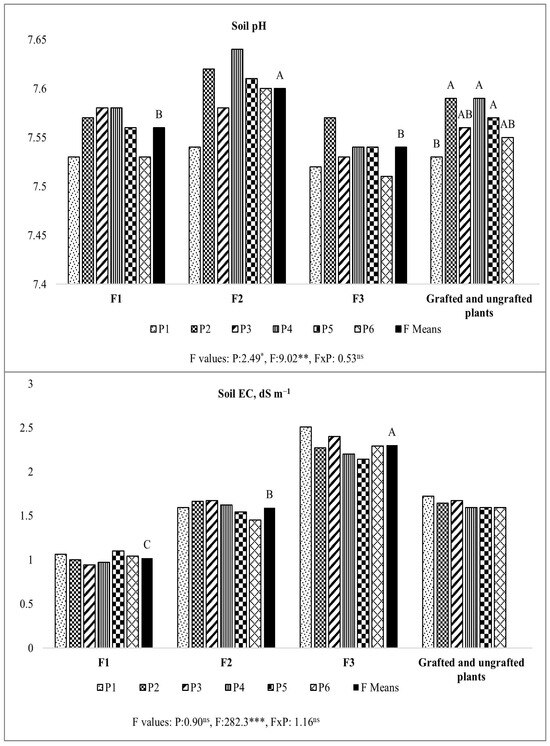
The effects of different fertilizer doses applied to grafted and ungrafted tomato plants on soil pH and EC were presented in Figure 1. Grafted and ungrafted tomato plants affected the soil pH (Table 2). The lowest soil pH was determined in Anıt, and the others had higher soil pH. Soil pH was changed by fertilizer treatments at the end of the growing period, and the highest soil pH was obtained from the recommended NPK treatment (Figure 1). Soil acidification reported in long-term greenhouse cultivation may be explained by the progressive consumption of soil buffering capacity, which lowers soil pH through nitrification and root exudation [2,7]. Soil CaCO3 content (24%) in this study conferred a strong acid-neutralizing capacity, which buffers the protons released by nitrification of applied ammonium and urea-based fertilizers over a 16-week cycle.
Figure 1.
Effects of treatments on soil pH and EC. Uppercase letters indicate a significant difference between the fertilizer doses (F Means) and plants (p Means).
Table 2.
Results of analysis of variance (p values) for soil properties.
Soil EC was statistically changed by different fertilizer doses (p < 0.001) (Table 2). The highest soil EC was observed in the F3 treatment (Figure 1). Previous studies reported that the use of fertilizer in greenhouses caused soil salinization [34]. Greenhouses have a lack of precipitation, high evapotranspiration, inappropriate irrigation practices, poor drainage systems, and excessive fertilizer use, thus collectively exacerbating the risk of secondary salinization [16].
Grafting and ungrafting did not affect the soil EC in this study. However, vigorous rootstocks are generally associated with greater root surface area and higher transpirational water flux, which together increase the mass flow of water and dissolved nutrients toward the root surface. Under frequent, high-frequency drip irrigation regimes typical of commercial greenhouses, the sustained high transpiration demand of vigorously growing grafted plants could accelerate the localized concentration of salts at the root–soil interface, particularly in the absence of substantial leaching. This process, wherein water uptake outpaces the downward movement of salts, may create sharper salinity gradients around the rhizosphere of grafted plants compared to ungrafted plants with lower water demand [35,36]. Our pot-based experimental design, which involved a controlled substrate volume and limited drainage, could not fully replicate the spatial and temporal dynamics of water and salt movement that occur in field or commercial greenhouse soil profiles.
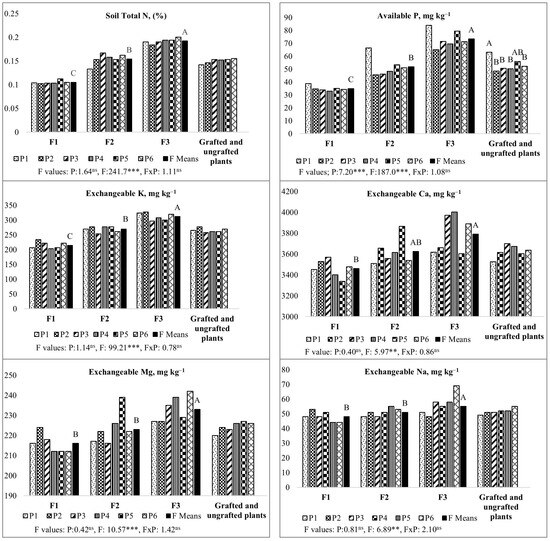
Soil TN concentration was significantly increased by fertilization treatments (p < 0.001) (Table 2). The highest TN concentration was obtained from the F3 treatment, and the lowest value was attained at the F1 treatment (Figure 2). This increase in F3 treatment may have resulted from the lack of leaching losses due to the irrigation and fertilization schedule not synchronizing with crop requirements. Sun et al. [6] reported that the total N concentration in soil increased by 27–42% with increasing N fertilization. Similarly, Patial et al. [7] found that the total N concentration in the soil increased by 24%, 35%, and 37% with increasing NPK treatments (50%, 100% and 150% NPK, respectively).
Figure 2.
Effects of treatments on soil N, P, K, Ca, Mg and Na. Uppercase letters indicate a significant difference between the fertilizer doses (F Means) and plants (P).
The available phosphorus (av-P) concentration in soil was statistically affected by fertilizer doses (p < 0.001) (Table 2). Phosphorus fertilization increased soil av-P concentration and varied from 34.9 mg kg−1 (F1) to 73.4 mg kg−1 (F3) due to fertilization. Phosphate ions added to the soil can be temporarily immobilized by adsorption or precipitation in soil depending on cation exchange reactions, particularly with Fe, Al and Ca compounds. However, as the fertilizer dose increases, some of the adsorption sites approach saturation, resulting in higher levels of available phosphorus measured in the soil [37]. Toprak and Seferoğlu [12] reported that 20 kg ha−1 chemical phosphorus fertilizer and 30 t ha−1 dairy manure led to a 142% increase in soil av-P compared with the unfertilized control. Ortas and Islam [38] stated that soil available P concentration in 100 and 200 kg P2O5 ha−1 treatments increased by two and three times compared with the control. In this study, soil av-P was statistically affected by grafting. Soil av-P changed from 48.4 mg kg−1 (Bestona scion onto Beaufort rootstock) to 63.0 mg kg−1 (Anıt scion) (Figure 2). This increase may have resulted from root density and length. The mechanism of root structure on the availability of soil P was explained by Pantigoso et al. [39]. Researchers reported that plants may modify root structure and promote the formation of cluster roots to secrete phosphorus solubilizers such as citrate and malate and release enzymes such as phosphatases to enhance the availability of soil P.
Soil ex-K concentration varied from 215 mg kg−1 (F1) to 312 mg kg−1 (F3). In intensively farmed soils, potassium added to the soil through base or top dressing directly increases the amount of available K+ in the soil solution and exchange complex [40]. According to Gudadhe et al. [8], NPK fertilizer resulted in a 15.8% increase in soil ex-K concentration. Subhashini [41] reported that soil av-P and ex-K concentrations increased by 41% and 30% with fertilization (115 kg ha−1 N, 60 kg ha−1 P2O5, 120 kg ha−1 K2O) compared to control.
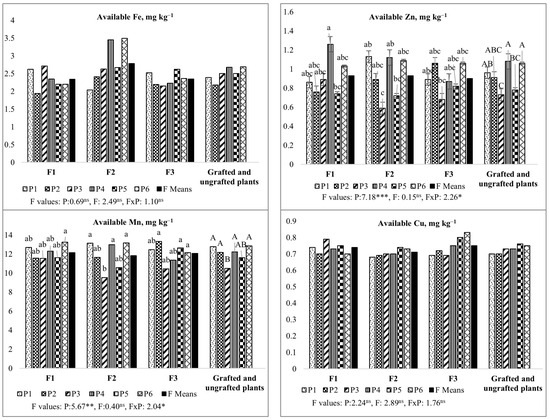
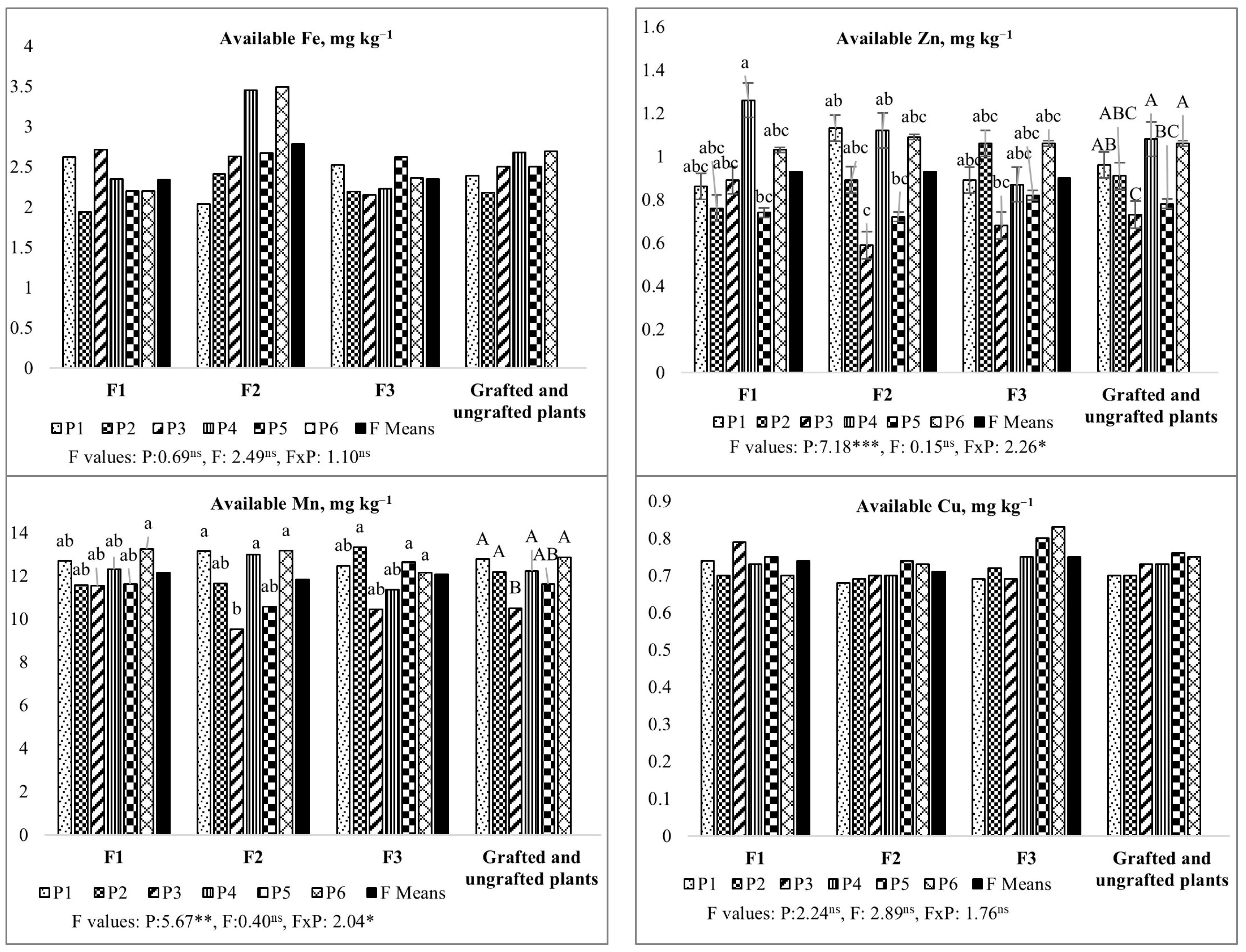
Soil ex-Ca concentration changed from 3460 mg kg−1 (F1) to 3790 mg kg−1 (F3). Increased ex-Ca in the soil may be directly related to the high CaCO3 content. It is likely that in highly calcareous soils, cation exchange capacity is dominated by calcium and high CaCO3 dissolution rates; thus, extractable Ca levels may tend to increase seasonally or temporally with sustained growth [42]. Soil ex-Mg increased with fertilization treatments. The lowest value (216 mg kg−1) was observed in the F1 treatment, and the highest value (233 mg kg−1) was determined from the F3 treatment. The highest soil exchangeable sodium (ex-Na) concentration was obtained from the F3 treatment. Increases in the concentrations of ex-Mg and ex-Na in the soil resulted from the addition of NPK fertilizers, and the bulk effect caused by cations such as NH4 and K binding to the colloid surfaces, occupying the negative charges on the colloids. Sodium, which is weakly bound to the colloid surface, and Mg2+, which is moderately bound, are displaced and pass into the soil solution (water phase), and their proportional amounts can increase [43]. Treatments did not affect soil av-Fe and av-Cu concentrations (Table 2, Figure 3). The interaction effects of fertilizer dose and scion/rootstock combination had a significant effect on soil available Mn concentration. The lowest Mn concentration (9.53 mg kg−1) was obtained from the P3 (Anıt grafted Vividfort), whereas the highest Mn concentration (13.3 mg kg−1) was recorded with the Bestona under F3 treatment (F3P2), which was not statistically different from F2P1, F1P6, and F2P6. Patial et al. [7] reported that application of 50%, 100%, and 150% NPK alone increased the soil av-Mn content by 27%, 34%, and 50%, respectively, compared to the control. The highest available Zn concentration was recorded in Anıt grafted to Beaufort under F1 treatment (F1P4: 1.26 mg kg−1), whereas the lowest av-Zn concentration (0.59 mg kg−1) was obtained from the Anıt grafted to Vividfort under F2 treatment. Xia et al. [44] reported that the recommended N dose (200 kg N ha−1) significantly increased Zn bioavailability in soil compared with a low N dose (75 kg N ha−1). Balliu et al. [45] reported that rootstocks differ in the quantity and composition of the organic compounds—organic acids (citrate, malate), enzymes (phosphatases), and other low-molecular-weight compounds—that they release into the rhizosphere, thereby acidifying the local rhizosphere or chelating metal cations, effectively increasing nutrient availability at the root surface independently of the bulk soil fertility level [45].
Figure 3.
Effects of treatments on soil available Fe, Zn, Mn, and Cu. Lowercase letters indicate a significant difference in the interaction between fertilizer doses and varieties. Uppercase letters indicate a significant difference between the fertilizer doses (F Means) and plants (p Means).
3.2. The Effects of Different Fertilizer Doses Applied to Grafted and Ungrafted Tomato on Yield, Macro and Micro-Nutrient Concentrations
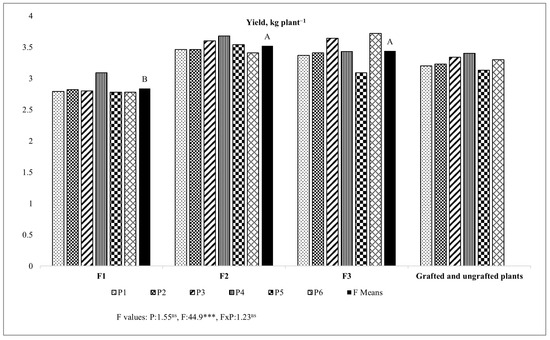
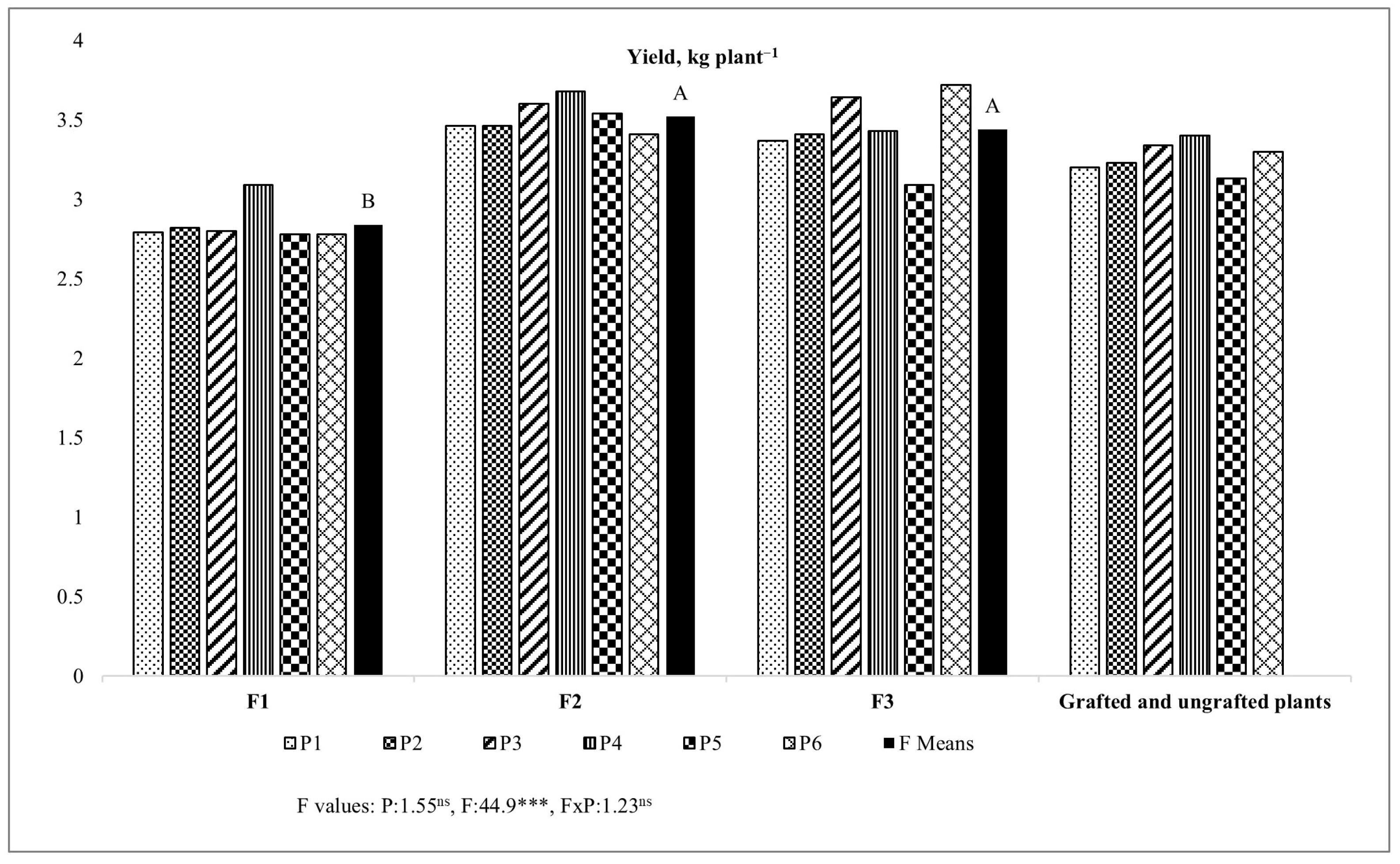
The effects of treatments on tomato yield were presented in Figure 4. The yield was statistically affected by NPK doses (p < 0.001). The lowest yield was obtained from the F1 treatment, while the F2 and F3 treatments were in the same statistical group and gave the highest yield values. Herath et al. [9] reported that the recommended NPK dose (220:160:250 kg ha−1) gave higher tomato yield than lower nutrient rates. Similarly, Kavvadias et al. [10] reported that the recommended fertilization dose gave the highest tomato yield.
Figure 4.
Effects of treatments on tomato yield. Uppercase letters indicate a significant difference between the fertilizer doses (F Means).
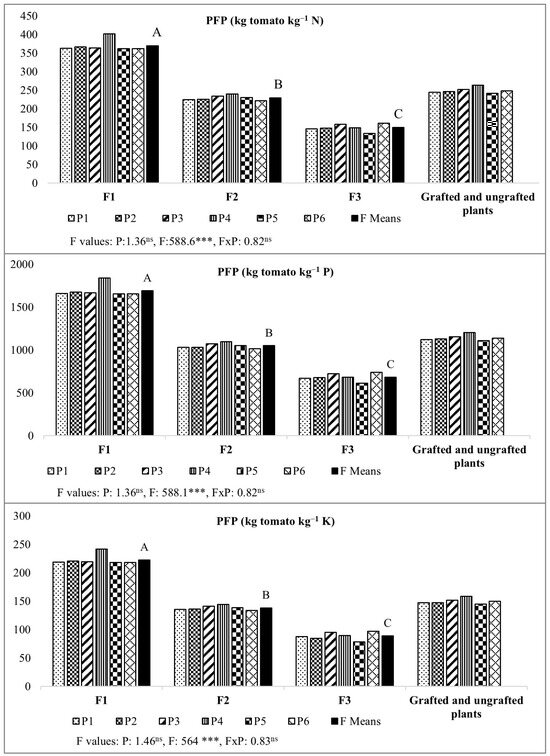
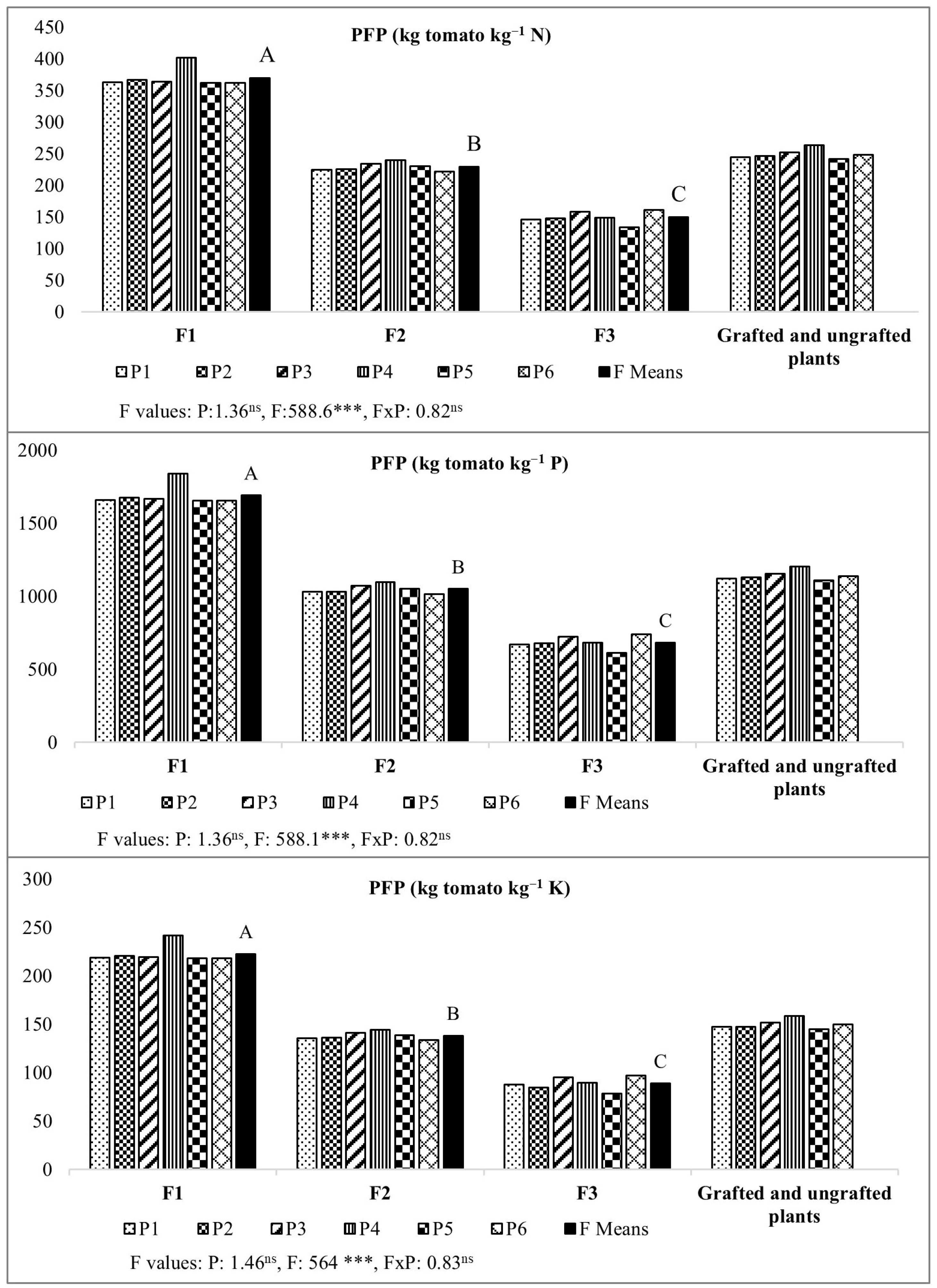
PFP was statistically influenced by fertilizer doses (p < 0.001). The lowest PFP was obtained from the F3 treatment for N (149 kg fruit kg−1 of applied N), P (683 kg fruit kg−1 of applied P), and K (88.8 kg fruit kg−1 of applied K) (Figure 5). The highest PFP was attained at the F1 treatment for N (370 kg fruit kg−1 of applied N), P (1692 kg fruit kg−1 of applied P), and K (223 kg fruit kg−1 of applied K). Our study found that PFP declined with increasing fertilizer rates. It should be noted that PFP reflects yield produced per unit of nutrient applied rather than the plant’s actual nutrient uptake or recovery efficiency, and it did not account for nutrients already present in the soil. Accordingly, the increase in PFP observed at lower doses indicates greater yield per unit of applied nutrient, not necessarily greater nutrient absorption efficiency [31,32]. This decline in PFP with increasing fertilizer dose may be partly explained by the limited root volume available under pot conditions, which can constrain nutrient uptake as soil nutrient availability increases [35]. However, root length, root area, and root biomass were not measured in the present study, so this remains a plausible explanation rather than a directly tested mechanism. Li et al. [31] reported that reducing nitrogen rate from 450 kg ha−1 to 300 kg ha−1 significantly improved tomato nitrogen use efficiency. Imran and Amanullah [32] found that increasing P rates decreased PFP in maize and soybean, and the highest PFP was obtained from the lowest P rate (50 kg ha−1).
Figure 5.
Partial factor productivity (PFP) in tomato influenced by treatments. Uppercase letters indicate a significant difference between the fertilizer doses (F Means).
First, PFP for N, P, and K declined sharply with increasing fertilizer dose, falling from 370, 1692 and 223 kg fruit kg−1 of applied N, P and K, respectively, at F1 to only 149, 683 and 88.8 kg fruit kg−1 at F3 (Figure 5). The yield difference between F2 (3.52 kg plant−1) and F3 (3.44 kg plant−1) was not statistically significant, indicating that the additional fertilizer applied under F3 did not produce a proportional yield gain during the 16-week pot experiment. Second, soil EC, together with total N, available P, and exchangeable K, Ca and Mg concentrations, was highest at F3 (Figure 2), reflecting nutrient accumulation in the root zone. This pattern was consistent with previous reports showing that nutrient use efficiency declines progressively once application rates exceed crop requirements [31,32], and that continued over-fertilization promotes salt and nutrient accumulation in greenhouse soils without a corresponding yield benefit [2]. Beyond these agronomic and environmental considerations, higher input rates such as F3 would also be expected to entail greater fertilizer input and labor costs. Although a formal economic analysis was not performed in this study, the markedly lower PFP observed at F3 suggests that this treatment would likely be less cost-efficient than F2. This is in line with earlier studies reporting that the recommended fertilization rate provided optimal tomato yield without requiring further dose increases [9,10].
The effects of treatments on macronutrient concentrations of tomato plants (in dry weight) were given in Table 3. The lowest N concentration (2.88%) was obtained in the Bestona scion with F1 treatment (F1P2), while the highest N (3.75%) was determined with Bestona scion grafted onto Vividfort rootstock with F3 treatment (F3P5). The leaf N concentration varied from 2.97% to 3.53% (increased by 10.4–18.8%) with fertilization doses. Grafted plants had higher leaf N concentration (3.27–3.41%) than ungrafted plants (3.11%) (Table 3). Balliu et al. [45] reported that root length and specific root length vary depending on the rootstock under root-restricted pot conditions. Liang et al. [14] stated that rootstock-grafted cucumber seedlings had the largest different root systems for N absorption, and the amount of N treatment could be reduced through grafting.
Table 3.
Effects of treatments on macronutrient concentrations of plants.
The lowest leaf P concentration (0.29%) was obtained from Anıt scion grafted to Vividfort rootstock, and the highest value (0.34%) was determined with grafting Bestona scion to Beaufort rootstock. According to Nawaz et al. [16], nutrient uptake and transport processes in grafted plants are modulated by complex interactions between rootstock and scion, encompassing long-distance signaling pathways and rootstock-specific ion regulation mechanisms. Similarly, Leisso et al. [46] explained that the organic compounds secreted by the rootstock plant’s roots into the rhizosphere (the layer of soil surrounding the roots) play a critical role in making insoluble nutrients available for plants in the soil. Rohwer [20] stated that grafted tomatoes removed more soil phosphorus and contained more P in plant organs than ungrafted tomatoes. In this study, leaf phosphorus (P) concentration increased with higher amounts of P fertilizer. Leaf P concentration increased by 33% and 58% in F2 and F3 treatments, respectively, compared to the F1 treatment. Similarly, Ortas and Islam [38] reported that the P concentration in both leaves and grains of Zea mays L. increased with higher rates of P fertilization.
As shown in Table 3, the lowest K concentration (2.04%) was recorded with F1 treatment, and the highest concentration (2.59%) was observed with F3 treatment. The K requirements of tomatoes rose substantially during the early reproductive period when the fruit load rapidly increased; therefore, K was transported into fruits [47]. Plant leaf K concentration varied from 2.17% to 2.38%, and grafting did not affect the plant’s K concentration. Unlike our results, previous studies reported that grafting significantly increased plant K concentration and alleviated K stress [18].
Treatments did not affect the Ca concentration of tomato plants. Öktüren Asri and Sonmez [47] stated that increasing K fertilizer doses in the fertilization solution increased K concentration of tomato leaf and stem, but Ca concentration was not changed by treatments. The interaction effects of treatments significantly affected Mg concentrations of the tomato plants (p < 0.05). The lowest Mg concentration (0.43%) was obtained from Anıt Scion in the F2 treatment, and the highest value (1.04%) was recorded with Bestona scion grafted to Vividfort rootstock with F2 treatment. The lowest value (0.57%) was obtained from Anıt scion, and others were in the same statistical group (Table 3). Nawaz et al. [16] explained that vigorous rootstocks have high levels of sugars, amino acids, and enzymes and secrete organic acids in the soil, which play an important role in nutrient mobilization and affect nutrient availability and uptake. Vigorous rootstocks typically develop a denser, more branched root system with greater root hydraulic conductivity, thereby increasing the mass flow of water and the nutrients dissolved in it from the soil to the root surface and ultimately to the shoot via the transpiration stream [48]. N and Mg transport to the root is largely by mass flow [36]; a rootstock with higher hydraulic conductivity would be expected to sustain higher nutrient delivery; thus, grafted combinations reached significantly higher leaf N and Mg concentrations than ungrafted.
Plant Na concentration was affected by fertilizer doses. The highest leaf Na concentration (147.9 mg kg−1) was determined with the F2 treatment, while the lowest value (117.4 mg kg−1) was determined with the F1 treatment. Leaf K concentration increased while leaf Na concentration decreased with F3 treatment. Marschner [49] explained that K in the cell membrane transport system competed with sodium, thereby restricting Na accumulation in plant tissues. Therefore, it was thought that high K application might stimulate selective ion uptake and contribute to a decrease in plant Na concentration. Leaf sodium concentration was statistically influenced by tomato grafting. The lowest leaf Na concentration was observed in the Anıt scion. The highest Na concentration was found in the Bestona scion grafted onto the Vividfort rootstock. Leonardi and Giuffrida [18] reported that graft combinations were significantly more efficient in absorbing and transporting nutrients to the shoot compared to ungrafted plants.
The interactive effect of treatments had a significant effect on Fe concentrations in the dry weight of tomato plants (Table 4). Fe concentrations ranged between 21.48 (F2P6) and 40.74 mg kg−1 (F2P5) across treatments. It has been commonly reported that the high calcareous content of soil restricted Fe uptake by plants [47,50]. The leaf Fe concentrations were statistically affected by tomato grafting. The highest leaf Fe concentration was obtained from Anıt scion grafted onto Vividfort rootstock (P3) and Bestona scion grafted onto Vividfort rootstock (P5) (Table 4). Ceylan et al. [18] reported that the differences between rootstocks in the uptake of Fe and Cu may stem from phytosiderophores and the acidifying compounds affecting the availability of these elements in the rhizosphere.
Table 4.
The effects of treatments on micronutrient concentrations of plants.
Leaf Zn concentration was not affected by grafting, but it increased with increasing NPK doses. Taşpınar et al. [13] found that available Zn was negatively correlated with pH and calcareous owing to the formation of hydroxides and carbonates of high valence. Plant Mn concentrations were affected by treatments. Leaf Mn concentration increased from 25.67 mg kg−1 to 36.98 mg kg−1 with NPK doses. Leaf Mn concentrations varied from 25.15 mg kg−1 to 40.15 mg kg−1 between rootstocks. The highest value was obtained from Bestona scion grafted onto Vividfort rootstock.
Leaf Cu concentrations were affected by treatments. Leaf Cu concentrations increased from 3.93 mg kg−1 (F1) to 5.47 mg kg−1 (F3) by increasing NPK dose. Leaf Cu concentrations varied from 3.88 mg kg−1 to 5.84 mg kg−1 between plants. The highest value was obtained from Bestona scion grafted onto Vividfort rootstock. Grafted plants do not simply take up more water and nutrients in bulk; the rootstock root system exercises selective control over which ions enter the xylem stream, a process governed by transporter activity in root epidermal and endodermal cells [16]. This selective uptake and loading are the mechanistic basis for the divergent leaf-ion profiles. In this study, the consistently higher leaf N, Mg, Fe, Mn, and Cu were observed in the Bestona/Vividfort combination, and the elevated Na in combination relative to the ungrafted Anıt scion. The four mechanisms, rhizophere modifications via exudates, ion selectivity, hydraulic conductivity, and hormonal coordination of the two systems, were considered together a coherent explanation for why grafting altered leaf mineral concentrations without altering yield in this study.
4. Conclusions
This study demonstrated that increasing fertilizer doses led to an increase soil EC, total N, available P, and exchangeable K, Ca, Mg and Na, whereas available Fe and Cu were not affected; available Zn and Mn changed only in response to the rootstock/scion combination and its interaction with fertilizer dose. Grafting increased tomato leaf N concentration relative to ungrafted plants; increases in leaf P, Mg, Fe, Mn and Cu were largely restricted to specific rootstock/scion combinations, particularly Bestona/Vividfort, rather than reflecting a general grafting effect. Regardless of the combination, this nutritional advantage did not translate into a significant yield benefit. When comparing fertilizer rates based on research results, the F3 treatment provided no yield advantage over the F2 treatment while it increased soil EC, reduced partial factor productivity, and would also be expected to increase fertilizer input and labor costs. Therefore, the recommended NPK dose (F2) is suggested in calcareous soil conditions for tomato production for both grafted and ungrafted plants, sustainable soil fertility and to maintain plant nutritional status. The fertilization program did not need to be modified when grafted plants were grown. Further studies, particularly longer-term trials under greenhouse conditions are needed to determine whether specific rootstock/scion combinations can support reduced fertilizer input over extended growing periods.
Author Contributions
Conceptualization, S.S.; Methodology, S.S.; Software, F.Ö.A. and İ.S.; Validation, S.S. and İ.S.; Formal analysis, S.S., F.Ö.A. and İ.S.; Investigation, S.S. and İ.S.; Resources, F.Ö.A. and İ.S.; Data Curation, S.S. and İ.S.; Writing—Original Draft Preparation, F.Ö.A. and S.S.; Writing—Review and Editing, S.S., F.Ö.A. and İ.S.; Visualization, F.Ö.A.; Supervision, S.S.; Project Administration, S.S.; Funding Acquisition, S.S. All authors have read and agreed to the published version of the manuscript.
Funding
This work was supported by the Scientific Studies Management Unit of Akdeniz University (Grant no. 2012.03.0121.006).
Data Availability Statement
The data used to support the findings of this study are available from the corresponding author upon reasonable request.
Acknowledgments
The authors would like to thank the Scientific Research Projects Coordination Unit of Akdeniz University for financial support.
Conflicts of Interest
The authors declare no conflicts of interest.
References
- Öktüren Asri, F.; Arı, N.; Demirtaş, E.I.; Özkan, C.F.; Güven, D. Determination of fertility properties of tomato grown greenhouse soils and plant nutrition status in the Gazipaşa and Alanya districts. COMU J. Agric. Fac. 2019, 7, 29–38. [Google Scholar] [CrossRef] [Scilit]
- Wang, X.; Wang, X.; Sheng, H.; Wang, X.; Zhao, H.; Feng, K. Excessive nitrogen fertilizer application causes rapid degradation of greenhouse soil in China. Pol. J. Environ. Stud. 2022, 31, 1527–1534. [Google Scholar] [CrossRef] [Scilit]
- Ju, X.T.; Kou, C.L.; Christie, P.; Dou, Z.X.; Zhang, F.S. Changes in the soil environment from excessive application of fertilizers and manures to two contrasting intensive cropping systems on the North China Plain. Environ. Pollut. 2007, 145, 497–506. [Google Scholar] [CrossRef] [Scilit]
- da Costa, M.F.; Silva, G.d.S.; de Albuquerque Junior, E.C.; Araújo, C.A.d.S.; Oliveira, F.F.D.; Tavares Filho, G.S. Process of soil salinization as a function of watermelon mineral fertilization. Comun. Sci. 2023, 14, e3991. [Google Scholar] [CrossRef] [Scilit]
- Kaplan, M.; Sönmez, S.; Tokmak, S. The nitrate content of well waters in the Kumluca region Antalya. Turk. J. Agric. For. 1999, 23, 309–313. [Google Scholar]
- Sun, J.; Li, W.; Li, C.; Chang, W.; Zhang, S.; Zeng, Y.; Zeng, C.; Peng, M. Effect of different rates of nitrogen fertilization on crop yield, soil properties and leaf physiological attributes in banana under subtropical regions of China. Front. Plant Sci. 2020, 11, 613760. [Google Scholar] [CrossRef] [Scilit]
- Patial, D.; Sankhyan, N.K.; Sharma, R.P.; Dev, P.A. Assessing soil physical and chemical properties under long term fertilization after forty-eight years in North-Western Himalayas. Commun. Soil Sci. Plant Anal. 2022, 53, 2257–2270. [Google Scholar] [CrossRef] [Scilit]
- Gudadhe, N.N.; Das, A.; Thanki, J.D.; Patel, M.C. Twenty-eight years long chemical fertilization effects on soil potassium status under rice-wheat-green gram cropping sequence. Arch. Agron. Soil Sci. 2023, 69, 2121–2137. [Google Scholar] [CrossRef] [Scilit]
- Herath, H.M.S.K.; Kumaragamage, D.; Indraratne, S.P. Performance of an optimized nutrient management approach for tomato in Central Sri Lanka. Commun. Soil Sci. Plant Anal. 2013, 44, 3049–3060. [Google Scholar] [CrossRef] [Scilit]
- Kavvadias, V.; Daggas, T.; Paschalidis, C.; Vavoulidou, E. Seasonal Variation in Yield Fruit Quality and Nutritional Status of Greenhouse Tomato under Different Fertilization Management Plans. Commun. Soil Sci. Plant Anal. 2012, 43, 197–208. [Google Scholar] [CrossRef] [Scilit]
- Öktüren Asri, F.; Özkan, C.F.; Demirtaş, E.I.; Arı, N. Effects of organic and chemical fertilizer on soil properties and nutrient uptake of cucumber. Soil-Water J. 2013, 2, 337–342. [Google Scholar]
- Toprak, S.; Seferoğlu, S. The comparative effects of phosphorus-enriched organomineral fertilization on some chemical properties of calcareous soils. Commun. Soil Sci. Plant Anal. 2024, 55, 3385–3399. [Google Scholar] [CrossRef] [Scilit]
- Taşpınar, K.; Aytop, H.; Ateş, Ö.; Varol, M.; Yalçın, G.; Kızılaslan, F.; Çakıllı, H.; Toprak, S. Zinc bioavailability in semiarid agricultural regions: A soil property-based assessment. Environ. Geochem. Health 2025, 47, 238. [Google Scholar] [CrossRef] [Scilit]
- Liang, J.; Chen, X.; Guo, P.; Ren, H.; Xie, Z.; Zhang, Z.; Zhen, A. Grafting improves nitrogen-use efficiency by regulating the nitrogen uptake and metabolism under low-nitrate conditions in cucumber. Sci. Hortic. 2021, 289, 110454. [Google Scholar] [CrossRef] [Scilit]
- Yuan, H.; Liqiang, Z.; Qiusheng, K.; Fei, C.; Mengliang, N.; Junjun, X.; Nawaz, M.A.; Zhilong, B. Comprehensive mineral nutrition analysis of watermelon grafted onto two different rootstocks. Hortic. Plant J. 2016, 2, 105–113. [Google Scholar] [CrossRef] [Scilit]
- Nawaz, M.A.; Imtiaz, M.; Kong, Q.; Cheng, F.; Ahmed, W.; Huang, Y.; Bie, Z. Grafting: A technique to modify ion accumulation in horticultural crops. Front. Plant Sci. 2016, 7, 1457. [Google Scholar] [CrossRef] [Scilit]
- Leonardi, C.; Giuffrida, F. Variation of plant growth and macronutrient uptake in grafted tomatoes and eggplants on three different rootstocks. Eur. J. Hortic. Sci. 2006, 71, 97–101. [Google Scholar] [CrossRef] [Scilit]
- Ceylan, Ş.; Alan, Ö.; Elmacı, Ö.L. Effects of grafting on nutrient element content and yield in watermelon. Ege Univ. J. Agric. Fac. 2018, 55, 67–74. [Google Scholar] [CrossRef] [Scilit]
- Ghanem, W.; Kaplan, I. Integrating grafting and companion planting to improve crop performance in intensive high-tunnel tomato production. J. Sustain. Agric. Environ. 2023, 2, 388–396. [Google Scholar] [CrossRef] [Scilit]
- Rohwer, C.L. Grafted tomatoes removed more soil phosphorus than nongrafted tomatoes under high-phosphorus conditions. HortScience 2024, 59, 471–477. [Google Scholar] [CrossRef] [Scilit]
- Cherney, J.H.; Ketterings, Q.M.; Orloski, J.L. Plant and soil elemental status as influenced by multi-year nitrogen and potassium fertilization. J. Plant Nutr. 2004, 27, 991–1014. [Google Scholar] [CrossRef] [Scilit]
- Bhattacharyya, R.; Prakash, V.; Kundu, S.; Srivastva, A.K.; Gupta, H. Soil properties and their relationships with crop productivity after 30 years of different fertilization in the Indian Himalayas. Arch. Agron. Soil Sci. 2009, 55, 641–661. [Google Scholar] [CrossRef] [Scilit]
- IFA. World Fertilizer Use Manual; International Fertilizer Industry: Paris, France, 1992. [Google Scholar]
- Geraldson, C.M.; Tyler, K.B. Plant analysis as an aid in fertilizing vegetable crops. In Soil Testing and Plant Analysis; Westerman, R.L., Ed.; Soil Science Society of America: Madison, WI, USA, 1990; pp. 181–227. [Google Scholar]
- Kacar, B. Physical and Chemical Soil Analysis; Nobel Publications and Distribution: Ankara, Türkiye, 2016. (In Turkish) [Google Scholar]
- Bouyoucos, G.J. A Recalibration of the hydrometer method for making mechanical analysis of the soils. Agron. J. 1955, 4, 434. [Google Scholar]
- Black, C.A. Methods of Soil Analysis Part 2; American Society of Agronomy Inc.: Madison, WI, USA, 1965; pp. 1372–1376. [Google Scholar]
- Olsen, S.R.; Sommers, E.L. Phosphorus Availability Indices. Phosphorus Soluble in Sodium Bicarbonate. In Methods of Soils Analysis. Part 2. Chemical and Microbiological Properties; Page, A.L., Miller, R.H., Keeney, D.R., Eds.; American Society of Agronomy: Madison, WI, USA, 1982; pp. 404–430. [Google Scholar]
- Lindsay, W.L.; Norwell, W.A. Development of a DTPA soil test for zinc, iron, manganese and copper. Soil Sci. Soc. Am. J. 1978, 42, 421–428. [Google Scholar] [CrossRef] [Scilit]
- Kacar, B.; Inal, A. Plant Analysis; Nobel Publications and Distribution: Ankara, Türkiye, 2010. (In Turkish) [Google Scholar]
- Li, H.; Gong, X.; Han, Q.; Zhong, Y.; Cui, H.; Qiang, X.; Zhang, X.; Liu, H. Optimal irrigation and nitrogen rate enhancing yield, quality, water productivity, and nitrogen use efficiency by promoting physiological growth in greenhouse tomato. J. Plant Nutr. 2026, 49, 599–621. [Google Scholar] [CrossRef] [Scilit]
- Imran, A. Integration of peach (Prunus persica L) remnants in combination with beneficial microbes and phosphorus differ phosphorus use efficiency, agronomic efficiency and partial factor productivity in soybean Vs maize crops. J. Plant Nutr. 2023, 46, 1745–1756. [Google Scholar] [CrossRef] [Scilit]
- Yurtsever, N. Experimental Statistics Methods; Technical Publication No: 56, General Publication No: 1212; TOKB: Ankara, Türkiye, 1984. [Google Scholar]
- Ramazanoglu, R.; Almarie, V.; Suzer, M.H.; Shan, J.; Wei, Z.; Cullu, M.A.; Bol, R.; Senbayram, M. Interactive effects of soil salinity and nitrogen fertilizer types on nitrous oxide and ammonia fluxes. Geoderma Reg. 2024, 38, e00831. [Google Scholar] [CrossRef] [Scilit]
- Passioura, J.B. Viewpoint: The perils of pot experiments. Funct. Plant Biol. 2006, 33, 1075–1079. [Google Scholar] [CrossRef] [Scilit]
- Munns, R.; Tester, M. Mechanisms of salinity tolerance. Annu Rev. Plant Biol. 2008, 59, 651–681. [Google Scholar] [CrossRef] [Scilit]
- El Attar, I.; Hnini, M.; Taha, K.; Aurag, J. Phosphorus Availability and its Sustainable Use. J. Soil Sci. Plant Nutr. 2022, 22, 5036–5048. [Google Scholar] [CrossRef] [Scilit]
- Ortas, I.; Islam, K.R. Phosphorus fertilization impacts on corn yield and soil fertility. Commun. Soil Sci. Plant Anal. 2018, 49, 1684–1694. [Google Scholar] [CrossRef] [Scilit]
- Pantigoso, H.A.; Yuan, J.; He, Y.; Guo, Q.; Vollmer, C.; Vivanco, J.M. Role of root exudates on assimilation of phosphorus in young and old Arabidopsis thaliana plants. PLoS ONE 2020, 15, e0234216. [Google Scholar] [CrossRef] [Scilit]
- Zhu, D.; Lu, J.; Cong, R.; Ren, T.; Zhang, W.; Li, X. Potassium management effects on quantity/intensity relationship of soil potassium under rice-oilseed rape rotation system. Arch. Agron. Soil Sci. 2020, 66, 1274–1287. [Google Scholar] [CrossRef] [Scilit]
- Subhashini, D.V. Effect of NPK fertilizers and co-inoculation with phosphate-solubilizing arbuscular mycorrhizal fungus and potassium mobilizing bacteria on growth, yield, nutrient acquisition, and quality of tobacco (Nicotiana tabacum L.). Commun. Soil Sci. Plant Anal. 2016, 47, 328–337. [Google Scholar] [CrossRef] [Scilit]
- Bohn, H.L.; McNeal, B.L.; O’Connor, G.A. Soil Chemistry, 3rd ed.; John Wiley & Sons, Inc.: New York, NY, USA, 2001; p. 307. [Google Scholar]
- Jalali, M. Effect of sodium and magnesium on kinetics of potassium release in some calcareous soils of western Iran. Geoderma 2008, 145, 207–215. [Google Scholar] [CrossRef] [Scilit]
- Xia, H.; Xue, Y.; Liu, D.; Kong, W.; Xue, Y.; Tang, Y.; Li, J.; Li, D.; Mei, P. Rational application of fertilizer nitrogen to soil in combination with foliar Zn spraying improved Zn nutritional quality of wheat grains. Front. Plant Sci. 2018, 9, 677. [Google Scholar] [CrossRef] [Scilit]
- Balliu, A.; Babaj, I.; Sallaku, G. Root morphology parameters and nutrient acquisition capabilities of grafted tomato plants in root-restricted conditions are subject to salinity and rootstock characteristics. Int. J. Veg. Sci. 2024, 30, 503–526. [Google Scholar] [CrossRef] [Scilit]
- Leisso, R.; Rudell, D.; Mazzola, M. Targeted Metabolic Profiling Indicates Apple Rootstock Genotype-Specific Differences in Primary and Secondary Metabolite Production and Validate Quantitative Contribution From Vegetative Growth. Front. Plant Sci. 2018, 9, 1336. [Google Scholar] [CrossRef] [Scilit]
- Öktüren Asri, F.; Sonmez, S. Effects of potassium and iron applications on nutrient concentrations of tomato plants grown in soilless culture. Acta Hortic. 2016, 1142, 329–334. [Google Scholar] [CrossRef] [Scilit]
- Xu, H.; Ediger, D. Rootstocks with Different Vigor Influenced Scion-Water Relations and Stress Responses in AmbrosiaTM Apple Trees (Malus Domestica var. Ambrosia). Plants 2021, 10, 614. [Google Scholar] [CrossRef] [Scilit]
- Marschner, H. Mineral Nutrition of Higher Plants; Academic Press: Cambridge, MA, USA, 2012. [Google Scholar]
- Sönmez, S.; Kaplan, M. Comparison of various analysis methods for determination of iron chlorosis in apple trees. J. Plant Nutr. 2005, 27, 2007–2018. [Google Scholar] [CrossRef]

Disclaimer/Publisher’s Note: The statements, opinions and data contained in all publications are solely those of the individual author(s) and contributor(s) and not of MDPI and/or the editor(s). MDPI and/or the editor(s) disclaim responsibility for any injury to people or property resulting from any ideas, methods, instructions or products referred to in the content. |
© 2026 by the authors. Licensee MDPI, Basel, Switzerland. This article is an open access article distributed under the terms and conditions of the Creative Commons Attribution (CC BY) license.