


Abstract
The objective of this study was to evaluate the effect of foliar and soil application of molybdenum (Mo) fertilizer on the biological efficiency, competitive ability, and nutrient uptake of the sorghum–cowpea intercropping system. The experimental design was a randomized complete block design with four replications and nine cropping systems: sorghum–cowpea intercropping with foliar Mo application; sorghum–cowpea intercropping with soil Mo application; sorghum–cowpea intercropping without Mo application; sole sorghum with foliar Mo application; sole sorghum with soil Mo application; sole sorghum without Mo application; sole cowpea with foliar Mo application; sole cowpea with soil Mo application; and sole cowpea without Mo application. Overall, molybdenum (Mo) application did not affect most indices of biological efficiency and competitive ability of the intercropping system, with effects observed only on the current loss or gain in sorghum yield, the partial land equivalent ratio of sorghum, and the area-time equivalent ratio. Regarding Na+ and K+ concentrations, the treatments affected these nutrients only during the second cropping cycle. On the other hand, no effect of the treatments was observed on Cl− concentration in the sorghum shoot. Therefore, molybdenum fertilization did not alter the overall biological efficiency or competitive ability of the intercropping system. The changes in Na+ and K+ concentrations were localized and dependent on the cropping cycle, without causing changes in Cl− accumulation in the sorghum shoot.
1. Introduction
In semiarid regions, agricultural production is limited by the irregular distribution of rainfall, which poses challenges to the development of agricultural activities [1]. Therefore, the adoption of crops that are more tolerant to water stress conditions, combined with the use of appropriate irrigation systems, becomes essential for sustaining production in these regions, especially considering that a large proportion of producers rely on family farming as their main source of income [2,3]. Furthermore, the region presents significant limitations to the development of irrigated agriculture, as a large proportion of the areas designated for irrigation are supplied with water from tubular wells, which, in many cases, exhibits high levels of salinity [4].
In this context, the implementation of crops adapted to the climatic conditions prevailing in these regions represents an excellent alternative for local producers. Among these species, sorghum (Sorghum bicolor L.), belonging to the Poaceae family, has high production potential, a C4 photosynthetic metabolism, and a well-developed root system, which enable better adaptation to semiarid climates [5]. In addition, sorghum exhibits high biomass production and satisfactory nutritional quality for hay production.
On the other hand, cowpea (Vigna unguiculata (L.) Walp.) is a legume of great agronomic importance, widely used in intercropping systems with grasses, and has adaptability to hot and dry climates. In addition, cowpea has a high protein content and the ability to fix nitrogen through symbiosis with nitrogen-fixing bacteria [6].
Furthermore, nitrate uptake is directly influenced by salinity, as the presence of salts can significantly limit nitrate ion (NO3−) uptake, due, among other factors, to competition between NO3− and chloride (Cl−) for uptake sites in the roots [7,8]. In this context, molybdenum application may promote nitrate uptake and utilization, as nitrate is one of the main forms of nitrogen absorbed by plants, thereby contributing to mitigating the negative effects of salinity [9]. Thus, its application may contribute to increasing nitrogen use efficiency and potentially reducing chloride uptake or the toxic effects associated with excess chloride under saline conditions.
For the nitrogen fixation process in cowpea, the participation of micronutrients is essential, particularly molybdenum, as it is a component of the enzymes nitrate reductase and nitrogenase. Nitrate reductase is involved in the reduction of nitrogen in the nitrate form, while nitrogenase catalyzes the reactions responsible for atmospheric nitrogen fixation [10]. Thus, because molybdenum is part of these two enzymes involved in the nitrogen fixation process, its supply becomes essential for cowpea production [11].
Given this situation, considering the importance of these crops, the use of intercropping systems may be an alternative for improving land-use efficiency, thereby increasing the forage yield of both crops and providing benefits to the plants and the soil [12]. The intercropping of grasses and legumes can increase dry matter production, improve water and soil nutrient use efficiency, and stimulate biological nitrogen fixation [13].
In order to assess the performance and outcomes associated with the adoption of intercropping systems, the application of competition indices is essential to determine whether advantages are obtained from their use. These indices include land equivalent ratio (LER), system productivity index (SPI), relative crowding coefficient (RCC), aggressivity (A), actual yield loss or gain (AYLG), and competitive ratio (CR) [14,15,16].
Therefore, the objective of this study was to evaluate the effect of molybdenum fertilization applied via foliar and soil methods on the biological efficiency, competitive ability, and nutrient uptake of the sorghum–cowpea intercropping system.
2. Materials and Methods
2.1. Experiment Location and Characterization
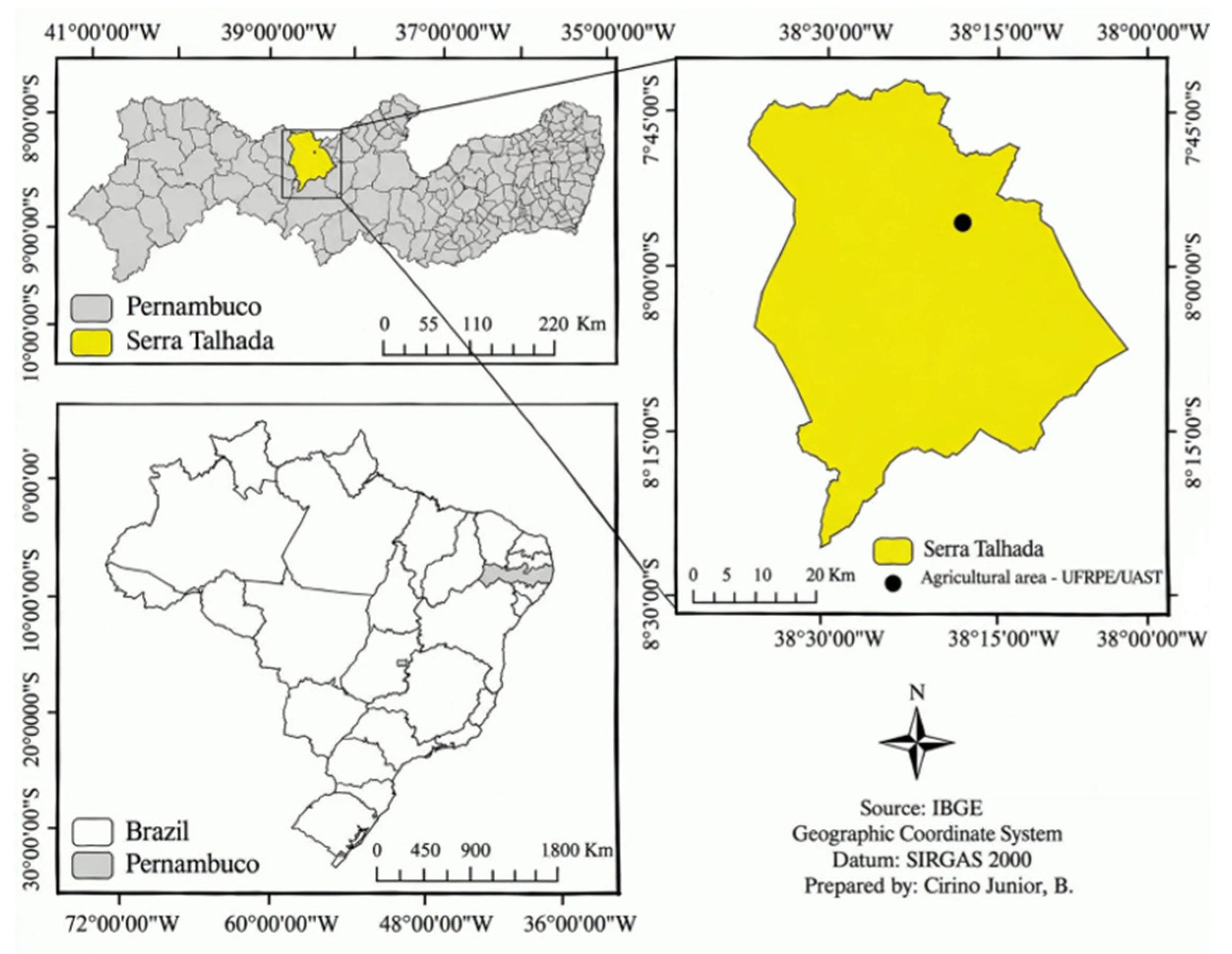
The experiment was conducted in the experimental area of the Federal Rural University of Pernambuco, Serra Talhada Academic Unit, in the city of Serra Talhada, Pernambuco, Brazil (latitude 7°59′7″ South, longitude 38°17′34″ West, and 443 m above sea level) (Figure 1) [17].
Figure 1.
Location of the experimental farm at the Federal Rural University of Pernambuco, Serra Talhada Academic Unit, Pernambuco, Brazil.
According to the Köppen climate classification, the region is classified as a hot and dry semiarid tropical climate (BSh) [18]. It presents minimum and maximum air temperatures of 20.1 and 32.9 °C, respectively, an average rainfall of 642 mm, and relative humidity of the region presents relative air humidity of approximately 63% and atmospheric demand above 1800 mm year−1 [19,20].
2.2. Soil Characterization and Fertilizer Management
The soil in the experimental area was classified as a Haplic Cambisol Ta Eutrophic [21]. The physical and chemical characteristics of the soil were determined according to [22].
The results of the soil chemical and physical analysis at depths of 0–20 and 20–40 cm were, respectively: pH values of 7.1 and 7.1; P (phosphorus) contents of 380 and 360 mg dm−3; K (potassium) contents of 0.88 and 1.68 cmolc dm−3; Na (sodium) contents of 0.11 and 0.27 cmolc dm−3; Ca (calcium) contents of 1.2 and 1.3 cmolc dm−3; Mg (magnesium) contents of 0.1 and 0.3 cmolc dm−3; H + Al (potential acidity) values of 1.0 and 1.0 cmolc dm−3; SB (sum of bases) values of 2.29 and 2.55 cmolc dm−3; CEC (cation exchange capacity) values of 3.29 and 3.55 cmolc dm−3; V (base saturation) values of 69.6 and 71.8%; C (carbon) contents of 0.72 and 0.51%; ESP (exchangeable sodium percentage) values of 3.34 and 7.60%; OM (organic matter) contents of 1.24 and 0.88%; BD (bulk density) values of 1.61 and 1.66 g cm−3; PD (particle density) values of 2.53 and 2.47 g cm−3; TP (total porosity) values of 36.26 and 32.80%; NS (natural sand) contents of 4.32 and 4.39%; DF (degree of flocculation) values of 59.00 and 58.31%; TS (total sand) contents of 73.6 and 72.2%; CS (coarse sand) contents of 44.50 and 48.88%; FS (fine sand) contents of 29.10 and 26.34%; silt contents of 15.9 and 17.2%; and clay contents of 10.5 and 10.5%.
Fertilizer management in the experimental area was based on the results of the soil chemical analysis, conducted at depths of 0–20 and 20–40 cm, following Embrapa recommendations [23].
2.3. Experiment Implementation
The crops used were forage sorghum (S. bicolor (L.) Moench) cv. IPA-467 and cowpea (V. unguiculata (L.) Walp.) of the Paulistinha landrace. The cowpea seeds used in the experiment were obtained from landrace varieties maintained by local farmers and were not subjected to any inoculation process.
At the beginning of the experimental period, soil plowing and harrowing were performed in the experimental area. Sorghum was sown with a row spacing of 0.75 m, maintaining 20 plants per linear meter, resulting in a plant density of 266,667 plants ha−1. For cowpea sowing, a spacing of 0.20 m from the sorghum row was adopted, resulting in a density of 66,667 cowpea plants ha−1.
Three consecutive cropping cycles were conducted. The first cycle took place from 20 January 2020 to 15 May 2020, with sorghum and cowpea sown on 20 January 2020. The second cycle was conducted from 17 May 2020 to 10 October 2020, and the third from 11 October 2020 to 2 February 2021. During the second and third cycles, sorghum regrowth was evaluated, while cowpea was resown at the beginning of each cropping cycle.
Weed control in the experimental area was carried out by manual weeding, starting 30 days after sowing (DAS). Following the first weeding, manual weeding was performed weekly to keep the experimental area free from weed interference throughout the evaluation period.
2.4. Irrigation Management
Irrigation was performed three times a week using water from a well, classified according to [24] as C3, with an electrical conductivity of 1.5 dS m−1, pH of 6.84, Na+ concentration of 7.33 mM, K+ concentration of 0.72 mM, and Cl− concentration of 9.28 mM. Irrigation management was based on sorghum crop evapotranspiration (ETc, Equation (1)), adopting an irrigation depth equivalent to 50% of ETc. Reference evapotranspiration was calculated using the Penman–Monteith method (Equation (2)), parameterized by FAO [25]. Irrigation was performed using a localized irrigation system, with a flow rate of 1.6 L h−1, an operating pressure of 100 kPa, and an application uniformity coefficient of 92%.
where ETc—Crop evapotranspiration (mm day−1); ET0—Reference evapotranspiration (mm day−1); Kc—Crop coefficient.
where ET0—Reference evapotranspiration (mm d−1); Rn—Net radiation at the surface (MJ m−2 d−1); G—Soil heat flux density (MJ m−2 d−1); T—Air temperature at 2 m height (°C); u2—Wind speed at 2 m height (m s−1); es—Saturation vapor pressure (kPa); ea—Actual vapor pressure (kPa); Δ—Slope of the saturation vapor pressure curve (kPa °C−1); and γ—Psychrometric coefficient (kPa °C−1).
ETC = Kc × ET0
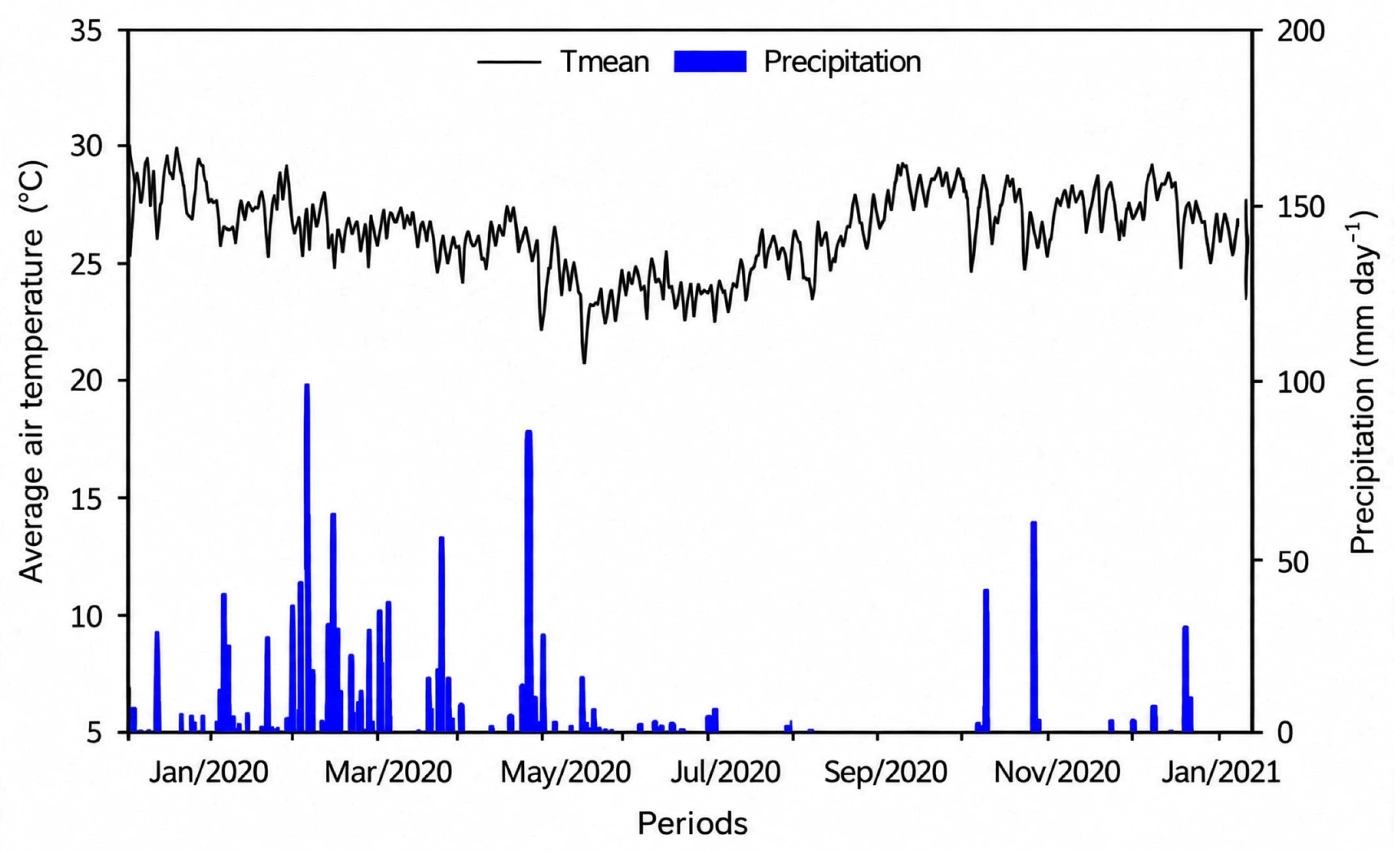
During the experimental period, meteorological data were collected using an automatic weather station operated by the National Institute of Meteorology (INMET). Figure 2 shows the variation in rainfall and mean air temperature throughout the experimental period.
Figure 2.
Mean air temperature and rainfall during the experimental period.
2.5. Molybdenum Application
Soil application of molybdenum was performed simultaneously with sorghum sowing during the first cropping cycle. In the second and third cycles, soil application was carried out on the cowpea sowing date in all treatments that received molybdenum, including those with sorghum regrowth. Sodium molybdate was used as the source of Mo, at a rate of 120 g ha−1 of Mo. Considering the application to the inner area of each plot (6 m2), corresponding to five crop rows spaced 0.75 m apart, totaling 3 m in width, and 2 m of usable length, and considering that the commercial product contains 39% Mo, 0.18 g of sodium molybdate was applied per plot, corresponding to approximately 0.072 g of Mo per plot. The product was previously dissolved in water, and the solution was uniformly distributed in the planting furrow using a watering can.
Foliar application was performed 30 days after emergence (DAE), using the same rate of 120 g ha−1 Mo, corresponding to 0.18 g of the product per plot. Sodium molybdate was dissolved in water, and the solution was placed in a backpack sprayer. Spraying was carried out in the morning, with the solution being uniformly distributed over the aerial parts of the plants. To prevent drift and contamination of adjacent plots, plots that were not being sprayed were protected with a tarp.
The molybdenum rate was determined based on the results obtained by [26].
2.6. Experimental Design
A randomized complete block design was used, consisting of nine cropping systems with four replications. The treatments were: sorghum–cowpea intercropping with foliar and soil application of Mo (S/F-MoF and S/F-MoS, respectively); sorghum–cowpea intercropping without Mo application (S/F-sMo); sole sorghum cropping with foliar and soil application of Mo (S-MoF and S-MoS, respectively); sole sorghum cropping without Mo application (S-sMo); sole cowpea cropping with foliar and soil application of Mo (F-MoF and F-MoS, respectively); and sole cowpea cropping without Mo application (F-sMo).
Each experimental plot consisted of five drip irrigation lines, each 3 m long and spaced 0.75 m apart, totaling 11.25 m2 of total area. The usable area comprised the three central lines, with 2 m of each line considered, corresponding to an area of 4.5 m2.
2.7. Analyzed Variables
2.7.1. Biological Efficiency Indices and Competitive Ability Indices
The biological efficiency and competitive ability indices were determined based on the cowpea and sorghum yield data presented by [17], referring to the same experiment. For the calculation of the indices, the mean yield of each experimental unit was considered. Subsequently, the means of the indices obtained were calculated, considering the four experimental replications.
Biological Efficiency Indices
The biological efficiency indices used to evaluate the sorghum–cowpea intercropping system were the land equivalent ratio (LER), area time equivalent ratio (ATER), and land equivalent coefficient (LEC), which were obtained from Equations (3), (4), and (5), respectively [14,15,16].
where Yab and Yba correspond to sorghum and cowpea yields in the intercropping system, respectively; Yaa and Ybb correspond to sorghum and cowpea yields in the sole cropping system, respectively. When LER > 1, the intercropping system has a yield advantage; when LER = 1, there is no yield advantage; and when LER < 1, the intercropping system is disadvantageous [16].
where LERa and LERb represent the relative yields of sorghum (a) and cowpea (b) in the intercropping system, respectively; ta and tb represent the duration of the sorghum and cowpea cycles, in days, respectively; and Tab represents the total duration of the intercropping system, in days, corresponding to the cultivation period of the crop with the shortest cycle. When ATER > 1, the intercropping system provides a yield advantage; when ATER = 1, there is no yield advantage; and when ATER < 1, the intercropping system results in a yield disadvantage [14].
where LEC > 0.25 indicates a yield advantage in the intercropping system, considering that the minimum coefficient value is 25% [14].
LEC = LERa · LERb
Competitive Ability Indices
To determine the competitive ability of the sorghum–cowpea intercropping system, the following indices were used: relative crowding coefficient (RCC), aggressivity (Aab), actual yield loss or gain (AYLG), and competitive ratio (CRa), obtained from Equations (6), (7), (8), and (9), respectively [14,15].
where Yab and Yba represent the yield of sorghum (a) and cowpea (b) in the intercropping system; Yaa and Ybb represent the yield of sole sorghum and cowpea crops, respectively; Xab represents the planting proportion of sorghum in mixture with cowpea; and Xba represents the planting proportion of cowpea in mixture with sorghum. When RCC (RCCa × RCCb) > 1, the intercropping system has an advantage compared with the sole cropping system; when RCC = 1, there is no advantage; and when RCC < 1, the use of the intercropping system results in a disadvantage. When RCCa > RCCb, sorghum exerts dominance over cowpea, whereas when RCCb > RCCa, cowpea exhibits dominance over sorghum [15].
When Aab = 0, sorghum and cowpea are equally competitive; when Aab > 0, sorghum exhibits dominance over cowpea; and when Aab < 0, cowpea is dominant over sorghum. When Aba = 0, sorghum and cowpea are equally competitive; when Aba > 0, cowpea exhibits dominance over sorghum; and when Aba < 0, sorghum exhibits dominance over cowpea [15].
where when AYLG > 0, the intercropping system presents an advantage over the sole cropping system; on the other hand, when AYLG < 0, there is a disadvantage in the use of the intercropping system [14].
where CRa < 1 indicates that the intercropping system is beneficial, allowing sorghum and cowpea to be cultivated together; however, when CRa > 1, the intercropped crops exhibit high competition compared with their respective sole cropping systems, making the intercropping system unfeasible [15]. The relationship applied to CRb follows the same rationale.
2.7.2. Sodium, Potassium, and Chloride Contents in the Shoot
At the end of each sorghum cultivation cycle, the Na+ and K+ contents were determined according to the methodology described by [27], using flame photometry. The Cl− content, in turn, was determined according to the methodology described by [28].
The analyses were performed after the aerial parts of the sorghum plants, collected from the useful area of each plot, were ground. For this purpose, a composite sample of the ground plant material was obtained and used to determine the Na+, K+, and Cl− contents.
2.8. Statistical Analysis
The data were subjected to tests of normality and homoscedasticity. The Shapiro–Wilk test was applied to assess data normality, while homoscedasticity was assessed using Bartlett’s test. After meeting the assumptions, analysis of variance (ANOVA) was performed using the F-test (p < 0.05). When the hypothesis test was significant, means were compared using Tukey’s test at a 5% probability level. All statistical analyses were performed using R version 3.5 [29].
3. Results
3.1. Biological Efficiency and Competitive Ability Indices
The biological efficiency indices LER, ATER, and LEC are presented in Table 1. Molybdenum (Mo) application did not result in significant differences for the partial land equivalent ratio of cowpea (LERb), whereas the LERa values for sorghum differed according to Mo application, with the highest results obtained with molybdenum application, regardless of the application method. The LER values were greater than 1 in all systems, indicating biological efficiency of the intercropping systems.
Table 1.
Biological efficiency indices of the sorghum/cowpea intercropping system, with and without molybdenum application, under semiarid conditions.
For the area time equivalent ratio (ATER), differences were observed among the systems, with the highest values obtained with Mo application. Overall, the systems presented ATER values > 1, indicating a yield advantage from the use of intercropping. The land equivalent coefficient (LEC) presented values greater than 0.25, demonstrating that all systems exhibited a yield advantage.
Table 2 presents the values of the competitive ability indices for the sorghum–cowpea intercropping systems without and with foliar and soil molybdenum application. The partial relative crowding coefficients of sorghum (RCCab) and cowpea (RCCba), as well as the product of RCCab and RCCba (RCC), showed no significant differences among the different cropping systems and molybdenum application methods. Furthermore, RCC values < 1 indicate a disadvantage in the use of intercropping systems. Sorghum aggressivity indices (Aa) showed negative values, whereas cowpea indices (Ab) showed positive values, indicating cowpea dominance over sorghum. Supporting the results observed for the aggressivity index, the competitive ratio values of sorghum (CRa) were lower than those of cowpea (CRb), confirming that cowpea is more competitive than sorghum. Therefore, cowpea is the dominant crop, while sorghum is the dominated crop.
Table 2.
Competitive ability indices of sorghum/cowpea intercropping systems with and without foliar and soil molybdenum application, cultivated under semiarid conditions.
The actual yield loss or gain values of sorghum (AYLGa) were influenced by the different cropping systems (p < 0.05), presenting satisfactory values (AYLGa > 1). On the other hand, the actual yield loss or gain values of cowpea (AYLGb), as well as the total value (AYLG), did not show significant differences. However, all values were greater than 1, indicating the effectiveness of crop use in the intercropping system. The AYLGa values were lower than those of AYLGb, indicating that the contribution of cowpea to AYLG is greater than that of sorghum.
3.2. Sodium, Potassium, and Chloride Ion Contents in the Shoot
The results obtained in this study demonstrate that the cropping systems did not significantly influence the ionic contents of Na+ and K+ (p > 0.05) during the first and third cropping cycles of forage sorghum (Table 3). However, in the second production cycle, differences were observed in Na+ contents, with the highest values, 6.30 and 5.31 µmol g−1 DM, recorded in the treatments with sorghum intercropped with cowpea and foliar molybdenum application, and sole sorghum with foliar molybdenum application, respectively. On the other hand, the treatments without molybdenum application and with soil-applied molybdenum did not differ from each other. Regarding K+ contents, the lowest means were observed in the treatments corresponding to sole sorghum with foliar molybdenum application and sole sorghum with soil-applied molybdenum, with values of 268.75 and 268.74 µmol g−1 DM, respectively.
Table 3.
Sodium (Na+) and potassium (K+) contents in the aboveground biomass of sorghum during three successive cycles, as affected by sorghum intercropping and molybdenum application.
Regarding chloride contents, no significant effect of the treatments was observed in any of the evaluated cycles (p > 0.05) (Table 4). Thus, the use of intercropping and molybdenum application did not affect Cl− uptake by forage sorghum.
Table 4.
Chloride (Cl−) contents in the aboveground biomass of sorghum during three successive cycles, as affected by sorghum intercropping and molybdenum application.
4. Discussion
4.1. Biological Efficiency Indices and Competitive Ability
The partial land equivalent ratio of sorghum (LERa) values show that the contribution of sorghum in the intercropping system depends on foliar molybdenum application. Meanwhile, the partial land equivalent ratio of cowpea (LERb) indicates that the contribution of cowpea is greater than that of sorghum, regardless of molybdenum application. The total land equivalent ratio (LER) values were greater than one in all cropping systems, with an average value of 2.26. Thus, the intercropping system provides a 126% advantage over sole cropping, meaning that an additional 1.26 hectares would be required under sole cropping to achieve the same production obtained with the intercropping system. The land equivalent ratio values may be associated with the advantages provided by the intercropping system, particularly its greater efficiency in the use of nutritional resources, improved soil cover, and better utilization of the cultivated area through the association of different crops [30].
Ref. [31], studying the sorghum–cowpea system, reported total land equivalent ratio (LER) values of 1.5, a result similar to that found in the sorghum–cowpea system without molybdenum in the present study. The increase in the partial land equivalent ratio of sorghum (LERa) with molybdenum application may be explained by the importance of this micronutrient in nitrogen metabolism and utilization by the crop [10]. Thus, molybdenum application may have favored nitrogen assimilation and utilization, contributing to improved plant nutritional status and development.
The relative crowding coefficient of sorghum (RCC ab) and the total relative crowding coefficient (RCC) showed negative values in almost all cropping systems, indicating that sorghum grown as a sole crop had higher productivity than when intercropped in all systems. According to [14], total relative crowding coefficient (RCC) values < 1 indicate that the crops had lower productivity under intercropping than under sole cropping, with interspecific competition being greater than intraspecific competition. The higher productivity of sorghum under sole cropping is associated with the absence of interspecific competition. Although intercropping sorghum with cowpea may increase the productivity of cultivated areas, some crops may exhibit lower productivity than that obtained under sole cropping when evaluated individually [32]. According to [33], crops grown in an intercropping system are expected to have lower productivity than under sole cropping, since interspecific competition, which is inevitable in such systems, may reduce productivity when the crop is evaluated individually. However, the combined production of the intercropped species tends to compensate for this reduction.
The aggressiveness of cowpea (Ab) was higher than that of sorghum (Aa), regardless of the cropping system adopted, demonstrating that cowpea exerts considerable dominance over sorghum. This dominance can be confirmed by observing that the competitiveness ratio was lower for sorghum than for cowpea (RCa < RCb). Conversely, ref. [34] observed a high degree of cereal dominance over legumes in intercropping systems.
Similarly, ref. [35] found that sorghum was dominated in intercropping systems with forage crops. On the other hand, ref. [33] observed, in a forage cactus–sorghum intercropping system, an explicit dominance of forage cactus over sorghum. This difference may be related to the distinct physiological and morphological characteristics of the species used in the different intercropping systems. Forage cactus has CAM-type photosynthetic metabolism, which provides high water-use efficiency and adaptation to conditions of high temperature and low water availability, whereas cowpea has C3 photosynthetic metabolism, in addition to differences in plant height, growth cycle, and nutritional, water, and photosynthetic requirements [36,37]. In this context, the experimental establishment conditions, particularly the establishment at the beginning of the rainy season, may have favored the initial development of cowpea. Furthermore, because it has a shorter growth cycle than sorghum, cowpea may have exploited the available resources more rapidly, resulting in greater competitive ability and, consequently, its dominance over sorghum in the intercropping system.
The values of the area-time equivalent ratio (ATER) indicate that the intercropping system used in the study achieved higher productivity than the values obtained under sole cropping. In turn, the ATER values for sorghum were influenced by molybdenum application. These results may be associated with molybdenum application, since this micronutrient plays an important role in nitrogen metabolism and assimilation, potentially contributing to an increase in ATER. In addition, molybdenum (Mo) is involved in processes related to biological nitrogen fixation, which may enhance the efficiency of this process and, consequently, nitrogen utilization by plants [38].
Molybdenum application did not affect most of the indices evaluated. These results may be related to the characteristics of the soil and water used in the experiment. Since the irrigation water was classified as C3 according to Richards, the high salt contents present may have impaired molybdenum uptake by the plants, although some studies indicate that foliar fertilization with this micronutrient can increase plant resilience in saline environments [39]. In addition, the soil in the experimental area has a pH of 7.1, a characteristic that may favor the availability of molybdenum in the soil in amounts sufficient to meet crop requirements. Soil pH is considered one of the main factors influencing the availability of this micronutrient, since molybdate activity increases linearly with increasing pH up to approximately 8.0 [40,41].
4.2. Sodium, Potassium, and Chloride Contents in the Shoot
According to [7], increasing salinity impairs nitrate reductase enzyme activity as a result of reduced water availability in plant tissues. This water limitation directly affects nitrogen uptake and assimilation by plants, since nitrate reductase is essential for the reduction of nitrate (NO3−) to nitrite (NO2−) in the cytoplasm. This step is fundamental to nitrogen metabolism, contributing to the synthesis of amino acids and proteins essential for plant growth and development [42].
The foliar application of sodium molybdate (Na2MoO4) favored the concentration of Na+ in the aerial part of sorghum. Since the amount of sodium absorbed by the plant was relatively low, the sodium present in the molybdate was sufficient to promote higher values in the treatments using this application method. In addition, the irrigation interval adopted in the second cycle favored the presence of salts in the crop’s root zone. According to [43], the application of irrigation depths lower than the crop’s water requirement results in salt accumulation in the root zone, and the effect of these salts depends on the irrigation method and frequency.
According to [44], the use of saline water can promote salt accumulation in the soil–plant system, resulting in a reduction in crop leaf area. This condition negatively affects the efficiency of foliar fertilization, as it reduces the absorption surface and compromises the plants’ ability to absorb nutrients.
The use of sorghum alone without molybdenum application favored potassium uptake and reduced sodium levels. As a crop with moderate tolerance to salt stress, sorghum exhibits selectivity in potassium absorption over sodium, enabling its development under conditions of moderate salinity [45].
The treatments in which the intercropping system was used showed an increase in potassium content when molybdenum was applied, with a simultaneous increase in Na+ and K+ levels. The legume used in the intercropping system may have promoted greater nitrogen availability for sorghum; since nitrogen uptake is preferential, Na+ uptake may have been reduced. Ref. [46] observed a quadratic relationship between nitrogen and K+ extraction and nitrogen fertilization. The maximum potassium extraction was found at the rate of 250 kg ha−1.
In the intercropping system, foliar application of molybdenum increased K+ and Na+ concentrations. The increase in Na+ concentration may be related to the application of sodium molybdate, which, in addition to supplying Mo to the plants, also constitutes a source of this cation. However, despite the increase in Na+ concentrations, the plants maintained the balance in the Na+/K+ ratio, which may indicate the maintenance of ionic homeostasis. The increase in K+ concentrations, in turn, may be related to the indirect effects of Mo on nitrogen metabolism and biological N fixation, processes that may promote plant growth and development and, consequently, influence the uptake and partitioning of other nutrients, including K+. According to [47], the Na+/K+ ratio is a strong indicator of salinity resistance, reflecting the selectivity of plants in cation uptake under saline conditions. Considering that the water used for irrigation in the experiment had a sodium concentration of 168.51 mg L−1, this factor may have influenced the dynamics of ionic uptake.
The use of the intercropping system between maize and cowpea reduces the harmful effects of salinity, representing a viable alternative for cultivation in saline environments [48]. According to [49], the toxicity caused by the presence of Na+ ions in plants is not the only harmful effect, as increased sodium levels can reduce potassium uptake, affecting K+ homeostasis, which is considered a fundamental process for plant resistance to salinity stress.
The high rainfall levels during the first cycle reduced chloride uptake. The rainy period decreased the application of saline water and promoted the leaching of salts present in the crop’s root zone. According to [43], rainwater has an electrical conductivity (EC) of approximately 0.010 dS m−1, which makes it suitable for irrigation and promotes salt leaching. According to [50], chloride can be easily leached from the soil without causing changes in pH; however, the water used for leaching must contain low levels of Na+.
All treatments received the same irrigation depth, corresponding to 50% of crop evapotranspiration. Therefore, the amount of water applied did not vary among treatments, which may explain the absence of significant differences in chloride uptake. According to [51], increases in irrigation depths and soluble salt concentrations in irrigation water promote greater chloride application in the root zone, contributing to higher uptake by plants.
5. Conclusions
The sorghum–cowpea intercropping system has established itself as a biologically efficient system dominated by cowpea, providing an average 126% advantage in land use (total LER of 2.26). Molybdenum fertilization did not affect the overall biological efficiency or competitive ability of the intercropping system, although soil application enhanced some indicators of individual sorghum performance. The fluctuations in Na+ and K+ contents were found to be localized and dependent on the cropping cycle, without affecting Cl− accumulation.
Limitations and Future Work
In light of the results obtained, further studies are recommended to evaluate biological nitrogen fixation and Mo concentrations in the soil and plants, as well as the effect of the timing of molybdenum fertilization application on crop responses. These assessments may contribute to a better understanding of the mechanisms involved and complement the results obtained in the present manuscript, since these aspects could not be evaluated in this study.
Author Contributions
Conceptualization, B.C.J. and A.C.d.O.; methodology, B.C.J. and A.C.d.O.; software, C.P.A., A.C.d.O. and B.C.J.; validation, A.C.d.O., H.R.B.S. and B.C.J.; data acquisition, B.C.J., C.M.P.G.S., N.S.G.d.S., C.P.A., D.d.S.E., J.C.G.d.S.H., D.S.M.d.M.V., D.O., L.H.M.C., H.R.B.S., D.G.M.R., R.C.A.B. and E.P.d.C.; formal analysis, B.C.J., A.C.d.O. and T.G.F.d.S.; investigation, B.C.J., H.R.B.S., A.C.d.O. and T.G.F.d.S.; data curation, B.C.J., A.C.d.O. and T.G.F.d.S.; writing—original draft preparation, B.C.J. and A.C.d.O.; writing—review and editing, B.C.J., T.G.F.d.S. and C.M.P.G.S.; visualization, A.C.d.O., D.d.S.E., L.H.M.C., C.M.P.G.S., B.C.J. and C.P.A.; supervision, A.C.d.O.; project administration, B.C.J., A.C.d.O. and T.G.F.d.S. All authors have read and agreed to the published version of the manuscript.
Funding
This study was partially funded by the Coordination for the Improvement of Higher Education Personnel (CAPES), Brazil—Finance Code 001.
Data Availability Statement
The original contributions presented in this study are included in the article. Further inquiries may be directed to the corresponding author.
Acknowledgments
We would like to thank the Universidade Federal Rural de Pernambuco for providing the equipment and facilities, and CAPES for the financial support. The present article is based on the results obtained from the master’s dissertation entitled Use of Molybdenum in the Intercropping of Irrigated Sorghum and Cowpea in a Semi-arid Environment, conducted by the postgraduate student Baltazar Cirino Júnior at the Federal Rural University of Pernambuco, under the supervision of Alexandre Campelo de Oliveira.
Conflicts of Interest
The authors declare no conflicts of interest.
References
- Barbosa, H.A.; Kumar, T.L.; Paredes, F.; Elliott, S.; Ayuga, J.G. Assessment of Caatinga response to drought using Meteosat-SEVIRI normalized difference vegetation index (2008–2016). ISPRS J. Photogramm. Remote Sens. 2019, 148, 235–252. [Google Scholar] [CrossRef] [Scilit]
- Superintendência do Desenvolvimento do Nordeste (SUDENE). Relatório de Gestão 2024; SUDENE: Recife, Brazil, 2025. Available online: https://www.gov.br/sudene/pt-br/acesso-a-informacao/transparencia-e-prestacao-de-contas/2024/relatrio2024_v4_compressed.pdf (accessed on 21 July 2026).
- Lamichhane, P.; Hadjikakou, M.; Miller, K.K.; Bray, B. Climate Change Adaptation in Smallholder Agriculture: Adoption, Barriers, Determinants, and Policy Implications. Mitig. Adapt. Strateg. Glob. Change 2022, 27, 32. [Google Scholar] [CrossRef] [Scilit]
- Costa, M.G.O. Águas subterrâneas e sustentabilidade no semiárido: Análise hidrogeológica e territorial do território de Irecê, estado da Bahia (BA). Águas Subterrâneas 2026, 40, 1–14. [Google Scholar] [CrossRef] [Scilit]
- Fontanet-Manzaneque, J.B.; Hernández, D.M.; Giordano, A.; Caño-Delgado, A.I. Sorghum as a Monocot Model for Drought Research. Front. Plant Sci. 2025, 16, 1665967. [Google Scholar] [CrossRef] [Scilit] [PubMed]
- Gualter, R.M.R.; Boddey, R.M.; Rumjanek, N.G.; Freitas, A.C.R.; Xavier, G.R. Eficiência agronômica de estirpes de rizóbio em feijão-caupi cultivado na região da Pré-Amazônia maranhense. Pesqui. Agropecu. Bras. 2011, 46, 303–308. [Google Scholar] [CrossRef] [Scilit]
- Aragão, R.M.; Silveira, J.A.G.; Silva, E.N.; Lobo, A.K.M.; Dutra, A.T.B. Absorção, fluxo no xilema e assimilação do nitrato em feijão-caupi submetido à salinidade. Rev. Ciênc. Agron. 2010, 41, 100–106. [Google Scholar] [CrossRef] [Scilit]
- Ashraf, M.; Shahzad, S.M.; Imtiaz, M.; Rizwan, M.S. Salinity effects on nitrogen metabolism in plants—Focusing on the activities of nitrogen metabolizing enzymes: A review. J. Plant Nutr. 2018, 41, 1065–1081. [Google Scholar] [CrossRef] [Scilit]
- Mabiya, T.C.; Hendricks, K.; Nkuna, M.; Faro, A.; Doumbia, I.Z.; Ajayi, R.F.; Iwuoha, E.; Ndimba, B.K.; Mulaudzi, T. Molybdenum improves Sorghum bicolor tolerance to salt stress by regulating the antioxidant system and the heat shock protein 70 expression. Int. J. Phytol. Res. 2023, 3, 30–40. [Google Scholar]
- Vieira, R.F. Ciclo do Nitrogênio em Sistemas Agrícolas; Embrapa Meio Ambiente: Jaguariúna, Brazil, 2017; Available online: https://www.embrapa.br/busca-de-publicacoes/-/publicacao/1074003/ciclo-do-nitrogenio-em-sistemas-agricolas (accessed on 10 January 2021).
- Reis, V.M.; Teixeira, K.R.S. Fixação biológica de nitrogênio—Estado da arte. In Processos Biológicos no Sistema Solo-Planta: Ferramentas para uma Agricultura Sustentável; Embrapa Informação Tecnológica: Brasília, Brazil, 2005; pp. 350–368. [Google Scholar]
- Mahallati, M.N.; Koocheki, A.; Mondani, F.; Feizi, H.; Amirmoradi, S. Determination of optimal strip width in strip intercropping of maize (Zea mays L.) Bean (Phaseolus Vulgaris L.) Northeast. Iran. J. Clean. Prod. 2015, 106, 343–350. [Google Scholar] [CrossRef] [Scilit]
- Collier, L.S.; Kikuchi, F.Y.; Benicio, L.P.F.; Sousa, S.A. Consórcio e sucessão de milho e feijão-de-porco como alternativa de cultivo sob plantio direto. Pesqui. Agropecu. Trop. 2011, 41, 306–313. [Google Scholar] [CrossRef] [Scilit]
- Diniz, W.J.S.; Silva, T.G.F.; Ferreira, J.M.S.; Santos, D.C.; Moura, M.S.B.; Araújo, G.G.L.; Zolnier, S. Forage cactus–sorghum intercropping at different irrigation water depths in the Brazilian semiarid region. Pesqui. Agropecu. Bras. 2017, 52, 724–733. [Google Scholar] [CrossRef] [Scilit]
- Sadeghpour, A.; Jahanzad, E.; Esmaeili, A.; Hosseini, M.B.; Hashemi, M. Forage yield, quality and economic benefit of intercropped barley and annual medic in semi-arid conditions: Additive series. Field Crops Res. 2013, 148, 43–48. [Google Scholar] [CrossRef] [Scilit]
- Yilmaz, Ş.; Özel, A.; Atak, M.; Erayman, M. Effects of seeding rates on competition indices of barley and vetch intercropping systems in the Eastern Mediterranean. Turk. J. Agric. For. 2015, 39, 135–143. [Google Scholar] [CrossRef] [Scilit]
- Cirino Júnior, B.; Souza, J.C.G.; Maciel, L.H.; Carmo, E.P.; Souza, C.M.P.G.; Alcântara, E.B.; Silva, N.S.G.; Oliveira, A.C. Utilização de molibdênio no consórcio sorgo e feijão-caupí irrigado em ambiente semiárido. Braz. J. Anim. Environ. Res. 2023, 6, 1838–1852. [Google Scholar] [CrossRef] [Scilit]
- Pereira, L.S.; Allen, R.G.; Paredes, P.; López-Urrea, R.; Raes, D.; Smith, M.; Salman, M. Crop Evapotranspiration; FAO Irrigation and Drainage Paper 56; FAO: Rome, Italy, 2025. [Google Scholar]
- Pereira, P.D.C.; Silva, T.G.F.; Zolnier, S.; Morais, J.E.F.; Santos, D.C. Morfogênese da palma forrageira irrigada por gotejamento. Rev. Caatinga 2015, 28, 184–195. [Google Scholar] [CrossRef] [Scilit]
- Silva, T.G.F.; Primo, J.T.A.; Morais, J.E.F.; Silva Diniz, W.J.; Souza, C.A.A.; Conceição Silva, M. Crescimento e produtividade de clones de palma forrageira no semiárido e relações com variáveis meteorológicas. Rev. Caatinga 2015, 28, 10–18. [Google Scholar]
- Santos, H.G.; Jacomine, P.K.T.; Anjos, L.H.C.; Oliveira, V.A.; Lumbreras, J.F.; Coelho, M.R.; Almeida, J.A.; Araújo Filho, J.C.; Lima, H.N.; Marques, F.A.; et al. Sistema Brasileiro de Classificação de Solos, 6th ed.; Embrapa: Brasília, Brazil, 2025. [Google Scholar]
- Teixeira, P.C.; Donagemma, G.K.; Fontana, A.; Teixeira, W.G. Manual de Métodos de Análise de Solo, 3rd ed.; Embrapa: Brasília, DF, Brazil, 2017; 574p. [Google Scholar]
- Veloso, C.A.C. Sorgo granífero e forrageiro. In Recomendações de Calagem e Adubação para o Estado do Pará, 2nd ed., rev. and updated; Brasil, E.C., Cravo, M.S., Viegas, I.J.M., Eds.; Embrapa: Brasília, DF, Brazil, 2020; pp. 263–264. [Google Scholar]
- Richards, L.A. (Ed.) Diagnosis and Improvement of Saline and Alkali Soils; Agricultural Handbook No. 60; U.S. Department of Agriculture (USDA): Washington, DC, USA, 1954; 160p. [Google Scholar]
- Allen, R.G.; Pereira, L.S.; Raes, D.; Smith, M. Crop Evapotranspiration—Guidelines for Computing Crop Water Requirements—FAO Irrigation and Drainage Paper 56; FAO: Rome, Italy, 1998; Volume 56. [Google Scholar]
- da Silveira, P.M.; Mesquita, M.A.M.; da Cunha, P.C.R. Adubação Foliar no Feijoeiro: Revisão de Literatura; Embrapa Arroz e Feijão: Santo Antônio de Goiás, Brazil, 2015; 45p, Available online: https://www.infoteca.cnptia.embrapa.br/handle/doc/1019635 (accessed on 15 December 2019).
- Rodrigues, C.R.F.; Silva, E.N.; Ferreira-Silva, S.L.; Voigt, E.L.; Viégas, R.A.; Silveira, J.A.G. High K+ supply avoids Na+ toxicity and improves photosynthesis by allowing favorable K+: Na+ ratios through the inhibition of Na+ uptake and transport to the shoots of Jatropha curcas plants. J. Plant Nutr. Soil Sci. 2013, 176, 157–164. [Google Scholar] [CrossRef] [Scilit]
- Ferreira-Silva, S.L.; Silveira, J.A.G.; Voigt, E.L.; Soares, L.S.; Viégas, R.A. Changes in physiological indicators associated with salt tolerance in two contrasting cashew rootstocks. Braz. J. Plant Physiol. 2008, 20, 51–59. [Google Scholar] [CrossRef] [Scilit]
- R Core Team. R: A Language and Environment for Statistical Computing; R Foundation for Statistical Computing: Vienna, Austria, 2018; Available online: https://www.R-project.org/ (accessed on 12 March 2021).
- Sadafzadeh, E.; Javanmard, A.; Amani Machiani, M.; Sofo, A. Application of Bio-Fertilizers Improves Forage Quantity and Quality of Sorghum (Sorghum bicolor L.) Intercropped with Soybean (Glycine max L.). Plants 2023, 12, 2985. [Google Scholar] [CrossRef] [Scilit] [PubMed]
- Chimonyo, V.G.P.; Modi, A.T.; Mabhaudhi, T. Water use and productivity of a sorghum–cowpea–bottle gourd intercrop system. Agric. Water Manag. 2016, 165, 82–96. [Google Scholar] [CrossRef] [Scilit]
- Ashenafi, M.; Wodimu, T.; Tenaye, S.; Kebede, T.; Alemu, D. Assessing the Advantages of Sorghum–Haricot Bean Intercropping Over Sole Cropping and Productivity via Competitive Indices in Ethiopia’s Highland Regions. Adv. Agric. 2025, 2025, 8847195. [Google Scholar] [CrossRef] [Scilit]
- Jardim, A.M.D.R.F.; Silva, T.G.F.; Souza, L.S.B.; Alves, H.K.M.N.; Sá Souza, M.; Moura, M.S.B. Intercropping forage cactus and sorghum in a semi-arid environment improves biological efficiency and competitive ability through interspecific complementarity. J. Arid. Environ. 2021, 188, 104464. [Google Scholar] [CrossRef] [Scilit]
- Zhang, F.-Y.; Wu, P.-T.; Zhao, X.-N.; Cheng, X.-F. Water-saving mechanisms of intercropping system in improving cropland water use efficiency. Ying Yong Sheng Tai Xue Bao 2012, 23, 1351–1358. [Google Scholar]
- Borghi, E.C.A.C.; Crusciol, C.A.C.; Nascente, A.S.; Sousa, V.V.; Martins, P.O.; Mateus, G.P.; Costa, C. Sorghum grain yield, forage biomass production and revenue as affected by intercropping time. Eur. J. Agron. 2013, 51, 130–139. [Google Scholar] [CrossRef] [Scilit]
- Selinga, T.I.; Maseko, S.T.; Muasya, A.M.; Ogola, J.B.O.; Ottosen, C.-O.; Rosenqvist, E.; Chimphango, S.B.M. Root and Leaf Traits for Dehydration Avoidance and Enhanced Grain Yield in Cowpea (Vigna unguiculata L., Fabaceae) Under Drought. Plant Direct 2025, 9, e70126. [Google Scholar] [CrossRef] [Scilit] [PubMed]
- Jardim, A.M.D.R.F.; Morais, J.E.F.; Tang, X.; Souza, L.S.B.; Souza, C.A.A.; Santos, W.R.; Marin, F.R.; Araújo Júnior, G.N.; Alves, C.P.; Silva, G.I.N.; et al. Energy Balance, Water Use Efficiency, and Photochemistry of Two Globally Cultivated Rainfed Cactus Species. Agric. Water Manag. 2025, 311, 109385. [Google Scholar] [CrossRef] [Scilit]
- Lopes, J.F.; Coelho, F.C.; Rangel, O.J.P.; Rabello, W.S.; Gravina, G.A.; Vieira, H.D. Adubação foliar com níquel e molibdênio no feijoeiro comum cv. Ouro Vermelho. Rev. Ceres 2014, 61, 234–240. [Google Scholar] [CrossRef] [Scilit]
- Zulfiqar, T.; Ahmad, S.; Shao, J.; Yang, H.; Wei, J.; Zhang, F. Molybdenum Enhances Soybean Growth and Seed Quality by Modulating Osmoregulation, Ion Homeostasis, and Antioxidant Activity under Saline–Alkaline Conditions. BMC Plant Biol. 2025, 25, 1336. [Google Scholar] [CrossRef] [Scilit] [PubMed]
- Souza, R.F.; Faquin, V.; Carvalho, R.; Torres, P.R.F.; Pozza, A.A.A. Atributos químicos de solos influenciados pela substituição do carbonato por silicato de cálcio. Rev. Bras. Ciênc. Solo 2008, 32, 1563–1572. [Google Scholar] [CrossRef] [Scilit]
- Alves, S.R.V.; Berti, M.P.S. Molibdênio no metabolismo e dinâmica vegetal: Uma revisão. Rev. Agrotecnol. 2022, 13, 50–63. [Google Scholar] [CrossRef]
- Yanagisawa, S. Transcription factors involved in controlling the expression of nitrate reductase genes in higher plants. Plant Sci. 2014, 229, 167–171. [Google Scholar] [CrossRef] [Scilit] [PubMed]
- Holanda, J.S.; Amorim, J.R.A.; Ferreira Neto, M.; Holanda, A.C.; Sá, F.V. Qualidade da água para irrigação. In Manejo da Salinidade na Agricultura: Estudos Básicos e Aplicados, 2nd ed.; Gheyi, H.R., Dias, N.S., Lacerda, C.F., Gomes Filho, E., Eds.; INCTSal: Fortaleza, Brazil, 2016; pp. 35–47. [Google Scholar]
- Feijão, A.R.; Marques, E.C.; Silva, J.C.B.; Lacerda, C.F.; Prisco, J.T.; Gomes-Filho, E. Nitrato modula os teores de cloreto e compostos nitrogenados em plantas de milho submetidas à salinidade. Bragantia 2013, 72, 10–19. [Google Scholar] [CrossRef] [Scilit][Green Version]
- Kaplan, M.; Kara, K.; Unlukara, A.; Kale, H.; Beyzi, S.; Varol, I.; Kamalak, A. Water deficit and nitrogen affects yield and feed value of sorghum sudangrass silage. Agric. Water Manag. 2019, 218, 30–36. [Google Scholar] [CrossRef] [Scilit]
- Restelatto, R.; Pavinato, P.S.; Sartor, L.R.; Einsfeld, S.M.; Baldicera, F.P. Nitrogen efficiency and nutrient absorption by a sorghum–oats forage succession. Adv. Agric. 2015, 2015, 857439. [Google Scholar] [CrossRef] [Scilit]
- Shabala, S. Learning from halophytes: Physiological basis and strategies to improve abiotic stress tolerance in crops. Ann. Bot. 2013, 112, 1209–1221. [Google Scholar] [CrossRef] [Scilit] [PubMed]
- Araújo, A.P.B. Influência da Irrigação com Água Salina em Sistema Consorciado Milho/Feijão-de-Corda. Ph.D. Thesis, Universidade Federal Rural de Pernambuco, Recife, Brazil, 2015. [Google Scholar]
- Capitulino, J.D.; Silva, A.A.R.; Lima, G.S.; Nóbrega, R.A.; Nascimento, H.M.; Soares, L.A.A. Aspectos fisiológicos e crescimento do algodoeiro ‘BRS Topázio’ cultivado com águas salinas e adubação potássica. Rev. Verde Agroecol. Desenv. Sustent. 2017, 12, 267–272. [Google Scholar] [CrossRef] [Scilit][Green Version]
- Geilfus, C.M. Chloride in soil: From nutrient to soil pollutant. Environ. Exp. Bot. 2019, 157, 299–309. [Google Scholar] [CrossRef] [Scilit]
- Mehdi-Tounsi, H.; Chelli-Chaabouni, A.; Mahjoub-Boujnah, D.; Boukhris, M. Long-term field response of pistachio to irrigation water salinity. Agric. Water Manag. 2017, 185, 1–12. [Google Scholar] [CrossRef] [Scilit]

Disclaimer/Publisher’s Note: The statements, opinions and data contained in all publications are solely those of the individual author(s) and contributor(s) and not of MDPI and/or the editor(s). MDPI and/or the editor(s) disclaim responsibility for any injury to people or property resulting from any ideas, methods, instructions or products referred to in the content. |
© 2026 by the authors. Licensee MDPI, Basel, Switzerland. This article is an open access article distributed under the terms and conditions of the Creative Commons Attribution (CC BY) license.