


Abstract
Nitric oxide (NO) is a small, highly reactive gaseous signaling molecule that plays diverse and context-dependent roles in microbial physiology and host–microbe interactions. Over the past decade, increasing evidence has revealed the dual nature of NO as both an antimicrobial effector and a signaling mediator involved in microbial stress responses, metabolism, biofilm dynamics, quorum sensing, virulence regulation, and symbiotic interactions. In microbial systems, NO influences adaptation to environmental stress and contributes to mechanisms associated with persistence and antimicrobial resistance. In host organisms, NO functions as a key component of innate immunity while also participating in beneficial interactions involving rhizobia, mycorrhizal fungi, and probiotic microorganisms. Despite its biological significance, accurate detection and quantification of NO remain challenging because of its transient nature, high reactivity, low physiological concentrations, and interference from related reactive oxygen and nitrogen species. Recent advances in biosensing technologies have substantially improved NO detection capabilities through the development of electrochemical, optical, enzyme-based, microfluidic, wearable, and implantable sensing platforms. These innovations are complemented by analytical techniques including electron paramagnetic resonance spectroscopy, mass spectrometry, fluorescence-based imaging, and advanced microscopy, which enhance sensitivity, specificity, and spatiotemporal resolution in complex biological environments. Concurrently, statistical and computational approaches—including sensor calibration models, multivariate analyses, machine learning algorithms, and bioinformatics pipelines—have become increasingly important for extracting biologically meaningful information from NO-related datasets. Unlike previous reviews that primarily focus on either NO biology or sensing technologies, this review integrates current knowledge of NO-mediated microbial physiology and host–microbe interactions with recent developments in biosensor engineering, analytical methodologies, statistical frameworks, and emerging artificial intelligence (AI)-driven data interpretation. We further highlight applications of NO detection in infectious disease diagnostics, antimicrobial screening, probiotic and biofertilizer evaluation, environmental microbiome monitoring, and real-time studies of symbiosis and infection. Finally, future directions including miniaturized sensing platforms, multi-omics integration, AI-assisted analytics, and sensor standardization are discussed. By unifying molecular, analytical, and computational perspectives, this review provides a multidisciplinary framework and roadmap for advancing NO-based research and translational applications across microbial, environmental, and host-associated systems.
1. Introduction
Nitric oxide (NO) is a small, diatomic, and highly reactive free radical that functions as a versatile signaling molecule across biological systems. Although initially recognized primarily as an environmental pollutant, NO is now widely acknowledged as a key regulator of physiological and pathological processes in both prokaryotic and eukaryotic organisms [1,2]. Owing to its lipophilic nature, rapid diffusibility, and short half-life, NO can act as a highly dynamic signaling mediator capable of regulating cellular responses over multiple spatial and temporal scales. Over the past decade, substantial advances have expanded our understanding of NO-mediated signaling in microbial physiology and host–microbe interactions, revealing complex regulatory networks that are highly dependent on environmental conditions, microbial species, and host context [3,4].
In microbial systems, NO exhibits a remarkable duality. As part of the host innate immune response, NO is produced by activated macrophages and other phagocytic cells through inducible NO synthase (iNOS), serving as a potent antimicrobial effector that restricts pathogen survival through nitrosative stress [5]. Conversely, NO also functions as an endogenous signaling molecule that regulates microbial adaptation, metabolism, stress responses, biofilm development, quorum sensing, and virulence [6,7]. In beneficial associations, NO contributes to the establishment and maintenance of symbiotic relationships, including those involving nitrogen-fixing rhizobia, mycorrhizal fungi, and gut-associated microbiota. These contrasting roles underscore the complexity of NO as both a defensive and communicative molecule that shapes microbial community dynamics and host responses.
The biological significance of NO extends beyond its direct physiological functions. In microbial communities, NO influences biofilm architecture, population-level communication, metabolic reprogramming, and responses to environmental stressors [7,8]. Many microorganisms have evolved sophisticated NO detoxification systems that not only confer protection against host-derived nitrosative stress but also enable the exploitation of NO signaling for adaptive and regulatory purposes. Similarly, in host–microbe interactions, the concentration, localization, and duration of NO production can determine whether interactions culminate in pathogen clearance, immune evasion, symbiotic establishment, or homeostatic maintenance [6,9].
Despite its central role in biological systems, the study of NO remains technically challenging. The molecule’s transient existence, rapid reactivity with oxygen and reactive oxygen species (ROS), and low physiological concentrations complicate accurate detection and quantification [10]. Traditional analytical methods, including the Griess assay, chemiluminescence, and conventional electrochemical approaches, have provided valuable insights but are often limited by insufficient specificity, sensitivity, or temporal resolution [11,12]. To overcome these limitations, considerable efforts have been directed toward the development of advanced biosensing technologies, including nanomaterial-enhanced electrochemical sensors, fluorescent probes, genetically encoded reporters, microfluidic platforms, and wearable sensing devices [13,14]. These technologies have significantly improved the ability to monitor NO dynamics in complex biological systems, although challenges related to selectivity, reproducibility, and real-time in vivo monitoring remain.
Several recent reviews have comprehensively examined either the biological functions of NO in microorganisms or the development of NO detection technologies. However, a critical gap remains in integrating these biological insights with advances in biosensor engineering, analytical methodologies, quantitative data analysis, and emerging artificial intelligence (AI)-based approaches. As NO research increasingly generates large, multidimensional datasets from biosensors, imaging platforms, transcriptomics, and microbiome studies, robust statistical and computational frameworks have become essential for extracting biologically meaningful information and facilitating translational applications.
Therefore, this review aims to provide a comprehensive and interdisciplinary synthesis of current knowledge regarding NO in microbial physiology and host–microbe interactions while highlighting recent advances in biosensing technologies, analytical methods, statistical frameworks, and AI-driven applications. By integrating molecular microbiology, sensor engineering, analytical chemistry, data science, and systems biology, this review seeks to establish a conceptual framework that extends beyond traditional NO-centered reviews and provides a multidisciplinary roadmap for future research, diagnostics, environmental monitoring, and precision biological applications.
2. Role of NO in Microbial Physiology
NO is now recognized as a central regulator of microbial physiology rather than merely a toxic reactive nitrogen species (RNS). In bacteria, fungi, and other microorganisms, NO functions as a signaling molecule that coordinates cellular adaptation, stress tolerance, metabolism, and community behavior [15]. The biological effects of NO are highly concentration dependent; low physiological concentrations often serve regulatory functions, whereas elevated levels induce nitrosative stress and cellular damage. This dual functionality allows NO to act as both a signaling mediator and a defensive molecule, making it a critical component of microbial survival strategies.
Many microorganisms possess the capacity to generate NO endogenously through bacterial NO synthase (bNOS) enzymes or as intermediates of denitrification pathways. Species such as Bacillus subtilis and Staphylococcus aureus produce NO through bNOS-mediated oxidation of L-arginine, a mechanism analogous to NOS systems in higher organisms [16]. Recent studies have demonstrated that endogenous NO production contributes to microbial adaptation under fluctuating environmental conditions, including oxidative stress, nutrient limitation, and antimicrobial exposure. These findings highlight the evolutionary conservation of NO signaling across biological kingdoms.
One of the most extensively studied functions of NO is its involvement in oxidative and nitrosative stress responses. As NO readily reacts with ROS, it generates secondary RNS capable of damaging proteins, lipids, and nucleic acids. To counteract these effects, microorganisms have evolved highly specialized detoxification systems. Flavohemoglobins, such as Hmp in Escherichia coli, convert NO into less toxic compounds including nitrate and nitrous oxide, thereby maintaining intracellular redox balance [17]. Similarly, regulatory networks involving OxyR, SoxR, NsrR, and NorR coordinate transcriptional responses that enhance resistance to oxidative and nitrosative stress [18]. Comparative analyses indicate that pathogenic bacteria generally possess more robust NO-detoxification systems than non-pathogenic species, reflecting adaptation to NO-rich host environments.
Beyond stress mitigation, NO serves as a regulator of metabolism and gene expression. Through reversible interactions with metal centers and cysteine residues, NO modulates the activity of transcription factors and metabolic enzymes involved in respiration, amino acid metabolism, and energy production. In S. aureus, NO regulates genes associated with metabolic flexibility, enabling transitions between aerobic and anaerobic respiration under changing environmental conditions [19]. Similar regulatory effects have been reported in denitrifying bacteria and mycobacteria, suggesting that NO functions as a conserved metabolic signal across diverse microbial taxa.
An emerging area of interest involves the role of NO in quorum sensing (QS) and biofilm dynamics. Comparative studies demonstrate that NO signaling intersects with cyclic di-guanosine monophosphate (c-di-GMP) pathways that regulate transitions between planktonic and sessile lifestyles. Low nanomolar concentrations of NO stimulate biofilm dispersal in species such as Pseudomonas aeruginosa and Vibrio cholerae, whereas higher concentrations may trigger stress responses that promote biofilm persistence [7,20,21]. In marine bacteria such as Vibrio harveyi, NO is sensed through heme-NO/oxygen-binding (H-NOX) proteins that influence QS-regulated traits including bioluminescence, motility, and virulence [22]. These findings highlight the concentration-dependent and species-specific effects of NO signaling on microbial community behavior.
The role of NO in antimicrobial resistance has received increasing attention in recent years. Endogenous NO production has been shown to protect bacteria against diverse antibiotic classes by reducing oxidative damage, modulating respiration, and enhancing stress tolerance. In B. subtilis, NO mitigates antibiotic-induced oxidative stress, whereas in Mycobacterium tuberculosis, NO contributes to dormancy-associated persistence mechanisms [23,24,25]. Importantly, recent evidence suggests that NO-mediated physiological adaptations may indirectly promote antimicrobial tolerance and complicate treatment outcomes, underscoring the relevance of NO signaling in the broader context of antimicrobial resistance.
Collectively, these studies demonstrate that NO occupies a central position at the interface of microbial signaling, stress adaptation, biofilm regulation, and antimicrobial resistance. Understanding these interconnected roles is essential not only for advancing microbial ecology but also for identifying novel therapeutic strategies that target NO-dependent pathways.
3. Nitric Oxide in Host–Microbe Interactions
NO serves as one of the most important molecular mediators governing host–microbe interactions. Unlike many antimicrobial molecules that function solely in host defense, NO exerts context-dependent effects that influence pathogen elimination, immune regulation, symbiotic communication, and microbiome stability. This duality positions NO at the center of both antagonistic and beneficial host–microbe relationships.
In mammalian hosts, NO is primarily generated by iNOS expressed in activated macrophages, neutrophils, dendritic cells, and epithelial cells [26]. Following microbial recognition, NO production increases dramatically as part of the innate immune response. Elevated NO concentrations impair microbial survival through multiple mechanisms, including DNA damage, inhibition of iron–sulfur cluster enzymes, disruption of respiratory pathways, and formation of highly reactive nitrogen intermediates [27]. Consequently, NO represents a major component of host antimicrobial defense against bacterial, fungal, parasitic, and viral pathogens.
Microorganisms have evolved diverse mechanisms to survive NO-mediated host defenses. Comparative genomic studies reveal that pathogens frequently possess expanded repertoires of NO-detoxification genes, including flavohemoglobins, NO reductases, and repair systems targeting nitrosative damage. For example, Acinetobacter baumannii expresses specialized hemoglobins capable of NO detoxification through dioxygenase and reductase activities [28]. Similar adaptations have been reported in Salmonella enterica, M. tuberculosis, and Candida albicans, illustrating the evolutionary arms race between host NO production and microbial countermeasures [29,30].
NO also plays critical roles in beneficial host-associated interactions. In plant–microbe symbioses, NO participates in signaling pathways that regulate root colonization, nodule formation, and nitrogen fixation. During legume–rhizobium interactions, tightly regulated NO production coordinates communication between plant and bacterial partners and influences genes involved in nodule development and symbiotic efficiency [3,31]. Similar signaling functions have been observed in mycorrhizal associations, where NO contributes to root development and nutrient exchange.
Beyond direct antimicrobial activity, NO functions as a key immunomodulatory molecule. Physiological levels of NO contribute to immune homeostasis by regulating cytokine production, leukocyte recruitment, and inflammatory signaling pathways. However, excessive NO production can promote tissue damage and chronic inflammation. Recent evidence suggests that NO influences immunometabolic pathways through regulation of metabolites such as citrate and succinate, thereby linking cellular metabolism to inflammatory responses [32]. This balance between protective and pathological effects underscores the importance of tightly regulated NO signaling.
The influence of NO extends to microbiome composition and stability. Elevated NO concentrations have been associated with alterations in microbial community structure, particularly within the gastrointestinal tract. Studies have reported reductions in beneficial butyrate-producing bacteria accompanied by increased abundance of opportunistic species including E. coli and Enterococcus faecalis under inflammatory conditions characterized by enhanced NO production [33,34]. Such changes can further amplify inflammatory responses, creating feedback loops that contribute to disease progression.
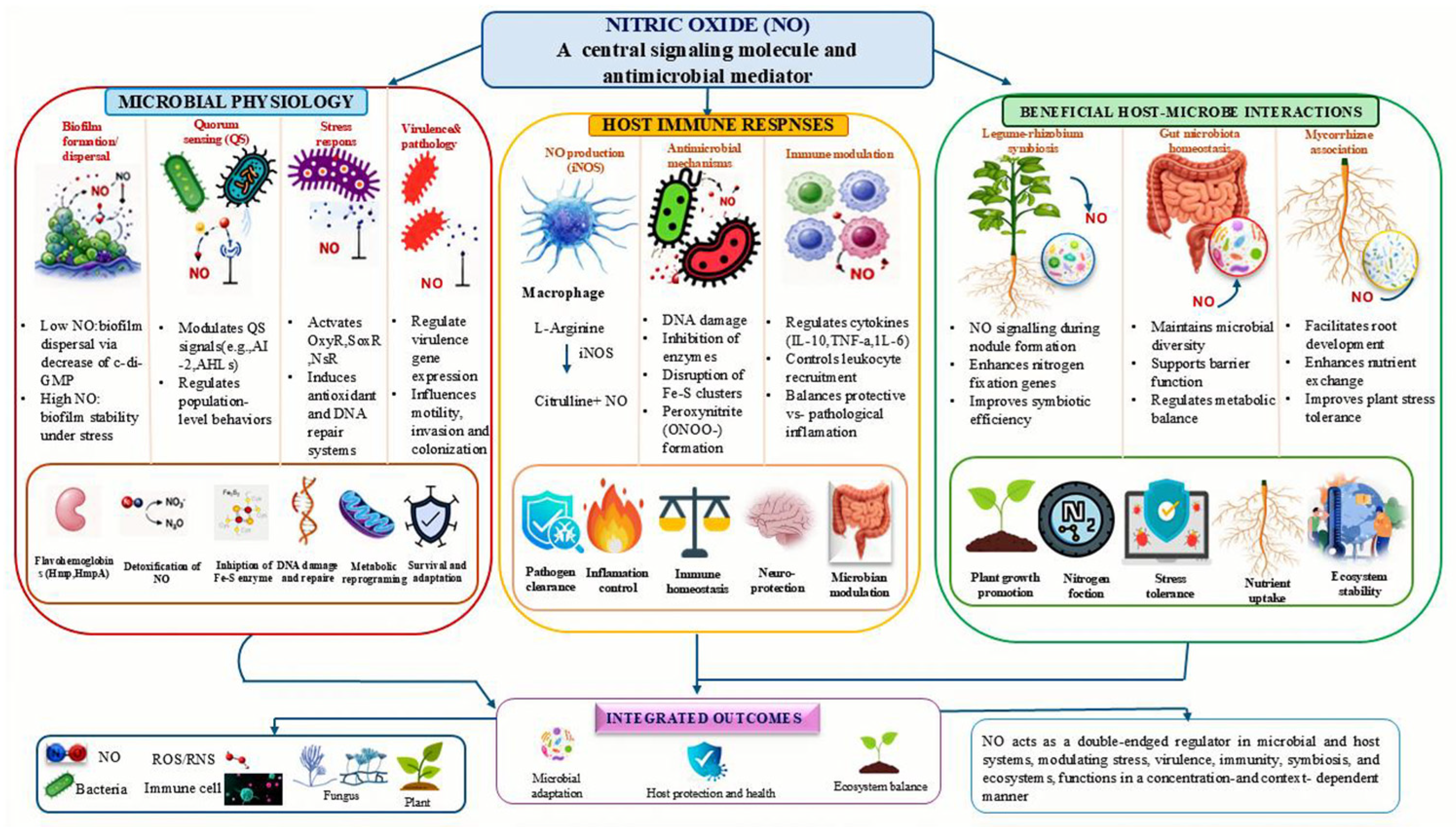
Overall, NO functions as a multidimensional regulator of host–microbe interactions by integrating antimicrobial defense, immune signaling, symbiotic communication, and microbiome dynamics [3,35]. These diverse and interconnected biological functions are summarized in Figure 1, which illustrates the central role of NO in microbial physiology, host immune responses, and beneficial host–microbe interactions, as well as their collective contributions to microbial adaptation, host protection, and ecosystem health. Understanding these interconnected processes is increasingly important for developing therapeutic approaches that manipulate NO signaling while preserving beneficial microbial relationships.
Figure 1.
Conceptual overview of the multifaceted roles of nitric oxide (NO) in microbial physiology, host immune responses, and beneficial host–microbe interactions. NO functions as a central signaling molecule and antimicrobial mediator that regulates biofilm dynamics, quorum sensing, stress responses, microbial virulence, immune defense, symbiotic communication, microbiome homeostasis, and ecosystem balance. The biological effects of NO are concentration- and context-dependent, integrating microbial adaptation, host protection, and environmental health.
4. Challenges in Nitric Oxide Detection in Microbial Systems
NO detection remains one of the most challenging aspects of microbial and host–microbe research because of the molecule’s unique physicochemical characteristics and the complexity of biological matrices. Unlike many signaling molecules, NO is highly reactive, freely diffusible, and exhibits an extremely short half-life, often ranging from milliseconds to seconds depending on local oxygen concentrations and redox conditions [15,36]. These properties make direct quantification difficult and frequently result in underestimation of biologically relevant NO fluctuations. Consequently, many conventional analytical approaches rely on the measurement of stable oxidation products such as nitrite and nitrate as indirect indicators of NO production [37]. While useful, these measurements provide only endpoint information and fail to capture the real-time spatial and temporal dynamics that often determine the biological functions of NO.
A second major challenge is analytical selectivity. Within microbial environments, NO coexists with numerous ROS and RNS, including superoxide (O2−), peroxynitrite (ONOO−), nitrogen dioxide (NO2), hydrogen peroxide (H2O2), and hydrogen sulfide (H2S). Many fluorescence- and chemiluminescence-based methods exhibit cross-reactivity with these molecules, generating overlapping signals that complicate accurate interpretation [38,39]. Such interference becomes particularly problematic in infection models, biofilms, and inflammatory microenvironments where multiple reactive species are simultaneously produced.
The complexity of biological matrices further limits detection accuracy. Proteins, lipids, extracellular polymeric substances, and cellular metabolites can interfere with sensor performance through adsorption, signal quenching, or nonspecific reactions [40]. For example, although the Griess assay remains one of the most widely used methods for NO determination, its reliance on nitrite detection makes it vulnerable to matrix effects and indirect estimation errors. Similarly, electrochemical sensors may experience electrode fouling, while fluorescent probes can suffer from photobleaching and background fluorescence.
Another frequently overlooked limitation is the introduction of sampling artifacts during specimen collection and processing. Factors such as oxygen exposure, temperature fluctuations, prolonged storage, freeze–thaw cycles, and delayed sample preparation can alter NO chemistry and promote interconversion among different nitrogen oxide species [41]. These procedural variables often contribute substantially to experimental variability and may explain inconsistencies reported across studies.
Importantly, no single analytical platform currently satisfies all requirements for NO measurement. Techniques with excellent sensitivity may lack temporal resolution, whereas methods capable of real-time monitoring may suffer from limited selectivity or long-term stability. Consequently, the choice of detection platform should be guided by the biological question being addressed. For example, electrochemical sensors are particularly valuable for continuous monitoring, whereas EPR spectroscopy offers superior molecular specificity, and fluorescence imaging provides spatial information at the cellular level.
Recent advances have focused on overcoming these limitations through nanomaterial-enhanced sensors, near-infrared fluorescent probes, microfluidic integration, and AI-assisted signal processing [42]. These developments are shifting the field from simple NO detection toward comprehensive NO monitoring platforms capable of integrating molecular sensing, real-time analytics, and predictive modeling. Such integration represents a major distinction between recent biosensing strategies and earlier detection methodologies, providing new opportunities for studying NO dynamics in complex microbial and host-associated ecosystems.
5. Biosensors for Nitric Oxide Detection
The development of biosensors for NO detection has progressed rapidly during the last decade, driven by the need for sensitive, selective, and real-time monitoring of NO in complex biological environments [43]. Unlike traditional analytical approaches that primarily provide endpoint measurements, biosensors enable continuous monitoring of NO dynamics and have become essential tools for investigating microbial physiology, host–microbe interactions, inflammation, and environmental microbiology. Furthermore, advances in materials science, nanotechnology, and microfabrication have significantly improved sensor performance, enabling NO detection at physiologically relevant concentrations and under increasingly complex biological conditions.
Among currently available technologies, electrochemical sensors remain the most extensively utilized platforms due to their rapid response times, high sensitivity, and compatibility with miniaturized devices. These sensors typically operate through amperometric or voltammetric detection of NO oxidation or reduction at electrode surfaces. Recent incorporation of nanomaterials, including gold nanoparticles, graphene derivatives, and carbon nanotubes, has substantially enhanced electron transfer efficiency and increased effective surface area, resulting in nanomolar or even sub-nanomolar detection limits [44]. Their capability for real-time monitoring makes them particularly suitable for studying dynamic NO production in microbial cultures and host tissues.
Optical biosensors provide complementary advantages through fluorescence- and chemiluminescence-based detection mechanisms [45]. Modern fluorescent probes, particularly near-infrared and ratiometric systems, have improved quantification accuracy while reducing background interference. Unlike electrochemical sensors, optical platforms offer high spatial resolution and enable visualization of NO distribution within cells, tissues, and biofilms. These characteristics make them especially valuable for mechanistic studies of NO signaling pathways and host–microbe communication. However, issues such as photobleaching, probe stability, and potential interference from other reactive species remain important considerations when selecting optical approaches.
Enzyme- and protein-based biosensors have also been developed, utilizing NO-sensitive proteins or enzymes as recognition elements. For instance, cytochrome c and other heme proteins exhibit conformational changes upon binding NO, which can be transduced into measurable signals [46]. These biosensors offer high specificity due to the selective binding properties of the biological recognition elements, making them valuable for applications where discrimination between NO and other RNS is critical.
The integration of microfluidics into NO sensing has led to the development of lab-on-a-chip platforms capable of analyzing small sample volumes with high precision [47]. These systems facilitate the study of NO production and consumption in controlled microenvironments, enabling the replication of physiological conditions and the investigation of NO’s role in microbial communities. Moreover, microfluidic platforms support high-throughput analyses and reduce reagent consumption, making them attractive for both research and diagnostic applications.
Wearable and implantable NO sensors have emerged for in vivo monitoring, particularly in host studies. Flexible, skin-integrated devices can non-invasively measure NO levels in sweat, providing insights into systemic inflammation and other physiological processes [48,49]. Implantable sensors offer the potential for continuous monitoring within specific tissues, aiding in the assessment of localized NO production during infections or in response to therapeutic interventions. These technologies represent an important step toward personalized monitoring and real-time assessment of NO-related physiological processes.
When evaluating NO biosensors, several performance parameters must be considered beyond sensitivity alone. Important performance indicators include the limit of detection (LOD), linear dynamic range, response time, selectivity toward common interfering species, operational stability, and compatibility with different biological matrices [50]. Because these characteristics vary considerably among sensing platforms, representative quantitative performance metrics can provide practical guidance for selecting appropriate technologies for specific research and clinical applications.
In summary, the past decade has witnessed substantial progress in the development of NO biosensors tailored for microbial and host systems. These advancements have enhanced our ability to detect and quantify NO with greater accuracy, sensitivity, and specificity, thereby deepening our understanding of NO physiology and host–microbe interactions. To facilitate technology selection, Table 1 compares the principal NO biosensor platforms using representative analytical performance metrics reported in the literature, including typical detection limits, linear dynamic ranges, response times, selectivity, operational stability, sample matrices, and representative references. Although these values may vary depending on sensor design and experimental conditions, they provide a practical benchmark for selecting suitable NO detection technologies for future applications.
Table 1.
Representative analytical performance of major biosensor platforms for nitric oxide detection in microbial and host systems.
6. Analytical Tools and Techniques for NO Quantification
Quantifying NO in biological systems is essential for understanding its diverse physiological and pathological functions. Because NO is highly reactive, diffusible, and short-lived, its accurate measurement remains technically challenging. Over the past decade, several analytical approaches have been developed and refined to improve detection sensitivity, specificity, and temporal resolution. These methods include spectrophotometric and fluorometric assays, electron paramagnetic resonance (EPR) spectroscopy, mass spectrometry, NO-sensitive dyes and fluorescent probes, and imaging-based detection techniques [56,57]. Each technique offers distinct advantages and limitations, making method selection highly dependent on the biological system under investigation, the desired analytical sensitivity, and the temporal and spatial information required.
Spectrophotometric assays, particularly the Griess reaction, remain among the most widely used methods for NO quantification because of their simplicity, affordability, and ease of implementation [58]. These assays indirectly estimate NO production by measuring its stable oxidation products, nitrite and nitrate. Although suitable for routine laboratory analyses and large-scale screening studies, they generally lack the sensitivity required for trace-level measurements and cannot provide real-time information regarding NO dynamics. Furthermore, interference from other RNS and matrix components may affect measurement accuracy, requiring careful experimental design and data interpretation.
Among direct detection methods, EPR spectroscopy is considered one of the most specific techniques because it exploits the unpaired electron present in NO molecules [59]. EPR enables direct identification and quantification of NO in complex biological matrices and has been widely applied in mechanistic studies investigating NO-mediated signaling pathways. However, the requirement for specialized instrumentation, extensive technical expertise, and relatively low sensitivity at physiologically relevant NO concentrations limits its widespread application. In addition, the transient nature of NO often necessitates the use of spin-trapping agents to stabilize detectable intermediates.
Mass spectrometry-based techniques, including gas chromatography–mass spectrometry (GC-MS) and liquid chromatography–tandem mass spectrometry (LC-MS/MS), provide exceptional sensitivity and molecular specificity for the analysis of NO and its related metabolites [60]. These approaches allow quantitative characterization of multiple NO-derived compounds simultaneously and are particularly valuable for metabolomic and biochemical investigations. Nevertheless, complex sample preparation procedures, high operational costs, and the inability to perform continuous real-time monitoring restrict their routine use in dynamic biological studies.
The development of NO-sensitive dyes and fluorescent probes has transformed NO research by enabling real-time detection and visualization in living systems [10]. Fluorescent probes, including diaminofluoresceins and metal-complex-based sensors, generate measurable optical signals upon interaction with NO, facilitating spatial and temporal analysis of NO production at cellular and subcellular levels. Recent advances in probe chemistry have improved sensitivity, selectivity, and resistance to background interference. Consequently, these probes have become indispensable tools for investigating NO-mediated signaling in microbial communities, host tissues, and host–microbe interactions.
Imaging-based detection techniques, including confocal microscopy and in vivo imaging platforms, further extend the capabilities of fluorescent NO detection by providing spatially resolved information on NO distribution within biological systems [61]. These approaches allow researchers to monitor NO dynamics in real time and to correlate NO production with specific physiological or pathological processes. However, challenges associated with photobleaching, probe cytotoxicity, signal attenuation, and limited tissue penetration continue to constrain their broader application, particularly in deep-tissue imaging studies.
A comparative assessment of currently available analytical tools reveals that no single technique is universally optimal for all applications. Traditional assays such as the Griess reaction remain valuable for routine quantification, whereas EPR and mass spectrometry provide greater specificity and analytical rigor. In contrast, fluorescent probes and imaging-based methods offer superior temporal and spatial resolution for studying dynamic NO signaling events. Consequently, the selection of an appropriate analytical strategy should be guided by the specific biological question, required sensitivity, sample complexity, and whether real-time monitoring is necessary. Increasingly, these analytical approaches are being integrated with advanced biosensor technologies and computational tools, creating opportunities for more comprehensive characterization of NO dynamics across microbial, environmental, and host-associated systems.
In summary, significant progress has been made in the analytical quantification of NO, with each technique contributing unique capabilities to the study of NO biology. Future developments will likely focus on combining high analytical sensitivity with real-time monitoring, improved selectivity, and integration with biosensing and data-driven analytical platforms to provide a more complete understanding of NO-mediated processes.
7. Statistical Approaches in NO Research
The increasing complexity of NO research, particularly in microbial communities and host–microbe systems, has generated large and multidimensional datasets that require advanced statistical and computational approaches for accurate interpretation [62]. Beyond traditional data analysis, modern statistical frameworks now play a central role in biosensor validation, signal processing, biomarker discovery, predictive modeling, and multi-omics integration. The combination of NO biosensing technologies with statistical and AI-assisted analytical tools represents one of the emerging directions in this field, enabling more reliable quantification and biological interpretation of NO dynamics. The principal statistical and computational approaches currently applied in NO research are summarized in Table 2.
7.1. Sensor Calibration: Linear Regression and Curve Fitting
Accurate calibration is fundamental for converting sensor outputs into reliable NO concentration measurements. Linear regression remains the most commonly used approach for establishing calibration curves between sensor responses and known NO standards [63,64]. These calibration models facilitate quantitative interpretation of sensor signals and provide essential parameters for evaluating sensor performance. However, many modern biosensors exhibit non-linear behavior at very low or high analyte concentrations. In such cases, polynomial, exponential, or logistic curve-fitting approaches are employed to improve calibration accuracy across broader dynamic ranges. Careful calibration is particularly important for nanomaterial-based and miniaturized biosensors, where small deviations can substantially affect NO quantification.
7.2. Limit of Detection and Limit of Quantification: Statistical Computation and Interpretation
Determination of the LOD and LOQ is essential for assessing the analytical sensitivity of NO detection platforms [65,66]. The LOD represents the lowest concentration distinguishable from background noise and is commonly calculated as three times the standard deviation of the blank signal divided by the slope of the calibration curve. Similarly, the LOQ is generally estimated as ten times the standard deviation of the blank signal divided by the calibration slope and defines the lowest concentration that can be measured with acceptable accuracy and precision. These parameters are particularly important when comparing biosensor platforms and selecting technologies for low-abundance NO measurements in microbial or clinical samples.
7.3. Comparing Treatment Effects: t-Tests and ANOVA
Statistical hypothesis testing remains a fundamental component of experimental NO research. Student’s t-tests are commonly used to compare NO levels between two experimental groups, whereas analysis of variance (ANOVA) enables simultaneous comparison among multiple treatments or environmental conditions [4,67]. These approaches are frequently applied to evaluate the effects of antimicrobial compounds, host immune responses, microbial stress conditions, or environmental perturbations on NO production. Appropriate post hoc analyses and corrections for multiple testing further improve the reliability of biological interpretations.
7.4. Multivariate Analysis: Principal Component Analysis and Partial Least Squares Discriminant Analysis for Microbial NO Profiling
Microbial NO datasets often involve multiple variables measured simultaneously, including metabolite concentrations, sensor outputs, gene expression profiles, and environmental parameters. Multivariate techniques such as principal component analysis (PCA) and partial least squares discriminant analysis (PLS-DA) provide powerful tools for extracting biologically meaningful patterns from such datasets [4,68]. PCA reduces data dimensionality and identifies dominant sources of variation, whereas PLS-DA enables supervised classification of predefined experimental groups. These approaches have become increasingly valuable for microbial NO profiling, biomarker discovery, and characterization of host–microbe interactions.
7.5. Receiver Operating Characteristic Curves in Evaluating Sensor Diagnostic Accuracy
Receiver operating characteristics (ROC) curve analysis is widely used to assess the diagnostic performance of NO biosensors and biomarker-based detection systems [69]. ROC curves evaluate the trade-off between sensitivity and specificity across different decision thresholds, while the area under the curve (AUC) provides a quantitative measure of overall diagnostic accuracy. In NO research, ROC analysis is particularly useful for validating biosensors intended for clinical diagnostics, infection monitoring, and environmental surveillance applications, where accurate discrimination between biological states is critical.
7.6. Machine Learning and Predictive Modeling in NO Signal Processing
Recent advances in biosensing technologies have generated increasingly large and complex datasets, creating opportunities for machine learning-assisted analysis. Algorithms such as artificial neural networks (ANNs), support vector machines (SVMs), and random forests (RF) have been applied to sensor calibration, signal denoising, NO concentration prediction, and identification of factors influencing NO production and consumption [70]. Compared with conventional statistical methods, machine learning approaches can capture complex non-linear relationships and interactions among variables. Their integration with NO biosensors represents a promising direction for real-time monitoring systems and automated interpretation of biological signals.
7.7. Bioinformatics Pipelines Integrating NO Data with Transcriptomics or Microbiome Studies
The growing availability of transcriptomic, metagenomic, metabolomic, and microbiome datasets has created opportunities to investigate NO biology within a systems-level framework [4,71,72]. Bioinformatics pipelines facilitate the integration of NO measurements with gene expression profiles, metabolic pathways, and microbial community composition. These approaches enable researchers to identify molecular determinants of NO production, characterize microbial responses to NO signaling, and uncover regulatory networks linking NO dynamics to host physiology and environmental processes. Such multi-omics integration is becoming increasingly important for understanding the complex roles of NO in microbial ecology, host–microbe interactions, and disease progression.
In summary, statistical and computational approaches have become indispensable components of modern NO research. Beyond conventional hypothesis testing, advanced analytical frameworks now support biosensor validation, multidimensional data exploration, machine learning-assisted prediction, and multi-omics integration. The convergence of NO biosensing technologies with statistical modeling and AI-driven analytics provides a distinctive and emerging direction that enhances the interpretation of complex biological datasets and strengthens the translational potential of NO research.
Table 2.
Key statistical and computational techniques applied to NO detection and analysis.
8. Application of NO Detection in Microbial and Host Systems
The ability to accurately detect and quantify NO has expanded its applications across diverse biological systems, ranging from clinical diagnostics and antimicrobial discovery to agriculture and environmental monitoring. Advances in biosensor technologies, analytical platforms, and computational tools have transformed NO from a fundamental signaling molecule into a practical biomarker and monitoring target. Importantly, the integration of sensitive NO detection systems with statistical and predictive analytical frameworks has enhanced the interpretation of NO dynamics in complex microbial and host-associated environments.
8.1. NO as a Biomarker in Infectious Disease Diagnostics
NO serves as important biomarker for assessing inflammatory and infectious processes in humans. One of the most established clinical applications is the measurement of fractional exhaled NO (FeNO), which provides a non-invasive indicator of airway inflammation. Elevated FeNO levels are strongly associated with Th2-mediated inflammatory responses and are routinely used for asthma diagnosis, phenotyping, and treatment monitoring [80]. Beyond respiratory disorders, alterations in exhaled NO profiles have also been associated with infectious diseases, including COVID-19, highlighting the potential of NO-based diagnostics for disease detection and monitoring [81]. As biosensor technologies continue to improve, real-time NO monitoring may further support precision medicine approaches and early disease detection.
8.2. Monitoring NO in Probiotics and Biofertilizer Performance
In agricultural systems, NO functions as a critical signaling molecule mediating plant–microbe interactions. Plant growth-promoting rhizobacteria (PGPR)-based biofertilizers stimulate plant growth, nutrient acquisition, and stress tolerance, partly through NO-dependent signaling pathways [82]. Consequently, monitoring NO production can provide valuable information regarding biofertilizer performance and microbial activity within the rhizosphere. Furthermore, increasing use of engineered nanomaterials in agriculture has raised concerns regarding their potential impacts on beneficial microbial communities and NO-mediated signaling processes [83]. Quantitative NO monitoring therefore offers an important tool for evaluating both biofertilizer efficacy and environmental safety. Key applications of NO detection across microbial and host systems are summarized in Table 3.
8.3. Screening of Antimicrobial Compounds Using NO Biosensors
The broad-spectrum antimicrobial properties of NO have stimulated significant interest in NO-releasing therapeutics and antimicrobial delivery systems. Biosensors capable of real-time NO detection provide valuable platforms for evaluating release kinetics, dosage optimization, and biological efficacy of candidate antimicrobial compounds [84]. Compared with conventional endpoint assays, NO biosensors enable continuous monitoring of antimicrobial performance, facilitating rapid screening of novel therapeutics and improving understanding of NO-mediated antimicrobial mechanisms.
8.4. Real-Time Monitoring of NO During Symbiosis and Infection
Real-time monitoring of NO dynamics is essential for understanding both beneficial and pathogenic host–microbe interactions [3,85]. In symbiotic systems such as the interaction between Medicago truncatula and Sinorhizobium meliloti, tightly regulated NO production contributes to successful establishment and maintenance of symbiosis [86]. Similarly, NO plays important roles during infection processes by influencing microbial virulence, host defense responses, and immune signaling. Advanced sensing technologies, including graphene–heme-based field-effect transistor sensors, have enabled highly sensitive real-time measurements of NO, providing unprecedented insights into the temporal dynamics of these biological interactions.
8.5. Environmental NO Monitoring in Soil and Water Microbiomes
NO is an important intermediate in microbial nitrogen cycling and contributes significantly to atmospheric nitrogen fluxes. Microbial processes such as nitrification and denitrification generate NO, with production rates influenced by nutrient availability, oxygen levels, soil moisture, and microbial community composition [87]. Continuous monitoring of NO emissions in soil and aquatic ecosystems provides valuable information regarding nutrient cycling, ecosystem health, and greenhouse gas dynamics. Recent advances in sensor technology have enabled long-term field measurements, improving our understanding of microbial contributions to environmental NO fluxes.
8.6. Integration of Sensor Data with Ecological/Biological Models
The increasing availability of high-resolution NO datasets has created opportunities to integrate sensor-derived measurements with ecological and biological modeling approaches. Combining NO monitoring data with microbiome profiles, environmental variables, and ecosystem parameters can reveal complex relationships between microbial activity, community structure, and biogeochemical processes [88]. Such integrative frameworks support predictive modeling of ecosystem responses to environmental change and demonstrate how NO biosensing can contribute to broader systems-level analyses. This integration of biosensing technologies with statistical and computational approaches represents one of the emerging directions that distinguishes current NO research from earlier descriptive studies.
In summary, NO detection technologies have evolved beyond simple measurement tools and now serve as essential components of clinical diagnostics, agricultural management, antimicrobial development, symbiosis research, and environmental monitoring. The combination of advanced biosensors with statistical, computational, and ecological modeling approaches continues to expand the scope and impact of NO research across microbial and host systems.
Table 3.
Representative applications of NO detection across microbial and host systems.
9. Future Perspectives
The future of NO detection is moving beyond improvements in analytical sensitivity alone toward the development of integrated sensing and data-analysis platforms capable of providing biologically meaningful information in real time. Advances in biosensor engineering, microfabrication, AI, and multi-omics technologies are expected to transform how NO is measured, interpreted, and applied across microbial, environmental, and clinical systems. Several emerging directions are likely to shape the next generation of NO research and applications.
9.1. Miniaturized, Real-Time, In Vivo NO Detection
Recent progress in nanotechnology and microfabrication has enabled the development of highly miniaturized sensors capable of real-time, in vivo NO monitoring. These devices offer improved spatial and temporal resolution, allowing researchers to investigate localized NO dynamics within tissues, microbial biofilms, and host–microbe interfaces. Future developments are expected to focus on improving sensitivity at physiologically relevant concentrations while minimizing invasiveness and signal interference. Such technologies will facilitate a deeper understanding of NO-mediated processes in health, disease, and microbial ecology.
9.2. Integration of NO Sensors in Wearable and Implantable Platforms
Wearable and implantable sensing technologies represent an important frontier in continuous NO monitoring. Wearable devices capable of measuring NO in breath, sweat, or skin-associated fluids may provide non-invasive indicators of inflammatory, respiratory, and cardiovascular conditions. Implantable sensors could enable continuous monitoring of tissue-specific NO dynamics during infection, wound healing, or therapeutic interventions. Future research should focus on improving biocompatibility, long-term stability, antifouling performance, and wireless communication capabilities to facilitate clinical translation and personalized healthcare applications.
9.3. Combining NO Biosensing with Multi-Omics and Imaging
The integration of NO biosensing with transcriptomics, proteomics, metabolomics, and microbiome profiling offers exciting opportunities for systems-level investigations of NO biology. Coupling real-time NO measurements with fluorescence imaging, confocal microscopy, and advanced molecular analyses can reveal how NO influences cellular signaling networks, microbial community interactions, and host responses. Such multi-dimensional datasets will enable a more comprehensive understanding of NO-mediated biological processes and may facilitate the discovery of novel biomarkers and therapeutic targets.
9.4. AI-Driven NO Interpretation for Complex Host–Microbe Systems
As NO sensing technologies generate increasingly large and complex datasets, AI and machine-learning approaches are expected to play an increasingly important role in data interpretation. Advanced computational models can identify hidden patterns, classify biological states, predict NO fluctuations, and integrate information from multiple sensing modalities. In host–microbe systems, AI-driven analyses may reveal previously unrecognized relationships between microbial communities, immune responses, and NO signaling networks. The convergence of biosensing, machine learning, and predictive analytics therefore represents one of the most promising directions for future NO research.
9.5. Development of NO Sensor Standards and Reproducibility Benchmarks
Despite substantial technological progress, the lack of standardized protocols remains a major challenge in the NO sensing field. Differences in calibration procedures, sample preparation methods, sensor architectures, and reporting metrics often complicate comparisons among studies. Establishing reproducibility benchmarks and standardized performance criteria, including sensitivity, specificity, response time, operational stability, and selectivity against common interferents, will be essential for advancing both research and practical applications. Such standardization efforts will facilitate regulatory approval, improve data comparability, and accelerate the adoption of NO sensing technologies across clinical, environmental, and agricultural sectors.
In summary, the future of NO detection lies in the convergence of advanced biosensors, multi-omics technologies, imaging platforms, AI-assisted analytics, and standardized validation frameworks. These developments will not only improve measurement accuracy but also enhance our ability to interpret NO dynamics within increasingly complex biological systems.
10. Conclusions
NO has emerged as a multifunctional signaling molecule that plays fundamental roles in microbial physiology, host defense, and host–microbe interactions. In microbial systems, NO regulates diverse biological processes including metabolism, stress adaptation, biofilm development, QS, and virulence. Within host organisms, NO contributes to innate immunity, inflammatory regulation, microbiome homeostasis, and beneficial symbiotic interactions. Despite its biological importance, accurate NO quantification remains challenging because of its short half-life, high diffusibility, and susceptibility to interference from other reactive oxygen and nitrogen species.
Substantial advances in analytical methodologies and biosensor technologies have significantly improved the ability to detect and monitor NO in complex biological environments. Electrochemical, optical, enzyme-based, microfluidic, wearable, and implantable sensing platforms now provide opportunities for real-time and highly sensitive NO measurements across diverse applications. These technological developments have expanded the utility of NO detection beyond fundamental research to include clinical diagnostics, environmental monitoring, antimicrobial screening, and agricultural management.
A central theme emerging from this review is that advances in NO sensing technologies are increasingly linked with developments in statistical analysis, machine learning, and systems biology. Modern NO research extends beyond measurement alone and increasingly relies on computational frameworks for sensor validation, signal processing, biomarker discovery, predictive modeling, and integration with transcriptomic and microbiome datasets. The combination of biosensing platforms with advanced analytical and AI-driven approaches provides new opportunities for interpreting complex biological information and represents an important evolution in the field.
Importantly, this review highlights how the integration of NO biosensing technologies with statistical and computational methodologies can bridge traditionally separate disciplines, including microbiology, analytical chemistry, bioengineering, and data science. Such interdisciplinary approaches are becoming essential for understanding NO dynamics within increasingly complex microbial and host-associated systems.
Looking forward, continued progress in miniaturized sensors, wearable and implantable devices, multi-omics integration, advanced imaging, and AI-assisted data interpretation is expected to further transform NO research. Equally important will be the establishment of standardized performance benchmarks and reproducibility guidelines that facilitate comparison among technologies and accelerate practical implementation.
In conclusion, NO research is entering a new era characterized by the convergence of biosensor engineering, analytical innovation, and computational intelligence. By integrating these complementary approaches, future studies will be better positioned to elucidate the multifaceted roles of NO in microbial ecology, infectious disease, environmental processes, and human health, ultimately expanding its value as a biomarker, signaling molecule, and therapeutic target.
Author Contributions
Conceptualization and writing—original draft preparation, T.N.I.A.A., H.F.H.A.-H. and M.K.; writing—review and editing and supervision, M.K. All authors have read and agreed to the published version of the manuscript.
Funding
This research received no external funding.
Data Availability Statement
No new data were created or analyzed in this study.
Conflicts of Interest
The authors declare no conflicts of interest.
References
- Kaviraj, M.; Kumar, U.; Snigdha, A.; Chatterjee, S. Nitrate reduction to ammonium: A phylogenetic, physiological, and genetic aspects in Prokaryotes and eukaryotes. Arch. Microbiol. 2024, 206, 297. [Google Scholar] [CrossRef] [Scilit] [PubMed]
- Al Azzawi, T.N.; Khan, M.; Mun, B.-G.; Lee, S.-U.; Imran, M.; Hussain, A.; Rolly, N.K.; Lee, D.-S.; Ali, S.; Lee, I.-J. Enhanced Resistance of atnigr1 against Pseudomonas syringae pv. tomato Suggests Negative Regulation of Plant Basal Defense and Systemic Acquired Resistance by AtNIGR1 Encoding NAD (P)-Binding Rossmann-Fold in Arabidopsis thaliana. Antioxidants 2023, 12, 989. [Google Scholar] [CrossRef] [Scilit] [PubMed]
- Pande, A.; Mun, B.-G.; Lee, D.-S.; Khan, M.; Lee, G.-M.; Hussain, A.; Yun, B.-W. No network for plant–microbe communication underground: A review. Front. Plant Sci. 2021, 12, 658679. [Google Scholar] [CrossRef] [Scilit] [PubMed]
- Al-Hakeem, H.F.H.; Khan, M. The role of statistics in advancing nitric oxide research in plant biology: From data analysis to mechanistic insights. Front. Plant Sci. 2025, 16, 1597030. [Google Scholar] [CrossRef] [Scilit] [PubMed]
- Fujii, J.; Osaki, T. Involvement of nitric oxide in protecting against radical species and autoregulation of M1-polarized macrophages through metabolic remodeling. Molecules 2023, 28, 814. [Google Scholar] [CrossRef] [Scilit] [PubMed]
- Pathak, P.K.; Yadav, N.; Kaladhar, V.C.; Jaiswal, R.; Kumari, A.; Igamberdiev, A.U.; Loake, G.J.; Gupta, K.J. The emerging roles of nitric oxide and its associated scavengers—Phytoglobins—In plant symbiotic interactions. J. Exp. Bot. 2024, 75, 563–577. [Google Scholar] [PubMed]
- Tian, Y.; Tian, X.; Li, T.; Wang, W. Overview of the effects and mechanisms of NO and its donors on biofilms. Crit. Rev. Food Sci. Nutr. 2025, 65, 647–666. [Google Scholar] [PubMed]
- Guo, K.; Gao, H. Physiological roles of nitrite and nitric oxide in bacteria: Similar consequences from distinct cell targets, protection, and sensing systems. Adv. Biol. 2021, 5, 2100773. [Google Scholar] [CrossRef] [Scilit] [PubMed]
- Khan, M.; Al Azawi, T.N.I.; Pande, A.; Mun, B.-G.; Lee, D.-S.; Hussain, A.; Lee, B.-H.; Yun, B.-W. The role of nitric oxide-induced ATILL6 in growth and disease resistance in Arabidopsis thaliana. Front. Plant Sci. 2021, 12, 685156. [Google Scholar] [CrossRef] [Scilit] [PubMed]
- Paul, S.; Pan, S.; Mukherjee, A.; De, P. Nitric oxide releasing delivery platforms: Design, detection, biomedical applications, and future possibilities. Mol. Pharm. 2021, 18, 3181–3205. [Google Scholar] [CrossRef] [Scilit] [PubMed]
- Apak, R.; Calokerinos, A.; Gorinstein, S.; Segundo, M.A.; Hibbert, D.B.; Gülçin, İ.; Demirci Çekiç, S.; Güçlü, K.; Özyürek, M.; Çelik, S.E. Methods to evaluate the scavenging activity of antioxidants toward reactive oxygen and nitrogen species (IUPAC Technical Report). Pure Appl. Chem. 2022, 94, 87–144. [Google Scholar]
- Milam-Guerrero, J.; Yang, B.; To, D.T.; Myung, N.V. Nitrous oxide is no laughing matter: A historical review of nitrous oxide gas-sensing capabilities highlighting the need for further exploration. ACS Sens. 2022, 7, 3598–3610. [Google Scholar] [CrossRef] [Scilit] [PubMed]
- Kulkarni, M.B.; Ayachit, N.H.; Aminabhavi, T.M. Recent advancements in nanobiosensors: Current trends, challenges, applications, and future scope. Biosensors 2022, 12, 892. [Google Scholar] [CrossRef] [Scilit] [PubMed]
- Almeida, B.; Rogers, K.E.; Nag, O.K.; Delehanty, J.B. Sensing nitric oxide in cells: Historical technologies and future outlook. ACS Sens. 2021, 6, 1695–1703. [Google Scholar] [CrossRef] [Scilit] [PubMed]
- Khan, M.; Ali, S.; Al Azzawi, T.N.I.; Saqib, S.; Ullah, F.; Ayaz, A.; Zaman, W. The key roles of ROS and RNS as a signaling molecule in plant–microbe interactions. Antioxidants 2023, 12, 268. [Google Scholar] [CrossRef] [Scilit] [PubMed]
- Chen, J.; Liu, L.; Wang, W.; Gao, H. Nitric oxide, nitric oxide formers and their physiological impacts in bacteria. Int. J. Mol. Sci. 2022, 23, 10778. [Google Scholar] [CrossRef] [Scilit] [PubMed]
- Jiang, Z.; Guan, J.; Liu, T.; Shangguan, C.; Xu, M.; Rao, Z. The flavohaemoprotein hmp maintains redox homeostasis in response to reactive oxygen and nitrogen species in Corynebacterium glutamicum. Microb. Cell Factories 2023, 22, 158. [Google Scholar] [CrossRef] [Scilit] [PubMed]
- Rajendrasozhan, S. Bacterial redox response factors in the management of environmental oxidative stress. World J. Microbiol. Biotechnol. 2023, 39, 11. [Google Scholar]
- Stephens, A.C.; Richardson, A.R. Recent developments in our understanding of the physiology and nitric oxide-resistance of Staphylococcus aureus. Adv. Microb. Physiol. 2022, 81, 111–135. [Google Scholar] [CrossRef] [Scilit] [PubMed]
- Bridges, A.A.; Prentice, J.A.; Wingreen, N.S.; Bassler, B.L. Signal transduction network principles underlying bacterial collective behaviors. Annu. Rev. Microbiol. 2022, 76, 235–257. [Google Scholar] [CrossRef] [Scilit] [PubMed]
- Naoun, A.A.; Raphael, I.; Forsthuber, T.G. Immunoregulation via cell density and quorum sensing-like mechanisms: An underexplored emerging field with potential translational implications. Cells 2022, 11, 2442. [Google Scholar] [CrossRef] [Scilit] [PubMed]
- Lee-Lopez, C.; Islam, M.S.; Meléndez, A.B.; Yukl, E.T. Influence of the Heme Nitric Oxide/Oxygen Binding Protein (H-NOX) on Cell Cycle Regulation in Caulobacter crescentus. Mol. Cell. Proteom. 2023, 22, 100679. [Google Scholar] [CrossRef] [Scilit] [PubMed]
- Webster, C.M.; Shepherd, M. The nitric oxide paradox: Antimicrobial and inhibitor of antibiotic efficacy. Emerg. Top. Life Sci. 2023, 8, 37–43. [Google Scholar] [CrossRef] [Scilit] [PubMed]
- Kundu, M.; Basu, J. Applications of transcriptomics and proteomics for understanding dormancy and resuscitation in Mycobacterium tuberculosis. Front. Microbiol. 2021, 12, 642487. [Google Scholar] [CrossRef] [Scilit] [PubMed]
- Chug, M.K.; Brisbois, E.J. Recent developments in multifunctional antimicrobial surfaces and applications toward advanced nitric oxide-based biomaterials. ACS Mater. Au 2022, 2, 525–551. [Google Scholar] [CrossRef] [Scilit] [PubMed]
- Andrés, C.M.C.; Pérez de la Lastra, J.M.; Juan, C.A.; Plou, F.J.; Pérez-Lebeña, E. The role of reactive species on innate immunity. Vaccines 2022, 10, 1735. [Google Scholar] [CrossRef] [Scilit] [PubMed]
- Agashe, P.S. The Nature of the Synergistic Lethality of Nitric Oxide and Hydrogen Peroxide in Escherichia coli and Its Effect on Chromosome Fragmentation. Doctoral Dissertation, University of Illinois at Urbana-Champaign, Urbana, IL, USA, 2022. [Google Scholar]
- Beas, J.Z.; Folgosa, F.; Karavaeva, V.; Sousa, F.L.; Saraiva, L.M. A novel type of hemoglobin confers host-derived nitric oxide resistance to the opportunistic pathogen Acinetobacter baumannii. Sci. Rep. 2025, 15, 5969. [Google Scholar] [CrossRef] [Scilit] [PubMed]
- Nathan, C.; Shiloh, M.U. Reactive oxygen and nitrogen intermediates in the relationship between mammalian hosts and microbial pathogens. Proc. Natl. Acad. Sci. USA 2000, 97, 8841–8848. [Google Scholar] [CrossRef] [Scilit] [PubMed]
- Stern, A.M.; Zhu, J. An introduction to nitric oxide sensing and response in bacteria. Adv. Appl. Microbiol. 2014, 87, 187–220. [Google Scholar] [CrossRef] [Scilit] [PubMed]
- Abd-Alla, M.H.; Al-Amri, S.M.; El-Enany, A.-W.E. Enhancing rhizobium–legume symbiosis and reducing nitrogen fertilizer use are potential options for mitigating climate change. Agriculture 2023, 13, 2092. [Google Scholar] [CrossRef] [Scilit]
- Bailey, J.D.; Diotallevi, M.; Nicol, T.; McNeill, E.; Shaw, A.; Chuaiphichai, S.; Hale, A.; Starr, A.; Nandi, M.; Stylianou, E. Nitric oxide modulates metabolic remodeling in inflammatory macrophages through TCA cycle regulation and itaconate accumulation. Cell Rep. 2019, 28, 218–230.e7. [Google Scholar] [CrossRef] [Scilit] [PubMed]
- da Costa Sousa, M.G.; Xavier, P.D.; de Freitas Lima, S.M.; de Almeida, J.A.; Franco, O.L.; Rezende, T.M.B. Enterococcus faecalis and Staphylococcus aureus stimulate nitric oxide production in macrophages and fibroblasts in vitro. Braz. J. Oral Sci. 2020, 19, e207039. [Google Scholar] [CrossRef] [Scilit]
- Kim, H.; Lee, D.G. Nitric oxide–inducing Genistein elicits apoptosis-like death via an intense SOS response in Escherichia coli. Appl. Microbiol. Biotechnol. 2020, 104, 10711–10724. [Google Scholar] [CrossRef] [Scilit] [PubMed]
- Pande, A.; Mun, B.G.; Rahim, W.; Khan, M.; Lee, D.S.; Lee, G.M.; Al Azzawi, T.N.I.; Hussain, A.; Kim, C.K.; Yun, B.W. Phytohormonal regulation through protein s-nitrosylation under stress. Front. Plant Sci. 2022, 13, 865542. [Google Scholar] [CrossRef] [Scilit] [PubMed]
- Csonka, C.; Páli, T.; Bencsik, P.; Görbe, A.; Ferdinandy, P.; Csont, T. Measurement of NO in biological samples. Br. J. Pharmacol. 2015, 172, 1620–1632. [Google Scholar] [PubMed]
- Schreiber, F.; Wunderlin, P.; Udert, K.M.; Wells, G.F. Nitric oxide and nitrous oxide turnover in natural and engineered microbial communities: Biological pathways, chemical reactions, and novel technologies. Front. Microbiol. 2012, 3, 372. [Google Scholar] [CrossRef] [Scilit] [PubMed]
- Li, B.; Kim, Y.L.; Lippert, A.R. Chemiluminescence measurement of reactive sulfur and nitrogen species. Antioxid. Redox Signal. 2022, 36, 337–353. [Google Scholar] [CrossRef] [Scilit] [PubMed]
- Jiao, S.; Yang, S.; Wang, Y.; Ma, A. A high-selectivity NIR fluorescent probe for detection of nitric oxide in saliva samples and living cells imaging. Sens. Actuators B Chem. 2023, 374, 132790. [Google Scholar] [CrossRef] [Scilit]
- Veronico, V.; Favia, P.; Fracassi, F.; Gristina, R.; Sardella, E. Validation of colorimetric assays for hydrogen peroxide, nitrate and nitrite ions in complex plasma-treated water solutions. Plasma Processes Polym. 2021, 18, 2100062. [Google Scholar] [CrossRef] [Scilit]
- Liu, T.; Zhang, M.; Duot, A.; Mukosera, G.; Schroeder, H.; Power, G.G.; Blood, A.B. Artifacts introduced by sample handling in chemiluminescence assays of nitric oxide metabolites. Antioxidants 2023, 12, 1672. [Google Scholar] [CrossRef] [Scilit] [PubMed]
- Liu, S.; Dong, W.; Gao, H.-q.; Song, Z.; Cheng, Z. Near-Infrared-II Fluorescent Probes for Analytical Applications: From In Vitro Detection to In Vivo Imaging Monitoring. Acc. Chem. Res. 2025, 58, 115063–115639. [Google Scholar] [CrossRef] [Scilit] [PubMed]
- Chen, X.J.; Wang, B.; Thompson, I.P.; Huang, W.E. Rational design and characterization of nitric oxide biosensors in E. coli Nissle 1917 and mini SimCells. ACS Synth. Biol. 2021, 10, 2566–2578. [Google Scholar] [CrossRef] [Scilit] [PubMed]
- Wenninger, N.; Bračič, U.; Kollau, A.; Pungjunun, K.; Leitinger, G.; Kalcher, K.; Ortner, A. Development of an electrochemical sensor for nitric oxide based on carbon paste electrode modified with Nafion, gold nanoparticles and graphene nanoribbons. Sens. Actuators B Chem. 2021, 346, 130532. [Google Scholar] [CrossRef] [Scilit]
- Deshpande, K.; Kanungo, L. Chemiluminescence and fluorescence biosensors for food application: A review. Sens. Actuators Rep. 2023, 5, 100137. [Google Scholar] [CrossRef] [Scilit]
- Liu, M.; Yang, W.; Zhu, W.; Yu, D. Innovative applications and research advances of bacterial biosensors in medicine. Front. Microbiol. 2025, 16, 1507491. [Google Scholar] [CrossRef] [Scilit] [PubMed]
- Catini, A.; Capuano, R.; Tancredi, G.; Dionisi, G.; Di Giuseppe, D.; Filippi, J.; Martinelli, E.; Di Natale, C. A lab-on-a-chip based automatic platform for continuous nitrites sensing in aquaculture. Sensors 2022, 22, 444. [Google Scholar] [CrossRef] [Scilit] [PubMed]
- Xu, C. Electronic Skin in Robotics and Healthcare: Towards Multimodal Sensing and Intelligent Analysis; California Institute of Technology: Pasadena, CA, USA, 2024. [Google Scholar]
- Cha, K.H.; Wang, X.; Meyerhoff, M.E. Nitric oxide release for improving performance of implantable chemical sensors–A review. Appl. Mater. Today 2017, 9, 589–597. [Google Scholar] [CrossRef] [Scilit] [PubMed]
- Wang, J.; Zhan, G.; Yang, X.; Zheng, D.; Li, X.; Zhang, L.; Huang, T.; Wang, X. Rapid detection of nitrite based on nitrite-oxidizing bacteria biosensor and its application in surface water monitoring. Biosens. Bioelectron. 2022, 215, 114573. [Google Scholar] [CrossRef] [Scilit] [PubMed]
- Liu, Y.-C.; Cui, S.-Q.; Zhao, J.; Yang, Z.-S. Direct electrochemistry behavior of cytochrome c/l-cysteine modified electrode and its electrocatalytic oxidation to nitric oxide. Bioelectrochemistry 2007, 70, 416–420. [Google Scholar] [CrossRef] [Scilit] [PubMed]
- Zhang, Y.; Liu, Y. Advances in integrated digital microfluidic platforms for point-of-care diagnosis: A review. Sens. Diagn. 2022, 1, 648–672. [Google Scholar] [CrossRef] [Scilit]
- He, W.; Wang, C.; Wang, H.; Jian, M.; Lu, W.; Liang, X.; Zhang, X.; Yang, F.; Zhang, Y. Integrated textile sensor patch for real-time and multiplex sweat analysis. Sci. Adv. 2019, 5, eaax0649. [Google Scholar] [CrossRef] [Scilit] [PubMed]
- Xu, Y.; Zhang, J.; Ray, W.Z.; MacEwan, M.R. Implantable and semi-implantable biosensors for minimally invasive disease diagnosis. Processes 2024, 12, 1535. [Google Scholar] [CrossRef] [Scilit]
- Wang, X.; Xia, Z.; Fodjo, E.K.; Deng, W.; Li, D. A dual-responsive nanozyme sensor with ultra-high sensitivity and ultra-low cross-interference towards metabolic biomarker monitoring. J. Mater. Chem. B 2022, 10, 3023–3031. [Google Scholar] [CrossRef] [Scilit] [PubMed]
- Vidanapathirana, A.K.; Psaltis, P.J.; Bursill, C.A.; Abell, A.D.; Nicholls, S.J. Cardiovascular bioimaging of nitric oxide: Achievements, challenges, and the future. Med. Res. Rev. 2021, 41, 435–463. [Google Scholar] [PubMed]
- Song, L.; Bai, H.; Liu, C.; Gong, W.; Wang, A.; Wang, L.; Zhao, Y.; Zhao, X.; Wang, H. Synthesis, biomacromolecular interactions, photodynamic NO releasing and cellular imaging of two [RuCl (qn)(Lbpy)(NO)] X complexes. Molecules 2021, 26, 2545. [Google Scholar] [CrossRef] [Scilit] [PubMed]
- Brizzolari, A.; Dei Cas, M.; Cialoni, D.; Marroni, A.; Morano, C.; Samaja, M.; Paroni, R.; Rubino, F.M. High-throughput griess assay of nitrite and nitrate in plasma and red blood cells for human physiology studies under extreme conditions. Molecules 2021, 26, 4569. [Google Scholar] [CrossRef] [Scilit] [PubMed]
- BEŠIĆ, E.; Rajić, Z.; Šakić, D. Advancements in electron paramagnetic resonance (EPR) spectroscopy: A comprehensive tool for pharmaceutical research. Acta Pharm. 2024, 74, 551–594. [Google Scholar] [CrossRef] [Scilit] [PubMed]
- Herz, M.M.; Gad, M.Z.; Hanafi, R.S. Development and validation of a bioanalytical method for the quantification of nitrated fatty acids in plasma using LC-MS/MS: Application to cardiovascular patients. Separations 2023, 10, 87. [Google Scholar] [CrossRef] [Scilit]
- Yoon, S.; Cheon, S.Y.; Park, S.; Lee, D.; Lee, Y.; Han, S.; Kim, M.; Koo, H. Recent advances in optical imaging through deep tissue: Imaging probes and techniques. Biomater. Res. 2022, 26, 57. [Google Scholar] [CrossRef] [Scilit] [PubMed]
- Valsecchi, C.; Winterton, D.; Fakhr, B.S.; Collier, A.-r.Y.; Nozari, A.; Ortoleva, J.; Mukerji, S.; Gibson, L.E.; Carroll, R.W.; Shaefi, S. High-dose inhaled nitric oxide for the treatment of spontaneously breathing pregnant patients with severe coronavirus disease 2019 (COVID-19) pneumonia. Obstet. Gynecol. 2022, 140, 195–203. [Google Scholar] [CrossRef] [Scilit] [PubMed]
- Han, Y.-Y.; Yue, M.; Rosser, F.; Gaietto, K.; Chen, W.; Celedon, J. Characteristics of T2-low and T2-high Childhood Asthma in a Population-based Study. Am. J. Respir. Crit. Care Med. 2025, 211, A4230. [Google Scholar] [CrossRef] [Scilit]
- Ambrosino, P.; Fuschillo, S.; Accardo, M.; Mosella, M.; Molino, A.; Spedicato, G.A.; Motta, A.; Maniscalco, M. Fractional exhaled nitric oxide (FeNO) in patients with stable chronic obstructive pulmonary disease: Short-term variability and potential clinical implications. J. Pers. Med. 2022, 12, 1906. [Google Scholar] [CrossRef] [Scilit] [PubMed]
- Gegenschatz, S.A.; Chiappini, F.A.; Teglia, C.M.; de la Peña, A.M.; Goicoechea, H.C. Binding the gap between experiments, statistics, and method comparison: A tutorial for computing limits of detection and quantification in univariate calibration for complex samples. Anal. Chim. Acta 2022, 1209, 339342. [Google Scholar] [CrossRef] [Scilit] [PubMed]
- Lu, C.; Liao, S.; Chen, B.; Xu, L.; Wu, N.; Lu, D.; Kang, H.; Zhang, X.-B.; Song, G. Responsive probes for in vivo magnetic resonance imaging of nitric oxide. Nat. Mater. 2025, 24, 133–142. [Google Scholar] [PubMed]
- Houston, M.; Chen, C.; D’Adamo, C.R.; Papathanassiu, A.E.; Green, S.J. Effects of S-Allylcysteine-Rich Garlic Extract and Dietary Inorganic Nitrate Formula on Blood Pressure and Salivary Nitric Oxide: An Open-Label Clinical Trial Among Hypertensive Subjects. Cureus 2023, 15, e45369. [Google Scholar] [PubMed]
- Zhou, Y.; Yu, X.; Nicely, A.; Cunningham, G.; Challa, C.; McKinley, K.; Nickel, R.; Campbell, A.; Darbari, D.; Summar, M. Amino acid signature during sickle cell pain crisis shows significant alterations related to nitric oxide and energy metabolism. Mol. Genet. Metab. 2022, 137, 146–152. [Google Scholar] [CrossRef] [Scilit] [PubMed]
- Razavi-Termeh, S.V.; Sadeghi-Niaraki, A.; Choi, S.-M. Spatial modeling of asthma-prone areas using remote sensing and ensemble machine learning algorithms. Remote Sens. 2021, 13, 3222. [Google Scholar] [CrossRef] [Scilit]
- Pietrenko-Dabrowska, A.; Koziel, S.; Wojcikowski, M.; Pankiewicz, B.; Rydosz, A.; Cao, T.-V.; Wojtkiewicz, K. Cost-Efficient measurement platform and machine-learning-based sensor calibration for precise NO2 pollution monitoring. Measurement 2024, 237, 115168. [Google Scholar] [CrossRef] [Scilit]
- Palmieri, M.C.; Sell, S.; Huang, X.; Scherf, M.; Werner, T.; Durner, J.; Lindermayr, C. Nitric oxide-responsive genes and promoters in Arabidopsis thaliana: A bioinformatics approach. J. Exp. Bot. 2008, 59, 177–186. [Google Scholar] [CrossRef] [Scilit] [PubMed]
- Shah, S.; Chen, C.; Sun, Y.; Wang, D.; Nawaz, T.; El-Kahtany, K.; Fahad, S. Mechanisms of nitric oxide involvement in plant-microbe interaction and its enhancement of stress resistance. Plant Stress 2023, 10, 100191. [Google Scholar] [CrossRef] [Scilit]
- Han, J.; Li, H.; Cheng, J.; Ma, X.; Fu, Y. Advances in metal oxide semiconductor gas sensor arrays based on machine learning algorithms. J. Mater. Chem. C 2025, 13, 4285–4303. [Google Scholar] [CrossRef] [Scilit]
- Armbruster, D.A.; Pry, T. Limit of Blank, Limit of Detection and Limit of Quantitation. Clin. Biochem. Rev. 2008, 29, S49–S52. [Google Scholar] [PubMed]
- Breider, F.; Von Gunten, U. Quantification of total N-nitrosamine concentrations in aqueous samples via UV-photolysis and chemiluminescence detection of nitric oxide. Anal. Chem. 2017, 89, 1574–1582. [Google Scholar] [CrossRef] [Scilit] [PubMed]
- Awolusi, O.; Nasr, M.; Kumari, S.; Bux, F. Principal component analysis for interaction of nitrifiers and wastewater environments at a full-scale activated sludge plant. Int. J. Environ. Sci. Technol. 2018, 15, 1477–1490. [Google Scholar]
- Hsu, C.-N.; Yang, H.-W.; Hou, C.-Y.; Chang-Chien, G.-P.; Lin, S.; Tain, Y.-L. Maternal adenine-induced chronic kidney disease programs hypertension in adult male rat offspring: Implications of nitric oxide and gut microbiome derived metabolites. Int. J. Mol. Sci. 2020, 21, 7237. [Google Scholar] [CrossRef] [Scilit] [PubMed]
- Tang, S.; Xie, Y.; Yuan, C.; Sun, X.; Cui, Y. Fractional exhaled nitric oxide for the diagnosis of childhood asthma: A systematic review and meta-analysis. Clin. Rev. Allergy Immunol. 2019, 56, 129–138. [Google Scholar] [PubMed]
- Maes, A.; Martinez, X.; Druart, K.; Laurent, B.; Guégan, S.; Marchand, C.H.; Lemaire, S.D.; Baaden, M. MinOmics, an integrative and immersive tool for multi-omics analysis. J. Integr. Bioinform. 2018, 15, 20180006. [Google Scholar] [CrossRef] [Scilit] [PubMed]
- Escamilla-Gil, J.M.; Fernandez-Nieto, M.; Acevedo, N. Understanding the cellular sources of the fractional exhaled nitric oxide (FeNO) and its role as a biomarker of type 2 inflammation in asthma. BioMed Res. Int. 2022, 2022, 5753524. [Google Scholar] [CrossRef] [Scilit] [PubMed]
- Zhang, H.; Zhang, C.; Hua, W.; Chen, J. Saying no to SARS-CoV-2: The potential of nitric oxide in the treatment of COVID-19 pneumonia. Med. Gas Res. 2024, 14, 39–47. [Google Scholar] [PubMed]
- Vishwakarma, K.; Singh, V.P.; Prasad, S.M.; Chauhan, D.K.; Tripathi, D.K.; Sharma, S. Silicon and plant growth promoting rhizobacteria differentially regulate AgNP-induced toxicity in Brassica juncea: Implication of nitric oxide. J. Hazard. Mater. 2020, 390, 121806. [Google Scholar] [CrossRef] [Scilit] [PubMed]
- Lu, C.; Hei, R.; Song, X.; Fan, Z.; Guo, D.; Luo, J.; Ma, Y. Metal oxide nanoparticles inhibit nitrogen fixation and rhizosphere colonization by inducing ROS in associative nitrogen-fixing bacteria Pseudomonas stutzeri A1501. Chemosphere 2023, 336, 139223. [Google Scholar] [CrossRef] [Scilit] [PubMed]
- Toyos-Rodríguez, C.; Valero-Calvo, D.; de la Escosura-Muñiz, A. Advances in the screening of antimicrobial compounds using electrochemical biosensors: Is there room for nanomaterials? Anal. Bioanal. Chem. 2023, 415, 1107–1121. [Google Scholar] [PubMed]
- Khan, M.; Imran, Q.M.; Shahid, M.; Mun, B.-G.; Lee, S.-U.; Khan, M.A.; Hussain, A.; Lee, I.-J.; Yun, B.-W. Nitric oxide-induced AtAO3 differentially regulates plant defense and drought tolerance in Arabidopsis thaliana. BMC Plant Biol. 2019, 19, 602. [Google Scholar] [CrossRef] [Scilit] [PubMed]
- Xie, H.; Li, Y.-T.; Lei, Y.-M.; Liu, Y.-L.; Xiao, M.-M.; Gao, C.; Pang, D.-W.; Huang, W.-H.; Zhang, Z.-Y.; Zhang, G.-J. Real-time monitoring of nitric oxide at single-cell level with porphyrin-functionalized graphene field-effect transistor biosensor. Anal. Chem. 2016, 88, 11115–11122. [Google Scholar] [CrossRef] [Scilit] [PubMed]
- Pan, S.-Y.; He, K.-H.; Lin, K.-T.; Fan, C.; Chang, C.-T. Addressing nitrogenous gases from croplands toward low-emission agriculture. npj Clim. Atmos. Sci. 2022, 5, 43. [Google Scholar] [CrossRef] [Scilit]
- Mukhtar, H.; Wunderlich, R.F.; Lin, Y.-P. Digital twins of the soil microbiome for climate mitigation. Environments 2022, 9, 34. [Google Scholar] [CrossRef] [Scilit]
- Hichri, I.; Boscari, A.; Meilhoc, E.; Catalá, M.; Barreno, E.; Bruand, C.; Lanfranco, L.; Brouquisse, R. Nitric oxide: A multitask player in plant–microorganism symbioses. In Gasotransmitters in Plants: The Rise of a New Paradigm in Cell Signaling; Springer: Berlin/Heidelberg, Germany, 2016; pp. 239–268. [Google Scholar]
- Li, L.; Hu, Z.; Tan, G.; Fan, J.; Chen, Y.; Xiao, Y.; Wu, S.; Zhi, Q.; Liu, T.; Yin, H. Enhancing plant growth in biofertilizer-amended soil through nitrogen-transforming microbial communities. Front. Plant Sci. 2023, 14, 1259853. [Google Scholar] [CrossRef] [Scilit] [PubMed]
- Del Giudice, J.; Cam, Y.; Damiani, I.; Fung-Chat, F.; Meilhoc, E.; Bruand, C.; Brouquisse, R.; Puppo, A.; Boscari, A. Nitric oxide is required for an optimal establishment of the Medicago truncatula–Sinorhizobium meliloti symbiosis. New Phytol. 2011, 191, 405–417. [Google Scholar] [CrossRef] [Scilit] [PubMed]
- Xing, H.; Smith, C.J.; Wang, E.; Macdonald, B.; Wårlind, D. Modelling nitrous oxide emissions: Comparing algorithms in six widely used agro-ecological models. Soil Res. 2023, 61, 523–541. [Google Scholar] [CrossRef] [Scilit]
- Chen, C.-P.; Chuang, C.-L.; Jiang, J.-A. Ecological Monitoring Using Wireless Sensor Networks-—Overview, Challenges, and Opportunities. In Advancement in Sensing Technology: New Developments and Practical Application; Springer: Berlin/Heidelberg, Germany, 2013; pp. 1–21. [Google Scholar]

Disclaimer/Publisher’s Note: The statements, opinions and data contained in all publications are solely those of the individual author(s) and contributor(s) and not of MDPI and/or the editor(s). MDPI and/or the editor(s) disclaim responsibility for any injury to people or property resulting from any ideas, methods, instructions or products referred to in the content. |
© 2026 by the authors. Licensee MDPI, Basel, Switzerland. This article is an open access article distributed under the terms and conditions of the Creative Commons Attribution (CC BY) license.