


Abstract
This research examines a fractional partial advection–dispersion model, incorporating both mobile and immobile components, employing the Hilbert reproducing algorithm under an appropriate Neumann constraint condition. To effectively formulate the model while adhering to the specified constraints, two suitable Hilbert spaces are constructed, with the time-fractional Caputo derivative being utilized in the model’s formulation. Alongside the convergence analysis, a derived approximate solution formula is presented, and a systematic computational algorithm is developed to effectively implement the solution methodology. Numerical applications related to the proposed model are presented, complemented by tables and graphical illustrations. In conclusion, significant results are analyzed, and directions for future research are outlined.
1. Introduction
Mathematical modeling serves as a pivotal analytical framework for understanding complex real-world systems, enabling precise characterization of phenomena across diverse scientific and engineering disciplines. Recently, fractional calculus has emerged as a valuable mathematical tool for modeling systems that exhibit long memory effects and anomalous diffusion, providing a more precise representation than traditional differential models. Its increasing relevance stems from its ability to account for non-local dependencies and hereditary behaviors, making it particularly useful in cases where traditional derivatives fail to capture the full complexity of the underlying dynamics [1,2,3,4,5,6]. Among various formulations, the Caputo derivative is especially notable for its ability to preserve initial conditions while efficiently representing temporal evolution. Its applications have seen remarkable expansion across multiple disciplines. In electrical engineering, fractional-order circuits provide enhanced performance characteristics compared to their integer-order counterparts. Similarly, in fluid mechanics, fractional models enable a more precise description of viscoelastic behavior and anomalous transport phenomena. Additionally, they play a key role in statistical mechanics, signal processing, telecommunications, image processing, and biomedical engineering, aiding advanced modeling [7,8,9,10,11].
As mentioned earlier, there are various definitions for calculating fractional derivatives in the literature, including, but not limited to, the Riemann–Liouville, Grünwald–Letnikov, Crank–Nicholson, Hadamard, and Caputo derivatives [8,9,10,11,12]. Many of these definitions have been widely accepted in the scientific community due to their theoretical importance and practical applications, while others have faced some criticism. Caputo derivatives effectively model systems with memory and non-local interactions, offering more flexibility than traditional derivatives. They are crucial in capturing complex behaviors like anomalous diffusion in various scientific fields, including fluid dynamics and material science, by providing a more accurate representation of time-dependent phenomena. In this paper, we adopt the definition of the Time-Fractional Caputo Derivative (TFCD) due to its broad applicability and its ability to preserve hereditary characteristics, making it particularly well-suited for the proposed model. This definition is presented as follows:
The mobile–immobile advection–dispersion model (MIADM) describes solute transport in heterogeneous media, where solutes partially move in a mobile phase while another portion remains temporarily trapped in immobile zones. This model plays a crucial role in hydrology, environmental engineering, and porous media to predict contaminant dispersion and groundwater flow movements [13,14,15,16,17]. While this model employs ordinary derivatives to describe advection and dispersion, it often fails to account for anomalous diffusion and heterogeneous systems. To overcome these limitations, fractional calculus was integrated, forming the mobile–immobile fractional advection–dispersion model (MIFADM). The authors in [18] proposed a numerical framework based on the Crank–Nicolson difference scheme to solve the MIFADM, incorporating both Atangana–Baleanu–Caputo and Caputo fractional derivatives, while providing a comprehensive analysis of the system’s physical behavior. Focusing on solute transport dynamics, the authors in [19] applied a computational scheme for MIFADM, utilizing fractional derivatives to capture the mobile–immobile interactions and improve the accuracy of the model’s predictions in heterogeneous media. A Chebyshev spectral collocation approach has been introduced in [20] to solve variable-order space–time MIFADM using Caputo derivatives. This approach ensures spectral convergence within Chebyshev-weighted Sobolev spaces, offering higher computational efficiency than existing approaches while effectively handling Dirichlet and Neumann boundary conditions. The authors in [21] developed a high-order computational method for solving temporal MIFADM. They utilized the first-order finite difference technique with linear interpolation for time discretization and the Legendre polynomial-based collocation technique for spatial discretization, also providing a convergence analysis and stability discussion. An implicit finite difference scheme combined with a collocation method was used to implement a novel numerical method to deal with the time-variable MIFADM in [22]. This scheme addresses challenges in simulating solute transport with fractional derivatives in both time and space. For additional computational and numerical techniques to address MIFADM, we refer to [23,24,25] and the references cited therein.
Our discussion investigates the approximate solutions for MIFADM by adapting the Reproducing Hilbert space algorithm (RHA) in conjunction with the TFCD. Specifically, we conduct simulations to solve the following model while incorporating the terms of the Neumann constraint condition (NCCs):
associated with
Here, , , , , and .
Typically, NCCs define the behavior of a function at a domain’s boundary by specifying its normal derivative, often as a constant or zero. This is particularly useful for solving physical problems, as it allows the function to be determined based on the given data and the differential equation that governs the model. For example, in heat transfer problems, the NCCs can be used to specify the amount of heat that is transferred across the boundary [26,27,28]. Indeed, this type of constraint can be used to exploit the symmetries of a region and can be imposed by selecting flux/source and filling in the boundary flux/source section.
Based on the previous discussion, the numerical investigation of MIFADM under NCCs based on TFCD is still rare and, to our knowledge, is absent from existing databases. This study introduces the promising numerical algorithm, RHA, that utilizes specialized function spaces to effectively approximate solutions. By leveraging advanced mathematical theories, this algorithm offers significant potential for solving complex problems with increased efficiency, exhibiting exceptional versatility in handling nonlinear operators while inherently preserving boundary condition enforcement through its functional construction; see [29,30,31,32,33] and [34,35], respectively. Notably, its foundation in functional analysis ensures rigorous theoretical guarantees regarding solution existence and convergence properties. Unlike traditional numerical schemes, this algorithm eliminates the need for spatial meshing, linearization, specialized singularity treatments, or complex preconditioning strategies. These attributes make it particularly suitable for challenging scenarios involving non-local fractional operators and multiscale phenomena. However, the proposed algorithm has certain limitations, such as the computational cost associated with higher-order approximations, which may become significant when dealing with complex systems or large-scale problems. Additionally, the algorithm’s accuracy may be affected by the choice of fractional parameters or basis functions, which may require careful consideration for optimal results in some contexts. Despite these challenges, the proposed algorithm remains easy to understand, flexible, and a powerful tool for handling a wide range of fractional models.
After introducing the model and its significance, we now review the paper’s structure in detail. In the first part, the appropriate spaces are defined and constructed. The second part develops both analytical and numerical solutions. The third part discusses the convergence theory. The fourth part outlines the algorithm steps and provides an applied example, along with related tables and graphics. Finally, the conclusion paragraph of the research is presented.
2. Appropriate Hilbert Spaces
Here, we present the shape and structure of the spaces, in addition to some mathematical details. Denote by , and . Then, we construct with
and where
In what follows, we have the following useful definition:
Definition 1
([30]). Denote by , where
In what follows, we recall some results that will be useful in the sequel.
Theorem 1
([30]). In , we have , such that
and
Further, we have
Definition 2
([30]). By we denote the set of functions such that , where
Theorem 2
([30]). In , we have , such that
and
To start with the RHA, assume that is a countable dense in . Also, assume that
and
3. Numerical Solution and Convergence
In this part, by taking into account [30], assume that and is continuous. Then, the main part to be clarified here is that if and as , then as , and satisfies the condition that .
Suppose that and is an orthonormal system. Then, is clearly complete in and However, let us consider the following result.
Theorem 3.
In , we have is complete, and
Proof.
First, from the previous analysis, we have
Or, equivalently, . So, for any , it follows that if with , then
However, by the existence of , we infer that or . This completes the proof of the theorem. □
Theorem 4.
If , then we have
Proof.
Fundamentally, is the Fourier expansion on . Thus, we have
This completes the proof of the theorem. □
Corollary 1.
The -approximation fulfills the equation
Theorem 5.
If and as , then we have
Proof.
Applying the identities
we reach to the inequalities
and
Merging (24) and (25) reveals that
Note that when , as , and , we have as . Hence, the continuum hypothesis of shows that as . The proof of the theorem is therefore completed. □
Theorem 6.
We have uniformly as .
Proof.
As , one may write
Therefore, the orthogonality of informs (27) can be written as
Thus, . By the fact that , we conclude that is convergent and can be found, such that . Hence, we have and
Still, at , we attain
Likewise, and as . Using the completeness of we find and as . Applying for the formula
yields that . By taking into account the property , we obtain
Therefore, from (32), we derive
Immediately after calculations, (33) gives
Hence, it follows that
Applying the density of at each , we obtain as . Furthermore,
By assuming , we, from (36), obtain Therefore, . However, , which assures agrees well with the given NCC.
Thus,
The aforementioned Equation (37) reveals that in . Once again, as , we derive as . This recognizes that in . Hence, this gives in , such that
The proof of the theorem is therefore completed. □
4. Algorithms and Application
The computational results in this section were obtained using MATHEMATICA 11, whilst and in where or with and .
Find with and as follows: , , together with .
Application 1.
Consider the next MIFADM
associated with the NCC
In Application 1, is therefore determined as
However, indeed, , , , and takes the shapes .
Application 2.
Consider the next MIFADM
associated with the NCC
In Application 2, is determined as
Indeed, , , , and takes the shapes .
The tabulated data concerning Applications 1 and 2 are listed in Table 1 and Table 2, respectively, in which
symbolizes the absolute error over at . Hither, in Table 1 and Table 2, the closeness of the results to zero is an indicator of the accuracy of the presented RHA and its effectiveness in solving MIFADM.
Table 1.
Results of error in Application 1 for through .
Table 2.
Results of error in Application 2 for through .
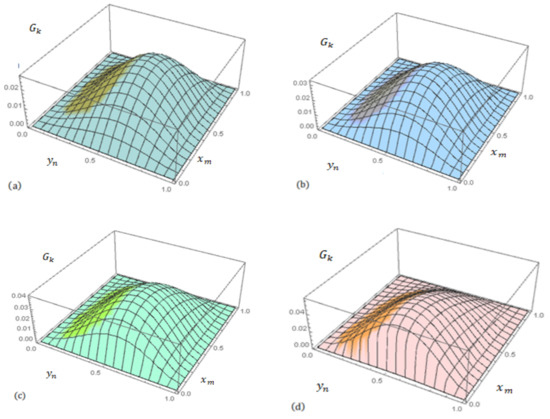
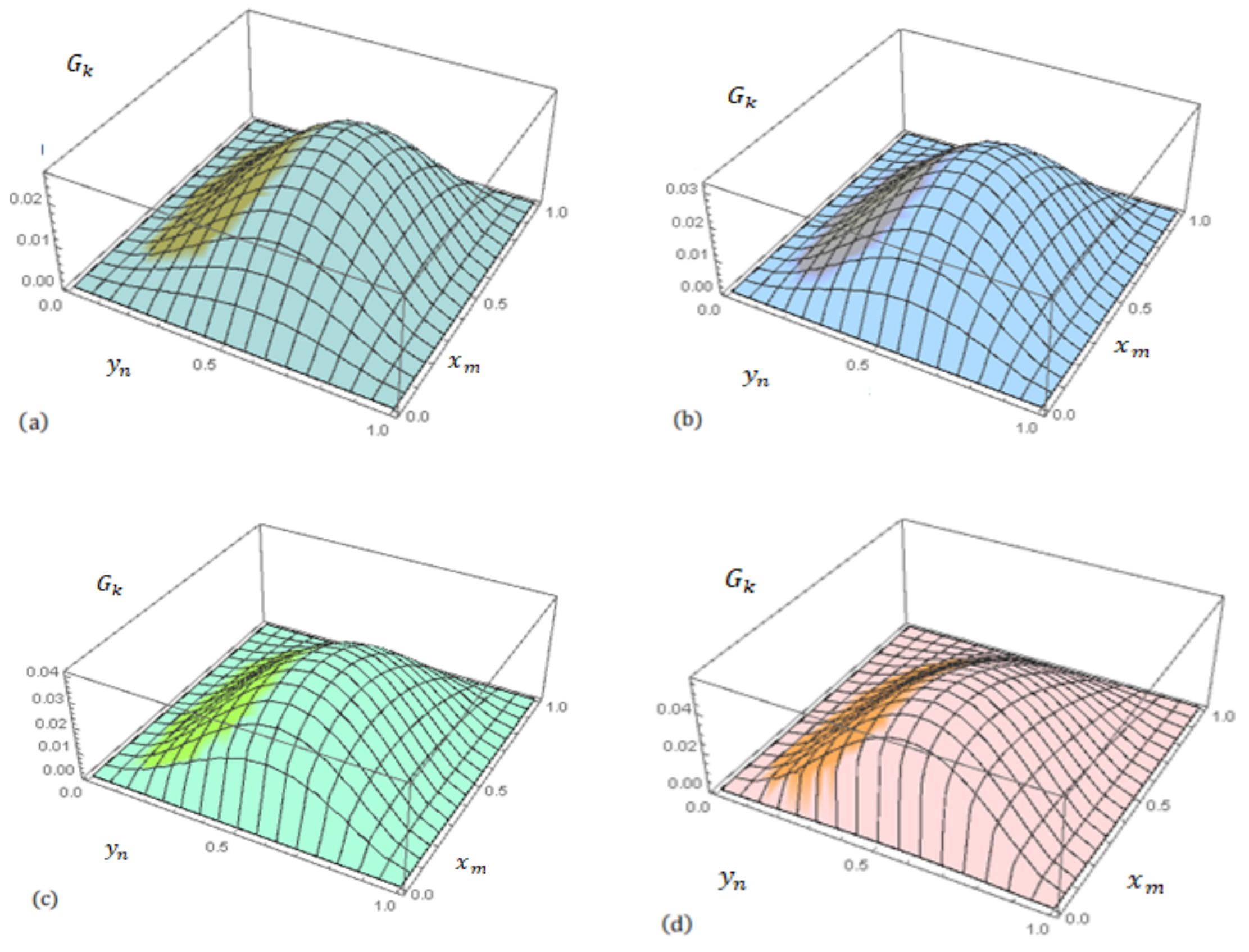
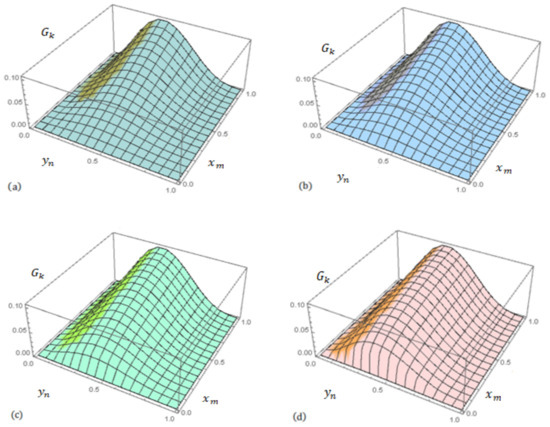
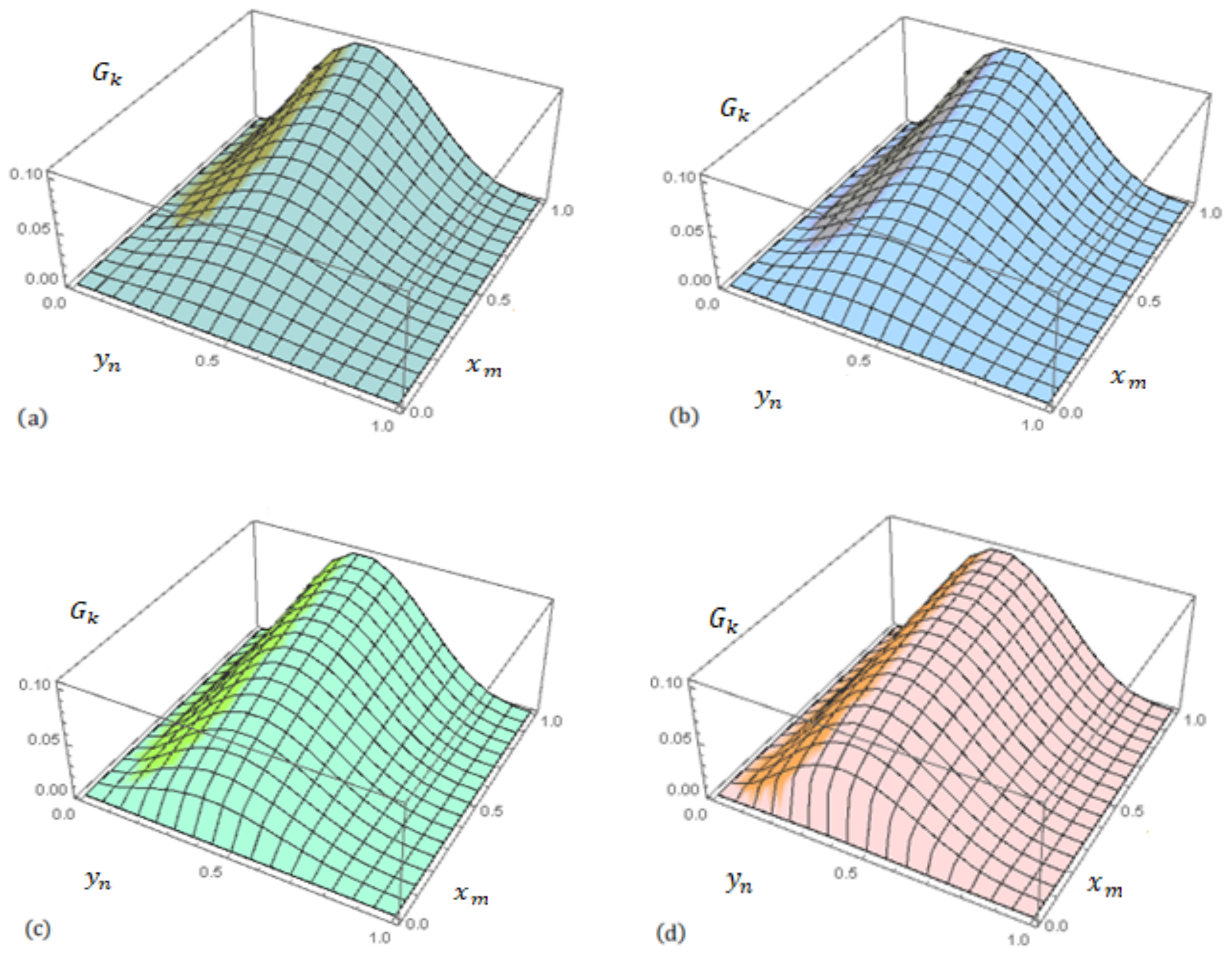
The results of the RHA solution for Applications 1 and 2 are given in Figure 1 and Figure 2, respectively, by plotting the approximation with over . Clearly, the Algorithms 1 and 2 result and the utilized model preserve the hereditary characteristics of the TFCD. A closer examination of the figures reveals that the graphics are roughly identical, as they have the same behavior, and this shows the continuity of the fractional derivative in preserving the hereditary properties of the solution.
Figure 1.
Results of in Application 1 for through as (a) , (b) , (c) , and (d)
Figure 2.
Results of in Application 2 for through as (a) , (b) , (c) , and (d)
| Algorithm 1. Steps of the orthogonal systems |
|
| Algorithm 2. Steps of the RHA |
|
5. Concluding Notes
This article presented the numerical solutions of MIFADM along with NCCs of two points using the RHA, based on the definition of TFCD. The forms of the exact and the approximate solution were derived in the Hilbert space, and the necessary convergence theory was provided. By calculating and scheduling the absolute error and drawing the approximate solutions for different values that represent the order of the TFCD, we conclude that the results are satisfactory and the algorithm demonstrates high accuracy and reliability. This work will be extended to higher-dimensional fractional models and nonclassical Neumann constraints. In parallel, efforts will focus on optimizing computational efficiency through adaptive basis selection. Moreover, future studies will examine the algorithm’s stability and convergence behavior under alternative fractional operators such as Riemann–Liouville and Atangana–Baleanu. Applications to more complex systems, including diffusion–wave equations and nonlinear fractional Schrödinger equations, will also be explored, broadening both the theoretical foundation and the practical applicability of the proposed method.
Author Contributions
Conceptualization, R.A.-D. and S.A.-O.; methodology, M.A.-S.; formal analysis, A.A.k.; investigation, S.A.-O.; resources, S.A.-O.; writing—original draft preparation, R.A.-D.; writing—review and editing, S.A.-O.; writing—review and editing, M.A.-S.; supervision, S.A.-O.; project administration, A.A.k.; funding acquisition, R.A.-D. All authors have read and agreed to the published version of the manuscript.
Funding
This research received no external funding.
Data Availability Statement
Data are contained within the article.
Conflicts of Interest
The authors declare no conflicts of interest.
References
- Daftardar-Gejji, V. Fractional Calculus and Fractional Differential Equations; Birkhäuser: Basel, Switzerland, 2019. [Google Scholar]
- Mainardi, F. Fractional Calculus and Waves in Linear Viscoelasticity; Imperial College Press: London, UK, 2010. [Google Scholar]
- Zaslavsky, G.M. Hamiltonian Chaos and Fractional Dynamics; Oxford University Press: Oxford, UK, 2005. [Google Scholar]
- Podlubny, I. Fractional Differential Equations; Academic Press: Cambridge, MA, USA, 1999. [Google Scholar]
- Samko, S.G.; Kilbas, A.A.; Marichev, O.I. Fractional Integrals and Derivatives Theory and Applications; Gordon and Breach: Philadelphia, PA, USA, 1993. [Google Scholar]
- Atangana, A. Fractional Operators with Constant and Variable Order with Application to Geo-Hydrology; Academic Press: Cambridge, MA, USA, 2017. [Google Scholar]
- Jafari, H.; Ganji, R.M.; Sayevand, K.; Baleanu, D. A numerical approach for solving fractional optimal control problems with mittag-leffler kernel. J. Vib. Control 2021, 28, 2596–2606. [Google Scholar] [CrossRef] [Scilit]
- Nikan, O.; Avazzadeh, Z.; Machado, J.T. An efficient local meshless approach for solving nonlinear time-fractional fourth-order diffusion model. J. King Saud Univ.-Sci. 2021, 33, 101243. [Google Scholar] [CrossRef] [Scilit]
- Nikan, O.; Machado, J.T.; Golbabai, A. Numerical solution of time-fractional fourth-order reaction-diffusion model arising in composite environments. Appl. Math. Model. 2021, 89, 819–836. [Google Scholar] [CrossRef] [Scilit]
- Gao, X.; Jiang, X.; Chen, S. The numerical method for the moving boundary problem with space-fractional derivative in drug release devices. Appl. Math. Model. 2015, 39, 2385–2391. [Google Scholar] [CrossRef] [Scilit]
- Alaroud, M.; Al-Smadi, M.; Rozita Ahmad, R.; Salma Din, U.K. An Analytical Numerical Method for Solving Fuzzy Fractional Volterra Integro-Differential Equations. Symmetry 2019, 11, 205. [Google Scholar] [CrossRef] [Scilit]
- Saadeh, R.; Alaroud, M.; Al-Smadi, M.; Ahmad, R.R.; Salma Din, U.K. Application of Fractional Residual Power Series Algorithm to Solve Newell-Whitehead-Segel Equation of Fractional Order. Symmetry 2019, 11, 1431. [Google Scholar] [CrossRef] [Scilit]
- Liu, Q.; Liu, F.; Turner, I.; Anh, V.; Gu, Y.T. A RBF meshless approach for modeling a fractal mobile/immobile transport model. Appl. Math. Comput. 2014, 226, 336–347. [Google Scholar] [CrossRef] [Scilit]
- Schumer, R.; Benson, D.A.; Meerschaert, M.M.; Baeumer, B. Fractal mobile/immobile solute transport. Water Resour. Res. 2003, 39, 1296–1307. [Google Scholar] [CrossRef] [Scilit]
- Hansen, S.K. Effective ADE models for first-order mobile–immobile solute transport: Limits on validity and modeling implications. Adv. Water Resour. 2015, 86, 184–192. [Google Scholar] [CrossRef] [Scilit]
- Ma, H.; Yang, Y. Jacobi Spectral Collocation Method for the Time Variable-Order Fractional Mobile-Immobile Advection-Dispersion Solute Transport Model. East Asian J. Appl. Math. 2016, 6, 337–352. [Google Scholar] [CrossRef] [Scilit]
- Abdelkawy, M.A.; Zaky, M.A.; Bhrawy, A.H.; Baleanu, D. Numerical Simulation of Time Variable Fractional Order Mobile-Immobile Advection-Dispersion Model. Rom. Rep. Phys. 2015, 67, 773–791. [Google Scholar]
- Modanli, M.; Karadag, K.; Abdulazeez, S.T. Solutions of the mobile-immobile advection-dispersion model based on the fractional operators using the Crank-Nicholson difference scheme. Chaos Solit. Fractals 2023, 167, 113114. [Google Scholar] [CrossRef] [Scilit]
- Aghdam, Y.E.; Farnam, B. A numerical process the mobile-immobile advection-dispersion model arising in solute transport. Math. Comput. Sci. 2022, 3, 1–10. [Google Scholar]
- Gupta, R.; Kumar, S. Chebyshev spectral method for the variable-order fractional mobile-immobile advection-dispersion equation arising from solute transport in heterogeneous media. J. Eng. Math. 2023, 142, 1. [Google Scholar] [CrossRef] [Scilit]
- Jafari, H.; Aghdam, Y.E.; Farnam, B.; Nguyen, V.T.; Masetshaba, M.T. A convergence analysis of the mobile–immobile advection–dispersion model of temporal fractional order arising in watershed catchments and rivers. Fractals 2023, 31, 2340068. [Google Scholar] [CrossRef] [Scilit]
- Zhang, H.; Liu, F.; Phanikumar, M.S.; Meerschaert, M.M. A novel numerical method for the time variable fractional order mobile-immobile advection-dispersion model. Comput. Math. Appl. 2013, 66, 693–701. [Google Scholar] [CrossRef] [Scilit]
- Jiang, W.; Liu, N. A numerical method for solving the time variable fractional order mobile-immobile advection-dispersion model. Appl. Numer. Math. 2017, 119, 18–32. [Google Scholar] [CrossRef] [Scilit]
- Sadri, K.; Aminikhah, H. An efficient numerical method for solving a class of variable-order fractional mobile-immobile advection-dispersion equations and its convergence analysis. Chaos Solit. Fractals 2021, 146, 110896. [Google Scholar] [CrossRef] [Scilit]
- Zhang, H.; Jiang, X.; Liu, F. Error analysis of nonlinear time fractional mobile/immobile advection-diffusion equation with weakly singular solutions. Fract. Calc. Appl. Anal. 2021, 24, 202–224. [Google Scholar] [CrossRef] [Scilit]
- Almeida, R.M.P.; Duque, J.C.M.; Ferreira, J.; Robalo, R.J. The Crank–Nicolson–Galerkin finite element method for a nonlocal parabolic equation with moving boundaries. Numer. Methods Partial. Differ. Equ. 2015, 31, 1515–1533. [Google Scholar] [CrossRef] [Scilit]
- Al-Smadi, M.; Abu Arqub, O.; Gaith, M. Numerical simulation of telegraph and Cattaneo fractional-type models using adaptive reproducing kernel framework. Math. Methods Appl. Sci. 2021, 44, 8472–8489. [Google Scholar] [CrossRef] [Scilit]
- Zolfaghari, R.; Shidfar, A. Solving a parabolic PDE with nonlocal boundary conditions using the Sinc method. Numer. Algorithms 2013, 62, 411–427. [Google Scholar] [CrossRef] [Scilit]
- Cui, M.; Lin, Y. Nonlinear Numerical Analysis in the Reproducing Kernel Space; Nova Science: Hauppauge, NY, USA, 2009. [Google Scholar]
- Arqub, O.A. Fitted reproducing kernel Hilbert space method for the solutions of some certain classes of time-fractional partial differential equations subject to initial and Neumann boundary conditions. Comput. Math. Appl. 2017, 73, 1243–1261. [Google Scholar] [CrossRef] [Scilit]
- Gumah, G.; Naser, M.F.M.; Al-Smadi, M.; Al-Omari, S.K.Q.; Baleanu, D. Numerical solutions of hybrid fuzzy differential equations in a Hilbert space. Appl. Numer. Math. 2020, 151, 402–412. [Google Scholar] [CrossRef] [Scilit]
- Berlinet, A.; Agnan, C.T. Reproducing Kernel Hilbert Space in Probability and Statistics; Kluwer Academic Publishers: Norwell, MA, USA, 2004. [Google Scholar]
- Daniel, A. Reproducing Kernel Spaces and Applications; Springer: Basel, Switzerland, 2003. [Google Scholar]
- Hasan, S.; Al-Smadi, M.; Freihet, A.; Momani, S. Two computational approaches for solving a fractional obstacle system in Hilbert space. Adv. Differ. Equ. 2019, 2019, 55. [Google Scholar] [CrossRef] [Scilit]
- Jiang, W.; Chen, Z. A collocation method based on reproducing kernel for a modified anomalous subdiffusion equation. Numer. Methods Partial. Differ. Equ. 2014, 30, 289–300. [Google Scholar] [CrossRef] [Scilit]

Disclaimer/Publisher’s Note: The statements, opinions and data contained in all publications are solely those of the individual author(s) and contributor(s) and not of MDPI and/or the editor(s). MDPI and/or the editor(s) disclaim responsibility for any injury to people or property resulting from any ideas, methods, instructions or products referred to in the content. |
© 2025 by the authors. Licensee MDPI, Basel, Switzerland. This article is an open access article distributed under the terms and conditions of the Creative Commons Attribution (CC BY) license (https://creativecommons.org/licenses/by/4.0/).