


Abstract
The significance of fractional calculus cannot be underestimated, as it plays a crucial role in the theory of inequalities. In this paper, we study a new class of mean-type inequalities by incorporating Riemann-type fractional integrals. By doing so, we discover a novel set of such inequalities and analyze them using different mathematical identities. This particular class of inequalities is introduced by employing a generalized convexity concept. To validate our work, we create visual graphs and a table of values using specific functions to represent the inequalities. This approach allows us to demonstrate the validity of our findings and further solidify our conclusions. Moreover, we find that some previously published results emerge as special consequences of our main findings. This research serves as a catalyst for future investigations, encouraging researchers to explore more comprehensive outcomes by using generalized fractional operators and expanding the concept of convexity.
Keywords:
Hermite–Hadamard-type inequalities; generalized Riemann-type integrals; h-convex function; Hölder’s inequality MSC:
26A33; 26D15
1. Introduction and Preliminaries
Fractional calculus deals with arbitrary order integrals and derivatives that are employed in several applications. In recent years, the area related to fractional differential and integral equations has received much attention from numerous mathematicians and specialists [1]. The derivatives of fractional order represent physical models of multiple phenomena in many fields, including engineering [2,3], mathematical physics [4], fractional calculus [5] and bio-engineering [6]. The idea of convexity has been modernized, extended and expanded in several ways [7,8]. Convexity has a significant impact on our daily lives because of its numerous applications in commerce [9], industry [10], medicine [11] and the arts [12]. Geometrically convex functions in n-dimensions and s-dimensions have been derived. Some classes of convex functions, such as geometrically convex and s-convex, were investigated by Yang and Hudzik et al. in [13,14], respectively. Functional analysis, optimization and control theory all depend on convexity in significant ways [15]. Due to the activities of its definition, convexity has a strong character in the area of inequalities. The idea of convexity has played a significant and astonishing role in integral inequalities that are equally important for both fields of pure and applied mathematics [16,17]. It is obvious that without inequalities, mathematical techniques are meaningless. The mathematician presented extensions, refinements and modifications of classical inequalities such as Hermite–Hadamard inequalities [18,19], Ostrowski inequalities [20], Olsen inequalities [21], Gagliardo–Nirenberg inequalities [22] and Hardy-type inequalities [23].
The classical Hermite–Hadamard inequality was first introduced in 1893 [24]. Peter Korus [25,26] successfully updated a class of Hermite–Hadamard inequalities by incorporating the class of generalized convex derivatives. Some other authors studied the Fejer–Hadamard inequalities for convex functions in [27,28,29,30,31,32]. This inequality basically provides the bounds of the average value of a convex function. Moreover, it provides error boundaries of specific means relations and numerous numerical quadrature rules of integration such as rectangular, trapezoidal and Simpson [33,34]. For further studies, we refer the reader to articles [35,36] and book [37]. In the proposed work, we first establish some identities involving fractional integrals of the Riemann-type. Such identities will then be used to investigate Hermite–Hadamard-type integral inequalities for twice differentiable h-convex functions. The Hölders inequality will be utilized to create this class. The gamma function is defined in [38] by the following.
Definition 1.
The Euler gamma function defined for , as
In [39], Mubeen et al. defined the following definition of the k-gamma function.
Definition 2.
The k-gamma functions defined for , as
where is the Pochhammer k-symbols for and factorial function. The integral form is given by
Clearly, , and the relation between classical gamma and k-gamma is Additionally, .
The following expression represents the complete beta function as defined in reference [40].
Definition 3.
The complete beta function is defined as
where .
The incomplete beta function [41] and relation between beta and gamma functions are given in the following.
Definition 4.
The incomplete beta function is defined as
where and . The notable relation between the beta and gamma function is stated as
The definition of the h-convex function presented in [42] is defined as follows.
Definition 5.
Let be a positive increasing function. A function is h-convex, if is nonnegative on ℵ, , and for all , we have
This definition generalizes the following convexities.
Definition 6
([43]). Let , then the Riemann–Liouville fractional integrals of the order ζ are defined by
and
are known as the left- and right-sided Riemann–Liouville fractional integrals with as the gamma function.
Definition 7
([39]). Let , then the fractional integrals of order ζ defined by
and
are known as the left- and right-sided k-Riemann–Liouville fractional integrals with a k-gamma function.
To establish the main results, we need to recall the following lemmas presented in [44,45], respectively.
Lemma 1.
For all , we have
Lemma 2.
Let be a function such that exists on with if ; then, the equation for k-fractional integrals is as follows:
The motivation behind this work is to explore and analyze a new set of inequalities that involve mean-type concepts by employing more general convexity and fractional integrals. The Höder’s inequality is used to establish these results that have applications in diverse areas, including mathematics, statistics, engineering and computer science, where it serves as a valuable tool for analyzing and solving a wide range of problems. Through visual representations and validation of our findings, we seek to contribute to the existing body of knowledge and inspire further research in this area, potentially leading to advancements in mathematical theory and applications.
2. Main Results
In this section, we first present some important identities using a generalized fractional operator of the Riemann-type. Secondly, we explore Hermite–Hadamard inequalities by first establishing some identities.
Lemma 3.
Let be a function such that exists on with if ; then, we have the identity
where
Proof.
Consider
Integrating by parts, we obtain
and
Multiplying with (7) on both sides, we can write
Substituting Lemma 2 into (8), we obtain the required result.
Hence, the proof is complete. □
Lemma 4.
Let be a function such that exists on with if , then, the identity
holds with
Proof.
Multiplying with Lemma 2, then
Multiplying with Lemma 3, then
By using Lemma 2 and Lemma 1, we obtain the following results.
Theorem 1.
Let be a function such that exists and is measurable. Let be a monotonic positive function and h-convex on ; then, for some fixed , the inequality
holds, where h is bounded by M.
Proof.
By using Lemma 2, we have
By using the h-convexity of , we can write
The required proof is complete. □
Example 1.
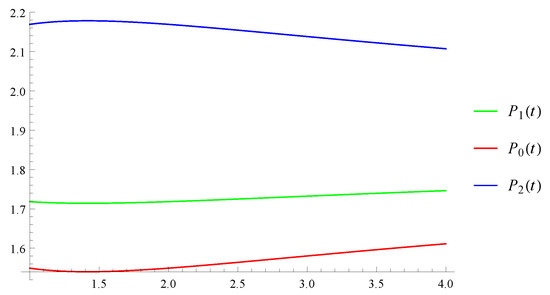
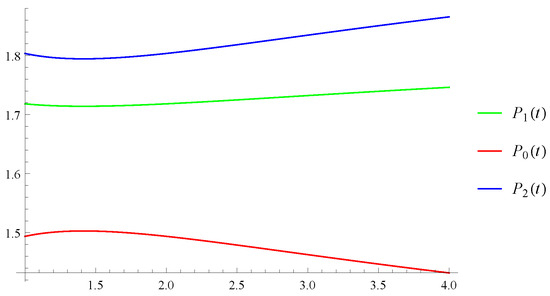
The inequality presented in Theorem 1 can be verified by sketching the graph of (29). For this purpose, we substitute and obtain the following
and
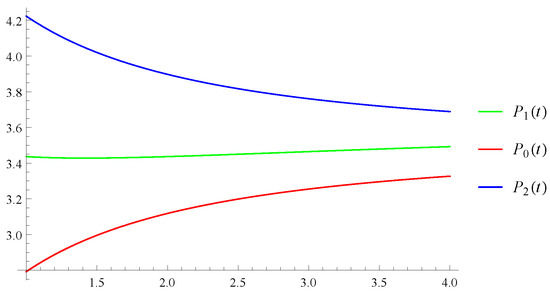
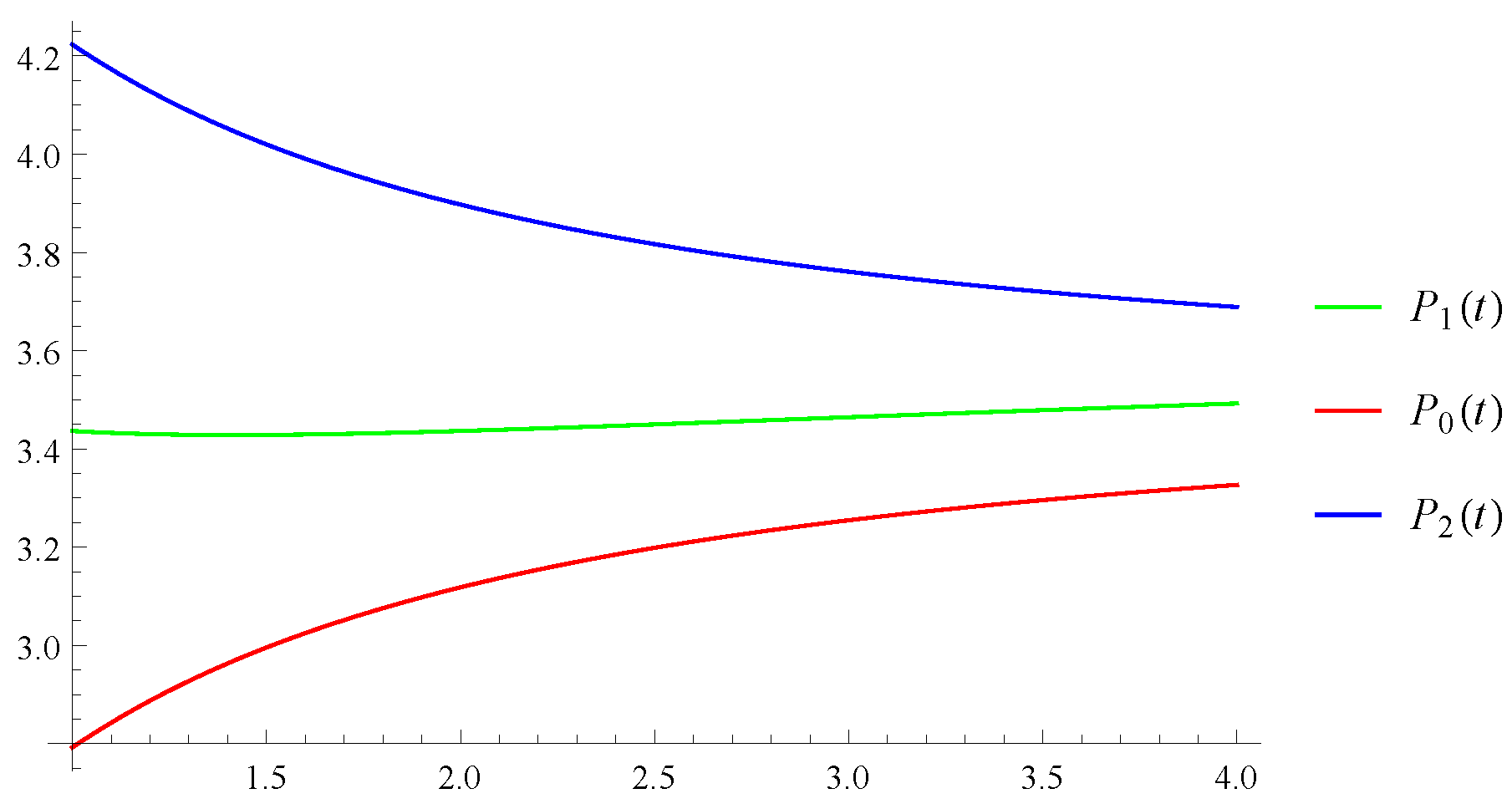
Corresponding to the choice of the parameters , , with , the graph of the double inequality (15) is as below.
Table 1.
The comparison results in Example 1 between the double inequality are presented in the following table.
Figure 1.
The graph of Theorem 1 for the choice of order is presented in Figure 1.
Remark 1.
By substituting and in Theorem 1, we arrive at ([46] Theorem 3.1) with a choice , i.e.,
Remark 2.
By substituting and in Theorem 1, we obtain ([46] Theorem 3.1), i.e.,
Theorem 2.
Let the be a function such that the exists. Let , be an h-convex monotonic positive function on , . Then, the inequality
holds with and
Proof.
The proof of this result is divided into two cases.
Case (i): Let . By using Lemmas 1 and 2 and applying Hölder’s inequality,
By using the h-convexity of ,
Case (ii): Let . By using Lemmas 1 and 2 and applying Hölder’s inequality,
By using the h-convexity of , we obtain
Hence, the proof is complete. □
Example 2.
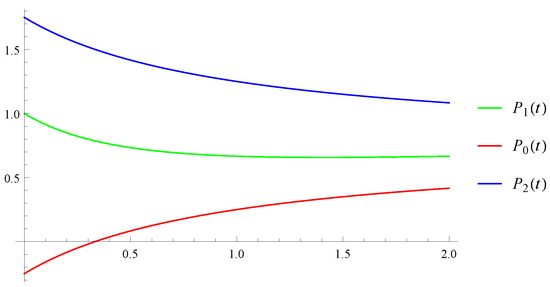
The inequality presented in Theorem 2 can be verified by sketching the graph of (31). For this purpose, we substitute and obtain the following relations
and
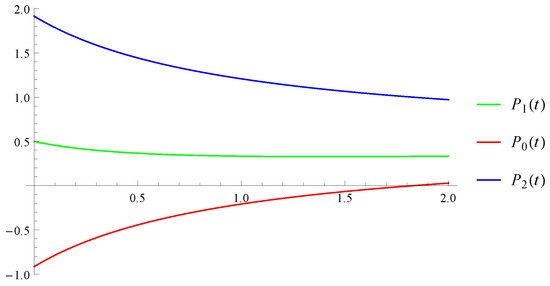
Corresponding to the choice of the parameters , , , , , with , the graph of the double inequality (19) is as below.
Table 2.
The comparison results in Example 2 between the double inequality are presented in the following table.
Figure 2.
The graph of Theorem 2 for the choice of order is presented in Figure 2.
Remark 3.
By substituting and in Theorem 2, we obtain ([46] Theorem 3.2) with the choice , i.e.,
where
Remark 4.
By substituting and in Theorem 2, we obtain ([46] Theorem 3.2), i.e.,
where
In the next two results, we used Lemma 3.
Theorem 3.
Let the be a differentiable mapping , is measurable, and is a monotonic positive function and h-convex on , ; then, we have the result
where and .
Proof.
By using Lemma 3, we can write
By using the h-convexity of , we have
Hence, the desired result is proved. □
Example 3.
The inequality presented in Theorem 3 can be verified by sketching the graph of (20). For this purpose, by utilizing the expressions (13) and (14) in (20), we obtain
Corresponding to the choice of the parameters , , , with , the graph of the double inequality (21) is as below.
Table 3.
The comparison results in Example 3 between the double inequality are presented in the following table.
Figure 3.
The graph of Theorem 3 for the choice of order is presented in Figure 3.
Remark 5.
By substituting and in Theorem 3, we obtain ([46] Theorem 4.1) with the choice
Remark 6.
By substituting and in Theorem 3, we obtain ([46] Theorem 4.1).
Theorem 4.
Consider a function defined on the interval such that its second derivative, denoted by , exists on this interval. Assume that the function belongs to the class of integrable functions and is both h-convex and a positive monotonic function. Additionally, suppose that . Then, the inequality
holds, where and .
Proof.
By using Hölder’s inequality and Lemma 3, we have
By using the h-convexity of , we obtain
This completes the result. □
Remark 7.
By substituting and in Theorem 4, we obtain ([46] Theorem 4.2) with the choice
where
Remark 8.
By substituting and in Theorem 4, we obtain ([46] Theorem 4.2).
where
By using Lemma 4, we obtain the next two results.
Theorem 5.
Suppose we have a function defined on the interval such that the absolute value of its second derivative, denoted by , exists. If is both monotonic and positive and it is also h-convex on the interval , where , then the following inequality holds:
where
Proof.
By using Lemma 4, we can write
By using the h-convexity of , we can write
However,
and
Additionally,
and
Substituting these values of integrals in (24), we obtain the required result. □
Example 4.
The inequality presented in Theorem 5 can be verified by sketching the graph of (23). For this purpose, by utilizing (17) and (18) in (23), we obtain
Corresponding to the choice of the parameters , , , , with , the graph of the double inequality (25) is as below.
Table 4.
The comparison results in Example 4 between the double inequality are presented in the following table.
Figure 4.
The graph of Theorem 5 for the choice of order is presented in Figure 4.
Remark 9.
By substituting and in Theorem 5, we obtain ([46] Theorem 5.1) with the choice
Remark 10.
By substituting and in Theorem 5, we obtain ([46] Theorem 5.1).
Theorem 6.
Let the be a function such that exists on Let , be an h-convex, monotonic positive function where . Then, the following inequality
holds, where and
Proof.
By using the Hölder’s inequality and Lemma 4, we can write
By using the h-convexity of , we can write
However,
and
Additionally
and
Substituting the values of integrals in (27), we obtain the required result. The proof is complete. □
Example 5.
The inequality presented in Theorem 6 can be verified by sketching the graph of (26). For this purpose, by utilizing these expressions (13) and (14) in (23), we obtain
Corresponding to the choice of the parameters , , , , , , with , the graph of the double inequality (28) is as below.
Table 5.
The comparison results in Example 5 between the double inequality are presented in the following table.
Figure 5.
The graph of Theorem 6 for the choice of order is presented in Figure 5.
Remark 11.
By substituting and in Theorem 6, we obtain ([46] Theorem 5.2) with the choice
where
Remark 12.
By substituting and in Theorem 6, we obtain ([46] Theorem 5.2).
where
3. Some Applications to the Main Results in Terms of Means
In mathematics, the means we employ hold profound significance in various domains such as problem-solving, statistical analysis, optimization problems and mathematical proofs. This section contains applications of thhe main results in terms of means. The representation of the means are given as follows:
- (i)
- The arithmetic mean:
- (ii)
- The logarithmic mean:
Proposition 1.
Let ,, ; then, we have the following inequalities.
Proof.
Using Theorem (1) and making some simplification, we can write this as
By substituting , , and in (30), we can write this as
This proved relation (29). □
Proposition 2.
Let ,, ; then, we have the following inequalities.
Proof.
Using Theorem (5) and making some simplification, we can write this as
By substituting , , , and in (32), we can write
This completes the proof of (31). □
4. Concluding Remarks
Convexity, a concept that originated from Archimedes around 250 B.C., is a simple and intuitive notion with far-reaching implications in various aspects of our daily lives, including industry, business, medicine and art. Its application is particularly prominent in the field of inequalities, which holds significant importance in optimization theory. In our recent research, we focused on exploring the Hermite–Hadamard integral inequality by employing h-convex functions and a Riemann-type fractional integral. By leveraging Hölder’s inequality, we introduced novel findings that have broad implications for inequality theory. These results were derived based on a newly established identity, allowing us to extend previously published findings and broaden the scope of our investigation. To establish the validity of our obtained results, we represented the double inequalities using graphical representations and tables of values. This comprehensive approach provides concrete evidence supporting our conclusions and further solidifies the significance of our research. Our research serves as a catalyst for future investigations, encouraging researchers to explore more comprehensive outcomes by incorporating generalized fractional operators and expanding the scope of convexities. By embracing these broader perspectives, we anticipate the discovery of more general results that can advance the theory of inequalities and enrich the field of fractional calculus.
Author Contributions
Conceptualization, M.S., Y.E. and M.T.G.; methodology, S.N. and G.R.; software, M.S., Y.E. and M.T.G.; validation, M.T.G. and G.R.; formal analysis, M.S. and S.N.; investigation, M.T.G., M.S., S.N. and M.V.-C.; data duration, G.R., M.T.G. and S.N.; writing—original draft preparation, M.S. and M.T.G.; writing—review and editing, M.S., M.T.G. and S.N.; visualization, M.T.G.; supervision, Y.E., G.R. and M.S.; project administration, Y.E. and M.S., funding acquisition, M.V.-C. All authors have read and agreed to the published version of the manuscript.
Funding
This research received no external funding.
Data Availability Statement
Not applicable.
Acknowledgments
The authors extend their appreciation to the Deanship of Scientific Research at King Khalid University for funding this work through the Large Groups under grant number (RGP.2/120/44).
Conflicts of Interest
The authors declare that they have no competing interest.
References
- Kilbas, A.A.; Srivastava, H.M.; Trujillo, J.J. Theory and Applications of Fractional Differential Equations; Elsevier: Amsterdam, The Netherlands, 2006. [Google Scholar]
- Loverro, A. Fractional Calculus: History, Definitions and Applications for the Engineer; Rapport Technique; Univeristy of Notre Dame, Department of Aerospace and Mechanical Engineering: Notre Dame, IN, USA, 2004; pp. 1–28. [Google Scholar]
- Samraiz, M.; Umer, M.; Abduljawad, T.; Naheed, S.; Rahman, G.; Shah, K. On Riemann-type weighted fractional operator and solution to cauchy problems. Comput. Model. Eng. Sci. 2023, 136, 901–919. [Google Scholar] [CrossRef] [Scilit]
- Singh, J.; Anastassiou, G.A.; Baleanu, D.; Kumar, D. On weighted fractional operators with applications to mathematical models arising in physics. In Advances in Mathematical Modelling, Applied Analysis and Computation; Lecture Notes in Networks and Systems; Springer: Cham, Switzerland, 2023; Volume 666. [Google Scholar]
- Ray, S.S.; Atangana, A.; Noutchie, S.C.; Kurulay, M.; Bildik, N.; Kilicman, A. Fractional calculus and its applications in applied mathematics and other sciences. Math. Probl. Eng. 2014, 2014, 849395. [Google Scholar] [CrossRef] [Scilit]
- Magin, R. Fractional calculus in bioengineering, Part 1. Crit. Rev. Biomed. Eng. 2004, 32, 104. [Google Scholar]
- Beckenbach, E.F. Convex functions. Bull. Am. Math. Soc. 1948, 54, 439–460. [Google Scholar] [CrossRef] [Scilit]
- Avriel, M. r-Convex functions. Math. Program. 1972, 2, 309–323. [Google Scholar] [CrossRef] [Scilit]
- Niculescu, C.P.; Persson, L.E. Convex Functions and Their Applications: A Contemporary Approach; CMC Books in Mathematics: New York, NY, USA, 2004. [Google Scholar]
- Ramli, A.A.; Watada, J.; Pedrycz, W. A combination of genetic algorithm-based fuzzy C-means with a convex hull-based regression for real-time fuzzy switching regression analysis: Application to industrial intelligent data analysis. IEEJ Trans. Electr. Electron. Eng. 2014, 9, 71–82. [Google Scholar] [CrossRef] [Scilit]
- Xu, J.; Noo, F. Convex optimization algorithms in medical image reconstruction in the age of AI. Phys. Med. Biol. 2022, 67, 07TR01. [Google Scholar] [CrossRef] [Scilit]
- Rockafellar, R.T. Convex Analysis; Princeton University Press: Princeton, NJ, USA, 1970. [Google Scholar]
- Yang, D.H. About inequality of geometrically convex function, Hebei university learned journal. Natur. Sci. Ed. 2002, 22, 325–328. [Google Scholar]
- Hudzik, H.; Maligranda, L. Some remarks on s-convex functions. Aequationes Math. 1994, 48, 100–111. [Google Scholar] [CrossRef] [Scilit]
- Bertsimas, D.; Brown, D.B.; Caramanis, C. Theory and applications of robust optimization. SIAM Rev. 2011, 53, 464–501. [Google Scholar] [CrossRef] [Scilit]
- Artacho, F.J.A.; Borwein, J.M.; Marquez, V.M.; Yao, L. Applications of convex analysis within mathematics. Math. Program. 2014, 148, 49–88. [Google Scholar] [CrossRef] [Scilit]
- Bullen, P.S. Handbook of Means and Their Inequalities; Springer Science and Business Media: Berlin/Heidelberg, Germany, 2003. [Google Scholar]
- Dragomir, S.S. Operator Inequalities of Ostrowski and Trapezoidal Type; Springer: New York, NY, USA, 2011. [Google Scholar]
- Mitrinovic, D.S.; Pecaric, J.E.; Fink, A.M. Classical and New Inequalities in Analysis; Springer Science and Business Media: Berlin/Heidelberg, Germany, 1993. [Google Scholar]
- Gavrea, B.; Gavrea, I. On some Ostrowski type inequalities. Gen. Math. 2010, 18, 33–44. [Google Scholar]
- Gunawan, H. Fractional integrals and generalized Olsen inequalities. Kyungpook Math. J. 2009, 49, 31–39. [Google Scholar] [CrossRef] [Scilit]
- Sawano, Y.; Wadade, H. On the Gagliardo-Nirenberg type inequality in the critical Sobolev-Morrey space. J. Fourier Anal. Appl. 2013, 19, 20–47. [Google Scholar] [CrossRef] [Scilit]
- Ciatti, P.; Cowling, M.G.; Ricci, F. Hardy and uncertainty inequalities on stratified Lie groups. Adv. Math. 2015, 277, 365–387. [Google Scholar] [CrossRef] [Scilit]
- Hadamard, J. Etude sur les proprietes des fonctions entieres et en particulier dune fonction consideree par Riemann. J. Math. Pures Appl. 1893, 9, 171–216. [Google Scholar]
- Korus, P. Some Hermite-Hadamard type inequalities for functions of generalized convex derivative. Acta Math. Hungar. 2021, 165, 463–473. [Google Scholar] [CrossRef] [Scilit]
- Vivas-Cortez, M.; Ali, M.A.; Kashuri, A.; Budak, H. Generalizations of fractional Hermite-Hadamard-Mercer like inequalities for convex functions. AIMS Math. 2021, 6, 9397–9421. [Google Scholar] [CrossRef] [Scilit]
- Baleanu, D.; Samraiz, M.; Perveen, Z.; Iqbal, S.; Nisar, K.S.; Rahman, G. Hermite-Hadamard-Fejer type inequalities via fractional integral of a function concerning another function. AIMS Math. 2021, 6, 4280–4295. [Google Scholar] [CrossRef] [Scilit]
- Farid, G.; Yussouf, M.; Nonlaopon, K. Fejer-Hadamard type inequalities for (α,h-m)-p-convex functions via extended generalized fractional integrals. Fractal Fract. 2021, 5, 253. [Google Scholar] [CrossRef] [Scilit]
- Kang, S.M.; Farid, G.; Nazeer, W.; Tariq, B. Hadamard and Fejer-Hadamard inequalities for extended generalized fractional integrals involving special functions. J. Inequal. Appl. 2018, 2018, 119. [Google Scholar] [CrossRef] [Scilit] [PubMed]
- Vivas-Cortez, M.; Hernández, H.; Jorge, E. On some new generalized Hermite Hadamard Fejér-inequalities for product of two operator convex functions. Appl. Math. Inf. Sci. 2017, 11, 983–992. [Google Scholar] [CrossRef] [Scilit]
- Vivas-Cortez, M.; Ali, M.A.; Budak, H.; Kalsoom, H.; Agarwal, P. Some new Hermite–Hadamard and related inequalities for convex functions via (p, q)-integral. Entropy 2021, 23, 828. [Google Scholar] [CrossRef] [Scilit] [PubMed]
- Kalsoom, H.; Latif, M.A.; Khan, Z.A.; Vivas-Cortez, M. Some New Hermite-Hadamard-Fejér fractional type inequalities for h-convex and harmonically h-Convex interval-valued Functions. Mathematics 2021, 10, 74. [Google Scholar] [CrossRef] [Scilit]
- Kwun, Y.C.; Farid, G.; Nazeer, W.; Ullah, S.; Kang, S.M. Generalized riemann-liouville k-fractional integrals associated with Ostrowski type inequalities and error bounds of hadamard inequalities. IEEE Access 2018, 6, 64946–64953. [Google Scholar] [CrossRef] [Scilit]
- Budak, H.; Hezenci, F.; Kara, H. On generalized Ostrowski, Simpson and Trapezoidal type inequalities for co-ordinated convex functions via generalized fractional integrals. Adv. Differ. Equ. 2021, 2021, 312. [Google Scholar] [CrossRef] [Scilit]
- Khan, M.A.; Chu, Y.; Khan, T.U.; Khan, J. Some new inequalities of Hermite-Hadamard type for s-convex functions with applications. Open Math. 2017, 15, 1414–1430. [Google Scholar] [CrossRef] [Scilit]
- Rashid, S.; Kalsoom, H.; Hammouch, Z.; Ashraf, R.; Baleanu, D.; Chu, Y.M. New multi-parametrized estimates having pth-order differentiability in fractional calculus for predominating h-convex functions in Hilbert space. Symmetry 2020, 12, 222. [Google Scholar] [CrossRef] [Scilit]
- Mitrinović, D.S. Analytic Inequalities; Springer: Berlin, Germany, 1970. [Google Scholar]
- Davis, P.J. Leonhard euler’s integral: A historical profile of the gamma function: In memoriam: Milton abramowitz. Am. Math. Mon. 1959, 66, 849–869. [Google Scholar] [CrossRef] [Scilit]
- Mubeen, S.; Habibullah, G.M. k-Fractional integrals and application. Int. J. Contemp. Math. Sci. 2012, 7, 89–94. [Google Scholar]
- Chaudhry, M.A.; Qadir, A.; Rafique, M.; Zubair, S.M. Extension of Euler’s beta function. J. Comput. Appl. Math. 1997, 78, 19–32. [Google Scholar] [CrossRef] [Scilit]
- DiDonato, A.R.; Jarnagin, M.P. The efficient calculation of the incomplete beta-function ratio for half-integer values of the parameters a, b. Math. Comp. 1967, 21, 652–662. [Google Scholar] [CrossRef] [Scilit]
- Varosanec, S. On h-convexity. J. Math. Anal. Appl. 2007, 326, 303–311. [Google Scholar] [CrossRef] [Scilit]
- Mubeen, S.H.; Iqbal, S.; Iqbal, Z. On Ostrowski type inequalities for generalized k-fractional integrals. J. Inequal. Spec. Funct. 2017, 8, 107–118. [Google Scholar]
- Deng, J.; Wang, J. Fractional Hermite-Hadamard inequalities for (a,m)-logarithmically convex functions. J. Inequal. Appl. 2013, 2013, 364. [Google Scholar] [CrossRef] [Scilit]
- Hussain, R.; Ali, A.; Gulshan, G.; Latif, A.; Rauf, K. Hermite-Hadamard type inequalities for k-Riemann-Liouville fractional integrals via two kinds of convexity. Austral. J. Math. Anal. Appl. 2016, 13, 1–12. [Google Scholar]
- Liao, Y.; Deng, J.; Wang, J. Riemann-Liouville fractional Hermite-Hadamard inequalities. Part II: For twice differentiable geometric-arithmetically s-convex functions. J. Inequal. Appl. 2013, 2013, 517. [Google Scholar] [CrossRef] [Scilit]

Disclaimer/Publisher’s Note: The statements, opinions and data contained in all publications are solely those of the individual author(s) and contributor(s) and not of MDPI and/or the editor(s). MDPI and/or the editor(s) disclaim responsibility for any injury to people or property resulting from any ideas, methods, instructions or products referred to in the content. |
© 2023 by the authors. Licensee MDPI, Basel, Switzerland. This article is an open access article distributed under the terms and conditions of the Creative Commons Attribution (CC BY) license (https://creativecommons.org/licenses/by/4.0/).