


Abstract
Aspects related to non-periodicity of a class of complex maps defined in the sense of Caputo like fractional differences and to the asymptotical stability of fixed points are considered. As example the Mandelbrot map of fractional order is considered.
1. Introduction
As is known, commensurate and non-commensurate Fractional Order (FO) continuous systems in the sense of Caputo, Riemann–Liouville, or Grundwald–Letnikov definitions, and also other types of fractional differences, cannot generate exactly periodic signals with all arising implications (see, e.g., [1,2,3,4,5,6,7,8,9,10,11,12]).
Fractional models can describe complex physics problems clearly and concisely, especially the non-linear model. Fractional order equations offer better possibilities to describe complex physics compared to the traditional integer order equations (see e.g., [13]). One of the most prominent features of the fractional order differential and discrete equations is its memory [14]. On the other side, there are very few results on the Mandelbrot set or Julia sets of fractional order. The Mandelbrot set generated by a fractional difference quadratic map involving Caputo-like fractional h-difference operators represents the subject in [15]. Problems of discrete systems of FO, such as hidden attractors and chaos control, are analyzed in, e.g., [16,17,18].
Fractional Mandelbrot sets have rarely been mentioned to date. Therefore, the application of fractional calculus to deterministic non-linear fractals such as Mandelbrot and also Julia sets generated by fractional maps leads to a very attractive and new theory with applications, e.g., to image and data compression or computer graphics.
In this paper, we focus on the class of complex maps defined below. Let , and . The fractional difference equations studied in this paper are
in which one considers the initial condition . is the Caputo delta fractional difference (see [19,20,21,22]).
As is known, in a convenient numerical form, the equivalent discrete integral form of (1) is (see, e.g., [19,20,21,22])
Some of results in this paper are particularized for the complex Mandelbrot map
The recurrence (1) with f given by (3) defines the Mandelbrot map of FO, denoted hereafter as the map.
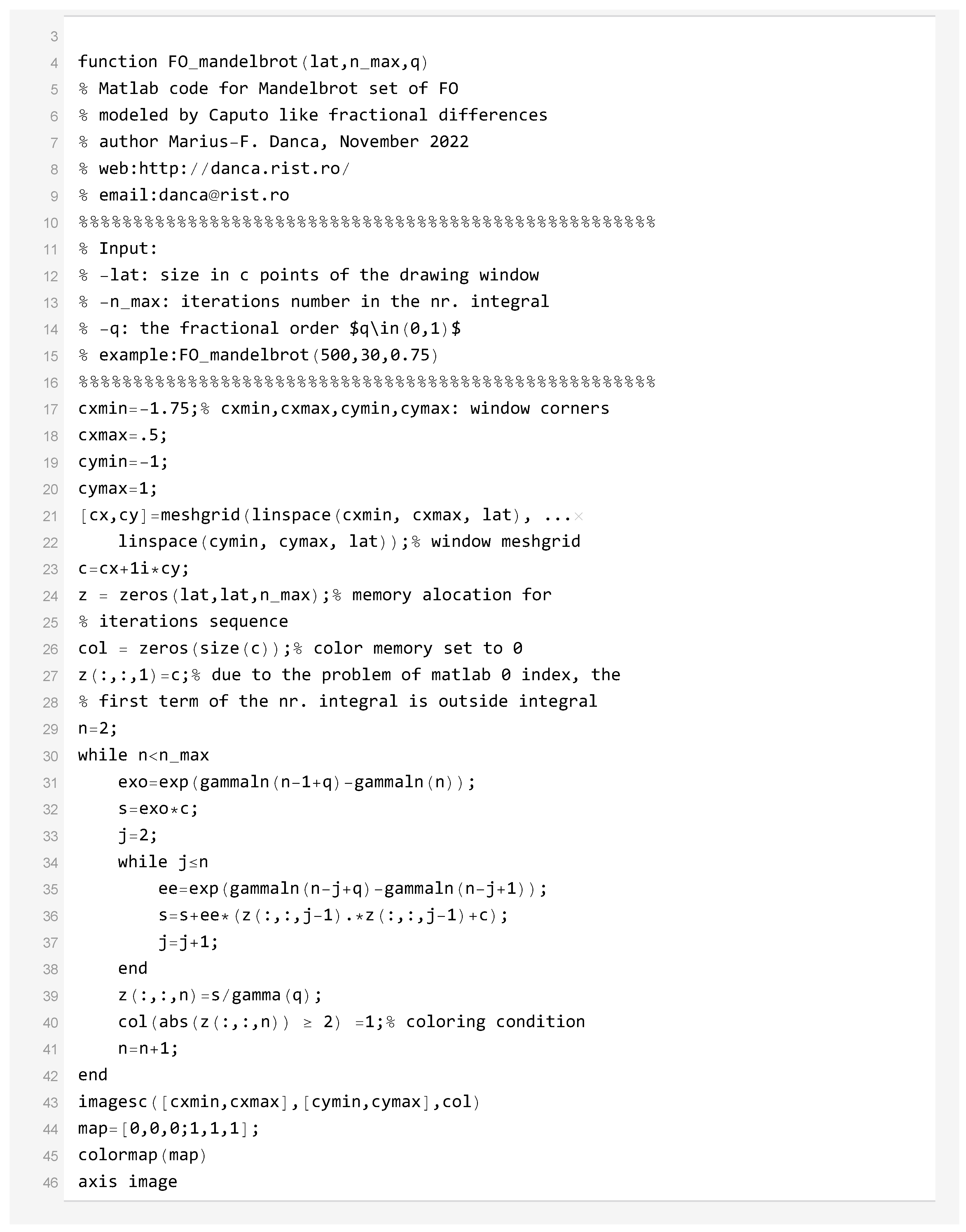
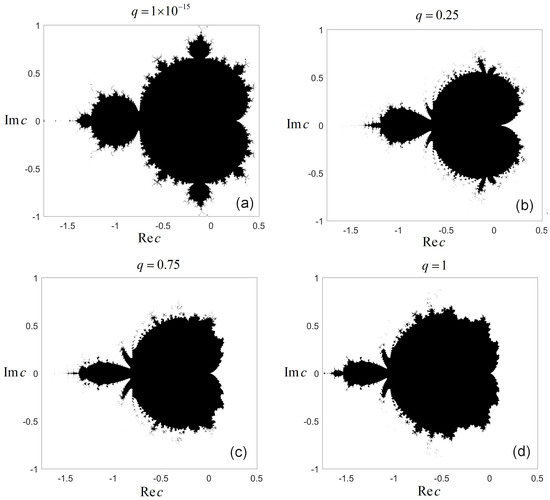
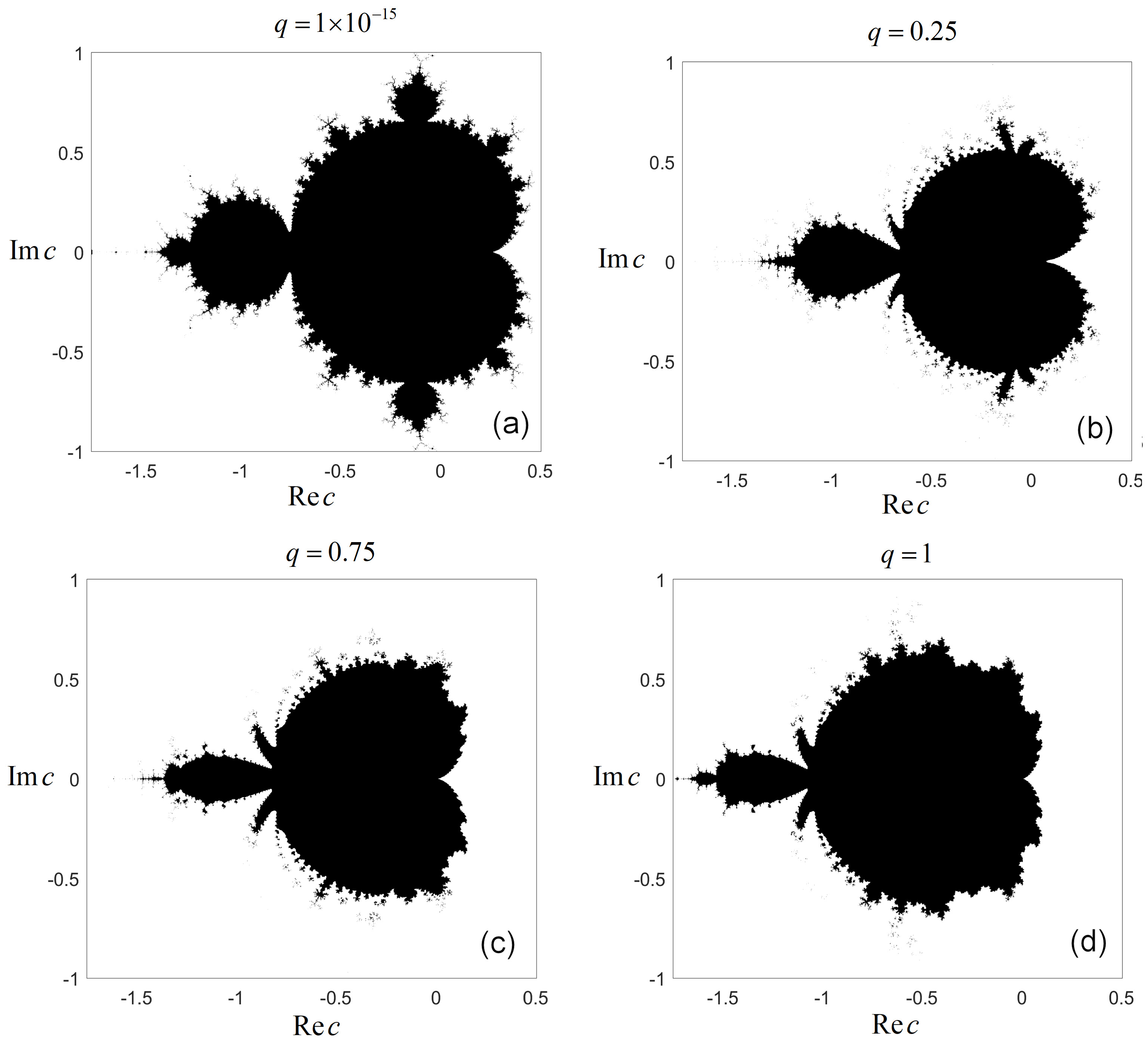
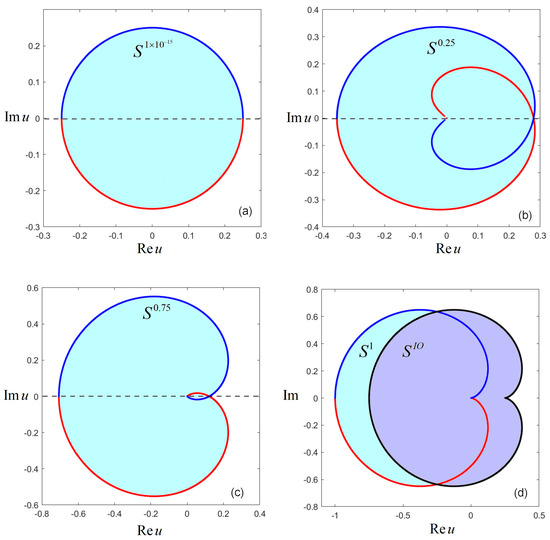
Representative sets for some values of q obtained with the matlab code in Appendix A (see Figure A1) (see also [23], where the time-escape algorithm for and Julia sets of FO are introduced) are presented in Figure 1. As can be seen, the set for is not, as expected, identical to the known integer order (IO) variant (Figure 1d). This characteristic suggests that FO systems should be considered only with caution as “generalizations” of IO systems. On the other side, a strong resemblance between IO and FO sets (Figure 1a) appears in the case , considered here for computational reasons ( in (2) is not defined for ). Many other interesting properties, resemblances and especially differences between the Mandelbrot set of IO and its FO counterparts can be found in [23].
Figure 1.
Four Mandelbrot sets of FO: (a) ; (b) ; (c) ; (d) .
2. Properties of the Map
In this section, the stability of the map and properties related to asymptotical periodicity are analyzed.
2.1. Stability of Fixed Points
Theorem 1.
The fixed points of the map are
Proof.
The stability domain of the fixed points is stated by the following result.
Theorem 2.
Proof.
The derivative of f is
and the spectrum of eigenvalues is .
Consider . Then,
Since , we have
hence
and
By [20], are locally stable whenever
This is equivalent to
Using and , the proof is finished. □
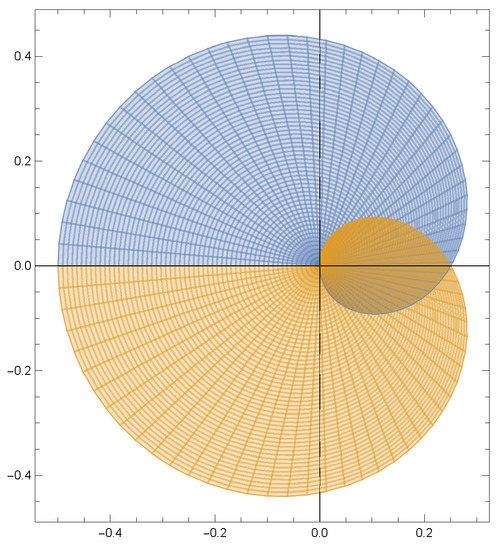
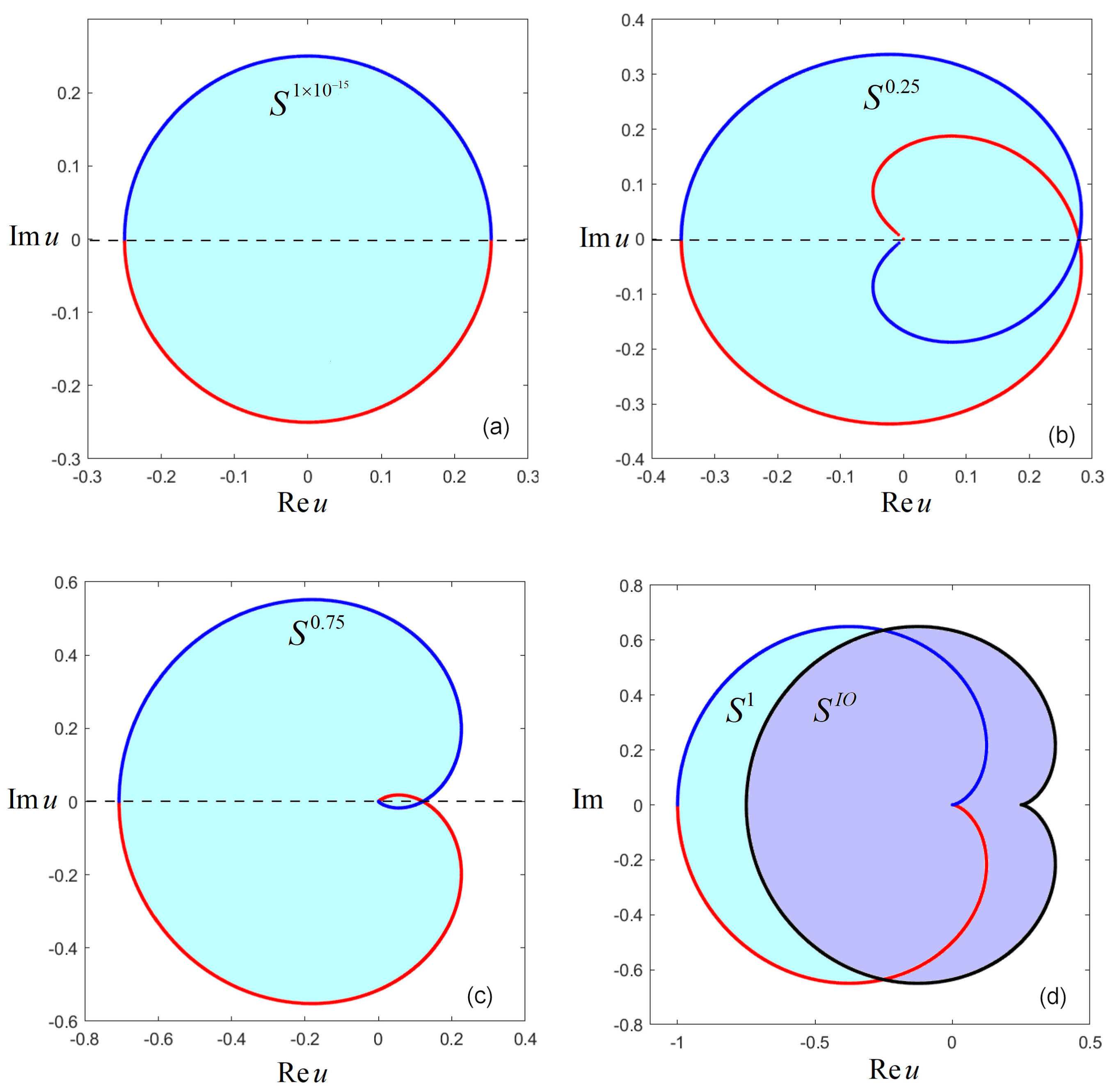
Four representative cases of are considered in Figure 3. The two colors (red and blue) correspond to the signs ±, respectively.
Figure 3.
Local asymptotic stable regions of fixed points (4) and of the fixed point of the Mandelbrot map of IO : (a) ; (b) ; (c) (d) Overplotted (for ) and the asymptotic stable region of the Mandelbrot map of integer order .
Next, the following inverse result is presented.
Theorem 3.
If are the eigenvalues corresponding to the fixed points , then
Proof.
We know that . So if , then
which implies
Similarly, gives
which implies
The proof is finished. □
2.2. Periodic Boundary Problem of (1)
As mentioned in the Introduction, FO systems cannot have non-constant periodic solutions. However, we may instead study the n-periodic boundary problem of (2)
for a fixed . So, for , we get the 2-periodic boundary problem.
We denote by “nonfixed point” a point that is not a fixed point of (1).
Theorem 4.
Nonfixed point solutions of
are given by
Proof.
Remark 2.
1. From the above formulas, we can explicitly solve
as
with nonfixed point solutions
2. Starting with (9), so , we obtain
Then
so .
Now, consider the formal definition of a discrete dynamical system as a triple , with a function, with the following properties: for any : and , for , i.e., . If is a solution of (1), i.e., , then Φ does not verify the semigroup relation for any . For example, if , then which, as proved above, does not hold for this concrete values. This justifies that (1) would be not a dynamical system, since otherwise would imply .
Another approach is due to the memory history of solutions of FO discrete equations. Consider a discrete dynamical system defined by a recurrence , for , where is some map. Compared with this definition, the integral (2) depends not only on the previous value, , but on all previous values , i.e., and, therefore, (1) should not define a dynamical system, which is independent of memory. Therefore, to overcome this impediment, another approach to define discrete FO systems should be given. Note that this situation appears in the case of FDEs as well. A possible approach would be to consider under some conditions the integrals characterizing the system as a dynamic system (see [24]).
2.3. Periodic Boundary Problem of FOM for Mandelbrot Case
Now, we restrict the above considerations on the for the Mandelbrot case; that is, we consider , i.e., instead of (2), we deal with
Then, we obtain the following result.
Theorem 5.
The following holds:
- (a)
- The only fixed point of (12) is .
- (b)
- Nonzero solutions ofexist just for
- (c)
- For any and , equationhas a nonzero solution for , but there are at most different solutions.
Proof.
To prove (a), by using (4), we obtain , so . This verifies (a).
To prove (b), by using (12), we have
Thus, (13) is equivalent to
since
We see that (16) has a nonzero solution given by (14), which verifies (b).
To prove (c), we note that , and thus Formula (12) shows that is a polynomial function of c of degree with nonnegative real coefficients. Thus, it has a nonzero solution for , but at most different ones. This verifies (c). The proof is finished. □
2.4. Asymptotic 2-Periodic Solutions of FOM
First, we derive necessary conditions for the existence of asymptotic 2-periodic solutions of the general case (1).
Theorem 6.
Proof.
The relation (17) gives
Equation (2) is equivalent to
So we have
Next, we have
Using Gautschi inequality, [25,26]
and considering that is decreasing [21], for any , we derive
On the other hand, for any , we have
where follows from the mean value theorem. Applying (25) to (24), we obtain
Since
Equation (26) implies
Using (17), (20), (23), (28) and taking in (22), we arrive at (18).
Remark 3.
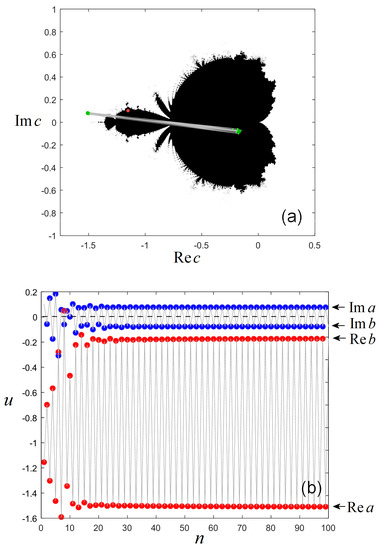
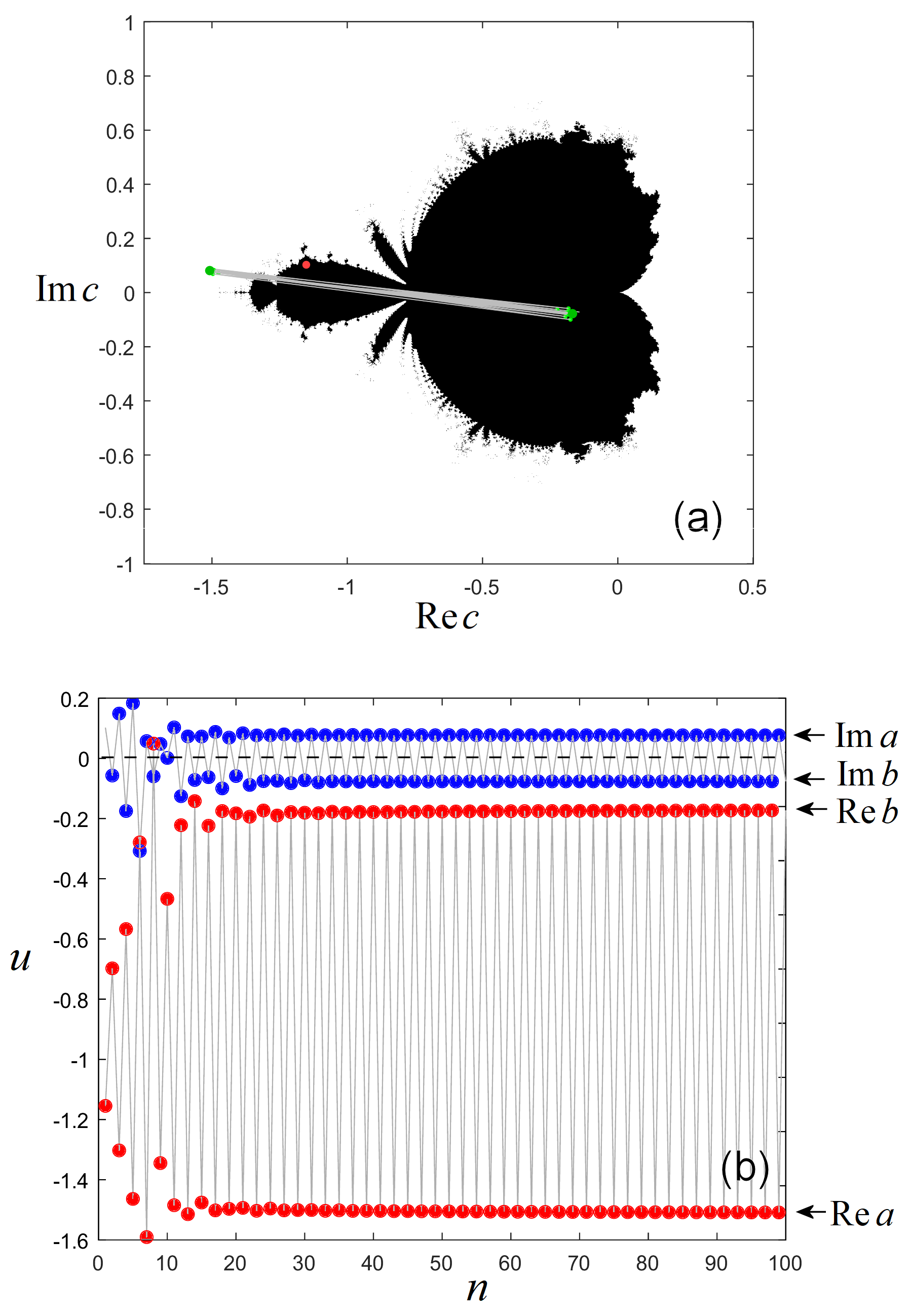
For example, considering (38) and (39) for with chosen in the “had” of the set (red point in Figure 4a), and the summations from to , one obtains the following system:
with the following solutions;
The first two solutions are fixed points
These fixed points are unstable since (see red point in Figure 4a), being outside (see Section 2.1 and Figure 3c).
Figure 4.
Asymptotic 2-periodic cycle of the map for and (red point): (a) Asymptotic 2-periodic cycle (green) overplotted over the set; (b) Time series of the solution u, after 100 iterations: real component (red) and imaginary component (blue).
The last two solutions present possible asymptotic 2-periodic approximate solutions corresponding to and . So, if one iterates the system with these data ( and ), one obtains the asymptotic 2-periodic solution with the time series presented in Figure 4b, which corresponds to the fourth rectangle solution. As can be seen from figure, the real component of the solution u (red plot in Figure 4b) oscillates asymptotically between the real component of a and b, respectively, while the imaginary component of the solution oscillates asymptotically between the imaginary components of a and b, respectively (blue plot in Figure 4b). In the parametric plane c, over the set, the asymptotic 2-periodic cycle visiting the two points a and b is overplotted in green (transients removed). The grey plot connects the cycle elements.
In addition, another interesting characteristic, shown here only numerically, is the property of all points c within the “head” of the set which generate asymptotic 2-periodic solutions (compare with the IO Mandelbrot set, where the points c within the “head” generate stable 2-period cycles).
3. Conclusions
In this paper, some results on the stability of the fixed points of the complex Mandelbrot map of fractional order are analyzed, and the non-periodicity for fractional differences of Caputo’s sense, exemplified in the case of the Mandelbrot set of fractional order, is studied. A possible future direction of research would be to extend this study of non-periodicity to other types of fractional differences such as Riemann–Liouville and Grundwald–Letnikov complex fractional differences. Another new direction would be to consider quaternion numbers instead of complex ones, i.e., quaternion fractional differences on instead of complex fractional differences on .
Author Contributions
Conceptualization, M.-F.D.; methodology, M.-F.D.; software, M.-F.D.; validation, M.F.; formal analysis, M.-F.D. and M.F.; investigation, M.F. and M.-F.D.; writing—original draft preparation, M.-F.D.; writing—review and editing, M.-F.D. and M.F.; visualization, M.F.; supervision, M.-F.D. and M.F. All authors have read and agreed to the published version of the manuscript.
Funding
M.F. is partially supported by the Slovak Research and Development Agency under the contract No. APVV-18-0308 and by the Slovak Grant Agency VEGA No. 1/0358/20 and No. 2/0127/20.
Institutional Review Board Statement
Not applicable.
Informed Consent Statement
Not applicable.
Data Availability Statement
Data supporting the reported results can be acquired from the corresponding author M.-F.D.
Acknowledgments
We thank the reviewers for their valuable comments which improved our paper.
Conflicts of Interest
The authors declare no conflict of interest.
Appendix A
Figure A1.
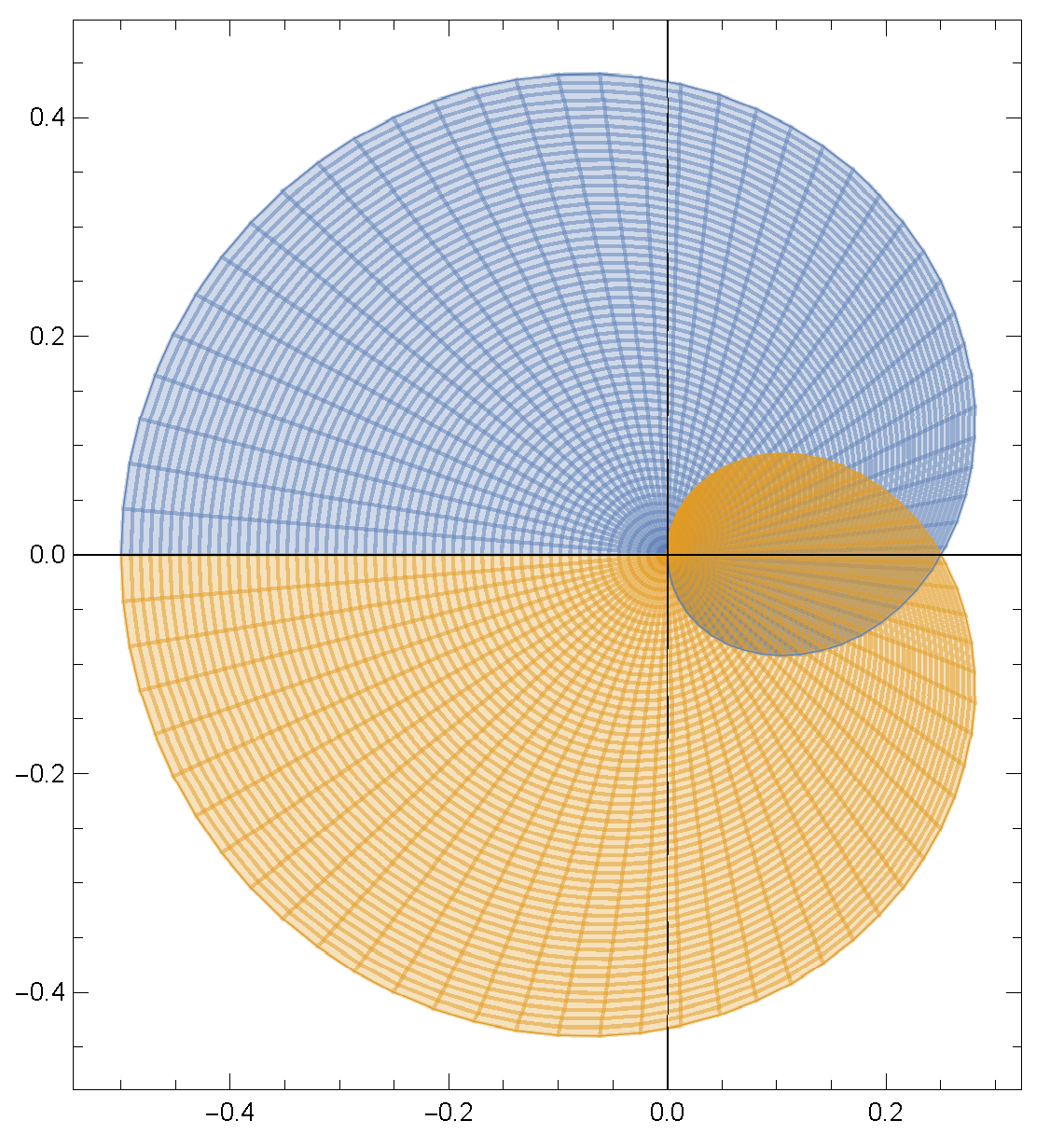
The code is set to draw the set in B-W, and it can be improved such that the speed is increased and colors are enhanced. To obtain the enlarged versions of some parts of the set, the underlying corners must be modified (see https://www.mathworks.com/matlabcentral/fileexchange/121632-fo_mandelbrot).
References
- Tavazoei, M.S.; Haeri, M. A proof for non existence of periodic solutions in time invariant fractional order systems. Automatica 2009, 45, 1886–1890. [Google Scholar] [CrossRef] [Scilit]
- Tavazoei, M.S. A note on fractional-order derivatives of periodic functions. Automatica 2010, 46, 945–948. [Google Scholar] [CrossRef] [Scilit]
- Yazdani, M.; Salarieh, H. On the existence of periodic solutions in time-invariant fractional order systems. Automatica 2011, 47, 1834–1837. [Google Scholar] [CrossRef] [Scilit]
- Kang, Y.-M.; Xie, Y.; Lu, J.-C.; Jiang, J. On the nonexistence of non-constant exact periodic solutions in a class of the Caputo fractional-order dynamical systems. Nonlinear Dyn. 2015, 82, 1259–1267. [Google Scholar] [CrossRef] [Scilit]
- Hoti, M. A note on the local stability theory for Caputo fractional planar system. J. Fract. Calc. Appl. 2022, 13, 1–8. [Google Scholar]
- Kaslik, E.; Sivasundaram, S. Non-existence of periodic solutions in fractional-order dynamical systems and a remarkable difference between integer and fractional-order derivatives of periodic functions. Nonlinear Anal. Real World Appl. 2012, 13, 1489–1497. [Google Scholar] [CrossRef] [Scilit]
- Fečkan, M. Note on periodic and asymptotically periodic solutions of fractional differential equations. In Applied Mathematical Analysis: Theory, Methods, and Applications; Dutta, H., Peters, J., Eds.; Studies in Systems, Decision and Control; Springer: Cham, Switzerland, 2020; Volume 177, pp. 153–185. [Google Scholar]
- Shen, J.; Lam, J. Non-existence of finite-time stable equilibria in fractional-order nonlinear systems. Automatica 2014, 50, 547–551. [Google Scholar] [CrossRef] [Scilit]
- Wang, J.R.; Fečkan, M.; Zhou, Y. Nonexistence of periodic solutions and asymptotically periodic solutions for fractional differential equations. Commun. Nonlinear Sci. Numer. Simul. 2013, 18, 246–256. [Google Scholar] [CrossRef] [Scilit]
- Diblíka, J.; Fečkan, M.; Pospíšil, M. Nonexistence of periodic solutions and S-asymptotically periodic solutions in fractional difference equations. Appl. Math. Comput. 2015, 257, 230–240. [Google Scholar] [CrossRef] [Scilit]
- Pospíšil, M. A note on fractional difference equations with periodic and S-asymptotically periodic right-hand sides. J. Math. Sci. 2022, 265, 669–681. [Google Scholar] [CrossRef] [Scilit]
- Area, I.; Nieto, J.L.J.J. On quasi-periodic properties of fractional sums and fractional differences of periodic functions. Appl. Math. Comput. 2016, 273, 190–200. [Google Scholar] [CrossRef] [Scilit]
- Abdelaziz, M.A.M.; Ismail, A.I.; Abdullah, F.A.; Mohd, M.H. Bifurcations and chaos in a discrete SI epidemic model with fractional order. Adv. Differ. Equ. 2018, 2018, 1–19. [Google Scholar] [CrossRef] [Scilit]
- Dzieliński, A.; Sierociuk, D. Stability of discrete fractional order state-space systems. J. Vib. Control 2008, 14, 1543–1556. [Google Scholar] [CrossRef] [Scilit]
- Wang, Y.; Li, X.; Wang, D.; Liu, S. A brief note on fractal dynamics of fractional Mandelbrot sets. Appl. Math. Comput. 2022, 432, 127353. [Google Scholar] [CrossRef] [Scilit]
- Danca, M.-F.; Fečkan, M.; Kuznetsov, N. Chaos control in the fractional order logistic map via impulses. Nonlinear Dyn. 2019, 98, 1219–1230. [Google Scholar] [CrossRef] [Scilit]
- Danca, M.-F. Puu system of fractional order and its chaos suppression. Symmetry 2020, 12, 340. [Google Scholar] [CrossRef] [Scilit]
- Danca, M.-F.; Fečkan, M.; Kuznetsov, N.; Chen, G. Coupled discrete fractional-order logistic maps. Mathematics 2021, 9, 2204. [Google Scholar] [CrossRef] [Scilit]
- Anastassiou, G.A. Discrete fractional calculus and inequalities. arXiv 2009, arXiv:0911.3370. [Google Scholar]
- Čermák, J.; Gyori, I.; Nechvátal, L. On explicit stability conditions for a linear fractional difference system. Fract. Calc. Appl. Anal. 2015, 18, 651–672. [Google Scholar] [CrossRef] [Scilit]
- Fečkan, M.; Pospíšil, M. Note on fractional difference Gronwall inequalities. Electron. J. Qual. Theory Differ. Equ. 2014, 44, 1–18. [Google Scholar] [CrossRef] [Scilit]
- Peterson, A.C.; Goodrich, C. Discrete Fractional Calculus; Springer: Cham, Switzerland, 2015. [Google Scholar]
- Danca, M.-F.; Fečkan, M. Mandelbrot set and Julia sets of fractional order. arXiv 2022, arXiv:2210.02037. [Google Scholar]
- Stuart, A.; Humphries, A.R. Dynamical Systems and Numerical Analysis; Cambridge University Press: Cambridge, UK, 1998. [Google Scholar]
- Gautschi, W. Some elementary inequalities relating to the gamma and incompletegamma function. J. Math. Phys. 1959, 38, 77–81. [Google Scholar] [CrossRef] [Scilit]
- Kershaw, D. Some extensions of W. Gautschi’s inequalities for the gamma function. Math. Comput. 1983, 41, 607–611. [Google Scholar]
Disclaimer/Publisher’s Note: The statements, opinions and data contained in all publications are solely those of the individual author(s) and contributor(s) and not of MDPI and/or the editor(s). MDPI and/or the editor(s) disclaim responsibility for any injury to people or property resulting from any ideas, methods, instructions or products referred to in the content. |
© 2023 by the authors. Licensee MDPI, Basel, Switzerland. This article is an open access article distributed under the terms and conditions of the Creative Commons Attribution (CC BY) license (https://creativecommons.org/licenses/by/4.0/).