


Abstract
Nonlinear electromagnetic wave propagation in complex plasma environments has attracted considerable attention due to its important applications in nonlinear optics, plasma physics, space science, and communication technologies. In the present study, a time-fractional Drinfel’d–Sokolov–Wilson equation (DSWE) is investigated under the influence of electromagnetic wave perturbations. The fractional-order formulation incorporates memory and hereditary effects, providing a more realistic description of wave propagation in nonlinear dispersive media. By employing an appropriate fractional traveling-wave transformation, the governing nonlinear fractional partial differential equation is reduced to a nonlinear ordinary differential equation. Exact solitary wave solutions are subsequently constructed using the -expansion technique. Furthermore, the nonlinear dynamical behavior of the reduced system is examined through phase portraits, bifurcation diagrams, Lyapunov exponents, sensitivity analysis, and multistability investigations. Particular attention is devoted to understanding the emergence of chaotic dynamics induced by electromagnetic wave effects and fractional-order interactions. The obtained results reveal that the fractional-order parameter significantly influences the stability, propagation characteristics, and dynamical evolution of nonlinear wave structures. The coexistence of multiple attractors, transitions between stable states, and chaotic regimes is identified for various parameter configurations. These findings provide deeper insight into the complex dynamics governed by the time-fractional DSWE and contribute to the understanding of nonlinear electromagnetic wave propagation in plasma and other nonlinear dispersive media.
1. Introduction
In recent years, fractional calculus has emerged as an effective mathematical framework for describing memory, hereditary effects, and nonlocal interactions in complex physical systems. Unlike classical integer-order differential equations, fractional differential equations provide a more realistic representation of many nonlinear phenomena encountered in plasma physics, electromagnetic wave propagation, viscoelastic materials, fluid mechanics, and biological systems. Consequently, nonlinear fractional partial differential equations (NFPDEs) have attracted considerable attention due to their ability to capture long-range temporal correlations and anomalous transport processes that cannot be adequately described by classical models [1,2,3,4].
The search for exact solutions of nonlinear fractional differential equations remains a challenging problem because of the presence of nonlocal fractional operators. To investigate the qualitative and quantitative behavior of fractional nonlinear systems, researchers have developed various analytical and computational approaches, including perturbation techniques, asymptotic methods, numerical simulations, and exact solution techniques such as the -method [5], direct algebraic method [6], and -model expansion method [7]. Exact solutions of nonlinear fractional equations are particularly important because they provide valuable information regarding wave propagation, stability properties, bifurcation structures, and nonlinear interactions occurring in complex media. Despite extensive research efforts, many important aspects of nonlinear fractional wave equations remain unexplored, motivating further investigation.
The present study focuses on the time-fractional Drinfel’d–Sokolov–Wilson equation (DSWE), which originates from integrable systems associated with affine and Lie algebras. The classical DSW equation was initially motivated by the interaction of nonlinear waves possessing different dispersion relations and is closely related to the Korteweg–de Vries (KdV) hierarchy [8,9]. Drinfel’d and Sokolov demonstrated that the governing equation can be regarded as a special reduction of the Kadomtsev–Petviashvili (KP) hierarchy [10], while Wilson established its connection with affine Lie algebras and further developed the coupled DSW model [11]. To incorporate memory effects and nonlocal temporal dynamics, we consider the time-fractional coupled DSW equation in the form
where , denotes the fractional derivative with respect to time, and c, d, e, and f are real constants. The fractional-order parameter characterizes the memory strength of the system. When , the fractional model reduces to the classical coupled DSW equation.
Fractional nonlinear wave models have found extensive applications in plasma physics and electromagnetic wave propagation. In dusty plasma environments, the existence of charged dust grains significantly modifies the propagation characteristics of nonlinear waves, leading to the formation of solitary waves, shock structures, and complex nonlinear patterns [12,13]. Since fractional operators naturally account for memory and anomalous transport mechanisms frequently observed in plasma media, the time-fractional DSWE provides a more realistic framework for investigating electromagnetic wave propagation in nonlinear and dispersive environments. Because of its many applications in long-distance communication, wireless networks, satellite transmission, atmospheric science, and plasma-based technologies, the dynamics of electromagnetic waves in complex plasma environments continue to attract considerable scientific interest [14].
Motivated by these physical applications, the present work investigates the exact solutions and nonlinear dynamical behavior of the time-fractional DSWE under electromagnetic wave influence. By employing an appropriate fractional traveling-wave transformation and analytical techniques, the governing nonlinear fractional partial differential equation is reduced to a nonlinear ordinary differential equation. The obtained exact solutions reveal various nonlinear wave structures and provide valuable insight into the influence of fractional-order effects on wave propagation dynamics.
Using the strong framework offered by the time-fractional DSWE, this study further explores the relationship between bifurcation theory and electromagnetic wave dynamics [15]. Through analytical investigations and numerical simulations, we reveal the complex bifurcation scenarios governing the evolution of electromagnetic waves and examine their stability characteristics, propagation properties, and potential physical applications [16,17,18]. The incorporation of the fractional-order parameter introduces additional dynamical richness, allowing memory-dependent effects to influence the system’s behavior.
In addition, the dynamics of electromagnetic waves become increasingly complicated in the presence of multistability, where several stable states coexist within the same parameter regime [19,20,21]. In this work, we investigate the existence and properties of multistable solutions within the time-fractional DSWE framework, providing insight into the coexistence of different wave structures and transitions among stable states. Through detailed numerical simulations and phase-space analysis, the boundaries of multistability are identified and their implications for electromagnetic wave propagation are discussed.
Chaotic dynamics constitute another important feature of nonlinear fractional systems and are characterized by aperiodic behavior and extreme sensitivity to initial conditions [22]. The present study therefore examines the emergence of chaotic behavior in electromagnetic wave dynamics governed by the time-fractional DSWE. By employing phase portraits, bifurcation diagrams, Lyapunov exponents, and sensitivity analyses, we identify the fundamental mechanisms responsible for complex nonlinear behavior and characterize the corresponding attractors and dynamical transitions [23,24].
Sensitivity assessments are also essential for understanding the predictability and robustness of nonlinear systems [25,26]. By analyzing the sensitivity of electromagnetic wave dynamics to variations in initial conditions and model parameters, we evaluate the stability and reliability of the obtained solutions. The combined investigation of exact solutions, bifurcation structures, multistability, chaos, and sensitivity provides a comprehensive understanding of the nonlinear dynamics governed by the time-fractional Drinfel’d–Sokolov–Wilson equation and highlights the significant role of fractional-order effects in electromagnetic wave propagation.
2. Mathematical Model
2.1. Description of Methods
In order to obtain the exact solution of the time-fractional DSW system, we consider the Equation (1) fractional traveling-wave transformation, which is taken as
Using the beta fractional derivative, we obtain
and
Integrating Equation (3) with respect to , and taking the integration constant as zero, gives
Again, integrating Equation (6) with respect to , we obtain
We assume that the solution of Equation (7) is as follows:
2.2. The Extended -Expansion Method
Suppose that the subsequent structure is the solution of Equation (4).
where
while and are real constants.
As a result, different nontrivial solutions are produced by using Maple to solve the above algebraic problems:
- Set 1:
- Set 2:
The generic solutions of Equation (10) concerning and parameters are shown below.
In order to create the following set of algebraic equations, inputting Equations (15) and (16) into Equation (8) is necessary. All terms with the same degree of where are added, and the coefficient of some degrees of is balanced.
2.2.1. Case 1
2.2.2. Case 2
3. Physical Interpretation
We will convert a few of the results into graphs now. In light of this, the Drinfeld–Sokolov–Wilson equation under the influence of electromagnetic waves is significant in a variety of physical situations, and analyzing its behavior under different values of parameters provides insightful information about fundamental mechanisms, because differences in the intensity of the electromagnetic waves interacting with the system can be correlated with different equation parameters. For instance, increasing the intensity parameter may make nonlinear effects more apparent and may lead to solitonic behavior. In addition, changing the parameters may also take into account changes to the characteristics of the medium that the waves travel through. Examples of factors that can significantly affect dynamics are modifications to the medium’s dispersion and nonlinearity.
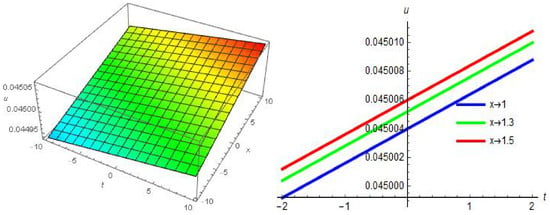
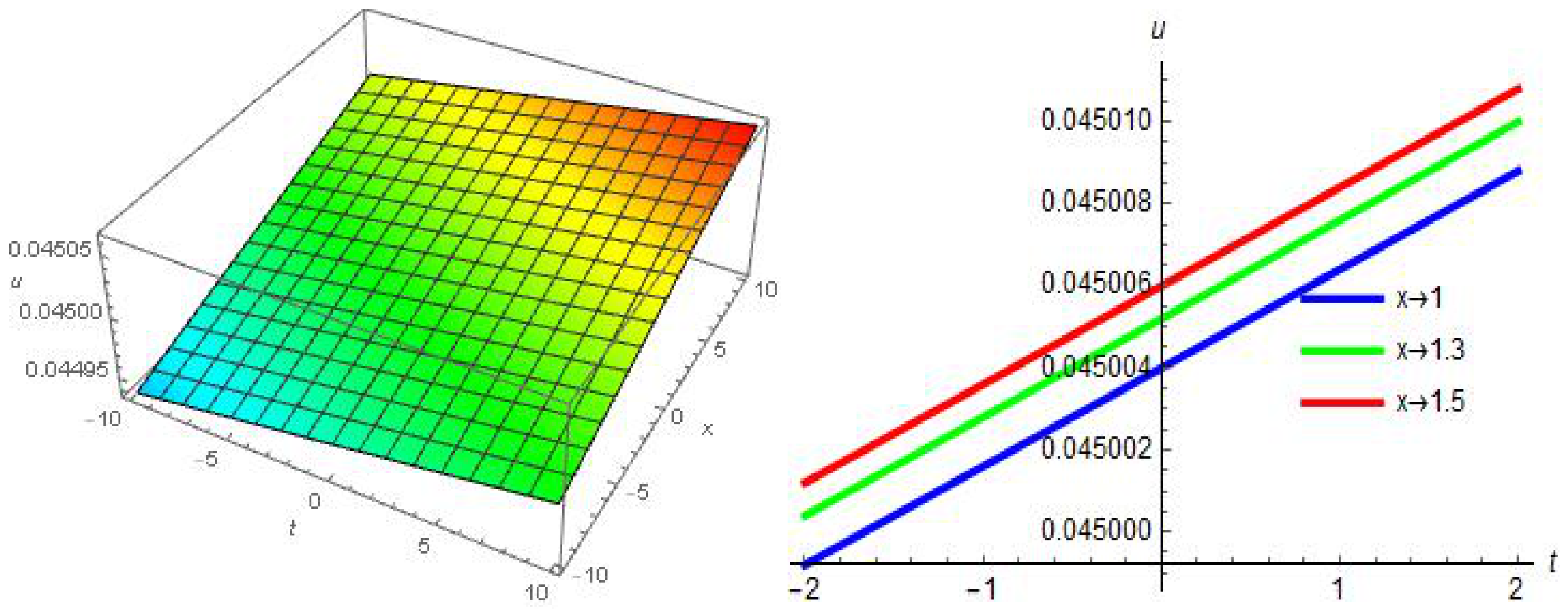
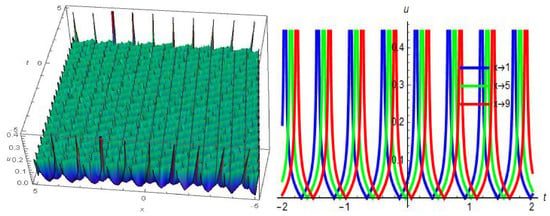
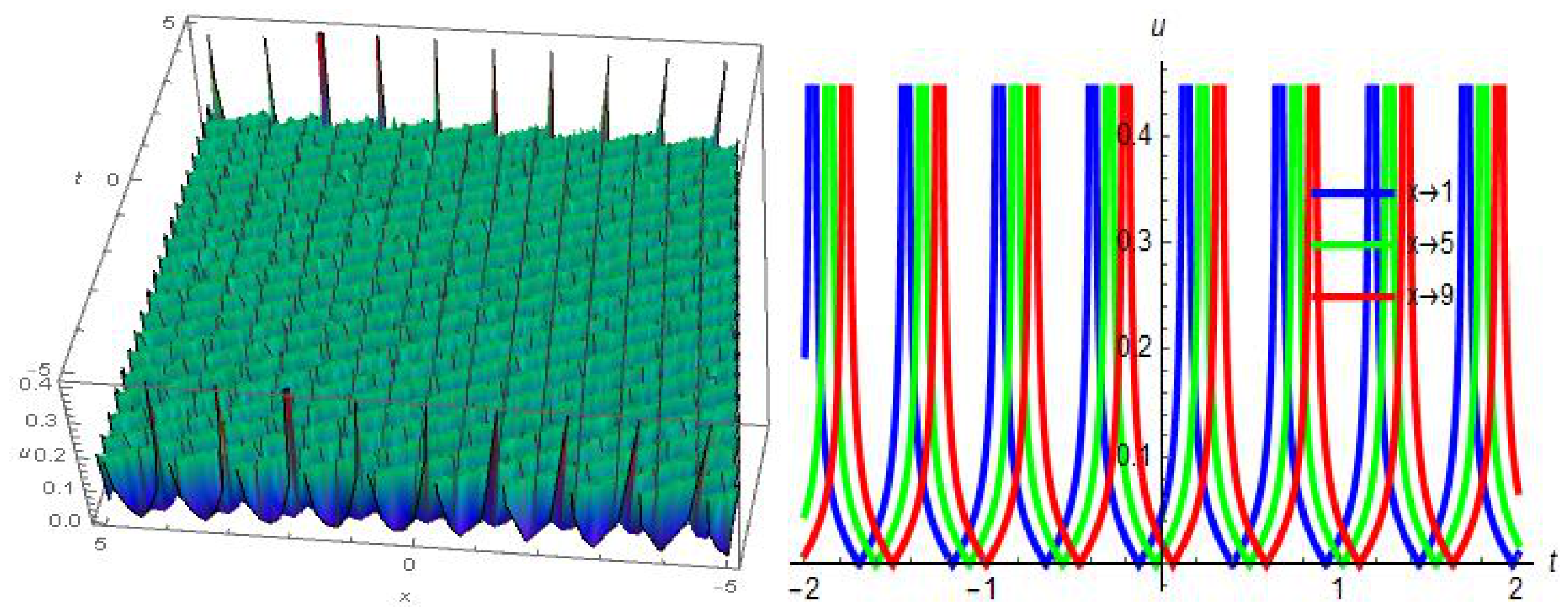
Figure 1 and Figure 2 represent the graphs of and , the solution of DSW under the value of , which demonstrate the potential for nonlinear effects such as soliton creation, wave modulation, and other behaviors in the DSW solutions. If there were a physical system with comparable mathematical features, these might have an impact on how electromagnetic waves behave.
Figure 1.
Using parameters x and t, the EM wave behavior of is shown in and for , , , , , , , and .
Figure 2.
Using parameters x and t, the EM wave behavior of is shown in and for , , , , , , , and .
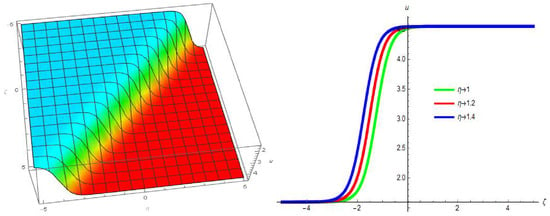
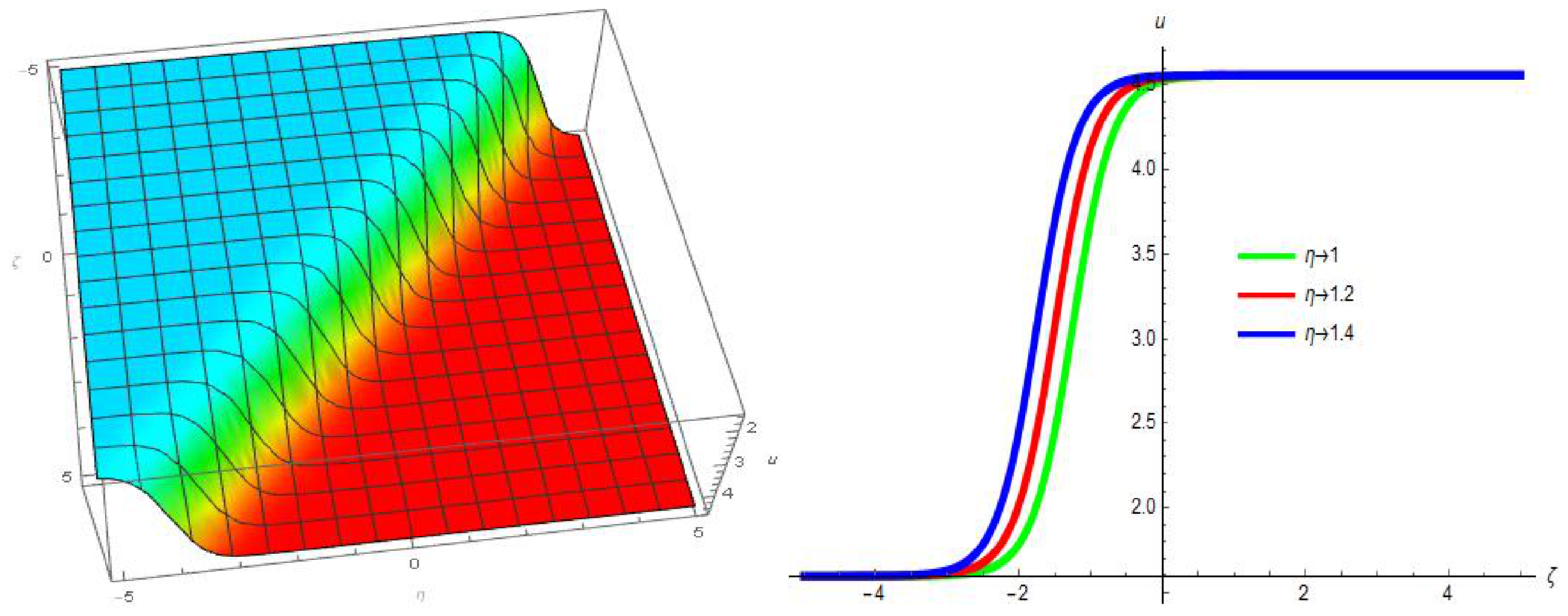
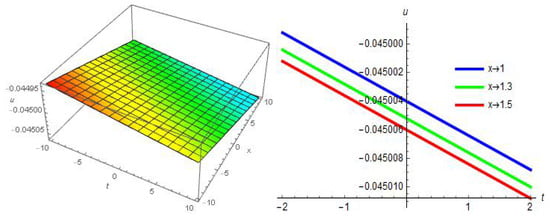
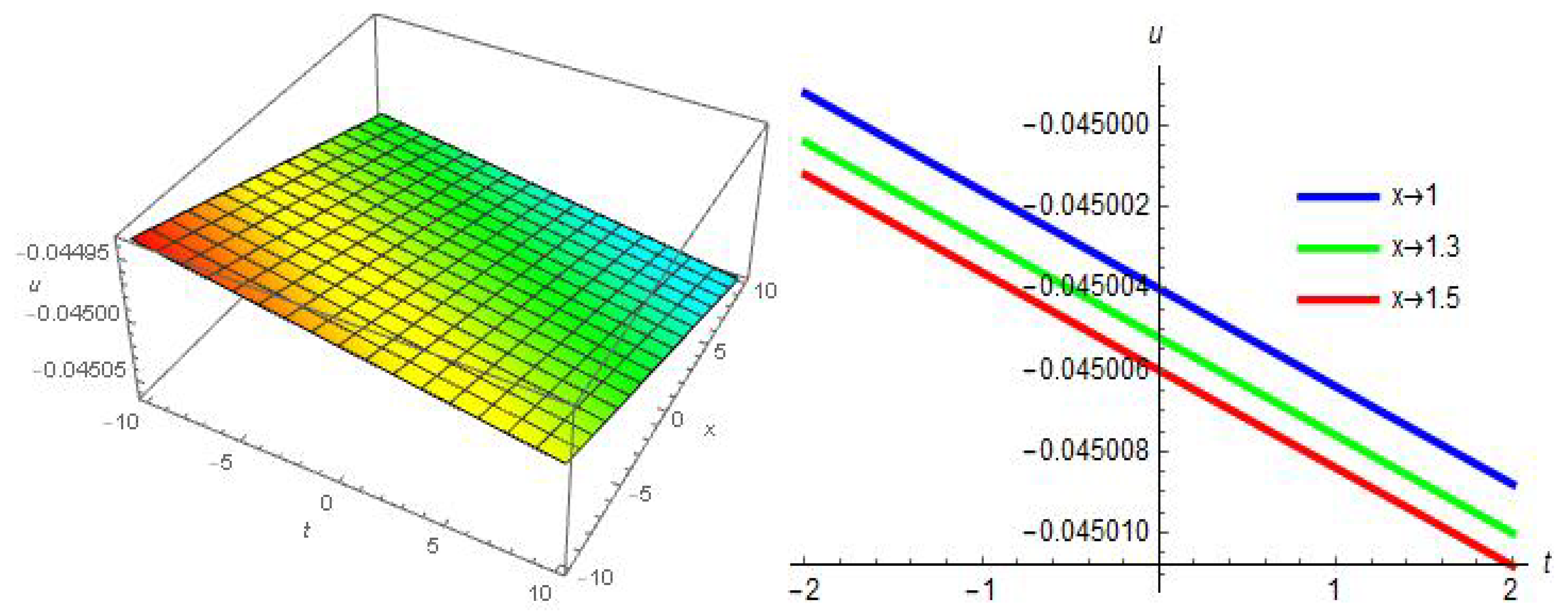
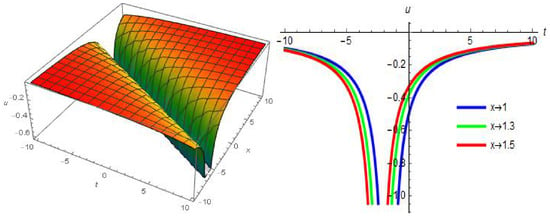
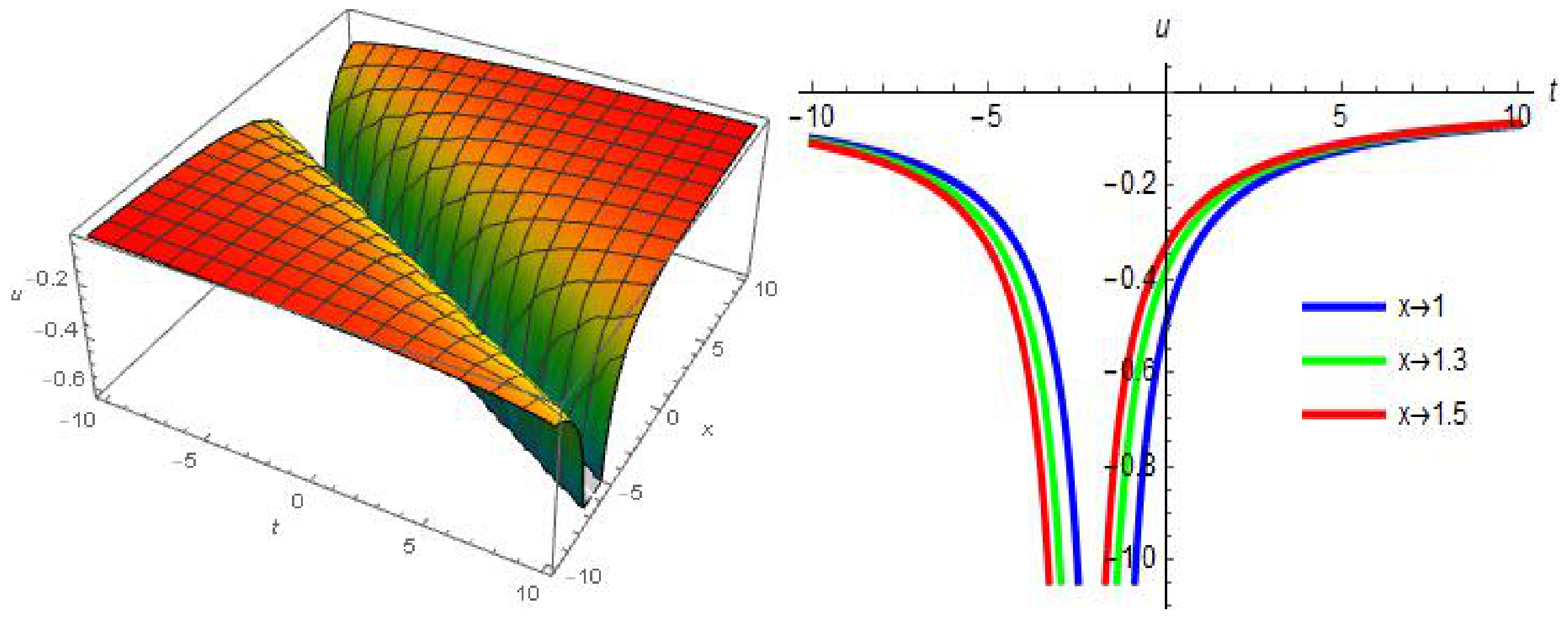
Solutions of and are the soliton with a kink-type wave for the particular values of are represented in Figure 3 and Figure 4. Smaller values of illustrate the kink waves’ contour. The behavior of the electromagnetic waves may be similar to kink waves in other systems in areas where they display these localized features. These structures can spread throughout the medium, link to one another, or exhibit other kink-like behaviors. They represent the differences in the underlying dynamics provided by the DSW equation.
Figure 3.
Using parameters x and t, the EM wave behavior of is shown in and for , , , , , , , and .
Figure 4.
Using parameters x and t, the EM wave behavior of is shown in and for , , , , , , , and .
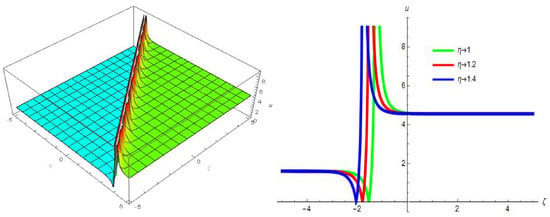
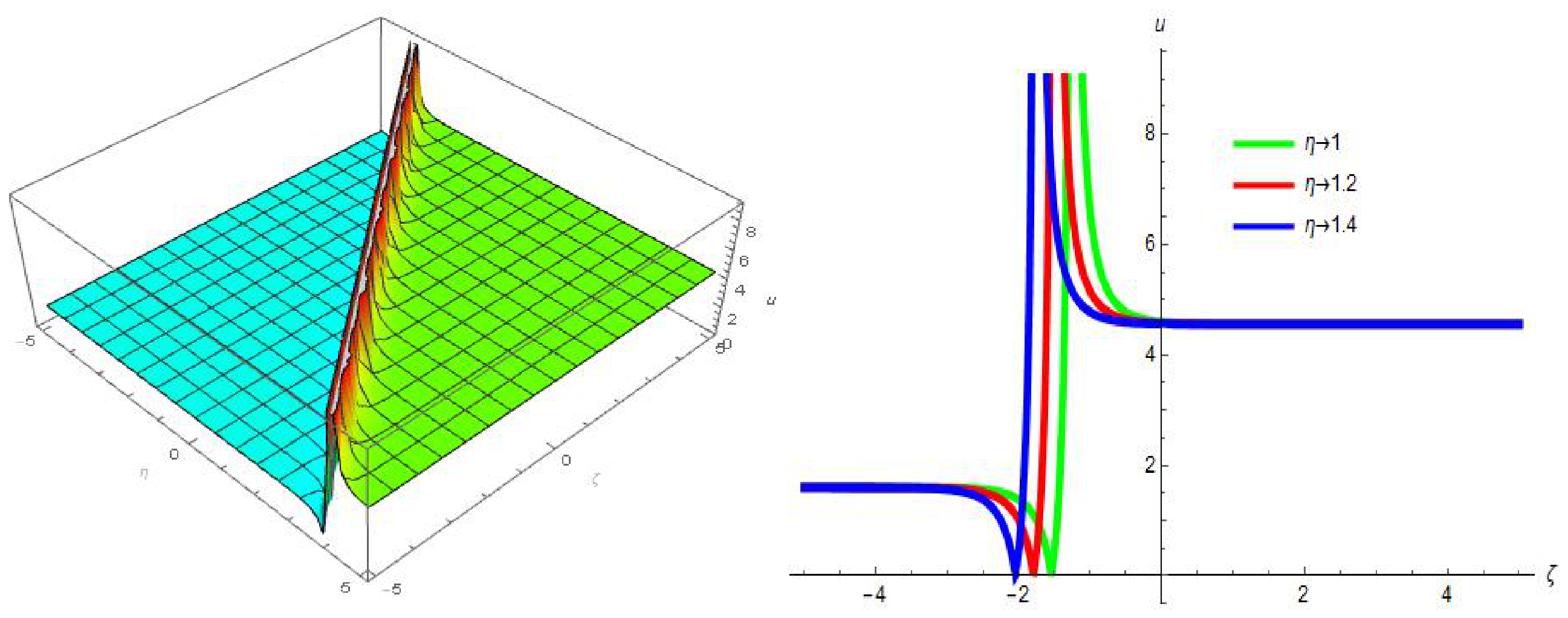
Solutions of and result in a singular bell-shape soliton for particular values of and are given in Figure 5 and Figure 6, displaying a solitary soliton in form.This soliton displays a highly concentrated energy profile and a localized, powerful electromagnetic flow disturbance and wave.
Figure 5.
Using parameters x and t, the EM wave behavior of is shown in and for , , , , , , , and .
Figure 6.
Using parameters x and t, the EM wave behavior of is shown in and for , , , , , , , and .
- Influence of the Fractional Parameter.
The time-fractional formulation incorporates memory and hereditary effects in the nonlinear wave dynamics, and is different from the classical integer-order DSWE (). Such memory effects affect the propagation attributes of the resulting solitary waves by affecting the localization, stability, and speed of the propagation. The fractional-order parameter becomes smaller the more the wave profile is influenced by the accumulated history of the system, which can lead to an increased nonlinear dissipation of nonlinear oscillations, a slowing of the waves’ propagation and broader wave structures. The fractional-order model will thus offer a more detailed description of nonlinear electromagnetic wave propagation than the related integer-order model.
- Comparison with Previous Methods.
The results of the obtained solitary wave solutions are different from those reported by the tanh-method, -expansion method and the other auxiliary equation methods in the classical integer-order Drinfel’d–Sokolov–Wilson equation. The solutions in the classical model represent wave propagation with no memory effects, while the present time-fractional model incorporates nonlocal temporal dynamics due to the fractional-order parameter. As such, the proposed solutions offer more flexibility in describing the propagation of nonlinear electromagnetic waves, and allow the investigation of memory-induced effects on stability, bifurcation, chaos and multistability that are not available in the traditional integer-order description.
4. Bifurcation Theory
We will use the idea of bifurcation to analyze Equation (1). The Galilean translation Equation (7), is supplied by
where
The three equilibrium points associated with the structure (26) are listed as follows: , , and .
Here, the values of and are defined as
4.1. Case 1
- ,
- .
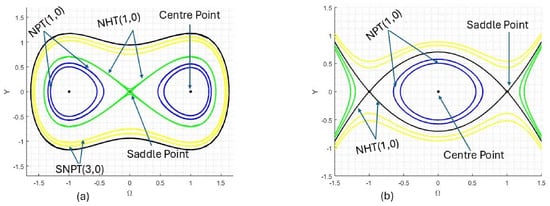
At the specified parameter values , , , , and , we construct the phase portrait shown in Figure 7a. The equilibrium points are
Figure 7.
Phase pictures with different values of arbitrary coefficients. Case 1: The graph is super nonlinear periodic for both conditions of A, B.
At these equilibrium locations, there exist two nonlinear periodic trajectories, denoted by , centered around and . Moreover, one nonlinear homoclinic trajectory is represented by , while a super nonlinear periodic trajectory is denoted by .
As observed in Figure 7a, the equilibrium point becomes a saddle point, whereas and become center points. Additionally, as demonstrated by the infinite number of kink and electromagnetic waves in Equation (7), the system (26) possesses infinitely many periodic trajectories both inside and outside the homoclinic trajectories.
As shown in Figure 7b, the three equilibrium points are , , and . Here, represents a single nonlinear periodic trajectory. In this case, and act as two saddle points. Consequently, open bounded trajectories exist on both the right and left sides of and , along with infinitely many periodic trajectories around . Homoclinic trajectories connecting each saddle point are also present.
Therefore, these results correspond to the plasma wave solutions of Equation (7), including kink and anti-kink dust-acoustic waves as well as electromagnetic waves.
4.2. Case 2
- ,
- .
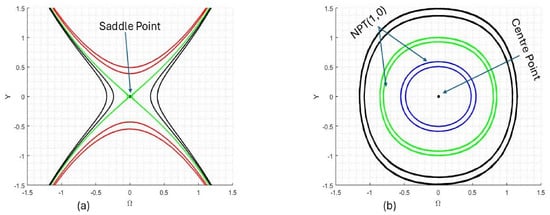
We construct phase portraits for provided parameters A, B, as indicated in Figure 8a. For open trajectories, there is a single saddle point at the center . As a result, the point is the only equilibrium point of the configuration where Equation (7) becomes a saddle point. This suggests that the electromagnetic wave of Equation (7) survives the infinite open bounded trajectories. Figure 8b plots the phase portrait of A when B is displayed. At , there is a single nonlinear periodic trajectory, represented as . Thus, the infinite electromagnetic wave of Equation (7) represents the system (26) with its infinite family of periodic trajectories over .
Figure 8.
Phase pictures with different values of arbitrary coefficients. Case 2: The graph is nonlinear periodic for both conditions of A, B.
4.3. Chaotic Behavior
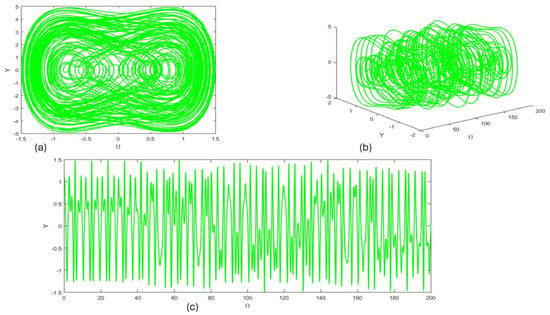
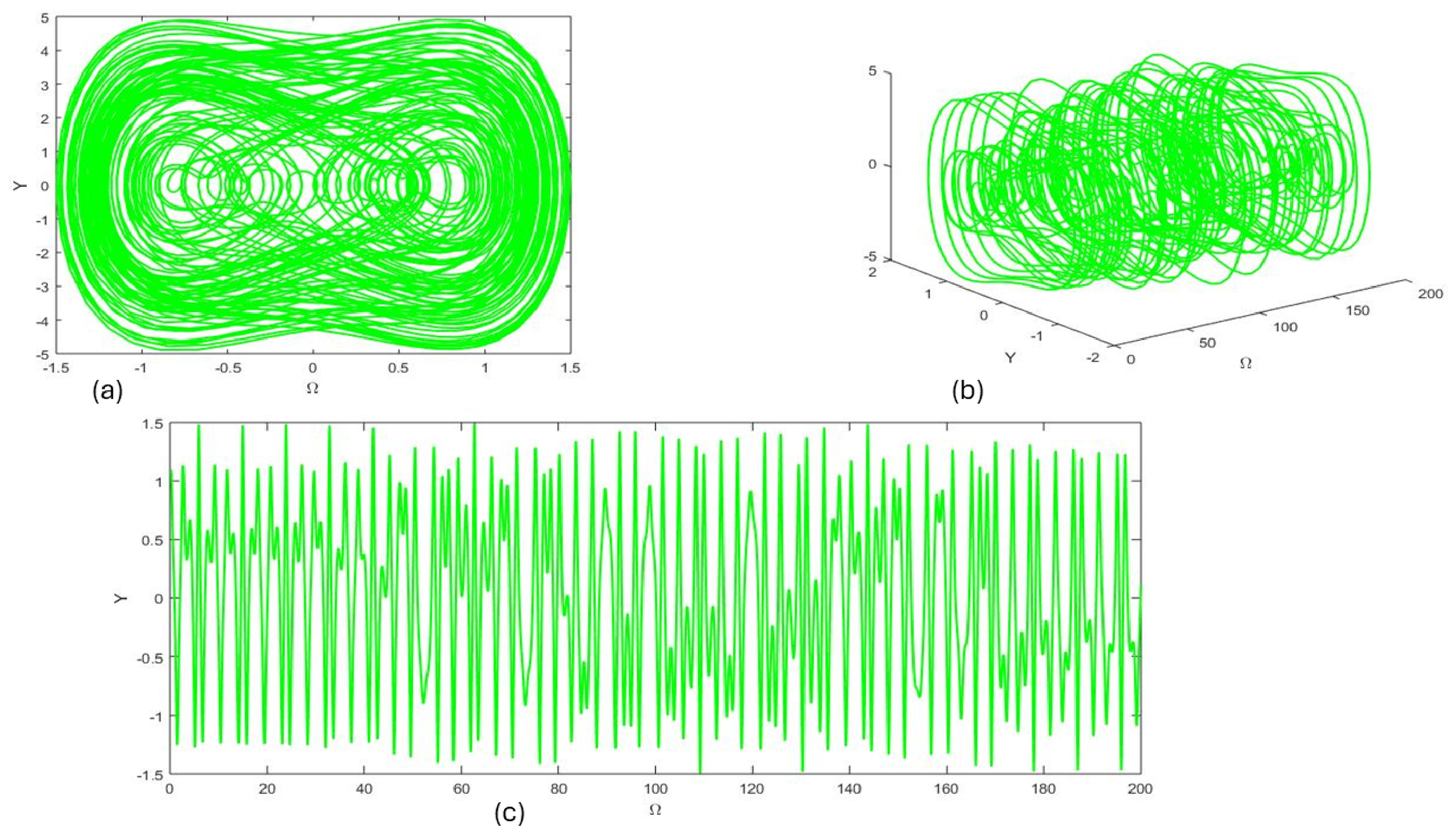
This section looks at the identified chaotic equation. We supplement Equation (1) with the perturbation term to further increase the excitement. The time series in Figure 9a–c illustrate how changes to the equation’s dispersion characteristics and bifurcation dynamics may also affect the stability of solutions and the onset of chaotic behavior. Depending on its specific characteristics and form, the new term may cause chaotic dynamics to emerge in the system. Equation (7) may be used to express the following frame with an extra disturbed term:
The chaotic system’s amplitude of some underlying force and interaction is most often represented by the parameters A, B, and . The creation, propagation, and interaction of electromagnetic waves may be impacted by changes in the system’s overall dynamics brought about by an increase or decrease in A. Variations in B may have an impact on the stability as well as general structure of solutions to the equation, which may then have an impact on the behavior of electromagnetic waves. For example, if B affects the dispersion characteristics of the system, changes in its value may result in modifications to the electromagnetic wave propagation frequency spectrum, which may affect phenomena such as shock wave creation or wave packet dispersion. The behavior of electromagnetic waves could be significantly affected by the parameter added in the bifurcation term. By adding a spatial periodicity to the bifurcation dynamics, this parameter may cause the electromagnetic field to exhibit spatial modulation effects. can result in the modification of wave attributes like frequency and amplitude or simply the production of spatially periodic structures, dependent on the term’s specific form and how it interacts with electromagnetic waves.
Figure 9.
For , the nonlinear dynamical systems are depicted for initial conditions .
5. Lyapunov Exponent
To investigate the chaotic dynamics of the Drinfeld–Sokolov–Wilson (DSWE) equation under traveling-wave transformation, we consider the reduced planar dynamical system
Because system (28) is nonautonomous based on the periodic excitation contribution, we reduce the system to an equivalent autonomous three-dimensional system by adding the phase variable.
so that . The augmented autonomous system becomes
where the dot denotes differentiation with respect to .
For the computation of Lyapunov exponents, we derive the variational equation associated with (30). Let
The Jacobian matrix of the system is given by
The corresponding variational system is
where is the evolution matrix of perturbation vectors.
The complete extended system used for Lyapunov exponent computation therefore consists of the original nonlinear system and the variational equations:
The Lyapunov exponents are defined by
where are orthonormalized perturbation vectors obtained through the Gram–Schmidt process.
- Computation of the Lyapunov Spectrum.
The augmented autonomous dynamical system and its variational equations were integrated to calculate the Lyapunov spectrum. To prevent the alignment of perturbation vectors and to guarantee the correct calculation of the three Lyapunov exponents, the standard Benettin algorithm was used, together with periodic Gram–Schmidt orthonormalization. The interval of the numerical integration was and the same numerical tolerances for both the original nonlinear system and the variational equations were applied. This part of the solution (the “transient”) was dropped from the average for convergence of the Lyapunov spectrum. When the largest Lyapunov exponent, which is when the value of the first Lyapunov exponent labeled as is positive, i.e., =0.03, it implies that the DSWE model exhibits sensitive dependence on initial conditions and, therefore, chaotic traveling-wave behavior. Also, in the event that the sum of Lyapunov exponents in Table 1 meets
the system is dissipative and possesses a strange attractor in phase space.
Table 1.
Computed Lyapunov spectrum of the perturbed time-fractional DSWE.
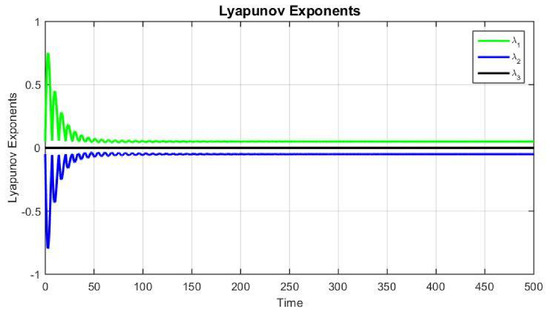
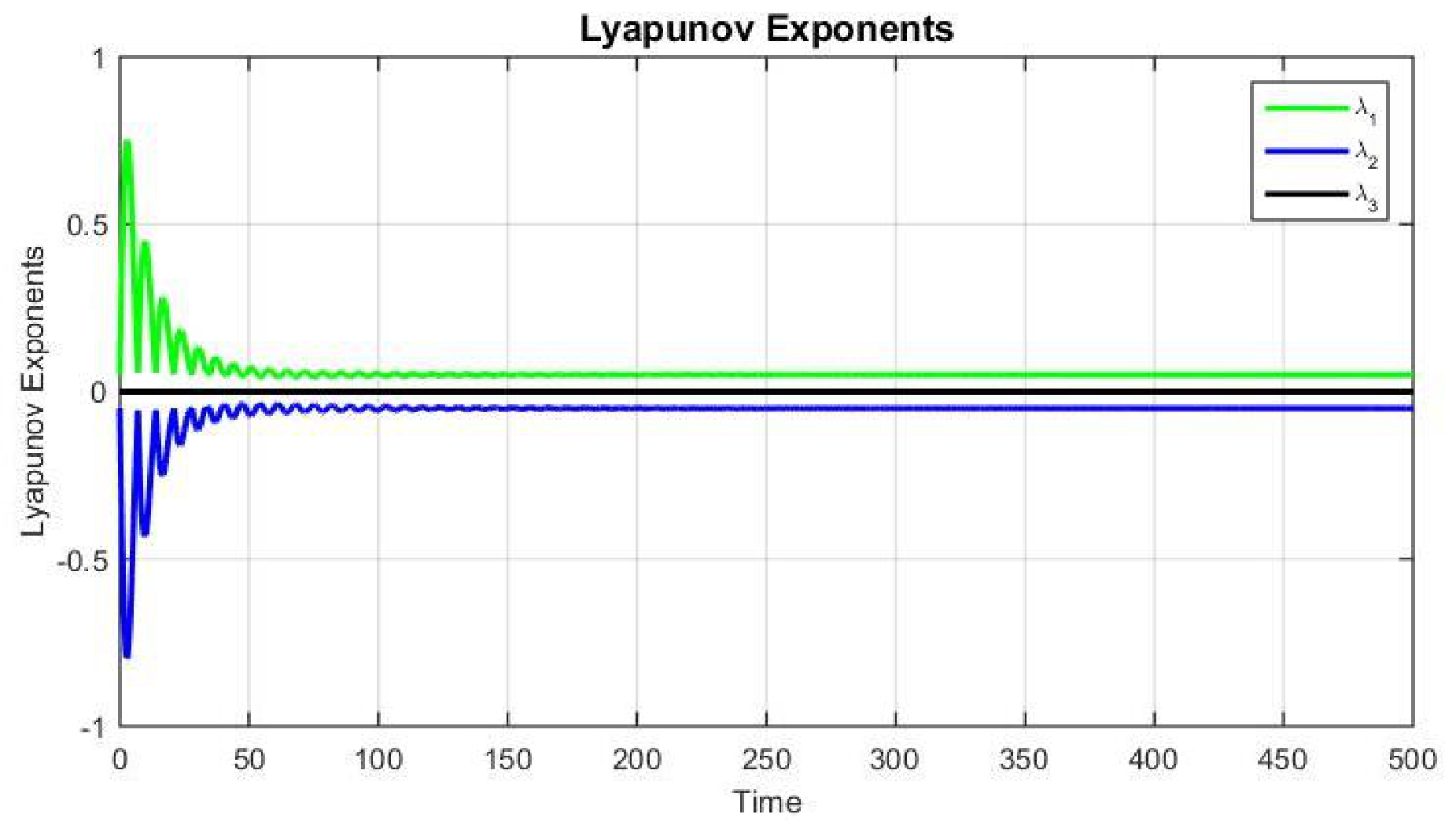
Figure 10 illustrates the temporal evolution of the Lyapunov exponents for the Drinfeld–Sokolov–Wilson equation (DSWE) dynamical system under electromagnetic wave influence. The three Lyapunov exponents, denoted by () (green), () (blue), and () (black), exhibit distinct dynamical behaviors that characterize the stability and chaotic nature of the system. In particular, the first Lyapunov exponent () remains positive over the entire observed time interval, which confirms the presence of chaotic behavior and strong sensitivity to initial conditions, a defining characteristic of nonlinear dynamical systems. In contrast, the second exponent () remains negative, indicating contraction in phase space and stability along another direction of the system dynamics. Meanwhile, the third exponent () stays close to zero, suggesting the presence of a neutral or marginally stable mode.
Figure 10.
Lyapunov exponents for the electromagnetic wave.
The observed behavior further shows that the system initially experiences noticeable fluctuations across all three dynamical modes under the influence of the electromagnetic wave. As time evolves, the first exponent gradually decreases but remains strictly positive, which further confirms the persistence of chaotic dynamics. The second exponent shows a slight increase while still remaining negative, thereby preserving the dissipative nature of the system. At the same time, the third exponent continues to oscillate around zero, indicating the existence of a quasi-neutral mode within the DSWE system. Overall, these findings provide strong evidence for the chaotic nature and complex stability structure of the proposed electromagnetic DSWE model.
6. Sensitive
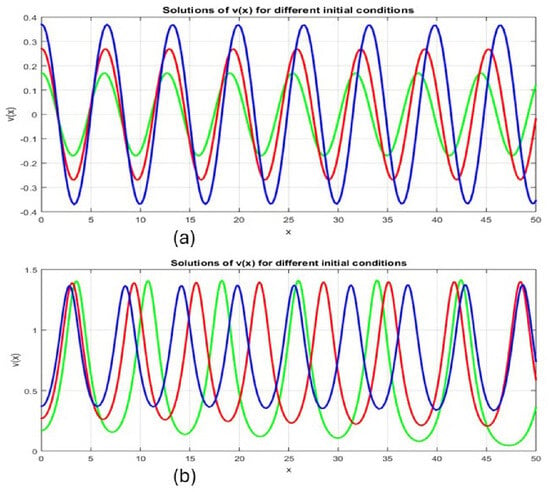
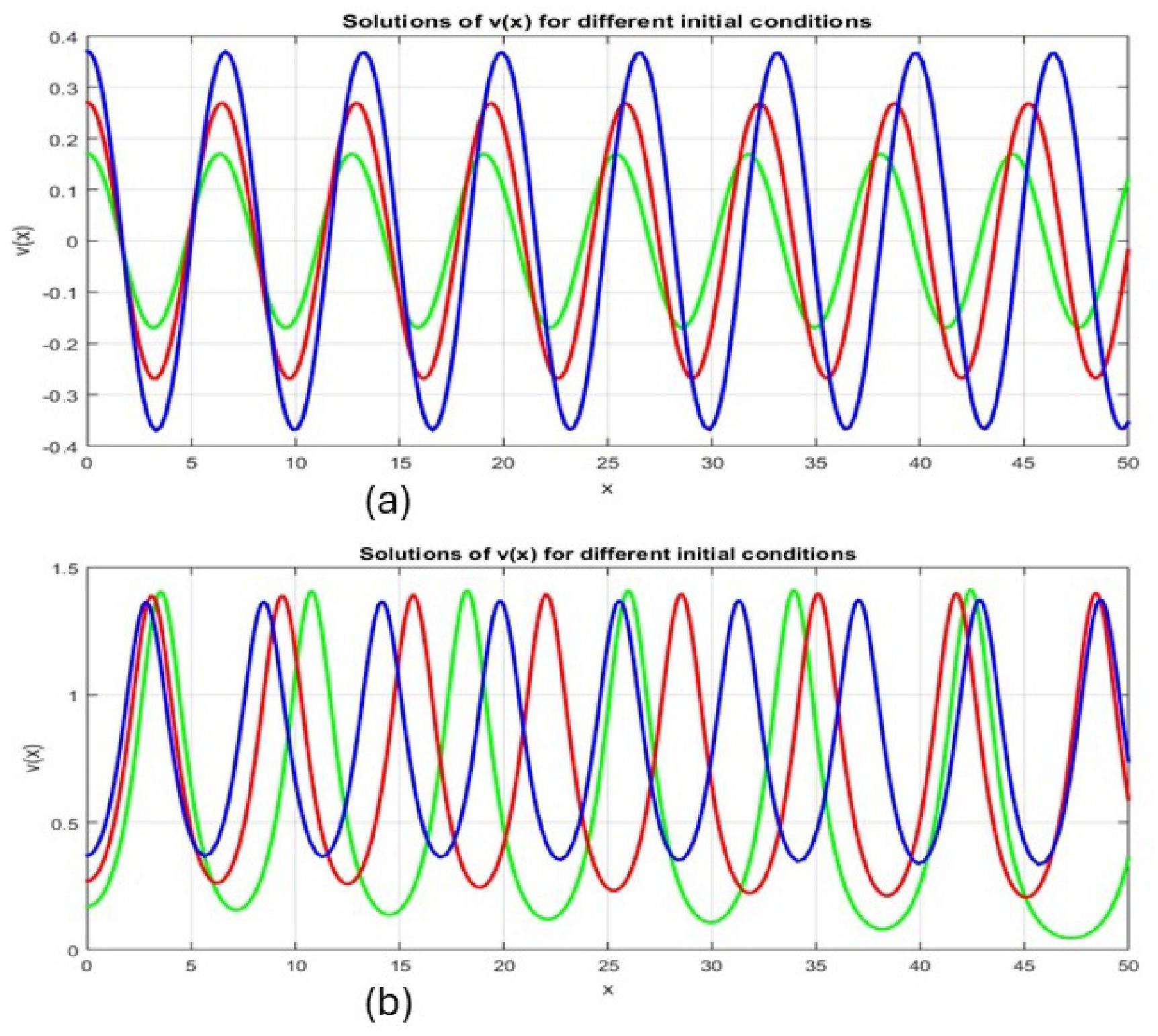
Our goal is to explore the system’s solution’s sensitive behavior using our existing dynamical frame (26). Figure 11a,b illustrate how beginning circumstances impact sensitively chaotic systems. Little changes to the initial state can cause trajectories to drastically change over time. As a result, the electromagnetic waves that serve as initial disruptions have a significant influence on the system’s later evolution. The trajectory of the system and the object it unites around is determined by their amplitude, frequency, and spatial distribution.
Figure 11.
Sensitive behavior.
7. Multistable Chaotic System
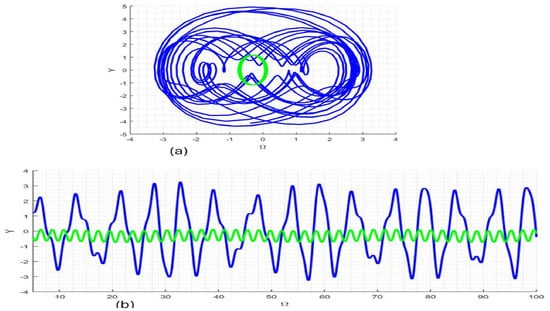
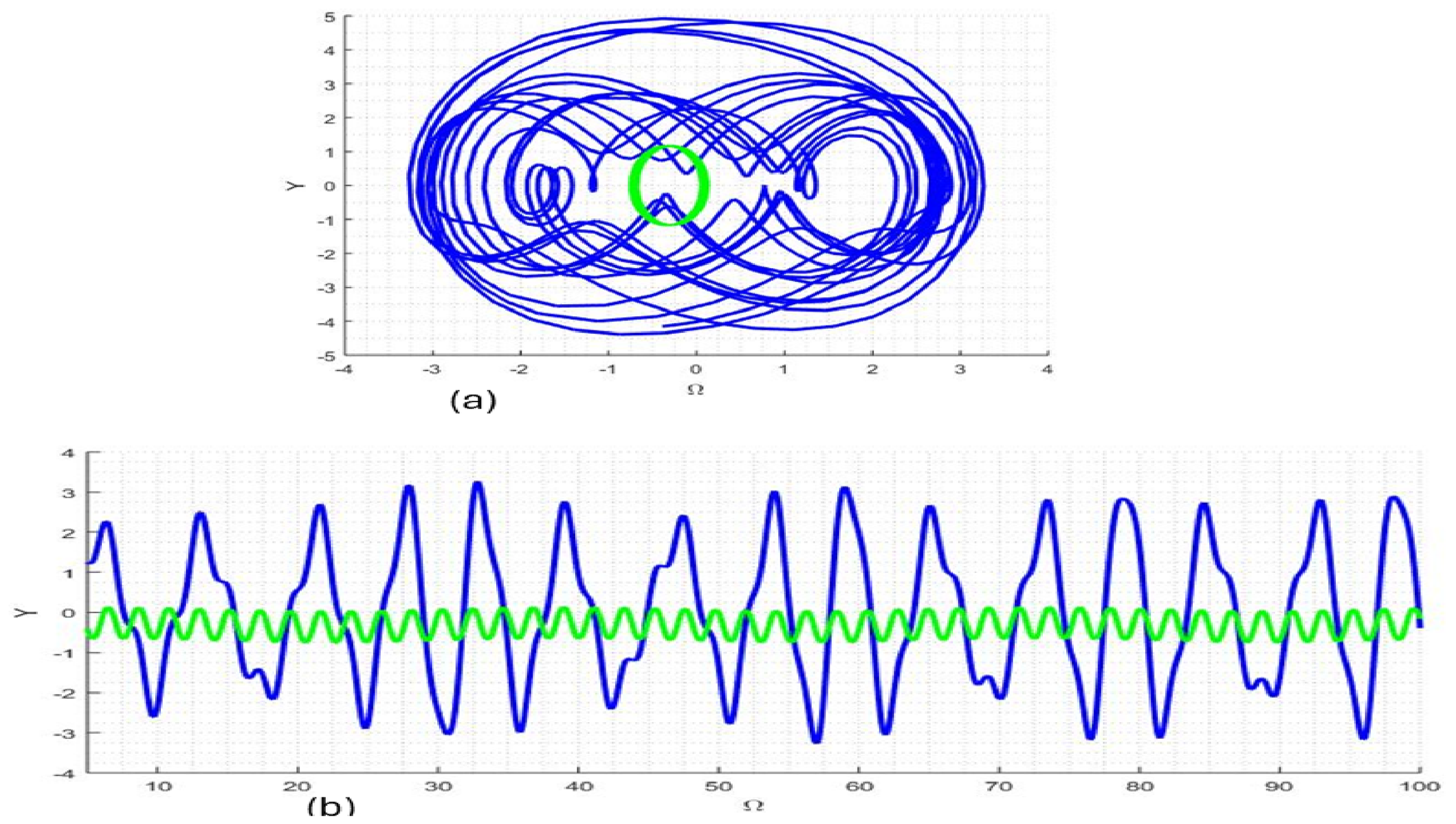
We assess the multistability of the system (27) by looking at the phase portrait and time series graph of the electromagnetic wave with the parametric values and . Both the time series in Figure 12b and the chaotic systems with multistability in Figure 12a exhibit a sensitive dependence on beginning conditions, meaning that small changes in initial conditions lead to different pathways. When electromagnetic waves interact with such a system, even little changes in their starting state can have a wide range of impacts. Depending on their amplitude and frequency, the electromagnetic waves can create resonance effects, intensify particular dynamical modes, and sustain some attractors while destabilizing others. The subsequent behaviors include the formation of coherent structures, secondary waves, and self-organized patterns.
Figure 12.
For and with the initial conditions .
8. Conclusions
In this study, we investigated the nonlinear dynamical behavior of the time-fractional Drinfel’d–Sokolov–Wilson equation (DSWE) under the influence of electromagnetic waves. Exact solitonic solutions of the unperturbed system were successfully obtained using the ()-expansion method, which revealed important solitary wave structures and characteristic profiles of the governing model. Furthermore, the reductive perturbation method was employed to incorporate electromagnetic wave effects into the time-fractional DSWE, transforming it into a perturbed dynamical system with rich nonlinear features. The presence of chaos, multistability, and sensitivity to initial conditions was confirmed through bifurcation analysis, phase portraits, and Lyapunov exponent analysis. In particular, the positive value of the leading Lyapunov exponent provided strong evidence of the system’s chaotic nature. The results clearly demonstrate that electromagnetic perturbations significantly influence the wave dynamics and may trigger transitions from regular solitonic behavior to more complex chaotic regimes. These findings offer deeper insight into nonlinear electromagnetic wave propagation in plasma and optical media. The proposed framework may find potential applications in nonlinear optics, plasma physics, wave propagation theory, and soliton-based engineering systems. Future work may focus on extending the present model to fractional-order formulations as well as machine-learning-based approaches for predicting chaotic regimes.
Author Contributions
W.A.K.: Writing—original draft and project administration; M.Z.: Conceptualization and methodology; R.K.: Software and validation; Z.U.R.: Resources and data curation; Y.A.: Writing—review and editing and supervision. All authors have read and agreed to the published version of the manuscript.
Funding
This research article is self funded.
Data Availability Statement
The original contributions presented in this study are included in the article. Further inquiries can be directed to the corresponding authors.
Conflicts of Interest
The authors declare no conflicts of interest.
References
- Veldes, G.P.; Lazarides, N.; Frantzeskakis, D.J.; Kourakis, I. Coupled circularly polarized electromagnetic soliton states in magnetized plasmas. Nonlinear Dyn. 2024, 112, 9477–9494. [Google Scholar] [CrossRef] [Scilit]
- Babajanov, B.; Abdikarimov, F. The Application of the Functional Variable Method for Solving the Loaded Non-linear Evaluation Equations. Front. Appl. Math. Stat. 2022, 8, 912674. [Google Scholar] [CrossRef] [Scilit]
- Jhangeer, A.; Muddassar, M.; Ur Rehman, Z.; Awrejcewicz, J.; Riaz, M.B. Multistability and dynamic behavior of non-linear wave solutions for analytical kink periodic and quasi-periodic wave structures in plasma physics. Results Phys. 2021, 29, 104735. [Google Scholar] [CrossRef] [Scilit]
- Riaz, M.B.; Atangana, A.; Jhangeer, A.; Junaid-U-Rehman, M. Some exact explicit solutions and conservation laws of Chaffee-Infante equation by Lie symmetry analysis. Phys. Scr. 2021, 96, 084008. [Google Scholar] [CrossRef] [Scilit]
- Rehman, Z.U.; Hussain, Z.; Li, Z.; Abbas, T.; Tlili, I. Bifurcation analysis and multi-stability of chirped form optical solitons with phase portrait. Results Eng. 2024, 21, 101861. [Google Scholar] [CrossRef] [Scilit]
- Faridi, W.; Asjad, M.; Jhangeer, A.; Yusuf, A.; Sulaiman, T.A. The weakly non-linear waves propagation for Kelvin–Helmholtz instability in the magnetohydrodynamics flow impelled by fractional theory. Opt. Quantum Electron. 2023, 55, 172. [Google Scholar] [CrossRef] [Scilit] [PubMed]
- Shahzad, M.U.; Rehman, H.U.; Awan, A.U.; Zafar, Z.; Hassan, A.M.; Iqbal, I. Analysis of the exact solutions of nonlinear coupled Drinfeld–Sokolov–Wilson equation through 6-model expansion method. Results Phys. 2023, 52, 106771. [Google Scholar] [CrossRef] [Scilit]
- Satsuma, J.; Hirota, R. A Coupled KdV Equation is One Case of the Four-Reduction of the KP Hierarchy. J. Phys. Soc. Jpn. 1982, 51, 3390–3397. [Google Scholar] [CrossRef] [Scilit]
- Hirota, R.; Grammaticos, B.; Ramani, A. Soliton structure of the Drinfel’d–Sokolov–Wilson equation. J. Math. Phys. 1986, 27, 1499–1505. [Google Scholar] [CrossRef] [Scilit]
- Drinfeld, V.G.; Sokolov, V.V. Equations of Korteweg–de Vries type, and simple Lie algebras. Dokl. Akad. Nauk 1981, 258, 11–16. [Google Scholar]
- Wilson, G. The affine lie algebra C(1)2 and an equation of Hirota and Satsuma. Phys. Lett. A 1982, 89, 332–334. [Google Scholar] [CrossRef] [Scilit]
- Shukla, P.K.; Silin, V.P. Dust ion-acoustic wave. Phys. Scr. 1992, 45, 508. [Google Scholar] [CrossRef] [Scilit]
- Jahan, S.; Chowdhury, N.A.; Mannan, A.; Mamun, A.A. Modulated Dust-Acoustic Wave Packets in an Opposite Polarity Dusty Plasma System. Commun. Theor. Phys. 2019, 71, 327. [Google Scholar] [CrossRef] [Scilit]
- Adeyemo, O.D.; Khalique, C.M. Shock waves, periodic, topological kink and singular soliton solutions of a new generalized two dimensional nonlinear wave equation of engineering physics with applications in signal processing, electromagnetism and complex media. Alex. Eng. J. 2023, 73, 751–769. [Google Scholar] [CrossRef] [Scilit]
- Refaie Ali, A.; Roshid, H.O.R.; Islam, S.; Khatun, A. Analyzing bifurcation, stability, and wave solutions in nonlinear telecommunications models using transmission lines, Hamiltonian and Jacobian techniques. Sci. Rep. 2024, 14, 15282. [Google Scholar] [CrossRef] [Scilit] [PubMed]
- Muddassar, M.; Khan, A.G.; Dragomir, S.S.; Budak, H.; Ur Rehman, Z.; Jabeen, T. Predicting nonlinear phenomena through fractional derivatives and advanced Riccati mapping: Bifurcation and solitary wave behavior in nonlinear systems. Bound. Value Probl. 2025, 2025, 141. [Google Scholar] [CrossRef] [Scilit]
- Hussain, Z.; Rehman, Z.U.; Abbas, T.; Smida, K.; Le, Q.H.; Abdelmalek, Z.; Tlili, I. Analysis of bifurcation and chaos in the traveling wave solution in optical fibers using the Radhakrishnan–Kundu–Lakshmanan equation. Results Phys. 2023, 55, 107145. [Google Scholar] [CrossRef] [Scilit]
- Tang, L. Bifurcations and traveling wave solitons in optical fibers with the nonlinear Kaup–Newell system. Optik 2023, 279, 170749. [Google Scholar] [CrossRef] [Scilit]
- Gao, C.; Qiao, S.; An, X. Global multistability and mechanisms of a memristive autapse-based Filippov Hindmash-Rose neuron model. Chaos Solitons Fractals 2022, 160, 112281. [Google Scholar] [CrossRef] [Scilit]
- Ramamoorthy, R.; Rajagopal, K.; Leutcho, G.D.; Krejcar, O.; Namazi, H.; Hussain, I. Multistable dynamics and control of a new 4D memristive chaotic Sprott B system. Chaos Solitons Fractals 2022, 156, 111834. [Google Scholar] [CrossRef] [Scilit]
- Yan, B.; He, S.; Wang, S. Multistability and Formation of Spiral Waves in a Fractional-Order Memristor-Based Hyperchaotic Lü System with No Equilibrium Points. Math. Probl. Eng. 2020, 2020, 2468134. [Google Scholar] [CrossRef] [Scilit]
- Sarkar, J.; Saha, A. Chaotic, rational and irrational oscillations of nonlinear waves in the Earth’s magnetosheath featuring bi-regularized κ-distributed electrons. Sci. Rep. 2025, 15, 34688. [Google Scholar] [CrossRef] [Scilit] [PubMed]
- Samina, S.; Jhangeer, A.; Chen, Z. Bifurcation, chaotic and multistability analysis of the (2 + 1)-dimensional elliptic nonlinear Schrödinger equation with external perturbation. Waves Random Complex Media 2025, 35, 11179–11203. [Google Scholar] [CrossRef] [Scilit]
- Lai, Q.; Akgul, A.; Li, C.; Xu, G.; Cavusoglu, U. A New Chaotic System with Multiple Attractors: Dynamic Analysis, Circuit Realization and S-Box Design. Entropy 2018, 20, 12. [Google Scholar] [CrossRef] [Scilit] [PubMed]
- Razavi, S.; Jakeman, A.; Saltelli, A.; Prieur, C.; Iooss, B.; Borgonovo, E.; Plischke, E.; Lo Piano, S.; Iwanaga, T.; Becker, W.; et al. The Future of Sensitivity Analysis: An essential discipline for systems modeling and policy support. Environ. Model. Softw. 2021, 137, 104954. [Google Scholar] [CrossRef] [Scilit]
- Oparaji, B.; Sheu, R.J.; Bankhead, M.; Austin, J.; Patelli, E. Robust artificial neural network for reliability and sensitivity analysis of complex non-linear systems. Neural Netw. 2017, 96, 80–90. [Google Scholar] [CrossRef] [Scilit] [PubMed]

Disclaimer/Publisher’s Note: The statements, opinions and data contained in all publications are solely those of the individual author(s) and contributor(s) and not of MDPI and/or the editor(s). MDPI and/or the editor(s) disclaim responsibility for any injury to people or property resulting from any ideas, methods, instructions or products referred to in the content. |
© 2026 by the authors. Licensee MDPI, Basel, Switzerland. This article is an open access article distributed under the terms and conditions of the Creative Commons Attribution (CC BY) license.