


Abstract
Understanding the anisotropic mechanical behavior and pore–fracture structure (PFS) evolution of bedded coal under mining disturbance is critical for gas extraction and hazard prevention in deep coal mining. This study employed low-field nuclear magnetic resonance (NMR) and fractal analysis to characterize the PFS of water-saturated coal samples with bedding angles of 0°, 30°, 45°, 60°, and 90°. The pore system was classified into adsorption and seepage pores according to pore size distribution. Real-time triaxial NMR tests were further conducted to reveal the coupled evolution of mechanical responses and PFS under different bedding orientations. Results show that bedding inclination controls pore distribution, connectivity, and structural complexity, while influencing coal strength, deformation, and failure through stress redistribution and bedding-plane activation. The mechanical response and PFS evolution exhibit strong anisotropic coupling during loading. A fractional-order porosity model was established by incorporating bedding orientation, anisotropy, and stress memory based on pore geometry and stress decomposition. Model verification confirms its effectiveness in describing anisotropic porosity and PFS evolution under varying bedding angles. This study provides theoretical support for permeability prediction, stability assessment, and hazard control in deep-bedded coal seams.
1. Introduction
Coal is a typical sedimentary rock inherently featured with multi-scale anisotropic structures such as bedding planes and joints, which substantially control the mechanical behaviors and seepage characteristics of coal masses [1,2]. With the continuous advance of underground mining into greater depths, deep coal seams are exposed to geological environments markedly different from the low-stress conditions of shallow coal resources, where coupled high geostress, elevated pore pressure, and intensive mining-induced disturbances prevail [3,4]. The interaction between weak bedding planes and external loading dominates the initiation, propagation and coalescence of internal pores and fractures, as well as the formation of dominant seepage channels, thereby governing coal strength, deformation responses, failure modes and permeability evolution [5,6]. Elucidating the anisotropic evolution of PFS in deep-bedded coal subjected to mining disturbances, while establishing porosity and permeability models that incorporate bedding effects, therefore remains essential for seepage prediction and the prevention of dynamic disasters in deep coal mining.
Existing studies have shown that bedding dip angle plays a dominant role in determining the mechanical strength, energy dissipation, failure behavior, and seepage properties of coal [7,8,9]. The peak strength and deformation modulus vary nonlinearly with bedding inclination, accompanied by a shift in failure mode from trans-bedding shear and tensile splitting to bedding slip or mixed failure [9]. By altering the initiation and propagation of cracks, weak bedding planes further control elastic energy storage, energy dissipation, and residual deformation. As a result, coal specimens with different bedding angles display distinct structural characteristics, mechanical responses, and seepage capacities even under the same stress conditions [10,11,12]. Although previous studies have clarified the macroscopic mechanical effects of bedding structures, the quantitative relationship between macroscopic mechanical behavior and microscopic pore-fracture evolution throughout the loading process remains insufficiently understood [6,13].
Common technical approaches for coal pore–fracture characterization include CT, SEM, AE and NMR testing [14,15,16]. CT can reconstruct three-dimensional fracture geometries, but its application is restricted by relatively low spatial resolution [16,17]; SEM provides detailed local microstructural information but cannot describe the overall connectivity of pore–fracture networks in coal [18]; and AE monitoring, meanwhile, cannot quantitatively characterize pore size distribution or fracture geometric features [19,20,21]. Compared with these methods, NMR offers advantages in the comprehensive, continuous, and quantitative evaluation of pore structures. It enables real-time observation of pore compression, fracture growth, network connectivity, and structural rearrangement during loading, providing an effective approach for revealing the microscopic evolution of coal under stress conditions [22,23,24]. Multiple parameters derived from NMR tests—including T2 spectrum distribution, pore size classification, pore fluid distribution, pore sensitivity and fractal dimension—have been adopted to characterize pore–fracture evolution in terms of pore scale, network connectivity and structural complexity [23,25,26,27,28]. However, limited research has focused on the dynamic structural evolution of deep-bedded coal under complex stress paths, and systematic investigation into the coordinated evolution of PFS, porosity and permeability remains insufficient.
Porosity and permeability serve as pivotal parameters linking microscopic pore–fracture evolution and macroscopic seepage behaviors of coal [27,29,30]. Traditional permeability models are developed based on effective stress, volumetric strain, adsorption swelling and matrix shrinkage theories, which provide fundamental theoretical support for seepage analysis under conventional stress conditions and coalbed methane exploitation [31,32,33]. Nevertheless, coal permeability in deep mining environments is not solely determined by instantaneous stress or volumetric strain, but comprehensively affected by bedding orientation, pore–fracture configuration, damage propagation, fracture coalescence and loading memory effects [10,13,34]. In recent years, damage mechanics, fractal geometry and fractional calculus have been introduced into coal seepage modeling to characterize the influences of complex pore structures and loading history on permeability evolution [12,27,35,36,37]. Even so, current models fail to fully quantify the coupled relationships among bedding dip angle, pore–fracture evolution and porosity–permeability variation, and their applicability for describing the anisotropic seepage behaviors of deep-bedded coal still needs further experimental validation [8,38].
This study systematically investigates the anisotropic evolution of PFS and mechanical responses of deep-bedded coal based on NMR experiments. Full-scale refined characterization of PFS is realized by establishing pore size conversion relations from T2 spectra. Microscopic structural parameters and macroscopic mechanical indices are synchronously acquired throughout the loading process, and dynamic correlations among deviatoric stress, strain, porosity, average pore size and fractal dimension are constructed to reveal the anisotropic evolution characteristics of coal structural and mechanical behaviors. A dynamic porosity evolution model that incorporates bedding dip angle and loading effects is finally established via fractional-order derivatives, with its reliability and rationality verified by experimental data. The research findings can provide theoretical references for instability judgment, seepage evolution prediction and mining-induced-disaster prevention in deep-bedded coal seam exploitation.
2. Materials and Methods
2.1. Sample Preparation
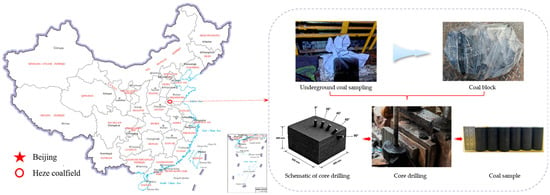
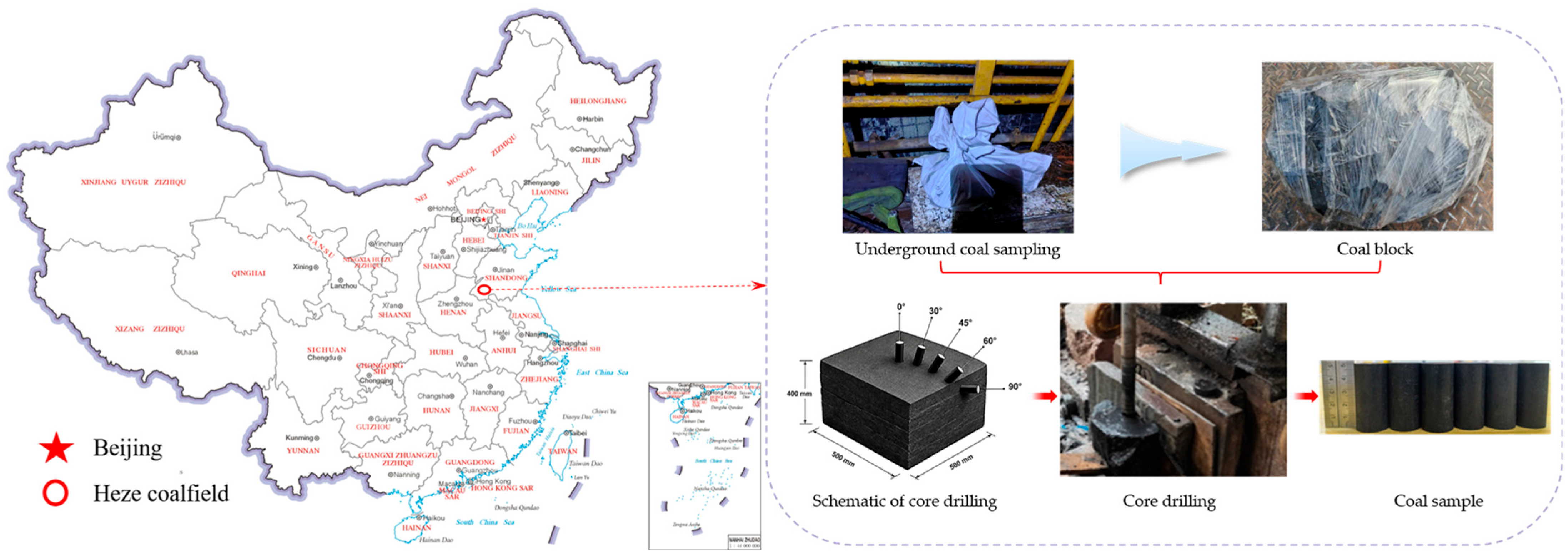
Raw coal blocks adopted in laboratory tests were collected from the 8302 fully mechanized caving face of Xin Julong Coal Mine. Intact and representative coal blocks with approximate dimensions of 500 mm × 500 mm × 400 mm were selected on-site to avoid pre-existing macroscopic damage. All specimens were processed in strict accordance with the testing standards recommended by the International Society of Rock Mechanics (ISRM). With natural primary bedding planes defined as the spatial reference datum, directional coring was conducted along five inclination angles of 0°, 30°, 45°, 60° and 90°. Standard cylindrical coal specimens were fabricated with a diameter of 25 mm and a height of 50 mm, and the specific coring orientation is illustrated in Figure 1. Ten high-quality coal specimens free of macroscopic fractures were prepared for subsequent NMR tests, which were numbered sequentially as 0-1, 0-2, 30-1, 30-2, 45-1, 45-2, 60-1, 60-2, 90-1 and 90-2.
Figure 1.
Coal sample location, drilling, and selection.
2.2. Experimental Scheme and Procedure
The experimental scheme was designed to investigate the anisotropic evolution of pore–fracture structures and mechanical responses of bedded coal under loading conditions. The specimens were divided into two groups according to different research objectives and loading paths.
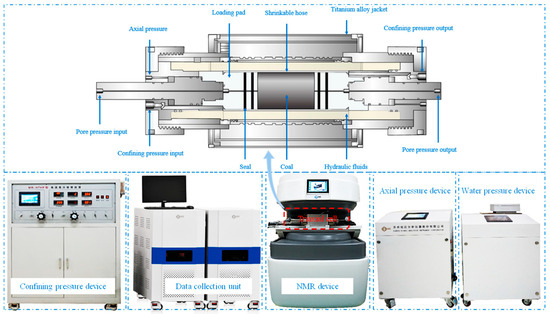
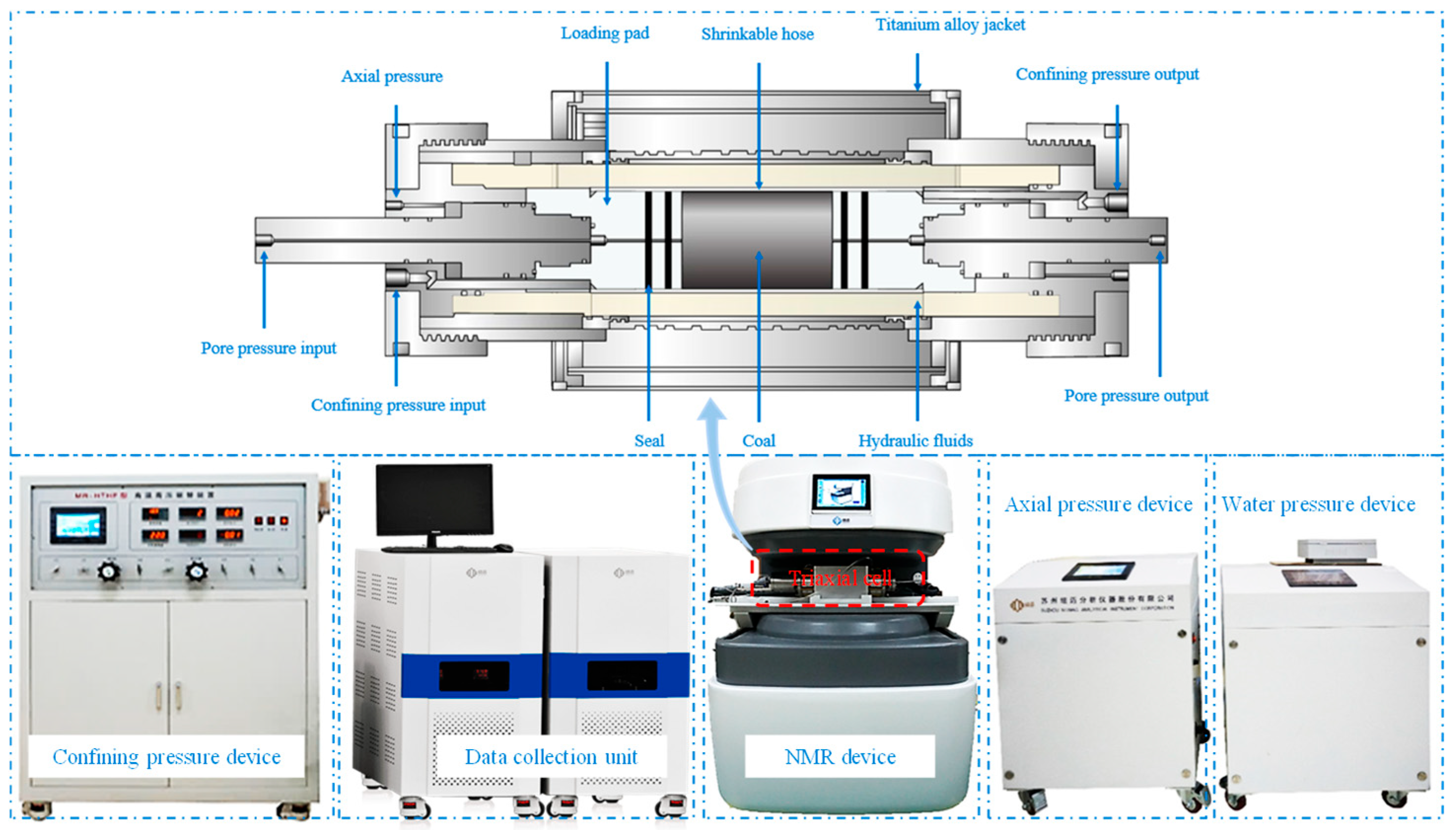
All specimens were initially subjected to offline NMR testing using the MacroMR12-150-I (Niumag Corporation, Suzhou, China) low-field NMR system (Figure 2) to characterize the initial PFS under static conditions. The obtained T2 spectra were used to analyze the initial pore size distribution, pore volume fraction, and fractal characteristics of coal specimens with different bedding orientations.
Figure 2.
MacroMR12-150-I low-field NMR pseudo-triaxial loading device.
Subsequently, the first group of specimens (0-1, 30-1, 45-1, 60-1, and 90-1) was selected for real-time triaxial NMR experiments. These tests were conducted to monitor the coupled evolution of mechanical behavior and PFS during monotonic loading. The stress–strain response and dynamic variation of T2 spectra were continuously recorded to reveal the anisotropic evolution mechanism induced by bedding structures. The remaining five specimens (0-2, 30-2, 45-2, 60-2, and 90-2) were assigned to another independent investigation. Since the stress path and research objective of this experiment differed from those of the present study, these specimens were not included in the current analysis.
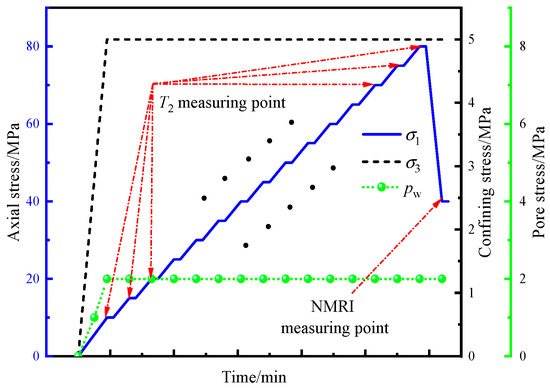
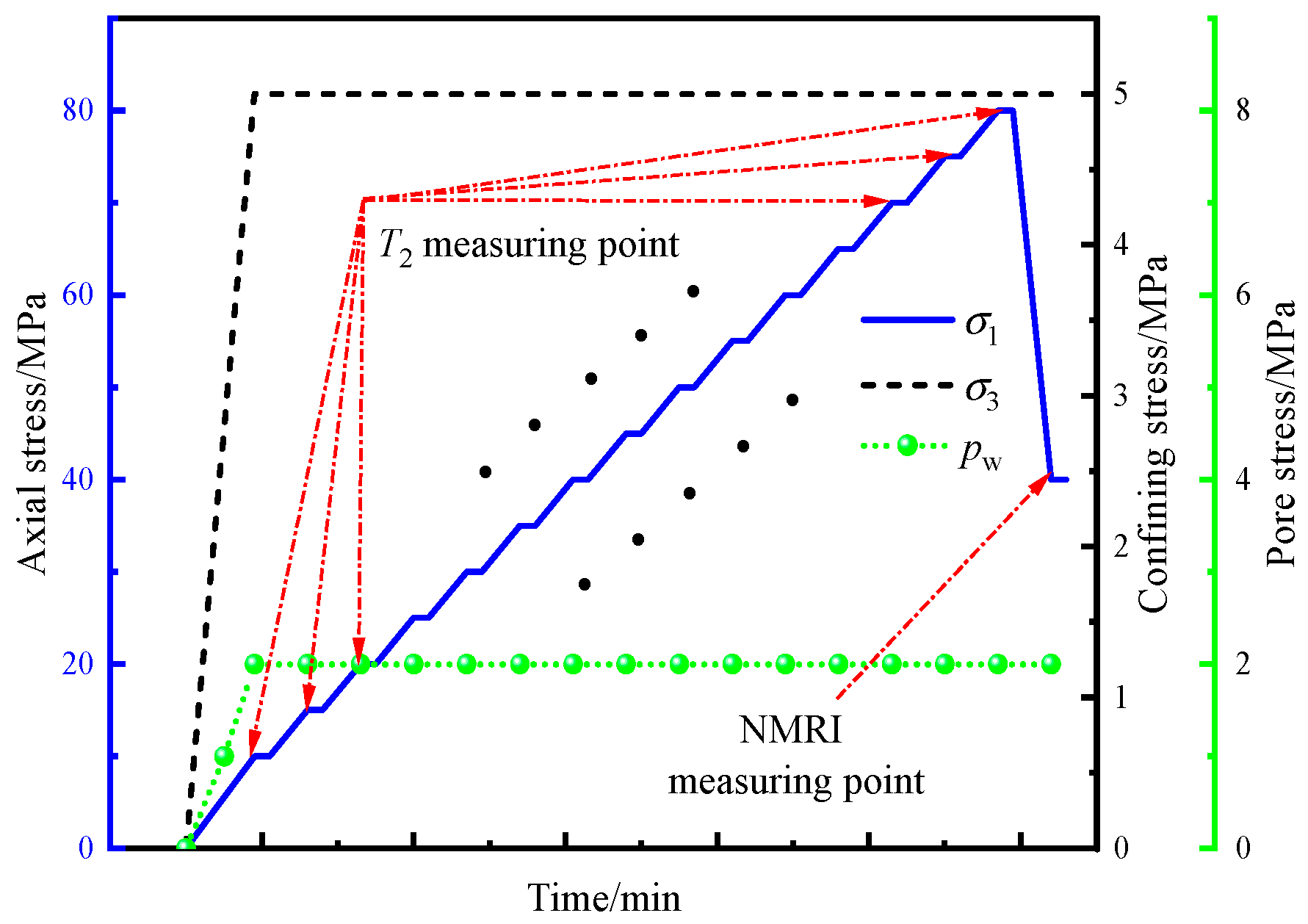
The detailed experimental procedure is illustrated in Figure 3. Before testing, all specimens were dried at for 24 h and then saturated under vacuum conditions to ensure sufficient water filling within the pore system. After saturation, the initial NMR measurements were performed. For real-time triaxial NMR testing, specimens were first subjected to hydrostatic loading to establish the initial stress state, followed by axial loading under a constant confining pressure until failure. During the loading process, NMR signals were continuously acquired to capture the evolution of adsorption pores, seepage pores, and the overall PFS.
Figure 3.
Stress path of triaxial compression test.
2.3. Nuclear Magnetic Resonance Principle and Fractal Theory
For fully water-saturated coal specimens, the detected hydrogen protons within the pore system are solely associated with liquid water occupying the internal pore spaces. According to classical NMR petrophysical theory, the transverse relaxation rate (1/T2) of pore fluids is controlled by three independent relaxation mechanisms in porous media [18]. The corresponding mathematical expression is given by
where T2 represents the transverse relaxation time (ms); T2B denotes the bulk transverse relaxation time (s); T2S is the surface transverse relaxation time (ms); and T2D refers to the diffusion transverse relaxation time (ms).
In geotechnical materials, the relaxation time of the pore fluid is predominantly governed by the surface relaxation mechanism. Accordingly, the surface relaxation time component for water can be expressed by
where ρ2 is the transverse surface relaxation rate, V is the pore volume, S is the surface area of the pores, FS is the geometric factor, and rc is the equivalent pore radius. Thus, the relationship between T2 and pore radius can be expressed as
In this study, the cylindrical pore shape factor was set as FS = 2, and the surface relaxivity was determined through centrifugal experiments. Using this relationship, the T2 spectrum was converted into an equivalent pore size distribution. It should be noted that the calculated pore size represents an equivalent pore radius rather than the actual geometric pore dimension.
Previous studies have confirmed that the pore structures within coal generally exhibit multifractal behavior [24,39]. Based on the basic principles of NMR, the relationship between relaxation time and pore size was incorporated into the fractal equation, thereby establishing the correlation between cumulative pore volume fraction and T2, we obtain
Equation (4) indicates a linear relationship between lg SV and lg T2, from which the fractal dimension D is determined by linear regression fitting.
3. Results and Discussion
3.1. Pore Structure Characteristics of Coal Samples
3.1.1. T2 and T2g
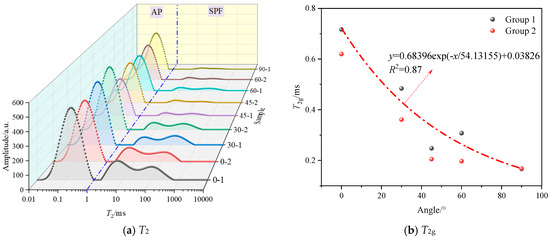
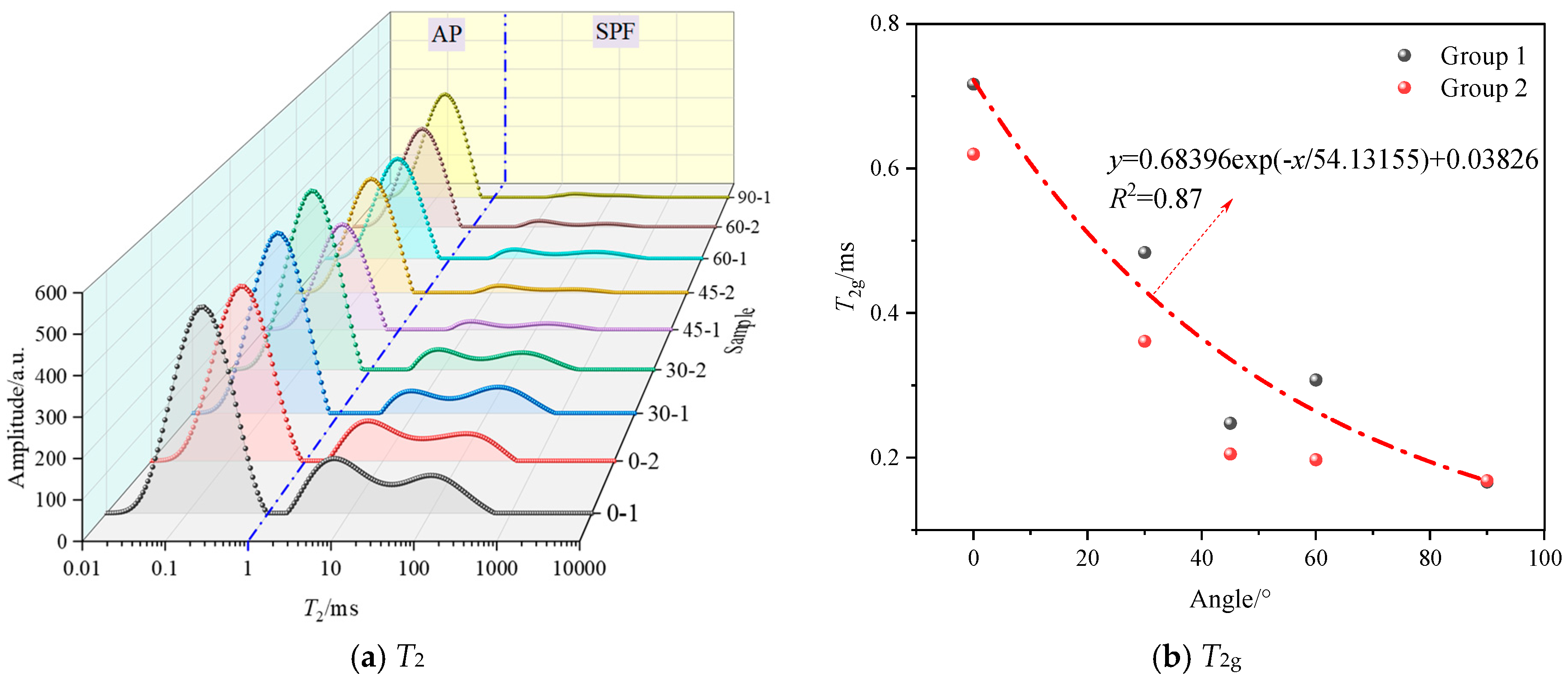
To investigate the effect of bedding structures on the microscopic pore–fracture characteristics of coal, T2 and corresponding geometric mean relaxation times (T2g) of specimens with bedding dip angles of 0°, 30°, 45°, 60°, and 90° were shown in Figure 4. Based on the T2 relaxation time, the total porosity (TP) was classified into two components: adsorption pores (APs) with T2 < 1 ms and seepage pores and fractures (SPFs) with T2 > 1 ms [18,40].
Figure 4.
T2 and T2g of saturated coal samples with different stratum inclination angles. (a) T2 and (b) T2g.
All coal specimens exhibit typical multi-peak T2 spectral distributions. Variations in bedding inclination lead to regular changes in peak position, amplitude, and spectral range. Specimens with low bedding angles (0–30°) show relatively concentrated T2 spectra, with the main peaks distributed in the short relaxation time region. As the bedding angle increases to 45–90°, the spectra gradually widen, and the signal contribution from medium and long relaxation time regions increases. Meanwhile, the peak intensities in both short and medium-to-long relaxation regions decrease noticeably compared with those of low-angle specimens. Although repeated specimens with the same bedding angle display similar spectral patterns, slight differences in peak intensity and spectral range remain, reflecting the inherent heterogeneity of coal structures.
T2g is positively related to the geometric mean pore size and can effectively reflect the pore size distribution characteristics of bedded coal with different bedding orientations. The T2g values of ten water-saturated coal specimens with various bedding angles are statistically presented in Figure 4b. The results indicate that T2g decreases continuously with increasing bedding dip angle, R2 = 0.87. Specimens with a bedding angle of 0° exhibit the highest T2g values, ranging from 0.6 ms to 0.7 ms. A rapid decrease occurs when the bedding angle increases from 30° to 60°, whereas the reduction becomes less significant at 90°, where T2g remains at a relatively low stable value of approximately 0.16–0.18 ms. Although duplicate specimens show some numerical differences, their overall variation trends remain consistent. The exponential decline of T2g with an increasing bedding angle indicates the systematic variation in pore scale characteristics caused by different structural orientations in coal.
3.1.2. Pore Size Distribution Frequency and Permeability Contribution
The T2 spectra can be transformed into pore radius using the relaxation rate conversion equation. The amplitude of T2 spectral peaks is proportional to the associated pore volume, meaning that a higher signal intensity represents a greater pore volume fraction at the corresponding pore scale. According to Darcy’s law and Poiseuille’s law, coal pores are simplified as capillary tubes with constant cross-sectional geometries. The permeability contribution of a single pore with radius r can be described by
where ki and φi represent the permeability and porosity of pores with radius r, respectively, and k denotes the total permeability of coal specimens.
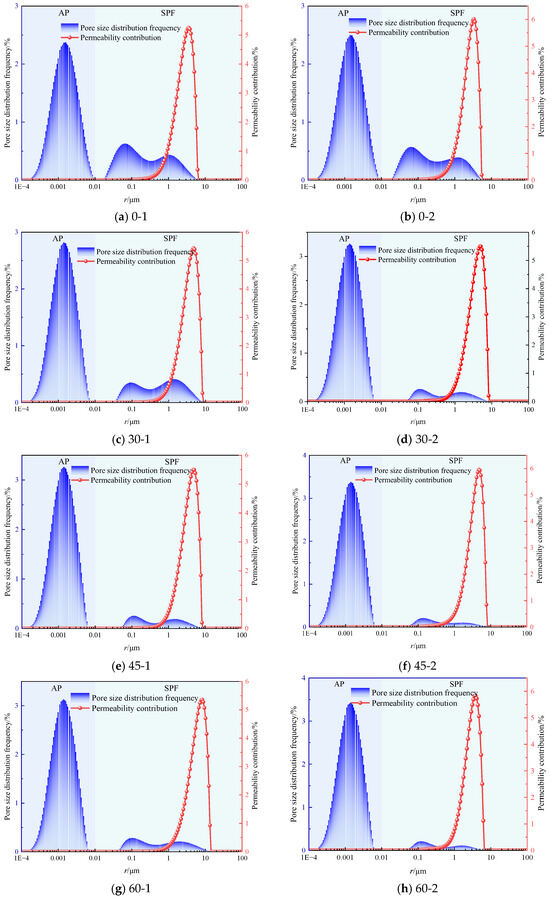
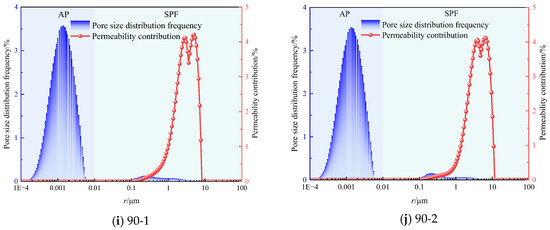
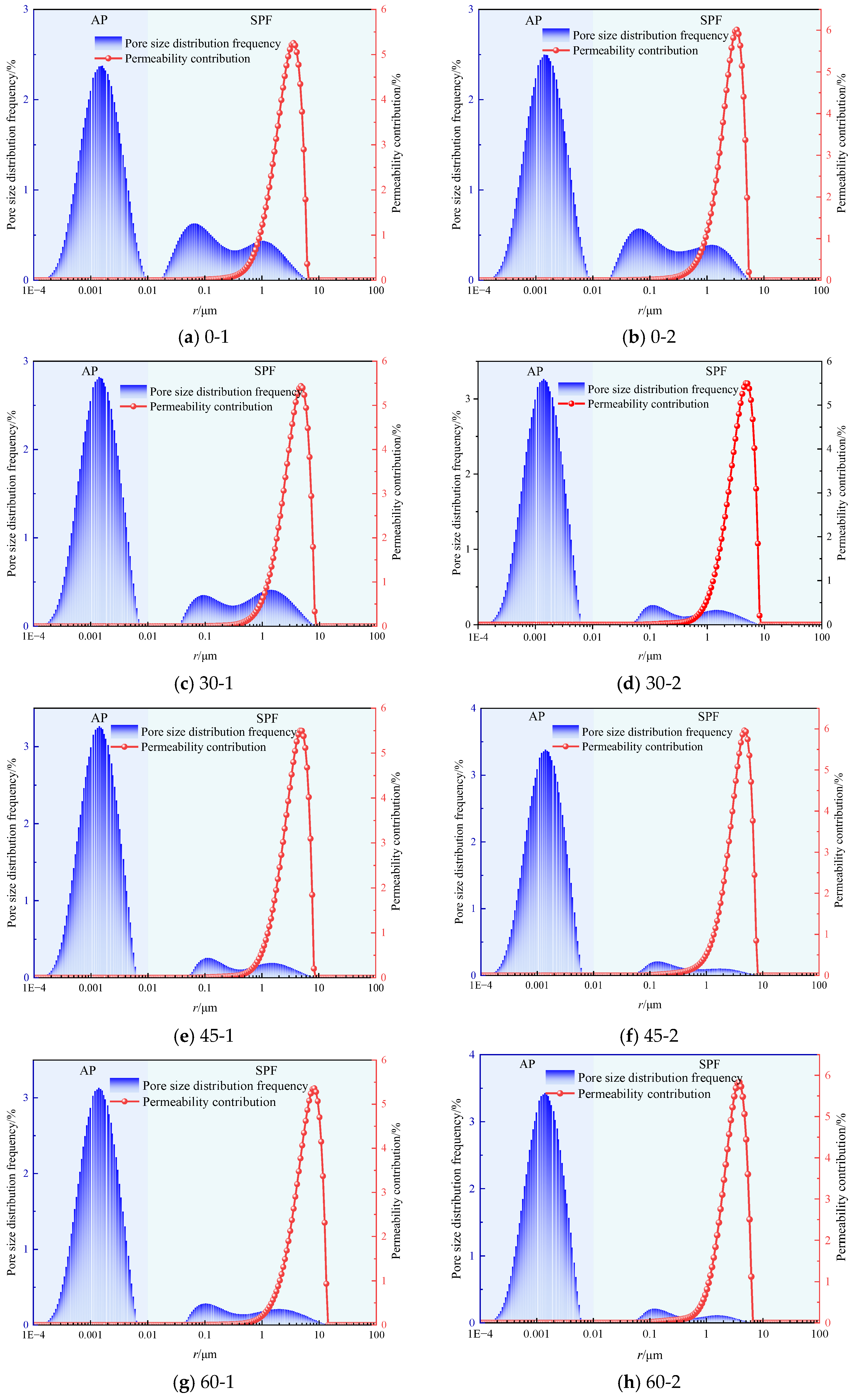
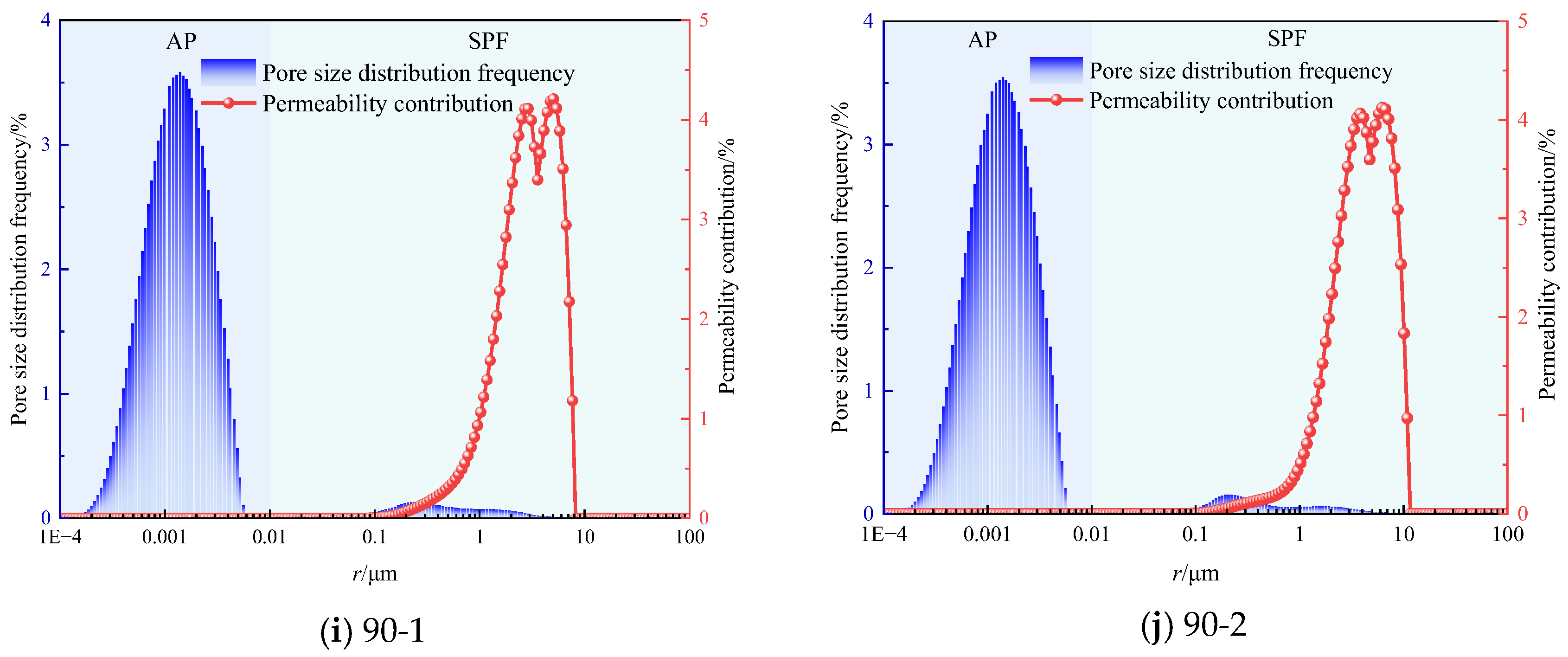
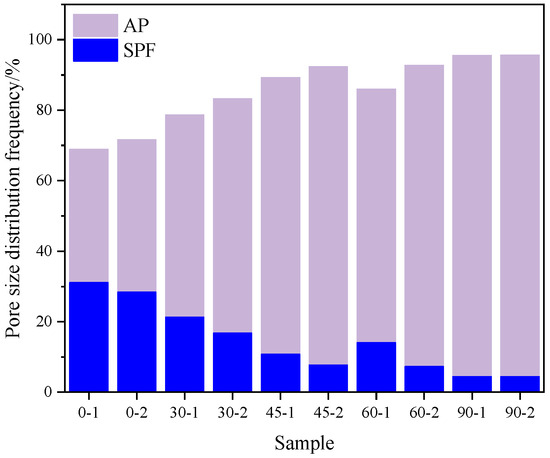
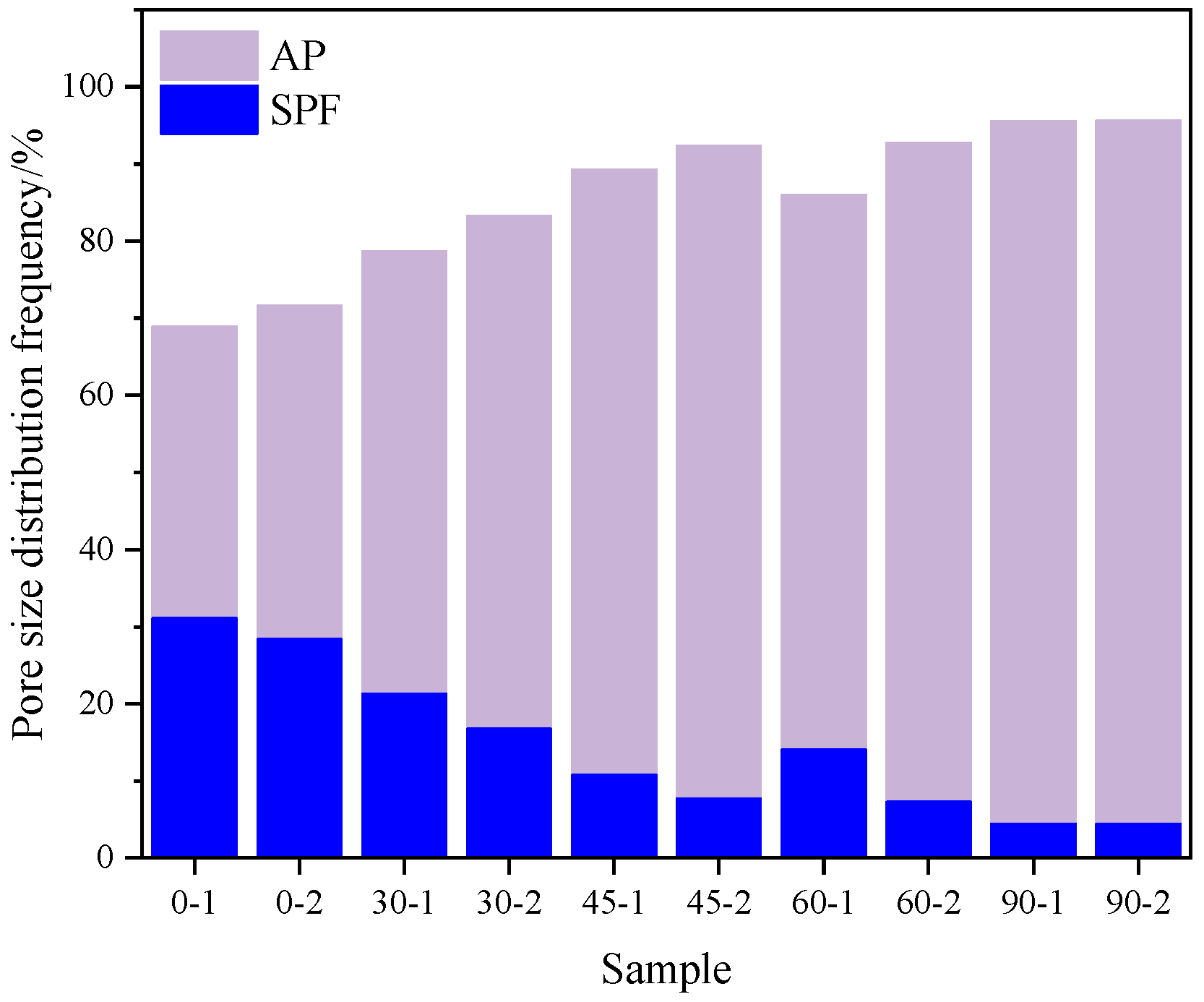
Pore size distribution histograms and permeability contribution curves of saturated coal specimens with different bedding dip angles were obtained from the measured T2 spectra, as shown in Figure 5 and Figure 6. The statistical results reflect the volume proportions of multi-scale pores within coal specimens under different bedding orientations.
Figure 5.
Pore size distribution and permeability contribution of coal samples. (a) 0-1; (b) 0-2; (c) 30-1; (d) 30-2; (e) 45-1; (f) 45-2; (g) 60-1; (h) 60-2; (i) 90-1 and (j) 90-2.
Figure 6.
Pore distribution frequency.
APs constitute the main component of the pore system, accounting for more than two-thirds of the TP volume, with distribution frequencies ranging from 68.89% to 95.59%. By comparison, SPFs occupy only 4.41–31.11% of the TP volume, showing a much lower proportion than APs. This indicates that the PFS of coal specimens are mainly composed of APs. With increasing bedding dip angle, the proportion of APs gradually rises, whereas the content of SPFs decreases correspondingly. These results indicate a positive relationship between bedding inclination and AP proportion, while the SPF proportion shows an inverse trend. The permeability contribution curves further reveal that macropores play a dominant role in fluid transport. Almost all permeability originates from macropores, confirming their function as the main seepage pathways in bedded coal.
3.1.3. Fractal Dimension
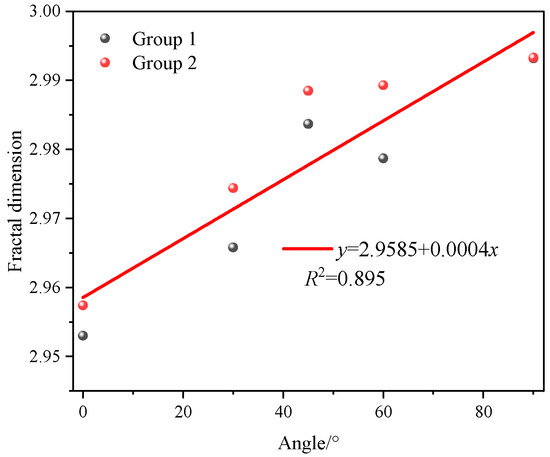
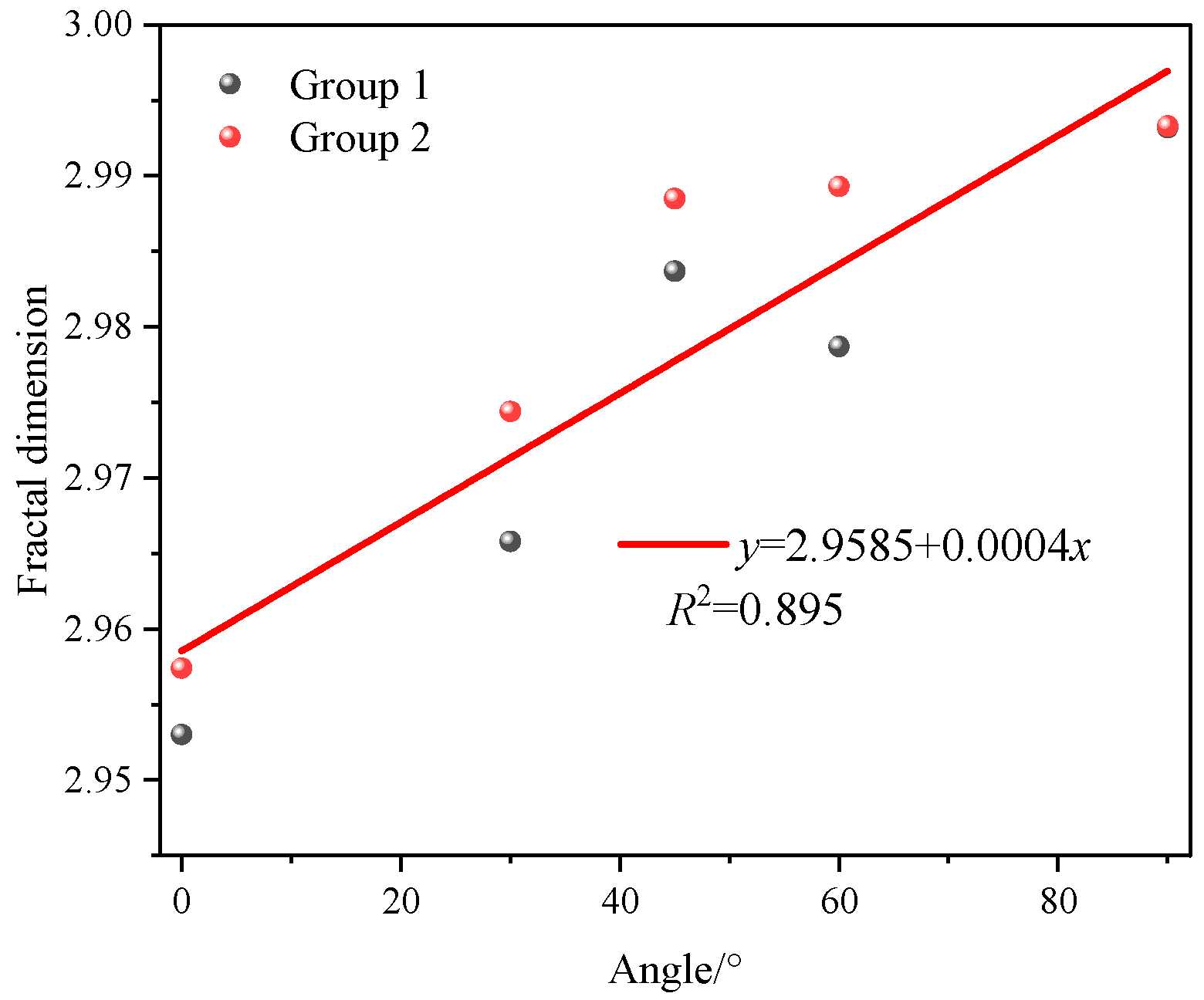
The fractal dimension of APs is generally lower than 2.0, indicating limited structural heterogeneity and variation regularity; thus, this study mainly focuses on the fractal characteristics of SPFs. The variation in SPF fractal dimension with bedding dip angle is displayed in Figure 7.
Figure 7.
Relationship between the fractal dimension of SPFs and bedding dip angle.
The results show that fractal dimension increases approximately linearly with bedding inclination, with R2 = 0.86. It gradually rises from around 2.95 to nearly 3.00, indicating that bedding orientation has a significant influence on the spatial distribution and connectivity of pore–fracture networks, thereby affecting the structural complexity of seepage pores in coal masses. In addition, the fractal dimension of the second specimen group is slightly higher than that of the first group, suggesting that the second batch of coal samples contains more developed initial PFS and stronger microstructural heterogeneity.
3.2. Macroscopic Mechanical Behaviors
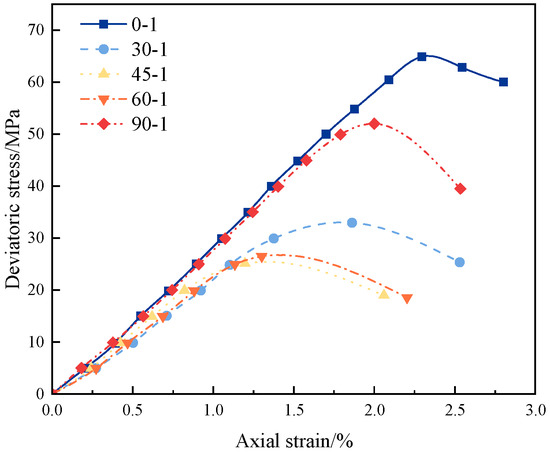
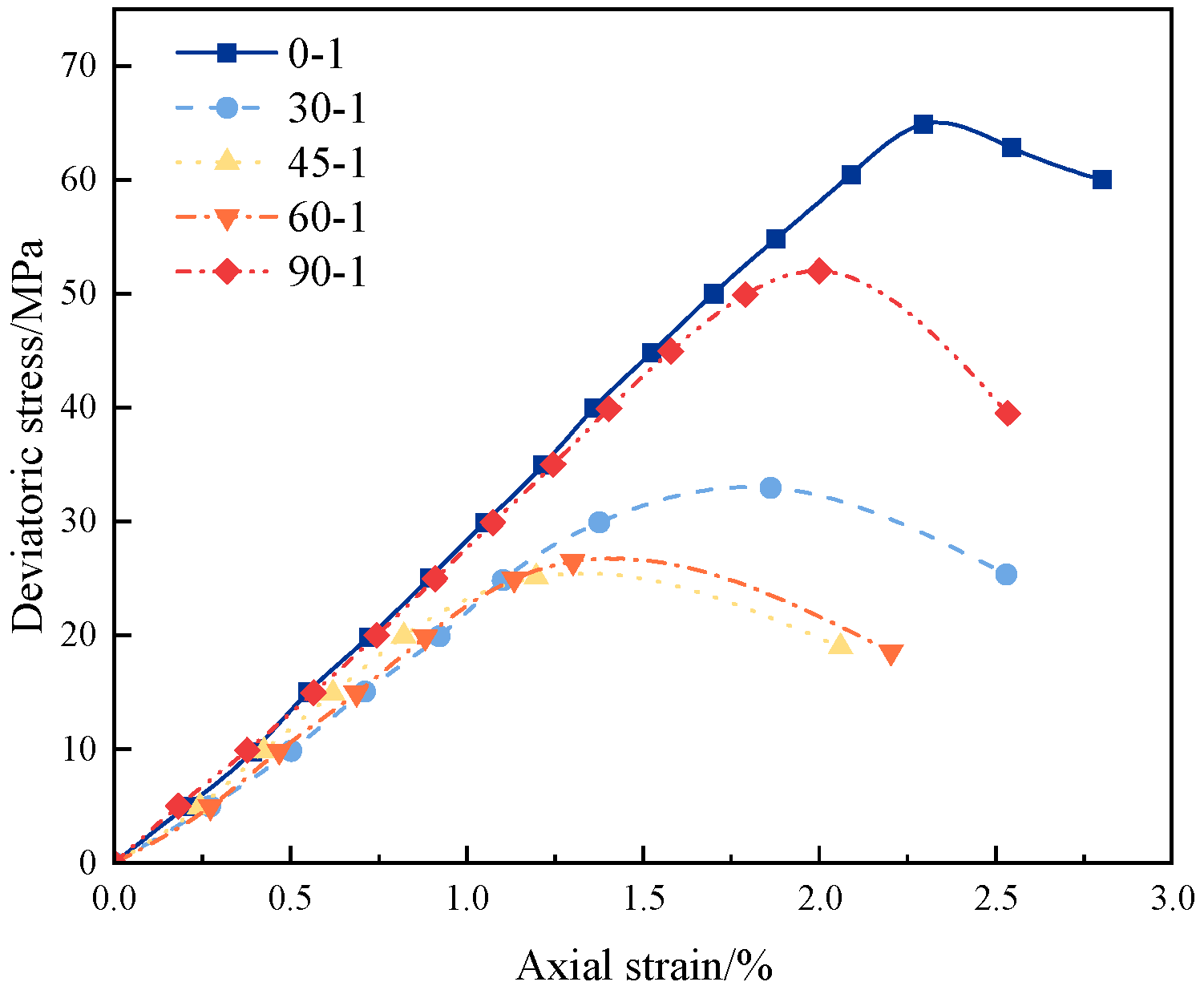
Figure 8 presents the stress–strain characteristics of coal specimens with different bedding dip angles under conventional triaxial loading conditions. The stress–strain responses vary significantly with bedding inclination. The 0° specimen exhibits the highest peak deviatoric stress, reaching 65 MPa. As the bedding angle increases to 30°, the peak deviatoric stress decreases markedly to approximately 31 MPa. For the 45° and 60° specimens, the peak deviatoric stress further decreases to around 25 MPa, with limited strength variation after failure. The 90° specimen shows a slight recovery in peak strength, reaching approximately 52 MPa. Overall, the strength of bedded coal follows a “V” trend with increasing bedding dip angle, while notable differences in deformation and failure characteristics are observed under different bedding orientations.
Figure 8.
Stress–strain curves.
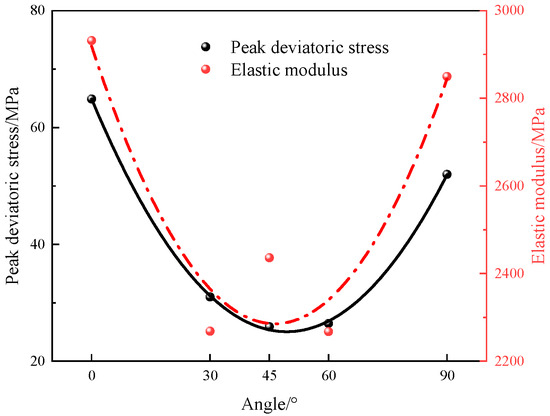
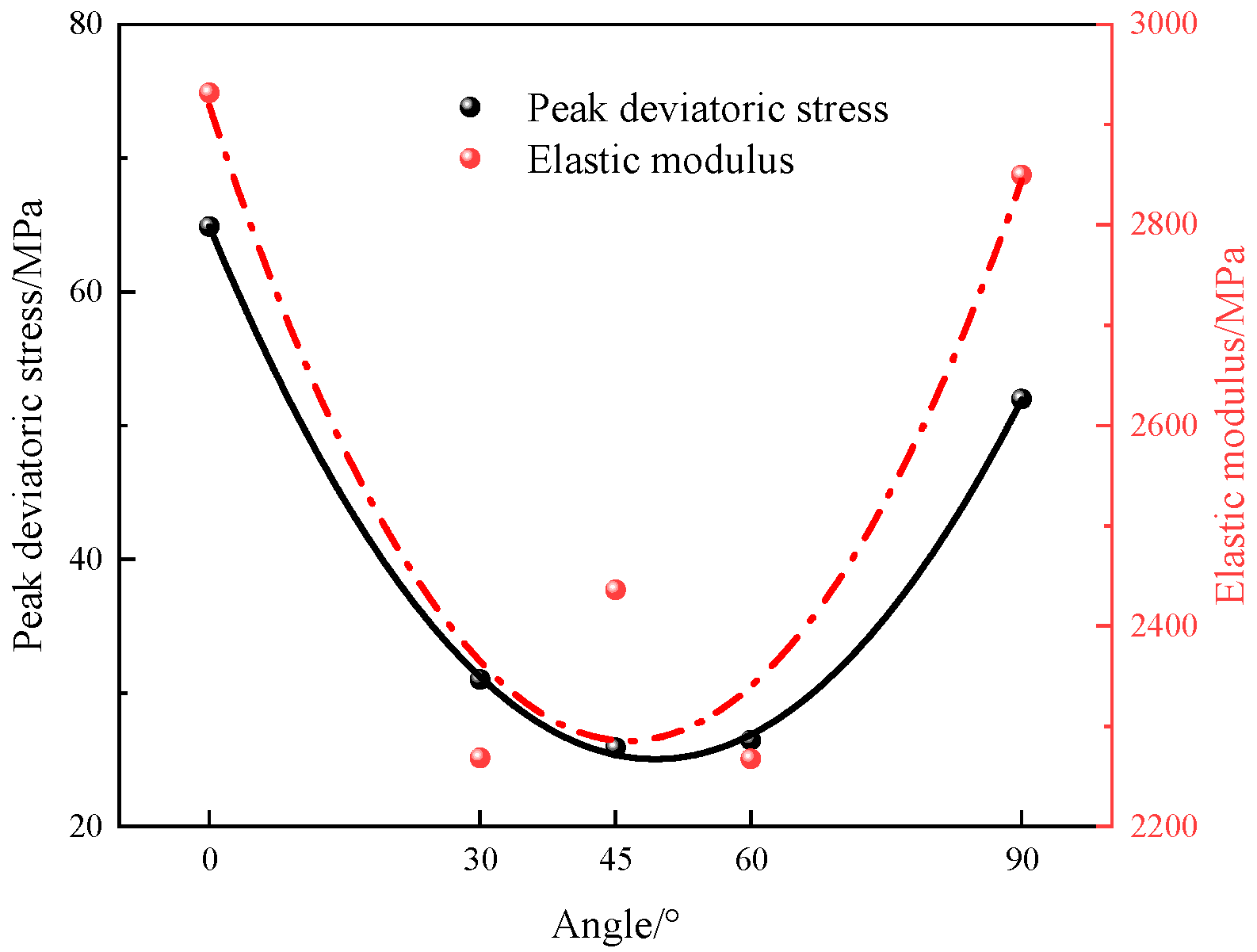
Figure 9 presents the variations in mechanical parameters and post-failure morphologies of coal specimens with different bedding angles, including the evolution of peak strength, elastic modulus, and fracture distribution. Both peak strength and elastic modulus exhibit a “V” trend as bedding inclination increases. The highest values occur at 0°, followed by a notable reduction between 30° and 60°, with the lowest peak stress observed at 45° and 60°. This suggests that coal specimens with bedding angles of 45–60° are more vulnerable to stress-induced damage.
Figure 9.
Peak strength and elastic modulus.
Comparisons between post-failure photographs and NMRI (Figure 10) further reveal the influence of bedding orientation on failure patterns. Specimens with low inclination (0°) retain relatively intact structures and exhibit limited fracture development, with failure mainly controlled by a single through-going crack. For specimens with medium bedding angles (30–60°), more dispersed and complex fracture networks develop, accompanied by increased microcrack generation. In contrast, the 90° specimens show distinct penetrating failure characteristics. These results confirm the anisotropic mechanical behavior caused by inherent bedding structures. The observed differences are mainly related to the redistribution of effective stress paths during loading. As bedding planes act as weak interfaces that are more susceptible to shear slip and damage than the intact coal matrix, their spatial arrangement strongly affects the mechanical response and final fracture morphology of bedded coal specimens.
Figure 10.
Post-failure photographs and NMRI. (a) 0-1; (b) 30-1; (c) 45-1; (d) 60-1; (e) 90-1.
3.3. Dynamic Evolution of PFS Under Stress
3.3.1. Stress Sensitivity of PFS
To quantitatively describe the stress-induced evolution of PFS during triaxial compression, dimensionless stress sensitivity coefficients were introduced to evaluate the dynamic responses of multi-scale PFS. The corresponding calculation formulas are given by [41]
where AA0, AS0 and AT0 represent the T2 spectral areas of APs, SPFs and TP under the initial hydrostatic pressure state, respectively; and AA(q), AS(q) and AT(q) denote the corresponding spectral areas at specific deviatoric stress levels. The derived indices RA(q), RS(q) and RT(q) serve as quantitative indicators that intuitively reflect the stress sensitivity of PFS at different scales during the entire loading process.
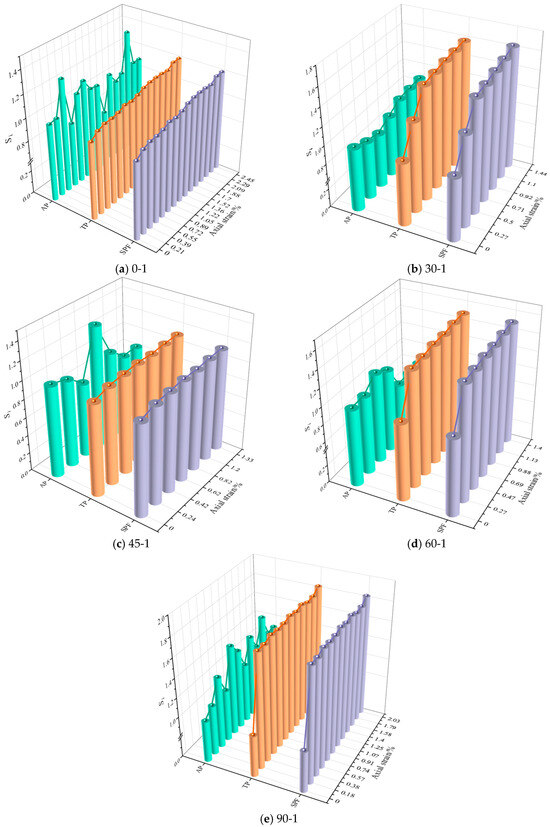
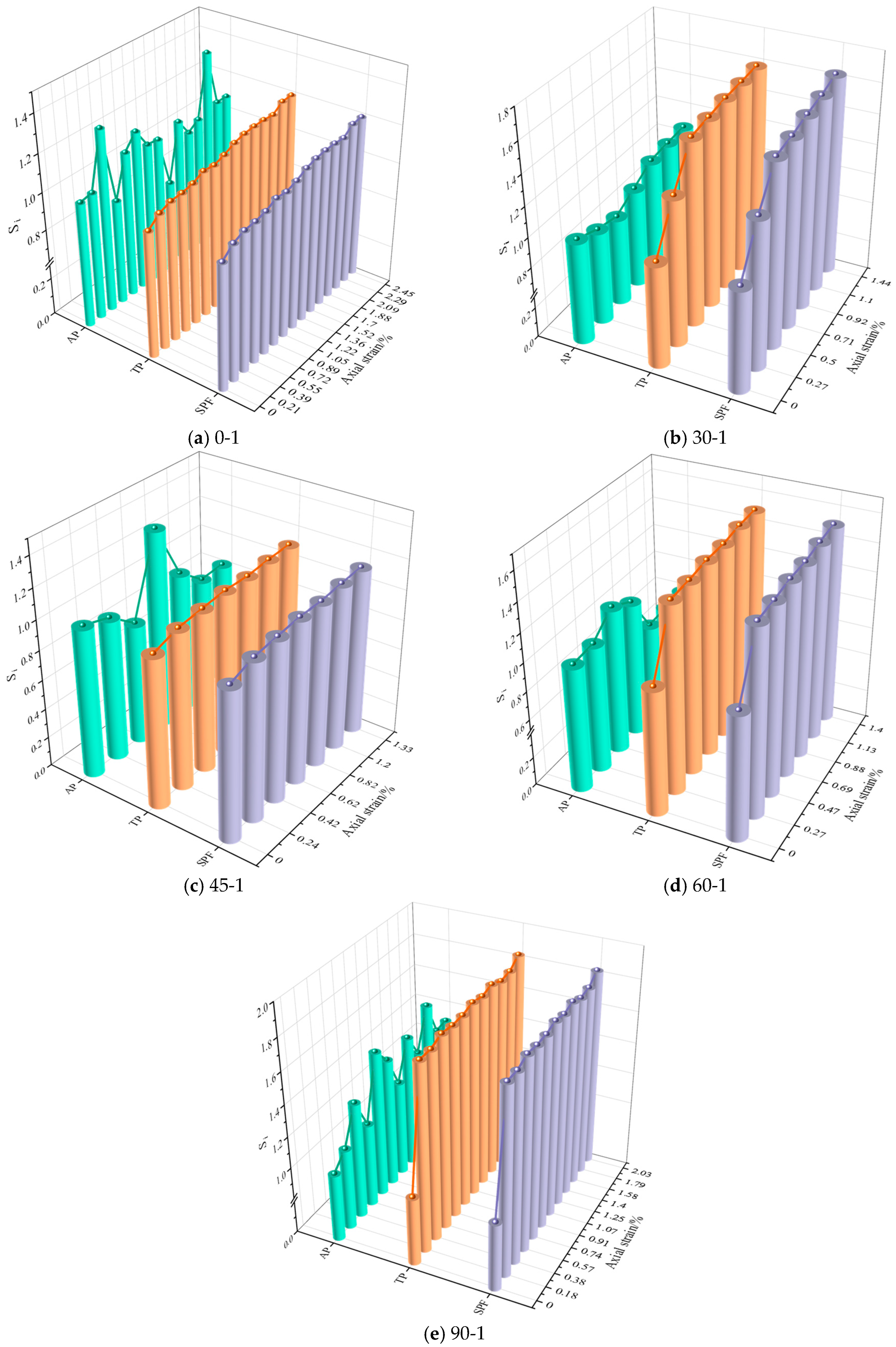
Considering that intense deformation after coal failure may damage the heat-shrinkable tube, resulting in fluid leakage and equipment failure, all loading tests were stopped immediately after the specimens reached peak strength. Therefore, this study focuses mainly on the dynamic evolution of PFS prior to macroscopic failure. Figure 11 shows the variations in APs, SPFs, and TP in coal specimens with different bedding dip angles during loading.
Figure 11.
Evolution characteristics of pore size distribution in coal samples with different bedding inclinations. (a) 0-1; (b) 30-1; (c) 45-1; (d) 60-1 and (e) 90-1.
The results reveal clear correlations between deviatoric stress evolution and pore size distribution changes in bedded coal with different inclinations. Overall, SPFs and TP show similar evolution patterns with increasing axial strain, increasing continuously at first and then approaching a stable state. A rapid increase occurs during the initial loading stage, followed by a slower and more stable structural adjustment. In contrast, APs exhibit stronger fluctuations during loading, with variation amplitudes depending on bedding angle. The 0° and 45° specimens show pronounced fluctuations in AP evolution throughout the loading process. For the 30° and 60° specimens, AP volume decreases initially and then slightly recovers. The 90° specimens exhibit a general increasing trend in APs with limited local variations. Moreover, the increasing amplitude and stabilized values of SPFs and TP gradually rise with bedding dip angle. These results suggest that the PFS evolution of loaded bedded coal is mainly controlled by the continuous development of SPF, whereas APs exhibit more complex stress responses related to bedding orientation.
3.3.2. Evolution Characteristics of Pore Structure Complexity
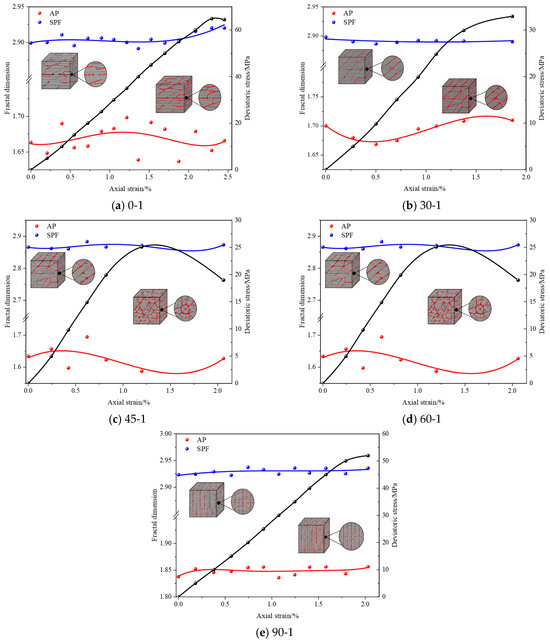
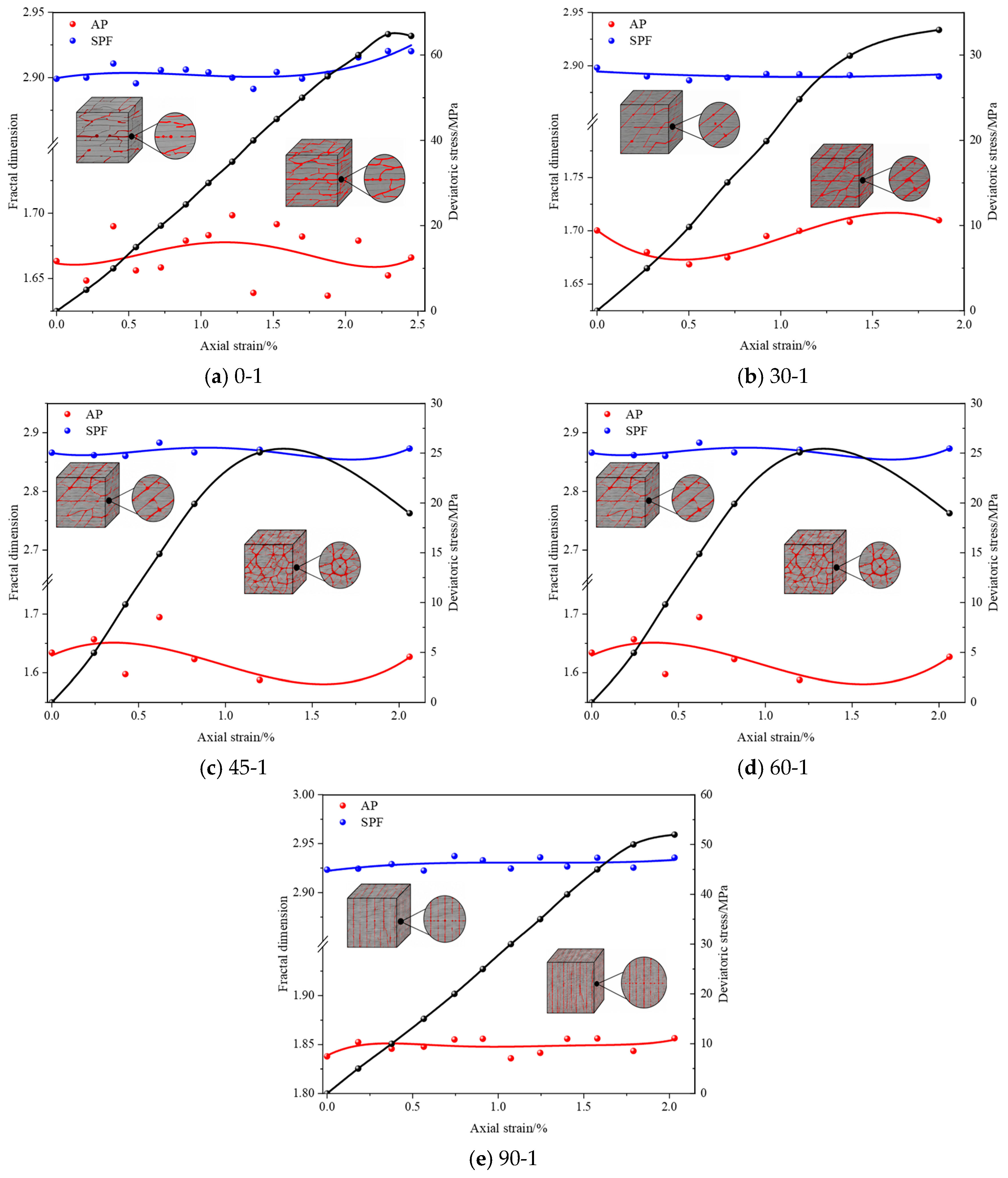
Figure 12 shows the dynamic evolution of fractal dimensions for APs and SPFs in coal specimens with different bedding dip angles during triaxial loading. The fractal dimensions of PFS in deep-bedded coal exhibit limited variation, while distinct evolution patterns occur throughout continuous loading. The fractal dimension of SPFs remains relatively high, ranging from 2.88 to 2.94, with slight fluctuations and an overall stable trend as axial strain increases, indicating limited changes in the structural complexity of SPFs during loading. In contrast, APs exhibit lower fractal dimensions of 1.60–1.85 and stronger stress sensitivity, with noticeable fluctuations throughout deformation. Fractal dimension evolution varies with bedding inclination. The 0° and 60° specimens show pronounced fluctuations, whereas the 30° specimens exhibit a gradual increasing trend. For the 45° specimens, the fractal dimension decreases slightly at the initial loading stage and then gradually stabilizes. The 90° specimens remain relatively stable, accompanied by a slight upward tendency.
Figure 12.
Evolution characteristics of pore–fracture fractal dimensions in coal samples with different bedding dip angles. (a) 0-1; (b) 30-1; (c) 45-1; (d) 60-1 and (e) 90-1.
Overall, SPFs control the structural complexity of PFS, whereas APs are more sensitive to stress disturbances and exhibit stronger dynamic evolution. Bedding inclination modifies the spatial distribution and stress conditions of internal PFS, thereby affecting the evolution of multi-scale PFS. Changes in bedding angle alter the geometric relationship between bedding planes and principal stress directions, enhancing the anisotropy of PFS and influencing pore structural complexity and stability. As the main interconnected seepage channels, SPFs maintain relatively high and stable fractal dimensions, indicating the stability of the dominant pore framework during loading. Conversely, APs respond more actively to stress variations, and their fluctuating fractal dimensions reflect local microstructural adjustment and reconstruction during triaxial deformation. Therefore, bedding dip angle not only controls the spatial complexity of coal PFS but also determines the evolution patterns of multi-scale pores under external loading.
4. Fractional-Order Pore Evolution Model
Conventional geometric models, such as the cubic model [42] and matchstick model [32,43], have been widely used to describe the physical properties and structural changes in coal. However, these models have limitations when applied to bedded coal with developed bedding structures. They cannot effectively represent stress transfer and deformation coordination between adjacent bedding planes, nor account for the angular effects caused by different bedding inclinations. In addition, bedding structures exhibit strong coupling with the mechanical behavior of the coal matrix. Classical nonlinear mechanical approaches often require numerous physical parameters and complex derivations to describe the responses of layered coal–rock masses [44,45]. To address the above deficiencies, this study develops a novel pore evolution model for loaded bedded coal based on NMR experimental data and elastic mechanics theory. The bedded coal mass is equivalently simplified into a composite spring model composed of multiple transversely isotropic units, and the proposed model fully considers the influence of bedding dip angles on pore structural evolution.
4.1. Model Assumptions
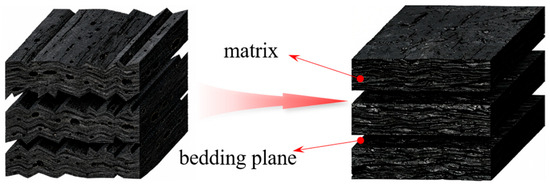
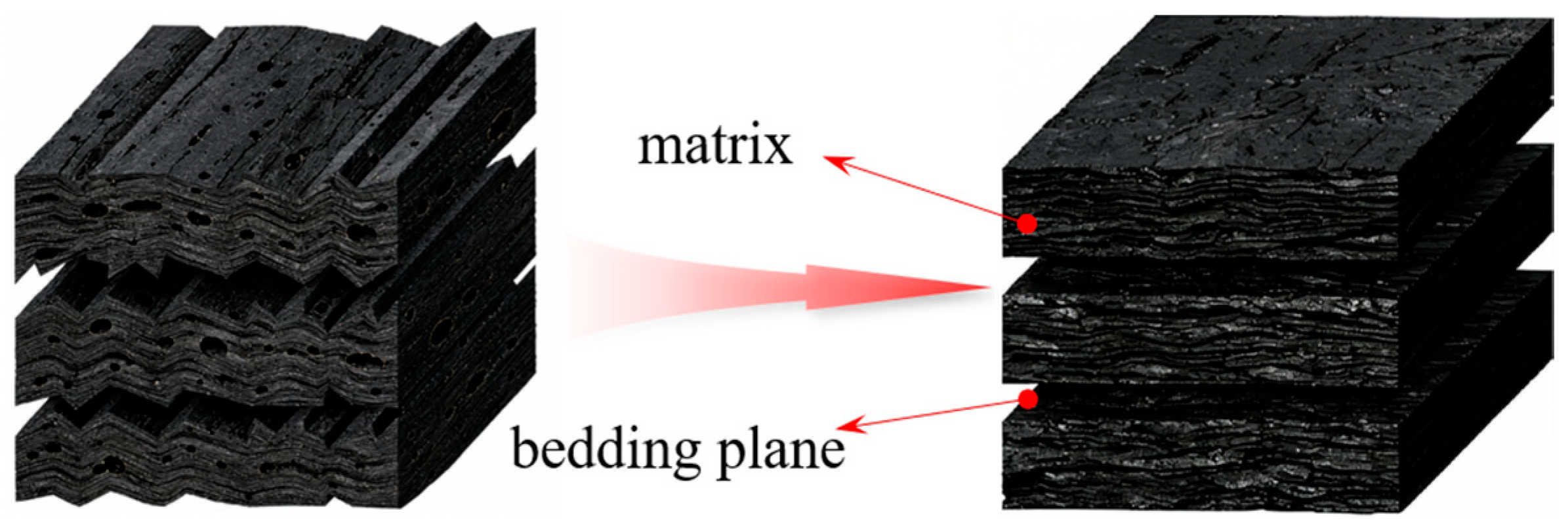
Natural joints and microcracks within layered coal exhibit random distributions, complex geometries, and multi-scale heterogeneity. To quantitatively evaluate the effects of bedding structures on PFS evolution, several reasonable assumptions and simplifications were introduced before model development. The layered coal mass is treated as a transversely isotropic porous medium composed of coal matrix and weak bedding planes. Both matrix elements and micro-joint elements are simplified as isotropic elastic bodies. Based on this assumption, the heterogeneous layered coal is equivalently transformed into an idealized structural system consisting of uniform thin coal matrix layers and parallel interlayer joints, as shown in Figure 13.
Figure 13.
Simplified model of layered coal.
4.2. Equivalent Spring Model for Layered Coal
4.2.1. Geometric Correlation of Porosity
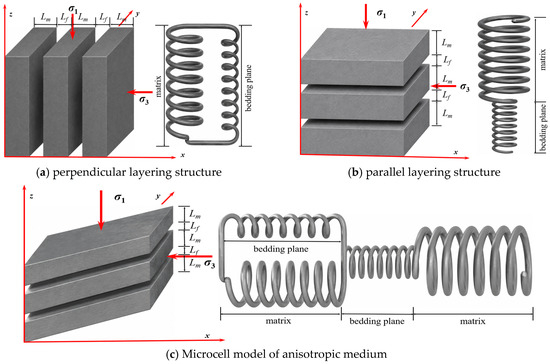
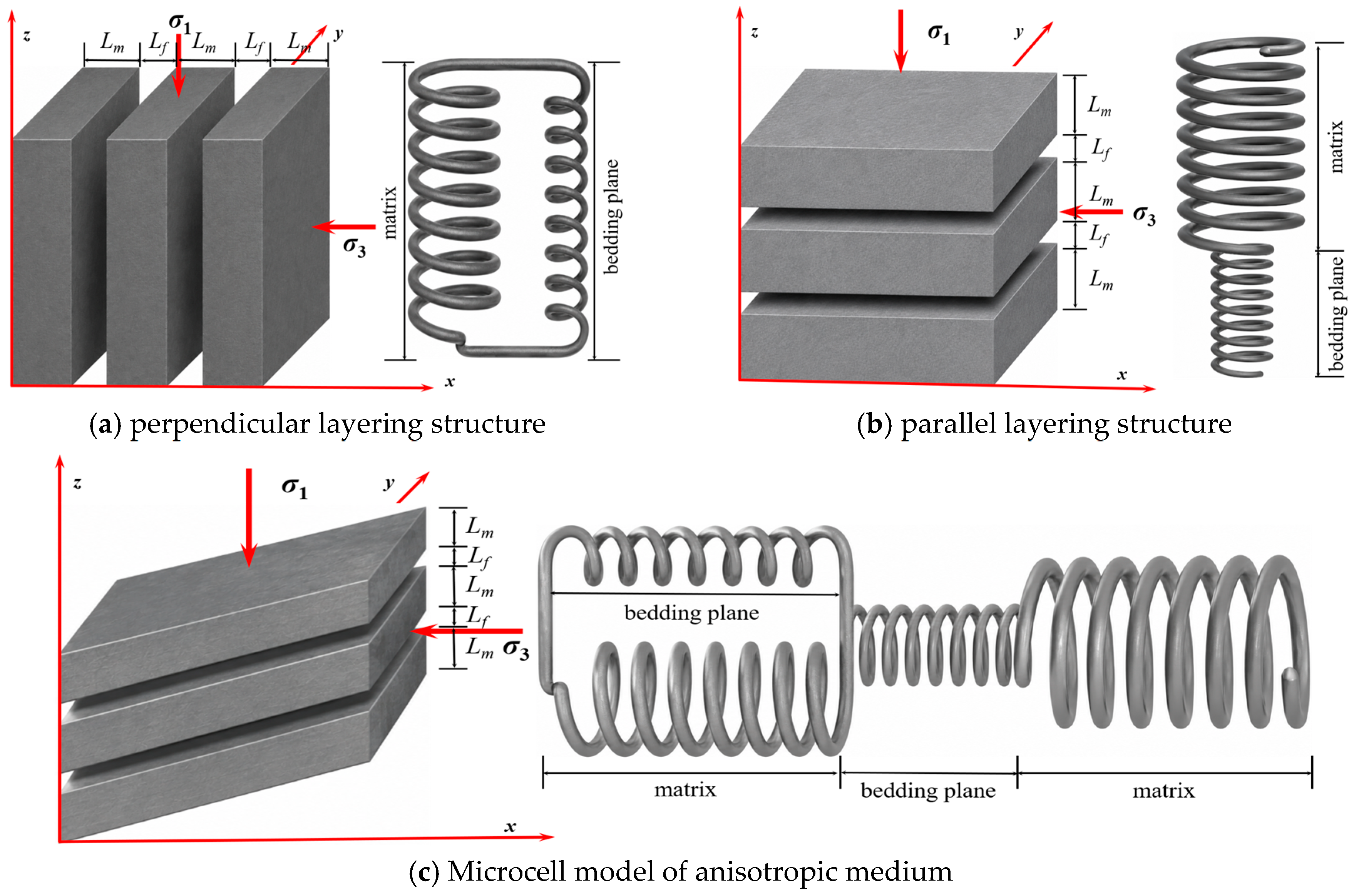
Bedded coal is generalized as a composite structure composed of elastic coal matrix units and weak bedding/fracture units. The elastic modulus of coal matrix and equivalent elastic modulus of weak bedding planes are denoted as Em and Ef, respectively. For coal specimens with bedding planes perpendicular to the loading direction, the elastic units can be equivalent to a parallel combination of matrix and micro-joint units; for specimens with bedding planes parallel to the loading direction, the structural units conform to a series combination mode, as illustrated in Figure 14.
Figure 14.
Schematic diagram of an equivalent model of layered coal. (a) Perpendicular layering structure; (b) parallel layering structure; and (c) microcell model of anisotropic medium.
Layered coal mass can be mechanically simplified as a composite structural system consisting of discrete coal matrix units and interlayer microfracture units. For an arbitrary micro-unit i, the fracture width and matrix width are denoted as Lfi and Lmi, respectively. Porosity is defined as the volumetric proportion of fracture space within the total unit width, which directly reflects the geometric occupancy of PFS. Based on structural geometric characteristics of layered porous coal, the quantitative relationship between porosity and structural width parameters is derived by
where φ represents the porosity of coal mass; Lfi is the fracture width of the i-th micro-unit; Lmi is the matrix width of the i-th micro-unit; and Lti denotes the total width of the i-th micro-unit.
For transversely isotropic layered coal, the pore structure parameters along the two in-plane directions of the bedding plane exhibit statistical consistency. Based on this assumption, the proportional relationship between coal matrix width and fracture width can be given by
Accordingly, the incremental variation in porosity responding to structural deformation is approximately derived by
According to the fundamental principle of NMR-based pore size conversion, if ρ2 and FS remain constant during loading, Equation (2) can be expressed as
Since the relative variation trend of fracture width is consistent with that of pore size, the correlation between their relative variations is obtained by
Combining Equations (11) and (13) the final correlation between porosity variation and T2 relaxation time variation is established as
4.2.2. Stress Decomposition Considering Bedding Dip Angle
In conventional triaxial compression tests, axial stress and confining pressure are defined as σ1 and σ3 respectively; a constant pore pressure of 2 MPa was applied during the triaxial loading process. The influence of pore pressure on pore–fracture evolution was considered based on the Biot effective stress principle. The effective stress tensor of saturated coal can be expressed as
where is the effective stress tensor, is the Biot coefficient, and represents the pore pressure.
For the triaxial loading condition, the effective principal stresses are
Therefore, the effective deviatoric stress is calculated by
This indicates that a constant pore pressure does not change the deviatoric stress applied to the coal specimen.
For bedded coal specimens, the included angle between bedding planes and the maximum principal stress is defined as θ. The normal stress and shear stress acting on bedding planes can be decomposed through stress coordinate transformation, as shown in Equation (18):
Combining Equation (17), the incremental normal stress and shear stress on bedding planes under loading are derived as
The pore pressure terms are canceled out in the increment of effective stress. Therefore, the constant pore pressure does not explicitly appear in the subsequent incremental driving model.
The quantitative relationship between the overall elastic modulus of coal mass and the elastic parameters of matrix and joints is thereby established
By incorporating the bedding dip angle θ, the equivalent elastic modulus of bedded coal under arbitrary loading directions is further modified and expressed by
Equation (21) reveals that bedding inclination alters the deformation contribution of parallel and perpendicular bedding components under external loading.
4.2.3. T2 Spectral Area Ratio and Pore Response Variable Correlation
In NMR testing, the total T2 spectral area positively correlates with the total volume of water-saturated pores, and its dynamic variation can effectively reflect the relative evolution of pore volume and porosity under stress disturbance. It should be noted that the pore pressure was maintained constant throughout the deviatoric loading stage (∆pw = 0). Therefore, the pore pressure only determines the initial effective stress state before deviatoric loading. In this study, the initial NMR spectrum obtained after pore pressure stabilization was adopted as the reference state (AT0) and while the spectral area at a specific deviatoric stress q is recorded as AT(q). Consequently, the influence of pore pressure has been implicitly incorporated into the initial pore structure condition. The T2 spectral area ratio is thereby defined to quantify pore structural responses
where AT0 represents the initial total T2 spectral area of coal specimens under hydrostatic condition and AT(q) corresponds to the spectral area under specific deviatoric stress. The derived index R quantitatively characterizes the stress sensitivity of pore–fracture networks during loading.
Under the initial hydrostatic stress state, the T2 spectral area ratio satisfies the initial boundary condition
To intuitively describe the dynamic change in pore volume, the porosity variation rate of coal mass is defined by
The relative variation in T2 spectral area is further proposed to normalize pore structural evolution
T2 spectral area ratio can be rewritten in the following form
A positive value of S(q) indicates an increase in total T2 spectral area, corresponding to the expansion and proliferation of internal pores and fractures as well as improved connectivity. Conversely, a negative S(q) suggests that pore compaction and throat closure dominate the structural deformation, leading to reduced effective pore volume.
To eliminate the dimensional influence of stress magnitude on model characterization, a dimensionless deviatoric stress variable is introduced
where qp is the peak deviatoric stress obtained from triaxial tests.
Accordingly, the corresponding variation in T2 spectral area can be expressed as
4.2.4. Normal–Shear Coupled Driving Mechanism of Pore Evolution
During conventional triaxial compression, the dynamic evolution of PFS in bedded coal is synergistically governed by coupled shear and normal stress under deviatoric loading. Shear stress dominates bedding plane slippage, microcrack propagation and pore–fracture connectivity enhancement, and its contribution to the growth of T2 spectral area is given by
where λτ is the shear dilatancy coefficient.
Normal stress may cause pore compaction in the early stages of loading, but continuous normal stress can promote matrix damage, microcrack propagation, and an increase in pore-crack volume. It is given by
where λn represents the normal damage growth coefficient.
The comprehensive driving function for pore evolution under the coupled effect of normal and shear stress in bedded coal is established by
Substituting the stress decomposition relationship in Equation (19) into Equation (31), the revised driving formula is derived by
Substitute Equation (26) into Equation (31). The coefficient can be further simplified as a bivariate function of θ and
Equation (32) can be further simplified as
where is the angle-dependent dimensionless pore sensitivity coefficient comprehensively reflects the overall driving effect of deviatoric stress variation on T2 spectral response. All angular, normal and dilatancy parameters are integrated to obtain the complete expression:
4.3. Fractional Derivatives Theoretical Model
The mechanical properties of layered coal–rock masses are highly dependent on bedding orientation and loading angle, which substantially restricts the applicability of traditional nonlinear mechanical theories in engineering practice and numerical simulation. In comparison, fractional calculus provides a concise and efficient theoretical framework to address such limitations. To establish a universal pore-strain evolution model for bedded coal under variable stress conditions, the Caputo fractional derivative is introduced to optimize the conventional theoretical system [22]. For the pore structural response variable , the definition of the Caputo fractional derivative is expressed by
where Γ denotes the Gamma function, 0 < α < 1, which quantifies the historical memory effect of pore structural evolution.
The fractional growth rate of pore evolution is positively correlated with the dimensionless driving force. To characterize the nonlinear evolutionary behavior of T2 spectral area ratio with deviatoric stress, a fractional dynamic evolution equation for pore structures is given by
The initial conditions are defined as S(0) = 0 and R(0) = 1.
Fractional integral operation of order α is performed on both sides of Equation (37), yielding
Further integral transformation gives the simplified relational expression
By combining Equations (27), (28) and (39), a fractional porosity evolution model based on T2 is established, which fully considers bedding inclination and normal–shear coupled stress effects
The proposed model indicates that the evolution of T2 spectral area ratio in bedded coal is comprehensively controlled by deviatoric stress level, bedding dip angle, shear stress, normal stress and equivalent elastic parameters.
Further combining Equation (13), the porosity expression can be obtained.
4.4. Model Verification and Parameter Analysis
4.4.1. Model Verification
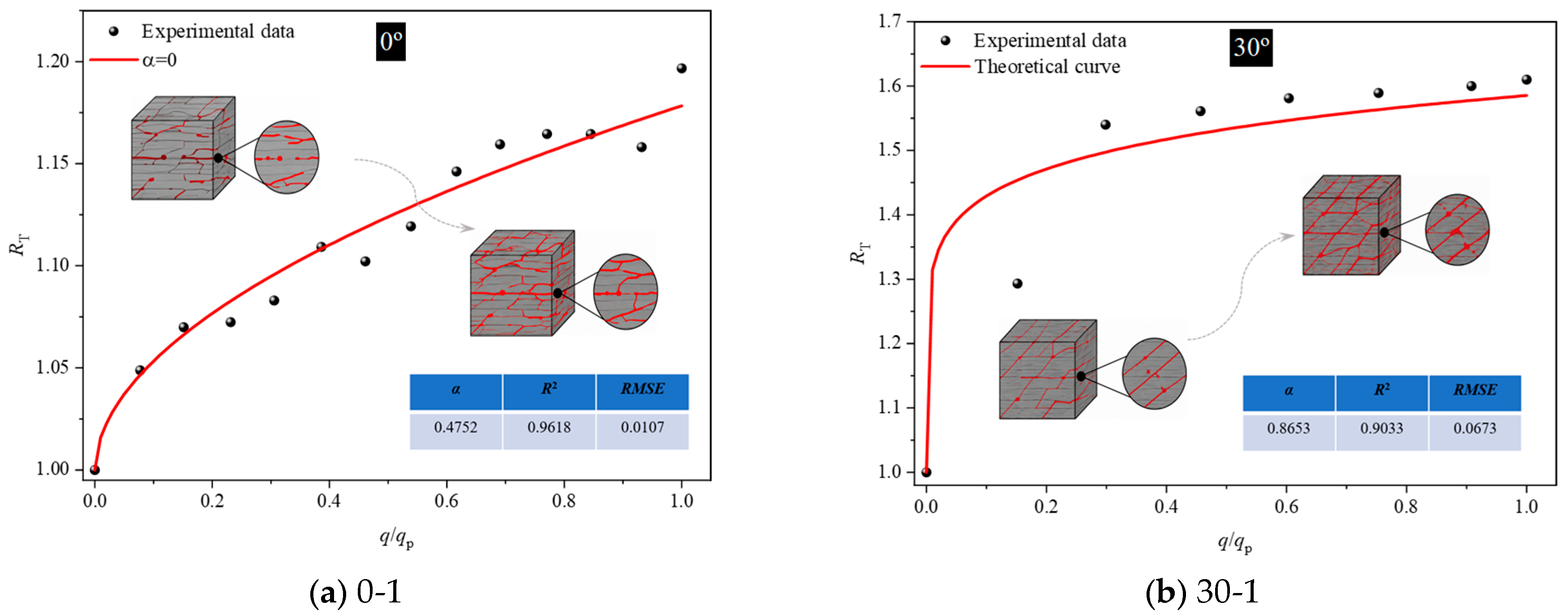
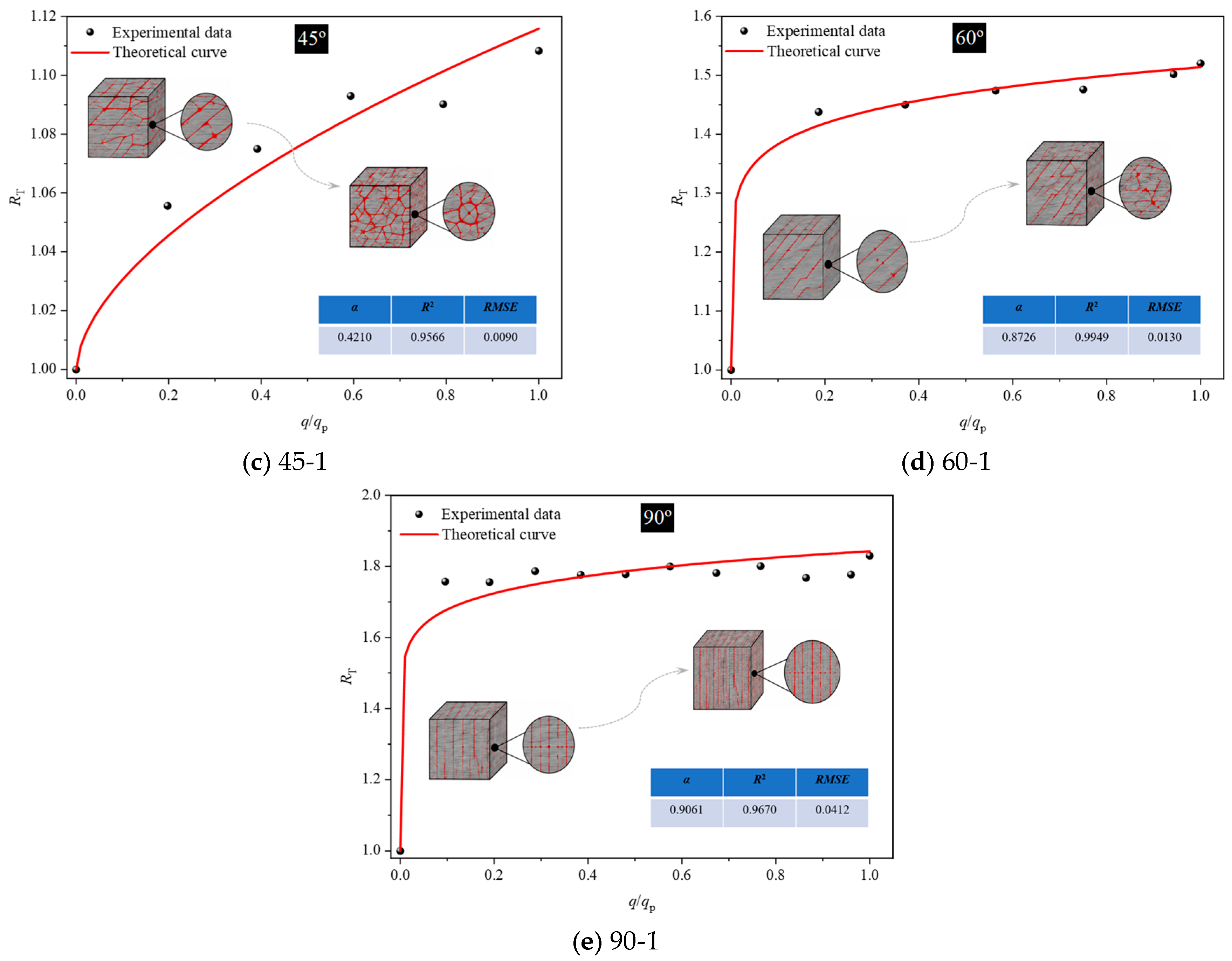
To validate the accuracy of the fractional-order pore evolution model, fitting analysis of pore evolution responses for coal specimens with different bedding dip angles during triaxial loading was performed based on real-time NMR experimental data. The dynamic evolution of coal PFS can be directly reflected by the variation characteristics of T2 spectra. In this study, the T2 spectral area and its stress-sensitive response index R were adopted as critical indicators to quantify the evolutionary degree of PFS, and the theoretical model predictions were compared with experimental monitoring results.
The determination procedure of K(θ) and α consists of two steps. First, the proposed fractional-order porosity evolution model was independently fitted to the experimental pore evolution ratio curves for each bedding inclination using the nonlinear least-squares method. The optimal values of K(θ) and α were obtained by minimizing the difference between experimental and calculated results. Subsequently, the arithmetic mean value of the fitted obtained from all specimens was calculated and adopted as the shared model parameter. This treatment ensures that the proposed model reflects the common anisotropic evolution characteristics of bedded coal rather than the individual variability of a single specimen.
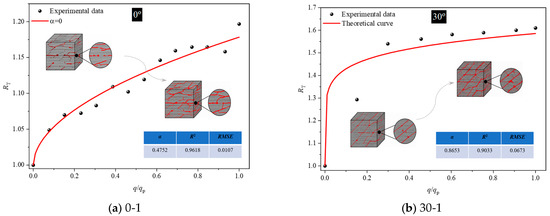
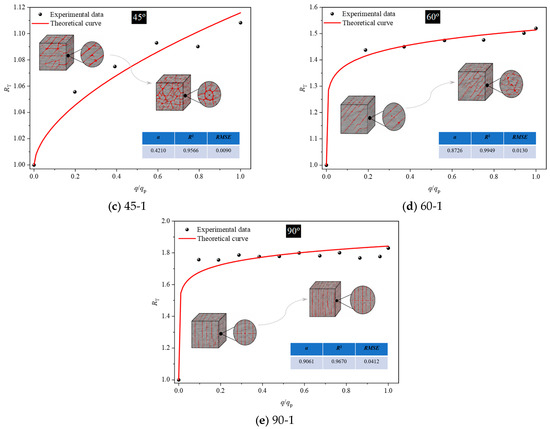
The fitting results of stress–pore rate for coal specimens with various bedding dip angles are presented in Figure 15 and model parameters are presented in Table 1. The theoretical curves derived from the fractional-order model are in good agreement with experimental data for all bedding angles, with R2 > 0.87 and low RMSE. In addition, the fractional order varies with bedding inclination rather than maintaining a constant value. The overall consistency between theoretical calculations and experimental observations demonstrates that the proposed pore evolution model can accurately characterize the nonlinear evolutionary characteristics of PFS in bedded coal during triaxial loading.
Figure 15.
Stress–porosity rate model fitting image. (a) 0-1; (b) 30-1; (c) 45-1; (d) 60-1 and (e) 90-1.
Table 1.
Model fitting parameters.
Notably, PFS evolution in loaded bedded coal is not merely determined by applied stress, but governed by the coupled effects of inherent bedding structures, initial microcrack distribution, internal stress redistribution, and frictional slippage along weak planes. Traditional integer-order models only characterize instantaneous mechanical responses and cannot capture the path-dependent memory features of nonlinear pore deformation. In comparison, the proposed fractional-order model introduces fractional derivatives to quantify the historical memory effect of structural evolution, enabling it to describe the continuous nonlinear pore evolution of bedded coal throughout loading, which is beyond the capability of conventional models. The high fitting accuracy confirms that the fractional-order model not only well reproduces experimental results, but also effectively reveals the bedding-induced anisotropic mechanism of pore evolution, significantly improving the theoretical interpretability and applicability for seepage analysis of disturbed deep layered coal.
4.4.2. Parameter Physical Meaning and Sensitivity Analysis
For bedded coal, the memory effect originates from the irreversible and progressive evolution of internal defects. During loading, pre-existing pores and bedding interfaces experience repeated closure, frictional adjustment, stress redistribution, and damage accumulation. These processes cause the current pore structure to retain information from previous stress states, resulting in a path-dependent evolution behavior.
Physically, the variation in α reflects the influence of stress-history dependence on pore structure evolution. A lower indicates a weaker memory effect, with pore evolution mainly controlled by the current stress state, whereas a higher α represents stronger nonlocal characteristics, implying that previous loading-induced pore closure, crack initiation, and fracture propagation exert a greater influence on the current pore structure. Therefore, α can be regarded as a characteristic parameter describing the degree of historical dependence in PFS evolution of bedded coal.
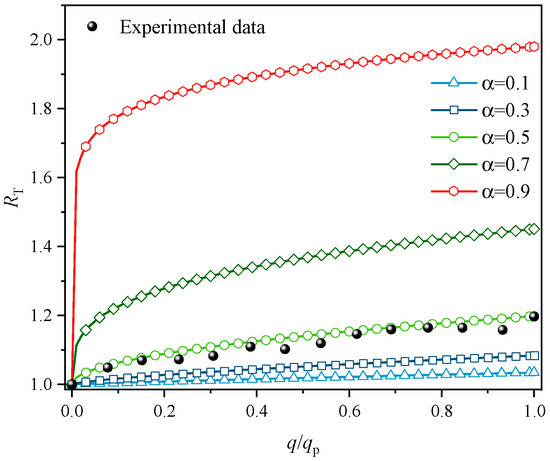
To further evaluate the model reliability, a sensitivity analysis of the fractional-order parameter α was conducted. During the analysis, the angle-dependent dimensionless anisotropic pore sensitivity coefficient K(θ) was kept constant, as shown in Figure 16. The results indicate that α significantly affects the nonlinear evolution of RT. With increasing α, the growth rate of RT gradually increases, leading to a higher final pore evolution ratio under the same stress condition. Specifically, the predicted RT increases from approximately 1.03 to 1.98 as increases from 0.1 to 0.9, demonstrating its critical role in regulating the cumulative PFS evolution during loading.
Figure 16.
Sensitivity analysis of α.
It should be noted that the present study mainly aims to reveal the intrinsic mechanism of bedding-controlled pore–fracture evolution rather than establish statistical distributions. Future studies involving larger specimen populations and repeated tests will be conducted to further quantify the statistical variability and improve the general applicability of the proposed model.
5. Conclusions
A series of NMR triaxial tests were conducted on coal specimens with bedding dip angles ranging from 0° to 90°. Combined with fractal theory and mathematical modeling, the anisotropic mechanical responses, PFS evolution, and porosity changes of deep coal under different bedding orientations were systematically investigated. The main conclusions are summarized as follows:
- (1)
- T2 spectra with different bedding dip angles exhibited multi-peak distributions, and T2g decreased exponentially with increasing bedding dip angle. APs dominated the pore system, accounting for over two-thirds of the TP, while SPFs decreased correspondingly. SPFs controlled permeability and acted as the main fluid migration pathways. The fractal dimension of SPFs increased from approximately 2.95 to nearly 3.00 with increasing bedding dip angle, suggesting that bedding structures modified PFS complexity.
- (2)
- Peak strength and elastic modulus exhibited a “V” trend with bedding dip angle. SPFs and TP increased as deviatoric stress rose, with their growth magnitude and stabilized levels becoming higher at larger bedding inclinations. The SPF fractal dimension remained high and stable (2.88–2.94), governing PFS complexity, while APs showed lower fractal dimensions (1.60–1.85) and greater sensitivity. Bedding dip angle affects mechanical responses and PFS evolution by altering pore spatial distribution, connectivity, and stress states within coal.
- (3)
- Based on transversely isotropic medium theory, a fractional-order porosity evolution model incorporating the effect of bedding dip angle was developed under loading conditions. The proposed model was validated against experimental results and effectively captured the influence of bedding structures on pore–fracture responses. It accurately characterized the evolution of seepage pores and fractures in bedded coal with different orientations during triaxial loading.
Author Contributions
Conceptualization, H.Z. and J.W.; methodology, H.Z.; software, Z.Q.; validation, J.W. and W.M.; formal analysis, Y.Y. and S.Z.; investigation, J.W.; resources, H.Z.; data curation, J.W.; writing—original draft preparation, J.W. and Y.Y.; writing—review and editing, H.Y. and W.M.; visualization, S.X.; supervision, H.Z.; project administration, H.Z.; funding acquisition, H.Z. All authors have read and agreed to the published version of the manuscript.
Funding
This research was funded by Deep Earth Probe and Mineral Resources Exploration-National Science and Technology Major Project (2024ZD1003902), Special Project for Intergovernmental Cooperation in Scientific and Technological Innovation of National Key Research and Development Program (2025YFE0109800), National Natural Science Foundation of China (52121003, 51827901, 52504102) and European Commission Horizon Europe Marie Skłodowska-Curie Actions Staff Exchanges Project-LOC3G (Grant No. 101129729).
Data Availability Statement
Data is contained within the article.
Conflicts of Interest
Author Yue Yang was employed by the company Power China International Group Limited. The remaining authors declare that the research was conducted in the absence of any commercial or financial relationships that could be construed as a potential conflict of interest.
References
- Fan, N.; Wang, J.; Deng, C.; Fan, Y.; Wang, T.; Guo, X. Quantitative Characterization of Coal Microstructure and Visualization Seepage of Macropores Using CT-Based 3D Reconstruction. J. Nat. Gas. Sci. Eng. 2020, 81, 103384. [Google Scholar] [CrossRef] [Scilit]
- Snæbjörnsdóttir, S.Ó.; Sigfússon, B.; Marieni, C.; Goldberg, D.; Gislason, S.R.; Oelkers, E.H. Author Correction: Carbon Dioxide Storage through Mineral Carbonation. Nat. Rev. Earth Env. 2020, 1, 695. [Google Scholar] [CrossRef] [Scilit]
- Ranjith, P.G.; Zhao, J.; Ju, M.; De Silva, R.V.S.; Rathnaweera, T.D.; Bandara, A.K.M.S. Opportunities and Challenges in Deep Mining: A Brief Review. Engineering 2017, 3, 546–551. [Google Scholar] [CrossRef] [Scilit]
- Xie, H.; Gao, M.; Zhang, R.; Peng, G.; Wang, W.; Li, A. Study on the Mechanical Properties and Mechanical Response of Coal Mining at 1000 m or Deeper. Rock Mech. Rock Eng. 2019, 52, 1475–1490. [Google Scholar] [CrossRef] [Scilit]
- He, F.; Yang, S.; Ren, T.; Bian, H.; Li, H. An Improved Bingham Model and the Parameter Identification of Coal (Rock) Containing Water Based on the Fractional Calculus Theory. Adv. Mater. Sci. Eng. 2021, 2021, 1996142. [Google Scholar] [CrossRef] [Scilit]
- Guo, X.; Liu, Y.; Zhang, L.; Deng, C.; Song, L.; Zhang, Y. Regulatory Mechanism of Microscopic Pore Structure on Anisotropy of Gas Multimodal Seepage in Original Coals. Energy 2024, 300, 131611. [Google Scholar] [CrossRef] [Scilit]
- Duan, M.; Jiang, C.; Guo, X.; Yang, K.; Tang, J.; Yin, Z.; Hu, X. Experimental Study on Mechanics and Seepage of Coal under Different Bedding Angle and True Triaxial Stress State. Bull. Eng. Geol. Environ. 2022, 81, 399. [Google Scholar] [CrossRef] [Scilit]
- Liu, Y.; Yin, G.; Li, M.; Zhang, D.; Deng, B.; Liu, C.; Lu, J. Anisotropic Mechanical Properties and the Permeability Evolution of Cubic Coal Under True Triaxial Stress Paths. Rock Mech. Rock Eng. 2019, 52, 2505–2521. [Google Scholar] [CrossRef] [Scilit]
- Wang, Y.; Zhao, Z.; Hui, Z.; Hao, J.; Zhang, J. Mechanical Responses of Bedding Coals under Uniaxial Compression: Insights from Deformation, Energy and Acoustic Emission Characteristics. Case Stud. Constr. Mater. 2025, 22, e04404. [Google Scholar] [CrossRef] [Scilit]
- Li, Y.; Zhao, B.; Yang, J.; Sun, J.; Huang, W.; Li, Z.; Wang, B. Experimental Study on the Influence of Confining Pressure and Bedding Angles on Mechanical Properties in Coal. Minerals 2022, 12, 345. [Google Scholar] [CrossRef] [Scilit]
- Yang, R.; Zhou, Y.; Ma, D. Failure Mechanism and Acoustic Emission Precursors of Coal Samples Considering Bedding Effect under Triaxial Unloading Condition. Geofluids 2022, 2022, 8083443. [Google Scholar] [CrossRef] [Scilit]
- Gao, L.; Zhao, H.; Liu, H. Mechanical Response Mechanism and Seepage Characteristics of Gas-Bearing Bedding Coal under Impact Loading. Eng. Fract. Mech. 2025, 326, 111425. [Google Scholar] [CrossRef] [Scilit]
- Gu, F.; Chalaturnyk, R. Permeability and Porosity Models Considering Anisotropy and Discontinuity of Coalbeds and Application in Coupled Simulation. J. Pet. Sci. Eng. 2010, 74, 113–131. [Google Scholar] [CrossRef] [Scilit]
- Xie, S.; Yang, S.; Jia, W.; Chen, Y.; Wang, Y.; Huang, C.; Cao, Z. Evolution of Pore and Fracture Structure in Coal Under Mining-Induced Unloading Conditions. Fractal Fract. 2026, 10, 391. [Google Scholar] [CrossRef] [Scilit]
- Liu, C.; Shi, B.; Zhou, J.; Tang, C. Quantification and Characterization of Microporosity by Image Processing, Geometric Measurement and Statistical Methods: Application on SEM Images of Clay Materials. Appl. Clay. Sci. 2011, 54, 97–106. [Google Scholar] [CrossRef] [Scilit]
- Liu, W.; Wang, G.; Han, D.; Xu, H.; Chu, X. Accurate Characterization of Coal Pore and Fissure Structure Based on CT 3D Reconstruction and NMR. J. Nat. Gas. Sci. Eng. 2021, 96, 104242. [Google Scholar] [CrossRef] [Scilit]
- Shan, C.; Yao, Q.; Cao, S.; Zheng, C.; Xu, Q.; Xia, Z.; Shang, X.; Huang, G. Analysis of Cracks Development and Damage Evolution in Red Sandstone under Dry-Wet Cycles Based on Temporal and Frequency Characteristics of Acoustic Emission. J. Build. Eng. 2024, 94, 109849. [Google Scholar] [CrossRef] [Scilit]
- Wang, J.; Zhou, H.; Lu, M.; Zhang, L.; Wang, Z.; Li, H.; Mao, T.; Shi, F.; Xue, D. Accurate Characterization and Fractal Analysis of Pore–Fracture Evolution in Deep Coal under Temperature Effect. Fuel 2026, 408, 137534. [Google Scholar] [CrossRef] [Scilit]
- Jia, Z.; Cheng, J.; Wang, L.; Pan, R.; Hainar, T.; Liu, Y.; Xue, D. On AE-Based Classification of the Real-Time Damage Evolution of Granite under Equal-Amplitude Multi-Stage Cyclic Loading–Unloading Test: A New Example to Recognize the Hybrid Tension-Shear Failure. Rock Mech. Rock Eng. 2025, 58, 3197–3225. [Google Scholar] [CrossRef] [Scilit]
- Ye, C.; Li, C.; Chen, H.; Wu, F.; Chu, P.; Xie, H. Progressive Failure Mechanism and Shear Strength Model of Granite Under Cyclic Direct Shear. Rock Mech. Rock Eng. 2026, 59, 1455–1482. [Google Scholar] [CrossRef] [Scilit]
- Zhao, Y.; Huang, L.; Dong, L.; Li, X. Estimation of Characteristic Stresses in Granite through Acoustic Emission Monitoring of Microcrack Fracture Mode Evolution. Int. J. Min. Sci. Technol. 2026, 36, 687–707. [Google Scholar] [CrossRef] [Scilit]
- Xie, S.; Zhou, H.; Jia, W.; Gu, Y.; Cao, Y.; Liu, Z. Spatial Evolution of Pore and Fracture Structures in Coal under Unloading Confining Pressure: A Stratified Nuclear Magnetic Resonance Approach. Energy 2024, 289, 130083. [Google Scholar] [CrossRef] [Scilit]
- Zhou, H.; Cao, Y.; Xie, S.; Liu, Z.; Jia, W. Evolution of Pore-Fracture Structure and Mechanical Properties of Coal under Dry-Wet Cycle. Int. J. Rock Mech. Min. 2025, 192, 106146. [Google Scholar] [CrossRef] [Scilit]
- Jia, W.; Zhou, H.; Li, F.; Hu, E.; Xie, S.; Zhang, L.; Liu, Z.; Jin, S. Coal Creep Deformation and Pore-Fracture Evolution under Cyclic Loading–Unloading Using NMRI and Fractal Analysis. Int. J. Min. Sci. Technol. 2026, 36, 1329–1344. [Google Scholar] [CrossRef] [Scilit]
- Sun, Y.; Zhai, C.; Xu, J.; Qin, L.; Tang, W. A Method for Accurate Characterisation of the Pore Structure of a Coal Mass Based on Two-Dimensional Nuclear Magnetic Resonance T1-T2. Fuel 2020, 262, 116574. [Google Scholar] [CrossRef] [Scilit]
- Qin, L.; Zhang, X.; Li, S.; Wang, W.; Lin, S.; Wang, P. Fluid Space Reformation Law of Liquid Nitrogen Fracturing Coal Based on NMR T1–T2 Spectra and Inspiration for Coalbed Methane Production. Fuel 2022, 324, 124811. [Google Scholar] [CrossRef] [Scilit]
- Xie, S.; Zhou, H.; Jia, W.; Cao, Y.; Hu, X.; Yue, H.; Zhang, L. Effects of Creep Deformation on the Spatial Evolution of Pore and Fracture Structures in Coal under Unloading Confining Pressure. Int. J. Rock Mech. Min. Sci. 2024, 174, 105658. [Google Scholar] [CrossRef] [Scilit]
- Chen, B.; Zhou, H.; Liu, Z.; Xie, S.; Jia, W.; Zhang, L.; Zhang, L.; Liu, Y. Study of the Pore Structure Effect on Seepage in Coal Reservoirs Based on Multifractal Analysis. Fractal Fract. 2026, 10, 251. [Google Scholar] [CrossRef] [Scilit]
- Liu, T.; Lin, B.; Fu, X.; Liu, S. A New Approach Modeling Permeability of Mining-Disturbed Coal Based on a Conceptual Model of Equivalent Fractured Coal. J. Nat. Gas. Sci. Eng. 2020, 79, 103366. [Google Scholar] [CrossRef] [Scilit]
- Zhang, X.; Zhang, D.; Leo, C.J.; Yin, G.; Feng, D.; Liyanapathirana, D.S. Damage Evolution and Post-Peak Gas Permeability of Raw Coal Under Loading and Unloading Conditions. Transp. Porous Media 2017, 117, 465–480. [Google Scholar] [CrossRef] [Scilit]
- Wang, C.; Zhang, J.; Chen, J.; Zhong, R.; Cui, G.; Jiang, Y.; Liu, W.; Chen, Z. Understanding Competing Effect between Sorption Swelling and Mechanical Compression on Coal Matrix Deformation and Its Permeability. Int. J. Rock Mech. Min. Sci. 2021, 138, 104639. [Google Scholar] [CrossRef] [Scilit]
- Xie, S.; Zhou, H.; Jia, W.; Gu, Y.; Zhao, W.; Zhao, J.; Chen, W. Modeling Approaches to Permeability of Coal Based on a Variable-Order Fractional Derivative. Energy Fuels 2023, 37, 5805–5813. [Google Scholar] [CrossRef] [Scilit]
- Zhang, Z.; Zhang, R.; Xie, H.; Gao, M.; Xie, J. Mining-Induced Coal Permeability Change under Different Mining Layouts. Rock Mech. Rock Eng. 2016, 49, 3753–3768. [Google Scholar] [CrossRef] [Scilit]
- Song, Z.; Zhang, J.; Zhang, L.; Dong, X.; Niu, W.; Zhang, Y. The Permeability Properties of Bedded Coal and Rock: Review and New Insights. Energy Sci. Eng. 2022, 10, 1544–1565. [Google Scholar] [CrossRef] [Scilit]
- Zhou, H.W.; Zhao, J.W.; Su, T.; Zhang, L.; Zhong, J.C.; Liu, Z.L. Characterization of Gas Flow in Backfill Mining-Induced Coal Seam Using a Fractional Derivative-Based Permeability Model. Int. J. Rock Mech. Min. Sci. 2021, 138, 104571. [Google Scholar] [CrossRef] [Scilit]
- Zhou, H.; Xie, S.; Jia, W.; Zhao, J.; Sun, X.; Yang, S.; Wei, Q.; Wang, X. Coal Permeability Considering Mining-Induced Stresses Subjected to Fractional Derivative. Geomech. Energy Environ. 2022, 32, 100411. [Google Scholar] [CrossRef] [Scilit]
- Yang, S.; Wei, Q.; Xie, S.; Zhou, H.; An, L. Time-Fractional Differential Operator Modeling of Contaminant Transport with Adsorption and Decay. Fractal Fract. 2025, 9, 671. [Google Scholar] [CrossRef] [Scilit]
- Chen, Y.; Zhang, Y.; Li, X. Experimental Study on Influence of Bedding Angle on Gas Permeability in Coal. J. Pet. Sci. Eng. 2019, 179, 173–179. [Google Scholar] [CrossRef] [Scilit]
- Xie, S.; Yang, S.; Jia, W.; Chen, Y.; Wang, Y.; Chen, W.; Wan, W. NMR-Based Fractal Characterization of Pore and Fracture Structure Evolution in Coal Under Cyclic Unloading. Fractal Fract. 2026, 10, 509. [Google Scholar] [CrossRef] [Scilit]
- Zou, M.; Wei, C.; Zhang, M.; Shen, J.; Chen, Y.; Qi, Y. Classifying Coal Pores and Estimating Reservoir Parameters by Nuclear Magnetic Resonance and Mercury Intrusion Porosimetry. Energy Fuels 2013, 27, 3699–3708. [Google Scholar] [CrossRef] [Scilit]
- Jia, W.; Zhou, H.; Xie, S.; Wang, Y.; Hu, X.; Zhang, L. Pore-Pressure and Stress-Coupled Creep Behavior in Deep Coal: Insights from Real-Time NMR Analysis. Int. J. Min. Sci. Technol. 2024, 34, 77–90. [Google Scholar] [CrossRef] [Scilit]
- Lu, S.; Li, M.; Ma, Y.; Wang, S.; Zhao, W. Permeability Changes in Mining-Damaged Coal: A Review of Mathematical Models. J. Nat. Gas. Sci. Eng. 2022, 106, 104739. [Google Scholar] [CrossRef] [Scilit]
- Liu, P.; Yuan, Z.; Li, K. An Improved Capillary Pressure Model Using Fractal Geometry for Coal Rock. J. Pet. Sci. Eng. 2016, 145, 473–481. [Google Scholar] [CrossRef] [Scilit]
- Zhang, S.; Qiu, S.; Jiang, Q.; Zheng, H.; Xie, Z.; Fang, Y. Study of the Mechanical Characteristics and Crack Evolution of Layered Rocks Using Voronoi Block-Based Finite-Discrete Element Method. Rock Mech. Rock Eng. 2025, 58, 4139–4158. [Google Scholar] [CrossRef] [Scilit]
- Fan, L.; Wu, Z.; Chu, Z.; Weng, L.; Nie, J.; Xu, X.; Wang, Z. A Transversely Isotropic Nonlinear Viscoelastic–Viscoplastic Model for Layered Rocks Incorporating Bedding Microstructure. Rock Mech. Rock Eng. 2025, 58, 7423–7444. [Google Scholar] [CrossRef] [Scilit]



Disclaimer/Publisher’s Note: The statements, opinions and data contained in all publications are solely those of the individual author(s) and contributor(s) and not of MDPI and/or the editor(s). MDPI and/or the editor(s) disclaim responsibility for any injury to people or property resulting from any ideas, methods, instructions or products referred to in the content. |
© 2026 by the authors. Licensee MDPI, Basel, Switzerland. This article is an open access article distributed under the terms and conditions of the Creative Commons Attribution (CC BY) license.