


Abstract
This paper concentrates on fractional-order fuzzy cellular neural networks (FOFCNNs) with bounded uncertainties and transmission delays. To better capture real-world dynamic behaviors, the fuzzy AND and OR operators are employed to construct drive-response systems. For the fixed-time synchronization task of the systems, a novel multi-module feedback controller incorporating three functional terms is designed. These terms aim to eliminate delay effects, ensure fixed-time convergence, and reduce parameter conservativeness. Leveraging the properties of fractional-order operators and our multi-module control scheme, new synchronization criteria of the studied drive-response systems can be established within a predefined time. An upper bound on the settling time is derived, depending on the system size and control parameters, but independent of the initial conditions. A significant corollary is derived for the case of no uncertainties under the nonlinear controller. Numerical experiments discuss the impact of uncertainties and delays on synchronization, and confirm the validity of the results presented in this study.
1. Introduction
Over the past decade, neural networks (NNs) have attracted considerable research interest owing to their strong potential in machine learning [1,2], intelligent control [3,4], system stability [5,6], and many other fields [7,8]. Time delays, which are pervasive in practical systems, constitute a key factor affecting the performance and reliability of NNs [9]. They arise from various sources, including the limited switching speed of amplifiers, signal propagation between neurons, and transmission delays induced by long-distance connections in network topologies [10]. Because of the inherent inevitability of these delays, they often significantly alter the dynamic characteristics of NNs, resulting in system instability and oscillatory behavior. Consequently, the analysis of network dynamics should account for time delays, whose impact has garnered growing scholarly interest [11]. To date, significant advances have been made in the study of delayed NNs, spanning multiple critical areas such as stability [12], dissipation [13], and synchronization control [14].
Synchronization, a fundamental collective behavior in NNs, has been the subject of extensive research [15]. Numerous synchronization schemes have consequently been explored, including quasi-synchronization [16], asymptotic synchronization [17], finite-time synchronization [18], and fixed-time synchronization [19,20]. Unlike asymptotic synchronization, which is theoretically achieved only as time approaches infinity, finite-time synchronization means convergence within a finite time horizon. This characteristic makes it highly suitable for practical applications with stringent convergence time requirements. As a result, the finite-time synchronization of delayed NNs has been widely studied, yielding many significant results [21,22,23]. To accurately predict the settling time, prior knowledge of the system’s initial values is necessary. However, in engineering practice, obtaining all initial states is often challenging for arbitrary network systems, severely limiting the application of finite-time synchronization.
Fixed-time synchronization requires that a system be not only stable within a finite time interval but also that the estimation of the settling time is independent of initial conditions [24]. Based on these advantages, some scholars have studied this issue and derived sufficient conditions for determining the fixed-time synchronization of NNs. The authors in [25] addressed the fixed-time synchronization of impulsive NNs, considering both stable and unstable impulsive gains. Their approach leveraged fixed-time stability theory and variable transformation schemes. For BAM NNs with variable delays, Sharma et al. [26] established sufficient conditions for fixed-time synchronization and derived an explicit formula for the settling time that depends on control parameters. The work by Wei et al. [27] focused on a class of multilayer NNs with time delays, proposing pinning control strategies to ensure fixed-time synchronization. Furthermore, Yu et al. [28] systematically investigated the fixed-time synchronization issue for stochastic delayed NNs with intra-layer and inter-layer links through M-matrix analysis and graph theory methods. Additional discussions, especially on the fixed-time synchronization of fuzzy NNs within cooperative control frameworks, can be found in [29,30].
Although the above studies successfully address fixed-time synchronization, the network models underlying these studies are predominantly based on integer-order calculus. In contrast, Caputo fractional-order calculus offers notable nonlocal memory and heritability, providing a more powerful and realistic framework for modeling the historical dependencies and complex dynamics ubiquitous in network systems [31]. It overcomes the inherent locality and instantaneity of integer-order operators, thereby providing more accurate descriptions of phenomena such as stress-strain relationships in viscoelastic materials, anomalous particle diffusion, and signal transmission across neuronal synapses [32,33,34]. Given these advantages, fractional-order operators have been introduced to model network dynamics, spurring active research on corresponding synchronization schemes [35,36]. For instance, Mei et al. [37] investigated the synchronization of both delay-free and delayed fractional-order Hopfield NNs using an information feedback controller. Cheng et al. [38] developed an improved fixed-time stability theorem that accounts for the effect of the fractional order on the settling time, applying it to derive synchronization criteria for fractional-order delayed NNs with impulses via sliding mode control. Wang et al. [39] established fixed-time synchronization conditions for fractional-order memristive NNs by designing a nonlinear fractional controller and applying inequality techniques. Ding et al. [40] employed differential inclusion theory and a nonlinear complex-valued controller to obtain new sufficient conditions for ensuring fixed-time synchronization in delayed fractional-order NNs. Liu et al. [41] focused on the fixed-time synchronization of FOFCNNs, deriving an upper bound for the settling time under fractional-order feedback control.
The above existing findings on fixed-time synchronization of fractional delayed NNs mainly rely on sliding mode controllers or feedback controllers involving positive fractional derivatives. To enhance the practicality of network models and their ability to handle imprecise information, incorporating fuzzy logic and bounded uncertainties becomes essential. To the best of our knowledge, the fixed-time synchronization of FOFCNNs with bounded uncertainties and transmission delays remains largely unexplored, particularly under multi-module feedback controllers that employ negative fractional-order derivatives. The core challenge of this work, therefore, lies in the design of such a multi-module controller and the construction of corresponding auxiliary functions for stability analysis.
Motivated by the considerations above, this article is dedicated to the fixed-time synchronization problem for FOFCNNs subject to bounded uncertainties and transmission delays. Table 1 compares the differences between this work and some existing literature in terms of uncertainties, time delays, controller structure, and independence of the setting time. The main contributions are as follows.
Table 1.
Comparison of various features with previous synchronization results.
- (I)
- To better capture the complexity of real-world networks, a generalized fractional-order drive-response model is established, which incorporates bounded uncertainties, transmission delays, and fuzzy AND and OR operators.
- (II)
- A nonlinear multi-module feedback controller is devised to simultaneously mitigate delay effects, guarantee fixed-time convergence independent of initial conditions, and reduce conservatism in parameter settings. A key distinction from existing controllers [22,35,36] is the multi-module feature with negative fractional-order derivatives, which prevents the control function from tending to infinity as the system error approaches zero, thereby enhancing practical applicability.
- (III)
- By integrating stability theory with a constructed negative-order Lyapunov function, novel sufficient conditions are derived to ensure synchronization for the considered FOFCNNs under the proposed control scheme. Furthermore, an upper bound for the settling time is established, which depends solely on the control parameters and is independent of the initial conditions.
2. Calculus Knowledge and Network Modeling
This section introduces the foundational knowledge of fractional calculus, which comprises relevant definitions, assumptions, and lemmas. Building upon this foundation, fractional-order fuzzy neural network models that account for transmission delays and bounded uncertainties are proposed.
Definition 1.
The Caputo derivative of is defined as [31]
where . When , one can obtain .
Definition 2.
The fractional integral of is defined as [31]
where , and .
Lemma 1.
For the function , , we have [31]
Remark 1.
The physical significance of Caputo fractional derivatives lies in global memory and hereditary effects. Their advantage stems from the physical interpretability of their initial conditions and compatibility with traditional integer-order differential operators. Through a power-law decaying memory kernel, Caputo derivatives accumulate integer-order change rates with power-law weights, thereby influencing the current state. This characteristic inherently aligns with neural networks exhibiting global memory effects. Therefore, this paper adopts the Caputo fractional derivative. For notational simplicity, the derivative is denoted as .
Consider a type of FOFCNNs with bounded uncertainties and transmission delays as below:
where , and . represents the pth state variable at instant t. Two functions and describe the network activation behaviors. denotes the delay signal. and represent the system uncertainties, which satisfy and . ⋀ and ⋁ denote the fuzzy AND and OR. and signify feedback and feed-forward templates. and signify feedback MIN and MAX templates. Similarly, and signify feed-forward MIN and MAX templates. and represent the input and bias, respectively.
Taking fractional NNs (3) as the drive system, we define the following response system:
where . is the pth state of fractional NNs (4). represents the nonlinear multi-module controller applied to the response system. The background meanings of the rest symbols are similar to fractional NNs (3).
Define synchronization error as . From fractional NNs (3) and (4), we get the error system as
where .
Remark 2.
The fractional-order nonlinear network model developed in this work concurrently incorporates bounded uncertainties, time delays, and fuzzy operators. This model constitutes a class of generalized dynamical systems, in which complex factors are commonly present in practical scenarios. For instance, the neural network of the brain controls the process of grasping with both hands, and the visual estimation of objects involves inherent uncertainties and fuzziness. Meanwhile, significant time delays arise from signal transmission through the visual cortex. Similarly, in coordinated target search missions conducted by unmanned aerial vehicle swarms, complex environmental conditions and communication delays introduce substantial uncertainties and fuzziness into the cooperative control system.
To keep things simple, we denote and .
Definition 3.
The origin of system (5) is called finite-time stable if there exists meeting
where is the settling time.
Definition 4.
The origin of system (5) is called fixed-time stable if the following two conditions hold: (I) it is finite-time stable, and (II) there exists a constant such that for ∀.
Remark 3.
Distinguishing between the two definitions, finite-time stability means that the system error between the drive-response networks converges to zero within a finite settling time that depends on the initial conditions. In contrast, fixed-time stability guarantees convergence within a bounded and predictable settling time that is independent of the initial state. Therefore, fixed-time stability represents a substantial improvement over finite-time stability, as it not only ensures synchronization within a predetermined time but also decouples the settling time from the initial conditions, enhancing its applicability in practical engineering scenarios.
Assumption 1.
For two functions and , there exist constants and satisfying
and
where , .
Lemma 3.
For a differentiable function , one can derive [32]
where .
Lemma 4.
Let , , and . Then we have [43]
and
3. New Fixed-Time Synchronization Criteria of FOFCNNs
This section studies the realization of the fixed-time synchronization task between FOFCNNs (3) and (4). We design a multi-module feedback controller as
where , , , , , and sign function
Remark 4.
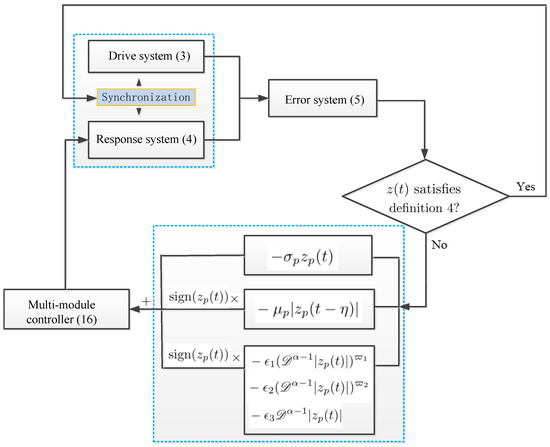
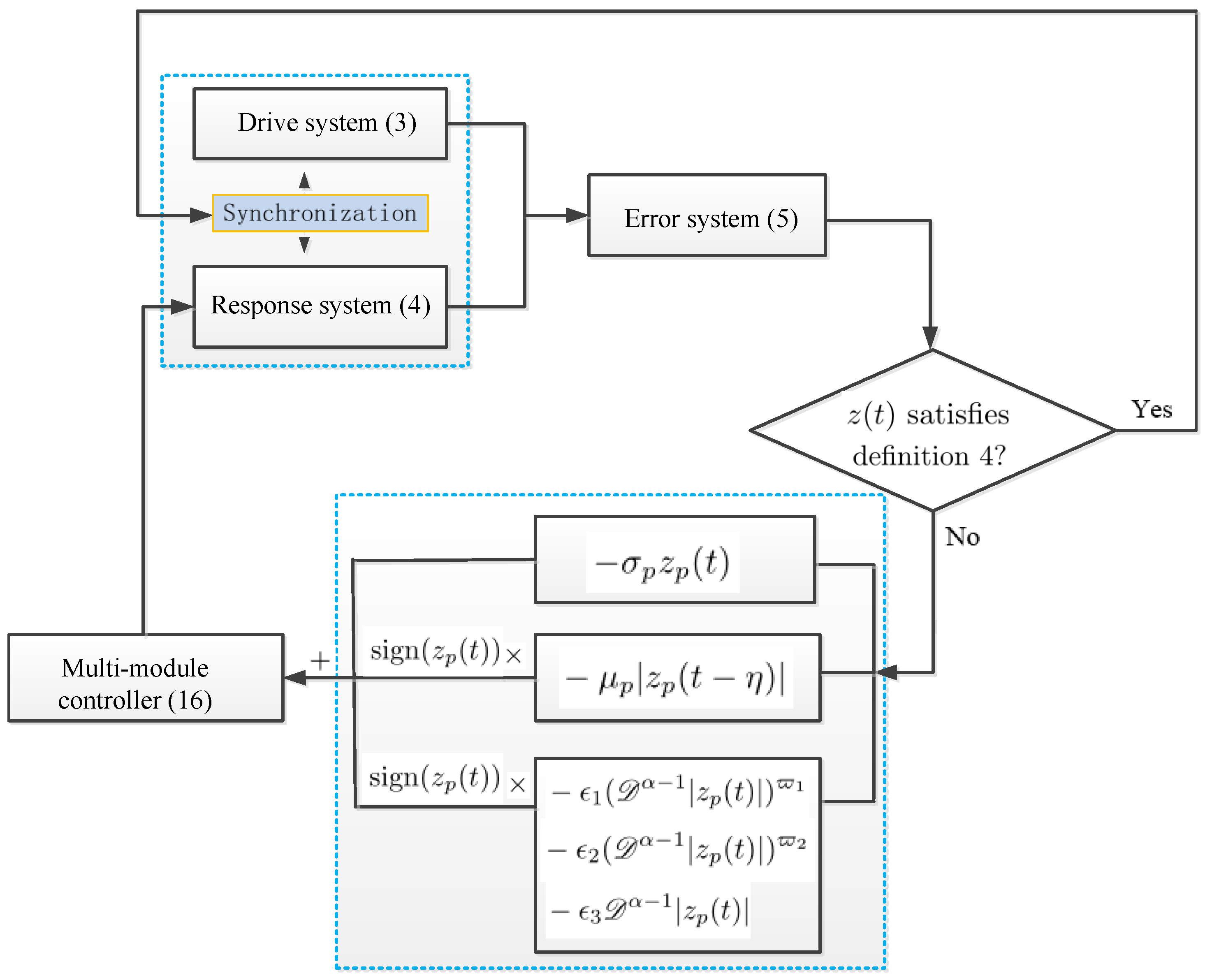
Figure 1 depicts the multi-module control framework for fractional systems (3) and (4). We apply a multi-module controller to the response system, ensuring that the error between the two systems approaches zero over time, as defined in Definition 4. The proposed controller integrates three dedicated modules, each fulfilling a distinct role. The first module reduces the conservativeness of system parameters. The second module eliminates the detrimental effects of delays on network stability. The role of the last module , , and is to accelerate the network to converge within a fixed time, unaffected by initial values. The synergistic operation of these modules enables the overall system to achieve the fixed-time synchronization objective.
Remark 5.
The study in [35] addressed fractional-order fuzzy memristive NNs with delays using a multi-module feedback controller. Similarly, Du et al. [36] investigated the finite-time synchronization of fractional fuzzy NNs via an information feedback control strategy. Both controllers incorporate similar submodules, specifically and . Despite their notable effectiveness, an inherent limitation of such designs is that the upper bound of the control signal may become unbounded over time. In contrast to the approaches in [35,36], the multi-module controller proposed in this work guarantees the boundedness of the control function throughout the entire time evolution.
Theorem 1.
Proof.
Consider the auxiliary function as
In view of Lemmas 1 and 3, calculating the first derivative of gives
By the boundedness of uncertainties, we can get
By Assumption 1, one can obtain
Combining Assumption 1 and Lemma 2, one has
and
Based on Lemma 4, for and , we obtain
and
Note that , and . By Lemma 5, the fixed-time synchronization of fractional fuzzy systems (3) and (4) is completed via nonlinear multi-module controller (16). The settling time satisfies
□
Remark 6.
The fixed-time synchronization issues for various networks (such as inertial NNs, impulsive NNs, BAM NNs, multi-layer NNs, and fuzzy cellular NNs) have been studied using various control schemes in [24,25,26,27]. It should be emphasized that the fixed-time synchronization results for NNs were obtained using integer-order controllers. However, due to the fundamental differences in the definitions and properties between integer and fractional calculus, existing control techniques in [24,25,26,27] cannot be employed for the fractional-order NNs studied in this work. This fundamental gap motivates the present study.
Remark 7.
In [38], Cheng et al. discussed the synchronization of delayed fractional-order NNs by sliding mode control methods. In [39], Wang et al. considered the synchronization for fractional memristive NNs by designing a sliding mode controller. Due to the presence of fuzziness, uncertainties, and delays in the system of this article, the system state may experience high-frequency and small-amplitude oscillations near the sliding mode surface. In this article, we attempt to achieve fixed-time synchronization of the network by applying a multi-mode feedback controller rather than sliding mode controllers.
Remark 8.
Previous work in [21] studied the synchronization of fractional memristive NNs by simple feedback controllers without fractional derivatives. Du et al. [22] designed a class of multi-module controllers with positive fractional derivatives for synchronizing fractional fuzzy NNs. Ding et al. [40] considered a multi-module controller with the initial error value for the fixed-time synchronization of delayed NNs. Unlike existing simple feedback controllers in [21] and multi-module controllers in [22,40], we designed a nonlinear multi-module controller incorporating negative-order derivatives that was unaffected by system initial values.
Remark 9.
Lemma 5 indicates that when the error system between the drive network and the response network satisfies Equation (14), the error system is stable within the setting time given by Equation (15). In Refs. [35,36,40], the Lyapunov function method was applied to the stability analysis of error network systems, where the Lyapunov function was designed as . In contrast to the aforementioned studies, this paper employs a Lyapunov function defined as , where denotes the negative fractional order.
In the absence of uncertainties, the fractional-order neural network models (3) and (4) can be simplified as
and
where , and . Given a nonlinear multi-module controller (16), the following synchronization corollary can be derived by applying similar mathematical reasoning.
Corollary 1.
Remark 10.
Distinct from the synchronization criteria of the integer-order model studied in [29], Corollary 1 provides the fixed-time synchronization condition for fractional-order FCNNs. Therefore, Corollary 1 constitutes a generalization of the results in [29].
4. Numerical Simulation
To prove the validity of the synchronization criteria derived, this section provides two simulation examples.
Example 1.
Consider nonlinear FOFCNNs incorporating bounded uncertainties and transmission delays as
where , , , , , , , , , and . Taking nonlinear functions , calculation shows that Assumption 1 holds for and .
Taking fuzzy delayed NNs (33) as the drive system, one derives the following fuzzy NNs as the response system:
where the parameters have the same values as (33).
Let control parameters , and . By simple calculation, one derives
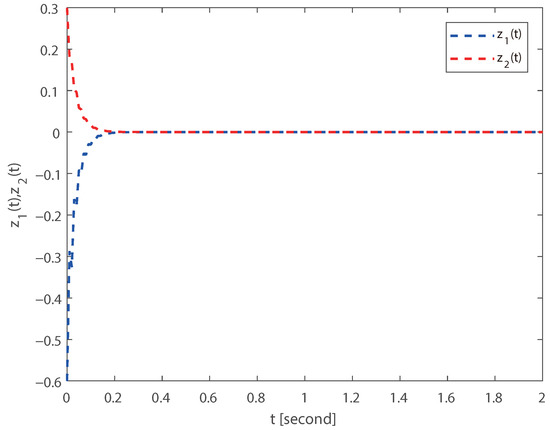
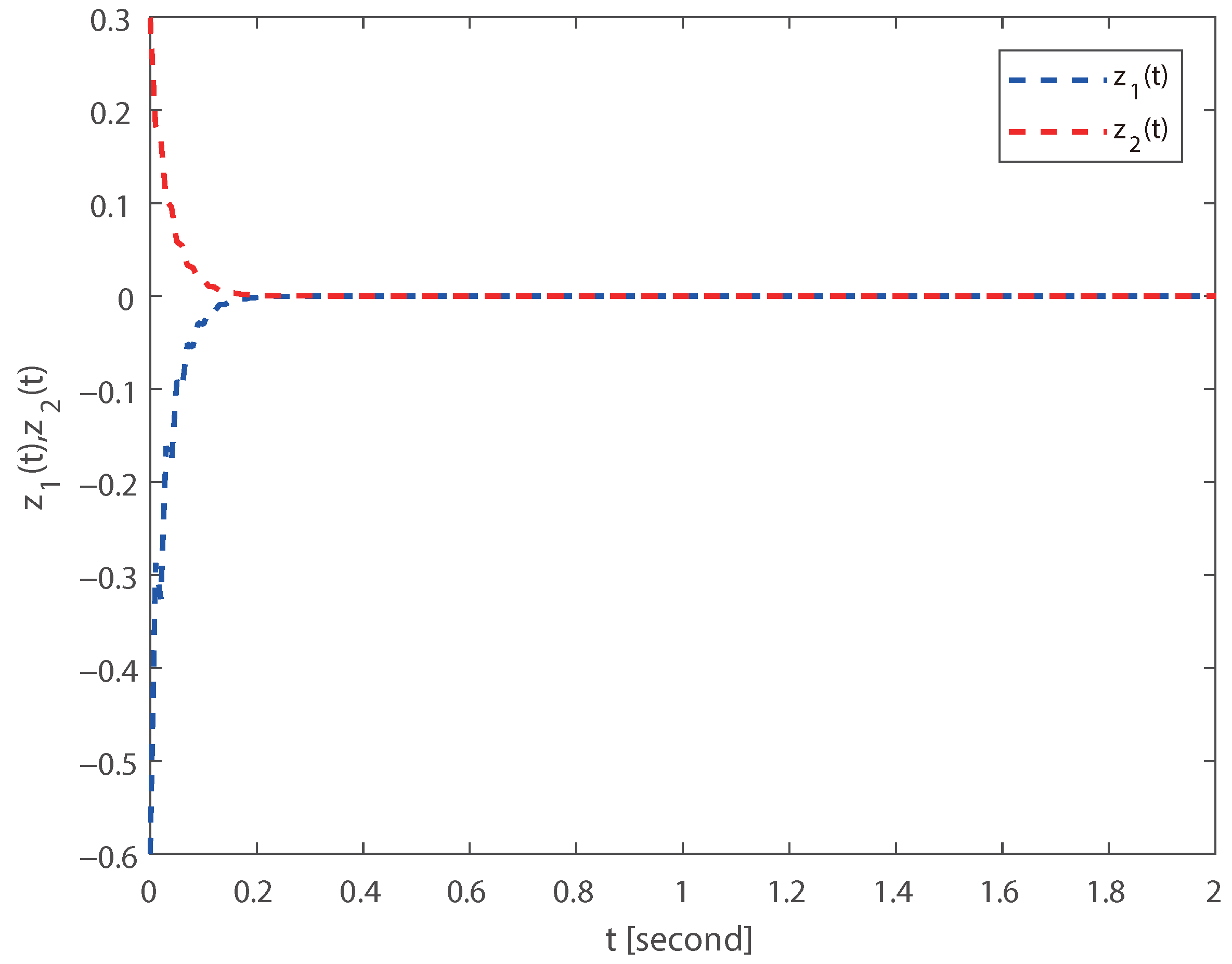
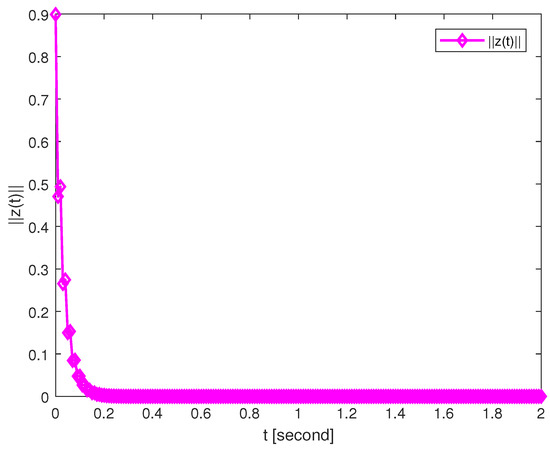
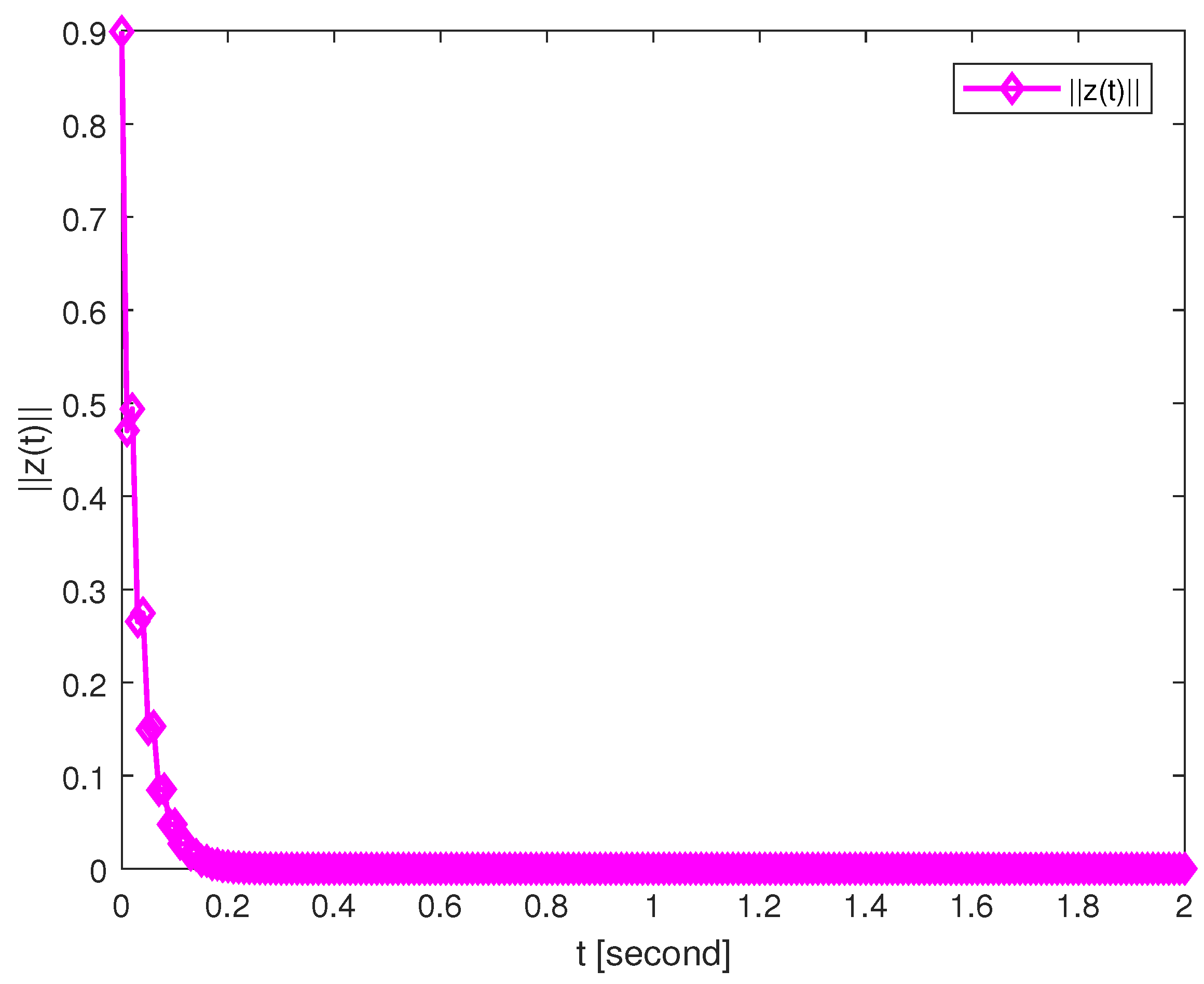
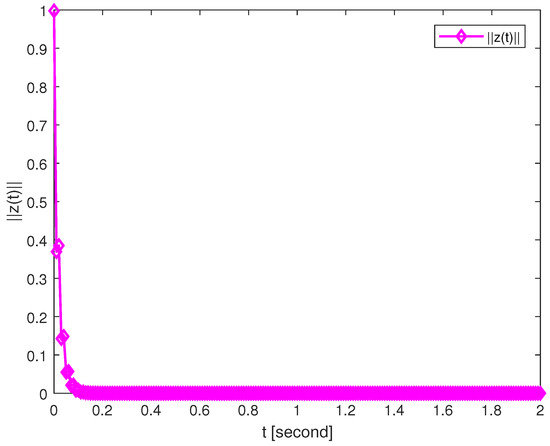
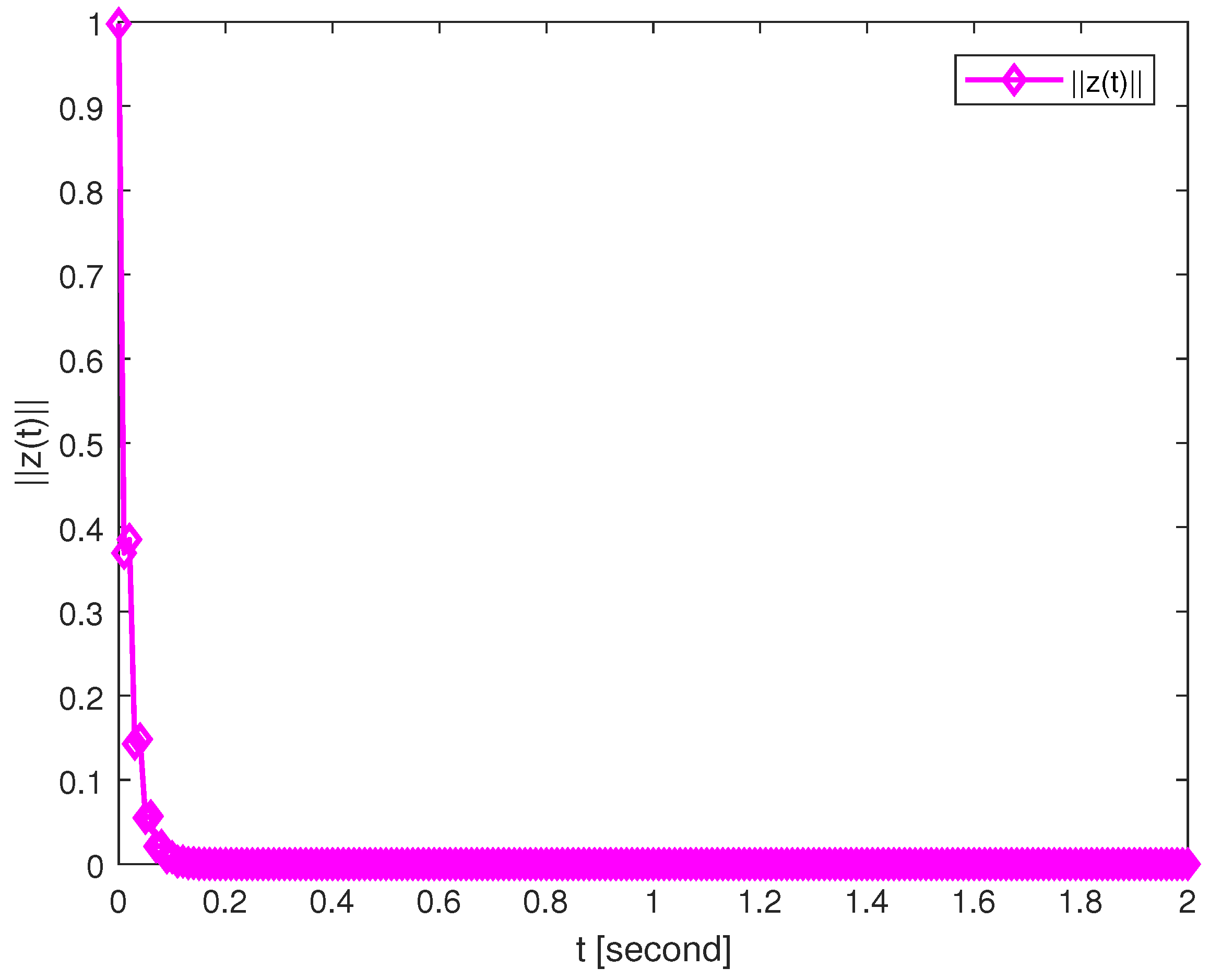
Obviously, the above parameters satisfy every inequality constraint in Theorem 1. Based on the estimation formula (17), the settling time is calculated to be 2.6416 s. The initial values are given by . The evolution of the synchronization error of each neuron in the control process under the nonlinear multi-module controller (16) is shown in Figure 2. The blue and red dashed lines represent the synchronization errors of the first and second neurons, respectively. Figure 3 illustrates the evolution of the error norm during the control process. Figure 2 and Figure 3 clearly demonstrate that the errors between drive system (33) and response system (34) converge to zero within the specified time, indicating that fixed-time synchronization of the NNs has been achieved.
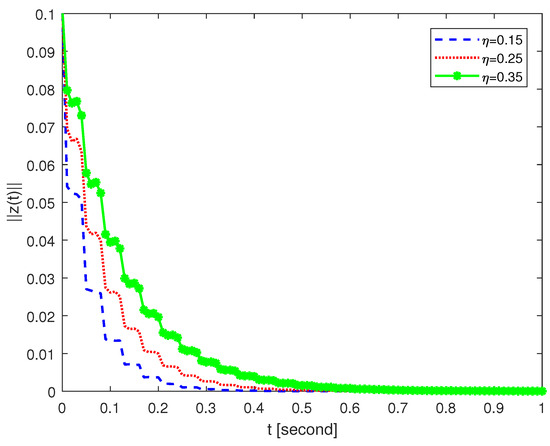
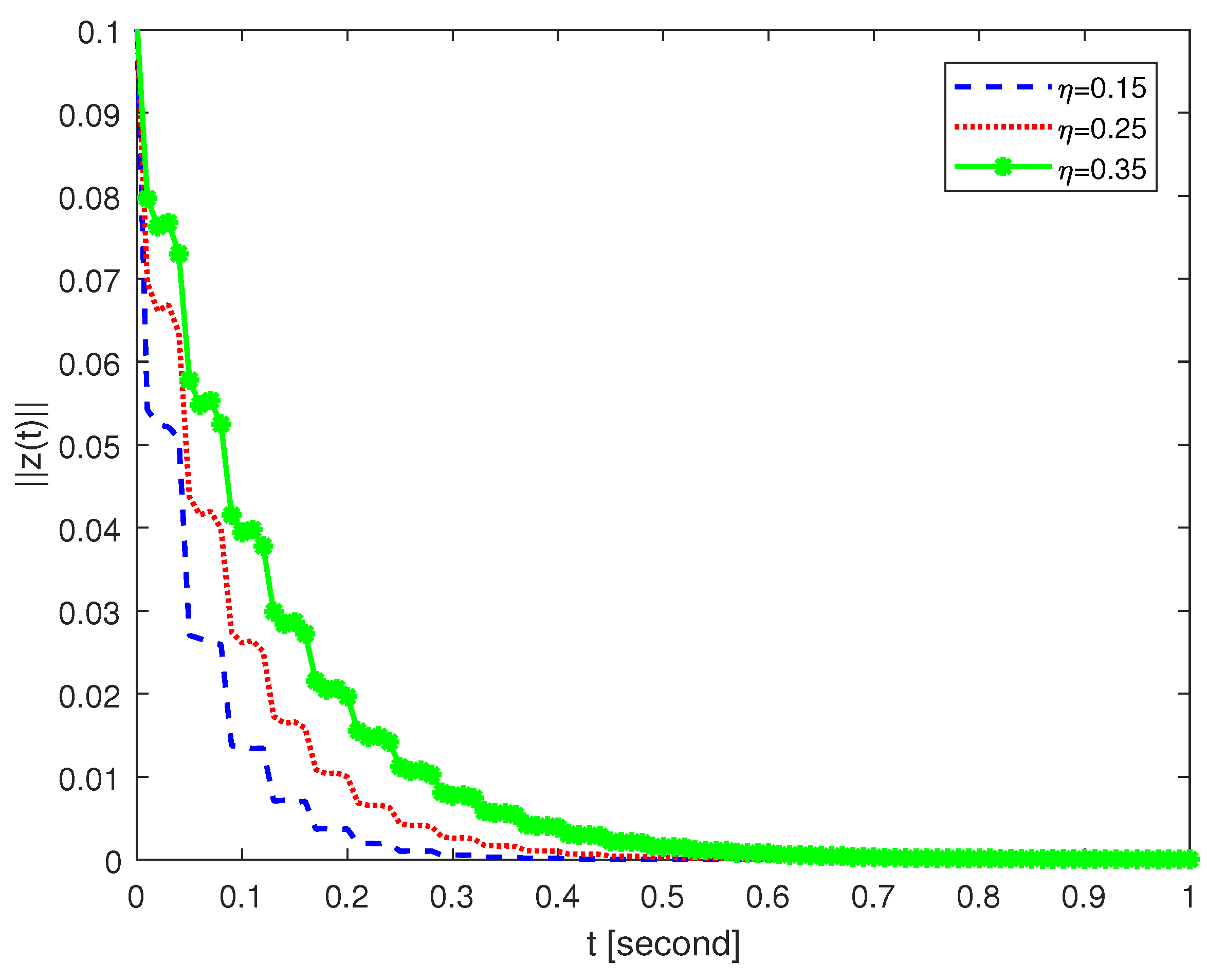
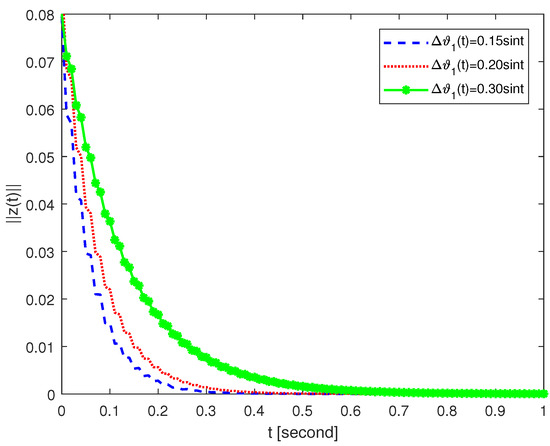
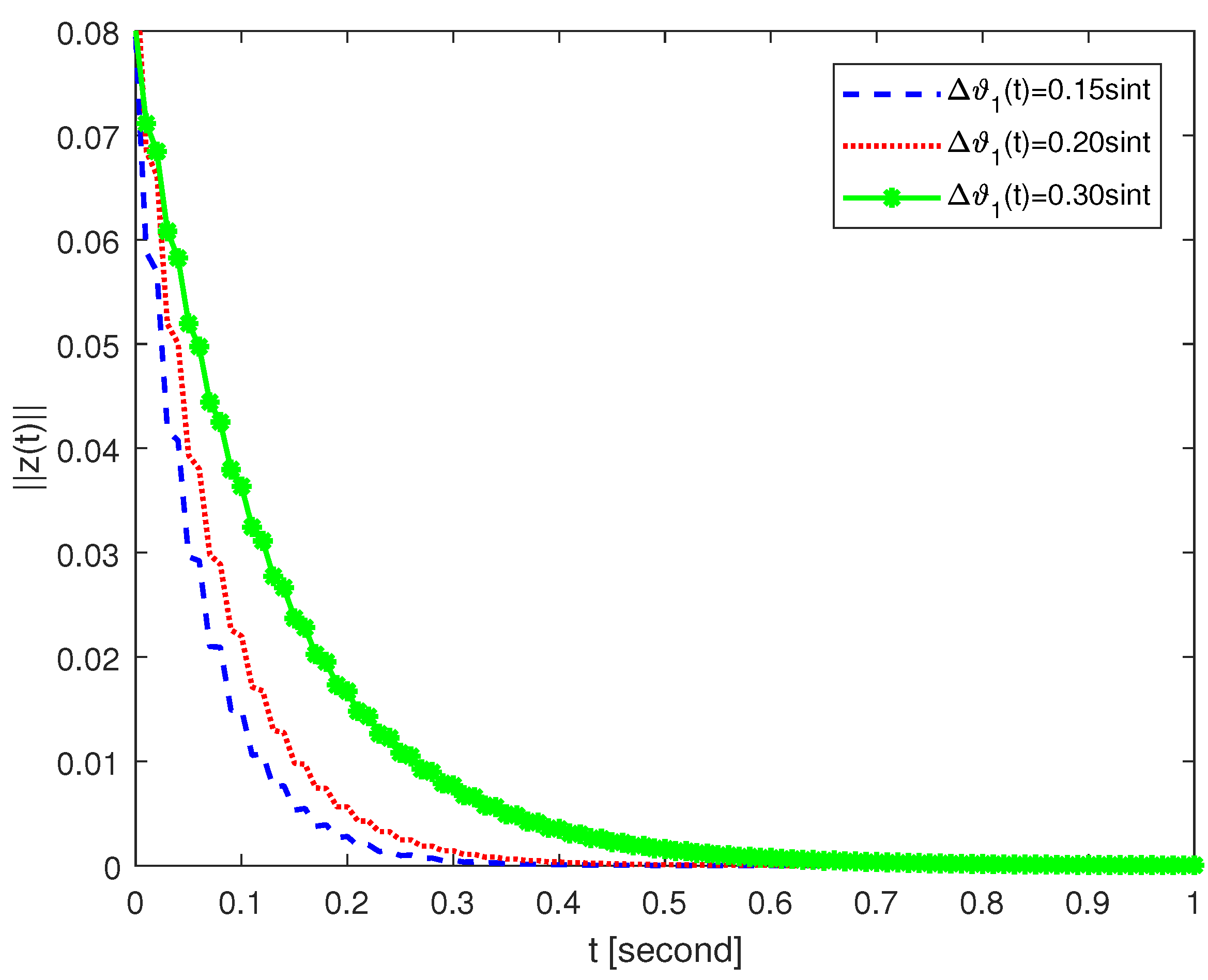
The fuzzy NNs in this article contain transmission delays and uncertainties. We will explore the impact of changes in these two key factors on synchronization. To evaluate the robustness of the controller, two groups of experiments are conducted with random initial values from . First, select communication delays of 0.15, 0.25, and 0.35, respectively. Figure 4 indicates that the convergence time of the error system gradually increases with increasing delays. Second, select disturbance coefficients of 0.15, 0.20, and 0.30, respectively. As shown in Figure 5, as the uncertain amplitude increases, the network takes longer to reach synchronization. In general, regardless of how the system parameters change, the NNs in this article can achieve synchronization within a predefined time under the appropriate control parameters.
Example 2.
Consider a class of delayed FOFCNNs without uncertainties as
where , , , , , , , , , and . Let nonlinear functions , calculation indicates Assumption 1 holds for and . Then one gets the response system as
where the parameters have the same values as (36).
Let control parameters , and . A simple calculation yields that
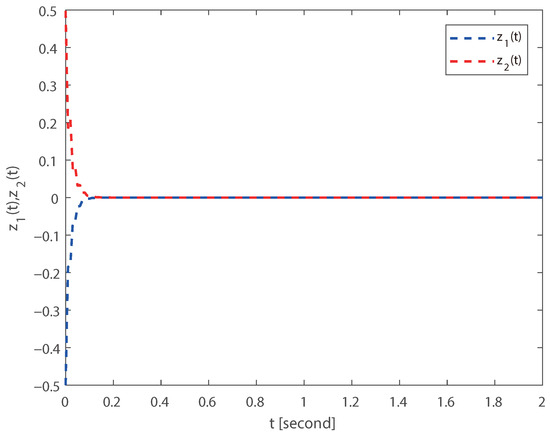
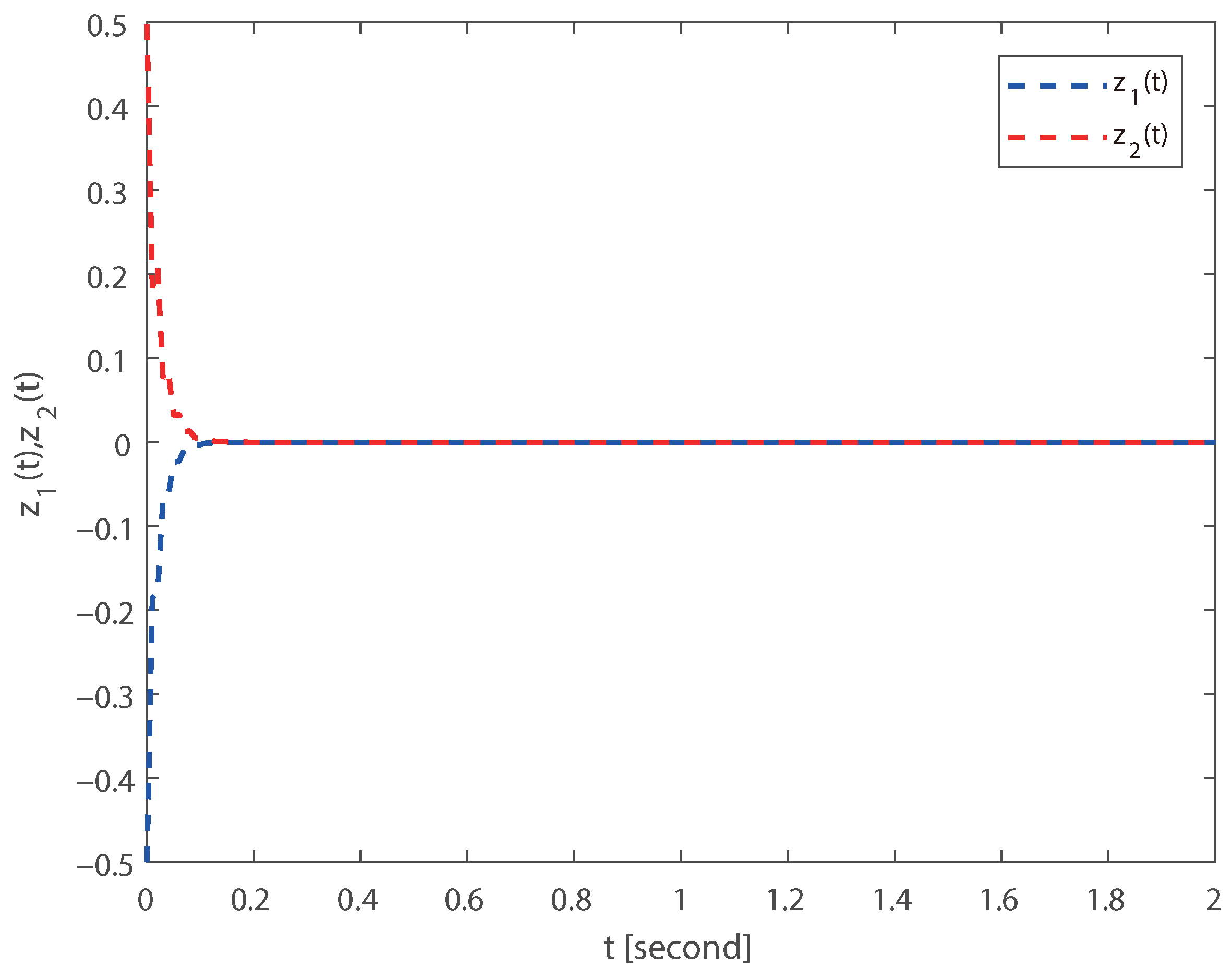
The system and control parameters are configured to satisfy all conditions of Corollary 1. Accordingly, the settling time for synchronization is calculated as 1.9730 s via the estimation Formula (32). The initial states are set to , , , and . Figure 6 displays the time evolution of the synchronization errors and between the drive-response systems (36) and (37) under the multi-module controller (16). Correspondingly, the time evolution of is shown in Figure 7. The results confirm that the system errors converge to zero within the estimated settling time, thus verifying the achievement of fixed-time synchronization between systems (36) and (37). To compare the convergence speed of different controllers and provide relevant comparison results. Randomly select initial values from and execute each controller five times under the same conditions. From Table 2, it is clear that the multi-mode controller designed in this article is very close to the adaptive controller in terms of mean convergence time. Moreover, compared to all controllers, the variance of the synchronization time of the controller in this paper is the smallest. It indicates that our multi-module controller has good robustness.
Table 2.
Comparisons of mean convergence time and variance for different controllers.
5. Conclusions
Based on two types of fuzzy operators, this paper constructs a generalized fuzzy neural network model with bounded uncertainties, transmission delays, and fractional order. A nonlinear controller is designed for the fixed-time synchronization task of drive-response NNs. A key feature of this controller is its multi-modal features with negative fractional-order derivatives, which enable it to simultaneously mitigate the impact of delays, guarantee fixed-time convergence independent of initial conditions, and reduce conservatism in parameter settings. Leveraging the stability theory and a constructed negative-order Lyapunov function, novel sufficient conditions have been derived to ensure synchronization within a predefined fixed time. Furthermore, an explicit upper bound on the settling time has been derived, which depends on the controller parameters but is independent of the initial state.
One direction of future research is to combine event-triggered control with feedback strategies to achieve fixed-time synchronization of fractional delayed systems. Unlike traditional time-triggered control, an event-triggered scheme updates the control signal only when the synchronization error exceeds a prescribed threshold, thereby substantially alleviating the communication burden and computational consumption. The challenge for designing event-triggered mechanisms lies in rigorously eliminating the Zeno phenomenon. A dynamic event-triggered mechanism that does not require continuous error monitoring could be explored to optimize resource utilization. The integration of such triggering mechanisms with the multi-module controller to achieve fixed-time synchronization in fractional fuzzy delayed systems constitutes an interesting and challenging problem. In addition, there are various forms of fractional derivatives, such as the Riemann–Liouville derivative, Grunwald–Letnikov derivative, and Atangana–Baleanu derivative. We will investigate the impact of different types of derivatives and large-scale networks on synchronization efficiency.
Author Contributions
Conceptualization, H.W., J.X. and K.S.; Methodology, H.W. and K.S.; Software, H.W. and H.F.; Writing—original draft, H.F., H.W. and K.S.; Writing—review and editing, H.F., H.W., J.X. and K.S. All authors have read and agreed to the published version of the manuscript.
Funding
The first author was partially supported by the Engineering Research Center for Big Data Application in Private Health Medicine of Fujian Universities, Putian University under Grant (MKF202401). The second author was partially supported by the Ministry of Education’s Industry-University Cooperation Collaborative Education Project under grant (231102311285117), the Putian Science and Technology Project (2024NJJ009, 2023GJGZ003), and the Natural Science Foundation of Fujian Province under grant (2022J011179, 2023J011015). The third author was partially supported by the Sichuan Science and Technology Program under Grants (25NSFSC2581, 2024NSFSC2056).
Data Availability Statement
Data is contained within the article.
Conflicts of Interest
The authors declare no conflicts of interest.
References
- Dou, H.; Shen, F.; Zhao, J.; Mu, X.Y. Understanding neural network through neuron level visualization. Neural Netw. 2023, 168, 484–495. [Google Scholar] [CrossRef] [Scilit]
- Xiao, J.Y.; Wen, S.P.; Guo, X.; Li, Y.T. New amplified inequalities and their application on mittag-leffler synchronization problem of fractional-order fuzzy bidirectional associative memory neural networks in octonion-valued field by using a genetic algorithm. Inf. Sci. 2026, 727, 122747. [Google Scholar] [CrossRef] [Scilit]
- Zhao, C.; Chen, Y.P.; Shi, K.B.; Zhang, L.; Nie, Y.J. A relaxed Lyapunov function lemma and genetic algorithm applying to time-delay systems. Chaos Solitons Fractals 2025, 199, 116687. [Google Scholar] [CrossRef] [Scilit]
- Xiao, J.Y.; Li, Y.T. Deep analysis on MLSY for fractional-order higher-dimension-valued neural networks under the action of free quadratic coefficients. Expert Syst. Appl. 2026, 298, 129586. [Google Scholar] [CrossRef] [Scilit]
- Luo, R.F.; Ren, J.J.; Shi, K.B. Stability analysis of delayed T-S fuzzy power system via a cubic function negative determination lemma. Nonlinear Dyn. 2025, 113, 5439–5456. [Google Scholar] [CrossRef] [Scilit]
- Cai, J.Y.; Yi, C.B.; Luo, X.; Xiao, C.R. Output feedback tracking consensus of switched stochastic uncertain multiagent systems via event-triggered control. IEEE Syst. J. 2025, 19, 130–141. [Google Scholar] [CrossRef] [Scilit]
- Zhang, K.; Cao, J.P.; Lyu, J.J. Dynamic behavior and modulation instability for a generalized nonlinear Schrodinger equation with nonlocal nonlinearity. Phys. Scr. 2025, 100, 015262. [Google Scholar] [CrossRef] [Scilit]
- Han, T.Y.; Liang, Y.; Fan, W.J. Dynamics and soliton solutions of the perturbed Schrodinger-Hirota equation with cubic-quintic-septic nonlinearity in dispersive media. AIMS Math. 2025, 10, 754–776. [Google Scholar] [CrossRef] [Scilit]
- Fan, H.G.; Wen, H.; Shi, K.B.; Zhou, A.R. Finite-time synchronization and practical synchronization for Caputo fractional-order fuzzy cellular neural networks with transmission delays and uncertainties via information feedback. Fractal Fract. 2025, 9, 297. [Google Scholar] [CrossRef] [Scilit]
- Ding, D.; Tang, Z.; Park, J.H.; Wang, Y.; Ji, Z.C. Dynamic self-triggered impulsive synchronization of complex networks with mismatched parameters and distributed delay. IEEE Trans. Cybern. 2023, 53, 887–899. [Google Scholar] [CrossRef] [Scilit]
- Ruan, X.L.; Xu, F.; Xiang, Y.; Pan, X. Dynamic event-triggered consensus control of multiagent systems under DoS attacks with intermittent communication. Asian J. Control 2025. early view. [Google Scholar] [CrossRef] [Scilit]
- Kong, F.C.; Zhu, Q.X.; Huang, T.W. New fixed-time stability lemmas and applications to the discontinuous fuzzy inertial neural networks. IEEE Trans. Fuzzy Syst. 2021, 29, 3711–3722. [Google Scholar] [CrossRef] [Scilit]
- Lian, H.H.; Xiao, S.P.; Yan, H.C.; Yang, F.W.; Zeng, H.B. Dissipativity analysis for neural networks with time-varying delays via a delay-product-type Lyapunov functional approach. IEEE Trans. Neural Netw. Learn. Syst. 2021, 32, 975–984. [Google Scholar] [CrossRef] [Scilit]
- Wang, H.; Yang, X.S.; Xiang, Z.R.; Tang, R.Q.; Ning, Q. Synchronization of switched neural networks via attacked mode-dependent event-triggered control and its application in image encryption. IEEE Trans. Cybern. 2023, 53, 5994–6003. [Google Scholar] [CrossRef] [Scilit]
- Ding, K.; Zhu, Q.X. A note on sampled-data synchronization of memristor networks subject to actuator failures and two different activations. IEEE Trans. Circuits Syst. II Express Briefs 2021, 68, 2097–2101. [Google Scholar] [CrossRef] [Scilit]
- Ding, D.; Tang, Z.; Park, J.H.; Ji, Z.C. Quasi-bipartite synchronization of derivatively coupled complex dynamic networks: Memory-based self-triggered approach. IEEE Trans. Syst. Man Cybern. Syst. 2024, 54, 1611–1621. [Google Scholar] [CrossRef] [Scilit]
- Yao, W.; Wang, C.H.; Sun, Y.C.; Gong, S.Q.; Lin, H.R. Event-triggered control for robust exponential synchronization of inertial memristive neural networks under parameter disturbance. Neural Netw. 2023, 164, 67–80. [Google Scholar] [CrossRef] [Scilit] [PubMed]
- Li, X.F.; Zhang, W.B.; Fang, J.A.; Li, H.Y. Finite-time synchronization of memristive neural networks with discontinuous activation functions and mixed time-varying delays. Neurocomputing 2019, 340, 99–109. [Google Scholar] [CrossRef] [Scilit]
- Liu, J.; Shu, L.; Chen, Q.; Zhong, S.M. Fixed-time synchronization criteria of fuzzy inertial neural networks via Lyapunov functions with indefinite derivatives and its application to image encryption. Fuzzy Sets Syst. 2023, 459, 22–42. [Google Scholar] [CrossRef] [Scilit]
- Wang, M.X.; Zhu, S.; Luo, W.W.; Zhang, Z. Finite-/fixed-time synchronization of coupled memristive neural networks with actuator nonlinearity and applications in secure communication. IEEE Trans. Circuits Syst. I Regul. Pap. 2025, 72, 4334–4345. [Google Scholar] [CrossRef] [Scilit]
- Fan, H.G.; Shi, K.B.; Guo, Z.Z.; Zhou, A.R.; Cai, J.Y. Finite-time synchronization and Mittag–Leffler synchronization for uncertain fractional-order delayed cellular neural networks with fuzzy operators via nonlinear adaptive control. Fractal Fract. 2025, 9, 634. [Google Scholar] [CrossRef] [Scilit]
- Du, F.F.; Lu, J.G.; Zhang, Q.H. Practical finite-time synchronization of delayed fuzzy cellular neural networks with fractional-order. Inf. Sci. 2024, 667, 120457. [Google Scholar] [CrossRef] [Scilit]
- Duan, L.; Wei, H.; Huang, L.H. Finite-time synchronization of delayed fuzzy cellular neural networks with discontinuous activations. Fuzzy Sets Syst. 2019, 361, 56–70. [Google Scholar] [CrossRef] [Scilit]
- Hu, J.H.; Zhang, G.D.; Li, Y.; Wang, T.Q. Fixed-time stabilization and synchronization of fuzzy inertial neural networks via aperiodically semi-intermittent control. Neurocomputing 2025, 631, 129720. [Google Scholar] [CrossRef] [Scilit]
- Abdurahman, A.; Tohti, R.; Li, C.C. New results on fixed-time synchronization of impulsive neural networks via optimized fixed-time stability. J. Appl. Math. Comput. 2024, 70, 2809–2826. [Google Scholar] [CrossRef] [Scilit]
- Sharma, A.; Ghosh, S.; Ali, J.; Baluni, S.; Yadav, V.K. Fixed-time synchronization of time-varying delayed BAM neural networks in quaternion variable. Phys. Scr. 2025, 100, 075244. [Google Scholar] [CrossRef] [Scilit]
- Wei, J.; Chen, Z.H. Finite and fixed time synchronization of multi-link complex-valued complex networks with time delay via hybrid control. Commun. Nonlinear Sci. Numer. Simul. 2025, 144, 108678. [Google Scholar] [CrossRef] [Scilit]
- Yun, G.N.; Liu, X.K.; Lei, Y.; Wang, Y.W. Fixed-time synchronization in p-th moment for stochastic multi-layer neural networks: An adaptive graph-theoretic Lyapunov functional approach. Neurocomputing 2025, 636, 108678. [Google Scholar]
- Kong, F.C.; Zhu, Q.X.; Sakthivel, R.; Mohammadzadeh, A. Fixed-time synchronization analysis for discontinuous fuzzy inertial neural networks with parameter uncertainties. Neurocomputing 2021, 422, 295–313. [Google Scholar] [CrossRef] [Scilit]
- Cui, W.X.; Wang, Z.J.; Jin, W.B. Fixed-time synchronization of Markovian jump fuzzy cellular neural networks with stochastic disturbance and time-varying delays. Fuzzy Sets Syst. 2021, 411, 68–84. [Google Scholar] [CrossRef] [Scilit]
- Podlubny, I. Fractional Differential Equations; Academic Press: New York, NY, USA, 1999. [Google Scholar]
- Chen, B.S.; Chen, J.J. Global asymptotical ω-periodicity of a fractional-order non-autonomous neural networks. Neural Netw. 2015, 68, 78–88. [Google Scholar] [CrossRef] [Scilit]
- Shafiya, M.; Nagamani, G.; Dafik, D. Extended dissipative performance of fractional-order neural networks via LMI approach. J. Anal. 2024, 32, 2329–2347. [Google Scholar] [CrossRef] [Scilit]
- Bhalekar, S.; Gejji, V. A predictor-corrector scheme for solving nonlinear delay differential equations of fractional order. J. Fract. Calc. Appl. 2011, 1, 1–9. [Google Scholar]
- Fan, H.G.; Shi, K.B.; Guo, Z.Z.; Zhou, A.R. Finite-time synchronization criteria for Caputo fractional-order uncertain memristive neural networks with fuzzy operators and transmission delay under communication feedback. Fractal Fract. 2024, 8, 619. [Google Scholar] [CrossRef] [Scilit]
- Du, F.F.; Lu, J.G. Finite-time synchronization of fractional-order delayed fuzzy cellular neural networks with parameter uncertainties. IEEE Trans. Fuzzy Syst. 2023, 31, 1769–1779. [Google Scholar] [CrossRef] [Scilit]
- Mei, X.; Ding, Y.C. Fixed-time synchronization of fractional-order Hopfield neural networks. Int. J. Control Autom. Syst. 2022, 20, 3584–3591. [Google Scholar] [CrossRef] [Scilit]
- Cheng, Y.L.; Yang, W.Y.; Xu, W.B.; Zhong, S.M. Impulsive effects on delayed fractional-order neural networks: Sliding mode control-based fixed-time synchronization analysis. Nonlinear Dyn. 2025, 113, 16571–16592. [Google Scholar] [CrossRef] [Scilit]
- Wang, W.P.; Jia, X.; Wang, Z.; Luo, X.; Li, L.X.; Kurths, J.; Yuan, M.M. Fixed-time synchronization of fractional order memristive MAM neural networks by sliding mode control. Neurocomputing 2020, 401, 364–376. [Google Scholar] [CrossRef] [Scilit]
- Ding, Z.X.; Wang, J.H.; Li, S.; Yang, L.; Wang, L.H. Fixed-time synchronization of fractional-order complex-valued delayed neural networks with discontinuous activation functions. Neural Comput. Appl. 2024, 36, 15947–15959. [Google Scholar] [CrossRef] [Scilit]
- Liu, Y.H.; Sun, Y.G. Finite-time adaptive synchronization and fixed-time synchronization of fractional-order memristive cellular neural networks with time-varying delays. Mathematics 2024, 12, 1108. [Google Scholar] [CrossRef] [Scilit]
- Du, F.F.; Lu, J.G. Adaptive finite-time synchronization of fractional-order delayed fuzzy cellular neural networks. Fuzzy Sets Syst. 2023, 466, 108480. [Google Scholar] [CrossRef] [Scilit]
- Chaouki, A.; Abed, A.E. Finite-time and fixed-time synchronization of inertial neural networks with mixed delays. J. Syst. Sci. Complex. 2021, 34, 206–235. [Google Scholar] [CrossRef] [Scilit]
- Abdurahman, A.; Jiang, H.J.; Hu, C. Improved fixed-time stability results and application to synchronization of discontinuous neural networks with state-dependent switching. Int. J. Robust Nonlinear Control 2021, 31, 5725–5744. [Google Scholar] [CrossRef] [Scilit]

Disclaimer/Publisher’s Note: The statements, opinions and data contained in all publications are solely those of the individual author(s) and contributor(s) and not of MDPI and/or the editor(s). MDPI and/or the editor(s) disclaim responsibility for any injury to people or property resulting from any ideas, methods, instructions or products referred to in the content. |
© 2026 by the authors. Licensee MDPI, Basel, Switzerland. This article is an open access article distributed under the terms and conditions of the Creative Commons Attribution (CC BY) license.