

A Fractional Framework for Modeling Malicious Code Spread in Wireless Sensor Networks




Abstract
1. Introduction
2. Fundamentals of Fractional Operators
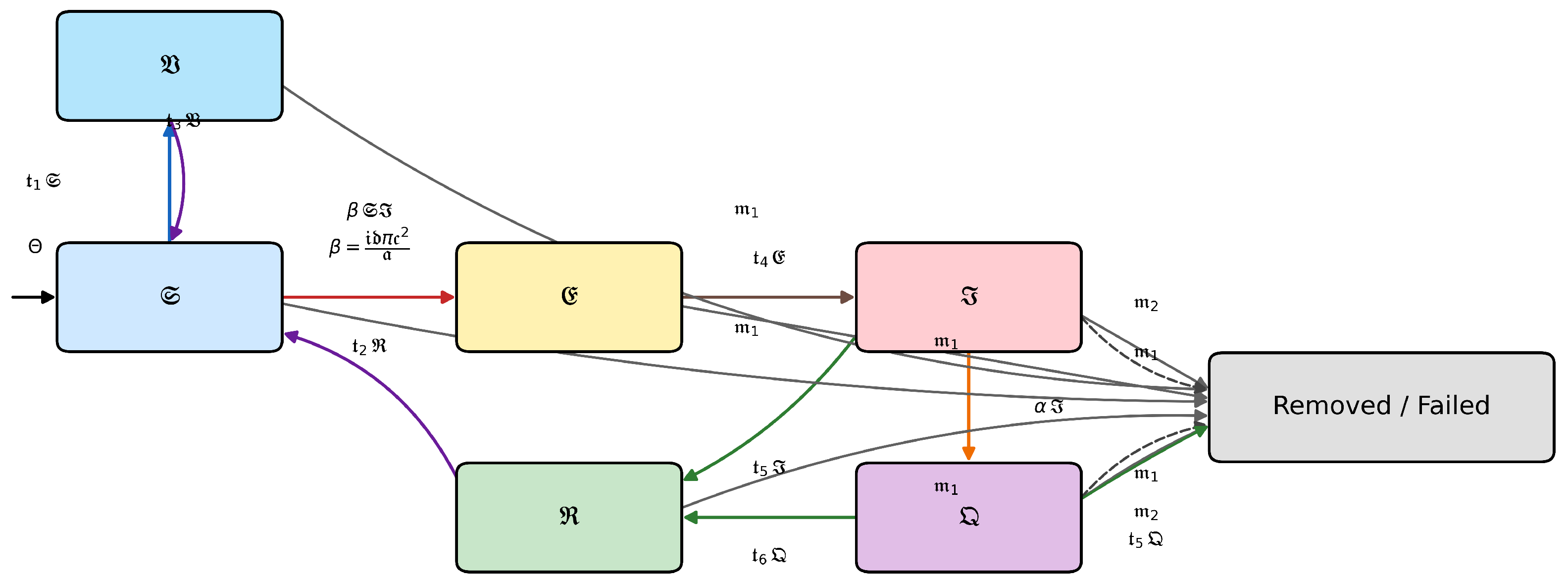
3. Fractional-Order Model Description
4. Main Results
4.1. Existence and Uniqueness Analysis
4.2. Stability Properties of the Proposed Model
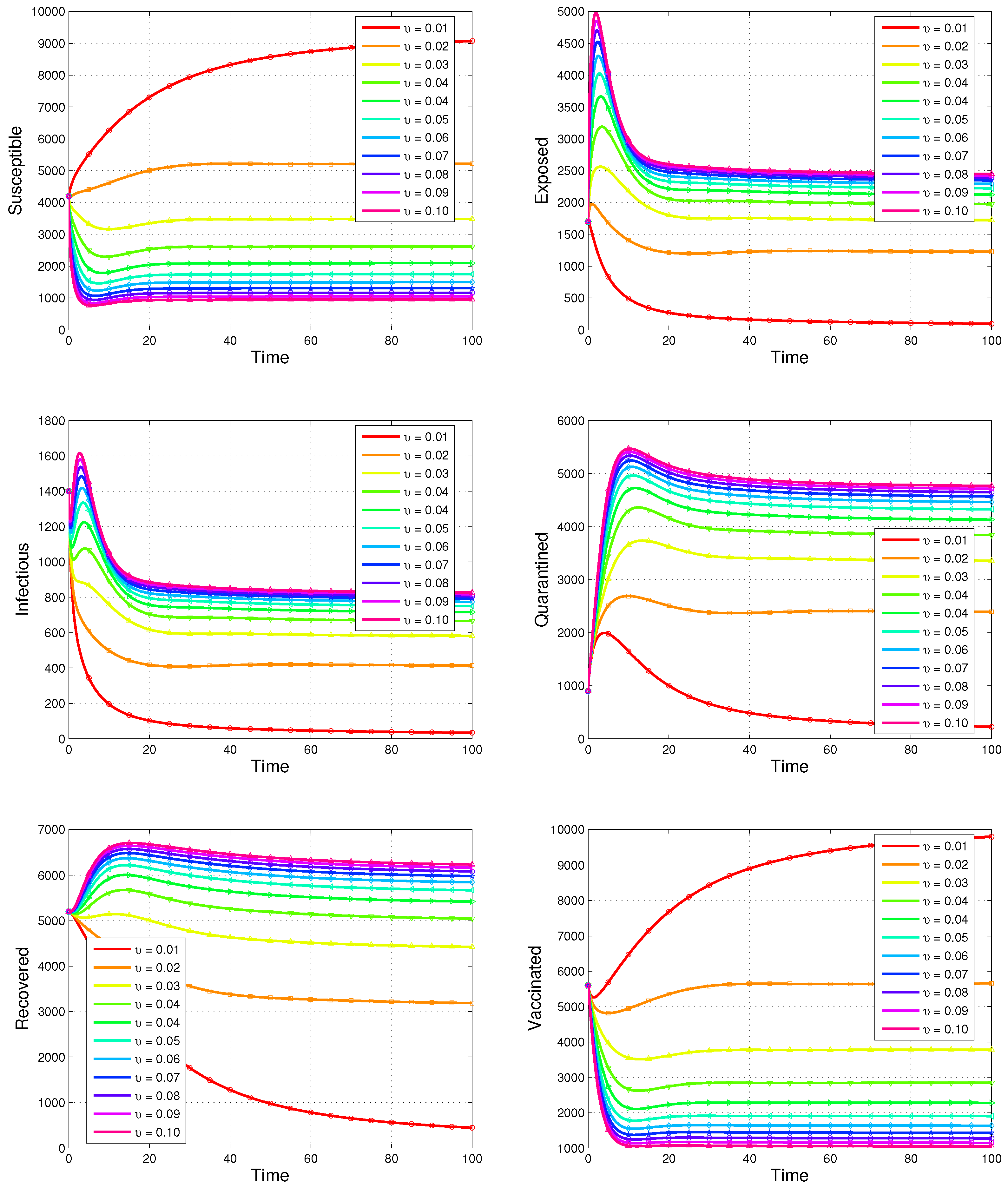
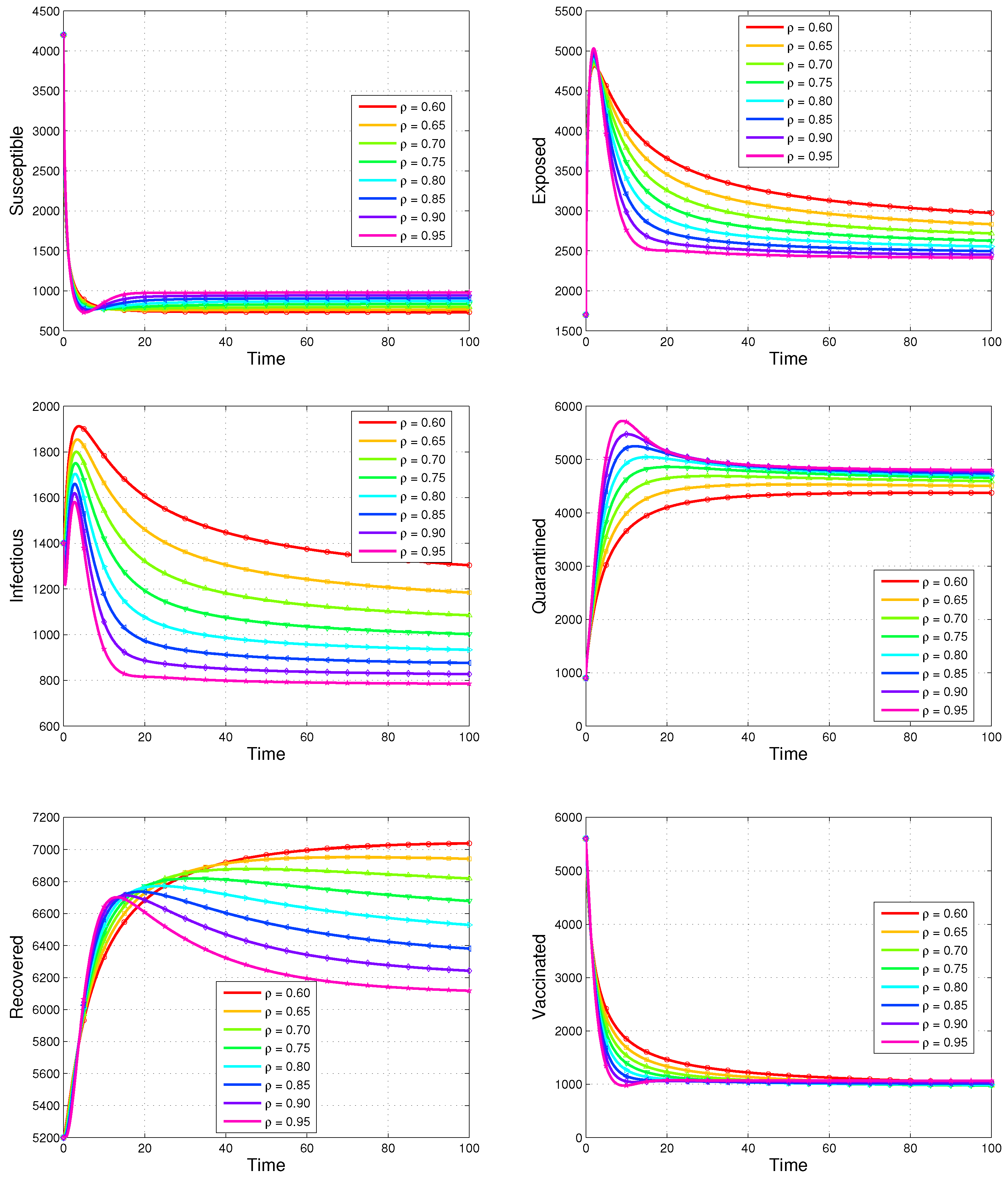
5. Numerical Simulations
6. Conclusions
Author Contributions
Funding
Data Availability Statement
Acknowledgments
Conflicts of Interest
References
- Chen, J. An SIRS epidemic model. Appl. Math. J. Chin. Univ. 2004, 19, 101–108. [Google Scholar] [CrossRef]
- Li, J.; Yang, Y.; Xiao, Y.; Liu, S. A Class of Lyapunov Functions and the Global Stability of Some Epidemic Models with Nonlinear Incidence. J. Appl. Anal. Comput. 2016, 6, 38–46. [Google Scholar] [CrossRef]
- Ruan, S.; Wang, W. Dynamical behavior of an epidemic model with a nonlinear incidence rate. J. Differ. Equ. 2003, 188, 135–163. [Google Scholar] [CrossRef]
- Korobeinikov, A. Global Properties of Infectious Disease Models with Nonlinear Incidence. Bull. Math. Biol. 2007, 69, 1871–1886. [Google Scholar] [CrossRef]
- la Sen, M.D.; Alonso-Quesada, S. Vaccination strategies based on feedback control techniques for a general SEIR-epidemic model. Appl. Math. Comput. 2011, 218, 3888–3904. [Google Scholar] [CrossRef]
- Zhang, Y.; Ma, X.; Din, A. Stationary distribution and extinction of a stochastic SEIQ epidemic model with a general incidence function and temporary immunity. AIMS Math. 2021, 6, 12359–12378. [Google Scholar] [CrossRef]
- Xu, R. Global stability of an HIV-1 infection model with saturation infection and intracellular delay. J. Math. Anal. Appl. 2011, 375, 75–81. [Google Scholar] [CrossRef]
- Souza, M.O.; Zubelli, J.P. Global Stability for a Class of Virus Models with Cytotoxic T Lymphocyte Immune Response and Antigenic Variation. Bull. Math. Biol. 2011, 73, 609–625. [Google Scholar] [CrossRef]
- Bentout, S.; Chekroun, A.; Kuniya, T. Parameter estimation and prediction for coronavirus disease outbreak 2019 (COVID-19) in Algeria. AIMS Public Health 2020, 7, 306–318. [Google Scholar] [CrossRef]
- Soufiane, B.; Touaoula, T.M. Global analysis of an infection age model with a class of nonlinear incidence rates. J. Math. Anal. Appl. 2016, 434, 1211–1239. [Google Scholar] [CrossRef]
- Mezouaghi, A.; Djilali, S.; Bentout, S.; Biroud, K. Bifurcation analysis of a diffusive predator–prey model with prey social behavior and predator harvesting. Math. Methods Appl. Sci. 2022, 45, 718–731. [Google Scholar] [CrossRef]
- Bentout, S.; Chen, Y.; Djilali, S. Global Dynamics of an SEIR Model with Two Age Structures and a Nonlinear Incidence. Acta Appl. Math. 2021, 171, 7. [Google Scholar] [CrossRef]
- Akyildiz, I.F.; Su, W.; Sankarasubramaniam, Y.; Cayirci, E. A survey on sensor networks. IEEE Commun. Mag. 2002, 40, 102–114. [Google Scholar] [CrossRef]
- Zhang, S.; Zhang, H. A review of wireless sensor networks and its applications. In Proceedings of the 2012 IEEE International Conference on Computer Science and Automation Engineering (CSAE), Zhangjiajie, China, 25–27 May 2012; IEEE: Piscataway, NJ, USA, 2012; pp. 223–226. [Google Scholar] [CrossRef]
- Zhao, Q. Protocol Stack Architecture for Wireless Sensor Networks. In Encyclopedia of Wireless Networks; Springer: Berlin/Heidelberg, Germany, 2020; pp. 1117–1120. [Google Scholar]
- Li, P.; Gao, R.; Xu, C.; Shen, J.; Ahmad, S.; Li, Y. Exploring the Impact of Delay on Hopf Bifurcation of a Type of BAM Neural Network Models Concerning Three Nonidentical Delays. Neural Process. Lett. 2023, 55, 11595–11635. [Google Scholar] [CrossRef]
- Xu, C.; Liao, M.; Li, P.; Yao, L.; Qin, Q.; Shang, Y. Chaos Control for a Fractional-Order Jerk System via Time Delay Feedback Controller and Mixed Controller. Fractal Fract. 2021, 5, 257. [Google Scholar] [CrossRef]
- Xu, C.; Farman, M.; Shehzad, A. Analysis and chaotic behavior of a fish farming model with singular and non-singular kernel. Int. J. Biomath. 2025, 18, 2350105. [Google Scholar] [CrossRef]
- Zhang, L.; Ahmad, S.; Ullah, A.; Akgül, A.; Akgül, E.K. Analysis of Hidden Attractors of Non-Equilibrium Fractal-Fractional Chaotic System with One Signum Function. Fractals 2022, 30, 2240139. [Google Scholar] [CrossRef]
- Etemad, S.; Tellab, B.; Zeb, A.; Ahmad, S.; Zada, A.; Rezapour, S.; Ahmad, H.; Botmart, T. A mathematical model of transmission cycle of CC-Hemorrhagic fever via fractal–fractional operators and numerical simulations. Results Phys. 2022, 40, 105800. [Google Scholar] [CrossRef]
- Khan, H.; Alzabut, J.; Baleanu, D.; Alobaidi, G.; Rehman, M.U. Existence of solutions and a numerical scheme for a generalized hybrid class of n-coupled modified ABC-fractional differential equations with an application. AIMS Math. 2023, 8, 6609–6625. [Google Scholar] [CrossRef]
- Khan, H.; Alzabut, J.; Shah, A.; He, Z.Y.; Etemad, S.; Rezapour, S.; Zada, A. On fractal-fractional waterborne disease model: A study on theoretical and numerical aspects of solutions via simulations. Fractals 2023, 31, 2340055. [Google Scholar] [CrossRef]
- Khan, H.; Alzabut, J.; Gulzar, H. Existence of solutions for hybrid modified ABC-fractional differential equations with p-Laplacian operator and an application to a waterborne disease model. Alex. Eng. J. 2023, 70, 665–672. [Google Scholar] [CrossRef]
- Atangana, A.; Gómez-Aguilar, J.F. Numerical approximation of Riemann–Liouville definition of fractional derivative: From Riemann–Liouville to Atangana–Baleanu. Numer. Methods Partial. Differ. Equ. 2018, 34, 1502–1523. [Google Scholar] [CrossRef]
- Akgül, A.; Iqbal, M.S.; Fatima, U.; Ahmed, N.; Iqbal, Z.; Raza, A.; Rafiq, M.; ur Rehman, M.A. Optimal existence of fractional order computer virus epidemic model and numerical simulations. Math. Methods Appl. Sci. 2021, 44, 10673–10685. [Google Scholar] [CrossRef]
- Abdel-Gawad, H.I.; Baleanu, D.; Abdel-Gawad, A.H. Unification of the different fractional time derivatives: An application to the epidemic-antivirus dynamical system in computer networks. Chaos Solitons Fractals 2021, 142, 110416. [Google Scholar] [CrossRef]
- Singh, J.; Kumar, D.; Hammouch, Z.; Atangana, A. A fractional epidemiological model for computer viruses pertaining to a new fractional derivative. Appl. Math. Comput. 2018, 316, 504–515. [Google Scholar] [CrossRef]
- Yang, L.; Song, Q.; Liu, Y. Dynamics analysis of a new fractional-order SVEIR-KS model for computer virus propagation: Stability and Hopf bifurcation. Neurocomputing 2024, 598, 128075. [Google Scholar] [CrossRef]
- Mishra, B.K.; Keshri, N. Mathematical model on the transmission of worms in wireless sensor network. Appl. Math. Model. 2013, 37, 4103–4111. [Google Scholar] [CrossRef]
- Kumar, D.; Singh, J. New Aspects of Fractional Epidemiological Model for Computer Viruses with Mittag–Leffler Law. In Mathematical Modelling in Health, Social and Applied Sciences; Dutta, H., Ed.; Springer: Singapore, 2020; pp. 283–301. [Google Scholar] [CrossRef]
- Kilbas, A.A.; Srivastava, H.M.; Trujillo, J.J. Theory and Applications of Fractional Differential Equations; Elsevier: Amsterdam, The Netherlands, 2006. [Google Scholar]
- Jarad, F.; Abdeljawad, T.; Alzabut, J. Generalized fractional derivatives generated by a class of local proportional derivatives. Eur. Phys. J. Spec. Top. 2017, 226, 3457–3471. [Google Scholar] [CrossRef]
- Tang, S.; Mark, B.L. Analysis of virus spread in wireless sensor networks: An epidemic model. In Proceedings of the 2009 7th International Workshop on the Design of Reliable Communication Networks (DRCN 2009), Washington, DC, USA, 25–28 October 2009; pp. 86–91. [Google Scholar] [CrossRef]
- Wang, X.; Li, Y. An improved SIR model for analyzing the dynamics of worm propagation in wireless sensor networks. Chin. J. Electron. 2009, 18, 8–12. [Google Scholar]
- Wang, X.; Li, Q.; Li, Y. EiSIRS: A formal model to analyze the dynamics of worm propagation in wireless sensor networks. J. Comb. Optim. 2010, 20, 47–62. [Google Scholar] [CrossRef]
- Tang, S. A modified SI epidemic model for combating virus spread in wireless sensor networks. Int. J. Wirel. Inf. Netw. 2011, 18, 319–326. [Google Scholar] [CrossRef]
- Zhang, Z.; Kundu, S.; Wei, R. A Delayed Epidemic Model for Propagation of Malicious Codes in Wireless Sensor Network. Mathematics 2019, 7, 396. [Google Scholar] [CrossRef]
- Khan, Z.U.; ur Rahman, M.; Arfan, M.; Waseem; Boulaaras, S. The artificial neural network approach for the transmission of malicious codes in wireless sensor networks with Caputo derivative. Int. J. Numer. Model. Electron. Netw. Devices Fields 2024, 37, e3256. [Google Scholar] [CrossRef]
- Diethelm, K.; Ford, N.J.; Freed, A.D. A predictor-corrector approach for the numerical solution of fractional differential equations. Nonlinear Dyn. 2002, 29, 3–22. [Google Scholar] [CrossRef]
- Diethelm, K.; Ford, N.J.; Freed, A.D. Detailed error analysis for a fractional Adams method. Numer. Algorithms 2004, 36, 31–52. [Google Scholar] [CrossRef]


| Parameter | Meaning | Parameter | Meaning |
|---|---|---|---|
| Node inclusion rate in the population of the sensor network. | Rate of infectivity contact. | ||
| Distribution density of the nodes. | Nodes’ communication radius. | ||
| Area over which the nodes are deployed. | Transmission rate between the confined and infected compartments. | ||
| Node death rate due to software/hardware malfunction. | Crash rate caused by a malicious attack. | ||
| Vaccination rate of susceptible nodes. | Reversion rate from recovered to susceptible. | ||
| Reversion rate from vaccinated to susceptible. | Transition rate from exposed to infectious. | ||
| Transition rate from infectious to recovered. | Transition rate from quarantined to recovered. |
| Parameter | Value | Parameter | Value |
|---|---|---|---|
| 100 | 0.007 | ||
| 0.5 | 1 | ||
| 10 | 0.1 | ||
| 0.05 | 0.035 | ||
| 0.45 | 0.05 | ||
| 0.55 | 0.65 | ||
| 0.35 | 0.07 | ||
| 2400 | 1700 | ||
| 1400 | 900 | ||
| 5200 | 5600 |
Disclaimer/Publisher’s Note: The statements, opinions and data contained in all publications are solely those of the individual author(s) and contributor(s) and not of MDPI and/or the editor(s). MDPI and/or the editor(s) disclaim responsibility for any injury to people or property resulting from any ideas, methods, instructions or products referred to in the content. |
© 2026 by the authors. Licensee MDPI, Basel, Switzerland. This article is an open access article distributed under the terms and conditions of the Creative Commons Attribution (CC BY) license.
Share and Cite
Abuelela, W.; Hyder, A.-A.; Aboelenen, T.; Barakat, M.A. A Fractional Framework for Modeling Malicious Code Spread in Wireless Sensor Networks. Fractal Fract. 2026, 10, 92. https://doi.org/10.3390/fractalfract10020092
Abuelela W, Hyder A-A, Aboelenen T, Barakat MA. A Fractional Framework for Modeling Malicious Code Spread in Wireless Sensor Networks. Fractal and Fractional. 2026; 10(2):92. https://doi.org/10.3390/fractalfract10020092
Chicago/Turabian StyleAbuelela, Waleed, Abd-Allah Hyder, Tarek Aboelenen, and Mohamed A. Barakat. 2026. "A Fractional Framework for Modeling Malicious Code Spread in Wireless Sensor Networks" Fractal and Fractional 10, no. 2: 92. https://doi.org/10.3390/fractalfract10020092
APA StyleAbuelela, W., Hyder, A.-A., Aboelenen, T., & Barakat, M. A. (2026). A Fractional Framework for Modeling Malicious Code Spread in Wireless Sensor Networks. Fractal and Fractional, 10(2), 92. https://doi.org/10.3390/fractalfract10020092