


Abstract
For the first time, this paper introduces Nabla fractional calculus into the distributed Nash equilibrium (NE) seeking problem of aggregative games (AGs) with partial decision information in undirected communication networks, and proposes two novel fractional-order distributed algorithms. In the considered setting, each agent can access to only local information and collaboratively estimates the global aggregate through communication with its neighbors. Both algorithms adopt a backward-difference scheme followed by an implicit fractional-order gradient descent step. One updates local aggregate estimates via fractional-order dynamic tracking and the other uses fractional-order average dynamic consensus protocols. Under standard assumptions, convergence of both algorithms to the NE is rigorously proved using nabla fractional-order Lyapunov stability theory, achieving a Mittag-Leffler convergence rate. The feasibility of the developed schemes is verified via numerical experiments applied to a Nash-Cournot game and the coordination control of flexible robotic arms.
1. Introduction
Aggregative games (AGs), an important subclass of non-cooperative games, have been widely applied in various domains such as smart grids [1], electric vehicle charging [2], cooperative robotic control [3], and network congestion control [4,5]. In AGs, each player’s cost function not only depends on its own decision variable but also couples with other strategies across agents through the aggregated term of all players’ decisions. The Nash equilibrium (NE) serves as the core solution concept in this framework, defined as a strategy profile where no player can benefit by unilaterally deviating from its current strategy. Although NE seeking algorithms developed for general non-cooperative games can be directly applied to AGs, they often incur redundant computation and communication overhead because they fail to exploit the aggregative structure. Consequently, it is essential to design more efficient algorithms tailored to AGs to reduce computational burden.
In the context of distributed NE seeking algorithms for AGs, previous methods can be categorized into three types based on their information structure: full-decision information [6,7], semi-decentralized [8,9], and partial-decision information [10,11,12,13,14,15,16,17,18]. Full-decision information algorithms assume that each agent can directly observe all agents’ strategies, which is suitable for scenarios with a central coordinator but is limited in practical applications. Semi-decentralized algorithms do not require access to individual strategies but rely on a central node broadcasting aggregate signals, posing risks of single-point failure. In contrast, the partial-decision information setup is more practical, i.e., each player only possesses local information and collaborates with neighbors to estimate the global aggregate through communication without a central coordinator, thus offering greater flexibility, scalability, and fault tolerance. In [15], a continuous-time algorithm based on dynamic average consensus was proposed for balanced directed networks. The algorithm consists of two components, one utilizing an average consensus protocol to align agents’ local estimates of the aggregate and the other employing gradient dynamics to drive strategies toward the NE. This algorithm was later extended to unbalanced directed networks [17,18]. Koshal and Nedic [10] proposed a discrete-time distributed NE seeking algorithm for average AGs, where the convergence can be achieved by introducing a dynamic tracking protocol. This protocol guarantees the average of all agents’ local estimates exactly matches the global aggregate. Based on this dynamic tracking mechanism, a series of discrete-time NE seeking algorithms were subsequently developed [11,12,13,14]. To achieve higher convergence rates, several acceleration mechanisms were further incorporated. Refs. [11,12,13] integrated the heavy-ball method from optimization into the framework of [10], leading to accelerated convergence to the NE. These approaches leverage state information from both of the current and previous steps to construct the momentum term and combine it with gradient directions to form new update directions. Thus, algorithms developed effectively based on historical state information hold significant potential for accelerating convergence to the NE. This insight motivates the exploration of algorithms that inherently utilize historical information, such as those based on fractional-order calculus.
In recent years, optimization algorithms based on fractional-order calculus have demonstrated faster convergence rates and higher solution accuracy in several centralized optimization problems, owing to their effective utilization of historical information [19,20]. Previous research on fractional-order optimization is primarily divided into two methodological streams. The first strategy employs a fractional-order gradient as a substitute for the conventional first-order gradient [21,22,23,24,25]. Conversely, the second approach focuses on replacing the standard integer-order derivative or difference operators with their fractional-order counterparts [26,27,28,29]. In particular, the latter strategy is distinct in that it maintains the steepest descent path of standard gradients while fully utilizing the non-local nature of fractional systems. Liang et al. [28] studied a continuous gradient system with fractional-order derivatives and proved that it converges to the optimal point when the objective function is strongly convex. Furthermore, a discrete-time scheme was developed in [29] using nabla fractional calculus. This approach modifies standard gradient descent by employing a nabla fractional difference instead of the integer-order backward difference. Essentially, this algorithm resembles the heavy-ball method, as it combines historical state information to modify the gradient descent direction, thereby achieving high-performance optimization. Subsequently, this framework has been extended to distributed optimization problems over both undirected and directed networks [30,31,32]. Utilizing discrete-time nabla fractional calculus, ref. [33] proposed a novel framework for addressing non-cooperative games. This approach updates strategies through a combination of gradient play and fractional difference equations. Significantly, the study proved that these algorithms ensure convergence to the NE with a Mittag-Leffler speed. However, to date, no research has been reported on the integration of fractional calculus into NE seeking algorithms for AGs.
For AGs over undirected communication networks, this paper focuses on fractional-order distributed NE seeking algorithms under partial-decision information. The main contributions of this work are threefold:
- (1)
- Drawing upon the framework of nabla fractional calculus, this study presents two distinct schemes for distributed NE seeking. The common operational mechanism in both algorithms requires every agent to refine its local approximation of the global aggregate while simultaneously executing a gradient descent operation. Both proposed algorithms employ a backward-difference discretization scheme. The difference lies in these estimates being updated through the fractional dynamic tracking protocol and the fractional average dynamic consensus protocol, respectively. The proposed algorithms are more numerically implementable and incur lower communication overhead compared to the continuous-time algorithms in [15,16,17,18], and allow for a larger step size compared to the forward-difference discrete-time algorithms in [10,11,12,13,14].
- (2)
- The convergence of the proposed algorithms is rigorously proved by leveraging the nabla fractional Lyapunov stability [34,35]. Theoretical analysis indicates that, given a specific fractional order , the algorithms achieve Mittag-Leffler convergence to the NE, provided the game mapping of the AG adheres to strong monotonicity and Lipschitz continuity requirements. Comparing to the integer-order algorithms in [10,11,12,13,14], the proposed algorithms only require the communication graph to be connected, without assuming that nodes have self-loops or the adjacency matrix is stochastic.
- (3)
- To verify the proposed algorithms, we implement them on a Nash-Cournot game and a coordination problem involving multiple flexible manipulators connected. Numerical outcomes indicate that the algorithms successfully converge to the Nash Equilibrium asymptotically. Furthermore, the convergence rate is adjustable by modifying the parameters and . It is worth noting that, relative to integer-order forward-difference methods, the developed algorithms deliver superior computational precision with a reduced iteration count.
The remainder of this paper is organized as follows. Section 2 introduces the essential background on AGs and the foundational concepts of nabla fractional calculus. In Section 3, we detail the design of the two distributed NE seeking algorithms and provide a comprehensive convergence analysis. Numerical experiments validating the proposed methods are illustrated in Section 4. Finally, Section 5 concludes the work.
Notations: represents the sets of real numbers. and denote real vectors of dimension n and real matrices of size , respectively. Let and . The index set is . For a vector x, its i-th component is , and we write . The partial derivative of a function , with respect to is denoted by . We use and to represent n-dimensional column vectors consisting entirely of zeros and ones, respectively, while stands for the zero matrix. refers to the identity matrix of dimension n. The entry located at the i-th row and j-th column of matrix A is written as . denotes the Euclidean norm or the 2-norm. The operators and construct diagonal and block-diagonal matrices, respectively. For a symmetric positive semi-definite matrix A, its ordered eigenvalues are denoted by . ⊗ denotes the Kronecker product.
2. Preliminaries
2.1. Aggregative Games
Suppose there are N agents participating in a non-cooperative game. Let the action of the i-th agent be . We define the joint action profile as (where ), and the action profile of the opponents as . Each agent is endowed with a local cost function . The objective for any agent i is to choose to minimize under the assumption that is determined.
For AGs, each agent only depends on the local action and the aggregate
where is the local function of agent i. The function models the contribution of agent i to the aggregate . Therefore, the AG problem can be written as
Assumption 1.
, is convex and continuously differentiable with respect to , and is differentiable, convex and -Lipschitz continuous.
The following is the definition of Nash equilibrium, which is an important solution to Problem (1) and also the calculation objective of this article.
Definition 1.
If is a NE of Problem (1), then , we have
At the Nash Equilibrium, no single agent is able to lower its individual cost by altering its strategy alone. Solving Problem (1) is equivalent to solving a variational inequality problem
where is the pseudo-gradient mapping.
Since also exists in , we use Leibniz notation to express as
For convenience of study, define the mapping as follows:
Let , then .
Assumption 2.
is -Lipschitz continuous and μ-strongly monotone.
Assumption 3.
For all , the mapping is -Lipschitz continuous.
Remark 1.
Assumptions 2 and 3 are widely adopted prerequisites in the literature on integer-order distributed NE seeking for AGs [10,11,12,13,14,15,16,17,18]. Crucially, the strong monotonicity condition imposed on the mapping guarantees that Problem (2) possesses a unique solution [36]. This, in turn, equivalently establishes that this solution constitutes the unique NE for Problem (2).
2.2. Nabla Discrete Fractional-Order Calculus
Following the framework established in [37], we present the essential concepts required for this study.
Definition 2.
Let be a function. The n-th nabla difference of f is given by
where , , , , is the Gamma function.
Specifically, for , the operation reduces to the backward difference .
Definition 3.
Let be a function. The α-th nabla fractional sum of f is given by
where , , .
Definition 4.
Let be a function. The α-th Caputo nabla fractional difference of f is given by
where , , , , is the ceiling function.
For the case considered in this paper, we have , and the definition simplifies to
Furthermore, the Mittag-Leffler function, which acts as a generalized exponential essential for fractional systems, is defined below.
Definition 5.
The nabla discrete Mittag-Leffler function is given by
where , , , .
To facilitate stability analysis, the following results are provided by [34].
Lemma 1
([34], Theorem 5). If is differentiable and convex, then the following inequality holds:
where , , .
Lemma 2
([34], Theorem 2). Let be a Lyapunov function. If is Lipschitz continuous and there exist positive constants such that
where , , then
3. Main Results
In this section, we develop two fractional distributed NE seeking algorithms for Problem (1) in Section 3.1. Then, in Section 3.2, we analyze the convergence of these two algorithms.
3.1. Nabla Fractional Distributed NE Seeking Algorithms
A classical approach to address Problem (1) utilizes the formula
where represent the step size. Here, denotes the delta or forward difference operator, defined by . This scheme is widely known as gradient play. Alternatively, employing the nabla operator instead of in (10) yields the following dynamics:
Generalizing Equation (11) to fractional calculus via the Caputo definition results in the fractional gradient play:
and its compact form is
In fact, (10) and (11) can be viewed as discrete-time difference equations obtained from the continuous-time dynamics
under different discretization schemes. The delta/forward difference scheme (10) arises from an explicit Euler discretization of the continuous dynamics; consequently, it exhibits negative damping in numerical implementation and requires a sufficiently small step size to ensure stability. In contrast, the nabla/backward difference scheme (11) results from an implicit Euler discretization, which shows over-damping in numerical computations and possesses strong stability properties.
Implementing Equation (12) requires a full-information structure, meaning that every agent must possess direct knowledge of the strategies adopted by all other agents. In scenarios where a central coordinator is present to gather the collective action vector and subsequently disseminate the aggregate signal to the network, the communication cost can be reduced through the following semi-decentralized implementation:
Equations (12) and (13) differ only in their communication protocols, and their convergence was established in [33].
Under partial-decision information constraints, the absence of a central coordinator necessitates neighbor-to-neighbor communication. This interaction topology is described by an undirected graph comprising a node set and an edge set . The existence of an edge implies bidirectional information flow between agents i and j. We utilize the adjacency matrix A to represent weights, satisfying , for connected nodes and otherwise. The Laplacian matrix L is constructed as , where is is the degree matrix with . A key property of the Laplacian is . A path is a sequence of edges connecting two vertices in the graph. If in an undirected graph there is a path between any two nodes, we say that the graph is connected. Consequently, the graph is deemed connected if a path exists between any pair of nodes, a condition that is pivotal for agents to access global information.
Assumption 4.
The graph is undirected and connected.
When Assumption 4 is satisfied, L is a symmetric positive semi-definite matrix, and , .
Since the aggregate cannot be computed directly, we assume that each agent maintains a local variable to estimate . The proposed distributed algorithm is as follows:
where . Let , , the compact form of Equation (14) can be written as
Remark 2.
Equation (15) is inspired by the dynamic tracking technique commonly used in integer-order discrete-time NE seeking algorithms [10,11,12,13,14]. Replacing the nabla fractional operator in Equation (15) with the forward-difference operator , we obtain:
Let us examine the special case where the communication graph includes self-loops and is characterized by a doubly stochastic adjacency matrix A. In this setting, the Laplacian is given by . Letting , then the second equation of (16) can be rewritten as . Consequently, Equation (16) takes the form
This formulation is equivalent to the distributed algorithm found in [10]. According to [10], the average of the estimates in Equation (17) exactly tracks the average of the aggregate , i.e., . Based on this property, it has been shown that, for sufficiently small step size ρ, Equation (17) converges linearly to the NE under Assumptions 1–4. As will be seen in the subsequent analysis, the proposed Equation (15) also enjoys a similar dynamic tracking property and exhibits excellent convergence performance (see Lemma 2 and Theorem 1).
Next, by introducing an auxiliary variable for each agent, we propose an alternative distributed algorithm:
where . Let , the compact form of Equation (18) can be written as
Remark 3.
The motivation for Equation (19) stems from integer-order continuous-time NE seeking algorithms, which can be expressed as:
Algorithms proposed in [15,16,17,18] all share a similar structure.Compared with Equation (15), Equation (19) increases the computational load due to the introduction of a new variable . However, Equation (19) only requires and does not need information of . Equation (19) consists of two parts. The first equation of (19) performs an approximate gradient descent, where the estimate replaces the true aggregate in the computation. The second and third equations of (19) implement a dynamic average consensus protocol analogous to the second and third equations of (20), with the auxiliary variable introduced to ensure that accurately estimates the aggregate. In particular, according to [38], when is a constant vector, the second and third equations of (20) guarantee that
where . For the fractional-order dynamics (19), a similar result can be established in the subsequent analysis (see Lemma 5 and Theorem 2).
3.2. Convergence Analysis
In this section, we analyze the convergence of Equations (15) and (19), respectively. We first focus on Equation (15).
We present the lemma below to demonstrate that the equilibrium point of (15) coincides with the NE. Furthermore, this lemma reveals how the fractional dynamic tracking protocol functions within the algorithm.
Lemma 3.
Let Assumptions 1–4 hold. If is an equilibrium point of dynamics (15), with initial conditions and for all , then .
Proof.
By , the equilibrium point satisfies
From the second equation of (21), it follows that for some . Multiplying both sides of the second equation of (15) by yields
Applying the nabla fractional sum to (22), we obtain
Given the initial condition , Equation (23) simplifies to
Thus, . Since , it follows that
Consequently, we have , which implies . Therefore, . □
From (24), we have , which means that the fractional dynamic tracking protocol executed by the second equation of (14) achieves exact tracking of the aggregate . Moreover, Lemma 3 shows that if the fractional-order dynamical system (15) is stable, then converges to . Therefore, in what follows, we establish the effectiveness of the proposed algorithm by analyzing the stability of (15).
Theorem 1.
Suppose Assumptions 1–4 hold. Let and the initial conditions , for all . If the parameters satisfy
where is a constant, then the action sequence generated by Equation (15) asymptotically converges to with at least a Mittag-Leffler convergence rate.
Proof.
We introduce the following coordinate transformation:
By and , Equation (15) can be rewritten as
Clearly, the equilibrium point of the transformed system (27) is at the origin. Therefore, if system (27) is stable, it follows that . Next, we employ Lyapunov stability theory to analyze the stability of system (27). First, we estimate the Caputo nabla fractional differences of the functions and .
For , by Lemma 1, we have
where the first inequality is given by and F is -strongly monotone, and the second inequality follows from .
For , we have
Since L is positive semi-definite, it follows that . Moreover, for the second term on the right-hand side of Equation (29), we apply the estimate . To this end, we estimate the norm of as follows
Then, we obtain from (29)
where .
Define the Lyapunov candidate function . Then,
where , . When the parameters and satisfy condition (25), we have . Let , then
According to Lemma 2, we obtain
Since , we conclude that converges asymptotically to 0. Consequently, , and the convergence occurs with at least a Mittag-Leffler rate. □
Remark 4.
In Theorem 1, the parameter c is introduced to implicitly characterize the relationship between the step-size parameters ρ and η. In fact, c is not a fundamental parameter; it can be eliminated to obtain an expression involving only ρ and η. For instance, by fixing , we can obtain
Thus, the parameters ρ and η are unbounded, and the convergence of Equation (15) depends solely on the choice of ρ and η. According to Theorem 2.2 in [21], the Mittag-Leffler function has the following asymptotic behavior:
It follows that a larger γ leads to a faster convergence rate of Equation (15). In the expression , the game-theoretic parameter (strongly monotone constant) μ and the graph-theoretic parameter (algebraic connectivity) are determined solely by the underlying game and communication graph, respectively. Specifically, μ governs the rate at which converges to the NE, and influences the speed at which achieves consensus. Therefore, parameters ρ and η can be regarded as the weights of μ and used to trade off the optimality and consensus of Equation (15). According to the form of γ, unilaterally adjusting ρ and η may lead to a decrease in the convergence rate of the algorithm or even divergence. While satisfying Equation (25), increasing ρ and η simultaneously has the potential to improve the convergence rate of the algorithm.
Remark 5.
It is worth noting that when , Equation (15) reduces to the integer-order backward-difference algorithm:
Since , Theorem 1 remains valid for the case .
Remark 6.
In practical situations, the most common type of aggregation is affine, i.e., , , . As a special case, this class includes average aggregation , such as those studied in [10,13].
Next, we analyze the convergence of Equation (19). First, we show that the equilibrium points of Equation (19) correspond exactly to the NE we aim to compute.
Lemma 4.
Let Assumptions 1–4 hold. If is an equilibrium point of dynamics (19), with initial conditions , , and for all , then .
Proof.
The equilibrium point satisfies
From the third equation of (36), it follows that for some . Multiplying both sides of the third equation of (19) by yields
Applying the nabla fractional sum to (37), we obtain , , hence . Next, multiplying both sides of the second equation of (36) by leads to . Since , we obtain . By the first equation of (36), we have , i.e., . Consequently, it follows that and . □
In Section 3.1, we noted that the second and third equations of Equation (19) are the fractional-order difference counterparts of the average dynamic consensus protocol. The following lemma demonstrates that the fractional average dynamic consensus protocol still retains desirable convergence properties.
Lemma 5.
Suppose Assumption 4 holds. Let be the sequences generated by the second and third equations of (19), with and initial conditions and for all . Then the following statements hold:
- (1)
- If for some , then there exists such that
- (2)
- If and , then
Proof.
We introduce the following coordinate transformation:
Under this transformation, the second and third equations of (19) become
Considering the Lyapunov function , we have
We first observe that
Then, based on (43), we analyze each term on the right-hand side of Equation (42) as follows. For the third and fourth terms on the right side of (42), we have
For the fifth and sixth terms on the right side of (42), we have
For the eighth and ninth terms on the right side of (42), we have
Substituting (44), (45), and (46) back into Equation (42), it follows that
where .
By Lemmas 4 and 5, if Equation (19) converges, then converges to the unique NE of the AG (1). Moreover, the fractional average consensus protocol is capable of tracking the aggregation. Next, we formally establish the convergence of Equation (19).
Theorem 2.
Suppose Assumptions 1–4 hold. Let and the initial conditions , , and for all . If the parameters satisfy
then the action sequence generated by Equation (19) asymptotically converges to with at least a Mittag-Leffler convergence rate.
Proof.
Consider the coordinate transformation , , and , Equation (19) can be rewritten as
Next, we employ Lyapunov theory to prove the stability of dynamics (49) at the origin. We begin by estimating upper bounds for the Caputo nabla fractional differences of the functions and , which will be used to construct a suitable Lyapunov function. By Equation (28), we already have
Moreover, combining estimates (30) and (47), we obtain
Now define the Lyapunov function . By (50) and (51), it follows that
where , , and . If the parameters satisfy condition (48), then . Taking , we have
So we obtain
Consequently, converges asymptotically to 0, i.e., , and the convergence occurs with at least a Mittag-Leffler rate. □
Remark 7.
According to Lemma 5, the fractional-order dynamic average consensus protocol given by the second and third equations of Equation (19) achieves results analogous to those of its integer-order counterpart. Theorem 1 shows that the parameters ρ, η, and ξ in Equation (19) have no upper bounds. By increasing η and ξ, one can select a larger step size ρ, potentially accelerating convergence. Moreover, when , Equation (19) reduces to the integer-order backward difference scheme:
Furthermore, Theorem 2 remains valid for Equation (19) in the case .
3.3. Approximate Algorithms with Short Memory Principle
The fractional difference operator is non-local, which may bring unacceptable computational and storage costs in practical applications. Inspired by the literature [39], we introduce the short memory principle into the proposed Equations (15) and (19) to enhance the practicality of the algorithms.
For Equation (15), let the approximate algorithm under a fixed memory length be
where . When , denotes an -th Caputo nabla fractional difference with fixed memory length , i.e.,
Similarly, for Equation (19), the approximate algorithm is
Essentially, is the -term truncated approximation of the fractional difference operator . Below, we conduct a simple analysis of the error of this short memory approximation. When , we have . Assuming there exists such that , then when , we have
where the second equality follows from the definition of the nabla fractional integral, and the third equality follows from the Newton-Leibniz formula for the nabla fractional integral. From (58), it can be seen that as , which aligns with our expectation that a longer memory length yields a smaller approximation error. Of course, it should also be noted that larger entails higher computational and storage costs. Moreover, we have as . Since in this limit the algorithm degenerates into an integer-order algorithm and loses its long-memory feature.
4. Numerical Experiments
4.1. Nash-Cournot Game
To validate the performance of the developed algorithms, we utilize a Nash-Cournot competition model involving firms. These firms compete by setting quantities for a homogeneous commodity. Let represent the production volume supplied by the i-th firm. The local cost function for every firm is defined as , where denotes the production cost and represents the market price. Notably, the price is determined by the average supply available in the market. The firms interact via a communication topology, with each agent striving to minimize its individual objective function.
Given and , then the cost function depends on and the aggregate , and can be written as
Thus, this game can be viewed as an AG, which admits a unique NE given by . Some parameters of the AG can be computed as: , , and .
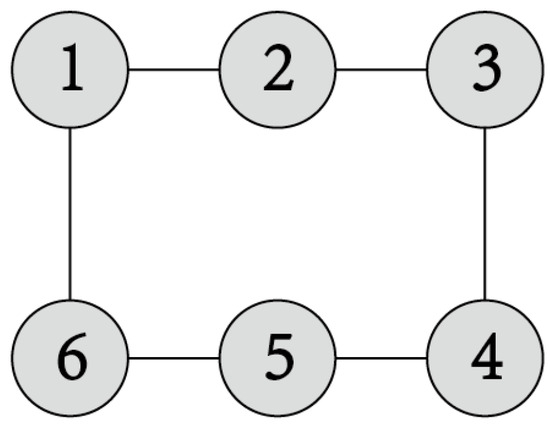
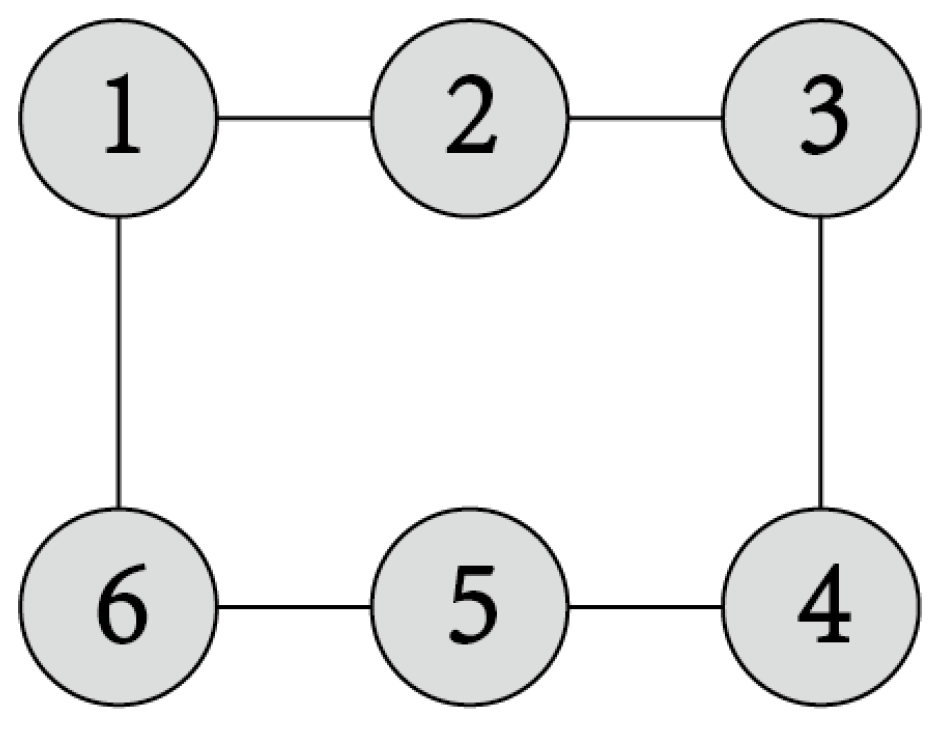
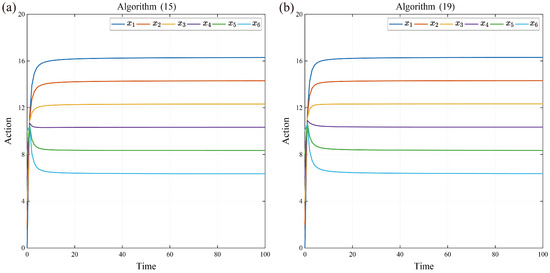
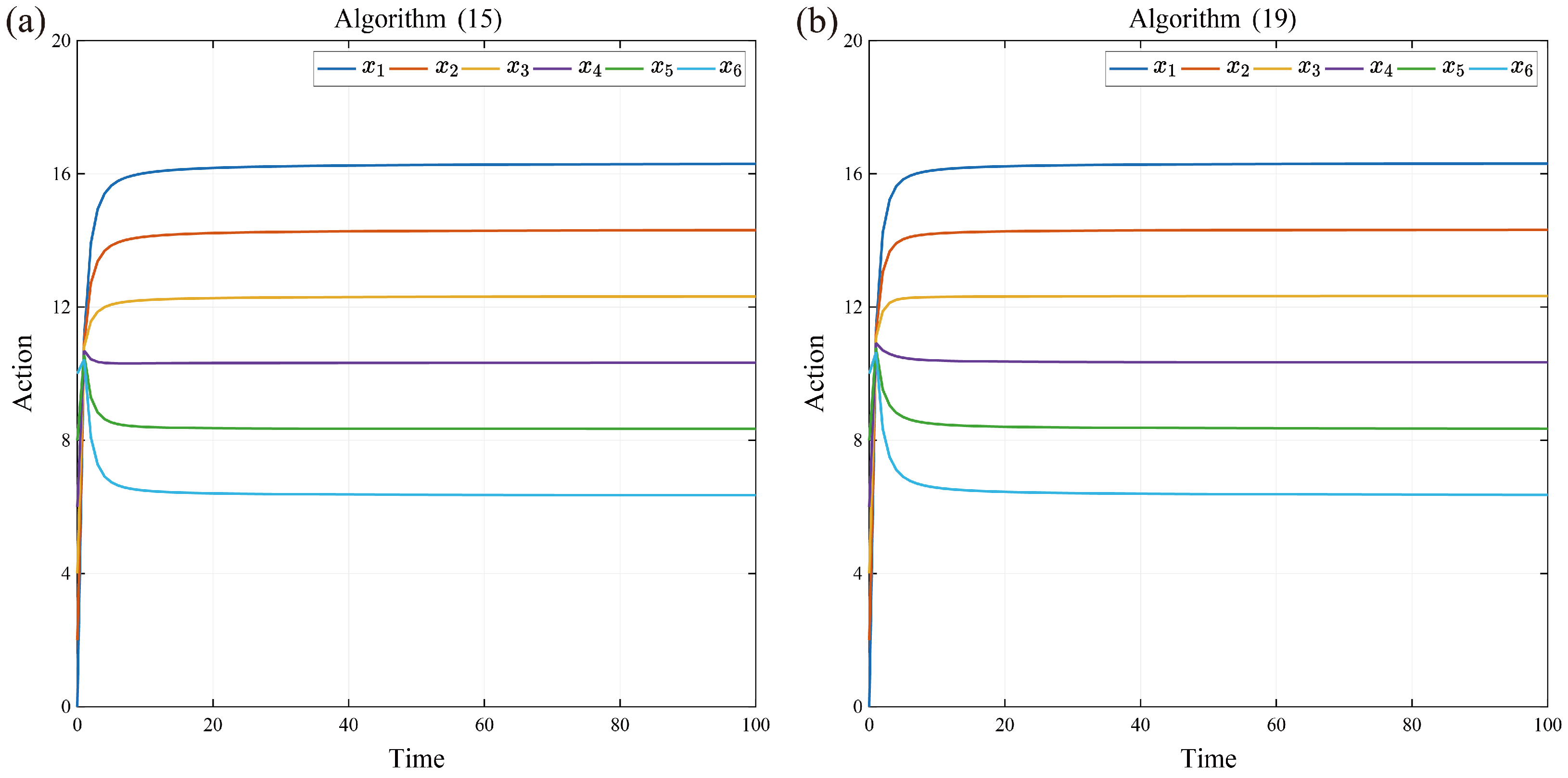
The communication topology between companies is described as a connected undirected graph of six nodes, as shown in Figure 1. We first set the adjacency matrix as , . The corresponding Laplacian matrix is , with algebraic connectivity . We choose the initial time and initial condition . The selected parameters respectively satisfy (25) of Theorem 1, and (48) of Theorem 2. Simulations are conducted for Equations (15) and (19), and the resulting action trajectories are shown in Figure 2. The effectiveness of Equations (15) and (19) is substantiated by the results in Figure 2a,b, where the actions of all firms stabilize at equilibrium point .
Figure 1.
The communication graph among the six firms .
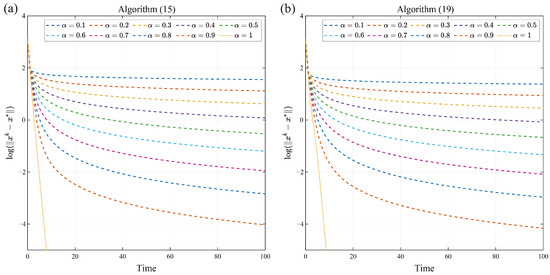
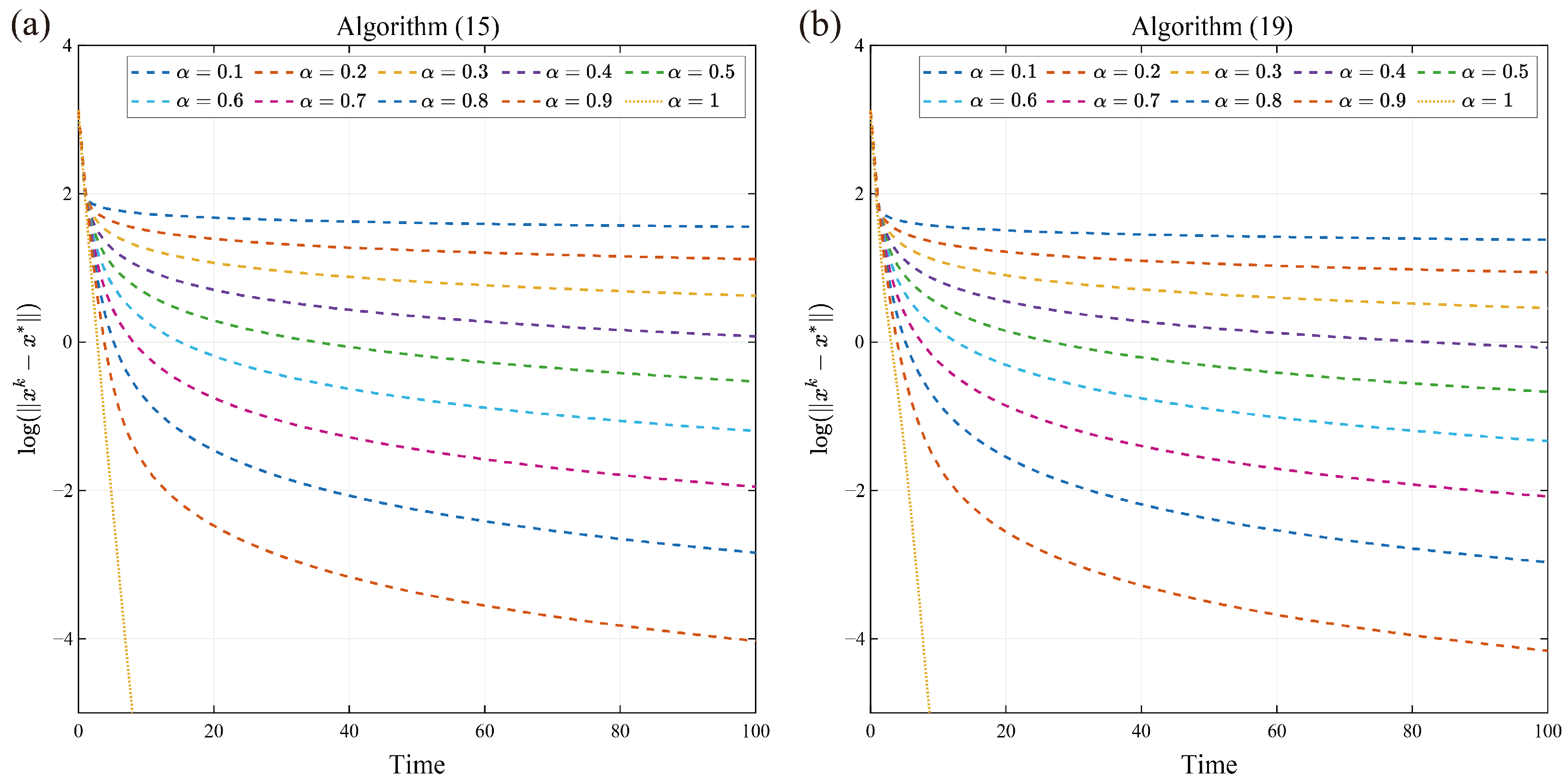
In Figure 3, we plot the semi-logarithmic graph of the optimal error for Equations (15) and (19), respectively, under different fractional orders with . As shown in these figures, both Equations (15) and (19) achieve convergence for all , exhibiting Mittag-Leffler convergence rates as stated in Theorems 1 and 2. Moreover, the convergence speed of both algorithms increases as increases. In particular, when , Equations (15) and (19) reduce to the integer-order backward-difference schemes (35) and (55), respectively, and their convergence becomes linear.
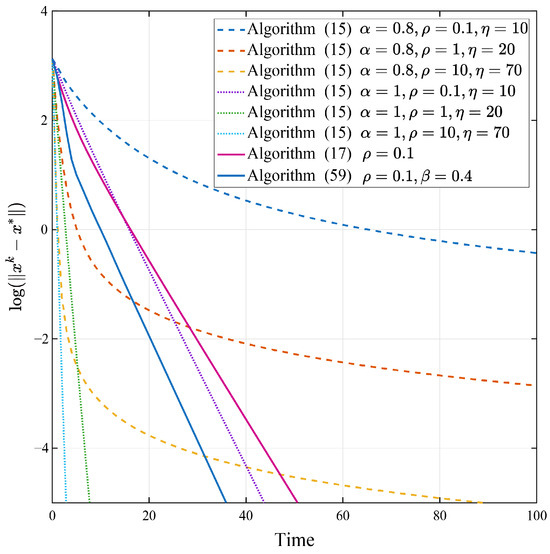
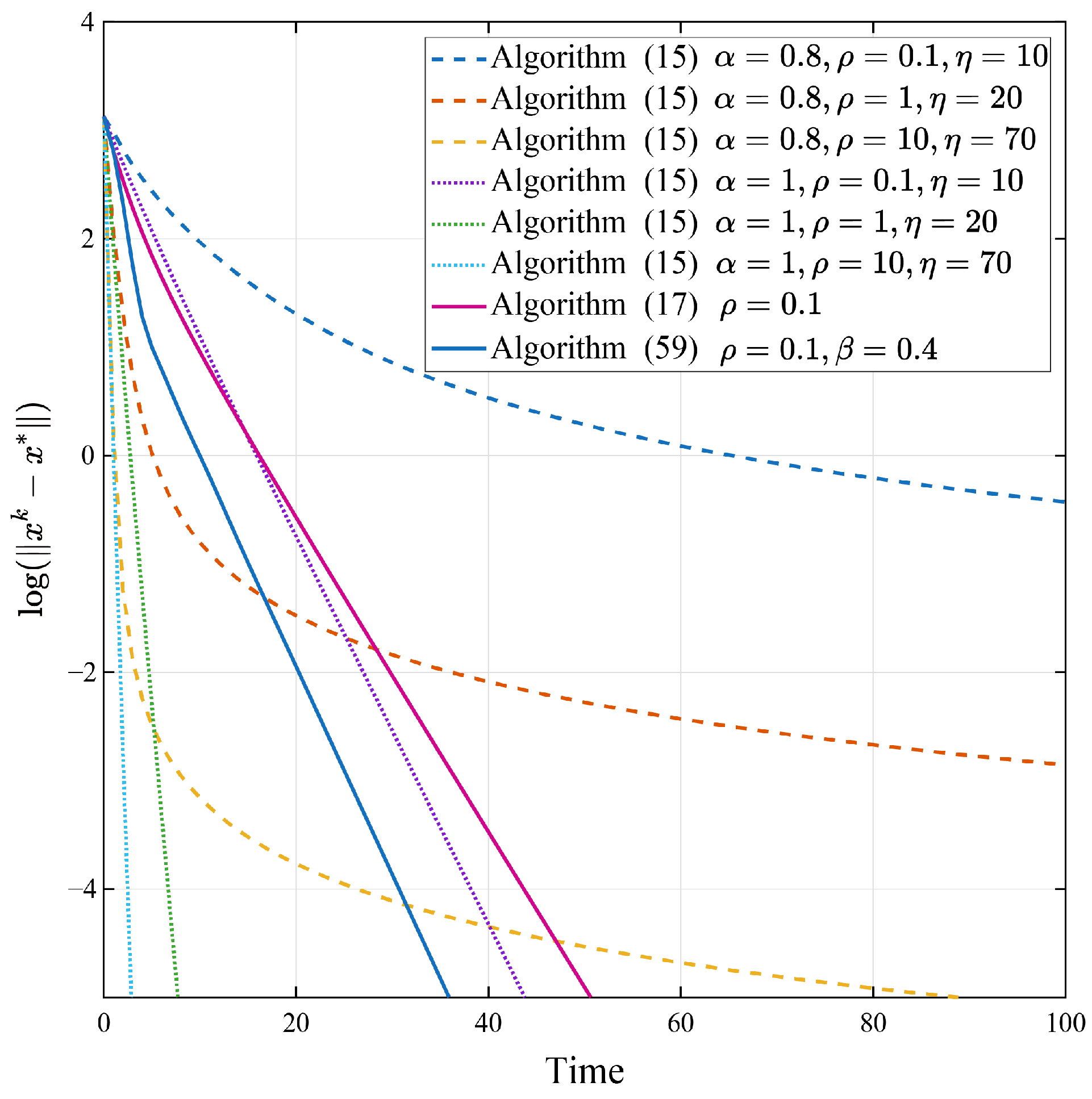
We posit that the topology in Figure 1 is equipped with self-loops and adopt a doubly stochastic adjacency matrix for every edge . Under this configuration, the Laplacian matrix is defined as , yielding an algebraic connectivity of . Moreover, the following algorithm was proposed in [13]:
which can be viewed as Equation (17) augmented with a momentum term. We include this algorithm in our simulations for comparison. Figure 4 shows the logarithmic optimal error of Equation (15) under various parameter settings, compared against Equations (17) and (59). In contrast to Equation (15), which maintains convergence stability even under large step sizes, Equations (17) and (59) impose stricter constraints on step size selection. Specifically, setting leads to divergence in Equation (17). Consequently, with optimal tuning of , , and , Equation (15) can achieve higher accuracy within fewer iterations compared to Equations (17) and (59). Numerical data shows that to reach an error bound of , Equation (15) needs merely 5 iterations (with , , ), whereas Equations (17) and (59) (with ) necessitate 30 and 20 iterations respectively to achieve the same benchmark.
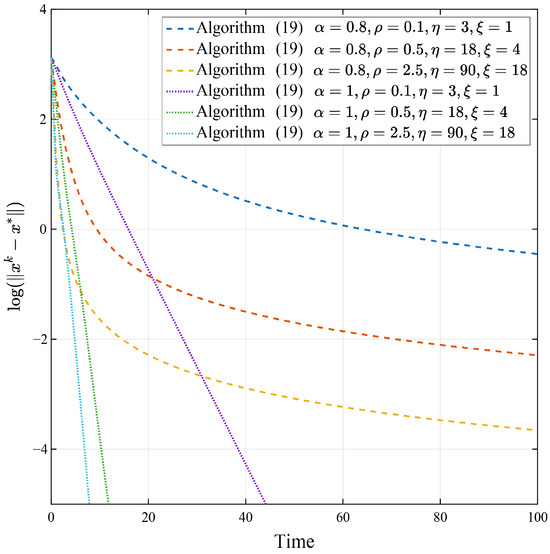
Figure 5 shows the logarithmic optimal error of Equation (19) under various parameter settings. In Figure 5, the convergence speed of Equation (19) can be improved by tuning parameters such as , , , and .
Figure 5.
Logarithmic optimal error for Equation (19) under the adjacency matrix .
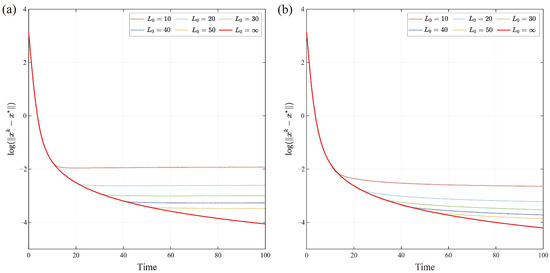
Next, we simulate the approximate Equations (56) and (57) with fixed memory lengths , where corresponds to the exact Equations (15) and (19). In Figure 6, it can be observed that both approximate Equations (56) and (57) converge to a value within a certain error bound of the NE. Moreover, as the fixed memory length increases, the trajectories generated by the approximate Equations (56) and (57) become increasingly close to those of the exact Equations (15) and (19), which validates the analysis presented in Section 3.3. On the other hand, larger values of lead to higher computational costs for (56) and (57). Consequently, the choice of represents a trade-off between computational cost and approximation accuracy.
4.2. Coordinated Control of Multiple Flexible Manipulators
This subsection considers the coordinated control problem of multiple flexible manipulators fabricated from viscoelastic materials. Viscoelastic materials have mechanical properties intermediate between those of purely elastic solids and purely viscous fluids. Consequently, modeling such materials constitutes one of the potential application areas of fractional-order theory.
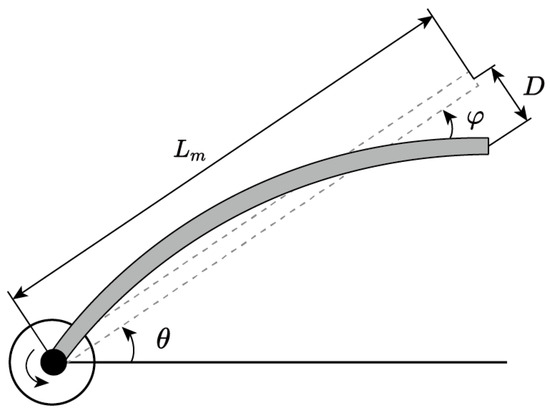
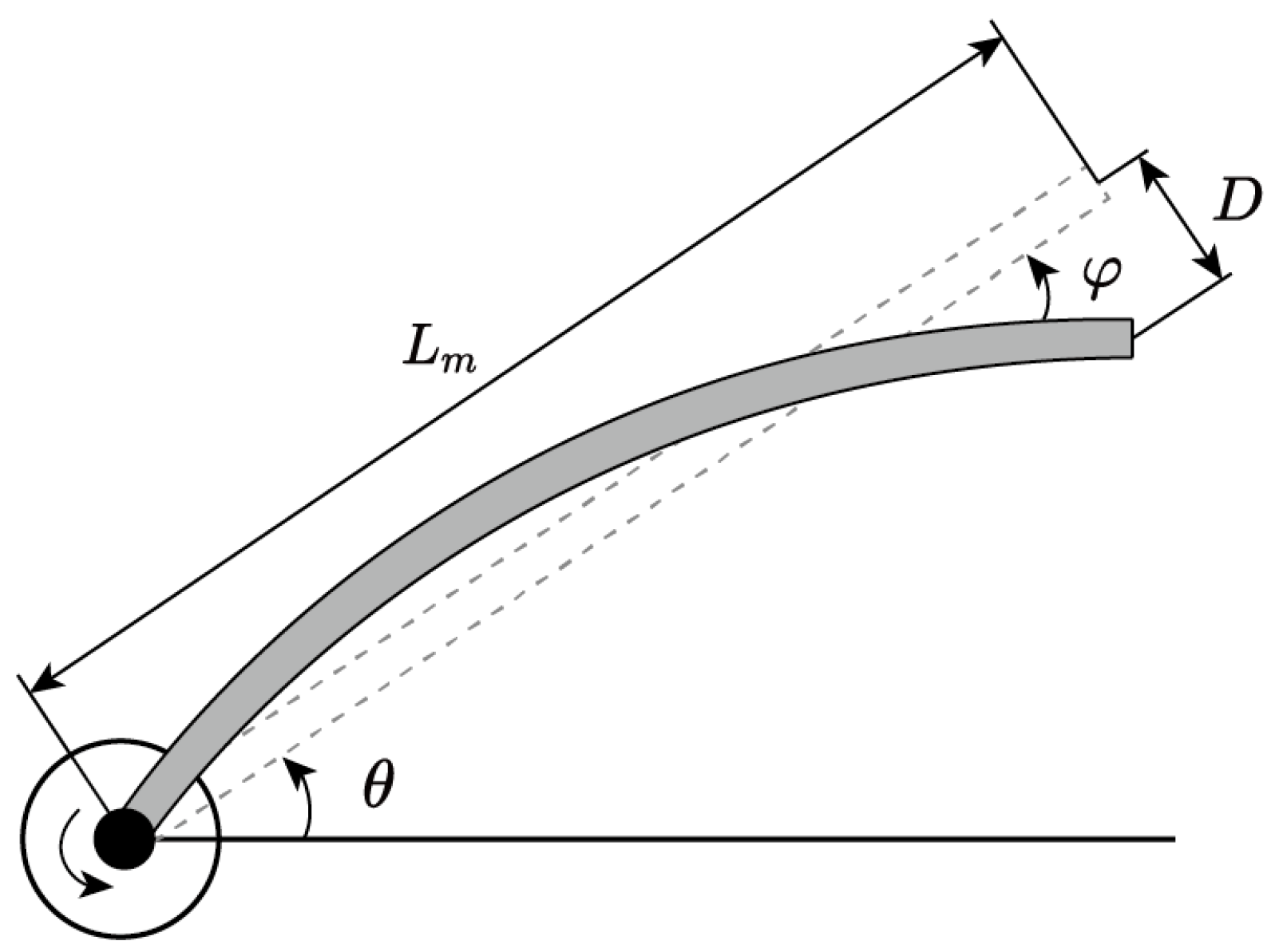
A single-link flexible manipulator actuated by a DC motor is illustrated in Figure 7. Following the reference [40], we present the following commensurate fractional-order dynamics
where denotes the motor shaft angle, represents the tip deflection angle (approximated as ), is the input voltage of the DC motor, is the equivalent viscous damping coefficient, is the total stiffness of the model, is the moment of inertia of the link, is the equivalent moment of inertia of the model, is the output, and is the fractional order.
Figure 7.
Single-link flexible manipulator.
If the parameters of the flexible manipulators are , mass , , and , then the dynamics (60) can be expressed as the following fractional-order linear system:
where the system matrices are
Note that the pair is stabilizable, and . Therefore, by [41], there exist and such that
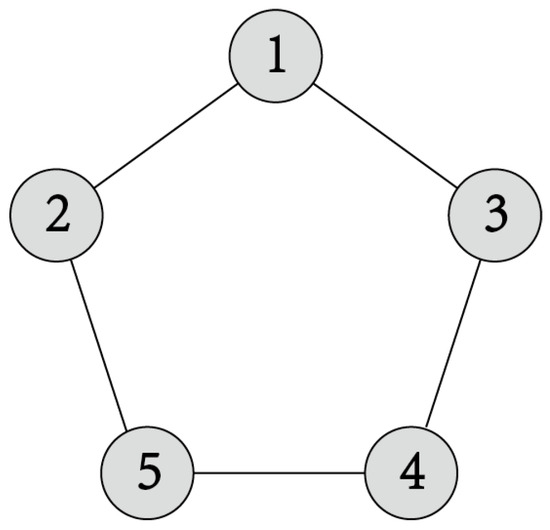
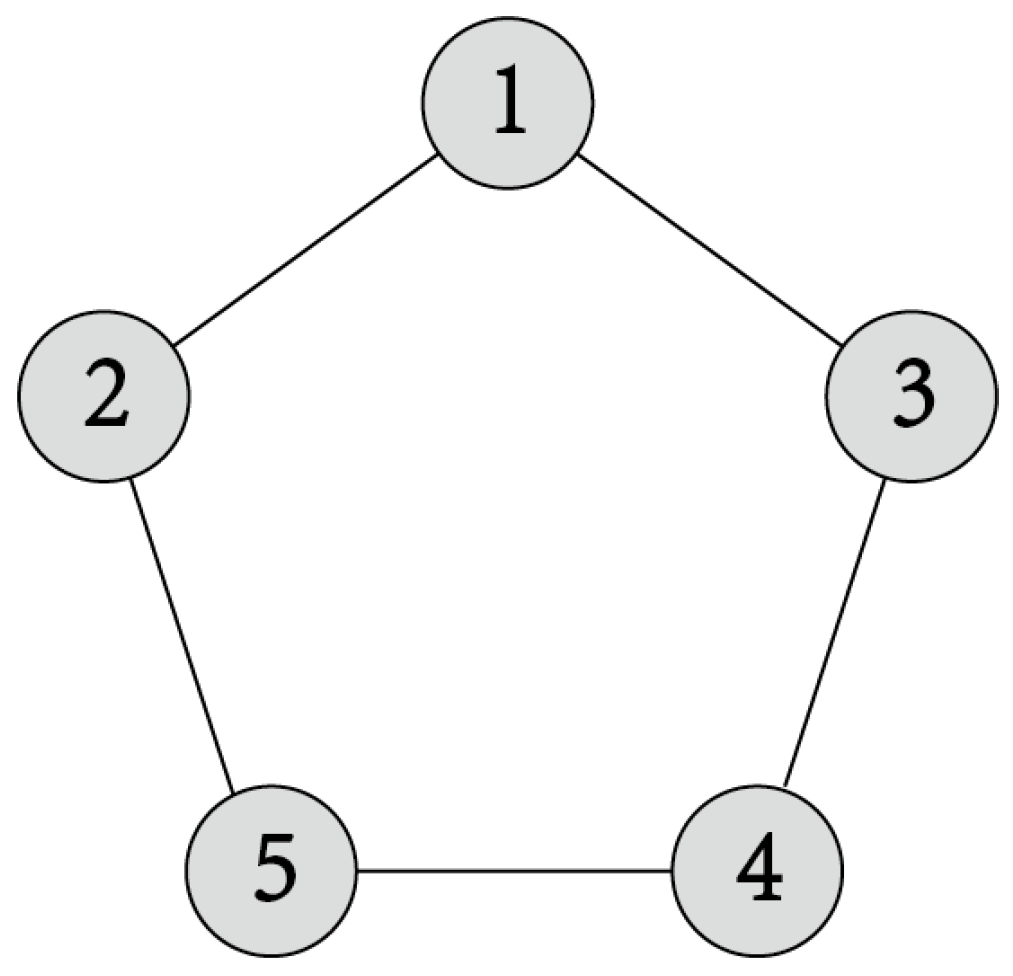
Consider a coordination problem involving identical single-link flexible manipulators as described above. The communication topology among the manipulators is illustrated in Figure 8, with the adjacency matrix defined by , . The corresponding graph Laplacian is then given by . The local cost function for each manipulator i is
where is a constant vector. Since depends only on the local output and the aggregate , this constitutes an aggregative game. If , , , , and , the game admits a unique Nash equilibrium , where , , , , and .
Figure 8.
The communication graph among the five flexible manipulators .
To ensure that the manipulator outputs converge to , we design the control law as follows:
Substituting the control law (63) into the dynamics (61), we obtain
Then, by (62), we have
Therefore, when is updated according to Equation (15) or (19), based on Theorems 1 and 2, the output converges to at a Mittag-Leffler rate.
To verify the above theoretical results, we perform numerical simulations using the control law (63) with the update rules given by Equation (15) or (19), respectively. The initial conditions are set as: , , , , , . The parameters are selected as follows: for updates using Equation (15), , ; for updates using Equation (19), , , .
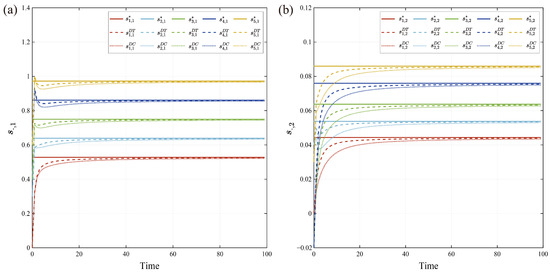
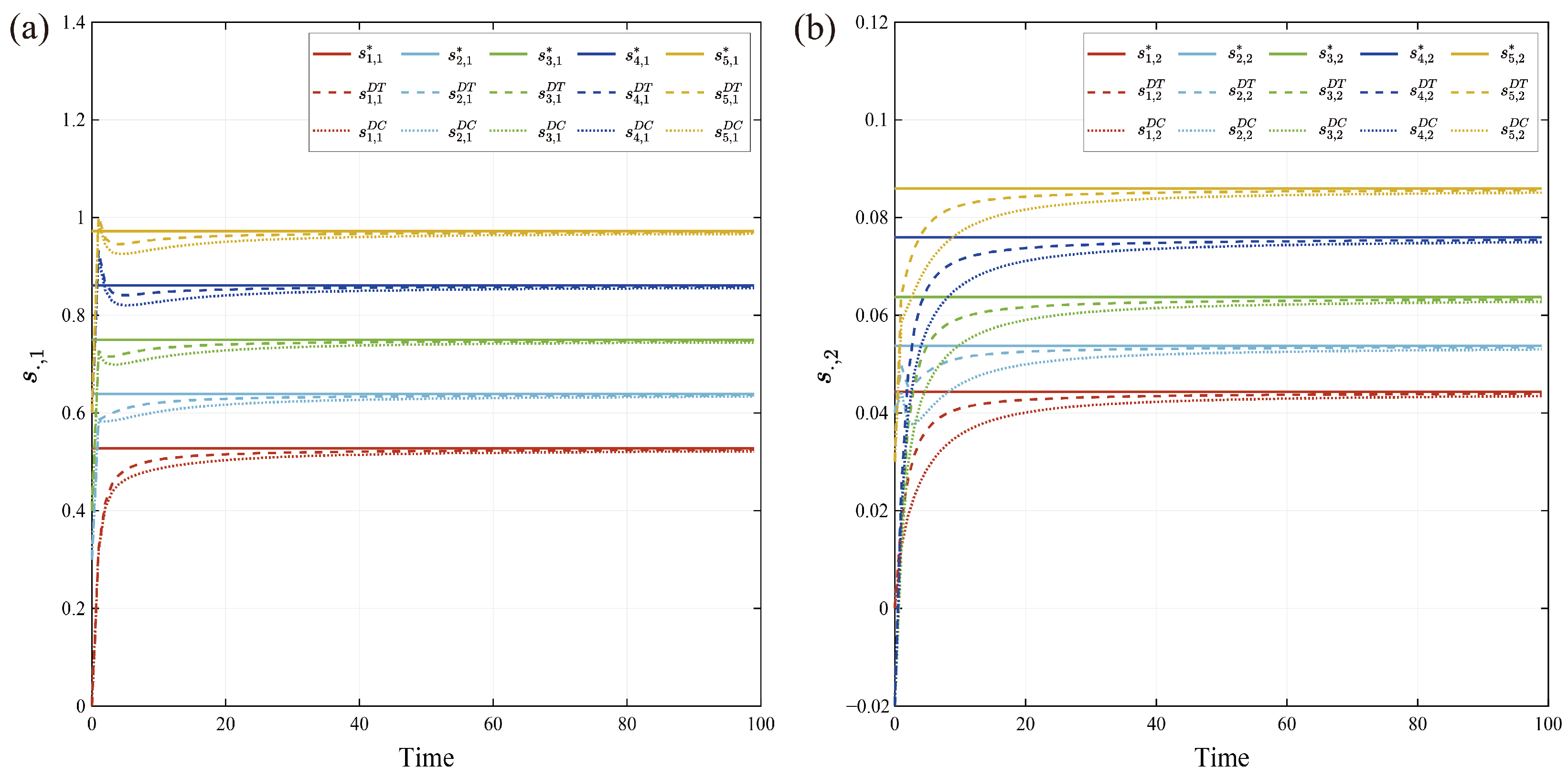
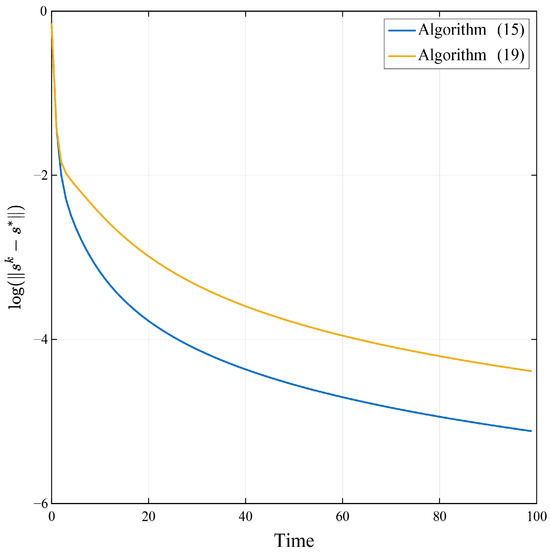
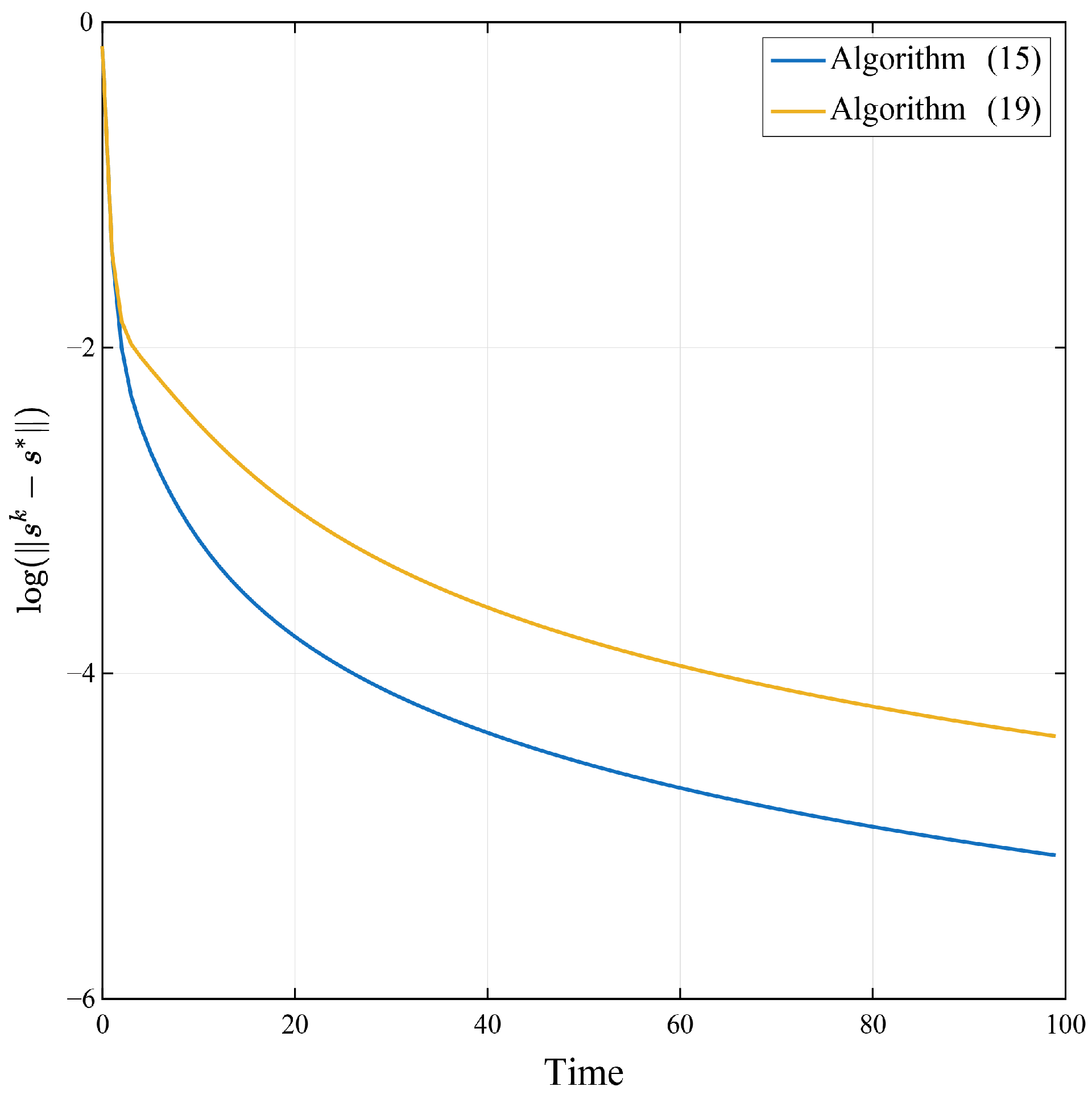
Figure 9 show the output trajectories generated by Equation (15), denoted as , where , and those generated by Algorithm (19), denoted as , where . It can be observed that both algorithms drive the outputs of the flexible manipulators to converge to the NE. Furthermore, as shown in Figure 10, the logarithmic optimal error converges at a Mittag-Leffler rate.
5. Conclusions
In this paper, we study the AG problem under partial-decision information by proposing two nabla fractional distributed NE seeking algorithms. The two algorithms incorporate a fractional dynamic tracking protocol and a fractional average dynamic consensus protocol, respectively. These protocols are generalized from integer-order counterparts, and we demonstrate that they also perform well within fractional-order dynamics. Utilizing Nabla fractional Lyapunov stability theory, we provide rigorous proofs confirming that both algorithms attain Mittag-Leffler stability at the NE. Numerical experiments validate our theoretical results. Moreover, when contrasted with traditional integer-order forward difference methods, the outcomes highlight the capability of fractional-order methods to boost the efficiency of distributed NE seeking. Future work will focus on extending these algorithms to directed or time-varying communication graphs and constrained scenarios.
Author Contributions
Y.X., conceptualization, methodology, validation, formal analysis, investigation, writing—original draft preparation, writing—review and editing, visualization; S.G., writing—original draft preparation, writing—review and editing; Y.Q., methodology, writing—review and editing; T.G., writing—review and editing, supervision, project administration; L.C., conceptualization, writing—review and editing, supervision, project administration. All authors have read and agreed to the published version of the manuscript.
Funding
This work was supported in part by the National Natural Science Foundation of China under Grant 52475169.
Institutional Review Board Statement
Not applicable.
Informed Consent Statement
Not applicable.
Data Availability Statement
Data are contained within the article.
Conflicts of Interest
The authors declare no conflicts of interest.
References
- Mohsenian-Rad, A.H.; Wong, V.W.S.; Jatskevich, J.; Schober, R.; Leon-Garcia, A. Autonomous Demand-Side Management Based on Game-Theoretic Energy Consumption Scheduling for the Future Smart Grid. IEEE Trans. Smart Grid 2010, 1, 320–331. [Google Scholar] [CrossRef] [Scilit]
- Deori, L.; Margellos, K.; Prandini, M. Price of anarchy in electric vehicle charging control games: When Nash equilibria achieve social welfare. Automatica 2018, 96, 150–158. [Google Scholar] [CrossRef] [Scilit]
- Fabiani, F.; Fenucci, D.; Caiti, A. A distributed passivity approach to AUV teams control in cooperating potential games. Ocean Eng. 2018, 157, 152–163. [Google Scholar] [CrossRef] [Scilit]
- Yin, H.; Shanbhag, U.V.; Mehta, P.G. Nash Equilibrium Problems With Scaled Congestion Costs and Shared Constraints. IEEE Trans. Autom. Control 2011, 56, 1702–1708. [Google Scholar] [CrossRef] [Scilit]
- Barrera, J.; Garcia, A. Dynamic Incentives for Congestion Control. IEEE Trans. Autom. Control 2015, 60, 299–310. [Google Scholar] [CrossRef] [Scilit]
- Kukushkin, N.S. Best response dynamics in finite games with additive aggregation. Games Econ. Behav. 2004, 48, 94–110. [Google Scholar] [CrossRef] [Scilit]
- Grammatico, S. Dynamic Control of Agents Playing Aggregative Games With Coupling Constraints. IEEE Trans. Autom. Control 2017, 62, 4537–4548. [Google Scholar] [CrossRef] [Scilit]
- Belgioioso, G.; Grammatico, S. Semi-decentralized Nash equilibrium seeking in aggregative games with separable coupling constraints and non-differentiable cost functions. IEEE Control Syst. Lett. 2017, 1, 400–405. [Google Scholar] [CrossRef] [Scilit]
- Belgioioso, G.; Grammatico, S. Semi-Decentralized Generalized Nash Equilibrium Seeking in Monotone Aggregative Games. IEEE Trans. Autom. Control 2023, 68, 140–155. [Google Scholar] [CrossRef] [Scilit]
- Koshal, J.; Nedić, A.; Shanbhag, U.V. Distributed Algorithms for Aggregative Games on Graphs. Oper. Res. 2016, 64, 680–704. [Google Scholar] [CrossRef] [Scilit]
- Fang, X.; Wen, G.; Zhou, J.; Lü, J.; Chen, G. Distributed Nash Equilibrium Seeking for Aggregative Games With Directed Communication Graphs. IEEE Trans. Circuits Syst. I Regul. Pap. 2022, 69, 3339–3352. [Google Scholar] [CrossRef] [Scilit]
- Song, C.; Wu, C.; Lv, Z.; Zhang, F.; Li, J.; Yang, S. Distributed Heavy-Ball Nash Equilibrium Seeking Algorithm in Aggregative Games. In 2020 39th Chinese Control Conference (CCC), Shenyang, China, 27–29 July 2020; IEEE: Piscataway, NJ, USA, 2020; pp. 5019–5024. [Google Scholar] [CrossRef] [Scilit]
- Pan, W.; Xu, X.; Lu, Y.; Zhang, W. Distributed Nash Equilibrium Learning for Average Aggregative Games: Harnessing Smoothness to Accelerate the Algorithm. IEEE Syst. J. 2023, 17, 4855–4865. [Google Scholar] [CrossRef] [Scilit]
- Zhu, R.; Wang, F.; Liu, Z.; Chen, Z. Distributed algorithms with linear convergence for aggregative games over time-varying networks. Expert Syst. Appl. 2025, 273, 126768. [Google Scholar] [CrossRef] [Scilit]
- Deng, Z.; Nian, X. Distributed Generalized Nash Equilibrium Seeking Algorithm Design for Aggregative Games Over Weight-Balanced Digraphs. IEEE Trans. Neural Netw. Learn. Syst. 2019, 30, 695–706. [Google Scholar] [CrossRef] [Scilit]
- Deng, Z. Distributed generalized Nash equilibrium seeking algorithm for nonsmooth aggregative games. Automatica 2021, 132, 109794. [Google Scholar] [CrossRef] [Scilit]
- Zhu, Y.; Yu, W.; Wen, G.; Chen, G. Distributed Nash Equilibrium Seeking in an Aggregative Game on a Directed Graph. IEEE Trans. Autom. Control 2021, 66, 2746–2753. [Google Scholar] [CrossRef] [Scilit]
- Wang, D.; Chen, P.; Chen, M.; Lian, J.; Wang, W. Distributed Nash Equilibrium Seeking for Aggregative Games over Weight-Unbalanced Digraphs. IFAC-PapersOnLine 2022, 55, 90–95. [Google Scholar] [CrossRef] [Scilit]
- Wahab, A.; Khan, S.; Naseem, I.; Ye, J.C. Performance Analysis of Fractional Learning Algorithms. IEEE Trans. Signal Process. 2022, 70, 5164–5177. [Google Scholar] [CrossRef] [Scilit]
- Shin, Y.; Darbon, J.; Karniadakis, G.E. Accelerating gradient descent and Adam via fractional gradients. Neural Netw. 2023, 161, 185–201. [Google Scholar] [CrossRef] [Scilit]
- Pu, Y.F.; Zhou, J.L.; Zhang, Y.; Zhang, N.; Huang, G.; Siarry, P. Fractional Extreme Value Adaptive Training Method: Fractional Steepest Descent Approach. IEEE Trans. Neural Netw. Learn. Syst. 2015, 26, 653–662. [Google Scholar] [CrossRef] [Scilit]
- Yin, W.; Cheng, S.; Wei, Y.; Shuai, J.; Wang, Y. A bias-compensated fractional order normalized least mean square algorithm with noisy inputs. Numer. Algorithms 2019, 82, 201–222. [Google Scholar] [CrossRef] [Scilit]
- Wang, J.; Wen, Y.; Gou, Y.; Ye, Z.; Chen, H. Fractional-order gradient descent learning of BP neural networks with Caputo derivative. Neural Netw. 2017, 89, 19–30. [Google Scholar] [CrossRef] [Scilit] [PubMed]
- Chen, L.; Huang, T.; Tenreiro Machado, J.; Lopes, A.M.; Chai, Y.; Wu, R. Delay-dependent criterion for asymptotic stability of a class of fractional-order memristive neural networks with time-varying delays. Neural Netw. 2019, 118, 289–299. [Google Scholar] [CrossRef] [Scilit] [PubMed]
- Sheng, D.; Wei, Y.; Chen, Y.; Wang, Y. Convolutional neural networks with fractional order gradient method. Neurocomputing 2020, 408, 42–50. [Google Scholar] [CrossRef] [Scilit]
- Tan, Y.; He, Z.; Tian, B. A Novel Generalization of Modified LMS Algorithm to Fractional Order. IEEE Signal Process. Lett. 2015, 22, 1244–1248. [Google Scholar] [CrossRef] [Scilit]
- Gallegos, J.A.; Duarte-Mermoud, M.A. Convergence of fractional adaptive systems using gradient approach. ISA Trans. 2017, 69, 31–42. [Google Scholar] [CrossRef] [Scilit]
- Liang, S.; Wang, L.; Yin, G. Fractional differential equation approach for convex optimization with convergence rate analysis. Optim. Lett. 2020, 14, 145–155. [Google Scholar] [CrossRef] [Scilit]
- Wei, Y.; Chen, Y.; Zhao, X.; Cao, J. Analysis and Synthesis of Gradient Algorithms Based on Fractional-Order System Theory. IEEE Trans. Syst. Man Cybern. Syst. 2023, 53, 1895–1906. [Google Scholar] [CrossRef] [Scilit]
- Hong, X.; Wei, Y.; Zhou, S.; Yue, D. Nabla fractional distributed optimization algorithms over undirected/directed graphs. J. Frankl. Inst. 2024, 361, 1436–1454. [Google Scholar] [CrossRef] [Scilit]
- Hong, X.; Wei, Y.; Zhou, S.; Yue, D.; Cao, J. Nabla Fractional Distributed Optimization Algorithm Over Unbalanced Graphs. IEEE Control Syst. Lett. 2024, 8, 241–246. [Google Scholar] [CrossRef] [Scilit]
- Xu, H.; Chen, R.; Ni, X.; Wei, Y. Passivity of nabla fractional order systems and its application on distributed optimization. Commun. Nonlinear Sci. Numer. Simul. 2025, 146, 108747. [Google Scholar] [CrossRef] [Scilit]
- Xiao, Y.; Ge, S.; Qiao, Y.; Gang, T.; Chen, L. Nabla Fractional Distributed Nash Seeking for Non-Cooperative Games. Fractal Fract. 2025, 9, 756. [Google Scholar] [CrossRef] [Scilit]
- Wei, Y.; Wei, Y.; Chen, Y.; Wang, Y. Mittag–Leffler stability of nabla discrete fractional-order dynamic systems. Nonlinear Dyn. 2020, 101, 407–417. [Google Scholar] [CrossRef] [Scilit]
- Wei, Y. Lyapunov Stability Theory for Nonlinear Nabla Fractional Order Systems. IEEE Trans. Circuits Syst. II Express Briefs 2021, 68, 3246–3250. [Google Scholar] [CrossRef] [Scilit]
- Facchinei, F.; Kanzow, C. Generalized Nash equilibrium problems. 4OR 2007, 5, 173–210. [Google Scholar] [CrossRef] [Scilit]
- Goodrich, C.; Peterson, A.C. Discrete Fractional Calculus; Springer: Berlin/Heidelberg, Germany, 2015; Volume 10. [Google Scholar]
- Kia, S.S.; Cortes, J.; Martinez, S. Dynamic Average Consensus under Limited Control Authority and Privacy Requirements. Int. J. Robust Nonlinear Control 2014, 25, 1941–1966. [Google Scholar] [CrossRef] [Scilit]
- Xu, Y.; He, Z. The short memory principle for solving Abel differential equation of fractional order. Comput. Math. Appl. 2011, 62, 4796–4805. [Google Scholar] [CrossRef] [Scilit]
- Mujumdar, A.; Tamhane, B.; Kurode, S. Fractional order modeling and control of a flexible manipulator using sliding modes. In 2014 American Control Conference, Portland, OR, USA, 4–6 June 2014; IEEE: Piscataway, NJ, USA, 2014; pp. 2011–2016. [Google Scholar] [CrossRef] [Scilit]
- Deng, Z.; Luo, J. Fully Distributed Algorithms for Constrained Nonsmooth Optimization Problems of General Linear Multiagent Systems and Their Application. IEEE Trans. Autom. Control 2024, 69, 1377–1384. [Google Scholar] [CrossRef] [Scilit]
Disclaimer/Publisher’s Note: The statements, opinions and data contained in all publications are solely those of the individual author(s) and contributor(s) and not of MDPI and/or the editor(s). MDPI and/or the editor(s) disclaim responsibility for any injury to people or property resulting from any ideas, methods, instructions or products referred to in the content. |
© 2026 by the authors. Licensee MDPI, Basel, Switzerland. This article is an open access article distributed under the terms and conditions of the Creative Commons Attribution (CC BY) license.