
Guaranteed Cost Data-Driven Feedback Control of Delta Discrete Fractional-Order Systems


Abstract
1. Introduction
- By utilizing the definition of the delta fractional difference, the original delta discrete fractional-order system is reformulated as an equivalent integer-order system with progressively increasing time delays. It is noteworthy that the resulting system differs significantly from conventional time-delay systems, as the number of delay terms increases with the discrete-time index k. To analyze the stability of this unique class of systems, we have established novel stability conditions based on the Lyapunov method, which are ultimately expressed as linear matrix inequalities (LMIs).
- Within the informativity framework established in [29], sufficient conditions are derived under which a finite sequence of input-state data is informative on state feedback stabilization. Directly from the data, a state feedback controller is synthesized, solely on the data, without recourse to prior knowledge of the system matrices.
- This work pioneers the establishment of data informativity conditions for guaranteed-cost control within delta discrete fractional-order systems. Accordingly, a guaranteed-cost controller is synthesized directly from state and input data, ensuring prescribed performance bounds.
2. Preliminaries
- (i)
- (ii)
- decays monotonically as i increases;
- (iii)
- .
3. Stability Analysis and Data-Driven Controller Design
4. Guaranteed-Cost Feedback Controller Design
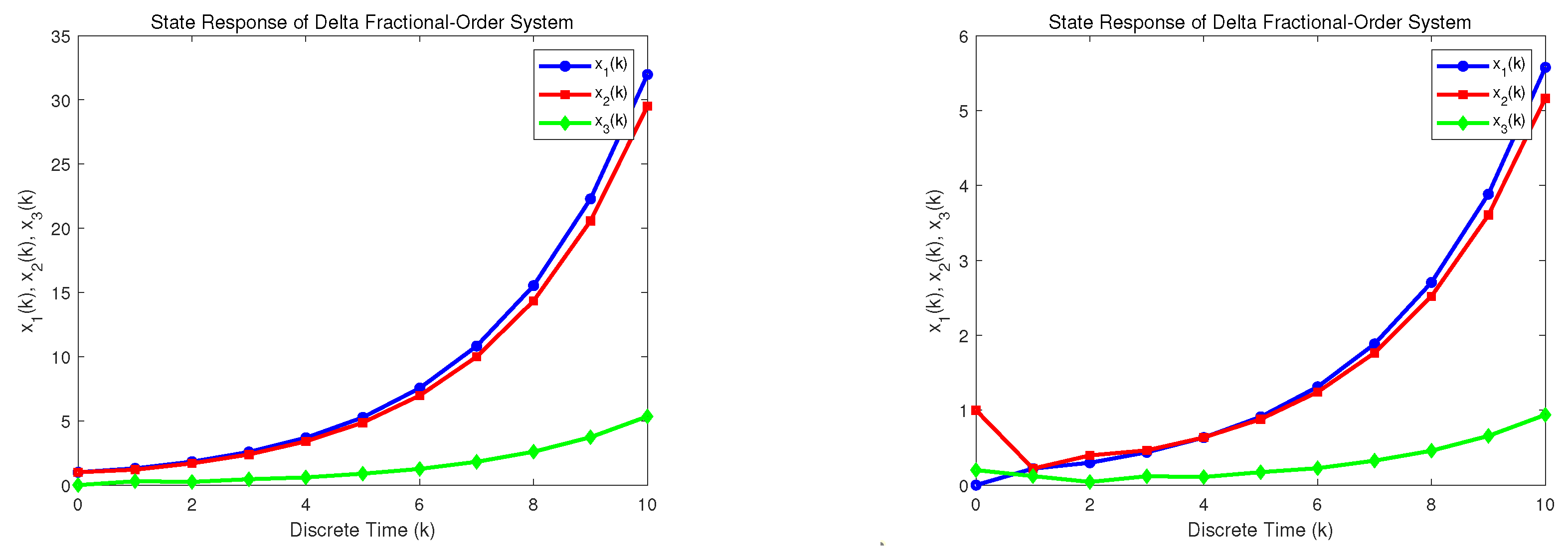
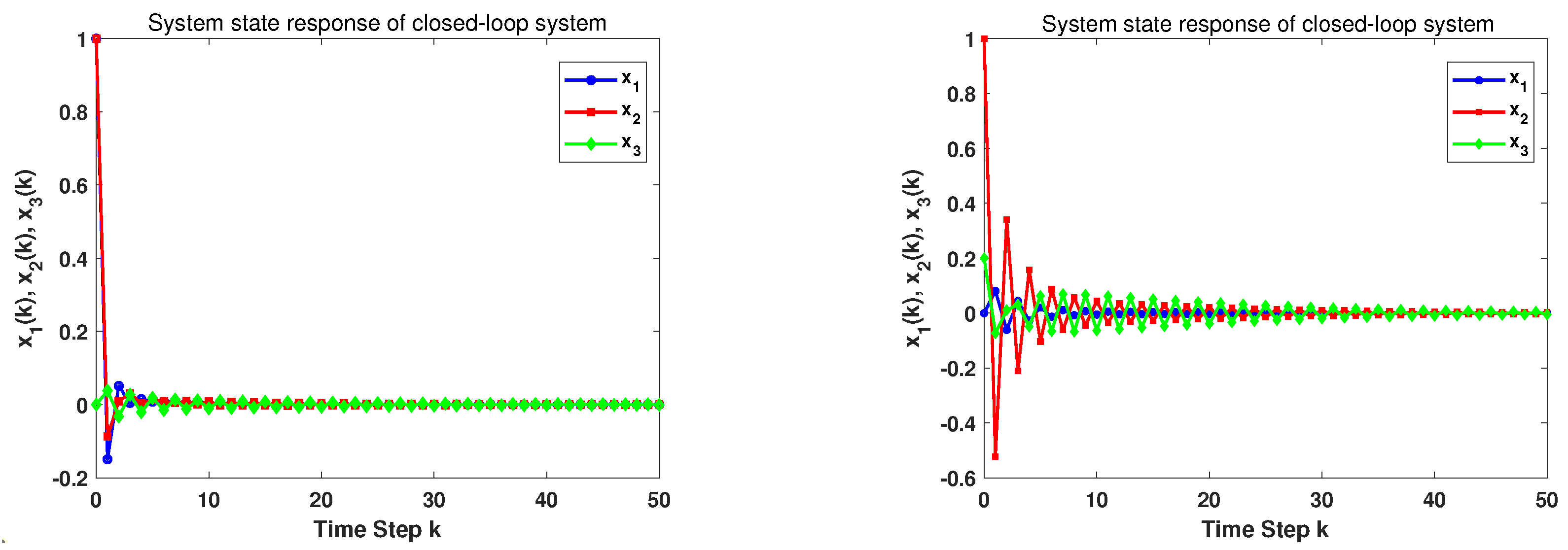
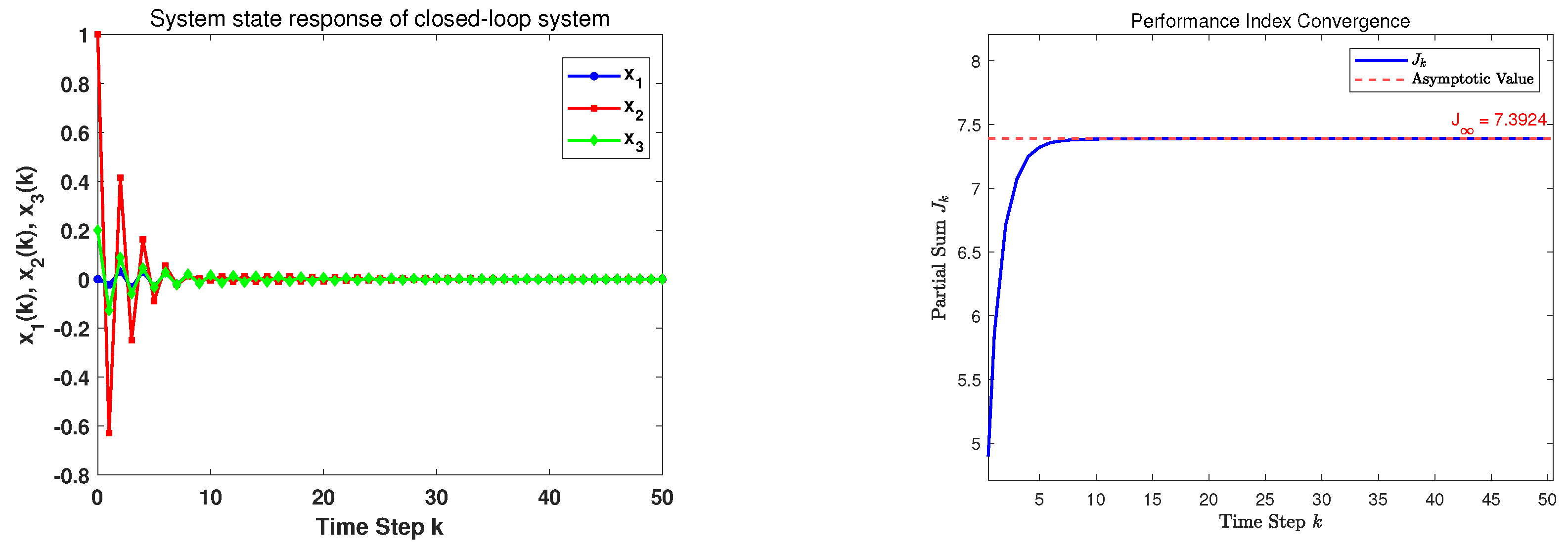
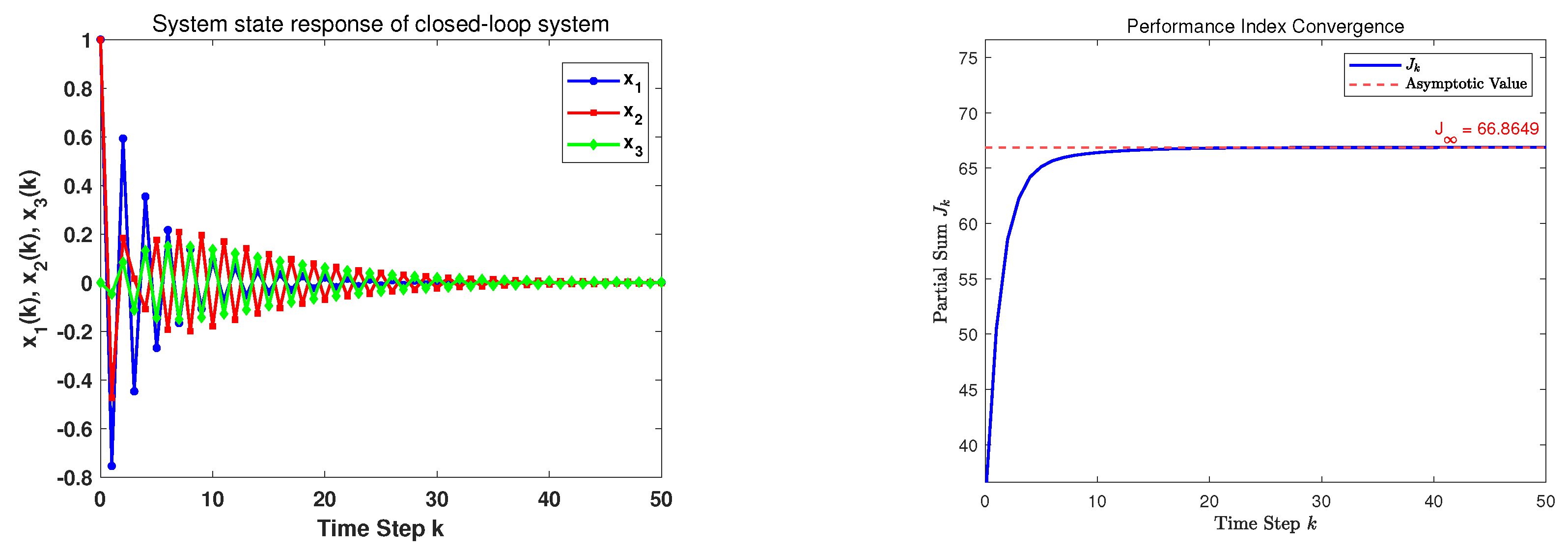
5. Numerical Examples
6. Conclusions
- Reducing conservatism: The current formulation uses the aggregate bound for all delay terms. Future work will develop delay-dependent or -dependent conditions that can reduce conservatism while preserving computational tractability.
- Robustness to noisy data: While the informativity framework offers a promising starting point, extending the results to handle measurement noise and uncertainties through robust LMI formulations or set-membership approaches is an essential step toward practical implementation.
- Nonlinear extensions: Generalizing the proposed data-driven framework to nonlinear fractional-order systems, possibly via linear parameter-varying (LPV) embeddings or Koopman operator representations, would significantly broaden its applicability.
- Scarce-data settings: Investigating informativity conditions and controller synthesis under limited data records, where , could enhance the method’s practicality in experimental settings with constrained data acquisition.
- Continuous-time counterparts: Developing parallel informativity-based designs for continuous-time fractional-order systems would complement the discrete-time results presented here.
- Application Prospects: The theoretical framework developed in this study can be directly applied to practical systems with fractional-order characteristics, such as viscoelastic material control and lithium-ion battery management (whose dynamics exhibit memory effects), as well as thermal process control in additive manufacturing (involving fractional diffusion). A common feature of these application scenarios is the difficulty in obtaining precise system models, whereas the data-driven approach proposed in this paper can directly design controllers based on operational data, thereby circumventing modeling challenges and demonstrating the engineering translational potential of the theoretical results.
Author Contributions
Funding
Data Availability Statement
Conflicts of Interest
References
- Monje, C.A.; Chen, Y.; Vinagre, B.M.; Xue, D.; Feliu, V. Fractional-Order Systems and Controls: Fundamentals and Applications; Springer: London, UK, 2010. [Google Scholar]
- Caponetto, R.; Dongola, G.; Fortuna, L.; Petras, I. Fractional Order Systems: Modeling and Control Applications; World Scientific: Singapore, 2010. [Google Scholar]
- Efe, M.Ö. Fractional order systems in industrial automation—A survey. IEEE Trans. Ind. Inf. 2011, 7, 582–591. [Google Scholar] [CrossRef]
- Meng, R.; Cao, L.; Zhang, Q. Study on the performance of variable-order fractional viscoelastic models to the order function parameters. Appl. Math. Model. 2023, 121, 430–444. [Google Scholar] [CrossRef]
- Magin, R.L. Fractional calculus models of complex dynamics in biological tissues. Comput. Math. Appl. 2010, 59, 1586–1593. [Google Scholar] [CrossRef]
- Sierociuk, D.; Skovranek, T.; Macias, M.; Podlubny, I.; Petras, I.; Dzielinski, A.; Ziubinski, P. Diffusion process modeling by using fractional-order models. Appl. Math. Comput. 2015, 257, 2–11. [Google Scholar] [CrossRef]
- Ge, F.; Chen, Y. Event-triggered control for boundary controlled time-fractional diffusion systems with spatially-varying coefficients. Appl. Math. Comput. 2024, 478, 128830. [Google Scholar] [CrossRef]
- Makowiec, D.; Gała, R.; Dudkowska, A.; Rynkiewicz, A.; Zwierz, M. Long-range dependencies in heart rate signals—revisited. Physica A 2006, 369, 632–644. [Google Scholar] [CrossRef]
- Zhang, X.; Chen, S.; Zhang, J.X. Adaptive sliding mode consensus control based on neural network for singular fractional order multi-agent systems. Appl. Math. Comput. 2022, 434, 127442. [Google Scholar] [CrossRef]
- Zhang, X.; Chen, Y. Admissibility and robust stabilization of continuous linear singular fractional order systems with the fractional order α: The 0 < α < 1 case. ISA Trans. 2018, 82, 42–50. [Google Scholar] [CrossRef] [PubMed]
- Shen, J.; Lam, J. Non-existence of finite-time stable equilibria in fractional-order nonlinear systems. Automatica 2014, 50, 547–551. [Google Scholar] [CrossRef]
- Luo, C.; Wu, G.C.; Huang, L.L. Fractional uncertain differential equations with general memory effects: Existences and alpha-path solutions. Nonlinear Anal. Model. Control 2023, 28, 152–179. [Google Scholar] [CrossRef]
- Goodrich, C.; Peterson, A.C. Discrete Fractional Calculus; Springer: Cham, Switzerland, 2015. [Google Scholar]
- Wu, G.C.; Wu, Z.Q.; Ji, L. Machine learning to discover discrete fractional chaotic models. J. Comput. Appl. Math. 2026, 473, 116869. [Google Scholar] [CrossRef]
- Alessandretti, A.; Pequito, S.; Pappas, G.J.; Aguiar, A.P. Finite-dimensional control of linear discrete-time fractional-order systems. Automatica 2020, 115, 108512. [Google Scholar] [CrossRef]
- Busłowicz, M. Robust stability of positive discrete-time linear systems of fractional order. Bull. Pol. Acad. Sci.-Tech. Sci. 2010, 58, 567–572. [Google Scholar] [CrossRef]
- Wei, Y.; Zhou, S.; Chen, Y.; Cao, J. Explicit stability condition for delta fractional order systems with α∈(0,+∞). ISA Trans. 2024, 150, 121–133. [Google Scholar] [CrossRef]
- Mozyrska, D.; Torres, D.F.; Wyrwas, M. Solutions of systems with the Caputo–Fabrizio fractional delta derivative on time scales. Nonlinear Anal. Hybrid Syst. 2019, 32, 168–176. [Google Scholar] [CrossRef]
- Wei, Y. Lyapunov stability theory for nonlinear nabla fractional order systems. IEEE Trans. Circuits Syst. II Exp. Briefs 2021, 68, 3246–3250. [Google Scholar] [CrossRef]
- Wei, Y.; Chen, Y. Converse Lyapunov theorem for nabla asymptotic stability without conservativeness. IEEE Trans. Syst. Man Cybern. Syst. 2021, 52, 2676–2687. [Google Scholar] [CrossRef]
- Klus, S.; Nüske, F.; Peitz, S.; Niemann, J.H.; Clementi, C.; Schütte, C. Data-driven approximation of the Koopman generator: Model reduction, system identification, and control. Physica D 2020, 406, 132416. [Google Scholar] [CrossRef]
- Tanaskovic, M.; Fagiano, L.; Novara, C.; Morari, M. Data-driven control of nonlinear systems: An on-line direct approach. Automatica 2017, 75, 1–10. [Google Scholar] [CrossRef]
- Asgari, S.; Gupta, R.; Puri, I.K.; Zheng, R. A data-driven approach to simultaneous fault detection and diagnosis in data centers. Appl. Soft Comput. 2021, 110, 107638. [Google Scholar] [CrossRef]
- Rosolia, U.; Zhang, X.; Borrelli, F. Data-driven predictive control for autonomous systems. Annu. Rev. Control Robot. Auton. Syst. 2018, 1, 259–286. [Google Scholar] [CrossRef]
- Willems, J.C.; Rapisarda, P.; Markovsky, I.; De Moor, B.L. A note on persistency of excitation. Syst. Control Lett. 2005, 54, 325–329. [Google Scholar] [CrossRef]
- Markovsky, I.; Rapisarda, P. On the linear quadratic data-driven control. In Proceedings of the 2007 European Control Conference (ECC), Kos, Greece, 2–5 July 2007; pp. 5313–5318. [Google Scholar]
- Markovsky, I.; Rapisarda, P. Data-driven simulation and control. Int. J. Control 2008, 81, 1946–1959. [Google Scholar] [CrossRef]
- Maupong, T.M.; Rapisarda, P. Data-driven control: A behavioral approach. Syst. Control Lett. 2017, 101, 37–43. [Google Scholar] [CrossRef]
- van Waarde, H.J.; Eising, J.; Trentelman, H.L.; Camlibel, M.K. Data informativity: A new perspective on data-driven analysis and control. IEEE Trans. Autom. Control 2020, 65, 4753–4768. [Google Scholar] [CrossRef]
- Rapisarda, P.; van Waarde, H.J.; Çamlibel, M.K. Orthogonal polynomial bases for data-driven analysis and control of continuous-time systems. IEEE Trans. Autom. Control 2023, 69, 4307–4319. [Google Scholar] [CrossRef]
- van Waarde, H.J.; Camlibel, M.K.; Rapisarda, P.; Trentelman, H.L. Data-driven dissipativity analysis: Application of the matrix S-lemma. IEEE Control Syst. Mag. 2022, 42, 140–149. [Google Scholar] [CrossRef]
- van Waarde, H.J.; Camlibel, M.K.; Eising, J.; Trentelman, H.L. Quadratic matrix inequalities with applications to data-based control. SIAM J. Control Optim. 2023, 61, 2251–2281. [Google Scholar] [CrossRef]
- van Waarde, H.J.; Camlibel, M.K.; Mesbahi, M. From noisy data to feedback controllers: Nonconservative design via a matrix S-lemma. IEEE Trans. Autom. Control 2020, 67, 162–175. [Google Scholar] [CrossRef]
- van Waarde, H.J.; Mesbahi, M. Data-driven parameterizations of suboptimal LQR and 2 controllers. IFAC-PapersOnLine 2020, 53, 4234–4239. [Google Scholar] [CrossRef]



Disclaimer/Publisher’s Note: The statements, opinions and data contained in all publications are solely those of the individual author(s) and contributor(s) and not of MDPI and/or the editor(s). MDPI and/or the editor(s) disclaim responsibility for any injury to people or property resulting from any ideas, methods, instructions or products referred to in the content. |
© 2026 by the authors. Licensee MDPI, Basel, Switzerland. This article is an open access article distributed under the terms and conditions of the Creative Commons Attribution (CC BY) license.
Share and Cite
Wang, C.; Du, L.; Hao, X.; Ge, F. Guaranteed Cost Data-Driven Feedback Control of Delta Discrete Fractional-Order Systems. Fractal Fract. 2026, 10, 78. https://doi.org/10.3390/fractalfract10020078
Wang C, Du L, Hao X, Ge F. Guaranteed Cost Data-Driven Feedback Control of Delta Discrete Fractional-Order Systems. Fractal and Fractional. 2026; 10(2):78. https://doi.org/10.3390/fractalfract10020078
Chicago/Turabian StyleWang, Cuihong, Luqi Du, Xiaoyu Hao, and Fudong Ge. 2026. "Guaranteed Cost Data-Driven Feedback Control of Delta Discrete Fractional-Order Systems" Fractal and Fractional 10, no. 2: 78. https://doi.org/10.3390/fractalfract10020078
APA StyleWang, C., Du, L., Hao, X., & Ge, F. (2026). Guaranteed Cost Data-Driven Feedback Control of Delta Discrete Fractional-Order Systems. Fractal and Fractional, 10(2), 78. https://doi.org/10.3390/fractalfract10020078