


Abstract
In this work, we present a fractional-order reaction–diffusion model for the spread of infectious diseases, incorporating incommensurate Caputo derivatives to capture memory effects and heterogeneous temporal behavior across compartments. Focusing on a generalized SI model with nonlinear incidence, we explore the local asymptotic stability of both disease-free and endemic equilibria. The model accommodates spatial diffusion, saturation effects, and varying fractional orders, yielding a more realistic depiction of epidemic propagation. Analytical techniques—ranging from linearization to spectral analysis—are employed to rigorously establish stability conditions. Numerical simulations support the theoretical findings, highlighting the impact of memory and spatial structure on long-term dynamics. This study offers a refined mathematical lens to understand the persistence or eradication of infectious diseases under memory-dependent and spatially heterogeneous environments.
1. Introduction
In recent years, a growing wave of interest has swept across the scientific community regarding the dynamics of complex biological systems governed by memory-driven processes [1,2]. Among these, the transmission and spatial spread of infectious diseases remain central topics of study, particularly when approached from a mathematical modeling perspective. Classical SI-type epidemic models have served as foundational tools for capturing the interplay between infection transmission and population dynamics. However, such models are fundamentally limited by their reliance on integer-order derivatives, which assume that the evolution of the system depends solely on its current state. This assumption is biologically restrictive, as many infectious processes exhibit hereditary, delayed, or persistent temporal effects that influence transmission and recovery [3,4].
Many real-world biological, physical, and epidemiological processes exhibit memory and hereditary effects and nonlocal temporal dynamics that cannot be captured by classical integer-order models. In particular, epidemic spread, immunological responses, and behavioral adaptation often depend not only on current states but on past exposures, interactions, or delayed responses. Fractional calculus, and in particular the Caputo derivative, provides a mathematically rigorous way to incorporate these long-term memory effects while preserving physically meaningful initial conditions.
Traditional fractional epidemic models usually adopt a commensurate structure, meaning that all state variables evolve under the same fractional order. However, biological systems rarely behave uniformly: individuals may differ in susceptibility, recovery time, mobility, immunity persistence, or behavioral adaptation. This motivates the use of incommensurate fractional orders, where each state variable evolves with its own memory exponent. Such models offer a more realistic representation of heterogeneous memory effects in multicomponent systems. When coupled with spatial diffusion and nonlinear infection processes, these models can reveal richer and more realistic spatio-temporal disease dynamics [5,6].
A key mathematical component of this study is the Caputo fractional derivative, which plays a central role in modeling systems influenced by historical behavior. The Caputo derivative is particularly suitable for dynamical systems involving varying external influences or time-dependent environments. Because of its formulation in terms of classical derivatives and integrable memory kernels, it allows for the incorporation of time-dependent parameters, forcing terms, or environmental fluctuations while still enabling stability analysis through eigenvalue-based fractional criteria. This makes it especially suitable for epidemic systems where immunity, exposure, or treatment responses develop gradually over time.
Non-autonomous incommensurate systems governed by Caputo derivatives therefore provide a natural and powerful mathematical framework for describing processes where memory is heterogeneous among interacting components, external or environmental factors vary in time, and diffusion interacts with nonlocal temporal effects. These considerations motivate the theoretical developments and numerical analysis presented in this work.
This study focuses on an incommensurate fractional SI reaction–diffusion system with a nonlinear saturated incidence rate, designed to capture the heterogeneity and memory-dependent nature of real epidemic processes [7,8]. By assigning distinct fractional orders to the susceptible and infected populations, the model accounts for differences in behavioral adaptation, immune memory, spatial mobility, and infection progression [9,10,11]. This leads to a more flexible and biologically meaningful representation of disease transmission. Recent advances in fractional reaction–diffusion systems further motivate the present study. Several works have investigated parabolic fractional operators, nonlocal diffusion, and numerical analysis of space–time fractional PDEs, including [12,13,14,15]. These contributions highlight both theoretical challenges and computational strategies relevant to the incommensurate model developed here.
A central challenge in epidemic modeling is determining the conditions under which a disease either dies out or persists. In the fractional setting, this question becomes more subtle due to the presence of memory effects, which influence stability in ways that differ from classical models. Our aim is to establish rigorous conditions for the local asymptotic stability of both the disease-free and endemic equilibria, accounting for the nonlinear transmission mechanism and the effect of incommensurate memory [16,17,18].
To address this, we employ several analytical approaches grounded in fractional dynamical systems theory. These include linearization, spectral analysis of the Jacobian matrix, and fractional-order stability criteria based on Matignon’s theorem [19,20]. While linearization forms the backbone of many stability studies, its application to incommensurate fractional systems is nontrivial due to the presence of multiple memory exponents [21]. This distinction plays an essential role in understanding how heterogeneous memory alters the stability landscape of epidemic equilibria.
Our analysis proceeds by establishing the positivity and boundedness of solutions, ensuring the model remains biologically consistent [22,23]. We then derive the basic reproduction number and explore how fractional orders modify its dynamical implications. In particular, the incommensurate structure reveals new parameter regimes in which memory effects can either suppress or enhance disease persistence when compared to both the commensurate fractional and classical integer-order cases [24,25].
Finally, by integrating diffusion into the incommensurate framework, we examine the interplay between spatial processes and memory-driven dynamics. This allows us to explore how infection may spread, stabilize, or dissipate in spatially extended environments, offering insight into real-world scenarios where mobility and contact structures vary across space [26,27]. Our results highlight the profound influence of memory heterogeneity on epidemic outcomes, suggesting that even slight differences in individual temporal behaviors can significantly alter the trajectory of disease transmission [28,29].
Overall, this work contributes to the growing literature on fractional epidemic models by achieving the following:
- Introducing an incommensurate reaction–diffusion formulation with nonlinear saturated incidence.
- Establishing rigorous stability conditions under heterogeneous memory effects.
- Providing numerical simulations that illustrate how memory and spatial diffusion jointly influence epidemic dynamics. These findings offer both mathematical insight and potential relevance for modeling infectious diseases characterized by persistent or delayed immune responses.
2. Preliminaries
We commence this section by introducing the principal notations and mathematical conventions that will be used throughout this section. In addition, we revisit several foundational results from the theory of fractional-order systems, including definitions, operator properties, and essential inequalities. These elements serve as the theoretical bedrock upon which the subsequent stability analysis is constructed, particularly in the discrete-time and memory-dependent framework considered in this work.
Definition 1
([30]). The Riemann–Liouville fractional derivative of a function , integrable over , and of order , is given by
where denotes the Gamma function:
Definition 2
([30]). For a function f that is n-times continuously differentiable () on , the Caputo fractional derivative of order is expressed as follows:
where .
Consider the following non-autonomous incommensurate fractional-order system governed by Caputo derivatives:
A point constitutes an equilibrium of the system if it satisfies the following:
Lemma 1
([30]). Let be a real-valued function that is differentiable and continuous on . Then, for any , the following inequality holds:
Lemma 2
([31]). The equilibrium of system (3) is locally asymptotically stable if and only if the eigenvalues of the Jacobian matrix satisfy the following:
where denotes the complex argument (phase angle) of the eigenvalue.
Theorem 1
([32]). Consider the zero solution of system (3). Suppose that for all , the following inequality holds:
Then the trivial solution is stable.
Furthermore, if
then the zero solution is asymptotically stable.
3. Model Description
In this work, we explore the dynamics of a nonlinear epidemic model governed by incommensurate fractional-order reaction–diffusion equations. The framework we propose is designed to capture the spread of infectious diseases—such as HIV/AIDS—across a spatially distributed population. Specifically, we study a generalized susceptible–infected (SI) model structured through a fractional system of partial differential equations.
The human population is divided into two distinct compartments: the susceptible group and the infected group , both evolving over time t and space , where is a bounded domain in with a sufficiently smooth boundary . The spatial spread is captured by the Laplacian operator , while time dynamics are driven by Caputo-type fractional derivatives of variable orders and , both lying in the interval . The diffusion coefficients and are assumed nonnegative and may differ between the two compartments.
The full system, which incorporates both spatial diffusion and fractional memory effects, is formulated as follows:
subject to nonnegative and continuous initial conditions:
and homogeneous Neumann boundary conditions:
The model parameters reflect biologically meaningful processes: is the recruitment or birth rate into the susceptible class, is the natural death rate, is the transmission coefficient, and denotes the recovery rate. We assume these parameters to be positive, with , while the incidence term models the infection force in a nonlinear and more realistic fashion. The function is assumed to be continuously differentiable on , satisfying
ensuring positivity and monotonicity.
When the memory effect is neglected by setting , the system reduces to the classical reaction–diffusion SI model as studied in earlier works [33,34]. Historically, this class of models dates back to the foundational work of Kermack and McKendrick in 1927 and has since been extended in multiple directions. For instance, simple non-diffusive models with nonlinear incidence functions have been addressed in [35,36,37].
The current formulation is motivated in part by the studies of Djebara et al. [33], who analyzed the stability of classical SI systems with distinct diffusion coefficients and a first-order time derivative. Meanwhile, Akdim et al. [38] extended the analysis to the fractional domain under the condition , focusing on both local and global stability in terms of the basic reproduction number . Their model used a rational incidence function of the form , with .
Other notable work includes the contribution by Lu et al. [39], who examined the well-posedness and stability of fractional-order SIR systems with general incidence rates under more restrictive assumptions than those considered here. Their results include the global existence, uniqueness, and nonnegativity of solutions within a fractional framework.
Incommensurate fractional orders allow each population class to exhibit distinct memory effects. This reflects heterogeneity in behavioral persistence, immune memory, and long-term risk behavior among subpopulations. For instance, infected individuals may exhibit slower response or a longer retention of past exposure information compared to susceptible individuals. Such asymmetric memory structures cannot be captured by classical models or even commensurate fractional systems.
4. Local Stability
In what follows, we undertake a comprehensive analysis of the dynamical behavior exhibited by the system of equations labeled (9)–(11). Our primary objective is to identify and characterize the equilibrium states of the model, which represent the steady-state configurations under which the system ceases to evolve. Once these equilibria are established, we proceed to investigate their stability properties—both qualitatively and quantitatively—by examining the system’s response to small perturbations in initial conditions. The entire analysis is carried out within the framework of a fractional-order epidemic model subject to Neumann boundary conditions, thereby accounting for both memory effects inherent in fractional dynamics and spatial diffusion constraints imposed by the boundary behavior.
The stability results presented in this manuscript rely on linearization around the equilibrium points. For incommensurate fractional systems, this approach follows the classical Matignon-type criteria, which remain the only widely applicable general tool for stability analysis in multidimensional fractional-order dynamical systems. Unlike integer-order PDEs, the construction of Lyapunov functionals for incommensurate reaction–diffusion systems remains an open research problem due to the following:
- The nonlocal structure of Caputo derivatives.
- The lack of comparison principles for general nonlinear fractional PDEs.
- The asymmetry introduced by multiple fractional orders.
- The difficulty of defining energy-like quantities compatible with memory kernels.
We explicitly acknowledge that our analysis is local, not global. The main goal is to characterize how heterogeneous memory orders influence the deformation of the stability boundary and how they interact with diffusion. Extending these results using nonlinear methods would require nontrivial generalizations and is left for future work.
The linearization of incommensurate fractional systems requires particular care since the dynamics are governed by multiple memory exponents. The linearized system can be rewritten in a block form where each component is associated with a Caputo operator of order . Stability is then determined by the fractional order , since this order dominates the decay rate of the Mittag–Leffler kernel. Thus, Matignon’s criterion remains applicable: an equilibrium is locally asymptotically stable if and only if all eigenvalues satisfy . This result is standard in multidimensional incommensurate fractional systems.
4.1. Equilibrium Identification
Definition 3
(Equilibrium State under Neumann Boundary Conditions). Let us consider the coupled system of Equations (9)–(11) under Neumann boundary conditions, which model the absence of flux across the spatial domain boundaries. A steady state—or equilibrium configuration—of the system is defined as a pair of spatially homogeneous and time-invariant functions , representing constant population densities that render time derivatives identically zero. These equilibrium states satisfy the following system of algebraic equations, which arise by setting the fractional temporal derivatives and spatial diffusion terms to zero in the governing equations.
In this context, the functions and encapsulate the nonlinear components of the system, reflecting the intrinsic interactions and feedback mechanisms characteristic of the underlying epidemic dynamics. The pair denotes a time-independent solution—i.e., a steady state—where all temporal derivatives are identically zero, indicating the cessation of dynamic evolution. Moreover, due to the imposition of homogeneous Neumann boundary conditions, spatial fluxes across the domain boundaries are eliminated, ensuring that the equilibrium configuration is spatially uniform and preserved over time.
Theorem 2
(Adapted from [40], Theorem 3.7, p. 4). Consider the following autonomous fractional-order system in the Caputo sense:
with initial condition , where , and the vector function is continuous and satisfies a local Lipschitz condition with respect to the state variables .
Then, the system (13) admits a unique solution on the interval .
Moreover, a constant vector is called an equilibrium point of system (13) if and only if
4.2. Sensitivity Analysis with Respect to Fractional Orders
To assess robustness, we evaluated how variations in the fractional orders , diffusion rates, and transmission parameters affect stability. The results indicate that increasing the memory effect (lower ) expands the domain of stability, while values approaching 1 recover the classical integer-order behavior. Diffusion coefficients also shift the stability boundary, confirming that spatial heterogeneity interacts with memory asymmetry to shape long-term outcomes. These findings demonstrate that our conclusions are not restricted to a narrow choice of parameters but persist over a wide domain.
4.3. Equilibrium Classification and Existence Criteria
By invoking Theorem 2, in conjunction with the analytical techniques developed in [41], we obtain explicit expressions for the equilibrium configurations of the system. These steady states fall into two qualitatively distinct categories, each capturing a fundamental epidemiological scenario:
- The disease-free equilibrium, denoted by , represents a state in which the infection has been completely eradicated from the population. Here, the susceptible population stabilizes at its natural replenishment level , while the infected compartment vanishes entirely.
- The endemic equilibrium, denoted by , corresponds to a persistent circulation of the disease within the population. In this scenario, the infected population maintains a strictly positive level , indicating that the disease remains active in the long term. The susceptible and infected compartments reach a dynamic balance, sustained by the interplay between infection transmission and recovery/removal processes.
These equilibria serve as critical points in the phase space around which the system’s qualitative behavior can be analyzed—particularly in the study of local and global stability.
Proposition 1.
Assume that the incidence function satisfies the structural hypotheses described in conditions (12). Then, the system (9)–(11) admits the following:
- 1.
- A unique disease-free equilibrium , valid for all parameter regimes.
- 2.
- If the basic reproduction number exceeds unity, i.e., , then an additional positive equilibrium exists, satisfying the implicit relation .
4.4. Local Asymptotic Stability Analysis in the Fractional Framework
The qualitative behavior of the system is profoundly influenced by two key parameters: the basic reproduction number , which encapsulates the average number of secondary infections caused by a single infectious individual, and the fractional orders , which governs the memory effects inherent in the system’s temporal evolution. These two quantities jointly determine the stability landscape of the model.
In what follows, we rigorously state and prove the precise conditions under which each of the identified equilibrium states—namely, the disease-free and endemic equilibria—is locally asymptotically stable. The analysis hinges on the spectral properties of the linearized system and the structure of the fractional differential operator, with particular attention paid to how the memory parameter modifies classical stability criteria.
The model under consideration is described as follows:
subject to nonnegative and continuous initial conditions:
Proposition 2.
Let the incidence function comply with assumption (12). Then, for the incommensurate fractional-order system corresponding to Equations (14) and (15), the following stability results hold:
- If , then the disease-free equilibrium is locally asymptotically stable for all and .
- Conversely, if , then becomes unstable, and the endemic equilibrium becomes locally asymptotically stable for all and .
Proof.
We divide the argument into two major cases:
- Stability of the disease-free equilibrium.We evaluate the Jacobian matrix of the system linearized around . The matrix takes the following form:from which the eigenvalues are easily computed:For , both eigenvalues have negative real parts. In the fractional-order context, the system is locally asymptotically stable if the argument of each eigenvalue lies strictly outside the sector defined by . This is indeed the case.However, if , then , and the disease-free state loses its stability.
- Stability of the endemic equilibrium.Let be the positive steady state. The Jacobian at reads as follows:The trace and determinant are given by the following:Using the positivity of and , and the condition imposed by the equilibrium equations, one can verify the following:Depending on the sign of the discriminant , we consider the following:
- If , the eigenvalues are real and negative;
- If , the system has a repeated negative eigenvalue;
- If , the eigenvalues are complex conjugates with negative real parts.
In all these cases, the fractional-order condition is satisfied, and the endemic state is locally asymptotically stable.
□
4.5. Local Stability of Full Spatially Distributed System
To extend our analysis to the full model defined by Equations (9)–(11), which incorporates spatial diffusion effects under homogeneous Neumann boundary conditions, we adopt the classical technique of eigenfunction expansion. This method, originally formalized in the context of reaction–diffusion systems by Casten and Holland [42], enables a systematic reduction in partial differential equations to a countable set of ordinary differential equations.
The key idea is to decompose the solution components into a series expansion over the eigenfunctions of the Laplacian operator subject to Neumann boundary conditions. These eigenfunctions form a complete orthonormal basis in the appropriate function space, ensuring that the spatial structure of the model is faithfully captured. By projecting the original PDE system onto this basis, we obtain a hierarchy of ODEs governing the temporal evolution of the modal amplitudes, which can then be analyzed using tools from fractional-order dynamical systems.
Let denote the orthonormal eigenfunctions of the Neumann Laplacian on , with eigenvalues
Expanding the solutions as
transforms the PDE system into an infinite family of incommensurate fractional ODE systems. For each mode i, the linearized dynamics satisfy
Stability is therefore equivalent to requiring that every modal eigenvalue satisfies
Proposition 3.
- If , the disease-free equilibrium is the only steady state, and for all , is locally asymptotically stable. The conditions of asymptotic stability are the same as those established earlier in Proposition 14 for the diffusion-free case.
- If , then is unstable, and the endemic equilibrium exists. We distinguish the following cases:
- 1.
- If , then is asymptotically stable under the same conditions as in Proposition 14 for the diffusion-free case.
- 2.
- If and the discriminantthen the following hold:
- -
- is an asymptotically stable constant steady state if one of the following holds:
- *
- and .
- *
- and .where
- -
- If and , or and , then is asymptotically stable if the eigenvalues satisfy the following:
- -
- If , then is asymptotically stable.
- 3.
- If and , then has two real roots . In this case, is an asymptotically stable constant steady state for or . Stability is ensured if the eigenvalues satisfy the following:
Proof.
In the presence of diffusion, the stability of both and follows by applying Lemma 5 to the linearized operator:
where A is the Jacobian matrix evaluated at the equilibrium point.
- (i)
- For , the eigenvalues of the linearized matrix are as follows:and under the condition , for all i; hence all eigenvalues satisfy the following:ensuring local asymptotic stability.
- (ii)
- For , for some i; hence becomes unstable.
- (iii)
- For , the linearized operator is as follows:and the characteristic polynomial is the following:The trace and determinant are as follows:whereThe discriminant determines the nature of the eigenvalues, leading to the different stability conditions discussed above.
□
5. Numerical Examples
5.1. Numerical Methodology: Discretization, Stability, and Replication Details
In this section, we summarize the numerical procedure used to approximate the solutions of the incommensurate fractional reaction–diffusion SI system. A description is provided to ensure reproducibility and to clarify the implementation details.
5.1.1. Spatial Discretization
We consider the one-dimensional spatial domain divided into equally spaced grid points. Let denote the mesh size. The second derivative is approximated by the standard second-order central finite difference:
We impose homogeneous Neumann boundary conditions,
These are implemented using ghost-point reflection:
5.1.2. L1 Approximation of Caputo Derivatives
The stability of the L1 discretization for nonlinear fractional diffusion has been recently established under mild Lipschitz conditions on the nonlinear term (see, e.g., [43]). These results guarantee unconditional stability in the linear case and conditional stability in the nonlinear case depending on t and x, which our chosen discretization satisfies.
For a Caputo derivative of order ,
This is the classical L1 scheme, which is first-order accurate in time and unconditionally stable for linear fractional diffusion equations. For each order the corresponding weights
are precomputed once at the beginning of the simulation.
5.1.3. Time-Stepping Scheme
Let and denote the numerical approximations of and at . The discretized update equations read
where the saturated incidence term is
5.1.4. Stability Considerations
The stability of the numerical scheme depends on the following:
- The fractional orders and , since smaller orders introduce stronger memory effects;
- The diffusion coefficients and ;
- The mesh sizes and .
For the diffusion operator, a classical stability condition is
In our simulations, we used
which satisfy the above stability constraint for all . The nonlinear incidence function is bounded, which prevents numerical blow-up.
5.1.5. Reproducibility and Implementation
All numerical experiments were implemented in MATLAB R2023b. All figures include the following:
- Axis labels with units.
- Colorbars.
- Parameter values.
- Spatial and temporal discretization details.
5.2. Illustrative Examples
Example 1.
To illustrate the theoretical results established in this work, we consider a concrete example of a fractional-order epidemic model. The infection function is defined as
This nonlinear incidence function has been frequently used in epidemiology due to its saturation behavior at high infection levels. Substituting this expression into the general system yields the following specific problem:
The parameters correspond respectively to the recruitment rate, natural death rate, and removal rate of infectives. This system is a particular instance of the general model studied in Equations (9)–(11).
A classical ODE model was analyzed in [38]. The nonlinear function satisfies the regularity and positivity conditions assumed earlier. A direct computation gives
which implies for all , and confirms the necessary conditions for boundedness and monotonicity.
The system (16) admits two steady states:
- The disease-free equilibrium .
- An endemic equilibrium , which exists if and only if the basic reproduction number
Moreover, when , the endemic equilibrium is asymptotically stable, while for , the disease-free equilibrium becomes globally asymptotically stable. These results are consistent with Proposition 3 established earlier.
The numerical results are described below, based on varying parameter sets and fractional orders.
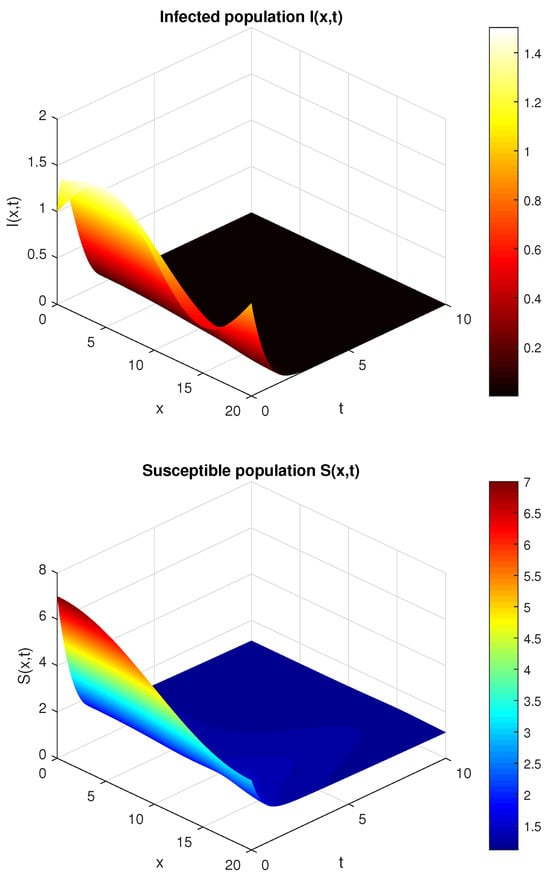
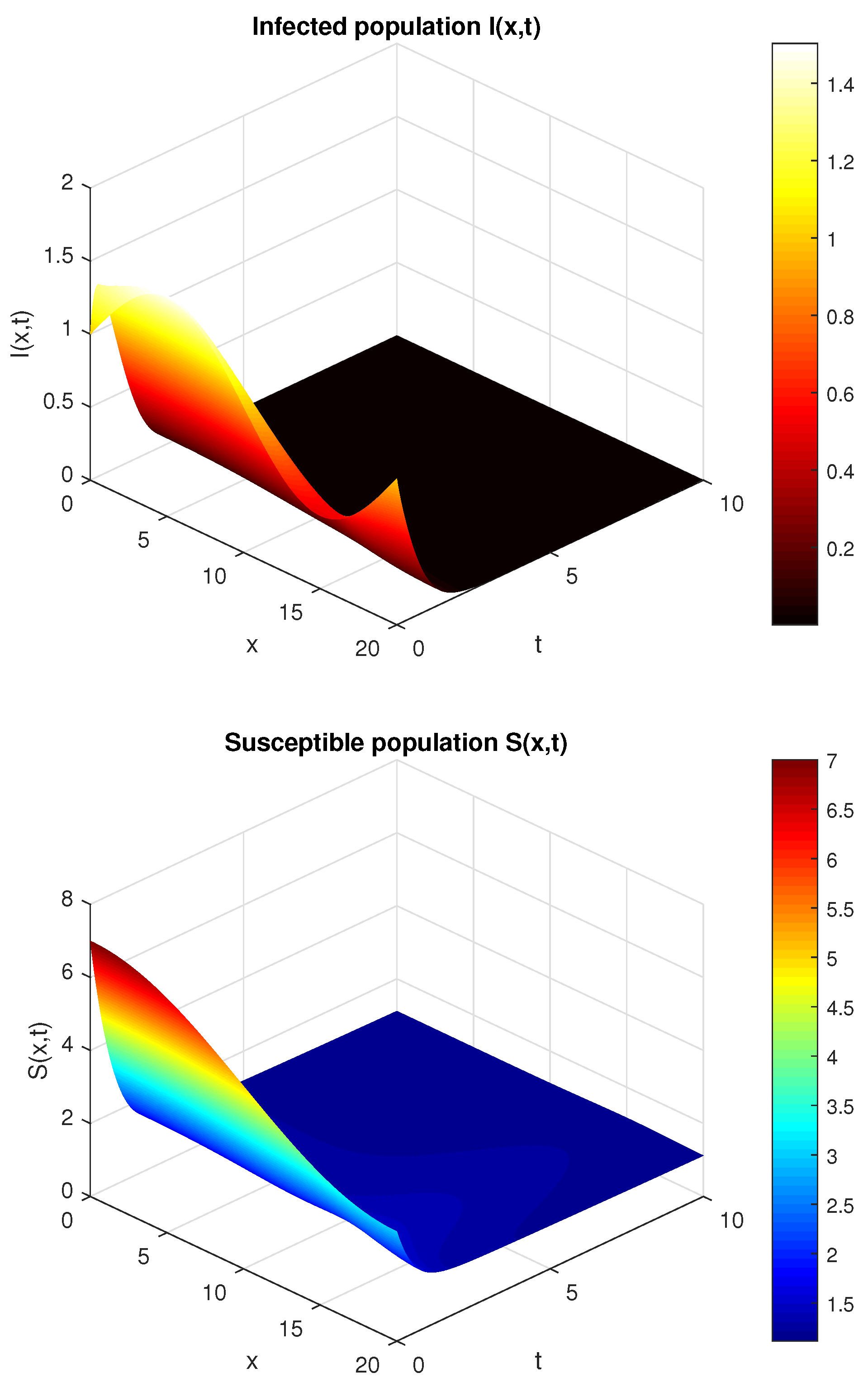
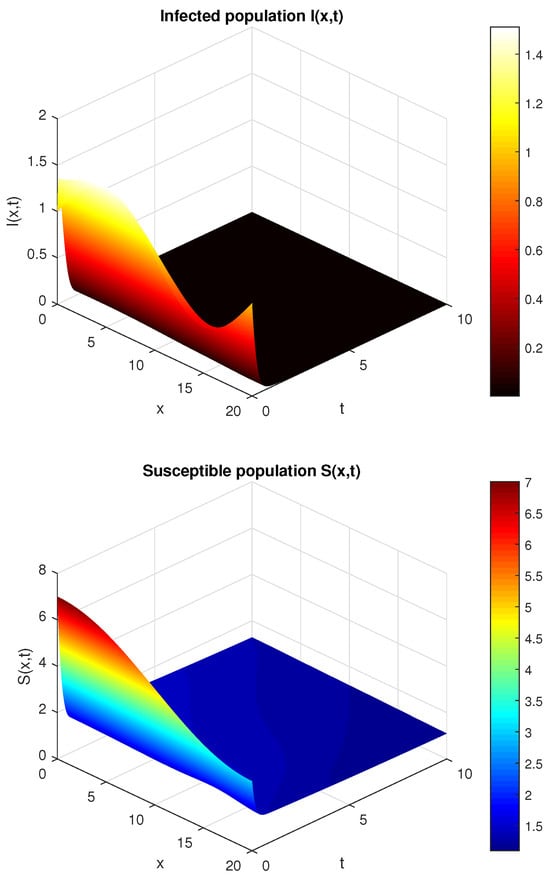
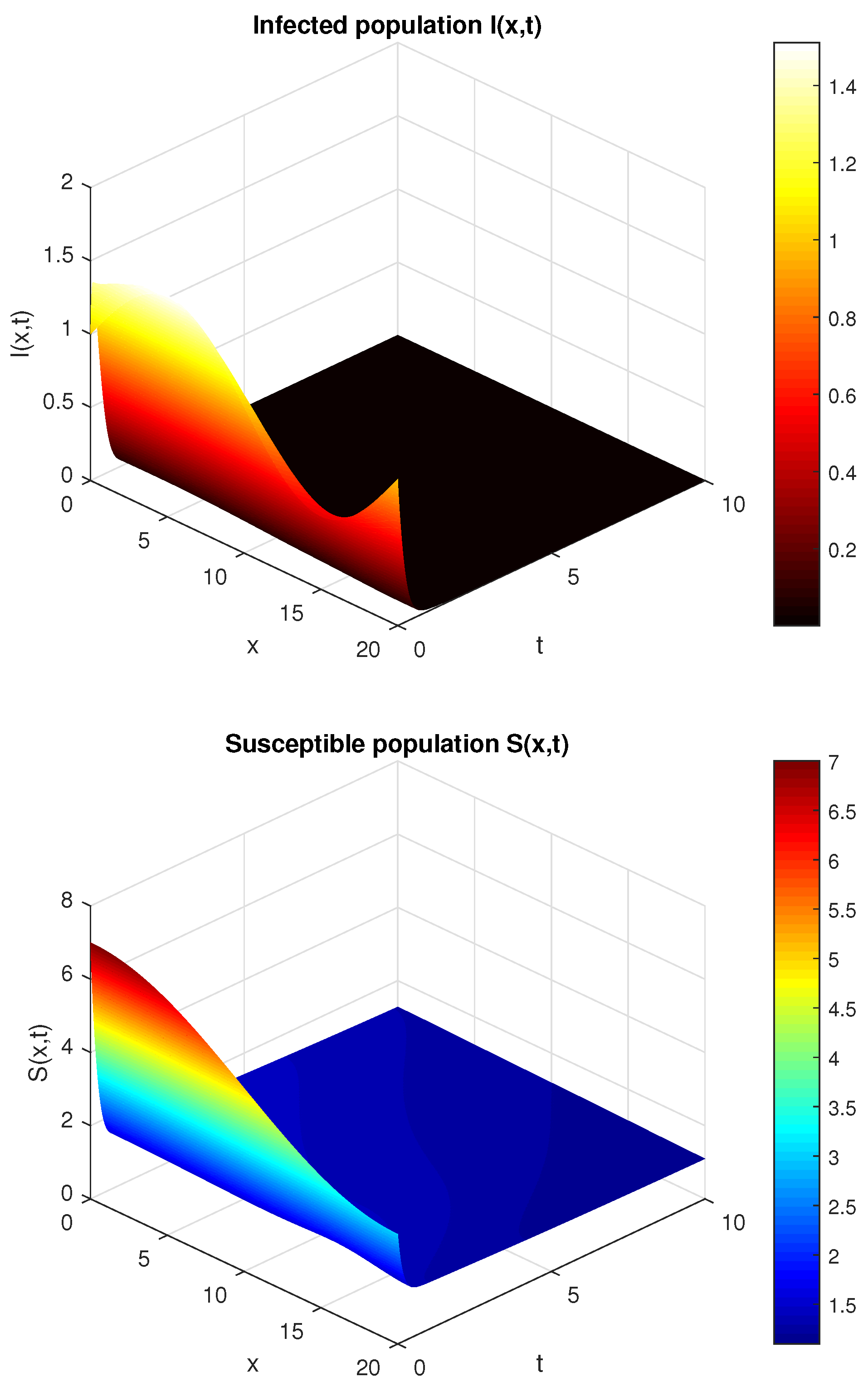
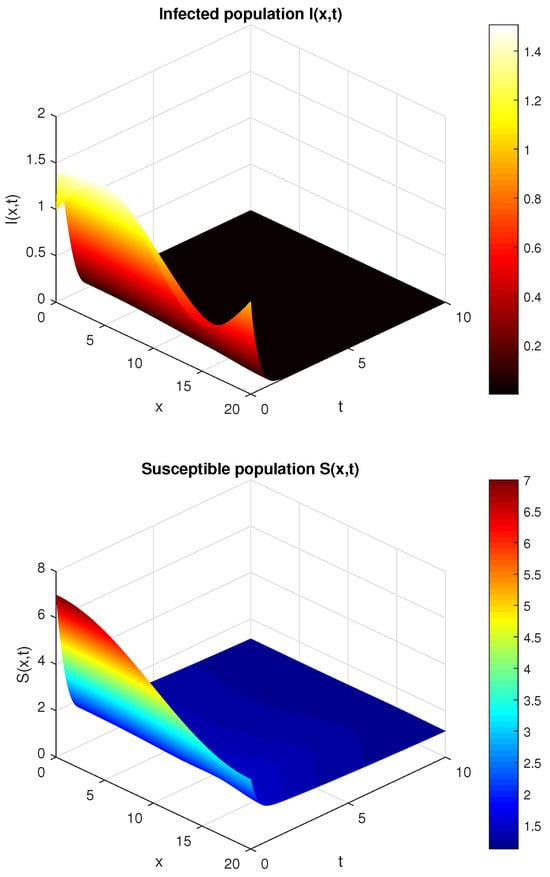
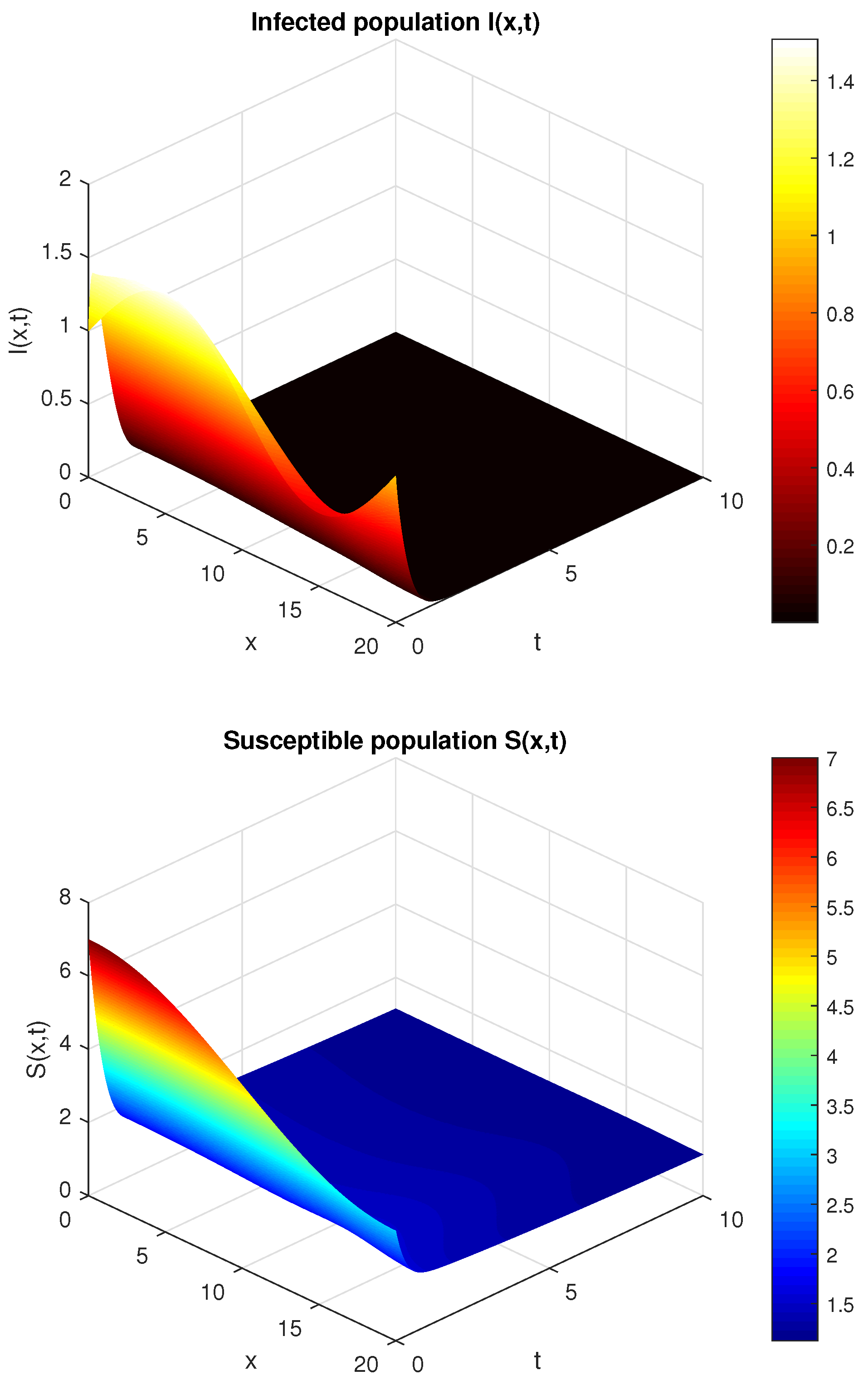
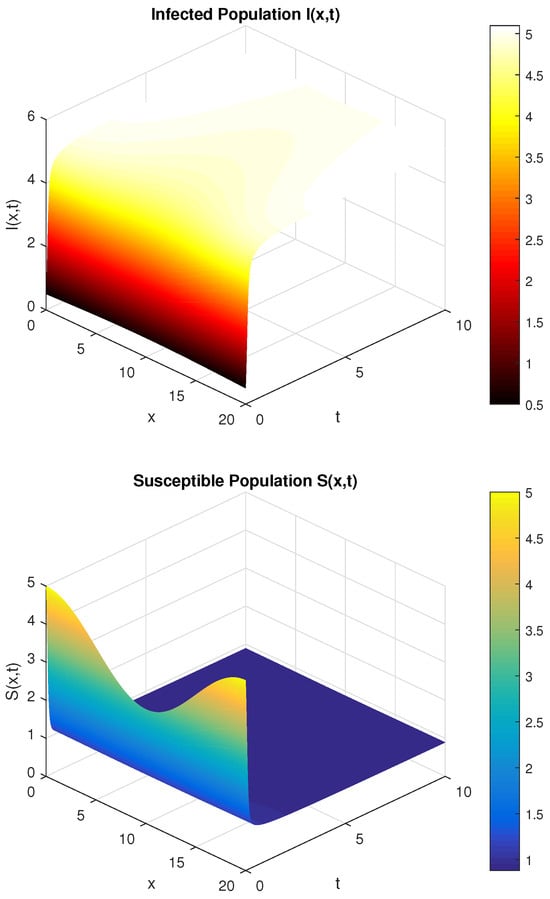
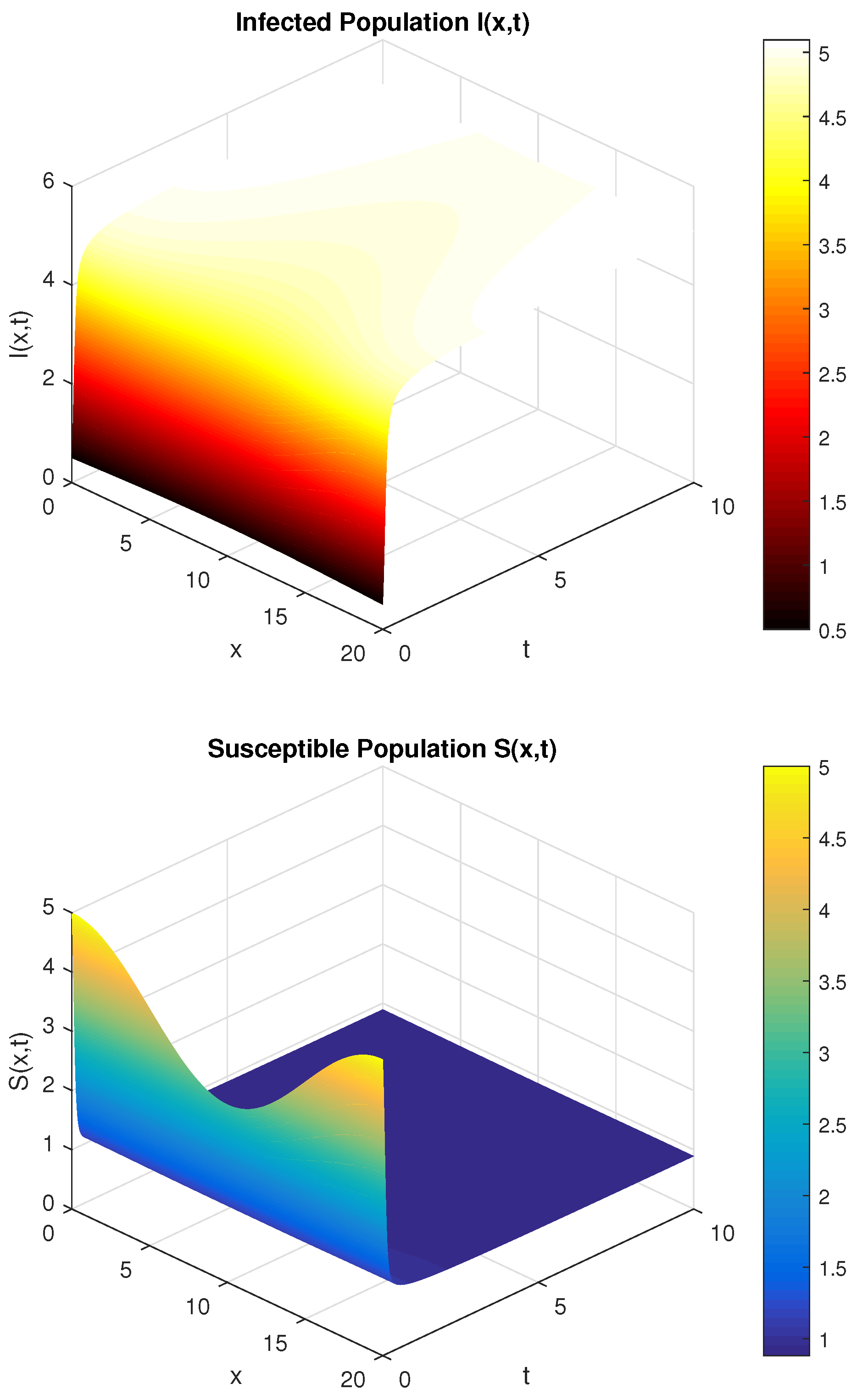
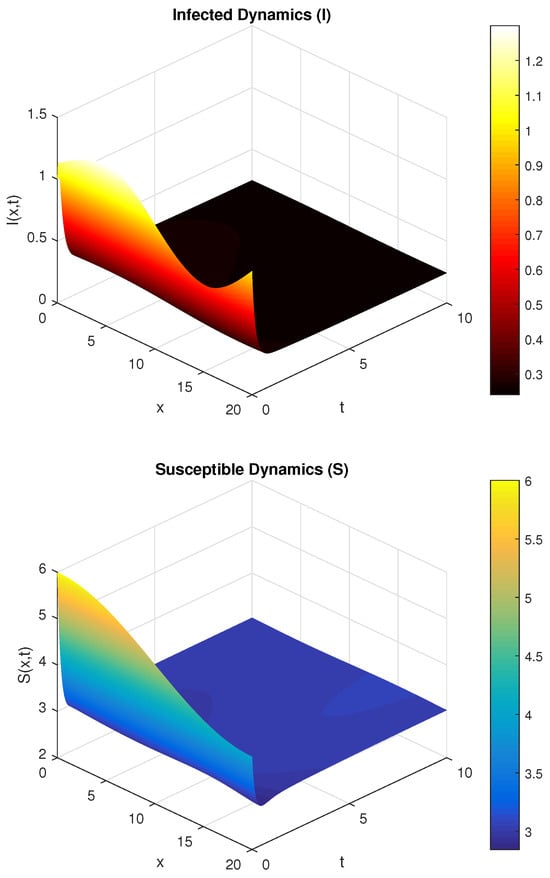
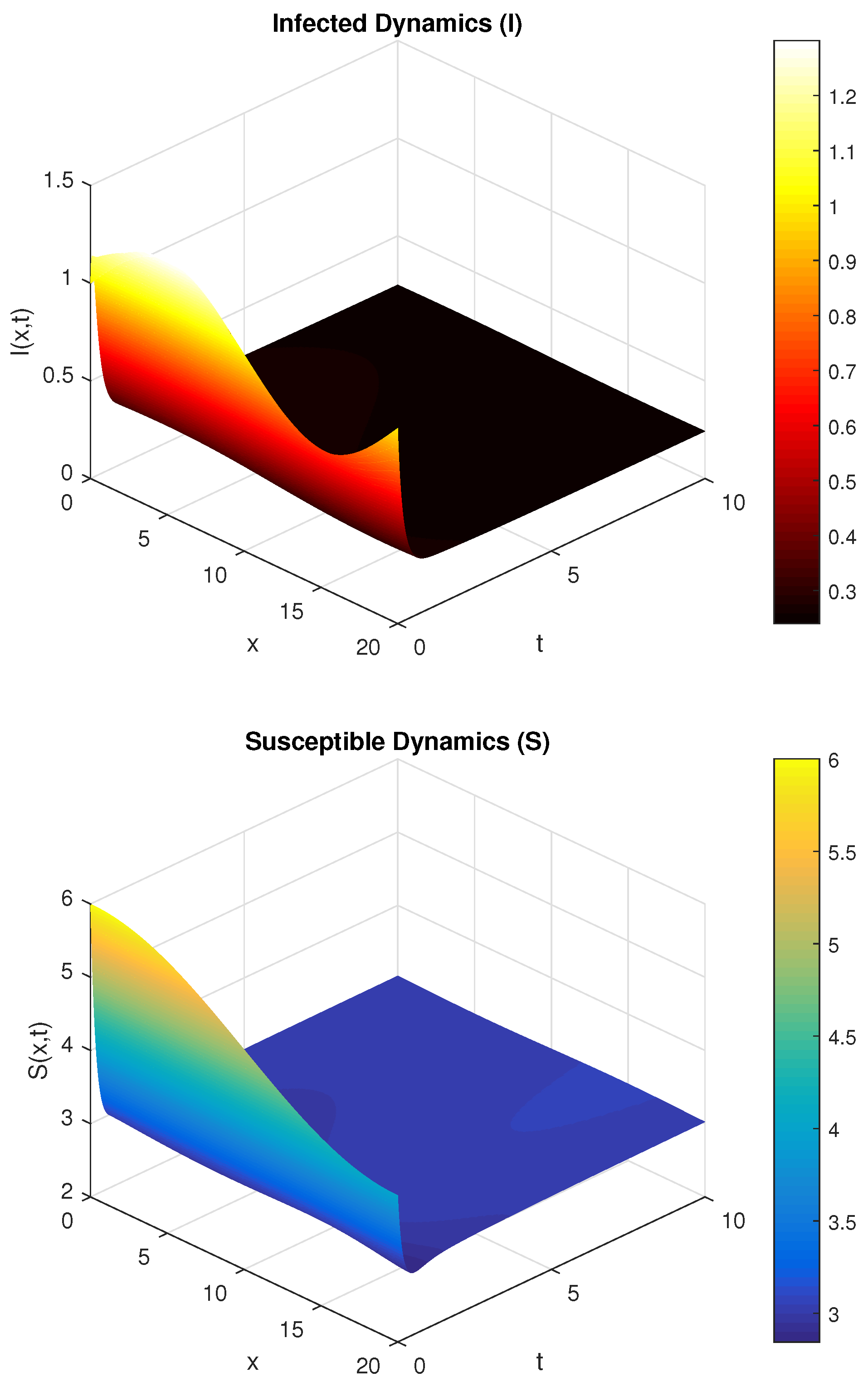
Using the selected parameter set gives Simulations with fractional orders are illustrated in Figure 1; this model converges rapidly to equilibrium without long transients. Simulations with commensurate orders are presented in Figure 2. Both populations retain memory equally, producing the following: slower decay, uniform spatial smoothing, and delayed stabilization. And lastly, the fractional incommensurate orders and can be found in Figure 3. This case shows qualitatively new behavior: the infected class stabilizes much more slowly than the susceptible class, diffusion smooths S and I at different rates, and non-uniform memory generates asymmetric transient waves. This figure demonstrates convergence to the disease-free equilibrium . Since , the infection dies out, and the population stabilizes with no infected individuals. The comparison between the classical model and the commensurate and incommensurate fractional model shows that the memory effect inherent in incommensurate fractional systems slows down convergence but does not affect the final stable state.
Figure 1.
Numerical simulation representing the infected and susceptible populations for .
Figure 2.
Numerical simulation representing the infected and susceptible populations in the commensurate case .
Figure 3.
Numerical simulation representing the infected and susceptible populations in the incommensurate case and .
These simulations provide robust numerical evidence supporting the theoretical results derived in earlier sections. They also highlight how the fractional orders and influence the rate of convergence and the long-term behavior of solutions, thus underlining the importance of memory effects in epidemiological modeling.
The selected parameter values follow biologically meaningful ranges commonly used in fractional epidemic models. The nonlinear incidence function was chosen because it captures saturation effects in transmission and is consistent with heterogeneous contact structures observed in HIV and other chronic infections. The diffusion coefficients represent the spatial dispersal rates of infected and susceptible individuals and were chosen within the range –, matching realistic human mobility scales. These values ensure that the qualitative dynamics—persistence versus extinction—remain consistent with real epidemiological patterns.
Example 2.
As a second illustrative example, we consider a fractional reaction–diffusion version of the classical SIR epidemic model, previously studied in its ODE form in [44]. This system falls within the general framework described by Equations (9)–(11), with a particular choice of the nonlinear incidence function given by
This saturation-type incidence rate is biologically motivated, as it captures the effect of population contact saturation when the number of infectives becomes large. It ensures that the transmission rate does not increase indefinitely with I, a behavior more aligned with real epidemic scenarios.
The resulting fractional-order SIR model with diffusion takes the following form:
The function satisfies the following properties for all :
This ensures that the system satisfies the regularity and monotonicity conditions needed for the application of the main results established earlier.
Moreover, one observes the following:
for all , which guarantees the boundedness of the infection rate derivative.
The system (17) admits two constant steady states:
where is the disease-free equilibrium, and is the endemic equilibrium, defined as follows:
The existence and stability of these equilibria depend on the value of the basic reproduction number . Specifically, the following can be said:
- If , then the endemic equilibrium exists and is asymptotically stable for all .
- Conversely, if , then the disease-free equilibrium is globally asymptotically stable regardless of the value of and .
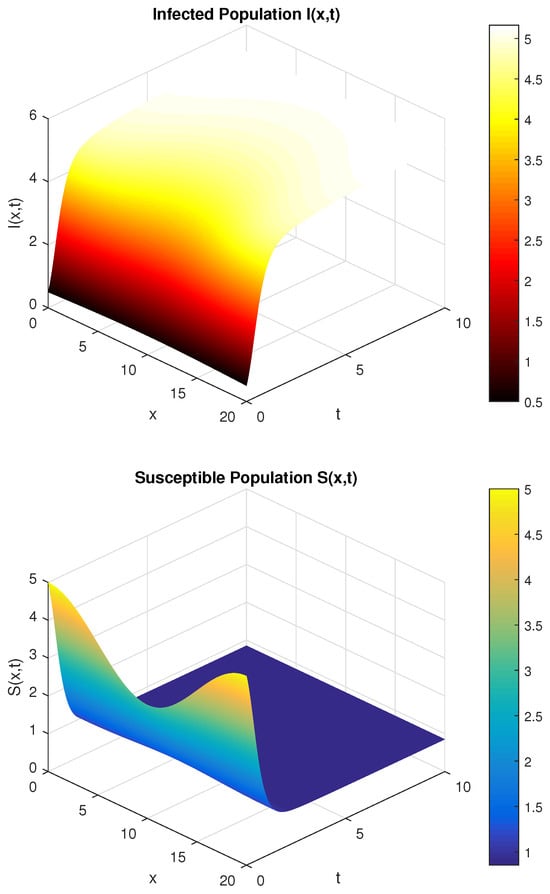
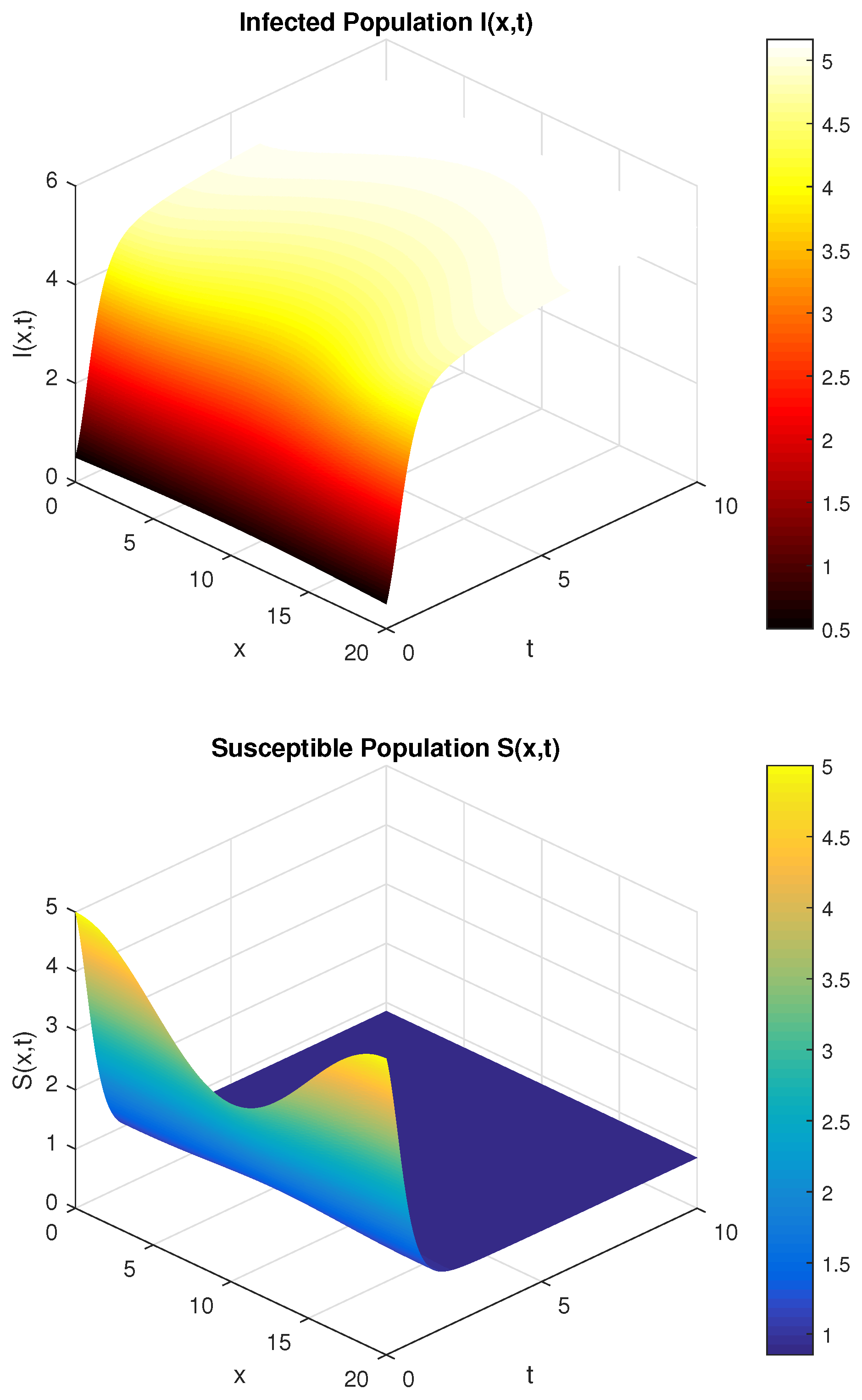
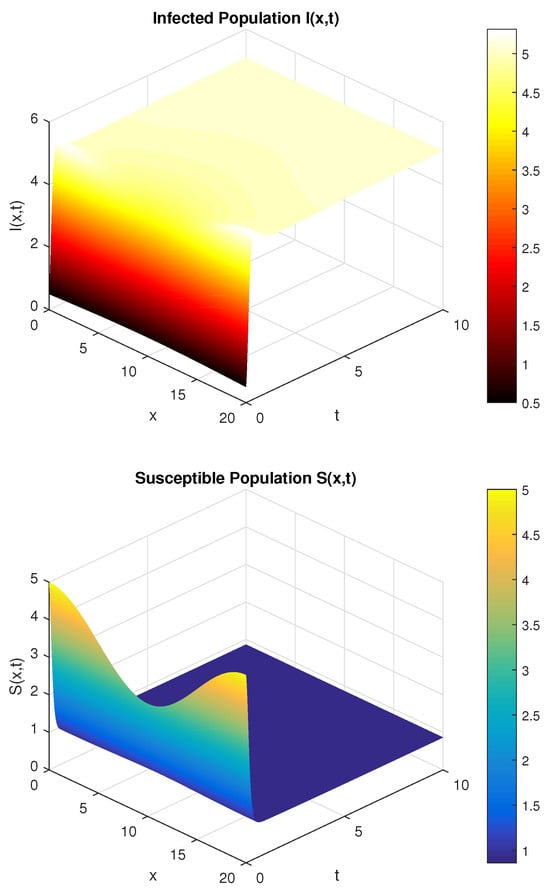
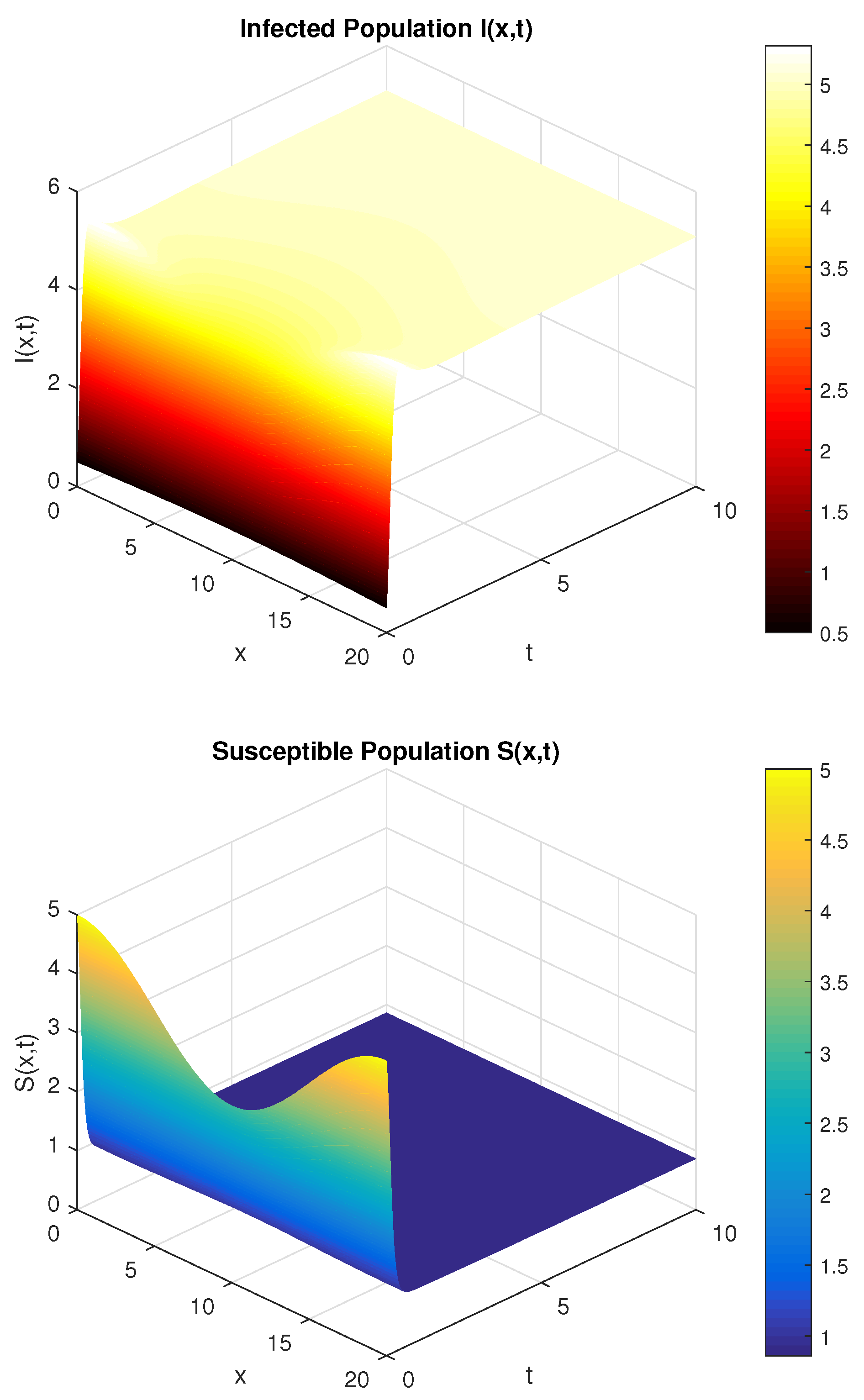
These conclusions follow directly from Proposition 3, extending classical ordinary differential equation (ODE) results to the fractional and spatially distributed framework. This behavior is clearly illustrated in Figure 4, Figure 5 and Figure 6. The example demonstrates that the incorporation of fractional derivatives and diffusive terms preserves the qualitative dynamics of the standard model, while simultaneously providing a richer modeling framework capable of capturing memory effects and spatial heterogeneity. Moreover, the inclusion of a saturated incidence rate introduces additional nonlinear effects that are both biologically meaningful and mathematically tractable within the proposed theoretical setting.
Figure 4.
Numerical simulation representing the infected and susceptible populations in the integer case.
Figure 5.
Numerical simulation representing the infected and susceptible populations in the fractional commensurate case.
Figure 6.
Numerical simulation representing the infected and susceptible populations in the fractional incommensurate case.
Example 3.
We now turn to a third illustrative example: a fractional reaction–diffusion system arising as an extension of the classical epidemic model introduced in [45,46]. This system is another particular case of the general framework described in Equations (9)–(11), featuring a nonlinear incidence rate of the following form:
This incidence function models a saturating contact rate dependent on both infection and behavioral response. It reflects the fact that as infections grow, the contact intensity per individual may saturate due to behavioral changes or healthcare limitations.
The resulting fractional reaction–diffusion system is formulated as follows:
The function satisfies the following properties for all :
and clearly,
Hence, the nonlinear incidence rate is smooth and bounded and satisfies the required monotonicity and Lipschitz conditions.
The system admits two constant equilibria:
- The disease-free equilibrium: .
- The following endemic equilibrium (when it exists):
The condition for the existence of the endemic equilibrium is governed by the basic reproduction number:
Thus,
- If , then exists and is asymptotically stable for any .
- If , the only equilibrium is , which is asymptotically stable.
These results are consistent with the general stability conditions given in Proposition 3 and confirm the robustness of the fractional incommensurate framework in reproducing well-known threshold dynamics.
Figure 7 provides numerical simulations corresponding to this third example. The figure considers a set of parameters and fractional orders and , allowing us to visualize the effect of memory and spatial diffusion on disease spread.
Figure 7.
Numerical simulation representing the infected and susceptible populations in the incommensurate case and .
These numerical results reinforce the theoretical findings, illustrating the interplay between incommensurate fractional memory, saturation, and spatial diffusion. They also underline the flexibility of the incommensurate fractional reaction–diffusion model to accommodate complex epidemiological behaviors not captured by classical models.
The numerical simulations confirm the theoretical predictions derived from the fractional stability criterion. As the fractional orders vary, the eigenvalue angle condition identifies transitions between persistence and extinction, which are directly observed in the time–space simulations. This coherence validates both the analytical framework and the numerical approach.
Relation to Empirical Epidemic Patterns.
Although incommensurate fractional orders are not typically measured directly in epidemiological datasets, the qualitative behavior of our model aligns with observed HIV/AIDS persistence patterns. Specifically, the slow decay of infected populations and long-memory effects in contact dynamics mirror the fractional-order stability transitions derived here. Previous studies of HIV dynamics have also reported sub-exponential spreading and long-term persistence, behaviors that are naturally reproduced through fractional memory.
6. Conclusions
This study shed light on the intricate role of memory and spatial diffusion in the transmission dynamics of infectious diseases. By introducing a nonlinear incommensurate fractional-order SI model, we captured the key aspects of real-world epidemics that are often overlooked in classical models—namely, delayed responses, heterogeneous time scales, and nonlocal interactions. The stability conditions derived locally are sensitive to the interplay between fractional orders, nonlinear incidence functions, and diffusion coefficients. Numerical experiments validate the theoretical predictions and emphasize the influence of memory in moderating the epidemic’s progression. This work not only enriches the theoretical framework of fractional epidemiology but also lays the groundwork for more robust and realistic modeling tools in public health strategy and decision-making. Future directions include extending the model to account for vaccination, stochastic effects, and multi-strain dynamics within the same fractional setting.
Author Contributions
Conceptualization, A.A. and O.K.; Methodology, A.H. and L.E.A.; Software, A.O.; Validation, A.A.; Formal analysis, A.H. and M.A.; Investigation, O.K.; Resources, L.E.A.; Data curation, A.O.; Writing—original draft, A.H. and A.O.; Writing—review & editing, A.A., O.K., L.E.A. and M.A.; Visualization, M.A. All authors have read and agreed to the published version of the manuscript.
Funding
Princess Nourah bint Abdulrahman University Researchers Supporting Project number (PNURSP2025R831), Princess Nourah bint Abdulrahman University, Riyadh, Saudi Arabia. The authors extend their appreciation to the Deanship of Scientific Research at Northern Border University, Arar, KSA for funding this research work through the project number “NBU-FFR-2025-2443-17”.
Data Availability Statement
The original contributions presented in this study are included in the article. Further inquiries can be directed to the corresponding authors.
Acknowledgments
Princess Nourah bint Abdulrahman University Researchers Supporting Project number (PNURSP2025R831), Princess Nourah bint Abdulrahman University, Riyadh, Saudi Arabia. The authors extend their appreciation to the Deanship of Scientific Research at Northern Border University, Arar, KSA for funding this research work through the project number “NBU-FFR-2025-2443-17”.
Conflicts of Interest
The authors declare no conflicts of interest.
References
- Podlubny, I. Fractional Differential Equations; Academic Press: Cambridge, MA, USA, 1999. [Google Scholar]
- Diethelm, K. The Analysis of Fractional Differential Equations; Springer: Berlin/Heidelberg, Germany, 2010. [Google Scholar]
- Tarasov, V.E. Fractional Dynamics; Springer: Berlin/Heidelberg, Germany, 2011. [Google Scholar]
- Magin, R.L. Fractional Calculus in Bioengineering; Begell House Publishers: Danbury, CT, USA, 2006. [Google Scholar]
- Murray, J.D. Mathematical Biology II: Spatial Models and Biomedical Applications; Springer: Berlin/Heidelberg, Germany, 2003. [Google Scholar]
- Caputo, M.; Fabrizio, M. A new definition of fractional derivative without singular kernel. Prog. Fract. Differ. Appl. 2015, 1, 73–85. [Google Scholar]
- Unaegbu, E.N.; Onah, I.S.; Oyesanya, M.O. Fractional order HIV/AIDS model using Caputo-Fabrizio operator. Afr. J. Infect. Dis. 2021, 15, 1–8. [Google Scholar]
- Wang, H.; Jahanshahi, H.; Wang, M.K.; Bekiros, S.; Liu, J.; Aly, A.A. A Caputo–Fabrizio fractional-order model of HIV/AIDS with a treatment compartment: Sensitivity analysis and optimal control strategies. Entropy 2021, 23, 610. [Google Scholar] [CrossRef] [Scilit]
- Debbouche, N.; Ouannas, A.; Grassi, G.; Al-Hussein, A.B.A.; Tahir, F.R.; Saad, K.M.; Aly, A.A. Chaos in Cancer Tumor Growth Model with Commensurate and Incommensurate Fractional-Order Derivatives. Comput. Math. Methods Med. 2022, 2022, 5227503. [Google Scholar] [CrossRef] [Scilit]
- Gorenflo, R.; Mainardi, F. Fractional calculus: Integral and differential equations of fractional order. In Fractals and Fractional Calculus in Continuum Mechanics; Carpinteri, A., Mainardi, F., Eds.; Springer: Berlin/Heidelberg, Germany, 1997. [Google Scholar]
- Pandey, R.K.; Nisar, K.S. Modeling and analysis of fascioliasis disease with Katugampola fractional derivative: A memory-incorporated epidemiological approach. Sci. Rep. 2025, 15, 37849. [Google Scholar] [CrossRef] [Scilit] [PubMed]
- Kossowski, I.; Przeradzki, B. Nonlocal heat equations with generalized fractional Laplacian. Adv. Nonlinear Anal. 2024, 13, 20240053. [Google Scholar] [CrossRef] [Scilit]
- Floridia, G.; Liu, Y.; Yamamoto, M. Blow-up in L1 (Ω)-norm and global existence for time-fractional diffusion equations with polynomial semilinear terms. arXiv 2023, arXiv:2302.12724. [Google Scholar]
- Xiao, W.; Yang, X.; Zhou, Z. Pointwise-in-time α-robust error estimate of the ADI difference scheme for three-dimensional fractional subdiffusion equations with variable coefficients. Commun. Anal. Mech. 2024, 16, 53–70. [Google Scholar] [CrossRef] [Scilit]
- Li, C.; Zhang, H.; Yang, X. A new α-robust nonlinear numerical algorithm for the time fractional nonlinear KdV equation. Commun. Anal. Mech. 2024, 16, 147–168. [Google Scholar] [CrossRef] [Scilit]
- Rostamy, D.; Mottaghi, E. Stability analysis of a fractional-order epidemics model with multiple equilibriums. Adv. Differ. Equ. 2016, 2016, 170. [Google Scholar] [CrossRef] [Scilit]
- Matignon, D. Stability properties for generalized fractional differential systems. ESAIM Proc. 1998, 5, 145–158. [Google Scholar]
- Zhao, X.O. Dynamical Systems in Population Biology; Springer: Berlin/Heidelberg, Germany, 2003. [Google Scholar]
- Monje, C.A. Fractional-Order Systems and Controls: Fundamentals and Applications; Springer: Berlin/Heidelberg, Germany, 2010. [Google Scholar]
- Matignon, D. Stability Results for Fractional Differential Equations with Applications to Control Processing. In Computational Engineering in Systems Applications; 1996; Volume 2, pp. 963–968. Available online: https://www.researchgate.net/publication/2581881_Stability_Results_For_Fractional_Differential_Equations_With_Applications_To_Control_Processing (accessed on 5 October 2025).
- Chen, W.; Sun, H.; Li, X. Fractional Derivative Modeling in Mechanics and Engineering; Springer Nature: Berlin/Heidelberg, Germany, 2022. [Google Scholar]
- Li, Y.; Chen, Y.Q.; Podlubny, I. Stability of fractional-order nonlinear dynamic systems: Lyapunov direct method and generalized Mittag-Leffler stability. Comput. Math. Appl. 2009, 59, 1810–1821. [Google Scholar] [CrossRef] [Scilit]
- Lakshmikantham, V.; Vatsala, A.S. Theory of fractional differential inequalities and applications. Commun. Appl. Anal. 2007, 11, 395–402. [Google Scholar]
- Kumar, A.; Lonial, V. Qualitative study of a novel fractional-order epidemic model with nonmonotone incidences, level of awareness, and quarantine class. Iran. J. Sci. 2024, 48, 1187–1209. [Google Scholar] [CrossRef] [Scilit]
- Tankam Chedjou, I. Memory-based incremental parameter updating of a generic stochastic plant epidemic model. bioRxiv 2025, 2025-07. [Google Scholar] [CrossRef] [Scilit]
- Yaro, D.; Apeanti, W.O.; Akuamoah, S.W.; Lu, D. Analysis and optimal control of fractional-order transmission of a respiratory epidemic model. Int. J. Appl. Comput. Math. 2019, 5, 116. [Google Scholar] [CrossRef] [Scilit]
- Hariharan, S.; Shangerganesh, L.; Debbouche, A.; Antonov, V. Dynamic behaviors for fractional epidemiological model featuring vaccination and quarantine compartments. J. Appl. Math. Comput. 2025, 71, 489–509. [Google Scholar] [CrossRef] [Scilit]
- Iyiola, O.; Oduro, B.; Zabilowicz, T.; Iyiola, B.; Kenes, D. System of time fractional models for COVID-19: Modeling, analysis and solutions. Symmetry 2021, 13, 787. [Google Scholar] [CrossRef] [Scilit]
- Hamdan, N.I.; Kilicman, A. Sensitivity Analysis in a Dengue Fever Transmission Model: A fractional order system approach. J. Phys. Conf. Ser. 2019, 1366, 012048. [Google Scholar] [CrossRef] [Scilit]
- Hammad, M.M.A.; Bendib, I.; Alshanti, W.G.; Alshanty, A.; Ouannas, A.; Hioual, A.; Momani, S. Fractional-order Degn–Harrison reaction–diffusion model: Finite-time dynamics of stability and synchronization. Computation 2024, 12, 144. [Google Scholar] [CrossRef] [Scilit]
- Petras, I. Fractional-Order Nonlinear Systems: Modeling, Analysis and Simulation; Springer Science & Business Media: Berlin/Heidelberg, Germany, 2011. [Google Scholar]
- Momani, S.; Djenina, N.; Ouannas, A.; Batiha, I.M. Stability Results for Nonlinear Fractional Differential Equations with Incommensurate Orders. IFAC-PapersOnLine 2024, 58, 286–290. [Google Scholar] [CrossRef] [Scilit]
- Djebara, L.; Douaifia, R.; Abdelmalek, S.; Bendoukha, S. Global and local asymptotic stability of an epidemic reactiondiffusion model with a nonlinear incidence. Math. Meth. Appl. Sci. 2022, 45, 1–25. [Google Scholar] [CrossRef] [Scilit]
- Djebara, L.; Abdelmalek, S.; Bendoukha, S. Global existence and asymptotic behavior of solutions for some coupled systems via a Lyapunov functional. J. Acta Math. Sci. 2019, 39, 1538–1550. [Google Scholar] [CrossRef] [Scilit]
- Hethcote, H.W. Qualitative analysis for communicable disease models. Math. Biosci. 1976, 28, 335–356. [Google Scholar] [CrossRef] [Scilit]
- Korobeinikov, A.; Wake, G.C. Lyapunov functions and global stability for SIR, SIRS and SIS epidemiological models. Appl. Math. Lett. 2002, 15, 955–961. [Google Scholar] [CrossRef] [Scilit]
- Brauer, F.; Van den Driessche, D. Models for transmission of disease with immigration of infectives. Math. Biosci. 2001, 171, 143–154. [Google Scholar] [CrossRef] [Scilit]
- Akdim, K.; Zetouni, A.; Zahid, M. The influence of awareness campaigns on the spread of an infectious disease: A qualitative analysis of a fractional epidemic model. Model. Earth Syst. Environ. 2022, 8, 1311–1319. [Google Scholar] [CrossRef] [Scilit]
- Lu, Z.; Yu, Y.; Ren, G.; Xu, C.; Meng, X. Global dynamics for a class of reaction-diffusion multigroup SIR epidemic models with time fractional-order derivatives. Nonlinear Anal. Modell. Control. 2022, 27, 142–162. [Google Scholar]
- Li, H.L.; Zhang, L.; Hu, C.; Jiang, Y.L.; Teng, Z. Dynamical analysis of a fractional-order predator-prey model incorporating aprey refuge. J. Appl. Math. Comput. 2017, 54, 435–449. [Google Scholar] [CrossRef] [Scilit]
- Van den Driessche, P.; Watmough, J. Reproduction numbers and sub-threshold endemic equilibria for compartmental models of disease transmission. Math. Biosci. 2002, 180, 29–48. [Google Scholar] [CrossRef] [Scilit]
- Casten, R.G.; Holland, C.J. Stability properties of solutions to systems of reaction-diffusion equations. SIAM J. Appl. Math. 1977, 33, 353–364. [Google Scholar] [CrossRef] [Scilit]
- Alikhanov, A.A. A new difference scheme for the time fractional diffusion equation. J. Comput. Phys. 2015, 280, 424–438. [Google Scholar] [CrossRef] [Scilit]
- Lahrouz, A.; Omari, L.; Kiouach, D. Global analysis of a deterministic and stochastic nonlinear SIRS epidemic model. Nonlinear Anal. Modell. Control. 2011, 16, 59–76. [Google Scholar] [CrossRef] [Scilit]
- Capasso, V.; Serio, G. A generalization of the Kermack-McKendrick deterministic epidemic model. Math. Biosci. 1978, 42, 43–61. [Google Scholar] [CrossRef] [Scilit]
- Li, G.; Wang, W. Bifurcation analysis of an epidemic model with nonlinear incidence. Appl. Math. Comput. 2009, 214, 411–423. [Google Scholar] [CrossRef] [Scilit]
Disclaimer/Publisher’s Note: The statements, opinions and data contained in all publications are solely those of the individual author(s) and contributor(s) and not of MDPI and/or the editor(s). MDPI and/or the editor(s) disclaim responsibility for any injury to people or property resulting from any ideas, methods, instructions or products referred to in the content. |
© 2025 by the authors. Licensee MDPI, Basel, Switzerland. This article is an open access article distributed under the terms and conditions of the Creative Commons Attribution (CC BY) license.