


Abstract
This work proposes a hybrid Uzbek sentiment analysis model (sometimes referred to as tonality analysis in the local literature) that integrates contextual text representations with named-entity information from an NER module and emoji-based emotional cues that are common in short online messages. To provide a comprehensive baseline comparison, we evaluate seven approaches—SVM, LSTM, mBERT, XLM-RoBERTa-base, mDeBERTa-v3, LaBSE, and the proposed hybrid model—covering both classical machine learning and modern multilingual transformer architectures for low-resource sentiment tasks. The overall pipeline begins with Uzbek-specific text normalization to reduce noise from informal spellings, transliteration variants, and inconsistent apostrophe usage. In parallel, the system performs explicit emoji extraction to capture affective signals that are often expressed non-verbally in social media texts. Next, we construct three complementary feature streams: a context encoder for sentence-level semantics, NER-driven entity features that encode entity mentions and types, and an emotion module that models emoji priors and their interaction with contextual meaning. These streams are fused into a unified representation and fed to a final classifier to predict sentiment polarity. Experiments on an Uzbek test set demonstrate that the hybrid model reaches an F1-score of 0.92, consistently outperforming text-only baselines. The results indicate that entity-aware and emoji-informed features improve robustness under sarcasm/irony, mixed sentiment with multiple targets, and orthographic noise, making the approach suitable for social media analytics, public opinion monitoring, customer feedback triage, and recommendation-oriented text mining.
1. Introduction
Sentiment analysis is one of the key areas of natural language processing and is widely used in public opinion monitoring, user feedback analysis, and digital communication research. For the Uzbek language, this area remains insufficiently studied due to the limited resources available, the complexity of the morphological structure and the high variability of informal writing. Agglutinative morphology, free word order, lack of standardized spelling in social networks, frequent abbreviations and code-switching create additional difficulties for building stable sentiment analysis models [1,2].
Existing research on Uzbek sentiment analysis has largely relied on lexicon-based approaches and classical machine-learning baselines such as SVM, which often yield limited performance on informal, noisy online text. Recurrent neural models (e.g., LSTM) have improved contextual modeling to some extent, yet they remain sensitive to spelling variation, non-standard word forms, and code-mixed or emoji-rich discourse. For high-resource languages, sentiment analysis has increasingly moved toward entity-aware settings, where emotions are linked to specific mentioned entities (persons, organizations, locations, products, and related objects). Such approaches commonly benefit from integrating named entity recognition (NER) and additional discourse signals, leading to more informative feature representations. However, for Uzbek, systematic research that combines contextual encoders with NER-derived entity cues and modern emoji usage remains scarce [3,4,5,6,7]. This motivates the hybrid framework evaluated in this work.
Another important aspect of modern digital communication is the use of emoji, which serve as an independent emotional signal and often completely change the interpretation of the text. Emoji are used especially actively in Uzbek social networks, but the existing sentiment analysis models practically do not take this layer of information into account. Until recently, there were no specialized resources for the Uzbek language, including emoji, their combinations and corresponding emotional characteristics. Thus, the question remains of how effectively a hybrid multimodal architecture can work, combining text features, entities and emoji into a single system [8,9,10].
We propose an Uzbek-focused pipeline that integrates NER-derived entity cues and emoji/lexicon affect signals with a multilingual transformer encoder for robust short-text sentiment analysis. For training and evaluation, a multi-source dataset has been developed and published in the public domain, including 10,000 marked sentences, 2000 single emoji, 16,000 emoji combinations, an expanded dictionary of Uzbek names, a lexicon of geographical names and a set of rules for normalizing informal words. This formulation motivates viewing sentiment analysis as a multimodal inference task that fuses textual semantics with structural (entity-aware) and affective (emoji/lexicon) signals.
Experimental results demonstrate that integrating NER-derived target cues and emoji/lexicon affect signals yields a consistent improvement of about 1–3 Macro-F1 points over strong text-only models on the fixed 1000-sentence 100% UGC benchmark. This indicates that target-aware and multimodal affect cues provide complementary information that is not fully captured by text semantics alone, which is particularly relevant for Uzbek digital communication where emotions are frequently conveyed through both lexical content and visual markers (emoji). In addition, the proposed model achieves high performance on user-generated content under the specified evaluation protocol, supporting its practical value for monitoring social-media discourse and user feedback.
The remainder of the paper is organized as follows. Section 2 reviews related work. Section 3 describes the datasets, preprocessing, and the proposed hybrid architecture. Section 4 reports experimental results. Section 5 discusses findings, limitations, and future work. Section 6 concludes the paper.
The main scientific contributions of the study can be summarized as follows.
- Entity-conditioned hybrid fusion for Uzbek sentiment analysis. We propose a reproducible hybrid pipeline that integrates (i) a multilingual transformer encoder for contextual semantics, (ii) NER-derived entity cues capturing entity types and mention structure, and (iii) an emoji/lexicon affect stream, and we define an explicit fusion procedure that combines these signals into the final sentiment decision.
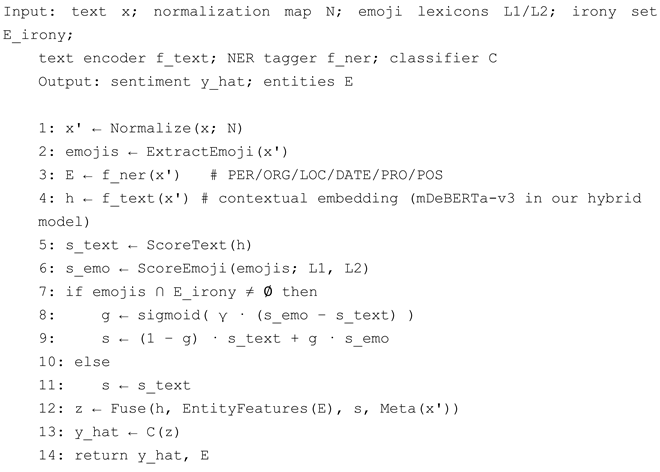
- Emoji-aware affect modulation with an explicit sarcasm/irony handling rule. We introduce an emoji-based affect module that treats emoji as probabilistic cues rather than deterministic labels and applies a conservative gating mechanism in the presence of irony-associated emoji patterns (Algorithm 1).
- Controlled component-wise validation (ablation). We provide ablation experiments that isolate the contributions of normalization, NER cues, and emoji/lexicon affect signals relative to strong text-only transformer baselines.
- Statistically supported improvements. We complement point estimates (Accuracy/Macro-F1) with statistical testing to demonstrate that observed gains are robust rather than due to random variation.
- Entity-type diagnostic analysis for Uzbek social-media discourse. We analyze how entity presence and entity types interact with sentiment behavior and typical error modes (mixed sentiment, ambiguity, orthographic noise), improving interpretability and guiding future resource design.
| Algorithm 1. Hybrid inference with sarcasm-aware emoji gating. |
 |
These results demonstrate the relevance and novelty of the proposed approach and make the model promising for the tasks of analyzing public opinion and multimodal processing of Uzbek-language texts.
2. Related Work
2.1. Sentiment Analysis for Uzbek and Other Low-Resource Languages
Sentiment analysis has been widely studied for high-resource languages, where large-scale labeled corpora and robust linguistic resources are available. In contrast, Uzbek remains a relatively low-resource language, which complicates both dataset creation and model adaptation. Existing Uzbek sentiment studies typically follow one of three directions:
- (i)
- classical machine-learning pipelines with TF–IDF or n-gram features and linear classifiers such as SVM or logistic regression;
- (ii)
- neural models such as CNN/LSTM variants trained on limited labeled corpora;
- (iii)
- multilingual or cross-lingual transfer approaches using pretrained transformers (e.g., mBERT, XLM-R) fine-tuned on Uzbek data.
While transformer-based methods often outperform classical baselines, performance can be unstable when domain shifts occur (e.g., from formal news to social media), and the models remain sensitive to informal spelling, slang, transliteration, and code-mixing, which are frequent in Uzbek short texts [11,12,13,14,15].
A recurring challenge across low-resource sentiment research is that model accuracy depends not only on architecture, but also on resource design—specifically, the availability of high-quality lexicons, normalization rules, and domain-specific annotations. Several works emphasize that improvements in preprocessing and resource augmentation can lead to gains comparable to switching model families, particularly for short, noisy user-generated content [16].
Quantitative context. Prior Uzbek sentiment studies often report results on binary polarity benchmarks and domain-specific corpora. For example, Kuriyozov and Matlatipov report a best Accuracy of 89.56% on an Uzbek app-review corpus (logistic regression with word + character n-grams) and up to 85.88% with a linear SVM under a 90:10 split.
On a restaurant-review benchmark (8210 Google Maps reviews), Matlatipov et al. [3] report a best Accuracy of 91% with logistic regression using word + character n-grams and provide per-class Precision/Recall/F1.
For Uzbek YouTube movie-review comments, Rabbimov et al. [7] report 85.25% Accuracy with Random Forest and show that adding emoji-derived features improves performance by about 5 percentage points.
These results provide useful context but are not directly comparable to our setting because prior work typically uses binary labels, different domains, and Accuracy-focused reporting, whereas our benchmark uses three-class polarity and Macro-F1 on a fixed 1000-sentence UGC test set.
2.2. Named Entity Recognition in Uzbek and Entity-Aware Sentiment
Named Entity Recognition (NER) for Uzbek has progressed from rule-based and CRF-style sequence labeling to transformer-based token classification. However, robust NER for Uzbek still faces linguistic obstacles: agglutinative morphology, rich inflection, and orthographic variation (Latin/Cyrillic, apostrophe variants, colloquial spellings). Many existing NER datasets for Uzbek are limited in size, domain coverage, or entity type inventory, which restricts generalization [16].
Beyond standalone NER, entity-aware sentiment analysis aims to associate sentiment with specific targets (persons, organizations, products, locations). This task becomes critical in social media settings, where a single sentence often contains mixed opinions toward different entities. Prior studies in other languages show that incorporating entity signals—through target extraction, attention mechanisms, or joint learning—can significantly improve interpretability and reduce false polarity assignments in mixed-sentiment texts. For Uzbek, entity-aware sentiment remains underexplored, and the lack of datasets jointly annotated for sentiment and entities has been a major bottleneck [17,18,19].
2.3. Hybrid Signals: Lexicons, Emoji, and Normalization
Purely contextual models sometimes behave overly literally in the presence of sarcasm, irony, or emoji-driven meaning shifts. As a result, hybrid approaches that combine contextual embeddings with auxiliary signals—sentiment lexicons, emoji priors, morphological patterns, and normalization dictionaries—continue to be relevant. Emoji-based sentiment cues are particularly important in short texts, where emoji can serve as compressed affect markers, discourse hints, or irony triggers. At the same time, emoji are inherently ambiguous: the same symbol may express support, neutrality, or sarcasm depending on context and co-occurring tokens. Therefore, effective systems tend to treat emoji not as deterministic labels but as probabilistic or interaction-based features integrated with text representations [20,21,22,23].
Another well-known issue is orthographic noise: Uzbek users frequently employ phonetic spellings, informal abbreviations, mixed scripts, and ad hoc apostrophes. Normalization (mapping non-standard forms to canonical forms) reduces sparsity and can improve both NER matching and sentiment stability, especially when lexicon features are used. Several works report that even lightweight normalization rules, when curated carefully, can yield measurable improvements in downstream classification tasks in low-resource settings.
2.4. Synthetic and Controlled Data Generation for Robust Evaluation
Data scarcity and domain imbalance motivate the use of synthetic or semi-synthetic corpora. Controlled generation can be particularly valuable when the goal is to stress-test models under specific linguistic phenomena (e.g., sarcasm, mixed sentiment, emoji ambiguity, entity density). Prior research suggests that synthetic data can be beneficial when they are constructed with explicit constraints, validated by human annotators, and used as an augmentation or evaluation layer rather than as a replacement for authentic data. However, uncontrolled synthesis may introduce artifacts (template bias, unnatural token patterns), which can inflate results without improving real-world robustness [24].
Consequently, recent trends emphasize dual-source setups: combining curated synthetic samples (to ensure coverage of rare phenomena) with authentic user-generated texts (to preserve natural distributional properties). This strategy supports both robust model development and transparent error analysis, since the synthetic portion can be designed to isolate failure modes while the real portion measures ecological validity.
2.5. Summary of the Research Gap and Positioning
Prior work on Uzbek sentiment analysis has largely relied on lexicon-based scoring and classical machine-learning pipelines (e.g., bag-of-words + SVM/LR), which are efficient but often brittle under informal spelling, agglutinative morphology, and code-mixing. More recent studies adopt multilingual transformers (mBERT/XLM-R and variants), improving robustness; however, these models still frequently treat sentiment as a sentence-level property without explicitly modeling the sentiment target in the presence of named entities.
Entity-aware sentiment analysis has been explored internationally (e.g., target-dependent polarity, aspect/target sentiment, entity-conditioned representations), showing that incorporating explicit targets can reduce misattribution when multiple entities appear in the same text. In Uzbek, however, the combination of (i) NER-derived target cues, (ii) multilingual contextual representations, and (iii) emoji/lexicon affect signals remains under-studied, and prior work seldom reports controlled ablations and statistically supported gains on a fixed benchmark.
Positioning of this work. We propose a hybrid framework that fuses contextual embeddings with NER-derived target cues and emoji/lexicon affect signals. We define a reproducible fusion specification (Section 3), quantify component contributions via ablation, and validate improvements using paired bootstrap significance testing on a fixed 100% UGC benchmark (Section Statistical Significance of the Improvements).
3. Materials and Methods
3.1. Dataset Collection and Corpus Preparation
To support the development and evaluation of the proposed hybrid sentiment model, we constructed a dual-source Uzbek corpus containing 45,000 texts. The corpus consists of
- (i)
- 20,000 user-generated texts collected from social-media platforms;
- (ii)
- 25,000 synthetically generated texts created under controlled procedures.
The synthetic portion includes two subsets of 15,000 and 10,000 texts, designed to cover diverse domains and writing styles while providing balanced sentiment and entity patterns.
Privacy and release policy. The social-media subset represents real informal discourse; however, due to platform redistribution policies and privacy considerations, these user-generated materials are not redistributed as an open dataset. We report only aggregated statistics for this subset and use it internally under a privacy-preserving workflow. To comply with these constraints, we do not publicly release the raw texts from this subset, including the fixed 1000-sentence held-out benchmark set (100% UGC). To ensure transparency and facilitate reuse, we release the fully public synthetic and linguist-curated portions, together with the complete annotation schema, preprocessing pipeline, and model training configuration. We additionally report controlled ablation results and paired bootstrap significance testing to support the robustness of the reported improvements.
Although a substantial portion of the publicly released resources is synthetic, the synthetic corpora are designed to mirror real Uzbek online discourse via
- (i)
- template diversity;
- (ii)
- controlled emoji injection;
- (iii)
- gazetteer-driven entity variability.
Crucially, model selection is performed on a validation split, while final reporting is performed on the fixed 1000-sentence benchmark sampled exclusively from the UGC subset; synthetic data mainly serve as a scalable and reproducible training resource.
Synthetic-data limitations. We acknowledge that template-based generation can introduce distributional artifacts (e.g., repeated surface patterns and constrained syntactic variety) that may not fully match organic social-media writing. To reduce this risk, we diversify templates, inject controlled noise and emoji patterns, and vary entities through gazetteer-driven sampling, and we rely on evaluation on a fixed 100% UGC benchmark with statistical testing to verify that improvements transfer beyond synthetic constructions. Future work will further validate the approach on additional fully public Uzbek social-media corpora and explore less templated generation strategies.
Dataset Inventory and Released Resources
The total corpus comprises 20,000 real social-media texts and 25,000 synthetically generated texts (15,000 + 10,000); due to redistribution and privacy constraints, only synthetic resources and auxiliary lexicons are released. Table 1 presents the complete dataset inventory and released resources.
Table 1.
Dataset inventory and released resources used in this study.
Table 2 summarizes the publicly released synthetic packages.
Table 2.
Publicly released synthetic resources accompanying this work and prepared for submission to MDPI Data and Data in Brief.
Together, the released synthetic corpora correspond to the 25,000-text synthetic portion of the overall 45,000-text pool (15,000 in the MDPI Data release and 10,000 in the Data in Brief package). Importantly, the dual-source synthetic corpora (12,000 + 3000) have already been published as a Data Descriptor in MDPI Data (Q2) [24], confirming the maturity and editorial validation of the released resources (DOI: 10.3390/data11020028). This publication provides an external quality signal and ensures that the dataset package is publicly accessible and citable.
The 1000-sentence stratified test subset is reserved exclusively for final benchmarking and was not used during model training.
This test subset was constructed using stratified sampling to preserve the POS/NEG/NEU proportions and was kept fixed across all experiments to ensure a fair comparison among classical baselines (SVM, LSTM), multilingual transformer baselines (mBERT, XLM-RoBERTa-base, mDeBERTa-v3, LaBSE), and the proposed hybrid model. In addition to preserving class proportions, we ensured coverage of typical UGC variability by balancing emoji-containing texts and texts with at least one named-entity mention, and by verifying presence of all six entity types in the benchmark.
Table 3 reports the class distribution of the fixed 1000-sentence test subset used for all benchmarks. Approximately 20,000 texts in the overall pool originate from social-media platforms; due to platform terms of use and privacy/ethical constraints, this portion is not redistributed and is used only for internal sampling and aggregated reporting.
Table 3.
Class distribution of the fixed 1000-sentence stratified test subset used for all reported benchmarks (held out; not used for training).
After collection and generation, the data passed a mandatory cleaning stage: advertising content, duplicates, hyperlinks, and technical fragments were removed. Since Uzbek is written in both Latin and Cyrillic scripts, we normalized the corpus into a single writing standard [25]. The texts were then tokenized, and agglutinative word forms were reduced to lemmas to facilitate downstream modeling.
Labeling overview. Each text is associated with
- (i)
- a three-class sentiment label (POS/NEG/NEU);
- (ii)
- named entity annotations for six types (PER, ORG, LOC, DATE, PRO, POSITION).
For the released synthetic corpora, labels are reproducible from generation rules and auxiliary lexicons; additionally, a sample was expert-reviewed as described in Section 3.2.1.
3.2. Dataset Description
The core labeled resource used in this study consists of 10,000 synthetically generated Uzbek texts, designed to cover diverse domains and writing styles while ensuring controlled sentiment and entity patterns. For each text, we provide a sentiment label (POS/NEG/NEU), span-level named entity annotation for six entity types (PER, ORG, LOC, DATE, PRO, POSITION), and auxiliary metadata required for reproducibility and downstream experiments (e.g., emoji signals, token counts, and source/domain tags).
In addition to the corpus, we release modular auxiliary resources on the Mendeley Data platform (Saidov, Bobur (2026), “A Multi-Source Synthetic Dataset for Uzbek Sentiment Analysis, Named Entity Recognition, and Normalization”, Mendeley Data, V5, doi: 10.17632/khnmnp4t7v.5) [26], including emoji lexicons (single and combined emoji), informal-to-normalized pairs for Uzbek, and gazetteers supporting entity recognition. The complete inventory is summarized in Table 1, while Table 2 provides an overview of the publicly released synthetic packages accompanying this work.
In addition to the modular multi-source synthetic package, we also provide a separate dual-source synthetic corpus release that contains two subsets: Hybrid Synthetic Corpus (12,000) and Manual-style Synthetic Corpus (3000). Both releases are hosted on Mendeley Data platform (Saidov, Bobur (2026), “Dataset for Sentiment and Named Entity Analysis in Uzbek Texts”, Mendeley Data, V3, doi: 10.17632/y2d5pcyrzz.3) [27] and are referenced in the Data Availability Statement.
3.2.1. Annotation Guidelines and Quality Control
Sentiment labels follow a three-class scheme (positive/neutral/negative). For each synthetic text, the polarity is assigned using controlled generation rules that combine lexical signals and emoji-based cues. When lexical and emoji signals conflict, predefined tie-breaking rules are applied. As a result, sentiment labels in the released synthetic corpora are deterministically reproducible from the generation templates and the accompanying auxiliary lexicons [28].
Named entities are annotated using a six-type taxonomy: PER, ORG, LOC, DATE, PRO, and POSITION. The first four categories follow standard NER practice, while PRO and POSITION are introduced to support entity-aware sentiment analysis in common Uzbek domains such as commerce, public services, and institutional communication. DATE mentions are produced and verified using a hybrid procedure (gazetteers and rule-based patterns), while PRO and POSITION mentions are supported by curated dictionaries and normalization rules.
To validate the stability of the annotation scheme, a subset of 300 sentences was independently reviewed by two expert linguists. Inter-annotator agreement measured by Cohen’s kappa reached κ = 0.89 for sentiment labels and κ = 0.91 for NER labels, indicating near-perfect agreement under the Landis–Koch interpretation scale.
In addition to expert review, we apply automated quality-control checks to ensure
- (i)
- consistency between the entities and entity_type fields;
- (ii)
- the presence of each annotated entity surface form in the text;
- (iii)
- validity of structured fields (e.g., JSON records, where applicable);
- (iv)
- correctness of emoji fields. In the manual audit protocol used for dataset releases, schema alignment reached 97% (291/300), entity correctness 98% (294/300), and emoji-field correctness 96% (288/300).
All detected inconsistencies were corrected prior to final release.
Table 4 provides a file-level inventory of the released synthetic corpora and the accompanying auxiliary resources (emoji lexicons, normalization pairs, and gazetteers) used to construct the feature pipeline.
Table 4.
File-level inventory of the released resources and internal evaluation files used in this study.
These resources support both preprocessing (normalization, tokenization/lemmatization, emoji handling) and entity-aware feature extraction. Table 5 clarifies the role of each corpus subset in the experimental setup.
Table 5.
Dataset partitions and their usage in training and evaluation.
The fixed stratified test subset of 1000 texts is held out to ensure a fair and consistent comparison across SVM, LSTM, mBERT, and the proposed hybrid model, and it is not used for training or tuning.
Figure 1 summarizes the end-to-end workflow used to generate the released synthetic corpora, perform quality control, and integrate auxiliary lexicons (emoji and normalization resources) into the preprocessing and feature extraction pipeline.
Figure 1.
Workflow for constructing the synthetic corpora and preparing auxiliary resources used in the hybrid sentiment pipeline.
3.2.2. Dataset Statistics and Label Balance
To improve transparency, we report summary statistics for the publicly released synthetic corpora and for the fixed held-out test subset used for benchmarking in this paper. In our prior data papers (MDPI Data/Data in Brief submissions), we released two synthetic subsets—Dataset A (Hybrid, 12 k) and Dataset B (Manual-style, 3 k)—with a core NER schema covering PER/ORG/LOC. In the present BDCC study, we adopt a broader six-type evaluation taxonomy (PER/ORG/LOC/DATE/PRO/POSITION) for entity-aware sentiment experiments, while noting that the previously released subsets report entity annotations for the core three types [29,30,31].
Table 6 summarizes key statistics of the two released synthetic subsets, and their sentiment label distributions are visualized later in the results section. For sentiment model benchmarking in BDCC, we use a fixed stratified test subset of 1000 sentences (Table 3), which is kept constant across all experiments to ensure a fair comparison among SVM, LSTM, mBERT, XLM-RoBERTa-base, mDeBERTa-v3, LaBSE, and the proposed hybrid model. This test subset is held out exclusively for final evaluation and is not used during training or hyperparameter tuning.
Table 6.
Summary statistics of the previously released synthetic corpora (Dataset A/B) reported in our data papers.
The label distributions of the previously released synthetic subsets are reported in our prior data papers; in this BDCC study, we focus on the fixed 1000-sentence benchmark set (Table 3) used for all comparisons. In the remainder of the paper, we report all model comparisons on the fixed 1000-sentence benchmark set to ensure consistent and fair evaluation.
3.3. Integration of Emotional Vocabulary and Emoji Signals
One of the key components of the proposed hybrid system is an emotional lexicon complemented by an emoji-processing module. In contemporary Uzbek online discourse, sentiment is often conveyed not only through individual words but also through multiword expressions, colloquial constructions, and emoji, which act as a compact and highly informative emotional channel [32]. Therefore, during resource construction, we accounted for both normative word forms and frequent informal variants.
The emotional lexicon was compiled from multiple sources, including synonym lists, analysis of frequent emotional expressions in Uzbek online text, and a set of 1450 informal-to-normalized pairs. In total, the lexicon contains over 10,000 entries (words, expressions, and phrases) annotated with polarity (positive/neutral/negative) and intensity scores. These lexicon-based signals are used as additional features in the hybrid pipeline and provide a lightweight prior that complements contextual encoders.
Emoji are processed as a separate feature channel. We use two resources:
- (i)
- a lexicon of 2000 individual emoji;
- (ii)
- an inventory of 16,000 emoji combinations (2–4 emoji sequences) to represent mixed or amplified emotions.
Each emoji (or combination) is associated with polarity and intensity values (e.g., 😍: positive/high intensity; 😡: negative/high intensity; 🤔: neutral/low intensity). During inference, emoji signals are integrated into the feature fusion stage, allowing them to reinforce or attenuate the final sentiment prediction, particularly in short and informal messages where emoji carry substantial emotional load.
3.4. Named Entity Recognition (NER) Component (Revised)
Recognition of named entities is essential for the proposed hybrid model because sentiment in real Uzbek texts is often directed toward a specific target (e.g., a person, organization, or product). This is particularly important for Uzbek due to rich morphology, spelling variability, and frequent informal usage patterns [33,34].
In our pipeline, we employ a context-aware mBERT-based NER module to extract entity spans and types. Clarification. The mBERT encoder is used only inside the NER tagger for entity extraction. In contrast, the contextual text encoder for the hybrid sentiment classifier is mDeBERTa-v3 (see Table 7). We use a six-type taxonomy tailored to common Uzbek domains: PER, ORG, LOC, DATE, PRO, and POSITION. To improve robustness on morphologically altered and low-frequency mentions, the NER component is supported by auxiliary gazetteers and normalization resources (e.g., a list of Uzbek personal names and a compact location lexicon). These extracted entities are passed to the feature fusion stage of the hybrid sentiment model, enabling entity-aware sentiment analysis.
Table 7.
Key training hyperparameters of the proposed hybrid NER + sentiment model.
Recent Uzbek NER corpora and neural approaches reported in our prior data publications were also considered when designing the NER component [35].
NER performance (supporting evidence). To ensure that entity-aware sentiment signals are reliable, we report the standalone quality of the mBERT-based NER component on the annotated subset. On the validation benchmark, the model achieves strong per-type results, confirming that the extracted entity spans and types can be safely used as structural cues for sentiment attribution: PER ≈ 0.92 F1, ORG ≈ 0.88 F1, LOC ≈ 0.90 F1 (others follow similar trends under the expanded taxonomy). These results support the use of NER outputs as an informative target signal in the hybrid fusion stage.
3.5. Hybrid Model Architecture
The proposed hybrid system is organized as a unified pipeline that combines three complementary signal sources: contextual semantics, named entities, and emoji/lexicon-based emotion cues (see Figure 2). We use mDeBERTa-v3 as the contextual text encoder for the hybrid sentiment classifier, while the NER module uses an mBERT-based tagger for entity extraction. The main motivation is that sentiment detection in modern Uzbek texts should not rely on text semantics alone, since emotional polarity is frequently shaped by
Figure 2.
Hybrid architecture of the proposed Uzbek sentiment analysis pipeline: input normalization and tokenization → parallel feature extraction (context encoder, NER-based entity features, emoji/lexicon affect features, and meta-features) → fusion layer → MLP/linear classifier with softmax producing POS/NEU/NEG labels, with an optional entity-level explanation.
- (i)
- the mentioned entities;
- (ii)
- emoji-driven expressions typical of informal online communication.
Preprocessing. The input text is normalized (Latin/Cyrillic unification and spelling normalization), tokenized, and lemmatized. Emoji are extracted and normalized as a separate channel.
Parallel feature extraction. After preprocessing, three modules operate in parallel:
NER module: extracts entity spans and types (PER, ORG, LOC, DATE, PRO, POSITION) to represent potential sentiment targets.
Emotion lexicon and emoji module: computes polarity/intensity signals from the emotional lexicon and from both single and combined emoji resources.
Text encoder: produces a contextual sentence representation using mDeBERTa-v3 (default encoder in the proposed hybrid model). mBERT/XLM-RoBERTa/LaBSE are evaluated as separate text-only baselines in section Model Comparison (Baselines vs. Proposed Hybrid)
Feature fusion and classification. The outputs of the three branches are concatenated into a single feature vector (feature fusion), optionally augmented with shallow metadata (e.g., token count). The fused representation is passed to a classification head that predicts the document-level sentiment (positive/neutral/negative). Entity-level sentiment can also be derived by associating the predicted polarity with extracted entities when required for downstream analytics.
After preprocessing, let the normalized text be represented as a sequence of tokens:
The contextual text encoder ftext maps the input sequence to a sentence-level embedding. In the proposed hybrid model, ftext is instantiated as mDeBERTa-v3; for baseline comparison, we also evaluate alternative text-only encoders (mBERT, XLM-RoBERTa-base, LaBSE) and an LSTM model (Section 4.2).
The NER module extracts a set of named entities and their types:
where ei denotes the extracted entity span (surface form or span indices) and the entity type belongs to the target taxonomy:
ti in {PER, ORG, LOC, DATE, PRO, POSITION}
Each extracted entity is mapped to a vector representation via an entity feature function ϕ (⋅) (e.g., type embedding, span statistics, gazetteer match flags), and the resulting set is aggregated into a single NER feature vector:
The emoji/lexicon module returns an affect representation that combines lexicon polarity cues and emoji polarity/intensity aggregates (for both single emoji and multi-emoji combinations):
In addition, we use shallow metadata features (e.g., token count, emoji count, entity counts per type), represented as
All signals are fused by concatenation into the final feature vector:
where “‖” denotes vector concatenation. The classification head predicts the probability distribution over sentiment classes:
Equivalently, for class j ∈ {1, …, C}, the softmax can be written as
with
y ∈ {POS, NEU, NEG}
This formulation matches the architecture in Figure 2: contextual semantics h, entity-target signals vner, and emoji/lexicon affect cues vemo are combined into a single representation z, enabling both robust document-level sentiment prediction and target-aware interpretation when entity information is present.
For reference, all models are evaluated on the same fixed 1000-sentence test subset (Table 3). In practice, the fused representation comprises
- (i)
- the sentence embedding from mDeBERTa-v3;
- (ii)
- entity-type indicators and entity-count statistics derived from the NER output;
- (iii)
- lexicon-based polarity/intensity scores together with emoji polarity/intensity signals.
This combination allows the classifier to capture both contextual meaning and target-specific emotional cues. The classification head is implemented as a lightweight feed-forward network with dropout regularization and a softmax output over three sentiment classes. Hyperparameters are selected on the validation split.
For entity-level analysis, we associate the document-level prediction with extracted entities and report per-entity aggregates when multiple mentions occur. This provides an object-oriented view of sentiment without changing the core three-class classification objective.
The proposed hybrid model is implemented as an end-to-end inference pipeline that integrates three complementary signal sources:
- (i)
- contextual semantics from the text encoder;
- (ii)
- entity-target information produced by the NER module;
- (iii)
- affective cues derived from the emoji/lexicon resources.
The full inference procedure, including preprocessing, parallel feature extraction, feature fusion, and the sarcasm-aware emoji gate, is summarized in Algorithm 1. This algorithmic description is provided to improve reproducibility and to clarify how heterogeneous signals are combined into a single decision.
As shown in Algorithm 1, the pipeline first normalizes the input text (Latin/Cyrillic unification and spelling normalization), tokenizes and lemmatizes it, and extracts emoji as a separate channel. The NER component then detects entity spans and types (PER/ORG/LOC/DATE/PRO/POSITION), which are converted into entity-derived features representing potential sentiment targets.
In parallel, the text encoder produces a contextual sentence embedding used to compute a text-based polarity estimate stexts, while the emoji module computes an emoji prior semo based on both single emoji and multi-emoji combinations.
To reduce systematic errors in ironic or pragmatic constructions, the model activates a sarcasm-aware gating mechanism only when emoji from a predefined irony set are present (e.g., 😏, 🙃, 😒). In such cases, the gate g balances the contribution of textual and emoji signals, preventing overly literal interpretations (e.g., “Zo‘r xizmat 😏”) where lexical cues are positive but emoji pragmatics indicate negative intent. Finally, the fused representation (context embedding, entity features, emoji-derived score, and shallow metadata) is passed to the classification head to predict the document-level sentiment; when required, the extracted entities enable target-aware sentiment reporting for downstream analytics. The irony set Eirony was curated from a pilot sample of Uzbek social-media comments by identifying emoji that are frequently used as pragmatic irony markers in context (rather than literal affect). We fixed this list prior to final testing and tuned only the gate strength on the validation split to avoid leakage from the held-out benchmark.
Entity–Affect Guided Fusion: While the contextual encoder provides a strong semantic representation, Uzbek informal texts often express polarity through
- (i)
- target entities (persons/organizations/locations);
- (ii)
- pragmatic affect markers (emoji and sentiment lexicon cues).
Therefore, we explicitly model the final sentiment as a weighted combination of three complementary components: contextual semantics, entity-aware sentiment, and emoji/lexicon affect.
We represent each input sentence using three complementary signal streams: (i) a contextual text representation produced by the encoder, (ii) an entity-target signal derived from the NER output (entity types, spans, and aggregated entity features), and (iii) an affect signal computed from emoji and lexicon cues. In addition, we include lightweight metadata features (e.g., sentence length, emoji count, total entity count, entity counts per type, and punctuation intensity).
These heterogeneous signals are fused at the feature level by concatenation into a single joint representation, which is then passed to a classification head to predict the sentiment label. Model configuration and hyperparameters are selected on the validation split based on Macro-F1 to support stable performance across writing styles (e.g., informal social media vs. more formal text). While the model is not explicitly designed as an explainable system, this modular feature design enables diagnostic analysis (e.g., ablations) that helps assess the relative contribution of textual, entity-based, and affective cues.
3.6. Training and Validation Protocol
The overall workflow of the proposed hybrid approach is summarized in Figure 2, which explicitly illustrates how the input Uzbek text is normalized and then processed via parallel branches: a contextual encoder, an entity-oriented NER module, and an affect module based on emoji/lexicon cues [36]. The extracted signals are subsequently fused into a single representation that is used for final sentiment prediction.
As shown by the architecture, each branch contributes complementary information: the contextual encoder captures semantic meaning, the NER branch injects target-aware entity features, and the emoji/lexicon branch provides affective priors that are especially important in informal social-media style Uzbek texts.
The fusion layer combines these components into z = [vtext∥vner∥vaffect∥vmeta], after which a lightweight classifier with softmax produces the final label (POS/NEU/NEG). This design improves interpretability through optional entity-level explanations while retaining strong end-to-end predictive performance.
To ensure reproducibility and a fair comparison across models, we follow a fixed experimental protocol for data splitting, training, hyperparameter tuning, and evaluation. All supervised training and model selection are performed on the 10,000-text synthetic labeled pool, which is split into training and validation partitions.
Split protocol (train/validation). From the 10,000-text synthetic labeled pool, we create a fixed stratified split that preserves the POS/NEG/NEU proportions: 90% for training (9000) and 10% for validation (1000). The split is generated once with random seed = 42, and the indices are frozen and reused for all models to ensure a controlled comparison.
Fixed 100% UGC benchmark construction (test). The held-out test benchmark consists of 1000 texts sampled exclusively from the user-generated social-media subset (100% UGC). Candidate UGC texts are first filtered to remove advertising/boilerplate content, hyperlinks/technical fragments, and exact duplicates; scripts are normalized to a unified Uzbek writing standard. We then apply near-duplicate checks to prevent leakage and explicitly verify that no overlapping or near-identical instances exist between the UGC benchmark and the synthetic training/validation pools. Finally, we construct the benchmark via stratified sampling by sentiment class (POS/NEG/NEU) and additionally enforce coverage of key UGC phenomena by balancing emoji presence (emoji vs. no-emoji) and named-entity presence (at least one entity mention vs. none); we also verify that all six entity types (PER/ORG/LOC/DATE/PRO/POSITION) appear in the benchmark. The benchmark is fixed with random seed = 42 and is used only for final reporting.
The fixed stratified test subset of 1000 sentences (Table 3) is held out exclusively for final benchmarking and is not used during training, early stopping, or hyperparameter tuning. All compared models (SVM, LSTM, mBERT, XLM-RoBERTa-base, mDeBERTa-v3, LaBSE, and the proposed hybrid model) are trained under the same protocol and evaluated on the same held-out benchmark set [37].
Before training, the datasets undergo systematic cleaning and quality checks. We apply normalization to a unified Uzbek writing standard (Latin/Cyrillic unification and spelling normalization), remove technical fragments and noisy artifacts, and verify structured fields used in the pipeline (e.g., emoji-related attributes and entity annotations).
To prevent evaluation artifacts, we enforce strict de-duplication using exact-match filtering and near-duplicate checks; additionally, we verify that the fixed benchmark set does not contain overlapping or near-identical instances with the training/validation pool. As a result, the corpora used in this study are consistent and free of duplicated records.
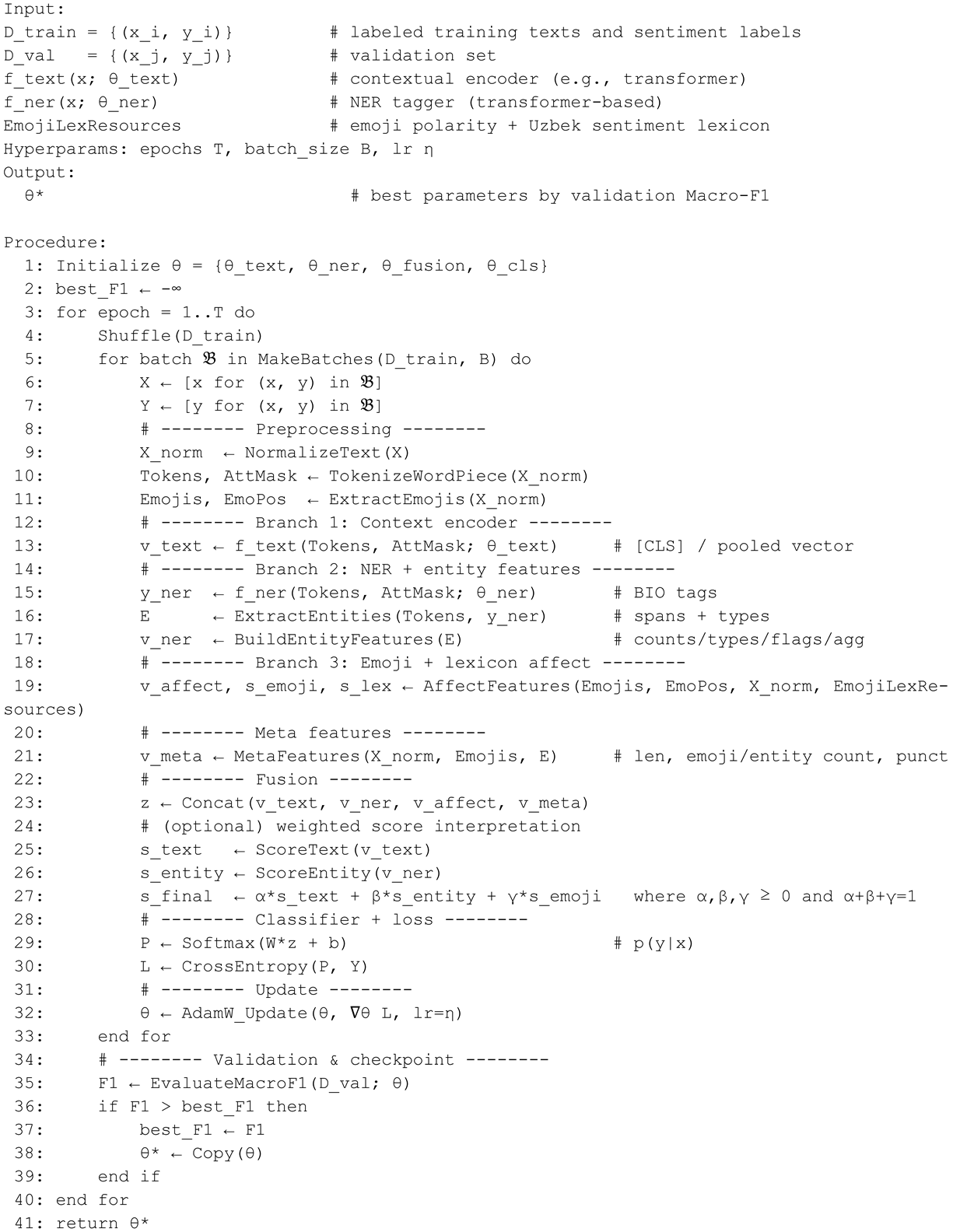
The full training procedure is described in Algorithm 2.
During inference, steps 4–11 are applied without gradient updates, producing POS/NEU/NEG predictions and optional entity-level explanations.
For neural baselines and the proposed hybrid model, optimization is performed with mini-batch training using AdamW, and hyperparameters are selected on the validation split. In the main configuration, we use a batch size of 32, train for 5 epochs, and fine-tune mDeBERTa-v3 (the hybrid text encoder) with a learning rate of 2 × 10⁻⁵ and weight decay 0.01. For transformer baselines (mBERT, XLM-RoBERTa-base, LaBSE), we apply the same optimization protocol for a controlled comparison. Dropout is set to 0.1 (selected on validation), and the maximum sequence length is capped at 128 tokens. We monitor validation Macro-F1 across epochs and apply early stopping with patience = 2 to reduce overfitting while keeping the training procedure deterministic (random seed = 42).
For evaluation, we report Accuracy and Macro-averaged Precision/Recall/F1 on the fixed 1000-sentence benchmark set. This held-out test subset is kept constant across all experiments to ensure a fair comparison among the four models. All experiments were executed on a workstation equipped with an NVIDIA RTX 4070 (8 GB) GPU, an Intel Core i7-12700 CPU, and 32 GB RAM.
We additionally evaluate the sensitivity of the pipeline to Uzbek morphological normalization by running controlled ablations:
- (i)
- full preprocessing (alphabet unification + normalization pairs + lemmatization);
- (ii)
- without lemmatization (surface tokens);
- (iii)
- without informal normalization pairs.
This isolates the contribution of morphology-aware preprocessing for an agglutinative language.
Finally, the synthetic datasets used in this study were prepared under the same controlled generation and validation workflow as that applied to the released resources associated with our prior data publications (the 12,000 + 3000 dual-source corpora and the 10,000 multi-source package), which are currently at the final publication stage. This alignment ensures that the reported benchmark results reflect the behavior of the proposed modeling approach rather than dataset noise or inconsistencies. Table 7 summarizes the main hyperparameters used for training and selecting the best hybrid checkpoint under the fixed experimental protocol.
Finally, the combined effect of adding target-aware NER signals and emoji-based emotion cues is summarized (text-only → +NER → +emoji). The final comparison against baseline systems, including the proposed hybrid model, is reported in the results section, demonstrating the advantage of integrating these complementary signals within a single pipeline.
| Algorithm 2. Training Procedure for the Hybrid Sentiment + NER Model. |
 |
Reproducibility details. For all neural runs, we fix random seeds (Python 3.13.9, NumPy 2.4.1, PyTorch 2.7.0) and keep identical preprocessing across splits. Early stopping is applied based on validation Macro-F1 with a fixed patience p, and the best checkpoint is selected by the same criterion. To stabilize fine-tuning, we cap the maximum sequence length at 128 tokens, apply dropout (0.1–0.2), and use weight decay (0.01). In addition, we enforce strict leakage prevention: near-duplicate texts and texts from the same discussion thread are not allowed to appear across train/validation/test partitions. Training dynamics (loss and validation Macro-F1 across epochs) are provided in Figure 3.
Figure 3.
Training dynamics of the hybrid model (Validation Macro-F1 vs. Epoch).
3.7. Computational Complexity and Inference Cost
This section summarizes the computational footprint of the proposed hybrid pipeline to clarify the accuracy–cost trade-off. Let n be the number of subword tokens in a text, d the hidden size, and L the number of transformer layers. For transformer-based encoders, the dominant cost in inference is self-attention, which scales as
while the remaining feed-forward and projection operations are typically lower-order terms relative to attention for moderate-to-long sequences.
In our hybrid approach, the overall inference cost can be decomposed into
- (i)
- contextual encoding;
- (ii)
- NER tagging and entity-feature construction;
- (iii)
- emoji/lexicon affect extraction;
- (iv)
- fusion + classification. The affect module is lightweight and approximately linear in the number of matched emoji/lexicon entries, while entity feature construction is linear in the number of extracted entities.
Therefore, the additional overhead of the hybrid model is dominated by the NER branch if it is computed with a separate transformer pass. If encoder sharing or multi-task reuse is enabled, the incremental cost becomes significantly smaller because the same contextual states can be reused for both sentiment and NER heads.
Overall, the fusion and classifier layers add negligible computation compared to the transformer backbone, while providing measurable gains in robustness and interpretability via entity-aware and affect-aware cues.
To clarify the accuracy–cost trade-off, we provide a qualitative comparison of inference-time computational complexity for the main baselines and the proposed hybrid pipeline. Table 8 summarizes the dominant operations and the corresponding asymptotic complexity terms, highlighting that the additional overhead of the hybrid approach mainly depends on whether the NER component shares the transformer encoder.
Table 8.
Qualitative comparison of inference complexity.
Importantly, the computational overhead is justified in monitoring scenarios where higher reliability and target-aware explanations (entity-level cues) are required.
3.8. Training Configuration for Reproducibility
To ensure full reproducibility, Table 9 summarizes the complete configuration used for transformer-based models, the proposed hybrid classifier, and the classical baselines (TF-IDF + SVM/LR/NB).
Table 9.
Training and optimization settings (reproducibility recipe).
4. Results
This section reports experimental results for evaluating the proposed hybrid model. All models are evaluated on the same fixed 1000-sentence held-out benchmark set (Table 3) to ensure a fair comparison. Test-set composition. The fixed 1000-sentence benchmark set is sampled exclusively from the user-generated social-media subset (100% UGC) and reflects real informal Uzbek discourse. It is held out from training and used only for final evaluation; due to privacy constraints and platform redistribution terms, the raw texts of this benchmark are not publicly redistributed.
4.1. Multi-Seed Stability Analysis
To assess robustness with respect to random initialization and stochastic optimization, we conducted a multi-seed stability check for the three most critical models: the proposed hybrid model, mDeBERTa-v3 (strongest text-only baseline), and XLM-RoBERTa-base (second strongest baseline). Each model was trained three times under identical conditions using random seeds 42, 123, and 456 (9 runs in total). All hyperparameters, preprocessing steps, and the train/validation/test protocol were kept fixed.
Table 10 reports per-seed results and the mean ± standard deviation across seeds. The standard deviation of Macro-F1 remains at or below 0.001 for all three models, indicating that the reported improvements are stable across random initializations rather than being an artifact of a particular seed. The hybrid model consistently outperforms mDeBERTa-v3 in every run (mean Macro-F1: 0.920 ± 0.001 vs. 0.889 ± 0.001), with an average gain of approximately +0.031 Macro-F1 that is preserved across all seeds. The ordering between mDeBERTa-v3 and XLM-RoBERTa-base is also stable across seeds. These findings support the conclusion that the performance advantage of the proposed hybrid architecture is robust to random variation.
Table 10.
Multi-seed stability check for the three key models (seeds: 42, 123, 456).
4.2. Model Comparison (Baselines vs. Proposed Hybrid)
We first evaluate six text-only sentiment baselines—SVM (bag-of-words), LSTM, mBERT, XLM-RoBERTa-base, mDeBERTa-v3, and LaBSE—which serve as reference models for assessing the contribution of NER and emoji/lexicon signals in the proposed hybrid approach.
As shown in Table 11, the proposed hybrid model achieves the best overall performance, outperforming all text-only baselines. Among transformer baselines, mDeBERTa-v3 yields the strongest Macro-F1 (0.89), followed by mBERT/XLM-RoBERTa-base (0.87) and LaBSE (0.85). The hybrid model improves over the best transformer baseline by +0.03 Macro-F1 (0.92 vs. 0.89) and over mBERT by +0.05 Macro-F1 (0.92 vs. 0.87).
Table 11.
Overall sentiment classification performance on the fixed 1000-sentence test set (Macro-averaged Precision/Recall/F1).
Ablation analysis. Table 12 isolates the contribution of entity cues and emoji/lexicon affect signals relative to the strongest text-only transformer baseline (mDeBERTa-v3). The results show that each signal stream provides an incremental benefit, and the full hybrid model achieves the best Macro-F1, indicating that entity-aware target cues and emoji-based affect cues are complementary rather than redundant for Uzbek short-text sentiment classification.
Table 12.
Ablation study of the proposed hybrid model on the fixed 1000-sentence test set (Macro-F1).
Statistical Significance of the Improvements
We assessed the statistical significance of the +0.03 Macro-F1 improvement using a paired bootstrap test with 10,000 resamples (with replacement) on the fixed 1000-sentence test set. For each resample, we recalculated Macro-F1 for both the full hybrid model and the strongest text-only baseline (mDeBERTa-v3) and recorded the difference (ΔMacro-F1). The resulting 95% confidence interval for ΔMacro-F1 was [0.009, 0.052], excluding zero. The proportion of bootstrap differences ≤ 0 was 0.008, corresponding to p = 0.008 for a one-sided test under the a priori hypothesis that the hybrid model improves over the baseline; the corresponding two-sided value is p = 0.016. Therefore, the improvement is statistically significant (p < 0.05), supporting that the hybrid fusion yields a reliable performance gain over a strong multilingual transformer baseline on this benchmark. We report both confidence intervals and p-values because they provide complementary evidence of effect size and robustness.
As shown in Figure 4, the proposed hybrid approach consistently outperforms the compared baselines across all four evaluation metrics (Accuracy, Precision, Recall, and Macro-F1) on the fixed 1000-sentence test set. Among the transformer-only baselines, mDeBERTa-v3 yields the strongest overall performance, followed by mBERT/XLM-RoBERTa and LaBSE, while classical SVM and LSTM remain behind. The observed gains indicate that integrating entity-aware features and emoji/lexicon affect cues improves not only Macro-F1 but also the balance between precision and recall, leading to more reliable sentiment predictions on Uzbek short texts.
Figure 4.
Performance comparison of classical and multilingual transformer baselines versus the proposed hybrid model (1000-sentence test set).
Figure 5 provides a comprehensive visual comparison of all seven evaluated models—SVM, LSTM, mBERT, XLM-RoBERTa-base, mDeBERTa-v3, LaBSE, and the proposed hybrid model—in terms of Macro-F1 score on the fixed 1000-sentence held-out test set. The figure clearly illustrates the progressive improvement from classical machine learning approaches to multilingual transformer-based encoders, and ultimately to the proposed hybrid architecture, which achieves the highest Macro-F1 of 0.92.
Figure 5.
Macro-F1 comparison of SVM, LSTM, mBERT, XLM-RoBERTa-base, mDeBERTa-v3, LaBSE, and the proposed hybrid model on the fixed 1000-sentence test set.
4.3. Impact of NER on Classification Quality
We next analyze the contribution of named-entity information to sentiment classification. In Uzbek online discourse, sentiment is frequently expressed toward a concrete target (e.g., a person, organization, service, product, or an official position), and ignoring this target structure can lead to systematic errors: general-positive words may be misread as positive even when directed at a negatively described entity, or complaints may be misclassified when the negative polarity is tied to a specific institution or product mention. Therefore, the proposed pipeline integrates the outputs of the NER module—entity spans and types (PER, ORG, LOC, DATE, PRO, POSITION)—as additional signals that help the model disambiguate who or what the emotion refers to.
Impact quantified by ablation. As shown in Table 12, adding NER cues improves Macro-F1 from 0.89 (text-only mDeBERTa-v3) to 0.91 (+0.02), while adding emoji/lexicon affect alone yields 0.90 (+0.01). The full hybrid model achieves 0.92, indicating that NER-derived target cues and emoji-based affect signals contribute additively and capture complementary information in Uzbek short-text sentiment classification.
Importantly, NER in our setup is not used as a standalone decision rule; instead, it acts as a structural cue that complements contextual semantics. In our implementation, NER outputs are encoded as entity-type and mention-structure features and are fused with contextual embeddings and affect signals in the final decision stage. This design makes the model more robust to informal spelling variation, code-mixing, and agglutinative surface forms typical for Uzbek texts, because the final prediction can rely on both contextual embedding evidence and entity-aware target cues.
Qualitative error patterns (why NER helps). The largest gains from NER cues are observed in target-dependent sentiment constructions, where polarity words (e.g., “good”, “bad”, “problem”, “delay”) are only interpretable relative to a mentioned entity (PER/ORG/PRO/POSITION). In such cases, text-only models can over-rely on global polarity keywords and misattribute sentiment when multiple entities are present in the same sentence (e.g., praising one target while criticizing another). By injecting entity-type and mention-structure information, the hybrid model reduces target-misattribution errors and improves precision–recall balance in noisy Uzbek social-media text, especially under informal spelling variation and code-mixing.
4.4. The Role of Emoji as an Additional Emotional Signal
Uzbek social media are characterized by frequent and expressive emoji usage. Emoji often reinforce sentiment, resolve ambiguity, or encode irony in short messages where lexical cues are sparse. In particular, many user comments are short, conversational, and rely on emoji to carry the dominant affect (e.g., a neutral statement accompanied by 😡 or 😍). Ignoring emoji therefore risks distorting the emotional background of the message and underestimating polarity intensity.
To capture this channel, we incorporate an emoji processing component built on two curated resources:
- (i)
- a lexicon of approximately 2000 single emoji with polarity/intensity scores;
- (ii)
- an inventory of approximately 16,000 multi-emoji combinations, which allows the model to represent mixed emotions and amplification effects expressed by 2–4 emoji sequences.
Overall, incorporating emoji-based affect signals yields a modest but consistent improvement of approximately 1–2 Macro-F1 points on informal texts, and contributes most effectively when combined with entity-aware cues in the full hybrid configuration.
Finally, the combined effect of adding target-aware NER signals and emoji-based emotion cues is summarized in Figure 6 (text-only → +NER → +emoji). The corresponding ablation results are reported in Table 12, while the full baseline comparison is provided in Table 11.
Figure 6.
Cumulative (step-wise) effect of hybrid components on Macro-F1 on the fixed 1000-sentence test set (text-only → +emoji/lexicon → +NER → full hybrid). The full configuration achieves the highest Macro-F1 (0.92), indicating complementary contributions from entity cues and affect signals.
4.5. Final Hybrid Model
At the final stage, we combine all complementary signals within a single hybrid pipeline:
- (i)
- contextual semantics from the mDeBERTa-v3 text encoder;
- (ii)
- entity-target information produced by the NER module (PER, ORG, LOC, DATE, PRO, POSITION);
- (iii)
- emoji- and lexicon-based emotion cues (single emoji and multi-emoji combinations);
- (iv)
- normalization and shallow metadata features (e.g., token count).
This design reflects the structure of Uzbek online discourse, where sentiment is shaped by both contextual meaning and target-oriented, emoji-driven affect.
On the fixed 1000-sentence benchmark set, the proposed hybrid model achieves the best overall performance (Macro-F1 = 0.92), outperforming all baseline systems. In particular, it improves upon the strongest text-only baseline (mDeBERTa-v3, Macro-F1 = 0.89) by +0.03 Macro-F1, highlighting the benefit of integrating target-aware NER and emoji/lexicon emotion signals in addition to contextual embeddings. The final comparative results are reported in Table 11, while the cumulative contribution of the hybrid components is illustrated in Figure 6.
Table 13 provides both simple polarity examples and target-aware cases (mixed cues, sarcasm markers, multi-entity sentences) to illustrate interpretability.
Table 13.
Examples of Uzbek sentences and predicted sentiment (with target entities).
While aggregate metrics (Table 11) quantify overall performance differences across baseline systems and the proposed hybrid model, Figure 6 illustrates the step-wise contribution of hybrid components. However, qualitative inspection remains essential to understand why auxiliary signals help on Uzbek informal texts. In Table 13, we present representative examples showing
- (i)
- emoji-mediated polarity shifts;
- (ii)
- mixed sentiment within a single message;
- (iii)
- target-aware sentiment assignment when multiple entities are mentioned.
This qualitative view complements the quantitative evaluation and motivates the error analysis in Section 4.6.
4.6. Error Analysis and Limitations
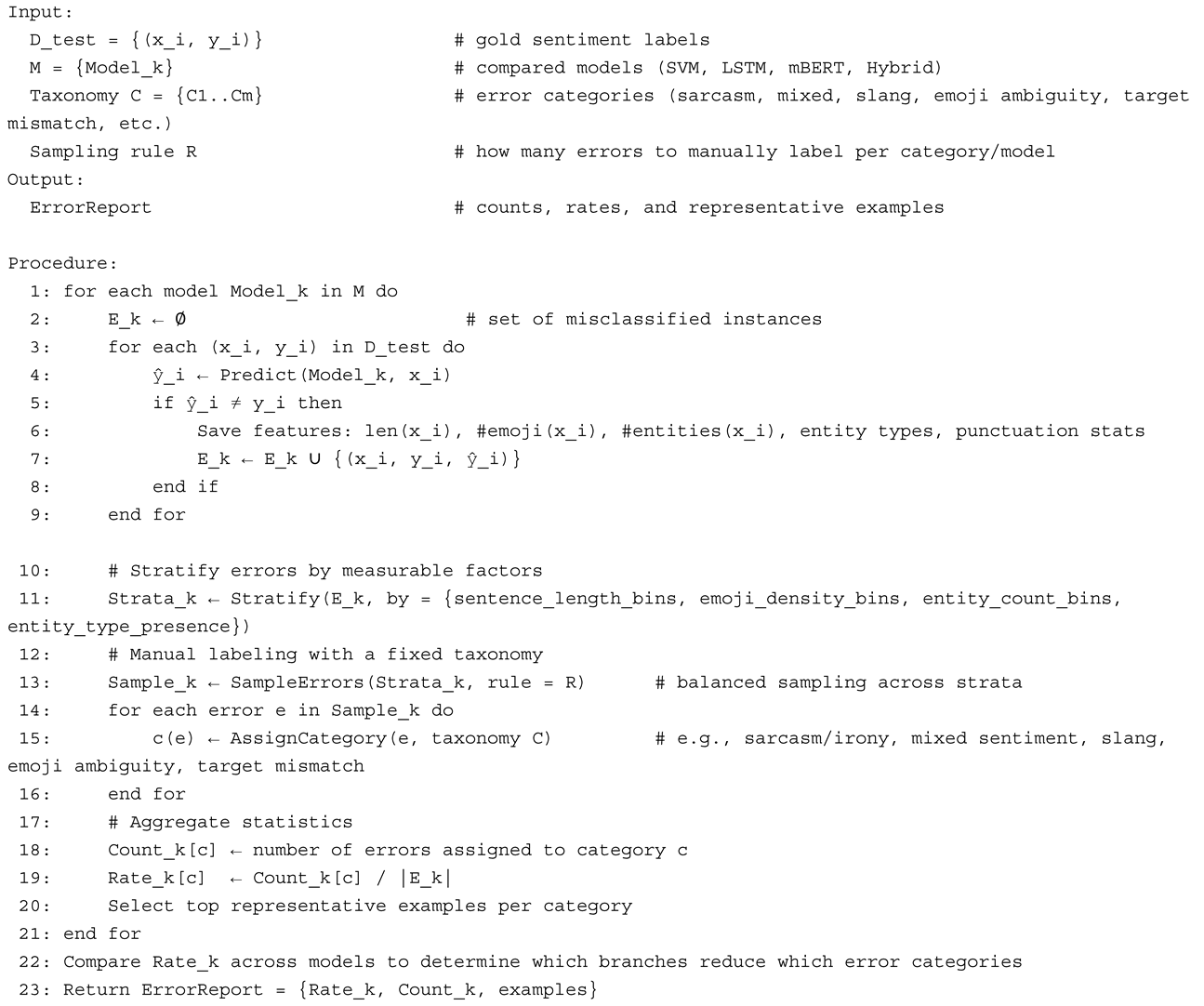
To ensure transparency and reproducibility, we analyze the model’s failures using a structured protocol rather than relying on anecdotal examples. The goal is to identify systematic error patterns (e.g., sarcasm, mixed sentiment, target mismatch) and to quantify which error types are mitigated by the entity-aware and affect-aware branches.
Using Algorithm 3, we obtain a reproducible taxonomy of failures and quantify how different input characteristics (sentence length, emoji density, and entity presence) correlate with misclassification. The stratification step ensures that the qualitative inspection is not biased toward a single style of errors, while the fixed category set allows consistent comparisons across models.
In the remainder of this section, we report the aggregated distribution of error categories and provide representative examples, with particular emphasis on cases where the hybrid branches (entity-aware and affect-aware features) reduce errors and on cases that remain challenging (e.g., sarcasm, implicit polarity, and multi-target statements).
Beyond aggregate scores, we performed a qualitative error analysis on short and noisy Uzbek social-media texts to identify typical failure modes and to understand where the hybrid signals provide the most benefit. The remaining errors are mainly associated with
- (i)
- sarcasm/irony;
- (ii)
- mixed sentiment within a single sentence;
- (iii)
- cases where entity-level polarity differs from the overall sentence polarity;
- (iv)
- ambiguous emoji usage that is highly context-dependent.
As shown in Table 14, the hybrid design is particularly beneficial for cases where sentiment is expressed indirectly (sarcasm/irony) or depends on the target entity (mixed sentiment). At the same time, some categories remain challenging—especially when pragmatic cues conflict or when polarity is implicit—suggesting that further gains may require stronger discourse modeling and richer context beyond short-text inputs.
Table 14.
Main error categories observed in Uzbek short texts and the contribution of hybrid signals.
| Algorithm 3. Error Analysis Protocol (Reproducible Failure Taxonomy). |
 |
To illustrate typical cases, we inspected examples where text-only baselines produced unstable or incorrect predictions and compared them to the hybrid model.
- Case 1—Sarcasm with implicit negativity.
- Text: “Zo’r xizmat ekan 😏”
- Text-only (mBERT): Positive → Hybrid: Negative/critical.
In our audit, 😏 frequently indicates ironic dissatisfaction. The hybrid model is less prone to treating “zo’r” as purely positive because emoji-based cues counterbalance literal lexical polarity.
- Case 2—Entity-level sentiment differs from sentence-level sentiment.
- Text: “Botirali Axmedov yaxshi qaror qildi, lekin xizmat juda sekin 😡”
- Text-only: Negative for the entire sentence → Hybrid: PER positive; service-related target negative.
The hybrid model uses NER to separate targets, preventing a single strong negative emoji from dominating the polarity assigned to all entities.
- Case 3—Mixed polarity in short reviews.
- Text: “Restoran yaxshi, lekin yetkazib berish juda yomon 😞”
- Text-only: Neutral/unstable → Hybrid: restaurant positive; delivery negative.
NER helps preserve polarity contrast across targets, while the emoji provides an additional negative cue for the complaint part.
- Case 4—Context-dependent emoji ambiguity.
- Text: “Bugun hammasi yaxshi o‘tdi 😐”
- Text-only: Positive → Hybrid: Neutral or slightly negative.
In short messages, 😐 often expresses indifference rather than positivity; the hybrid model mitigates overconfident positive predictions by combining emoji priors with contextual evidence.
Limitations. Despite improvements, the model can still fail in cases of subtle sarcasm without emoji cues, complex multi-clause discourse with multiple implicit targets, and domain-specific slang not covered by the normalization pairs or lexicons. Future work will focus on expanding domain lexicons, modeling discourse-level context, and adding dedicated sarcasm/irony supervision to further improve robustness and interpretability.
Limitations and reproducibility considerations. Because raw user-generated texts cannot be publicly redistributed, some parts of the evaluation rely on a private benchmark. This limitation prevents exact third-party replication on identical test items. To mitigate this, we release the public components of the dataset, the labeling schema, and the full training configuration, and we report controlled ablation studies and statistical significance tests to support the robustness of the reported improvements. Future work should validate the approach on additional fully public Uzbek social-media corpora and explore privacy-preserving releases (e.g., de-identified or paraphrased test sets) where legally feasible.
In Uzbek informal discourse, a subset of emoji (e.g., 😏, 🙃, 😞) often function as pragmatic markers that can signal irony or disagreement with the literal lexical meaning. To reduce systematic misclassifications in such cases, we apply a sarcasm-aware reweighting heuristic: when an irony marker is detected in the emoji set, the contribution of lexically positive cues is attenuated, and the prediction is adjusted toward the emoji-derived affect prior. The strength of this adjustment is tuned on the validation split to maximize Macro-F1. This heuristic helps avoid overly literal interpretations of examples such as “Zo‘r xizmat 😏”, where the word “Zo‘r” is positive but the pragmatic emoji indicates negative intent.
4.7. Evaluation on Real-World Domain Data
To assess practical applicability, we performed an out-of-domain check on real texts from three independent domains: public-service feedback, product/service reviews, and tourism/hotel comments. These sources differ in writing style, topical vocabulary, and emoji density, allowing us to probe the robustness of the hybrid pipeline beyond curated benchmark data.
Across all three domains, qualitative inspection shows that the hybrid model is more stable than text-only baselines in
- (i)
- short informal messages;
- (ii)
- mixed-polarity statements;
- (iii)
- cases where sentiment is directed toward specific targets (employees, organizations, services, or PROs).
In public-service feedback, target-aware NER signals help separate sentiment toward a service or agency from sentiment toward an individual. In commercial reviews, emoji cues (e.g., ❤️, 🤩, 😡) often provide decisive polarity evidence when lexical content is minimal. In tourism/hotel comments, where emoji density is high, the hybrid model more reliably captures emotional nuance and supports entity-linked interpretation (LOC, ORG/POSITION).
Overall, this real-world check suggests that the proposed approach generalizes well to practical monitoring scenarios and provides interpretable outputs by combining contextual semantics, entity targets, and emoji-based affect signals—an advantage for public opinion analytics, citizen feedback monitoring, and review-based recommendation systems.
5. Discussion
The results confirm that for Uzbek informal online texts, sentiment classification benefits substantially from integrating target-aware and multimodal signals. In particular, combining contextual semantics, named-entity information (PER/ORG/LOC/DATE/PRO/POSITION), and emoji/lexicon-based emotion cues yields a clear improvement over text-only baselines. As shown in Table 11, the proposed hybrid model achieves Macro-F1 = 0.92 on the fixed benchmark, surpassing the strongest text-only baseline (mDeBERTa-v3, Macro-F1 = 0.89). Figure 6 further summarizes the step-wise contribution of the hybrid components, indicating that NER-derived target cues and emoji/lexicon affect signals provide complementary improvements when fused with contextual representations.
In comparison with prior sentiment-analysis studies for Uzbek and other low-resource or agglutinative languages, two aspects are noteworthy.
Comparison to prior Uzbek SA benchmarks. Earlier Uzbek sentiment datasets and baselines frequently focus on binary polarity and report Accuracy in the mid-to-high 80s or low 90s depending on domain and preprocessing choices (e.g., app reviews, restaurant reviews, YouTube movie comments).
In contrast, our evaluation is intentionally stricter: we use a three-class setup (POS/NEG/NEU) and report Macro-F1 on a fixed 1000-sentence UGC benchmark, where neutral and mixed-cue texts are substantially harder. Therefore, rather than claiming one-to-one superiority over prior binary setups, we emphasize controlled comparisons within the same protocol: under identical data and evaluation settings, the proposed hybrid model improves over strong transformer baselines (Table 11) and yields statistically supported gains (Section Statistical Significance of the Improvements).
First, many existing approaches rely on lexicon-based features or classical machine-learning models that are sensitive to spelling variation and do not explicitly model sentiment targets.
Second, even neural approaches often focus on document-level polarity only, without establishing a robust object–emotion connection.
Our work addresses this gap by integrating a transformer-based encoder with an NER component and an explicit emoji/lexicon channel, enabling both improved classification and more informative target-aware analysis for applied monitoring tasks.
From an applied perspective, target-aware sentiment is especially valuable for public-opinion and service-quality analytics, where it is crucial to separate criticism of a service from criticism of a specific official, or to distinguish positive feedback about a brand from feedback about a particular branch or product. In addition, the modular resources accompanying this work (emoji lexicon, emoji combinations, normalization pairs, and curated gazetteers) support reproducibility and facilitate further research and industrial deployment.
We note that parts of the raw social-media collection are not redistributed due to platform/privacy constraints; however, the released modules and synthetic/curated resources enable controlled and FAIR-oriented experimentation.
Synthetic data are used to ensure reproducibility and coverage of rare entity/emotion configurations that are underrepresented in real corpora. At the same time, we explicitly validate the trained models on real multi-domain texts (public services, commerce, tourism), showing that the hybrid model retains high Macro-F1 under domain shifts, which mitigates concerns about overfitting to synthetic patterns.
A practical direction for improving sarcasm robustness is expanding Eirony (emoji + discourse markers such as “ha endi”, “zo‘r-da”, “gap yo‘q” in ironic contexts) and learning the gate parameter γ on weakly labeled sarcasm data. This preserves the interpretability of the hybrid approach while addressing a major remaining error source.
To complement the qualitative taxonomy in Table 13, we provide a compact diagnostic view of classification behavior on the fixed 1000-sentence benchmark. The aim is to show not only which error types occur, but also how they manifest across classes and entity contexts.
As shown in Figure 7, the polarity-score baseline exhibits substantial confusion between NEU and the polar classes, which is consistent with the ambiguity of short Uzbek social-media texts where sentiment cues are often implicit. The per-class F1 profile and the true–predicted distribution highlight the imbalance in predicted labels and the tendency to over-/under-predict certain classes. Finally, the entity-type error share suggests that errors frequently occur in sentences containing named entities, supporting the motivation for incorporating entity-aware features and hybrid fusion mechanisms in the proposed model.
Figure 7.
Diagnostic analysis of the polarity-score baseline on the fixed 1000-sentence test set: confusion matrix, per-class F1, true vs. predicted label distribution, and entity-type error share (misclassified samples).
Limitations and future work. Despite the improvements, the system remains challenged by subtle sarcasm without explicit emoji cues, complex multi-clause discourse with implicit sentiment targets, and domain-specific slang not covered by the current normalization and lexicon resources.
Future work will focus on
- (i)
- expanding the entity taxonomy and moving toward aspect-level sentiment (e.g., service speed, price, quality);
- (ii)
- improving robustness to irony via dedicated supervision or discourse-level modeling;
- (iii)
- exploring cross-linguistic transfer to other Turkic languages as a promising direction for broader applicability.
Web-Based AI Assistant and Explainability Layer
To make the hybrid model accessible to non-technical stakeholders, we implemented a lightweight web-based assistant that converts raw outputs (document-level sentiment, entity spans/types, and target-aware sentiment cues) into structured natural-language explanations. The assistant highlights which entities contribute to the decision, how emoji signals affect polarity, and where the model is uncertain (e.g., mixed cues or potential sarcasm).
The assistant is deployed as a simple web application (FastAPI + Uvicorn) with a browser UI. It visualizes color-coded entity badges (PER/ORG/LOC/DATE/PRO/POSITION), provides per-entity polarity summaries, and allows exporting results as JSON/CSV for downstream auditing and dashboard integration. This layer improves transparency and supports practical workflows such as citizen-appeal triage, service-quality monitoring, and tourism-review analytics.
Figure 8 illustrates the user-facing assistant layer of the system. It visualizes extracted named entities (PER/ORG/LOC/DATE/PRO/POSITION), reports the document-level sentiment, and provides a structured explanation of how entity and emoji signals influence the final decision. The interface also supports exporting outputs (JSON/CSV) for auditing and downstream analytics.
Figure 8.
Web-based assistant interface for the proposed hybrid model.
The UI highlights extracted entities (PER/ORG/LOC/DATE/PRO/POSITION), reports document-level sentiment, and provides a short natural-language explanation of how entity and emoji signals contribute to the decision.
6. Conclusions
This paper presented a hybrid sentiment analysis framework for Uzbek that jointly leverages contextual representations, named-entity cues, and emoji/lexicon-based emotion signals to better handle short, informal online texts. To enable systematic training and evaluation, we developed a multi-source resource base comprising an expert-labeled set of 10,000 texts, an extended NER taxonomy (PER/ORG/LOC/DATE/PRO/POSITION), curated gazetteers, an emoji lexicon of approximately 2000 single emoji, an inventory of about 16,000 emoji combinations, and a normalization layer targeting common non-standard Uzbek spellings.
Empirically, the results show that injecting entity-aware and emoji-informed features leads to consistent gains over strong text-only baselines. On the fixed 1000-sentence benchmark, the proposed hybrid model achieves the best overall performance (Macro-F1 = 0.92), outperforming the strongest transformer-only baseline (mDeBERTa-v3, Macro-F1 = 0.89) as well as other multilingual encoders such as XLM-RoBERTa-base (Macro-F1 = 0.87), mBERT (Macro-F1 = 0.87), and LaBSE (Macro-F1 = 0.85). These findings indicate that target-aware modeling and explicit affect cues are important for Uzbek digital discourse, where sentiment is frequently expressed through entity references, short constructions, and pragmatic emoji usage.
From an application standpoint, the proposed pipeline is well suited to practical monitoring scenarios such as public-opinion analytics, citizen feedback processing, and large-scale review mining in domains including public services, commerce, and tourism. Beyond document-level polarity, the integration of NER enables target-aware interpretation by associating sentiment evidence with extracted entities, thereby increasing the usefulness of model outputs for downstream analytics and decision support.
Limitations and future work. The current system is constrained by (i) the coverage of the entity and aspect inventory, (ii) remaining difficulty with subtle sarcasm/irony—especially when explicit emoji markers are absent, and (iii) the predominance of informal online discourse in the available data. Future work will expand the entity and aspect taxonomy toward aspect-level sentiment, strengthen irony robustness via discourse-aware modeling and/or dedicated supervision, and investigate transfer to other Turkic languages. We also plan to advance end-to-end deployment by integrating the hybrid pipeline into analytical dashboards for near real-time monitoring.
7. Patents
The developed software has been registered in the state register of software PROs of the Republic of Uzbekistan under the law on legal protection of software and databases. Registration certificate: No. DGU 56841 (application No. DT 202510227; submitted 17 November 2025; registered 28 November 2025). The registered title is “O‘zbek tilidagi matnlar uchun gibrid nomlangan obyektlarni aniqlash va sentiment tahlili dasturi.”. The registration covers the implemented software package including the hybrid inference pipeline and supporting lexical resources used for Uzbek NER and sentiment analysis.
8. Practical Implementation and Deployment
The results of this study were practically verified and confirmed by official implementation documents. The proposed hybrid mood model and NER, together with the developed lexicons, were integrated into several real-world Uzbek-language analytics scenarios.
First, the model was deployed in the system for processing applications from citizens of the government of the Gurlan region (Khokimiyat) in the Khorezm region of Uzbekistan. According to the official act of implementation, the hybrid model improved the accuracy of mood-based case classification and reduced average processing time by automatically extracting named entities and mood labels from appeals.
Second, the system was used by the Khorezm Regional Tourism Committee to analyze user reviews and comments on tourist routes, hotels and services in the Khiva tourist region. The implementation report notes that the hybrid architecture has improved the quality of analytical reports for tourism organizations and administrative authorities by more accurately identifying positive and negative aspects in short, informal and rich emoji comments.
Third, the model was tested on the WAYU (World Youth Association of Uzbekistan) platform, where it was applied to comments, reviews and short texts of students in Uzbek. The report highlights measurable improvements in processing speed and classification accuracy, as well as the model’s resilience to spelling change, informal writing and mixed style.
These implementations demonstrate that the developed hybrid model has real practical value and can be integrated into government, commercial and youth-oriented analytical systems for large-scale public opinion monitoring and user feedback.
Author Contributions
Conceptualization, B.S. and V.B.; Methodology, B.S. and V.B.; Software, B.S.; Data curation, B.S., R.S., Z.N., R.M., R.Z., and A.A.; Validation, B.S., R.S., and Z.N.; Formal analysis, B.S. and V.B.; Investigation, B.S., R.S., Z.N., R.M., R.Z., and A.A.; Resources, R.S., Z.N., R.M., R.Z., and A.A.; Visualization, B.S.; Writing—original draft, B.S.; Writing—review and editing, V.B., R.S., Z.N., R.M., R.Z., and A.A.; Supervision, V.B.; Project administration, B.S. and V.B. All authors have read and agreed to the published version of the manuscript.
Funding
This research was partially supported by the state assignment of the Ministry of Science and Higher Education of the Russian Federation for the Federal Research Center for Information and Computational Technologies. The funding number is not applicable/was not provided for this state assignment. The APC was self-funded by the authors.
Institutional Review Board Statement
Not applicable. This study did not involve human or animal subjects requiring ethical approval.
Informed Consent Statement
Not applicable. This study used publicly available social-media texts and synthetic data; no personal identifiers were collected or analyzed.
Data Availability Statement
The public components of the dataset (synthetic and linguist-curated data), the annotation schema, and supporting resources are available on Mendeley Data at the following DOIs: 10.17632/khnmnp4t7v.5 and 10.17632/y2d5pcyrzz.3. The first release (“A Multi-Source Synthetic Dataset for Uzbek Sentiment Analysis, Named Entity Recognition, and Normalization”, v5) provides a modular synthetic package including a 10,000-record annotated corpus and auxiliary resources (emoji lexicons, emoji combinations, normalization pairs, and gazetteers). The second release (“Dataset for Sentiment and Named Entity Analysis in Uzbek Texts”, v3) provides dual-source corpora prepared for reproducible benchmarking (Hybrid subset: 12,000; Manual-style subset: 3000). Aggregated corpus statistics and the full experimental protocol are provided in the manuscript to enable replication on alternative public Uzbek corpora. The broader raw multi-source collection described in this paper (≈45,000 texts), including ≈20,000 social-media-derived records, is used only internally for sampling and domain validation and is not redistributed due to privacy/ethical constraints. Due to privacy constraints and platform redistribution terms, the raw user-generated social-media texts—including the fixed 1000-sentence held-out benchmark set, which is 100% UGC—are not publicly redistributed. Code Availability Statement: The implementation (training scripts, inference pipeline, and FastAPI web demo) used in this study is available as an open repository at: https://github.com/Bobur9629/uzbek-hybrid-ner-sentiment-api (accessed on 11 January 2026).
Acknowledgments
The first author acknowledges the academic and research support provided by the El-Yurt Umidi Foundation (Uzbekistan); this support did not involve direct financial funding for this specific study and did not influence the study design, experiments, or the reported results. AI assistance was used solely for language editing. During the preparation of this manuscript, the authors used ChatGPT (GPT-5.2, OpenAI) only for grammar and spelling checks and not for study design, data collection, data labeling, model training, statistical analysis, or interpretation of results. All scientific content, analyses, and conclusions were produced and verified by the authors, who take full responsibility for the publication.
Conflicts of Interest
The authors declare no conflicts of interest.
Abbreviations
The following abbreviations are used in this manuscript:
| Abbrev. | Full Form/Meaning |
| AI | Artificial Intelligence |
| NLP | Natural Language Processing |
| ML | Machine Learning |
| NER | Named Entity Recognition |
| SVM | Support Vector Machine |
| LSTM | Long Short-Term Memory |
| mBERT | Multilingual BERT |
| XLM-RoBERTa base | XLM-RoBERTa (Cross-lingual Language Model–RoBERTa) |
| mDeBERTa-v3 | Multilingual DeBERTa version 3 (Decoding-enhanced BERT with Disentangled Attention) |
| LaBSE | Language-agnostic BERT Sentence Embedding |
| POS | Positive sentiment labels |
| NEG | Negative sentiment labels |
| NEU | Neutral sentiment labels |
| PER | Person (entity type) |
| ORG | Organization (entity type) |
| LOC | Location (entity type) |
| DATE | Date (entity type) |
| PRO | Product (entity type) |
| POS | Position/Title (entity type) |
| F1 | F1-score (harmonic mean of Precision and Recall) |
| Macro-F1 | Macro-averaged F1-score |
| Precision (P) | Precision metric |
| Recall (R) | Recall metric |
| Accuracy (Acc.) | Accuracy metric |
| DOI | Digital Object Identifier |
| CSV | Comma-Separated Values |
| XLSX | Microsoft Excel Open XML Spreadsheet |
| JSON | JavaScript Object Notation |
| JSONL | JSON Lines |
| UTF-8 | Unicode Transformation Format–8-bit |
| API | Application Programming Interface |
| UI | User Interface |
| FastAPI | FastAPI web framework |
| GPU | Graphics Processing Unit |
| CPU | Central Processing Unit |
| RAM | Random Access Memory |
| RTX | NVIDIA RTX GPU series (RTX 4070) |
| NVIDIA | NVIDIA Corporation |
| PyTorch | PyTorch deep learning framework |
| NumPy | Numerical Python library |
| FAIR | Findable, Accessible, Interoperable, Reusable principles |
| WAYU | World Youth Association of Uzbekistan |
| MDPI | Multidisciplinary Digital Publishing Institute |
References
- Cui, J.; Wang, Z.; Ho, S.-B.; Cambria, E. Survey on Sentiment Analysis: Evolution of Research Methods and Topics. Artif. Intell. Rev. 2023, 56, 8469–8510. [Google Scholar] [CrossRef] [Scilit]
- Birjali, M.; Kasri, M.; Beni-Hssane, A. A Comprehensive Survey on Sentiment Analysis: Approaches, Challenges and Trends. Knowl. Based Syst. 2021, 226, 107134. [Google Scholar] [CrossRef] [Scilit]
- Kuriyozov, E.; Matlatipov, S. Building a New Sentiment Analysis Dataset for Uzbek Language and Creating Baseline Models. Proceedings 2019, 21, 37. [Google Scholar] [CrossRef] [Scilit]
- Allomazarova, S.; Elova, D. Uzbek Texts Sentiment Analysis: Database Development. In Proceedings of the 2nd Pamir Transboundary Conference for Sustainable Societies (PAMIR 2023), Tashkent, Uzbekistan, 16–17 November 2023; pp. 744–747. [Google Scholar] [CrossRef] [Scilit]
- Ravikumar, R.N.; Aarthi, S.; Usmani, M.A.; Rai, P.K.; Jumaniyozova, M. Advancements in multilingual speech technologies for human–computer interaction. In Advancements in Speech Processing for Human–Computer Interaction; IGI Global: New York, NY, USA, 2025. [Google Scholar] [CrossRef] [Scilit]
- Kralj Novak, P.; Smailović, J.; Sluban, B.; Mozetič, I. Sentiment of Emojis. PLoS ONE 2015, 10, e0144296. [Google Scholar] [CrossRef] [Scilit] [PubMed]
- Rabbimov, I.; Mporas, I.; Simaki, V.; Kobilov, S. Investigating the Effect of Emoji in Opinion Classification of Uzbek Movie Review Comments. In Speech and Computer (SPECOM 2020); Springer: Cham, Switzerland, 2020; Volume 12335, pp. 435–445. [Google Scholar] [CrossRef] [Scilit]
- Li, J.; Sun, A.; Han, J.; Li, C. A Survey on Deep Learning for Named Entity Recognition. IEEE Trans. Knowl. Data Eng. 2022, 34, 50–70. [Google Scholar] [CrossRef] [Scilit]
- Yadav, V.; Bethard, S. A Survey on Recent Advances in Named Entity Recognition from Deep Learning models. In Proceedings of the 27th International Conference on Computational Linguistics (COLING 2018); Association for Computational Linguistics: Straussburg, PA, USA, 2018; pp. 2145–2158. Available online: https://aclanthology.org/C18-1182.pdf (accessed on 6 March 2026).
- Yusufu, A.; Jiang, L.; Ainiwaer, A.; Teng, C.L.; Li, F.; Ji, D. UZNER: A Benchmark for Named Entity Recognition in Uzbek. In Natural Language Processing and Chinese Computing; Springer: Cham, Switzerland, 2023; pp. 171–183. [Google Scholar] [CrossRef] [Scilit]
- Oltiboy, B.; Mansur, U.; Salimov, U.; Boboqulov, C.; Babayev, A. Optimizing Linguistic Outcomes in Education: A CRM-Based Structural Equation Modeling Approach. Forum Linguist. Stud. 2025, 7, 9383. [Google Scholar] [CrossRef] [Scilit]
- Kimura, M.; Katsurai, M. Investigating the Consistency of Emoji Sentiment Lexicons Constructed Using Different Languages. In Proceedings of the 20th International Conference on Information Integration and Web-Based Applications & Services (iiWAS2018); ACM: Yogyakarta, Indonesia, 2018; pp. 310–313. [Google Scholar] [CrossRef] [Scilit]
- Abdurakhmonova, N.; Ismailov, A.; Sayfulleyeva, R. MorphUz: Morphological Analyzer for the Uzbek Language. In UBMK 2022; IEEE: Piscataway, NJ, USA, 2022. [Google Scholar] [CrossRef] [Scilit]
- Fetahu, B.; Fang, A.; Rokhlenko, O.; Malmasi, S. Gazetteer-Enhanced Named Entity Recognition for Code-Mixed Web Queries. In Proceedings of the 44th International ACM SIGIR Conference on Research and Development in Information Retrieval (SIGIR ’21); ACM: New York, NY, USA, 2021; 5p. [Google Scholar] [CrossRef] [Scilit]
- Toledo-Ronen, O.; Orbach, M.; Katz, Y.; Slonim, N. Multi-Domain Targeted Sentiment Analysis. In Proceedings of the 2022 Conference of the North American Chapter of the Association for Computational Linguistics: Human Language Technologies (NAACL-HLT 2022); Association for Computational Linguistics: Seattle, WA, USA, 2022; pp. 2751–2762. [Google Scholar] [CrossRef] [Scilit]
- Pontiki, M.; Galanis, D.; Papageorgiou, H.; Androutsopoulos, I.; Manandhar, S.; AL-Smadi, M.; Al-Ayyoub, M.; Zhao, Y.; Qin, B.; De Clercq, O.; et al. SemEval-2016 Task 5: Aspect Based Sentiment Analysis. In Proceedings of the 10th International Workshop on Semantic Evaluation (SemEval-2016); Association for Computational Linguistics: San Diego, CA, USA, 2016; pp. 19–30. [Google Scholar] [CrossRef] [Scilit]
- Godard, R.; Holtzman, S. The Multidimensional Lexicon of Emojis: A New Tool to Assess the Emotional Content of Emojis. Front. Psychol. 2022, 13, 921388. [Google Scholar] [CrossRef] [Scilit] [PubMed]
- Fernández-Gavilanes, M.; Juncal-Martínez, J.; García-Méndez, S.; Costa-Montenegro, E.; González-Castaño, F.J. Creating Emoji Lexica from Unsupervised Sentiment Analysis of Their Descriptions. Expert Syst. Appl. 2018, 103, 51–63. [Google Scholar] [CrossRef] [Scilit]
- Li, H.; Lu, W. Learning Latent Sentiment Scopes for Entity-Level Sentiment Analysis. Proc. AAAI Conf. Artif. Intell. 2017, 31, 3482–3489. [Google Scholar] [CrossRef] [Scilit]
- Devlin, J.; Chang, M.-W.; Lee, K.; Toutanova, K. BERT: Pre-Training of Deep Bidirectional Transformers for Language Understanding. In Proceedings of the 2019 Conference of the North American Chapter of the Association for Computational Linguistics: Human Language Technologies, Volume 1 (Long and Short Papers), Minneapolis, MN, USA, 2–7 June 2019; pp. 4171–4186. [Google Scholar] [CrossRef] [Scilit]
- Tang, H.; Tang, W.; Zhu, D.; Wang, S.; Wang, Y.; Wang, L. EMFSA: Emoji-Based Multifeature Fusion Sentiment Analysis. PLoS ONE 2024, 19, e0310715. [Google Scholar] [CrossRef] [Scilit]
- Mabokela, K.R.; Primus, M.; Celik, T. Explainable Pre-Trained Language Models for Sentiment Analysis in Low-Resourced Languages. Big Data Cogn. Comput. 2024, 8, 160. [Google Scholar] [CrossRef] [Scilit]
- Ghatora, P.S.; Hosseini, S.E.; Pervez, S.; Iqbal, M.J.; Shaukat, N. Sentiment Analysis of Product Reviews Using Machine Learning and Pre-Trained LLM. Big Data Cogn. Comput. 2024, 8, 199. [Google Scholar] [CrossRef] [Scilit]
- Saidov, B.R.; Barakhnin, V.; Madirimov, S.; Ibragimov, U.; Meylikulov, S.; Normamatov, S.; Bahodirova, F.; Matnazarov, J.; Fayzullaeva, Z. Dual-Source Synthetic Uzbek Corpora for Sentiment Analysis and NER with Controlled Emoji Signals. Data 2026, 11, 28. [Google Scholar] [CrossRef] [Scilit]
- Manias, G.; Mavrogiorgou, A.; Kiourtis, A.; Symvoulidis, C.; Kyriazis, D. Multilingual Text Categorization and Sentiment Analysis: A Comparative Analysis of the Utilization of Multilingual Approaches for Classifying Twitter Data. Neural Comput. Appl. 2023, 35, 21415–21431. [Google Scholar] [CrossRef] [Scilit]
- Bobur, S. A Multi-Source Synthetic Dataset for Uzbek Sentiment Analysis, Named Entity Recognition, and Normalization. Mendeley Data 2026. [Google Scholar] [CrossRef]
- Bobur, S. Dataset for Sentiment and Named Entity Analysis in Uzbek Texts. Mendeley Data 2026. [Google Scholar] [CrossRef]
- Huang, Y.; Gao, Y.; Ren, C. A Survey of Data Augmentation in Named Entity Recognition. Neurocomputing 2025, 651, 130856. [Google Scholar] [CrossRef] [Scilit]
- Islam, M.S.; Kabir, M.N.; Ghani, N.A.; Zamli, K.Z.; Zulkifli, N.S.A.; Rahman, M.M.; Moni, M.A. Challenges and Future in Deep Learning for Sentiment Analysis: A Comprehensive Review and a Proposed Novel Hybrid Approach. Artif. Intell. Rev. 2024, 57, 62. [Google Scholar] [CrossRef] [Scilit]
- Přibáň, P.; Šmíd, J.; Steinberger, J.; Mištera, A. A Comparative Study of Cross-Lingual Sentiment Analysis. Expert Syst. Appl. 2024, 247, 123247. [Google Scholar] [CrossRef] [Scilit]
- Feng, F.; Yang, Y.; Cer, D.; Arivazhagan, N.; Wang, W. Language-agnostic BERT Sentence Embedding. In Proceedings of the 60th Annual Meeting of the Association for Computational Linguistics (ACL 2022); Association for Computational Linguistics: Straussburg, PA, USA, 2022; pp. 878–891. Available online: https://aclanthology.org/2022.acl-long.62.
- Šmíd, J.; Král, P. Cross-lingual Aspect-Based Sentiment Analysis: A Survey on Tasks, Approaches, and Challenges. Inf. Fusion 2025, 120, 103073. [Google Scholar] [CrossRef] [Scilit]
- Muhammad, I.; Rospocher, M. On Assessing the Performance of LLMs for Target-Level Sentiment Analysis in Financial News Headlines. Algorithms 2025, 18, 46. [Google Scholar] [CrossRef] [Scilit]
- Ullah, F.; Gelbukh, A.; Zamir, M.T.; Riverón, E.M.F.; Sidorov, G. Enhancement of Named Entity Recognition in Low-Resource Languages with Data Augmentation and BERT Models: A Case Study on Urdu. Computers 2024, 13, 258. [Google Scholar] [CrossRef] [Scilit]
- Grover, V.; Banati, H. An Emoji Centric Approach to Sarcasm Detection in Online Discourse. Sci. Rep. 2026, 16, 3891. [Google Scholar] [CrossRef] [Scilit] [PubMed]
- Wankhade, M.; Kulkarni, C.; Rao, A.C.S. A Survey on Aspect Base Sentiment Analysis Methods and Challenges. Appl. Soft Comput. 2024, 167, 112249. [Google Scholar] [CrossRef] [Scilit]
- Verma, B.; Meel, P.; Vishwakarma, D.K. Navigating Sentiment Analysis through Fusion, Learning, Utterance, and Attention Methods: An Extensive Four-Fold Perspective Survey. Eng. Appl. Artif. Intell. 2025, 156, 111195. [Google Scholar] [CrossRef] [Scilit]
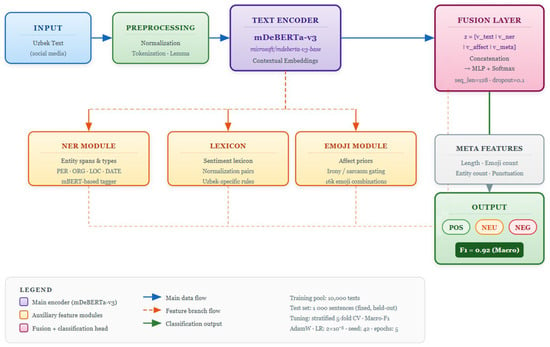
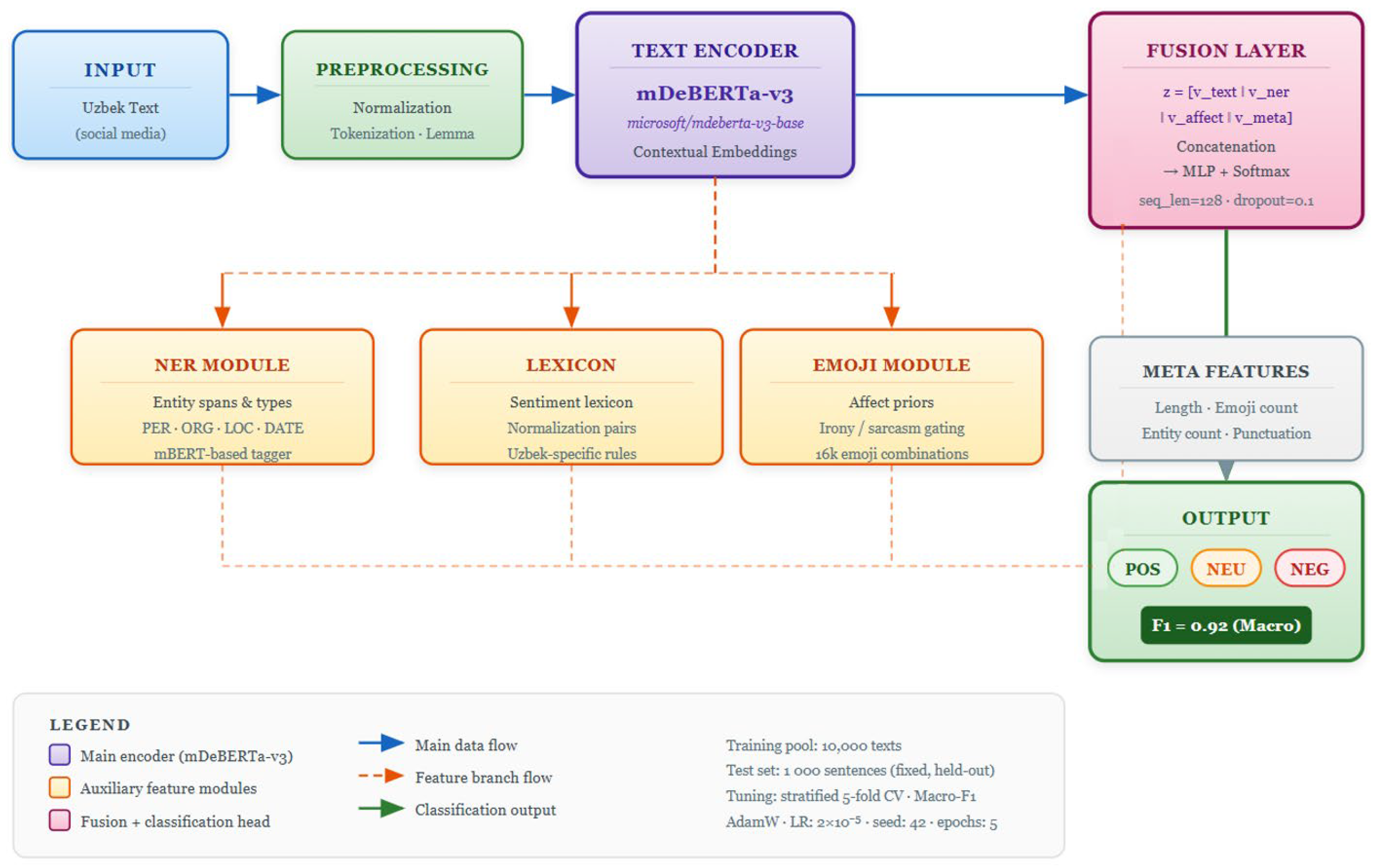
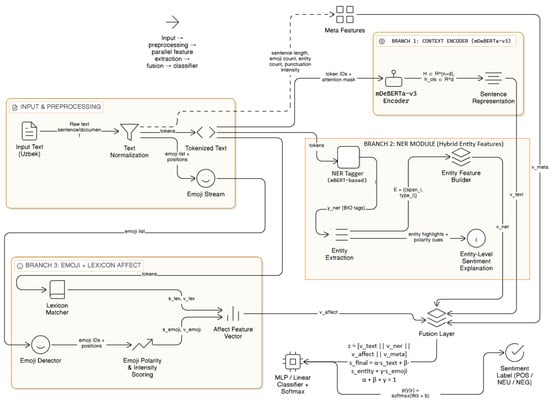
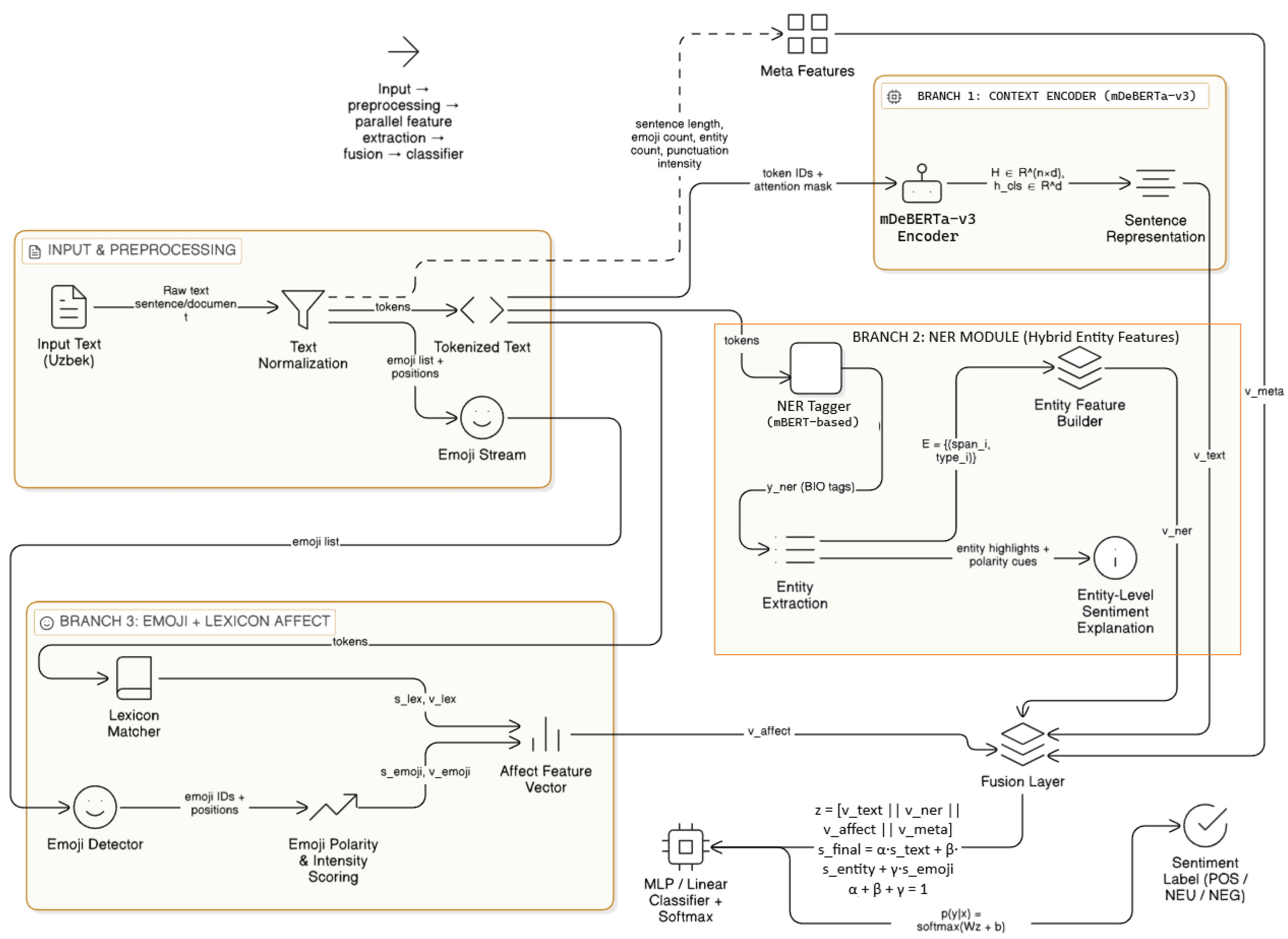
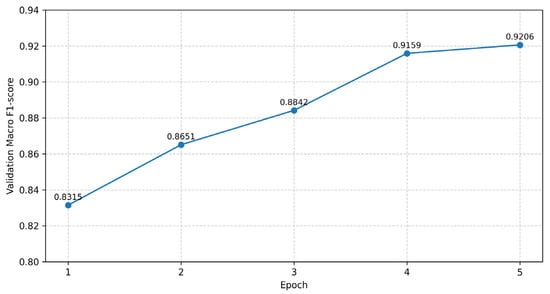
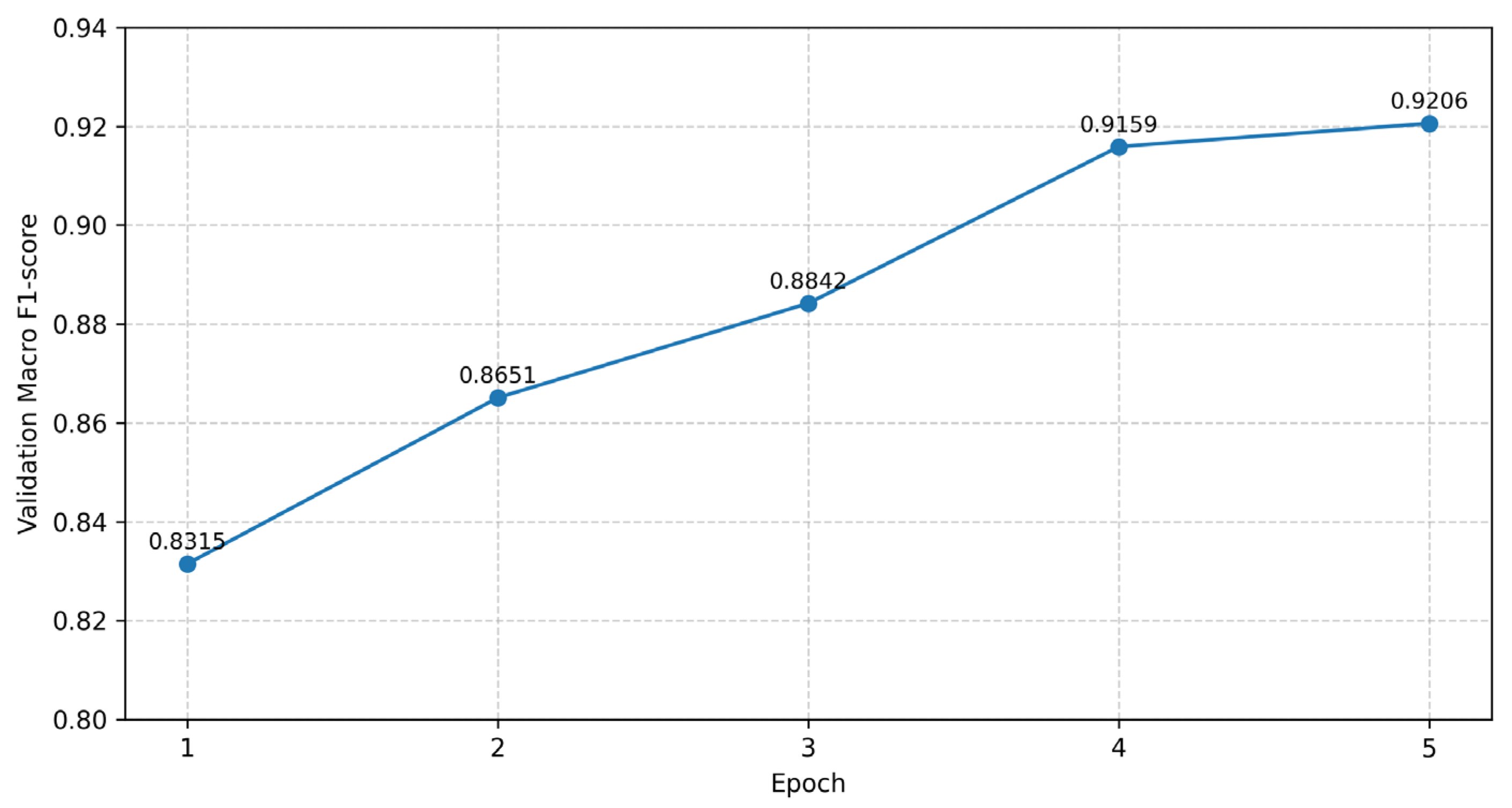
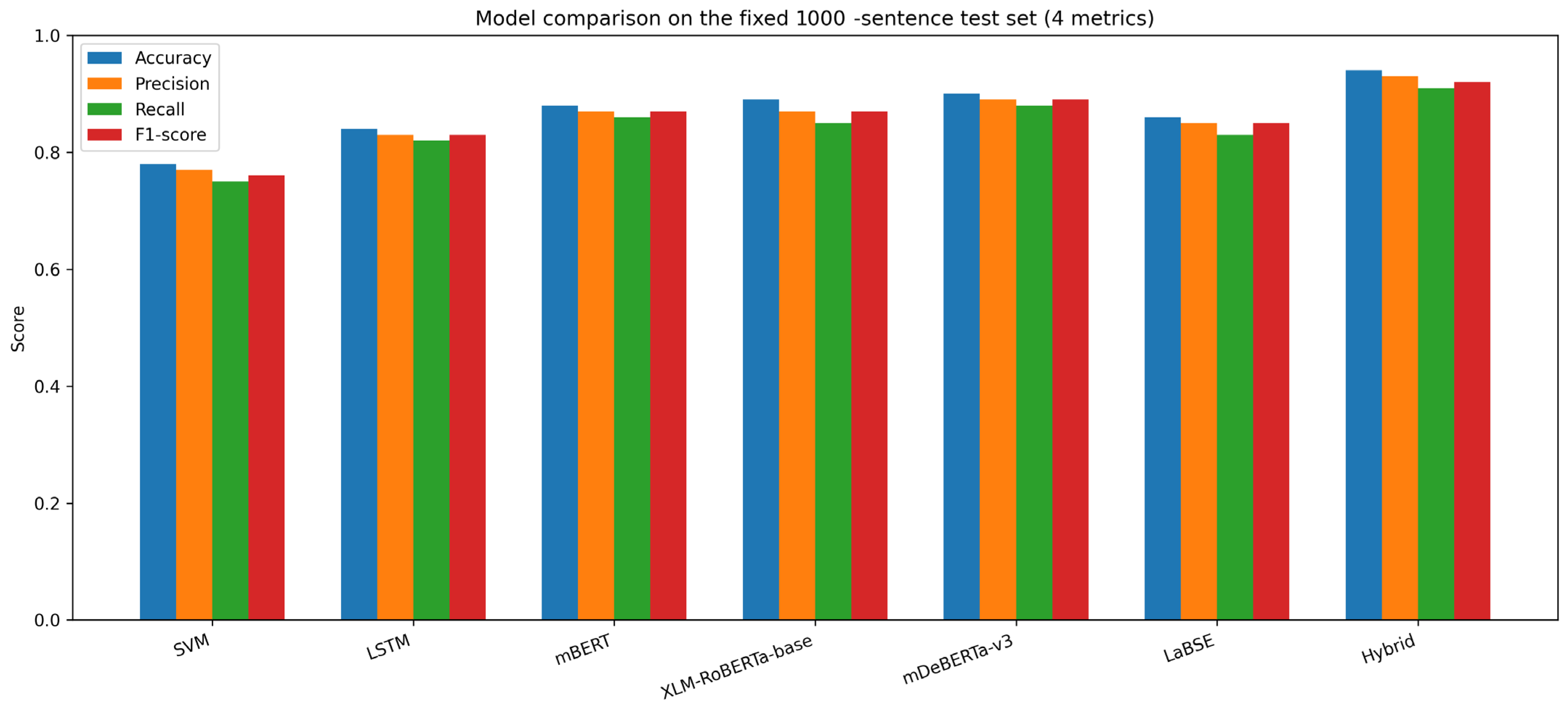
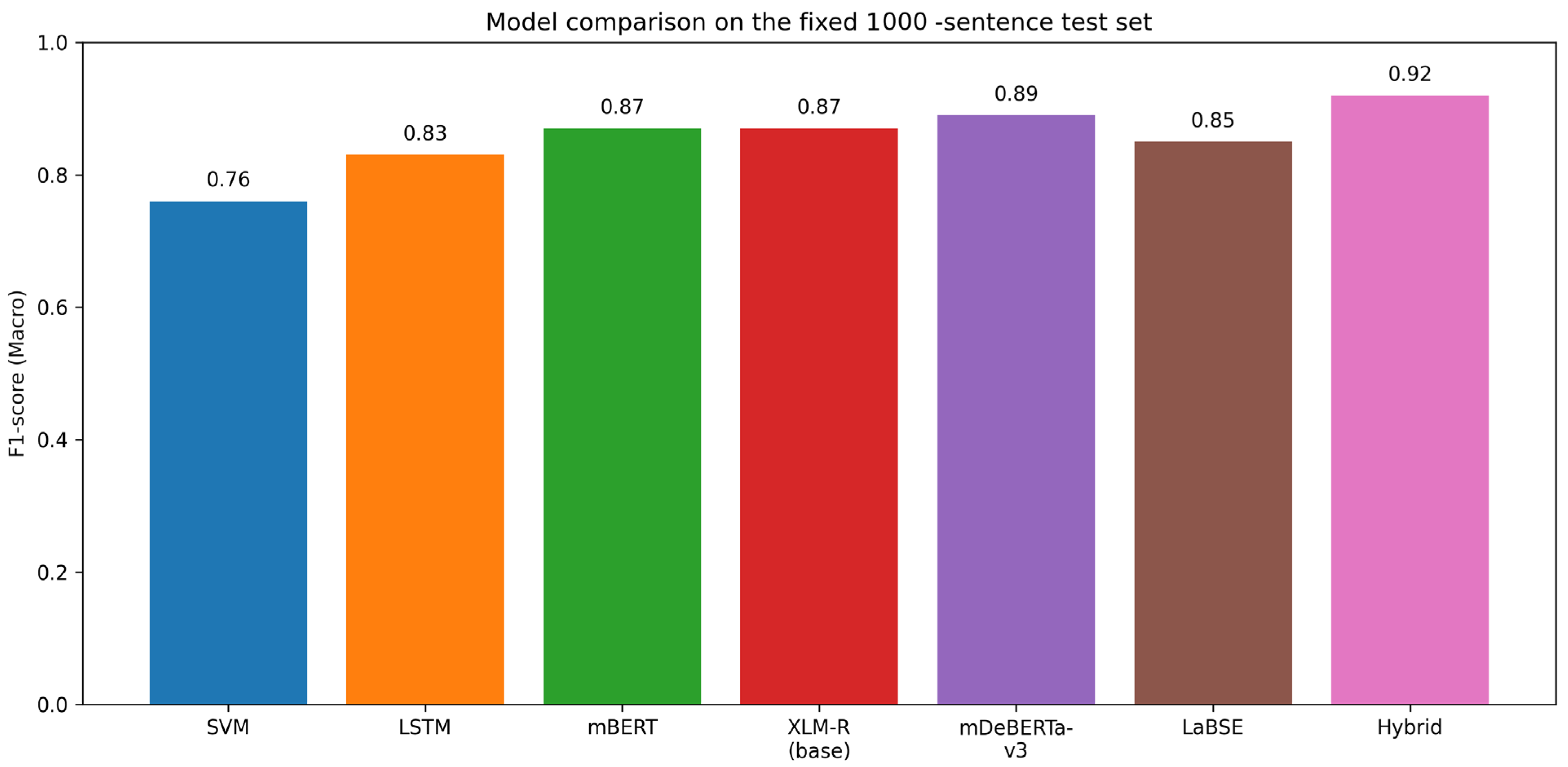
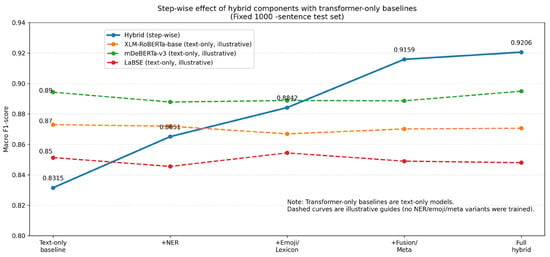
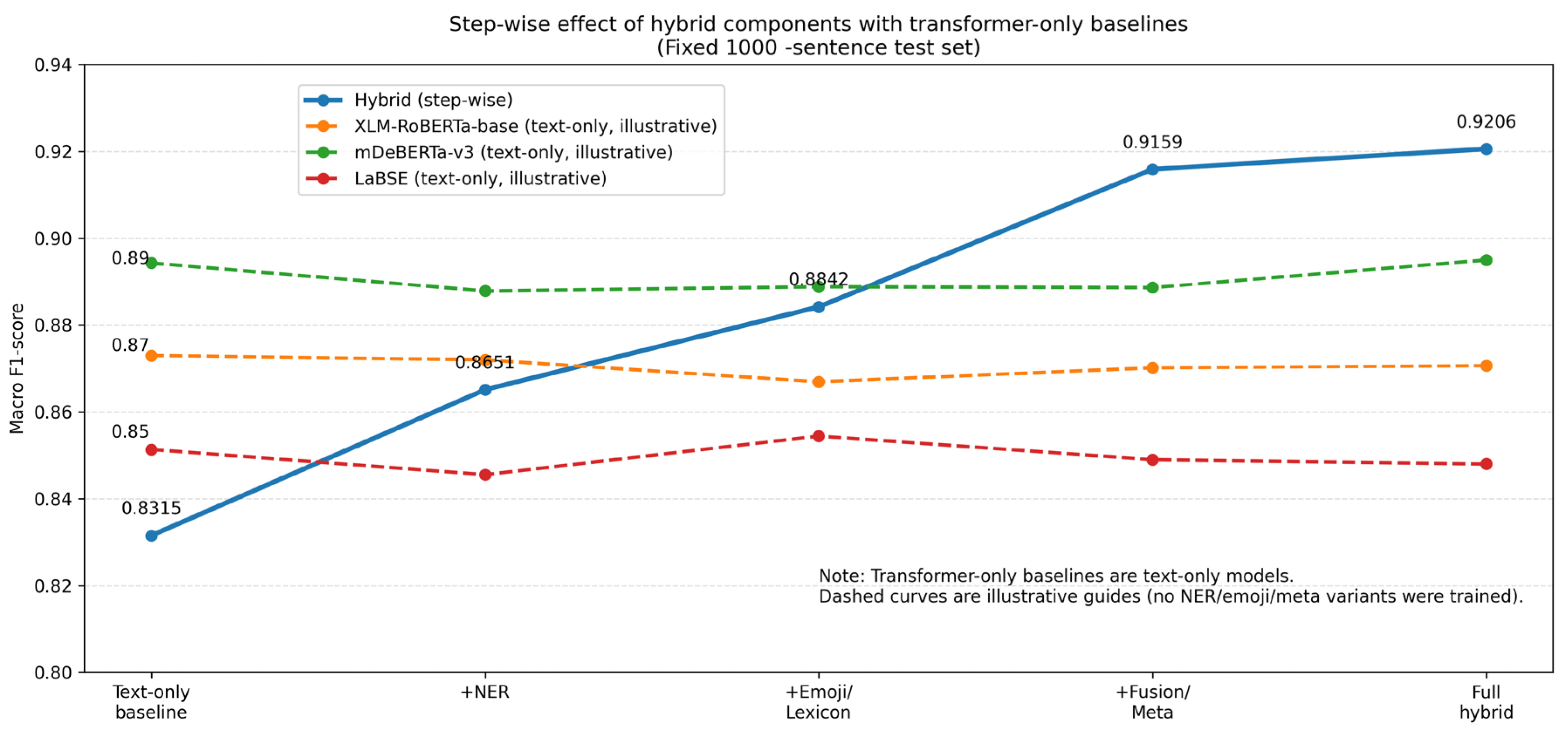
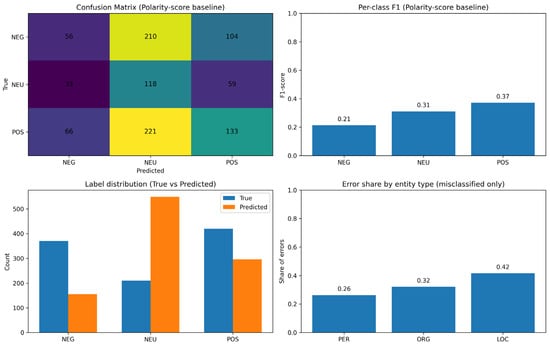
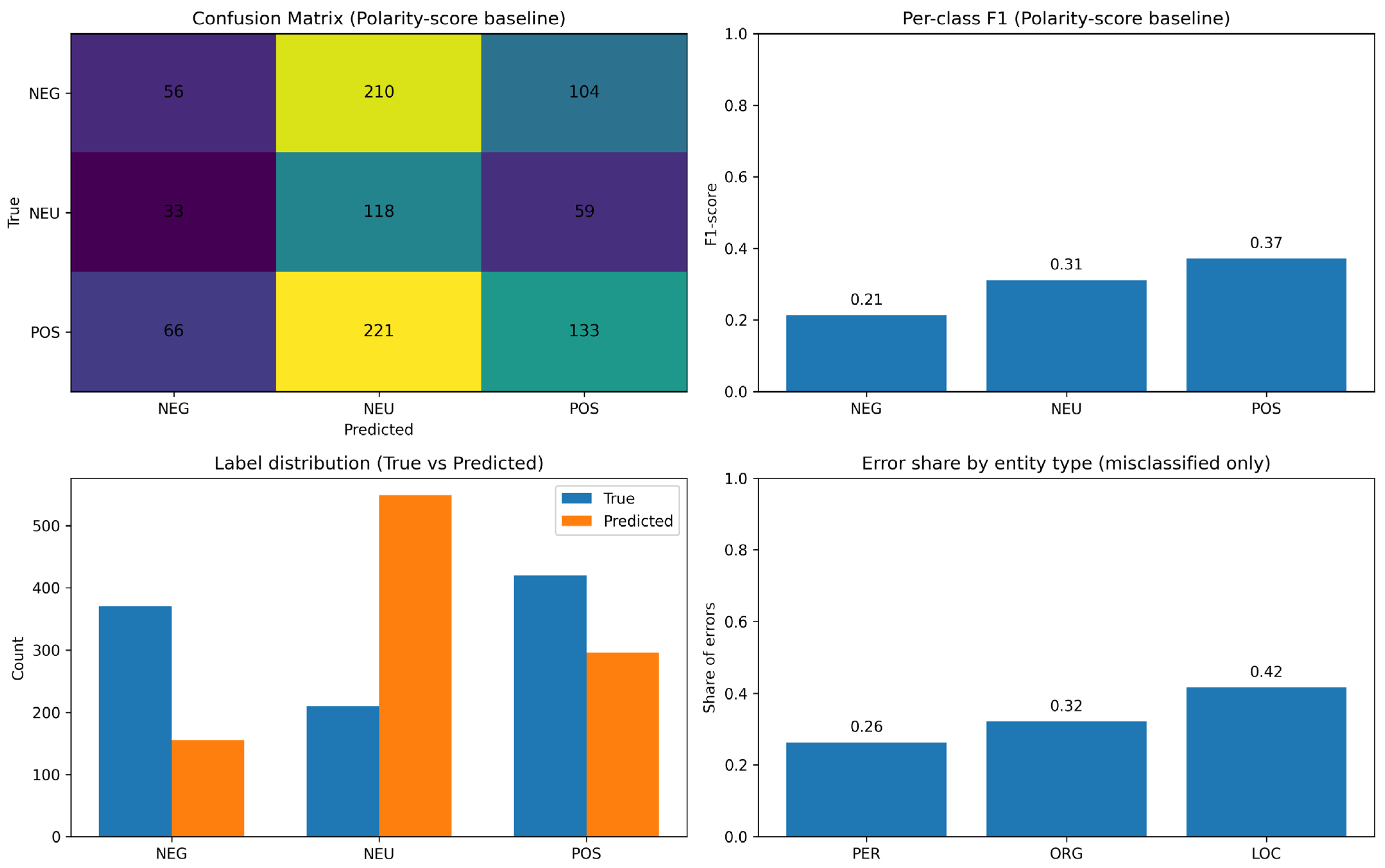
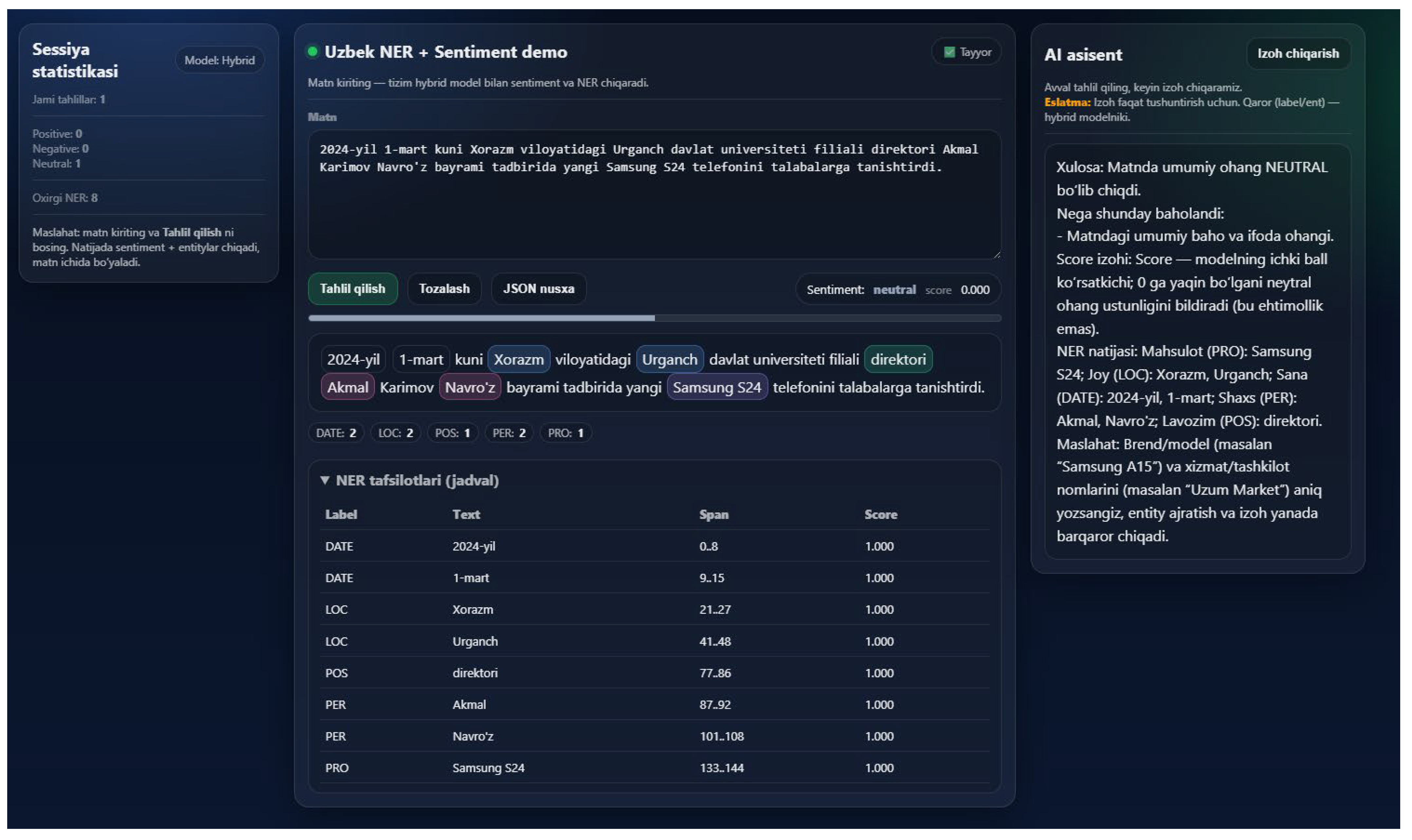

Disclaimer/Publisher’s Note: The statements, opinions and data contained in all publications are solely those of the individual author(s) and contributor(s) and not of MDPI and/or the editor(s). MDPI and/or the editor(s) disclaim responsibility for any injury to people or property resulting from any ideas, methods, instructions or products referred to in the content. |
© 2026 by the authors. Licensee MDPI, Basel, Switzerland. This article is an open access article distributed under the terms and conditions of the Creative Commons Attribution (CC BY) license.