


Abstract
The COVID-19 pandemic demonstrated that vulnerability, rather than chronological age alone, is a major determinant of severe infectious-disease outcomes; yet adult vaccination policies remain largely based on age and selected medical conditions. This narrative review examines vulnerability as a multidimensional framework for adult vaccination and explores its implications for vaccine policy, healthy aging, and pandemic preparedness. We conducted a non-systematic search of PubMed, Scopus, and Google Scholar (January 2020–June 2026), complemented by a targeted consultation of institutional reports, and synthesized evidence on the biological, clinical, functional, and social determinants of vulnerability and their relationship to vaccination. Vulnerability emerged as a multidimensional construct in which immunosenescence, multimorbidity, frailty, and social disadvantage were consistently identified as major contributors to susceptibility to, and adverse outcomes of, infectious diseases such as COVID-19, influenza, respiratory syncytial virus, pneumococcal disease, and herpes zoster; these dimensions also shaped vaccine uptake, access, and effectiveness; and appeared to identify at-risk populations more accurately than age alone. Adult vaccination policies should therefore complement age-based recommendations with person-centered approaches incorporating multidimensional vulnerability assessment, which may improve vaccine equity, optimize protection among high-risk groups, help preserve functional independence, and strengthen pandemic preparedness. The development of a practical Vaccination Vulnerability Index warrants further investigation.
1. Introduction
The COVID-19 pandemic exposed an important limitation in medicine and public health, namely: chronological age alone does not adequately define vulnerability to infectious diseases [1,2]. Although older adults accounted for most COVID-19-related deaths, substantial differences in outcomes were observed among individuals of the same age. These observations demonstrated that vulnerability, rather than age itself, is a major determinant of susceptibility to infection, severe disease, hospitalization, functional decline, and mortality.
Although the COVID-19 pandemic provided a particularly compelling illustration of these disparities, the underlying determinants of vulnerability are not specific to SARS-CoV-2. Similar biological, clinical, functional, and social factors influence susceptibility to, and outcomes of, other major vaccine-preventable infections in adults, including influenza, respiratory syncytial virus (RSV), pneumococcal disease, and herpes zoster. Immunosenescence, multimorbidity, and frailty may increase the risk of severe disease and complications, while social disadvantage and barriers to healthcare may limit access to timely vaccination. Moreover, as the severity of SARS-CoV-2 infection has decreased with population immunity and the circulation of less pathogenic variants, the burden of COVID-19 among vulnerable older adults has become more comparable to that of other respiratory infections. The lessons learned from COVID-19 should therefore be considered within the broader framework of routine adult immunization and healthy aging, rather than as exclusively pandemic-related observations.
Growing evidence indicates that vulnerability is a multidimensional construct shaped by biological, clinical, functional, and social factors. Immunosenescence, multimorbidity, frailty, disability, cognitive impairment, social isolation, poverty, and barriers to healthcare may, individually or collectively, increase the risk of adverse health outcomes [3,4,5]. Consequently, chronological age should be regarded as only one component of a broader vulnerability framework.
This multidimensional view is particularly relevant to vaccination. Vaccine uptake, access, effectiveness, and health outcomes are influenced not only by biological factors but also by health literacy, healthcare utilization, social circumstances, and structural inequalities [6,7,8]. Vaccination policies based primarily on age or individual diseases may therefore fail to identify many adults at greatest risk of vaccine-preventable diseases and their consequences.
The aim of this narrative review is to examine vulnerability as a framework for adult vaccination by exploring its biological, clinical, functional, and social determinants, and by assessing how a vulnerability-based approach could inform more equitable and effective vaccination policies and pandemic-preparedness strategies.
2. Methods
This study was conducted as a narrative review exploring vulnerability as a framework for adult vaccination policy and pandemic preparedness. The objective was to integrate evidence from different scientific disciplines and to examine how biological, clinical, functional, and social determinants of vulnerability influence susceptibility to infectious diseases, vaccine uptake, and vaccination effectiveness.
A non-systematic, exploratory literature search was performed in PubMed, Scopus, and Google Scholar, focusing primarily on publications from January 2020 to June 2026. Search terms included combinations of the following concepts: vulnerability, vaccination, vaccine uptake, vaccine effectiveness, COVID-19, frailty, immunosenescence, inflammaging, multimorbidity, healthy aging, health inequities, social vulnerability, resilience, and pandemic preparedness. No formal search strings, standardized Boolean search strategy, or database filters were used. Instead, search terms were combined and iteratively refined to explore the different dimensions of vulnerability and their relevance to vaccination. This flexible approach allowed the identification of evidence from different disciplines and the incorporation of additional concepts that emerged during the review process.
To complement the scientific literature, we undertook a targeted, non-systematic consultation of institutional documents (policy briefs, technical reports, fact sheets, and recommendations) issued by organizations selected for their direct relevance to the objectives of the review, namely the World Health Organization (WHO), including its Strategic Advisory Group of Experts on Immunization (SAGE); the United Nations (UN); the European Centre for Disease Prevention and Control (ECDC); the US Centers for Disease Control and Prevention and Agency for Toxic Substances and Disease Registry (CDC/ATSDR); and the international LTCcovid network on long-term care (Care Policy and Evaluation Centre, London School of Economics and Political Science). These documents were identified through the official websites of these organizations. No predefined search terms, retrieval protocol, or formal selection criteria were applied to this component, and the January 2020–June 2026 window applied to the scientific literature only: institutional documents published before 2020 were included when they provided a foundational conceptual or policy framework (e.g., the WHO World Report on Ageing and Health and the WHO conceptual framework on the social determinants of health). The access dates given in the reference list indicate when each online resource was last consulted to verify its availability during manuscript preparation (July–August 2026), not the date on which it was first identified.
Evidence was selected based on its relevance to the objectives of the review. Attention was given to publications addressing (1) biological, clinical, functional, and social determinants of vulnerability; (2) associations between vulnerability and infectious-disease outcomes; (3) vaccination strategies targeting vulnerable populations; (4) approaches to vaccine prioritization and equitable access; and (5) implications for future pandemic preparedness. Preference was given to systematic reviews, meta-analyses, large observational studies, consensus statements, and major policy reports, while other publications were considered when they provided important conceptual or interdisciplinary insights. Foundational publications predating the COVID-19 pandemic were included when necessary to contextualize key concepts such as frailty, resilience, healthy aging, hospitalization-associated disability, and vulnerability.
Given the narrative nature of the review, no formal screening procedure, predefined eligibility protocol, quantitative record-selection process, or quality appraisal was implemented. Consequently, PRISMA-style study-selection counts are not available, and the review does not claim exhaustive coverage of the literature.
The selected evidence was synthesized narratively to identify converging findings and interactions across the different dimensions of vulnerability, and to develop an integrated conceptual framework describing vulnerability as a multidimensional construct encompassing biological, functional, clinical, and social domains. This review was not intended to be a systematic review of all available evidence but rather to provide a multidisciplinary perspective on vulnerability and its implications for more equitable and effective vaccination policies; the potential for selection bias associated with this approach is acknowledged in Section 8.
3. Defining Vulnerability and States of Vulnerability
To examine the role of vulnerability in adult vaccination, it is essential to distinguish between the concepts of vulnerability and states of vulnerability [9].
- Vulnerability refers broadly to the susceptibility of an individual, group, or community to adverse outcomes when exposed to biological, environmental, social, or economic stressors. It is a multidimensional concept reflecting the interaction between individual characteristics, contextual determinants, and the capacity to respond to or recover from health challenges.
- States of vulnerability, in contrast, describe specific, context-dependent, and often dynamic conditions in which individuals experience increased susceptibility to adverse outcomes or a reduced capacity to anticipate, cope with, resist, or recover from health challenges. Such states may be temporary, recurrent, or persistent and can arise from interactions among biological, clinical, functional, psychological, social, or socioeconomic factors.
In the context of adult vaccination and pandemic preparedness, the proposed framework does not seek to define or measure vulnerability as a single, uniform construct. Rather, it aims to identify and organize the multiple determinants and interacting conditions that contribute to vulnerability in relation to three distinct but interconnected dimensions: (1) susceptibility to infectious diseases and their adverse consequences; (2) reduced vaccine-induced protection; and (3) insufficient vaccination coverage or access. These dimensions may involve different, although frequently overlapping, determinants:
- Biological and clinical factors, such as immunosenescence, multimorbidity, and frailty, may increase susceptibility to severe infectious diseases and, in some circumstances, attenuate vaccine responses.
- Functional and cognitive impairments may compromise the capacity of individuals to access preventive healthcare and to manage health challenges.
- Social and structural determinants, including poverty, social isolation, limited health literacy, migration-related barriers, and restricted access to healthcare, may contribute to insufficient vaccination and increase exposure to infectious risks. Institutional settings, such as nursing homes, may further influence exposure, care dependency, and opportunities for prevention.
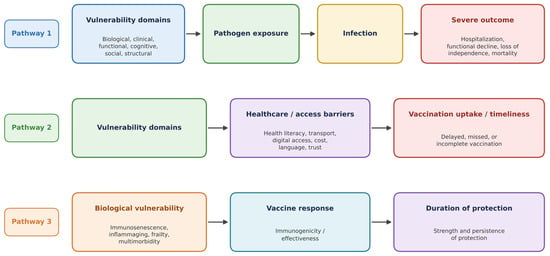
Importantly, these factors should not be interpreted as equivalent indicators of a single underlying construct. Rather, they represent heterogeneous determinants, contextual conditions, or manifestations of vulnerability, whose relevance varies according to the outcome considered, and some of them (e.g., frailty, cognitive impairment, or institutional residence) may contribute to several dimensions simultaneously. Their interactions may create or intensify particular states of vulnerability. The three main pathways linking vulnerability to exposure, vaccination, and outcomes are summarized in Figure 1.
Figure 1.
Conceptual pathways linking vulnerability to exposure, vaccination, and outcomes. Pathway 1: vulnerability domains (biological, clinical, functional, cognitive, social, and structural) increase the risk of pathogen exposure, infection, and severe outcomes (hospitalization, functional decline, loss of independence, and mortality). Pathway 2: vulnerability domains generate healthcare and access barriers (health literacy, transport, digital access, cost, language, and trust) that result in delayed, missed, or incomplete vaccination. Pathway 3: biological vulnerability (immunosenescence, inflammaging, frailty, and multimorbidity) attenuates vaccine immunogenicity and effectiveness and shortens the duration of protection. The three pathways are interconnected and may coexist in the same individual.
Vulnerability is therefore not synonymous with chronological age. Although the prevalence and coexistence of vulnerability-related conditions increase with advancing age, individuals of the same chronological age may differ substantially in their biological, functional, clinical, and social characteristics, as well as in their capacity to benefit from preventive interventions.
Recognizing and characterizing these different states of vulnerability is therefore essential for the design of effective and equitable vaccination strategies. Moving beyond exclusively age-based approaches toward vulnerability-informed prevention may help public health systems to identify individuals at increased risk of adverse infectious-disease outcomes, those who may require optimized vaccination strategies, and those facing barriers to vaccination, thereby improving protection against both seasonal infectious diseases and future pandemics. The primary purpose of this conceptual framework is therefore to inform risk characterization, vaccination prioritization, and public-health decision-making, rather than to propose a validated, universal vulnerability index.
4. Biological States of Vulnerability
4.1. Immunosenescence, Inflammaging, and States of Vulnerability
The biological dimension of vulnerability is strongly influenced by immunosenescence and inflammaging, two interconnected hallmarks of aging that play a central role in susceptibility to infectious diseases, vaccine responsiveness, and health outcomes. Immunosenescence refers to the progressive remodeling of the immune system that occurs with age, characterized by reduced production of naïve immune cells, impaired adaptive immune responses, and a diminished capacity to respond effectively to novel pathogens [10]. In parallel, inflammaging describes the chronic, low-grade inflammatory state associated with aging, driven by lifelong antigenic exposure, cellular senescence, metabolic dysfunction, and chronic disease burden [5].
These processes are closely intertwined and may be viewed as complementary manifestations of immune aging. Chronic inflammation accelerates immune dysfunction, while impaired immune regulation further amplifies inflammatory responses, creating a self-perpetuating cycle that progressively erodes physiological reserve. Importantly, the consequences extend beyond the immune system: immunosenescence and inflammaging have been associated with multiple age-related conditions that increase vulnerability to health stressors [5,10].
Emerging evidence indicates that accelerated immune aging is not determined solely by chronological age [11,12]. This observation supports the concept that vulnerability reflects biological age and functional reserve more accurately than chronological age alone.
These biological processes are not specific to SARS-CoV-2. Immune aging contributes to the high burden of influenza, RSV infection, and pneumococcal disease in older adults, and the age-related decline in varicella-zoster virus-specific cellular immunity underlies the increasing incidence of herpes zoster with age. Immunosenescence also attenuates the immunogenicity of several conventional vaccines in older adults, which has driven the development of vaccine formulations specifically designed for this population [11,12].
4.2. Multimorbidity and States of Vulnerability
Multimorbidity represents one of the most important clinical determinants of vulnerability in later life. Defined as the coexistence of two or more chronic conditions in the same individual, multimorbidity increases markedly with advancing age and is particularly prevalent among persons experiencing socioeconomic deprivation and mental-health disorders [13]. In a landmark population-based study involving more than 1.7 million individuals, Barnett et al. demonstrated that multimorbidity is strongly associated with age but is also disproportionately concentrated among socially deprived populations, occurring 10–15 years earlier in the most deprived compared with the most affluent groups [14]. Furthermore, physical and mental-health disorders frequently coexist, creating complex patterns of vulnerability that extend beyond disease count alone.
The relationship between multimorbidity and vulnerability also extends beyond the mere accumulation of diseases, leading to a progressive reduction in physiological reserve and resilience [4,15]. Consequently, the ability to respond effectively to acute stressors, including infectious diseases, becomes increasingly compromised. Vulnerability should therefore be viewed as a multidimensional construct arising from interactions among biological, clinical, functional, psychological, and social determinants rather than as a direct consequence of chronological age alone.
The accumulation of cardiovascular disease, metabolic disorders, chronic respiratory disease, neurocognitive disorders, chronic kidney disease, and liver disease progressively erodes physiological reserve and resilience. This process ultimately increases susceptibility to infectious diseases, accelerates functional decline, and threatens independence.
This framework suggests that vaccination should not be viewed solely as a means of preventing infection. Rather, it should be considered a broader intervention capable of preserving physiological reserve, maintaining functional ability, reducing frailty progression, and ultimately mitigating vulnerability among older adults living with multimorbidity.
4.3. Frailty and Vulnerability
Frailty emerges from the same biological processes that drive immunosenescence and inflammaging, creating a common pathway linking immune aging, multimorbidity, and functional decline [4,5]. It can be viewed as the clinical manifestation of biological aging, reflecting a progressive loss of physiological reserve and resilience [16]. Consequently, individuals of the same chronological age may exhibit very different levels of biological aging, multimorbidity, immune dysfunction, and frailty, resulting in markedly different degrees of vulnerability.
Frailty is not a disease, but a multidimensional clinical syndrome characterized by reduced function across multiple physiological systems. This decline compromises the ability to maintain homeostasis and to respond to internal or external stressors, increasing the risks of disability, hospitalization, institutionalization, and death. Importantly, frailty reflects biological rather than chronological age and is therefore a more meaningful indicator of health risk [17].
The COVID-19 pandemic highlighted the importance of frailty as a determinant of vulnerability to infectious diseases. Although advanced age was initially considered the primary risk factor for severe outcomes, large observational studies and meta-analyses demonstrated that frailty predicted infection-related complications and mortality more accurately than chronological age alone. Frailty remained strongly associated with adverse outcomes even after accounting for age and comorbidities, confirming its value as a marker of biological vulnerability [18,19,20].
These same biological mechanisms also influence vaccine responses. Immunosenescence and chronic low-grade inflammation reduce both humoral and cellular immunity, leading frail individuals to develop lower antibody responses and to experience a faster decline in vaccine-induced protection. Studies of SARS-CoV-2 vaccination, as well as broader vaccination research, consistently show reduced immunogenicity among individuals with frailty, multimorbidity, and advanced biological aging [11,21].
Importantly, the relationship between frailty and infectious diseases is bidirectional. Frailty increases susceptibility to severe infections and adverse outcomes, but acute infections and the associated hospitalizations may themselves precipitate or accelerate frailty, functional decline, and loss of independence. This phenomenon, often described as hospitalization-associated disability, may occur even when the acute illness has been successfully treated: previously independent older adults may experience persistent reductions in mobility, muscle strength, and ability to perform activities of daily living, sometimes resulting in increased care dependency or institutionalization [22,23]. In a Canadian prospective cohort of 925 adults aged 65 years and older hospitalized with influenza or another acute respiratory illness, 8.2% experienced persistent moderate functional decline and 9.9% catastrophic disability (equivalent to full loss of independence in two basic activities of daily living) 30 days after discharge; higher baseline frailty was associated with increased odds of functional decline, catastrophic disability, and death, and the authors highlighted the potential for vaccine-preventable disability [24]. In this context, frailty and functional deterioration should be regarded not only as determinants of vulnerability but also as potential indirect targets of vaccination strategies. By preventing severe infections and reducing infection-related hospitalizations, vaccination may help preserve physiological reserve, functional capacity, and autonomy. Although the direct impact of vaccination on frailty progression and long-term dependency requires further investigation, this perspective highlights its potential contribution to healthy aging beyond the conventional prevention of infection and mortality.
This creates a major public-health paradox. Frail individuals stand to benefit greatly from vaccination because they face increased risks of infection, hospitalization, functional decline, loss of independence, and death; however, they are also less likely to achieve optimal protection. Tailored vaccination strategies, such as enhanced (e.g., high-dose or adjuvanted) formulations, additional doses, or adapted schedules, may therefore be considered for vulnerable older adults, but only where pathogen-specific clinical evidence supports them and where they are approved and recommended by the relevant regulatory and public-health authorities. Their appropriateness depends on the target pathogen, the vaccine platform, the age and clinical circumstances of the individual, and national or regional guidelines, which continue to evolve. Such measures should be combined with interventions addressing modifiable contributors to frailty, such as malnutrition, physical inactivity, and poorly controlled chronic disease [12,25].
Novel vaccine platforms may offer further advantages. Messenger RNA (mRNA) vaccines can be rapidly adapted, enable precise antigen expression, and stimulate both humoral and cellular immunity. COVID-19 mRNA vaccines have provided substantial protection against severe disease in older adults, although frailty and immunosenescence may weaken antibody responses and accelerate waning immunity [26,27]. Booster doses, where recommended, can partly overcome these limitations. The efficacy of an mRNA respiratory syncytial virus (RSV) vaccine in adults aged 60 years or older also supports the broader potential of this platform [28]. Future research should optimize mRNA formulations, antigen design, dosing, delivery systems, and combination vaccines for frail and immunologically vulnerable individuals.
However, frailty should not be equated with vulnerability. Frailty primarily reflects impaired physiological reserve and biological aging, whereas vulnerability encompasses a broader interaction of biological, functional, psychological, social, economic, and environmental factors. Frailty remains one of the major contributors to vulnerability and one of its most visible clinical expressions. Together, these concepts provide a comprehensive framework for identifying individuals at greatest risk and should play a central role in vaccination policies, preventive strategies, and efforts to promote healthy aging throughout the life course.
5. Social and Structural Vulnerability, Vaccination, and Healthy Aging
5.1. Social Deprivation in Older Adults
Social deprivation is a major determinant of vulnerability. It encompasses the lack of material, social, and service-related resources needed to maintain health and to participate fully in society. Beyond low income, it includes limited education, insecure housing, food and energy insecurity, social isolation, weak support networks, digital exclusion, transportation difficulties, and restricted access to healthcare and preventive services [29,30]. It may occur at the individual or household level or result from neighborhood disadvantage and structural exclusion.
Social deprivation increases vaccine vulnerability through two pathways. It heightens exposure to infection and severe outcomes through overcrowding, occupational risks, chronic stress, malnutrition, multimorbidity, and delayed care. It also limits access to vaccination through financial, geographical, administrative, linguistic, informational, and digital barriers. Disadvantaged older adults may therefore experience a “double vulnerability”: greater susceptibility to vaccine-preventable disease alongside reduced access to timely vaccination and, potentially, a diminished immune response [31].
A useful conceptual framework links social deprivation to vulnerability through a series of interconnected mechanisms. Social deprivation frequently leads to reduced health literacy, diminished access to healthcare services, and lower utilization of preventive interventions. These barriers contribute to lower vaccination uptake, which subsequently increases the burden of infectious diseases [6,7]. Recurrent infections and associated complications may accelerate functional decline, promote frailty, and ultimately increase overall vulnerability.
Importantly, this relationship is bidirectional. Increased vulnerability may further exacerbate social isolation, financial difficulties, dependence on caregivers, and barriers to healthcare, creating a self-perpetuating vicious circle between social deprivation and vulnerability.
A growing body of evidence demonstrates that socially disadvantaged populations experience lower vaccination rates. In a global umbrella review examining socioeconomic inequalities in vaccine uptake, Sacre and colleagues identified multiple determinants contributing to lower vaccine uptake among vulnerable older adults [32]:
- Individual-level determinants include lower health literacy, vaccine hesitancy, reduced trust in healthcare institutions, language barriers, and cognitive impairment. Older adults with limited health literacy may experience difficulties understanding vaccine recommendations, assessing risks and benefits, or navigating increasingly complex healthcare systems.
- Social determinants include living alone, weak social networks, absence of caregivers, and social exclusion. These factors reduce opportunities for health-related communication and support. Socially isolated individuals may receive fewer reminders, less encouragement, and reduced assistance in accessing vaccination services.
- Structural barriers include transportation difficulties, financial constraints, administrative complexity, reduced access to primary-care services, and digital exclusion. The increasing digitalization of healthcare appointments and information dissemination may further disadvantage older adults with limited technological skills or internet access.
Importantly, these determinants rarely occur in isolation; rather, they tend to accumulate and reinforce one another throughout the life course, leading to progressively increasing vulnerability among older populations.
The concept of a Social Vulnerability Index (SVI) combines indicators of socioeconomic status, household composition, disability, minority status, language barriers, housing conditions, and transportation access to identify populations at increased risk during public health emergencies [33].
Barry et al. demonstrated significant disparities in COVID-19 vaccination coverage according to levels of social vulnerability across the United States [34]. Similarly, Chien and collaborators reported that communities characterized by poverty, low educational attainment, disability, transportation difficulties, and social disadvantage experienced lower vaccine uptake and delayed vaccination [35], and Brown et al. showed that county-level COVID-19 vaccination rates varied according to community vulnerability [36]. These findings suggest that social vulnerability indices may be valuable tools for identifying populations that require targeted immunization strategies and enhanced public health interventions.
5.2. Migrants and States of Vulnerability
Migrants, refugees, asylum seekers, and displaced populations are important but often overlooked groups experiencing vulnerability. Migrant status is not itself a biological risk factor, and these populations are highly heterogeneous. Vulnerability instead arises from circumstances before, during, and after migration, including interrupted preventive care, incomplete vaccination records, overcrowded accommodation, socioeconomic insecurity, discrimination, and uncertain access to healthcare [37,38].
Language barriers, limited health literacy, unfamiliarity with health systems, administrative constraints, socioeconomic disadvantage, and concerns about legal status may reduce vaccine uptake. Migration can also result in missed doses and fragmented records, while some individuals face greater infectious-disease exposure during displacement. Older migrants may experience compounded vulnerability from aging, multimorbidity, frailty, social isolation, and structural barriers to care.
A vulnerability-based framework should link assessment of need with practical access measures (Table 1). These include culturally sensitive health assessments, review of available records without requiring documentation, catch-up vaccination according to host-country schedules, and opportunistic vaccination in primary care, hospitals, pharmacies, and community settings. Additional measures include translated low-literacy information, interpreters and cultural mediators, mobile clinics, reminder systems, and clear separation of vaccination services from immigration enforcement. WHO and ECDC support the inclusion of newly arrived migrants in routine and catch-up programs [38,39]. Deal et al. further highlight co-produced communication through trusted organizations, convenient vaccination sites, simplified registration, and reassurance regarding entitlement and confidentiality [40]. For older migrants, these approaches may require functional assessment, transport assistance, home vaccination, and coordination with caregivers and social services.
Table 1.
Key barriers and strategies to improve vaccination access and uptake among migrant populations (adapted from Deal et al., 2021 [40], and WHO/ECDC guidance [38,39]).
5.3. Living Alone: An Under-Recognized Marker of Vulnerability
Living alone has emerged as a particularly important marker of vulnerability in older age. In a systematic review and meta-analysis, Jain et al. demonstrated that older adults living alone were significantly less likely to receive recommended vaccinations than those living with family members or caregivers [41].
Living alone may represent more than a simple demographic characteristic and, together with social isolation and loneliness, has been associated with increased mortality [42]. It frequently reflects reduced social support, lower healthcare-navigation capacity, limited transportation resources, loneliness, and a higher likelihood of frailty. Furthermore, individuals living alone may be less likely to receive practical assistance for scheduling appointments, attending vaccination clinics, or understanding evolving vaccine recommendations.
Evidence for a direct biological effect of social isolation or loneliness on vaccine responses remains limited and heterogeneous, and should be interpreted cautiously. Observational studies have reported associations between loneliness, low social cohesion, and weaker antibody responses after influenza or COVID-19 vaccination, plausibly mediated by chronic stress, neuroendocrine activation, sleep disturbance, depression, or poorer health behaviors [43,44]. However, the study by Pressman et al. was conducted in college freshmen [43], and its findings cannot be directly extrapolated to older adults, whose immunological, biological, and psychosocial characteristics differ substantially. Moreover, these studies do not establish causality; frailty, comorbidity, nutrition, and socioeconomic disadvantage may confound the associations observed, and living alone is not equivalent to loneliness or social isolation. Social isolation and living alone should therefore be regarded primarily as markers of vulnerability to low vaccine uptake and reduced access, rather than as established independent determinants of vaccine immunogenicity. In the present framework, living alone should mainly be used as a pragmatic signal to assess social support, healthcare navigation, transport, and the need for reminder, outreach, or home-based vaccination, rather than as a proxy for impaired immune response.
5.4. Nursing-Home Residents and States of Vulnerability
Nursing-home residents are among the most vulnerable populations in modern healthcare. Although advanced chronological age is common among residents, vulnerability extends far beyond age itself and reflects the accumulation of frailty, multimorbidity, disability, cognitive impairment, malnutrition, and reduced physiological reserve. These factors interact to increase susceptibility to adverse health outcomes and diminish the ability to recover from acute stressors.
Biologically, many nursing-home residents exhibit immunosenescence and chronic low-grade inflammation (inflammaging), both of which contribute to impaired immune responses and increased vulnerability to infectious diseases [15]. The congregate living environment further amplifies these risks by facilitating the transmission of respiratory and gastrointestinal pathogens. The COVID-19 pandemic dramatically illustrated this reality, as nursing-home residents experienced disproportionately high rates of severe illness, hospitalization, and mortality worldwide [45,46].
Vulnerability in nursing homes is not limited to biological factors. Functional limitations may reduce the capacity to recognize symptoms, seek medical assistance, or comply with preventive measures. Cognitive disorders, particularly dementia, can impair communication and decision-making, while psychological conditions such as depression and loneliness may further compromise health and well-being. Social vulnerability is also common, as many residents depend heavily on caregivers and may have limited contact with family members or support networks.
Vaccination is therefore a cornerstone of preventive care in long-term-care facilities. Immunization against influenza, COVID-19, pneumococcal disease, RSV, and other vaccine-preventable infections can reduce severe disease, hospitalization, outbreaks, and mortality in this high-risk population. Because frailty and immunosenescence may attenuate or shorten vaccine-induced protection, programs should combine timely on-site vaccination of residents and staff with appropriate use of enhanced vaccines or additional doses when recommended, systematic recording, high-coverage targets, surveillance, and outbreak-control measures [21,47,48].
Nursing-home residence should therefore be considered a marker of accumulated vulnerability and a practical trigger for proactive, facility-wide vaccination delivery. Individual assessment remains important for consent, contraindications, prior vaccination, expected response, and preferences, but should complement rather than delay systematic on-site programs.
6. Implications for Vaccine Prioritization and Pandemic Preparedness
Prioritization should remain proportionate, transparent, and adaptable. A vulnerability score should complement, not replace, clinical judgment or population-level ethical deliberation. Its purpose is to identify people missed by simple age thresholds, not to exclude those already eligible under established recommendations. During an outbreak, domain weighting may need to be adjusted on the basis of pathogen characteristics, vaccine effectiveness, transmission patterns, and policy goals, such as preventing deaths, preserving health-system capacity, reducing transmission, or improving equity.
For pandemic preparedness, vulnerability assessment should be established before a crisis. Plans should define the minimum data required for rapid risk stratification, develop interoperable vaccination registries linked—under appropriate safeguards—to clinical and social care information, identify trusted community partners and mobile teams, maintain consent and proxy decision-making procedures, and include home care and long-term care populations in preparedness exercises and distribution plans. Vaccine supplies and appointment systems are insufficient when those at greatest risk cannot be identified, contacted, transported, or vaccinated in familiar settings.
Prioritization should operate at two complementary levels. Clinicians and vaccination services can identify individuals with accumulated clinical and functional vulnerability, including frailty, immunocompromise, multimorbidity, malnutrition, disability, or dependence. Public health agencies can use area-based indicators, care-setting data, primary care registers, and information on housing, transport, language, and healthcare access to identify communities with high exposure or poor access. Nursing-home residence, homelessness, displacement, and home confinement may justify proactive delivery rather than merely earlier eligibility.
Age- and disease-based criteria remain transparent and practical but should be supplemented by indicators of severe-outcome risk, exposure, expected vaccine responsiveness, and access barriers. The WHO SAGE framework emphasized human well-being, equal respect, equity, reciprocity, and legitimacy, particularly for groups facing high medical or societal risk [49]. A multidimensional vulnerability framework translates these principles into geriatric and public-health practice by recognizing that biological risk and structural disadvantage often coexist.
7. Discussion
This review highlights a central lesson from the COVID-19 pandemic and the broader literature on aging and infectious diseases: vulnerability is a more meaningful determinant of health outcomes than chronological age alone.
Vulnerability should be understood as a multidimensional state arising from interactions between biological, clinical, functional, cognitive, environmental, and social factors. Immunosenescence, inflammaging, multimorbidity, and frailty may increase susceptibility to infection and reduce vaccine responsiveness. Functional limitations, cognitive impairment, and dependence may affect the ability to understand, organize, and complete vaccination. Poverty, social isolation, limited health literacy, language barriers, and restricted access to care may further increase exposure and reduce uptake. Vulnerability thus reflects the combined effects of aging-related changes, accumulated health deficits, living conditions, and unequal access to prevention.
Physical function represents another essential dimension of vulnerability and healthy aging. Sarcopenia, reduced muscle strength, impaired mobility, and declining physical performance may diminish physiological reserve, increase susceptibility to adverse outcomes, and compromise recovery from acute infectious diseases [50]. Conversely, severe infections and the associated hospitalizations may accelerate muscle loss, physical deconditioning, frailty progression, and functional dependency, even after resolution of the acute illness [22,24]. These processes may initiate unfavorable functional trajectories, transforming previously independent older adults into individuals requiring long-term assistance or institutional care [23]. In this context, vaccination may contribute indirectly to preserving physical function and autonomy by preventing severe infections and the associated hospitalizations. Although direct evidence of the effects of vaccination on long-term functional trajectories remains limited, the preservation of mobility, functional capacity, and independence should be considered an important outcome in future research evaluating vaccination strategies in vulnerable older adults.
For geriatric practice, this framework supports a shift from disease-centered and age-based approaches toward person-centered preventive care.
- Vaccination should be considered an integral component of healthy aging, chronic-disease management, and the preservation of functional ability. Assessment of frailty, multimorbidity, cognitive and functional status, nutrition, living environment, and social circumstances may help identify individuals at increased risk of vaccine-preventable harm or requiring additional support.
- Cognitive impairment deserves explicit consideration, not because it is necessarily a stronger biological determinant of vaccine response than other comorbidities, but because it may disrupt several stages of the vaccination pathway. It can impair understanding of recommendations, recall of previous doses, appointment management, symptom reporting, and valid consent. It is also frequently associated with frailty, dependence, institutional residence, and reliance on caregivers. Its inclusion would therefore capture decision-support and delivery needs not adequately represented by conventional comorbidity counts.
- Other geriatric conditions, including sensory impairment, depression, falls, incontinence, and mobility limitation, should be included only if they independently predict exposure, uptake, immunogenicity, adverse outcomes, or a need for adapted delivery. The final vaccination vulnerability index should be empirically derived and validated for feasibility, discrimination, calibration, acceptability, and equity, with particular attention to the risks of stigma, bias, and reinforcement of disadvantage.
Attention should also be given to structurally vulnerable populations, including migrants, refugees, displaced persons, ethnic minorities, people with disabilities, nursing-home residents, socially isolated older adults, and those facing socioeconomic disadvantage. These groups may experience both greater exposure and substantial barriers to vaccination. Migrant or minority status should not be regarded as a homogeneous biological risk category, but as a marker of potentially remediable barriers involving entitlement, communication, trust, continuity of care, and service accessibility. Systematic assessment, catch-up vaccination, opportunistic delivery, community partnerships, adapted communication, and low-threshold services can translate vulnerability assessment into action.
The concept also has implications for public-health policy. Adult immunization programs are mainly organized around age thresholds and selected medical conditions. These practical criteria should remain the basis for clear and accessible schedules, but they may overlook individuals whose risk stems from the accumulation of multiple biological, functional, environmental, and social disadvantages. Vaccination strategies could therefore complement traditional eligibility criteria with approaches that account for accumulated vulnerability and identify those in need of intensified support.
Although many of the examples discussed in this review derive from the COVID-19 pandemic, a vulnerability-informed approach is applicable to the broader spectrum of adult vaccine-preventable diseases, including influenza, RSV, pneumococcal disease, and herpes zoster. Nevertheless, the relative importance of individual determinants of vulnerability is likely to differ across pathogens, depending on transmission patterns, the clinical spectrum of disease, the populations at greatest risk, and the characteristics of the available vaccines. For example, exposure in congregate settings may be particularly relevant for respiratory viruses, whereas the age-related decline in cell-mediated immunity is central to the risk of herpes zoster. Any future vulnerability-based tool would therefore require pathogen-specific adaptation and validation.
One possible application would be the development of a Vaccination Vulnerability Index (VVI). The VVI should not be a simple count of diseases, impairments, or social disadvantages, but a structured assessment of the pathways leading to vaccine-preventable harm. A preliminary framework could include six domains: biological and immunological vulnerability; clinical risk; functional and geriatric vulnerability; cognitive and decision-support needs; exposure and living environment; and access and social vulnerability (Table 2). Each domain relates primarily to one or more of the pathways shown in Figure 1: the biological and immunological domain mainly concerns vaccine response and the duration of protection (Pathway 3); the clinical and functional domains mainly concern the risk of severe outcomes, and the exposure domain the probability of infection (Pathway 1); and the cognitive and access domains mainly concern vaccination uptake and timeliness (Pathway 2). Keeping these pathways distinct should help avoid conflating different types of risk within a single composite score.
Table 2.
Preliminary conceptual framework for a Vaccination Vulnerability Index (VVI).
Adult immunization policy should continue to maximize uptake through clear, stable, and easily applicable recommendations. The VVI should neither replace nor restrict age- and condition-based schedules, nor create an additional eligibility hurdle. Requiring a complex assessment before vaccination could increase uncertainty, workload, delays, and inequities.
The VVI should instead serve as a complementary case-finding and implementation tool. Individuals meeting routine recommendations should be vaccinated without formal scoring. Vulnerability data could then help primary-care systems, public-health services, and registries identify those needing earlier invitations, simplified booking, reminders, transport assistance, caregiver involvement, outreach, mobile clinics, or home vaccination. Consistent with Norman et al., vulnerability measures should direct additional support toward populations with lower coverage rather than complicate recommendations [51].
Any VVI-based intervention should be evaluated before widespread implementation, including its effects on uptake, timeliness, equity, clinical outcomes, workload, acceptability, and unintended exclusion. The purpose of vulnerability assessment should not be to complicate access, but to ensure that those at greatest risk receive vaccination promptly and with the support required to benefit from it.
Moving beyond exclusively age-based policies toward vulnerability-informed vaccination could improve equity, protection, functional preservation, and preparedness for future infectious threats. This approach should simplify access rather than complicate eligibility. The key question is therefore not only who is vulnerable, but what practical support will ensure timely and effective vaccination.
8. Limitations
This review has several limitations. First, it was conducted as a narrative rather than a systematic review and therefore does not provide an exhaustive assessment of all available evidence. Although multiple databases and major policy documents were consulted, the selection of publications was guided by their relevance to the conceptual framework of vulnerability and vaccination, introducing the possibility of selection bias. In addition, institutional documents were identified through a targeted rather than exhaustive consultation, and some relevant publications or policy documents may therefore have been missed.
Second, no formal quality appraisal of individual studies was performed. Consequently, the strength of the evidence supporting different aspects of vulnerability and vaccination may vary across the reviewed literature.
Third, vulnerability is a complex and multidimensional concept for which no universally accepted definition or measurement framework currently exists. The conceptual model proposed in this review, including the potential development of a Vaccination Vulnerability Index, should therefore be considered exploratory and requires further validation through empirical research.
Fourth, much of the recent evidence derives from the COVID-19 pandemic, and some studies were conducted in specific populations or settings (e.g., younger adults or US communities), which may limit the generalizability of certain findings to older adults and to other vaccine-preventable infections.
Despite these limitations, the review integrates evidence from gerontology, vaccinology, public health, and the social sciences to provide a comprehensive perspective on vulnerability and its implications for future vaccination policies.
9. Conclusions
The COVID-19 pandemic demonstrated that chronological age alone is an insufficient measure of risk. Vulnerability, shaped by biological, clinical, functional, and social factors, provides a more comprehensive framework for identifying individuals at greatest risk of infectious diseases and their consequences. Although highlighted by COVID-19, this lesson applies to all major adult vaccine-preventable diseases, and vulnerability-informed vaccination should become a cornerstone of routine adult preventive care rather than solely a component of pandemic preparedness.
The evidence reviewed in this paper supports a transition from age-based and disease-centered vaccination policies toward a person-centered approach that recognizes vulnerability in all its dimensions. Such a shift has the potential to improve vaccine equity, optimize protection among high-risk populations, help preserve functional ability and independence, and strengthen preparedness for future infectious-disease threats.
A practical Vaccination Vulnerability Index may support this transition as a complementary implementation tool, helping clinicians and policymakers identify people who require earlier invitation, simplified access, targeted outreach, or adapted vaccination strategies, without replacing clear routine adult vaccination schedules.
Ultimately, the goal of vaccination policy should not simply be to protect older adults, but to identify and protect vulnerable individuals throughout the life course.
Author Contributions
Conceptualization, F.E. and J.-P.M.; methodology, F.E., J.-P.M. and R.F.D.S.; writing—original draft preparation, J.-P.M.; writing—review and editing, J.B., F.E., A.M.-P. and R.F.D.S.; and supervision, J.B. All authors have read and agreed to the published version of the manuscript.
Funding
This research received no external funding.
Data Availability Statement
No new data were created or analyzed in this study. Data sharing is not applicable to this article.
Conflicts of Interest
The authors declare no conflicts of interest.
References
- United Nations. Policy Brief: The Impact of COVID-19 on Older Persons; United Nations: New York, NY, USA, 2020; Available online: https://unsdg.un.org/resources/policy-brief-impact-covid-19-older-persons (accessed on 30 July 2026).
- World Health Organization. Global Report on Ageism; World Health Organization: Geneva, Switzerland, 2021; Available online: https://www.who.int/publications/i/item/9789240016866 (accessed on 30 July 2026).
- World Health Organization. World Report on Ageing and Health; World Health Organization: Geneva, Switzerland, 2015; Available online: https://www.who.int/publications/i/item/9789241565042/ (accessed on 30 July 2026).
- Clegg, A.; Young, J.; Iliffe, S.; Rikkert, M.O.; Rockwood, K. Frailty in elderly people. Lancet 2013, 381, 752–762. [Google Scholar] [CrossRef] [Scilit]
- Fulop, T.; Larbi, A.; Dupuis, G.; Le Page, A.; Frost, E.H.; Cohen, A.A.; Witkowski, J.M.; Franceschi, C. Immunosenescence and Inflamm-Aging as Two Sides of the Same Coin: Friends or Foes? Front Immunol. 2017, 8, 1960. [Google Scholar] [CrossRef] [Scilit]
- Berkman, N.D.; Sheridan, S.L.; Donahue, K.E.; Halpern, D.J.; Crotty, K. Low health literacy and health outcomes: An updated systematic review. Ann. Intern. Med. 2011, 155, 97–107. [Google Scholar] [CrossRef] [Scilit]
- Sorensen, K.; Van den Broucke, S.; Fullam, J.; Doyle, G.; Pelikan, J.; Slonska, Z.; Brand, H.; Consortium Health Literacy Project, E. Health literacy and public health: A systematic review and integration of definitions and models. BMC Public Health 2012, 12, 80. [Google Scholar] [CrossRef] [Scilit]
- Marmot, M. Society and the slow burn of inequality. Lancet 2020, 395, 1413–1414. [Google Scholar] [CrossRef] [Scilit]
- Levasseur, M.; Lussier-Therrien, M.; Biron, M.L.; Dubois, M.F.; Boissy, P.; Naud, D.; Dubuc, N.; Coallier, J.C.; Calve, J.; Audet, M. Scoping study of definitions and instruments measuring vulnerability in older adults. J. Am. Geriatr. Soc. 2022, 70, 269–280. [Google Scholar] [CrossRef] [Scilit]
- Franceschi, C.; Campisi, J. Chronic inflammation (inflammaging) and its potential contribution to age-associated diseases. J. Gerontol. A Biol. Sci. Med. Sci. 2014, 69, S4–S9. [Google Scholar] [CrossRef] [Scilit]
- Crooke, S.N.; Ovsyannikova, I.G.; Poland, G.A.; Kennedy, R.B. Immunosenescence and human vaccine immune responses. Immun. Ageing 2019, 16, 25. [Google Scholar] [CrossRef] [Scilit]
- Weinberger, B. Vaccines for the elderly: Current use and future challenges. Immun. Ageing 2018, 15, 3. [Google Scholar] [CrossRef] [Scilit]
- Marengoni, A.; Angleman, S.; Melis, R.; Mangialasche, F.; Karp, A.; Garmen, A.; Meinow, B.; Fratiglioni, L. Aging with multimorbidity: A systematic review of the literature. Ageing Res. Rev. 2011, 10, 430–439. [Google Scholar] [CrossRef] [Scilit]
- Barnett, K.; Mercer, S.W.; Norbury, M.; Watt, G.; Wyke, S.; Guthrie, B. Epidemiology of multimorbidity and implications for health care, research, and medical education: A cross-sectional study. Lancet 2012, 380, 37–43. [Google Scholar] [CrossRef] [Scilit]
- Fulop, T.; Pawelec, G.; Castle, S.; Loeb, M. Immunosenescence and vaccination in nursing home residents. Clin. Infect. Dis. 2009, 48, 443–448. [Google Scholar] [CrossRef] [Scilit]
- Fried, L.P.; Tangen, C.M.; Walston, J.; Newman, A.B.; Hirsch, C.; Gottdiener, J.; Seeman, T.; Tracy, R.; Kop, W.J.; Burke, G.; et al. Cardiovascular Health Study Collaborative Research G. Frailty in older adults: Evidence for a phenotype. J. Gerontol. A Biol. Sci. Med. Sci. 2001, 56, M146–M156. [Google Scholar]
- Rockwood, K.; Mitnitski, A. Frailty in relation to the accumulation of deficits. J. Gerontol. A Biol. Sci. Med. Sci. 2007, 62, 722–727. [Google Scholar] [CrossRef] [Scilit]
- Hewitt, J.; Carter, B.; Vilches-Moraga, A.; Quinn, T.J.; Braude, P.; Verduri, A.; Pearce, L.; Stechman, M.; Short, R.; Price, A.; et al. The effect of frailty on survival in patients with COVID-19 (COPE): A multicentre, European, observational cohort study. Lancet Public Health 2020, 5, e444–e451. [Google Scholar] [CrossRef] [Scilit]
- Pranata, R.; Henrina, J.; Lim, M.A.; Lawrensia, S.; Yonas, E.; Vania, R.; Huang, I.; Lukito, A.A.; Suastika, K.; Kuswardhani, R.A.T.; et al. Clinical frailty scale and mortality in COVID-19: A systematic review and dose-response meta-analysis. Arch. Gerontol. Geriatr. 2021, 93, 104324. [Google Scholar] [CrossRef] [Scilit]
- Bellelli, G.; Rebora, P.; Valsecchi, M.G.; Bonfanti, P.; Citerio, G. COVID-19 Monza Team Members. Frailty index predicts poor outcome in COVID-19 patients. Intensive Care Med. 2020, 46, 1634–1636. [Google Scholar]
- Andrew, M.K.; McElhaney, J.E. Age and frailty in COVID-19 vaccine development. Lancet 2020, 396, 1942–1944. [Google Scholar] [CrossRef] [Scilit]
- Covinsky, K.E.; Pierluissi, E.; Johnston, C.B. Hospitalization-associated disability: “She was probably able to ambulate, but I’m not sure”. JAMA 2011, 306, 1782–1793. [Google Scholar]
- Gill, T.M.; Allore, H.G.; Gahbauer, E.A.; Murphy, T.E. Change in disability after hospitalization or restricted activity in older persons. JAMA 2010, 304, 1919–1928. [Google Scholar] [CrossRef] [Scilit]
- Andrew, M.K.; MacDonald, S.; Godin, J.; McElhaney, J.E.; LeBlanc, J.; Hatchette, T.F.; Bowie, W.; Katz, K.; McGeer, A.; Semret, M.; et al. Persistent functional decline following hospitalization with influenza or acute respiratory illness. J. Am. Geriatr. Soc. 2021, 69, 696–703. [Google Scholar] [CrossRef] [Scilit]
- Ciabattini, A.; Nardini, C.; Santoro, F.; Garagnani, P.; Franceschi, C.; Medaglini, D. Vaccination in the elderly: The challenge of immune changes with aging. Semin Immunol. 2018, 40, 83–94. [Google Scholar] [CrossRef] [Scilit]
- Semelka, C.T.; DeWitt, M.E.; Blevins, M.W.; Holbrook, B.C.; Sanders, J.W.; Alexander-Miller, M.A. Frailty impacts immune responses to Moderna COVID-19 mRNA vaccine in older adults. Immun. Ageing 2023, 20, 4. [Google Scholar] [CrossRef] [Scilit]
- Seiffert, P.; Konka, A.; Kasperczyk, J.; Kawa, J.; Lejawa, M.; Maslanka-Seiffert, B.; Zembala-John, J.; Bugdol, M.; Romanik, M.; Buldak, R.; et al. Immunogenicity of the BNT162b2 mRNA COVID-19 vaccine in older residents of a long-term care facility: Relation with age, frailty and prior infection status. Biogerontology 2022, 23, 53–64. [Google Scholar] [CrossRef] [Scilit]
- Wilson, E.; Goswami, J.; Baqui, A.H.; Doreski, P.A.; Perez-Marc, G.; Zaman, K.; Monroy, J.; Duncan, C.J.A.; Ujiie, M.; Ramet, M.; et al. Efficacy and Safety of an mRNA-Based RSV PreF Vaccine in Older Adults. N. Engl. J. Med. 2023, 389, 2233–2244. [Google Scholar] [CrossRef] [Scilit]
- Marmot, M. Social determinants of health inequalities. Lancet 2005, 365, 1099–1104. [Google Scholar] [CrossRef]
- World Health Organization. A Conceptual Framework for Action on the Social Determinants of Health; World Health Organization: Geneva, Switzerland, 2010; Available online: https://www.who.int/publications/i/item/9789241500852 (accessed on 30 July 2026).
- Lapi, F.; Marconi, E.; Domnich, A.; Cricelli, I.; Rossi, A.; Grattagliano, I.; Icardi, G.; Cricelli, C. A Vulnerability Index to Assess the Risk of SARS-CoV-2-Related Hospitalization/Death: Urgent Need for an Update after Diffusion of Anti-COVID Vaccines. Infect. Dis. Rep. 2024, 16, 260–268. [Google Scholar] [CrossRef] [Scilit]
- Sacre, A.; Bambra, C.; Wildman, J.M.; Thomson, K.; Bennett, N.; Sowden, S.; Todd, A. Socioeconomic inequalities in vaccine uptake: A global umbrella review. PLoS ONE 2023, 18, e0294688. [Google Scholar] [CrossRef] [Scilit]
- Centers for Disease Control and Prevention and Agency for Toxic Substances and Disease Registry. Social Vulnerability Index. Available online: https://www.atsdr.cdc.gov/place-health/php/svi/index.html (accessed on 30 July 2026).
- Barry, V.; Dasgupta, S.; Weller, D.L.; Kriss, J.L.; Cadwell, B.L.; Rose, C.; Pingali, C.; Musial, T.; Sharpe, J.D.; Flores, S.A.; et al. Patterns in COVID-19 Vaccination Coverage, by Social Vulnerability and Urbanicity—United States, December 14, 2020–May 1, 2021. MMWR Morb. Mortal. Wkly. Rep. 2021, 70, 818–824. [Google Scholar] [CrossRef] [Scilit]
- Chien, L.C.; Marquez, E.R.; Smith, S.; Tu, T.; Haboush-Deloye, A. Exploring the role of the social vulnerability index in understanding COVID-19 immunization rates. PLoS ONE 2024, 19, e0302934. [Google Scholar] [CrossRef] [Scilit]
- Brown, C.C.; Young, S.G.; Pro, G.C. COVID-19 vaccination rates vary by community vulnerability: A county-level analysis. Vaccine 2021, 39, 4245–4249. [Google Scholar] [CrossRef] [Scilit]
- World Health Organization. Refugee and Migrant Health. Available online: https://www.who.int/news-room/fact-sheets/detail/refugee-and-migrant-health (accessed on 1 August 2026).
- European Centre for Disease Prevention and Control. Migrant and Refugee Health. Available online: https://www.ecdc.europa.eu/en/migrant-and-refugee-health (accessed on 1 August 2026).
- World Health Organization. Ensuring the Integration of Refugees and Migrants in Immunization Policies, Planning and Service Delivery Globally; World Health Organization: Geneva, Switzerland, 2022; Available online: https://www.who.int/publications/i/item/9789240051843 (accessed on 1 August 2026).
- Deal, A.; Hayward, S.E.; Huda, M.; Knights, F.; Crawshaw, A.F.; Carter, J.; Hassan, O.B.; Farah, Y.; Ciftci, Y.; Rowland-Pomp, M.; et al. Strategies and action points to ensure equitable uptake of COVID-19 vaccinations: A national qualitative interview study to explore the views of undocumented migrants, asylum seekers, and refugees. J. Migr. Health 2021, 4, 100050. [Google Scholar] [CrossRef] [Scilit]
- Jain, A.; van Hoek, A.J.; Boccia, D.; Thomas, S.L. Lower vaccine uptake amongst older individuals living alone: A systematic review and meta-analysis of social determinants of vaccine uptake. Vaccine 2017, 35, 2315–2328. [Google Scholar] [CrossRef] [Scilit]
- Holt-Lunstad, J.; Smith, T.B.; Baker, M.; Harris, T.; Stephenson, D. Loneliness and social isolation as risk factors for mortality: A meta-analytic review. Perspect. Psychol. Sci. 2015, 10, 227–237. [Google Scholar] [CrossRef] [Scilit]
- Pressman, S.D.; Cohen, S.; Miller, G.E.; Barkin, A.; Rabin, B.S.; Treanor, J.J. Loneliness, social network size, and immune response to influenza vaccination in college freshmen. Health Psychol. 2005, 24, 297–306. [Google Scholar] [CrossRef] [Scilit]
- Gallagher, S.; Howard, S.; Muldoon, O.T.; Whittaker, A.C. Social cohesion and loneliness are associated with the antibody response to COVID-19 vaccination. Brain Behav. Immun. 2022, 103, 179–185. [Google Scholar] [CrossRef] [Scilit]
- McMichael, T.M.; Currie, D.W.; Clark, S.; Pogosjans, S.; Kay, M.; Schwartz, N.G.; Lewis, J.; Baer, A.; Kawakami, V.; Lukoff, M.D.; et al. Epidemiology of Covid-19 in a Long-Term Care Facility in King County, Washington. N. Engl. J. Med. 2020, 382, 2005–2011. [Google Scholar] [CrossRef] [Scilit]
- Aguzzoli, E.; Ayalon, L.; Bell, D.; Brammli-Greenberg, S.; Byrd, W.; Comas-Herrera, A.; Curry, N.; Drou, G.; Ettelt, S.; Fenech, M.; et al. LTCcovid International Living Report on COVID-19 and Long-Term Care; LTCcovid, Care Policy & Evaluation Centre, London School of Economics and Political Science: London, UK, 2022. [Google Scholar] [CrossRef]
- Anastassopoulou, C.; Ferous, S.; Medic, S.; Siafakas, N.; Boufidou, F.; Gioula, G.; Tsakris, A. Vaccines for the Elderly and Vaccination Programs in Europe and the United States. Vaccines 2024, 12, 566. [Google Scholar] [CrossRef] [Scilit]
- Demurtas, J.; Celotto, S.; Beaudart, C.; Sanchez-Rodriguez, D.; Balci, C.; Soysal, P.; Solmi, M.; Celotto, D.; Righi, E.; Smith, L.; et al. The efficacy and safety of influenza vaccination in older people: An umbrella review of evidence from meta-analyses of both observational and randomized controlled studies. Ageing Res. Rev. 2020, 62, 101118. [Google Scholar] [CrossRef] [Scilit]
- World Health Organization. WHO SAGE Values Framework for the Allocation and Prioritization of COVID-19 Vaccination; World Health Organization: Geneva, Switzerland, 2020; Available online: https://iris.who.int/server/api/core/bitstreams/b9435560-6b7d-45e9-978b-e67ad18cd91f/content (accessed on 30 July 2026).
- Cruz-Jentoft, A.J.; Sayer, A.A. Sarcopenia. Lancet 2019, 393, 2636–2646. [Google Scholar] [CrossRef] [Scilit]
- Norman, G.; Kletter, M.; Dumville, J. Interventions to increase vaccination in vulnerable groups: Rapid overview of reviews. BMC Public Health 2024, 24, 1479. [Google Scholar] [CrossRef] [Scilit]

Disclaimer/Publisher’s Note: The statements, opinions and data contained in all publications are solely those of the individual author(s) and contributor(s) and not of MDPI and/or the editor(s). MDPI and/or the editor(s) disclaim responsibility for any injury to people or property resulting from any ideas, methods, instructions or products referred to in the content. |
© 2026 by the authors. Published by MDPI on behalf of the Italian Society of Gerontology and Geriatrics. Licensee MDPI, Basel, Switzerland. This article is an open access article distributed under the terms and conditions of the Creative Commons Attribution (CC BY) license.