


Abstract
Psychological sweating in the palms occurs in response to mental activity. This sweating response (SR) may be observed during concentrated finger perception and may be associated with tactile sensitivity in older adults. This research was conducted as a cross-sectional observational study. We investigated the SR of the finger pad during a discrimination task (Braille reading) in 84 healthy older women. Furthermore, we evaluated the tactile threshold (TT) of the fingertip and examined its relationship with the characteristics of the SR—specifically, the maximum change in SR (SRMAX) and the latency to the maximum SR (SRLAT)—using Spearman’s rank correlation coefficient. Notably, SR increased during Braille reading. Significant correlations were observed between TT and SRMAX (rs = −0.36, p < 0.01) and between TT and age (rs = 0.33, p < 0.01) but not between TT and SRLAT (rs = 0.18, p = 0.11). These results posit that tactile sensitivity declines with age in older women and maximum SR during a finger sensory discrimination task may be associated with finger sensory function in this population.
1. Introduction
Older adults experience age-related changes and abnormalities in their sensory functions, such as vision, hearing, smell, and taste. Age-related changes in sensory function also manifest in somatic sensations, which are distributed across the body surface. Previous studies have reported that aging-related decline in sensory receptors contributes to reduced tactile sensitivity [1,2,3]. Following a decline in tactile sensation in the hands, it becomes difficult to distinguish the texture of touched objects. Since a reduction in the sensory function of hands can impair manual dexterity and precision [4,5,6,7], maintaining and improving the function is a key factor for promoting health in older adults.
In addition, discriminating the texture of touched objects requires attention to the stimulus. Psychological sweating in the palmar skin reflects increased mental activity during tasks such as mental arithmetic and recall [8,9,10]. This sweating response (SR) may also occur during concentrated finger perception. However, aging is associated with morphological changes in the central nervous system, including a decrease in brain weight [11,12,13]. Notably, the rate of cortical neuronal loss increases substantially during the seventh to ninth decades of life [5]. These morphological changes are associated with declines in cognitive functions such as attention and information processing speed [14,15,16], including changes in tactile sensitivity [1,2,3] and SR function [17,18] in older adults. Therefore, there may be a correlation between SR evoked during concentrated finger perception and tactile sensitivity in older adults; however, this relationship remains unclear.
To verify these hypotheses, we measured SR during a finger discrimination task and the tactile pressure threshold (TT) in community-dwelling older women and investigated the relationship between these measurements.
2. Materials and Methods
2.1. Participants
This study was conducted as a cross-sectional observational study. Of the 189 participants (37 men and 152 women) who attended the “Gathering on Mental and Physical Health for the Elderly” held in Imari City, Saga Prefecture, Japan from 18 to 26 October 2021, 84 older women who provided informed consent were included in this study. The elderly population of Imari City was approximately 50,000. All participants verified their health status by completing a medical examination questionnaire and confirmed that they were living independently in the community. The study purpose and methods were explained to each participant in advance, and written informed consent was obtained from all participants. This study was conducted in accordance with the principles of the Declaration of Helsinki and was approved by the Institutional Review Board of Nagasaki University (Approval Number: 14043001).
Table 1 presents an overview of the study participants. Data regarding history of present illness were derived from self-reported responses in a medical examination questionnaire. Overall, 24 participants were on regular medication for hypertension; among them, hyperlipidemia co-occurred in 11 cases and associated osteoporosis in 1 case. Otherwise, 17 participants had hyperlipidemia. Five had knee osteoarthritis (including 3 with concurrent lower back pain), 4 had lower back pain, 2 had osteoporosis, and 1 had cataracts. The remaining 47 older women reported that they were not taking any medication regularly. The exclusion criteria were as follows: (1) individuals under 65 years of age, (2) individuals with a Mini-Mental State Examination (MMSE) score below 24, (3) individuals who did not consent to participate in this study, and (4) individuals with impaired hand function owing to musculoskeletal or central nervous system disorders, such as carpal tunnel syndrome, osteoarthritis of the hand joints, diabetic polyneuropathy, or cervical spondylosis-related cervical radiculopathy. Accordingly, 87 older women provided informed consent to participate in the study. Among them, 3 participants were excluded as their MMSE score was below 24 and 1 was excluded because of a history of stroke. Thus, 84 participants were included in the final analysis.
Table 1.
Demographic and clinical characteristics of the participants (n = 84).
2.2. Measurements
Sweating response (SR) was measured using a ventilated capsule method (SMN-1000; SKINOS Co., Ltd., Nagano, Japan). The measurement probe was placed on the ventral aspect of the middle finger pad to avoid motion artifacts caused by the Braille reading task, which was performed using the index finger. The SR data were digitized and stored on a computer via an analog-to-digital converter (PowerLab 8/30; ADInstruments, Bella Vista, Australia) at a sampling frequency of 1 kHz.
The TT on the distal palmar pad of the index finger was evaluated using Semmes-Weinstein monofilaments (North Coast Medical, Morgan Hill, CA, USA). We used 20 kinds of filaments ranging in weight from 0.004 to 447 g. For each filament, the aesthesiometer pressure in grams was converted to log10·0.1 mg, yielding a scale composed of intervals of equal intensity (approximately) between filaments. After receiving clear instructions, participants completed the test with their eyes closed. The target area was marked on the volar side of the distal phalanx of the dominant index finger. Each filament was pushed into the target area until it bent 90° for about a second. The threshold was recorded as the smallest filament diameter that could be perceived in at least 80% of its applications (5 trials).
2.3. Experimental Procedure
All experiments were performed in a sound-proof room at an ambient temperature of 24–26 °C with a relative humidity of 50% and were conducted between 10:00 a.m. and 12:00 p.m., and between 2:00 p.m. and 4:00 p.m.
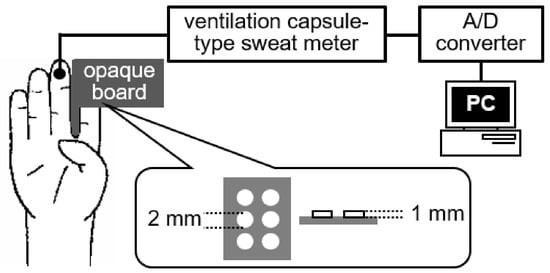
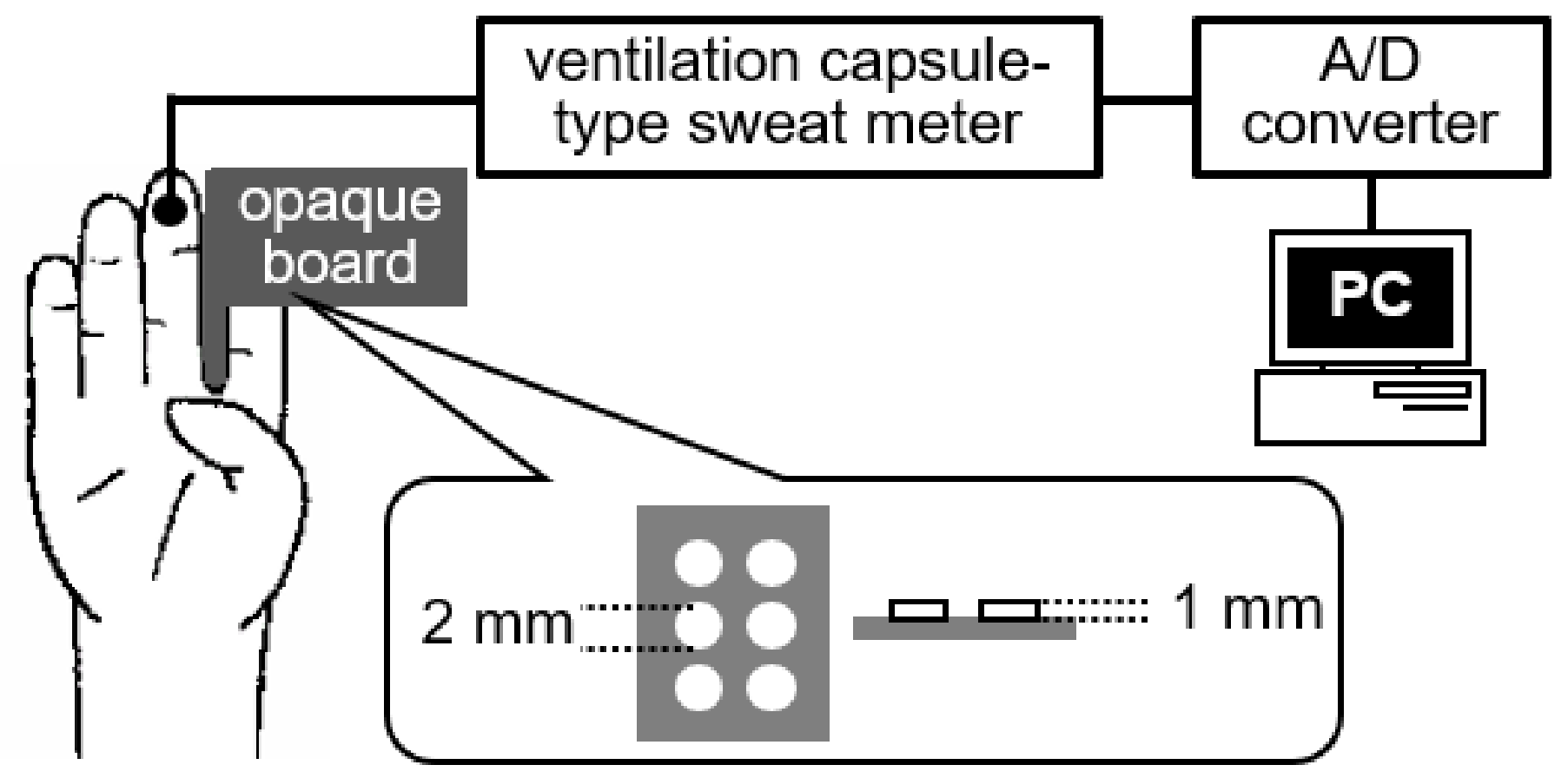
As shown in Figure 1, we prepared a flat plate with raised letters. The convexities (diameter: 2 mm, height: 1 mm) on the plates were arranged according to Braille code. Each flat plate was mounted on the back face of an opaque board to simulate blind conditions. The experimental protocol for the Braille discrimination task followed the methodology outlined in previous studies [7,19]. None of the participants had earlier experience with Braille reading. Prior to the experiment, participants were asked to practice a task involving the decoding of a specific Braille character. After completing all necessary preparations for SR measurement, participants were required to sit for at least 5 min to allow the SR data to stabilize. Subsequently, they were asked to touch the Braille plate with the index finger of their dominant hand for 15 s while remaining blindfolded and to keep their finger steady while identifying the Braille character to avoid motion artifacts. After a 30 s interval following the Braille reading, each participant was instructed to identify the character they had felt by referring to a Braille chart. As participants were not required to provide correct answers during this task, discrimination accuracy was not included as a measurement variable in this study.
Figure 1.
Braille character discrimination task. A flat plate with raised letters, which were arranged according to the Braille code, was mounted on the back surface of an opaque board. The SR of the middle finger during Braille reading was evaluated using a ventilation capsule-type sweat meter.
2.4. Data Analysis
Finger pad sweating was analyzed using software (LabChart v5 for Windows, ADInstruments Pty Ltd., Bella Vista, Australia). The mean value during the 15 s before the start of Braille reading was considered as the baseline, and the changes observed during Braille decoding were calculated. The maximum SR change (SRMAX) and the time required for maximum SR (SRLAT) during the Braille discrimination task were subsequently extracted. The normality of the data distribution for each measurement (TT, SRMAX, and SRLAT) was examined using the Kolmogorov–Smirnov test, and the data were not normally distributed. Therefore, Spearman’s rank correlation coefficients were calculated to examine the relationships among age, TT, SRMAX, and SRLAT. Furthermore, sweating function and tactile sensitivity may be influenced by aging and the use of antihypertensive medications, which can affect autonomic nervous system activity. Therefore, participants were grouped by age (65–75 years and ≥76 years) and antihypertensive medication use (users and non-users). Differences in TT, SRMAX, and SRLAT between the groups were examined using the Mann–Whitney U test. Statistical significance was set at p < 0.05.
3. Results
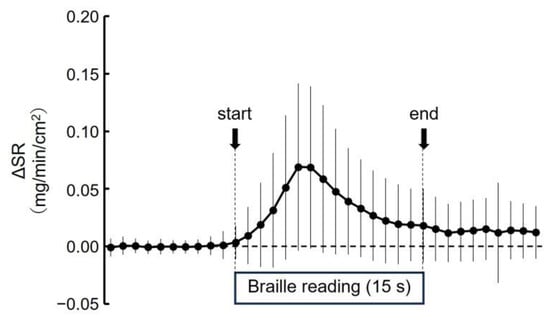
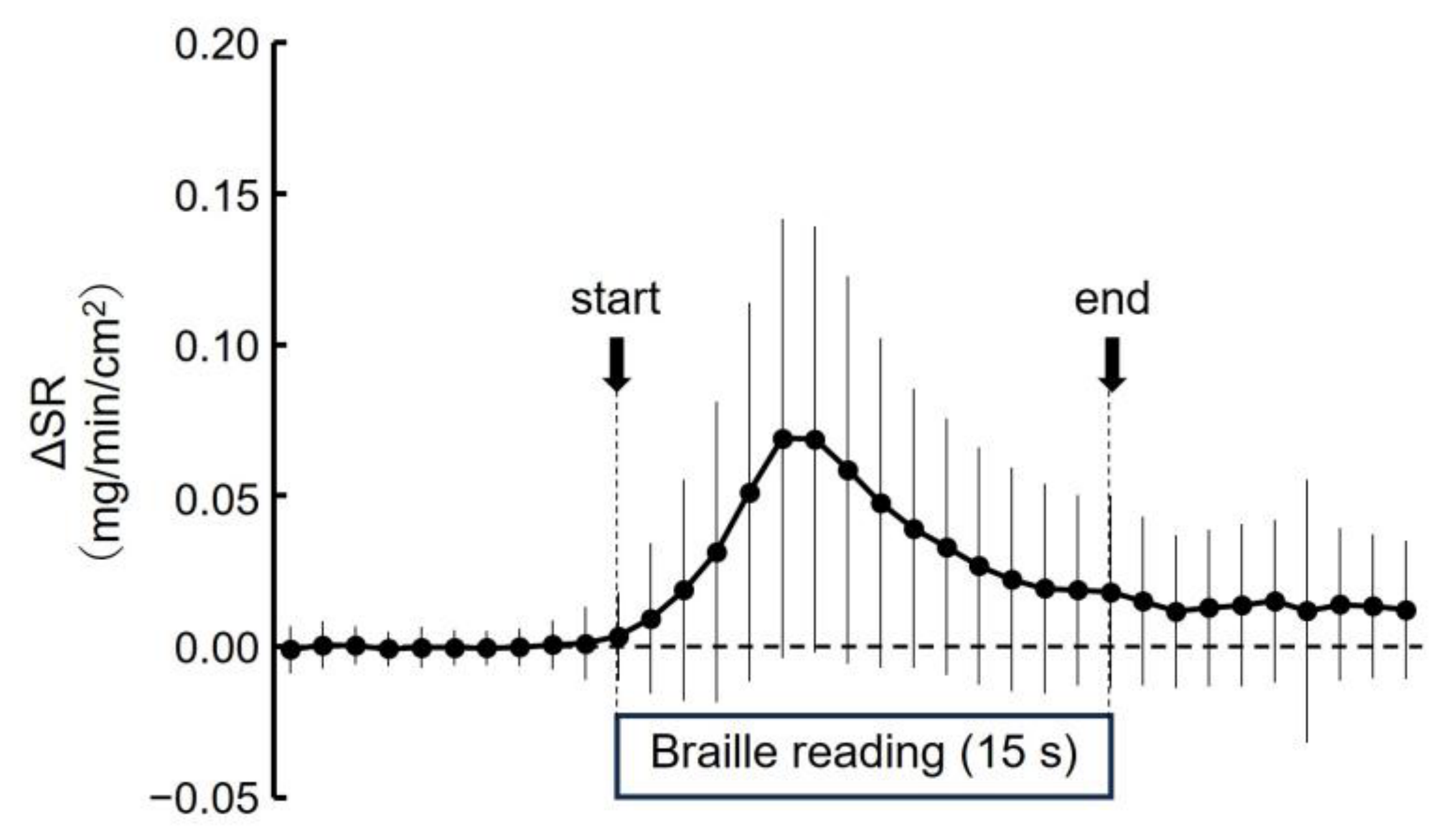
Figure 2 shows the time course of mean SR changes during Braille reading in older adults: SR increased during Braille reading, SRMAX at the finger pads was 0.08 ± 0.08 mg/cm2·min, SRLAT was 6.8 ± 2.7 s, and mean TT was 3.15 ± 0.28 log10·0.1 mg.
Figure 2.
Time course of the mean change (Δ) in SR from baseline before, during, and after Braille reading in older women. The horizontal bar indicates the duration of plate touching. Values are presented as the mean ± SD.
Table 2 summarizes the relationships among age, TT, SRMAX, and SRLAT., with TT establishing a positive correlation with age (rs = 0.33, 95% confidence interval [CI]: 0.11 to 0.51, p < 0.01) and a negative correlation with SRMAX (rs = −0.36, 95% CI: −0.54 to −0.16, p < 0.01). By contrast, SRLAT does not show a significant correlation with TT (rs = 0.18, 95% CI: −0.04 to 0.38, p = 0.11).
Table 2.
Relationships among age, TT, SRMAX, and SRLAT (n = 84).
TT, but neither SRMAX nor SRLAT, was significantly higher in the ≥76 years group (n = 52) than in the 65–75 years group (n = 32) (Table 3). Conversely, TT, SRMAX, and SRLAT did not show significant differences between antihypertensive medication users (n = 24) and non-users (n = 60) (Table 4).
Table 3.
Comparison of TT and SR between two age groups.
Table 4.
Comparison of TT and SR between antihypertensive medication users and non-users.
4. Discussion
This study aimed to clarify whether the responses in SR during concentrated finger perception are associated with finger sensory function in older women. Therefore, we investigated the relationship between the characteristics of SR observed during Braille reading, and TT in older adults. We found a significant correlation between TT and the maximum change in SR observed during Braille reading. These results suggest that the sweat response during finger sensory discrimination tasks is related to finger sensory function in older adults.
SR was observed in the finger pads during the Braille discrimination task. Sweating in the palms is known as psychological sweating, which increases in response to mental stress and emotional fluctuations; SR increases immediately in response to mental arithmetic tasks, painful stimuli, and exercise [8,9,10]. This study demonstrated that psychological sweating also occurs in the finger pads during discrimination tasks that require focused attention. Mental activity in higher brain centers related to sensory discrimination may promote sweating in the finger pads.
This study found a direct correlation between the SRMAX observed during Braille reading and the TT of the fingertip in older women, indicating that finger pad sweating observed during Braille reading may be associated with the tactile sensitivity of the fingers. Conversely, we did not observe any significant difference in SRMAX between the two age groups examined in this study. SR may be evoked by tactile discrimination in the fingers without significant influence from age in older women. However, the observed correlation coefficients signal a moderate association, implying that factors such as age differences, cognitive function, physical function, and medication use may be involved.
By contrast, this study shows that the tactile pressure threshold was not significantly correlated with the peak response latency of SRLAT during Braille reading (r = 0.18, p = 0.11). These results suggest that different factors may also be involved in the relationship between the delayed SR and tactile sensitivity. In Braille reading, cognitive processing in higher brain centers is involved, such as the identification of Braille dot patterns and matching characters. The peak response latency of SR may be influenced by the speed of cognitive processing during the Braille discrimination task in higher brain centers. However, the present study did not assess the timing of participants’ judgments during the discrimination tasks. Further studies are required to address these issues.
Tactile sensitivity in older adults attenuates due to age-related changes [4,5,6,7]. When the tactile pressure threshold was measured in four age groups (65–69, 70–74, 75–79, and 80–85 years), it gradually increased with age [6]. Consistent with these findings, this study shows higher tactile pressure thresholds in the ≥76 years group than in the 65–75 years group. These results indicate that aging-related declines in tactile sensitivity continue throughout old age.
A limitation of our study is the exclusive inclusion of female participants, as only a few male participants were enrolled. Consequently, we did not examine the influence of gender differences on SR in the discrimination task. Numerous studies have reported gender differences in SR to stimuli [20,21,22,23,24]. This difference may also affect SR during Braille character discrimination tasks. Further research is required to clarify this issue. A post hoc power analysis based on the present sample size and correlation coefficient (r = 0.36, n = 84), performed using G*Power software (ver. 3.1.9.7; Heinrich-Heine-Universität Düsseldorf, Düsseldorf, Germany), indicated a statistical power of 0.81 (81%). As this study did not gather data on participants’ medical history, cognitive and motor abilities, or types of medications, we were unable to conduct a multivariate analysis to evaluate how these potential confounding factors might have influenced the results. As a result, this study cannot definitively assert that the link between finger sensory sensitivity and SR is unaffected by unmeasured variables or potential confounding factors. As this study did not assess Braille discrimination accuracy, we could not examine the relationship between Braille discrimination performance and SR. Therefore, we could not determine whether differences in SR can be attributed to differences in discrimination performance, attention, cognitive processing, task engagement, or a combination of these processes—either individually or combined. As pre-experimental conditions—such as restrictions on smoking, meals, and exercise, or hand-washing—were not established, the reproducibility of the data is limited. Furthermore, the test–retest reliability across sessions of SR during the finger discrimination task was not evaluated. As these points are unclear, further examination is warranted.
5. Conclusions
In conclusion, the phenomenon of finger pad sweating observed during Braille reading may be associated with the tactile sensitivity of fingers. Sensory function in the human hand is closely linked to motor function and is considered an important factor in the recovery of hand function in rehabilitation medicine. The SR during concentrated tactile perception may contribute to the development of novel sensory assessment methods that enable the quantitative assessment of tactile function. However, further research is needed to evaluate potential confounding factors.
Author Contributions
Conceptualization, J.M.; methodology, J.M.; formal analysis, J.M., S.M., Y.K., H.K. and N.K.; investigation, J.M., S.M. and Y.K.; resources, J.M.; data curation, J.M., H.K. and N.K.; writing—original draft preparation, J.M.; writing—review and editing, J.M., S.M., Y.K., H.K. and N.K.; visualization, J.M.; supervision, J.M.; project administration, J.M. All authors have read and agreed to the published version of the manuscript.
Funding
This study was supported by a Grant-in-Aid for Scientific Research (Grant Number: 24K14248) from the Ministry of Education, Culture, Sports, Science, and Technology, Japan.
Institutional Review Board Statement
The present study was performed in accordance with the Declaration of Helsinki and approved by the Institutional Ethical Committee of Nagasaki University (protocol code: 14043001, date of approval: 20 May 2015).
Informed Consent Statement
Informed consent was obtained from all subjects involved in the study. Written informed consent has been obtained from the patients to publish this paper.
Data Availability Statement
The data supporting the findings of this study are available from the corresponding author upon reasonable request. The data are not publicly available because they contain information that could compromise the privacy of the research participants.
Conflicts of Interest
The authors declare no conflicts of interest. The funders had no role in the design of the study; in the collection, analyses, or interpretation of data; in the writing of the manuscript, or in the decision to publish the results.
References
- Bolton, C.F.; Winkelmann, R.K.; Dyck, P.J. A quantitative study of Meissner’s corpuscles in man. Neurology 1966, 16, 1–9. [Google Scholar] [CrossRef] [Scilit]
- Schimrigk, K.; Rüttinger, H. The touch corpuscles of the plantar surface of the big toe. Histological and histometrical investigations with respect to age. Eur. Neurol. 1980, 19, 49–60. [Google Scholar] [CrossRef] [Scilit]
- García-Piqueras, J.; García-Mesa, Y.; Cárcaba, L.; Feito, J.; Torres-Parejo, I.; Martín-Biedma, B.; Cobo, J.; García-Suárez, O.; Vega, J.A. Ageing of the somatosensory system at the periphery: Age-related changes in cutaneous mechanoreceptors. J. Anat. 2019, 234, 839–852. [Google Scholar] [CrossRef] [Scilit]
- Thornbury, J.M.; Mistretta, C.M. Tactile sensitivity as a function of age. J. Gerontol. 1981, 36, 34–39. [Google Scholar] [CrossRef] [Scilit]
- Wickremaratchi, M.M.; Llewelyn, J.G. Effects of ageing on touch. Postgrad. Med. J. 2006, 82, 301–304. [Google Scholar] [CrossRef] [Scilit]
- Murata, J.; Murata, S.; Hiroshige, J.; Ohtao, H.; Horie, J.; Kai, Y. The influence of age-related changes in tactile sensitivity and muscular strength on hand function in older adult females. Int. J. Gerontol. 2010, 4, 180–183. [Google Scholar] [CrossRef] [Scilit]
- Murata, J.; Murata, S.; Kodama, T.; Nakano, H.; Soma, M.; Nakae, H.; Satoh, Y.; Kogo, H.; Umeki, N. Age-related changes in the response of finger skin blood flow during a Braille character discrimination task. Healthcare 2021, 9, 143. [Google Scholar] [CrossRef] [Scilit]
- Ogawa, T. Thermal influence on palmar sweating and mental influence on generalized sweating in man. Jpn. J. Physiol. 1975, 25, 525–536. [Google Scholar] [CrossRef] [Scilit]
- Sugenoya, J.; Ogawa, T.; Asayama, M.; Miyagawa, T. Occurrence of mental and thermal sweating on the human axilla. Jpn. J. Physiol. 1982, 32, 717–726. [Google Scholar] [CrossRef] [Scilit]
- Ogata, A.; Sugenoya, J.; Nishimura, N.; Matsumoto, T. Low and high frequency acupuncture stimulation inhibits mental stress-induced sweating in humans via different mechanisms. Auton. Neurosci. 2005, 118, 93–101. [Google Scholar] [CrossRef] [Scilit]
- Gur, R.C.; Mozley, P.D.; Resnick, S.M.; Gottlieb, G.L.; Kohn, M.; Zimmerman, R.; Herman, G.; Atlas, S.; Grossman, R.; Berretta, D. Gender differences in age effect on brain atrophy measured by magnetic resonance imaging. Proc. Natl. Acad. Sci. USA 1991, 88, 2845–2849. [Google Scholar] [CrossRef] [Scilit]
- Mueller, E.A.; Moore, M.M.; Kerr, D.C.; Sexton, G.; Camicioli, R.M.; Howieson, D.B.; Quinn, J.F.; Kaye, J.A. Brain volume preserved in healthy elderly through the eleventh decade. Neurology 1998, 51, 1555–1562. [Google Scholar] [CrossRef] [Scilit]
- Scahill, R.I.; Frost, C.; Jenkins, R.; Whitwell, J.L.; Rossor, M.N.; Fox, N.C. A longitudinal study of brain volume changes in normal aging using serial registered magnetic resonance imaging. Arch. Neurol. 2003, 60, 989–994. [Google Scholar] [CrossRef] [Scilit]
- Salthouse, T.A.; Fristoe, N.M.; Lineweaver, T.T.; Coon, V.E. Aging of attention: Does the ability to divide decline? Mem. Cogn. 1995, 23, 59–71. [Google Scholar] [CrossRef] [Scilit]
- Bertsch, K.; Hagemann, D.; Hermes, M.; Walter, C.; Khan, R.; Naumann, E. Resting cerebral blood flow, attention, and aging. Brain Res. 2009, 1267, 77–88. [Google Scholar] [CrossRef] [Scilit]
- Harada, C.N.; Natelson Love, M.C.; Triebel, K.L. Normal cognitive aging. Clin. Geriatr. Med. 2013, 29, 737–752. [Google Scholar] [CrossRef] [Scilit]
- Inoue, Y.; Nakao, M.; Araki, T.; Murakami, H. Regional differences in the sweating responses of older and younger men. J. Appl. Physiol. 1991, 71, 2453–2459. [Google Scholar] [CrossRef] [Scilit]
- Lee, J.B.; Lee, I.H.; Shin, Y.O.; Min, Y.K.; Yang, H.M. Age- and sex-related differences in sudomotor function evaluated by the quantitative sudomotor axon reflex test (QSART) in healthy humans. Clin. Exp. Pharmacol. Physiol. 2014, 41, 392–399. [Google Scholar] [CrossRef] [Scilit]
- Murata, J.; Murata, S.; Soma, M.; Nakae, H.; Sato, Y.; Kogo, H.; Umeki, N. Relationship between the changes in blood flow and volume in the finger during a Braille character discrimination task. Ski. Res. Technol. 2017, 23, 514–518. [Google Scholar] [CrossRef] [Scilit]
- Inoue, Y.; Tanaka, Y.; Omori, K.; Kuwahara, T.; Ogura, Y.; Ueda, H. Sex- and menstrual cycle-related differences in sweating and cutaneous blood flow in response to passive heat exposure. Eur. J. Appl. Physiol. 2005, 94, 323–332. [Google Scholar] [CrossRef] [Scilit]
- Ichinose-Kuwahara, T.; Inoue, Y.; Iseki, Y.; Hara, S.; Ogura, Y.; Kondo, N. Sex differences in the effects of physical training on sweat gland responses during a graded exercise. Exp. Physiol. 2010, 95, 1026–1032. [Google Scholar] [CrossRef] [Scilit]
- Gagnon, D.; Crandall, C.G.; Kenny, G.P. Sex differences in postsynaptic sweating and cutaneous vasodilation. J. Appl. Physiol. (1985) 2013, 114, 394–401. [Google Scholar] [CrossRef] [Scilit]
- Niu, Z.; Goto, T. Effects of individual characteristics and local body functions on sweating response: A review. Int. J. Biometeorol. 2024, 68, 2185–2204. [Google Scholar] [CrossRef] [Scilit]
- Amano, T.; Ichinose-Kuwahara, T.; Ueda, H.; Kondo, N.; Wang, H.; Inoue, Y. Biological aging and sex differences in cholinergic sweating: From young adults to the elderly in their 80s and beyond. Am. J. Physiol. Regul. Integr. Comp. Physiol. 2026, 330, R1–R12. [Google Scholar] [CrossRef] [Scilit]

Disclaimer/Publisher’s Note: The statements, opinions and data contained in all publications are solely those of the individual author(s) and contributor(s) and not of MDPI and/or the editor(s). MDPI and/or the editor(s) disclaim responsibility for any injury to people or property resulting from any ideas, methods, instructions or products referred to in the content. |
© 2026 by the authors. Published by MDPI on behalf of the Italian Society of Gerontology and Geriatrics. Licensee MDPI, Basel, Switzerland. This article is an open access article distributed under the terms and conditions of the Creative Commons Attribution (CC BY) license.