


Abstract
The World Health Organization targets hepatitis C virus (HCV) elimination as a public-health threat by 2030. Phetchabun province, in lower northern Thailand, has historically reported one of the country’s highest HCV seroprevalence rates. We describe a province-wide, decentralized test-to-treat micro-elimination program implemented within Thailand’s universal health-coverage system. Adults aged 35–64 years (2020–2024) and individuals born before 1992 (late 2023) across all 11 districts were screened using fingerstick anti-HCV rapid diagnostic tests at sub-district health-promoting hospitals. Reactive participants underwent confirmatory HCV-RNA testing at three regional nodes. Eligible patients received pangenotypic sofosbuvir/velpatasvir for 12 weeks, with ribavirin added for cirrhosis. Sustained virological response at 12 weeks post-treatment (SVR12) was the primary outcome. Of 400,567 targeted individuals, 389,547 (97.3%) were screened; 18,340 (4.71%) were anti-HCV reactive. Confirmatory HCV-RNA testing was completed in 14,845 (80.9%), of whom 10,996 (74.1%) had active infection. Of 8961 treatment-eligible patients, 8842 (98.7%) received DAA therapy. Among 6719 evaluable for SVR12, 6474 (96.4%) achieved cure. This simplified, domestically financed, decentralized test-to-treat model achieved WHO-target-level diagnosis, treatment, and cure rates at provincial scale, offering a scalable framework for HCV micro-elimination in low- and middle-income countries.
1. Introduction
Viral hepatitis remains a major global public-health problem. According to the World Health Organization (WHO) 2024 Global Hepatitis Report, an estimated 254 million people are living with chronic hepatitis B virus (HBV) infection and 50 million with chronic hepatitis C virus (HCV) infection worldwide, with approximately 1.3 million deaths attributed to viral hepatitis in 2022, comparable to mortality from tuberculosis [1,2]. In 2016, the World Health Assembly endorsed the Global Health Sector Strategy on Viral Hepatitis, which set the goal of eliminating viral hepatitis as a public-health threat by 2030 through a 90% reduction in new chronic HBV and HCV infections, an 80% treatment coverage among diagnosed patients, and a 65% reduction in hepatitis-related mortality, with at least 90% of infected individuals diagnosed [3,4]. Thailand endorsed these targets and integrated them into its National Strategic Plan on Viral Hepatitis; however, early implementation was constrained by limited budget allocation and the high cost of antiviral therapy [5].
In Thailand, viral hepatitis is dominated by chronic HBV and HCV infections [5,6]. For HBV, a highly effective vaccine introduced into the Expanded Program on Immunization (EPI) for all newborns in 1992, together with universal precaution practices and stringent blood-bank screening, has driven a marked decline in HBV prevalence from 6 to 8% before 1992 to 1.68% in 2024, with the carrier rate among children aged < 10 years now below 0.1% [6,7,8]. For HCV, no vaccine is available, but pangenotypic direct-acting antivirals (DAAs) can cure more than 95% of treated patients [9,10,11]. The originator-brand DAA regimens were initially prohibitively expensive in Thailand; the situation changed when generic sofosbuvir-based regimens became available, and in early 2021, the National Health Security Office (NHSO) added pangenotypic sofosbuvir/velpatasvir (SOF/VEL) to the Universal Coverage Scheme benefit package, enabling access without cost to patients [12,13].
Following the 2016 WHO call for elimination, the Centre of Excellence in Clinical Virology, Faculty of Medicine, Chulalongkorn University, prioritized hepatitis C as the most achievable elimination target given the existence of curative therapy, and selected Phetchabun, a province in lower northern Thailand with one of the highest reported HCV seroprevalence rates in the country and a correspondingly high incidence of liver cancer, as a pilot site for a province-wide micro-elimination program [14,15].
Baseline epidemiological work began in Phetchabun in 2015. A randomly sampled cross-sectional study in adults aged 30–64 years compared two high-burden districts in Phetchabun (Lom Sak and Lom Kao, n = 1667) with the neighboring Chum Phae district of Khon Kaen province (n = 1410). Anti-HCV seroprevalence in Phetchabun was about five-fold higher than in Khon Kaen (15.5% vs. 3.6%) and substantially exceeded the national average of 1–2% reported in earlier nationwide surveys [14,15]. A subsequent study in young adults aged 18–30 years residing in the same Phetchabun districts showed an anti-HCV seroprevalence of <4% in those aged 18–34 years that rose abruptly to ≥15% in those aged ≥ 35 years, identifying individuals born before 1983 as the principal birth cohort harboring chronic HCV infection [16,17]. These data established that DAA-based treatment should be prioritized in this older birth cohort to reduce the long-term burden of cirrhosis and hepatocellular carcinoma (HCC) [17,18].
The Phetchabun “test-to-treat” micro-elimination project was designed in 2018. At that time, the province had a population of approximately 995,000, of whom about 438,000 were aged 35–64 years. A 1:100 province-wide sample of 4753 individuals aged 35–64 years was drawn proportionally from every sub-district and tested for anti-HCV using an automated chemiluminescent microparticle immunoassay (ARCHITECT anti-HCV assay, Abbott Diagnostics, Chicago, IL), with confirmation of active infection by HCV-RNA testing [18]. Anti-HCV seroprevalence was higher in the northern districts and lower in the south. Of the seropositive individuals, 76% had detectable HCV RNA, and more than half of those with active infection were infected with HCV genotype 6, supporting the choice of a pangenotypic regimen [18,19]. To enable point-of-care screening, four commercial rapid diagnostic tests (RDTs) for anti-HCV (Abon, Blue Cross, Healgen, and SD Bioline) were evaluated under field conditions and found to have comparable diagnostic performance, supporting their use as a first-line screening tool [20].
Building on these findings, the province-wide test-to-treat program, the Phetchabun model, was launched in early 2020 [21]. Anti-HCV screening was performed using a fingerstick whole-blood RDT, and reactive samples underwent confirmation by automated qualitative real-time RT-PCR, with confirmation testing operationalized from early 2021 onward [21]. The initial target population was adults aged 35–64 years across all eleven districts. In October 2023 (Thai fiscal year 2024), the Department of Disease Control of the Ministry of Public Health and the NHSO expanded eligibility to include all individuals born before 1992 (i.e., the pre-universal-HBV-vaccination birth cohort), and the Phetchabun program adjusted its target population accordingly [12,22]. NHSO has reimbursed SOF/VEL for HCV treatment under universal health coverage since March 2021 [12,13].
The present report consolidates more than five years of programmatic and research data from the Phetchabun model, summarizing progress in screening, confirmatory testing, treatment uptake, and treatment outcomes. The intent is to document a scalable, domestically financed, decentralized micro-elimination strategy that can serve as a reference for other Thai provinces and for other low- and middle-income countries (LMICs) with comparable HCV epidemiology.
2. Materials and Methods
2.1. Project Framework and Ethics
The Phetchabun province test-to-treat HCV micro-elimination project was supported by the Grand Challenge Fund of the National Research Council of Thailand (NRCT). The protocol was approved by the Institutional Review Board (IRB) of the Faculty of Medicine, Chulalongkorn University (IRB No. 028/63). Research-funded operations ran from early 2021 to early 2024; thereafter, the test-to-treat workflow continued as a routine service under the Department of Disease Control, Ministry of Public Health, and the NHSO. The present analysis combines primary research data and secondary service data captured under the same operational framework, covering the period from program inception in 2020 through April 2026. Selected interim findings have been published previously [18,20,21].
2.2. Study Setting
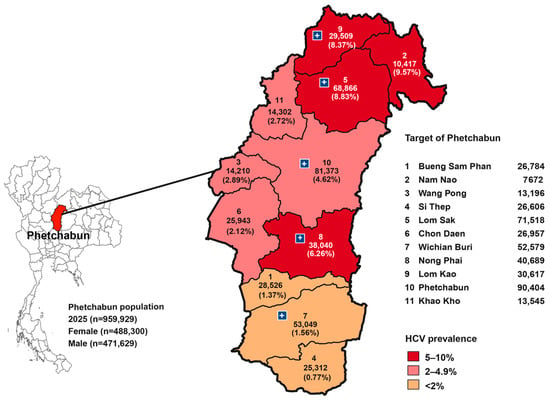
Phetchabun is a province in lower northern Thailand, located approximately 350 km north of Bangkok, covering 12,668 km2 (Figure 1). The province comprises 11 districts and 117 sub-districts, with a total population of 959,929 (471,629 men and 488,300 women). Health-care delivery is supported by 12 public hospitals, 2 private hospitals, and 155 sub-district health-promoting hospitals. The majority of residents are engaged in agriculture. The provincial map (Figure 1) was generated in R software (version 4.4.2) using the sf and ggplot2 packages, with administrative boundary data obtained from GADM (version 4.1; https://gadm.org (accessed on 6 June 2026)).
Figure 1.
Map of Phetchabun Province and the study districts, showing the total provincial population, the target population, and the results of anti-HCV screening. Administrative boundaries were obtained from the Database of Global Administrative Areas (GADM, version 4.1; https://gadm.org, accessed on 6 June 2026) and processed in R software (version 4.4.2).
2.3. Study Period and Target Population
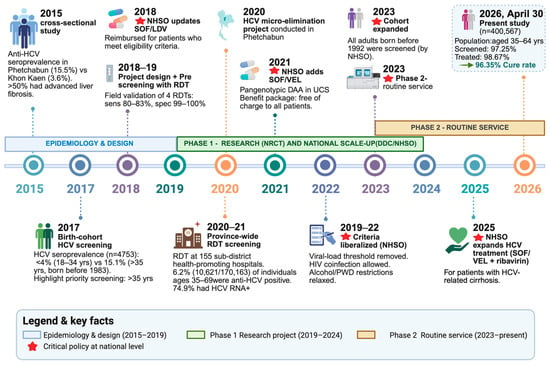
The program was implemented in two consecutive phases. In Phase 1 (early 2020 to September 2024), conducted under the Grand Challenge research project, point-of-care anti-HCV screening with fingerstick RDTs was paired with qualitative real-time RT-PCR confirmation, targeting adults aged 35–64 years. In Phase 2 (from late 2023 onward), screening was implemented under the policies of the Department of Disease Control and the NHSO; eligibility was broadened to individuals born before 1992 (one-time lifetime screening), with annual rescreening offered to high-risk groups including people living with HIV (PLHIV), people who inject drugs (PWID), men who have sex with men (MSM), incarcerated individuals, and health-care personnel. The present analysis is restricted to the one-time screening cohort, which corresponds to a target population of 400,567 individuals. The timeline of the planning, testing, and treatment of the project, and the NHSO and DDC criteria, are shown in Figure 2.
Figure 2.
Programmatic and policy timeline of the Phetchabun HCV micro-elimination model, 2015–2026. Created in BioRender. Poovorawan, Y. (2026) https://BioRender.com/t1bou3b (accessed on 6 June 2026).
2.4. Diagnostic Procedures
During Phase 1, fingerstick whole-blood anti-HCV screening was performed using the SD Bioline HCV rapid diagnostic test (Standard Diagnostics, Yongin-si, Gyeonggi-do, Korea), which demonstrated 80% sensitivity (95% CI: 70.8–87.3%) and 100% specificity (95% CI: 96.4–100.0%) in laboratory evaluation against a panel of anti-HCV-positive and anti-HCV-negative samples [20]. Reactive samples were forwarded to designated provincial laboratories for confirmation by qualitative HCV-RNA testing on the automated cobas® 4800 system (cobas® HCV test, Roche Diagnostics, Mannheim, Germany), an integrated platform that performs both viral RNA extraction and real-time RT-PCR; 200 μL of plasma was used per assay, with a lower limit of detection of 15.2 IU/mL [21]. During Phase 2 (from October 2024), screening continued to use commercially available, Thai FDA–approved anti-HCV RDTs distributed through the public-health system. Confirmatory testing in Phase 2 used quantitative HCV RNA viral-load assays performed at commercial laboratories accredited by the NHSO, with reimbursement and sample logistics organized at the district level.
All HCV-RNA-positive individuals subsequently underwent additional pre-treatment evaluation, including a complete blood count (CBC) and liver-function tests. Liver fibrosis was assessed using two non-invasive indices: the aspartate aminotransferase-to-platelet ratio index (APRI) and the fibrosis-4 (FIB-4) score [23,24]; no patient in this program underwent liver biopsy.
2.5. Treatment Eligibility and Exclusion Criteria
Since late 2021, the NHSO has applied the National List of Essential Medicines criteria for HCV treatment with SOF/VEL [12,13], broadly aligned with international guidance [25,26]. Initially, eligibility required: age 18–70 years; treatment-naïve status, or previous failure or intolerance of pegylated interferon plus ribavirin [25]; HCV-RNA ≥ 5000 IU/mL; significant fibrosis (Metavir stage ≥ F2 on liver biopsy, transient elastography > 7 kPa, FIB-4 > 1.45 or APRI > 0.5), consistent with EASL guidance that non-invasive tests should be used in place of liver biopsy to assess fibrosis severity [23,24,26]; estimated glomerular filtration rate (eGFR) ≥ 30 mL/min [25]; for cirrhotic patients with Child-Pugh score B or C, a Model for End-Stage Liver Disease (MELD) score ≤ 18 was required [25,26]; abstinence from alcohol and illicit substances for ≥6 months [12,13]; for HIV-coinfected patients on highly active antiretroviral therapy (HAART), CD4 count ≥ 200 cells/mm3 and HIV viral load < 50 copies/mL [25]; for HBV-coinfected patients, concurrent HBV therapy [25]; and for patients with previous malignancy, ≥6 months of disease-free status [12,13].
Liver biopsy was listed as one option under the NHSO policy criteria but was not performed for any patient in this program; fibrosis staging was assessed exclusively using the non-invasive indices (APRI and FIB-4) described in Section 2.4, consistent with EASL guidance that non-invasive tests should be used in place of liver biopsy [26].
Patients with cirrhosis (assessed by APRI, FIB-4, or clinical judgment) received SOF/VEL plus ribavirin under the supervision of a gastroenterology specialist. Contraindications included pregnancy or unwillingness to use contraception during therapy, uncontrolled severe comorbidity, ongoing chemotherapy, active opportunistic infection in HIV, and decompensated cirrhosis with MELD score > 18. In 2022, the criteria were liberalized: viral-load thresholds were removed (qualitative HCV RNA, quantitative viral load, or HCV core antigen all accepted), restrictions on alcohol and substance use were relaxed, and HIV co-infection was permitted in the absence of active opportunistic infection, particularly tuberculosis. SOF/VEL plus ribavirin remained recommended for cirrhotic patients with a MELD score ≤ 18.
2.6. Treatment Discontinuation Criteria
Treatment was completed after 12 weeks of therapy. Therapy was discontinued early in cases of uncontrolled exacerbation of comorbidity, persistent non-adherence to medical advice, or active alcohol consumption during treatment.
2.7. Treatment Regimen
HCV-RNA-positive patients received oral SOF/VEL (sofosbuvir 400 mg/velpatasvir 100 mg) once daily, a pangenotypic regimen, dispensed monthly for three consecutive months (total duration 12 weeks). Sustained virological response was assessed 12 weeks after the last dose (SVR12). SOF/VEL has been included in the Thai National List of Essential Medicines for HCV treatment since early 2021 [12,13].
2.8. Follow-Up
HCV-RNA-positive patients were initially evaluated by a physician at the district treatment unit. Subsequent follow-up during the 12-week treatment course was conducted by nurse practitioners, with assessment of treatment outcome by HCV-RNA testing 12 weeks after completion (SVR12). Patients who remained HCV-RNA-positive after treatment (treatment failure) were referred to a gastroenterology specialist for re-treatment with SOF/VEL plus ribavirin.
2.9. Assessment of Liver Fibrosis
APRI and FIB-4 were used as non-invasive markers to assess liver fibrosis. APRI was categorized as <0.5, 0.5–1.5, and >1.5, while FIB-4 was categorized as <1.45, 1.45–2.67, and >2.67 according to established clinical cut-offs [23,24]. Age-adjusted FIB-4 cut-offs were applied for patients aged ≥ 65 years (<2.0, 2.0–2.67, >2.67). The age-adjusted FIB-4 approach in this study draws on evidence that FIB-4 diagnostic accuracy declines significantly with age in chronic hepatitis C cohorts specifically [27], and follows the age-specific cut-off framework (lower threshold 2.0, upper threshold 2.67 unchanged) validated by McPherson et al. [28].
2.10. Data Analysis
Programmatic data were summarized as the cumulative numbers screened (and as a percentage of the target population), the number and percentage of anti-HCV–reactive participants by district, the proportion of reactive participants undergoing confirmatory HCV-RNA testing, the proportion confirmed as HCV-RNA-positive by district, the number entering treatment, the number who died before treatment, and the SVR12 cure rate among those who completed treatment and reached the 12-week post-treatment evaluation.
Baseline demographic and clinical characteristics were compared between patients who achieved SVR12 and those with DAA treatment failure. Categorical variables were compared using the chi-square test or Fisher’s exact test, as appropriate for cell counts; continuous variables (age, BMI) were compared using the Mann–Whitney U test, as these were not normally distributed. A two-sided p-value < 0.05 was considered statistically significant. Statistical analyses were performed using Python (version 3.12.3) with the SciPy (version 1.17.1) and pandas (version 3.0.2) libraries.
2.11. Generative AI and AI-Assisted Technologies in the Writing Process
Generative AI tools (GPT-4o and Claude Sonnet 4.5) were used exclusively to refine language and improve readability, including translation from Thai to English. All content, concepts, and findings were wholly conceived and developed by the authors. The authors subsequently reviewed the final manuscript to ensure its accuracy, integrity, and adherence to academic standards.
3. Results
3.1. HCV Screening Coverage
The Phetchabun test-to-treat micro-elimination program, planned from 2018, began screening in 2020 and confirmatory HCV-RNA testing in 2021, initially targeting adults aged 35–64 years and, from late 2023, the broader pre-1992 birth cohort under the joint policy of the Department of Disease Control and the NHSO. The target population for the present analysis comprised 400,567 individuals (out of a total provincial population of approximately 960,000). As of 8 April 2026, cumulative anti-HCV screening using fingerstick RDTs had been performed in 389,547 individuals, equivalent to 97.25% of the target population. Anti-HCV reactivity was detected in 18,340 participants (4.71% of those screened). The seroprevalence was higher in the northern districts of the province (Lom Kao, Lom Sak, Nam Nao) than in the southern districts (Si Thep, Wichian Buri, Bueng Sam Phan); district-level data are presented in Table 1, and the geographical distribution is shown in Figure 1.
Table 1.
Cumulative HCV screening coverage and anti-HCV reactivity by district, Phetchabun province, 2020 to 30 April 2026.
3.2. Confirmatory HCV-RNA Testing
Of the 18,340 anti-HCV-reactive individuals identified by RDT, 14,845 (80.94%) underwent confirmatory HCV-RNA testing (qualitative or quantitative), of whom 10,996 (74.07% of those tested) were confirmed as actively infected (HCV-RNA positive). District-level results are presented in Table 2.
Table 2.
Cumulative HCV-RNA confirmatory testing and HCV-RNA positivity by district, Phetchabun province.
3.3. Linkage to Treatment
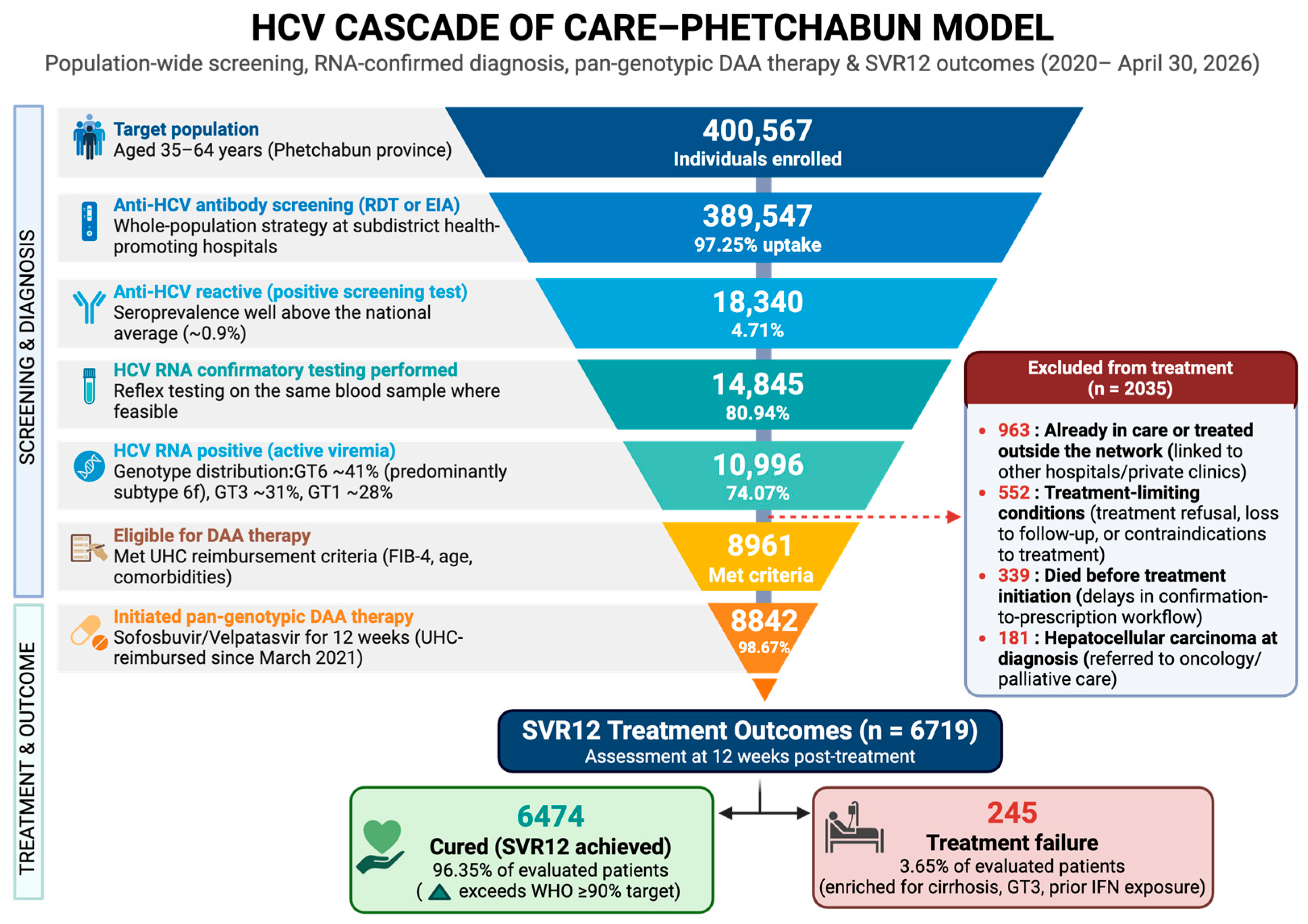
Of the 10,996 HCV-RNA-confirmed individuals province-wide, 75 refused the treatment, 70 was lost to follow up, 407 had treatment-limiting conditions, 181 had hepatocellular carcinoma, 339 died before treatment, 339 died before treatment could be initiated and 963 were already in care or being treated outside the Phetchabun network, The remaining 8961 individuals constituted the eligible target population for treatment, of whom 8842 (98.67%, 119 awaiting for treatment) had received DAAs therapy for treatment. District-level details are presented in Table 3.
Table 3.
Treatment cascade for HCV-RNA-confirmed individuals by service unit and district, Phetchabun province.
3.4. Treatment Outcomes
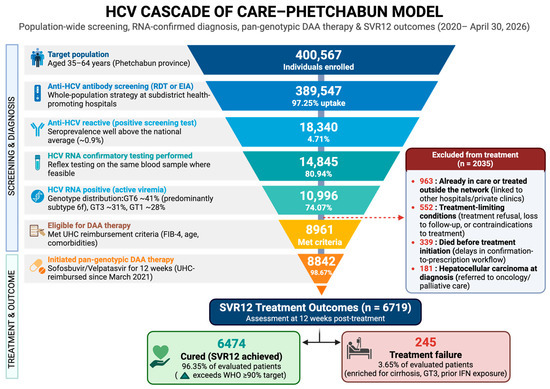
By April 2026, of the 8961 patients eligible for treatment, 8842 had received DAAs treatment. Among them, 6719 completed the 12-week regimen and underwent SVR12 evaluation. HCV RNA was undetectable in 6474 patients, corresponding to a cure rate of 96.35%, while 245 patients (3.65%) remained HCV-RNA-positive and were classified as treatment failures. The flow of the study population, including screening, confirmatory HCV RNA testing, initiation of direct-acting antiviral (DAA) treatment, and treatment outcomes, is shown in Figure 3.
Figure 3.
Overview of the study population from screening, confirmatory testing, initiation of direct-acting antiviral (DAA) therapy, and treatment outcomes. The icons represent each stage of the HCV care cascade, including the target population, anti-HCV antibody screening, anti-HCV seropositivity, HCV RNA confirmatory testing, HCV RNA positivity, eligibility for DAA therapy, treatment initiation, SVR12 achievement (cure), and treatment failure. The color scheme distinguishes the screening and diagnostic phase (blue and green), treatment eligibility and treatment initiation (yellow and orange), treatment outcomes (green for SVR12 achieved and pink for treatment failure), and reasons for treatment exclusion (red). Created in BioRender. Poovorawan, Y. (2026) https://BioRender.com/rs31eze (accessed on 6 June 2026).
3.5. Factors Associated with DAA Treatment Failure
Compared with patients who achieved SVR, those with treatment failure were more frequently male (89.0% vs. 73.8%, p = 0.002), had a higher prevalence of any comorbidity (61.0% vs. 46.0% had at least one condition, p = 0.004), and more often had a history of liver cirrhosis (19.2% vs. 6.0%, p < 0.001) or injection drug use (8.2% vs. 1.0%, p < 0.001) (Table 4). Regular medication adherence was less common among patients with treatment failure (80.8% vs. 95.0%, p < 0.001). In contrast, age, BMI, antiviral regimen, and baseline fibrosis severity by APRI or FIB-4 (including age-stratified FIB-4 cut-offs) did not differ significantly between groups (all p > 0.05).
Table 4.
Baseline demographic and clinical characteristics of patients by direct-acting antiviral (DAA) treatment outcome (n = 444).
3.6. Overall Program Performance Against WHO 2030 Targets
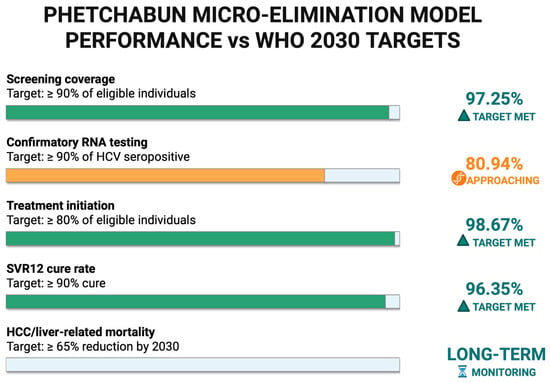
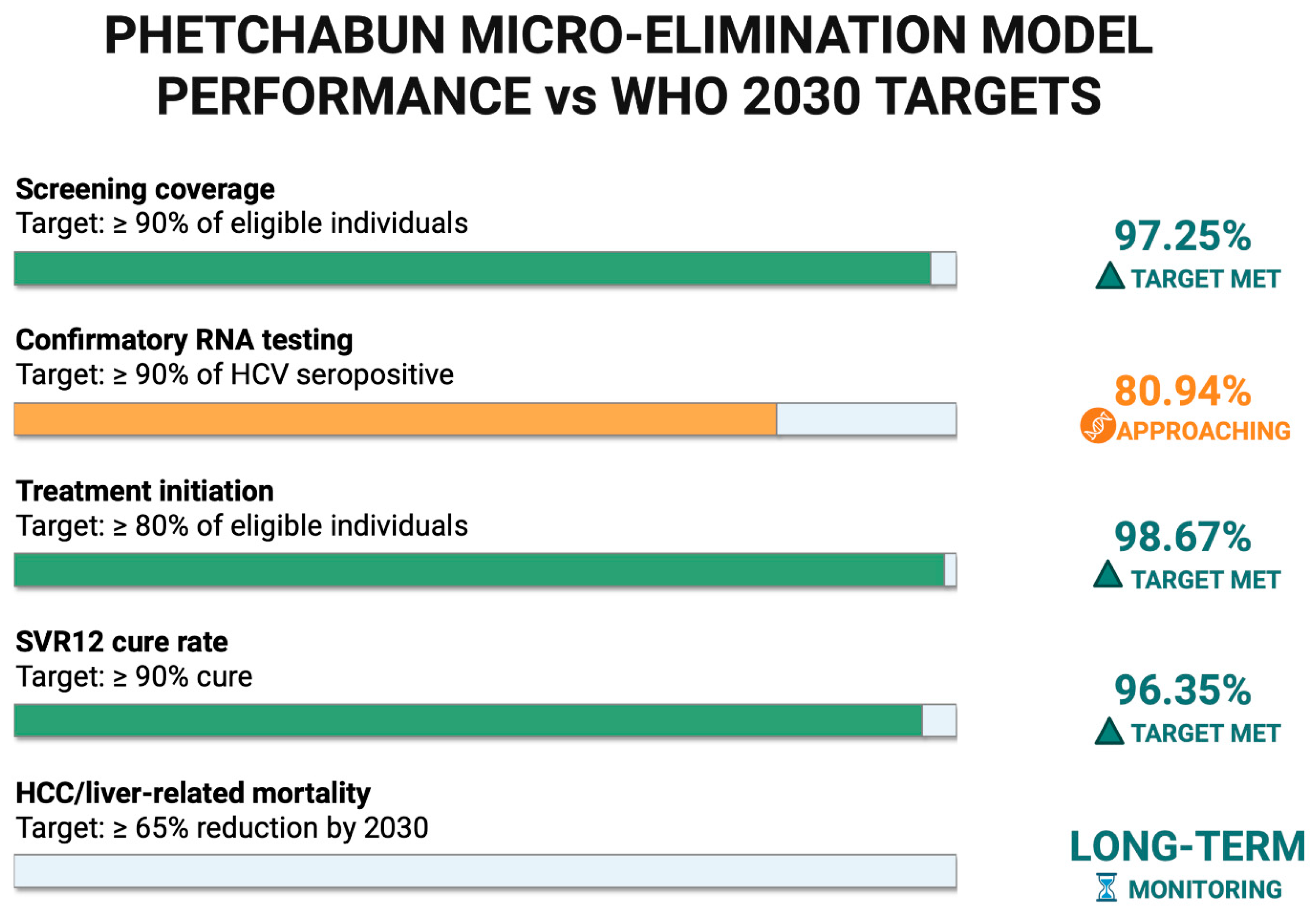
Overall, the Phetchabun model met or exceeded WHO 2030 elimination targets for screening coverage, treatment initiation, and SVR12 cure rate, and was approaching the target for confirmatory HCV-RNA testing; long-term monitoring of the HCC and liver-related mortality target is ongoing (Figure 4). These results, summarizing the full screening-to-cure cascade described above, indicate that a provincial-scale, decentralized test-to-treat strategy can achieve WHO programmatic benchmarks within a domestically financed universal health coverage system.
Figure 4.
Performance of the Phetchabun HCV micro-elimination model against WHO 2030 elimination targets, 2020 to 8 August 2025. The triangle symbol denotes that the corresponding WHO 2030 target has been achieved (Target Met), the clock symbol indicates that the indicator is Approaching the WHO target, and the hourglass symbol denotes Long-term Monitoring. Green indicates indicators that met the WHO target, orange indicates indicators approaching the target, and gray indicates indicators requiring continued long-term monitoring. Created in BioRender. Poovorawan, Y. (2026) https://BioRender.com/rwg6gw8 (accessed on 6 June 2026).
4. Discussion
The Phetchabun model demonstrates that WHO 2030 hepatitis C elimination targets can be achieved at the provincial scale within a low- or middle-income country (LMIC) through a decentralized test-to-treat strategy embedded in a universal health coverage (UHC) system [3,4,5]. WHO defines elimination as an 80% reduction in new HCV infections and a 65% reduction in HCV-related mortality versus 2015 baselines, with intermediate targets of diagnosing >90% and treating >80% of infected individuals [1,3,4]; only a minority of countries are currently on track to meet these goals [1,29]. Micro-elimination, formalized by Lazarus and colleagues in 2017–2018, breaks national targets into tractable sub-goals focused on defined populations or geographies [30,31]. Phetchabun, with historical sub-district anti-HCV seroprevalence of 7–15% and one of Thailand’s highest provincial liver-cancer rates [5,14,15,18,32,33], was a strategic site for the country’s first geographically targeted micro-elimination project, covering all 11 districts and ~960,000 residents.
From 2020 to April 2026, the program met or exceeded WHO programmatic targets: 389,547 of 400,567 targeted individuals (97.25%) were screened; 18,340 (4.71%) were anti-HCV reactive; 14,845 (80.94%) completed confirmatory HCV-RNA testing, of whom 10,996 (74.07%) had active infection; 8842 of 8961 eligible patients (98.67%) received SOF/VEL; and 6474 of 6719 evaluable patients (96.35%) achieved SVR12. These cure rates are consistent with global real-world SOF/VEL evidence and with >95% SVR reported by other national elimination programs [9,10,11,34,35,36,37,38].
Comparison with other elimination programs situates these findings. National programs achieving high coverage, such as Egypt, Georgia, and Rwanda, share sustained political commitment, low-cost pangenotypic DAA procurement, task-shifting to non-specialist providers, decentralized care, and integrated electronic data systems [29,34,35,36,39,40,41,42,43,44,45,46,47,48]; Phetchabun replicates these delivery principles at provincial rather than national scale, without external donor financing or a national political mandate. By contrast, Pakistan’s experience illustrates how fragmented sub-national governance and limited political continuity constrain population-level impact despite comparable ambition [49,50,51,52]; Phetchabun was designed to avoid these pitfalls by embedding all data within Thailand’s NHSO national system. Population-targeted programs in Iceland, Australia, Spain, the Netherlands, and Scotland further demonstrate that prioritizing settings of concentrated transmission improves cascade outcomes even in low-prevalence, high-income settings [37,53,54,55,56,57,58,59,60,61,62]; while Phetchabun’s epidemiology reflects historical transmission in an older birth cohort rather than active injecting drug use, the same principle of targeted intervention applies. Community-based programs in Taiwan and rural Egypt achieved diagnostic and treatment rates broadly comparable to Phetchabun’s [38,63,64,65]. Relative to these programs, Phetchabun’s distinctive contribution is province-wide coverage integrated directly into Thailand’s UHC reimbursement system and national guidelines, using a low-cost, pangenotypic RDT-to-qualitative-RNA workflow suited to Thailand’s mixed HCV genotype distribution [12,19,22] and reproducible across Thailand’s remaining 75 provinces, supported by an ongoing research agenda spanning serosurveys, diagnostic validation, and post-treatment outcome studies [18,19,20,21].
Of 6719 patients evaluated for SVR12, 245 (3.65%) did not achieve cure; detailed comparison was possible for 146 of these patients against 298 patients who achieved SVR (Table 4). Treatment failure was significantly associated with male sex, any comorbidity, history of cirrhosis, injecting drug use, and irregular medication adherence (all p < 0.05), while age, BMI, antiviral regimen, and baseline fibrosis severity by APRI or FIB-4 did not differ significantly between groups. The absence of a fibrosis-severity gradient is notable: it suggests that, within this real-world cohort, behavioral and adherence-related factors were more strongly linked to treatment failure than baseline liver disease severity, reinforcing that programmatic success depends as much on sustained engagement through the treatment course as on clinical risk stratification at enrolment. The association with injecting drug use may reflect both nonadherence and a risk of reinfection that cannot be distinguished from true relapse without sequence-based analysis, an important area for future study. Taken together, these findings support incorporating adherence-support interventions, peer-led engagement for people who inject drugs and incarcerated individuals, integration with hemodialysis and HIV services, and selective directly observed therapy into future program iterations [54,55,57,58,59,60].
The Phetchabun model has several notable strengths. It reached all 11 districts and nearly 390,000 people across the province, surpassing WHO’s target of diagnosing 90% and treating 80%, at a scale rarely reported outside of national-level programs. The workflow was fully integrated into Thailand’s existing UHC reimbursement system and domestically financed, without reliance on external donor support, demonstrating that geographic micro-elimination is achievable using routine health-system infrastructure alone. Task-shifting of DAA prescribing to trained general practitioners at district hospitals, combined with a low-cost point-of-care RDT-to-qualitative-RNA workflow, kept the model operationally simple and reproducible. Real-time integration of screening, confirmatory testing, and treatment data into the NHSO national database further supports transparency, monitoring, and direct translation of provincial evidence into national policy, providing a template that is readily transferable to Thailand’s remaining 75 provinces and to other middle-income settings in Southeast Asia.
Several limitations of the Phetchabun model warrant explicit acknowledgment. First, internal and cross-border population mobility, including migrant workers from neighboring countries, can attenuate the long-term impact of province-limited strategies if screening and treatment are not coordinated beyond provincial boundaries, as also documented in the Catalan and Dutch experiences [60,61]. Second, residual transmission may persist in PWID, prisoners, hemodialysis patients, and PLHIV, populations that the Australian and Spanish data identify as priority targets even in low-prevalence settings [54,55,58,60]. Third, although the Thai NHSO criteria for SOF/VEL were liberalized in 2022 (removal of viral-load thresholds, relaxation of alcohol/substance-use restrictions, permissive HIV co-infection rules), historical eligibility had prioritized advanced fibrosis, potentially delaying treatment for earlier-stage patients [12]. Fourth, sustained political prioritization, stable financing, and active community engagement remain essential; the Pakistani experience emphasizes that sub-national successes can stall in the absence of central coordination and continuity [49,50,51]. Fifth, the analysis of factors associated with treatment failure (Table 4) was restricted to a sub-cohort of 444 patients with detailed case-record data available under the sub-study protocol, representing only a small fraction (5.0%) of the 8842 patients who received DAA treatment province-wide. As this sub-cohort was not randomly selected and may differ systematically from the broader treated population, these findings may not be fully representative of the entire cohort and should be interpreted with caution; moreover, only univariable (bivariate) analyses were performed, with no multivariable analysis conducted to identify independent predictors of treatment failure, so the reported associations may be subject to residual confounding and should not be interpreted as evidence of independent risk factors. This sub-cohort also did not include HIV/HBV coinfection status. Corresponding analyses of confirmatory-testing completion, treatment uptake, and loss to follow-up were not possible, as only aggregate programmatic data were available for these outcomes. Finally, long-term sero-surveillance, formal cost-effectiveness analyses, and reinfection surveillance are planned to confirm sustained impact and to support nationwide scale-up.
Global HCV micro-elimination experience converges on a consistent set of success factors: political commitment, free-of-charge testing and treatment, simplified workflows with pangenotypic DAAs, task-shifting to non-specialists, integration into existing health-system and data infrastructure, active case-finding in defined populations or geographies, and robust cascade-of-care monitoring [29,34,36,38,50,56,66].
5. Conclusions
The Phetchabun model contributes to this evidence base a province-wide, UHC-integrated, domestically financed, and simplified test-to-treat strategy that is directly reproducible across the remaining 75 Thai provinces and, with modest adaptation, across LMICs in Southeast Asia and beyond. Its alignment with Thailand’s existing health-system architecture, demonstrated provincial feasibility, successful policy uptake by the Department of Disease Control and NHSO, and explicitly planned expansion of test-to-treat coverage to all HCV-active adults aged 18–70 years suggests that the Phetchabun model is not merely a local achievement but a replicable reference model for accelerating Thailand’s progress toward the WHO 2030 hepatitis C elimination targets.
Author Contributions
Y.P., W.P., P.N., N.S. (Nungruthai Suntronwong) and J.P. conceptualization. S.N., P.J., L.K., K.T., W.T., P.W., J.S. (Jarunlak Saokeaw), N.T., S.R., A.Y., N.S. (Nitiya Srisuk), J.S. (Jidapa Suwannachat) and A.K. samples and data collection. P.N., N.S. (Nungruthai Suntronwong) and S.N. methodology. P.N., N.S. (Nungruthai Suntronwong) and D.H.H.L. formal analysis. P.N., N.S. (Nungruthai Suntronwong), J.P., D.H.H.L., R.W. and Y.P. wrote and edited the manuscript. All authors have read and agreed to the published version of the manuscript.
Funding
This research was funded by Health Systems Research Institute (HSRI No. 69-013), the National Research Council of Thailand (NRCT, Thailand Grand Challenges; RES_64_058_30_020), Ratchadapiseksompotch Fund, Faculty of Medicine, Chulalongkorn University, grant number RA-MF-28/69, the Center of Excellence in Clinical Virology of Chulalongkorn University, King Chulalongkorn Memorial Hospital, the MK Restaurant Group, Aunt Thongkham Foundation, and the Education and Public Welfare Foundation. Pornjarim Nilyanimit was supported by the Second Century Fund (C2F) fellowship of Chulalongkorn University.
Institutional Review Board Statement
The protocol was approved by the Institutional Review Board (IRB) of the Faculty of Medicine, Chulalongkorn University (IRB No. 028/63, approval date 2 April 2020).
Informed Consent Statement
Informed consent for participation was obtained from all subjects involved in the study during the research phase (Phase 1, 2021–2024), in accordance with the approved protocol of the Institutional Review Board of the Faculty of Medicine, Chulalongkorn University (IRB No. 028/63). Data collected during Phase 2 (from late 2023 onward) were obtained as de-identified secondary service data under the routine operational framework of the Department of Disease Control, Ministry of Public Health, and the National Health Security Office (NHSO), for which individual informed consent was not required per applicable national regulations.
Data Availability Statement
The data presented in this study are not publicly available due to ethical restrictions protecting patient privacy but are available from the corresponding author upon reasonable request.
Acknowledgments
The authors gratefully acknowledge the staff of the Center of Excellence in Clinical Virology, Faculty of Medicine, Chulalongkorn University, Department of Disease Control, Ministry of Public Health, Thailand, the National Health Security Office (NHSO), Phetchabun Provincial Public Health Office, and the teams of all Phetchabun Hospitals for their support throughout this study.
Conflicts of Interest
The authors declare no conflicts of interest.
References
- World Health Organization. Global Hepatitis Report 2024: Action for Access in Low- and Middle-Income Countries. Available online: https://www.who.int/publications/i/item/9789240091672 (accessed on 22 December 2025).
- World Health Organization. WHO Sounds Alarm on Viral Hepatitis Infections Claiming 3500 Lives Each Day. Available online: https://www.who.int/news/item/09-04-2024-who-sounds-alarm-on-viral-hepatitis-infections-claiming-3500-lives-each-day (accessed on 9 April 2026).
- World Health Organization. Global Health Sector Strategies on, Respectively, HIV, Viral Hepatitis and Sexually Transmitted Infections for the Period 2022–2030. Available online: https://www.who.int/publications/i/item/9789240053779 (accessed on 1 January 2026).
- World Health Organization. Combating Hepatitis B and C to Reach Elimination by 2030: Advocacy Brief. Available online: https://www.who.int/publications/i/item/combating-hepatitis-b-and-c-to-reach-elimination-by-2030 (accessed on 5 February 2026).
- Poovorawan, Y.; Kanokudom, S.; Suntronwong, N.; Nilyanimit, P.; Yorsaeng, R.; Phaengkha, W.; Pimsing, N.; Jullapetch, C. Microelimination of Hepatitis C in Thailand, Phetchabun Model: Progress, Challenges, and Future Directions. J. Clin. Med. 2025, 14, 3946. [Google Scholar] [CrossRef] [Scilit] [PubMed]
- Posuwan, N.; Wasitthankasem, R.; Pimsing, N.; Phaengkha, W.; Ngamnimit, S.; Vichaiwattana, P.; Klinfueng, S.; Raksayod, M.; Poovorawan, Y. Hepatitis B Prevalence in an Endemic Area of Hepatitis C Virus: A Population-Based Study Implicated in Hepatitis Elimination in Thailand. J. Virus Erad. 2024, 10, 100577. [Google Scholar] [CrossRef] [Scilit] [PubMed]
- Posuwan, N.; Wanlapakorn, N.; Sa-nguanmoo, P.; Wasitthankasem, R.; Vichaiwattana, P.; Klinfueng, S.; Vuthitanachot, V.; Sae-lao, S.; Foonoi, M.; Fakthongyoo, A.; et al. The Success of a Universal Hepatitis B Immunization Program as Part of Thailand’s EPI after 22 Years’ Implementation. PLoS ONE 2016, 11, e0150499. [Google Scholar] [CrossRef] [Scilit] [PubMed]
- Poovorawan, Y.; Inma, P.; Nilyanimit, P.; Kanokudom, S.; Jullapetch, C. Lessons from Thailand’s Successful Prevention of Mother-to-Child Hepatitis B Transmission: Advancing toward Elimination by 2030. Asian Pac. J. Allergy Immunol. 2025, 43, 1–9. [Google Scholar] [CrossRef] [Scilit] [PubMed]
- Mangia, A.; Milligan, S.; Khalili, M.; Fagiuoli, S.; Shafran, S.D.; Carrat, F.; Ouzan, D.; Papatheodoridis, G.; Ramji, A.; Borgia, S.M.; et al. Global Real-World Evidence of Sofosbuvir/Velpatasvir as Simple, Effective HCV Treatment: Analysis of 5552 Patients from 12 Cohorts. Liver Int. 2020, 40, 1841–1852. [Google Scholar] [CrossRef] [Scilit] [PubMed]
- Cheng, P.-N.; Mo, L.-R.; Chen, C.-T.; Chen, C.-Y.; Huang, C.-F.; Kuo, H.-T.; Lo, C.-C.; Tseng, K.-C.; Huang, Y.-H.; Tai, C.-M.; et al. Sofosbuvir/Velpatasvir for Hepatitis C Virus Infection: Real-World Effectiveness and Safety from a Nationwide Registry in Taiwan. Infect. Dis. Ther. 2022, 11, 485–500. [Google Scholar] [CrossRef] [Scilit] [PubMed]
- Foster, G.R.; Afdhal, N.; Roberts, S.K.; Bräu, N.; Gane, E.J.; Pianko, S.; Lawitz, E.; Thompson, A.; Shiffman, M.L.; Cooper, C.; et al. Sofosbuvir and Velpatasvir for HCV Genotype 2 and 3 Infection. N. Engl. J. Med. 2015, 373, 2608–2617. [Google Scholar] [CrossRef] [Scilit] [PubMed]
- National Health Security Office (NHSO). NHSO Added New Hepatitis C Medication (Sofosbuvir/Velpatasvir) to the Universal Coverage Scheme Benefit Package. Available online: https://www.nhso.go.th/en/news-events/news-announcements/news-279 (accessed on 24 March 2026).
- Make Medicines Affordable. Pan-Genotypic Hep-C Drug Added to Thai Health System. Available online: https://makemedicinesaffordable.org/pan-genotypic-hep-c-drug-added-to-thai-health-system/ (accessed on 1 January 2025).
- Wasitthankasem, R.; Vichaiwattana, P.; Siripon, N.; Posuwan, N.; Auphimai, C.; Klinfueng, S.; Thaneskongtong, N.; Vuthitanachot, V.; Saiyatha, S.; Thongmai, C.; et al. Assessment of Hepatitis C Virus Infection in Two Adjacent Thai Provinces with Drastically Different Seroprevalence. PLoS ONE 2017, 12, e0177022. [Google Scholar] [CrossRef] [Scilit] [PubMed]
- Wasitthankasem, R.; Vichaiwattana, P.; Siripon, N.; Posuwan, N.; Auphimai, C.; Klinfueng, S.; Thanetkongtong, N.; Vuthitanachot, V.; Saiyatha, S.; Thongmai, C.; et al. Liver Disease Burden and Required Treatment Expenditures for Hepatitis C Virus (HCV) Infection in Thailand: Implications for HCV Elimination in the New Therapeutic Era, a Population-Based Study. PLoS ONE 2018, 13, e0196301. [Google Scholar] [CrossRef] [Scilit] [PubMed]
- Wasitthankasem, R.; Vichaiwattana, P.; Siripon, N.; Posuwan, N.; Auphimai, C.; Klinfueng, S.; Thanetkongtong, N.; Vuthitanachot, V.; Saiyatha, S.; Thongmai, C.; et al. Birth-Cohort HCV Screening Target in Thailand to Expand and Optimize the National HCV Screening for Public Health Policy. PLoS ONE 2018, 13, e0202991. [Google Scholar] [CrossRef] [Scilit] [PubMed]
- Wasitthankasem, R.; Wanlapakorn, N.; Pimsing, N.; Posuwan, N.; Poovorawan, Y. Simplified Test-to-Treat Strategy for Hepatitis C in Thailand: The Phetchabun Model. J. Infect. Dis. 2023, 228, S198–S203. [Google Scholar] [CrossRef] [Scilit] [PubMed]
- Wasitthankasem, R.; Pimsingh, N.; Treesun, K.; Posuwan, N.; Vichaiwattana, P.; Auphimai, C.; Thongpan, I.; Tongsima, S.; Vongpunsawad, S.; Poovorawan, Y. Prevalence of Hepatitis C Virus in an Endemic Area of Thailand: Burden Assessment toward HCV Elimination. Am. J. Trop. Med. Hyg. 2020, 103, 175–182. [Google Scholar] [CrossRef] [Scilit] [PubMed]
- Wasitthankasem, R.; Aiewsakun, P.; Lapchai, S.; Raksayot, M.; Keeratipusana, C.; Jarupund, P.; Nakhonsri, V.; Pimsing, N.; Tongsima, S.; Poovorawan, Y. Historical Drivers of HCV Subtypes 1b and 3a in Thailand and 6f in Phetchabun, an HCV Endemic Area of the Country. Virus Evol. 2024, 10, veae079. [Google Scholar] [CrossRef] [Scilit] [PubMed]
- Wasitthankasem, R.; Posuwan, N.; Pimsingh, N.; Phaengkha, W.; Ngamnimit, S.; Vichaiwattana, P.; Thongpan, I.; Tongsima, S.; Vongpunsawad, S.; Poovorawan, Y. Prescreening with a Rapid Diagnostic Test Followed by a Confirmatory Qualitative Nucleic Acid Test Can Simplify Hepatitis C Diagnosis. Am. J. Trop. Med. Hyg. 2022, 106, 1534–1538. [Google Scholar] [CrossRef] [Scilit] [PubMed]
- Pratedrat, P.; Nilyanimit, P.; Wasitthankasem, R.; Posuwan, N.; Auphimai, C.; Hansoongnern, P.; Pimsing, N.; Ngamnimit, S.; Thongmai, C.; Phaengkha, W.; et al. Qualitative Hepatitis C Virus RNA Assay Identifies Active Infection with Sufficient Viral Load for Treatment among Phetchabun Residents in Thailand. PLoS ONE 2023, 18, e0268728. [Google Scholar] [CrossRef] [Scilit] [PubMed]
- Department of Disease Control, Ministry of Public Health. National Guideline for the Elimination of Hepatitis C Virus Infection; Department of Disease Control: Bangkok, Thailand, 2023.
- World Health Organization. Guidelines for the Care and Treatment of Persons Diagnosed with Chronic Hepatitis C Virus Infection. Available online: https://www.who.int/publications/i/item/9789241550345 (accessed on 19 January 2026).
- Sterling, R.K.; Lissen, E.; Clumeck, N.; Sola, R.; Correa, M.C.; Montaner, J.; Sulkowski, M.S.; Torriani, F.J.; Dieterich, D.T.; Thomas, D.L.; et al. Development of a Simple Noninvasive Index to Predict Significant Fibrosis in Patients with HIV/HCV Coinfection. Hepatology 2006, 43, 1317–1325. [Google Scholar] [CrossRef] [Scilit] [PubMed]
- Bhattacharya, D.; Aronsohn, A.; Price, J.; Lo Re, V.; AASLD-IDSA HCV Guidance Panel. Hepatitis C Guidance 2023 Update: AASLD-IDSA Recommendations for Testing, Managing, and Treating Hepatitis C Virus Infection. Clin. Infect. Dis. 2023, ciad319. [Google Scholar] [CrossRef] [Scilit] [PubMed]
- European Association for the Study of the Liver; Pawlotsky, J.M.; Negro, F.; Aghemo, A.; Berenguer, M.; Dalgard, O.; Dusheiko, G.; Marra, F.; Puoti, M.; Wedemeyer, H. EASL recommendations on treatment of hepatitis C: Final update of the series. J. Hepatol. 2020, 73, 1170–1218. [Google Scholar] [CrossRef] [Scilit] [PubMed]
- Kurosaki, M.; Izumi, N. External validation of FIB-4: Diagnostic accuracy is limited in elderly populations. Hepatology 2008, 47, 352. [Google Scholar] [CrossRef] [Scilit] [PubMed]
- McPherson, S.; Hardy, T.; Dufour, J.F.; Petta, S.; Romero-Gomez, M.; Allison, M.; Oliveira, C.P.; Francque, S.; Van, G.L.; Schattenberg, J.M.; et al. Age as a Confounding Factor for the Accurate Non-Invasive Diagnosis of Advanced NAFLD Fibrosis. Am. J. Gastroenterol. 2017, 112, 740–751. [Google Scholar] [CrossRef] [Scilit] [PubMed]
- World Health Organization Regional Office for the Eastern Mediterranean. Egypt Becomes the First Country to Achieve WHO Validation on the Path to Elimination of Hepatitis C. Available online: https://www.emro.who.int/media/news/egypt-becomes-the-first-country-to-achieve-who-validation-on-the-path-to-elimination-of-hepatitis-c.html (accessed on 9 April 2026).
- Lazarus, J.V.; Wiktor, S.; Colombo, M.; Thursz, M. Micro-Elimination–A Path to Global Elimination of Hepatitis C. J. Hepatol. 2017, 67, 665–666. [Google Scholar] [CrossRef] [Scilit] [PubMed]
- Lazarus, J.V.; Safreed-Harmon, K.; Thursz, M.R.; Dillon, J.F.; El-Sayed, M.H.; Elsharkawy, A.M.; Hatzakis, A.; Jadoul, M.; Prestileo, T.; Razavi, H.; et al. The Micro-Elimination Approach to Eliminating Hepatitis C: Strategic and Operational Considerations. Semin. Liver Dis. 2018, 38, 181–192. [Google Scholar] [CrossRef] [Scilit] [PubMed]
- Danpanichkul, P.; Suparan, K.; Sukphutanan, B.; Kaeosri, C.; Tothanarungroj, P.; Sirimangklanurak, S.; Kalligeros, M.; Polpichai, N.; Pang, Y.; Wijarnpreecha, K.; et al. Changes in the Epidemiological Trends of Primary Liver Cancer in the Asia–Pacific Region. Sci. Rep. 2024, 14, 19544. [Google Scholar] [CrossRef] [Scilit] [PubMed]
- Ploysawang, P.; Sangrajrang, S. Factors Associated with Hepatocellular Carcinoma among Patients Receiving Treatment at the National Cancer Institute, Thailand: A Case-Control Study. Asian Pac. J. Cancer Prev. 2024, 25, 4169. [Google Scholar] [CrossRef] [Scilit] [PubMed]
- Hassany, M.; Abdel-Razek, W.; AbdAllah, M. WHO Awards Egypt with Gold Tier Status on the Path to Eliminate Hepatitis C. Lancet Gastroenterol. Hepatol. 2023, 8, 1073–1074. [Google Scholar] [CrossRef] [Scilit] [PubMed]
- Waked, I.; Esmat, G.; Elsharkawy, A.; El-Serafy, M.; Abdel-Razek, W.; Ghalab, R.; Elshishiney, G.; Salah, A.; Abdel Megid, S.; Kabil, K.; et al. Screening and Treatment Program to Eliminate Hepatitis C in Egypt. N. Engl. J. Med. 2020, 382, 1166–1174. [Google Scholar] [CrossRef] [Scilit] [PubMed]
- Tsertsvadze, T.; Gamkrelidze, A.; Chkhartishvili, N.; Abutidze, A.; Sharvadze, L.; Kerashvili, V.; Butsashvili, M.; Metreveli, D.; Gvinjilia, L.; Shadaker, S.; et al. Three Years of Progress toward Achieving Hepatitis C Elimination in the Country of Georgia, April 2015–March 2018. Clin. Infect. Dis. 2020, 71, 1263–1268. [Google Scholar] [PubMed]
- Olafsson, S.; Fridriksdottir, R.H.; Love, T.J.; Tyrfingsson, T.; Runarsdottir, V.; Hansdottir, I.; Bergmann, O.M.; Björnsson, E.S.; Johannsson, B.; Sigurdardottir, B.; et al. Cascade of Care during the First 36 Months of the Treatment as Prevention for Hepatitis C (TraP HepC) Programme in Iceland: A Population-Based Study. Lancet Gastroenterol. Hepatol. 2021, 6, 628–637. [Google Scholar] [CrossRef] [Scilit] [PubMed]
- Lo, C.-C.; Tsai, W.-L.; Huang, J.-S.; Hwang, S.-J.; Lin, H.-H.; Liang, C.-C.; Huang, Y.-H.; Cheng, P.-N. Micro-Elimination of Hepatitis C Virus Infection in the Rural and Remote Areas of Taiwan–A Multi-Center Collaborative Care Model. J. Microbiol. Immunol. Infect. 2023, 56, 680–687. [Google Scholar] [CrossRef] [Scilit] [PubMed]
- Hassanin, A.; Kamel, S.; Waked, I.; Fort, M. Egypt’s Ambitious Strategy to Eliminate Hepatitis C Virus: A Case Study. Glob. Health Sci. Pract. 2021, 9, 187–200. [Google Scholar] [CrossRef] [Scilit] [PubMed]
- Gomaa, A.; Allam, N.; Elsharkawy, A.; El Kassas, M.; Waked, I. Hepatitis C Elimination in Egypt: Story of Success. Pathogens 2024, 13, 681. [Google Scholar] [CrossRef] [Scilit] [PubMed]
- Mitruka, K.; Tsertsvadze, T.; Butsashvili, M.; Gamkrelidze, A.; Sabelashvili, P.; Adamia, E.; Chokheli, M.; Drobeniuc, J.; Hagan, L.; Harris, A.M.; et al. Launch of a Nationwide Hepatitis C Elimination Program—Georgia, April 2015. MMWR Morb. Mortal. Wkly. Rep. 2015, 64, 753–757. [Google Scholar] [CrossRef] [Scilit] [PubMed]
- Nasrullah, M.; Sergeenko, D.; Gvinjilia, L.; Gamkrelidze, A.; Tsertsvadze, T.; Butsashvili, M.; Metreveli, D.; Sharvadze, L.; Alkhazashvili, M.; Shadaker, S.; et al. The Role of Screening and Treatment in National Progress toward Hepatitis C Elimination—Georgia, 2015–2016. MMWR Morb. Mortal. Wkly. Rep. 2017, 66, 773–776. [Google Scholar] [CrossRef] [Scilit] [PubMed]
- Walker, J.G.; Tskhomelidze, I.; Shadaker, S.; Tsereteli, M.; Handanagic, S.; Armstrong, P.A.; Gamkrelidze, A.; Vickerman, P. Insights from a National Survey in 2021 and from Modelling on Progress towards Hepatitis C Virus Elimination in the Country of Georgia since 2015. Euro. Surveill. 2023, 28, 2200952. [Google Scholar] [CrossRef] [Scilit] [PubMed]
- World Health Organization Regional Office for Europe. New WHO Collaborating Centre on Viral Hepatitis Elimination Opens in Georgia. Available online: https://www.who.int/europe/news/item/25-01-2023-new-who-collaborating-centre-on-viral-hepatitis-elimination-opens-in-georgia (accessed on 25 January 2026).
- Mbituyumuremyi, A.; Van Nuil, J.I.; Umuhire, J.; Mugabo, J.; Mwumvaneza, M.; Makuza, J.D.; Umutesi, J.; Nsanzimana, S.; Gupta, N. Controlling Hepatitis C in Rwanda: A Framework for a National Response. Bull. World Health Organ. 2018, 96, 51–58. [Google Scholar] [CrossRef] [Scilit] [PubMed]
- Umutesi, G.; Shumbusho, F.; Kateera, F.; Serumondo, J.; Kabahizi, J.; Musabeyezu, E.; Ngwije, A.; Gupta, N.; Nsanzimana, S. Rwanda Launches a 5-Year National Hepatitis C Elimination Plan: A Landmark in Sub-Saharan Africa. J. Hepatol. 2019, 70, 1043–1045. [Google Scholar] [CrossRef] [Scilit] [PubMed]
- Gupta, N.; Mbituyumuremyi, A.; Kabahizi, J.; Ntaganda, F.; Muvunyi, C.M.; Shumbusho, F.; Musabeyezu, E.; Mukabatsinda, C.; Ntirenganya, C.; Van Nuil, J.I.; et al. Treatment of Chronic Hepatitis C Virus Infection in Rwanda with Ledipasvir–Sofosbuvir (SHARED): A Single-Arm Trial. Lancet Gastroenterol. Hepatol. 2019, 4, 119–126. [Google Scholar] [CrossRef] [Scilit] [PubMed]
- Zhong, H.; Aaron, A.; Hiebert, L.; Serumondo, J.; Zhuo, Y.; Adee, M.; Rwibasira, G.N.; Ward, J.W.; Chhatwal, J. Hepatitis C Elimination in Rwanda: Progress, Feasibility, and Economic Evaluation. Value Health 2024, 27, 918–925. [Google Scholar] [CrossRef] [Scilit] [PubMed]
- Asim, N.; Hu, W.; Qiao, L.; Khan, U.A.; Nisa, Z.U. Stakeholder Perspectives and the Challenges in Implementing Hepatitis C Elimination Policy in Pakistan. Front. Public Health 2025, 13, 1540689. [Google Scholar] [CrossRef] [Scilit] [PubMed]
- Mooneyhan, E.; Qureshi, H.; Mahmood, H.; Tariq, M.; Maqbool, N.A.; Anwar, M.; Aslam, M.; Azam, F.; Blach, S.; Khan, A.G.; et al. Hepatitis C Prevalence and Elimination Planning in Pakistan, a Bottom-Up Approach Accounting for Provincial Variation. J. Viral Hepat. 2023, 30, 345–354. [Google Scholar] [CrossRef] [Scilit] [PubMed]
- Qureshi, M. A Health Systems Strengthening Approach to Address the High Burden of Hepatitis C in Pakistan. J. Viral Hepat. 2025, 32, e14050. [Google Scholar] [CrossRef] [Scilit] [PubMed]
- Coalition for Global Hepatitis Elimination. Pakistan HEAT Project: The Local Hepatitis Elimination and Prevention Program (LHEAP). Available online: https://www.globalhep.org/projects-research/hepatitis-evaluation-amplify-testing-project/pakistan-heat-project (accessed on 16 January 2026).
- Hajarizadeh, B.; Grebely, J.; Matthews, G.V.; Martinello, M.; Dore, G.J. Uptake of Direct-Acting Antiviral Treatment for Chronic Hepatitis C in Australia. J. Viral Hepat. 2018, 25, 640–648. [Google Scholar] [CrossRef] [Scilit] [PubMed]
- Stone, J.; Lim, A.G.; Dore, G.J.; Borquez, A.; Geddes, L.; Gray, R.; Grebely, J.; Hajarizadeh, B.; Iversen, J.; Maher, L.; et al. Prison-Based Interventions Are Key to Achieving HCV Elimination among People Who Inject Drugs in New South Wales, Australia: A Modelling Study. Liver Int. 2023, 43, 569–579. [Google Scholar] [CrossRef] [Scilit] [PubMed]
- Hajarizadeh, B.; Grebely, J.; Byrne, M.; Marks, P.; Amin, J.; McManus, H.; Butler, T.; Cunningham, E.B.; Vickerman, P.; Martin, N.K.; et al. Evaluation of Hepatitis C Treatment-as-Prevention within Australian Prisons (SToP-C): A Prospective Cohort Study. Lancet Gastroenterol. Hepatol. 2021, 6, 533–546. [Google Scholar] [CrossRef] [Scilit] [PubMed]
- Olafsson, S.; Tyrfingsson, T.; Runarsdottir, V.; Bergmann, O.M.; Hansdottir, I.; Björnsson, E.S.; Johannsson, B.; Sigurdardottir, B.; Fridriksdottir, R.H.; Löve, A.; et al. Treatment as Prevention for Hepatitis C (TraP Hep C)–A Nationwide Elimination Programme in Iceland Using Direct-Acting Antiviral Agents. J. Intern. Med. 2018, 283, 500–507. [Google Scholar] [CrossRef] [Scilit] [PubMed]
- Hlynsdottir, K.; Olafsson, S.; Hernandez, U.B.; Kristjansson, M.; Gottfredsson, M. Marked Reduction in HIV/HCV Coinfections in Iceland Following the TraP HepC Nationwide Hepatitis C Elimination Program. Open Forum Infect. Dis. 2025, 13, ofaf806. [Google Scholar] [CrossRef] [Scilit] [PubMed]
- Lazarus, J.V.; Villota-Rivas, M.; Fernández, I.; Gea, F.; Ryan, P.; López, S.A.; Guy, D.; Calleja, J.L.; García-Samaniego, J. A Cascade of Care Analysis on the Elimination of Hepatitis C from Public Hospitals in Madrid. Commun. Med. 2022, 2, 20. [Google Scholar] [CrossRef] [Scilit] [PubMed]
- Ryan, P.; Valencia, J.; Cuevas, G.; Amigot-Sanchez, R.; Martínez, I.; Lazarus, J.V.; Pérez-García, F.; Resino, S. Decrease in Active Hepatitis C Infection among People Who Use Drugs in Madrid, Spain, 2017 to 2023: A Retrospective Study. Euro. Surveill. 2024, 29, 2300712. [Google Scholar] [CrossRef] [Scilit] [PubMed]
- Saludes, V.; Bordoy, A.E.; Yela, E.; Turú, E.; Not, A.; López-Corbeto, E.; Egea-Cortés, L.; González-Candelas, F.; Casabona, J.; Marco, A.; et al. Incidence and Molecular Epidemiology of Hepatitis C Virus Reinfection in Prisons in Catalonia, Spain (Re-HCV Study). Sci. Rep. 2023, 13, 16012. [Google Scholar] [CrossRef] [Scilit] [PubMed]
- Smit, C.; Boyd, A.; Rijnders, B.J.A.; van de Laar, T.J.W.; Leyten, E.M.; Bierman, W.F.; Brinkman, K.; Claassen, M.A.A.; den Hollander, J.; Boerekamps, A.; et al. HCV Micro-Elimination in Individuals with HIV in the Netherlands 4 Years after Universal Access to Direct-Acting Antivirals: A Retrospective Cohort Study. Lancet HIV 2021, 8, e96–e105. [Google Scholar] [CrossRef] [Scilit] [PubMed]
- Byrne, C.; Robinson, E.; Rae, N.; Dillon, J.F. Toward Microelimination of Hepatitis C and HIV Coinfection in NHS Tayside, Scotland: Real-World Outcomes. Health Sci. Rep. 2020, 3, e191. [Google Scholar] [CrossRef] [Scilit] [PubMed]
- Hu, T.H.; Su, W.W.; Yang, C.C.; Yang, C.C.; Kuo, W.H.; Chen, Y.Y.; Yeh, Y.H.; Chen, S.S.; Tsao, Y.Y.; Chen, K.M.; et al. Elimination of Hepatitis C Virus in a Dialysis Population: A Collaborative Care Model in Taiwan. Am. J. Kidney Dis. 2021, 78, 511–519.E1. [Google Scholar] [CrossRef] [Scilit] [PubMed]
- Yang, C.C.; Yao, Y.C.; Wang, H.C.; Hsieh, M.L.; Liu, H.C.; Chen, H.H.; Su, W.W.; Lin, A.T.; Yen, A.M.; Chen, S.L.; et al. Changhua Integrated Program to Stop HCV Infection (CHIPS-C): A County-Wide Model for Integrated HCV Elimination in Taiwan. J. Formos. Med. Assoc. 2025, 124, S130–S140. [Google Scholar] [CrossRef] [Scilit] [PubMed]
- Shiha, G.; Soliman, R.; Mikhail, N.N.H.; Easterbrook, P. Reduced Incidence of Hepatitis C in 9 Villages in Rural Egypt: Progress towards National Elimination Goals. J. Hepatol. 2021, 74, 303–311. [Google Scholar] [CrossRef] [Scilit] [PubMed]
- Handanagic, S.; Shadaker, S.; Drobeniuc, J.; Tsereteli, M.; Alkhazashvili, M.; Adesigbin, C.; Adamu, I.; Adabe, R.; Agwuocha, C.; Adisa, O.; et al. Lessons Learned from Global Hepatitis C Elimination Programs. J. Infect. Dis. 2024, 229, S334–S341. [Google Scholar] [CrossRef] [Scilit] [PubMed]

Disclaimer/Publisher’s Note: The statements, opinions and data contained in all publications are solely those of the individual author(s) and contributor(s) and not of MDPI and/or the editor(s). MDPI and/or the editor(s) disclaim responsibility for any injury to people or property resulting from any ideas, methods, instructions or products referred to in the content. |
© 2026 by the authors. Licensee MDPI, Basel, Switzerland. This article is an open access article distributed under the terms and conditions of the Creative Commons Attribution (CC BY) license.