


Abstract
Virtual reality (VR) has increasingly been explored to support mental health interventions, including those informed by Cognitive Behavioural Therapy (CBT). However, many VR-based CBT systems report limited usability evaluation and minimal practitioner involvement, raising questions about their applicability beyond clinical settings. This study aimed to conduct a usability-focused validation of a gamified VR platform translating selected CBT-informed techniques for non-clinical use. Selected CBT techniques were implemented as short VR mini-games guided by a design rationale emphasising simplicity, symbolic interaction, and ease of use. A user study involving 58 university students evaluated usability using the System Usability Scale (SUS), ISO 9241-11-informed usability categories, and brief anxiety-related self-report measures. In addition, three psychological practitioners reviewed the platform and assessed therapeutic coherence and design alignment. Findings demonstrated good overall usability, positive immediate experiential responses, and practitioner support for the platform’s therapeutic coherence and suitability as a supportive digital wellbeing tool. The study demonstrates a structured usability-based validation approach for VR systems translating CBT-informed techniques and offers practical guidance for the design and evaluation of immersive mental health technologies.
1. Introduction
Virtual reality (VR) has increasingly been explored as a medium for supporting mental health interventions [1]. By providing immersive and interactive environments, VR enables users to engage with therapeutic exercises in ways that extend beyond traditional text-based or conversational formats [2]. Within this context, VR is positioned as a complementary format that may support therapeutic engagement outside formal clinical sessions. Although research in this area continues to expand, evaluation practices across VR-based CBT systems remain methodologically varied. Differences in study design, outcome measurement, and reporting approaches make it difficult to interpret findings consistently or compare results across studies. Therefore, questions remain regarding how such systems should be systematically evaluated, particularly when intended for self-guided or non-clinical use.
Our previous review identified considerable variation in the evaluation of VR-based mental health interventions, including differences in outcome measures, validation approaches, and stakeholder involvement [3]. These findings motivated the adoption of a usability-focused validation framework that integrates end-user evaluation with practitioner perspectives.
In response to this context, the present study adopts a usability-focused validation perspective to examine a gamified VR platform supporting selected CBT-informed activities. This study positions usability as the primary validation construct within a non-clinical, self-guided framework. The evaluation integrates standardised usability measures, short-term experiential assessment, and structured practitioner input. Building upon a multi-phase research programme that included a review study identifying challenges in the evaluation of VR-based mental health interventions [3] and a subsequent pilot study introducing and evaluating the platform [4], the present work provides a comprehensive validation through a main study and practitioner validation. In doing so, the study extends the initial pilot findings through a broader evaluation of usability and user experience, introduces a multi-perspective assessment approach that integrates usability, experiential, and practitioner perspectives, and contributes empirical evidence regarding the practical suitability of self-guided VR-CBT experiences for non-clinical mental health support. The findings indicate strong perceived usability, positive short-term experiential responses, and practitioner support for the platform’s therapeutic coherence and suitability as a self-guided digital mental health tool. To structure the evaluation, the study addresses the following research questions:
RQ1:
Does the VR platform achieve usability levels above established SUS benchmarks?
RQ2:
How is perceived usability distributed across the usability categories informed by ISO 9241-11?
RQ3:
Is there an immediate experiential change following interaction?
RQ4:
How do practitioners evaluate therapeutic coherence and suitability for self-guided use?
2. Related Work and Research Gaps
Prior literature on serious games and virtual reality in mental health provides the empirical context for this study. A recent scoping review identified recurring limitations in evaluation consistency, study scale, and outcome measurement [3]. Serious games and related interactive technologies have been explored as interactive formats supporting Cognitive Behavioural Therapy (CBT). Early work reported positive engagement but emphasised the need for more structured and larger-scale evaluation [5]. Subsequent reviews examining game-based interventions for depression and anxiety reported moderate symptom improvements while noting persistent constraints related to small samples and limited long-term evidence [6,7]. Broader analyses of game-based behaviour change similarly highlighted the potential of interactive systems alongside ongoing design and evaluation challenges [8,9].
Within this evolving landscape, VR-based interventions have received increased attention for their capacity to provide immersive therapeutic environments. Reviews of VR applications for anxiety and post-traumatic stress disorder reported encouraging outcomes while highlighting methodological variation and the need for further high-quality clinical evaluation [10,11]. Focused VR-CBT investigations have similarly employed heterogeneous measures, including self-report instruments, behavioural and real-life assessments [12], physiological indicators [13], and cognitive, behavioural, and psychophysiological measures reported in meta-analytic evidence [14]. This diversity of outcome approaches reflects a fragmented evaluation landscape in which standardisation remains limited.
Beyond variability in measurement, additional structural constraints are evident in the study scale and duration. Many systems continue to be evaluated through short-term studies involving relatively small participant samples [2,6,7], while previous VR studies have demonstrated promising outcomes in relatively small participant samples [1]. Previous reviews have highlighted the importance of clinician involvement when implementing digital therapeutic interventions [10]. In addition to evaluation and scale constraints, implementation depth varies across the literature. Although CBT principles are widely referenced, considerable variation exists in the design and implementation of interactive therapeutic systems [5,6,9]. Fully interactive VR systems grounded in explicit design rationale and systematic usability evaluation remain comparatively underdeveloped. Taken together, the literature highlights persistent gaps in evaluation standardisation, study scale, practitioner integration, and immersive translation. The present study addresses these gaps through a usability-focused validation of a gamified VR platform supporting CBT-informed activities in a non-clinical context.
3. Design Rationale
This section outlines how therapeutic objectives informed the structure and interaction design of the virtual reality platform. Detailed system architecture and implementation processes are reported in [4]. The present section summarises the therapeutic foundations and translation principles relevant to the interpretation of the usability findings.
3.1. Therapeutic Foundations and Technique Selection
A two-stage selection process ensured alignment with Cognitive Behavioural Therapy (CBT) objectives. Resource criteria guided the identification of appropriate CBT materials, followed by technique criteria used to select exercises suitable for VR implementation. Two primary sources were selected: Cognitive Therapy Techniques for Children and Adolescents [15] and the Anxiety Management Self-Help Workbook [16]. These resources were chosen for their structured format and practical, step-based exercises. Four techniques were implemented: Bubble Breathing, Square Breathing, Traffic-Light Steps, and Thought–Feeling Hoops. Selection was based on structured formulation, clinical grounding, and suitability for brief self-guided VR interaction.
3.2. Translation into VR Interaction
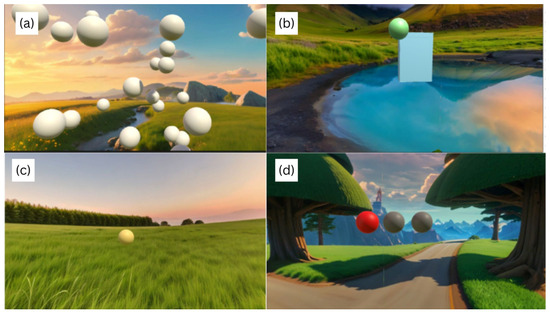
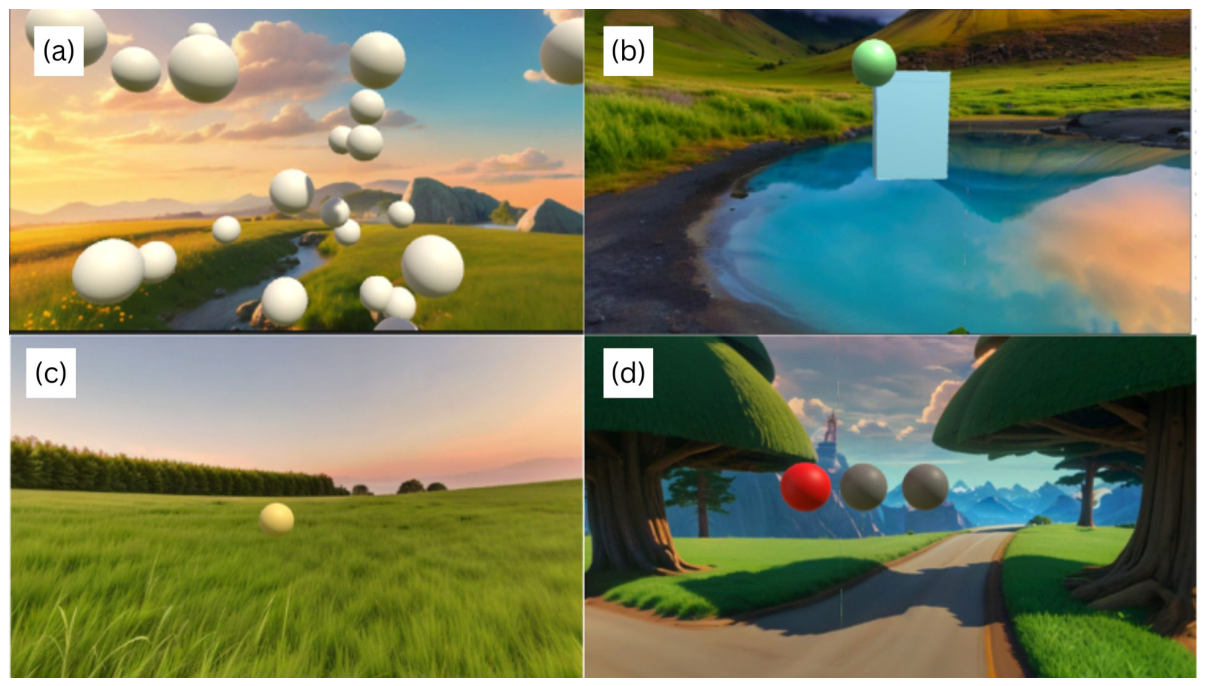
Each technique was translated into a standalone VR mini-game, preserving core therapeutic structure while supporting experiential engagement. Implementation is centred on a single interaction cycle per activity to maintain clarity and reduce cognitive load. Bubble Breathing and Square Breathing were implemented through guided breathing cycles based on structured pacing [16]. Traffic-light steps were represented through sequential interaction stages supporting pause, reflection, and response selection. Thought–Feeling Hoops translated cognitive–emotional mapping into symbolic spatial interaction [15]. Figure 1 provides an overview of the implemented mini-games.
Figure 1.
Overview of the VR mini-game environments: (a) Bubble Breathing, (b) Square Breathing, (c) Thought–Feeling Hoops, and (d) Traffic Light Steps. In (d), the red, amber, and green colours represent sequential stages supporting pause, reflection, and response selection, respectively.
3.3. Development Principles
Development followed a modular approach, enabling independent mini-games and simplified interaction logic. Environments prioritised visual clarity and restrained motion to reduce sensory strain. Audio guidance supported independent completion without external facilitation. Design decisions were guided by therapeutic alignment and usability considerations. Further technical details are available in [4]. This condensed rationale establishes the conceptual link between CBT techniques and VR implementation necessary for interpreting subsequent evaluation findings.
4. Evaluation Methodology
This section outlines the methodology used to evaluate the virtual reality platform, focusing on usability, short-term experiential response, and therapeutic coherence within a non-clinical, self-guided context.
4.1. Study Design and Participants
The evaluation followed a staged design comprising a pilot study, a main user study, and practitioner validation. The pilot study involved 28 university students and examined feasibility and usability issues, informing refinements before the main evaluation. The main study included 58 participants and focused on structured usability assessment and short-term experiential response. Practitioner validation involved three psychological practitioners with professional backgrounds in organisational psychology and high-intensity Cognitive Behavioural Therapy (CBT). All practitioners evaluated the complete set of four VR mini-games to assess the clarity, therapeutic coherence, and appropriateness of the translated CBT-informed techniques for self-guided use. Unlike the user study, in which each participant experienced a single self-selected mini-game, practitioners reviewed the full platform to provide a comprehensive professional evaluation of the translation of CBT-informed techniques rather than the technical implementation. Participants were recruited through voluntary university participation. A student sample was selected due to its suitability for evaluating a gamified, self-guided VR platform, as this demographic commonly interacts with digital systems with minimal instruction. No prior VR or CBT experience was required, enabling assessment of first-time interaction. Practitioners completed a structured survey assessing usability and therapeutic relevance and were provided with a summary of the main study results. This enabled commentary on both platform design and alignment between user-reported outcomes and therapeutic expectations. Ethical approval was obtained before data collection, and all procedures followed institutional guidelines for research involving human participants.
4.2. Survey Design and Evaluation Procedures
Evaluation measures captured usability, short-term experiential response, and therapeutic relevance within a unified framework. The survey design drew on three established sources: the System Usability Scale (SUS) [17], usability criteria derived from ISO 9241-11 [18], and the Generalised Anxiety Disorder scale (GAD-7) [19]. System usability was assessed using SUS, with standard scoring procedures applied to obtain benchmark-comparable scores. In addition, ISO 9241-11 dimensions were used as an interpretative framework to provide domain-level analysis of usability constructs within the VR context, enabling examination of ease of use, clarity of instructions, accessibility, consistency, and error handling alongside overall SUS scores. The relationship between SUS items and ISO usability areas is presented in Table 1. The GAD-7 was included to capture participants’ immediate experiential response following interaction with the VR platform. As a standardized self-report measure, it was used to support the interpretation of short-term changes in participants’ responses within the overall validation framework, complementing the usability assessment and practitioner evaluation. Open-ended questions were included to gather participant reflections on comfort, engagement, and clarity of interaction. The study used an Oculus Rift VR headset connected to a laptop running the platform. Surveys were administered electronically using a tablet. Each session followed a standardised procedure. Participants reviewed an information sheet, provided informed consent, and completed the pre-experience survey. Before entering the VR session, they were presented with a brief description of the purpose of each mini-game and were invited to select the activity that best matched their current needs. This self-selection process was designed to reflect the intended self-guided use of the platform. Of the 58 participants, 20 (34%) selected Traffic-Light Steps, 16 (28%) selected Bubble Breathing, 13 (22%) selected Thought–Feeling Hoops, and 9 (16%) selected Square Breathing. Following the VR session, participants completed the post-experience survey and received a short debrief.
Table 1.
Organisation of questionnaire items according to ISO 9241-11 usability dimensions.
4.3. Data Analysis
Quantitative and qualitative data were analysed to examine usability, experiential response, and therapeutic relevance. SUS scores were calculated using the standard procedure described by Brooke [17], adjusting for item polarity and producing a total score on a 0–100 scale. This enabled comparison with established benchmarks. To provide domain-level insight beyond overall SUS scoring, ISO 9241-11 usability principles were incorporated as an analytical framework alongside the SUS results. Rather than applying ISO as a separate measurement instrument, the usability questionnaire was organised into five researcher-defined operational usability categories informed by ISO 9241-11 principles: ease of use, clarity of instructions, accessibility, consistency, and error handling [18]. To support domain-level interpretation of usability outcomes, SUS items and supplementary usability questions were organised according to the underlying usability principles described in ISO 9241-11 while retaining the standard SUS scoring procedure. Domain scores were calculated using the arithmetic mean of associated items, allowing both overall and domain-specific analysis. The internal consistency of the SUS questionnaire was assessed using Cronbach’s alpha (α = 0.684), indicating acceptable internal consistency for the present study. The operational usability categories were used to support structured interpretation of usability outcomes and were not intended to represent independent psychometric subscales. For the GAD-7, pre- and post-experience scores were calculated using the standard scoring procedure [19]. Differences between scores were examined to identify immediate changes following VR interaction. Within the overall validation framework, the GAD-7 was treated as an experiential indicator to capture participants’ immediate responses following interaction with the platform and to complement the usability and practitioner evaluations. Qualitative responses from participants and practitioners were analysed using thematic analysis [20]. Coding was conducted by the researcher using an inductive approach, allowing themes to emerge directly from the data through an iterative process of reviewing, coding, and refining recurring patterns. An iterative coding process identified recurring patterns related to usability, interaction clarity, emotional response, and therapeutic coherence. These findings informed interpretation of the quantitative results and highlighted areas for refinement.
5. User-Based Evaluation Results
This section presents findings from the main user study, including participant characteristics, short-term experiential response, system usability, and qualitative feedback. Together, these results provide an empirical basis for evaluating the platform for brief, self-guided, non-clinical use.
5.1. Participant Characteristics and Contextual Information
The main study included 58 university students: undergraduate (52%), master’s (31%), and doctoral (17%) students. This distribution reflects a mixed academic cohort, allowing evaluation across varying levels of academic experience. Participants reported prior VR experience as follows: 67% had previous exposure, while 33% had none. This variation supports assessment of usability for both experienced and first-time users. The combination of academic diversity and mixed VR exposure provides context for interpreting subsequent findings. Participant characteristics are summarised in Table 2.
Table 2.
Participant characteristics.
5.2. Short-Term Experiential Response (GAD-7)
Short-term experiential response was examined using the Generalised Anxiety Disorder 7-item scale (GAD-7) [19], administered before and after VR interaction. The pre-session mean GAD-7 score was 7.16 (SD = 5.28), which decreased to 3.36 (SD = 3.62) following the VR session. Categorical analysis showed a shift from minimal (29%), mild (38%), moderate (24%), and severe (9%) anxiety pre-session to minimal (69%), mild (26%), and moderate (5%) post-session, with no participants remaining in the severe category as presented in Table 3. A paired-samples t-test indicated a statistically significant change between pre- and post-experience scores, t(57) = 7.53, p < 0.001, Cohen’s d = 0.99, 95% CI [2.78, 4.80], representing a large effect size. Because the distribution of the difference scores did not satisfy the normality assumption (Shapiro–Wilk = 0.923, p = 0.001), a Wilcoxon signed-rank test was conducted as a sensitivity analysis. The non-parametric analysis confirmed the same overall conclusion, indicating a significant reduction in GAD-7 scores following the VR session (Z = −5.772, p < 0.001). Within the scope of this evaluation, the observed difference is interpreted as an immediate experiential change associated with the VR interaction rather than evidence of clinical or therapeutic effect. These findings should therefore be interpreted as immediate post-experience responses within a single-session evaluation and not as indicators of long-term therapeutic outcomes.
Table 3.
Distribution of GAD-7 anxiety severity categories before and after the VR experience.
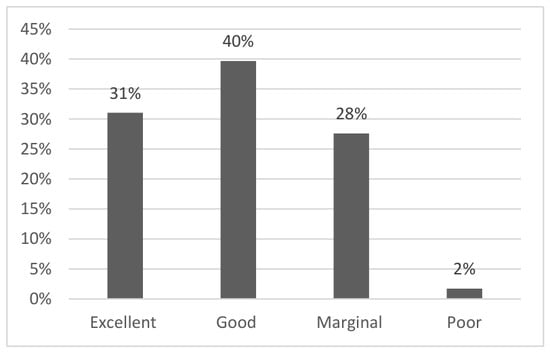
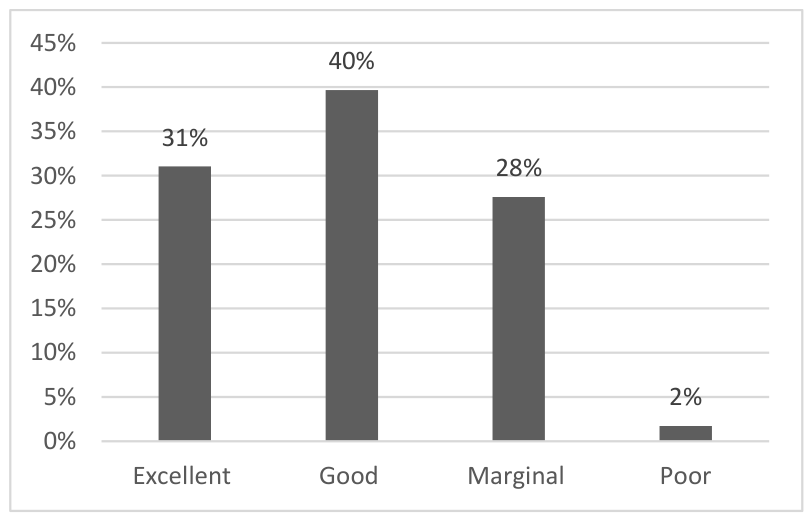
System usability was assessed using SUS. Most participants rated the system within Good or Excellent ranges, with fewer in the Marginal category and very few in Poor. Figure 2 illustrates this distribution. The mean SUS score was 76.98 (SD = 12.45, 95% CI [73.71, 80.26]), corresponding to the good usability category according to established SUS interpretation guidelines. This score is above the commonly accepted usability benchmark of 68, indicating a positive level of perceived usability. This suggests participants were able to understand and interact with the platform with minimal difficulty. Positive ratings were observed across users with and without prior VR experience, supporting suitability for short self-guided use.
Figure 2.
Distribution of participants across SUS usability benchmark categories.
5.3. ISO 9241-11 Usability Dimensions
To complement the SUS score, selected ISO 9241-11:2018 dimensions were analysed [18]. Five domains were examined: clarity of instructions, ease of use, consistency, accessibility, and error handling. Descriptive statistics are presented in Table 4.
Table 4.
Descriptive statistics (M, SD) for ISO 9241-11 usability dimensions.
Clarity of instructions (M = 3.36, SD = 0.62) and ease of use (M = 3.20, SD = 0.63) received the highest ratings. Accessibility (M = 3.09, SD = 0.58) was also rated positively. Consistency received lower ratings (M = 2.72, SD = 0.79), indicating some variation in interaction experience. Although lower than the other domains, consistency remained within the positive range and did not substantially affect overall usability ratings. Error handling (M = 3.18, SD = 0.83) was rated positively. These findings provide a domain-level view of usability strengths and areas for refinement.
5.4. Participant Feedback
Qualitative feedback was collected using structured checklist-based items informed by pilot study themes. The most frequently reported positive aspects are summarised in Table 5. Ease of use was most frequently selected, followed by relaxing audio, immersive environment, and clear instructions. A smaller proportion selected effectiveness of the technique.
Table 5.
Frequency of participant-reported positive aspects of the VR CBT game prototypes.
Table 6 summarises the participant-reported areas for improvement. Longer exercises were most frequently selected, followed by increased interactivity, improved graphics, and greater personalisation. Clearer instructions were selected by a small proportion, consistent with earlier findings.
Table 6.
Frequency of participant-reported areas for improvement in the VR CBT game prototypes.
Overall, qualitative findings were consistent with the quantitative results, reinforcing the platform’s perceived usability while highlighting opportunities for further refinement and enhancement.
6. Practitioner Validation Results
Practitioner validation complemented the user-based evaluation by examining usability, therapeutic coherence, and suitability from a professional perspective. Three psychological practitioners with experience in CBT-informed and wellbeing-focused interventions participated. The validation followed two stages. First, practitioners interacted with the VR platform and completed the SUS [17]. SUS scores were 95, 80, and 95, with a mean of 90.0, indicating high perceived usability. All practitioner scores fell within the Excellent usability range according to established SUS interpretation guidelines. The narrow score range reflects convergence in professional judgement regarding clarity, ease of use, and system coherence. In the second stage, practitioners reviewed a structured report summarising user-based results and provided written reflections on therapeutic suitability and user outcomes. Responses were analysed using thematic analysis following Braun and Clarke [20]. Recurring themes included therapeutic coherence, highlighting alignment between VR activities and CBT constructs such as breathing regulation and emotional awareness. Practitioners emphasised interaction simplicity and controlled cognitive load, noting the importance of reduced stimulation for users experiencing stress or limited VR familiarity. Suitability for self-guided use was also highlighted, with brief sessions and predictable structure supporting independent engagement. Additional themes included user autonomy and personalisation, emotional safety, and the appropriateness of outcome measurement. Practitioners highlighted the value of providing users with greater flexibility to tailor their experience while maintaining a simple and supportive interaction structure. They also emphasised the importance of emotional safety and accessibility, particularly for individuals who may be unfamiliar with VR environments. Practitioners stressed that the platform should be positioned as a supportive digital wellbeing tool rather than a replacement for therapist-led CBT. While practitioners viewed the platform positively overall, one practitioner also questioned the suitability of GAD-7 for very short interventions, supporting cautious interpretation of the observed short-term changes and reinforcing the exploratory nature of the experiential findings.
7. Discussion
This study examined the usability of a gamified VR platform supporting CBT-informed activities in a non-clinical context. By integrating standardised usability measures, short-term experiential assessment, and structured practitioner validation, the evaluation moves beyond feasibility testing toward a more structured validation model. The observed levels of perceived usability are consistent with previous studies reporting high user acceptance and positive engagement with interactive mental health interventions, including VR-based applications [5,11]. In contrast to studies where usability is treated descriptively, this study positioned usability as the primary validation construct. This emphasis is particularly relevant for self-guided systems, where clarity of interaction and ease of use directly influence accessibility and engagement. The SUS results, together with domain-level interpretation using ISO 9241-11 [18], suggest that simplicity of structure and controlled interaction design supported a consistent user experience. The integration of SUS and ISO-based interpretation provides complementary perspectives on usability. While SUS captures perceived usability and acceptability, ISO domains allow examination of specific usability dimensions within context. The consistency across these usability categories suggests that participants experienced few barriers during interaction, reinforcing the platform’s suitability for self-guided VR-CBT use. The qualitative findings further supported this interpretation, with participants frequently identifying ease of use and clear instructions as positive aspects of the platform while reporting relatively few concerns related to usability barriers.
Changes observed in self-reported anxiety scores should be interpreted within the non-clinical scope of the study. The GAD-7 was applied as a short-term experiential indicator rather than a diagnostic tool [19]. Given the single-session design, the observed differences represent immediate experiential variation associated with the VR interaction, without implying sustained therapeutic impact. Within the present study, participants engaged with the platform as an integrated VR experience in which CBT-informed activities, immersive interaction, and usability-oriented design were intentionally combined. Because the present study did not include a control condition, alternative explanations such as brief relaxation, the novelty of the immersive VR experience, expectancy effects, or regression to the mean cannot be excluded. Consequently, the observed short-term changes should be interpreted cautiously as immediate experiential responses rather than evidence of the specific effectiveness of the CBT-informed activities. This integrated evaluation is consistent with the study’s objective of validating the practical suitability of translating CBT-informed activities into an immersive, self-guided VR environment. Practitioner validation provides an initial professional perspective on the therapeutic coherence, interaction simplicity, and suitability of the translated CBT-informed techniques for self-guided use. Consistent themes related to therapeutic coherence, interaction simplicity, and suitability for self-guided use suggest alignment between the platform’s design rationale and professional expectations. While users expressed interest in longer or more varied activities, practitioners consistently emphasised maintaining interaction simplicity and controlling cognitive load to preserve accessibility and therapeutic clarity. Rather than representing conflicting viewpoints, these perspectives highlight an important balance between user expectations and practitioner recommendations when designing self-guided VR-CBT experiences. Practitioners’ emphasis on positioning the system as a supportive tool aligns with previous literature recommending that digital therapeutic technologies complement, rather than replace, professional support [10]. Taken together, the convergence between quantitative usability outcomes, experiential indicators, and practitioner perspectives supports the internal coherence of the evaluation framework. Beyond evaluating a single VR application, the study demonstrates how user-centred usability assessment, experiential measures, and practitioner validation can be integrated within a unified evaluation process for self-guided VR mental health technologies. This contribution is particularly relevant for emerging VR-CBT systems, where evaluation practices remain heterogeneous and practitioner involvement is often limited. By providing empirical evidence from both users and practitioners, the study offers a structured validation approach that may support the future design, assessment, and implementation of non-clinical VR-based mental health interventions.
8. Limitations and Future Work
Several limitations should be considered when interpreting these findings. First, the sample consisted of university students, which may limit generalisability. Although appropriate for usability evaluation of a self-guided VR platform, future research should examine broader demographic groups. Second, the evaluation was based on a single-session interaction. Findings therefore reflect immediate usability perceptions and short-term experiential response. Future studies could explore repeated or longer-term engagement to assess sustained interaction patterns. Third, the GAD-7 was used as a short-term experiential indicator within a non-clinical context [19]. While applied cautiously, it remains a clinically oriented instrument. Future controlled study designs incorporating comparison conditions may provide further insight into the relative contribution of CBT-informed interaction elements within the overall immersive VR experience. Such designs would complement the present validation framework by enabling more detailed examination of individual intervention components. Additional measures tailored to non-clinical digital well-being contexts may also strengthen future evaluations. Practitioner validation provided an initial professional perspective on the therapeutic coherence of the translated CBT-informed techniques. Future work could extend practitioner involvement through a broader range of practitioners, co-design processes, and expert review to further strengthen professional validation.
9. Conclusions
This study presented a usability-focused validation of a gamified virtual reality platform translating selected CBT-informed techniques into brief self-guided activities for non-clinical use. The evaluation integrated standardised usability assessment, short-term experiential measures, qualitative feedback, and practitioner validation to provide a structured assessment framework. Findings demonstrated good overall usability, positive user perceptions across multiple usability dimensions, and practitioner support for the platform’s therapeutic coherence and suitability for independent engagement. Participants also reported positive short-term experiential responses following interaction, although these findings should be interpreted within the context of a single-session, non-clinical evaluation.
The study contributes to the growing body of research exploring the use of VR for mental health support by emphasising usability as a primary validation construct. The integration of SUS, ISO 9241-11 usability dimensions, qualitative user feedback, and practitioner perspectives provided complementary evidence supporting the platform’s design rationale and overall evaluation framework.
Rather than positioning the platform as a therapeutic intervention, the findings support its potential as a supportive digital wellbeing tool incorporating CBT-informed activities. The study demonstrates how user-centred usability assessment, experiential measures, and practitioner validation can be integrated within a structured evaluation process for self-guided VR mental health technologies.
Author Contributions
Conceptualisation, M.B.S., G.U. and R.D.; methodology, M.B.S., G.U. and R.D.; software, M.B.S.; validation, M.B.S.; formal analysis, M.B.S.; investigation, M.B.S.; data curation, M.B.S.; writing—original draft preparation, M.B.S.; writing—review and editing, M.B.S., G.U. and R.D.; supervision, G.U. and R.D.; project administration, M.B.S. All authors have read and agreed to the published version of the manuscript.
Funding
This research received no external funding.
Institutional Review Board Statement
Ethical approval for this study was obtained from the Newcastle University Science, Agriculture and Engineering Ethics Committee prior to data collection (Reference No. 23-024-SAB). All procedures were conducted in accordance with institutional guidelines and ethical standards.
Informed Consent Statement
Informed consent was obtained from all participants prior to their participation in the study.
Data Availability Statement
The data supporting the findings of this study are not publicly available due to ethical restrictions related to participant confidentiality. The data contain information collected from human participants and were approved for use under institutional ethical approval. Anonymised data may be made available from the corresponding author upon reasonable request, subject to ethical approval and institutional data access restrictions.
Conflicts of Interest
The authors declare no conflicts of interest.
References
- Rizzo, A.; John, B.; Newman, B.; Williams, J.; Hartholt, A.; Lethin, C.; Buckwalter, J.G. Virtual Reality as a Tool for Delivering PTSD Exposure Therapy and Stress Resilience Training. Mil. Behav. Health 2013, 1, 52–58. [Google Scholar] [CrossRef] [Scilit]
- Valmaggia, L.R.; Latif, L.; Kempton, M.J.; Rus-Calafell, M. Virtual reality in the psychological treatment for mental health problems: A systematic review of recent evidence. Psychiatry Res. 2016, 236, 189–195. [Google Scholar] [CrossRef] [Scilit] [PubMed]
- Sabbar, M.B.; Davison, R.; Ushaw, G. A Review Study: Using Serious Games and Virtual Reality to Support Mental Health and Cognitive Behavioral Therapy. In 2024 10th International Conference on Virtual Reality (ICVR); IEEE: New York, NY, USA, 2024; pp. 100–105. [Google Scholar] [CrossRef] [Scilit]
- Sabbar, M.B.; Davison, R.; Ushaw, G. Virtual Reality for Cognitive Behavioral Therapy: A Gamified Approach and Pilot Study with University Students. In 2025 11th International Conference on Virtual Reality, ICVR 2025; IEEE: New York, NY, USA, 2025; pp. 184–190. [Google Scholar] [CrossRef] [Scilit]
- Coyle, D.; McGlade, N.; Doherty, G.; O’Reilly, G. Exploratory evaluations of a computer game supporting Cognitive Behavioural Therapy for adolescents. In CHI ’11: Proceedings of the SIGCHI Conference on Human Factors in Computing Systems; Association for Computing Machinery: New York, NY, USA, 2011; pp. 2937–2946. [Google Scholar] [CrossRef] [Scilit]
- Li, J.; Theng, Y.L.; Foo, S. Game-based digital interventions for depression therapy: A systematic review and meta-analysis. Cyberpsychol. Behav. Soc. Netw. 2014, 17, 519–527. [Google Scholar] [CrossRef] [Scilit] [PubMed]
- Lau, H.M.; Smit, J.H.; Fleming, T.M.; Riper, H. Serious games for mental health: Are they accessible, feasible, and effective? A systematic review and meta-analysis. Front. Psychiatry 2017, 7, 209. [Google Scholar] [CrossRef] [Scilit] [PubMed]
- Baranowski, T.; Buday, R.; Thompson, D.I.; Baranowski, J. Playing for Real: Video Games and Stories for Health-Related Behavior Change. Am. J. Prev. Med. 2008, 34, 74–82. [Google Scholar] [CrossRef] [Scilit] [PubMed]
- Fleming, T.M.; Bavin, L.; Stasiak, K.; Hermansson-Webb, E.; Merry, S.N.; Cheek, C.; Lucassen, M.; Lau, H.M.; Pollmuller, B.; Hetrick, S. Serious games and gamification for mental health: Current status and promising directions. Front. Psychiatry 2017, 7, 215. [Google Scholar] [CrossRef] [Scilit] [PubMed]
- Horne-Moyer, H.L.; Moyer, B.H.; Messer, D.C.; Messer, E.S. The Use of Electronic Games in Therapy: A Review with Clinical Implications. Curr. Psychiatry Rep. 2014, 16, 520. [Google Scholar] [CrossRef] [Scilit] [PubMed]
- Freeman, D.; Haselton, P.; Freeman, J.; Spanlang, B.; Kishore, S.; Albery, E.; Denne, M.; Brown, P.; Slater, M.; Nickless, A. Automated psychological therapy using immersive virtual reality for treatment of fear of heights: A single-blind, parallel-group, randomised controlled trial. Lancet Psychiatry 2018, 5, 625–632. [Google Scholar] [CrossRef] [Scilit] [PubMed]
- Morina, N.; Ijntema, H.; Meyerbröker, K.; Emmelkamp, P.M.G. Can virtual reality exposure therapy gains be generalized to real-life? A meta-analysis of studies applying behavioral assessments. Behav. Res. Ther. 2015, 74, 18–24. [Google Scholar] [CrossRef] [Scilit] [PubMed]
- Maples-Keller, J.L.; Bunnell, B.E.; Kim, S.J.; Rothbaum, B.O. The use of virtual reality technology in the treatment of anxiety and other psychiatric disorders. Harv. Rev. Psychiatry 2017, 25, 103–113. [Google Scholar] [CrossRef] [Scilit] [PubMed]
- Powers, M.B.; Emmelkamp, P.M.G. Virtual reality exposure therapy for anxiety disorders: A meta-analysis. J. Anxiety Disord. 2008, 22, 561–569. [Google Scholar] [CrossRef] [Scilit] [PubMed]
- Friedberg, R.D.; McClure, J.M.; Garcia, J.H. Cognitive Therapy Techniques for Children and Adolescents: Tools for Enhancing Practice; Guilford Press: New York, NY, USA, 2009. [Google Scholar]
- Hampshire CAMHS. Anxiety Management Self-Help Workbook (Children); Hampshire Child and Adolescent Mental Health Services: Hampshire, UK, 2018; Available online: https://hampshirecamhs.nhs.uk/wp-content/uploads/2018/03/Self-help-Workbook-Children-1.pdf (accessed on 4 June 2026).
- Brooke, J. SUS: A Quick and Dirty Usability Scale. In Usability Evaluation in Industry; Jordan, P.W., Thomas, B., McClelland, I.L., Weerdmeester, B., Eds.; Taylor & Francis: London, UK, 1996; pp. 189–194. [Google Scholar]
- ISO 9241-11:2018; Ergonomics of Human-System Interaction-Part 11: Usability: Definitions and Concepts. International Organization for Standardization: Geneva, Switzerland, 2018.
- Spitzer, R.L.; Kroenke, K.; Williams, J.B.W.; Löwe, B. A Brief Measure for Assessing Generalized Anxiety Disorder: The GAD-7. Arch. Intern. Med. 2006, 166, 1092–1097. [Google Scholar] [CrossRef] [Scilit] [PubMed]
- Braun, V.; Clarke, V. Using thematic analysis in psychology. Qual. Res. Psychol. 2006, 3, 77–101. [Google Scholar] [CrossRef] [Scilit]

Disclaimer/Publisher’s Note: The statements, opinions and data contained in all publications are solely those of the individual author(s) and contributor(s) and not of MDPI and/or the editor(s). MDPI and/or the editor(s) disclaim responsibility for any injury to people or property resulting from any ideas, methods, instructions or products referred to in the content. |
© 2026 by the authors. Licensee MDPI, Basel, Switzerland. This article is an open access article distributed under the terms and conditions of the Creative Commons Attribution (CC BY) license.