


Abstract
This study investigates tactile spatial resolution on the palm using two successive rectangular stimuli. Whereas classical tactile resolution studies have focused mainly on point or circular stimulation, less is known about how spatial resolution depends on the placement and geometry of rectangular, device-relevant stimuli. We measured the successive two-stimulus discrimination threshold using three rectangular stimulators across five palm areas aligned along the proximal–distal axis. Participants compared a fixed reference stimulus with a variable comparison stimulus, and the minimum separation at which the two stimuli were perceived as occurring at different locations was recorded as the threshold. The overall average threshold across all experimental conditions was approximately 5.2 mm. The threshold varied systematically across palm regions, being smallest around the palmar digital crease and the base of the fingers. In the central palm, threshold differences were more evident for changes in stimulator width than for changes in stimulator length. These results extend tactile spatial resolution research beyond point stimulation and provide design-relevant guidance for palm-based haptic devices.
1. Introduction
Tactile feedback is increasingly used in virtual reality (VR), teleoperation, sensory substitution, and interactive systems, where it can complement or substitute visual and auditory channels [1,2,3]. In sensory substitution in particular, tactile stimulation has long been studied as a means of conveying spatial information through the skin when vision is unavailable or limited [1]. In engineering applications, tactile feedback has also been used to support interaction in handheld and wearable systems [2,3].
Designing such interfaces requires perceptually grounded knowledge of how accurately users can distinguish tactile events on the skin, because usable spatial resolution depends on both body location and contact mechanics at the interface [4,5,6]. Lederman and Klatzky emphasised that haptic perception depends strongly on the interaction between sensory signals and exploratory contact conditions [5]. Accordingly, the spatial performance of a tactile interface cannot be determined solely by actuator pitch or device geometry, but must also be evaluated from the user’s perceptual perspective [3].
Among candidate body sites for tactile interfaces, the palm is particularly important because it plays a central role in handheld interaction. Compared with the fingertip, however, the palm has received less attention in basic psychophysical studies despite its practical relevance in handheld interaction [7,8]. Unlike fingertip stimulation, palm stimulation in practical devices is often delivered through areal stimulators rather than point-like contacts. Under such conditions, tactile spatial resolution cannot be inferred solely from receptor distribution, because it is also affected by stimulator size, shape, and contact conditions during hand-device interaction [5,6]. Therefore, it is important to measure palm tactile spatial resolution for stimulators of different sizes and shapes under realistic contact conditions.
In this study, we quantify palm tactile spatial resolution using two successive rectangular stimuli. Specifically, we measure the successive two-stimulus discrimination threshold at different locations on the palm. This measure is related to classical point localization, in which two successive contacts are judged as occurring at different positions [4,5], but is adapted here for rectangular stimuli that are more relevant to palm-based haptic interfaces [7,8,9].
Rectangular stimulation is of particular interest because such stimulators are well suited to the lateral surface of cylindrical devices designed for stable grasping. They are also representative of areal stimuli used in practical palm-based interfaces, where contact is often delivered through flat or elongated surfaces rather than idealised point contacts. Investigating spatial resolution for such stimuli is therefore important for bridging classical tactile psychophysics and the design of realistic grip-type tactile devices.
Despite this relevance, most classical threshold studies focused on point or circular stimuli. By contrast, many practical palm interfaces use rectangular or otherwise areal stimulators [7,8,9]. In addition, the successive spatial resolution threshold for such rectangular stimuli on the palm has not been systematically quantified across multiple palm areas under a common protocol. Thus, there remains a gap between classical psychophysical knowledge of tactile spatial resolution and the design requirements of contemporary palm-based haptic interfaces.
This study makes three main contributions. First, we define and quantify the successive two-stimulus discrimination threshold for rectangular stimuli on the palm. Second, we compare this threshold across five palm areas aligned along the proximal/distal axis and identify region-dependent differences relevant to stimulator placement. Third, we examine the effect of stimulator geometry and show that, in the central palm, stimulator width affects discrimination, whereas stimulator length does not show a clear effect.
Related Work
Typical psychophysical measures of tactile spatial resolution include the two-point discrimination test and the point localization test [4,10]. Two-point discrimination evaluates the minimum distance at which two simultaneously presented contacts are perceived as distinct, whereas point localization evaluates the minimum distance at which two successive contacts are perceived at different positions [4,5]. Weinstein reported that tactile spatial resolution for point stimuli varies substantially across body sites and provided classical reference values for the palm [4]. For male participants, the reported values were approximately 10.7 mm for two-point discrimination and 5.5 mm for point localization on the palm [4].
Classical psychophysical studies were mainly based on point-like or small-contact stimuli. Carmon showed that tactile discrimination performance depends on the mode of stimulation and the tested skin region [11]. Moberg also emphasized that tactile acuity differs across body locations and is closely related to functional use of the hand [12]. More recently, Frahm et al. reported regional differences in tactile discrimination across the hand and arm [13]. These psychophysical measures are also used in clinical contexts to assess somatosensory function after injury or impairment [14,15,16].
Recent developments in palm-based haptic devices further motivate the need for psychophysical data on areal stimulation. For example, Kuang et al. developed a wearable palm device for rendering surfaces and edges [7]. Wang et al. developed a multichannel hand-adaptive tactile stimulation device for the hand, including the palm [8]. In addition, grip-type palm devices have been studied as a means of presenting pseudo-force through pressure and skin-stretch stimulation [17]. These studies highlight that practical palm interfaces often rely on areal stimulation rather than point-like contact, and therefore require psychophysical data beyond those provided by classical point-stimulation studies.
Psychophysical evaluation of palm pressure stimulation has also been reported using the constant method to estimate the point of subjective equality [18]. In addition, the cylindrical tactile device used in the present study was developed to present rectangular stimuli over a wide area of the palm [9]. However, although areal palm stimulation has become increasingly relevant in device design, the successive spatial resolution threshold for rectangular stimuli has not yet been systematically compared across multiple palm areas under a unified protocol.
2. Tactile Stimulation Device
To measure the tactile spatial resolution on the palm, this study uses a cylindrical grip-type tactile device developed previously [9]. This section focuses on performance characteristics of the device that are directly relevant to the present threshold evaluation.
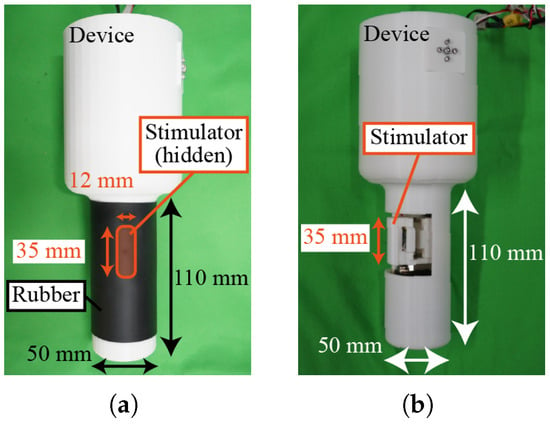
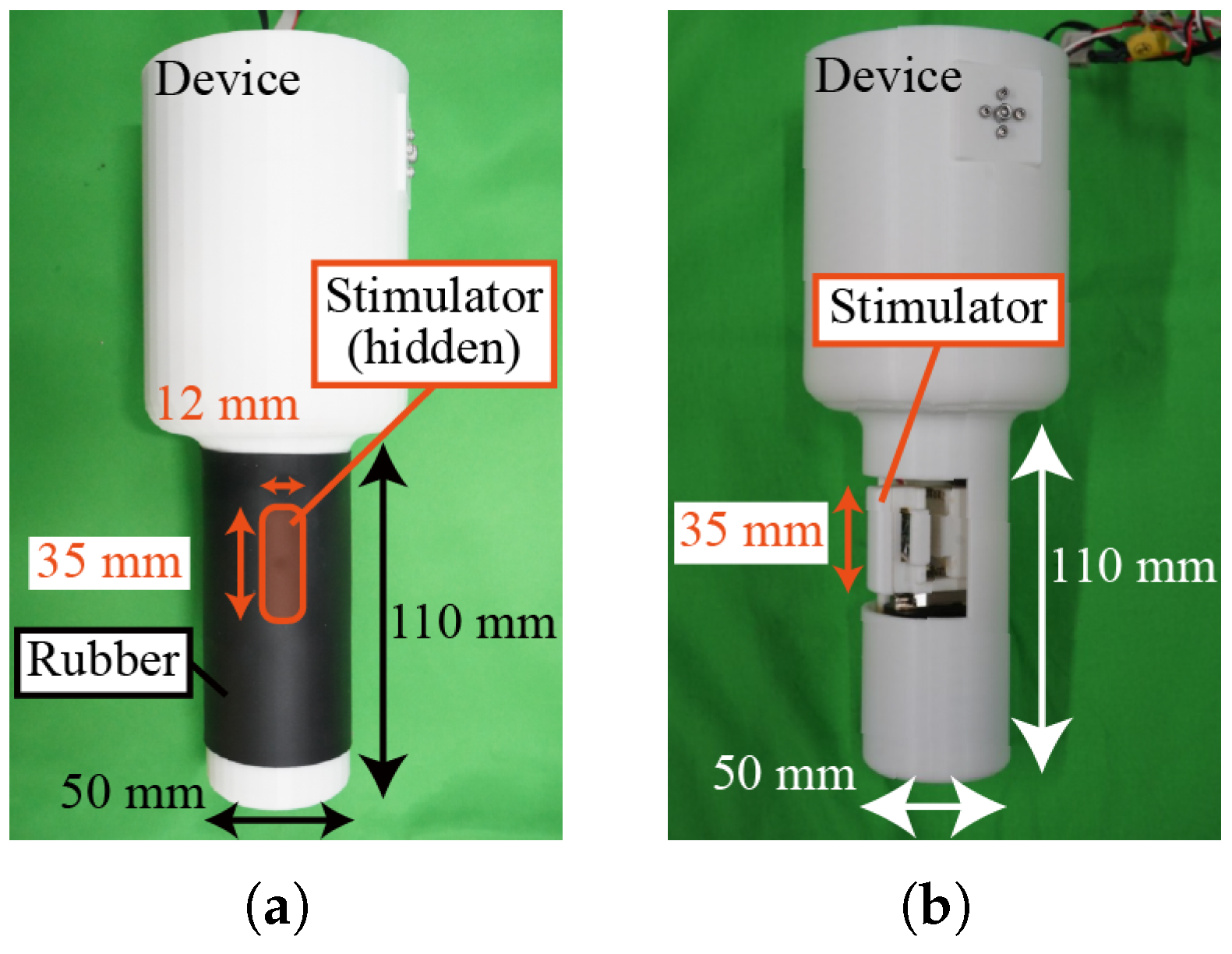
The grip-type device has a stepped cylindrical shape, as shown in Figure 1. The narrower cylinder, which is the grip part, contains a stimulator that is driven by motors installed in the wider cylinder. The diameter of the grip part is 50 mm, and its surface is covered with a 1-mm-thick black rubber sheet. Under the cover, the grip part has an opening that spans approximately 180°, through which an interchangeable rectangular stimulator extends in the radial direction for tactile stimulation. The extension stroke is about 10 mm, and the maximum force is 15 N. The stimulator can also move in the circumferential direction so that the device can stimulate various areas on the palm. The stroke for the rotation is approximately 150°.
Figure 1.
Overview of the stimulation device. (a) The device has a stepped cylindrical shape. The smaller diameter part, which is the grip part, is covered with a black rubber sheet. A rectangular stimulator is arranged under the sheet that pops out radially to press the palm through the rubber sheet. (b) The stimulator under the rubber sheet. The stimulator rotates inside the opening and sits within the grip circumference when retracted.
In this study, the output force response in the radial direction and the positioning accuracy in the circumferential direction were evaluated because this information is essential for the experiments described in Section 3.
2.1. Force Response Against a Human Hand
In the discrimination tests described later, the radial motion of the stimulator was controlled using a step-force command to stimulate the palm. Therefore, it is important to know the response of the stimulator to force commands.
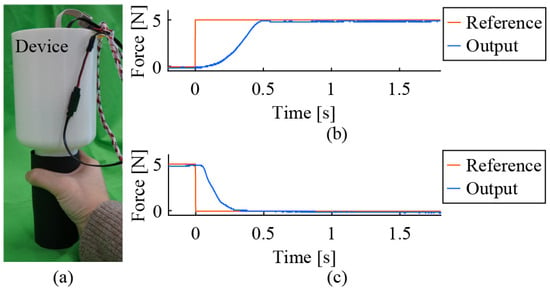
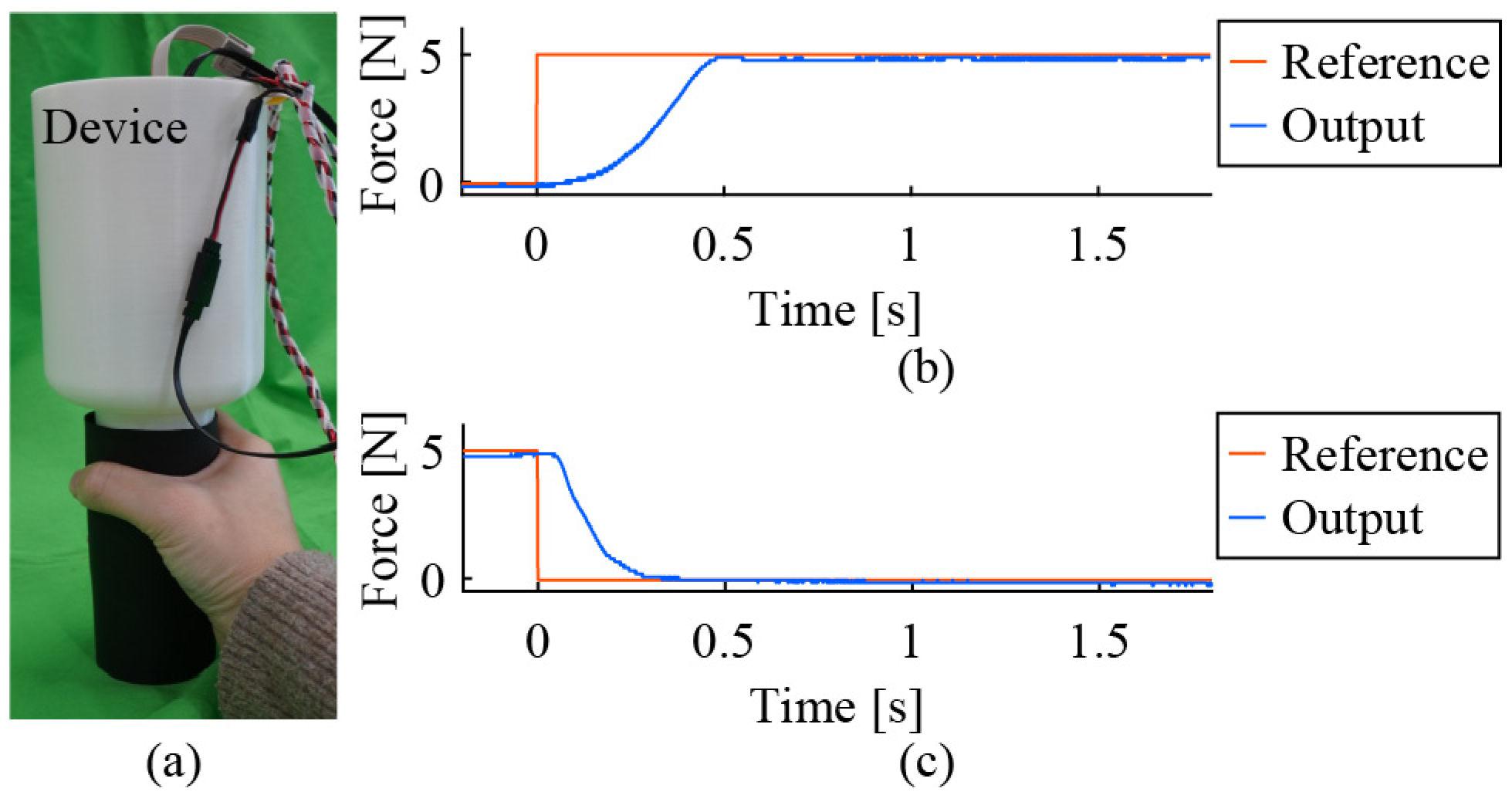
The responses for a rising step from 0 N to 5 N and a falling step from 5 N to 0 N were measured while a human experimenter was gripping the device, as shown in Figure 2a. The output force was estimated using the photo-interrupter installed under the stimulator [9]. The stimulator was supported by a spring, whose displacement was assumed to be proportional to the output force and was monitored using the photo-interrupter.
Figure 2.
Step responses to force commands during grip. (a) Measurement setup. The measurement was conducted while gripping the device. (b) Rising step response. (c) Falling step response.
Figure 2b,c show the responses. The output force converged within approximately 0.5 s for rising and 0.4 s for falling.
2.2. Positioning Accuracy
The stimulator was designed to rotate along the circumferential direction using an RC servo-motor (KRS-3204R2 ICS, Kondo Kagaku Co., Ltd., Tokyo, Japan) installed in the wider cylinder of the device. The positioning accuracy is important in the discrimination test and was therefore investigated in this work.
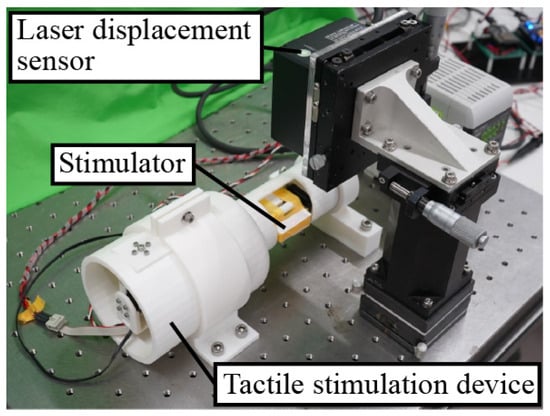
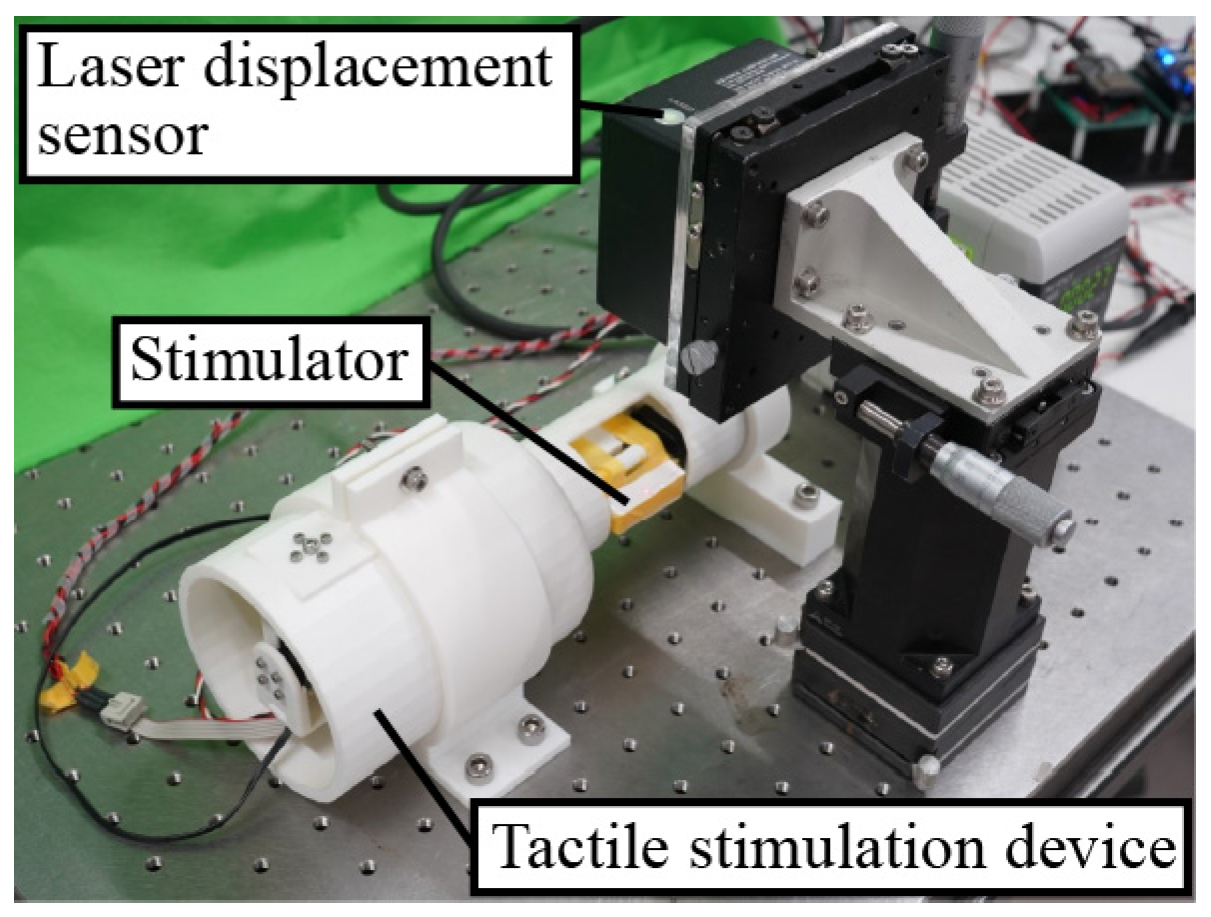
Figure 3 shows the measurement setup. The device was fixed on a plate, with the rubber cover sheet removed, and the stimulator position was initialized at the center of the opening. Then, the servo-motor was given a reciprocal step command so that the stimulator rotated away from the center and then rotated back to the initial center position. The vertical position of the stimulator at the beginning and the end of the reciprocal motion was measured using a laser displacement sensor (LK-G85 + LK-G3000V, KEYENCE Corporation, Osaka, Japan), which measured the position with a range of mm. From the measured vertical displacement, the rotational positioning accuracy was evaluated, assuming that the vertical displacement approximated the rotational displacement well within the limited range tested.
Figure 3.
Setup for measuring the rotational positioning accuracy of the stimulator. The vertical displacement of the stimulator was measured using a laser displacement sensor when the stimulator was near the target position, which approximates the rotational displacement.
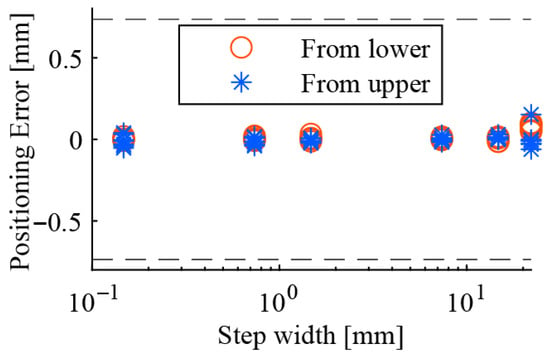
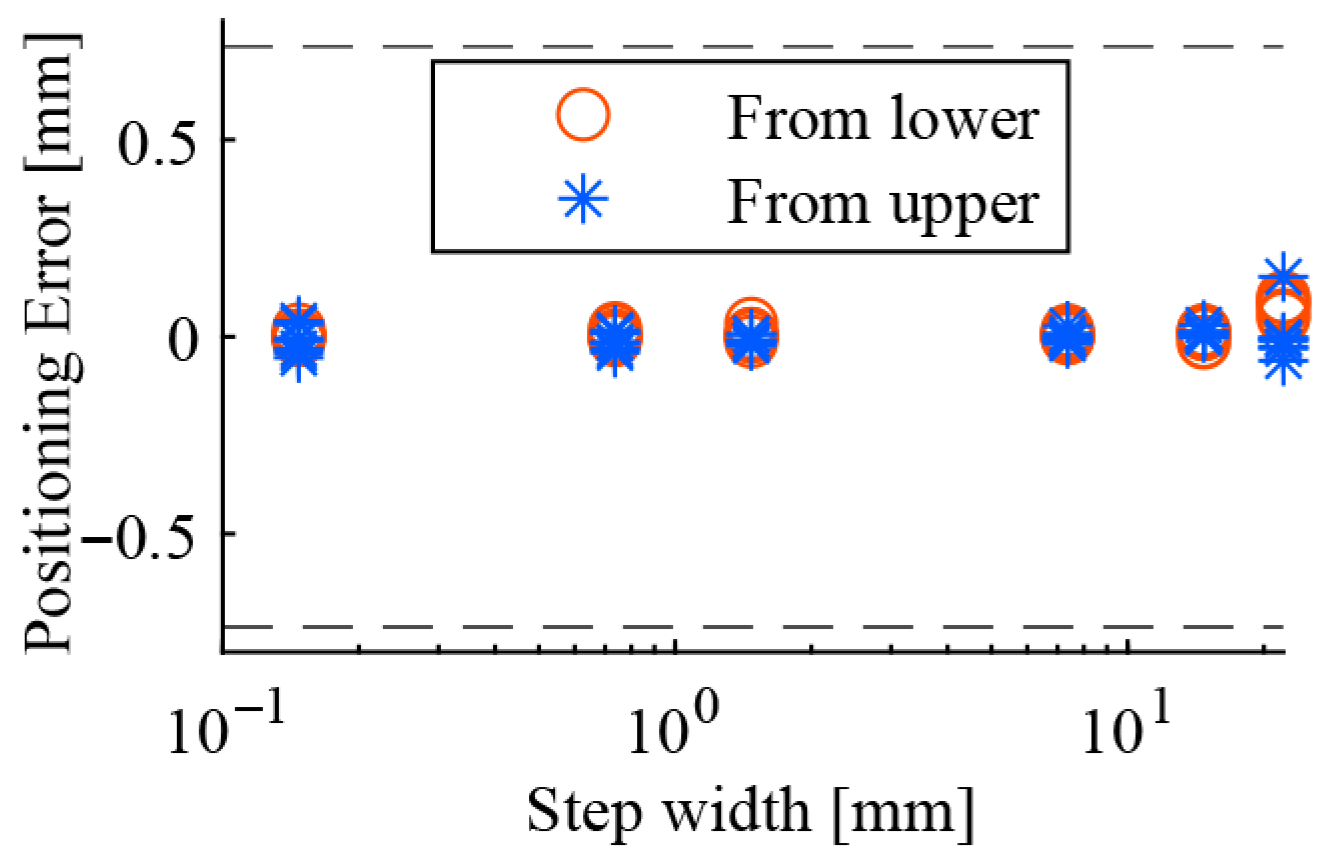
For six different step widths in both directions, the error of the stimulator position after the reciprocal motion was measured against the initial position. The measurements were repeated seven times for each step width in each direction. The results are shown in Figure 4. For most of the steps, the error was less than mm. Only for the largest step, which was about mm, a significant error up to mm was found. In the experiments to identify the discrimination thresholds, motion steps close to this largest step were mainly used. Nevertheless, this maximum error remains well below the expected discrimination threshold, considering the reported point localization threshold of mm for males. It is also smaller than the step interval of mm used in the experiments below. This confirms that the device has sufficient positioning accuracy to measure discrimination thresholds.
Figure 4.
Measurement results of the positioning error. The red markers indicate the positioning errors when approaching from the lower side in Figure 3, and the blue markers indicate those from the upper side. The dashed lines indicate the minimum command interval used in the discrimination test described later.
3. Experiment
Using the grip-type tactile device, we measured the discrimination threshold for two successive rectangular stimuli. To the palm that was gripping the device, a rectangular stimulus was given successively at two locations. The minimum distance at which the participant could perceive a positional difference was recorded as the discrimination threshold.
3.1. Setup and Conditions
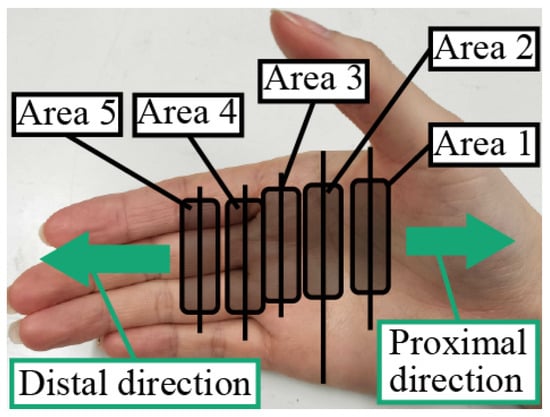
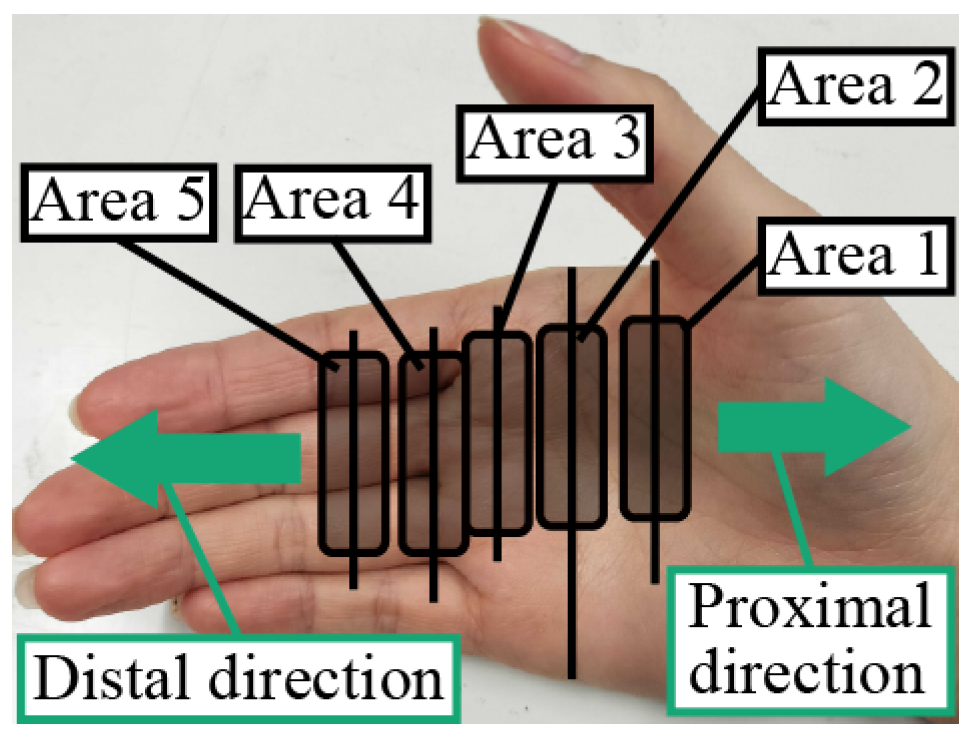
The measurements were carried out in five areas on the palm, as shown in Figure 5, using three different-sized stimulators as shown in Table 1. Areas 1 through 5 are around the thenar eminence, the center of the palm (around the proximal and distal palmar creases), the metacarpophalangeal (MCP) joint, the palmar digital crease, and the proximal phalanx, respectively.
Figure 5.
Target areas for measuring the discrimination threshold in this experiment. Area 1 is around the thenar eminence, Area 2 is the center of the palm, Area 3 is around the metacarpophalangeal (MCP) joint, Area 4 is around the palmar digital crease, and Area 5 is the proximal phalanx. The arrows indicate the proximal direction (towards the wrist) and the distal direction (towards the fingertips).
Table 1.
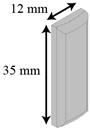
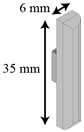
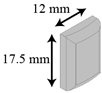
Stimulators used in this experiment. Stimulator S1 was used as the standard stimulator. Stimulators S2 and S3 have half the area of S1 by reducing either length or width to half the original length. The surface edges were rounded to a radius of 2 mm in each stimulator to avoid pressure concentration at the edges.
Among the stimulators, S1 had a width of 12 mm and a length of 35 mm and was used as the standard of this study. The stimulator S2 had half the width, and S3 had half the length. Because S2 and S3 had approximately half the contact area of S1, the average pressure was roughly twice that of S1 when the same force was applied.
Twelve participants (11 men and one woman) were recruited from students at the University of Tokyo who were not affiliated with the authors’ laboratory. They were all healthy, right-handed, and aged between 23 and 49 years (mean = 26.5, standard deviation = 7.3). They had no prior experience with the haptic device used in this study, although their experience with other haptic devices was not assessed. The number of participants was predetermined with reference to previous tactile psychophysics studies that employed comparable sample sizes for discrimination-threshold measurements [11,19,20,21,22]. All measurements were conducted in an ordinary indoor laboratory environment.
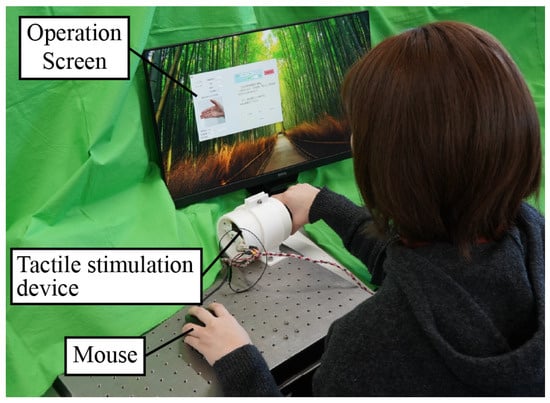
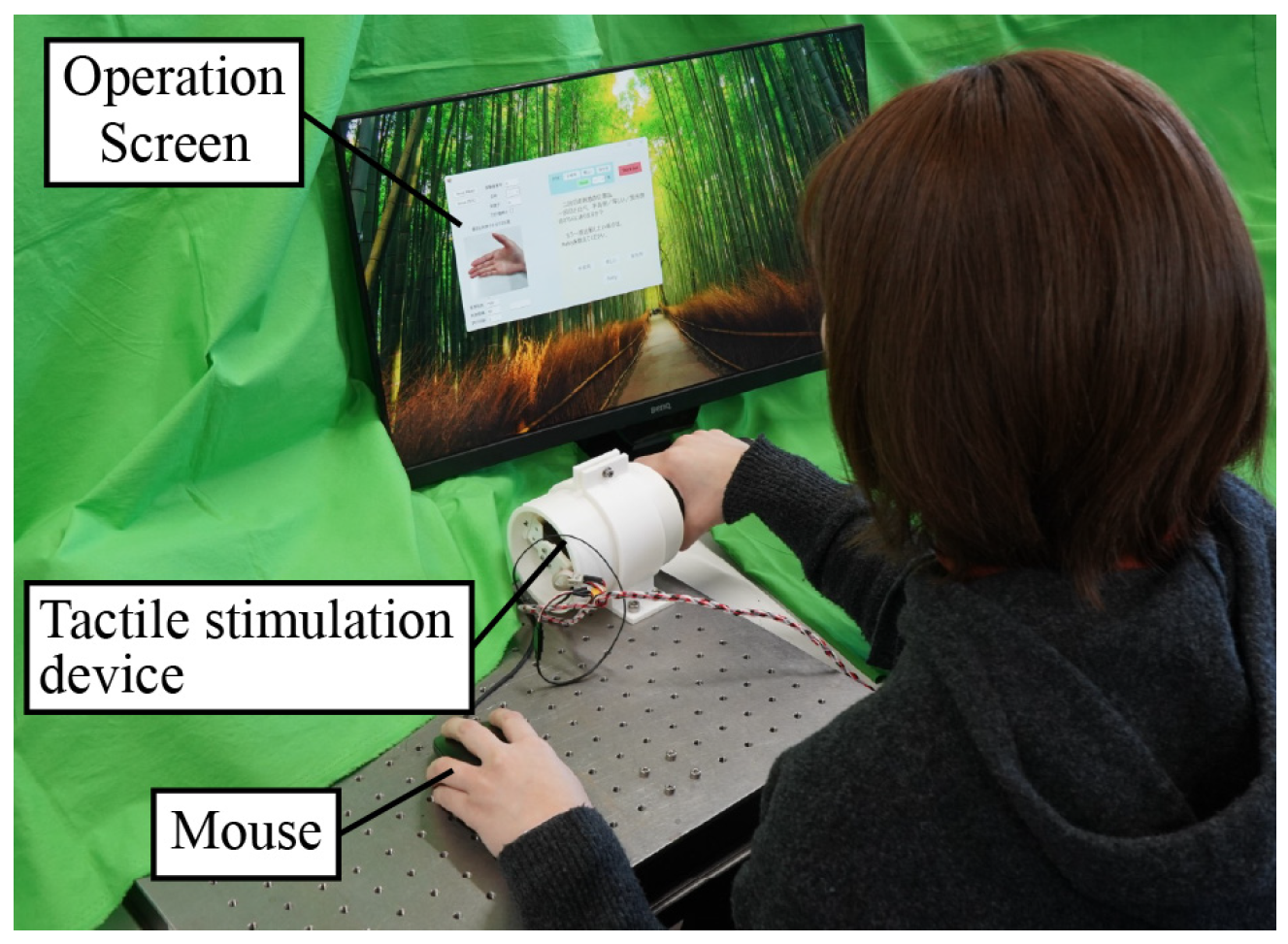
In the experiments, the participants sat in a seated posture as shown in Figure 6. They gripped the rubber-covered grip part of the device with their right hand, with their elbow resting on the table, and held a computer mouse to answer with their left hand. They were instructed either to close their eyes or to look at the computer screen during stimulus presentation. To reduce fatigue, the position of the device was adjusted within the horizontal plane to a location that each participant found comfortable.
Figure 6.
Experimental setup. The participants held the device with their right hand and used a mouse with their left hand to respond.
For each subject, the discrimination threshold was measured for eight conditions that combine different target areas and stimulators, as shown in Table 2. In the measurements, rectangular stimuli were sequentially presented at a fixed reference position and a comparison position that changed every time. Then, the subject compared the stimuli and answered their positional relationship.
Table 2.
Measurement areas and stimulator types for each experimental condition (C1 to C8). In conditions C1 to C5, the five target areas were measured using the same standard stimulator S1 to investigate differences among areas. In conditions C6 to C8, the target area was fixed to Area 2, while the stimulator was changed from S1 to S3 to examine the effect of stimulator shape. Conditions C2 and C6 were identical but were treated separately to avoid multiple testing during the analysis.
3.2. Procedure to Measure Threshold
At the beginning of each condition, participants adjusted the angle of the device so that the stimulator, positioned at the center of the opening, aligned with the target measurement area on the palm. The gripping posture was kept the same regardless of the measurement area.
The following procedure was repeated.
- The stimulator is retracted, and the rotational position is reset to the center.
- The reference stimulus is presented by extruding the stimulator with a force step command of 5 N that lasts for 1.5 s and then retracting it.
- The stimulator moves to a random position while retracted.
- The stimulator moves to the comparison position while retracted.
- The comparison stimulus is presented with a force step command of 5 N that lasts for 1.5 s. Then, the stimulator retracts.
- The stimulator moves to a random position while retracted.
- The participant compares the positions of the reference and comparison stimuli and provides an answer to the question using the mouse.
In steps 2 and 5, considering the force rising time of approximately 0.5 s, the 1.5-s stimulation period was determined to allow 1 s of constant force stimulation. The 1-s stimulation time was adopted from previous studies measuring two-point discrimination thresholds [11,13].
We instructed the participants not to hold the device firmly so that the rotational movement of the stimulator at steps 3, 4, and 6 could not be felt. However, in case the participants sensed the movement of the stimulator through the rubber sheet, random movements were inserted in steps 3 and 6. Grip force was not quantitatively monitored and may therefore have contributed to inter-individual variability.
The question was a multiple-choice question with three options, which asked whether the position of the comparison stimulus was (1) felt on the wrist side, (2) felt on the same place, or (3) felt on the finger side, compared to the reference stimulus. If they were not sure about the answers, they were allowed to experience the stimuli as many times as they wanted. Also, to perform the comparison smoothly, the participants practiced the comparison several times before starting the experiments.
The above procedure was repeated by changing the comparison position until the threshold was determined. For each condition, the thresholds were measured in two directions, proximal and distal. After completing the experiment for one condition, the participants took a one-minute break, and after the first four conditions, they took a five-minute break. The order of the eight conditions was randomly set for each subject.
3.3. Order of Presenting Comparison Stimulus
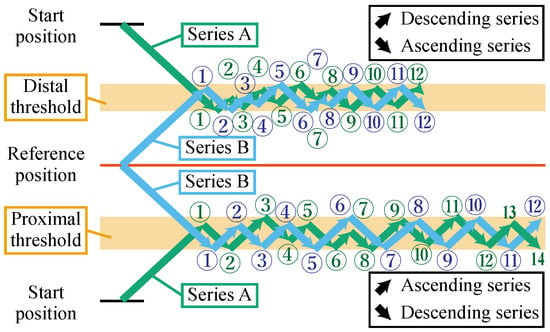
To determine the threshold in each condition, the comparison position was varied using a double-staircase method, in which two stepwise series were presented alternately to prevent participants from predicting the next stimulus position [23]. The two series, which are denoted as series A and B, were defined as shown in Figure 7. For each subject, the proximal side was first measured, which was then followed by the measurement of the distal side. The settings for the proximal and distal sides are symmetrical with respect to the reference position.
Figure 7.
Change in the comparison position in the double-staircase method. The upward direction in the figure corresponds to the distal direction, and the downward direction corresponds to the proximal direction. For each target area, the threshold was measured in both directions, and the figure illustrates the protocols for both measurements. The green trajectories represent Series A, and the blue trajectories represent Series B. Circled numbers indicate the order of the values used for threshold calculation, whereas uncircled numbers indicate the order of the presented values that were not used for threshold calculation. The arrow symbols in the legends denote ascending and descending series. The shaded bands labeled “Distal threshold” and “Proximal threshold” schematically indicate the regions in which the corresponding thresholds were determined.
The following explains the procedure in detail, with the proximal side used as an example. In series A, the comparison position started from a position far from the reference position (approximately 8.8 mm to 10.3 mm from the reference position) and then approached it with a step of approximately mm. When the participant’s response changed to “felt on the same place” or “felt on the finger side”, the position was recorded, more precisely as the position half a step back, and the direction of the staircase was reversed. Then, in the altered series, if the answer changed to “felt on the wrist side”, the position was recorded and the direction was altered again. In series B, the comparison position started from the reference position and then moved toward the start position of series A. The rest of the protocol was the same as that for series A. The stimuli in these two series were presented alternately.
The procedure ended when 12 reversals had occurred in both series A and B. The average of the twelve thresholds was calculated for each of the A and B series. Finally, the average of the thresholds for the A and B series was recorded as the threshold for that condition. The total number of trials (comparisons) per experimental condition, including the measurements for proximal and distal measurements, ranged from 56 to 99.
4. Results
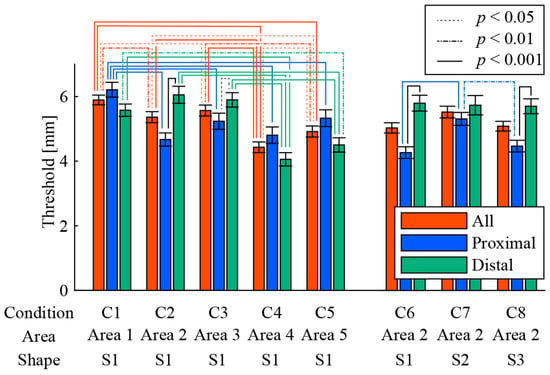
The means and standard errors (SEs) of the measured thresholds are summarized in Figure 8. The overall average of the discrimination thresholds for the two successive stimuli across all experimental conditions was approximately mm.
Figure 8.
Average discrimination thresholds for the two successive stimuli and their standard errors (SE) for each experimental condition. Blue bars and lines represent the proximal side, green bars and lines represent the distal side, and red bars and lines represent the average of both.
The measured thresholds were analyzed separately for the fixed-stimulator conditions (C1 to C5) and the fixed-area conditions (C6 to C8). Because the normality assumption was rejected by the Shapiro-Wilk test (), we applied the aligned rank transform (ART) before conducting two-way repeated-measures ANOVA at a significance level of 5% [24,25].
The results of the ANOVA are shown in Table 3. The factors used in the ANOVA for the fixed stimulator shape conditions (C1 to C5) were measurement area and the proximal/distal side of the reference position. The factors used for the fixed measurement area conditions (C6 to C8) were the stimulator shape and the proximal/distal side of the reference position.
Table 3.
Results of the two-way ANOVA for the measured two-stimulus discrimination thresholds, divided into fixed stimulator-shape conditions (C1 to C5) and fixed measurement-area conditions (C6 to C8). The factors used were measurement area, stimulator shape, and the proximal/distal side of the reference position (P/D).
Post hoc multiple comparisons were performed using Holm’s step-down procedure. The results of the multiple comparisons are shown in Figure 8. For the fixed stimulator shape conditions, significant differences were observed for all combinations of measurement areas except for the comparison between Areas 2 and 3. Additionally, significant differences were observed for the proximal/distal side in Areas 2 and 3. For the fixed measurement area conditions, significant differences were observed for the proximal/distal side, except for S2.
5. Discussion
Across five measurement areas and three rectangular stimulator shapes, the overall mean threshold for successive spatial resolution was approximately mm. This value is close to the classical point-localization threshold of mm reported by Weinstein for the male palm [4]. Rather than a simple replication of that benchmark, this result indicates that, within the range tested here, palm tactile spatial resolution remains on a similar scale even for areal rectangular stimuli. From a design perspective, this common scale implies that a spatial separation of around 5 mm may serve as a useful initial reference, which can then be refined according to palm region and stimulator geometry.
Previous evaluation of the same device also supports the stability and perceptibility of the tactile output under operating conditions relevant to the present study [9]. In that evaluation, the device produced more than 10 N maximum thrust force within the designed 0 mm to 10 mm stroke, showed approximately linear steady-state force control across multiple stimulator positions, and had an average rise time of s for a 0 N to 10 N step input. Moreover, in a human-subject experiment using the same device, participants correctly identified the intended direction of tangential skin-stretch stimuli with 94.5% accuracy while normal pressure was simultaneously applied to the palm [9]. These results suggest that, within the tested range, the device output remained sufficiently stable and the tactile signals remained clearly perceivable under actual gripping conditions. The similar thresholds obtained in the repeated conditions C2 and C6 are consistent with this interpretation, although they do not constitute a formal reliability analysis.
Beyond the overall threshold magnitude, systematic differences were observed across palm areas. When the stimulator shape was fixed to S1, the thresholds were smallest in the order of Areas 4, 5, 2, 3, and 1. The lower threshold in Area 4 may reflect the fact that the palmar digital crease provides a salient anatomical landmark during successive position judgments. A similarly low threshold in Area 5 is consistent with previous reports that tactile acuity is higher near the base of the fingers than in the central palm [12]. These patterns may reflect local differences in tactile sensitivity, although the present experiment was not designed to test these mechanisms directly [26,27].
No significant overall difference was observed between thresholds measured for the proximal-side stimuli and those measured for the distal-side stimuli when conditions C1 to C5 were considered together, but the interaction between measurement area and proximal/distal side was significant. This result indicates that whether the proximal or distal side yields the lower threshold depends on the measurement area. In other words, spatial resolution on the palm appears to be locally structured, and this local structure should be taken into account when considering stimulator placement.
The effect of stimulator geometry was more limited but still informative. In the fixed-area conditions C6 to C8, the proximal threshold for S2 differed significantly from those for S1 and S3, whereas changing stimulator length did not produce a clear effect. In addition, the proximal thresholds in C6 to C8 tended to be smaller than the distal thresholds, suggesting an asymmetric sensitivity pattern in the central palm. This pattern suggests that discrimination in the central palm is influenced not simply by contact area, but by how the rectangular stimulus extends relative to the judged direction. Thus, within the present experimental range, stimulator width appears to matter more than stimulator length for successive spatial resolution in the center of the palm.
Several limitations should be noted. First, the participant sample was relatively small and demographically unbalanced, as it consisted of 12 right-handed adults, most of whom were male and recruited from a single university. Therefore, the present results should be interpreted as an initial characterization under the current experimental conditions rather than as normative values for the general population. Second, grip force was not quantitatively controlled, even though the measurements were conducted under actual gripping conditions. Third, the effects of temperature, humidity, electromagnetic interference, and long-term drift were not systematically evaluated. Future work should examine these factors in a larger and more diverse sample and should test how environmental and mechanical factors influence the perceptual thresholds reported here.
Beyond these limitations, an important potential application of rectangular palm stimulation is pseudo-force presentation, in which palm stimulation evokes a force-like percept [17]. The present study focused only on the spatial resolution of the skin stimulation itself and did not evaluate the perceptual properties of the pseudo-force induced by such stimuli. An interesting direction for future work will therefore be to examine how accurately the direction of the induced pseudo-force can be discriminated when rectangular stimulators are used on the palm. Such a study would help bridge basic knowledge of palm tactile spatial resolution and the design of palm-based pseudo-force interfaces.
6. Conclusions
In this study, we quantified the successive two-stimulus discrimination threshold for rectangular stimuli on the palm using a cylindrical grip-type tactile device. Across five measurement areas and three stimulator shapes, the overall mean threshold was approximately mm, suggesting that a spatial separation on the order of 5 mm may serve as an initial design reference for palm-based tactile interfaces employing rectangular stimulators. However, the threshold was not spatially uniform. Lower values were observed around Area 4, near the palmar digital crease, and around Area 5, near the base of the fingers, than around the thenar region. In addition, in the center of the palm, stimulator width affected discrimination whereas stimulator length did not show a clear effect. Together, these findings suggest that palm tactile interface design should consider both a common threshold scale and region- and geometry-dependent optimization. Future work should also examine application-oriented perceptual tasks using rectangular palm stimulation, particularly how accurately the direction of the induced pseudo-force can be discriminated.
Author Contributions
Conceptualization, M.K. and A.Y.; methodology, M.K. and A.Y.; formal analysis, M.K.; investigation, M.K.; writing—original draft preparation, M.K.; writing—review and editing, M.K. and A.Y.; supervision, A.Y.; funding acquisition, A.Y. All authors have read and agreed to the published version of the manuscript.
Funding
This work was supported in part by JSPS KAKENHI, Grant Number 24K00843. One of the authors (M.K.) was supported by JST SPRING, Grant Number JPMJSP2108.
Institutional Review Board Statement
The study was conducted in accordance with the Declaration of Helsinki and approved by the Ethics Review Committee of The University of Tokyo (Application No. 23–310, approved on 28 September 2023).
Informed Consent Statement
Informed consent was obtained from all participants involved in the study.
Data Availability Statement
The data presented in this study are available on request from the corresponding author. The data are not publicly available due to privacy and ethical restrictions.
Acknowledgments
The authors thank all participants for their cooperation in the experiments.
Conflicts of Interest
The authors declare no conflicts of interest. The funders had no role in the design of the study; in the collection, analyses, or interpretation of data; in the writing of the manuscript; or in the decision to publish the results.
References
- Bach-y-Rita, P.; Kercel, S.W. Sensory substitution and the human-machine interface. Trends Cogn. Sci. 2003, 7, 541–546. [Google Scholar] [CrossRef] [Scilit]
- Chouvardas, V.; Miliou, A.; Hatalis, M. Tactile displays: Overview and recent advances. Displays 2008, 29, 185–194. [Google Scholar] [CrossRef] [Scilit]
- Fleck, J.J.; Zook, Z.A.; Clark, J.P.; Preston, D.J.; Lipomi, D.J.; Pacchierotti, C.; O’Malley, M.K. Wearable multi-sensory haptic devices. Nat. Rev. Bioeng. 2025, 3, 288–302. [Google Scholar] [CrossRef] [Scilit]
- Weinstein, S. Intensive and extensive aspects of tactile sensitivity as a function of body part, sex, and laterality. In Proceedings of the First International Symposium on the Skin Senses; Kenshalo, D.R., Ed.; Charles C Thomas: Springfield, IL, USA, 1968; pp. 195–222. [Google Scholar]
- Lederman, S.J.; Klatzky, R.L. Haptic perception: A tutorial. Atten. Percept. Psychophys. 2009, 71, 1439–1459. [Google Scholar] [CrossRef] [Scilit]
- Li, B.; Gerling, G.J. Individual differences impacting skin deformation and tactile discrimination with compliant elastic surfaces. In Proceedings of the 2021 IEEE World Haptics Conference (WHC); IEEE: Piscataway, NJ, USA, 2021; pp. 721–726. [Google Scholar] [CrossRef] [Scilit]
- Kuang, L.; Malvezzi, M.; Ferro, M.; Prattichizzo, D.; Robuffo Giordano, P.; Chinello, F.; Pacchierotti, C. A 4-DoF wearable hand device for haptic rendering of surfaces and edges. Mechatron. Sci. Intell. Mach. 2024, 99, 103173. [Google Scholar] [CrossRef] [Scilit]
- Wang, Y.; Luo, D.; Ma, L.; Wang, L.; Wu, J.; Zhang, J.; Yan, T. Development of a multichannel hand-adaptive tactile stimulation device for somatotopic map of human hand in somatosensory cortex with fMRI. NeuroImage 2025, 310, 121126. [Google Scholar] [CrossRef] [Scilit] [PubMed]
- Kojima, M.; Yoshimoto, S.; Yamamoto, A. Design of a haptic device for presenting pressure and skin stretching stimuli to the palm. Front. Mech. Eng. 2024, 10, 1417881. [Google Scholar] [CrossRef] [Scilit]
- Loomis, J.M.; Collins, C.C. Sensitivity to shifts of a point stimulus: An instance of tactile hyperacuity. Percept. Psychophys. 1978, 24, 487–492. [Google Scholar] [CrossRef] [Scilit]
- Carmont, A.; Benton, A.L. Parametric aspects of tactile resolution. Percept. Psychophys. 1971, 10, 331–334. [Google Scholar] [CrossRef] [Scilit]
- Moberg, E. Two-point discrimination test. A valuable part of hand surgical rehabilitation, eg in tetraplegia. Scand. J. Rehabil. Med. 1990, 22, 127–134. [Google Scholar] [CrossRef] [Scilit] [PubMed]
- Frahm, K.S.; Gervasio, S. The two-point discrimination threshold depends both on the stimulation noxiousness and modality. Exp. Brain Res. 2021, 239, 1439–1449. [Google Scholar] [CrossRef] [Scilit] [PubMed]
- van Nes, S.I.; Faber, C.G.; Hamers, R.M.T.P.; Harschnitz, O.; Bakkers, M.; Hermans, M.C.E.; Meijer, R.J.; van Doorn, P.A.; Merkies, I.S.J. Revising two-point discrimination assessment in normal aging and in patients with polyneuropathies. J. Neurol. Neurosurg. Psychiatry 2008, 79, 832–834. [Google Scholar] [CrossRef] [Scilit] [PubMed]
- Catley, M.J.; Tabor, A.; Wand, B.M.; Moseley, G.L. Assessing tactile acuity in rheumatology and musculoskeletal medicine—how reliable are two-point discrimination tests at the neck, hand, back and foot? Rheumatology 2013, 52, 1454–1461. [Google Scholar] [CrossRef] [Scilit] [PubMed]
- Ur Rehman, H.; Andaleeb, H.; Saeed, I.; Asif, T.; Sharif, Z.; Haq, K.; Faizan Hamid, M. Two Point Discrimination Threshold Among Different Aged Populations of People with Diabetes: Discrimination Threshold Among Diabetics of Varying Age. Pak. BioMed. J. 2022, 5, 188–191. [Google Scholar] [CrossRef] [Scilit]
- Yoshimoto, S.; Yamamoto, A. Pressure Stimulus to the Palm Substitutes and Augments Force Sensation. IEEE Trans. Haptics 2021, 14, 930–935. [Google Scholar] [CrossRef] [Scilit]
- Kojima, M.; Yoshimoto, S.; Yamamoto, A. Evaluation of Point of Subject Equality Using Constant Method in Pseudo Force Sensation by Pressure Stimulation to the Palm. In Proceedings of the 2022 31st IEEE International Conference on Robot and Human Interactive Communication (RO-MAN); IEEE: Piscataway, NJ, USA, 2022; pp. 205–210. [Google Scholar] [CrossRef] [Scilit]
- Schlereth, T.; Magerl, W.; Treede, R. Spatial discrimination thresholds for pain and touch in human hairy skin. Pain 2001, 92, 187–194. [Google Scholar] [CrossRef] [Scilit]
- Taylor-Clarke, M.; Kennett, S.; Haggard, P. Persistence of visual-tactile enhancement in humans. Neurosci. Lett. 2004, 354, 22–25. [Google Scholar] [CrossRef] [Scilit]
- Mancini, F.; Bauleo, A.; Cole, J.; Lui, F.; Porro, C.A.; Haggard, P.; Iannetti, G.D. Whole-body mapping of spatial acuity for pain and touch: Spatial Acuity for Pain. Ann. Neurol. 2014, 75, 917–924. [Google Scholar] [CrossRef] [Scilit]
- Cataldo, A.; Frier, W.; Haggard, P. Quantifying spatial acuity of frequency resolved midair ultrasound vibrotactile stimuli. Sci. Rep. 2023, 13, 21149. [Google Scholar] [CrossRef] [Scilit]
- Cornsweet, T.N. The Staircase-Method in Psychophysics. Am. J. Psychol. 1962, 75, 485–491. [Google Scholar] [CrossRef] [Scilit]
- Wobbrock, J.O.; Findlater, L.; Gergle, D.; Higgins, J.J. The aligned rank transform for nonparametric factorial analyses using only anova procedures. In Proceedings of the Proceedings of the SIGCHI Conference on Human Factors in Computing Systems; Association for Computing Machinery: New York, NY, USA, 2011; pp. 143–146. [Google Scholar] [CrossRef] [Scilit]
- Elkin, L.A.; Kay, M.; Higgins, J.J.; Wobbrock, J.O. An aligned rank transform procedure for multifactor contrast tests. In Proceedings of the ACM Symposium on User Interface Software and Technology; ACM Press: New York, NY, USA, 2021; pp. 754–768. [Google Scholar] [CrossRef] [Scilit]
- Johansson, R.S.; Vallbo, Å.B. Tactile sensory coding in the glabrous skin of the human hand. Trends Neurosci. 1983, 6, 27–32. [Google Scholar] [CrossRef] [Scilit]
- Vallbo, Å.B.; Johansson, R.S. Properties of Cutaneous Mechanoreceptors in the Human Hand Related to Touch Sensation. Hum. Neurobiol. 1984, 3, 3–14. [Google Scholar] [PubMed]

Disclaimer/Publisher’s Note: The statements, opinions and data contained in all publications are solely those of the individual author(s) and contributor(s) and not of MDPI and/or the editor(s). MDPI and/or the editor(s) disclaim responsibility for any injury to people or property resulting from any ideas, methods, instructions or products referred to in the content. |
© 2026 by the authors. Licensee MDPI, Basel, Switzerland. This article is an open access article distributed under the terms and conditions of the Creative Commons Attribution (CC BY) license.