


Abstract
Urban science has learned to measure cities through the flows that cross them: capital, labour, information, and air traffic. It has paid far less attention to what the name of a city does when a person speaks it about themselves. “I live in London”, “I am flying in from Milan”, and “I am going to Burlington” are not neutral statements of location; each converts a place into a public claim about the speaker’s wealth, mobility, taste, and future. This study theorizes that conversion as toponymic capital: the convertible symbolic value that accrues to a person through the city names attached to their residence, origin, destination, and transit. Drawing on Bourdieusian field theory, Peircean and post-Silversteinian semiotics, mobility research, and the postcolonial critique of world-city hierarchies, the study conducts a comparative interpretive semiotic analysis of 24 publicly documented instances spanning Africa, Europe, North America, Latin America, the Gulf, South Asia, and East Asia, sourced from vernacular lexicons, platform practices, popular culture, and institutional instruments. Four findings emerge. Speakers use city names differently according to whether they claim the city as residence, origin, destination, or transit, and the cases suggest, as a hypothesis for testing, that voluntary destination and transit carry more prestige than residence; the value of a name depends on the audience’s reference frame rather than on the city alone; its polarity reverses under identifiable conditions that enable toponymic arbitrage; and city names may be associated with marriage prospects, credit, and employment, whereas permission to travel is set by state rules for which a name cannot substitute. The cases do not provide a matched comparison of the four positions for the same city and audience, nor do they separate the contribution of the name from that of income, education, legal status, and networks. The study proposes a toponymic status grammar as a construct for future measurement and sets out its implications for city branding, urban rankings, and the study of spatial inequality.
1. Introduction
Consider four short exchanges. A guest at a dinner party in Abuja says she lives in London, and the table leans in. A visitor at a Nairobi café says he is flying in from Milan, and the waiter asks whether he works in fashion. A student in Philadelphia announces she has been accepted to a program in Los Angeles, and her friends answer with audible delight. A colleague mentions he is relocating to Burlington, Vermont, and the room offers the polite murmur reserved for news that requires no response. In none of these cases has anyone learned much about the actual city. What has been exchanged is a judgement about the person, transacted through a place name that arrives already loaded with value.
This study argues that the name of a city, when attached to a person, can function as a status label through which audiences interpret a person’s social position, with possible social and economic consequences that future research can measure, and that urban science has the conceptual means to study it but has not yet assembled them. The discipline has developed sophisticated accounts of how cities are ranked and networked [1,2], how they compete for investment through entrepreneurial governance [3,4], how they are branded for external audiences [5,6], and how particular districts are stigmatized so that residence becomes a liability [7,8]. Each of these studies treats the city, or a part of it, as the unit that carries reputation. The person who carries that reputation into conversation, onto a dating profile, into a job interview, or into a visa queue appears only at the margins. Yet it is at the level of the person that urban reputation is cashed out. A city’s brand index rises or falls in aggregate; the label “from Lagos” or “based in Dubai” is spent, one encounter at a time, by individuals whose life chances it may alter.
The question of how a city name becomes a personal label also cannot be answered from a single side of the world-city hierarchy. A familiar account would hold that Western metropolitan names carry prestige and non-Western names carry deficit. That account is empirically false and analytically lazy. Within Ghana, “Accra” is a name of considerable weight, carrying connotations of salaried work, connectivity, and urban sophistication against the rural home. Within Liberia, a Monrovia address in a particular enclave signals more than most European postcodes. Among North American lifestyle migrants, a Latin American city can confer the prestige of discovery and cosmopolitan taste [9]. Among young Americans on social platforms, the name of a large and unremarkable Midwestern state became, for a season, a byword for the absurd. Status by toponym operates in every direction, and its polarity depends on who is listening.
The contribution of this study is threefold. First, it introduces toponymic capital as a concept that joins Bourdieu’s account of convertible capitals [10,11] to the semiotic study of indexicality and the mobilities paradigm [12,13], defining the value that city names confer on persons in specific positions of utterance. Second, through a comparative analysis of 24 documented instances across six world regions, it identifies the grammar by which that value is generated, the reference frames that fix it, the conditions under which it reverses, and the routes by which it may convert into economic outcomes. Third, it translates these findings into a set of propositions that can be operationalized by urban scholars working with surveys, platform data, and experimental designs. The aim is to move the analysis of urban prestige from the scale of the city to the scale of the speaking person, and in doing so to give urban science a handle on one of the most ordinary and least examined ways in which cities shape inequality.
2. Theoretical Framework
The study of urban reputation has been dominated by two research programs that rarely speak to one another. The first, rooted in economic geography, treats cities as nodes in hierarchies of command and connectivity. Sassen’s account of New York, London, and Tokyo as sites where the coordination functions of the global economy concentrate [2] and the Globalization and World Cities group’s rosters of alpha, beta, and gamma cities [1] established that some urban names stand for the capacity to direct flows that others only receive. The second program, rooted in urban sociology, concerns the opposite pole: the blemish that attaches to places of relegation. Wacquant’s concept of territorial stigmatization describes how a neighborhood’s name comes to discredit those who live there, so that residents conceal their address, employers discount applicants, and the state treats the district as a zone of exception [7]. Subsequent work has traced this mechanism across national contexts and shown that it operates through journalism, policy discourse, and everyday talk alike [8].
What these programs share is an assumption that reputation is a property of places. What neither specifies is the mechanism by which reputation migrates from a place to a person. The world-city literature is largely silent on persons; the stigma literature attends to persons but restricts its analysis to the negative pole and, in most applications, to the intra-urban scale of the neighborhood. A further body of work on city branding has made reputation an object of deliberate management [5], and instruments such as the Anholt-GMI City Brands Index have quantified how global publics perceive named cities across dimensions of presence, place, potential, pulse, people, and prerequisites [6]. Branding research, however, measures attitudes towards cities held by distant publics. It does not follow what happens when an individual claims a city as their own.
Territorial stigma has a positive counterpart that scholarship has begun to name but has yet to theorize. Research on neighborhood reputation has shown that a place may carry both an internal reputation held by its residents and an external one held by outsiders, and that the two often differ [14]. Otero and colleagues made the distinction visible in panel data from Santiago, Chile: perceived stigma weakened residents’ identification with their neighborhood, their rootedness, and their trust in it, whereas perceived prestige strengthened the same dimensions [15]. These findings suggest that territorial stigma and residential prestige share a common structure and belong to the same symbolic process. Both are produced largely by outsiders such as journalists, officials, and estate agents; both attach people to an address; and both are durable. Pinkster and colleagues found that the reputation of Amsterdam’s most notorious neighborhood persists and is experienced differently across resident groups [16]. The production and activation of territorial stigma therefore play a key role in how the urban is structured [17], and stigma can be activated to legitimize privatization, gentrification, and displacement [18].
Territorial stigma and residential prestige are nonetheless not opposite ends of a single spectrum. Stigma appears to exert a stronger influence than prestige, so that its damages may outweigh the benefits that prestige confers [15]. The two are also managed differently: residents of stigmatized places often conceal, deflect, or contest their association with them [8], whereas those who hold prestige communicate it through socially recognizable signals, from conspicuous display to the subtle markers legible only to insiders [19,20]. Stigma may also outlast residence. The benefits of prestige appear closely tied to a person’s current address, but people who move away from stigmatized neighborhoods may continue to carry the effects of their place of origin once it becomes known to others [21]. Stigma can be contested through residents’ counter-narratives or mobilized to justify redevelopment and gentrification [18,22], whereas prestige is maintained through exclusivity, high economic barriers to entry, and concealment from public view [23,24]. This literature, however, remains focused on neighborhoods and residential locations. They have given little attention to how the reputations of entire cities and countries shape personal status, so that names such as London, Lagos, or Dubai carry symbolic value beyond any neighborhood boundary, and they rarely consider reputations attached to the positions of origin, destination, and transit. It is this gap that the concept of toponymic capital addresses.
The postcolonial critique of urban theory supplies an important corrective to the hierarchy that both sides of the literature tend to reproduce. Robinson’s call to view cities “off the map” of world-city rankings challenged the assumption that only a handful of metropolises generate the categories through which all others are known [25]. Roy argued that theory must be produced from the cities of the Global South rather than tested upon them [26], and the volume on worlding cities edited by Roy and Ong documented how Asian cities fashion their own global aspirations through spectacular architecture, master-planned enclaves, and inter-referencing among peer cities rather than deference to Western models [27]. In Johannesburg, Mbembe and Nuttall showed that an African metropolis writes the world on its own terms, as a hub of continental aspiration and style [28], while Simone demonstrated that the city’s economic life runs on improvised configurations of people that render it legible to those inside it and opaque to outside observers [29]. These arguments establish that urban prestige is plural. They do not, however, provide a theory of how plural prestige becomes personal status.
Bourdieu provides the first element of such a theory. In his account, social space is structured by the volume and composition of capital that agents hold, whether economic, cultural, social, or symbolic, and positions in that space are expressed and recognized through practices and possessions that function as signs of distinction [10]. Symbolic capital is the form any capital takes when it is perceived and recognized as legitimate, and its power lies in the capacity to name and classify [11]. Two features of this framework matter here. Capitals are convertible, so that the recognition one acquires can be exchanged, at a rate set by the field, for other goods. And the signs that express position are themselves objects of struggle, because the classifiers are also classified by their classifications. A city name claimed as residence is precisely such a sign: it is publicly visible, compressed into a single word, and capable of conversion.
The second element comes from semiotics. Keane argued that material and linguistic signs are bundled with qualities that can be selectively activated, so that the same object carries different meanings as it moves among contexts [30]. The sociolinguistic literature on indexicality makes this mobility analytically tractable. Johnstone, Andrus, and Danielson, building on Silverstein’s model of indexical orders, showed how the speech features of Pittsburgh became, through movement and contact, first unnoticed correlates of place, then markers of class and locality, and finally stereotyped tokens available for performance and commodification on souvenirs and T-shirts [31]. The value of this model is that it distinguishes layers of meaning: the first-order fact that a sign co-occurs with a place, the second-order association of that sign with social types, and the third-order reflexive use of the sign to perform or parody those types. City names traverse the same layers. “London” begins as a location, becomes associated with a class of people who live there, and finally circulates as a token that can be claimed, displayed, mocked, or counterfeited. Blommaert’s sociolinguistics of globalization adds the insight that such signs are evaluated within scales and orders of indexicality that are not equally valid everywhere, so that a resource of high value in one locality loses value when it travels to another [32].
The argument that place names function as signs of value is foregrounded in critical toponymy, which understands naming not as a neutral act of identification but as a political and economic practice through which social power is inscribed into space [33]. Place names are sites where struggles over identity, memory, value, and belonging are negotiated. Research on streets named after Martin Luther King Jr. demonstrates that disputes over naming are disputes over whose histories and identities a place recognizes [34]. Other scholars have shown that place names operate as economic assets, generating value through naming rights, branding strategies, and property speculation [35], and that naming has become integral to place branding under entrepreneurial urban governance, turning names into instruments for attracting investment and enhancing competitiveness [36]. From a geosemiotic perspective, such meanings are produced through the placement of signs in the material world, so that names derive significance from their location within the social landscape [37]. Together, critical toponymy, research on place branding and naming rights, and geosemiotics establish that place names carry both symbolic and economic power. They locate that power, however, in the landscape to which the names are attached: the street sign, the map, the neighborhood, the branded venue. Toponymic capital extends the insight by following the value of place names beyond their physical inscription and into the social life of the persons who claim them.
The third element comes from mobility research. The new mobilities paradigm repositioned movement as constitutive of social life rather than a residual between fixed places [12], and Kaufmann, Bergman, and Joye’s concept of motility defined the capacity to be mobile as a form of capital in its own right, distributed by access, competence, and appropriation [13]. Cresswell’s politics of mobility directed attention to the motive force, speed, rhythm, route, experience, and friction that differentiate the movements of the privileged from those of others [38], and the regimes-of-mobility framework demonstrated that the freedom of some to travel is structurally tied to the containment of others [39]. Mau and others documented the global mobility divide produced by visa regimes, in which citizens of wealthy states have gained visa-free access to ever more destinations while citizens of poorer states have not [40], and Carling’s work on involuntary immobility showed that the aspiration to migrate and the ability to do so are distinct, so that many people live with a desire to leave that they cannot act upon [41]. Mobility research therefore establishes what the stigma and branding literature overlooks: the value of a city name depends on the speaker’s relation to movement, not only on the city.
Thurlow and Jaworski brought these strands together in their analysis of frequent-flyer programs, showing how airlines manufacture symbolic capital by stylizing the traveler as an elite whose distinction lies in seamless, exclusive movement [42]. Their work identifies a crucial point: elite status is increasingly performed through the semiotics of mobility rather than through fixed possessions. Platform research has extended this observation to social media, where Marwick’s analysis of luxury selfies on Instagram showed that aspirational display of travel, consumption, and locale became a currency of the attention economy [43], and Abidin documented how influencers deploy apparently frivolous self-presentation as calculated labour [44]. Studies of tourist photography show that travelers curate images of destinations to manage impressions of themselves rather than to document places [45], and Jansson has argued that social media have reconfigured tourism into a mode of self-mediation in which the destination serves as a resource for identity display [46].
A further body of work concerns the relation between places and the identities of the people attached to them. Place identity was first understood as a property of the individual, the dimensions of self that define personal identity in relation to the physical environment [47]. Later research has moved beyond this individual focus in three connected ways. It has distinguished two meanings that are often conflated: the identity people draw from a place and the identity of the place itself [48]. It has shown that attachment to place does not depend on staying put but is formed and sustained through movement as well as residence [49]. And it has shown that the two meanings are connected, because a place’s external image enters the identity of the people associated with it, so that residents who absorb a negative outside portrayal of their place struggle to maintain a positive bond with it [50]. Research on residential identity bridges the felt and the judged sides of place. People identify with dwelling, community, and region in ways that vary with their history of moving [51], and these identifications are performed: Benson and Jackson showed that middle-class Londoners build and defend the identity of their neighborhoods by contrasting them with less desirable places [52]. Residence, in this work, is a claim as well as a fact. That claim, however, has been studied mainly at the scale of the neighborhood and in the position of residence; the present study extends it to the global system of cities and from residence to origin, destination, and transit.
Labeling theory explains how such claims, and the judgements they provoke, attach to persons. Goffman showed that a discrediting attribute produces a spoiled identity that must be concealed or managed [53], and Link and Phelan defined stigma as the convergence of labeling, stereotyping, separation, status loss, and discrimination under conditions of unequal power [54]. That power is located in states, media, and markets, and residents can contest the labels attached to their neighborhoods [22,55]. Territorial stigma is, in this sense, labeling theory applied to residential location [7]. Toponymic capital builds on this tradition: it recognizes that place labels have social effects, that those effects depend on audience interpretation, and that they often persist whether or not the label accurately describes the place. It extends the tradition to positive as well as negative place associations and to the strategic ways in which individuals claim and perform place-based identities.
From these elements the study derives its central concept. Toponymic capital is the symbolic value that accrues to a person through their association with a city, as residence, origin, destination, or transit, and that is recognized by an audience. It is the value of the association, not the value of any outcome that may follow from it. The unit of analysis is the person who claims, or is assigned, a relation to a named city in the eyes of a particular audience, and toponymic capital is the status that this audience ascribes to the person by virtue of that relation. A city may also provide employment, professional networks, institutional entitlements such as those attached to household registration, and the means and permission to travel. These resources help explain how a city’s reputation arose, and they may be the reason a particular outcome is achieved. The symbolic process is distinct: it is the process by which an audience draws on a city’s reputation to assess the person. The two processes can operate in the same encounter and reinforce each other, so a favorable outcome is not sufficient evidence that the symbolic process was at work. To attribute an outcome to toponymic capital, one must show that a particular audience interpreted the city connection as a marker of status and acted on that interpretation, with income, education, legal status, and access to networks taken into account.
Defined in this way, the concept differs from each of the bodies of work reviewed above. Unlike place reputation and city branding, it belongs to persons rather than places. Unlike territorial stigma, it carries both positive and negative charges, operates at every scale from the neighborhood to the global city system, and applies to origin, destination, and transit as well as residence. Unlike place identity and residential identity, which concern how people identify with places, it concerns how audiences evaluate people through places. Unlike critical toponymy, which locates the power of names in the landscape they label, it follows names into the encounters in which persons claim them. Unlike motility, it concerns not the capacity to move but the public legibility of positions in space, which may or may not correspond to actual movement. The concept sets up four research questions, addressed in turn below. What is the grammar by which city names generate value in utterance? What determines the value a given name carries for a given audience? Under what conditions does the value of a name reverse? And by what mechanisms might toponymic capital become economic and social outcomes, and what evidence would show that it had?
3. Materials and Methods
The study employs comparative interpretive semiotic analysis, a design suited to research that seeks to theorize the meaning-making mechanisms of a phenomenon across contexts rather than to estimate its prevalence. The approach follows the case-oriented logic of urban comparison advocated by Robinson [25], in which cases from different regions are placed in conversation without presuming that one region supplies the standard against which others are measured. The analytic aim was theoretical generalization: the identification of recurrent mechanisms and the conditions under which they vary.
The evidence base consists of 24 instances in which a city name functioned as a status label for persons, selected through purposive maximum-variation sampling. Selection proceeded on four criteria. Each instance had to be publicly documented, either in peer-reviewed scholarship, in established reporting, or as a widely circulated platform phenomenon whose existence is a matter of public record. Each had to involve a named city or urban region claimed by, or attributed to, persons rather than a city discussed in the abstract. The set as a whole had to span six world regions (sub-Saharan Africa, Europe, North America, Latin America, the Gulf and South Asia, and East Asia) and both positive and negative valences. Finally, the set had to include four genres of evidence: vernacular lexicons (terms such as “Jand”, “IJGB”, “burger”, and “ushago”); platform practices (geotagging, staged travel imagery, viral trends); popular culture (television series and recorded music); and institutional instruments (city rankings, residence registration, visa regimes, and property markets). Instances were collected for the period 1988 to 2026, with most concentrated after 2010, the decade in which image-centered social platforms became dominant.
Candidate instances were identified in three ways: through the scholarship on world cities, territorial stigma, migration, and platform cultures reviewed in Section 2; through established reporting on city labels attached to persons; and through vernacular terms and platform phenomena whose public existence could be verified. An instance was retained only when at least one citable public source documented a city name being claimed by, or attributed to, persons before an identifiable audience, and was excluded when the city was discussed only in the abstract or when no audience could be specified. Selection continued until every region was represented and both valences and all four genres of evidence appeared across regions. This process yielded 24 instances for analysis. Because sampling sought maximum variation rather than representativeness, the set shows the range of the phenomenon and does not estimate how common any pattern is.
Analysis proceeded in three passes. The first pass coded each instance for the position in which the city name was deployed (residence, origin, destination, or transit), the audience before which it was deployed, and the valence it carried for that audience. The second pass applied the indexical-order model [31] to establish whether the name operated as a first-order correlate of location, a second-order index of social type, or a third-order reflexive token available for performance, parody, or commodification. The third pass traced conversion. A source may record three distinct things: the speaker’s use of a city name, the audience’s response to the name and the speaker, and a decision that follows. Where a source recorded only the speaker’s use of a city name, we describe how the speaker presents the affiliation; where it recorded the audience’s response, we also describe the status ascribed to the speaker. We treat a conversion route as documented only where the source records a decision and links it to the audience’s interpretation of the city; in all other cases we describe the route as possible. Comparison across instances was conducted through a matrix that placed cases from different regions side by side on each coded dimension, permitting the identification of mechanisms that held across regions and of the conditions that produced variation. A mechanism was retained as a finding only when it recurred in instances from at least two world regions, and instances that departed from a recurring pattern were used to specify the conditions under which it varied.
The design carries the limits of any interpretive comparative study. It does not establish the frequency of the mechanisms it identifies, nor does it estimate effect sizes. Its claims concern the existence and structure of mechanisms, and Section 9 sets out how those claims can be translated into hypotheses for quantitative testing. Platform phenomena are described at the level of their documented public form; no private accounts were accessed and no individual users are identified beyond those who appear in public reporting under their own names.
4. The Grammar of the Utterance: Residence, Origin, Destination, and Transit
The first finding concerns form. A city name does not carry a fixed quantum of value that is released whenever it is uttered. Its value depends on the grammatical position it occupies in relation to the speaker. Comparison across instances reveals four positions, summarized in Table 1, each of which performs a distinct semiotic operation.
Table 1.
The toponymic status grammar: four positions of utterance and their semiotic operations.
Residence is the stative position: “I live in London”. It indexes a sustained relation to a place, and with it the presumption of sustained resources, since residence in an expensive city implies the means to remain there. Residence is therefore the position most tightly coupled to economic capital, and it is the position in which territorial stigma also operates most forcefully, because a stigmatized address is difficult to shed [7]. In the most rarefied segments of the property market the residential name narrows from city to district to street. Webber and Burrows documented how a small number of London neighborhoods became “alpha territories” occupied by a transnational super-rich whose presence displaced older professional elites and transformed the local meaning of the address [23], and Atkinson showed that the super-rich in London conduct much of their urban life in concealed and privatized circuits, so that the value of the address lies partly in the very invisibility it affords [24]. At this level residence has become a form of quiet signaling, consistent with consumer research showing that those with the most cultural capital often prefer subtle signals legible only to insiders [19] while those seeking to dissociate from lower-status groups favor conspicuous ones [20].
Origin is the retrospective position: “I am from Lagos” or “I just flew in from Milan”. Here the operation is genealogical. Origin can confer authenticity, as when a performer claims the streets of a stigmatized city as credentials, or it can impose a deficit that the speaker must work against. A subtype of origin, the immediate prior location in a journey, operates differently from biographical origin. “Flying in from Milan” does not claim that the speaker was born in Milan or lives there. It claims recent presence in a city whose name indexes a particular circuit, in this case the fashion industry and its calendar of shows. The name certifies the speaker’s insertion into a network of high-value mobility. This is the frequent-flyer logic that Thurlow and Jaworski identified [42], extended beyond the airline to the itinerary itself.
Destination is the prospective position: “I am flying to Los Angeles” or “I got into a program in Paris”. In the instances examined it often carries a strong charge because it combines two indices. It indexes the city’s value, and it indexes the speaker’s motility: the capacity, documentation, and resources to reach that city [13]. The announcement of a destination is a claim on the future, and audiences reward it accordingly. In the Nigerian vernacular, the verb “japa”, from Yoruba, became the dominant term for emigration during the early 2020s, and the most celebrated destination named in that discourse was the United Kingdom, with London as its metonym [56]. The prestige of the announced destination in this case derives less from the city’s intrinsic qualities than from the scarcity of the means to reach it, given the visa asymmetries documented by Mau and others [40] and the condition of involuntary immobility that Carling describes for those who aspire to leave but cannot [41]. The destination name is valuable because most of the audience cannot say it truthfully.
Transit is the liminal position: the airport lounge, the stopover, the boarding pass photographed and posted. Transit claims neither residence nor arrival but movement itself, and in the platform era it has become a distinct genre of display. Its semiotic operation is the performance of seamlessness. The traveler shows not a city but a hub, often Dubai, Doha, Istanbul, or Frankfurt, and the image of the hub certifies membership in the class of persons for whom borders are passages rather than walls. Thurlow and Jaworski’s analysis of elite mobilities identified this valorization of frictionless movement as a defining feature of contemporary distinction [42], and Cresswell’s attention to the friction that differentiates mobilities explains why its absence can be displayed as a sign of rank [38].
The four positions do not appear to carry equal weight. The cases show that city names are used differently in each position (Table 1), but they do not provide a matched comparison of the four positions for the same city and the same audience. In several instances, destination and transit appear to carry more prestige than residence in the same city when the movement is voluntary, because the audience reads the move as a sign of access and choice and so combines place value with mobility value. We therefore treat this ordering as a hypothesis rather than an established ranking; it may vary across audiences, and Section 9 sets out how to test it. One condition appears to reverse it: when the destination is unchosen. Deportation, displacement, or relocation for employment one did not seek can convert a prestigious destination into a mark of subordination. The grammar of the toponymic utterance is therefore not a fixed ranking but a set of operators whose output depends on the agency attributed to the speaker. The dinner guest who says she lives in London is credited with an accomplishment; the same sentence spoken by someone known to have been posted there by an employer carries less, and the sentence “I was sent to London” carries less still.
5. Reference Frames and the Relativity of Toponymic Value
The second finding concerns audience. The value of a city name is not set by the city, nor by its position in any global ranking, but by the reference frame of the audience that receives it. The same name carries different charges before different publics, and the most consequential determinant of its value is the distance, social and spatial, between the city named and the audience’s own location.
The Kenyan evidence illustrates this principle at the national scale. In Sheng, the urban vernacular of Nairobi, “ushago” denotes the rural home, the upcountry place of origin to which urban residents return for holidays, funerals, and obligations of kinship. The opposition between Nairobi and ushago structures a domestic hierarchy in which the capital stands for wage employment, connectivity, education, and modernity. Before an audience in Kisumu or Eldoret, a Nairobi address signals success; before an audience in London, the same address may provoke the stock associations of the city’s ironic nickname “Nairobbery” or, alternatively, the more recent branding of the city as a technology hub. The name does not change. The frame does. Ferguson’s analysis of African claims to membership in a “new world society” provides the deeper context: for many Africans, the aspiration expressed through urban and Western place names is not imitation of foreign models but a demand for full membership in a global order from which they have been excluded [57]. The value of a city name rises with the audience’s sense of its distance from that membership.
The Nigerian vernacular offers an especially articulated system. “Jand”, a slang term for the United Kingdom and, by extension, for being abroad, compresses London and its hinterland into a single syllable of aspiration. “IJGB”, an acronym for “I just got back”, labels diasporans who return to Lagos for the December festive season. The label is double-edged. It recognizes the returnee’s mobility and spending power, and it mocks the affectations that the returnee is presumed to perform: the adopted accent, the complaints about heat and traffic, the conspicuous spending. Here a destination name, London or Houston or Toronto, attaches to the person as a portable origin, and the audience in Lagos simultaneously confers and contests the status it carries. Comparable terms appear wherever migration to higher-income regions is both common and selective. In Ghana, “burger” became a term for migrants returned from Germany, derived from the city of Hamburg, and gave its name to “burger highlife”, a genre of popular music associated with the returnees’ sound and style. A German port city’s name was thereby converted, through an audience in Accra and Kumasi, into a label for a social type and then into a musical genre. This progression traces precisely the movement from first-order to third-order indexicality described by Johnstone and colleagues [31].
In South Asia, Osella and Osella documented how men from Kerala returning from labour migration to the Gulf states are known as “Gulf returnees” or “Gulfans” and display their earnings through houses, gold, consumer goods, and styles of dress that assert a masculine prestige grounded in having been away and having prospered [58]. The Gulf, for this audience, is not a site of construction labour under restrictive sponsorship regimes, which is how it often figures in Western reporting, but a site of transformative earning. The same region carries opposite valences before different publics, and the difference lies wholly in the frame.
At the opposite end of the conventional hierarchy, the evidence includes cases in which Western city and regional names carry low or negative value before Western audiences. Bell and Jayne observed that urban studies have privileged large and global cities, neglecting the small cities in which a substantial share of the world’s urban population lives and whose identities are often framed by comparison with larger neighbors [59]. Burlington, Vermont, is in many respects an attractive small city, with a lakefront, a university, and a reputation for progressive politics. Its name, however, carries little charge in the national conversation of the United States, and the announcement of a move there typically elicits a response calibrated to the unremarkable. The name is not stigmatized; it is unmarked. Unmarkedness is itself a position in the toponymic economy, one in which the speaker neither gains nor loses status by naming the city and must therefore rely on other signals.
A more striking case is the Ohio meme that spread across short-video platforms from 2022, in which captions such as “only in Ohio” were attached to absurd, surreal, or grotesque videos regardless of where they had been filmed. The meme assigned to the state a reputation for uncanny strangeness entirely detached from any characteristic of the place. It illustrates that third-order toponymic meanings can be generated through platform play, without any underlying reputational history, and can then circulate with sufficient force to attach to the state’s residents in conversation. The Ohio case is the inverse of the London case: a name that carried no special charge acquired a negative charge through collective joking among a young audience, while the actual state remained what it had been.
China supplies a case in which the reference frame is partly institutionalized. The household registration system, known as hukou, ties access to public services, education, and, in some periods, employment to a registered place of residence, and has historically produced a sharp distinction between rural and urban registrations and among cities of different rank [60]. Commercial city-tier rankings published by Chinese business media sort cities into first-tier, new first-tier, second-tier, and lower categories, and the tier vocabulary has entered everyday speech so that persons are described by the tier of the city in which they live or hold registration. A Beijing or Shanghai hukou is an institutional status: a formal registration that may differ from where a person actually lives, from how a family or employer regards the city, and from any decision actually taken. The registration confers the entitlements described above, and the city name may also carry symbolic value for the person who holds it. The two processes, registration and perception, can operate in parallel, and the hukou case alone does not show how much of any marriage or employment outcome is attributable to the registration rather than to the person’s income and education. The reference frame here is co-produced by state classification and popular evaluation, and we treat hukou as an instance of institutional advantage that can give a city affiliation social meaning.
These cases yield a general principle. The value of a city name is a function of three variables: the position of the named city in the audience’s own hierarchy of places, the perceived difficulty for members of that audience of reaching or remaining in the city, and the audience’s prior stock of associations with the name. None of these variables is a property of the city alone. The implication for urban science is direct. Rankings and brand indices that aggregate perceptions across global publics [1,6] measure a quantity that is rarely the operative one in the encounters where toponymic capital is spent. What matters for a person is the value of their city name before the specific audiences whose recognition they require.
This value is not detached from the city itself. Urban environments shape cooperation, mobility, interaction, and perceived safety [61], and audiences’ reference frames rest on real differences in wages, services, and legal rights. The value of a name is therefore a symbolic layer built on material conditions, one that perception can exaggerate or lag behind. It also depends on scale. Patterns of social interaction differ with the spatial scale and context at which they are observed [62], so a name that confers status before a neighborhood or national audience may carry little weight before a global one, and the reverse. Studies of toponymic value must therefore specify the scale of the audience they examine, and the scope of any generalization follows from that scale: the frames documented here hold for the audiences named in Table 2 and are not claims about global publics at large.
Table 2.
Comparative matrix of the 24 instances analyzed. Valence is reported for the audience frame listed; + denotes positive, − negative charge. In the final column, “Documented” marks an outcome that the source records, and “Possible” marks a route that our interpretation proposes without a recorded decision. Section 8 states, for the routes it discusses, what the sources record.
6. Valence Reversal and Toponymic Arbitrage
The third finding concerns change. The polarity of a city name is not permanent, and comparison across the evidence base identifies three conditions under which it reverses: when an audience revalues a stigmatized origin as authenticity; when the direction of travel inverts conventional hierarchies; and when price differentials allow persons to acquire the status of one city with the income of another.
The first condition is exemplified by the transformation of Compton, California, in the semiotics of hip-hop. N.W.A.’s 1988 album Straight Outta Compton took the name of a city associated in mainstream American discourse with poverty, gang violence, and racialized neglect and turned it into a credential of authenticity. Forman showed that rap’s insistence on representing specific places, down to the neighborhood, street, and housing project, constitutes a spatial politics in which the stigmatized locale is reclaimed as the ground of identity and artistic legitimacy [63]. The city’s name did not lose its association with hardship; the hardship became the source of value. The same mechanism operated when later artists from Compton, Atlanta, Houston, and London’s council estates made their places of origin central to their public personae, and when the FX series Atlanta (2016 to 2022) presented the city through the eyes of residents rather than tourists. Valence reversal through authenticity requires an audience that values the experiences the stigmatized name indexes, and it commonly produces a second-order effect: the reclaimed name becomes available for appropriation by persons who did not live the experience, which generates struggles over who may legitimately claim it.
The second condition, inversion of direction, is visible in the December migrations to Lagos and Accra that the Nigerian and Ghanaian vernaculars name “Detty December”. Over the past decade, the festive season in both cities has become a destination in its own right, drawing diasporans and, increasingly, visitors without family ties from London, Houston, Atlanta, and Toronto for concerts, parties, and conspicuous consumption. Ghana’s government promoted 2019 as the “Year of Return” for people of African descent, and the December season has since become a focal point of that invitation. For these travelers, the names “Lagos” and “Accra” carry high positive charge in the destination position, signaling cultural capital, diasporic belonging, and access to a scene that cannot be bought in the global North. The flow of prestige runs from South to North: a Londoner gains status before London peers by announcing a December in Lagos. Mbembe and Nuttall’s argument that African cities produce the world rather than receiving it [28] finds an empirical correlate here. The same season generates a domestic counter-discourse in both cities, centered on rising prices, inflated rents, and the exclusion of residents from venues priced in foreign currency, showing that toponymic value created for one audience imposes costs on another.
The third condition, price arbitrage, is the most consequential for urban economies. Hayes documented how North American retirees and lifestyle migrants relocating to Cuenca, Ecuador, described their move as a gain in the quality of life they could afford, converting modest pensions into domestic help, spacious housing, and a cosmopolitan lifestyle unavailable at home [9]. Benson and O’Reilly framed such lifestyle migration as the pursuit of a better way of life by relatively affluent people moving to places that promise authenticity, slower pace, or escape [64]. The digital-nomad phenomenon generalized the pattern: remote workers earning in high-income currencies took up residence in Bali, Chiang Mai, Lisbon, Medellín, and Mexico City, and Thompson’s study of this population showed how its lifestyle depended on privilege that was rarely acknowledged and on constructed communities that kept local residents at a distance [65]. Mexico City provides a documented instance of the institutional embrace of this arbitrage: in October 2022 the city government announced a partnership with a short-term rental platform to promote the capital to remote workers, a move that coincided with protests and graffiti in central neighborhoods such as Roma and Condesa objecting to rising rents and displacement.
Toponymic arbitrage, as these cases reveal it, involves a double conversion. The migrant from the global North earns in the currency of a high-value city and spends in the currency of a lower-cost one, capturing a material surplus. At the same time the migrant may acquire symbolic capital from the destination name, since “living in Mexico City” or “based in Bali” may carry, before peers in San Francisco or London, connotations of adventurousness, taste, and freedom from the constraints of conventional careers. The material gain is documented in the Cuenca account [9]; the symbolic gain is an interpretation that would require evidence of how the migrant’s peers actually regard them. The destination city’s name may thus rise in value for the Northern audience at the very moment that rising rents reduce the welfare of its long-term residents. Zukin’s early analysis of urban lifestyles warned that spaces of consumption tend towards standardization as they are reshaped to attract affluent incomers [66], and Peck’s critique of creative-class urbanism showed how policies designed to attract mobile talent tend to reproduce inequality while presenting it as dynamism [67]. Toponymic arbitrage may provide a micro-level mechanism through which these processes operate: individual status-seeking through destination names aggregates into neighborhood change.
Reversal also operates in the other direction, from positive to negative. Names that once carried high charge can lose it, as when a city associated with industrial prosperity becomes associated with decline, or when a destination becomes so accessible that naming it no longer distinguishes the speaker. Brooklyn’s trajectory over the past two decades is instructive: the borough’s name moved from an index of working-class and immigrant New York, through an index of artistic and countercultural cool, to a globally licensed brand applied to clothing, beer, and lifestyle products sold far from the borough, at which point its capacity to distinguish residents diminished in proportion to its commercial reach. The cycle mirrors the third-order commodification that Johnstone and others traced in Pittsburgh [31], in which local signs become souvenirs and, as souvenirs, cease to mark insiders.
7. Platforms, Simulation, and the Counterfeit Toponym
The fourth finding concerns the media through which city names are now displayed. Social platforms have not invented toponymic capital, but they have altered its economy in three ways: they have made location a structured data field that can be displayed without being stated; they have lowered the cost of simulating presence; and they have accelerated the movement of city names from second-order to third-order indexicality.
Geotagging converts location from a claim made in conversation into metadata attached to an image. Boy and Uitermark’s study of Instagram in Amsterdam showed that the platform reassembles the city into a selective map of visible, curated places frequented by particular social groups, so that some districts become highly represented and others disappear [68]. Hochman and Manovich’s comparative analysis of Instagram imagery across cities demonstrated that platform data reveal distinct visual rhythms and signatures for different urban places [69]. For the user, the geotag performs a toponymic claim without requiring the user to say anything: the image of a breakfast table carries the label of a Paris arrondissement, and the label does the work. Lo and McKercher’s study of tourist photography showed that the selection and editing of travel images are oriented towards an imagined audience and governed by impression management [45]. The geotag systematizes that orientation by attaching a machine-readable city name to every image.
The lowering of the cost of simulation follows directly. If the status value of a city name can be acquired through the display of an image tagged with that name, then the image can be produced without the journey. In 2014 a Dutch design student, Zilla van den Born, staged a five-week trip to Southeast Asia from her home in Amsterdam, posting edited photographs and arranging calls that convinced family and friends that she was abroad, and revealed the deception as part of a university project designed to show how easily social media realities are manipulated. In 2019 reporting documented studios in Los Angeles renting stationary mock-ups of private-jet cabins to users who wished to photograph themselves apparently in flight. Both cases demonstrate that the destination and transit positions, the most valuable in the toponymic grammar, are also the most vulnerable to counterfeiting, precisely because they are claimed through images rather than through sustained presence. Marwick’s observation that aspirational display on Instagram blurs the boundary between possession and performance [43] acquires a specifically spatial form here: the city name has become a prop.
The counterfeit toponym also takes the form of products. In late 2023 a video posted on TikTok showing a pistachio-and-kataifi-filled chocolate bar made by a Dubai confectioner spread rapidly across platforms, and by 2024 and 2025 “Dubai chocolate” had become a global product category, reproduced by multinational chocolate manufacturers and small shops alike, most of whom had no connection to the city. The name “Dubai” here detached from residence, origin, destination, and transit entirely and became an adjective of luxury applicable to a confection. Acuto’s analysis of Dubai’s skyline as a technology of symbolic power showed how the city deliberately manufactured an image of spectacular excess through high-rise construction [70]. The chocolate phenomenon reveals that this image had become portable: a consumer in Berlin, Lagos, or Seoul could purchase a fragment of Dubai’s toponymic capital for the price of a bar of chocolate. This is third-order indexicality in its most commodified form.
Popular culture amplifies these dynamics and reveals the stakes for states and city governments. The Netflix series Emily in Paris, first released in 2020, presented Paris to global audiences as a backdrop of romance, fashion, and professional reinvention. French critics derided its clichés, yet the series drove tourist visits to filming locations and became an object of official interest: when later seasons moved part of the action to Rome, the French president told an American trade publication in 2024 that France would fight to keep the series in Paris. A head of state intervened, however lightly, on behalf of the toponymic capital of the national capital as it circulated through a streaming series. The episode confirms that city governments and states understand the name as an asset whose value can be augmented or depleted by representation, and it aligns with the branding literature’s account of cities as objects of reputational management [5,6]. The series’ own premise, that an American woman’s status rises by virtue of residence in Paris, enacts toponymic capital as narrative.
The platform era has therefore produced a paradox. On the one hand, the display of city names has become cheaper, faster, and more widespread than ever, giving rise to an inflationary economy in which the most valuable positions are claimed by more people than can occupy them. On the other hand, the very availability of simulation has generated scepticism, so that audiences increasingly discount unverified claims and reward signals that are costly to fake: sustained residence, local knowledge, fluency in local vernaculars, and the subtle markers of insider status that consumer research associates with high cultural capital [19]. Jansson’s argument that tourism has become a practice of self-mediation [46] can therefore be extended: the mediation of place through platforms has produced its own counter-economy of authenticity, in which the most prestigious use of a city name is one that does not appear to be a claim at all.
8. Conversion: When the Label May Become Money
The final finding concerns the routes by which toponymic capital converts into other goods. Bourdieu’s framework holds that capitals are convertible at rates set by the fields in which they are exchanged [10]. The evidence identifies five such routes but supports them unequally. Some sources show only that a person claimed or was assigned a city name; others show how an audience responded; and a few show that a decision followed. For each route we state what the sources record, and we do not read an outcome as evidence of symbolic capital unless the source links the two.
The first route is matrimonial. In China, urban hukou registration in a first-tier city is an institutional status that ties access to public services and education to a registered place of residence [60], and registration may also confer health care and property rights that pass to children. Given these entitlements, a family may well take registration into account in marriage negotiations; we present this as an inference rather than a documented marital decision, and we cite [60] for the registration system only. Four things must be kept apart here: the formal registration, where the person actually lives, how the family perceives the city, and any marriage decision actually observed. In Kerala, Osella and Osella found that Gulf migration raised the marriageability of returning men, whose foreign earnings and displayed consumption translated into enhanced prospects in arranged marriage [58]. The case shows the distinction between the symbolic and the material most clearly. The earnings are a material resource that a family could value wherever they were earned; the prestige of having been in the Gulf, described in Section 5, is a judgement about the man. The account attributes the rise in marriageability to earnings and display together and does not separate the contribution of the Gulf name from that of the earnings, so it is consistent with a route that runs through income and its display and leaves the independent weight of the name unassessed. The two may also interact, since it is the display of earnings that makes the Gulf legible as a status marker. Residence abroad may likewise figure in marital evaluation in Nigerian and Ghanaian diasporic networks, which we treat as a possible rather than a documented route. In each case the city or region name may act as a status proxy, a signal from which a family infers future income, security, and mobility for the next generation. That inference is distinct from the income, education, and registration status that the proxy indicates, and in none of the three cases can the weight of the name itself be separated from them.
The second route is commercial and occupational. Self-employed professionals, consultants, and creative workers commonly list a city name alongside their own, so that “London-based designer” or “Dubai-based consultant” becomes part of the professional identity offered to clients. That label is the professional’s own presentation; it does not show what the client took it to mean. A client might infer standing, access to markets and networks, or familiarity with standards of practice, or might value practical proximity to the work, and several of these may operate at once. Showing that the label produced an opportunity would require evidence from clients, or a comparison of otherwise equivalent professionals who differ only in the city they name. The label alone therefore supports a possible route rather than an established one. Congolese sapeurs offer a historically deep illustration: Gondola documented how young men from Brazzaville and Kinshasa who travelled to Paris returned as “Parisians”, displaying designer clothing as proof of a successful sojourn and converting the prestige of the Paris name into social standing, leadership in peer associations, and, in some cases, commercial opportunities [71]. Paris functioned as a destination whose name, carried home through dress, became a form of capital realized in Central African cities.
The third route is residential and financial. In high-value urban property markets, the name of a city or district is capitalized into price, and residents who can claim the name capture the premium. Webber and Burrows showed how London’s alpha territories commanded values driven by global demand for the address itself [23]. The obverse holds for stigmatized names, where residents can experience discounts in employment and credit that compound the disadvantages of low income [7,8]. Urban growth coalitions have long understood that the value of land depends on the reputation of the place [4], and the entrepreneurial turn in urban governance made the management of that reputation a core function of municipal policy [3].
The fourth route concerns mobility rights. The visa regimes documented by Mau and others [40] mean that nationality largely determines the ease with which a person can obtain permission to travel. That permission is an institutional advantage, distinct from any status attached to a city name: residence in a city confers neither nationality nor a passport. A person living in Lagos, Karachi, or Kinshasa may face consular scrutiny that turns on proof of property, income, or employment, and a prestigious city of residence may help supply that proof, but it does so as a practical credential rather than as a status symbol. The suspension of United Arab Emirates visa issuance to Nigerian nationals announced in late 2022 and reported lifted in 2024 showed how sharply the transit and destination positions can be closed to holders of a particular nationality. For Nigerians who had made Dubai a destination of aspiration and display, the closure revealed the dependence of toponymic capital on legal permissions controlled by states. In this route we claim a symbolic mechanism only where a source states how a decision-maker interpreted a city affiliation; the cases cited here document an institutional rule.
The fifth route is political and developmental. Governments in the Global South have pursued master-planned new cities, such as Eko Atlantic off the coast of Lagos and Konza Technopolis outside Nairobi, which Watson characterized as “urban fantasies” modelled on Dubai and Singapore and promising to transform their host nations’ international image [72]. These projects represent an attempt by states to manufacture toponymic capital at the level of the city, producing names that can be claimed by investors, residents, and the nation. Watson’s critique, that such projects tend to exclude the urban majority and divert resources from existing cities, indicates that the pursuit of toponymic capital at the state level reproduces the inequalities that the concept identifies at the personal level. Acuto’s analysis of Dubai [70] and the worlding strategies documented by Roy and Ong [27] show that the model is regional and inter-referential rather than simply copied from the West.
Figure 1 summarizes the model that emerges from the four findings. A city name enters an utterance in one of four positions; its value is filtered through the audience’s reference frame; its polarity is subject to reversal under the three conditions identified; and the resulting charge may convert into material outcomes through five possible routes. A feedback loop runs from aggregated personal claims back into the reputation of the city, through platform data, tourism flows, property markets, and the branding strategies of municipal and national governments.
Figure 1.
A model of toponymic capital. A city name attached to a person enters one of four positions of utterance, is evaluated through the audience’s reference frame, acquires a positive, negative, or unmarked charge that can reverse under three conditions, and may convert through five possible routes. Aggregated claims feed back into the city’s reputation.
Table 2 presents the comparative matrix of the 24 instances, recording for each the city or region, the reference frame, the dominant position, the direction of valence, the principal mechanism, and the proposed route of conversion.
9. Discussion: Toponymic Capital and the Agenda of Urban Science
The findings support a reorientation of how urban science conceives of city reputation. The dominant instruments of the field, from world-city rosters to brand indices and livability rankings, measure the standing of cities before aggregated publics. The analysis presented here suggests that the operative unit of urban prestige is the person in a position of utterance before a specific audience. A city’s ranking explains little about the value its name confers on a given person, because that value depends on the position in which the name is claimed, the reference frame of the audience, the conditions of valence reversal, and the available routes of conversion. Four propositions follow, each of which can be translated into a research design. For each, we state what the key term means, what the present cases allow us to observe, what a future study would need to measure, and what result would count against it. Because the propositions were derived from the cases, we present them as hypotheses and not as results.
The first proposition is that toponymic value is positional. By position we mean the speaker’s relation to the city: residence, origin, destination, or transit. The observable indicator in the present material is the audience reaction that sources describe when a claim is made in each position. Several cases suggest that, where movement is voluntary, destination and transit can carry more prestige than residence; because no case provides a matched comparison of all four positions for the same city and audience, this ordering is a hypothesis rather than a finding. It can be tested through factorial survey experiments in which respondents rate vignette persons whose relation to the same city varies by position, with perceived social standing measured on a common scale. A second manipulation, whether the person chose to move, would test the effect of attributed agency. If ratings do not vary by position, or if agency does not alter the ordering, the proposition would not be supported.
The second proposition is that toponymic value is frame-dependent. By reference frame we mean the places, hierarchies, and prior associations an audience draws on when it interprets a city name. Section 5 specifies the frame through three variables: the position of the named city in the audience’s own hierarchy, the perceived difficulty for the audience of reaching or remaining in it, and the audience’s prior stock of associations. In the present cases, frame dependence appears where the same place carries opposite charges before different audiences, as the Gulf does in Keralite communities and in Western reporting; these contrasts come from different sources and are not measured on a common scale. A test would present the same vignette to audiences in different cities and countries and compare their ratings of social standing, measuring the three variables for each audience through indicators such as visa access, migration rates, and media exposure. Including several city names would separate the effect of a particular name from an audience’s general tendency to rate all persons more favorably, and analysis of platform engagement with geotagged content across audience locations offers a complementary route. If ratings do not vary with these measures, the proposition would not be supported. The proposition also implies that global brand indices [6] should be supplemented with audience-specific measures if they are to inform policy concerning the personal consequences of urban reputation.
The third proposition is that toponymic value is reversible under three conditions: authenticity revaluation of stigmatized origins, inversion of the direction of prestige flows, and price arbitrage. By reversal we mean a change in the direction of the charge a name carries, from negative to positive or the reverse. Evidence of reversal requires a stated basis of comparison. A change within one audience over time supports a claim about historical change; opposing judgements by different audiences at the same time support a claim about audience difference. The Compton case, as Section 6 describes it, shows a credential of authenticity among hip-hop audiences; it does not show that the stigma held by other audiences has reversed, because the name did not lose its association with hardship. Likewise, a move that increases a migrant’s purchasing power is a material gain, as Hayes reports for North American migrants in Cuenca [9], and becomes evidence of symbolic revaluation only if others are shown to assign the migrant or the city higher standing. A future study would track the sentiment attached to a city name within a defined audience over time and compare audiences at a single point in time, using methods such as the tracking of city-name mentions and their sentiment across platform data, the monitoring of short-term rental listings and price changes in neighborhoods that become destinations of arbitrage, and the analysis of city names in the commercial branding of products sold elsewhere. Finding no change in the specified audience and period would count against reversal. Such analyses would also allow urban scholars to anticipate gentrification pressures associated with the rising toponymic value of particular cities for distant audiences, an outcome of direct concern for planning.
The fourth proposition is that toponymic value is convertible through identifiable routes, at rates that differ across fields. By conversion we mean a process in which an identifiable audience uses a city affiliation in a decision that affects the person who claims it. A qualitative source shows conversion only when it records the city cue, the decision-maker’s interpretation of it, and the resulting action. A source that records only the use of a city name, such as the listing of a “London-based designer” described in Section 8, documents self-presentation, and conversion remains an inference. A source that records a decision, such as the visa suspension described in Section 8, must still show whether the decision turned on the city name or on another rule, in that case nationality. The proposition invites the integration of toponymic variables into existing studies of labour-market discrimination, marriage markets, credit access, and visa adjudication. Correspondence studies that vary the city of residence or origin listed on applications while holding other attributes constant already exist for neighborhood stigma; extending them to the inter-urban and international scale, and measuring responses such as interview invitations, would estimate the effect of a city cue in the labour or housing market studied. A separate measure of why decision-makers responded would show whether they inferred prestige, expected practical convenience, or weighed another consideration. If otherwise identical applications receive the same responses regardless of the city named, the proposition would not be supported for that field.
The study also carries implications for urban policy. City governments invest heavily in branding and in the attraction of mobile professionals, tourists, and investors. The cases suggest that such investment may raise the toponymic value of the city for distant audiences while potentially lowering welfare for residents who cannot capture that value, a dynamic that appears in the cases of Mexico City, Lagos, Accra, and the alpha territories of London. Branding strategies should therefore be evaluated not only for their effects on visitor numbers and investment but for their distributive consequences within the city. Conversely, cities whose names carry stigma can pursue strategies that support the authenticity revaluation documented for Compton and for rap’s spatial politics [63], though such strategies risk appropriation by outsiders and commodification of local experience.
Finally, the study places the critique of world-city hierarchy [25,26] on a new footing. That critique has argued that urban theory should not privilege a handful of Western metropolises. The present analysis provides an empirical complement: it shows that ordinary people in the regions our cases cover already practise a plural, frame-dependent, and reversible evaluation of cities, in which Nairobi outranks Eldoret, Lagos outranks London for a December, Hamburg becomes a Ghanaian musical genre, and a Midwestern state becomes a joke. The hierarchy of cities, as lived, is not a single ladder but a set of overlapping and contested rankings anchored in particular audiences. Urban science can study those rankings directly, and in doing so it can examine whether and how cities shape life chances through the names people carry.
The study’s limits define its next steps. As an interpretive comparative analysis of 24 purposively selected instances, it establishes mechanisms but not their prevalence or magnitude, and it cannot separate the contribution of a city name from that of income, education, legal status, and networks. Its comparisons draw on different sources for different audiences, so contrasts between audiences are interpretive rather than measured on a common scale. Its evidence is drawn from documented and public instances, which over-represent phenomena visible to scholars and journalists. Its coverage of the Middle East and North Africa, Central Asia, and Oceania is thin, and its treatment of Latin America centres on lifestyle migration rather than intra-regional hierarchies such as those among São Paulo, Rio de Janeiro, and the cities of Brazil’s Northeast. Each of these gaps marks a site for further comparative work.
10. Conclusions
Cities are commonly understood as places where status is pursued. This article has argued that they are also signs through which status is claimed, displayed, contested, and converted. The concept of toponymic capital names the value that accrues to persons through the city names attached to them, and the analysis of 24 instances across six world regions has identified the grammar, frames, reversals, and possible conversions through which that value operates. The analysis suggests that city names carry different weights in the positions of residence, origin, destination, and transit; that their value depends on the audience before whom they are claimed; that their polarity can reverse through authenticity revaluation, inversion of prestige flows, and price arbitrage; and that they are associated with advantages in marriage, commerce, property, mobility, and state development strategy. Some of these outcomes, mobility rights above all, are set by institutional rules, and in the cases examined the contribution of the name cannot be disentangled from the resources and rules of the place. Because the 24 instances were selected for variation across regions rather than to represent them, they show that these mechanisms exist and how they are structured, not how widely they operate. In the cases examined, London carried status before audiences in Lagos, Lagos before peers in London, and Nairobi before audiences in Kisumu and Eldoret, while Burlington carried almost none before national publics in the United States, which is itself a position worth studying. Whether a city name has an effect on outcomes independent of income, education, legal status, and networks is the question the propositions in Section 9 are designed to test.
The contribution to urban science lies in shifting the unit of analysis for urban reputation from the city to the person, and in providing a framework that connects the study of world-city hierarchies, territorial stigma, city branding, and mobility. The propositions advanced here are testable with established methods, and their testing would equip planners and policymakers to understand what may be one of the most pervasive and least measured channels through which cities distribute advantage. When a person says where they live, where they are from, or where they are going, they are not reporting a location. They are spending capital, and the city has set the rate of exchange.
Author Contributions
Conceptualization, E.O.E., V.N.A.A. and A.W.S.; methodology, E.O.E.; investigation, E.O.E., V.N.A.A. and A.W.S.; formal analysis, E.O.E., V.N.A.A. and A.W.S.; data curation, E.O.E.; writing—original draft preparation, E.O.E., V.N.A.A. and A.W.S.; writing—review and editing, E.O.E., V.N.A.A. and A.W.S. All authors have read and agreed to the published version of the manuscript.
Funding
This research received no external funding.
Data Availability Statement
No new data were created or analyzed in this study. All instances examined are drawn from published scholarship and publicly documented sources described in the text.
Conflicts of Interest
The authors declare no conflicts of interest.
References
- Beaverstock, J.V.; Smith, R.G.; Taylor, P.J. A Roster of World Cities. Cities 1999, 16, 445–458. [Google Scholar] [CrossRef] [Scilit]
- Sassen, S. The Global City: New York, London, Tokyo, 2nd ed.; Princeton University Press: Princeton, NJ, USA, 2001. [Google Scholar] [CrossRef] [Scilit]
- Harvey, D. From Managerialism to Entrepreneurialism: The Transformation in Urban Governance in Late Capitalism. Geogr. Ann. Ser. B Hum. Geogr. 1989, 71, 3–17. [Google Scholar] [CrossRef]
- Molotch, H. The City as a Growth Machine: Toward a Political Economy of Place. Am. J. Sociol. 1976, 82, 309–332. [Google Scholar] [CrossRef] [Scilit]
- Kavaratzis, M. From City Marketing to City Branding: Towards a Theoretical Framework for Developing City Brands. Place Brand. 2004, 1, 58–73. [Google Scholar] [CrossRef] [Scilit]
- Anholt, S. The Anholt-GMI City Brands Index: How the World Sees the World’s Cities. Place Brand. 2006, 2, 18–31. [Google Scholar] [CrossRef] [Scilit]
- Wacquant, L. Territorial Stigmatization in the Age of Advanced Marginality. Thesis Elev. 2007, 91, 66–77. [Google Scholar] [CrossRef] [Scilit]
- Wacquant, L.; Slater, T.; Pereira, V.B. Territorial Stigmatization in Action. Environ. Plan. A Econ. Space 2014, 46, 1270–1280. [Google Scholar] [CrossRef] [Scilit]
- Hayes, M. ‘We Gained a Lot over What We Would Have Had’: The Geographic Arbitrage of North American Lifestyle Migrants to Cuenca, Ecuador. J. Ethn. Migr. Stud. 2014, 40, 1953–1971. [Google Scholar] [CrossRef] [Scilit]
- Bourdieu, P. The Social Space and the Genesis of Groups. Theory Soc. 1985, 14, 723–744. [Google Scholar] [CrossRef] [Scilit]
- Bourdieu, P. Social Space and Symbolic Power. Sociol. Theory 1989, 7, 14–25. [Google Scholar] [CrossRef] [Scilit]
- Sheller, M.; Urry, J. The New Mobilities Paradigm. Environ. Plan. A Econ. Space 2006, 38, 207–226. [Google Scholar] [CrossRef] [Scilit]
- Kaufmann, V.; Bergman, M.M.; Joye, D. Motility: Mobility as Capital. Int. J. Urban Reg. Res. 2004, 28, 745–756. [Google Scholar] [CrossRef] [Scilit]
- Permentier, M.; van Ham, M.; Bolt, G. Same Neighbourhood… Different Views? A Confrontation of Internal and External Neighbourhood Reputations. Hous. Stud. 2008, 23, 833–855. [Google Scholar] [CrossRef] [Scilit]
- Otero, G.; Ramond, Q.; Méndez, M.L.; Carranza, R.; Link, F.; Ruiz-Tagle, J. The Damages of Stigma, the Benefits of Prestige: Examining the Consequences of Perceived Residential Reputations on Neighbourhood Attachment. Urban Stud. 2024, 61, 462–494. [Google Scholar] [CrossRef] [Scilit]
- Pinkster, F.M.; Ferier, M.S.; Hoekstra, M.S. On the Stickiness of Territorial Stigma: Diverging Experiences in Amsterdam’s Most Notorious Neighbourhood. Antipode 2020, 52, 522–541. [Google Scholar] [CrossRef] [Scilit]
- Sisson, A. Denigrating by Numbers: Quantification, Statistics and Territorial Stigma. Int. J. Urban Reg. Res. 2021, 45, 407–422. [Google Scholar] [CrossRef] [Scilit]
- Kallin, H.; Slater, T. Activating Territorial Stigma: Gentrifying Marginality on Edinburgh’s Periphery. Environ. Plan. A 2014, 46, 1351–1368. [Google Scholar] [CrossRef] [Scilit]
- Berger, J.; Ward, M. Subtle Signals of Inconspicuous Consumption. J. Consum. Res. 2010, 37, 555–569. [Google Scholar] [CrossRef] [Scilit]
- Han, Y.J.; Nunes, J.C.; Drèze, X. Signaling Status with Luxury Goods: The Role of Brand Prominence. J. Mark. 2010, 74, 15–30. [Google Scholar] [CrossRef] [Scilit]
- Born, A.M. The Long Shadow of Territorial Stigma: Upward Social Mobility and the Symbolic Baggage of the Old Neighbourhood. Urban Stud. 2023, 60, 537–553. [Google Scholar] [CrossRef] [Scilit]
- Müller, T. Doing/Undoing Stigma: The Moral Enterprise of Territorial Stigma. J. Contemp. Ethnogr. 2024, 53, 212–247. [Google Scholar] [CrossRef] [Scilit]
- Webber, R.; Burrows, R. Life in an Alpha Territory: Discontinuity and Conflict in an Elite London ‘Village’. Urban Stud. 2016, 53, 3139–3154. [Google Scholar] [CrossRef] [Scilit]
- Atkinson, R. Limited Exposure: Social Concealment, Mobility and Engagement with Public Space by the Super-Rich in London. Environ. Plan. A Econ. Space 2016, 48, 1302–1317. [Google Scholar] [CrossRef] [Scilit]
- Robinson, J. Global and World Cities: A View from off the Map. Int. J. Urban Reg. Res. 2002, 26, 531–554. [Google Scholar] [CrossRef] [Scilit]
- Roy, A. The 21st-Century Metropolis: New Geographies of Theory. Reg. Stud. 2009, 43, 819–830. [Google Scholar] [CrossRef] [Scilit]
- Roy, A.; Ong, A. (Eds.) Worlding Cities: Asian Experiments and the Art of Being Global; Wiley-Blackwell: Chichester, UK, 2011. [Google Scholar] [CrossRef] [Scilit]
- Mbembe, A.; Nuttall, S. Writing the World from an African Metropolis. Public Cult. 2004, 16, 347–372. [Google Scholar] [CrossRef] [Scilit]
- Simone, A. People as Infrastructure: Intersecting Fragments in Johannesburg. Public Cult. 2004, 16, 407–429. [Google Scholar] [CrossRef] [Scilit]
- Keane, W. Semiotics and the Social Analysis of Material Things. Lang. Commun. 2003, 23, 409–425. [Google Scholar] [CrossRef] [Scilit]
- Johnstone, B.; Andrus, J.; Danielson, A.E. Mobility, Indexicality, and the Enregisterment of “Pittsburghese”. J. Engl. Linguist. 2006, 34, 77–104. [Google Scholar] [CrossRef] [Scilit]
- Blommaert, J. The Sociolinguistics of Globalization; Cambridge University Press: Cambridge, UK, 2010. [Google Scholar] [CrossRef] [Scilit]
- Rose-Redwood, R.; Alderman, D.; Azaryahu, M. Geographies of Toponymic Inscription: New Directions in Critical Place-Name Studies. Prog. Hum. Geogr. 2010, 34, 453–470. [Google Scholar] [CrossRef] [Scilit]
- Alderman, D.H.; Inwood, J. Street Naming and the Politics of Belonging: Spatial Injustices in the Toponymic Commemoration of Martin Luther King Jr. Soc. Cult. Geogr. 2013, 14, 211–233. [Google Scholar] [CrossRef] [Scilit]
- Light, D.; Young, C. Toponymy as Commodity: Exploring the Economic Dimensions of Urban Place Names. Int. J. Urban Reg. Res. 2015, 39, 435–450. [Google Scholar] [CrossRef] [Scilit]
- Rose-Redwood, R.; Vuolteenaho, J.; Young, C.; Light, D. Naming Rights, Place Branding, and the Tumultuous Cultural Landscapes of Neoliberal Urbanism. Urban Geogr. 2019, 40, 747–761. [Google Scholar] [CrossRef] [Scilit]
- Scollon, R.; Scollon, S.W. Discourses in Place: Language in the Material World; Routledge: London, UK, 2003. [Google Scholar]
- Cresswell, T. Towards a Politics of Mobility. Environ. Plan. D. Soc. Space 2010, 28, 17–31. [Google Scholar] [CrossRef] [Scilit]
- Glick Schiller, N.; Salazar, N.B. Regimes of Mobility across the Globe. J. Ethn. Migr. Stud. 2013, 39, 183–200. [Google Scholar] [CrossRef] [Scilit]
- Mau, S.; Gülzau, F.; Laube, L.; Zaun, N. The Global Mobility Divide: How Visa Policies Have Evolved over Time. J. Ethn. Migr. Stud. 2015, 41, 1192–1213. [Google Scholar] [CrossRef] [Scilit]
- Carling, J. Migration in the Age of Involuntary Immobility: Theoretical Reflections and Cape Verdean Experiences. J. Ethn. Migr. Stud. 2002, 28, 5–42. [Google Scholar] [CrossRef] [Scilit]
- Thurlow, C.; Jaworski, A. The Alchemy of the Upwardly Mobile: Symbolic Capital and the Stylization of Elites in Frequent-Flyer Programmes. Discourse Soc. 2006, 17, 99–135. [Google Scholar] [CrossRef] [Scilit]
- Marwick, A.E. Instafame: Luxury Selfies in the Attention Economy. Public Cult. 2015, 27, 137–160. [Google Scholar] [CrossRef] [Scilit]
- Abidin, C. “Aren’t These Just Young, Rich Women Doing Vain Things Online?”: Influencer Selfies as Subversive Frivolity. Soc. Media Soc. 2016, 2, 2056305116641342. [Google Scholar] [CrossRef] [Scilit]
- Lo, I.S.; McKercher, B. Ideal Image in Process: Online Tourist Photography and Impression Management. Ann. Tour. Res. 2015, 52, 104–116. [Google Scholar] [CrossRef] [Scilit]
- Jansson, A. Rethinking Post-Tourism in the Age of Social Media. Ann. Tour. Res. 2018, 69, 101–110. [Google Scholar] [CrossRef] [Scilit]
- Proshansky, H.M. The City and Self-Identity. Environ. Behav. 1978, 10, 147–169. [Google Scholar] [CrossRef] [Scilit]
- Peng, J.; Strijker, D.; Wu, Q. Place Identity: How Far Have We Come in Exploring Its Meanings? Front. Psychol. 2020, 11, 294. [Google Scholar] [CrossRef] [Scilit]
- Di Masso, A.; Williams, D.R.; Raymond, C.M.; Buchecker, M.; Degenhardt, B.; Devine-Wright, P.; Hertzog, A.; Lewicka, M.; Manzo, L.; Shahrad, A.; et al. Between Fixities and Flows: Navigating Place Attachments in an Increasingly Mobile World. J. Environ. Psychol. 2019, 61, 125–133. [Google Scholar] [CrossRef] [Scilit]
- Biddau, F.; D’Oria, E.; Brondi, S. Coping with Territorial Stigma and Devalued Identities: How Do Social Representations of an Environmentally Degraded Place Affect Identity and Agency? Sustainability 2023, 15, 2686. [Google Scholar] [CrossRef] [Scilit]
- Cuba, L.; Hummon, D.M. A Place to Call Home: Identification with Dwelling, Community, and Region. Sociol. Q. 1993, 34, 111–131. [Google Scholar] [CrossRef] [Scilit]
- Benson, M.; Jackson, E. Place-Making and Place Maintenance: Performativity, Place and Belonging among the Middle Classes. Sociology 2013, 47, 793–809. [Google Scholar] [CrossRef] [Scilit]
- Goffman, E. Stigma: Notes on the Management of Spoiled Identity; Prentice-Hall: Englewood Cliffs, NJ, USA, 1963. [Google Scholar]
- Link, B.G.; Phelan, J.C. Conceptualizing Stigma. Annu. Rev. Sociol. 2001, 27, 363–385. [Google Scholar] [CrossRef] [Scilit]
- Tyler, I.; Slater, T. Rethinking the Sociology of Stigma. Sociol. Rev. 2018, 66, 721–743. [Google Scholar] [CrossRef] [Scilit]
- Okunade, S.K.; Awosusi, O.E. The Japa Syndrome and the Migration of Nigerians to the United Kingdom: An Empirical Analysis. Comp. Migr. Stud. 2023, 11, 27. [Google Scholar] [CrossRef] [Scilit]
- Ferguson, J.G. Of Mimicry and Membership: Africans and the “New World Society”. Cult. Anthropol. 2002, 17, 551–569. [Google Scholar] [CrossRef] [Scilit]
- Osella, F.; Osella, C. Migration, Money and Masculinity in Kerala. J. R. Anthropol. Inst. 2000, 6, 117–133. [Google Scholar] [CrossRef] [Scilit]
- Bell, D.; Jayne, M. Small Cities? Towards a Research Agenda. Int. J. Urban Reg. Res. 2009, 33, 683–699. [Google Scholar] [CrossRef] [Scilit]
- Chan, K.W.; Zhang, L. The Hukou System and Rural-Urban Migration in China: Processes and Changes. China Q. 1999, 160, 818–855. [Google Scholar] [CrossRef] [Scilit]
- Balsa-Barreiro, J.; Menendez, M. How Cities Influence Social Behavior. In Digital Ethology: Human Behavior in Geospatial Context; Strüngmann Forum Reports; Paus, T., Kum, H.-C., Eds.; MIT Press: Cambridge, MA, USA, 2024; Volume 33, pp. 139–157. [Google Scholar]
- Balsa-Barreiro, J.; Menendez, M.; Morales, A.J. Scale, Context, and Heterogeneity: The Complexity of the Social Space. Sci. Rep. 2022, 12, 9037. [Google Scholar] [CrossRef] [Scilit]
- Forman, M. ‘Represent’: Race, Space and Place in Rap Music. Pop. Music 2000, 19, 65–90. [Google Scholar] [CrossRef] [Scilit]
- Benson, M.; O’Reilly, K. Migration and the Search for a Better Way of Life: A Critical Exploration of Lifestyle Migration. Sociol. Rev. 2009, 57, 608–625. [Google Scholar] [CrossRef] [Scilit]
- Thompson, B.Y. The Digital Nomad Lifestyle: (Remote) Work/Leisure Balance, Privilege, and Constructed Community. Int. J. Sociol. Leis. 2019, 2, 27–42. [Google Scholar] [CrossRef] [Scilit]
- Zukin, S. Urban Lifestyles: Diversity and Standardisation in Spaces of Consumption. Urban Stud. 1998, 35, 825–839. [Google Scholar] [CrossRef] [Scilit]
- Peck, J. Struggling with the Creative Class. Int. J. Urban Reg. Res. 2005, 29, 740–770. [Google Scholar] [CrossRef] [Scilit]
- Boy, J.D.; Uitermark, J. Reassembling the City through Instagram. Trans. Inst. Br. Geogr. 2017, 42, 612–624. [Google Scholar] [CrossRef] [Scilit]
- Hochman, N.; Manovich, L. Zooming into an Instagram City: Reading the Local through Social Media. First Monday 2013, 18. [Google Scholar] [CrossRef] [Scilit]
- Acuto, M. High-Rise Dubai Urban Entrepreneurialism and the Technology of Symbolic Power. Cities 2010, 27, 272–284. [Google Scholar] [CrossRef] [Scilit]
- Gondola, C.D. Dream and Drama: The Search for Elegance among Congolese Youth. Afr. Stud. Rev. 1999, 42, 23–48. [Google Scholar] [CrossRef] [Scilit]
- Watson, V. African Urban Fantasies: Dreams or Nightmares? Environ. Urban. 2014, 26, 215–231. [Google Scholar] [CrossRef] [Scilit]
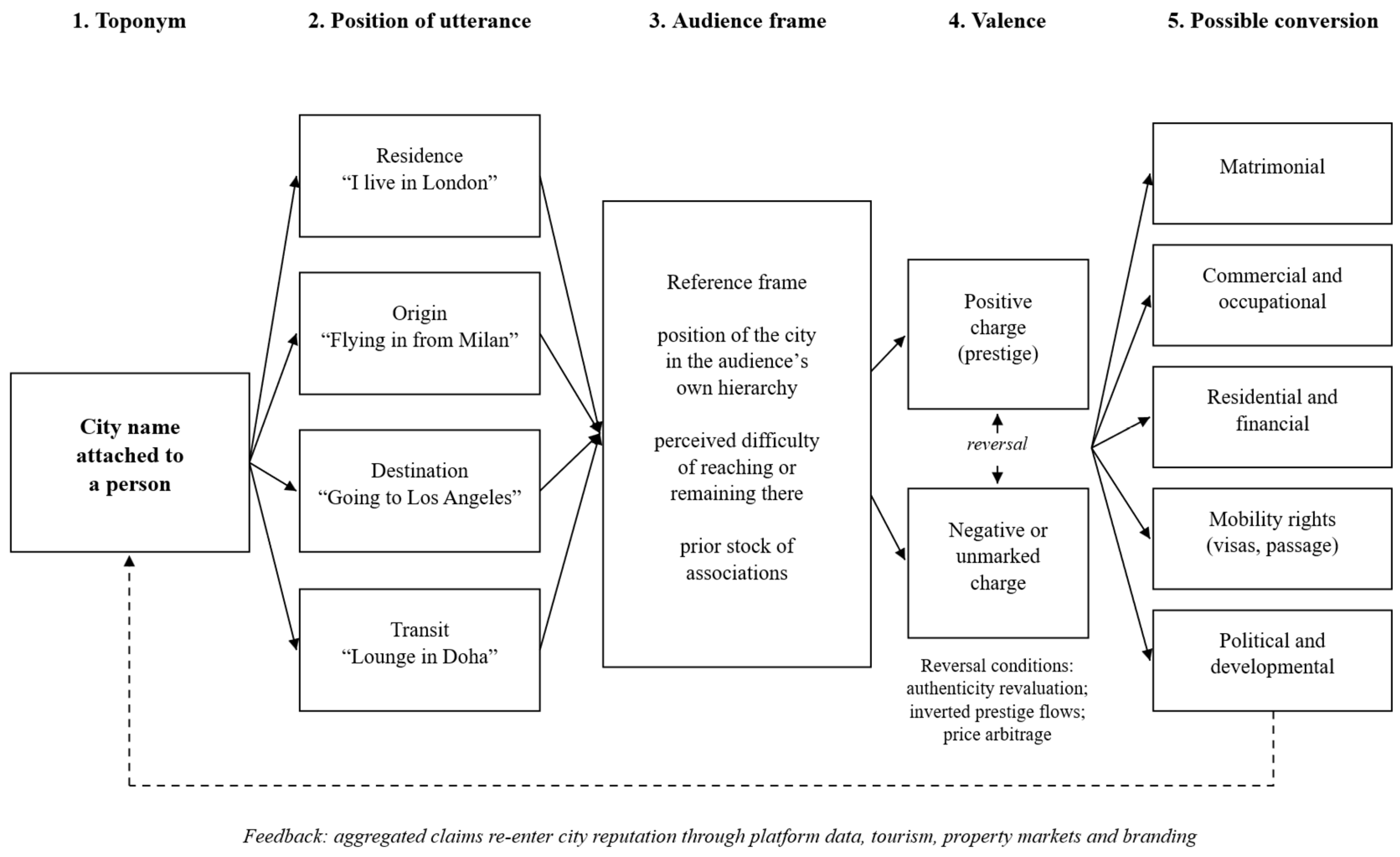

Disclaimer/Publisher’s Note: The statements, opinions and data contained in all publications are solely those of the individual author(s) and contributor(s) and not of MDPI and/or the editor(s). MDPI and/or the editor(s) disclaim responsibility for any injury to people or property resulting from any ideas, methods, instructions or products referred to in the content. |
© 2026 by the authors. Licensee MDPI, Basel, Switzerland. This article is an open access article distributed under the terms and conditions of the Creative Commons Attribution (CC BY) license.