


Abstract
Urban household biowaste is shaped by recurring food categories, among which citrus peels represent a structured and seasonally patterned input. As these peels may carry postharvest fungicide residues, their movement through decentralized waste-treatment pathways represents a chemically meaningful component of the urban metabolism. This study examined how three widely used citrus fungicides—imazalil, pyrimethanil, and thiabendazole—behave within a household-scale sealed microaerobic fermentation system typical of common urban practices. The system displayed clear composition-driven concentration patterns: imazalil and pyrimethanil concentrations increased or remained elevated, whereas thiabendazole remained relatively stable in the solid phase while decreasing in the liquid phase. Physicochemical conditions (pH value, dry matter content) followed typical microaerobic fermentation behaviour, and microbial communities reflected acidity-driven and substrate-driven development rather than fungicide-driven suppression. Fungal colonies remained detectable despite the presence of residues, indicating that substrate composition and fermentation conditions played a more prominent role in shaping microbial responses than fungicide-associated effects. These findings position postharvest fungicides not as active inhibitors in household fermentation, but as citrus-associated residues moving through decentralized waste-to-soil pathways. The results provide new insights into how citrus-associated fungicide residues move through decentralized urban waste-treatment pathways and shape chemical and microbial flows relevant to urban soil systems and the safe use of Bokashi-based fermentation residues.
1. Introduction
Urban dietary patterns have undergone a marked shift in recent decades, which is accompanied by health-conscious consumption of fresh fruits and vegetables becoming widespread across industrialized regions, independent of settlement size. Citrus fruits, in particular, represent a substantial share of this trend due to their year-round availability and perceptible health benefits [1]. However, citrus peels are routinely treated with post-harvest fungicides, such as imazalil, thiabendazole, and pyrimethanil, to prevent spoilage during long-distance transport and storage [2,3]. As a result, increasing consumption of fresh produce also increases the quantity of fungicide-contaminated organic residues generated at the household level [2,4]. While rural households have long reintegrated such residues into local soil systems through traditional composting practices [5], urban households operate within fundamentally different waste-management infrastructures, creating distinct pathways for how these residues enter the environment [6,7].
Early monitoring studies have already demonstrated how deeply embedded postharvest fungicide use is in the citrus supply chain. In a Swiss retail survey, imazalil and thiabendazole were detected in 70% and 36% of citrus samples, respectively, and the authors reported that the vast majority of postharvest fungicide residues remained concentrated in the peel [8]. Although these data are more than two decades old, they provide an important historical baseline: at the time, citrus consumption patterns were different, and citrus peels typically entered the streams to insulated landfills, where fungicide residues remained largely isolated from the urban environment. Today, however, the situation has changed. Urban consumption increasingly relies on fresh-cut citrus, juices, and culinary uses of citrus peel [1], while mandatory biowaste collection systems channel citrus peels directly into municipal composting and soil-amendment pathways [5,6]. As a result, a long-standing and well-documented postharvest fungicide load—once confined to landfill—now re-enters the urban material cycles, making peel-associated residues newly relevant in the context of urban biowaste management and environmental exposure [2,4].
Recent regulatory developments further amplify the relevance of household biowaste streams. The European Union now mandates the separate collection of biowaste from all households [9], including those in densely populated urban areas. This policy substantially increases the volume of organic residues requiring treatment in cities—many of which lack private gardens or other direct outlets for compost utilization. Consequently, biowaste from urban households is increasingly directed into municipal collection systems, community-level composting sites, or decentralized household technologies [10]. These parallel pathways together form a heterogeneous and rapidly evolving system of urban biowaste flows that differs markedly from rural organic-waste cycles.
Within this system, several technological and organizational solutions coexist. Municipal waste-management services operate large-scale aerobic composting facilities and anaerobic digestion plants, while community-based initiatives, such as neighbourhood composting points, shared garden composters, and allotment-garden systems, provide localized alternatives [11,12]. At the household level, residents may adopt balcony composters, vermicomposting units, or autonomous home-composting technologies [13,14]. Although these systems differ in scale, oxygen availability, and microbial ecology, they have a common feature: the end-products ultimately re-enter the urban soil environments [15]. Even Bokashi-based household fermentation systems, often promoted as closed indoor systems, contribute indirectly to community compost streams; their liquid effluent is frequently applied to potted plants, and the potting soil—upon repotting, plant senescence or household disposal—typically enters neighbourhood green-waste collection points. Thus, household-level fermentation systems are not isolated endpoints but integral components of urban organic-matter flows.
The expansion of community gardens, rooftop farms, and other urban-agriculture initiatives further increases the likelihood that household-derived compost or soil amendments are applied directly to urban soils [11,12]. These practices support local food production and circular economy goals but also create new exposure pathways for chemical residues and microbial communities originating from household biowaste [16,17]. Nevertheless, the fate of post-harvest fungicides within diverse composting and fermentation systems used in urban settings remains poorly understood. Existing research has primarily focused on aerobic composting or industrial-scale treatment technologies [11,13,14], leaving a critical knowledge gap regarding microaerobic household systems and their potential to retain, transform, or mobilize pesticide residues [16,17,18,19].
Household-scale food-waste fermentation can also be implemented in simple sealed containers that create microaerobic environment without the need for microbial inoculation. In these systems, oxygen is rapidly depleted after sealing, and the fermentation process is driven by the endogenous microbial community naturally present on fruit and vegetable residues. Recent studies show that such closed-bin microaerobic fermentations proceed through characteristic microbial-succession phases dominated by facultative anaerobes and lactic acid bacteria, accompanied by the accumulation of organic acids and other bioactive metabolites [16,17]. Spontaneous microaerobic fermentation of plant materials is well documented in food-science research, where endogenous microbiota governs substrate hydrolysis, acidification, and metabolite formation in the absence of starter cultures [18,19].
The present study examines the behaviour of three widely used post-harvest fungicides—imazalil, thiabendazole, and pyrimethanil—within a household-scale sealed-container microaerobic fermentation system typical of common urban practices. The setup was operated without microbial inoculation to allow the fate of residues to be assessed under non-augmented microbial conditions. The study was designed as an exploratory household-scale investigation aimed at characterizing concentration trends, physicochemical development, and microbial dynamics across a citrus-waste gradient under realistic domestic fermentation conditions. By tracking fungicide dissipation patterns, physicochemical changes, and microbial dynamics across varying citrus-waste proportions, the study provides insight into how microaerobic fermentation influences the persistence and distribution of chemical residues in both solid and liquid fractions. These findings contribute to a broader understanding of decentralized (small scale) urban biowaste-treatment pathways and the quality of the fermented material produced in household green-waste collection systems. They also clarify potential environmental exposure pathways and inform the safe use of this end-product in urban gardening and soil-related applications.
2. Materials and Methods
2.1. Fermentation Setup
Household-scale microaerobic fermentation experiments were conducted by using commercially available sealed kitchen-waste fermentation containers (Organko Mini; Bioeszold Ltd., Budapest, Hungary). Although these containers are typically marketed for Bokashi fermentation, no microbial inoculant or starter culture was added, in order to model spontaneous microaerobic fermentation driven solely by endogenous microbiota naturally present on household food residues. This setup reflects common urban household practices, in which food-waste fermentation is performed without controlled inoculation. The fermentation containers were operated according to their intended household use, including periodic drainage of accumulated fermentation liquid through the outlet valve, as recommended in the operational instructions provided for this type of system.
Mixed household food residues (vegetable scraps, fruit residues, tea leaves, coffee-grounds, breadcrumbs) served as the base substrate. Each bin represented a single citrus-input level and was treated as an individual fermentation unit throughout the study. The composition of each initial mixture was documented and is shown in Supplementary Table S2. Five fermentation bins were assembled, each containing 4.7–5.3 kg of base material, to which increasing quantities of citrus fruits (lemon and orange) were added. Citrus items were purchased from retail sources and labelled as peel-treated with post-harvest fungicides. The citrus gradient was designed to represent realistic variability in urban household citrus consumption and associated pesticide input.
Citrus additions were as follows:
Vessel K (control): 0 g
Bin A: 423.5 g
Bin B: 888.5 g
Bin C: 1368.0 g
Bin D: 2281.0 g
2.2. Sampling Procedures
2.2.1. Solid-Phase Sampling
Initial fungicide concentrations (imazalil, thiabendazole, pyrimethanil) were quantified both in the citrus fruits and in the mixed base substrate prior to fermentation. Additional solid-phase samples were collected on Day 2 to characterize the early stage of the fermentation process. Fermentation proceeded for six weeks under sealed, microaerobic conditions at ambient indoor temperature. At the end of the six-week period (Day 44), the solid fermentation residue from each bin was sampled for pesticide analysis. No further intermediate solid-phase samples were collected during the fermentation period.
2.2.2. Liquid-Phase Sampling
Liquid effluent (“fermentation liquid”) accumulating at the bottom drainage tap of each bin was drained and collected twice weekly throughout the six-week period. Each sample was analysed for imazalil, thiabendazole, pyrimethanil, and caffeine. Caffeine, originating from coffee grounds and used tea leaves present in the household food-waste mixtures, was quantified as a representative non-pesticide bioactive compound naturally occurring in kitchen residues. Its concentration was monitored alongside the fungicides to characterise the behaviour of endogenous organic constituents during microaerobic fermentation. In addition, pH values and dry-matter contents were measured for each liquid sample. Microbiological samples were collected weekly from the liquid phase for culture-based enumeration.
Supplementary Chapter SC1 provides the detailed laboratory protocols, including analytical, physicochemical, and microbiological procedures, together with LC–MS/MS method validation data (Table S1A–C).
2.3. Data Processing and Statistical Analysis
Chromatographic data were processed by means of Shimadzu LabSolutions version 5.95 software, and calibration curves were fitted using least-squares regression with 1/C2 weighting. Quantitative results were compiled in Microsoft Excel and evaluated using correlation-based exploratory statistics to assess relationships between citrus-derived pesticide input, physicochemical parameters, microbial activity, and pesticide concentrations in the liquid phase. Pearson correlation coefficients were calculated to provide a descriptive overview of co-variation patterns among the measured variables and were interpreted as exploratory indicators of system-level relationships.
2.4. Declaration of Generative AI Use
Generative AI (Microsoft Copilot; web-based service, accessed via copilot.microsoft.com; GPT-5-based conversational model, Microsoft, Redmond, WA, USA) was used to assist in refining the phrasing of methodological descriptions and clarifying the presentation of correlation results. Its role was limited to improving readability and consistency of the manuscript text. No AI tools were used to generate data, perform analyses, or create figures; all scientific content and interpretation were produced by the authors.
3. Results
Over the course of the six-week process, the fermentation system developed a distinct temporal structure influenced by its composition. Detailed numerical values for all chemical and microbiological measurements are shown in Supplementary Tables S3–S8. Pairwise correlations among chemical, physicochemical and microbiological variables were computed, and the full correlation matrix is provided in the Supplementary Materials, Table S11.
3.1. Initial Fungicide Loads and Concentration Trends in Solid and Liquid Phases
3.1.1. Background Concentrations on the Whole Fruits
The initial fungicide load of the fermentation system was determined from homogenized whole lemons and oranges. From among the three investigated fungicides, imazalil showed the highest concentrations in both fruit types, followed by thiabendazole and pyrimethanil. All measured values remained below the corresponding EU Maximum Residue Levels (MRLs) [20], as listed in the EU Pesticides Database. The presence of multiple residues in citrus fruits is consistent with post-harvest treatment practices widely reported for urban household biowaste streams, where citrus peels constitute a major fraction of food waste inputs [21,22]. Caffeine was not detectable in either fruit type, confirming that its later appearance in the fermentation system originates exclusively from the mixed household waste matrix.
3.1.2. Solid-Phase Concentrations (Days 0, 2, 44)
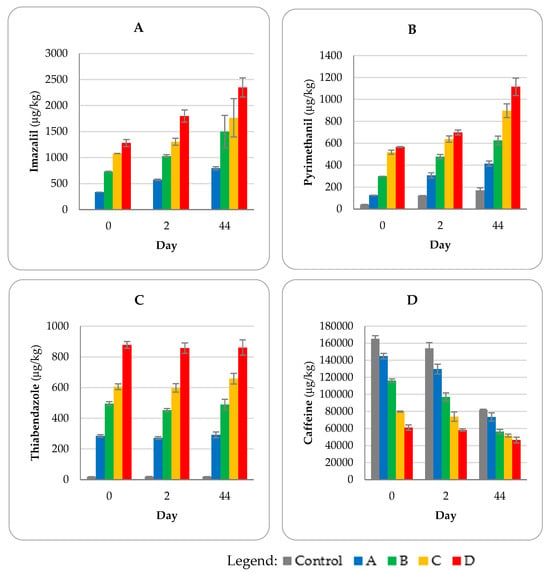
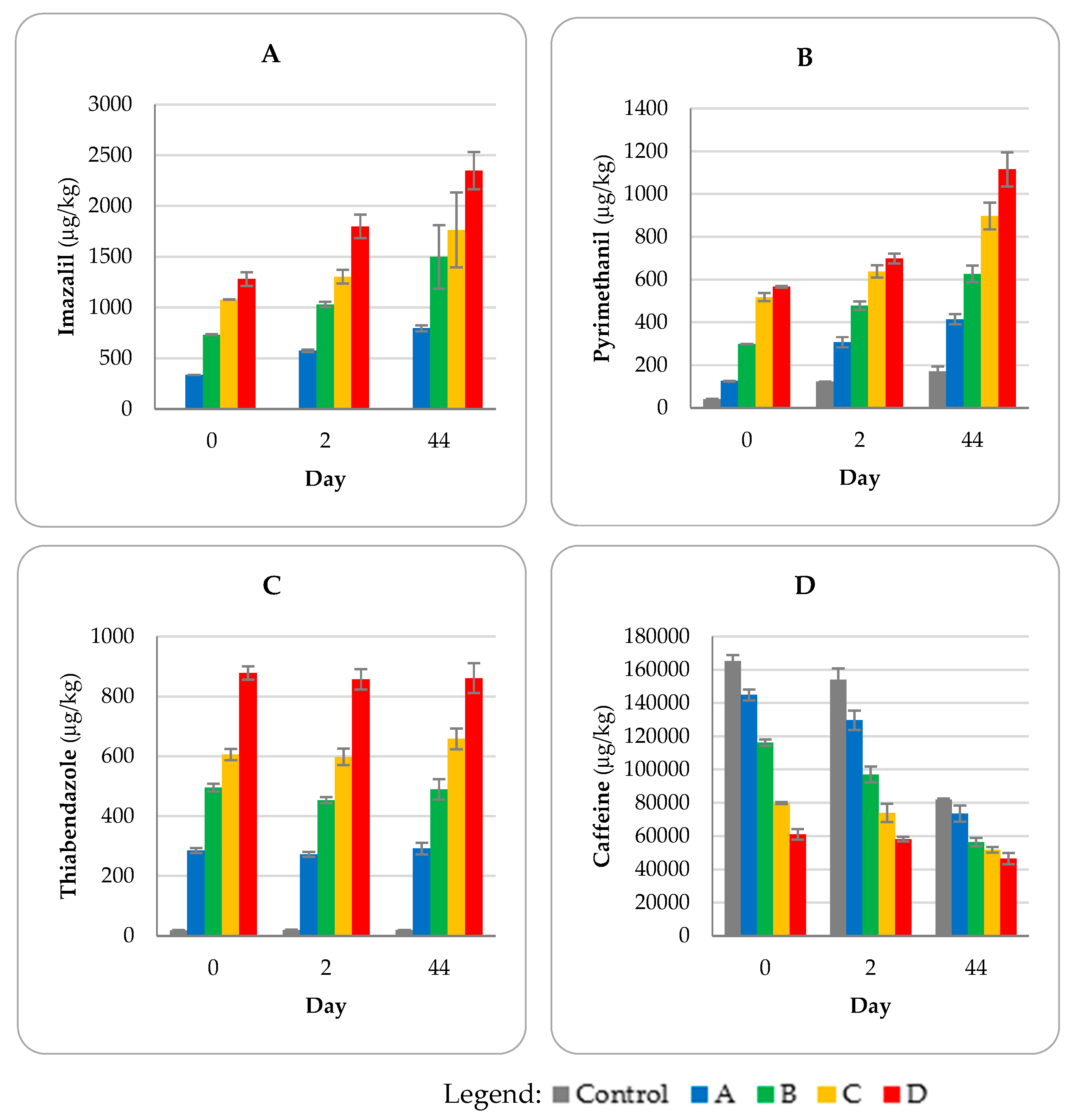
Solid-phase concentrations of the four target compounds showed clear temporal patterns over the six-week period (Figure 1A–D). Imazalil and pyrimethanil generally showed higher concentrations at Day 44 than at Day 0 across the citrus-amended bins, although the magnitude and variability of changes differed among bins. Thiabendazole concentrations showed no consistent change over time. Caffeine concentrations decreased continuously in all bins. For the three fungicides, the measured levels reflected the citrus-input gradient: bin D showed the highest concentrations, followed by C, B, A, and the control. Caffeine did not follow this pattern; its concentrations were highest in the control bin and lowest in bin D. This fungicide-related gradient aligns with the well-documented dominance of fruit and vegetable residues in urban biowaste streams [21], where citrus peels frequently represent a substantial share of household food waste, particularly in winter months [22]. To sum up, the solid-phase data show that fungicide concentrations remained substantially higher in the solid fraction than in the liquid fraction throughout the experiment.
Figure 1.
(A–D) Solid-phase concentrations of imazalil, pyrimethanil, thiabendazole and caffeine measured at Days 0, 2 and 44 across the citrus-input gradient (control, A–D). Error bars represent the standard deviation of triplicate LC–MS/MS determinations performed for each sample.
3.1.3. Liquid-Phase Concentrations (Days 6–44)
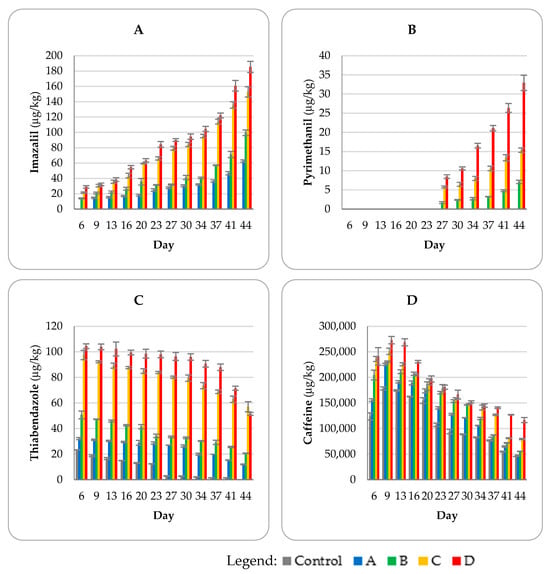
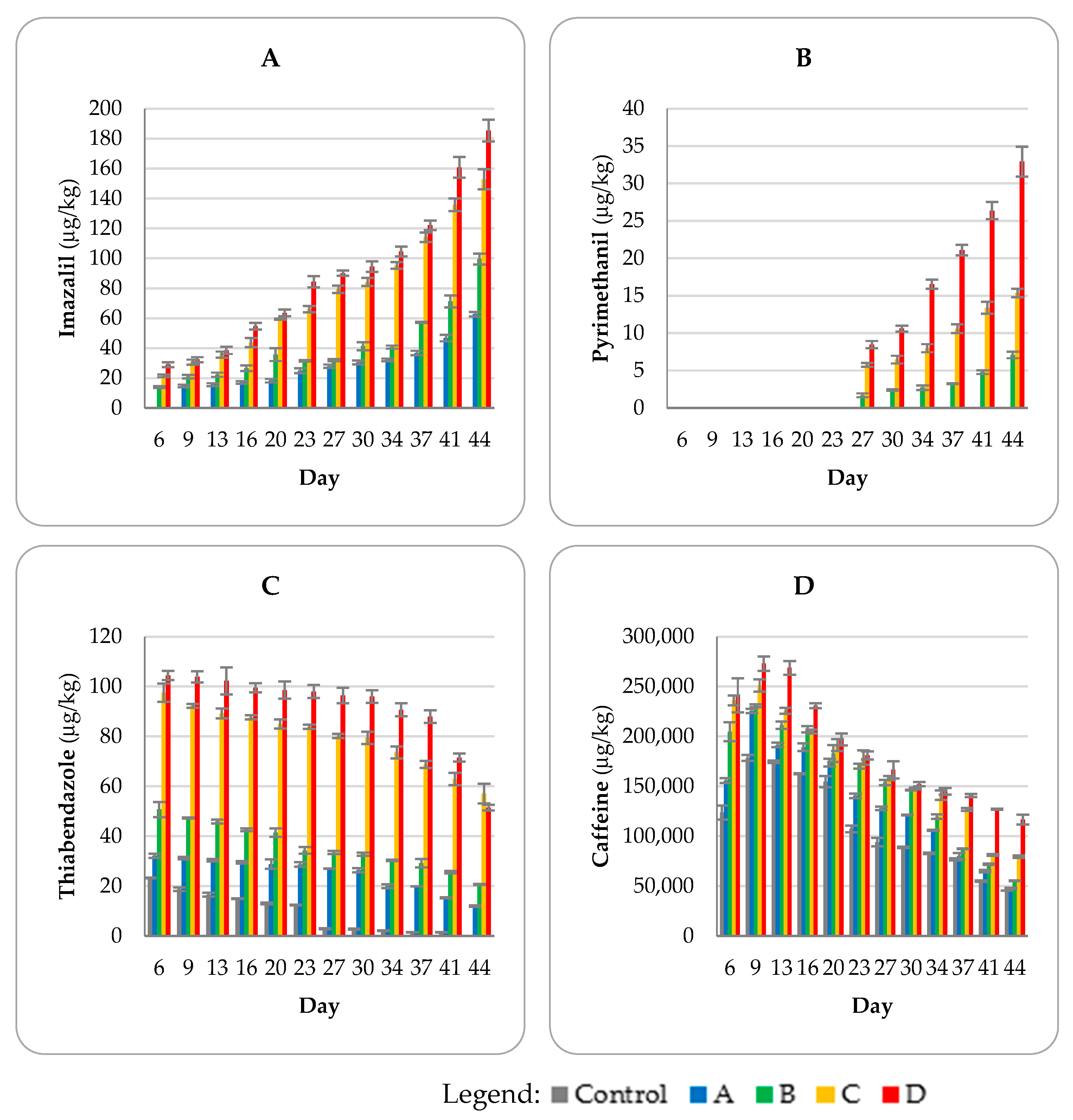
In the drained liquid, imazalil concentrations increased continuously from Day 6 to Day 44. Pyrimethanil was detectable only from Day 27 onward, after which its concentrations also increased. Thiabendazole concentrations decreased over time in the liquid drained. Caffeine concentrations decreased steadily across all bins (Figure 2A–D). As in the solid phase, the citrus-input gradient was reflected in the fungicide concentrations, with bin D showing the highest values and the control the lowest. Caffeine showed a different ordering, with the highest concentrations in the control bin and the lowest in bin D. These observations are consistent with the limited aqueous mobility of fungicides in household biowaste matrices dominated by fruit and vegetable residues [21]. The liquid-phase results show that fungicide concentrations in the drained liquid remained substantially lower than those observed in the solid phase throughout the experiment.
Figure 2.
(A–D) Liquid-phase concentrations of imazalil, pyrimethanil, thiabendazole and caffeine measured twice weekly from Day 6 to Day 44. Error bars represent the standard deviation of triplicate LC–MS/MS determinations performed for each sample.
3.2. Selected Physicochemical Parameters
3.2.1. pH Trends
The initial pH values of all bins ranged between 3.7 and 4.0. A slight decrease was observed during the early phase of the experiment in all bins. In the later stages, the pH increased in the control bin and in bins A and B, reaching values between approximately 4.1 and 4.4. No increase relative to the initial values was observed in bins C and D throughout the experimental period. These pH ranges are typical for urban biowaste streams rich in fruit and vegetable residues [21,23].
3.2.2. Dry Matter Trends
The dry matter content of the liquid drained decreased continuously over the course of the experiment in all bins. Initial dry matter values were higher in the bins containing citrus material compared to the control. A gradual decline was observed in each bin across all sampling points. Similar moisture-rich profiles have been reported for mixed household food wastes in urban residential areas [23].
3.3. Microbial Dynamics
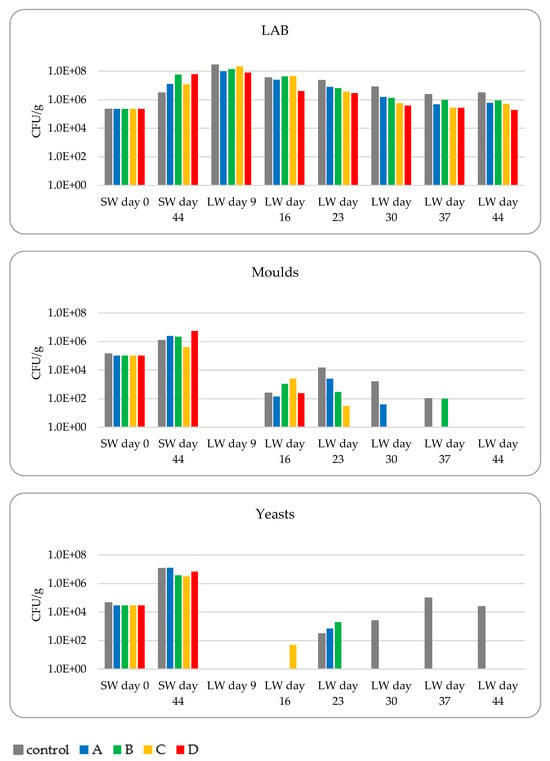
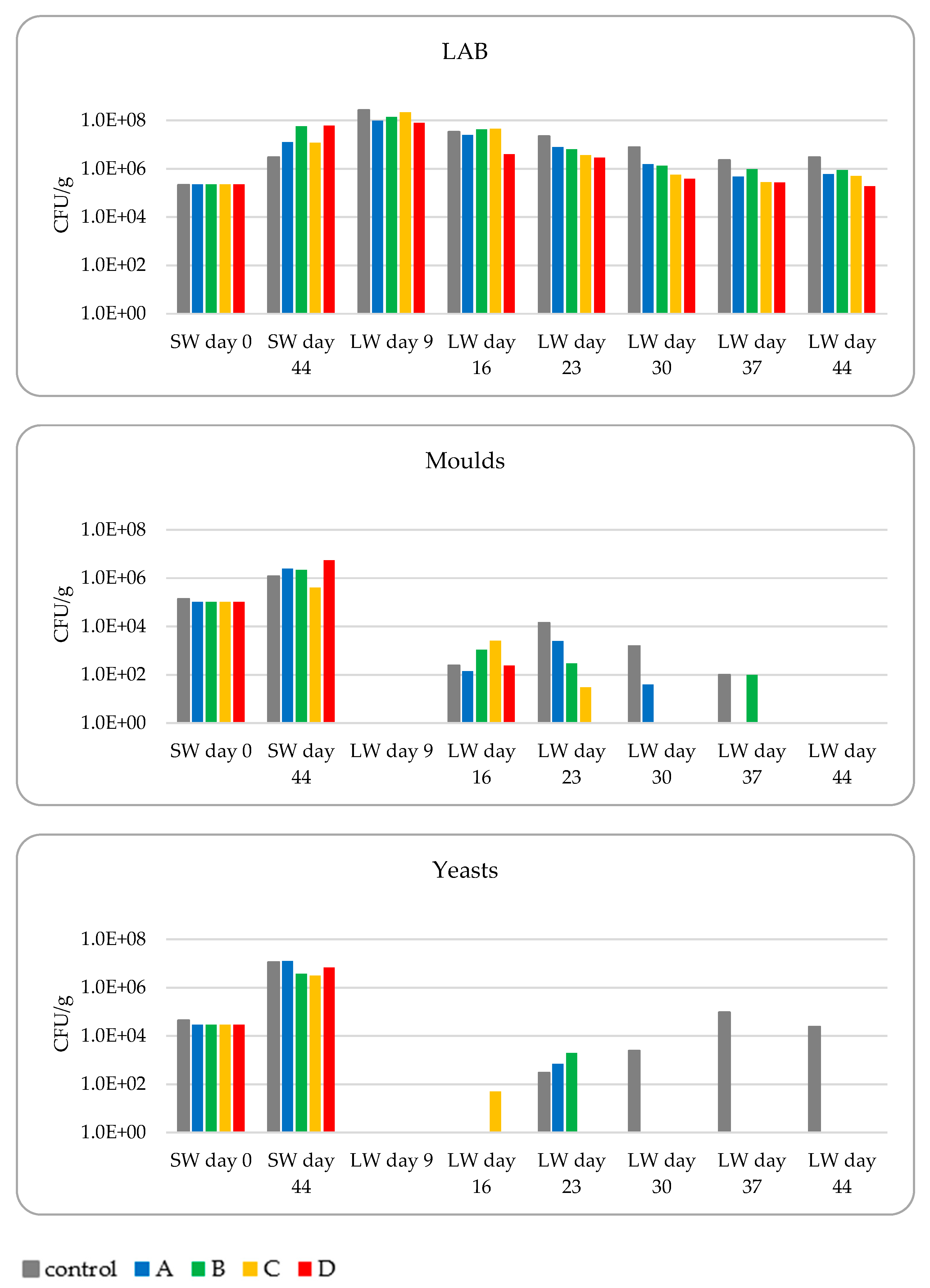
Microbial activity in the fermentation system exhibited clear temporal and phase-specific patterns shaped by substrate composition and the progression of fermentation. Figure 3 provides an overview of these dynamics, showing how the major microbial groups responded in both the solid and liquid fractions.
Figure 3.
Culture-based enumeration of lactic acid bacteria (LAB), yeasts and moulds in solid samples (Day 0 and Day 44) and liquid samples (Days 9–44).
Lactic acid bacteria (LAB) were detected in all solid samples on Day 0, with slightly higher initial levels in the citrus-containing bins compared to the control. By Day 44, LAB concentrations increased in all solid samples, and bins A–D reached values approximately one order of magnitude higher than the control. This behaviour is consistent with the high availability of fermentable substrates typically present in urban household biowaste streams [21,23]. In contrast, LAB concentrations in the liquid drained declined sharply over time in all bins, with no notable differences between the citrus/fungicide bins and the control.
Yeasts were present in all solid samples on Day 0, with only minor initial differences between bins. Their concentrations increased in all solid samples by Day 44, and no consistent differences were observed between the control and the fungicide-treated bins. In the liquid drained, yeasts were not detected at the first sampling point (Day 9) and appeared only sporadically during the subsequent stages of fermentation. Detectable yeast counts were observed in bin C on Day 16 and in the control, A and B bins on Day 23, after which their occurrence became progressively restricted. From Day 30 onward, yeasts were detected only in the control liquid samples, and by the end of the experiment no yeasts were detected in any citrus-containing liquid sample.
Moulds were detected in all solid samples on Day 0, and their concentrations increased in all bins by Day 44. No consistent differences were observed between the control and bins A–D. In the liquid drained, moulds were not detected at the first sampling point (Day 9) but became detectable in all bins by Day 16, with the highest counts observed in bin C. By Day 23, moulds remained detectable in the control and in bins A–C, whereas no moulds were detected in bin D. Their occurrence subsequently declined in the citrus-containing systems, while low-level persistence was observed in the control liquid samples during the later stages of fermentation.
By the end of the experiment, the solid phase remained microbiologically diverse, with all major microbial groups persisting at high cell densities, whereas the liquid phase was dominated by lactic acid bacteria, with yeasts detectable only in the control sample and moulds no longer detectable in any liquid sample.
4. Discussion
The fermentation system showed a highly structured behaviour, in which both chemical and microbiological variables consistently followed the citrus-input gradient. In the solid phase, imazalil and pyrimethanil concentrations increased steadily from Day 0 to Day 44 and continued to reflect the citrus-input gradient throughout the fermentation period. In contrast, thiabendazole concentrations remained relatively stable over time despite the increasing citrus-input gradient. In the liquid phase, imazalil concentrations increased continuously throughout the sampling period, while pyrimethanil became detectable only after Day 27 and subsequently increased. Thiabendazole displayed a contrasting pattern, with concentrations gradually decreasing over the course of the experiment. Caffeine, originating from household residues rather than citrus fruits, decreased uniformly in both phases, consistently with fermentative degradation. Microbial dynamics mirrored these chemical trends: lactic acid bacteria, yeasts, and moulds increased in all solid samples, while in the liquid phase, LAB counts declined sharply, and yeasts and moulds disappeared after their transient mid-fermentation appearance. Taken together, these patterns indicate a composition-driven system, in which citrus peels—an abundant and chemically distinctive component of urban household biowaste—act as a dominant structural input that simultaneously shapes fungicide loading, substrate availability, and microbial activity throughout microaerobic fermentation.
4.1. Citrus-Driven Urban Biowaste Material Flow
Urban household biowaste is not compositionally random: its structure reflects dietary habits, seasonal consumption, and the recurring presence of specific food categories. Multiple municipal waste-composition studies demonstrate that fruit and vegetable residues form one of the largest and most variable fractions of urban biowaste [10,24,25,26]. Within this category, citrus peels represent a chemically distinctive and seasonally abundant component, particularly in regions with high winter citrus consumption. Their contribution to urban biowaste streams was documented in marketplace waste analyses [27,28,29] and in studies examining the organic fraction of municipal solid waste [30,31]. These works consistently show that citrus residues appear in concentrated, predictable patterns, often forming a substantial share of the fermentable fraction of household waste.
Citrus peels also carry postharvest fungicide residues, which enter the urban waste streams in a structurally embedded manner. Surveys of citrus fruits routinely report measurable levels of imazalil, thiabendazole, and pyrimethanil on peels [4,8,32,33], and these residues persist during storage and handling. As citrus peels are discarded directly into household waste, the fungicide load in urban biowaste is not diffuse but category-specific, reflecting the chemical signature of citrus consumption. This structural input explains why the fermentation system in our study did not behave as a generic food-waste mixture: the increasing imazalil and pyrimethanil concentrations observed in both phases align with the documented persistence and peel-associated distribution of these fungicides.
Urban biowaste heterogeneity is strongly substrate-driven. Studies from Greece, Brazil, India, and Northern Europe show that specific food categories—not total waste volume—determine the chemical and microbial trajectories of downstream processing [21,23,34,35]. Citrus residues, with their high moisture, sugar content, organic acids, and bioactive compounds [1,36,37] are repeatedly identified as drivers of fermentation dynamics in mixed biowaste systems. The strong co-variation observed in our system between citrus input, fungicide concentrations, and solid-phase microbial growth is therefore not an isolated laboratory phenomenon but reflects a broader structural reality of urban waste flows.
4.2. Microaerobic Household Fermentation as an Urban Technology
Microaerobic household fermentation systems—commonly referred to as bokashi—are increasingly used in urban settings, where limited outdoor space constrains conventional composting options. These systems operate in sealed containers under oxygen-limited conditions, creating physicochemical and microbial environments distinct from those found in open aerobic compost piles. Recent surveys indicate that household-scale fermentation is widespread in cities and frequently relies on citrus-rich waste streams, reflecting urban dietary patterns and seasonal consumption [38,39]. As the process is carried out indoors and on a small scale, the transformations occurring within these bins tend to be more concentrated and less buffered than in municipal or community composting systems [11,12].
The microaerobic conditions characteristic of Bokashi-based fermentation systems strongly influence fermentation trajectories. Culture-independent analyses show that lactic acid bacteria rapidly dominate in sealed household systems, driving acidification and producing microbial succession [16]. Similar dynamics were reported in microaerobic fermentation of fruit- and vegetable-derived substrates, where endogenous microbiota govern substrate hydrolysis, organic-acid accumulation, and metabolite formation [17,18,19]. These observations closely align with the microbial patterns in our study, including LAB proliferation in the solid phase, transient yeast activity, and the disappearance of moulds and yeasts from the liquid phase as acidity increased. The consistency between published fermentation dynamics and our results indicates that the citrus-driven structure identified in Section 4.1 is enhanced by the operational characteristics of microaerobic household systems.
A characteristic feature of household Bokashi-based fermentation systems is the periodic drainage of accumulated liquid. Manufacturer instructions commonly recommend regular removal of the liquid fraction during operation and its subsequent application, typically after dilution, to potted plants and small-scale urban gardening systems. Periodic drainage may influence the retention of soluble compounds and the redistribution of microorganisms within the system and should therefore be considered when interpreting the observed chemical and microbial patterns.
The residues generated by Bokashi-based fermentation systems—both solid and liquid—are commonly incorporated into urban soil systems such as community gardens, rooftop farms, balcony planters, and neighbourhood green-waste points [13,14]. Studies on decentralized urban waste management highlight that repeated application of such residues can influence local soil chemistry and microbiology, particularly when inputs originate from compositionally distinctive waste streams [40,41]. In this context, the sealed microaerobic process functions as a concentrator of citrus-associated substrates and metabolites, producing materials with characteristic chemical and microbial signatures.
Together, these observations situate microaerobic household fermentation within the broader metabolism of urban biowaste. The technology does not merely transform food residues; it modulates the fate of citrus-associated fungicides, selects for specific microbial groups, and channels these outputs into urban soil systems. In summary, these observations highlight the role of microaerobic household fermentation in forming chemical and microbial trajectories of citrus-rich biowaste within urban environments.
4.3. Fate of Postharvest Fungicides in a Microaerobic Fermentation System
The behaviour of postharvest fungicides within a microaerobic fermentation environment reflects both the physicochemical properties of the compounds and the structural influence of citrus-rich household biowaste. Imazalil, thiabendazole, and pyrimethanil are routinely detected on citrus peels at measurable levels [4,8,32,33], and their persistence during storage and handling was documented in several postharvest studies [1,36,37]. These residues enter the household waste streams in a structurally embedded manner, and their subsequent fate is shaped by the sealed, acidic, and substrate-rich conditions characteristic of microaerobic fermentation. The detailed numerical values underlying these trends are shown in Supplementary Tables S5 and S8.
Imazalil concentrations increased progressively in both the solid and liquid phases of the system. This behaviour is consistent with its known stability under acidic conditions and its limited degradation in low-oxygen environments [32,37]. The progressive increase observed in the solid fraction aligns with reports that imazalil binds strongly to organic matrices and can be gradually released from citrus peel tissues during microbial and physicochemical breakdown [4,8]. The continuous increase in liquid-phase concentrations is similarly supported by studies showing that imazalil becomes increasingly extractable as peel structure degrades [33].
Pyrimethanil displayed a delayed appearance in the liquid phase, emerging only after Day 27 and increasing thereafter. This pattern corresponds with its moderate hydrophobicity and documented tendency to remain associated with peel tissues until substantial matrix disruption occurs [32,36]. Its steady increase in the solid fraction is consistent with its stability under acidic conditions and its persistence in fruit-derived organic substrates [37]. The delayed increase in liquid-phase concentrations suggests that pyrimethanil availability in the aqueous phase may be linked to the progressive hydrolysis and solubilization of citrus peel components, a process well described in microaerobic fermentation of fruit residues [18,19].
Thiabendazole showed a contrasting trajectory, with high initial concentrations and a gradual decrease in the liquid phase, while remaining largely unchanged in the solid phase. This behaviour is in line with its known susceptibility to degradation under acidic conditions, particularly in aqueous environments, and its partial transformation during storage and processing of citrus fruits [4,8]. Studies reported that thiabendazole underwent matrix-dependent dissipation in moist, low-oxygen conditions [32,36], which corresponded with a decreasing trend observed in the liquid phase of our system. The faster decline in the liquid phase is consistent with its higher solubility and documented degradation in acidic aqueous media [37].
Caffeine, originating from household residues rather than citrus, decreased uniformly in both phases. This behaviour aligns with its known biodegradability in fermentation systems and its rapid transformation by lactic acid bacteria and yeast communities [17,19]. Its decline provides a useful internal contrast to the fungicides, highlighting the difference between endogenous, readily degradable compounds and exogenous, peel-associated residues.
Taken together, the concentration trajectories of imazalil, pyrimethanil, and thiabendazole suggest that fungicide behaviour in microaerobic household fermentation is influenced by a combination of compound-specific physicochemical properties and the structural influence of citrus-derived substrates. The sealed, acidic environment was associated with distinct fungicide concentration patterns that reflected both substrate composition and process conditions.
4.4. Microbial Dynamics and Composition-Driven Interactions
The microbial trajectories observed in the fermentation system reflect the combined influence of citrus-derived substrates, microaerobic conditions, and the physicochemical environment formed by lactic acid bacteria. Culture-independent studies of household bokashi consistently report rapid lactic acid bacteria (LAB) dominance in sealed systems, accompanied by progressive acidification and suppression of competing microbial groups [12,16]. Similar patterns were documented in microaerobic fermentation of fruit- and vegetable-derived substrates, where endogenous microbiota drive substrate hydrolysis, organic acid accumulation, and shifts in microbial community structure [17,18,19]. These findings closely align with the microbial dynamics in our system, where LAB increased in all solid samples, yeasts exhibited transient activity, and moulds persisted only in the solid phase.
The solid-phase environment favoured microbial proliferation. Citrus peels provide fermentable sugars, organic acids, and moisture—conditions known to support LAB and yeast growth in fruit-based fermentation systems [36,37]. The consistent increase in LAB, yeasts, and moulds in the solid fraction corresponds with observations from microaerobic processing of citrus residues, where substrate richness and limited oxygen availability promote mixed microbial activity [18,19]. The strong association between citrus input and solid-phase microbial growth in our system is consistent with substrate-driven dynamics rather than clear inhibitory or selective effects of fungicides.
In contrast, the liquid phase exhibited declining microbial activity. LAB counts decreased sharply, and yeasts and moulds disappeared after their brief mid-fermentation presence. This pattern is consistent with the documented sensitivity of non-LAB groups to low pH values and microaerobic stress in sealed fermentation systems [16,17]. As acidity increased and readily fermentable substrates were depleted, the liquid environment became progressively less hospitable for yeasts and moulds, mirroring trends reported in microaerobic fermentation of fruit-derived substrates [18]. The disappearance of these groups from the liquid fraction is better explained by environmental constraints associated with acidification and microaerobic conditions than by fungicide-driven inhibition.
The correlation structures observed in the system are consistent with a composition-driven interpretation (see numerical correlation values in Supplementary Table S11). Citrus-input variables showed positive associations with fungicide concentrations and weaker associations with certain microbiological parameters, reflecting the co-occurrence of peel-associated residues and substrate-related gradients within the fermentation matrix. Similar composition-driven correlations were reported in urban biowaste studies, where specific food categories shape both chemical loads and microbial trajectories [10,23,24,26]. In our system, the observed associations between fungicide concentrations and microbial parameters are more plausibly attributed to the structural role of citrus peels as a key input than to direct toxicological interactions. The declining microbial activity in the liquid phase likewise correlates with decreasing substrate availability and increasing acidity, consistent with established fermentation dynamics [16,17].
The microbial observations suggest that substrate composition and process conditions played a more prominent role in shaping system dynamics than any detectable fungicide-associated effects. The citrus-driven structure identified in previous sections forms both chemical and microbial trajectories, producing coherent patterns reflecting the interplay between peel-associated residues, endogenous microbiota, and the microaerobic environment. Overall, these patterns underscore the extent to which substrate composition and process conditions structure microbial communities in citrus-rich microaerobic systems.
4.5. Residue Levels, Inhibitory Thresholds and Biological Relevance
Several studies on postharvest citrus systems related fungicide residue levels expressed on a mass basis to biological efficacy and disease control outcomes [2,42,43]. Reported effective residue ranges differ among fungicides and application systems, but all three compounds have been shown to exert measurable biological effects at residue levels directly quantified in citrus matrices rather than in liquid culture media. For pyrimethanil and thiabendazole, residue-based efficacy studies identified C50 and C75 thresholds associated with green mould control, whereas imazalil studies demonstrated effective disease suppression and sporulation inhibition within residue ranges measured directly in citrus tissues. Across these studies, biologically relevant residue levels generally ranged from several tens of ng g−1 to several thousand ng g−1, depending on the fungicide, citrus cultivar, application method and efficacy endpoint.
The concentrations measured in the present fermentation system showed varying degrees of overlap with residue levels reported as biologically relevant in postharvest citrus systems (Supplementary Table S9). All three fungicides reached concentration ranges that partially or extensively coincided with residue levels associated with biological efficacy in citrus matrices, although the extent of overlap differed among compounds and between the solid and liquid phases.
Taken together, these comparisons suggest that the fungicide concentrations observed in the Bokashi-based fermentation system cannot be regarded as negligible from a toxicological perspective. Nevertheless, the microbial trajectories observed during fermentation did not exhibit the clear suppression patterns typically associated with effective fungicidal activity in citrus-pathogen systems.
The microbial patterns observed in the fermentation system are consistent with this toxicological context. Lactic acid bacteria increased steadily in the solid phase despite rising imazalil and pyrimethanil concentrations, and yeasts and moulds exhibited transient activity before declining in response to acidification and microaerobic conditions. These trajectories correspond with established fermentation dynamics [16,17,19] and do not resemble fungicide-driven inhibition that typically manifests as stagnation or collapse of susceptible fungal groups at concentrations near MIC ranges [44,45]. The absence of such signatures suggests that environmental conditions played a more prominent role in shaping microbial behaviour, although a contributory effect of imazalil or pyrimethanil on yeasts and moulds cannot be fully excluded.
The correlation structures observed in the system are consistent with this interpretation. Positive associations between fungicide concentrations and solid-phase microbial growth reflect the shared origin of both variables in citrus peels, a chemically distinctive and seasonally abundant component of urban household biowaste [8,32,33,36]. Similar composition-driven correlations were documented in studies of urban biowaste structure, where specific food categories form both chemical loads and microbial trajectories [10,23,24,26]. In this context, the observed co-variation between fungicide concentrations and microbial parameters is more plausibly attributed to the structural role of citrus residues as a dominant input than to inhibitory interactions.
Published MIC and EC50 values determined in liquid media provide additional toxicological context for interpreting the observed concentration ranges. However, direct comparison should be approached cautiously, because inhibitory thresholds are generally established in aqueous systems, whereas fungicide concentrations in fermented biowaste were quantified on a mass basis. Despite this limitation, MIC and EC50 studies indicate that imazalil exhibits inhibitory activity at relatively low concentrations, whereas higher thresholds are generally reported for pyrimethanil and thiabendazole [44,45,46,47,48,49,50,51].
In this broader toxicological context, the available MIC and EC50 data provide additional reference points for interpreting the observed concentration ranges, particularly for imazalil, which exhibited the strongest overlap with biologically relevant concentration ranges reported in the literature. Comparable inhibitory thresholds for complex fermented solid matrices remain largely unavailable, highlighting an important knowledge gap for future studies addressing fungicide behaviour in fermented biowaste systems (Supplementary Table S10A,B).
Taken together, the residue-based literature, the concentration ranges observed in the fermentation system, and the corresponding microbial responses indicate that fungicide residues occurred at biologically relevant levels but were not associated with clear fungicide-driven suppression patterns. The observed microbial trajectories were more consistent with acidification, substrate composition and microaerobic process conditions, although a contributory effect of imazalil or pyrimethanil on yeasts and moulds cannot be fully excluded. Within household-scale biowaste streams, fungicide residues therefore appear to function primarily as structural markers of citrus input rather than as dominant determinants of microbial behaviour.
4.6. Urban Implications and Fungicide Resistance as an Emerging Environmental Issue
The citrus-driven structure identified in the fermentation system has broader implications for urban biowaste management. Because citrus peels enter the household waste streams in concentrated and seasonally patterned flows [27,28,29], the fungicide residues associated with these peels also occur in a structured manner. Studies of marketplace and municipal biowaste consistently show that citrus residues disproportionately contribute to the chemical load of urban organic waste [22,30,31]. In this context, the fungicide concentrations observed in our system represent not an isolated laboratory phenomenon, but the chemical signature of citrus consumption embedded within urban material flows.
Microaerobic household fermentation amplifies this structural signal. The sealed process concentrates peel-associated substrates and metabolites, producing residues with characteristic chemical and microbial profiles [12,14]. When these residues are incorporated into urban soil systems—community gardens, rooftop farms, balcony planters, and neighbourhood green-waste points—they introduce citrus-associated compounds into localized environments [40,41]. Although the fungicide concentrations observed in our system did not appear to be associated with clear inhibitory effects, their repeated appearance in household fermentation residues highlights how specific food categories can form the chemical system of decentralized urban waste-to-soil pathways.
Multiple studies report reduced sensitivity or resistance development in Penicillium digitatum, P. italicum, P. expansum and Botrytis cinerea following repeated exposure to imazalil and pyrimethanil [44,47,49,50,52,53]. Molecular analyses identified target-site mutations, efflux-pump activation, and transcriptional changes contributing to resistance phenotypes [54]. Although the fungicide concentrations measured in our household fermentation system were not inhibitory, their recurrent presence in citrus-derived biowaste highlights that exposure pathways outside agricultural settings may warrant consideration in future studies addressing resistance-related selection processes over longer timescales. In this sense, the citrus-associated chemical footprint extends beyond production and postharvest handling into consumption, disposal, and decentralized processing within urban environments.
Taken together, these considerations position citrus-associated fungicides as part of an emerging urban environmental issue. Their presence in household biowaste is structurally determined by consumption patterns, their fate in microaerobic fermentation is shaped by process conditions, and their downstream movement into urban soil systems reflects the decentralized nature of contemporary waste management. The concentrations observed in the present system were not associated with clear inhibitory effects, either in the observed microbial responses or when considered in the context of the available literature on fungicide sensitivity and resistance. Nevertheless, they illustrate how postharvest fungicides may participate in the metabolism of cities, linking food systems, waste flows, and environmental exposures in ways that merit further attention.
5. Conclusions
This study reveals that the behaviour of postharvest fungicides and microbial communities in household-scale microaerobic fermentation is more strongly associated with substrate composition and the structural influence of citrus-rich urban biowaste than with detectable fungicide-associated effects. The concentration patterns of imazalil, pyrimethanil, and thiabendazole reflected compound-specific physicochemical properties and the progressive breakdown of citrus peel matrices, while microbial development followed established fermentation dynamics formed by acidity and oxygen limitation. Comparison with published residue-based efficacy studies and inhibitory thresholds indicated that the observed fungicide concentrations were within ranges considered biologically relevant in citrus-associated systems. The microbial changes observed in the system did not display clear signatures of fungicide-driven suppression, suggesting that environmental conditions and substrate composition played a more prominent role in shaping microbial behaviour, although a contributory effect of imazalil or pyrimethanil on fungal groups cannot be fully excluded.
The findings position citrus residues as a chemically distinctive and seasonally patterned component of urban household biowaste, whose structural presence forms both chemical loads and microbial profiles in decentralized fermentation systems. As citrus peels enter the waste streams in concentrated flows, the fungicide residues associated with them likewise appear in predictable patterns, becoming part of the chemical signature of urban consumption. Microaerobic household fermentation amplifies this signal by concentrating peel-associated substrates and metabolites, producing residues with characteristic profiles that subsequently enter the urban soil systems through community gardens, rooftop farms, and other decentralized pathways.
Taken together, these considerations position our findings within a wider urban-metabolic context. The citrus-driven patterns observed in the fermentation system reflect how specific food categories influence the composition, chemical load, and microbial behaviour of urban household biowaste. This perspective is essential for understanding the downstream implications of household-scale fermentation technologies operating not on abstract “food waste,” but on the structured material flows generated by urban dietary habits.
These results highlight that postharvest fungicides participate in the urban metabolism not as active inhibitors in household fermentation, but as structurally embedded markers of citrus consumption that move through production, disposal, and localized waste-to-soil processes. While no clear inhibitory effects were observed during the fermentation process, the recurring presence of these residues highlights the broader relevance of citrus-associated chemical footprints within urban biowaste management and emerging discussions of fungicide resistance. Understanding these structurally driven material flows is essential for designing urban waste systems that are both environmentally responsive and aligned with the material realities of contemporary food consumption.
Limitations and Scope
This study examined a single household-scale microaerobic fermentation system under controlled conditions, using citrus-rich biowaste representative of seasonal urban consumption patterns. While the system reflects the structural influence of citrus residues documented in urban biowaste studies, the findings do not capture the full variability of household waste composition across cities, seasons, or socio-economic contexts. The fermentation process was conducted in standardized bins and without inoculated microbial starters, which limits direct comparison with operationally diverse household practices. Periodic drainage of fermentation liquid may also have influenced the retention and distribution of soluble compounds and microorganisms compared with a completely undisturbed batch fermentation process. Each citrus-input level was represented by a single fermentation unit; therefore, the study provides exploratory system-level observations rather than statistically replicated treatment comparisons.
The fungicide concentrations measured in this study represent the chemical signature of the specific citrus inputs used and may differ from residues associated with other citrus varieties, postharvest treatments, or regional supply chains. Although the concentrations were not inhibitory, the study did not assess long-term accumulation or transformation pathways in urban soils following repeated application of fermentation residues. Similarly, the microbial analyses focused on culturable groups and did not include metagenomic or functional assessments that could reveal subtler ecological responses.
Despite these limitations, the system provides a structurally coherent model of citrus-driven biowaste streams and their behaviour in decentralized microaerobic fermentation. The results delineate the conditions under which postharvest fungicides act as embedded chemical markers rather than dominant drivers of microbial suppression, and they highlight the need for future work on the environmental fate, transformation, and potential resistance-related implications of citrus-associated residues within urban waste-to-soil pathways.
Supplementary Materials
The following supporting information can be downloaded at: https://www.mdpi.com/article/10.3390/urbansci10110613/s1. The Supplementary Materials provides detailed methodological descriptions, method-validation data, and complete datasets supporting all chemical, physicochemical, and microbiological results presented in the manuscript. Section SC01 contains full laboratory protocols for chemical analyses, LC–MS/MS method validation, physicochemical measurements, and culture-based microbiological determinations. Table S1A–C summarize the analytical performance characteristics of the LC–MS/MS method. Tables S2–S8 present processed sample-level data generated during the waste-treatment experiment, including waste composition, citrus background pesticide loads, chemical concentrations, physicochemical parameters, and microbiological counts. Table S9 compares observed fungicide concentration ranges with biologically relevant residue levels reported in postharvest citrus systems. Table S10A,B summarize literature-derived EC50 and MIC values for the investigated fungicides. Table S11 presents the exploratory correlation matrix used to evaluate system-level relationships.
Author Contributions
K.L.: Conceptualization, Methodology, Investigation, Data curation, Formal analysis, Validation, Visualization, Writing—original draft; M.S.: Methodology, Investigation, Formal analysis, Data curation; G.R.L.: Methodology, Investigation, Formal analysis, Data curation; O.S.: Methodology, Investigation; E.N.: Conceptualization, Methodology, Investigation; B.Z.: Conceptualization, Methodology, Investigation, Data curation; T.E.: Conceptualization, Methodology, Funding acquisition. All authors have read and agreed to the published version of the manuscript.
Funding
This research received no external funding.
Data Availability Statement
The original contributions presented in this study are included in the article/Supplementary Materials. Further inquiries can be directed to the corresponding author.
Acknowledgments
The authors gratefully acknowledge the language editing assistance of István Lányi. During the preparation of this manuscript, the authors used Microsoft Copilot to assist in refining phrasing of methodological descriptions and clarifying the presentation of correlation results. The authors have reviewed and edited the output and take full responsibility for the content of this publication.
Conflicts of Interest
The authors declare no conflicts of interest.
References
- Ademosun, A.O. Citrus peels odyssey: From the waste bin to the lab bench to the dining table. Appl. Food Res. 2022, 2, 100083. [Google Scholar] [CrossRef] [Scilit]
- Kellerman, M.; Liebenberg, E.; Njombolwana, N.; Erasmus, A.; Fourie, P.H. Postharvest dip, drench and wax coating application of pyrimethanil on citrus fruit: Residue loading and green mould control. Crop Prot. 2018, 103, 115–129. [Google Scholar] [CrossRef] [Scilit]
- Strano, M.C.; Altieri, G.; Allegra, M.; Di Renzo, G.C.; Paterna, G.; Matera, A.; Genovese, F. Postharvest Technologies of Fresh Citrus Fruit: Advances and Recent Developments for the Loss Reduction during Handling and Storage. Horticulturae 2022, 8, 612. [Google Scholar] [CrossRef] [Scilit]
- Li, M.; Zhao, S.; Kong, Z.; Li, L.; Yang, L.; Feng, B.; Cui, Y.; Lin, X.; Fan, B.; Simal-Gandara, J.; et al. Preservation of citrus fruit, and dissipation by diffusion and degradation of postharvest pesticides during storage. J. Food Compos. Anal. 2023, 122, 105456. [Google Scholar] [CrossRef] [Scilit]
- Choy, S.Y.; Wang, K.; Qi, W.; Wang, B.; Chen, C.-L.; Wang, J.-Y. Co-composting of horticultural waste with fruit peels, food waste, and soybean residues. Environ. Technol. 2015, 36, 1448–1456. [Google Scholar] [CrossRef] [Scilit]
- Neofotistos, M.; Hanioti, N.; Kefalonitou, E.; Perouli, A.Z.; Vorgias, K.E. A Real-World Scenario of Citizens’ Motivation and Engagement in Urban Waste Management Through a Mobile Application and Smart City Technology. Circ. Econ. Sustain. 2023, 3, 221–239. [Google Scholar] [CrossRef] [Scilit]
- Patsalou, M.; Chrysargyris, A.; Tzortzakis, N.; Koutinas, M. A biorefinery for conversion of citrus peel waste into essential oils, pectin, fertilizer and succinic acid via different fermentation strategies. Waste Manag. 2020, 113, 469–477. [Google Scholar] [CrossRef] [Scilit]
- Ortelli, D.; Edder, P.; Corvi, C. Pesticide residues survey in citrus fruits. Food Addit. Contam. 2005, 22, 423–428. [Google Scholar] [CrossRef] [Scilit]
- European Parliament and Council of the European Union. Directive (EU) 2018/851 of the European Parliament and of the Council of 30 May 2018 amending Directive 2008/98/EC on waste. Off. J. Eur. Union 2018, L 150, 109–140. [Google Scholar]
- Dronia, W.; Kostecki, J.; Połomka, J.; Jędrczak, A. Composition and selected properties of bio-waste collected in towns from single- and multi-family housing and in rural areas. Waste Manag. 2023, 172, 140–150. [Google Scholar] [CrossRef] [Scilit]
- Alves, D.; Villar, I.; Mato, S. Community composting strategies for biowaste treatment: Methodology, bulking agent and compost quality. Environ. Sci. Pollut. Res. Int. 2024, 31, 9873–9885. [Google Scholar] [CrossRef] [Scilit]
- De Boni, A.; Melucci, F.M.; Acciani, C.; Roma, R. Community composting: A multidisciplinary evaluation of an inclusive, participative, and eco-friendly approach to biowaste management. Clean. Environ. Syst. 2022, 6, 100092. [Google Scholar] [CrossRef] [Scilit]
- Sulewski, P.; Kais, K.; Gołaś, M.; Rawa, G.; Urbańska, K.; Wąs, A. Home Bio-Waste Composting for the Circular Economy. Energies 2021, 14, 6164. [Google Scholar] [CrossRef] [Scilit]
- Maragkaki, A.; Gamvroudis, C.; Lountou, C.; Stamatiadis, P.; Sampathianakis, I.; Papadaki, A.; Manios, T. Autonomous home composting units for urban areas in Greece: The case study of the municipality of Rhodes. Sustainability 2022, 14, 12362. [Google Scholar] [CrossRef] [Scilit]
- Bassouka-Miatoukantama, R.K.; Lerch, T.; Enock Bocko, Y.; Pando-Bahuon, A.; Watha-Ndoudy, N.; Nzila, J.d.D.; Loumeto, J.-J. Composting urban biowaste: A potential solution for waste management and soil fertility improvement in Dolisie, Congo. Sustainability 2025, 17, 560. [Google Scholar] [CrossRef] [Scilit]
- Kujala, K.; Kinnunen, V. Lactic acid bacteria dominate urban Bokashi: A participatory, culture-independent pilot study of microbial diversity and functional potential in household-scale food waste fermentation. FEMS Microbes 2026, 7, xtag018. [Google Scholar] [CrossRef] [Scilit]
- Liu, P.; He, G.; Guo, Z.; Tang, Y.; Tan, Z.; Song, Y.; He, T.; Lee, S.L. Characteristics of microbial community succession and functional metabolite accumulation during microaerobic fermentation of high-sugar-load fruit and vegetable residues: Potential implications for guiding home production of environmental-friendly bioactive fertilizer. Genomics 2026, 118, 111204. [Google Scholar] [CrossRef] [Scilit]
- Xu, J.; Peng, S.; Xiong, Y.; Zheng, Z.; Liu, M.; Xu, J.; Chen, W.; Liu, M.; Kong, J.; Wang, C.; et al. A review on fermented vegetables: Microbial community and potential upgrading strategy via inoculated fermentation. Compr. Rev. Food Sci. Food Saf. 2024, 23, e13362. [Google Scholar] [CrossRef] [Scilit]
- Nascimento, A.L.A.A.; Santos, M.C.S.; Silva, D.F.; Souza, J.R.; Lima, E.S.; Andrade, E.H.A.; Souza, T.P.; Ribeiro, P.R.V. Influence of spontaneous and inoculated fermentation of açai on simulated digestion, antioxidant capacity and cytotoxic activity. Food Res. Int. 2023, 173, 113222. [Google Scholar] [CrossRef] [Scilit]
- European Parliament and European Council. Regulation (EC) No 396/2005 of the European Parliament and of the Council of 23 February 2005 on maximum residue levels of pesticides in or on food and feed of plant and animal origin and amending Council Directive 91/414/EEC. Off. J. Eur. Union 2005, L 70, 1–16. [Google Scholar]
- Malamis, D.; Moustakas, K.; Bourka, A.; Valta, K.; Papadaskalopoulou, C.; Panaretou, V.; Skiadi, O. Compositional Analysis of Biowaste from Study Sites in Greek Municipalities. Waste Biomass Valorization 2015, 6, 637–646. [Google Scholar] [CrossRef] [Scilit]
- Förster, M.; Vorkamp, K.; Taube, J.; Herrmann, R. Contribution of southern fruit peels to the contamination of biological waste. Water Sci. Technol. 1999, 40, 371–377. [Google Scholar] [CrossRef] [Scilit]
- Veselá, L.; Vršanská, M.; Baláková, I.; Voběrková, S.; Kubíčková, L.; Vaverková, M.D. Analysis of the structure and seasonal variability of food waste in urbanized areas: Possible actions for achieve sustainable development. Sustain. Dev. 2025, 33, 5742–5761. [Google Scholar] [CrossRef] [Scilit]
- Edjabou, M.E.; Jensen, M.B.; Götze, R.; Pivnenko, K.; Petersen, C.; Scheutz, C.; Astrup, T.F. Municipal solid waste composition: Sampling methodology, statistical analyses, and case study evaluation. Waste Manag. 2015, 36, 12–23. [Google Scholar] [CrossRef] [Scilit]
- Hanc, A.; Novak, P.; Dvorak, M.; Habart, J.; Svehla, P. Composition and parameters of household bio-waste in four seasons. Waste Manag. 2011, 31, 1450–1460. [Google Scholar] [CrossRef] [Scilit]
- Dronia, W.; Połomka, J.; Jędrczak, A. Morphological composition of bio-waste collected selectively in towns and villages during autumn and winter. J. Air Waste Manag. Assoc. 2023, 73, 313–320. [Google Scholar] [CrossRef] [Scilit]
- Angulo, J.; Mahecha, L.; Yepes, S.A.; Yepes, A.M.; Bustamante, G.; Jaramillo, H.; Valencia, E.; Villamil, T.; Gallo, J. Quantitative and nutritional characterization of fruit and vegetable waste from marketplace: A potential use as bovine feedstuff? J. Environ. Manag. 2012, 95, S203–S209. [Google Scholar] [CrossRef] [Scilit]
- Brancoli, P.; Makishi, F.; Lima, P.G.; Rousta, K. Compositional analysis of street market food waste in Brazil. Sustainability 2022, 14, 7014. [Google Scholar] [CrossRef] [Scilit]
- Buhion, R.P.; Barrion, A.S.; Lanorio, M.C. Fruit and vegetable waste characteristics and management practices at Pasig Mega Market in Pasig city, Philippines. Int. J. Food Agric. Nat. Resour. 2024, 5, 8–14. [Google Scholar] [CrossRef] [Scilit]
- Sailer, G.; Eichermüller, J.; Poetsch, J.; Paczkowski, S.; Pelz, S.; Oechsner, H.; Müller, J. Characterization of the separately collected organic fraction of municipal solid waste (OFMSW) from rural and urban districts for a one-year period in Germany. Waste Manag. 2021, 131, 471–482. [Google Scholar] [CrossRef] [Scilit]
- Speier, C.J.; Mondal, M.M.; Weichgrebe, D. Evaluation of compositional characteristics of organic waste shares in municipal solid waste in fast-growing metropolitan cities of India. J. Mater. Cycles Waste Manag. 2018, 20, 2150–2162. [Google Scholar] [CrossRef] [Scilit]
- Besil, N.; Cesio, V.; Luque, E.; Pintos, P.; Rivas, F.; Heinzen, H. Dissipation of Pre-Harvest Pesticides on ‘Clementine’ Mandarins after Open Field Application, and Their Persistence When Stored under Conventional Postharvest Conditions. Horticulturae 2018, 4, 55. [Google Scholar] [CrossRef] [Scilit]
- Alenazi, M.; Al-Zaid, A.; Najai, J.; AL-Dossari, A.; Al-Batti, A.; Al-Bahouth, F. Pesticide residue distribution in citrus fruits: Effectiveness of peeling as a mitigation strategy. Environ. Pollut. Manag. 2025, 2, 114–121. [Google Scholar] [CrossRef] [Scilit]
- Chen, Y.-C. Effects of urbanization on municipal solid waste composition. Waste Manag. 2018, 79, 828–836. [Google Scholar] [CrossRef] [Scilit]
- Chen, F.; Zhang, S.; Liang, Y.; Yin, A. Spatiotemporal variability in municipal solid waste production and the determinants in Hefei’s core urban districts. Sustainability 2023, 15, 16058. [Google Scholar] [CrossRef] [Scilit]
- Lucarini, M.; Durazzo, A.; Nazhand, A.; Kiefer, J. Lemon (Citrus limon) Bio-waste: Chemistry, Functionality and Technological Applications. In Mediterranean Fruits Bio-Wastes: Chemistry, Functionality and Technological Applications; Ramadan, M.F., Farag, M.A., Eds.; Springer International Publishing: Cham, Switzerland, 2022; pp. 303–322. [Google Scholar]
- Chavan, P.; Singh, A.K.; Kaur, G. Recent progress in the utilization of industrial waste and by-products of citrus fruits: A review. J. Food Process Eng. 2018, 41, e1285. [Google Scholar] [CrossRef] [Scilit]
- Aloysius, N.; Ananda, J.; Mitsis, A.; Pearson, D. Exploring household leftover food waste heterogeneity: Insights from latent class analysis. Br. Food J. 2025, 127, 3175–3193. [Google Scholar] [CrossRef] [Scilit]
- Silvennoinen, K.; Nisonen, S.; Katajajuuri, J.-M. Food waste amount, type, and climate impact in urban and suburban regions in Finnish households. J. Clean. Prod. 2022, 378, 134430. [Google Scholar] [CrossRef] [Scilit]
- Weidner, T.; Graça, J.; Machado, T.; Yang, A. Comparison of local and centralized biowaste management strategies—A spatially-sensitive approach for the region of Porto. Waste Manag. 2020, 118, 552–562. [Google Scholar] [CrossRef] [Scilit]
- Rolewicz-Kalińska, A.; Wesołowska, J.H. Towards a circular economy in urban households: Spatial challenges of waste collection under residential growth in Warsaw. Sustainability 2025, 17, 8542. [Google Scholar] [CrossRef] [Scilit]
- Njombolwana, N.S.; Erasmus, A.; van Zyl, J.G.; du Plooy, W.; Cronje, P.J.R.; Fourie, P.H. Effects of citrus wax coating and brush type on imazalil residue loading, green mould control and fruit quality retention of sweet oranges. Postharvest Biol. Technol. 2013, 86, 362–371. [Google Scholar] [CrossRef] [Scilit]
- Kellerman, M.; Erasmus, A.; Cronjé, P.J.R.; Fourie, P.H. Thiabendazole residue loading in dip, drench and wax coating applications to control green mould and chilling injury on citrus fruit. Postharvest Biol. Technol. 2014, 96, 78–87. [Google Scholar] [CrossRef] [Scilit]
- Kanetis, L.; Förster, H.; Adaskaveg, J.E. Baseline Sensitivities for New Postharvest Fungicides Against Penicillium spp. on Citrus and Multiple Resistance Evaluations in P. digitatum. Plant Dis. 2008, 92, 301–310. [Google Scholar] [CrossRef] [Scilit]
- Moussa, H.; Hriouechf, S.; Tanghort, M.; Chefchaou, H.; Mzabi, A.; Chami, N.; Remmal, A. A comparative study of the antifungal activity of a natural product based on essential oils with imazalil and thiabendazole on Penicillium digitatum and Penicillium italicum. Plant Cell Biotechnol. Mol. Biol. 2020, 21, 16–23. [Google Scholar]
- Zhao, H.; Kim, Y.K.; Huang, L.; Xiao, C.L. Resistance to thiabendazole and baseline sensitivity to fludioxonil and pyrimethanil in Botrytis cinerea populations from apple and pear in Washington State. Postharvest Biol. Technol. 2010, 56, 12–18. [Google Scholar] [CrossRef] [Scilit]
- Erasmus, A.; Lennox, C.L.; Korsten, L.; Lesar, K.; Fourie, P.H. Imazalil resistance in Penicillium digitatum and P. italicum causing citrus postharvest green and blue mould: Impact and options. Postharvest Biol. Technol. 2015, 107, 66–76. [Google Scholar] [CrossRef] [Scilit]
- Nascente, P.d.S.; Meinerz, A.R.M.; de Faria, R.O.; Schuch, L.F.D.; Meireles, M.C.A.; de Mello, J.R.B. CLSI broth microdilution method for testing susceptibility of Malassezia pachydermatis to thiabendazole. Braz. J. Microbiol. 2009, 40, 222–226. [Google Scholar] [CrossRef] [Scilit]
- Yan, H.J.; Jurick, W.M.; Lou, Y.G.; Gaskins, V.L.; Kim, Y.K. First Report of Pyrimethanil Resistance in Botrytis cinerea from Stored Apples in Pennsylvania. Plant Dis. 2014, 98, 999. [Google Scholar] [CrossRef] [Scilit]
- Cao, W.; Liu, Y.; Wang, Y.; Wang, M. Resistance investigation of Penicillium digitatum to imazalil in China. Pest Manag. Sci. 2026. [Google Scholar] [CrossRef] [Scilit]
- Peters, R.D.; Macdonald, I.K.; MacIsaac, K.A.; Woodworth, S. First Report of Thiabendazole-Resistant Isolates of Fusarium sambucinum Infecting Stored Potatoes in Nova Scotia, Canada. Plant Dis. 2001, 85, 1030. [Google Scholar] [CrossRef] [Scilit]
- Cabañas, R.; Abarca, M.L.; Bragulat, M.R.; Cabañes, F.J. In vitro activity of imazalil against Penicillium expansum: Comparison of the CLSI M38-A broth microdilution method with traditional techniques. Int. J. Food Microbiol. 2009, 129, 26–29. [Google Scholar] [CrossRef] [Scilit]
- Caiazzo, R.; Kim, Y.K.; Xiao, C.L. Occurrence and Phenotypes of Pyrimethanil Resistance in Penicillium expansum from Apple in Washington State. Plant Dis. 2014, 98, 924–928. [Google Scholar] [CrossRef] [Scilit]
- Sánchez-Torres, P. Molecular mechanisms underlying fungicide resistance in citrus postharvest green mold. J. Fungi 2021, 7, 783. [Google Scholar] [CrossRef] [Scilit]
Disclaimer/Publisher’s Note: The statements, opinions and data contained in all publications are solely those of the individual author(s) and contributor(s) and not of MDPI and/or the editor(s). MDPI and/or the editor(s) disclaim responsibility for any injury to people or property resulting from any ideas, methods, instructions or products referred to in the content. |
© 2026 by the authors. Licensee MDPI, Basel, Switzerland. This article is an open access article distributed under the terms and conditions of the Creative Commons Attribution (CC BY) license.