


Abstract
Echinocactus grusonii (Golden Barrel Cactus; GBC), a cactus native to central Mexico, is gaining attention for its phytochemical content, which is high in compounds like lutein, flavonoids, phenolic acids, chlorophylls, and betalains. Many of these substances have antioxidant, anti-inflammatory, and anti-obesity effects. This study evaluated the impact of solvent extraction (60, 70, 80, 90% ethanol, acetonitrile, chloroform, and water) on antioxidant capacity and identified the phenolic profiles of Echinocactus grusonii crude extracts using HPLC. Antioxidant potentials were evaluated using the DPPH free radical scavenging capacity assay, ferric reducing antioxidant power assay, ABTS+ radical cation scavenging capacity assay, and ferrous ion chelating assay. The extracts with the most potent antioxidant effect were chosen for phenolic compound profiling. The 90% ethanol extract had the highest total phenolic content at 1254.40 ± 19.35 mg GAE/100 g RM, while the chloroform extract had the highest total flavonoid content at 777.5 ± 22.62 mg QE/100 g RM. Furthermore, the 90% ethanol extract demonstrated the highest antioxidant activity in all assays compared to the other extracts (p < 0.05). Additionally, HPLC analysis revealed the presence of various phenolic constituents, including gallic, protocatechuic, caffeic, p-coumaric, ferulic, sinapic, and rosmarinic acids, in the 90% ethanolic extract of Echinocactus grusonii. In conclusion, Echinocactus grusonii may be used as a medicinal plant from which antioxidants and anti-obesogenic compounds can be extracted for future commercial applications; therefore, in vitro anti-obesity efficacy studies should be carried out in the future.
1. Introduction
Modern nutritional science is increasingly focusing on reclaiming valuable biomolecules from underutilized flora and agricultural by-products, transforming what was once considered waste into protective functional foods. Within this field, cacti and other highly resilient plant species have emerged as particularly promising candidates due to their dense profiles of protective secondary metabolites. A prominent example is Opuntia ficus-indica (OFI), whose stem extracts are well-documented for their potent antioxidant properties, capacity to mitigate oxidative stress, and ability to shield cellular models from cytotoxicity [1]. Furthermore, these foundational findings correlate with significant in vivo metabolic benefits, including the distinct ability to lower blood glucose levels and elevate basal insulin in animal models [2].
Building upon the therapeutic precedent set by the cactus family, Echinocactus grusonii, commonly known as the Golden Barrel Cactus (GBC), has recently attracted substantial attention for its rich phytochemical profile, which includes lutein, flavonoids, phenolic acids, and chlorophylls [3]. Phenolic compounds constitute a structurally diverse category of plant secondary metabolites characterized by at least one aromatic ring and one or more hydroxyl groups, often existing as glycosides or aglycones [4]. Along with other specialized metabolites like terpenoids and alkaloids, these compounds are strongly associated with anti-obesity and metabolic regulatory effects [5,6]. This study outlines our investigations into three-year-old Echinocactus grusonii obtained from Uncle Chorn’s Cabin Garden, Pathumthani province, Thailand, which was used as raw material in an experiment conducted during October–November 2024. In this study, Echinocactus grusonii plants were washed, trimmed, and chopped before being placed on trays for drying at 60 °C for 13 h. Next, the dried plants were ground into powders and sieved with a 0.2 mm mesh. Then, the dried Echinocactus grusonii powder was vacuum-packaged and stored at −20 °C for future experiments. Our results indicate that its nutraceutical potential is closely tied to plant maturity; three-year-old specimens yield significantly higher bioactive content and superior antioxidant activity than their six-year-old counterparts, with these health-promoting components remaining structurally stable and bioaccessible throughout simulated human digestion [3].
Capturing these biological benefits requires isolating the target compounds cleanly without triggering thermal or chemical degradation. Isolating polyphenols from complex plant matrices typically requires polar solvents like aqueous solutions of acetone, methanol, or ethyl acetate; however, ethanol is widely preferred as a safe, non-toxic option for commercial applications, while water serves as an ideal, eco-friendly, and cost-effective alternative [7]. Consequently, refining extraction parameters, including solvent ratios, temperature, and processing time, is essential to maximizing the recovery of these fragile phenolics and flavonoids [4].
Despite growing interest in the functional properties of Echinocactus grusonii, a critical gap remains in the literature; while broad antioxidant activity and pigment retention have been documented across different plant ages, no researchers have yet definitively identified or characterized the specific phenolic constituents within the Echinocactus grusonii extract [3]. To address this limitation, this study seeks to comprehensively profile the phenolic compounds and evaluate the antioxidant potential of Echinocactus grusonii crude extract. Utilizing High-Performance Liquid Chromatography (HPLC) for precise phenolic profile analysis, this work establishes a strategic framework to identify the active ingredients within Echinocactus grusonii, laying the necessary groundwork for future anti-obesity efficacy studies.
2. Materials and Methods
2.1. Sample Preparation
Three-year-old Echinocactus grusonii, used as a raw material to conduct the experiment, was obtained from Uncle Chorn’s Cabin Garden, Pathumthani province, Thailand, during October–November 2024. Echinocactus grusonii plants were washed, trimmed, and chopped before being placed on tray dryer (Kluaynumtaitowop, Bangkok, Thailand) for drying at 60 °C for 13 h. Next, the dried plants were ground (GmbH & Co., KG D-42781, Haan, Germany) into powders and sieved with a 0.2 mm mesh. Then, the dried Echinocactus grusonii powder was vacuum-packaged and stored at −20 °C for future experiments [3].
2.2. Proximate Analysis
The chemical composition of the dried Echinocactus grusonii powder was determined using the standard AOAC (2005) procedure [8]. Moisture content was assessed using AOAC Method 925.10; ash content was quantified using AOAC method 900.02A; fat and protein were quantified using AOAC methods 928.08 and 963.15, respectively; and crude fiber was determined using AOAC method 978.10 [8].
2.3. Echinocactus grusonii Extract Preparation
One gram of Echinocactus grusonii powder was mixed with 12 mL portions of solvent for extraction, including ethanol (60%, 70%, 80%, and 90%), chloroform, acetonitrile, and water. Mixture solutions were vortexed for 1 min and then shaken in a water bath set at 55 °C for 30 min. Thereafter, the solution was centrifuged (Model: FC5718R, S/N: 94C1C420111, Wehingen, Germany) at 3000× g for 5 min before being filtered using Whatman CAT No. 1 paper. The extraction was repeated twice. The supernatant was filtered, combined, and adjusted to a volume of up to 50 mL with the same solvent. Then, 2 mL aliquots of each extract were transferred to glass test tubes. Extract solutions were evaporated using a vacuum dryer, and freeze-drying was used for the DI water extract. Then, samples were stored in the refrigerator at −20 °C until use [9]. After evaporation/freeze-drying, the obtained crude extracts were weighed to determine the amount of dry extract recovered from each solvent extraction. The concentration of each extract solution used for the antioxidant and inhibitory activity assays was prepared based on the measured dry weight of the crude extracts. Each dried crude extract was redissolved in the same solvent used for its corresponding extraction. The required amount of dried extract was accurately weighed and dissolved to obtain the predetermined concentrations used in the assays. Therefore, the extract concentration was expressed based on the dry crude extract weight (ppm or µg/mL).
2.4. Chemicals and Reagents
1,1-Diphenyl-2-picrylhydrazyl (DPPH) free radical, 2,4,6-tri (2-pyridyl) striazine (TPTZ), ferric chloride, ferrozine iron, ferrous sulfate 7-hydrate, 2,2’-azino’-bis (3-ethylbenzthiazoline-6-sulphonic acid) (ABTS), potassium persulfate, ascorbic acid, Folin–Ciocalteu phenol reagent, anhydrous sodium carbonate, sodium nitrite, aluminum chloride, and sodium hydroxide were obtained from Sigma-Aldrich (St. Louis, MO, USA). HPLC-certified grades of acetic acid and acetonitrile solution (Mallinckrodt-Baker, Phillipsburg, NJ, USA) were used. Phenolic standards of gallic acid, caffeic acid, protocatechuic acid, p-coumaric acid, catechin, sinapic acid, rutin, rosmarinic acid, and ferulic acid were obtained from Sigma-Aldrich (St. Louis, MO, USA) for analysis.
2.5. Quantification of Total Phenolic and Flavonoid Contents of Echinocactus grusonii Crude Extract
2.5.1. Total Phenolic Contents
The total phenolic content (TPC) of each extract was determined using the Folin–Ciocalteu procedure described by Posridee et al. (2023) [10], and gallic acid (GA) was used as a standard.
Briefly, 20 µL of the sample/standard/blank was transferred to test tubes; then, 1.58 mL of deionized water (DI water) was added. After adding 100 µL of the Folin–Ciocalteu reagent, the solution was mixed and allowed to stand for 5 min. Then, after adding 300 µL of 20% (w/v) Na2CO3, the tubes were vortexed and stored in the dark for 120 min at room temperature. A spectrophotometer was utilized to measure the absorbance at 765 nm. A standard curve was calibrated using GA concentrations ranging from 0 to 500 µg/mL. The calibration plot was used to determine the phenolic content in the test solution, which was then expressed as GAE corresponding to mg/100 g of raw material (RM). Measurements were made in triplicate, and mean results were computed.
2.5.2. Total Flavonoid Contents
The total flavonoid content (TFC) was determined using the aluminum chloride colorimetric method described by Lin and Tang (2007) [11], with minor modifications, using quercetin (QE) as the reference standard. First, 0.3 mL of DI water was added to 0.1 mL of the samples; then, 0.03 mL of 5% NaNO2 was added. Following a 5 min incubation period at room temperature (RT), 0.03 mL of 10% AlCl3 was added. The reaction mixture was treated with 1 mM NaOH (0.2 mL) following a 5 min incubation period. After diluting the reaction mixture with 1 mL of DI water, absorbance was measured at 510 nm using a spectrophotometer (Genesys 10S UV-VIS, Thermo Fisher Scientific, Waltham, MA, USA). The total concentration in the test sample was calculated from the calibration plot and expressed as QE equivalents mg/100 g of RM.
2.6. Antioxidant Activity of Echinocactus grusonii Extract
2.6.1. DPPH Free Radical Scavenging Assay
According to Oonsivilai et al. (2010) [9], 0.5 mL of standard/sample/blank and 0.5 mL of DPPH solution were combined in test tubes, mixed, and then left at RT for 15 min to assess the DPPH radical scavenging activity. Absorbance measurements at 515 nm were used to assess scavenging activity. Ascorbic acid was used as the positive control. The IC50 value was the sample concentration required to scavenge 50% DPPH free radical and was calculated from a calibration curve by linear regression. The %RSA of DPPH free radical was determined using the following formula:
where Absc and Abss are the absorbances of the control and sample reactions, respectively.
%RSA (Percentage of inhibitions) = (Absc − Abss/Absc) × 100
2.6.2. Ferric Reducing Antioxidant Power Assay (FRAP Assay)
The modified FRAP was used to evaluate antioxidant capacity based on the method of Posridee et al. (2023) [10]. In brief, 300 mM acetate buffer, 10 mM TPTZ solution in 40 mM HCl, and 20 mM iron (III) chloride solution were combined in a 10:1:1 (v/v) ratio to make the FRAP reagent. Before use, the freshly made FRAP reagent was warmed in a water bath at 37 °C. Then, 1500 µL of the FRAP reagent was mixed with 50 µL of sample/standard and 150 µL of water, and the mixture was allowed to stand at room temperature for 4 min. Absorbance at 593 nm was recorded. A ferrous sulfate standard curve (0–750 µM) was used as the reference standard, and the results were expressed as mM Fe2+/g of extract.
2.6.3. ABTS+ Cation Radical Scavenging Assay (ABTS+)
The antioxidant capacity of all the extracts was assessed using the Kandasamy et al. (2023) [12] method with some modifications. The ABTS reagent was prepared by combining 1.5 mL of 7 mM ABTS solution and 1.5 mL of 2.45 mM ammonium persulfate, and the combination was left for 16 h at 37 °C in the dark. Before the experiments, the ABTS solution was diluted with methanol to achieve an OD of 0.70 ± 0.02 at 745 nm. Then, 150 µL of the extracts was mixed with 1.5 mL of ABTS reagent at varying concentrations. The solution with methanol and ABTS without a sample was used as a blank. The IC50 was determined by the calibration curve to indicate inhibitory activity.
2.6.4. Ferrous Ion Chelating Assay
The ferrous ion chelating (FIC) test was carried out using the procedure of Rohmah (2022) [13] with some modifications. After mixing 0.5 mL of the samples with 0.5 mL of 1 mM FeCl2, the mixture was first incubated for 5 min in the absence of light at RT. The mixture was then incubated for a further 20 min after adding 0.5 mL of 5 mM ferrozine. Absorbance was measured at 562 nm. The FIC assay utilized EDTA as a positive control. IC50 is a formula used to calculate the chelating impact of the Fe2+ ion.
2.7. Phenolic Profile of Echinocactus grusonii Extract
The experimental procedure was described by Oonsivilai et al. (2007) [14]. A 0.22 µm nylon membrane was used to filter the Echinocactus grusonii crude extract. A total of 25 µL of Echinocactus grusonii crude extract and phenolic acid standards were injected into an Agilent ZORBAX Eclipse Plus C18 (4.6 mm × 250 mm) column at a steady flow rate of 1 mL/min at 35 °C. An Agilent 1260_1 Series HPLC system with a diode array detector was used to conduct this experiment. The mobile phases comprised 2% acetic acid in water (A) and acetonitrile (B). The initial solvent ratio was 99:1 A/B with a linear gradient to 70:30 A/B for 20 min, followed by a 5 min linear gradient back to 99:1 A/B and a 5 min equilibration at the initial state for a total of 30 min of chromatography. The determination was performed in triplicate. Detection wavelengths were 270 nm and 340 nm.
2.8. Statistical Analysis
All experiments were assessed at least three times. All statistical analyses were conducted using One-way ANOVA. Data are reported as the mean ± SD. Means were compared using the independent samples t-test. The experiments were compared at a significance level of p < 0.05. Multiple group statistical comparisons were evaluated at a 5% significance level using Duncan’s multiple-range test.
3. Results
A summary of the proximate analysis of dried Echinocactus grusonii powder is shown in Table 1.
Table 1.
Chemical composition of Golden Barrel Cactus dried powder.
3.1. Phytochemical Profiling of Echinocactus grusonii Extract
TPC and TFC
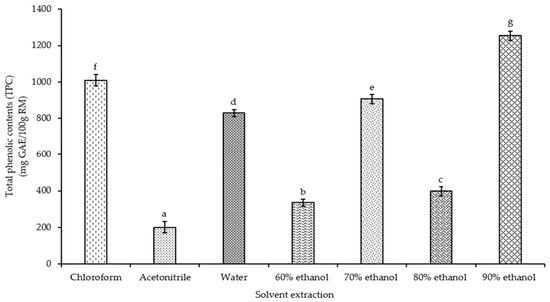
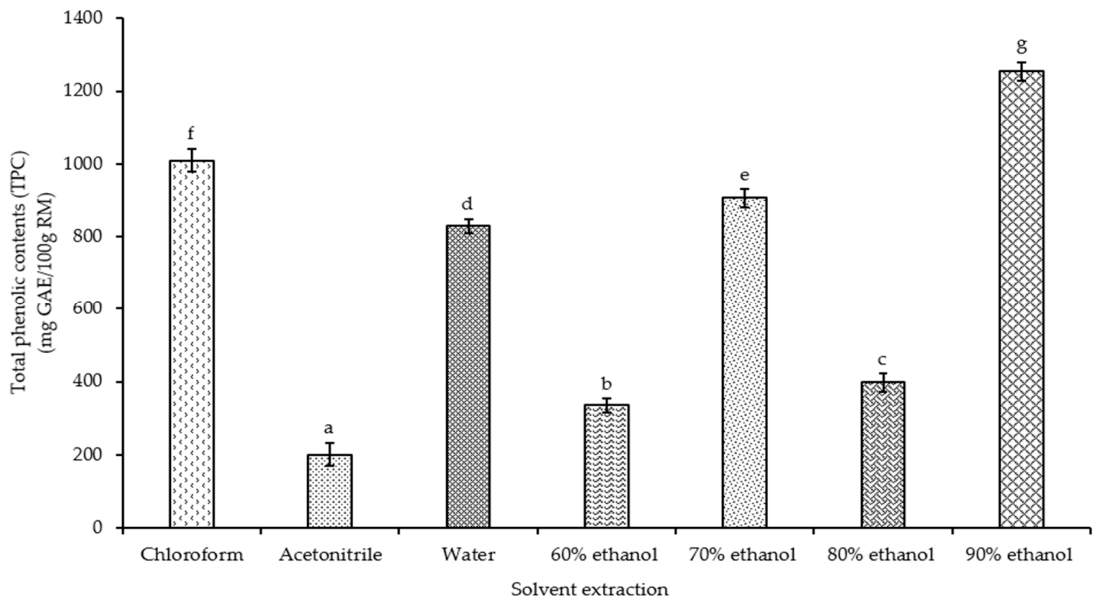
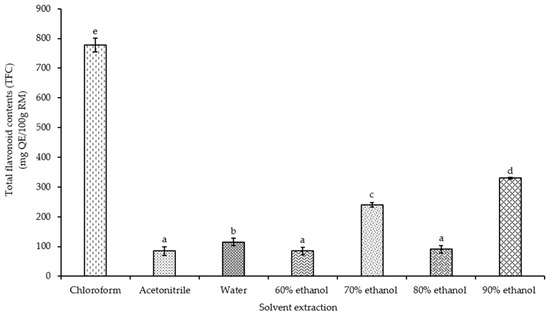
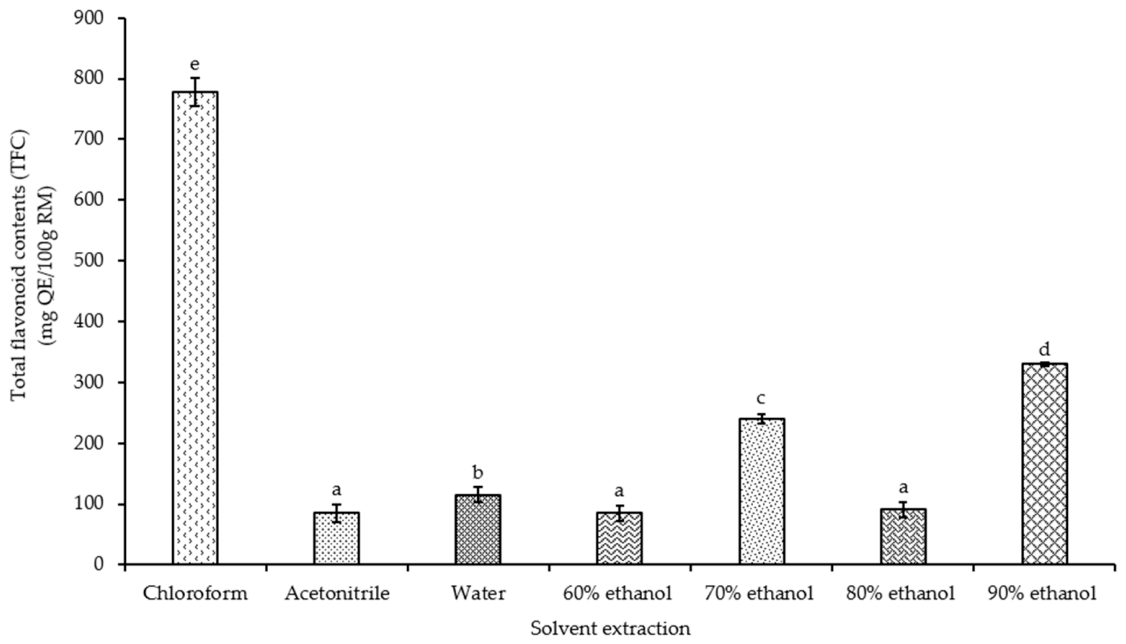
Among the seven different solvents, 90% ethanolic extracts stand out as having the highest TPC, with 1254.40 ± 19.35 mg GAE/100 g RM, followed by chloroform, 70% ethanol, water, 80% ethanol, 60% ethanol, and acetonitrile (Figure 1). Meanwhile, the chloroform extract displayed the highest TFC, with a value of 777.5 ± 22.62 mg QE/100 g extract, followed by the 90% ethanol, 70% ethanol, and water extracts, as shown in Figure 2. There is no significant difference in the TFCs of the acetone, 60% ethanol, and 80% ethanol extracts. Conversely, the acetonitrile extract showed the lowest TPC and TFC compared to other extracts. Phenolics and their constituents have antioxidant effects and free radical scavenging activity, thereby protecting cellular components [15].
Figure 1.
Total phenolic contents of different solvent extracts from Echinocactus grusonii. Data are presented as mean ± standard deviation of three replicates; different superscripts letter indicate significant differences (p < 0.05).
Figure 2.
Total flavonoid contents of different solvent extracts from Echinocactus grusonii. Data are presented as mean ± standard deviation of three replicates; different superscripts letter indicate significant differences (p < 0.05).
3.2. Antioxidant Activity of Echinocactus grusonii Crude Extract
3.2.1. DPPH Assay
Free radicals are often very unstable molecules, although conjugation and resonance can stabilize them. Through a hydrogen atom donation mechanism, compounds with antioxidant activity will react with DPPH free radicals, changing the color of DPPH from purple to yellow [16]. Changes in absorbance can be used to quantitatively assess the decolorization of DPPH, which occurs when it accepts an electron donated by an antioxidant molecule. To assess the antioxidant content of Echinocactus grusonii extracts, the DPPH radical was selected for evaluation based on IC50 values when compared with ascorbic acid as a positive control. The results showed that the antioxidant activity of the 90% ethanol extract is higher than that of the 70% ethanol and water extracts, with IC50 values of 0.43 ± 0.008 mg/mL, 0.62 ± 0.004 mg/mL, and 1.46 ± 0.025 mg/mL, respectively. Meanwhile, ascorbic acid showed an IC50 value of 0.01 ± 0.00 mg/mL (Table 2).
Table 2.
Antioxidant properties on DPPH, ABTS+, and FIC assays of Echinocactus grusonii crude extracts.
3.2.2. FRAP Assay
The FRAP technique is used to measure antioxidant activity to determine the antioxidant capacity of the sample. Ferric ions (Fe3+) are reduced to ferrous ions (Fe2+) by the presence of antioxidant activity, which further determines the reducing power of the Echinocactus grusonii extract. Using an IC50 value comparison with ascorbic acid as a positive control, the concentration of natural antioxidants present in Echinocactus grusonii is determined using a reference standard calibration curve of FeSO4.7H2O to indicate antioxidant capability. The results showed that the 90% ethanol extract was higher than the 70% and water extracts using FRAP, with values of 0.140 ± 0.002 mmol Fe2+/g extract, 0.109 ± 0.004 mmol Fe2+/g extract, and 0.049 ± 0.002 mmol Fe2+/g extract, respectively (Table 3).
Table 3.
Antioxidant properties on FRAP assay of Echinocactus grusonii crude extracts.
3.2.3. ABTS+ Assay
The ABTS+ radical scavenging capability of Echinocactus grusonii crude extract shows antioxidant effectiveness when compared to ascorbic acid (positive control) based on its IC50 value. Stronger scavenging action is indicated by a lower IC50 value, which is negatively correlated with antioxidant potential. Table 2 shows that Echinocactus grusonii crude extract taken from 90% ethanol extract has the best ABTS+ radical scavenging activity compared to the 70% ethanol and water extracts, with IC50 values of 1.14 ± 0.029 mg extract/mL, 1.31 ± 0.039 mg extract/mL, and 1.61 ± 0.031 mg extract/mL.
3.2.4. FIC Assay
The FIC technique was used to evaluate antioxidant capacity using a metal-chelating procedure. Echinocactus grusonii crude extracts may have antioxidant activity. Table 2 shows that the IC50 for the 90% ethanol extract of Echinocactus grusonii, 70% ethanol, and water were 1.323 ± 0.050 mg extract/mL, 1.93 ± 0.032 mg extract/mL, and 3.14 ± 0.032 mg extract/mL. The reaction solution with the lowest IC50 value was characterized as a molecule having antioxidant activity and a strong metal-chelating mechanism. The antioxidant activity of 90% ethanol extract was considerably greater than the 70% ethanol and water extracts, but significantly lower than EDTA at 0.015 ± 0.001 mg/mL.
3.2.5. Phytochemical Profiling of Echinocactus grusonii Extract by HPLC-DAD
The results of the chromatographic investigation of the 90% ethanol crude extract of Echinocactus grusonii’s phenolic profile is shown in Table 3. The results indicate the presence of many phenolic compounds such as gallic, protocatechuic, caffeic, coumaric, ferulic, sinapic, and rosmarinic acids. Coumaric and gallic acids are the main compounds, as revealed by their higher amounts at 952.45 ± 8.82 µg/g and 406.07 ± 54.19 µg/g, respectively. Quantities of each of the remaining compounds are as follows: proto-chuic acid (284.43 ± 7.17 µg/g), ferulic acid (267.17 ± 13.30 µg/g), rosmarinic acid (214.21 ± 21.11 µg/g), caffeic acid (84.74 ± 4.23 µg/g), rutin (242.10 ± 33.07 µg/g), and sinapic acid (64.62 ± 3.84 µg/g) (Table 4).
Table 4.
Phenolic composition quantification of 90% ethanol extract from Echinocactus grusonii by HPLC-DAD.
4. Discussion
The proximate analysis revealed that the sample is an excellent candidate for functional food formulation, characterized by a dominant available carbohydrate content (55.58 ± 0.19%) and low crude fat level (1.96 ± 0.08%). This macromolecular distribution closely mirrors the structural trends observed in Opuntia ficus-indica (nopal) and Echinocactus grusonii, where non-structural polysaccharides serve as the primary energy backbone, and lipids are restricted to minimal structural membrane components [3,16]. Furthermore, the sample’s crude fiber content (11.82 ± 0.03%) aligns with the baseline values of young, tender nopal cladodes (11.00%), avoiding the heavy lignification and palatability challenges that develop as succulent tissues mature [16]. A major nutritional asset of the matrix is its exceptionally high ash content (18.70 ± 0.01%), confirming a dense mineral profile characteristic of desert xerophytes capable of substantial mineral bioaccumulation [3,16]. Conversely, the moderate crude protein value (6.73 ± 0.15%), while typical for Cactaceae, indicates a secondary nutritional role compared to high-protein alternative crops like optimized Wolffia arrhiza, which regularly exceeds 20–30% protein content [11]. Finally, the low moisture content (5.19 ± 0.02%) demonstrates the efficiency of the dehydration process, satisfying critical preservation benchmarks required to inhibit microbial growth, maximize shelf-life, and protect vulnerable bioactive elements within complex plant matrices [11]. Meanwhile, the slightly higher fat content of the Echinocactus grusonii powder may have resulted from physiological changes or variations, such as in precipitation or irrigation, in the climate in which the plants were cultivated. Different soil types and climates may cause variations in the chemical composition of cactus [17]. According to the results, Echinocactus grusonii powder has high ash and crude fiber content, which might lead to its potential use and development as dietary fiber in dietary supplements. Therefore, it could be more beneficial as a fiber and mineral source.
Increased absorbance indicates a higher quantity of polyphenols in the plant extract [18]. In this investigation, the Echinocactus grusonii extract exhibited a significantly high total phenolic content when compared to the results of previous Echinocactus grusonii studies, with a value of 3545.35 mg GAE/100 g RM [3]. This suggests that the total phenolic content increases when a higher percentage of ethanol is used for extraction; De Santiago et al. (2021) [19] also obtained a higher total phenolic content when using a high percentage of ethanol for extraction. Phenolic compounds have been reported to be responsible for most of the antioxidant activities of plant extracts. They support antioxidant potency by inhibiting the breakdown of hydroperoxides into free radical molecules or by inhibiting lipid free radical activity [20]. As shown in Figure 1, the chloroform extract of Echinocactus grusonii exhibited a total flavonoid content, while Sigwela et al. (2021) [21] and Lataief et al. (2021) [22] reported total flavonoid contents of 0.63 ± 0.02 mg catechin (CE)/g and 8.08 ± 0.03 mg CE/g in extracts of a Cactaceae plant, respectively. In this case, it is hard to compare the results of this study with other research because of the different standards used to determine total flavonoid content. However, these results yielded greater values than the cactus cladode extract reported by Ben Saad et al. (2017) [23], who found a total flavonoid content of 71.02 ± 0.757 mg QE/g of extract. These outcomes suggest that the phenolic and flavonoid compounds in Echinocactus grusonii plants are predominantly of intermediate (moderate) polarity. Consequently, extraction efficiency peaked with 90% ethanol and was the lowest when using water. Hence, Echinocactus grusonii could be a rich source of flavonoid content, which contains hydroxyl radicals that can block free radicals and mediate the health advantages of antioxidant activity [24].
In this study, four different assays, DPPH, ABTS+, FIC, and FRAP, were used to assess the antioxidant potency of Echinocactus grusonii extracts. The antioxidant activities of the Echinocactus grusonii extracts were determined by identifying the IC50 parameters of the DPPH, ABTS+, and FIC assays, in which the antioxidant concentration causes 50% inhibition. Extracts exhibiting lower values demonstrate superior antioxidant activity [25]. Meanwhile, the reducing power of the Echinocactus grusonii extract was assessed using the FRAP assay, which was calculated from a standard calibration curve for ferrous sulfate (FeSO4). In this study, the Echinocactus grusonii extract obtained using 90% ethanol displayed the highest antioxidant effects compared to the other extracts (70% and water extracts) in the DPPH, ABTS+, and FIC assays (Table 2). Similarly, the FRAP assay showed that 90% ethanol and chloroform were slightly higher than other solvents in reducing ferric ions to ferrous ions of Echinocactus grusonii extract, as shown in Table 3. Therefore, there was no significant difference among all solvent extracts. On the other hand, these results also reveal much greater antioxidant potency than Chaicharoenaudomrung et al. (2014) [26] reported for using acetonitrile for extraction of Echinocactus grusonii of the same age, with DPPH and ABTS+ assay values of 112.60 ± 1.42 mg/mL and 44.62 ± 2.43 mg/mL, respectively, but a similar outcome for the FRAP assay, with a value of 0.014 ± 0.001 mmol Fe2+/g. On the other hand, Opuntia Stricta extracts obtained using water, reported by Affi et al. (2021) [27], showed lower ferric reducing antioxidant power in both fruit peel and cladode extracts, with values of 1.40 ± 1.31 mg/mL and 1.12 ± 0.05 mg/mL, respectively. The antioxidant activity of the 90% ethanol extracts of Echinocactus grusonii was stronger than that of other varieties. It is obvious that the antioxidant capacity was linked to the bioactive components in the plant extract. This might be because the primary antioxidants in the 90% ethanol extract are high in phenolic compounds and flavonoids, which act as radical scavengers, reducing agents, hydrogen donors, and metal chelators [28]. In contrast, the antioxidant activity of Echinocactus grusonii extracts from 90% ethanol was less than that of the positive control, i.e., ascorbic acid, for the DPPH, ABTS+, FRAP, EDTA, and FIC assays. These results revealed that the 90% ethanol extract was more effective than 70% ethanol and water for total phenolic and flavonoid content extractions as well as antioxidant activity from the Echinocactus grusonii plant selected for future analysis.
Phenolic constituents in Echinocactus grusonii extracts were identified and quantified using HPLC analysis. Calibration plots were created for each standard to determine the concentration of each bioactive chemical in the extracts. In previous studies, an HPLC-DAD chromatogram of Opuntia ficus-indica L. reported by Chbani et al. (2020) [29] found the highest quantity of coumaric and ferulic acid in plants of different geographical origins in Mexico, with values of 2.2 ± 0.04 µg/g and 2.4 ± 0.53 µg/g of extract, respectively. Another study reported by Iftikhar et al. (2023) [30] exhibited a high quantity of phenolic compounds in 100% aqueous extract of cladode, including gallic and caffeic acid of 122.47 ± 2.65 µg/g and 7.15 ± 0.12 µg/g, respectively. Meanwhile, seed extracts of Opuntia ficus-indica L. revealed the presence of phenolic compounds such as gallic, coumaric, ferulic, and sinapic acids, with values of 1.02 µg/g, 0.90 µg/g, 0.198 µg/g, and 0.195 µg/g, respectively [31].
The 90% ethanol extract exhibits a diverse phenolic and flavonoid profile, totaling 2515.82 ± 65.25 µg/g, dominated by coumaric (952.45 ± 8.82 µg/g) and gallic (406.07 ± 54.19 µg/g) acids, which combined constitute over 54% of the quantified bioactive constituents. According to Abdel-Moneim et al. (2017) [32], the synergistic combination of gallic and p-coumaric acid exerts potent neuroprotective effects by suppressing oxidative stress, mitigating neuroinflammation, and balancing apoptotic cellular pathways to attenuate type 2 diabetes-induced neurodegeneration. Furthermore, the extract possesses a substantial concentration of ferulic acid (267.17 ± 13.30 µg/g), a compound explicitly identified by He et al. (2024) [33] as a major regulator of adipocyte differentiation that downregulates master lipogenic signaling pathways like PPARγ and C/EBPα to combat obesity-induced systemic inflammation. The overall therapeutic matrix is further enriched by other dense polyphenols and flavonoids within the extract, such as proto-catechuic, ferulic, rutin, rosmarinic, caffeic, and sinapic acids—which structurally align with the systemic, multi-pathway anti-obesity mechanisms, lipid profile regulations, and oxidative stress management detailed by Boccellino and D’Angelo (2020) [34].
5. Conclusions
In conclusion, the investigated raw material demonstrates a balanced nutritional profile characterized by high carbohydrate and mineral contents alongside moderate fiber levels. Solvent polarity significantly influences the recovery of phytoconstituents and their subsequent biological properties. The results show that 90% ethanol extraction is highly efficient for maximizing the total phenolic content in extracts, whereas a non-polar chloroform system is uniquely optimal for isolating total flavonoids.
These extraction efficiencies directly correlate with distinct antioxidant mechanisms: the 90% ethanol extract exhibited superior free-radical scavenging and reducing capabilities, driven by a dense matrix of individual phenolic acids dominated by coumaric and gallic acids. Conversely, the chloroform extract showed the strongest iron-chelating activity. Overall, these findings highlight the potential of utilizing targeted ethanolic or chloroform extractions to isolate value-added ingredients for functional foods and nutraceutical formulations. The anti-obesity potential of the Echinocactus grusonii extract also requires further research.
Author Contributions
K.C., methodology, formal analysis, data curation; K.P. (Kakanang Posridee), investigation, writing—original draft preparation; K.P. (Kitipong Promyo), writing—review and editing; A.O., software, resources, writing—review and editing; S.P., writing—review and editing; J.S., writing—review and editing; R.O., conceptualization, investigation, validation, writing—review and editing. All authors have read and agreed to the published version of the manuscript.
Funding
This work was supported by (i) Suranaree University of Technology (SUT), (ii) Thailand Science Research and Innovation (TSRI), and (iii) National Science, Research and Innovation Fund (NSRF) Project number 204160.
Institutional Review Board Statement
Not applicable.
Informed Consent Statement
Not applicable.
Data Availability Statement
The original contributions presented in this study are included in the article. Further inquiries can be directed to the corresponding author.
Acknowledgments
The author would like to thank Suranaree University of Technology for providing the facilities for this research.
Conflicts of Interest
The authors declare no conflicts of interest.
References
- Lee, J.C.; Kim, H.R.; Kim, J.; Jang, Y.S. Antioxidant property of an ethanol extract of the stem of Opuntia ficus-indica var. saboten. J. Agric. Food Chem. 2002, 50, 6490–6496. [Google Scholar] [CrossRef] [Scilit] [PubMed]
- Butterweck, V.; Semlin, L.; Feistel, B.; Pischel, I.; Bauer, K.; Verspohl, E.J. Comparative evaluation of two different Opuntia ficus-indica extracts for blood sugar lowering effects in rats. Phytother Res. 2011, 25, 370–375. [Google Scholar] [CrossRef] [Scilit] [PubMed]
- Chaicharoenaudomrung, N.; Posridee, K.; Oonsivilai, A.; Oonsivilai, R. Golden Barrel Cactus: Unveiling Its Potential as a Functional Food and Nutraceutical Source. Foods 2024, 13, 1137. [Google Scholar] [CrossRef] [Scilit] [PubMed]
- Salih, A.M.; Al-Qurainy, F.; Nadeem, M.; Tarroum, M.; Khan, S.; Shaikhaldein, H.O.; Al-Hashimi, A.; Alfagham, A.; Alkahtani, J. Optimization Method for Phenolic Compounds Extraction from Medicinal Plant (Juniperus procera) and Phytochemicals Screening. Molecules 2021, 26, 7454. [Google Scholar] [CrossRef] [Scilit] [PubMed]
- Son, J.Y.; Park, S.Y.; Kim, J.Y.; Won, K.C.; Choi, Y.J.; Zheng, M.S.; Son, J.K.; Kim, Y.W. Orthosiphon stamineus reduces appetite and visceral fat in rats. J. Korean Soc. Appl. Biol. Chem. 2011, 54, 200–205. [Google Scholar] [CrossRef] [Scilit]
- Sorrenti, V.; Burò, I.; Consoli, V.; Vanella, L. Recent Advances in Health Benefits of Bioactive Compounds from Food Wastes and By-Products: Biochemical Aspects. Int. J. Mol. Sci. 2023, 24, 2019. [Google Scholar] [CrossRef] [Scilit] [PubMed]
- Tan, S.P.; Parks, S.E.; Stathopoulos, C.E.; Roach, P.D. Extraction of flavonoids from bitter melon. Food Sci. Nutr. 2014, 5, 458–465. [Google Scholar] [CrossRef]
- AOAC International. Official Methods of Analysis of AOAC International, 22nd ed.; Online edition; AOAC International: Rockville, MD, USA, 2025. [Google Scholar]
- Oonsivilai, R.; Chaijareonudomroung, N.; Huantanom, Y.; Oonsivilai, A. Extraction condition of Echinocactus grusonii. World Acad. Sci. Eng. Technol. 2010, 70, 366–369. [Google Scholar]
- Posridee, K.; Oonsivilai, R.; Tira-aumphon, A.; Singthong, J.; Oonmetta-aree, J.; Oonsivilai, A. Optimum aquaculture and drying conditions for Wolffia arrhiza (L.) Wimn. Heliyon 2023, 9, e19730. [Google Scholar] [CrossRef] [Scilit] [PubMed]
- Lin, J.; Tang, C. Determination of Total Phenolic and Flavonoid Contents in Selected Fruits and Vegetables, as Well as Their Stimulatory Effects on Mouse Splenocyte Proliferation. Food Chem. 2007, 101, 140–147. [Google Scholar] [CrossRef] [Scilit]
- Kandasamy, A.; Aruchamy, K.; Praveena, R.; Varadhaiyan, D. Phytochemical Analysis and Antioxidant Activity of Centella Asiatica Extracts: An Experimental and Theoretical Investigation of Flavonoids. Plants 2023, 12, 3547. [Google Scholar] [CrossRef] [Scilit] [PubMed]
- Rohmah, J. Anti Oxidant Activities Using Dpph, Fic, Frap, And Abts Methods From Ethanolic Extract Of Lempuyang Gajah Rhizome (Zingiber zerumbet (L.) Roscoeex Sm.). J. Chem. Res. 2022, 7, 2. [Google Scholar] [CrossRef] [Scilit]
- Oonsivilai, R.; Cheng, C.; Bomser, J.; Ferruzzi, M.G.; Ningsanond, S. Phytochemical profiling and phase II enzyme-inducing properties of Thunbergia laurifolia Lindl. (RC) extracts. J. Ethnopharmacol. 2007, 114, 300–306. [Google Scholar] [CrossRef] [Scilit] [PubMed]
- Riza, A.; IIyas, S.; Sjamsudin, E.; Delyuzar, D. Effect of Extraction Method and Solvent Type on Total Phenolics Content, Total Flavonoid and Antioxidant Activity of Pegagan Extract (Centella asiatica (Linn.) Urban). Biosci. Med. 2024, 8, 3873–3881. [Google Scholar] [CrossRef] [Scilit]
- Hernández-Urbiola, M.; Contreras-Padilla, M.; Pérez-Torrero, E.; Hernández-Quevedo, G.; Rojas-Molina, J.I.; Cortes, M.E.; Rodríguez-García, M.E. Study of nutritional composition of nopal (Opuntia ficus indica cv. Redonda) at different maturity stages. Open Nutr. J. 2010, 4, 11–16. [Google Scholar] [CrossRef] [Scilit]
- Stintzing, F.C.; Carle, R. Cactus stems (Opuntia spp.): A review on their chemistry, technology, and uses. Mol. Nutr. Food Res. 2005, 49, 175–194. [Google Scholar] [CrossRef] [Scilit] [PubMed]
- Schofield, P.; Mbugua, D.M.; Pell, A.N. Analysis of condensed tannins: A review. Anim. Feed Sci. Technol. 2001, 91, 21–40. [Google Scholar] [CrossRef] [Scilit]
- De Santiago, E.; Juániz, I.; Cid, C.; Peña, M.-P.D. Extraction of (Poly)phenolic Compounds of Cactus (Opuntia ficus-indica (L.) Mill.) Cladodes. Food Anal. Methods 2021, 14, 1167–1175. [Google Scholar] [CrossRef] [Scilit]
- Thurnham, D. Antioxidants in Food: Practical Applications; Pokorny, J., Yanishlieva, N., Gordon, M., Eds.; Woodhead Publishing: Cambridge, UK, 2001; Volume 87. [Google Scholar] [CrossRef]
- Sigwela, V.; De Wit, M.; du Toit, A.; Osthoff, G.; Hugo, A. Bioactive Betalain Extracts from Cactus Pear Fruit Pulp, Beetroot Tubers, and Amaranth Leaves. Molecules 2021, 26, 5012. [Google Scholar] [CrossRef] [Scilit] [PubMed]
- Ben Lataief, S.; Zourgui, M.N.; Rahmani, R.; Najjaa, H.; Gharsallah, N.; Zourgui, L. Chemical composition, antioxidant, antimicrobial and cytotoxic activities of bioactive compounds extracted from Opuntia dillenii cladodes. J. Food Meas. Charact. 2021, 15, 782–794. [Google Scholar] [CrossRef] [Scilit]
- Ben Saad, A.; Dalel, B.; Rjeibi, I.; Smida, A.; Ncib, S.; Zouari, N.; Zourgui, L. Phytochemical, antioxidant and protective effect of cactus cladodes extract against lithium-induced liver injury in rats. Pharm. Biol. 2017, 55, 516–525. [Google Scholar] [CrossRef] [Scilit] [PubMed]
- Chang, C.; Yang, M.-H.; Wen, H.-M.; Chern, J.-C. Estimation of total flavonoid content in propolis by two complementary colometric methods. J. Food Drug Anal. 2002, 10, 178–182. [Google Scholar] [CrossRef] [Scilit]
- Akullo, J.; Kiang-Mokua, B.N.; Nakimbugwe, D.; Ng’ang’a, J. Phytochemical profile and antioxidant activity of various solvent extracts of two varieties of ginger and garlic. Heliyon 2023, 9, e18806. [Google Scholar] [CrossRef] [Scilit] [PubMed]
- Chaicharoenaudomrung, N.; Oonsivilai, A.; Oonsivilai, R. Chlorophylls Contents in Echinocactus grusonii Extract. Adv. Mater. Res. 2014, 931–932, 1507–1511. [Google Scholar] [CrossRef] [Scilit]
- Affi, W.; Zourgui, M.N.; Lataief, S.B.; Agil, A.; Zourgui, L. Comparative Study of Phenolic Compound Antioxidant and Antimicrobial Activities of Fruits Peel and Cladodes from Tunisian Opuntia stricta. J. Altern. Complement. Integr. Med. 2021, 7, 201. [Google Scholar] [CrossRef] [Scilit] [PubMed]
- Dai, J.; Mumper, R.J. Plant phenolics: Extraction, analysis and their antioxidant and anticancer properties. Molecules 2010, 15, 7313–7352. [Google Scholar] [CrossRef] [Scilit] [PubMed]
- Chbani, M.; Matthäus, B.; Charrouf, Z.; El Monfalouti, H.; Kartah, B.; Gharby, S.; Willenberg, I. Characterization of Phenolic Compounds Extracted from Cold Pressed Cactus (Opuntia ficus-indica L.) Seed Oil and the Effect of Roasting on Their Composition. Foods 2020, 9, 1098. [Google Scholar] [CrossRef] [Scilit] [PubMed]
- Iftikhar, K.; Siddique, F.; Ameer, K.; Arshad, M.; Kharal, S.; Mohamed Ahmed, I.A.; Yasmin, Z.; Aziz, N. Phytochemical profiling, antimicrobial, and antioxidant activities of hydroethanolic extracts of prickly pear (Opuntia ficus indica) fruit and pulp. Food Sci. Nutr. 2023, 11, 1916–1930. [Google Scholar] [CrossRef] [Scilit] [PubMed]
- Bouaouich, A.; Bouguerche, F.; Mahiaoui, H.; Peron, G.; Bendif, H. Phytochemical Elucidation and Antioxidant Activity of Seeds from Three Prickly Pear (Opuntia ficus-indica L.) Cultivars from Algeria. Appl. Sci. 2023, 13, 1444. [Google Scholar] [CrossRef] [Scilit]
- Abdel-Moneim, A.; Yousef, A.I.; El-Twab, S.M.A.; Reheim, E.S.A.; Ashour, A.B. Gallic acid and p-coumaric acid attenuate type 2 diabetes-induced neurodegeneration in rats. Metab. Brain Dis. 2017, 32, 1279–1286. [Google Scholar] [CrossRef] [Scilit] [PubMed]
- He, L.; Su, Z.; Wang, S. The anti-obesity effects of polyphenols: A comprehensive review of molecular mechanisms and signal pathways in regulating adipocytes. Front. Nutr. 2024, 11, 393575. [Google Scholar] [CrossRef] [Scilit] [PubMed]
- Boccellino, M.; D’Angelo, S. Anti-Obesity Effects of Polyphenol Intake: Current Status and Future Possibilities. Int. J. Mol. Sci. 2020, 21, 5642. [Google Scholar] [CrossRef] [Scilit] [PubMed]

Disclaimer/Publisher’s Note: The statements, opinions and data contained in all publications are solely those of the individual author(s) and contributor(s) and not of MDPI and/or the editor(s). MDPI and/or the editor(s) disclaim responsibility for any injury to people or property resulting from any ideas, methods, instructions or products referred to in the content. |
© 2026 by the authors. Licensee MDPI, Basel, Switzerland. This article is an open access article distributed under the terms and conditions of the Creative Commons Attribution (CC BY) license.