


Abstract
(1) Background: Chronic endometritis (CE) is a chronic disease of the endometrium characterized by inflammatory infiltration into the endometrial stroma. The diagnosis of CE is complex. Clinical examination and transvaginal ultrasound are not specific for CE. Biopsy is an indispensable tool. Two specific populations can be analyzed at the endometrial level: CD138 positive plasma cells and CD56 positive Natural Killer cells. (2) Methods: Our narrative review was based on an online search with a focus on the last ten years of literature in the English language. (3) Results: Twenty studies on CD138 positive plasma cells and 16 articles on CD56 positive Natural Killer cells highlighted the correlations of CE with diagnostic possibilities and reproductive outcomes. (4) Conclusions: The etiological pathway and management of CE require further scientific studies and investigations. Hysteroscopy is the diagnostic gold standard, but other blind biopsy techniques (i.e., Perma, Pipelle, Novak, etc.) and molecular procedures may help in the diagnosis of chronic endometritis.
1. Introduction
Infertility is defined as the inability to conceive after unprotected sexual intercourse. Guidelines recommend initiating a diagnostic workup after 12 months of unsuccessful conception in women under 35 years of age and after 6 months in women over 35 years of age. However, in women over 40 years of age, a more immediate evaluation may be considered [1].
The extent of investigations depends on multiple factors, including the patient’s age, personal and reproductive history, duration of infertility, and the couple’s preferences.
It is estimated that in 40% of infertile couples, the woman is the sole or contributing cause of infertility; in another 40% of cases, infertility is attributable to the male partner, and in the remaining 20% of cases, there are no identifiable causes.
Transvaginal ultrasound is a fundamental first-line tool for evaluating uterine and adnexal pathologies and for studying ovarian reserve. It allows for the analysis of the number and size of ovarian follicles, especially when performed during the luteal phase [2]. Uterine pathologies account for approximately 16% of the causes of female infertility. They include both more common acquired conditions, such as endometrial polyps, uterine fibroids, and adhesions, as well as congenital pathologies, including bicornuate uterus, septate uterus, or other congenital uterine anomalies [3].
Hysteroscopy, on the other hand, represents a diagnostic but also therapeutic method for intrauterine pathologies [4].
The balance between reproductive difficulties and achieving a pregnancy is very delicate. Another potential cause of recurrent miscarriages or implantation failure is genital infection, connecting intestinal dysbiosis and endometritis. Several microorganisms, including Ureaplasma, Mycoplasma, and Chlamydia [5,6], that cause bacterial vaginosis, also appear to be implicated in first- and second-trimester miscarriages [7].
More recently, increasing attention has been paid to the role of the immune system in reproductive function, particularly the altered inflammatory and immune status of the endometrium, which can lead to unexplained infertility and recurrent miscarriages: this condition is called chronic endometritis (CE).
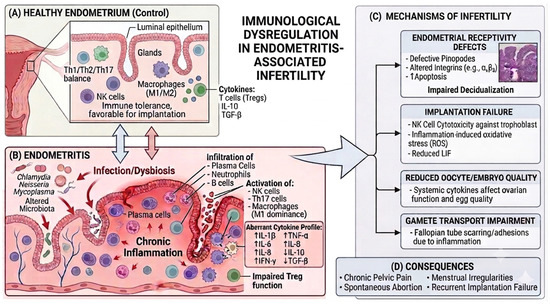
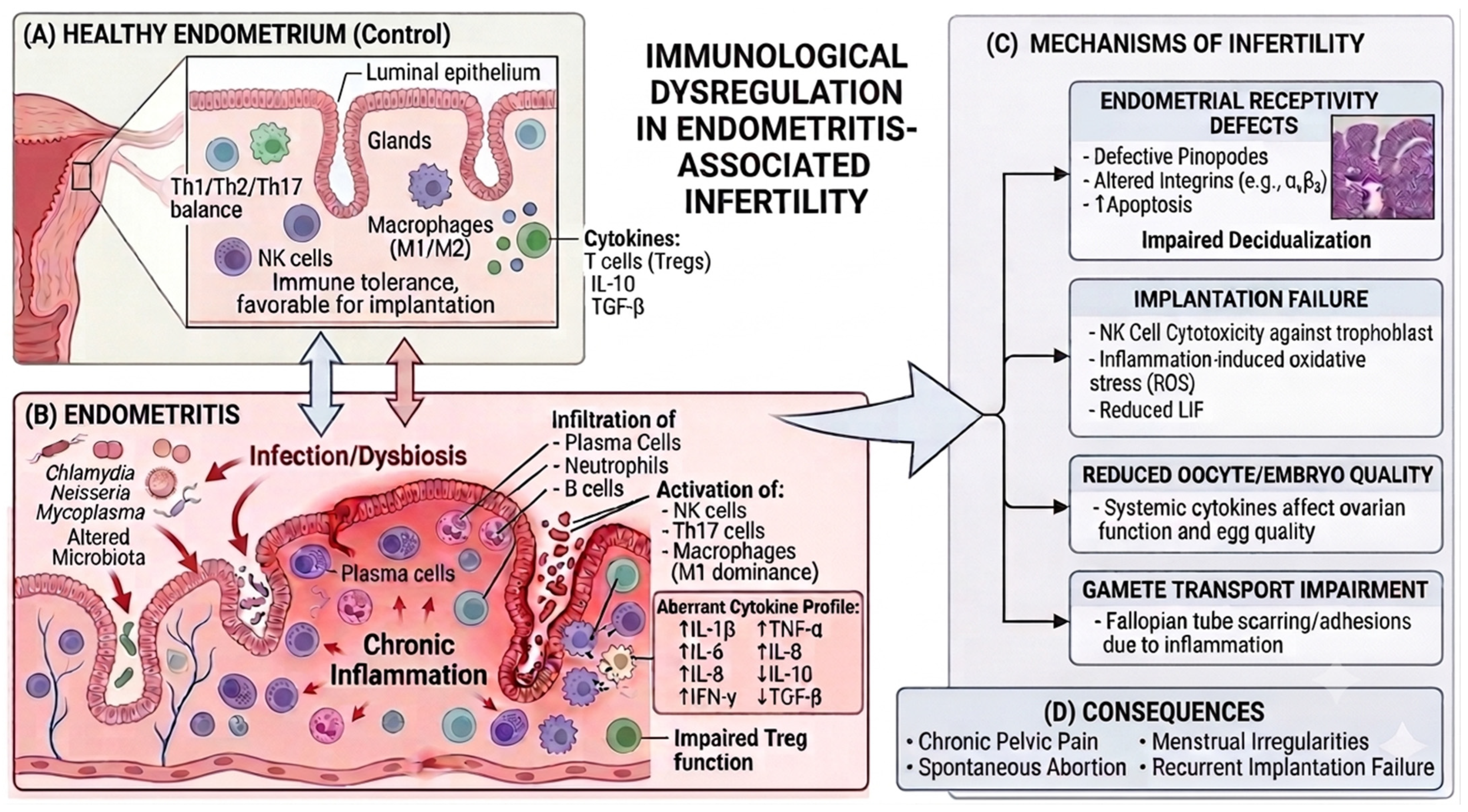
Chronic endometritis is a chronic inflammatory disease of the endometrium characterized by plasma cell infiltration into the endometrial stroma (Figure 1). The diagnosis of CE is complex. Clinical examination and transvaginal ultrasound are not specific for CE; endometrial biopsy is fundamental. Several diagnostic methods have been suggested for the diagnosis of chronic endometritis, the most widely used of which is hysteroscopy, allowing the identification of the classic signs of endometritis:
Figure 1.
Impaired immunological function, endometritis and infertility.
- -
- Focal or diffuse hyperaemia (the “strawberry” appearance);
- -
- Stromal edema;
- -
- Micro-polyps (small growths < 1 mm, a highly predictive sign of endometritis).
Moreover, the endometrial biopsy is fundamental for studying these diagnostic populations: CD138 plasma cells and CD56 Natural Killer cells.
Immunohistochemistry for the plasma cell marker CD-138 at the endometrial histological level is currently the most reliable and rapid diagnostic method for CE. However, this technique has several limitations [8,9].
Endometrial epithelial cells can express CD-138 on the basolateral side of their plasma membrane, potentially leading to misdiagnosis. Therefore, additional specific staining techniques for CE would be useful. CE may represent a substrate for the development of proliferative endometrial lesions, including endometrial polyps [8]. Furthermore, CE may impair endometrial receptivity to the embryo, resulting in infertility and recurrent miscarriages. Unfortunately, the exact mechanisms underlying chronic endometritis-related infertility are still unknown, potentially involving other cells, such as Natural Killer (NK) CD56+ [8,9]. The risk of CE may also be significantly related to the presence of endometrial polyps: it appears more likely in women with polypoid endometrium, as well as in those with three or more endometrial formations compared to those with a single one [8,9]. Available evidence in premenopausal women suggests that this condition may represent two consecutive phases of a common pathological process, which requires further study to fully clarify its role in infertility [8,9].
In most cases, patients are asymptomatic or present with nonspecific symptoms such as pelvic pain, dyspareunia, leukorrhea, and dysmenorrhea [8].
Chronic endometritis compromises the uterine environment by altering cytokine production, reducing the expression of implantation-related genes, and promoting stromal fibrosis [9].
Our aim is to summarize the updated literature known so far about the topic to deepen our understanding of the diagnostic criteria and management in infertility.
2. Materials and Methods
Our study aims to conduct a narrative review of the literature on CD138+ plasma cells and CD56+ NK cells, focusing on endometritis and reproductive outcomes such as abortion/pregnancy rate/recurrent implantation failure, etc., using searches from PubMed, Scholar, Embase, Scopus, etc.
The identification of the articles in the English language was based on the keywords:
- (“Infertility” [MeSH Terms]) AND (“CD138” [Title/Abstract] OR “syndecan-1” [Title/Abstract] OR “plasma cells” [MeSH Terms]),
- (“Infertility” [MeSH Terms]) AND (“Natural Killer Cells” [MeSH Terms] OR “NK cells” [Title/Abstract]).
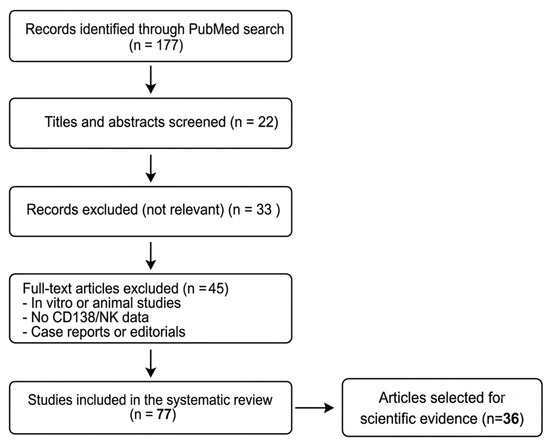
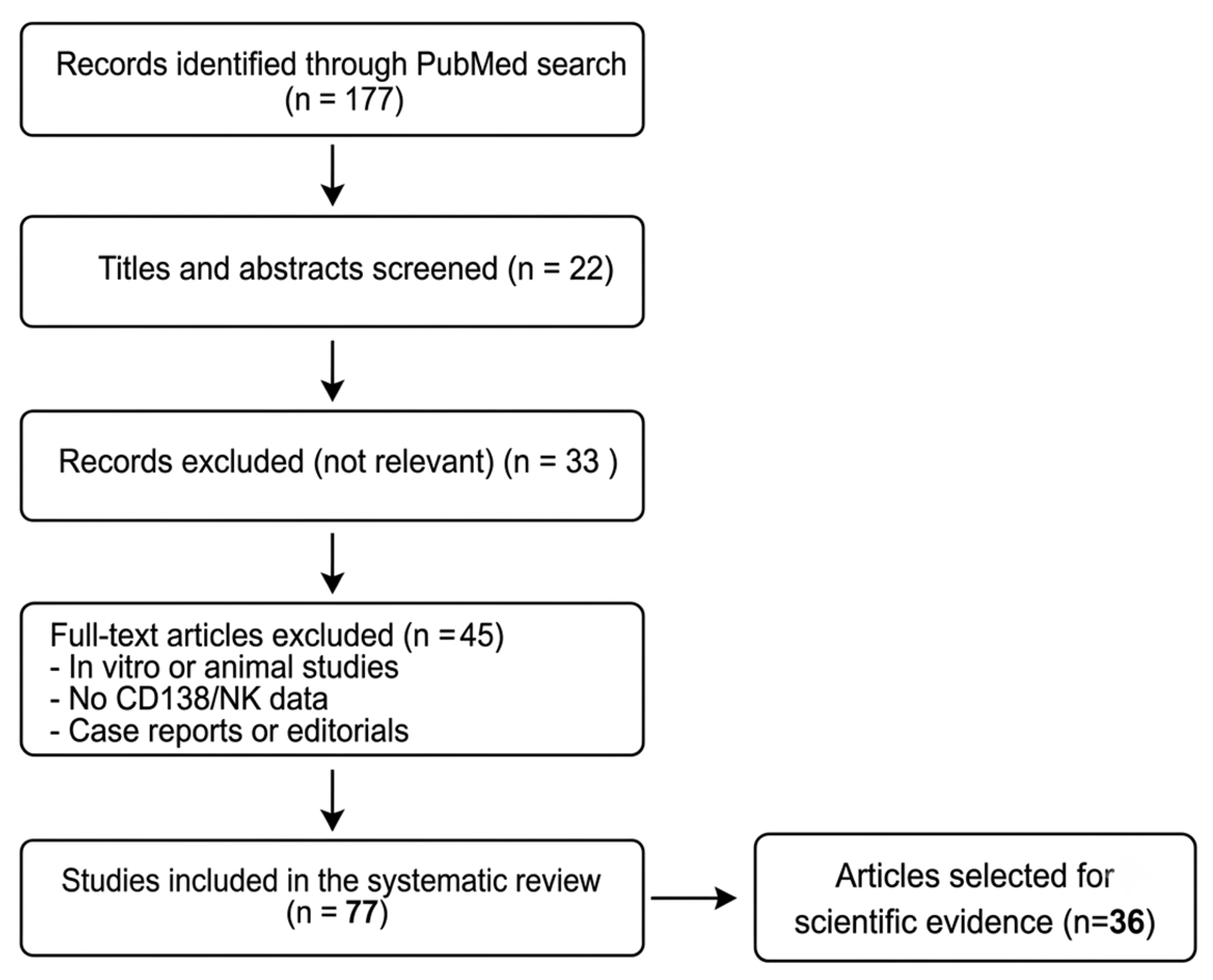
Literature from the last 10 years (2016–2026) was then filtered, according to the scientific research evidence (based on strength of evidence, sample size, quality of studies, etc.). Our narrative review is written following the Equator Guidelines [10] (Figure 2).
Figure 2.
Flow-chart of the literature evaluation.
Inclusion and Exclusion Criteria
-Inclusion Criteria:
- Observational studies (cohort, case–control, cross-sectional) and clinical trials (randomized or otherwise) evaluating the role of CD138+ plasma cells and/or NK cells in patients with infertility.
- Studies that included an assessment of CD138+ (by immunohistochemistry) or CD56+ NK cells (using flow cytometry, immunohistochemistry, or endometrial biopsy).
- Comparative studies with fertile control groups or pre-/post-treatment designs.
-Exclusion Criteria:
- Preclinical studies using animal models or in vitro cell lines.
- Abstracts without full text available.
- Case reports, editorials, letters to the editor, and narrative reviews.
- Studies not directly related to infertility (e.g., oncology).
Gemini AI 3.5 Flash was used to create Figure 1 (Branch • CD56, CD138 and implantation failure—Google Gemini https://gemini.google.com/app/b2888b43343800b0?hl=it), accessed online on 29 May 2026.
3. Results
The initial identification of 77 articles was based on the keywords and scientific evidence; 36 articles in the English language were then filtered according to the last 10 years of production for table description.
3.1. Plasma Cells CD138 (Table 1)
CD138+ plasma cells (Syndecan-1) are the main diagnostic marker of chronic endometritis. Although immunohistochemical detection of CD138+ plasma cells is now globally accepted as the best marker for diagnosing CE, there is no consensus on the cut-off that is considered statistically significant. This variability may be due to the different methods used to quantify CD138+ cells. The most common approach is to count CD138+ cells per high-power field (HPF). The study by Chen et al. recommends a cutoff of >5 CD138+ cells/HPF [11]. Bouet et al. [12] proposed a minimum of five plasma cells in 10 non-overlapping HPFs as the diagnostic threshold for chronic endometritis; Kitaya et al. [13] instead suggested a cutoff of >5 cells in 20 non-overlapping HPFs.
These above-mentioned studies, however, do not definitively correlate the number of CD138+ cells with adverse reproductive outcomes.
The optimal diagnostic window is also still unclear regarding the optimal timing for endometrial sampling, and results are controversial. Furthermore, Li et al.’s research [9] evaluated 716 women highlighting that a number of CD138+ cells ≥ 5 in at least one of 30 HPFs was statistically significantly associated with adverse pregnancy outcomes. In this study, endometrial biopsies were performed during the proliferative phase, highlighting how the result may vary depending on the phase of the menstrual cycle in which the sampling was performed [9].
Previous studies have suggested the follicular phase as the best time to perform biopsy, as the luteal phase may show inflammatory infiltration, leading to false positives [14].
Selmi et al.’s study on 249 patients found no statistically significant differences in the detection of CE between the proliferative and secretory phases in patients with RIF (recurrent implantation failure) and RPL (recurrent pregnancy loss), suggesting that this is a persistent rather than cyclical condition [15].
A prospective study from 2021 [16] observed that the mean CD138+ score (calculated as the number of CD138/HPF cells) was significantly altered in women with full-term pregnancies compared to those with infertility and recurrent miscarriages. Women with >16 CD138/HPF had a significantly higher risk of miscarriage.
The rate of chronic endometritis in infertile women undergoing in vitro fertilization (IVF) reaches 30–40%, decreasing to approximately 10% after antibiotic and probiotic therapy [16].
Table 1.
Literature review about plasma cells CD138+ and infertility.
3.2. Natural Killer CD56+
Natural Killer (NK) cells are potentially linked to reproduction in a significant way [35]. The literature provides varied data regarding the connection between Natural Killer cells, endometritis, and infertility (Table 2) [36,37,38,39,40,41,42,43,44,45,46,47,48,49,50].
Uterine NK cells represent the major leukocyte population in the normal endometrium and also play a fundamental role in angiogenesis and trophoblast invasion [51]. Their presence varies physiologically during the different phases of the menstrual cycle, likely due to the recruitment of NK cells from peripheral blood or their proliferation in the uterus. They represent 40% of total leukocytes during the proliferative phase and increase to 60% during the secretory phase [52].
There are two subgroups of CD56+ NK cells, depending on the density of CD56 on the cell surface, which can be distinguished into CD56bright (high expression) and CD56dim (low expression) cells. CD56bright cells are primarily immunomodulatory and cytokine-producing, while CD56dim cells are highly cytotoxic and represent the mature and predominant phase in peripheral blood [53].
In peripheral blood, 90% of NK cells are CD56+/CD16+ and CD56−/CD16+ cells. CD56+/CD16− cells constitute 70–90% of lymphocytes present in the secretory phase of the endometrium and are less cytotoxic [54,55]. Both peripheral blood NK cells (pNKs) and uterine NK cells (uNKs) display CD56 on their surface but differ in both phenotype and function. A total of 90% of pNK cells are CD56dim/CD16+, while 80% of uNK cells are CD56bright/CD16+.
Several studies have attempted to correlate pNK levels with recurrent miscarriages, but the literature to date has yielded conflicting results (Table 2).
The study by Azargoon et al. observed a significantly higher mean percentage of CD56+ cells in infertile women compared to fertile women (p-value 0.007). However, no significant differences were found in the total number of CD56+ cells between women with recurrent miscarriages and the control group [56].
The study by Fukui et al. showed, using immunophenotypic analysis, a higher percentage of CD16+/CD56dim cells and a lower percentage of CD16−/CD56bright cells in women with infertility who miscarried following in vitro fertilization, compared to women who carried their pregnancies to term [57].
Lachapelle et al. also observed a prevalence of CD16+/CD56dim cells and a reduction in CD16−/CD56bright cells in women with recurrent miscarriages compared to controls [58].
The study by Junovich et al. found an increase in the number of CD16+ endometrial NK cells in patients with unexplained infertility, correlated with a reduction in IL-6 and VEGF levels in the endometrium [59].
It can therefore be hypothesized that an increase in CD16+ NK cells may create an unfavourable environment for implantation, likely by producing pro-inflammatory cytokines and secreting cytotoxic factors in response to trophoblast cells [59].
Repeated implantation failure is typically defined as three failed Intra-Cytoplasmic Sperm Injection (ICSI) cycles, although this definition varies, and the literature often uses a number of failed cycles of ≥2. The IVF success rate is 40.1% in women under 35 years of age, while it is 20.6% in women over 40 years of age. Pregnancy failure is due to implantation failure in more than 50–75% of cases [60].
During the implantation window, the number of endometrial NK cells increases significantly, from 30% in the proliferative phase to 70% in the secretory phase [39]. The increase in NK cells is likely involved in preparing the endometrium for embryo implantation, angiogenesis, trophoblast invasion, decidualization, and immunological tolerance through the production of various cytokines [61].
Several studies have investigated the impact of NK cells on the success or failure of IVF procedures (Table 2).
Interestingly, some research has observed a paradoxical association between normal uNK cell counts and poor reproductive outcomes, leading to functional hypotheses of exhaustion or inappropriate receptor–ligand interactions. Killer Cell Immunoglobulin-like Receptors (KIRs) and their interactions with HLA-C ligands on trophoblasts could potentially determine the immunological “compatibility” between mother and embryo, influencing implantation success [30,52,62].
The study by Mardanian et al. demonstrated a significantly higher level of CD56dimCD16+ cells in peripheral blood in the IVF-failure group compared to the IVF-successful group (p < 0.0001), while the level of CD56brightCD16− cells did not show statistically significant differences (p = 0.28) [63].
Other data have found a higher percentage of CD56dim NK cells in the peripheral blood of women with repeated implantation failure compared to fertile controls, such as the study by Sacks et al. (p < 0.001) [64].
The relationship between NK cells in the peripheral blood and implantation failure remains highly controversial. It is believed that increased NK cell activity may be involved in the immune response of “fetal rejection” by preventing invasion of the trophoblast in the endometrium [65].
However, updated studies evaluating the presence and impact of endometrial NK cells on infertility are few or with a small sample size and are not always conclusive.
Chen et al. [66] showed a significantly higher percentage of CD56+ cells in the endometrium in cases of repeated implantation failure (p-value < 0.001). A more in-depth investigation of the NK cell population showed a significantly higher percentage of both CD56+CD16+ and CD56+CD16− cells in women with repeated implantation failure compared to the control group.
In the retrospective study by Ekemen et al. [36], endometrial samples were collected during the secretory phase of the cycle. In 74.3% of cases with two or more IVF failures, elevated CD56+ cells were found in patients. These patients were then treated with cortisone and intralipid therapy. In 85.5% of cases, a successful pregnancy was achieved following treatment.
Functional profiling of uNK cells at the transcriptomic level reveals a dual phenotype. While CD56bright uNK cells express angiogenic factors, aberrant populations exhibit increased transcripts for cytotoxic mediators. Research using single-cell RNA sequencing has identified uNK subpopulations with divergent roles, supporting implantation or mediating immune rejection. At the proteomic level, excessive activation correlates with the secretion of granzyme B, perforin, and IFN-γ, which can disrupt trophoblast invasion and endometrial vascular remodelling [30,57]. CD56bright CD16− endometrial NK cells are present in large numbers at the implantation site where they come into contact with trophoblast cells, and transcriptomic studies suggest that this cell phenotype expresses proangiogenic factors [53,67].
The mechanism by which trophoblast cells escape endometrial NK cells is unclear. It is hypothesized that increased NK cell activity may lead to trophoblast cell suppression and thus miscarriage [68].
A new area of interest is the interaction between CD138+ plasma cells and endometrial NK cells. Some studies, such as that of Kitaya et al. in 2018, suggest that chronic inflammation and an altered innate immune response may together create a uterine environment unfavourable to implantation [69].
Preliminary studies suggest altered levels of metabolites involved in oxidative stress, which could alter immune tolerance and local cytokine production. These alterations could modulate the cytotoxic threshold of NK cells and plasma cell survival, compromising embryo implantation [70].
CD138+ plasma cells and NK cells have shown a particularly important role in IVF, where the lack of endogenous immunomodulation by the corpus luteum could increase susceptibility to immune dysfunction. This is a possible explanation why antibiotic therapy for chronic endometritis and/or corticosteroid and intralipid therapy in cases of high numbers of cytotoxic NK cells in the peripheral blood are associated with increased implantation success [67].
Table 2.
Literature review about Natural Killer CD56+ and infertility.
3.3. Endometrial Sampling Methods
Regarding different diagnostic methods, hysteroscopy is still the gold standard, but the 2025 study by Falahy et al. showed no statistically significant differences between hysteroscopic curettage and the Pipelle probe sampling [71].
An innovative and less invasive diagnostic tool still under investigation is the aspiration of uterine fluid (“endometrial lavage”) as a method to assess the immune status of the endometrium through the search for immune markers. Some preliminary studies suggest that soluble forms of CD138 and NK cell-associated cytokines (e.g., IL-15, IFN-γ) can be quantified in endometrial secretions and may correlate with endometrial tissue findings [72].
These blind techniques would facilitate repeated monitoring of the immune profile over time and in response to potential treatment [30,72].
3.4. Treatment
The treatment of chronic endometritis is predominantly antibiotic, given the primarily bacterial etiology of the disease. In recent years, several studies have shown that adequate treatment of chronic endometritis is associated with significant improvements in in vitro fertilization outcomes [51,67].
Currently, antibiotic therapy represents the gold standard for the treatment of this condition, often combined with the use of prednisone [73] or, in more experimental settings, supported by immunoglobulin treatment [74].
The study by Cicinelli et al. [51] compared the pregnancy rate and live birth rate between patients undergoing antibiotic treatment with subsequent histological confirmation of disease resolution and patients with persistent endometritis after treatment. The results showed a significantly higher live birth rate in group 1 compared to group 2 (61% vs. 13%, p-value 0.02).
Similarly, Cheng et al. [75], through a systematic review and meta-analysis, evaluated the impact of antibiotic therapy on IVF outcomes. The results showed a statistically significant increase in several outcomes, such as implantation rate, ongoing pregnancy rate, and live birth rate in patients with successfully treated chronic endometritis, compared to both patients with persistent CE and those without an initial diagnosis of chronic endometritis. This benefit was demonstrated exclusively in cases where histological confirmation of endometritis resolution was present.
Similar results were also reported in the meta-analysis by Vitagliano et al. [67], which highlighted a significant increase in clinically confirmed pregnancy and live birth rates in patients with histologically confirmed resolved chronic endometritis compared to patients with persistent endometritis after treatment. Conversely, no statistically significant differences were found between patients who did not receive antibiotic treatment and those who did, but without histological confirmation of treatment success.
Several studies have also investigated the role of corticosteroid therapy, given the importance of immunological factors in embryo implantation processes due to the involvement of uterine NK cells in regulating embryo implantation [76].
The 2022 [77] study by Giulini et al., conducted on patients with repeated implantation failure, evaluated the impact of combined therapy with prednisone (10 mg/day) and doxycycline (100 mg twice daily for 14 days) in patients with endometrial biopsies positive for CD138 plasma cells and CD56 cells vs. corticosteroid therapy alone in cases positive exclusively for CD56. The results showed improved reproductive outcomes, with a live birth rate of 22.2% after treatment. Specifically, treatment with prednisone was more effective in patients with severe endometritis (CD56 > 10%), with a live birth rate of 29.4%, compared to patients with mild forms of endometritis, where the therapy was less effective (live birth rate of 10%). The 2018 study by Lédée et al. [78], conducted on 55 patients with RIF, showed a reduction in CD56+ cell expression in approximately half of the patients after treatment with prednisone.
Cooper et al. (2019) observed a significant reduction in uterine NK cell concentration following prednisone therapy, but did not demonstrate a statistically significant difference in pregnancy outcomes [79].
More recently, the study by Zou et al. [80] reported a significant increase in key reproductive outcomes, such as implantation rate, clinically confirmed pregnancy rate with heartbeat, and ongoing pregnancy rate, in the group treated with the combination of doxycycline and prednisone compared to the group treated with doxycycline alone. Furthermore, treatment with doxycycline alone also showed a significant improvement in reproductive outcomes compared to no treatment, confirming the role of antibiotic treatment.
An emerging area of interest concerns the intrauterine therapeutic approach.
A 2023 [81] study compared pregnancy outcomes between patients treated with oral antibiotic therapy (doxycycline and metronidazole) combined with intrauterine perfusion with gentamicin and dexamethasone and patients treated with oral therapy alone. Comparing the group receiving oral therapy alone with the cohort receiving the combined treatment, significantly higher rates of clinically proven pregnancy (30% vs. 50%, p < 0.001), ongoing pregnancy (33.33% vs. 45.45%, p < 0.0001), and live births (33.33% vs. 45.45%, p < 0.0001) were reported. A statistically significant decrease in the rate of early spontaneous abortions was also observed (6.667% vs. 4.545%, p = 0.0068).
The work by Zhang [82] et al. evaluated the efficacy of intrauterine infusion of a targeted antibiotic against the identified microorganism in combination with dexamethasone 5 mg. Patients in whom treatment resulted in resolution of chronic endometritis showed a significantly higher rate of implantation and clinically confirmed pregnancy, both compared to patients with RIF without evidence of chronic endometritis and those with persistent chronic endometritis [82]. Finally, restorative medicine could have a role. Mesenchymal stem cells introduced into the uterus may actively repair damaged endometrial tissue. Regenerative therapies utilize immunomodulation to calm persistent uterine inflammation and tissue damage. Transplanted stem cells secrete critical growth factors to trigger natural cellular healing processes. These cellular approaches stimulate angiogenesis, forming new blood vessels to improve tissue circulation. For example, cell-free therapies utilize exosomes to deliver regenerative genetic material directly to the tissue, and advanced therapies successfully restore lost endometrial glands crucial for early embryo implantation. By reducing fibrosis and boosting lining thickness, these alternatives could restore fertility after chronic infection [83].
4. Discussion
Chronic endometritis is a persistent inflammation of the endometrial stroma. Unlike the acute form, it is often oligosymptomatic or completely asymptomatic, manifesting clinically only through infertility. The role of CE has been linked to miscarriages and recurrent implantation failures. The local balance required for pregnancy establishment is very delicate, and many factors may intervene, albeit in ways that are still unknown. For this reason, the ESHRE guidelines also highlight the evaluation of the endometrium as a potential resource for the diagnosis of CE. Since there are no definitive data, this step is among the suggested ones, which is why it is necessary to increase scientific research in this direction [84].
Standard histological diagnosis is based on the identification via biopsy of inflammatory infiltrates. Plasma cells should not be abundant in a normal endometrium. The CD138 marker is the surface antigen of choice, identified using techniques such as immunohistochemistry [24]. This dramatically increases diagnostic sensitivity compared to simple hematoxylin–eosin staining, where plasma cells can be confused with stromal fibroblasts. There is still no universal consensus, but the presence of ≥5 plasma cells per high-power field (HPF) is commonly used to define positivity (Table 1).
Uterine NK cells are different from peripheral ones. Although they are not direct markers of infection, their count can be crucial. Excessive activation or density of CD56+ cells is often associated with a pro-inflammatory state resulting from endometritis, contributing, for example, to trophoblast rejection.
Hysteroscopy is the visual “gold standard,” but biopsy remains essential for confirmation to study these cell populations.
In addition to direct under vision biopsy, other techniques are available, such as Fluid Biopsy (Uterine Liquid Biopsy) with the analysis of endometrial fluid to detect bacterial DNA or inflammatory cytokines and blind sampling techniques, such as Pipelle, Perma, and Novak [5].
The future of diagnosis is shifting from cellular observation to molecular biology. While CD138+ plasma cell evaluation remains the operational standard, it suffers from high inter-observer variability and epithelial false positives. As CE heavily impacts reproductive success, integrating emerging molecular and microbial approaches could be clinically vital. Other new markers are being studied for their potential diagnostic reliability [30,57], e.g., MUM1 [29], cytokine profile in uterine fluid (IL-6, IL-1beta and TNF-α), and transcriptomic indicators. Molecular techniques, like Real-Time PCR and Next-Generation Sequencing (NGS), provide objective and quantifiable data. Alternative cellular markers like MUM1/IRF4 reduce diagnostic ambiguity by offering cleaner staining with lower background noise [29]. Concurrently, 16S rRNA gene sequencing has redefined CE from a simple infection into a complex microbiome dysbiosis. Mapping the uterine cavity into Lactobacillus-dominated or non-dominated environments allows for personalized, targeted therapies. Techniques are becoming increasingly precise, such as microbiome analysis (Real-Time PCR, NGS), e.g., tests such as ALICE (Analysis of Infectious Chronic Endometritis), allowing the identification of specific pathogens responsible for inflammation, overcoming the limitations of traditional procedures (many endometrial bacteria are difficult to grow in vitro) [85].
Furthermore, evaluating advanced immune biomarkers highlights the true inflammatory burden harming endometrial receptivity. Measuring uterine Natural Killer (uNK) cell density and pro-inflammatory cytokines (IL-6, IL-1β) maps local immune disruption.
Together, these multi-omic approaches transform CE from a poorly defined finding into a highly characterized condition. Expanding the narrative to include these diagnostic vectors could be essential to optimize treatments and improve reproductive outcomes.
Due to their practicality and ease of use, the outpatient use of other devices (e.g., Pipelles, Perma, etc.) could be beneficial [71]. Despite the lack of visual support, this could streamline waiting lists for hysteroscopic procedures and provide a rapid clinical approach in targeted cases.
The strength of this study is its updated summary of the topic, identifying the most relevant recent literature. This work also attempted to highlight the quantitative aspects of diagnostics in the two most well-known populations in CE and, for the first time, underscored the value of blind endometrial sampling techniques for clinical speed and patient comfort. Limitations include that studies generally involve heterogeneous, limited sample sizes of patients undergoing search for offspring, with different reproductive outcomes.
5. Conclusions
The evolution of various sampling techniques could significantly impact future reproductive outcomes. The diagnosis of chronic endometritis may provide a response to the many implantation failures that still exist in assisted reproduction. It is necessary to further investigate the possibility of increasingly personalized management of the couple seeking pregnancy [29], as well as with some drugs in the context of other infertility disorders [86], with:
- -
- Faster and more painless sampling techniques- even during the gynecological examination (e.g., Perma, Pipelles) [71,87].
- -
- Targeted Antibiotic Therapy—moving from empiric protocols (often based on doxycycline) to therapies guided by molecular PCR results to combat antibiotic resistance.
- -
- Immunomodulation—in addition to antibiotics, the use of vaginal/uterine probiotics to restore a Lactobacillus-dominant microbiome and the use of specific anti-inflammatories [88].
- -
- AI in Hysteroscopy—the development of artificial intelligence algorithms capable of recognizing CE patterns during endoscopic examinations in real time, eliminating operator subjectivity.
In conclusion, the diagnosis of chronic endometritis and its treatment in case of a positive result require further scientific studies and investigations to determine the most valid and appropriate strategy for each specific case.
Author Contributions
Conceptualization, C.I.A. and D.S.; methodology, C.I.A. and D.S.; validation, C.I.A., S.C., R.T. and D.S.; formal analysis, C.I.A., A.L. and D.S.; investigation, C.I.A., A.L. and D.S.; resources, R.B. and S.C.; data curation, C.I.A., A.L. and D.S.; writing—original draft preparation, C.I.A., A.L. and D.S.; writing—review and editing, C.I.A. and D.S.; visualization, C.I.A. and D.S.; supervision, S.C. and D.S.; project administration, C.I.A. and D.S. All authors have read and agreed to the published version of the manuscript.
Funding
This research received no external funding.
Institutional Review Board Statement
Not applicable.
Informed Consent Statement
Not applicable.
Data Availability Statement
No new data were created or analyzed in this study. Data sharing is not applicable to this article.
Acknowledgments
During the preparation of this manuscript, the authors used Gemini AI to create Figure 1 (https://gemini.google.com/app/b2888b43343800b0?hl=it, accessed on 29 May 2026). The authors have reviewed and edited the output and take full responsibility for the content of this publication.
Conflicts of Interest
The authors declare no conflicts of interest.
References
- Practice Committee of the American Society for Reproductive Medicine. Definitions of Infertility and Recurrent Pregnancy Loss: A Committee Opinion. Fertil. Steril. 2020, 113, 533–535. [Google Scholar] [CrossRef] [Scilit] [PubMed]
- Practice Committee of the American Society for Reproductive Medicine. Testing and Interpreting Measures of Ovarian Reserve: A Committee Opinion. Fertil. Steril. 2020, 114, 1151–1157. [Google Scholar] [CrossRef] [Scilit] [PubMed]
- Practice Committee of the American Society for Reproductive Medicine. Fertility Evaluation of Infertile Women: A Committee Opinion. Fertil. Steril. 2021, 116, 1255–1265. [Google Scholar] [CrossRef] [Scilit] [PubMed]
- Soares, S.R.; Barbosa dos Reis, M.M.; Camargos, A.F. Diagnostic Accuracy of Sonohysterography, Transvaginal Sonography, and Hysterosalpingography in Patients with Uterine Cavity Diseases. Fertil. Steril. 2000, 73, 406–411. [Google Scholar] [CrossRef] [Scilit] [PubMed]
- Aquino, C.I.; La Vecchia, M.; Pasolli, E.; Sala, G.; Ligori, A.; Boldorini, R.; Ferrante, D.; Dianzani, I.; Aspesi, A.; Surico, D.; et al. Decoding the Microbial Landscape of Endometrial Cancer: A Case-Control Study. BMC Microbiol. 2026, 26, 492. [Google Scholar] [CrossRef] [Scilit] [PubMed]
- Aquino, C.I.; Nicosia, A.; Ligori, A.; Volpicelli, A.I.; Surico, D. Microbiota Status and Endometrial Cancer: A Narrative Review About Possible Correlations in Affected Versus Healthy Patients. Sci 2024, 6, 75. [Google Scholar] [CrossRef] [Scilit]
- Check, J.H. A Practical Approach to the Prevention of Miscarriage. Part 4--Role of Infection. Clin. Exp. Obstet. Gynecol. 2010, 37, 252–255. [Google Scholar] [PubMed]
- Seshadri, S.; Sunkara, S.K. Natural Killer Cells in Female Infertility and Recurrent Miscarriage: A Systematic Review and Meta-Analysis. Hum. Reprod. Update 2014, 20, 429–438. [Google Scholar] [CrossRef] [Scilit] [PubMed]
- Li, Y.; Xu, S.; Yu, S.; Huang, C.; Lin, S.; Chen, W.; Mo, M.; Lian, R.; Diao, L.; Ding, L.; et al. Diagnosis of Chronic Endometritis: How Many CD138+ Cells/HPF in Endometrial Stroma Affect Pregnancy Outcome of Infertile Women? Am. J. Reprod. Immunol. 2021, 85, e13369. [Google Scholar] [CrossRef] [Scilit] [PubMed]
- Baethge, C.; Goldbeck-Wood, S.; Mertens, S. SANRA—A scale for the quality assessment of narrative review articles. Res. Integr. Peer Rev. 2019, 26, 5. [Google Scholar] [CrossRef] [Scilit] [PubMed]
- Chen, Y.-Q.; Fang, R.-L.; Luo, Y.-N.; Luo, C.-Q. Analysis of the Diagnostic Value of CD138 for Chronic Endometritis, the Risk Factors for the Pathogenesis of Chronic Endometritis and the Effect of Chronic Endometritis on Pregnancy: A Cohort Study. BMC Womens Health 2016, 16, 60. [Google Scholar] [CrossRef] [Scilit] [PubMed]
- Bouet, P.-E.; El Hachem, H.; Monceau, E.; Gariépy, G.; Kadoch, I.-J.; Sylvestre, C. Chronic Endometritis in Women with Recurrent Pregnancy Loss and Recurrent Implantation Failure: Prevalence and Role of Office Hysteroscopy and Immunohistochemistry in Diagnosis. Fertil. Steril. 2016, 105, 106–110. [Google Scholar] [CrossRef] [Scilit] [PubMed]
- Kitaya, K.; Matsubayashi, H.; Yamaguchi, K.; Nishiyama, R.; Takaya, Y.; Ishikawa, T.; Yasuo, T.; Yamada, H. Chronic Endometritis: Potential Cause of Infertility and Obstetric and Neonatal Complications. Am. J. Reprod. Immunol. 2016, 75, 13–22. [Google Scholar] [CrossRef] [Scilit] [PubMed]
- McQueen, D.B.; Maniar, K.P.; Hutchinson, A.; Confino, R.; Bernardi, L.; Pavone, M.E. Redefining Chronic Endometritis: The Importance of Endometrial Stromal Changes. Fertil. Steril. 2021, 116, 855–861. [Google Scholar] [CrossRef] [Scilit] [PubMed]
- Selmi, C.; Lazzarin, S.; Monari, F.; Giulini, S.; Tarozzi, G.; Lecis, S.; Neri, I.; Botticelli, L.; Cuoghi Costantini, R.; Longo, M.; et al. Timing of Endometrial Biopsy for Chronic Endometritis Diagnosis: CD138+ and CD56+ Cell Variability throughout the Menstrual Cycle. Eur. J. Contracept. Reprod. Health Care 2026, 31, 149–157. [Google Scholar] [CrossRef] [Scilit] [PubMed]
- Rimmer, M.P.; Fishwick, K.; Henderson, I.; Chinn, D.; Al Wattar, B.H.; Quenby, S. Quantifying CD138+ Cells in the Endometrium to Assess Chronic Endometritis in Women at Risk of Recurrent Pregnancy Loss: A Prospective Cohort Study and Rapid Review. J. Obstet. Gynaecol. Res. 2021, 47, 689–697. [Google Scholar] [CrossRef] [Scilit] [PubMed]
- Huang, W.; Duan, L.; Wei, L.; Tang, N.; Wei, J.; Chou, X.; Ma, Y.; Wei, L.; Zhang, M.; Lu, F.; et al. Impact of Chronic Endometritis on Assisted Reproductive Technology Outcomes: A Propensity Score Inverse Probability Weighting Cohort Study. Front. Cell Dev. Biol. 2026, 14, 1749173. [Google Scholar] [CrossRef] [Scilit] [PubMed]
- Ryan, E.; Tolani, A.T.; Zhang, J.; Cruz, G.I.; Folkins, A.K.; Lathi, R.B. The Menstrual Cycle Phase Impacts the Detection of Plasma Cells and the Diagnosis of Chronic Endometritis in Endometrial Biopsy Specimens. Fertil. Steril. 2022, 118, 787–794. [Google Scholar] [CrossRef] [Scilit] [PubMed]
- de Medeiros Garcia Torres, M.; de Andrade, M.M.P.; de Oliveira Sales, A.; Lanza, D.C.F. Evaluating Chronic Endometritis in Unexplained Infertility Through Hysteroscopy and Immunohistochemistry. J. Minim. Invasive Gynecol. 2026. In Press. [Google Scholar] [CrossRef] [Scilit] [PubMed]
- Herlihy, N.S.; Klimczak, A.M.; Titus, S.; Scott, C.; Hanson, B.M.; Kim, J.K.; Seli, E.; Scott, R.T. The Role of Endometrial Staining for CD138 as a Marker of Chronic Endometritis in Predicting Live Birth. J. Assist. Reprod. Genet. 2022, 39, 473–479. [Google Scholar] [CrossRef] [Scilit] [PubMed]
- Halouani, A.; Aloui, H.; Hamdaoui, R.; Masmoudi, Y.; Triki, A.; Ben Amor, A.; Halouani, L. Performance of Hysteroscopy in Diagnosing Chronic Endometritis and the Role of Intra- and Inter-Observer Variability: A Prospective Study of 70 Cases. AJOG Glob. Rep. 2025, 5, 100515. [Google Scholar] [CrossRef] [Scilit] [PubMed]
- Kuroda, K.; Takamizawa, S.; Motoyama, H.; Tsutsumi, R.; Sugiyama, R.; Nakagawa, K.; Sugiyama, R.; Kuribayashi, Y. Analysis of the Therapeutic Effects of Hysteroscopic Polypectomy with and without Doxycycline Treatment on Chronic Endometritis with Endometrial Polyps. Am. J. Reprod. Immunol. 2021, 85, e13392. [Google Scholar] [CrossRef] [Scilit] [PubMed]
- Szafarowska, M.; Chirzyńska, M.; Kurlenko, K.; Biela, M.; Doniec, J.; Łuszczyński, K.; Ścieżyńska, A.; Kamiński, P. Micropolyps, Plasma Cells, and Pregnancy: Reevaluating Diagnostic and Therapeutic Strategies in Chronic Endometritis. J. Clin. Med. 2025, 14, 6435. [Google Scholar] [CrossRef] [Scilit] [PubMed]
- Amrani, M.; Renné, C.; Blaschke, V.; Schlautmann, E.; Schaffrath, M.; Linek, B.; Skala, C.; Schepers, M.; Brenner, W. Chronic Endometritis Identified by Plasma Cells Can Often Be Diagnosed in Patients with Recurrent Implantation Failure. Eur. J. Obstet. Gynecol. Reprod. Biol. 2025, 312, 114092. [Google Scholar] [CrossRef] [Scilit] [PubMed]
- Ilic, J.; Issa, J.; Varinot, J.; Bouaziz, J.; Massin, N.; Haddad, B.; Touboul, C.; Mitri-Frangieh, R.; Daraï, E.; Dabi, Y. Chronic Endometritis Diagnosis and Fertility Outcomes: An Old Unresolved Question. Reprod. Fertil. 2025, 6, e250016. [Google Scholar] [CrossRef] [Scilit] [PubMed]
- Mitter, V.R.; Meier, S.; Rau, T.T.; Gillon, T.; Mueller, M.D.; Zwahlen, M.; von Wolff, M.; Kohl Schwartz, A.S. Treatment Following Hysteroscopy and Endometrial Diagnostic Biopsy Increases the Chance for Live Birth in Women with Chronic Endometritis. Am. J. Reprod. Immunol. 2021, 86, e13482. [Google Scholar] [CrossRef] [Scilit] [PubMed]
- Furui, M.; Ito, A.; Fukuda, Y.; Sekiguchi, M.; Nakaoka, K.; Hayashi, Y.; Tamaki, Y.; Katagiri, Y.; Nagao, K.; Nakata, M. Endometrial Congestion Is the Only Hysteroscopic Finding Indicative of Chronic Endometritis. PLoS ONE 2024, 19, e0303041. [Google Scholar] [CrossRef] [Scilit] [PubMed]
- Volodarsky-Perel, A.; Badeghiesh, A.; Shrem, G.; Steiner, N.; Tulandi, T. Chronic Endometritis in Fertile and Infertile Women Who Underwent Hysteroscopic Polypectomy. J. Minim. Invasive Gynecol. 2020, 27, 1112–1118. [Google Scholar] [CrossRef] [Scilit] [PubMed]
- Xiong, Z.; Zhang, W.; Liu, S.; Liu, K.; Wang, J.; Qin, P.; Liu, Y.; Jiang, Q. The Combination of CD138/MUM1 Dual-Staining and Artificial Intelligence for Plasma Cell Counting in the Diagnosis of Chronic Endometritis. Am. J. Reprod. Immunol. 2023, 89, e13671. [Google Scholar] [CrossRef] [Scilit] [PubMed]
- Liu, Y.; Chen, X.; Huang, J.; Wang, C.-C.; Yu, M.-Y.; Laird, S.; Li, T.-C. Comparison of the Prevalence of Chronic Endometritis as Determined by Means of Different Diagnostic Methods in Women with and without Reproductive Failure. Fertil. Steril. 2018, 109, 832–839. [Google Scholar] [CrossRef] [Scilit] [PubMed]
- Qiao, X.; Wu, L.; Liu, D.; Pei, T.; Huang, W. Existence of Chronic Endometritis and Its Influence on Pregnancy Outcomes in Infertile Women with Minimal/Mild Endometriosis. Int. J. Gynaecol. Obstet. 2023, 160, 628–634. [Google Scholar] [CrossRef] [Scilit] [PubMed]
- Liu, Y.; Ko, E.Y.-L.; Wong, K.K.-W.; Chen, X.; Cheung, W.-C.; Law, T.S.-M.; Chung, J.P.-W.; Tsui, S.K.-W.; Li, T.-C.; Chim, S.S.-C. Endometrial Microbiota in Infertile Women with and without Chronic Endometritis as Diagnosed Using a Quantitative and Reference Range-Based Method. Fertil. Steril. 2019, 112, 707–717.e1. [Google Scholar] [CrossRef] [Scilit] [PubMed]
- Cicinelli, E.; Haimovich, S.; De Ziegler, D.; Raz, N.; Ben-Tzur, D.; Andrisani, A.; Ambrosini, G.; Picardi, N.; Cataldo, V.; Balzani, M.; et al. MUM-1 Immunohistochemistry Has High Accuracy and Reliability in the Diagnosis of Chronic Endometritis: A Multi-Centre Comparative Study with CD-138 Immunostaining. J. Assist. Reprod. Genet. 2022, 39, 219–226. [Google Scholar] [CrossRef] [Scilit] [PubMed]
- Zargar, M.; Ghafourian, M.; Nikbakht, R.; Mir Hosseini, V.; Moradi Choghakabodi, P. Evaluating Chronic Endometritis in Women with Recurrent Implantation Failure and Recurrent Pregnancy Loss by Hysteroscopy and Immunohistochemistry. J. Minim. Invasive Gynecol. 2020, 27, 116–121. [Google Scholar] [CrossRef] [Scilit] [PubMed]
- Díaz-Hernández, I.; Alecsandru, D.; García-Velasco, J.A.; Domínguez, F. Uterine Natural Killer Cells: From Foe to Friend in Reproduction. Hum. Reprod. Update 2021, 27, 720–746. [Google Scholar] [CrossRef] [Scilit] [PubMed]
- Ekemen, S.; Comunoglu, C.; Kayhan, C.K.; Bilir, E.; Cavusoglu, I.; Etiler, N.; Bilgi, S.; Ince, U.; Coban, C.; Erden, H.F. Endometrial Staining of CD56 (Uterine Natural Killer), BCL-6, and CD138 (Plasma Cells) Improve Diagnosis and Clinical Pregnancy Outcomes in Unexplained Infertility and Recurrent IVF Failures: Standardization of Diagnosis with Digital Pathology. Diagnostics 2023, 13, 1557. [Google Scholar] [CrossRef] [Scilit] [PubMed]
- Cuadrado-Torroglosa, I.; Pacheco, A.; Barrio, A.; Garrido, N.; Aparicio, P.; Pellicer, N.; García-Velasco, J.A.; Alecsandru, D. Increased Cytotoxic Natural Killer Cells in the Endometrium Alone Cannot Be Considered the Immunological Cause of Recurrent Miscarriage. Fertil. Steril. 2023, 120, 101–110. [Google Scholar] [CrossRef] [Scilit] [PubMed]
- Mousavi-Salehi, A.; Ghafourian, M.; Amari, A.; Zargar, M. Evaluation of NKT Cell Percentage and Function and Its Relationship with Serum IFN-γ and Vitamin D Levels in Women with Recurrent Spontaneous Abortion and Recurrent Implantation Failure. J. Obstet. Gynaecol. India 2024, 74, 391–397. [Google Scholar] [CrossRef] [Scilit] [PubMed]
- Kanter, J.; Gordon, S.M.; Mani, S.; Sokalska, A.; Park, J.Y.; Senapati, S.; Huh, D.D.; Mainigi, M. Hormonal Stimulation Reduces Numbers and Impairs Function of Human Uterine Natural Killer Cells during Implantation. Hum. Reprod. 2023, 38, 1047–1059. [Google Scholar] [CrossRef] [Scilit] [PubMed]
- Vomstein, K.; Egerup, P.; Kolte, A.M.; Behrendt-Møller, I.; Boje, A.D.; Bertelsen, M.-L.; Eiken, C.S.; Reiersen, M.R.; Toth, B.; la Cour Freiesleben, N.; et al. Biopsy-Free Profiling of the Uterine Immune System in Patients with Recurrent Pregnancy Loss and Unexplained Infertility. Reprod. Biomed. Online 2023, 47, 103207. [Google Scholar] [CrossRef] [Scilit] [PubMed]
- Yu, S.; Huang, C.; Lian, R.; Diao, L.; Zhang, X.; Cai, S.; Wei, H.; Chen, C.; Li, Y.; Zeng, Y. Establishment of Reference Intervals of Endometrial Immune Cells during the Mid-Luteal Phase. J. Reprod. Immunol. 2023, 156, 103822. [Google Scholar] [CrossRef] [Scilit] [PubMed]
- Lapides, L.; Klein, M.; Belušáková, V.; Csöbönyeiová, M.; Varga, I.; Babál, P. Uterine Natural Killer Cells in the Context of Implantation: Immunohistochemical Analysis of Endometrial Samples from Women with Habitual Abortion and Recurrent Implantation Failure. Physiol. Res. 2022, 71, S99–S105. [Google Scholar] [CrossRef] [Scilit] [PubMed]
- Li, Y.; Yu, S.; Huang, C.; Lian, R.; Chen, C.; Liu, S.; Li, L.; Diao, L.; Markert, U.R.; Zeng, Y. Evaluation of Peripheral and Uterine Immune Status of Chronic Endometritis in Patients with Recurrent Reproductive Failure. Fertil. Steril. 2020, 113, 187–196.e1. [Google Scholar] [CrossRef] [Scilit] [PubMed]
- Marron, K.; Walsh, D.; Harrity, C. Detailed Endometrial Immune Assessment of Both Normal and Adverse Reproductive Outcome Populations. J. Assist. Reprod. Genet. 2019, 36, 199–210. [Google Scholar] [CrossRef] [Scilit] [PubMed]
- Yang, W.-J.; Chen, X.; Zhao, Y.; Cheung, W.C.; Hsiao, S.-Y.; Liu, Y.; Law, T.S.M.; Chung, J.P.W.; Li, T.C. A Comparison of Uterine Natural Killer Cell Density in the Peri-Implantation Period between Natural Cycles and Hormone Replacement Therapy Cycles. Am. J. Reprod. Immunol. 2019, 82, e13156. [Google Scholar] [CrossRef] [Scilit] [PubMed]
- Donoghue, J.F.; Paiva, P.; Teh, W.T.; Cann, L.M.; Nowell, C.; Rees, H.; Bittinger, S.; Obers, V.; Bulmer, J.N.; Stern, C.; et al. Endometrial uNK Cell Counts Do Not Predict Successful Implantation in an IVF Population. Hum. Reprod. 2019, 34, 2456–2466. [Google Scholar] [CrossRef] [Scilit] [PubMed]
- Adib Rad, H.; Basirat, Z.; Mostafazadeh, A.; Faramarzi, M.; Bijani, A.; Nouri, H.R.; Soleimani Amiri, S. Evaluation of Peripheral Blood NK Cell Subsets and Cytokines in Unexplained Recurrent Miscarriage. J. Chin. Med. Assoc. 2018, 81, 1065–1070. [Google Scholar] [CrossRef] [Scilit] [PubMed]
- Kofod, L.; Lindhard, A.; Bzorek, M.; Eriksen, J.O.; Larsen, L.G.; Hviid, T.V.F. Endometrial Immune Markers Are Potential Predictors of Normal Fertility and Pregnancy after in Vitro Fertilization. Am. J. Reprod. Immunol. 2017, 78, e12684. [Google Scholar] [CrossRef] [Scilit] [PubMed]
- Chen, X.; Mariee, N.; Jiang, L.; Liu, Y.; Wang, C.C.; Li, T.C.; Laird, S. Measurement of Uterine Natural Killer Cell Percentage in the Periimplantation Endometrium from Fertile Women and Women with Recurrent Reproductive Failure: Establishment of a Reference Range. Am. J. Obstet. Gynecol. 2017, 217, e1–e680-680.e6. [Google Scholar] [CrossRef] [Scilit] [PubMed]
- Elabd, S.H.; Nour, M.S.; Hassanin, A.S.; Elsafty, M.S.; Hendawy, S.F.; Fawzy, M.M.; Abd El Hameed, M.M. Percentage of CD3-CD56+dim and of CD3-CD56+dimCD69+ Natural Killer Cells in the Peripheral Blood of Women with In Vitro Fertilization (IVF) Failure. Egypt. J. Immunol. 2016, 23, 39–44. [Google Scholar] [PubMed]
- Cicinelli, E.; Matteo, M.; Tinelli, R.; Lepera, A.; Alfonso, R.; Indraccolo, U.; Marrocchella, S.; Greco, P.; Resta, L. Prevalence of Chronic Endometritis in Repeated Unexplained Implantation Failure and the IVF Success Rate after Antibiotic Therapy. Hum. Reprod. 2015, 30, 323–330. [Google Scholar] [CrossRef] [Scilit] [PubMed]
- Tang, A.W.; Alfirevic, Z.; Quenby, S. Natural Killer Cells and Pregnancy Outcomes in Women with Recurrent Miscarriage and Infertility: A Systematic Review. Hum. Reprod. 2011, 26, 1971–1980. [Google Scholar] [CrossRef] [Scilit] [PubMed]
- Moffett-King, A. Natural Killer Cells and Pregnancy. Nat. Rev. Immunol. 2002, 2, 656–663. [Google Scholar] [CrossRef] [Scilit] [PubMed]
- King, A.; Hiby, S.E.; Verma, S.; Burrows, T.; Gardner, L.; Loke, Y.W. Uterine NK Cells and Trophoblast HLA Class I Molecules. Am. J. Reprod. Immunol. 1997, 37, 459–462. [Google Scholar] [CrossRef] [Scilit] [PubMed]
- Deniz, G.; Christmas, S.E.; Brew, R.; Johnson, P.M. Phenotypic and Functional Cellular Differences between Human CD3- Decidual and Peripheral Blood Leukocytes. J. Immunol. 1994, 152, 4255–4261. [Google Scholar] [CrossRef] [Scilit] [PubMed]
- Azargoon, A.; Mirrasouli, Y.; Shokrollahi Barough, M.; Barati, M.; Kokhaei, P. The State of Peripheral Blood Natural Killer Cells and Cytotoxicity in Women with Recurrent Pregnancy Loss and Unexplained Infertility. Int. J. Fertil. Steril. 2019, 13, 12–17. [Google Scholar] [CrossRef] [Scilit] [PubMed]
- Fukui, A.; Fujii, S.; Yamaguchi, E.; Kimura, H.; Sato, S.; Saito, Y. Natural Killer Cell Subpopulations and Cytotoxicity for Infertile Patients Undergoing in Vitro Fertilization. Am. J. Reprod. Immunol. 1999, 41, 413–422. [Google Scholar] [CrossRef] [Scilit] [PubMed]
- Lachapelle, M.H.; Miron, P.; Hemmings, R.; Roy, D.C. Endometrial T, B, and NK Cells in Patients with Recurrent Spontaneous Abortion. Altered Profile and Pregnancy Outcome. J. Immunol. 1996, 156, 4027–4034. [Google Scholar] [CrossRef] [Scilit] [PubMed]
- Junovich, G.; Azpiroz, A.; Incera, E.; Ferrer, C.; Pasqualini, A.; Gutierrez, G. Endometrial CD16(+) and CD16(-) NK Cell Count in Fertility and Unexplained Infertility. Am. J. Reprod. Immunol. 2013, 70, 182–189. [Google Scholar] [CrossRef] [Scilit] [PubMed]
- Norwitz, E.R.; Schust, D.J.; Fisher, S.J. Implantation and the Survival of Early Pregnancy. N. Engl. J. Med. 2001, 345, 1400–1408. [Google Scholar] [CrossRef] [Scilit] [PubMed]
- Xie, M.; Li, Y.; Meng, Y.-Z.; Xu, P.; Yang, Y.-G.; Dong, S.; He, J.; Hu, Z. Uterine Natural Killer Cells: A Rising Star in Human Pregnancy Regulation. Front. Immunol. 2022, 13, 918550. [Google Scholar] [CrossRef] [Scilit] [PubMed]
- Garrido, F. The Major Histocompatibility Complex (MHC/HLA) in Medicine; A Personal Recollection; Springer Nature: Cham, Switzerland, 2024. [Google Scholar]
- Mardanian, F.; Kazeroonizadeh, M.; Rashidi, B. Evaluation of CD56(Dim) and CD56(Bright) Natural Killer Cells in Peripheral Blood of Women with IVF Failures. Iran. J. Reprod. Med. 2015, 13, 577–582. [Google Scholar] [PubMed]
- Sacks, G.; Yang, Y.; Gowen, E.; Smith, S.; Fay, L.; Chapman, M. Detailed Analysis of Peripheral Blood Natural Killer Cells in Women with Repeated IVF Failure. Am. J. Reprod. Immunol. 2012, 67, 434–442. [Google Scholar] [CrossRef] [Scilit] [PubMed]
- Lunghi, L.; Ferretti, M.E.; Medici, S.; Biondi, C.; Vesce, F. Control of Human Trophoblast Function. Reprod. Biol. Endocrinol. 2007, 5, 6. [Google Scholar] [CrossRef] [Scilit] [PubMed]
- Chen, L.; Yang, W.-J.; Chen, X.; Li, J.J.X.; Xu, Q.; Chen, J.; Wang, C.C.; Chung, J.P.W.; Li, M.; Li, T.C.; et al. Measurement of Four Novel Endometrial NK Cell Subsets by Multiplex Staining in Women with Reproductive Failure: A Comparison with Fertile Controls. J. Reprod. Immunol. 2025, 169, 104525. [Google Scholar] [CrossRef] [Scilit] [PubMed]
- Vitagliano, A.; Saccardi, C.; Noventa, M.; Di Spiezio Sardo, A.; Saccone, G.; Cicinelli, E.; Pizzi, S.; Andrisani, A.; Litta, P.S. Effects of Chronic Endometritis Therapy on in Vitro Fertilization Outcome in Women with Repeated Implantation Failure: A Systematic Review and Meta-Analysis. Fertil. Steril. 2018, 110, 103–112.e1. [Google Scholar] [CrossRef] [Scilit] [PubMed]
- Kwak-Kim, J.; Gilman-Sachs, A. Clinical Implication of Natural Killer Cells and Reproduction. Am. J. Reprod. Immunol. 2008, 59, 388–400. [Google Scholar] [CrossRef] [Scilit] [PubMed]
- Kitaya, K.; Takeuchi, T.; Mizuta, S.; Matsubayashi, H.; Ishikawa, T. Endometritis: New Time, New Concepts. Fertil. Steril. 2018, 110, 344–350. [Google Scholar] [CrossRef] [Scilit] [PubMed]
- Lédée, N.; Petitbarat, M.; Chevrier, L.; Vitoux, D.; Vezmar, K.; Rahmati, M.; Dubanchet, S.; Gahéry, H.; Bensussan, A.; Chaouat, G. The Uterine Immune Profile May Help Women with Repeated Unexplained Embryo Implantation Failure After In Vitro Fertilization. Am. J. Reprod. Immunol. 2016, 75, 388–401. [Google Scholar] [CrossRef] [Scilit] [PubMed]
- Falahy, E.P.; Pahlevan-Fallahy, M.-T.; Keikha, F. Comparing the Accuracy of Pipelle versus Hysteroscopy and Curettage in the Diagnosis of Chronic Endometritis in Women with Recurrent Implantation Failure: A Prospective Cross-Sectional Study. PLoS ONE 2025, 20, e0319294. [Google Scholar] [CrossRef] [Scilit] [PubMed]
- Kitaya, K.; Nagai, Y.; Arai, W.; Sakuraba, Y.; Ishikawa, T. Characterization of Microbiota in Endometrial Fluid and Vaginal Secretions in Infertile Women with Repeated Implantation Failure. Mediat. Inflamm. 2019, 2019, 4893437. [Google Scholar] [CrossRef] [Scilit] [PubMed]
- Chen, L.; Chen, X.; Xu, Q.; Li, J.J.X.; Yang, W.-J.; Wu, H.; Wang, C.C.; Fan, X.; Ji, J.; Chung, J.P.W.; et al. Distinct Suppression of Prednisone on Endometrial Immune Cells in Women with Reproductive Failure. Am. J. Reprod. Immunol. 2025, 94, e70151. [Google Scholar] [CrossRef] [Scilit] [PubMed]
- van den Heuvel, M.J.; Peralta, C.G.; Hatta, K.; Han, V.K.; Clark, D.A. Decline in Number of Elevated Blood CD3(+) CD56(+) NKT Cells in Response to Intravenous Immunoglobulin Treatment Correlates with Successful Pregnancy. Am. J. Reprod. Immunol. 2007, 58, 447–459. [Google Scholar] [CrossRef] [Scilit] [PubMed]
- Cheng, X.; Huang, Z.; Xiao, Z.; Bai, Y. Does Antibiotic Therapy for Chronic Endometritis Improve Clinical Outcomes of Patients with Recurrent Implantation Failure in Subsequent IVF Cycles? A Systematic Review and Meta-Analysis. J. Assist. Reprod. Genet. 2022, 39, 1797–1813. [Google Scholar] [CrossRef] [Scilit] [PubMed]
- Sfakianoudis, K.; Maziotis, E.; Kida, S.; Pastroma, I.; Rapani, A.; Anifandis, G.; Bolaris, S.; Pantou, A.; Nikas, Y.; Pantos, K. The Role of Uterine Natural Killer Cells on Recurrent Miscarriage and Recurrent Implantation Failure: From Pathophysiology to Treatment. Biomedicines 2021, 9, 1425. [Google Scholar] [CrossRef] [Scilit] [PubMed]
- Giulini, S.; Grisendi, V.; Sighinolfi, G.; Di Vinci, P.; Tagliasacchi, D.; Botticelli, L.; La Marca, A.; Facchinetti, F. Chronic Endometritis in Recurrent Implantation Failure: Use of Prednisone and IVF Outcome. J. Reprod. Immunol. 2022, 153, 103673. [Google Scholar] [CrossRef] [Scilit] [PubMed]
- Lédée, N.; Prat-Ellenberg, L.; Petitbarat, M.; Chevrier, L.; Simon, C.; Irani, E.E.; Vitoux, D.; Bensussan, A.; Chaouat, G. Impact of Prednisone in Patients with Repeated Embryo Implantation Failures: Beneficial or Deleterious? J. Reprod. Immunol. 2018, 127, 11–15. [Google Scholar] [CrossRef] [Scilit] [PubMed]
- Cooper, S.; Laird, S.M.; Mariee, N.; Li, T.C.; Metwally, M. The Effect of Prednisolone on Endometrial Uterine NK Cell Concentrations and Pregnancy Outcome in Women with Reproductive Failure. A Retrospective Cohort Study. J. Reprod. Immunol. 2019, 131, 1–6. [Google Scholar] [CrossRef] [Scilit] [PubMed]
- Zou, Y.; Ming, L.; Ding, J.; Xiao, Z.; Li, S.; Yang, J.; Bao, A.; Zhang, Y. Low Dosage of Prednisone Acetate Combined with Doxycycline in the Treatment of Chronic Endometritis in Patients with Repeated Implantation Failure. Am. J. Reprod. Immunol. 2023, 89, e13713. [Google Scholar] [CrossRef] [Scilit] [PubMed]
- Ma, N.; Li, J.; Zhang, J.; Jin, Y.; Wang, J.; Qin, W.; Hang, F.; Qin, A. Combined Oral Antibiotics and Intrauterine Perfusion Can Improve in Vitro Fertilization and Embryo Transfer Pregnancy Outcomes in Patients with Chronic Endometritis and Repeated Embryo Implantation Failure. BMC Womens Health 2023, 23, 344. [Google Scholar] [CrossRef] [Scilit] [PubMed]
- Zhang, Y.; Xu, H.; Liu, Y.; Zheng, S.; Zhao, W.; Wu, D.; Lei, L.; Chen, G. Confirmation of Chronic Endometritis in Repeated Implantation Failure and Success Outcome in IVF-ET after Intrauterine Delivery of the Combined Administration of Antibiotic and Dexamethasone. Am. J. Reprod. Immunol. 2019, 82, e13177. [Google Scholar] [CrossRef] [Scilit] [PubMed]
- Bulletti, F.M.; Giacomucci, E.; Guido, M.; Palagiano, A.; Coccia, M.E.; Bulletti, C. Revitalizing reproductive health: Innovations and future frontiers in restorative medicine. Ther. Adv. Reprod. Health 2025, 19, 26334941251345844. [Google Scholar] [CrossRef] [Scilit] [PubMed]
- ESHRE Working Group on Recurrent Implantation Failure; Cimadomo, D.; de Los Santos, M.J.; Griesinger, G.; Lainas, G.; Le Clef, N.; McLernon, D.J.; Montjean, D.; Toth, B.; Vermeulen, N.; et al. ESHRE Good Practice Recommendations on Recurrent Implantation Failure. Hum. Reprod. Open 2023, 2023, hoad023. [Google Scholar] [CrossRef] [Scilit] [PubMed]
- Bahia, W.; Soltani, I.; Ferchichi, S.; Almawi, W.Y. Mechanisms and Therapeutic Implications of Microbiome-Mediated Immune Dysregulation in Recurrent Pregnancy Loss and Implantation Failure. Am. J. Reprod. Immunol. 2026, 95, e70219. [Google Scholar] [CrossRef] [Scilit] [PubMed]
- Naseri, A.; Sanaie, S.; Hamzehzadeh, S.; Seyedi-Sahebari, S.; Hosseini, M.-S.; Gholipour-Khalili, E.; Majidazar, R.; Seraji, P.; Daneshvar, S.; Rezazadeh-Gavgani, E. Metformin: New applications for an old drug. J. Basic Clin. Physiol. Pharmacol. 2022, 34, 151–160. [Google Scholar] [CrossRef] [Scilit] [PubMed]
- Aquino, C.I.; Surico, D.; Miglino, F.; Ligori, A.; Ferrante, D.; Remorgida, V. Perma Curette and Hysteroscopy: An Observational Study About Endometrial Sampling. Biomedicines 2025, 13, 1113. [Google Scholar] [CrossRef] [Scilit] [PubMed]
- Papúchová, H.; Saxtorph, M.H.; Hallager, T.; Jepsen, I.E.; Eriksen, J.O.; Persson, G.; Funck, T.; Weisdorf, I.; Macklon, N.S.; Larsen, L.G.; et al. Endometrial HLA-F Expression Is Influenced by Genotypes and Correlates Differently with Immune Cell Infiltration in IVF and Recurrent Implantation Failure Patients. Hum. Reprod. 2022, 37, 1816–1834. [Google Scholar] [CrossRef] [Scilit] [PubMed]
Disclaimer/Publisher’s Note: The statements, opinions and data contained in all publications are solely those of the individual author(s) and contributor(s) and not of MDPI and/or the editor(s). MDPI and/or the editor(s) disclaim responsibility for any injury to people or property resulting from any ideas, methods, instructions or products referred to in the content. |
© 2026 by the authors. Licensee MDPI, Basel, Switzerland. This article is an open access article distributed under the terms and conditions of the Creative Commons Attribution (CC BY) license.