


Abstract
To investigate the rheological properties and compositional changes in SBS-modified bitumen under different aging conditions in the unique environmental conditions of the Xinjiang region, this study selected a local 70# base bitumen from Xinjiang and prepared modified bitumen by adding 4.0%, 4.5%, and 5.0% SBS modifier, respectively. RTFOT and PAV were used to simulate the short-term thermal-oxidative aging and long-term oxidative pressure aging processes of the bitumen samples, respectively. The three key indicators and dynamic rheological properties of the bitumen were tested for the original sample, as well as before and after short-term thermal-oxidative aging and long-term oxidative pressure aging. Thin-layer chromatography/flame ionization detection (TLC/FID) was used to analyze the migration patterns of the samples’ chemical components, and a random forest model was employed to establish a quantitative mapping between the four components of the modified bitumen and the rutting factor over a wide temperature range. The results indicate that aging weakens the improvement effect of SBS on the high-temperature performance of bitumen. However, 4.5% SBS-modified bitumen subjected to long-term oxidative pressure aging still maintains the best high- and low-temperature performance, elastic recovery capacity, and fatigue resistance compared to other dosage levels. It also has the highest bitumen content, which verifies the high-temperature performance of this dosage at the component level. Therefore, the optimal SBS dosage is recommended to be 4.5%. Notably, as the SBS content increases, it significantly regulates the increase in heavy fraction content during the aging process, while the decrease in light fraction content is not significantly affected by the content. Based on the random forest algorithm, a mapping relationship between fractions and properties under fully aged conditions was established. This study provides a theoretical basis for research on the modification and aging mechanisms of Xinjiang bitumen.
1. Introduction
In recent years, the implementation of the Belt and Road Initiative has driven a sharp increase in transportation demand in Xinjiang, resulting in a continuous rise in load capacity and axle weight, as well as frequent instances of heavy and overloaded vehicles. At the same time, the Xinjiang region is characterized by extremely long periods of high summer temperatures and significant diurnal temperature variations; as a result, asphalt pavements are subjected to prolonged heat-oxygen coupling during their service life. Under the combined influence of these adverse conditions, the performance of traditional asphalt pavements exhibits a high degree of uncertainty [1,2], and early-stage pavement deterioration has become increasingly prominent. This not only reduces pavement service life and compromises traffic safety but also increases maintenance costs [3]. Consequently, the increasingly complex and variable service environment places higher demands on the durability and service life of asphalt pavements [4].
To improve the performance of bitumen in road applications, researchers have long been dedicated to exploring the modification and reinforcement mechanisms of various polymer modifiers [5,6]. Among these, the unique physical cross-linking structure of SBS triblock copolymers effectively improves the physical properties and thermal stability of bitumen, while significantly enhancing its low-temperature crack resistance, making it widely used in the construction of asphalt pavements [7,8,9]. During mixing, construction, and service, asphalt materials are subjected to factors such as heat and air, causing their performance to gradually deteriorate. The extent of aging directly affects the service life and durability of pavement structures; consequently, considerable effort has been devoted to studying bitumen aging behavior. To simulate the aging effects of bitumen during hot mixing, construction, and service, various laboratory aging test methods have been developed both domestically and internationally [10]. Among these, the Rotating Thin Film Oven Test (RTFOT) and the Pressure Aging Vessel Test (PAV) are widely recognized as the most commonly used methods for simulating performance changes in bitumen during the hot-mixing and construction phases, as well as the standard methods for simulating long-term service aging. This study employs RTFOT and PAV aging tests to simulate the aging process of SBS-modified bitumen at different degrees of aging. Extensive research indicates that SBS-modified bitumen exhibits superior aging resistance compared to base bitumen [11,12,13]; however, this does not imply that higher SBS content necessarily results in better performance. Currently, many engineers blindly pursue high SBS content to ensure pavement performance [14], neglecting the balance between project economics and material cost-effectiveness, which can easily lead to resource wastage. The modified bitumen content range selected in this study is 4.0–5.0%, which is the most commonly used SBS content range for expressways in China. Therefore, it is essential to investigate the aging behavior of modified bitumen with different SBS contents.
Numerous studies have shown that the rheological properties of SBS-modified bitumen are closely related to pavement performance, and its rheological properties after aging are also one of the key factors determining the durability of asphalt pavements [15,16]. The aging rheological behavior of SBS-modified bitumen is subject to the dual competing effects of bitumen matrix hardening and SBS polymer degradation. Thermal-oxidative hardening of the bitumen matrix increases the system’s stiffness and elastic recovery capacity, whereas the degradation of SBS molecular chains disrupts the three-dimensional elastic network, leading to a loss of elasticity [17]. Xiao et al. [18] investigated the effects of SBS swelling, short-term thermo-oxidative aging, and sulfur cross-linking on the chemorheological properties of SBS-modified bitumen, confirming that the disruption of the SBS three-dimensional elastic network during the aging process is the primary cause of the deterioration in the elastic rheological properties of bitumen and the decline in pavement crack resistance and durability. Zheng et al. [9] prepared SBS-modified bitumen with varying high SBS contents using 70# and 90# base bitumen. They systematically investigated the regulatory mechanisms of SBS content, base bitumen type, and the aging process on the macroscopic properties and microstructure of the bitumen, confirming that raw material characteristics significantly alter the rheological response characteristics and road suitability of the bitumen after aging. Guo Meng et al. [19] systematically analyzed the correlation between the degradation of macroscopic rheological properties and microstructural damage in both base bitumen and SBS-modified bitumen during short-term thermal-oxidative aging and long-term oxidative pressure aging. In summary, a large body of research has revealed the patterns of macro and micro performance changes in SBS-modified bitumen following aging [20]; however, most existing studies are based on modifications of conventional base bitumen, and the applicability of the conclusions to local Xinjiang bitumen and its unique service environment remains to be verified.
Previous studies have confirmed that changes in the four components of bitumen exhibit a certain degree of correlation with fundamental macroscopic properties such as penetration, softening point, and ductility [21]. Among these components, asphaltene exhibits the lowest temperature sensitivity and makes a significant contribution to the stiffness and elasticity of the bitumen [22,23,24]. Some scholars have employed traditional linear regression methods to explore the correlation between components and performance. Tian et al. [25] investigated the relationship between SARA components and mechanical properties using 16 types of bituminous binders. However, traditional linear regression methods struggle to reveal the complex nonlinear relationships between components and rheological properties [26,27,28]. Furthermore, there are few published studies on using the extent of chemical component migration to quantify the effect of SBS dosage on the sensitivity of Xinjiang base bitumen at different aging levels [29,30,31]. It is worth noting that a specific 70# base bitumen from the Xinjiang region has only gradually been applied on a large scale in engineering projects over the past two years; consequently, there is currently a lack of research on the SBS-modified rheological properties and component migration patterns of this bitumen under different aging conditions.
Based on this, a grade 70# base bitumen from Xinjiang, after SBS modification and undergoing short-term thermal-oxidative aging and long-term oxidative pressure aging, exhibits an optimal SBS content that allows it to maintain good high- and low-temperature performance, elastic recovery, and fatigue resistance. Consequently, this study uses a 70# base bitumen from the Xinjiang region as the foundation to investigate the effects of different content levels of SBS on the high-temperature rutting factor of bitumen, medium-temperature fatigue life, and viscous–elastic properties following short-term thermal-oxidative aging and long-term oxidative pressure aging. Utilizing thin-layer chromatography/hydrogen flame ionization detection (TLC/FID) to characterize four components of the samples, a random forest algorithm was employed to construct quantitative prediction models for the relationship between these four components and the rutting factor across a wide temperature range throughout the aging process. This study aims to elucidate the aging mechanism of SBS-modified bitumen from multiple perspectives, including microstructure, rheological properties, and chemical composition, to provide a theoretical basis for bitumen modification in the Xinjiang region and lay the foundation for subsequent research on the performance of bitumen mixtures.
2. Meterials and Experimental Methods
2.1. Main Raw Materials
This study utilized Grade 70# road petroleum bitumen (ES), with its main performance indicators shown in Table 1. All modifiers were linear SBS copolymers produced by Dushanzi Petrochemical (Karamay, Xinjiang, China); its key performance indicators are shown in Table 2.
Table 1.
Standard properties of base bitumen.
Table 2.
Performance specifications of SBS modifiers.
2.2. Major Instruments and Equipment
Rotary Film Oven (XH-85A, Wuxi Petroleum Instrument Equipment Co., Ltd., Wuxi, Jiangsu, China); Pressure Aging Vessel (PAV-1-1, Tianjin Gangyuan Test Instrument Factory, Tianjin, China); Dynamic Shear Rheometer (SmartPave92-102, Anton Paar GmbH, Graz, Austria); Four-Component System (SF-2020, Zibo Shanfen Analytical Instrument Co., Ltd., Zibo, Shandong, China).
2.3. Preparation of SBS-Modified Bitumen
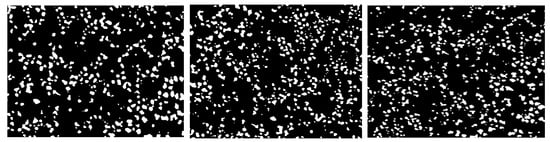
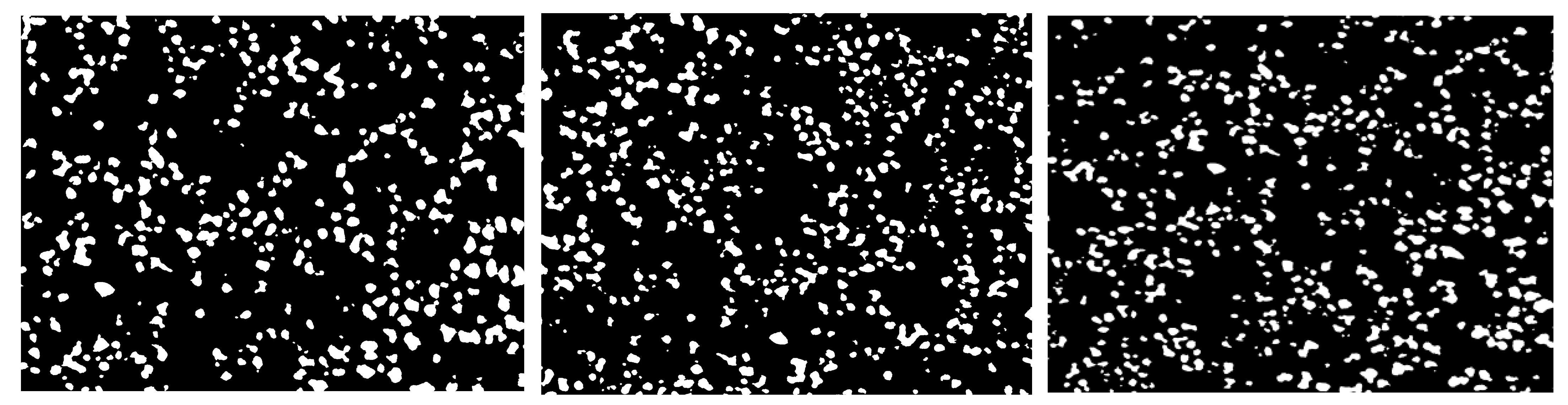
First, slowly add the SBS granules to 550 g of molten base bitumen at 135 °C. Heat the high-shear mixer to 165 °C and shear the mixture at 4500 rpm for 50 min. Then, add 1.5% Sinopec refinery compatibilizer to a temperature-controlled heating jacket maintained at 185 °C and 300 rpm. The aromatic components in this compatibilizer effectively swell the polystyrene hard segments in the SBS, making it easier to disperse. This dosage ensures sufficient swelling of the SBS and the formation of a stable network. Once the temperature reaches 172 °C, add a stabilizer (Xinjiang Hengxing Ludata Road Materials Technology Co., Ltd., Urumqi, Xinjiang, China) containing sulfur compounds with a purity of ≥99.5% at a dosage of 0.25%, and mix at a speed of 650 rpm. At high temperatures, sulfur cross-links with the unsaturated bonds of SBS and bitumen, transforming the physical network into a chemically bonded network. This solidifies the SBS dispersion and improves storage stability. This dosage induces moderate cross-linking while preventing excessive cross-linking that could cause bitumen embrittlement. During the curing process, samples were taken every 0.5 h, and the dispersion of the polymer was monitored using a fluorescence microscope. The specific curing times for SBS modifiers at different dosage levels were determined based on the fluorescence tracking results. Ultimately, the curing times for 4.0%, 4.5%, and 5.0% SBS-modified bitumen were 4 h, 4.5 h, and 5 h, respectively. Binarization of the images enhances the contrast analysis of the two-phase structure, where the black phase represents the bitumen and the white phase represents the SBS particles. The binary image of the microstructure is shown in Figure 1.
Figure 1.
Binarized fluorescence images of SBS-modified bitumen (from left to right: 4.0%, 4.5%, and 5.0% SBS content).
As shown in Figure 1, in the SBS-modified bitumen samples with various SBS content levels, the SBS particles—which are small, spherical, uniform in size, and well-defined—are uniformly dispersed throughout the bitumen matrix. The interface between the two phases is distinct, and no significant agglomeration is observed. This indicates that the SBS particles have undergone sufficient shearing and development, resulting in a stable microstructural phase.
2.4. Testing
2.4.1. Aging Test
Short-term thermal-oxidative aging (RTFOT): Conducted in accordance with Chinese standards JTG E20-2011 and T0610-2011. For each test, 35 g ± 0.5 g of bitumen sample is placed in a designated wide-mouth bottle and aged for 85 min at 163 °C ± 0.5 °C with a flow rate of 4000 mL/min ± 200 mL [32].
Long-term oxidative pressure aging (PAV): Conducted in accordance with T0630-2011. Place 50 g ± 0.5 g of RTFOT residue in a pressure aging vessel and age for 20 h at 100 °C ± 0.5 °C and an air pressure of 2.1 MPa ± 0.1 MPa [32].
2.4.2. Testing of the Three Key Indicators
Penetration (T0604-2011), 15 °C ductility (T0605-2011), and softening point (T0606-2011) shall be determined. For each sample, three parallel tests shall be conducted [32].
2.4.3. Rheological Properties Testing
The instruments used for frequency sweep tests, multi-stress creep recovery (MSCR) tests, temperature sweep tests (TeS), and linear amplitude sweep (LAS) tests are all dynamic shear rheometers. These tests are conducted in accordance with AASHTO T315-09 [33], with two parallel tests performed on each sample.
(1) Frequency sweep tests and master curve construction: Frequency sweeps were performed on all samples within the temperature range of 30–70 °C, with 10 °C intervals, over a frequency range of 0.1 Hz to 15 Hz, while keeping the strain within 0.1%. Based on the time temperature superposition principle (TTSP), using 50 °C as the reference temperature, the Christensen–Anderson–Marasteanu Christensen-Anderson-Marasteanu (CAM) equation was fitted using nonlinear least squares to obtain the master curves for the complex modulus (G*) and phase angle (δ).
(2) Multi-Stress Creep Recovery (MSCR): The multi-stress creep recovery (MSCR) test was conducted using a dynamic shear rheometer with 25 mm parallel plates and a 1 mm gap. The test temperatures were set to 64 °C, 70 °C, and 76 °C, with a creep recovery cycle consisting of 1 s of creep followed by 9 s of recovery. The test procedure is as follows: First, 20 creep recovery cycles were performed at a stress of 0.1 kPa, followed immediately by 10 creep recovery cycles at a stress of 3.2 kPa. For the stress of 0.1 kPa, data from cycles 11 through 20 were selected for analysis.
(3) Temperature Sweep Test (TeS): A 25 mm parallel plate setup was used with a 1 mm gap, a loading frequency of 10 rad/s, a strain of 1%, and temperature intervals of 5 °C. The trends in elasticity and the viscous–elastic ratio were analyzed based on the complex modulus (G*) and phase angle (δ) of the bitumen within the temperature range of 30–90 °C. The test procedure follows AASHTO T313 [34].
(4) Linear Amplitude Sweep (LAS): An 8 mm parallel plate setup was used with a gap of 2 mm between the plates, and the test temperature was 25 °C. First, a frequency sweep test was conducted in the range of 0.2–30 Hz with a strain of 0.1% to obtain the rheological parameter α of the bitumen; second, an amplitude sweep test was performed at a frequency of 10 Hz with strain linearly increasing from 0.1% to 30% to obtain the fatigue failure characteristic curve of the sample. Finally, the fatigue life Nf is determined using the simplified viscous–elastic continuum damage Simplified viscous-elastic Continuum Damage (S-VECD) theory.
2.4.4. Four-Component Bitumen Test (TLC/FID)
Four-component analysis was performed using thin-layer chromatography with flame ionization detection (TLC/FID, Zibo Shanfen Analytical Instrument Co., Ltd.). In accordance with T0618-2025, 0.45 g of bitumen sample was dissolved in 30 g of dichloromethane solution and spotted onto a Chromarod-SIII quartz rod using a micropipette. Development was performed sequentially using n-hexane, toluene, and a dichloromethane/methanol (95:5 by volume) mixed solvent to separate the saturate, asphaltene, resin and aromatic. Finally, the content of each component was determined via FID. Each sample was analyzed in triplicate, and the average value was calculated.
2.5. Test Methods
The engineering properties and rheological behavior of modified bitumen with varying SBS content and different aging states were tested. TLC/FID techniques were used to analyze the migration patterns of the four components of the bitumen, and a random forest model was employed to establish a quantitative mapping relationship between the chemical components and the wide-temperature-range rutting factor. The instruments and equipment are shown in Figure 2.
Figure 2.
From left to right: DSR casting sample, DSR equipment, and four-component equipment.
3. Results and Discussion
3.1. Analysis of Bitumen Technical Specifications
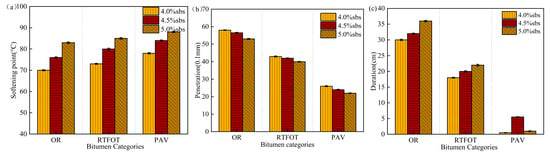
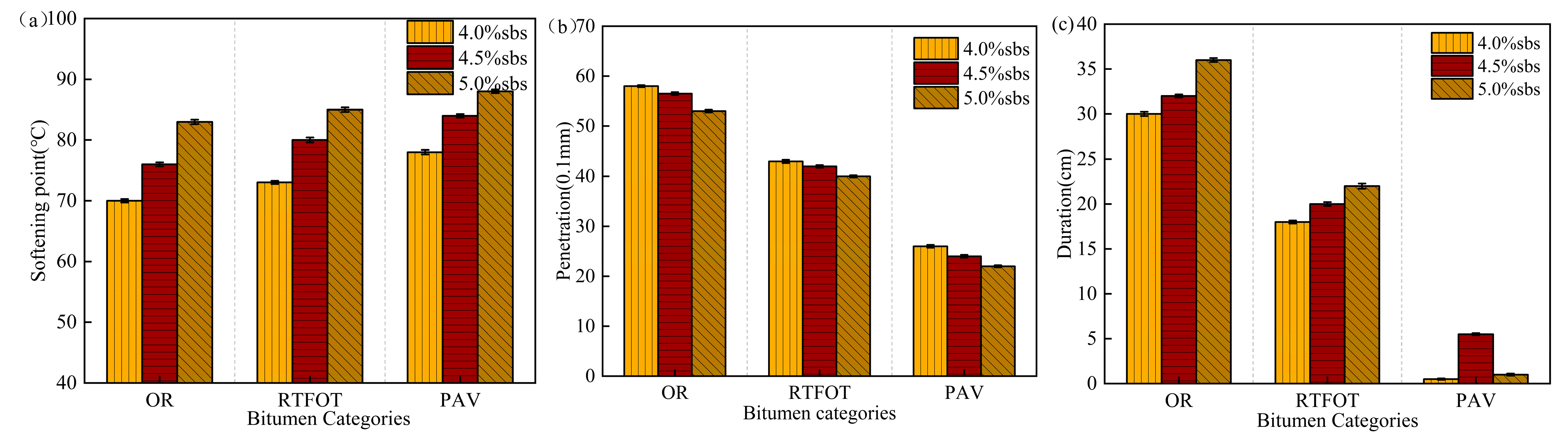
In this study, linear SBS modifier with loading levels of 4.0%, 4.5%, and 5.0% were selected. Three key parameters of the selected bitumen were tested before and after aging. The aging conditions included original bitumen (OR), short-term thermal-oxidative aging bitumen (RTFOT), and long-term oxidative pressure aging bitumen (PAV). The test results are shown in Table 3 and Table 4, as shown in Figure 3.
Table 3.
Testing of conventional properties of base bitumen at different degrees of aging.
Table 4.
Testing of conventional properties of SBS-modified bitumen at different degrees of aging.
Figure 3.
Comparison of three key parameters of modified bitumen at different degrees of aging; (a) Softening point bitumen categories by degree of aging; (b) Penetration bitumen categories by degree of aging; (c) Ductility bitumen categories by degree of aging.
According to the data in the chart showing changes in the performance of bitumen engineering indicators, both the 70# base bitumen and the prepared SBS-modified bitumen meet the specifications. As shown in Figure 3, aging causes the bitumen to harden, primarily manifested by a significant decrease in both penetration and ductility, as well as an increase in the softening point. Thermal-oxidative aging of bitumen binder leads to a marked decrease in low-temperature performance and an increase in high-temperature stability [35]. Notably, after long-term oxidative pressure aging, the elongation of the 4.5% SBS-modified bitumen was slightly higher than that of the other two dosage levels. This result is consistent with the finding discussed below that, after long-term aging, this dosage level exhibits the lowest complex modulus and phase angle under low-temperature conditions, indicating better elastic response of the material.
3.2. Analysis of Sample Rheological Properties
3.2.1. Frequency Sweep
To characterize the linear viscous–elastic properties of the materials, this study conducted small-strain linear amplitude sweep tests on all bitumen samples at different aging levels by applying varying frequencies (0.1 Hz–15 Hz) within a temperature range of 30–70 °C [11]. Based on the results of the frequency scanning tests, the time temperature superposition principle (TTSP) was applied, and a mathematical model related to the free-displacement technique [36] was employed. Combined with a nonlinear least-squares optimization method to determine the displacement factor, the main curves of the complex modulus and phase angle at a reference temperature of 50 °C were ultimately constructed.
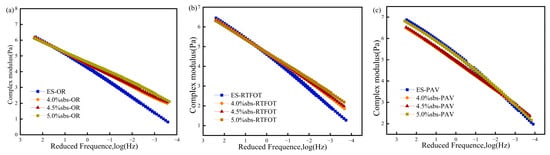
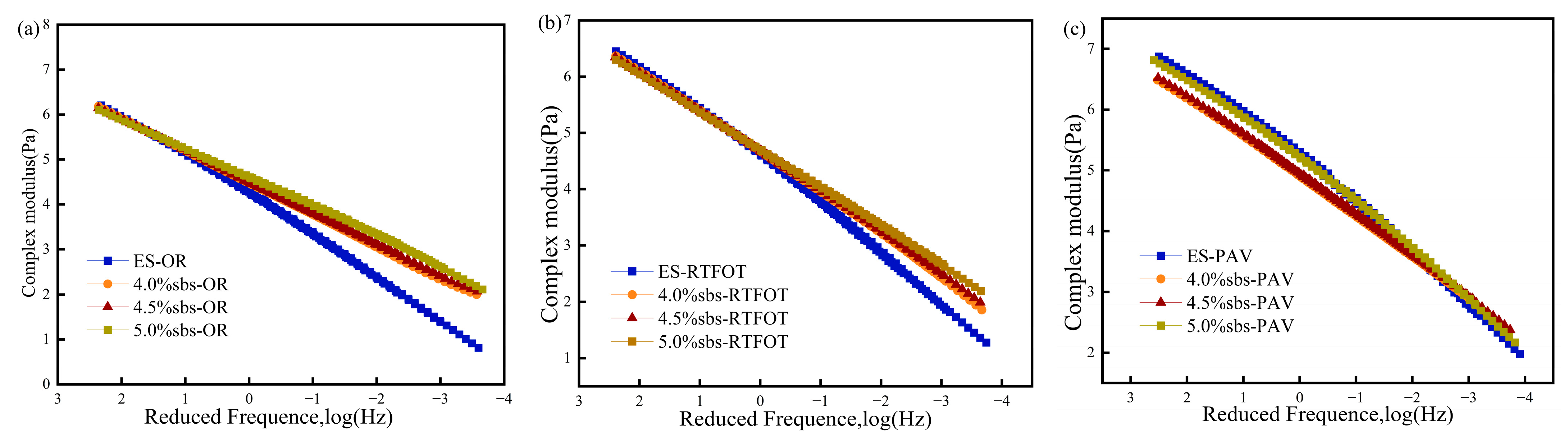
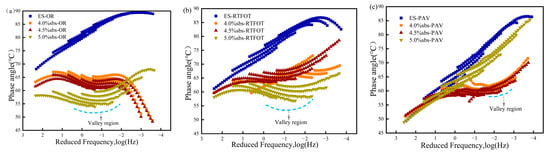
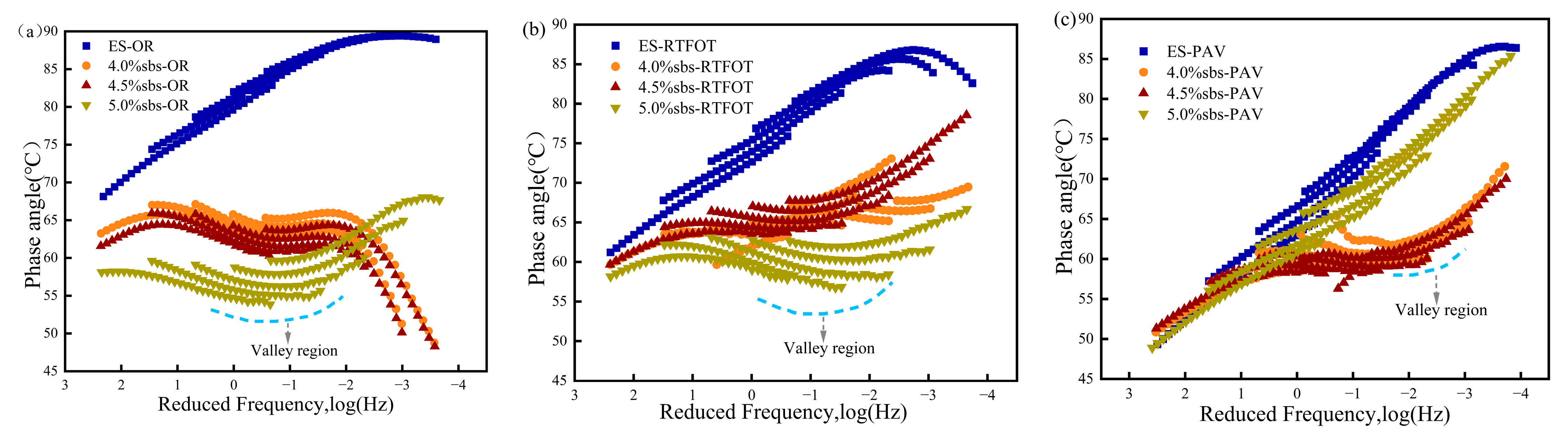
In this study, the Christensen–Anderson–Marasteanu (CAM) equation was selected as the fitting equation for the bitumen master curve. The complex modulus master curves for different bitumens are shown in Figure 4, and the phase angle master curves are shown in Figure 5.
Figure 4.
Effect of different aging conditions on the principal modulus curve of SBS-modified bitumen; (a) The complex modulus of unaged bitumen; (b) The complex modulus of RTFOT bitumen; (c) The complex modulus of PAV bitumen.
Figure 5.
Effect of different aging conditions on the phase angle main curve of SBS-modified bitumen; (a) Phase angle of unaged bitumen; (b) Phase angle of RTFOT bitumen; (c) Phase angle of PAV bitumen.
As shown in Figure 4, under non-aged conditions, as the SBS content increases, the complex modulus of the modified bitumen significantly increases in the low-frequency range (high-temperature conditions), indicating enhanced resistance to deformation at high temperatures; in the high-frequency range (low-temperature conditions), the complex modulus decreases slightly, resulting in improved low-temperature performance. After short-term thermal-oxidative aging, the overall complex modulus of the bitumen increases slightly, and high-temperature performance improves marginally. At this stage, the hardening reaction of the bitumen matrix has not yet been fully completed. SBS molecular chains rapidly degrade under the influence of high-temperature thermal-oxidative stress, and the rate of elastic degradation exceeds the rate of matrix hardening; together, these factors result in a limited increase in modulus. Meanwhile, the modulus of SBS-modified bitumen with high SBS content shows a smaller increase in the high-frequency region (low-temperature conditions), indicating that a sufficient amount of SBS polymer effectively delays the thermal-oxidative hardening process of the bitumen. As the aging reaction progresses, light components continuously oxidize and volatilize, transforming into more polar bitumen, resulting in a significant restructuring of the phase composition [37,38]. The decrease in swelling between SBS and low-molecular-weight components leads to a deterioration in the compatibility between bitumen and SBS, manifested as the destruction of the three-dimensional network structure and a decline in macroscopic properties [39,40]. After long-term oxidative pressure aging, the overall modulus of the bitumen increased significantly, and low-temperature performance further deteriorated. This is attributed to the substantial loss of the degradable SBS macromolecular elastic structure during the short-term thermal-oxidative aging stage; consequently, the rate of polymer elastic degradation slowed, the thermal-oxidative reaction of the bitumen matrix continued, and the bitumen’s rigid elasticity increased. In contrast, 4.5% SBS-modified bitumen exhibits a lower complex modulus in the high-frequency region (under low-temperature conditions) compared to modified bitumen with other SBS contents. This indicates that the smaller molecular segments formed after SBS degradation at this content level provide better low-temperature flexibility than those at other content. The modulus of SBS-modified bitumen in the low-frequency region (under high-temperature conditions) shows little difference from that of the base bitumen, reflecting that the polymer network structure of the SBS polymer is severely damaged after long-term aging, significantly weakening its role in improving high-temperature performance. Based on this, long-term stress aging significantly weakens the improvement effect of SBS on the high-temperature performance of bitumen; however, the low-temperature impact resistance of 4.5% SBS-modified bitumen remains superior to that of the base bitumen.
The phase angle represents the phase difference between stress and strain; the larger the phase angle, the greater the viscosity of the bitumen material [28]. As shown in Figure 5, the phase angle of SBS-modified bitumen exhibits a plateau region within a certain temperature range.
The phase angle represents the phase difference between stress and strain; the larger the phase angle, the greater the viscosity of the bitumen material [41]. As shown in Figure 5, the phase angle of SBS-modified bitumen exhibits a plateau region within a certain temperature range. The three-dimensional network structure formed by the SBS polymer improves the original rheological properties of the bitumen matrix, particularly by significantly reducing the phase angle of the bitumen in the low-to-mid frequency range (under medium-to-high temperature conditions), reflecting that the SBS modifier significantly enhances the medium-to-high temperature performance of the bitumen [35]. As the degree of aging increases, the phase angle plateau region gradually disappears. It is worth noting that for 4.0% and 4.5% modified bitumen, the phase angle drops sharply in the low-frequency region (under high-temperature conditions). At high temperatures, the bitumen matrix softens and flows, while SBS molecular chains cross-link under thermal conduction. Additionally, slight oxidative reactions during testing promote the formation of oxygen-containing functional groups in the bitumen matrix, facilitating intermolecular association and the formation of a stable three-dimensional network structure. The proportion of elasticity in the system increases significantly, manifesting as a sharp decrease in the phase angle, which is a normal rheological phenomenon. After long-term oxidative pressure aging, the phase angle of modified bitumen in the low-frequency region (under high-temperature conditions) increases overall, and its high-temperature deformation resistance significantly deteriorates. The reason for this is that while long-term aging increases the stiffness of the bitumen matrix, the viscouselastic equilibrium supported by the three-dimensional elastic polymer network of SBS is disrupted. At high temperatures, the proportion of viscous behavior in the material increases significantly, manifested as an increase in the phase angle. This rheological behavior is consistent with the findings of Zhang et al. [42] and Sharma et al. [43]. In particular, the 5.0% SBS-modified bitumen is prone to excessive cross-linking, leading to increased brittleness and exhibiting the highest phase angle; this characteristic is corroborated by the test results showing poor elongation of the bitumen at this dosage after long-term aging; it also aligns with research by Yan et al. [44] and Xiao et al. [18], which suggests that excessive cross-linking caused by high polymer content leads to increased brittleness. The 4.5% SBS-modified bitumen exhibited the lowest phase angle, maintaining better elastic response and high-temperature deformation resistance; this result is consistent with the conclusions regarding modulus discussed above.
3.2.2. High-Temperature Rutting Factor
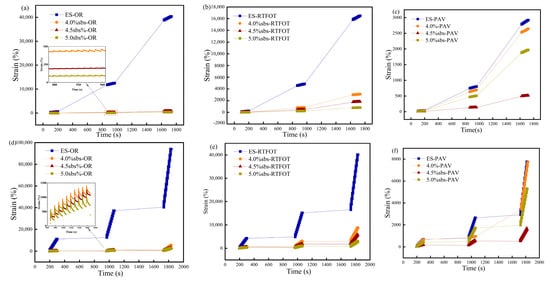
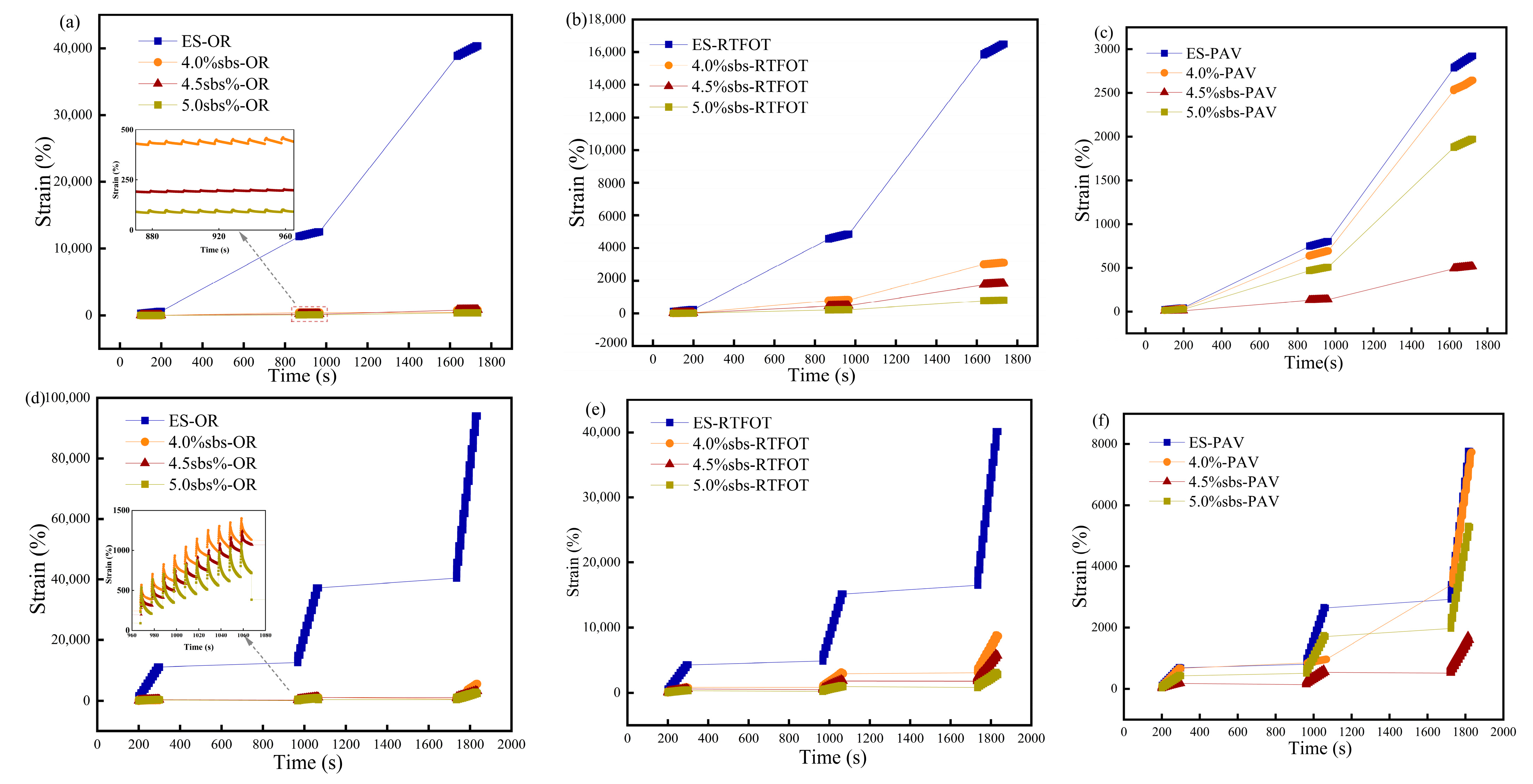
The multi-stress creep recovery (MSCR) test evaluates the contribution of modifiers to the behavior of the binder’s permanent deformation and recovery rate [29]. In this study, irreversible creep tests were conducted at three temperatures (58 °C, 64 °C, and 70 °C) and two stress levels (0.1 kPa and 3.2 kPa); the mechanical response during the testing process is shown in Figure 6.
Figure 6.
Strain–stress response curves for MSCR testing of matrix bitumen and SBS-modified bitumen under two stress levels; (a) 0.1 kPa unaged bitumen response diagram; (b) 0.1 kPa RTFOT bitumen response diagram; (c) 0.1 kPa PAV bitumen response diagram; (d) 3.2 kPa unaged bitumen response diagram; (e) 3.2 kPa RTFOT bitumen response diagram; (f) 3.2 kPa PAV bitumen response diagram.
A comparison of Figures (a) and (d) reveals that during repeated creep loading, the cumulative plastic strain of the base bitumen increases significantly with rising test temperature and stress, while its ability to recover from deformation upon unloading decreases. This indicates that both high temperatures and excessive loading exacerbate the permanent deformation of the base bitumen, leading to a decline in its resistance to rutting. Figures (a) to (f) show that, at the same temperature and stress levels, compared to the base bitumen, the cumulative plastic strain of SBS-modified bitumen decreases as the content increases, and its elastic recovery performance improves. This indicates that SBS polymers can effectively enhance the bitumen’s recovery capacity and resistance to permanent deformation. Figures (d) to (f) show that, under the same stress level, both cumulative plastic strain and elastic recovery performance decrease significantly as the degree of aging increases. This indicates that aging weakens the bitumen’s plastic deformation capacity; however, after long-term oxidative pressure aging, the 4.5% SBS-modified bitumen exhibits the lowest cumulative plastic strain and the best elastic recovery compared to other dosage levels, consistent with the modulus results discussed earlier.
Increased stress leads to higher cumulative plastic strain and lower elastic recovery rates, which not only significantly exacerbates the permanent deformation of the bitumen but also demonstrates that the SBS polymer exhibits pronounced stress sensitivity.
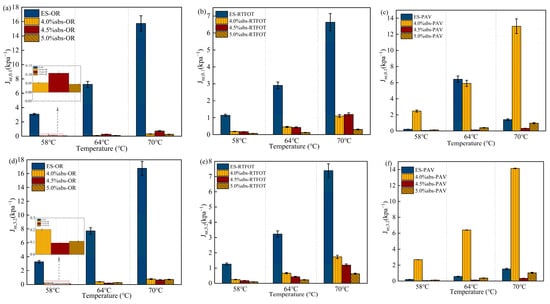
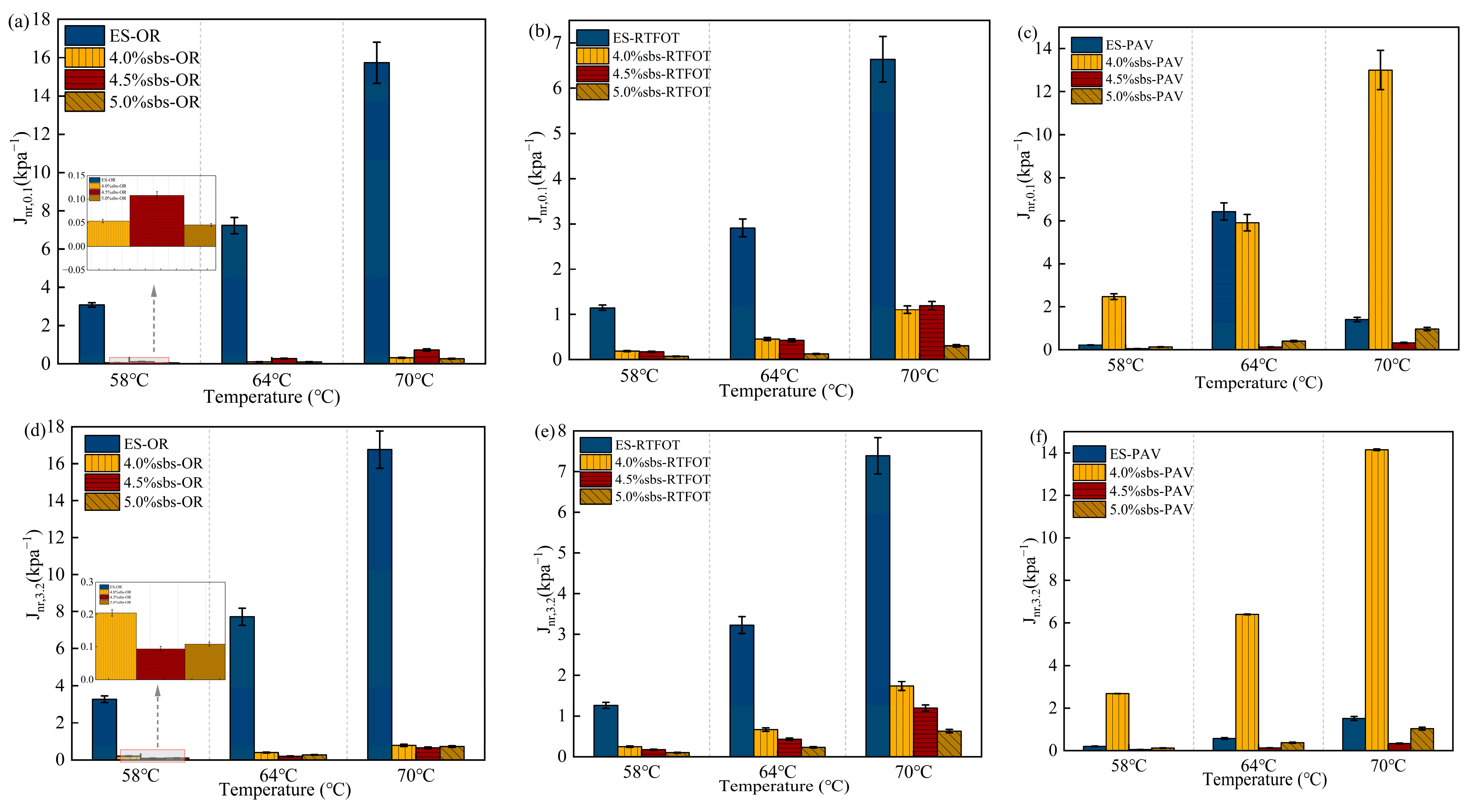
This paper further analyzes the high-temperature rutting factor of bitumen mixtures with different SBS contents at various aging levels using the non-recoverable creep compliance (Jnr) at 0.1 kPa and 3.2 kPa (Figure 7). A lower Jnr value indicates stronger rutting factor of the bitumen mixture [45,46].
Figure 7.
The non-recoverable creep compliance (Jnr) of base bitumen and SBS-modified bitumen at a stress level of 3.2 kPa and 0.1 kPa; (a) Jnr,0.1 of unaged bitumen; (b) Jnr,0.1 of RTFOT bitumen; (c) Jnr,0.1 of PAV bitumen; (d) Jnr,3.2 of unaged bitumen; (e) Jnr,3.2 of RTFOT bitumen; (f) Jnr,3.2 of PAV bitumen.
As shown in Figure 7, under all test temperatures and stress conditions, the Jnr value decreases significantly with increasing SBS concentration in the unaged state. This indicates that irreversible damage may occur in the matrix bitumen structure under loading, and that SBS-modified materials enhance elasticity, thereby significantly improving resistance to rutting. After short-term thermal-oxidative aging, the Jnr of the bitumen in all samples was lower than that of the unaged state, indicating that the material’s resistance to permanent deformation at high temperatures had improved to some extent. After long-term oxidative pressure aging, the Jnr of the 4.5% SBS-modified bitumen was the lowest under all test temperatures and stress conditions, indicating that this modified bitumen with this content exhibits the strongest resistance to deformation. This finding corresponds with the lowest cumulative plastic strain observed during long-term oxidative pressure aging at both stress levels in the MSCR test. The Jnr values of all bitumen increased slightly as the stress level increased from 0.1 kPa to 3.2 kPa. This is a typical stress dependent characteristic of bitumen materials, meaning that under high stress, the shear flow of the matrix is more pronounced, and plastic deformation accumulates more easily. At the same time, the rates of change in ∆Jnr caused by temperature variations at 0.1 kPa for the four unaged bitumen were 412.4%, 494.3%, 244.1%, and 493.3%, respectively, indicating that the 4.5% SBS-modified bitumen can effectively mitigate the temperature sensitivity of the base bitumen.
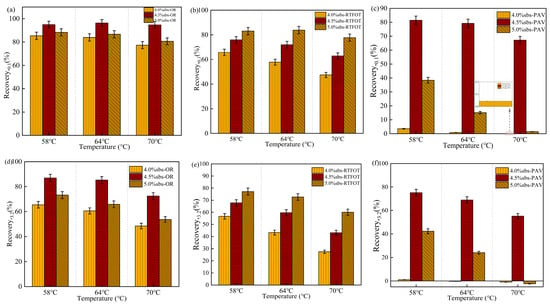
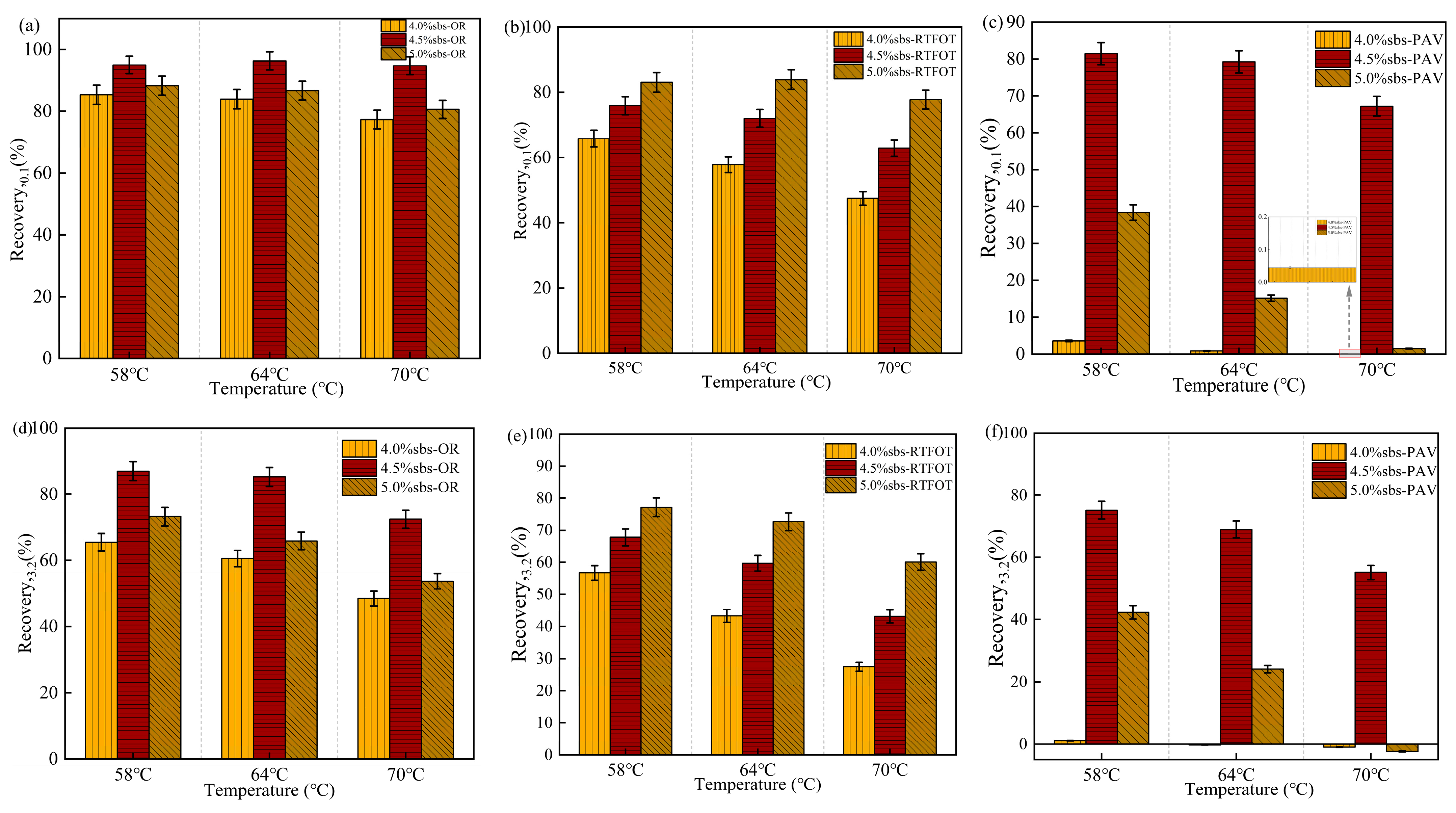
At the same time, the elastic recovery rate can also distinguish differences among various SBS content levels at different aging levels; the higher the recovery value, the stronger the elastic recovery ability [45,46]. The elastic recovery rates at 0.1 kPa and 3.2 kPa are shown in Figure 8.
Figure 8.
The elastic recovery rates at 0.1 kPa and 3.2 kPa are shown; (a) 0.1 recovery of unaged bitumen; (b) 0.1 recovery of RTFOT bitumen; (c) 0.1 recovery of PAV bitumen; (d) 3.2 recovery of unaged bitumen; (e) 3.2 recovery of RTFOT bitumen; (f) 3.2 recovery of PAV bitumen.
As shown in Figure 8, the recovery rate at 0.1 kPa values of all three SBS modifiers at the test temperature were greater than 80% prior to aging, indicating that under light load conditions, the primary resistance to deformation stems from the polymer network structure. When the stress level increased to 3.2 kPa, the recovery rate at 3.2 kPa of the SBS-modified bitumen decreased significantly, suggesting that under heavy load conditions, the polymer network structure may suffer irreversible damage. For the 4.5% SBS-modified bitumen, the recovery value exhibited a trend of first decreasing and then increasing with aging at all temperatures and stress levels. During short term thermal oxidative aging, the recovery value decreased primarily due to the rapid degradation of SBS macromolecular segments. During long-term oxidative pressure aging, the rate of polymer elastic degradation slowed, the bitumen matrix underwent deep hardening, and the recovery value increased.
3.2.3. ViscousElastic Analysis
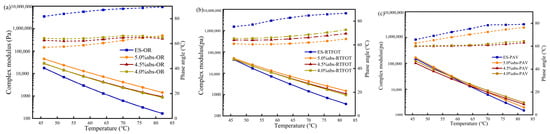
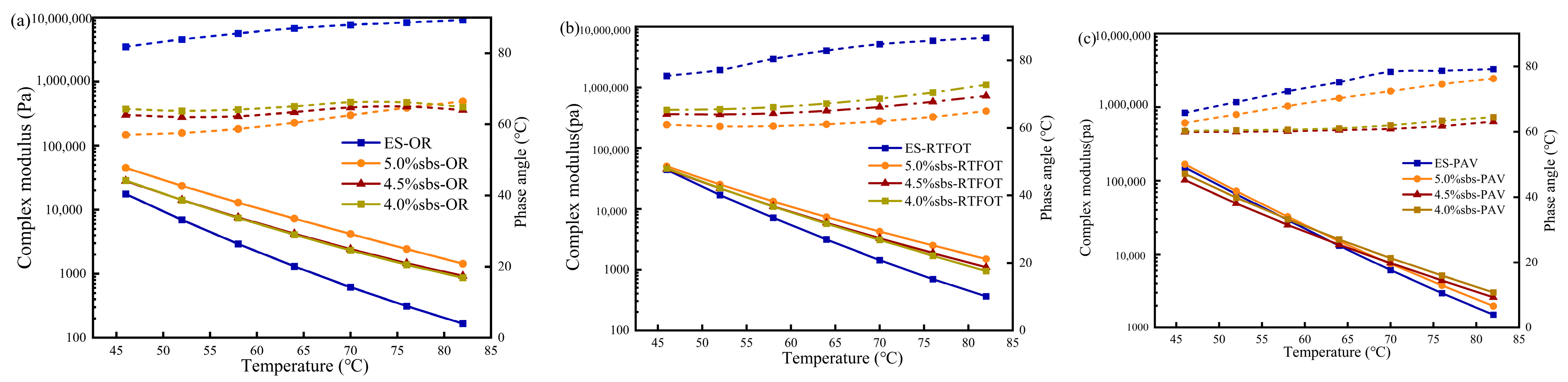
The trends in the complex modulus (G*) and phase angle (δ) of base bitumen and modified bitumen over the temperature range of 46–82 °C were examined using temperature scanning (TeS) tests [4] (Figure 9). A higher G* value indicates greater elasticity and better deformation resistance in the bitumen, while a smaller δ value indicates a higher elastic component and stronger deformation recovery capacity [34].
Figure 9.
Complex modulus (G*) and phase angle (δ) of various aged modified bitumen; (a) The complex modulus and phase angle of unaged bitumen; (b) The complex modulus and phase angle of RTFOT bitumen; (c) The complex modulus and phase angle of PAV bitumen.
As shown in Figure 9, within the test temperature range, the complex modulus of all bitumen samples decreases with increasing temperature, while the phase angle increases accordingly. the material gradually transitions from elastic to viscous–elastic behavior. Compared to the base bitumen, an increase in SBS content significantly enhances the complex modulus G* and reduces the phase angle δ, thereby improving high-temperature rutting factor and enhancing elastic recovery at moderate temperatures. The phase angle increases substantially within the 48–72 °C temperature range, indicating that SBS has a significant modifying effect on the base bitumen. Short-term aging performance showed little change, consistent with the results of the linear amplitude sweep test. However, after long-term aging, the 4.5% SBS-modified bitumen exhibited the lowest phase angle across the entire temperature range and the most pronounced elastic behavior, consistent with the results from the MSCR test, where this content showed the smallest cumulative plastic strain and the best elastic recovery.
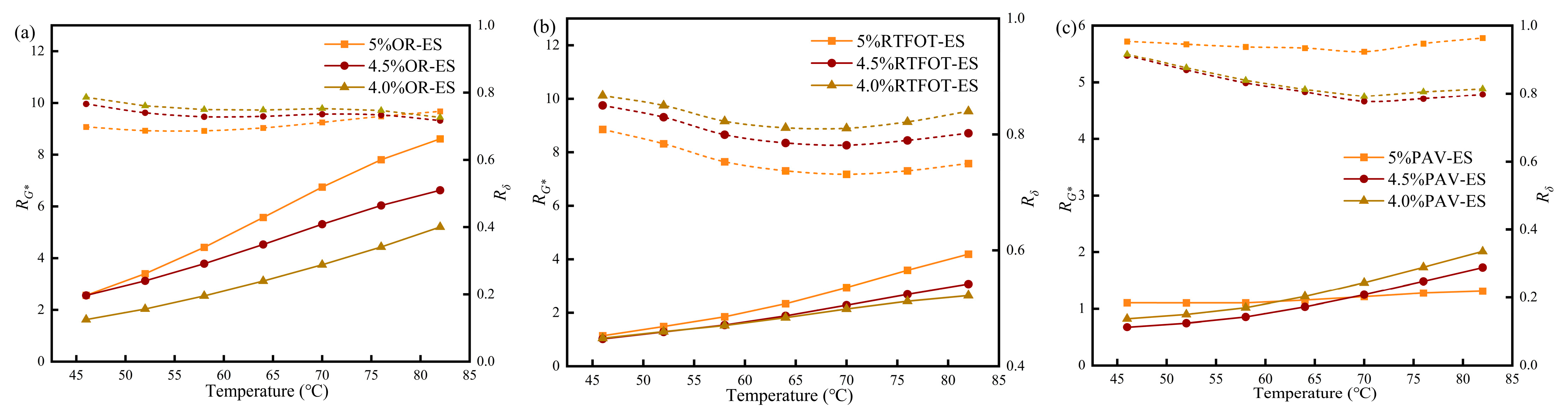
To more intuitively compare the modifying effects of SBS modifier with different loading levels on bitumen [4], the modulus ratio RG* and phase angle ratio Rδ shown in Figure 10 were obtained using Equations (1) and (2):
Figure 10.
Modulus ratio RG* and phase angle ratio Rδ for different aged modified bitumen; (a) The modulus ratio RG* and phase angle ratio Rδ for unaged bitumen; (b) The modulus ratio RG* and phase angle ratio Rδ for RTFOT bitumen; (c) The modulus ratio RG* and phase angle ratio Rδ for PAV bitumen.
In the equation: and represent the complex moduli of SBS-modified bitumen and base bitumen, respectively; and represent the phase angles of SBS-modified bitumen and base bitumen, respectively.
In terms of RG*, SBS modifiers mitigate, to a certain extent, the adverse effects of temperature on bitumen’s resistance to permanent deformation. Specifically, the relative increase in bitumen hardness due to SBS is significant below 72 °C, after which it fluctuates only slightly. This phenomenon may be attributed to the micro-scaffolding effect provided by the unique triblock copolymer structure of SBS within the bitumen [39]. As evidenced by the phase angle ratio Rδ, aging significantly alters the viscous elasticity of bitumen. In the low-to-medium temperature range, the hardening of the bitumen matrix after aging causes a decrease in the phase angle. Combined with the reduced elastic contribution resulting from the degradation of the SBS polymer network structure, the phase angle decreases only slightly. In the high-temperature region, the bitumen matrix enters a viscous flow state, where viscous flow dominates, and the elastic contribution of the residual SBS network is greatly weakened, resulting in a significant increase in the phase angle. In contrast, the unaged SBS network structure remains intact, with the strongest elastic contribution occurring near 52 °C; subsequently, the trend of the phase angle with rising temperature becomes more gradual, and it can still maintain a certain degree of elastic recovery capacity at high temperatures.
Overall, SBS can significantly increase the hardness of bitumen and reduce the temperature sensitivity of its elasticity; different aging behaviors have significantly altered the temperature-dependent viscous–elastic properties of SBS-modified bitumen.
3.2.4. Fatigue Resistance at Intermediate Temperatures
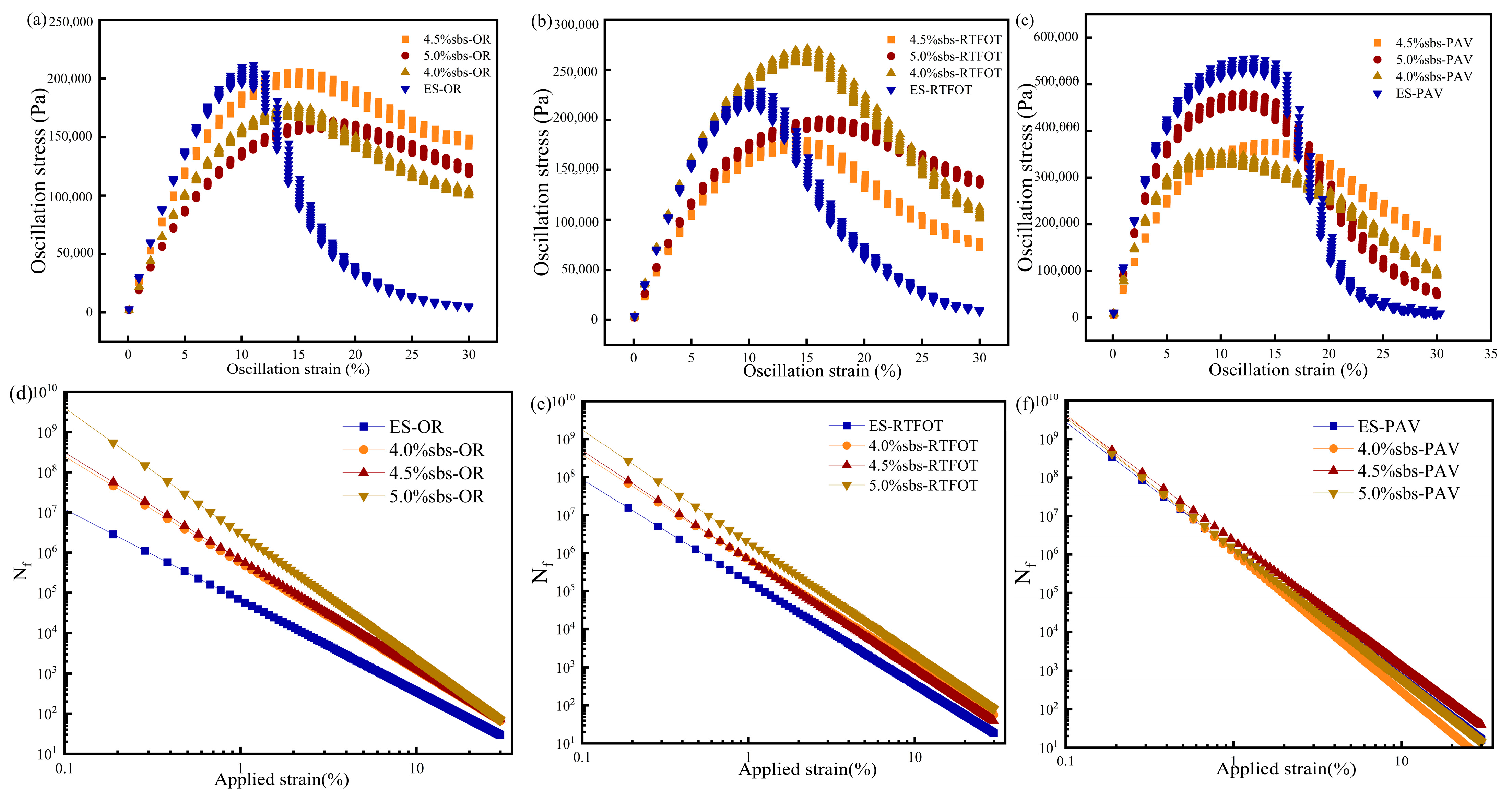
A linear amplitude sweep (LAS) was conducted to characterize the medium-temperature fatigue life of materials with different SBS content under various aging conditions. Based on the S-VECD theory, stress–strain curves (Figure 11a–c) and fatigue life (Nf) curves (Figure 11d–f) were obtained, along with the parameters A and B of the fatigue performance model and the fatigue life calculated at three strain levels [36] (Table 5, Table 6 and Table 7).
Figure 11.
Stress–strain curves for each bitumen sample (a–c), fatigue life Nf (d–f); (a) Strain stress diagram for unaged bitumen; (b) Strain stress diagram for RTFOT bitumen; (c) Strain stress diagram for RTFOT bitumen; (d) Fatigue life (Nf) of unaged bitumen; (e) Fatigue life (Nf) of RTFOT bitumen; (f) Fatigue life (Nf) of PAV bitumen.
Table 5.
Binder test results for LAS testing of unaged samples.
Table 6.
Binder test results for LAS testing of short-term thermal-oxidative aging samples.
Table 7.
Binder test results for LAS testing of long-term oxidative pressure aging samples.
In the stress–strain curves (Figure 11a–c), the strain corresponding to the point where shear strain continues to increase while shear stress decreases is the yield strain (εf). The larger the value of εf, the stronger the fatigue resistance. Furthermore, the flatter the curve after the peak and the slower the rate of decline following the peak stress, the better the material’s toughness [4]. For the unaged samples, as the SBS content increased, the yield strain significantly improved (εfES < εf4.0% < εf4.5% < εf5.0%), and the rate of decline in the curve after the peak stress slowed. After short-term thermal-oxidative aging, the yield strain of all samples decreased, and the rate of decline in the curve after the peak stress became steeper; however, samples with high SBS content still maintained relatively high yield strain and a slower post-peak rate. After long-term oxidative pressure aging, the yield strain of all specimens decreased further, and the differences between the various SBS content narrowed; the post-peak decline rate increased sharply. However, the 4.5% SBS-modified bitumen exhibited the highest yield strain and the slowest post-peak rate, indicating that this SBS content provides better fatigue resistance compared to other SBS contents.
Regarding fatigue life (Nf) (Figure 11d–f), when the strain is small, the fatigue life of modified bitumen increases significantly compared to base bitumen as the SBS content increases. As the strain continues to increase, the fatigue life of both the SBS-modified bitumen and the base bitumen decreases, and the difference between the two becomes negligible.
As shown in Table 5, under non-aged, low-strain conditions, increasing the dosage of SBS modifier significantly improves the fatigue life (Nf) of bitumen. However, as strain increases, the differences in fatigue life (Nf) among the bitumen samples gradually decrease, indicating that the effectiveness of SBS modification diminishes with increasing strain.
As previously demonstrated, short-term thermal-oxidative aging increases the hardening of bitumen, raises the complex modulus, reduces the non-recoverable creep compliance, and enhances resistance to deformation; however, it also increases brittleness, resulting in a certain degree of reduction in the fatigue life (Nf) of SBS-modified bitumen compared to non-aged specimens. However, the short-term thermal-oxidative aging of the base bitumen actually increases its low-stress fatigue life (Nf) because the hardening effect enhances its initial resistance to damage. Overall, SBS-modified bitumen subjected to short-term thermal-oxidative aging still exhibits a higher fatigue life compared to the base bitumen.
After long-term oxidative pressure aging, the fatigue life (Nf) of 4.0% and 5.0% SBS-modified bitumen differed little from that of the base bitumen. However, the 4.5% SBS-modified bitumen exhibited the best fatigue performance, indicating that the structure of the SBS polymer at this concentration remained relatively stable during long-term oxidative pressure aging.
In summary, larger strain amplitudes induce greater internal stresses and accelerate the propagation of fatigue cracks. The fatigue life of all bitumen samples decreases as the strain amplitude increases, and during long-term aging, the 4.5% SBS-modified bitumen exhibits the best fatigue resistance compared to other dosage levels.
3.3. Four-Component Test
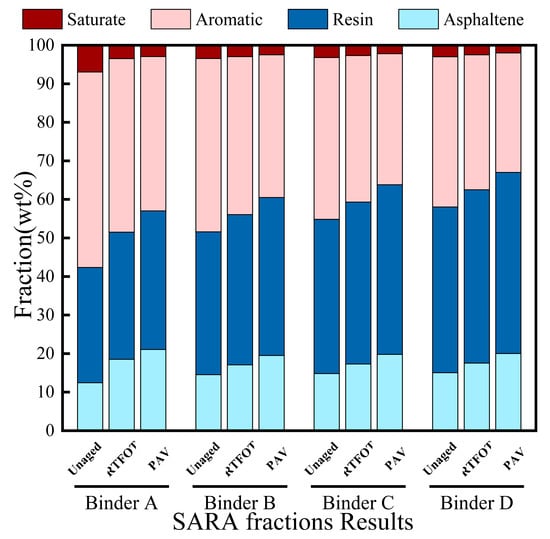
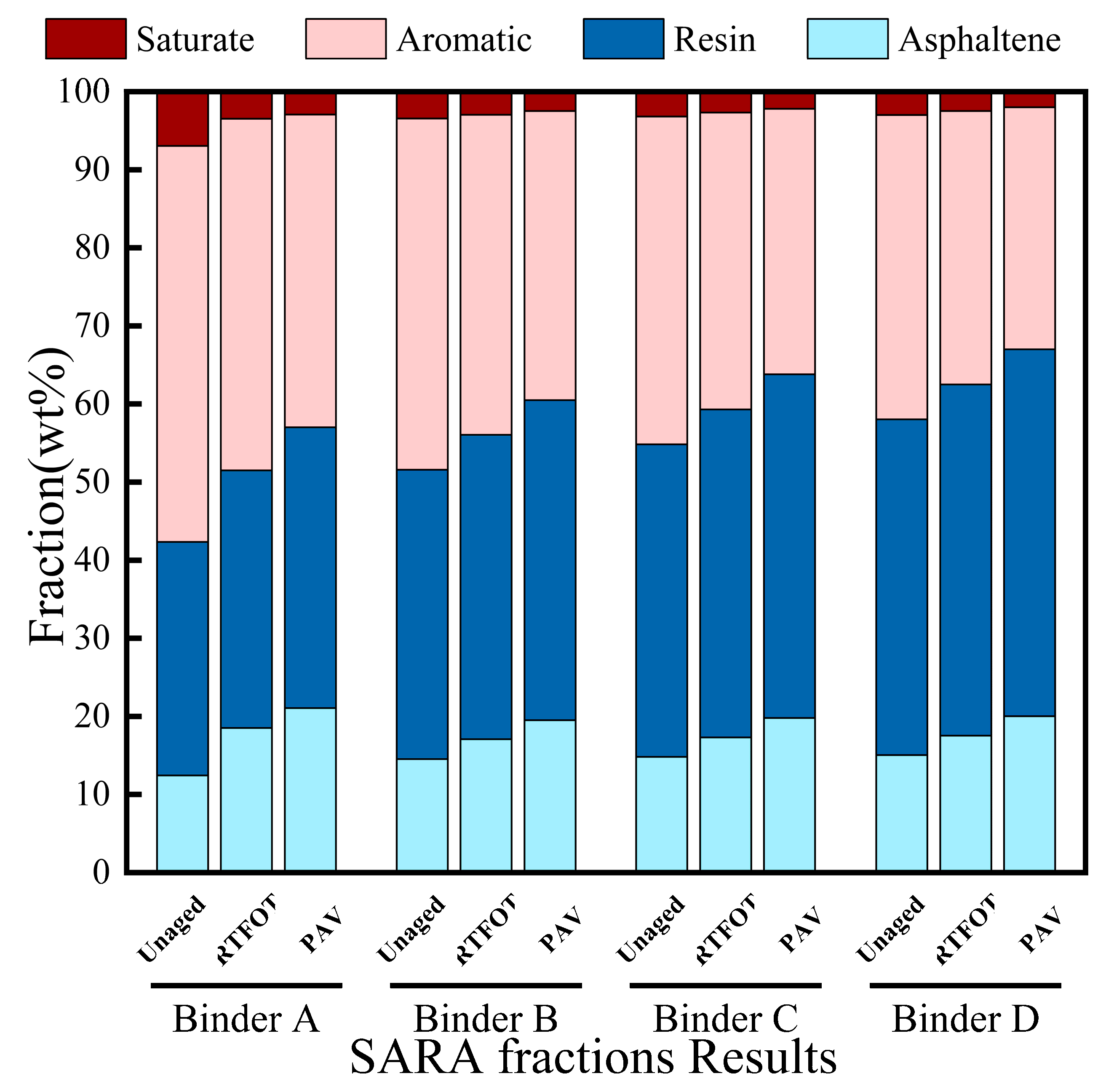
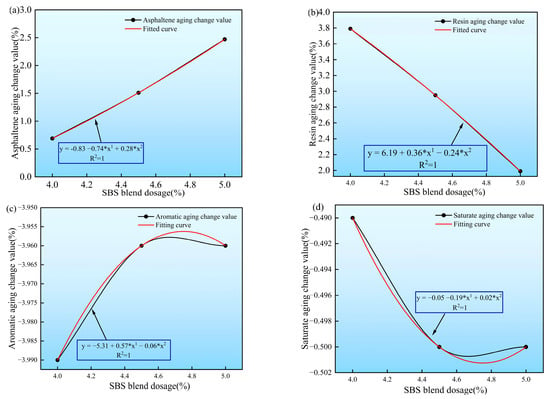
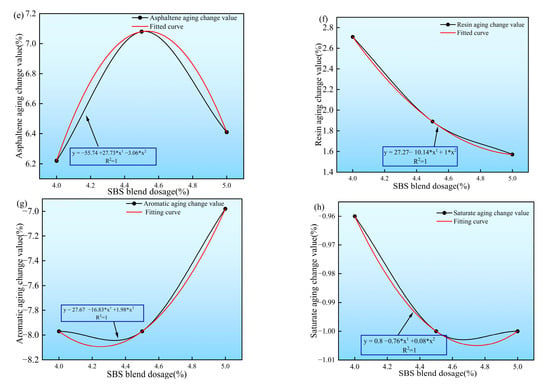
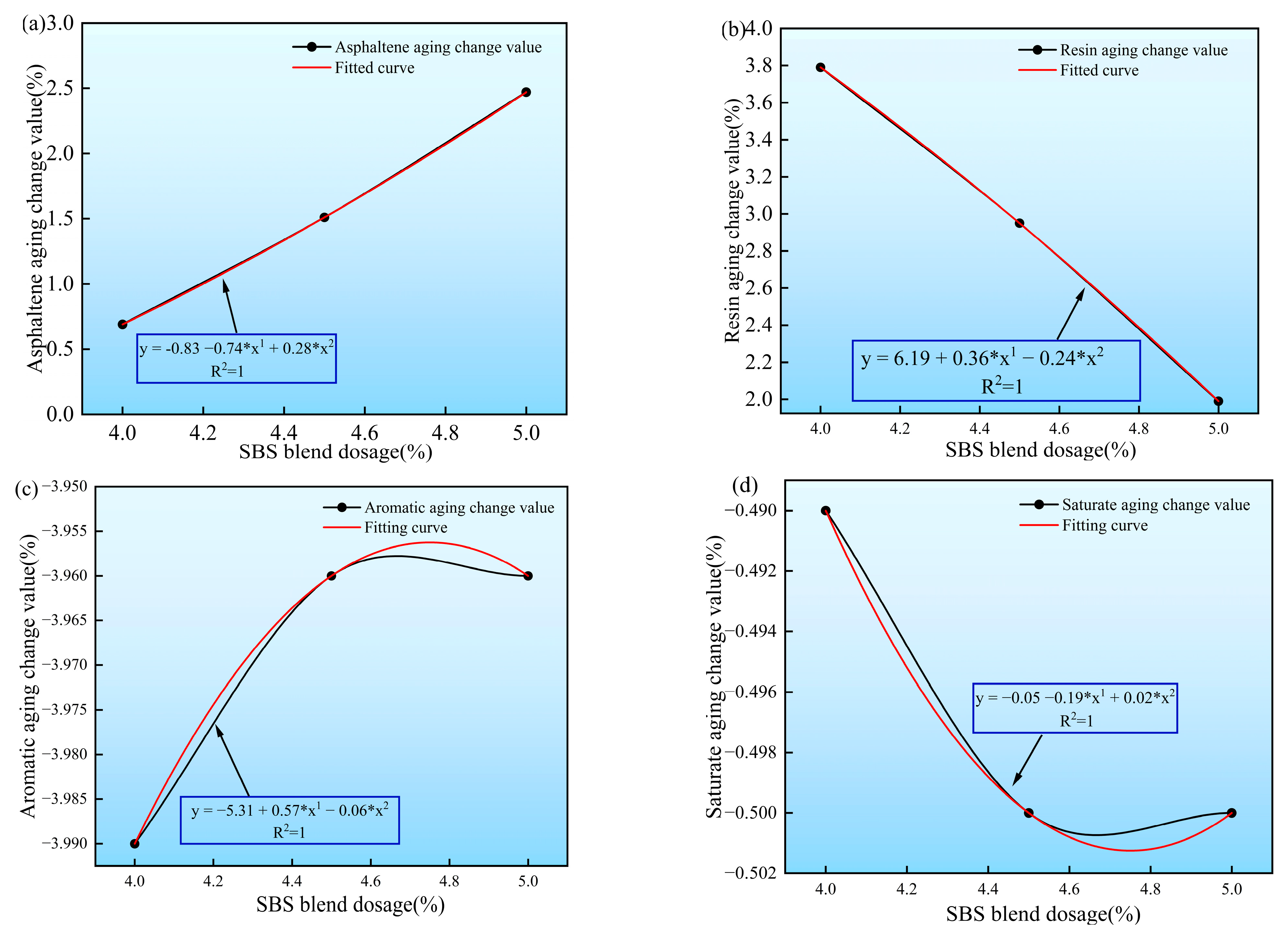
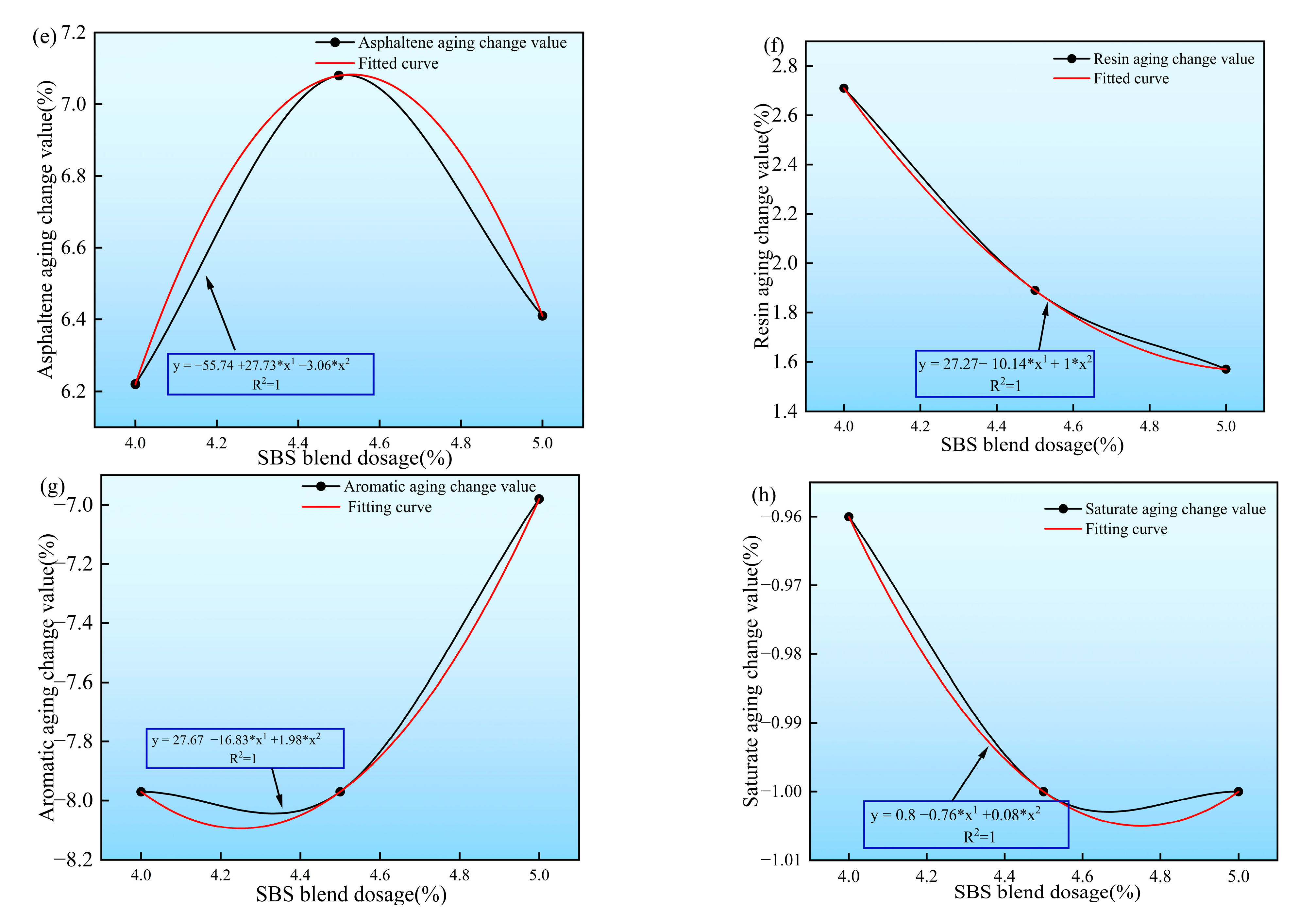
To quantify the effect of SBS content on the aging behavior of bitumen, this study uses unaged modified bitumen as a reference to investigate the extent of changes in the various components of modified bitumen after short-term thermal-oxidative aging and long-term oxidative pressure aging. These changes are used as evaluation indicators, and a binomial model is employed to fit the trends of these components. Binder A is the base bitumen, Binder B is 4.0% SBS-modified bitumen, Binder C is 4.5% SBS-modified bitumen, and Binder D is 5.0% SBS-modified bitumen. The test results for the four bitumen samples are shown in Figure 12, and the fitting curves for the changes in each component at different aging stages are shown in Figure 13.
Figure 12.
Results from the polarity based separation into the SARA fractions.
Figure 13.
Changes in the components of different aging groups; (a) Changes in Asphaltene Properties with Varying SBS Content Under Short-Term Thermal-Oxidative Aging; (b) Changes in Resin Properties with Varying SBS Content Under Short-Term Thermal-Oxidative Aging; (c) Changes in Aromatic Properties with Varying SBS Content Under Short-Term Thermal-Oxidative Aging; (d) Changes in Saturate Properties with Varying SBS Content Under Short-Term Thermal-Oxidative Aging; (e) Changes in Asphaltene Properties with Varying SBS Content Under Long-Term Oxidative Pressure Aging; (f) Changes in Resin Properties with Varying SBS Content Under Long-Term Oxidative Pressure Aging; (g) Changes in Aromatic Properties with Varying SBS Content Under Long-Term Oxidative Pressure Aging; (h) Changes in Saturate Properties with Varying SBS Content Under Long-Term Oxidative Pressure Aging.
The results of thin-layer chromatography with flame ionization detection are analyzed in Figure 12. During the aging process, low-polarity components undergo oxidation and volatilization, resulting in increased polarity; they are ultimately eluted as high-polarity components. Both aging treatments exhibited a trend toward increasing polarity with aging. Lesueur et al. [47] established that the saturate fraction consists of low-polarity, unreactive components; therefore, this study observed a change of only about 1 wt% between the unaged sample and the PAV sample. After short-term thermal-oxidative aging, the increase in resin content was most significant, with the 4.5% SBS-modified bitumen exhibiting a resin content of 2.95 wt%. During the long-term oxidative pressure aging process, the reduction in the aromatic fraction ranged from 6.98 to 7.97 wt%. indicating that many molecules in the aromatic fraction were oxidized and volatilized, shifting toward higher-polarity fractions. This led to respective increases in resin (1.57–2.71 wt%) and asphaltene (6.44–7.08 wt%) content, with asphaltene content rising significantly compared to the short-term thermal-oxidative aging stage. The content of resin was slightly lower than that observed during short-term thermal-oxidative aging, with a portion of the resin further converting into asphaltene. The trends observed for these four components are consistent with the findings of Asif et al. [48].
On the one hand, the resin content did indeed increase due to the uptake of oxidized molecules from the aromatic; on the other hand, molecules originally present in the resin were oxidized themselves, becoming more polar and migrating into the asphaltene. This implies that the content not only increases but also decreases, with the change depending on the oxidative conditions of the aging process [49]. Whether in short-term thermal-oxidative aging or long-term oxidative pressure aging, the oxidation and volatilization of certain saturate and aromatic components result in their conversion into resin, which is further converted into asphaltene, leading to a significant increase in the relative proportions of resin and asphaltene. This pattern of component migration is consistent with the conclusions drawn by Hu et al. [50] based on isothermal thermal analysis. Numerous studies have shown that the Sara fraction has a critical influence on traditional indicators such as penetration, softening point, and ductility [51]. This also provides a good explanation for the macro-engineering changes observed in this study, where penetration and ductility decreased while the softening point increased under aging conditions.
An analysis of Figure 13 shows that the SBS content increases, the increase in both types of aged resin content continues to decline, while the decrease in the aromatic and saturate fractions remains stable. The increase in asphaltene content during short-term thermal-oxygen aging continues to rise, but the increase in asphaltene content during long-term oxidative pressure aging first increases and then decreases (6.22–7.08–6.41%). The 4.5% SBS-modified bitumen exhibited the highest asphaltene content and rate of increase, which is consistent with the results from the multi-stress creep recovery (MSCR) test, where this blend showed the best high-temperature rutting resistance and optimal modulus-deformation resistance. Overall, the SBS content can significantly regulate the evolution of components during the aging process. The increase in the content of recombinant components after aging varies significantly with increasing SBS content, while the regulatory effect on the content of light fractions shows little fluctuation due to SBS content.
3.4. Predictive Analysis Using the Random Forest Algorithm
The dataset for this study includes four groups of bitumen component concentrations—from unaged modified bitumen, short-term thermal-oxygen aging, and long-term oxidative pressure aging and seven temperature gradients ranging from 46 °C to 82 °C as model inputs. The corresponding rutting factor under fully aged conditions and across the seven temperature gradients serve as output values. A total of 84 valid measured samples were used, with 50 decision trees configured and a regression model selected. To fully utilize all experimental data and avoid information loss caused by random splitting, this study employed the entire dataset for model training and validated the model using a training–test split. The model training results indicate a coefficient of determination (R2) of 0.967, demonstrating high fitting accuracy.
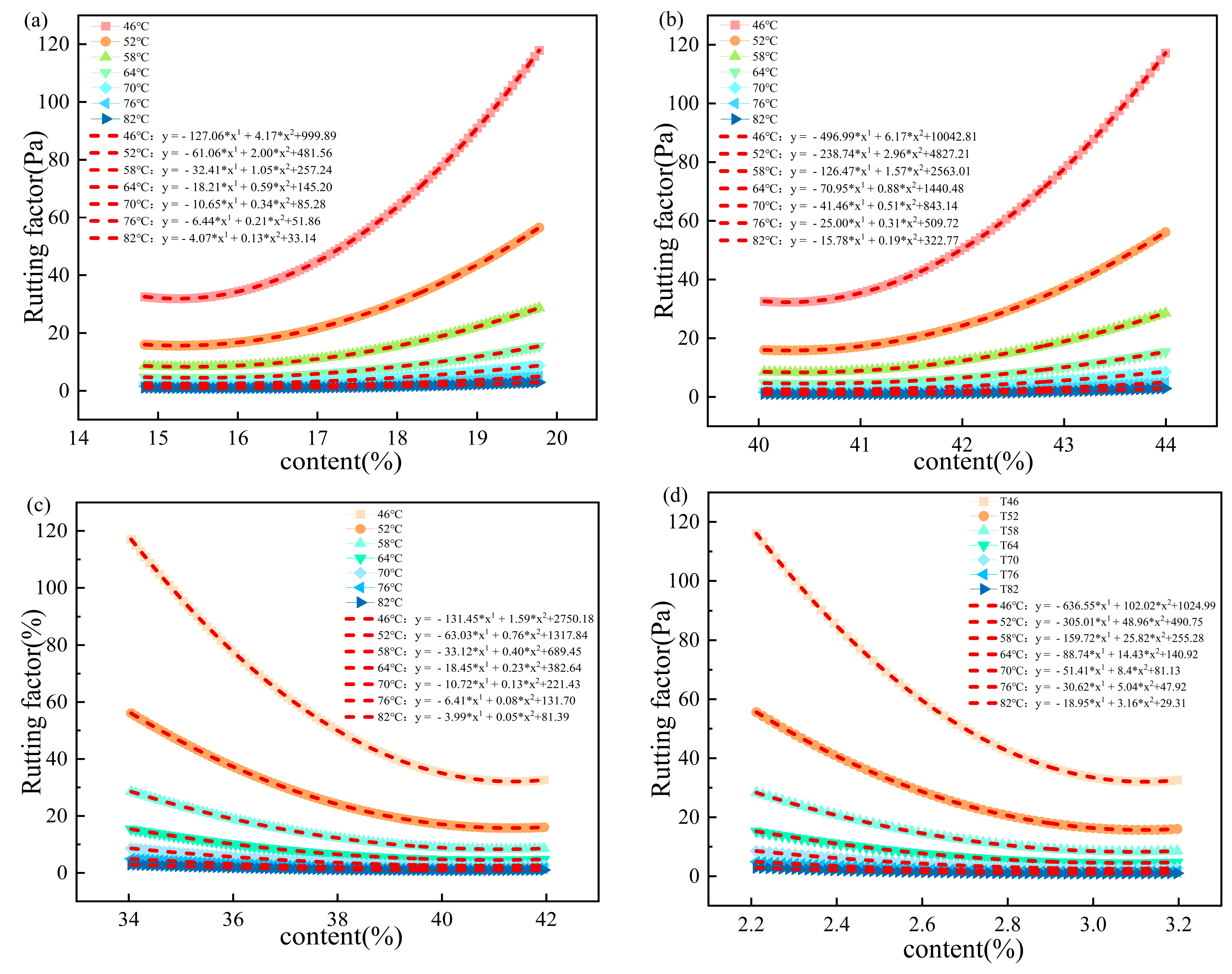
A random forest machine learning model was introduced for training. The relationship between the four asphalt components and the rutting factor at all temperature levels during the full aging phase is shown in Figure 14.
Figure 14.
Mapping of bitumen four-component properties against rutting factor at various temperatures throughout the aging process; (a) Asphaltene content; (b) Resin content; (c) Aromatic content; (d) Saturates content.
As shown in Figure 14, the random forest model accurately captures the nonlinear relationship between the rutting factor and the four components across all temperature and aging stages. As the content of asphaltene and resin increases, the rutting factor shows a significant upward trend; conversely, as the content of saturate and aromatic increases, the rutting factor shows a downward trend. This trend is consistent with existing knowledge, indicating that asphaltene and resin exert a positive regulatory effect on the high-temperature deformation resistance of bitumen. In the extremely hot regions of Xinjiang, where summer road surface temperatures can reach 70 °C, modified bitumen is required to maintain a rutting factor above a certain threshold at that temperature. The model can output the required content ranges for the four components, which can be used to formulate the four-component design. This provides quantifiable theoretical support for the design of SBS-modified formulations, targeted regulation of high-temperature performance, and prediction of service performance for this base bitumen in the Xinjiang region.
4. Conclusions
This study, using a 70# base bitumen from the Xinjiang region, investigates the rheological properties and changes in the four components of SBS-modified bitumen at three different dosage levels under various aging conditions. The conclusions are as follows:
(1) Frequency-sweep tests indicate that SBS polymer significantly improves the high-and low-temperature properties of this Xinjiang-based bitumen. As aging progresses, SBS polymer degradation gradually becomes the dominant process; the phase angle plateau disappears, and its reinforcing effect on high- and low-temperature properties weakens. However, after long-term aging, the 4.5% SBS-modified bitumen exhibits superior performance.
(2) Analysis of multiple-stress creep recovery (MSCR) tests indicates that the addition of SBS significantly reduces Jnr, enhances elastic recovery capacity, and improves the high-temperature rutting resistance of SBS-modified bitumen binder. After long-term aging, a 4.5% SBS content maintains the optimal recovery performance and the lowest cumulative plastic strain.
(3) Temperature sweep test results show that the phase angle increases significantly within the temperature range of 48–72 °C, indicating that SBS has a significant modifying effect on this Xinjiang-based bitumen matrix in this temperature range. Linear amplitude sweep (LAS) testing further confirms that SBS can significantly improve the fatigue life (Nf) at small strains. After long-term oxidative pressure aging, the 4.5% SBS-modified bitumen exhibited the highest yield strain and the lowest stress decay rate, indicating that this polymer content provides better structural stability during the aging process.
(4) Analysis using thin-layer chromatography with flame ionization detection (FLID) revealed that the increase in resin content was most significant under short-term thermal-oxidative aging. During long-term stress aging, saturate and aromatic components oxidize and volatilize to form resin, which is further converted into asphaltene. The 4.5% SBS-modified bitumen exhibited the highest asphaltene content and the greatest increase, confirming at the component level that this blend ratio provides the best resistance to rutting. The SBS content significantly regulates the evolution of aging components, with minimal impact on saturate and aromatic components.
(5) The random forest model accurately captures the nonlinear relationship between the four components and rutting factor across a wide temperature range. It can generate the required ranges for the four components based on temperature data from a specific region in Xinjiang, thereby providing a theoretical basis for the targeted regulation of the high-temperature performance of SBS-modified bitumen in the Xinjiang region.
Taking all factors into account, the recommended optimal SBS content for the 70# base bitumen studied in this paper is 4.5%.
5. Discussion
This study used RTFOT and PAV tests to simulate the short-term thermal-oxidative aging and long-term oxidative pressure aging processes of asphalt; however, it did not account for factors such as intense ultraviolet radiation and freezethaw cycles in the actual environment of the Xinjiang region, nor did it consider their coupled effects. Second, no microscopic characterization analyses, such as Fourier transform infrared spectroscopy (FTIR), scanning electron microscopy (SEM), or fluorescence microscopy (FM), were conducted to track the phase changes in SBS during the aging process; furthermore, the conclusions are based solely on tests of the bitumen binder, and the actual in-service performance of the pavement still needs to be verified through bitumen mixture tests. Future research should conduct multi-factor coupled aging tests and integrate the aforementioned microscopic characterization techniques to more comprehensively reveal the performance evolution patterns of SBS-modified bitumen under the extreme environmental conditions of Xinjiang.
Author Contributions
Conceptualization, Y.Y.; Methodology, Y.Y.; Validation, Z.L.; Formal analysis, Y.Y.; Investigation, Y.Y. and Y.C.; Resources, Z.L.; Data curation, Y.C.; Writing—review and editing, W.W.; Visualization, Y.Y. and W.W.; Supervision, W.Z.; Project administration, W.Z.; Funding acquisition, Z.L. All authors have read and agreed to the published version of the manuscript.
Funding
1. Research on Key Technologies of Stable Asphalt and Pavement Structure Design for Heavy-Duty Asphalt Pavements in Extremely Arid Areas of Xinjiang: AWAGSGCJS-ZXFWHT-002, 2. Research on Key Technologies for Pavement Performance and Construction Quality Control of Crumb Rubber–SBS Composite Modified Asphalt Mixture by Guizhou Highway Engineering Group Co., Ltd.: XHGJ-5-JSFW-004.
Data Availability Statement
The original contributions presented in this study are included in the article. Further inquiries can be directed to the corresponding author.
Conflicts of Interest
Author Wengui Zhang is employed by Guizhou Highway Engineering Group Co., Ltd. Author Wei Wan is employed by Xinjiang Communications Investment Construction Management Co., Ltd. Author Yile Chen is employed by Guizhou Highway Engineering Group Co., Ltd. The remaining authors declare that the research was conducted in the absence of any commercial or financial relationships that could be construed as a potential conflict of interest.
References
- Shambilova, G.K.; Iskakov, R.M.; Shazhdekeyeva, N.K.; Kuanbayeva, B.U.; Kuzin, M.S.; Skvortsov, I.Y.; Makarov, I.S. Environmentally Sustainable and Climate-Adapted Bitumen—Composite Materials for Road Construction in Central Asia. Infrastructures 2025, 10, 345. [Google Scholar] [CrossRef] [Scilit]
- Neupane, P.; Wu, S. A comprehensive review of moisture damage in asphalt mixtures: Mechanisms, evaluation methods, and mitigation strategies. Constr. Build. Mater. 2025, 471, 140740. [Google Scholar] [CrossRef] [Scilit]
- Xin, J.; Frangopol, D.M.; Akiyama, M.; Zhang, L.; Pei, J. Life-cycle performance, design, maintenance, optimization, and decision-making of asphalt pavement under uncertainty: A review. Struct. Infrastruct. Eng. 2026, 22, 358–386. [Google Scholar] [CrossRef] [Scilit]
- Chen, L.; Zhao, X.; Li, L.; Zhang, C. Asphalt pavement performance under complex service conditions. Front. Mater. 2025, 12, 1697740. [Google Scholar]
- Zhang, D.; Chen, Z.; Zhang, H.; Wei, C. Rheological and anti-aging performance of SBS modified asphalt binders with different multi-dimensional nanomaterials. Constr. Build. Mater. 2018, 188, 409–416. [Google Scholar] [CrossRef] [Scilit]
- Li, S.Q.; Yan, C.Q.; Zhou, S.X. Rheological properties and modification mechanism of fumed silica modified asphalt. Acta Mater. Compos. Sin. 2023, 40, 6275–6287. [Google Scholar]
- Zhou, S.; Yan, J.; Shi, B.; Li, S.; Ai, C.; Yan, C. Green synthesis of a broad-spectrum UV-blocking bitumen modifier: Investigation of anti-aging performance and mechanism in bitumen. J. Clean. Prod. 2023, 425, 139064. [Google Scholar] [CrossRef] [Scilit]
- Yi, Y.; Chen, Y.; Shi, S.; Zhao, Y.; Wang, D.; Lei, T.; Duan, P.; Cao, W.; Wang, Q.; Li, H. Study on properties and micro-mechanism of RHB-SBS composite-modified asphalt. Polymers 2023, 15, 1718. [Google Scholar] [CrossRef] [Scilit]
- Zheng, Q.; Wang, H.; Jiang, B.; Yue, S.; Wang, T. Influence Mechanism of Performance and Aging Behavior of High-Content SBS-Modified Asphalt. Buildings 2025, 15, 4430. [Google Scholar] [CrossRef] [Scilit]
- Hosseinnezhad, S.; Zadshir, M.; Yu, X.; Yin, H.; Sharma, B.K.; Fini, E. Differential effects of ultraviolet radiation and oxidative aging on bio-modified binders. Fuel 2019, 251, 45–56. [Google Scholar] [CrossRef] [Scilit]
- Cong, P.; Luo, W.; Xu, P.; Zhao, H. Investigation on recycling of SBS modified asphalt binders containing fresh asphalt and rejuvenating agents. Constr. Build. Mater. 2015, 91, 225–231. [Google Scholar] [CrossRef] [Scilit]
- Zhao, X.; Wang, S.; Wang, Q.; Yao, H. Rheological and structural evolution of SBS modified asphalts under natural weathering. Fuel 2016, 184, 242–247. [Google Scholar] [CrossRef] [Scilit]
- Wang, Y.; Sun, L.; Qin, Y. Aging mechanism of SBS modified asphalt based on chemical reaction kinetics. Constr. Build. Mater. 2015, 91, 47–56. [Google Scholar] [CrossRef] [Scilit]
- Xu, M.; Zhang, Y.; Zhao, P.; Liu, C. Study on aging behavior and prediction of SBS modified asphalt with various contents based on PCA and PLS analysis. Constr. Build. Mater. 2020, 265, 120732. [Google Scholar] [CrossRef] [Scilit]
- Lin, P.; Yan, C.; Huang, W.; Li, Y.; Zhou, L.; Tang, N.; Xiao, F.; Zhang, Y.; Lv, Q. Rheological, chemical and aging characteristics of high content polymer modified asphalt. Constr. Build. Mater. 2019, 207, 616–629. [Google Scholar] [CrossRef] [Scilit]
- Zhou, S.; Wang, J.; Li, S.; Yan, C. Investigating the rheological behaviour of styrene–butadiene–styrene modified asphalt. Road Mater. Pavement Des. 2024, 25, 1964–1979. [Google Scholar] [CrossRef] [Scilit]
- Chen, G.; Wang, Q.; Gu, R.; Lyu, L.; Li, R.; Zhang, H.; Li, G.; Pei, J. Macro-micro coupled investigation of aged styrene-butadiene-styrene modified asphalt binders rejuvenated by waste soybean oil. Constr. Build. Mater. 2025, 499, 144085. [Google Scholar] [CrossRef] [Scilit]
- Xiao, H.; Cao, D.; Qin, Z.; Yi, H.; Chen, X. Research on the effects of SBS swelling, thermal-oxidative aging, and sulfur crosslinking on chemical composition and rheological properties of SBS-modified asphalt. Int. J. Pavement Res. Technol. 2025, 18, 930–950. [Google Scholar] [CrossRef] [Scilit]
- Guo, M.; He, S.X.; Gong, Y.; Xie, H.W.; Jia, Y.X. Correlation between macro and micro properties of asphalt before and after aging. Transp. Res. 2024, 10, 58–69, (In Chinese with English abstract). [Google Scholar] [CrossRef]
- Wu, M.; Yin, L.; Li, M.; You, Z.; Jin, D.; Xin, K. A state-of-the-art review of asphalt aging behavior at macro, micro, and molecular scales. Constr. Build. Mater. 2025, 460, 139738. [Google Scholar] [CrossRef] [Scilit]
- Redelius, P.; Soenen, H. Relation between bitumen chemistry and performance. Fuel 2015, 140, 34–43. [Google Scholar] [CrossRef] [Scilit]
- Firoozifar, S.H.; Foroutan, S.; Foroutan, S. The effect of asphaltene on thermal properties of bitumen. Chem. Eng. Res. Des. 2011, 89, 2044–2048. [Google Scholar] [CrossRef] [Scilit]
- Primerano, K.; Werkovits, S.; Mirwald, J.; Hofko, B. Aging behaviour and mechanical characterisation of maltenes and asphaltenes. Road Mater. Pavement Des. 2025, 26, 870–887. [Google Scholar] [CrossRef] [Scilit]
- Ghasemirad, A.; Bala, N.; Hashemian, L. High-temperature performance evaluation of asphaltenes-modified asphalt binders. Molecules 2020, 25, 3326. [Google Scholar] [CrossRef] [Scilit] [PubMed]
- Tian, R.; Luo, H.; Huang, X.; Zheng, Y.; Zhu, L.; Liu, F. Correlation analysis between mechanical properties and fractions composition of oil-rejuvenated asphalt. Materials 2022, 15, 1889. [Google Scholar] [CrossRef] [Scilit] [PubMed]
- Zhao, Y.; Wu, X.; Chao, Y.; Liang, N.; Zhou, P.; Li, Z.; Mei, Y. Aging characteristics and microscopic mechanisms of SBS asphalt based on coupled light–heat–water aging. Constr. Build. Mater. 2024, 456, 139190. [Google Scholar] [CrossRef] [Scilit]
- Zhang, Y.; Hao, J.; Liu, H.; Chen, C.; Shi, S. Technical development of modified emulsion asphalt: A review on the preparation, performance, and applications. Rev. Adv. Mater. Sci. 2025, 64, 20240078. [Google Scholar] [CrossRef] [Scilit]
- Zhang, L.; Xing, C.; Gao, F.; Li, T.-S.; Tan, Y.-Q. Using DSR and MSCR tests to characterize high temperature performance of different rubber modified asphalt. Constr. Build. Mater. 2016, 127, 466–474. [Google Scholar] [CrossRef] [Scilit]
- Sun, E.; Zhao, Y. Investigation into the Evolution of Structural Characteristics of Asphalt by Aging at Microscale and Macroscale. Transp. Res. Rec. 2025, 2679, 675–693. [Google Scholar] [CrossRef] [Scilit]
- Dai, Z.; Shen, J.; Shi, P.; Zhu, H.; Li, X. Nano-sized morphology of asphalt components separated from weathered asphalt binders. Constr. Build. Mater. 2018, 182, 588–596. [Google Scholar] [CrossRef] [Scilit]
- Zhang, E.; Shan, L.; Qi, X.; Wang, X.; Fan, Y. Investigating the relationship between chemical composition and mechanical properties of asphalt binders using atomic force microscopy (AFM). Constr. Build. Mater. 2022, 343, 128001. [Google Scholar] [CrossRef] [Scilit]
- JTG E20-2011; Standard Test Methods of Bitumen and Bituminous Mixtures for Highway Engineering. China Communications Press: Beijing, China, 2011.
- AASHTO T315-09; Standard Method of Test for Determining the Rheological Properties of Asphalt Binder Using a Dynamic Shear Rheometer (DSR). American Association of State Highway and Transportation Officials: Washington, DC, USA, 2009.
- AASHTO T313; Standard Method of Test for Determining the Flexural Creep Stiffness of Asphalt Binder Using the Bending Beam Rheometer (BBR). American Association of State Highway and Transportation Officials: Washington, DC, USA, 2022.
- Xu, G.; Li, Q.; Kuang, H.; Zhang, H.; Zhou, R.; Chen, Y. Structural Repair and Performance Evaluation of Aged SBS Modified Asphalt. J. China Foreign Highw. 2024, 44, 108–116. [Google Scholar]
- Rowe, G.M.; Sharrock, M.J. Alternate shift factor relationship for describing temperature dependency of viscous-elastic behavior of asphalt materials. Transp. Res. Rec. 2011, 2207, 125–135. [Google Scholar] [CrossRef] [Scilit]
- Xiong, K.; He, Y.; Hu, D.; Pei, J.; Zhang, J.; Li, R.; Cavalli, M.C. Chemical characterization of asphaltene structures derived from resins transformation for an in-depth understanding of asphalt aging mechanisms. Constr. Build. Mater. 2025, 493, 143213. [Google Scholar] [CrossRef] [Scilit]
- Fischer, H.R.; Cernescu, A. Relation ot chemical composition to asphalt microstructure-Details and properties of micro- structures in bitumen as seen by thermal and friction force microscopy and by scanning near-filed optical microscopy. Fuel 2015, 153, 628–633. [Google Scholar] [CrossRef] [Scilit]
- Cao, Z.; Hao, Q.; Qu, X.; Qiu, K.; Zhao, R.; Liu, Q. Evolution of structure and properties of SBS-modified asphalt during aging process. Buildings 2024, 14, 291. [Google Scholar] [CrossRef] [Scilit]
- Li, L.; Guo, Z.; Ran, L.; Zhang, J. Study on low-temperature cracking performance of asphalt under heat and light together conditions. Materials 2020, 13, 1541. [Google Scholar] [CrossRef] [Scilit]
- Wang, Y.; Zang, Z.; Xu, W. Study on the Influence of ZM Modifier on the Rheological Properties and Microstructural Characteristics of Asphalt. Coatings 2025, 15, 1069. [Google Scholar] [CrossRef] [Scilit]
- Zhang, H.; Lv, S.; Pang, J.; Chen, J.; Xuan, W.A. Effects of aging on rheological properties and microstructural evolution of SBS modified asphalt and crumb rubber modified asphalt binders. Buildings 2024, 14, 1722. [Google Scholar] [CrossRef] [Scilit]
- Sharma, A.; Ransinchung, R.N.G.D.; Ravindranath, S.S. Synergistic effects of SBS polymer degradation and binder stiffening on the rheological properties of SBS-modified asphalt during RTFO aging. Mech. Time-Depend. Mater. 2026, 30, 35. [Google Scholar] [CrossRef] [Scilit]
- Yan, C.; Huang, W.; Lin, P.; Zhang, Y.; Lv, Q. Chemical and rheological evaluation of aging properties of high content SBS polymer modified asphalt. Fuel 2019, 252, 417–426. [Google Scholar] [CrossRef] [Scilit]
- Zhu, C.; Zhang, H.; Xu, G.; Shi, C. Aging rheological characteristics of SBR modified asphalt with multi-dimensional nanomaterials. Constr. Build. Mater. 2017, 151, 388–393. [Google Scholar] [CrossRef] [Scilit]
- Zhou, S.; Yan, J.; Ning, W.; Li, S.; Ai, C.; Yan, C. Performance and mechanism of using low-cost fumed silica nanoparticles in enhancing high viscosity modified asphalt. Constr. Build. Mater. 2023, 409, 134090. [Google Scholar] [CrossRef] [Scilit]
- Lesueur, D. The colloidal structure of bitumen: Consequences on the rheology and on the mechanisms of bitumen modification. Adv. Colloid Interface Sci. 2009, 145, 42–82. [Google Scholar] [CrossRef] [Scilit] [PubMed]
- Asif, S.A.; Ahmad, N.; Asif, S.U.; Zaidi, S.B.A.; Amin, S. Effect of aging on physical, chemical, and thermal properties of bitumen. J. Transp. Eng. Part B Pavements 2023, 149, 04023006. [Google Scholar] [CrossRef] [Scilit]
- Mirwald, J.; Werkovits, S.; Camargo, I.; Maschauer, D.; Hofko, B.; Grothe, H. Investigating bitumen long-term-ageing in the laboratory by spectroscopic analysis of the SARA fractions. Constr. Build. Mater. 2020, 258, 119577. [Google Scholar] [CrossRef] [Scilit]
- Hu, Z.; Zhang, H.; Wang, S.; Xu, T. Thermal-oxidative aging mechanism of asphalt binder based on isothermal thermal analysis at the SARA level. Constr. Build. Mater. 2020, 255, 119349. [Google Scholar] [CrossRef] [Scilit]
- Zhang, H.; Li, Y.; Zhang, J.; Li, Z.; Chen, Z.; Pei, J.; Wang, M. Examining the rheological and adhesion performance of asphalt: Insights into the influence of SARA components. Case Stud. Constr. Mater. 2024, 21, e03427. [Google Scholar] [CrossRef] [Scilit]



Disclaimer/Publisher’s Note: The statements, opinions and data contained in all publications are solely those of the individual author(s) and contributor(s) and not of MDPI and/or the editor(s). MDPI and/or the editor(s) disclaim responsibility for any injury to people or property resulting from any ideas, methods, instructions or products referred to in the content. |
© 2026 by the authors. Licensee MDPI, Basel, Switzerland. This article is an open access article distributed under the terms and conditions of the Creative Commons Attribution (CC BY) license.