


Abstract
Pavement management systems (PMS) are essential for formulating a cost-effective capital improvement plan (CIP) that adheres to budget constraints. Optimization techniques are vital in enhancing the efficiency of these plans. Among the various methods available, genetic algorithms (GA) are particularly effective at identifying optimal solutions in complex scenarios. This study introduces a GA-based priority optimization model designed to select the most beneficial road improvement projects while staying within budgetary limits. The model was applied to the extensive road network of Fort Wayne, Indiana, considering critical factors such as budget allocation, roadway classification, PASERs, treatment options, and associated costs. The results demonstrate the model’s effectiveness in prioritizing projects, ensuring that available funds are utilized to achieve maximum impact on roadway conditions. By leveraging GA, this approach not only enhances decision-making processes but also provides a robust framework for future pavement management efforts. Overall, the integration of genetic algorithms into PMS can lead to more strategic and economically sound infrastructure improvements.
1. Introduction
In the United States, Capital Improvement Plans (CIPs) serve as a strategic framework for prioritizing road maintenance projects across the nation [1]. Each state’s Department of Transportation develops a Pavement Management System (PMS) that can be tailored by counties or local agencies. Although prioritization methods may differ, the primary objective is to enhance the overall transportation network within a limited budget efficiently [2,3]. However, many local agencies face resource constraints that hinder the adoption of advanced prioritization techniques. To address this challenge, there is a need for a PMS that is specifically designed for local agencies. This system should be user-friendly, require minimal resources, and effectively improve road conditions while adhering to budget limitations. By focusing on practicality and efficiency, such a tailored PMS can empower local agencies to make informed decisions about road maintenance, ensuring that funds are utilized wisely, and that transportation infrastructure is maintained at a high standard. Ultimately, the development of an accessible and effective PMS will help local agencies overcome resource challenges and contribute to the overall improvement of the nation’s transportation network. This study aimed to develop a pavement management system (PMS) specifically for local roads.
Optimization techniques are vital in developing a PMS as they enable the identification of the most cost-effective mix of maintenance and rehabilitation projects, ultimately maximizing overall network performance [4,5,6,7,8,9,10,11]. A brief overview of various optimization techniques, along with their advantages and disadvantages, is presented in Table 1 below. Among the optimization techniques, genetic algorithms (GA) have emerged as an effective tool for addressing complex optimization challenges inherent in pavement management systems [2,12]. By mimicking the principles of natural selection, GAs evolves solutions towards optimality, making them particularly well-suited for determining the best CIP strategies. This iterative process allows for the exploration of a wide solution space, ensuring that various factors, such as budget constraints and project priorities, are considered. As a result, GAs not only enhance the decision-making process for local agencies but also facilitate the development of sustainable and efficient maintenance plans. Through the application of genetic algorithms, agencies can better allocate resources and prioritize projects, ultimately leading to improved road conditions and a more resilient transportation network [3].
Table 1.
Summary of Optimization Techniques Applied in Previous Studies.
Priority ranking optimization techniques are vital tools in pavement management systems (PMS) for the efficient allocation of limited resources to maintenance and rehabilitation projects [13,14,15,16]. These techniques systematically prioritize pavement sections by evaluating a range of factors such as pavement condition, traffic volume, and budget limitations. By doing so, they ensure that the most critical sections receive timely attention and maintenance, thus optimizing overall network performance. This prioritization process not only helps in identifying which roads are in the greatest need of repair but also assists agencies in making informed decisions that align with budgetary constraints. By focusing on high-priority areas, local agencies can maximize the impact of their maintenance efforts and extend the lifespan of their road infrastructure. Ultimately, effective priority ranking leads to improved safety and service quality for road users, as well as enhanced sustainability of the transportation network. Through these optimization techniques, agencies can navigate resource challenges and strategically manage pavement conditions to ensure that funding is utilized effectively and efficiently.
While genetic algorithms (GA) have been previously applied in pavement management systems, many studies primarily focus on network-level optimization without explicitly integrating practical priority-ranking criteria used by local agencies. This study addresses this gap by developing a priority-based GA optimization model that combines engineering condition indicators (PASER), roadway classification, treatment options, and agency budget constraints within a unified framework. Unlike traditional approaches that rely solely on condition or cost minimization, the proposed method incorporates project prioritization factors commonly used in practice. The application to the Fort Wayne, Indiana road network demonstrates how the model improves decision-making and resource allocation, thereby providing a practical and implementable advancement for local pavement management systems.
This study developed a priority-based optimization model utilizing genetic algorithms (GA) for the pavement management system (PMS) of local roads.
2. Methodology
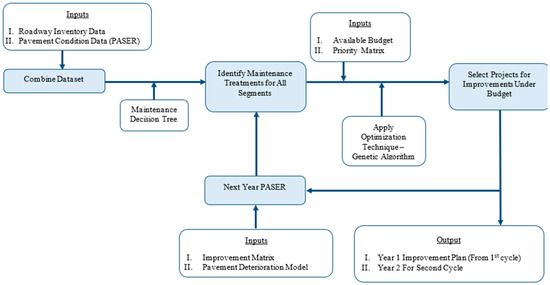
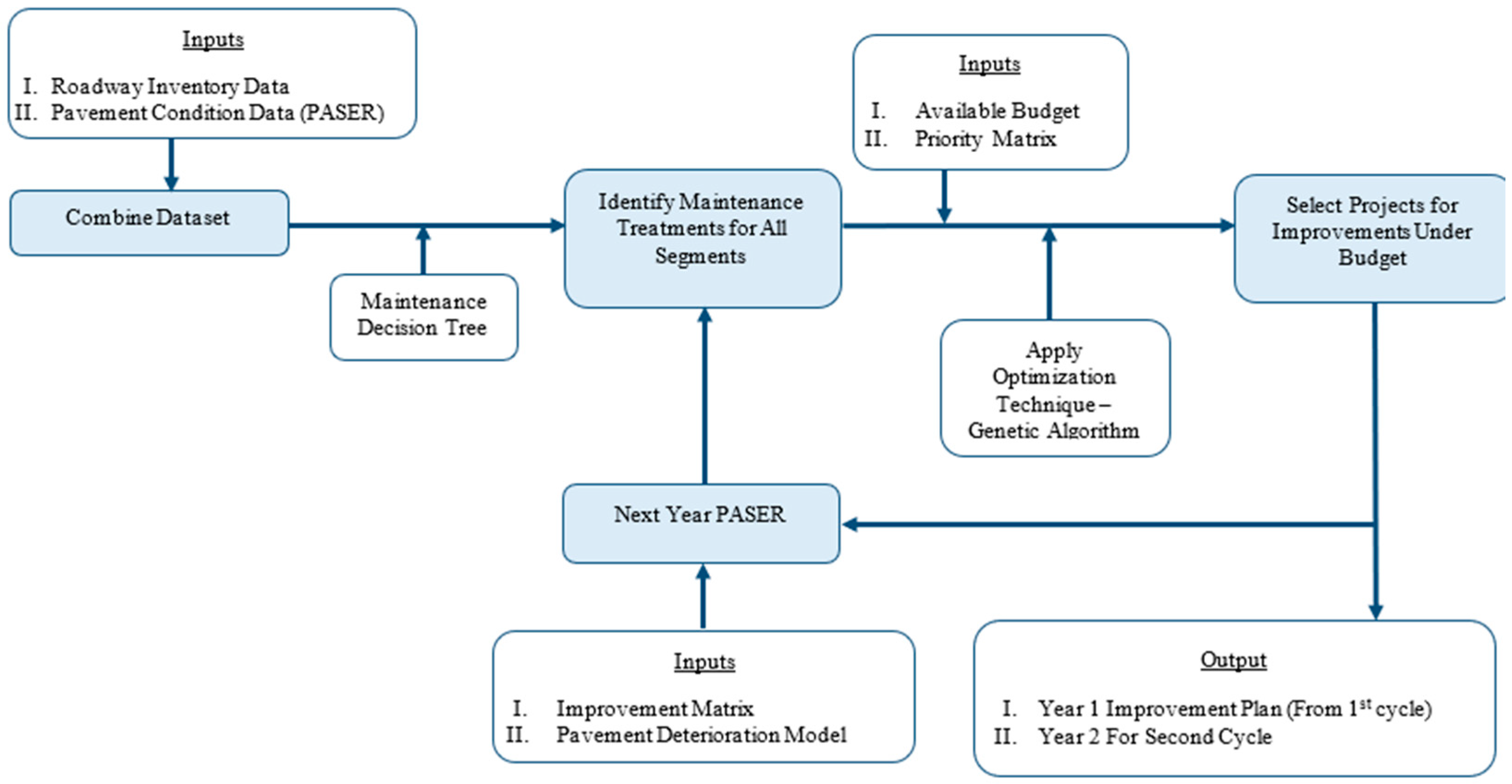
This study proposes a comprehensive Pavement Management System (PMS) that leverages a Genetic Algorithm (GA) to optimize pavement maintenance and rehabilitation strategies. The proposed system aims to effectively allocate limited resources by prioritizing projects based on their criticality and considering various factors such as pavement condition, available budget, and maintenance treatment options. Figure 1 illustrates the overall methodology, with the key inputs and steps outlined in the following sections.
Figure 1.
Research Methodology.
2.1. Data Collection and Preparation of Input Dataset
The first step in the PMS involves the collection and preparation of relevant data. Two primary datasets are required:
- Roadway Inventory Data: This dataset provides information about the road network, including its length, type, and condition. It serves as a foundation for identifying potential maintenance needs.
- Pavement Condition Data (PASER): Collected through Pavement Assessment Surveys, this data offers insights into the current state of the pavement, such as its roughness, cracking, and patching. PASER data is crucial for assessing the severity of pavement deterioration and determining appropriate maintenance treatments.
Once collected, the two datasets are combined into a comprehensive dataset to facilitate subsequent analysis and decision-making as shown in Table 2.
Table 2.
Sample Combined Dataset.
2.2. Pavement Maintenance Cost and Decision Tree
Using the combined dataset, the optimization model identifies the most suitable maintenance treatments for each road segment. This process involves analyzing pavement condition data while considering factors such as pavement deterioration, budget, and available maintenance options. A decision tree (see Table 3) can be utilized to streamline this selection process, ensuring that treatments are chosen based on specific criteria. This table illustrates the relationship between PASERs, maintenance and rehabilitation (M&R) treatments, anticipated PASER improvements, and associated costs. For local roads, six types of pavement maintenance treatments are currently under consideration. The “Existing PASER” column shows the pavement’s initial condition, while the “New PASER after Improvement” column indicates the expected condition post-treatment. The “Cost per lane-mile” provides cost estimates for each treatment. The table indicates that pavements with lower PASERs (1–2) require more extensive and costly treatments, such as reconstruction, to achieve significant improvements. Conversely, as the initial PASER increases, less intensive and more economical treatments, like chip sealing or patch paving, can yield smaller yet meaningful enhancements in PASERs.
Table 3.
Pavement Maintenance Cost and Decision Tree.
2.3. Prioritization of Projects
To allocate limited budget effectively, the system prioritizes projects for improvement based on their criticality and alignment with the available budget. A priority matrix is developed to define the relative importance of different maintenance treatments and pavement conditions. This matrix allows for the quantification of the benefits and costs associated with each project, enabling informed decision-making. The following Table 4 summarizes the costs, rankings, and distribution of different pavement maintenance and rehabilitation (M&R) treatments. Cost per lane-mile represents the construction or treatment cost required to maintain or rehabilitate one lane-mile of roadway, providing a standardized measure for comparing project costs across different road segments. Cost per PASER improvement reflects the cost required to increase the pavement condition rating (PASER) by one unit, indicating the efficiency of a treatment in improving pavement condition. The costs per M&R treatment increase with the complexity and intensity of the treatment, ranging from $1500 for crack sealing to $176,471 for reconstruction. The priority ratio reflects the order of preference for selecting M&R treatments, with crack sealing being the most preferred and reconstruction being the least preferred. The distribution of M&R treatments across road types indicates that arterial roads receive a higher proportion of more intensive and expensive treatments compared to collector and residential roads. This suggests that arterial roads, which typically carry higher traffic volumes, require more extensive maintenance to maintain their condition.
Table 4.
Priority Ratio of Maintenance Types.
2.4. Genetic Algorithm
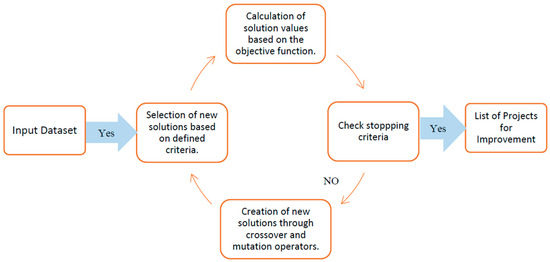
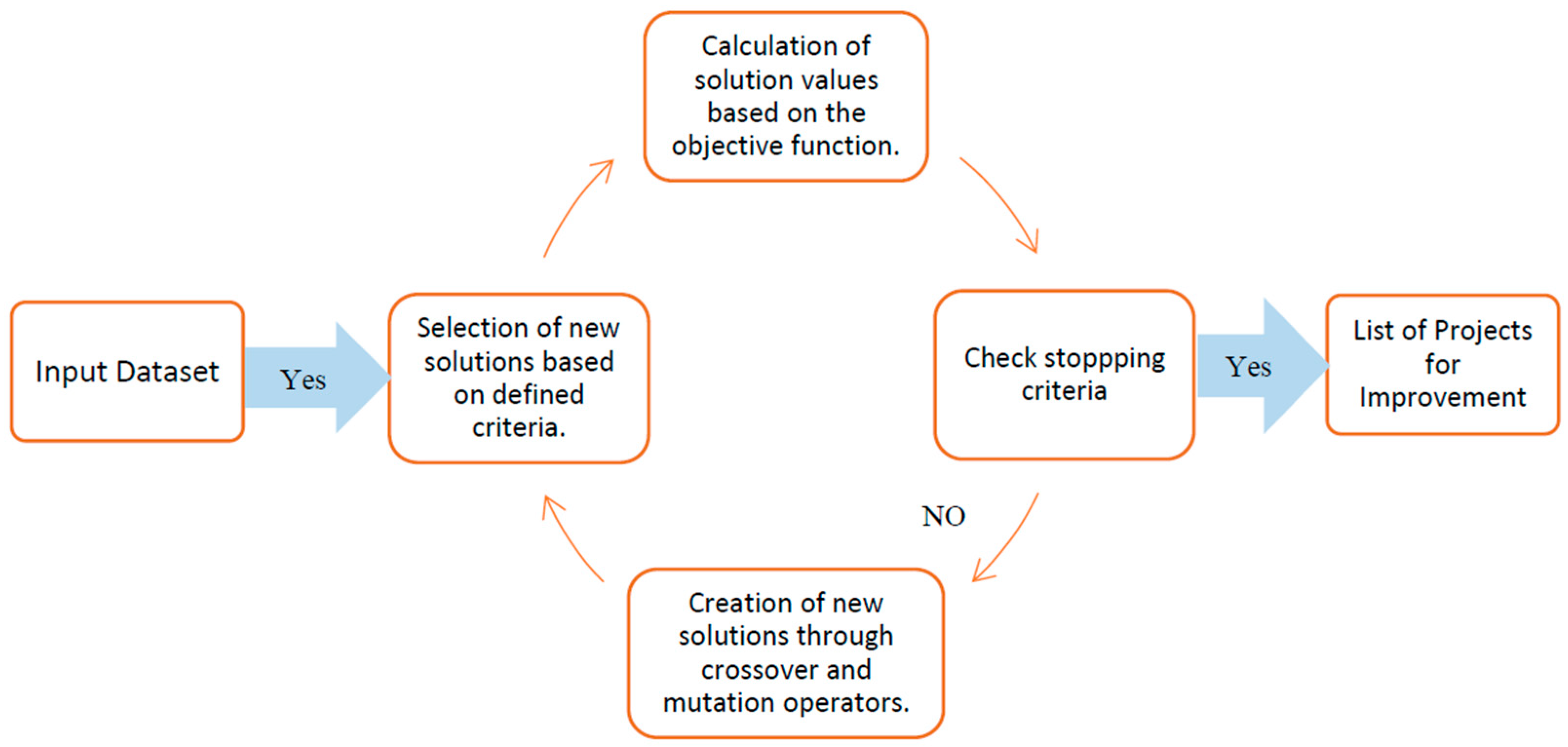
A Genetic Algorithm (GA) is incorporated into the PMS to optimize the selection of projects and the allocation of resources. The GA mimics the process of natural evolution, iteratively improving the solution through processes of selection, crossover, and mutation [17,18,19].
- Initialization: An initial population of potential solutions is generated. Each solution represents a specific combination of projects and resource allocations.
- Evaluation: The fitness of each solution is evaluated based on its adherence to budget constraints and its contribution to improving overall pavement condition.
- Selection: The fittest individuals from the population are selected for reproduction.
- Crossover: Genetic material is exchanged between selected individuals to create new offspring solutions.
- Mutation: Random changes are introduced to the genetic material of some individuals to maintain diversity and explore new possibilities.
- Termination: The GA continues until a satisfactory solution is found or a predetermined termination criterion is met.
The genetic algorithm (GA) was implemented using Microsoft Excel with the Palisade Evolver add-in to identify the optimal combination of pavement projects under budget constraints. A binary encoding scheme was used, where each gene represents a pavement segment and the decision variable takes a value of 1 if selected for treatment and 0 otherwise. Each chromosome therefore represents a feasible set of projects.
The initial population consisted of 50 randomly generated solutions using an automatic seed. A rank-based tournament selection strategy was employed to select parent solutions, giving higher probability to better-performing candidates. A uniform crossover operator with a crossover rate of 0.5 was applied to exchange genetic information between parent solutions. Mutation was implemented using a bit-flip operator with a mutation rate of 0.1 to maintain population diversity and prevent premature convergence.
Hard constraints were enforced to ensure budget limits were not violated. The convergence criterion was defined as either reaching 5000 trials, exceeding the 5 min runtime limit, or no improvement in the objective function over successive generations. These settings ensure reproducibility and provide a structured framework for identifying optimal pavement treatment strategies.
The GA’s ability to explore a wide range of potential solutions and adapt to changing conditions makes it well-suited for optimizing pavement maintenance and rehabilitation strategies. In previous studies, different types of genetic algorithms were applied for pavement management systems, including the adaptive hybrid genetic algorithm, the multi-objective genetic algorithm, and stochastic simulation-based genetic algorithms [20].
In this study, the optimized solution generated by the GA provides a prioritized list of projects and a corresponding resource allocation plan (see Figure 2). This plan serves as a roadmap for implementing pavement maintenance and rehabilitation activities over a specified period.
Figure 2.
Genetic Algorithm.
2.5. Optimization Model
The optimization model presented aims to minimize the weighted sum of priority indices for selected pavement maintenance projects while ensuring that the total treatment costs do not exceed the available budget. The objective function calculates the weighted average priority index of the selected projects. Constraints (2) ensure that the total cost of the selected projects does not exceed the budget. Constraint (3) specifies that the decision variables must be binary, indicating whether a project is selected or not. In essence, the model seeks to identify a set of projects that maximizes the overall priority index while staying within the budgetary constraints.
In Equations (1) and (2), n represents the total number of roadway segments; represents whether the segment is selected or not (if the segment is not selected for improvements, the is 0; otherwise, it is 1); represents the length of the segment; represents the roadway type (residential, collector and arterial); length of a segment was incorporated in the objective function to estimate the weighted PASER. The only constraint used in this model was budget.
In the developed model, minimizing the priority index is conceptually equivalent to maximizing the overall impact of pavement improvement decisions. The priority index is formulated so that roadway segments with treatments with low costs and higher functional importance receive lower priority values. Therefore, selecting projects that minimize the total weighted priority index ensures that the most critical pavement sections are addressed first, resulting in the greatest overall improvement in network condition. The priority index is calculated based on treatment type and roadway functional classification. A genetic algorithm is then applied to identify the optimal combination of projects that minimizes the priority index while satisfying the available budget constraint.
3. Case Study: Fort Wayne Roadway Network
3.1. Study Area
This study focused on the road network within the city of Fort Wayne, Indiana, a city with a population of 263,886 as of the 2020 census. Fort Wayne’s road network consists of 12,505 segments, totaling 1167 miles of center line and 2570 lane miles. A breakdown of road surface types reveals that asphalt concrete is the dominant surface, comprising nearly 70% of the total lane-miles. Other surfaces, such as brick, gravel, concrete reinforced and concrete plain, are also present and excluded from this study. The analysis specifically examined asphalt-surfaced segments, which account for 9735 segments and 922 miles (2037 lane-miles). The length of these segments varies significantly, with the shortest measuring 0.003 miles and the longest reaching 1.57 miles, while the average length is 0.095 miles.
3.2. Existing Pavement Condition
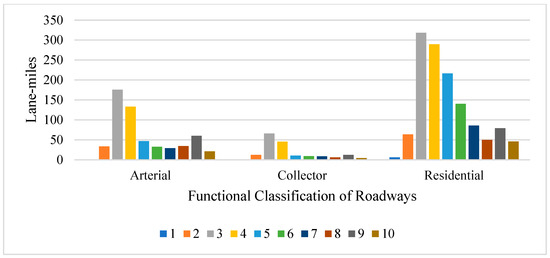
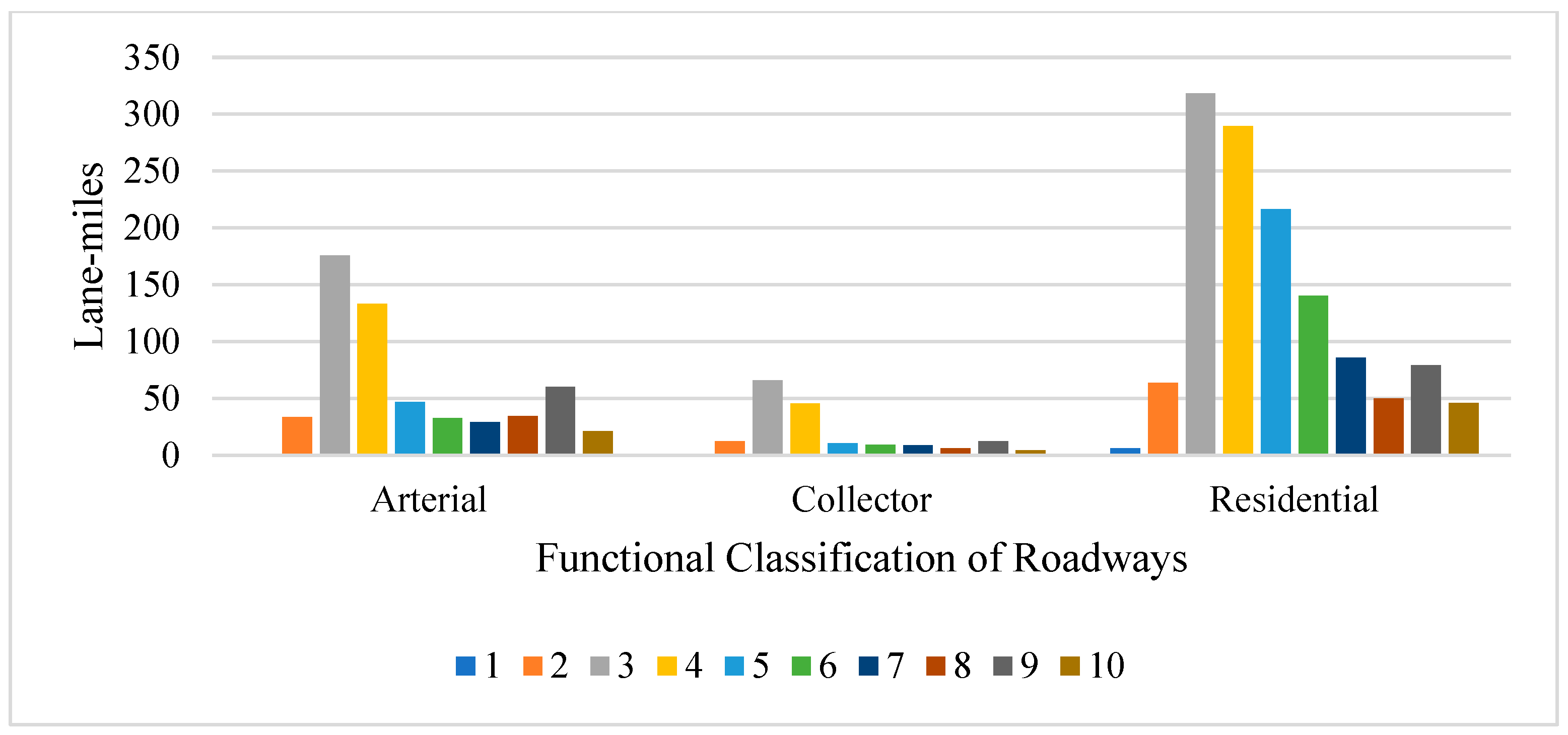
Figure 3 and Table 5 shows the distribution of roadways by functional classification, along with their corresponding lane miles, percentage of total lane-miles, budget for repairs, and overall PASERs. Arterial, collector, and residential roads account for 28%, 9%, and 63% of lane-miles respectively. The overall budget for roadway repairs is expected to be approximately $213,880,830. The overall PASER for all roadways is 4.8, but the average PASER for collector roads is 4.4, the lowest of the three functional classifications.
Figure 3.
Pavement Conditions by Functional Classification of Roadways.
Table 5.
Summary of miles by functional classification of roadways.
3.3. Priority Index
Table 6 and Table 7 summarizes the costs, rankings, and distribution of different pavement maintenance and rehabilitation (M&R) treatments across three road types: arterial, collector, and residential. The costs per M&R treatment increase with the complexity and intensity of the treatment, ranging from $1000 for crack sealing to $35,294 for reconstruction. The ranking reflects the order of preference for selecting M&R treatments, with crack sealing being the most preferred and reconstruction being the least preferred. The “Overall Weight” values in Table 7 and Table 8 are calculated by combining normalized ranking weights with functional class factors. First, the weighting factors (29, 24, 19, 14, 10, 5) are normalized by dividing each by the total (100) and converting to percentages. For example, Rank 1 becomes 29%. Next, these normalized values are multiplied by the class-specific factors (Arterial = 1.0, Collector = 0.39, Residential = 0.14). Thus, for Rank 1, the weights are 28.6 (Arterial), 11.1 (Collector), and 4.0 (Residential). This process is repeated for all ranks to obtain the final overall weights consistently across categories. The distribution of M&R treatments across road types indicates that arterial roads receive a higher proportion of more intensive and expensive treatments compared to collector and residential roads. This suggests that arterial roads, which typically carry higher traffic volumes, require more extensive maintenance to maintain their condition.
Table 6.
Priority index for each combination of roadways and treatments.
Table 7.
Overall weight of each type of roadways for selecting M&R treatments.
Table 8.
Software—Optimization Settings and Model Definition.
3.4. Effectiveness of GA Compared to Linear and Greedy Optimization
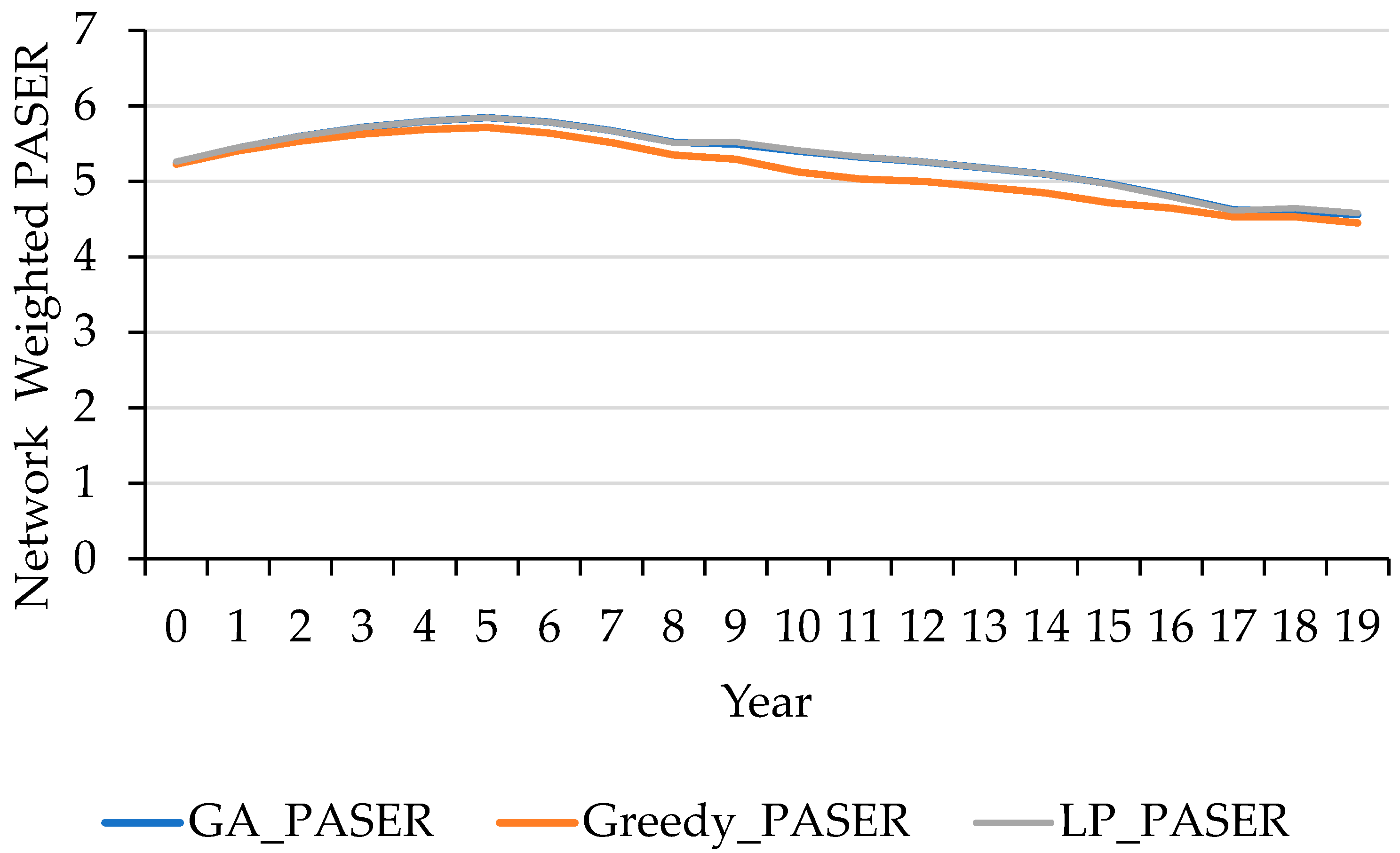
To evaluate the performance of the proposed approach, the Genetic Algorithm (GA) was compared with two commonly used optimization techniques: the Greedy method and Linear Programming (LP). The comparison focuses on network-level weighted PASER values over the analysis period, providing a consistent basis for assessing solution quality and long-term effectiveness.
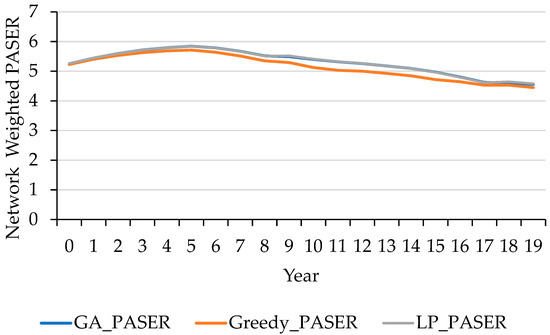
The results show that GA consistently maintains a higher network-level weighted PASER over the analysis period compared to the Greedy approach and performs competitively with LP (see Figure 4). While LP slightly outperforms GA in some early years, GA provides comparable long-term performance with greater flexibility in handling complex, nonlinear constraints. This demonstrates that the GA-based model improves decision-making and resource allocation by achieving near-optimal or improved pavement conditions over time.
Figure 4.
Comparison of Network PASER Across Three Optimization Techniques.
3.5. Software Inputs
The genetic algorithm was applied using an optimization software to find the best set of projects for improvements within budget. Table 8 provides the configuration settings for the optimization process which mimics the principles of natural selection to optimize solutions. The process is set to run for 5000 trials within a time limit of 5 min. The Progress recorded so far is 0.03%, indicating minimal advancement at the point of measurement. The Initial Seed is set to Automatic, meaning the random number generator used for starting conditions is automatically determined. The Population Size is 50, representing the number of candidate solutions evaluated in each generation. A Crossover Rate of 0.5 specifies that half of the genetic material is exchanged between solutions during reproduction, while a Mutation Rate of 0.1 introduces small random changes to 10% of the population to maintain diversity. The Constraint Type is marked as Hard, meaning strict rules govern feasible solutions. The Adjustable Cell Ranges are set to a “Recipe-type”, suggesting the variables being optimized pertain to a specific recipe or configuration. Lastly, the Analysis Type is Standard, indicating a typical or non-specialized evaluation method is used for the process. This setup highlights a structured and systematic approach to solving complex optimization problems.
The genetic algorithm was implemented using the optimization solver in Microsoft Excel with the Palisade Evolver add-in. The model was developed within a spreadsheet environment where decision variables, constraints, and the objective function were defined. The genetic algorithm-based evolutionary solver in Excel was used to search for the optimal combination of pavement projects under the specified budget constraint. This platform was selected because it is widely accessible to local agencies and practitioners, allowing the optimization framework to be easily replicated and applied in practical pavement management applications.
3.6. Sensitivity Analysis
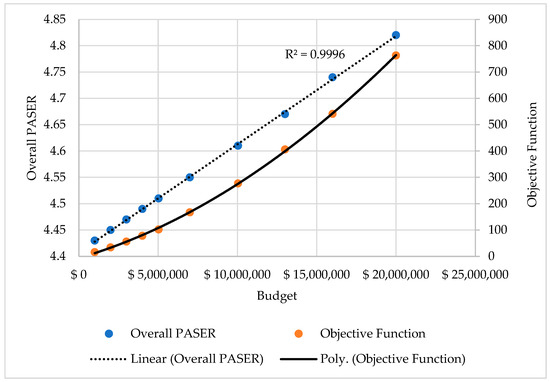
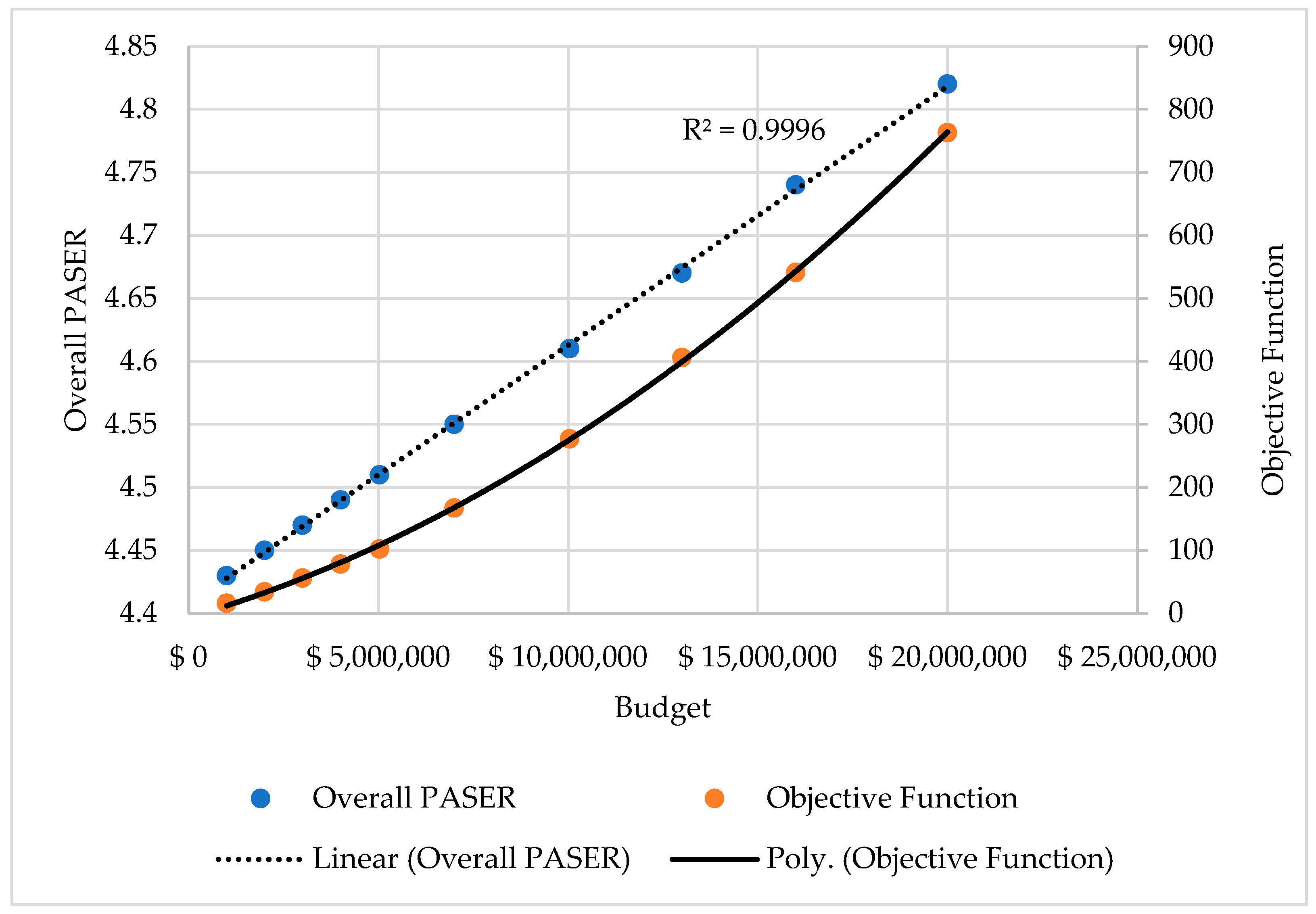
As the budget increases, the overall PASER of the road network improves. This rating is influenced by the total budget allocated for road maintenance. Figure 5 illustrates the trend of overall PASERs at various budget levels. For instance, with a budget of $1 million, the overall PASER is 4.61. Table 9 provides a sample output of project selection using the model developed in this study, detailing the selected projects along with their treatment types, overall costs, and priority indices. Table 10 Provides the summary results from the GA developed in this study.
Figure 5.
Modeling results of Scenario 1 from different trials.
Table 9.
Sample Output Results.
Table 10.
Summary of Selected Projects for Improvement.
The following section presents the results of the analysis and provides a detailed discussion of their implications.
4. Results and Discussion
The application of the proposed optimization framework to the Fort Wayne roadway network provides important insights into pavement management decision-making under budget constraints. The analysis shows that the overall network condition, represented by a weighted PASER of 4.8, reflects moderate pavement performance, with collector roads exhibiting the lowest average condition (PASER = 4.4). This indicates a critical need for targeted interventions within the collector network to prevent further deterioration and avoid costly future rehabilitation.
The priority index developed in this study effectively differentiates maintenance and rehabilitation (M&R) strategies based on treatment type and functional classification. Higher-ranked, lower-cost treatments such as crack sealing and patch chip sealing are more frequently assigned, particularly for arterial and collector roads, demonstrating the model’s emphasis on preventive maintenance. This aligns with best practices in pavement management, where early interventions are more cost-effective than delayed reconstruction.
The Genetic Algorithm (GA) results further highlight the efficiency of the proposed approach. Compared to the Greedy method, GA consistently achieves higher network-level PASER values, indicating improved allocation of limited resources. While Linear Programming (LP) shows slightly better performance in the short term, GA provides comparable long-term outcomes with added flexibility to handle discrete decision variables and non-linear constraints inherent in real-world pavement systems.
The sensitivity analysis confirms a direct relationship between budget levels and network condition improvement. As funding increases, the model selects a greater number of preservation and rehabilitation treatments, leading to higher overall PASER values. Notably, the majority of selected projects fall under preservation (523 lane-miles), emphasizing the cost-effectiveness of early maintenance strategies over reconstruction.
Overall, the results demonstrate that the proposed GA-based framework supports balanced and practical decision-making, enabling agencies to optimize pavement conditions while efficiently utilizing available budgets.
5. Conclusions
This study demonstrates the effectiveness of a Genetic Algorithm (GA)-based framework for optimizing pavement maintenance and rehabilitation decisions at the network level. Applied to the Fort Wayne roadway system, the model successfully integrated key factors—including budget constraints, functional classification, PASERs, treatment types, and costs—to generate practical and data-driven investment strategies. The results show that the GA approach consistently improves network-level pavement conditions compared to a Greedy method and achieves performance comparable to Linear Programming (LP), particularly over the long term. Additionally, the model emphasizes cost-effective preservation strategies, with a significant portion of selected projects focused on preventive maintenance rather than reconstruction. In addition, the model successfully prioritized projects, ensuring that resources were allocated to the most critical needs. By integrating these factors, the model not only improved decision-making processes but also enhanced the overall condition of the road network, demonstrating its practical utility in real-world pavement management scenarios.
Compared to existing approaches in the literature, which often rely on deterministic or linear formulations, the GA-based model offers greater flexibility in handling discrete decision variables and non-linear constraints commonly encountered in real-world pavement management. While LP methods may provide slightly better short-term optimality under simplified assumptions, the GA approach demonstrates strong adaptability and robustness, making it more suitable for complex, large-scale transportation networks. However, the model’s performance depends on parameter settings (e.g., population size, mutation rate), and computational efficiency may be a concern for larger datasets.
Future research should focus on enhancing the model by incorporating uncertainty in deterioration rates, traffic growth, and cost estimates, as well as integrating multi-objective optimization to balance condition, cost, and user impacts. Expanding the framework to include multiple pavement types and real-time data sources (e.g., sensor-based monitoring) would further improve its applicability. Overall, this work provides a scalable and practical foundation for advancing intelligent, optimization-based pavement management systems.
Funding
This research received no external funding.
Data Availability Statement
The data presented in this study are available on request from the corresponding author due to privacy and confidentiality restrictions associated with the data source.
Conflicts of Interest
The author declares no conflicts of interest.
Abbreviations
The following abbreviations are used in this manuscript:
| GA | Genetic Algorithm |
| PMS | Pavement Management Systems |
| CIP | Capital Improvement Program |
| PASER | Pavement Surface Evaluation and Rating |
| M&R | Maintenance and Rehabilitation |
| LP | Linear Programming |
| IP | Integer Programming |
| DP | Dynamic Programming |
| SA | Simulated Annealing |
References
- Haas, R.; Hudson, W.R.; Zaniewski, J. Modern Pavement Management; Krieger Publishing Company: Malabar, FL, USA, 1994. [Google Scholar]
- Fwa, T.F.; Chan, W.T.; Tan, C.Y. Genetic-algorithm programming for optimizing pavement maintenance and rehabilitation works. J. Transp. Eng. 2000, 126, 315–322. [Google Scholar] [CrossRef] [Scilit]
- Labi, S.; Sinha, K.C. Transportation Decision Making: Principles of Project Evaluation and Programming; John Wiley & Sons: Hoboken, NJ, USA, 2003. [Google Scholar]
- Shah, Y.U.; Jain, S.S.; Parida, M. Evaluation of prioritization methods for effective pavement maintenance of urban roads. Int. J. Pavement Eng. 2014, 15, 238–250. [Google Scholar] [CrossRef] [Scilit]
- Saha, P.; Ksaibati, K. A Risk-based Optimization Methodology for Pavement Management System of County Roads. Int. J. Pavement Eng. 2015, 17, 913–923. [Google Scholar] [CrossRef] [Scilit]
- Mishra, S.; Golias, M.M.; Sharma, S.; Boyles, S.D. Optimal Funding Allocation Strategies for Safety Improvements on Urban Intersections. Transp. Res. Part A 2015, 75, 113–133. [Google Scholar] [CrossRef] [Scilit]
- Yamany, M.S.; Cawley, L.; Reza, I.; Ksaibati, K. Network-level pavement maintenance and rehabilitation planning using genetic algorithm. Innov. Infrastruct. Solut. 2024, 9, 208. [Google Scholar] [CrossRef] [Scilit]
- Naseri, H.; Fani, A.; Golroo, A. Toward equity in large-scale network-level pavement maintenance and rehabilitation scheduling using water cycle and genetic algorithms. Int. J. Pavement Eng. 2022, 23, 1095–1107. [Google Scholar] [CrossRef] [Scilit]
- Kosanoglu, F.; Atmis, M.; Turan, H.H. A deep reinforcement learning assisted simulated annealing algorithm for a maintenance planning problem. Ann. Oper. Res. 2024, 339, 79–110. [Google Scholar] [CrossRef] [Scilit]
- Gomes Correia, M.; Bonates, T.d.O.E.; Prata, B.d.A.; Nobre Júnior, E.F. An integer linear programming approach for pavement maintenance and rehabilitation optimization. Int. J. Pavement Eng. 2022, 23, 2710–2727. [Google Scholar] [CrossRef] [Scilit]
- Zhao, H.; Zhang, H.; Pan, Z. Research on Optimization and Allocation of Road Maintenance Funds at the Network Level Based on Dynamic Programming Model. In Proceedings of the CICTP 2024, Shenzhen, China, 23–26 July 2024; pp. 3822–3830. [Google Scholar]
- Chan, W.T.; Fwa, T.F.; Tan, C.Y. Optimal programming by genetic algorithms for pavement management. Transp. Res. Rec. 1994, 1455, 63–70. [Google Scholar]
- Saha, P.; Nguyen, T. Priority-based optimisation model for developing CIP using PASER for city roads: A case study. Int. J. Pavement Eng. 2021, 23, 2703–2709. [Google Scholar] [CrossRef] [Scilit]
- Chootinan, P.; Chen, A.; Horrocks, M.R.; Bolling, D. A multi-year pavement maintenance program using a stochastic simulation-based genetic algorithm approach. Transp. Res. Part A Policy Pract. 2006, 40, 725–743. [Google Scholar] [CrossRef] [Scilit]
- Elhadidy, A.A.; Elbeltagi, E.E.; Ammar, M.A. Optimum analysis of pavement maintenance using multi-objective genetic algorithms. HBRC J. 2015, 11, 107–113. [Google Scholar] [CrossRef] [Scilit]
- Kumar, S.; Jain, S.; Sharma, H. Genetic algorithms. In Advances in Swarm Intelligence for Optimizing Problems in Computer Science; Chapman and Hall/CRC: Boca Raton, FL, USA, 2018; pp. 27–52. [Google Scholar]
- Madushani, S.; Sandamal, K.; Rangajeewa, T. A genetic algorithm-based decision framework to incorporate climate impact on pavement maintenance planning. Period. Polytech. Transp. Eng. 2024, 52, 120–127. [Google Scholar] [CrossRef] [Scilit]
- Hanandeh, S. Introducing mathematical modeling to estimate pavement quality index of flexible pavements based on genetic algorithm and artificial neural networks. Case Stud. Constr. Mater. 2022, 16, e00991. [Google Scholar] [CrossRef] [Scilit]
- Sovanneth, N.; Obunguta, F.; Sasai, K.; Kaito, K. Optimization of Pavement Maintenance Planning in Cambodia Using a Probabilistic Model and Genetic Algorithm. Infrastructures 2025, 10, 261. [Google Scholar] [CrossRef] [Scilit]
- Yabi, C.P.; Agongbe, S.W.; Tamou, B.C.K.; Farsangi, E.N.; Alamou, E.; Gibigaye, M. Prediction of CBR by deep artificial neural networks with hyperparameter optimization by simulated annealing. Indian Geotech. J. 2024, 54, 2318–2334. [Google Scholar] [CrossRef] [Scilit]
- Huang, D.; Shi, S. Research on Hydraulic Optimization of Urban High-Temperature Hot Water Heating System based on Simulated Annealing Algorithm. In Proceedings of the 2024 IEEE 3rd International Conference on Electrical Engineering, Big Data and Algorithms, Changchun, China, 27–29 February 2024. [Google Scholar]

Disclaimer/Publisher’s Note: The statements, opinions and data contained in all publications are solely those of the individual author(s) and contributor(s) and not of MDPI and/or the editor(s). MDPI and/or the editor(s) disclaim responsibility for any injury to people or property resulting from any ideas, methods, instructions or products referred to in the content. |
© 2026 by the author. Licensee MDPI, Basel, Switzerland. This article is an open access article distributed under the terms and conditions of the Creative Commons Attribution (CC BY) license.