


Abstract
The reuse of milled pavement material, known as RAP (Reclaimed Asphalt Pavement), represents one of the major current challenges in highway engineering worldwide. There is no doubt that the most valuable application of this residue is its use in the production of new hot asphalt mixtures, incorporating the highest possible RAP content, a process that requires adaptations in residue processing at asphalt plants. In Brazil, the RAP content added to these mixtures is limited to a maximum of 25%. Consequently, alternative applications have gained prominence in the country to increase RAP utilization in pavement engineering, such as its use in cold premixed asphalt mixtures. This study aimed to evaluate the performance of cold asphalt mixtures containing different RAP contents through mechanistic-empirical analyses of a reference pavement structure, using the modelling framework adopted in the Brazilian Asphalt Pavement Design Method (MeDiNa). After Marshall mix design and volumetric and mechanical characterization of mixtures containing 0%, 10%, 20%, 30%, and 40% RAP, stiffness and fatigue parameters were used to estimate the evolution of cracked area in the reference pavement, with each mixture applied as the surface layer under different traffic levels. The results demonstrated that pavement performance improved for all RAP contents evaluated compared to the mixture without RAP, with the mixture containing 30% RAP showing the best overall performance.
1. Introduction
Maintenance and rehabilitation activities of asphalt pavements often involve milling of the surface layer, resulting in the generation of significant volumes of asphalt residues suitable for reuse, known as Reclaimed Asphalt Pavement (RAP). According to records from the European Asphalt Pavement Association [1], Germany leads the ranking of RAP production and reuse in Europe. Of the approximately 14 million tons of RAP generated annually in the country, about 90% is recycled, primarily in asphalt mixtures. The continent as a whole generates around 54 million tons of RAP per year. In the United States, it is estimated that approximately 94.6 million tons of RAP are generated annually, of which about 95% are reincorporated into new pavements [2]. According to Lopes et al. [3], between 2019 and 2021 Brazil produced, on average, about 2.1 million tons of RAP per year, predominantly originating from maintenance, restoration, and rehabilitation activities of the road infrastructure. Of this total, only about 1.3% was reused to produce new asphalt mixtures during the analyzed period. It highlights the need for scientific and technical advances to expand RAP use in asphalt mixture production nationwide.
Recent studies [4,5,6] have demonstrated that RAP has high potential for reuse in asphalt mixtures, thereby improving the material’s mechanical properties, including increased stiffness and enhanced fatigue resistance. In addition, incorporating RAP into new mixtures reduces the consumption of virgin binders and aggregates, aligning RAP use with the principles of the circular economy in road infrastructure. It reduces waste generation and emissions associated with the production of conventional asphalt materials.
Furthermore, the use of RAP in other pavement layers has proven to be a promising alternative at the laboratory scale, both as a granular material blended directly with soil or with small additions of Portland cement [7], and as a material stabilized through RAP reheating [8]. Other approaches have also sought to enable RAP use in alternative applications, such as the stabilization of primary surfaces of unpaved roads [9].
Ragab and El-Naga [10] evaluated the performance of cold asphalt mixtures with different RAP contents (0%, 25%, 50%, 75%, and 100%) through mechanical testing. Their results indicated that increasing RAP content reduced the residual asphalt binder content from 5.6% (0% RAP) to 4.2% (100% RAP), while also increasing stability and shear resistance. The 100% RAP mixture exhibited a stability of 714.82 kgf, a value close to that of the reference mixture (1070.70 kgf), demonstrating the potential of RAP to enhance mechanical performance while reducing binder consumption.
Santos et al. [6] evaluated the mechanical behavior of cold recycled mixtures with high RAP contents; however, although the potential of these mixtures was demonstrated, difficulties in achieving granulometric compliance were highlighted, mainly due to RAP heterogeneity. The authors observed that mixtures containing 90% and 100% RAP did not meet the granulometric limits established for a service band specified by the São Paulo State Highway Department. This finding underscores the complexity of granulometric control in cold mixtures with high RAP contents and the need for adjustments in material composition to technically enable such formulations.
Nanda and Siddagangaiah [11] recommend limiting RAP content to 75% to ensure adequate CAM performance. Higher RAP stiffens the mix, reducing cracking and fatigue resistance, especially without rejuvenation or additives [11,12,13]. At very high RAP levels (≥75–100%), fatigue performance can decline unless rejuvenators, epoxy, or adequate binder/emulsion are used [12,13,14].
In response to the growing demand for sustainable pavement solutions and the need to ensure adequate structural performance under increasing traffic levels, this study aims to systematically investigate the feasibility of incorporating reclaimed asphalt pavement (RAP) into cold asphalt mixtures. The primary objective is to evaluate the mechanical behavior of cold asphalt mixtures containing 10%, 20%, 30%, and 40% RAP and to compare their performance with that of a control mixture produced exclusively with virgin aggregates. In addition, the study seeks to assess the structural and fatigue performance of these mixtures at the pavement level by means of a mechanistic-empirical analysis using the MeDiNa design software, applied to a reference pavement structure subjected to different traffic levels. By combining laboratory mechanical characterization with performance-based modelling, this work aims to provide technical evidence to support the use of RAP in cold asphalt mixtures as a viable and reliable alternative for pavement surface layers.
2. Brazilian Mechanistic-Empirical Pavement Design Method
In the context of mechanistic–empirical asphalt pavement design in Brazil, the Brazilian Pavement Design Method (MeDiNa) employs a transfer function based on the concept of average damage to predict the evolution of cracked area in the field, originally proposed by Fritzen et al. [15]. The adopted modelling framework uses a reference sigmoidal mathematical function to describe the progression of cracked area () as a function of load accumulation, represented by the number of repetitions of the standard 8.2-t single axle load adopted in Brazil ().
In general terms, this evolution is characterized by an initial phase in which the pavement remains structurally intact, followed by the onset of cracking at the critical point , and subsequently by a non-linear growth of the cracked area, asymptotically approaching 100% over the service life [16]. The reference sigmoidal function used in MeDiNa was recently adjusted according to the formulation proposed by Almeida et al. [17].
On the vertical axis of the sigmoidal function adopted in MeDiNa, the evolution of the estimated cracked area is represented (Equation (1)), as a function of parameters (Equation (2)) and (Equation (3)).
where
CA is the estimated cracked area (%);
Z and n are parameters for adjusting the sigmoidal function ( = 0.45 and = 5) selected by fitting model predictions to Brazilian Long-Term Pavement Performance and Pavement Management System field performance data;
ESAL′ is the adjusted or corrected Equivalent Single Axle Load ().
For the definition of the MeDiNa transfer function, the approach proposed by Fritzen et al. [18] is based on representing the tensile stresses induced by traffic in the asphalt layer through the concept of average damage. This damage is determined from the tensile strains () calculated at multiple points within the asphalt surface layer, as presented by Fritzen et al. [15]. In total, 20 analysis points are considered throughout the layer, with 10 located at the upper fibre and 10 at the lower fibre of the asphalt surface course. The tensile strains at the 20 previously defined points are obtained using the Multiple Elastic Layer Analysis (AEMC) subroutine of MeDiNa. This analysis considers the deformability properties and thicknesses of the various pavement layers, generally assuming no bonding between layers, except in specific situations involving contact between asphalt materials.
Based on the tensile strains () calculated at each analysed point, the allowable number of load repetitions that the asphalt surface layer can withstand is estimated using the asphalt mixture fatigue curve previously obtained in the laboratory, whose model is presented in Equation (4). This procedure yields 20 values of for each pavement structure, corresponding to the evaluated points. From these values, associated with each evaluated structure is calculated according to Equation (5).
where
Nef is the allowable number of load repetitions;
and
are parameters for adjusting the fatigue curve;
is tensile strain;
is the average damage.
In the development of the sigmoidal function adopted in MeDiNa, the horizontal axis is defined based on a normalized value of the Equivalent Single Axle Load (), referred to as the adjusted number of load repetitions (), as proposed by Fritzen et al. [15]. This parameter incorporates a displacement factor, known as the shift factor (), which represents the transfer function of the method and was calibrated using data from the monitoring of 41 pavement sections over a 10-year period [18].
To determine and to facilitate graphical interpretation along the horizontal axis, the product of the number of load repetitions and the shift factor () is divided by , as shown in Equation (6), with the value of fs obtained according to Equation (7).
MeDiNa modeling assumes that the parameters involved in highway design are probabilistic, as none has a single deterministic value. Therefore, statistical treatment is essential and cannot be disregarded. The probabilistic approach introduces a degree of reliability to the design outcomes. Assuming that damage and roughness prediction models follow a normal probability distribution within the design’s relevant range, it is possible to determine the damage value corresponding to a desired reliability level using Equation (8). Fritzen et al. [15] report that the applicability of the Standard Error, in MeDiNa simulations follows a probabilistic approach, considering that the damage prediction models have a Normal type probability distribution. Several factors influence fatigue damage in pavement structures, including traffic volume, wheel load and pressure, lateral vehicle wander, material quality, and environmental factors, particularly temperature and humidity. Designers typically lack precise knowledge of these variables and rely on average or representative values, accepting a certain level of statistical risk deemed appropriate for the project.
where
CADR is the critical value corresponding to the selected degree of reliability (DR);
CA is the predicted cracked area (Equation (1));
Zα is the critical value of the standard normal distribution (e.g., = 1.6449 for a DR of 95%);
δx is the standard error (Equation (9)).
3. Materials and Methods
The development of the experimental programmer initially comprised the characterization of virgin aggregates and milled material (RAP), followed by the design of the cold asphalt mixture used as the control, composed exclusively of virgin aggregates, and of cold recycled asphalt mixtures incorporating different RAP contents. Subsequently, dynamic resilient modulus and fatigue tests were performed on all designed mixtures.
The results obtained from these dynamic tests enabled mechanistic analyses using the modelling framework adopted in MeDiNa, applied to a reference pavement structure initially designed to withstand low traffic levels () over a 10-year design period, with the control mixture used as the surface layer. Thereafter, the performance of this same reference structure was comparatively evaluated by replacing the surface layer with the different cold recycled asphalt mixtures. Finally, the structural gain of the reference pavement was assessed for the different recycled mixtures, considering increased traffic levels that exceeded load repetitions. These analyses allowed the identification of the RAP content that provided the longest service life for the reference pavement.
3.1. Materials Characterization
3.1.1. RAP
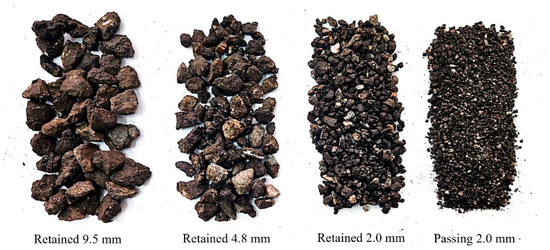
The milled material used in this study originated from pavement rehabilitation works on the BR-101/BA highway. The characterization of the RAP began with the determination of its particle size distribution by sieving, in accordance with ME DNIT 412 [19], and its relative density, as per ME DNIT 413 [20]. The residual asphalt binder content of the RAP was determined using the Rotarex method, in accordance with ME DNER 053 [21]. Figure 1 presents the different RAP particle size fractions (19.1-9.5 mm; 9.5-4.8 mm; 4.8-2.0 mm; and passing the 2.0 mm sieve) used in the asphalt mixture design, in accordance with DNER 107 [22]. Table 1 presents the gradation information of the material before and after asphalt binder extraction.
Figure 1.
Different RAP particle sizes.
Table 1.
Gradation of RAP.
Table 2 shows the results of the real density and absorption tests, as well as the residual asphalt binder content present in the RAP.
Table 2.
RAP characteristics.
3.1.2. Characterization of Virgin Aggregates
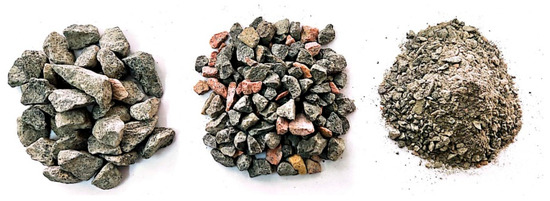
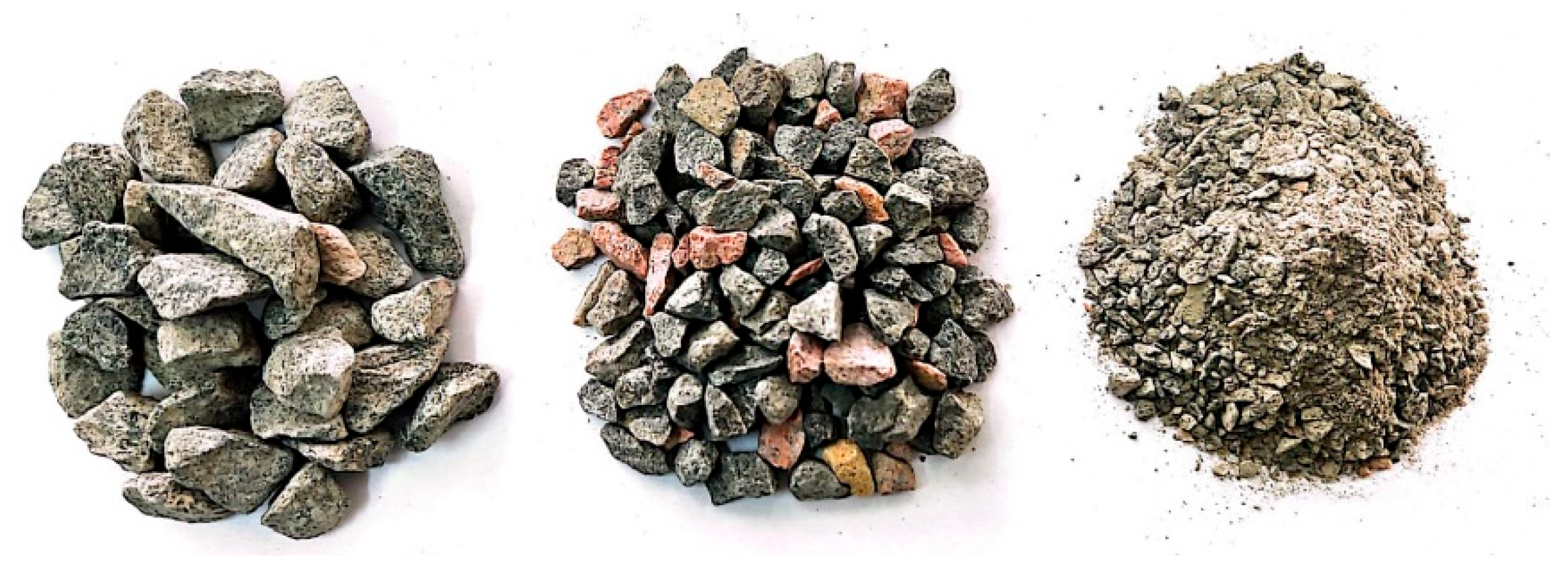
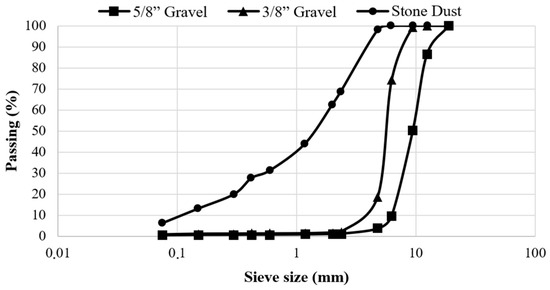
The virgin aggregates used in this study consisted of crushed stones with nominal sizes of 5/8″ and 3/8″, as well as stone dust, sourced from a commercial quarry located in the city of Muritiba, Bahia State, Brazil. The arrangement of the virgin aggregates used is illustrated in Figure 2. Initially, particle size distributions were determined by sieving for the three aggregates in accordance with the test method ME DNIT 412 [19]. Subsequently, the real density and absorption of the aggregates were determined, using ME DNIT 413 [20] for the coarse aggregates and ME DNER 084 [23] for the fine aggregate. Thereafter, the resistance of the coarse aggregates to wear was evaluated using the Los Angeles abrasion test, in accordance with ME DNER 035 [24], and their shape was determined using a flakiness index measured with a calliper, in accordance with ME DNIT 425 [25]. Finally, the fine aggregate sand equivalent test was performed according to ME DNER 054 [26]. Figure 3 presents the particle size distributions of the respective virgin aggregates, while Table 3 summarizes the results of the Los Angeles abrasion, absorption, density, sand equivalent, and flakiness index tests.
Figure 2.
Virgin aggregates (5/8″ Gravel, 3/8″ Gravel and Stone Dust).
Figure 3.
Virgin aggregates granulometry.
Table 3.
Characterization of aggregates.
3.1.3. Characterization of Asphalt Emulsion
The asphalt emulsion used was a slow-setting type (RL-1C), supplied by BRASQUÍMICA Salvador, Brazil. Its characteristics, based on the results of various tests reported by the manufacturer, are presented in Table 4.
Table 4.
Characterization of the asphalt emulsion.
3.2. Production of Cold Asphalt Mixtures
The control mixture, composed of the virgin aggregates presented in Table 1, was used to define the optimal percentage combination of each material in the asphalt mixture. This stage of the study focused on adjusting the granulometric composition of the mixture in order to fit within the limits specified for CRM Band VII, as established in the technical specification ET-DE-P00/025 of the São Paulo State Highway Department [36]. Based on the granulometric adjustment, a composition consisting of 35% 5/8″ crushed stone, 20% 3/8″ crushed stone, and 45% stone dust was defined.
In this initial phase of the research, residual asphalt binder contents ranging from 4.0% to 6.0% were evaluated, with increments of 0.5%. According to the Marshall methodology, as specified in ME DNER 107 [22], six specimens were molded for each binder content, with an approximate mass of 1200 g per specimen. Mix design was performed by applying 50 blows to each specimen face. After compaction, the specimens were placed in an oven at 60 °C for 24 h. Subsequently, they were kept at room temperature (approximately 25 °C) for 2 h and then demolded. Geometric measurements were then performed, with four height and diameter measurements taken at diametrically opposite positions.
Subsequently, the apparent density of the specimens was determined in accordance with the procedure established in ME DNER 117 [37]. After this step, the specimens were subjected to Marshall stability and flow tests, in accordance with ME DNER 107 [22].
The selection of the design binder content for the control mixture was based on the recommendations of Santana [38], who highlights the significant influence of apparent density on volumetric parameters and on the effective binder content of the mixture, emphasizing the need for careful consideration of these factors in the design of cold asphalt mixtures. Regarding the requirements applicable to PMFs, the technical specification of the São Paulo State Highway Department [36] does not differentiate void content limits based on the adopted compaction effort, unlike DNIT 153 [39], which allows a range of 5% to 30%.
Cold asphalt mixtures use asphalt emulsion. During curing, water evaporation and emulsion breaking generate additional micro-voids where water was previously present, resulting in final air-void contents (7–14%) significantly higher than those of hot-mix asphalt (HMA) [40]. Moreover, these mixtures often lack sufficient fine particles to effectively fill the void structure, further increasing the air-void content when fines are not adequately supplemented [41].
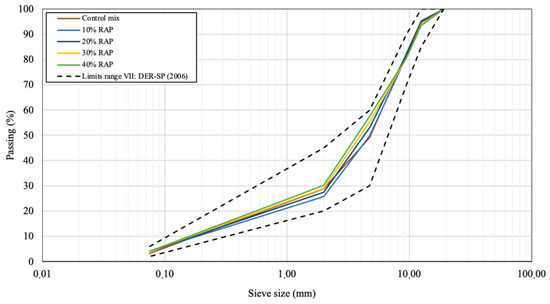
The same procedure adopted for the control asphalt mixture design was applied to the design of the cold recycled mixtures. Using the particle size distributions of all materials (aggregates and RAP), trial combinations were performed to identify the composition that best fitted within Band VII of ET-DE-P00/025 [36]. The visualization of the designed gradations of the control and cold recycled asphalt mixtures is presented in Figure 4, together with the limits of Band VII [36].
Figure 4.
Gradation of the recycled mixtures.
The average values obtained from the bulk density (d), theoretical maximum density (TMD), air void content (AV), voids filled with asphalt (VFA), stability (ST), and flow (F) tests for the samples with RAP contents of 0% (control mixture), 10%, 20%, 30%, and 40% are summarized in Table 5.
Table 5.
Parameters with average results for mixtures with RAP additions.
The optimal emulsified asphalt and water contents were defined through laboratory mix design based on volumetric and mechanical criteria. The selected design binder content corresponded to the lowest emulsified asphalt level that met all performance requirements while optimizing binder consumption.
For the control mixture, the residual asphalt binder contents of 5.5% and 6.0% did not meet the minimum flow parameter requirement. Therefore, in defining the design binder content of the control mixture, it was observed that the apparent densities of the remaining evaluated contents (4.0%, 4.5%, and 5.0%) were very similar (Table 5). Thus, to optimize asphalt binder consumption, the lowest content that met the established criteria was selected, resulting in a design residual asphalt binder content of 4.0%.
The mixtures containing 10%, 20%, 30%, and 40% RAP met the stability and flow requirements for all evaluated residual asphalt binder contents, in accordance with the limits established in specification ET-DE-P00/025 [36]. Accordingly, and to standardize the comparative analysis, the same design binder content adopted for the control mixture, corresponding to 4.0% residual asphalt binder, was also applied to these mixtures.
3.3. Dynamic Tests on Asphalt Mixtures
The specimens used for the indirect tensile strength (ITS) and resilient modulus (RM) tests were prepared in the laboratory by compacting the asphalt mixture using the Marshall compaction equipment. After molding, the specimens had a diameter of approximately 100 mm and a height of about 65 mm. Prior to the ITS and RM tests, the specimens were subjected to a thermal conditioning process, remaining in a climate-controlled chamber at the test temperature for at least 4 h, maintained at approximately 25 °C.
The RM test commenced with 50 load cycles to mechanically condition the specimen. Subsequently, 15 additional cycles were applied, during which load and displacement signals were continuously recorded. Thereafter, the initial load was increased by 5%, and a new set of 15 cycles was applied, with displacement measurements taken. This procedure was repeated with a further 5% increase in load, while maintaining 15 cycles at each loading stage. All cyclic loadings were applied at 1 Hz. The RM value was determined for each set of cycles, considering the last five cycles of each loading stage.
The fatigue curves of the asphalt mixtures were determined in accordance with the test method ME DNIT 183 [42]. Based on the previously determined average ITS value of the mixture, the applied load was calculated to generate, using sets of three specimens, four distinct stress levels ranging from 5% to 40% of the load corresponding to the tensile strength of the specimen. Fatigue tests were conducted under cyclic loading at 1 Hz, and fatigue life was expressed as the number of load repetitions () required for test termination. These values were correlated with the initial tensile strain () using specific plots constructed on a logarithmic scale.
The fatigue behavior of the asphalt mixtures was modeled using Equation (4), where is the fatigue life and is the initial tensile strain. To determine the model parameters, the experimental data were linearized through logarithmic transformation, resulting in the linear form (). Linear regression was then performed on the log-log data, with the slope corresponding to and the intercept to , from which was obtained by exponentiation. The coefficient of determination () was calculated from the regression analysis to assess the goodness of fit between the experimental results and the fitted fatigue model.
3.4. Performance Evaluation of Cold Asphalt Mixtures
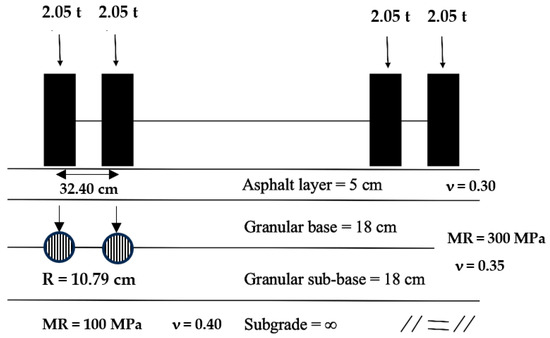
To evaluate the mechanistic performance of the different asphalt mixtures assessed in this study, a reference asphalt pavement structure was initially designed (Figure 5), with base, subbase, and subgrade materials having properties identical to those adopted by Santos et al. [6].
Figure 5.
Reference pavement structure.
The MeDiNa simulation boundary conditions were defined according to the standard default parameters established by the MeDiNa framework. Specifically: (i) laboratory test results used as input were obtained at 25 °C; (ii) no interlayer bonding was assumed between pavement layers (slip condition); and (iii) the load spectrum was defined based on repetitions of the standard 8.2-ton single axle load, as prescribed by MeDiNa.
Thus, for the base and subbase layers, the resilient modulus (RM) was assumed to be approximately 300 MPa, while for the subgrade, the RM was set at 100 MPa, in accordance with the recommendations of DER-SP [36]. Poisson’s ratios () of 0.30 for the asphalt surface layer, 0.35 for the base and subbase layers, and 0.40 for the subgrade were also adopted, following the values suggested by DER-SP [36].
The procedure adopted for the performance analysis of the asphalt mixtures was based on the individual simulation of each mixture as the surface layer of the designed reference pavement, using the mechanistic–empirical modeling framework of MeDiNa. Initially, the average damage () for each mixture was determined based on the stress–strain analysis performed using the AEMC routine at the 20 evaluated points, combined with the parameters and obtained from the fitting of the fatigue curve of the respective mixture (Equation (4)), by applying Equation (5).
Subsequently, the shift factor () was calculated using Equation (7), and the adjusted number of load repetitions () was then determined according to Equation (6). In the final stage of the modeling process, adopting the MeDiNa sigmoidal function adjusted by Almeida et al. [17], with parameters and . The coefficients and were calculated using Equations (2) and (3), respectively, enabling the estimation of the cracked area through Equation (1). The cracked area obtained from Equation (1) was finally increased using Equation (8), accounting for the error associated with a 95% reliability level (Equation (9)).
Based on the results obtained from this mechanistic analysis, a comparative evaluation of the performance of the different asphalt mixtures was carried out, considering the estimated cracked area at the end of a 10-year design period for different traffic levels (; ; and load repetitions).
4. Results and Discussion
4.1. Comparison Between the Mix Design Parameters of the Different Asphalt Mixtures
Table 6 presents the results of Marshall Stability, Marshall Flow, and air void content (AV) for the control asphalt mixture and the recycled cold mixtures, produced with the designed residual asphalt binder content of 4.0%.
Table 6.
Results of the Marshall mix design for the design residual asphalt binder (CAP) contents.
The results presented in Table 6 indicate a significant increase in the stability of the recycled mixtures compared with the control mixture. A similar trend was reported by Ragab and El-Naga [10], which reinforces the positive effect of RAP incorporation on this mechanical parameter, possibly due to the additional binder stiffening provided by the milled material.
Regarding flow, it was observed that the addition of RAP increased this parameter up to 30% RAP content, indicating greater deformability of the specimens. This behavior may be associated with an increase in air void content.
4.2. Mechanical Behavior of Cold Asphalt Mixtures
The values of indirect tensile strength (ITS), resilient modulus (RM), and the regression coefficients obtained from the fatigue test of the asphalt mixtures evaluated are presented in Table 7.
Table 7.
Mechanical behavior of cold asphalt mixtures.
The results in Table 7 indicate that incorporating RAP improved the mechanical behavior of cold asphalt mixtures compared to the control mixture. A progressive increase in indirect tensile strength (ITS) and resilient modulus (RM) is observed with increasing RAP content up to 40%, with ITS rising from 0.101 to 0.139 MPa and RM increasing from 502 to 807 MPa, indicating a significant stiffening of the recycled mixtures. This behavior can be attributed primarily to the incorporation of aged asphalt binder from RAP, which enhances mixture stiffness, as evidenced by the increased ITS and resilient modulus. In addition, the adoption of a constant residual asphalt binder content (4.0%) for all mixtures. It was selected to standardize the comparative analysis in accordance with the specification requirements, thereby contributing to the observed response.
With respect to fatigue performance, the parameters of the fitted fatigue curves ( and ) indicate a tendency toward increased fatigue life with the addition of RAP, reflecting a reduction in resilient strains under the same loading level. Overall, the high coefficients of determination () obtained demonstrate good representativeness of the fatigue curve fittings, reinforcing that the recycled mixtures exhibited superior structural performance compared to the control mixture, especially in terms of stiffness and fatigue resistance.
Studies on cold- and recycled-mixes typically show higher RAP content, with higher indirect tensile strength and stiffness, up to 50–75% RAP, due to a stiff, aged binder and aggregate skeleton [14].
4.3. Evaluation of the Estimated Performance of Cold Asphalt Mixtures
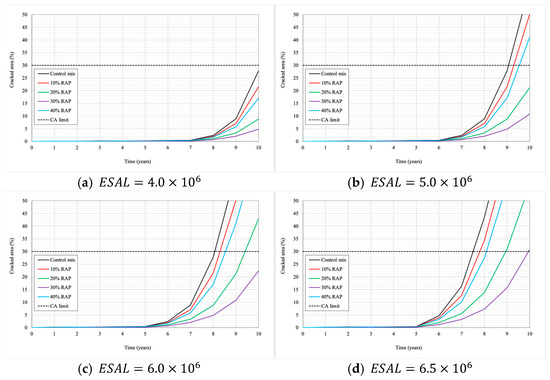
The estimated cracked areas at the end of the service life of the idealized reference pavement, considering each cold asphalt mixture investigated in this study and the MeDiNa modeling, are presented in Table 8. The temporal evolution of the estimated cracked areas for each mixture is shown in Figure 6.
Table 8.
Estimated cracked area for the design horizon.
Figure 6.
Performance of the reference pavement for different RAP contents and traffic levels.
In the application of the MeDiNa modeling, the average damage () is a central parameter for estimating the cracked area. It represents the cumulative structural damage induced by traffic loading over the pavement service life. Based on the results presented in Table 8, it is observed that the incorporation of RAP significantly influenced the values and, consequently, the evolution of the estimated cracked area. Overall, a reduction in average damage was observed with increasing RAP content up to 30%, resulting in lower cracked area values across the different traffic levels analyzed, indicating superior fatigue resistance for these mixtures. For the 40% RAP content, however, an increase in average damage and cracked area was observed, especially for higher traffic levels.
The estimated cracked area () decreased with increasing RAP content from 0% to 30%, dropping from 27.9% (0% RAP) to 21.6%, 8.8%, and 4.9% for 10%, 20%, and 30% RAP, respectively, at an of . However, for the 40% RAP mixture, the cracked area increased to 17.1%, indicating a reversal in performance. This trend is consistent with the fatigue curve behaviour, which also shows a change at higher RAP contents. Although the resilient modulus increased continuously with RAP content, the fatigue response suggests that excessive stiffness at 40% RAP negatively affects fatigue performance, leading to higher cracking levels. This behaviour may be associated with increased air-void content, the predominance of a considerably harder aged binder from RAP, and the potential for incomplete blending between the aged and virgin binders. Similar observations were reported by Redelius et al. [43], who noted higher void contents due to compaction difficulties and significantly harder recovered binders in RAP-containing sections, with possible stratification between old and new binders in the asphalt layer.
Considering the maximum allowable limit of 30% cracked area at the end of service life adopted in Brazil, it is verified that mixtures with moderate RAP contents, suitable for low and intermediate traffic levels, meet the established performance criteria (Figure 6).
Within the context of simulations conducted with the MeDiNa software 2.0 version, the fatigue behavior of asphalt mixtures is evaluated by predicting cracked-area evolution, enabling an integrated analysis of structural damage accumulation over the pavement service period. Figure 6 illustrates the progression of the cracked area over time for different traffic levels, considering the control mixture and recycled mixtures with varying RAP contents.
As traffic levels increase, crack initiation and propagation accelerate, reducing the time required for the cracked area to reach the admissible limit of 30%. In general, mixtures incorporating RAP showed superior performance compared to the control mixture, delaying the attainment of this limit, especially for intermediate RAP contents of 20% and 30%.
For the lowest traffic level evaluated, , for which the reference pavement was originally designed with the control mixture as the surface layer, all mixtures remained below the 30% cracked area limit at the end of the 10-year design horizon. However, when traffic was increased to , only the mixtures with 20% and 30% RAP exhibited behavior consistent with the established performance criteria. For a traffic level of , only the mixture containing 30% RAP maintained a cracked area below the 30% limit.
These results demonstrate the potential of using RAP in cold asphalt mixtures as a viable alternative for pavement surface layers subjected to heavy traffic levels in Brazil, i.e., above . Evidence of this potential is that, for the mixture with 30% RAP, it was possible to further increase traffic to while maintaining a cracked area close to the 30% limit. On the other hand, another relevant assessment of this study is that, maintaining the original traffic level of , the use of all RAP contents showed the potential to extend pavement service life beyond the 10 years initially projected for the control mixture, with particular emphasis on the mixture containing 30% RAP.
Considering that the mechanical characterization was conducted at 4.0% CAP, the optimal performance observed at 30% RAP reflects a balance between stiffness enhancement and strain tolerance at constant binder content. At this level, the mixture exhibited the highest Marshall stability, increased resilient modulus, and the lowest predicted cracked area, without excessive strain sensitivity. Increasing RAP to 40% further increased stiffness but also led to higher predicted cracking, suggesting the onset of brittle behavior. Therefore, approximately 30% RAP represents a balanced condition between structural capacity and fatigue resistance under the selected binder content.
At this level, partial blending of the aged RAP binder with the emulsion residue may yield a composite binder system that enhances stiffness while maintaining sufficient viscoelastic relaxation capacity. Simultaneously, improved aggregate interlock and optimized void distribution promote efficient stress transfer without excessive brittleness. At 40% RAP, however, the increased dominance of aged binder may reduce strain tolerance and energy dissipation capacity, leading to higher strain sensitivity and increased predicted cracking.
5. Conclusions
The results of this study indicate that incorporating RAP at 10–40% in cold asphalt mixtures improves mechanical performance compared to the control mixture. From a mechanical standpoint, RAP incorporation increased stability, indirect tensile strength, resilient modulus, and fatigue resistance, particularly at RAP contents of 20% to 30%. These improvements are primarily attributed to the aged asphalt binder in the RAP, which enhances mixture stiffness and strengthens the aggregate skeleton.
The mechanistic–empirical analysis, based on fatigue test results for the mixtures and MeDiNa modeling, demonstrated that for RAP contents up to 40%, the increase in stiffness was associated with estimated cracked area values consistently lower than those for the control mixture at all traffic levels analyzed. The analyses of cracked area evolution demonstrate that mixtures with intermediate RAP contents (20% and 30%) consistently outperform the control mixture as traffic levels increase. While all mixtures met the performance criteria for the original design traffic of load repetitions, only RAP-modified mixtures, particularly those with 20% and 30% RAP, remained within the admissible cracked area limit when traffic levels increased to and above.
These results demonstrate that the use of RAP constitutes a viable alternative for producing cold asphalt mixtures, contributing to reduced consumption of virgin aggregates and asphalt binder, as well as to the valorization of residues from road infrastructure. Future developments in this research line should include investigating the permanent deformation behavior of cold mixtures containing RAP with higher residue contents to deepen the understanding of their mechanical behavior. Additionally, the analysis of the use of rejuvenating agents may be relevant to evaluate their effects on improving the properties of the aged binder, promoting greater mixture homogeneity and workability, with a consequent enhancement of long-term performance.
Overall, the results indicate that incorporating RAP provides clear advantages, including increased mechanical strength and stiffness, improved fatigue life and crack resistance, better performance under higher traffic levels, extended pavement service life, reduced material costs and environmental impacts, and good compatibility with mechanistic–empirical design methods. However, these benefits are accompanied by some limitations, as excessive RAP contents may result in overly stiff mixtures with a higher susceptibility to cracking, optimal performance is generally restricted to a limited RAP range (approximately 20–30%), variability in RAP properties can affect mixture consistency and requires careful material characterization, and long-term field performance data are still needed to fully validate the laboratory and numerical findings.
Author Contributions
Conceptualization, P.R.L.d.S. and M.S.d.S.A.; methodology, P.R.L.d.S. and M.S.d.S.A.; validation, E.D.S. and M.S.d.S.A.; formal analysis, W.G.S.C.; investigation, F.S.d.A.D., L.P.d.J., E.D.S., P.R.L.d.S. and A.R.A.A.; resources, M.S.d.S.A.; data curation, E.D.S. and M.S.d.S.A.; writing—original draft preparation, P.R.L.d.S. and E.D.S.; writing—review and editing, M.S.d.S.A., A.R.A.A. and W.G.S.C.; visualization, W.G.S.C.; supervision, M.S.d.S.A.; project administration, W.G.S.C., A.R.A.A. and M.S.d.S.A. All authors have read and agreed to the published version of the manuscript.
Funding
This research is an integral part of the Decentralized Execution Term nº 507/2023, signed between the financier National Department of Transport Infrastructure (DNIT) and the beneficiary Federal University of Recôncavo da Bahia (UFRB).
Data Availability Statement
The datasets presented in this article are not readily available because the data are part of an ongoing study by the National Department of Transport Infrastructure (DNIT). Requests to access the datasets should be directed to the corresponding author.
Acknowledgments
The authors thank the Brazilian National Department of Transport Infrastructure.
Conflicts of Interest
The authors declare that they have no conflicts of interest.
Abbreviations
The following abbreviations are used in this manuscript:
| MeDiNa | Brazilian Mechanistic–Empirical Method |
| DNIT | National Department of Transport Infrastructure |
| ESAL | Equivalent Single Axle Loads |
| ESAL’ | Adjusted or corrected equivalent number |
| CA | Cracked Area |
| ME | Mechanistic–Empirical |
| RM | Resilient Modulus |
| ITS | Indirect Tensile Strength |
| RAP | Reclaimed Asphalt Pavement |
| CRM | Cold Recycled Mixtures |
| TMD | Theoretical Maximum Density |
| AV | Air voids |
| ST | Stability |
| F | Flow |
References
- European Asphalt Pavement Association (EAPA). Asphalt in Figures 2023. Bruxelas. 2023. Available online: https://eapa.org (accessed on 12 December 2025).
- National Asphalt Pavement Association. IS 138: Recycling Asphalt Pavements with RAP, RAS, and WMA: 2021 Survey of Asphalt Mixture Production; NAPA: Lanham, MD, USA, 2021. [Google Scholar]
- Lopes, A.F.D.; Savasini, K.V.; Almeida, M.S.S.; Bernucci, L.L.B. Geração e utilização de RAP no Brasil. Rev. ENINFRA 2024, 3, 201–217. [Google Scholar] [CrossRef] [Scilit]
- Hidalgo, A.E.; Moreno-Navarro, F.; Tauste, R.; Rubio-Gámez, M.C. The Influence of Reclaimed Asphalt Pavement on the Mechanical Performance of Bituminous Mixtures: An Analysis at the Mortar Scale. Sustainability 2020, 12, 8343. [Google Scholar] [CrossRef] [Scilit]
- Mariyappan, R.; Palammal, J.S.; Balu, S. Sustainable use of reclaimed asphalt pavement (RAP) in pavement applications-a review. Environ. Sci. Pollut. Res. 2023, 30, 45587–45606. [Google Scholar] [CrossRef] [Scilit] [PubMed]
- Santos, E.D.; Almeida, M.S.S.; Santana, P.R.L.; Divino, F.S.A.; Gouveia, B.C.S.; Costa, W.G.S.; Achy, A.R.A. Design and performance evaluation of cold asphalt mixtures produced with high RAP content. Geomech. Geoengin. 2025, 21, 65–80. [Google Scholar] [CrossRef] [Scilit]
- Coelho, L.M.; Marchi, B.Z.; Silveira, P.H.P.M.; Azevedo, R.G.; Monteiro, S.N.; Guimarães, A.C.R. Thermal compaction as an alternative approach for full-RAP base layer construction. Sci. Rep. 2025, 15, 16394. [Google Scholar] [CrossRef] [Scilit]
- Filho, L.H.A.; Casagrande, M.D.T.; Almeida, M.S.S.; Costa, W.G.S.; Santana, P.R.L. Mechanical Performance and Life Cycle Assessment of Soil Stabilization Solutions for Unpaved Roads from Northeast Brazil. Sustainability 2024, 16, 9850. [Google Scholar] [CrossRef] [Scilit]
- Costa, W.G.S.; Izzo, R.L.S.; Almeida, M.S.S.; Achy, A.R.A.; Santos, I.J.; Ramos, R.S. Investigation of cement and polymer stabilization in gravel soil-RAP mixtures: Plastic and resilient behaviour. Constr. Build. Mater. 2025, 482, 141548. [Google Scholar] [CrossRef] [Scilit]
- Ragab, M.; El-Naga, I.A. Performance Assessment of Cold Asphalt Concrete Mixtures Containing Recycled Paving Materials. Arab. J. Sci. Eng. 2022, 47, 4351–4360. [Google Scholar] [CrossRef] [Scilit]
- Nanda, H.; Siddagangaiah, A.K. Effect of RAP fractionation and dosage on design and mechanical behaviour of cold asphalt mixes. Constr. Build. Mater. 2024, 422, 135773. [Google Scholar] [CrossRef] [Scilit]
- Elnihum, A.; Lu, Q.; Alharthai, M.; Alamri, M.; Chen, C.; Elmagarhe, A. Evaluation of an Asphalt Mixture Containing a High Content of Reclaimed Asphalt Pavement (RAP) Materials with Epoxy Asphalt. Sustainability 2024, 16, 4988. [Google Scholar] [CrossRef] [Scilit]
- Yousefi, A.; Behnood, A.; Nowruzi, A.; Haghshenas, H. Performance evaluation of asphalt mixtures containing warm mix asphalt (WMA) additives and reclaimed asphalt pavement (RAP). Constr. Build. Mater. 2021, 268, 121200. [Google Scholar] [CrossRef] [Scilit]
- Chegenizadeh, A.; Tufilli, A.; Arumdani, I.; Budihardjo, M.; Dadras, E.; Nikraz, H. Mechanical Properties of Cold Mix Asphalt (CMA) Mixed with Recycled Asphalt Pavement. Infrastructures 2022, 7, 45. [Google Scholar] [CrossRef] [Scilit]
- Fritzen, M.A.; Franco, F.A.C.P.; Motta, L.M.G.; Ubaldo, M.O. Atualização da função transferência do dano de fadiga para a área trincada do programa MeDiNa. In Proceedings of the Anais do Congresso Rodoviário Português, Lisbon, Portugal, 16–18 October 2019. [Google Scholar]
- DNIT. Manual de Pavimentação, 3rd ed.; DNIT: Rio de Janeiro, RJ, Brazil, 2006; p. 274.
- Almeida, M.S.S.; Costa, W.G.S.; Bressanin, H.W.; Filho, N.W.; Mello, L.G.R. Proposta de ajuste da função sigmoidal e área trincada do MeDiNa usando dados da gerência de pavimentos e de segmentos experimentais. Rev. ENINFRA 2024, 3, 35–52. [Google Scholar] [CrossRef] [Scilit]
- Fritzen, M.A. Desenvolvimento e Validação de Função de Transferência para Previsão do Dano por Fadiga em Pavimentos Asfálticos. Ph.D. Thesis, Universidade Federal do Rio de Janeiro, Rio de Janeiro, RJ, Brasil, 2016; p. 286. [Google Scholar]
- DNIT-ME 412; Pavimentação—Misturas Asfálticas—Análise Granulométrica de Agregados Graúdos e Miúdos e Misturas de Agregados por Peneiramento—Método de Ensaio. DNIT: Rio de Janeiro, RJ, Brazil, 2019.
- DNIT-ME 413; Pavimentação—Massa Específica, Densidade Relativa e Absorção de Agregado Graúdo para Misturas Asfálticas—Método de Ensaio. DNIT: Rio de Janeiro, RJ, Brazil, 2021.
- DNER-ME 053; Mistura Betuminosa—Porcentagem de Betume. DNER: Rio de Janeiro, RJ, Brazil, 1994.
- DNER-ME 107; Mistura Betuminosa a Frio, com Emulsão Asfáltica—Ensaio Marshall. DNER: Rio de Janeiro, RJ, Brazil, 1994.
- DNER-ME 084; Agregado Miúdo—Determinação da Densidade Real. DNER: Rio de Janeiro, RJ, Brazil, 1995.
- DNER-ME 035; Agregados—Determinação da Abrasão “Los Angeles”. DNER: Rio de Janeiro, RJ, Brazil, 1998.
- DNIT-ME 425; Pavimentação—Agregado—Determinação do Índice de Forma com Paquímetro—Método de Ensaio. DNIT: Rio de Janeiro, RJ, Brazil, 2020.
- DNER-ME 054; Equivalente de Areia. DNER: Rio de Janeiro, RJ, Brazil, 1997.
- ABNT NBR 14491; Emulsões Asfálticas—Determinação da Viscosidade Saybolt Furol. ABNT: Rio de Janeiro, RJ, Brazil, 2007.
- ABNT NBR 6570; Ligantes Asfálticos—Determinação da Sedimentação e Estabilidade à Estocagem de Emulsões Asfálticas. ABNT: Rio de Janeiro, RJ, Brazil, 2016.
- ABNT NBR 14393; Emulsões Asfálticas—Determinação da Peneiração. ABNT: Rio de Janeiro, RJ, Brazil, 2012.
- ABNT NBR 6567; Ligantes Asfálticos—Emulsões Asfálticas—Determinação da Carga de Partícula. ABNT: Rio de Janeiro, RJ, Brazil, 2015.
- ABNT NBR 6299; Emulsões Asfálticas—Determinação do pH. ABNT: Rio de Janeiro, RJ, Brazil, 2012.
- ABNT NBR 14376; Ligantes Asfálticos—Determinação do Teor do Resíduo Seco de Emulsões Asfálticas Convencionais ou Modificadas—Métodos Expeditos. ABNT: Rio de Janeiro, RJ, Brazil, 2019.
- ABNT NBR 6576; Materiais Asfálticos—Determinação da Penetração. ABNT: Rio de Janeiro, RJ, Brazil, 2007.
- ABNT NBR 14855; Ligantes Asfálticos—Determinação da Solubilidade em Tricloroetileno. ABNT: Rio de Janeiro, RJ, Brazil, 2015.
- ABNT NBR 6293; Ligantes Asfálticos—Determinação da Ductilidade. ABNT: Rio de Janeiro, RJ, Brazil, 2015.
- ET-DE-P00/025; Manual de Normas—Pavimentação: Especificação Técnica—Pré-Misturado a Frio. DER/SP: São Paulo, Brazil, 2006.
- DNER-ME 117; Mistura Betuminosa—Determinação da Densidade Aparente. DNER: Rio de Janeiro, RJ, Brazil, 1994.
- Santana, E.P. Estudos das Propriedades Físicas e Mecânicas de Misturas Asfálticas Recicladas com Materiais Fresados: Estudo de Caso—BR-230. Master’s Dissertation, Universidade Federal de Campina Grande, Campina Grande, Brazil, 2009. [Google Scholar]
- DNIT-ES 153; Pavimentação Asfáltica—Pré-Misturado a Frio com Emulsão Catiônica Convencional. DNIT: Rio de Janeiro, RJ, Brazil, 2010.
- Meena, P.; Naga, G.R.R.; Kumar, P. Effect of Mechanical Properties on Performance of Cold Mix Asphalt with Recycled Aggregates Incorporating Filler Additives. Sustainability 2023, 16, 344. [Google Scholar] [CrossRef] [Scilit]
- Orosa, P.; Orozco, G.; Carret, J.C.; Carter, A.; Pérez, I.; Pasandín, A.R. Compactability and mechanical properties of cold recycled mixes prepared with different nominal maximum sizes of RAP. Constr. Build. Mater. 2022, 339, 127689. [Google Scholar] [CrossRef] [Scilit]
- DNIT-ME 183; Pavimentação Asfáltica—Ensaio de Fadiga por Compressão Diametral à Tensão Controlada—Método de Ensaio. DNIT: Rio de Janeiro, RJ, Brazil, 2018.
- Redelius, P.; Östlund, J.-A.; Soenen, H. Field experience of cold mix asphalt during 15 years. Road Mater. Pavement Des. 2015, 17, 223–242. [Google Scholar] [CrossRef] [Scilit]

Disclaimer/Publisher’s Note: The statements, opinions and data contained in all publications are solely those of the individual author(s) and contributor(s) and not of MDPI and/or the editor(s). MDPI and/or the editor(s) disclaim responsibility for any injury to people or property resulting from any ideas, methods, instructions or products referred to in the content. |
© 2026 by the authors. Licensee MDPI, Basel, Switzerland. This article is an open access article distributed under the terms and conditions of the Creative Commons Attribution (CC BY) license.