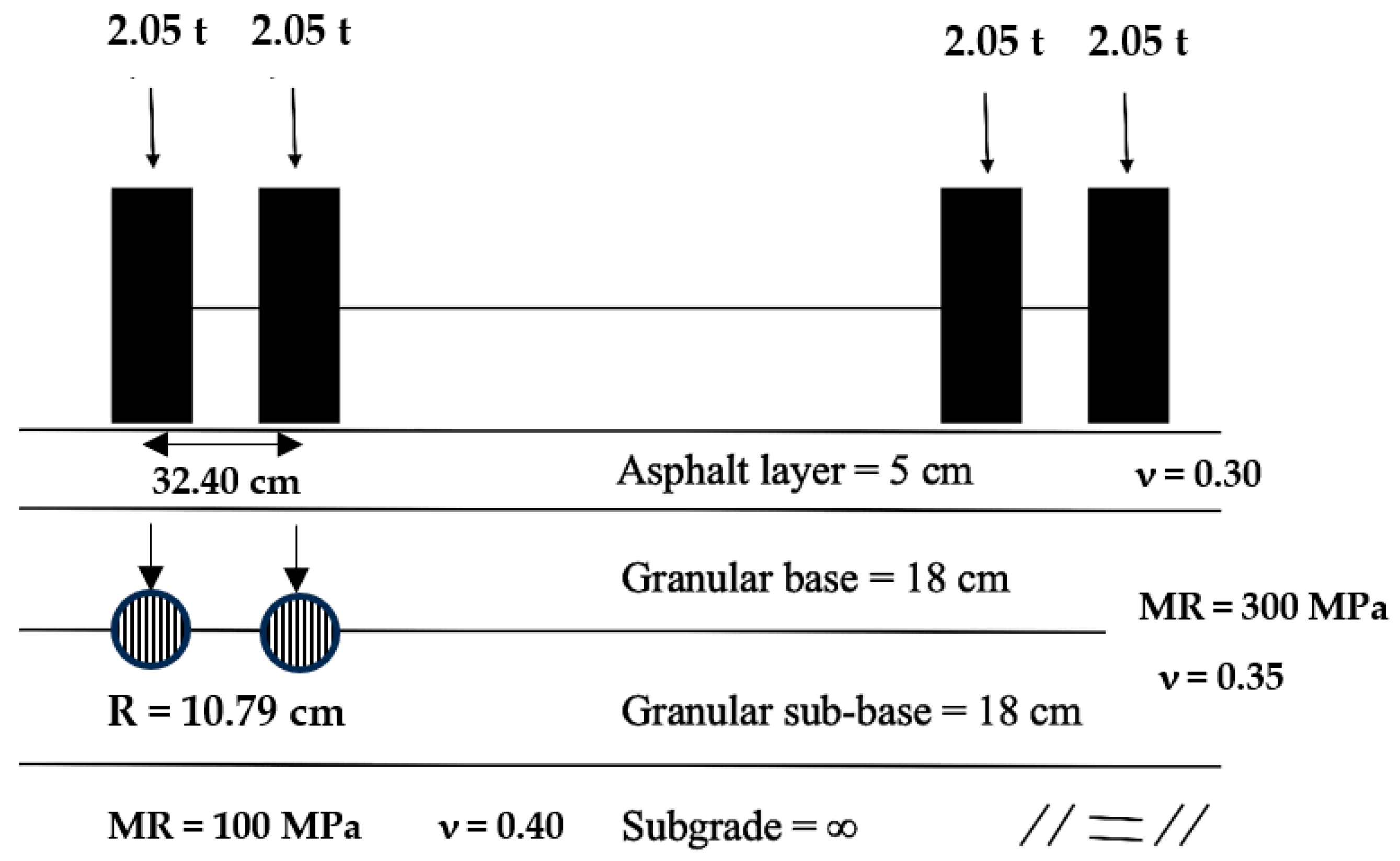
4.2. Mechanical Behavior of Cold Asphalt Mixtures
The values of indirect tensile strength (ITS), resilient modulus (RM), and the regression coefficients obtained from the fatigue test of the asphalt mixtures evaluated are presented in
Table 7.
The results in
Table 7 indicate that incorporating RAP improved the mechanical behavior of cold asphalt mixtures compared to the control mixture. A progressive increase in indirect tensile strength (ITS) and resilient modulus (RM) is observed with increasing RAP content up to 40%, with ITS rising from 0.101 to 0.139 MPa and RM increasing from 502 to 807 MPa, indicating a significant stiffening of the recycled mixtures. This behavior can be attributed primarily to the incorporation of aged asphalt binder from RAP, which enhances mixture stiffness, as evidenced by the increased ITS and resilient modulus. In addition, the adoption of a constant residual asphalt binder content (4.0%) for all mixtures. It was selected to standardize the comparative analysis in accordance with the specification requirements, thereby contributing to the observed response.
With respect to fatigue performance, the parameters of the fitted fatigue curves ( and ) indicate a tendency toward increased fatigue life with the addition of RAP, reflecting a reduction in resilient strains under the same loading level. Overall, the high coefficients of determination () obtained demonstrate good representativeness of the fatigue curve fittings, reinforcing that the recycled mixtures exhibited superior structural performance compared to the control mixture, especially in terms of stiffness and fatigue resistance.
Studies on cold- and recycled-mixes typically show higher RAP content, with higher indirect tensile strength and stiffness, up to 50–75% RAP, due to a stiff, aged binder and aggregate skeleton [
14].
4.3. Evaluation of the Estimated Performance of Cold Asphalt Mixtures
The estimated cracked areas at the end of the service life of the idealized reference pavement, considering each cold asphalt mixture investigated in this study and the MeDiNa modeling, are presented in
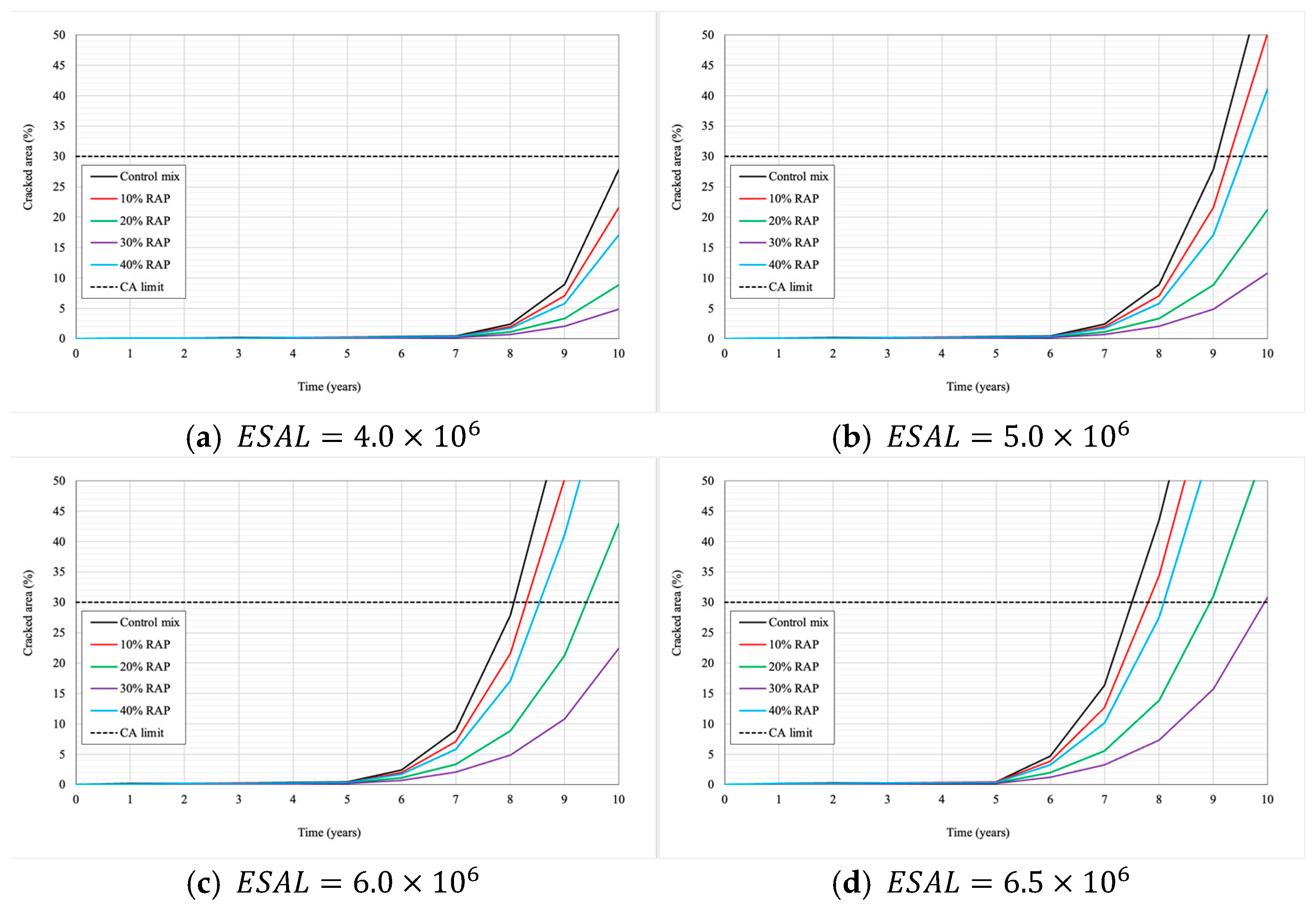
Table 8. The temporal evolution of the estimated cracked areas for each mixture is shown in
Figure 6.
In the application of the MeDiNa modeling, the average damage (
) is a central parameter for estimating the cracked area. It represents the cumulative structural damage induced by traffic loading over the pavement service life. Based on the results presented in
Table 8, it is observed that the incorporation of RAP significantly influenced the
values and, consequently, the evolution of the estimated cracked area. Overall, a reduction in average damage was observed with increasing RAP content up to 30%, resulting in lower cracked area values across the different traffic levels analyzed, indicating superior fatigue resistance for these mixtures. For the 40% RAP content, however, an increase in average damage and cracked area was observed, especially for higher traffic levels.
The estimated cracked area (
) decreased with increasing RAP content from 0% to 30%, dropping from 27.9% (0% RAP) to 21.6%, 8.8%, and 4.9% for 10%, 20%, and 30% RAP, respectively, at an
of
. However, for the 40% RAP mixture, the cracked area increased to 17.1%, indicating a reversal in performance. This trend is consistent with the fatigue curve behaviour, which also shows a change at higher RAP contents. Although the resilient modulus increased continuously with RAP content, the fatigue response suggests that excessive stiffness at 40% RAP negatively affects fatigue performance, leading to higher cracking levels. This behaviour may be associated with increased air-void content, the predominance of a considerably harder aged binder from RAP, and the potential for incomplete blending between the aged and virgin binders. Similar observations were reported by Redelius et al. [
43], who noted higher void contents due to compaction difficulties and significantly harder recovered binders in RAP-containing sections, with possible stratification between old and new binders in the asphalt layer.
Considering the maximum allowable limit of 30% cracked area at the end of service life adopted in Brazil, it is verified that mixtures with moderate RAP contents, suitable for low and intermediate traffic levels, meet the established performance criteria (
Figure 6).
Within the context of simulations conducted with the MeDiNa software 2.0 version, the fatigue behavior of asphalt mixtures is evaluated by predicting cracked-area evolution, enabling an integrated analysis of structural damage accumulation over the pavement service period.
Figure 6 illustrates the progression of the cracked area over time for different traffic levels, considering the control mixture and recycled mixtures with varying RAP contents.
As traffic levels increase, crack initiation and propagation accelerate, reducing the time required for the cracked area to reach the admissible limit of 30%. In general, mixtures incorporating RAP showed superior performance compared to the control mixture, delaying the attainment of this limit, especially for intermediate RAP contents of 20% and 30%.
For the lowest traffic level evaluated, , for which the reference pavement was originally designed with the control mixture as the surface layer, all mixtures remained below the 30% cracked area limit at the end of the 10-year design horizon. However, when traffic was increased to , only the mixtures with 20% and 30% RAP exhibited behavior consistent with the established performance criteria. For a traffic level of , only the mixture containing 30% RAP maintained a cracked area below the 30% limit.
These results demonstrate the potential of using RAP in cold asphalt mixtures as a viable alternative for pavement surface layers subjected to heavy traffic levels in Brazil, i.e., above . Evidence of this potential is that, for the mixture with 30% RAP, it was possible to further increase traffic to while maintaining a cracked area close to the 30% limit. On the other hand, another relevant assessment of this study is that, maintaining the original traffic level of , the use of all RAP contents showed the potential to extend pavement service life beyond the 10 years initially projected for the control mixture, with particular emphasis on the mixture containing 30% RAP.
Considering that the mechanical characterization was conducted at 4.0% CAP, the optimal performance observed at 30% RAP reflects a balance between stiffness enhancement and strain tolerance at constant binder content. At this level, the mixture exhibited the highest Marshall stability, increased resilient modulus, and the lowest predicted cracked area, without excessive strain sensitivity. Increasing RAP to 40% further increased stiffness but also led to higher predicted cracking, suggesting the onset of brittle behavior. Therefore, approximately 30% RAP represents a balanced condition between structural capacity and fatigue resistance under the selected binder content.
At this level, partial blending of the aged RAP binder with the emulsion residue may yield a composite binder system that enhances stiffness while maintaining sufficient viscoelastic relaxation capacity. Simultaneously, improved aggregate interlock and optimized void distribution promote efficient stress transfer without excessive brittleness. At 40% RAP, however, the increased dominance of aged binder may reduce strain tolerance and energy dissipation capacity, leading to higher strain sensitivity and increased predicted cracking.






 ,
,