


Abstract
The development of durable road sealing materials capable of maintaining performance under combined mechanical and climatic loads remains a critical challenge for modern infrastructure. Conventional bitumen-based sealants exhibit limited resistance to high-temperature deformation, cracking, and adhesion degradation, leading to reduced service life. This study proposes a rheology-oriented approach to the design of polymer-reinforced bituminous sealants based on penetration-grade bitumen 50/70 and 70/100 modified with styrene–butadiene–styrene (SBS) copolymers up to 9 wt.% and reinforced with cellulose fibers. The rheological behavior of the developed composites was investigated using dynamic shear rheometry to determine the complex shear modulus (G*), phase angle (δ), and temperature–frequency dependencies in the range from −20 to +90 °C, while infrared spectroscopy was employed to assess intermolecular interactions. Adhesion performance was evaluated at different temperature. The modified systems demonstrated a 5–10-fold increase in G*/sinδ enhanced high-temperature stability, and improved adhesion and crack resistance compared to base bitumen. Based on the obtained rheological and performance indicators, the developed composition was approved for subsequent pilot-scale testing and field validation as a promising road sealing material.
1. Introduction
The polymer modifier styrene–butadiene–styrene (SBS) is widely used to enhance the elasticity of bituminous binders and improve their resistance to high-temperature deformation [1,2,3,4,5]. With the increasing intensity of road traffic and harsher climatic loads, the modification of bitumen has become particularly important. However, the relatively high cost and technological complexity associated with the production of SBS-modified binders stimulate the search for more accessible alternative solutions [6].
Cellulose fibers, being natural biopolymers, possess a high adsorption capacity towards bitumen [7,8,9]. This allows for a significant reduction in binder drainage and an increase in mixture stiffness [1]. Furthermore, studies are known which show that composite fibers with polymer or rubber impregnation enhance these effects, additionally increasing the elastic modulus and reducing the phase angle of the bituminous binder [10,11,12]. For gap-graded mixtures, natural fibers are preferable for drainage control, while synthetic fibers are recommended for improving rutting resistance and pavement strength [13].
Polymer modification of bitumen (e.g., with SBS) improves the elastic properties of the binder: such bitumen demonstrates an increased elastic modulus and recovery rate after deformation, which enhances resistance to rutting and prolongs the service life of the pavement [3,14].
Meanwhile, the addition of cellulose fibers to SBS-modified bitumen further stabilizes the binder structure, slowing down crack formation and improving the low-temperature plasticity of the pavement [15,16]. This approach aligns with modern “green road” concepts, where biopolymeric fillers (cellulose, lignin, etc.) are considered as eco-friendly additives that enhance binder durability [17,18,19].
Recent studies demonstrate that fiber-reinforced asphalt binders represent a promising direction for improving the rheological performance and durability of pavement materials. The incorporation of different types of fibers (cellulose, basalt, lignin, polyester) into bitumen has been shown to influence both the viscous and elastic components of binder behavior, resulting in increased complex modulus and improved resistance to permanent deformation under high temperatures and repeated loading [12,20,21,22]. In particular, cellulose-based fibers are capable of forming a spatial reinforcing network within the binder, which restricts binder flow and enhances rutting resistance while simultaneously improving fatigue performance of asphalt mixtures [20,23]. Investigations using dynamic shear rheometer (DSR) tests have demonstrated that fiber-modified binders exhibit higher values of rutting parameter G*/sinδ, indicating improved resistance to high-temperature deformation [20,21]. Furthermore, the combination of polymer modification and fiber reinforcement has been reported to produce synergistic effects: the elastomeric polymer phase improves elastic recovery, while the fibers stabilize the binder structure and suppress binder drainage in mixtures such as stone mastic asphalt [12,24].
At the microstructural level, the reinforcing effect of cellulose fibers is associated with several mechanisms including adsorption of light fractions of bitumen, physical interlocking, and the formation of a three-dimensional network that redistributes stresses within the binder matrix [21,25]. Surface interactions between the polar functional groups of cellulose and the polar components of bitumen (such as resins and asphaltenes) may further enhance adhesion and stabilize the colloidal structure of the binder. Modern microscopic and spectroscopic approaches provide valuable insight into the hierarchical structure of bitumen and its modification mechanisms. In particular, recent nanoscale investigations using atomic force microscopy have demonstrated that the morphology of characteristic “bee-phase” structures in bitumen strongly depends on the thermal history of the sample and the preparation conditions, which can significantly influence the observed surface mechanical and chemical characteristics [26]. These findings highlight the importance of carefully controlled sample preparation and thermal equilibration when analyzing the morphology of modified binders using microscopic techniques.
In this work, the main focus is on a comprehensive investigation of bitumen with dual modification by SBS and cellulose fibers. To evaluate the influence of additives on viscoelastic properties, rheological tests are conducted at various temperatures. Chemical interactions and the morphology of the modified binder are analyzed using infrared spectroscopy (FTIR) and optical microscopy. Such a comprehensive approach allows for a thorough characterization of the modified bitumen and an assessment of the prospects for combined polymer and fiber modification.
2. Materials and Methods
2.1. Materials
2.1.1. Bitumen
In this work, bitumen grades B-1 and B-2 produced by Moscow Plant of Bituminous Materials LLC (Moscow, Russia) were used, designated B-1 and B-2, respectively. The physical parameters of these grades are listed in Table 1.
Table 1.
Physical properties of asphalt binder.
The SARA analysis of the samples in question revealed the following chemical composition, as shown in Table 2.
Table 2.
Result of SARA analysis of the samples.
2.1.2. Styrene–Butadiene–Styrene Block Copolymer
Styrene–butadiene–styrene (SBS) block copolymer L 7317 supplied by SIBUR (Moscow, Russia) are thermoplastic elastomers synthesized via block copolymerization of styrene and butadiene. Typical grades exhibit Shore A hardness of ~80–85, tensile strength ≥14–19 MPa, elongation at break ≥650%, and low melt flow indices suitable for melt processing. These materials are widely applied for asphalt modification, elastomeric composites, adhesives, and sealants due to their high elasticity, mechanical strength, and processability.
2.1.3. Cellulose
Sulfate viscose cellulose produced by Baikal pulp and paper mill (Baykalsk, Russia) with degree of polymerization of 750, equilibrium moisture content of 8, and alpha-cellulose content of 94% (Russian state standard GOST 6840-78) [27].
To evaluate the effect of fiber on the properties of bitumen-based compositions, cellulose was added at concentrations of 3%, 6%, and 10% by weight, respectively.
2.2. Methods
2.2.1. Polymer-Modified Bitumen MIXING
Polymer-modified bitumen systems were prepared using a sequential high-shear mixing procedure. The base bitumen was first heated to 150 °C under continuous stirring until a fully fluid state was achieved. Subsequently, up to 9 wt.% SBS copolymer (relative to the base bitumen) was gradually introduced, and the mixture was subjected to high-shear mixing at 5000 rpm for 15 min to promote polymer swelling and uniform dispersion within the bitumen matrix.
After obtaining a homogeneous SBS-modified bitumen, 3, 6, or 10 wt.% cellulose (relative to the total mass of the modified system) was slowly added under sustained mechanical agitation to avoid agglomeration. The mixture was then subjected to additional high-shear mixing at 2000 rpm for 40 min to ensure uniform distribution of the cellulose fibers within the binder.
2.2.2. Rheology
Rheological properties of the base bitumen, SBS-modified and SBS–cellulose-modified binders were characterized using a rotational rheometer (Kinexus, Malvern Instruments, Malvern, UK) in oscillatory mode over a temperature range up to 200 °C. Measurements were conducted under a nitrogen atmosphere to minimize oxidative effects at elevated temperatures.
For the base bitumen, standard measuring geometries were applied within the temperature range ensuring stable flow conditions. In the case of SBS–cellulose-modified and binder systems, particularly those containing 6 wt.% or higher SBS content, rheological measurements were performed using a parallel-plate geometry (plate–plate) with a plate diameter of 20 mm and a fixed gap of 0.4 mm. This configuration was selected to ensure reliable measurements of highly elastic and structured binders at elevated temperatures.
Rheological properties of the base bitumen as well as SBS-modified and SBS–cellulose-modified binders were characterized using a rotational rheometer (Kinexus, Malvern Instruments, Malvern, UK) operating in dynamic shear rheometer (DSR) mode. Oscillatory shear measurements were carried out over a temperature range up to 200 °C under a nitrogen atmosphere in order to minimize oxidative effects at elevated temperatures.
For the base bitumen, standard measuring geometries were applied within the temperature range ensuring stable flow conditions. For SBS- and SBS–cellulose-modified binders, particularly for compositions containing 6 wt.% or higher SBS content, measurements were performed using a parallel-plate geometry with a plate diameter of 20 mm and a fixed gap of 0.4 mm. This configuration was selected to ensure reliable characterization of highly elastic and structured binders.
Prior to testing, each sample was equilibrated at the target temperature to ensure thermal stability. Small-amplitude oscillatory shear (SAOS) tests were conducted within the linear viscoelastic region (LVE), which was determined in preliminary strain-sweep experiments.
During oscillatory measurements, the storage modulus (G′) and loss modulus (G″) were determined. The complex shear modulus was calculated as
The complex viscosity of the binders was obtained from the oscillatory data according to
where ω is the angular frequency of oscillation.
2.2.3. Adhesion of Bitumen
The tackiness and adhesive behavior of the bitumen compounds were evaluated using an axial plate separation test performed on a Kinexus rotational rheometer (Malvern Instruments, Malvern, UK). Tack is associated with the stickiness of a material and may arise from adhesive interactions at the interface or cohesive forces within the material during separation.
The test is conceptually based on the inverted probe tack method described in ASTM D2979-95, implemented here in an equivalent parallel-plate configuration suitable for highly viscoelastic materials. A defined volume of sealant was placed between two parallel plates with a diameter of 20 mm. The measurements were performed at controlled temperatures of 10, 25, 50, 75, and 100 °C using the rheometer temperature-control system. For each temperature, the sample was equilibrated until thermal stability was achieved before starting the test.
A normal preload of 5 N (1 N at temperatures above 50 °C) was applied to ensure full contact between the plates, followed by a dwell time of 15 s. The plates were then separated at a constant rate of 5 mm·s−1, while the normal force F(t) was continuously recorded. The test procedure was repeated independently at each temperature.
The adhesive behavior was quantified using the maximum negative normal force (Fmax), which represents the tackiness of the material, and the area under the absolute force–time curve,
which corresponds to the total work of adhesion and cohesion. In addition, the time required for the tensile force to decrease by 90% from its maximum value was used as a comparative indicator of the failure rate of the adhesive joint.
2.2.4. FTIR Spectroscopy
The chemical structure of composite investigated using an IFS 66 v/s FTIR spectrometer (Bruker, Germany). Spectra were recorded using the Attenuated Total Reflectance method with an accessory fitted with a ZnSe crystal. The parameters used were: resolution 2 cm−1, range 4000–600 cm−1, 30 scans.
3. Results and Discussion
3.1. Rheology
3.1.1. Rheology of Bitumen
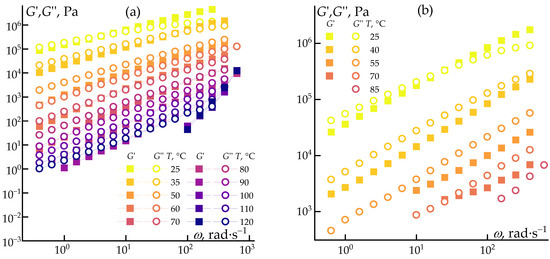
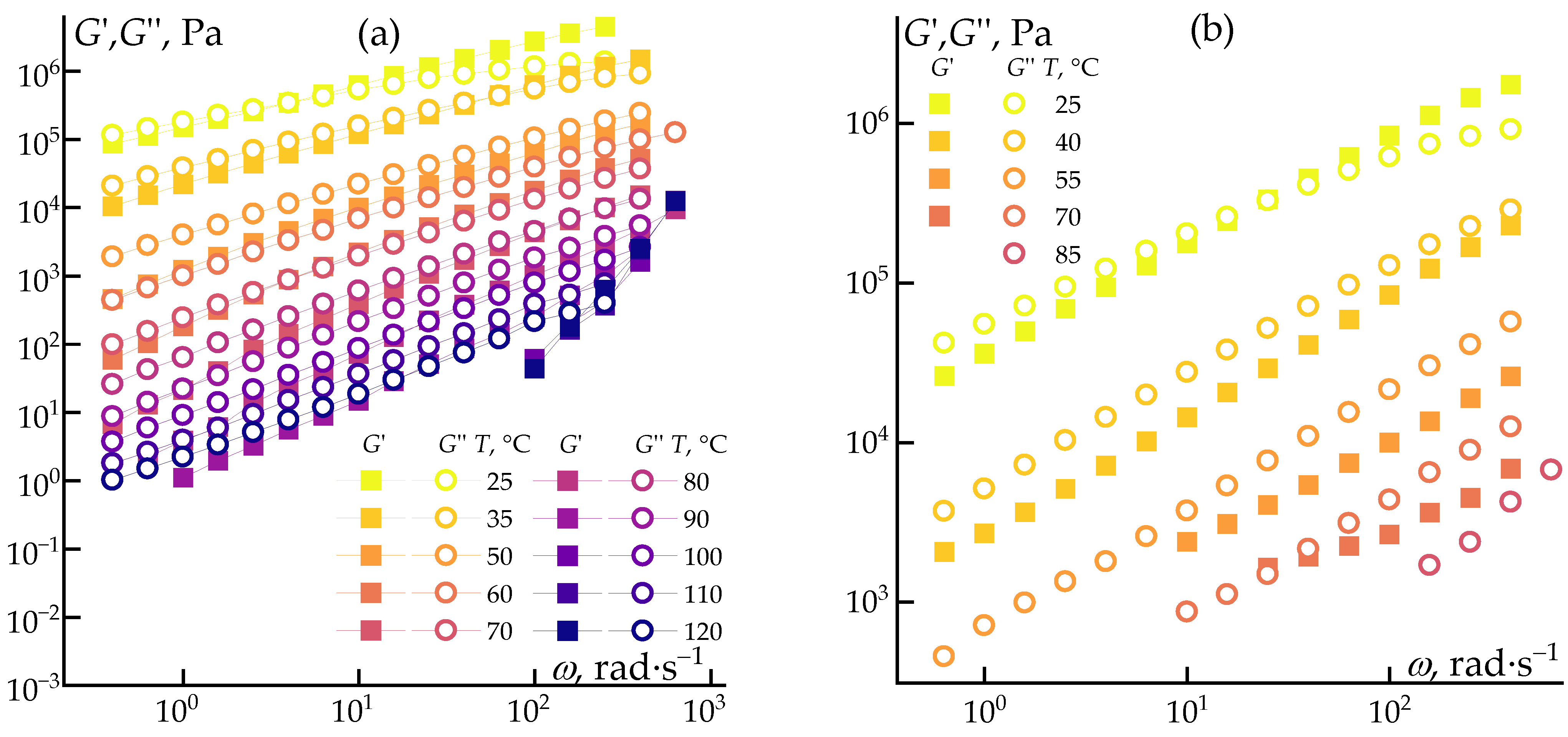
Figure 1a,b illustrate the temperature dependences of the storage modulus (G′) and loss modulus (G″) for bitumen grades B-1 and B-2, respectively.
Figure 1.
The dependence of the elastic modulus and loss on temperature for bitumen grades B-1 and B-2 is shown in Figures (a) and (b), respectively.
At temperatures close to ambient (≈25 °C), the storage modulus of bitumen B-1 is on the order of 105–106 Pa, indicating a solid-like response governed by asphaltene associations and restricted molecular mobility, whereas for the softer B-2 grade it is noticeably lower, approximately 104–105 Pa, reflecting its reduced structural rigidity. As temperature increases, both moduli decrease progressively; however, the rate of decrease is significantly higher for the B-2 bitumen.
The crossover temperature (G′≈G″), indicating the transition from viscoelastic solid-like to viscous-dominated behavior, occurs at lower temperatures for the B-2 grade compared to the B-1 binder. This shift suggests an earlier loss of elastic response and a higher susceptibility to flow under elevated service temperatures.
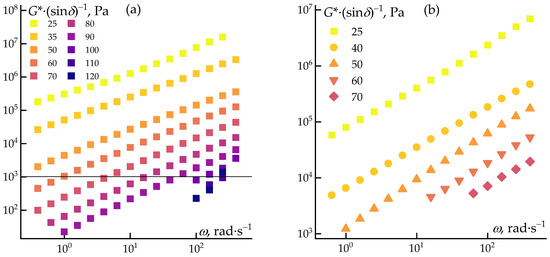
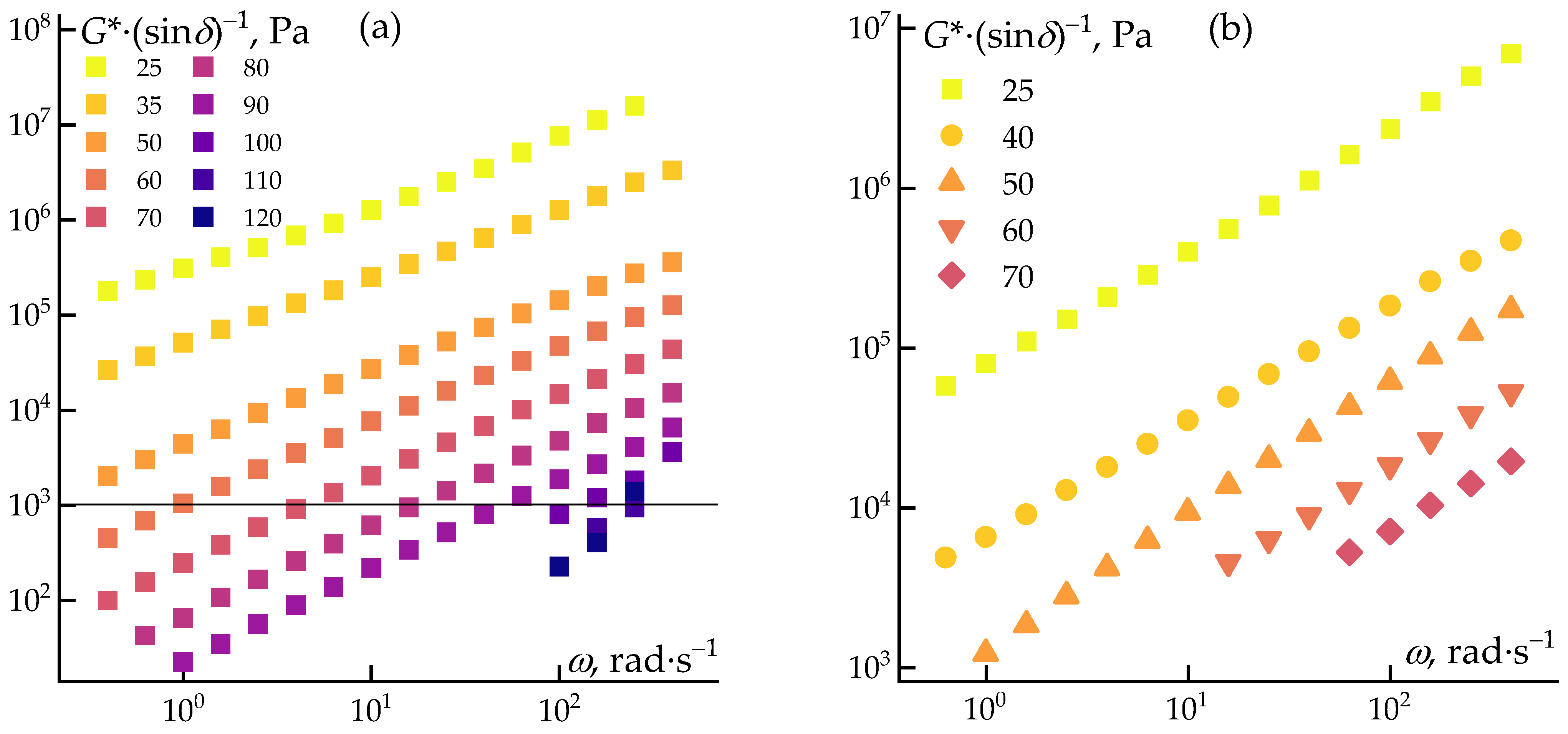
Figure 2 presents the temperature dependence of the rutting index G*/sinδ for both base bitumen. For both materials, G*/sinδ decreases monotonically with increasing temperature, consistent with thermally activated softening of the binder.
Figure 2.
The dependence of the rutting index on the temperature for bitumen grades (a) B-1 and (b) B-2 is presented.
At moderate temperatures (≈50–60 °C), the G*/sinδ values for bitumen B-1 are approximately 1.5–2 times higher than those of the B-2 grade. At higher temperatures (≈80–90 °C), this difference becomes even more pronounced, with the B-1 binder maintaining G*/sinδ values on the order of 103 Pa, while the B-2 bitumen approaches the lower performance threshold. This behavior confirms the superior resistance of the harder B-1 grade to shear deformation and rutting under high-temperature loading conditions.
From a fundamental perspective, the higher G*/sinδ values of the B-1 bitumen are associated with its higher degree of internal structuring and increased contribution of elastic response, which delays the transition to viscous flow.
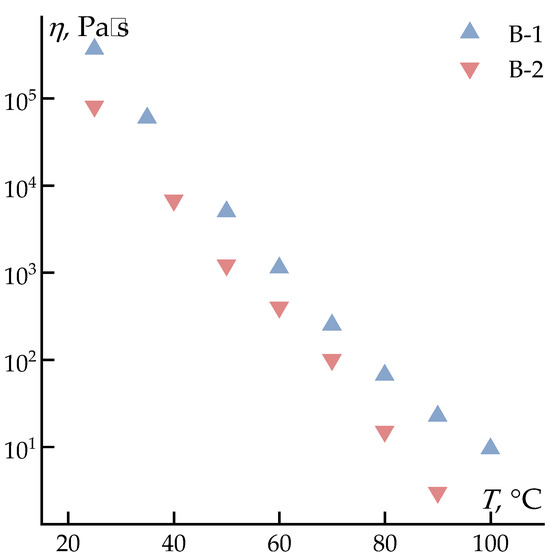
Figure 3 shows the temperature dependence of the highest Newtonian viscosity for both bitumen. In the investigated temperature range, viscosity decreases exponentially with increasing temperature, following an Arrhenius-type trend typical for bituminous binders.
Figure 3.
The highest Newtonian viscosity of the bitumen under study at various temperatures.
At comparable temperatures, the viscosity of bitumen B-1 is consistently higher by approximately a factor of 2–3 than that of the B-2 grade. For example, at elevated temperatures relevant to processing and service conditions (≈150–180 °C), the viscosity of the B-1 binder remains on the order of 102–103 Pa·s, whereas the B-2 bitumen exhibits value closer to 101–102 Pa·s. This difference highlights the lower temperature sensitivity and enhanced structural stability of the harder grade.
3.1.2. SBS-Modified System
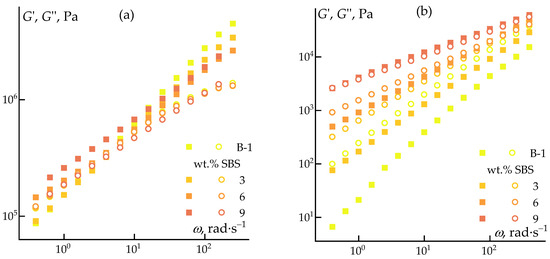
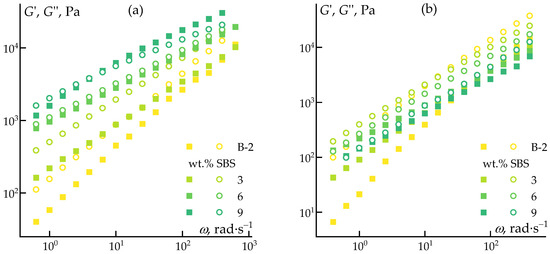
To increase the elasticity of the system, SBS-modified bitumens with a concentration of up to 9% were prepared, their rheological behavior is shown in Figure 4.
Figure 4.
Dependence of B-1 accumulation and loss modules when adding up to 9% SBS at 25 °C (а) and 70 °C (b).
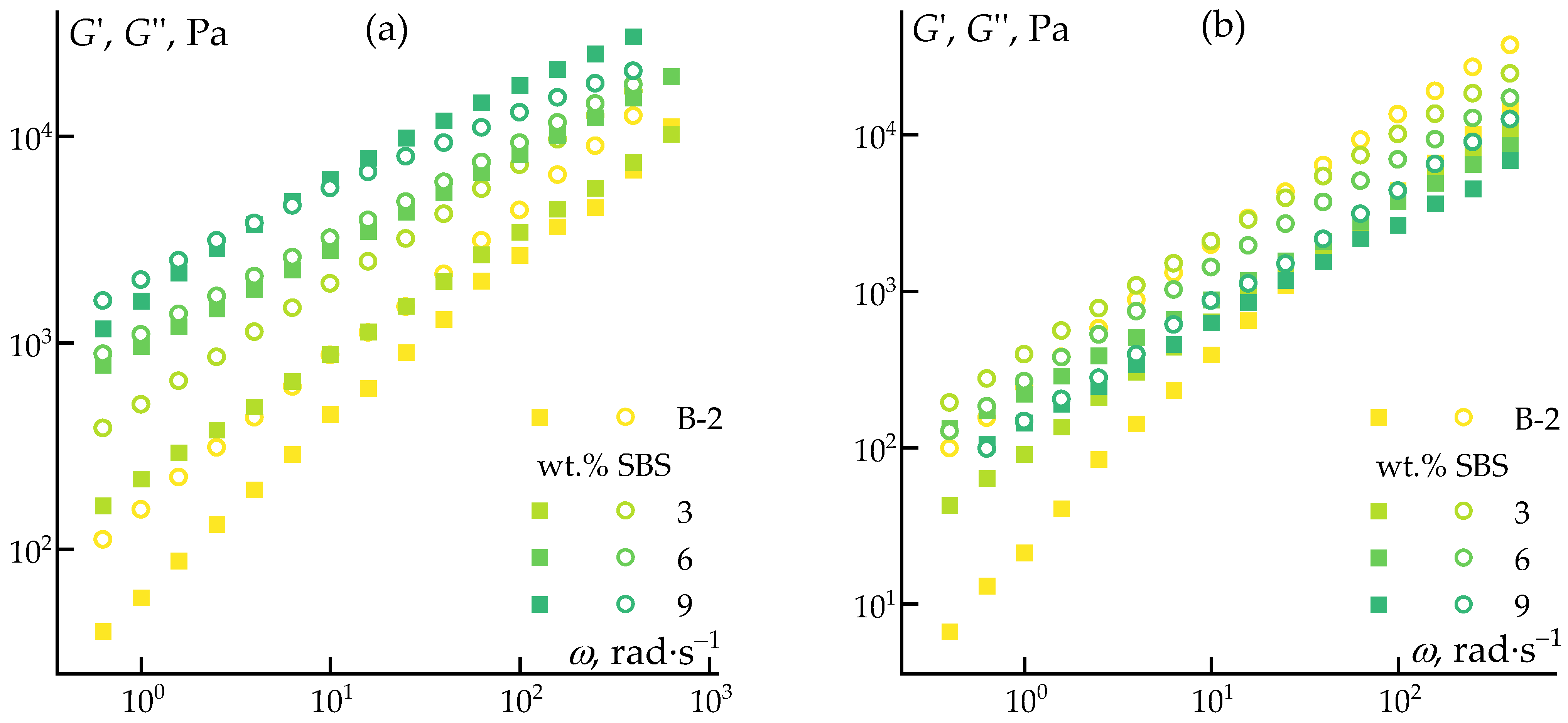
At 25 °C, the addition of SBS leads to a pronounced increase in G′ for both bitumen. At SBS contents above 6 wt.%, G′ exceeds G″ by nearly one order of magnitude, indicating a transition toward predominantly elastic, rubber-like behavior. The absolute values of G′ reach approximately 106–107 Pa, suggesting the formation of an SBS network within the bitumen matrix.
At 70 °C, unmodified bitumen shows a sharp decrease in moduli and viscous-dominated behavior. In contrast, SBS-modified systems retain significantly higher G′ values, particularly at SBS contents ≥ 6 wt.%. For these compositions, G′ remains on the order of 104–105 Pa, while G″ increases only moderately, indicating effective suppression of viscous flow.
The reinforcing effect of SBS is more pronounced for the softer B-2 bitumen, where polymer modification compensates for the initially lower stiffness of the base binder (Figure 5). Fundamentally, this behavior is attributed to the formation of physical cross-links via polystyrene domains and elastic deformation of polybutadiene segments, which collectively enhance elasticity and reduce temperature-induced flow.
Figure 5.
Storage and loss moduli of the B-2 binder as a function of SBS content up to 9 wt.% measured at (a) 25 °C and (b) 70 °C.
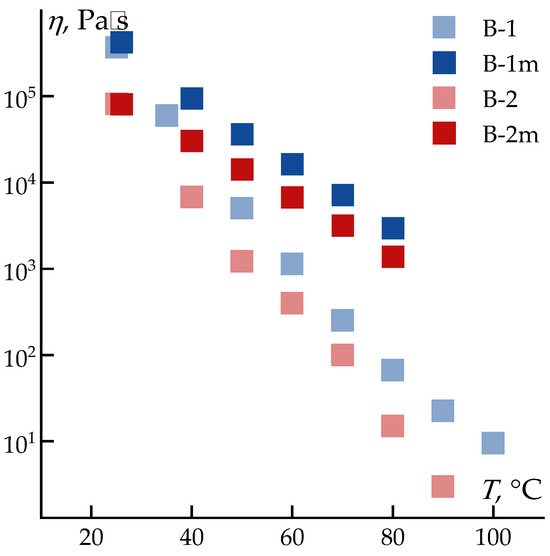
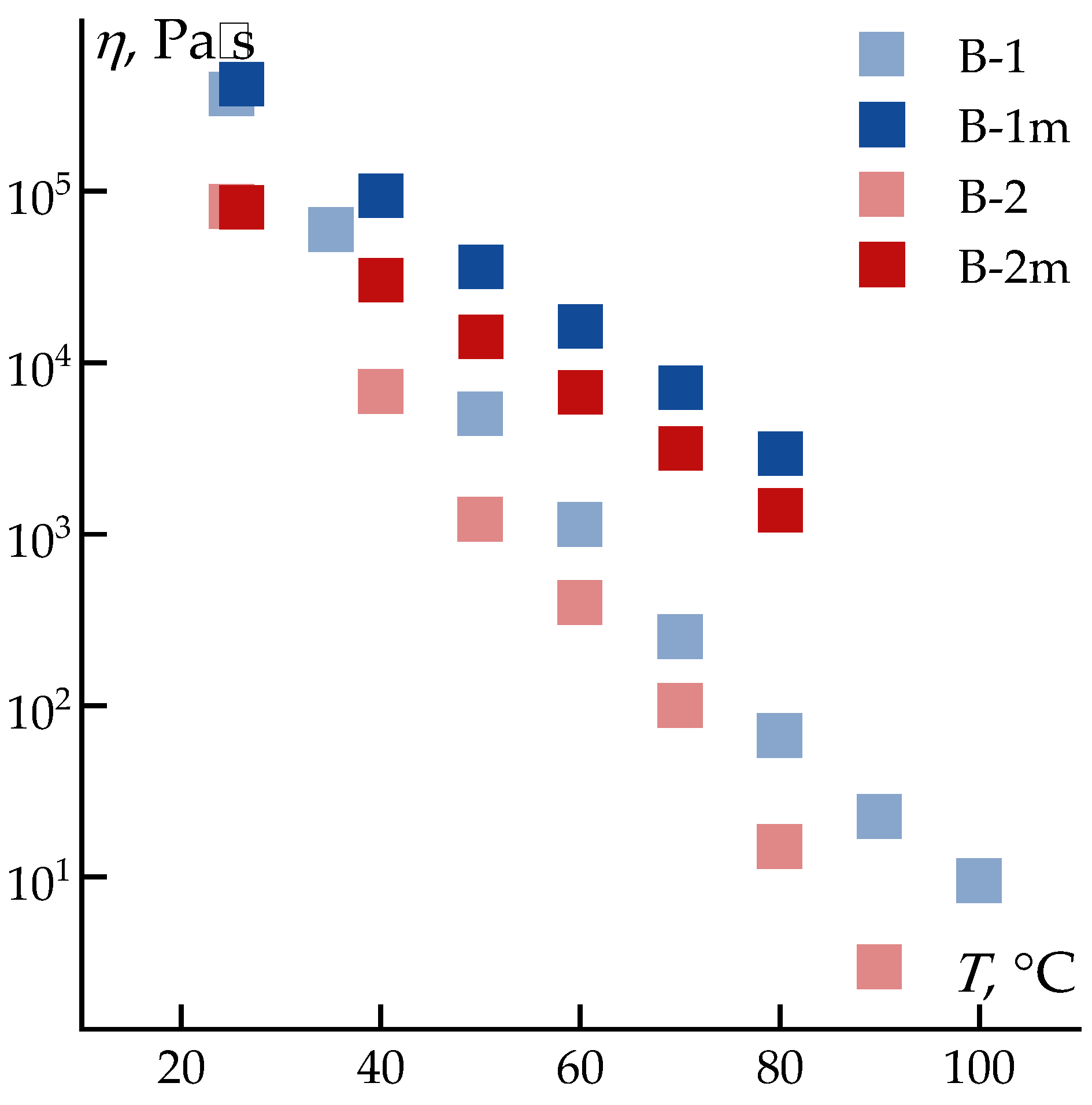
Figure 6 clearly demonstrates that the incorporation of SBS significantly reduces the temperature dependence of binder viscosity, resulting in enhanced rheological stability at elevated temperatures. This stabilizing effect is more pronounced for the B-2-based compositions compared to the B-1 system. Increasing the SBS content beyond 10 wt.% leads to a substantial increase in mixing complexity, requiring higher energy input to achieve a homogeneous system, which is considered impractical from a technical and economic standpoint.
Figure 6.
Temperature dependence of the zero-shear viscosity for the base bitumen and their SBS-modified counterparts.
Accordingly, an SBS content of 9 wt.% was selected as optimal in the present study. Further enhancement of performance is achieved through the introduction of anisotropic reinforcing particles, namely viscose cellulose fibers. Unlike synthetic fibers, cellulose does not contribute to microplastic release while providing a significant improvement in mechanical properties and, most importantly, increasing resistance to permanent deformation (rutting).
For simplicity of notation, the compositions containing 9 wt.% SBS based on B-1 and B-2 binders are denoted as B-1m and B-2m, respectively.
3.1.3. Cellulose-Modified Systems
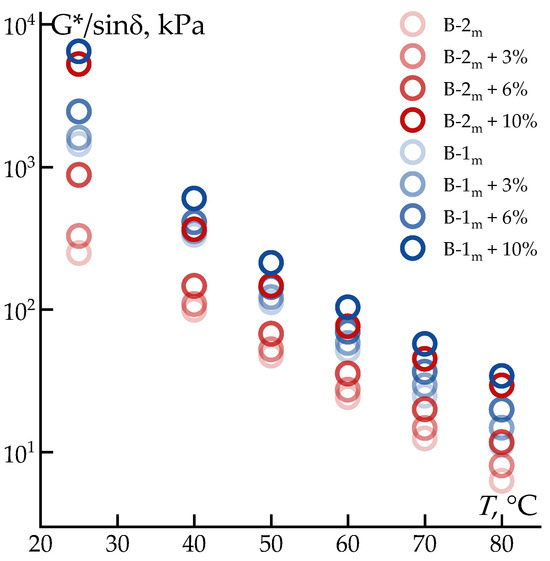
For hot-climate applications, the temperature dependence of the rutting resistance parameter is a key performance indicator. Figure 7 presents the temperature dependence of the rutting index G*/sinδ for SBS-modified bitumen systems containing 9 wt.% SBS and reinforced with cellulose fibers in the concentration range of 3–10 wt.%. Measurements were performed over the temperature interval of approximately 25–80 °C.
Figure 7.
Dependence of the rutting index on temperature for B-1 and B-2 modified with 9% SBS (index m) with different amounts of added cellulose.
For all compositions, G*/sinδ decreases monotonically with increasing temperature, reflecting the thermorheological softening typical of viscoelastic asphalt binders. However, at each temperature level, the addition of cellulose fibers leads to a systematic increase in G*/sinδ compared to the reference SBS-modified binder without fibers.
The reinforcing effect of cellulose becomes more pronounced with increasing fiber content. At low temperatures (≈25–40 °C), fiber-reinforced systems exhibit markedly higher G*/sinδ values by up to an order of magnitude for the highest cellulose loadings, indicating a substantial increase in stiffness and elastic contribution. At elevated temperatures (≥60 °C), although absolute values of G*/sinδ decrease for all compositions, cellulose-containing systems retain consistently higher rutting resistance relative to the unfilled SBS-modified binder.
Notably, the slope of the G*/sinδ temperature curves become less steep with increasing cellulose content, suggesting reduced temperature sensitivity and enhanced structural stability of the binder. This behavior can be attributed to the formation of a fiber-reinforced microstructure superimposed on the SBS polymer network, which restricts molecular mobility and delays the transition to viscous-dominated flow at high temperatures.
The synergistic behavior can be attributed to the combination of two complementary mechanisms: the elastomeric SBS phase enhances the elastic response and recovery of the binder, while cellulose fibers form a stabilizing network within the bitumen matrix and adsorb light fractions of the binder. This combination contributes to improved structural stability and enhanced viscoelastic properties of the modified system.
Overall, the results indicate a synergistic effect of SBS modification and cellulose reinforcement, leading to improved high-temperature rutting resistance and enhanced thermal stability of the polymer-modified bitumen system.
3.2. FTIR Spectroscopy
3.2.1. Polymer-Modified Bitumen
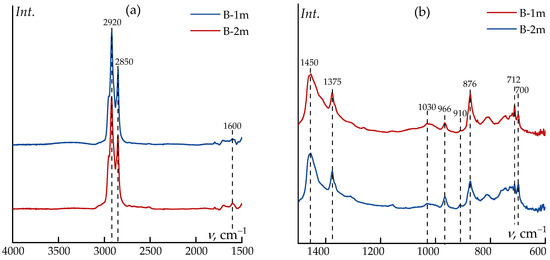
The FTIR spectra of the B-1m and B-2m samples are shown in Figure 8.
Figure 8.
FTIR spectra of samples B-1m and B-2m: (a) 4000–1500 cm−1 region and (b) 1500–600 cm−1 region.
Both samples display the characteristic broadband features of hydrocarbon-rich bituminous materials together with peaks attributable to styrene and butadiene moieties. Major absorptions (representative, peak positions in cm−1 and tentative assignments) are listed in Table 3.
Table 3.
Description of the major infrared peaks in the studied samples.
No distinct carbonyl (~1720–1740 cm−1) or hydroxyl (~3200–3600 cm−1) stretches were detected, indicating minimal free plasticizer or contaminant content. Both spectra share functional group signatures, but relative intensities differ: B-1m shows stronger SBS-specific bands (~966 and ~698 cm−1), more pronounced carbonate bands (~876 and ~712 cm−1), and a more intense S=O band (~1030 cm−1) compared to B-2m. This suggests B-1m has a higher relative content of SBS polymer, inorganic filler (e.g., CaCO3), and sulfoxide or oxidized bitumen fractions. Both materials are consistent with SBS-modified bituminous sealants, with B-1m being richer in polymer and filler.
3.2.2. Cellulose Composite
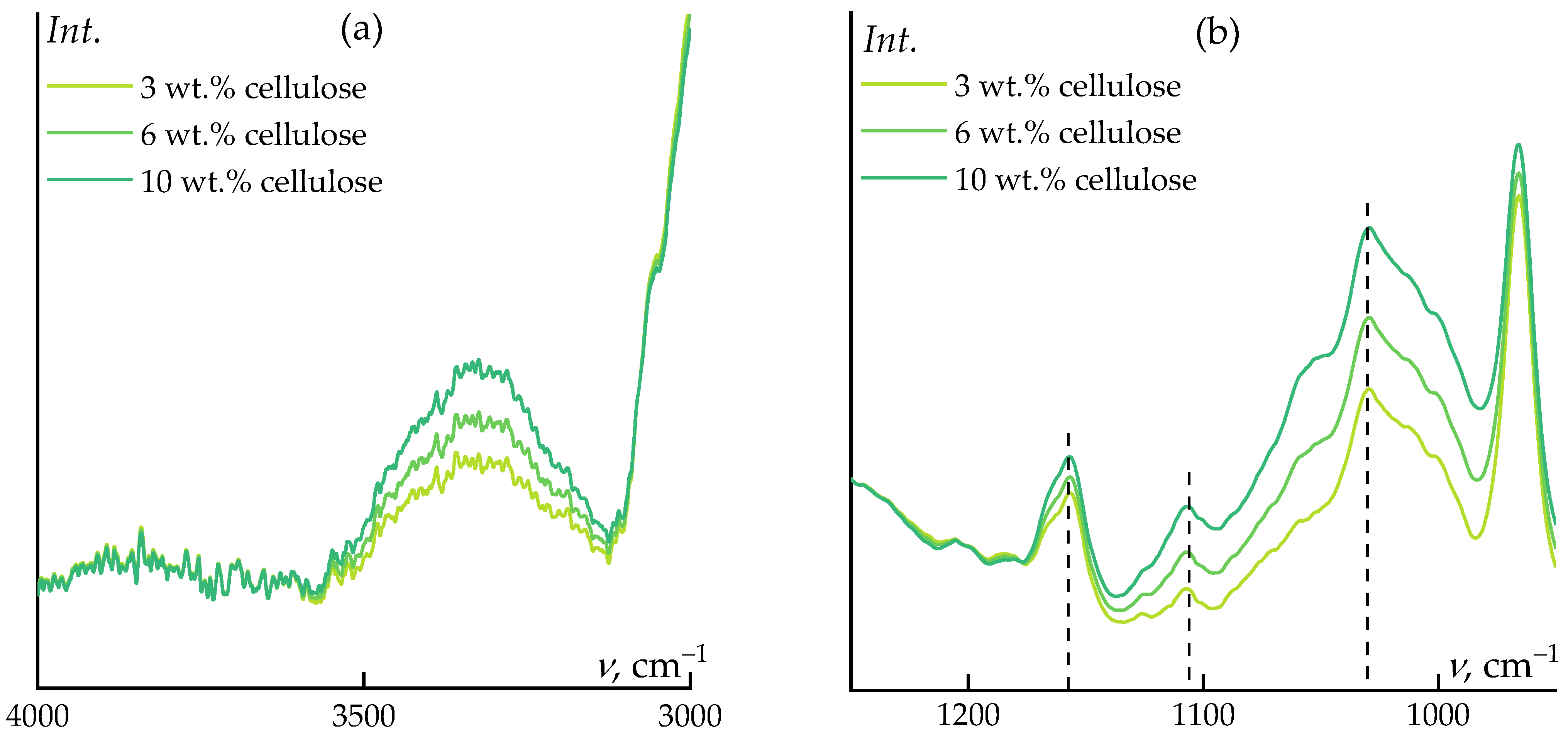
To elucidate the chemical basis for the distinct rheological and adhesive properties of samples B-1m and B-2m, as well as their interaction with cellulose, FTIR spectroscopy was employed. The spectrum of the base bitumen binder is presented in Figure 8 for reference, while the spectra of cellulose-modified samples are detailed in Figure 9.
Figure 9.
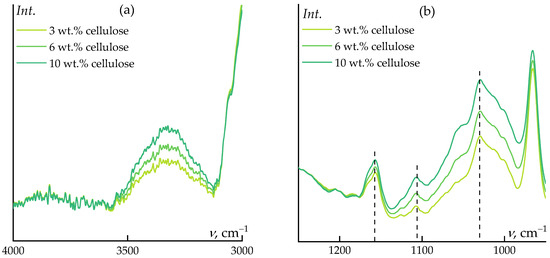
FTIR spectra of B-1m sample with different concentration of cellulose: (a) 4000–3000 cm−1 region; (b) 1250–900 cm−1 region.
For sample B-1m, a broad O-H stretch band appears at ~3300–3400 cm−1 (Figure 9a), confirming cellulose incorporation and suggesting hydrogen bonding between fibers and the matrix. In the fingerprint region (Figure 9b), new bands at 1050–1030 cm−1 correspond to cellulose C-O-C/C-O vibrations. Observable shifts in native bitumen bands could indicate the interactions at the interface, beyond simple mixing. For sample B-2m, the spectral changes upon cellulose addition are analogous.
3.3. Adhesion of Bitumen
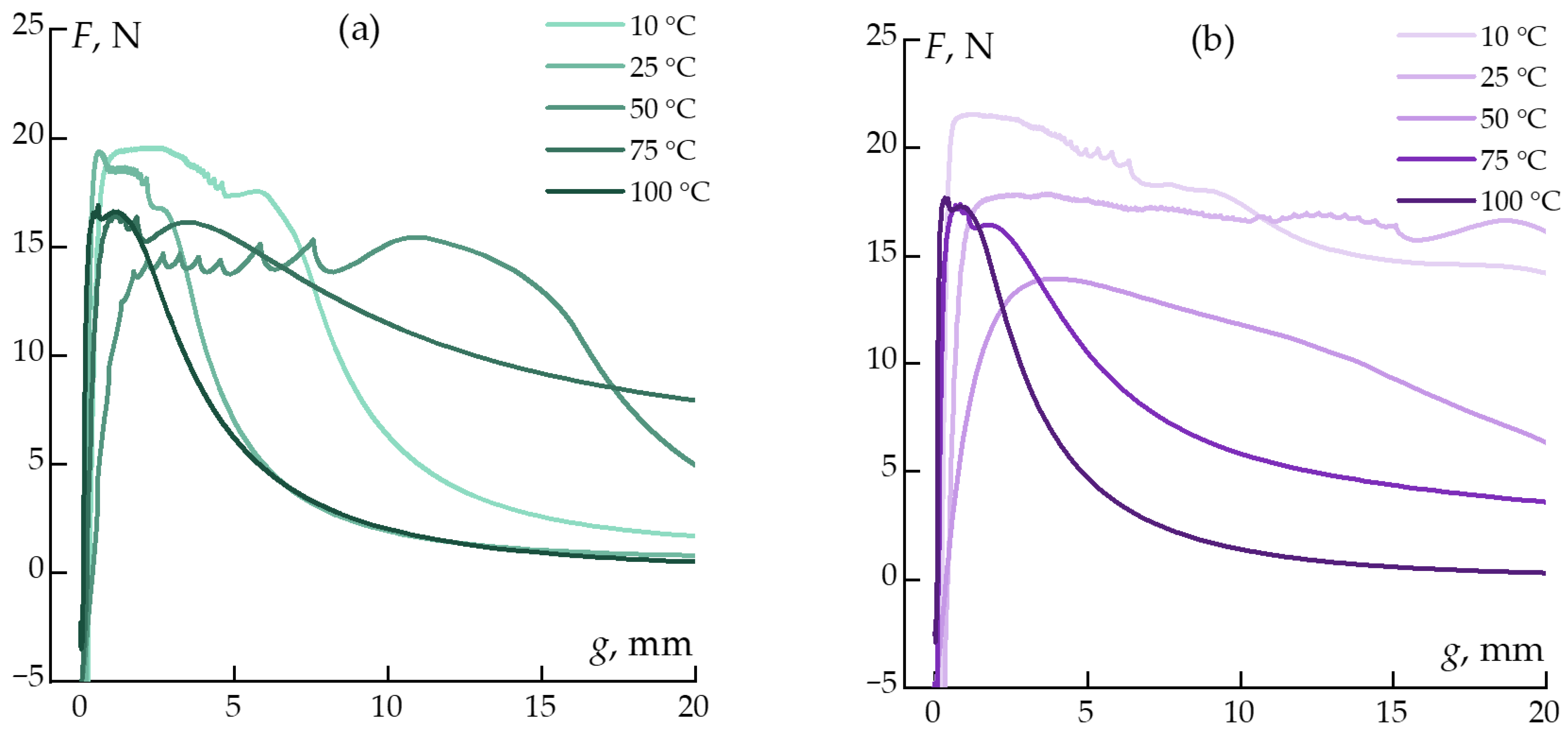
The axial plate separation test produced three metrics per condition: peak tensile (negative normal) force Fmax (N), the area under the absolute force–time curve A (N/s), and the time for the tensile force to fall to 10% of its peak (t90, s). Results for samples B-1m + 6% and B-2m + 6% at the tested temperatures are summarized in Table 4 and Figure 10.
Table 4.
The main test results for the both samples.
Figure 10.
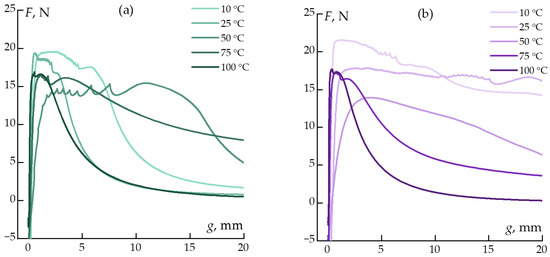
The results of the tack test for the sample (a) B-1m + 6% and (b) B-2m + 6% at different temperature.
The adhesive properties of sample B-1m + 6% exhibit a pronounced temperature dependence, characteristic of a viscoelastic pressure-sensitive adhesive. The tack (peak force) and adhesive/cohesive strength (area under the curve) demonstrate a distinct maximum at 25 °C (19.5 N and 132.5 N·s, respectively), indicating optimal performance at ambient conditions. This temperature corresponds to a balanced viscoelastic state where the material possesses sufficient stiffness for effective load-bearing (elastic component) and adequate flow to establish intimate contact (viscous component). As the temperature increases to 50–100 °C, a sharp, monotonic decrease in both parameters is observed (e.g., tack drops to ~16.9 N at 100 °C, adhesion strength to 13.5 N/s). This softening is attributed to a significant reduction in the material’s storage modulus (G′) and complex viscosity, leading to a transition towards viscous-dominated, non-cohesive failure. Conversely, at 10 °C, while tack remains relatively high (19.4 N), a reduction in adhesive strength and shorter failure time compared to 25 °C suggest an increase in stiffness (higher G′) that limits deformation and energy dissipation during debonding, promoting more brittle, adhesive-type failure.
Sample B-2m + 6% shows a notably different and more complex behavior profile. Its maximum tack is achieved at a lower temperature of 10 °C (21.6 N), and it maintains exceptionally high adhesive/cohesive strength at both 10 °C and 25 °C (206.8 and 159.8 N/s, respectively). This indicates that B-2m + 6% retains a favorable viscoelastic balance—high elasticity for strength and sufficient viscous flow for bonding—at lower temperatures compared to B-1m. However, a critical transition occurs near 50 °C, where a dramatic collapse in adhesive strength is observed (falling to 10.6 N/s). This sharp drop suggests a possible thermal transition or a significant disruption of the cohesive network within the adhesive at this temperature. At higher temperatures (75–100 °C), properties remain at a low plateau. The failure time for B-2m + 6% is longest at 25 °C (9.7 s), underscoring its superior cohesive resistance to debonding under ambient conditions.
Comparison Results
A comparative analysis of samples B-1m + 6% and B-2m + 6% reveals their distinct operational temperature windows and underlying structural mechanics.
Sample B-2m + 6% demonstrates superior performance in low-temperature and high-stress scenarios. Its significantly higher adhesive strength at 10 °C and 25 °C (exceeding B-1m + 6% by a factor of ~1.5 and ~1.2, respectively) and its longer failure time at 25 °C classify it as a structural-grade pressure-sensitive adhesive with enhanced cohesive strength. The fundamental reason for this behavior is likely a higher degree of internal structuring or cross-linking density, resulting in a higher storage modulus (G′) and enhanced elastic energy storage at moderate temperatures. This network is, however, susceptible to a breakdown at approximately 50 °C, leading to a catastrophic loss of properties.
In contrast, sample B-1m + 6% performs as a reliable general-purpose adhesive within a moderate temperature range centered around 25 °C. While its peak strength is lower than that of B-2m + 6%, it shows a less dramatic decline at elevated temperatures up to 75 °C, indicating greater thermal stability of its viscoelastic network or a different softening mechanism. The more gradual reduction in its properties suggests a lower activation energy for flow and a broader glass transition region.
4. Conclusions
In this study, complex modified bituminous binders based on different base bitumen grades were developed through combined modification with SBS elastomer and cellulose fibers. The resulting systems exhibit a favorable combination of enhanced high-temperature rheological performance, preserved adhesion, and alignment with sustainability-oriented road material concepts. The proposed modification strategy combines the elasticity-inducing effect of thermoplastic elastomers with the structural stabilization provided by natural fibrous additives, forming a multifunctional binder system.
Rheological analysis shows that SBS modification induces a transition toward elastic-dominated behavior. At 25 °C and SBS contents above 6 wt.%, the storage modulus G′ exceeds the loss modulus G″ by nearly one order of magnitude, with G′ reaching 106–107 Pa, indicating the formation of a percolated polymer network. At 70 °C, SBS-modified binders retain storage modulus values on the order of 104–105 Pa, whereas unmodified bitumen exhibit viscous-dominated flow. The effect is most pronounced for the softer B-2 binder, where polymer modification compensates for its initially lower stiffness.
An SBS content of 9 wt.% was identified as optimal, as higher concentrations (>10 wt.%) significantly increase processing complexity without proportional performance gains. Additional reinforcement with viscose cellulose fibers (3–10 wt.%) leads to a systematic increase in the rutting resistance parameter G*/sinδ over the entire temperature range of 25–80 °C. Among the investigated fiber concentrations, 6 wt.% cellulose provides the most balanced combination of rheological improvement, processability, and structural stability of the binder. At this concentration, the fibers effectively form a reinforcing spatial network within the polymer-modified bitumen matrix while maintaining acceptable viscosity and mixing characteristics during processing. In contrast, compositions containing 10 wt.% cellulose exhibit significantly increased viscosity and reduced processability, which complicates mixing and handling during industrial preparation. Nevertheless, such highly filled systems demonstrate exceptionally high stiffness and rutting resistance and may therefore be considered for applications in regions characterized by extremely high pavement temperatures and severe climatic loading.
For higher cellulose contents, G*/sinδ exceeds the Superpave criterion of 2.2 kPa at temperatures above 80 °C, satisfying the requirements for hot-climate pavements and sealant applications. Moreover, cellulose incorporation reduces temperature sensitivity, indicating enhanced structural stability.
FTIR analysis confirms that SBS modification preserves the chemical integrity of the bitumen, while cellulose addition is evidenced by hydroxyl- and C–O–C-related bands, indicating successful incorporation and intermolecular interactions. Despite the increased elastic stiffness, the composites maintain favorable adhesive performance. The B-1m + 6% system shows maximum adhesion at 25 °C (≈19.6 N, 132.5 N·s), while B-2m + 6% exhibits superior cohesive strength at lower temperatures, with adhesion energies exceeding 200 N·s at 10 °C.
The observed synergistic effect between SBS and cellulose fibers can be attributed to the complementary roles of the two modifiers within the bituminous matrix. The SBS elastomer forms a continuous or semi-continuous polymer network that enhances elasticity and deformation recovery, whereas cellulose fibers act as a structural reinforcement element capable of adsorbing lighter fractions of bitumen and restricting viscous flow. As a result, a hybrid microstructure is formed in which the polymer network provides elastic resilience while the fibrous phase stabilizes the binder structure and redistributes stresses under mechanical loading. This combined mechanism leads to improved resistance to rutting, reduced temperature susceptibility, and enhanced structural stability of the modified binder.
From a scientific perspective, the novelty of this work lies in the systematic investigation of dual modification of bitumen using a thermoplastic elastomer and renewable cellulose fibers, combined with a comprehensive characterization approach including rheological analysis, adhesion testing, FTIR spectroscopy, and morphological observations. Unlike conventional studies focusing on either polymer or fiber modification separately, the present work demonstrates the synergistic interaction between these modifiers and establishes an optimal composition window that balances performance enhancement with processing feasibility. The results highlight the potential of integrating synthetic elastomers with bio-based structural additives to create high-performance, sustainable bituminous binders suitable for modern road construction technologies.
Overall, the results demonstrate a clear synergistic effect between synthetic (SBS) and natural (cellulose) modifiers, enabling the development of high-performance and sustainable bituminous materials suitable for use both as asphalt binders and as advanced bituminous sealants.
Author Contributions
Conceptualization, G.K.S. and Z.K.; methodology, N.K., I.S.M., S.B., G.K.S. and M.S.K.; validation, Z.K.; formal analysis, G.K.S. and Z.K.; investigation, I.V.G., I.Y.S., G.K.S., S.B. and Z.K.; data curation, S.B. and G.K.S.; writing—original draft preparation, Z.K. and G.K.S.; writing—review and editing, Z.K. and G.K.S.; visualization N.K.; supervision, Z.K.; project administration, G.K.S. All authors have read and agreed to the published version of the manuscript.
Funding
This research was funded by the Science Committee of the Ministry of Science and Higher Education of the Republic of Kazakhstan (Grant No. AP26100713).
Data Availability Statement
The data that support the findings of this study are available from the corresponding author upon reasonable request.
Acknowledgments
This work was performed using the equipment of the Shared Research Center “NSF” (DMR-2122108 (PREM)).
Conflicts of Interest
The authors declare no conflicts of interest. The funders had no role in the design of the study; in the collection, analyses, or interpretation of data; in the writing of the manuscript; or in the decision to publish the results.
References
- Putman, B.J. Effects of Fiber Finish on the Performance of Asphalt Binders and Mastics. Adv. Civ. Eng. 2011, 2011, 172634. [Google Scholar] [CrossRef] [Scilit]
- Manosalvas-Paredes, M.; Gallego, J.; Saiz, L.; Bermejo, J.M. Rubber Modified Binders as an Alternative to Cellulose Fiber–SBS Polymers in Stone Matrix Asphalt. Constr. Build. Mater. 2016, 121, 727–732. [Google Scholar] [CrossRef] [Scilit]
- Al-Hadidy, A.I.; Yi-qiu, T. Effect of Styrene-Butadiene-Styrene on the Properties of Asphalt and Stone-Matrix-Asphalt Mixture. J. Mater. Civ. Eng. 2011, 23, 504–510. [Google Scholar] [CrossRef] [Scilit]
- Mokhtari, A.; Nejad, F.M. Comparative Study on Performance of Wax-Modified and Typical SMA Mixtures. J. Mater. Civ. Eng. 2013, 25, 419–427. [Google Scholar] [CrossRef] [Scilit]
- Shambilova, G.K.; Iskakov, R.M.; Shazhdekeyeva, N.K.; Kuanbayeva, B.U.; Kuzin, M.S.; Skvortsov, I.Y.; Makarov, I.S. Environmentally Sustainable and Climate-Adapted Bitumen–Composite Materials for Road Construction in Central Asia. Infrastructures 2025, 10, 345. [Google Scholar] [CrossRef] [Scilit]
- Fahad, M.; Nagy, R. Performance Comparison of Polymer and Fiber Modified Asphalt Mixtures. Discov. Appl. Sci. 2025, 7, 570. [Google Scholar] [CrossRef] [Scilit]
- Chen, J.-S.; Lin, K.-Y. Mechanism and Behavior of Bitumen Strength Reinforcement Using Fibers. J. Mater. Sci. 2005, 40, 87–95. [Google Scholar] [CrossRef] [Scilit]
- Peltonen, P.V. Characterization and Testing of Fibre-Modified Bitumen Composites. J. Mater. Sci. 1991, 26, 5618–5622. [Google Scholar] [CrossRef]
- Makarov, I.; Golova, L.; Vinogradov, M.; Levin, I.; Gromovykh, T.; Arkharova, N.; Kulichikhin, V. Cellulose Fibers from Solutions of Bacterial Cellulose in N-Methylmorpholine N-Oxide. Fibre Chem. 2019, 51, 175–181. [Google Scholar] [CrossRef] [Scilit]
- Eskandarsefat, S.; Sangiorgi, C.; Dondi, G.; Lamperti, R. Recycling Asphalt Pavement and Tire Rubber: A Full Laboratory and Field Scale Study. Constr. Build. Mater. 2018, 176, 283–294. [Google Scholar] [CrossRef] [Scilit]
- Wu, M.-M.; Li, R.; Zhang, Y.-Z.; Fan, L.; Lv, Y.-C.; Wei, J.-M. Stabilizing and Reinforcing Effects of Different Fibers on Asphalt Mortar Performance. Pet. Sci. 2015, 12, 189–196. [Google Scholar] [CrossRef] [Scilit]
- Kou, C.; Chen, Z.; Kang, A.; Zhang, M.; Wang, R. Rheological Behaviors of Asphalt Binders Reinforced by Various Fibers. Constr. Build. Mater. 2022, 323, 126626. [Google Scholar] [CrossRef] [Scilit]
- Gallo, P. Asphalt Mix Reinforced with Vegetable Fibers. IOP Conf. Ser. Mater. Sci. Eng. 2017, 236, 012024. [Google Scholar] [CrossRef] [Scilit]
- Chen, B.; Dong, F.; Yu, X.; Zheng, C. Evaluation of Properties and Micro-Characteristics of Waste Polyurethane/Styrene-Butadiene-Styrene Composite Modified Asphalt. Polymers 2021, 13, 2249. [Google Scholar] [CrossRef] [Scilit]
- Bocci, E.; Prosperi, E. Recycling of Reclaimed Fibers from End-of-Life Tires in Hot Mix Asphalt. J. Traffic Transp. Eng. (Engl. Ed.) 2020, 7, 678–687. [Google Scholar] [CrossRef] [Scilit]
- Yang, Q.; Lin, J.; Wang, X.; Wang, D.; Xie, N.; Shi, X. A Review of Polymer-Modified Asphalt Binder: Modification Mechanisms and Mechanical Properties. Clean. Mater. 2024, 12, 100255. [Google Scholar] [CrossRef] [Scilit]
- Lee, S.J.; Rust, J.P.; Hamouda, H.; Kim, Y.R.; Borden, R.H. Fatigue Cracking Resistance of Fiber-Reinforced Asphalt Concrete. Text. Res. J. 2005, 75, 123–128. [Google Scholar] [CrossRef] [Scilit]
- Shambilova, G.K.; Iskakov, R.M.; Bukanova, A.S.; Kairliyeva, F.B.; Kalauova, A.S.; Kuzin, M.S.; Novikov, E.M.; Gerasimenko, P.S.; Makarov, I.S.; Skvortsov, I.Y. Polypropylene Crystallinity Reduction through the Synergistic Effects of Cellulose and Silica Formed via Sol–Gel Synthesis. Polymers 2024, 16, 2855. [Google Scholar] [CrossRef] [Scilit]
- Iskakov, R.M.; Bukanova, A.S.; Kalauova, A.S.; Kairliyeva, F.B.; Nauashev, A.N.; Shambilova, G.K.; Obidin, I.M.; Kuzin, M.S.; Chernenko, D.N.; Patsaev, T.D.; et al. Eco-Friendly Polypropylene Composites Reinforced with Cellulose Fibers and Silica Nanoparticles. Polymers 2025, 17, 1290. [Google Scholar] [CrossRef] [Scilit] [PubMed]
- Mohammed, M.; Parry, T.; Grenfell, J. Influence of Fibres on Rheological Properties and Toughness of Bituminous Binder. Constr. Build. Mater. 2018, 163, 901–911. [Google Scholar] [CrossRef] [Scilit]
- Wu, M.; Cai, H.; Wang, H.; Hua, J.W.; Liang, J.; Zhang, Y. Stabilization and Reinforcement Effect of Fibers on a Bitumen Binder. ACS Omega 2022, 7, 44207–44214. [Google Scholar] [CrossRef] [Scilit]
- Aljubory, A.; Teama, Z.T.; Salman, H.T.; Abd Alkareem, H.M. Effects of Cellulose Fibers on the Properties of Asphalt Mixtures. Mater. Today Proc. 2021, 42, 2941–2947. [Google Scholar] [CrossRef] [Scilit]
- Desseaux, S.; Dos Santos, S.; Geiger, T.; Tingaut, P.; Zimmermann, T.; Partl, M.N.; Poulikakos, L.D. Improved Mechanical Properties of Bitumen Modified with Acetylated Cellulose Fibers. Compos. Part B Eng. 2018, 140, 139–144. [Google Scholar] [CrossRef] [Scilit]
- Eskandarsefat, S.; Hofko, B.; Rossi, C.O.; Sangiorgi, C. Fundamental Properties of Bitumen Binders Containing Novel Cellulose-Based Poly-Functional Fibres. Compos. Part B Eng. 2019, 163, 339–350. [Google Scholar] [CrossRef] [Scilit]
- Mashaan, N.; Karim, M.; Khodary, F.; Saboo, N.; Milad, A. Bituminous Pavement Reinforcement with Fiber: A Review. CivilEng 2021, 2, 599–611. [Google Scholar] [CrossRef] [Scilit]
- Xing, C.; Han, Z.; Li, M.; Zhu, B.; Sun, Z.; Wang, Y.; Wang, S. Thermal History-Induced Nanoscale Surface Characteristics of Bitumen: Implications of Sample Preparation on Accurate Characterization. Appl. Surf. Sci. 2026, 730, 166309. [Google Scholar] [CrossRef] [Scilit]
- ГOCT 6840-78 Цeллюлoза. Meтoд Oпрeдeлeния Coдeржания Aльфацeллюлoзы-Docs.Cntd.Ru. Available online: https://files.stroyinf.ru/Data2/1/4294822/4294822889.pdf (accessed on 11 March 2026).

Disclaimer/Publisher’s Note: The statements, opinions and data contained in all publications are solely those of the individual author(s) and contributor(s) and not of MDPI and/or the editor(s). MDPI and/or the editor(s) disclaim responsibility for any injury to people or property resulting from any ideas, methods, instructions or products referred to in the content. |
© 2026 by the authors. Licensee MDPI, Basel, Switzerland. This article is an open access article distributed under the terms and conditions of the Creative Commons Attribution (CC BY) license.