


Abstract
Despite the large volumes of marbleized limestone processing waste (MLPW) generated by the stone industry, its utilization in the production of high-strength masonry materials remains limited, and systematic comparative studies of white and gray Portland cements in hyperpressed MLPW-based bricks are scarce. In this study, four mixture formulations containing MLPW (70–85 wt.%), white Portland cement (CEM I 52.5, M500) or gray Portland cement (CEM I 42.5, M450), and water were prepared at a constant water-to-cement ratio of 0.25. Specimens were manufactured by hyperpressing under compaction pressures of 28 and 41 MPa and cured for 7 days in a sealed moist environment. The formulations compacted at 28 MPa achieved compressive strengths corresponding to brick strength grades M350 and M400. Increasing the pressure to 41 MPa yielded grades M400–M550 with white cement; under identical conditions with gray cement, grades M400 and M450 were attained. Among the tested formulations, those containing 75–80 wt.% MLPW (20–16 wt.% cement) showed the most favorable combination of compressive strength and density. The mechanical performance correlated well with the microstructural features observed by scanning electron microscopy (SEM) and EDS analysis. The average density of all specimens exceeded 2100 kg/m3, classifying the materials as heavyweight concrete. The novelty of this work lies in the comparative evaluation of white and gray Portland cements in hyperpressed MLPW bricks and the establishment of relationships between compaction pressure, binder type, overall mixture composition, and resulting strength grades. The results demonstrate a promising route for converting high volumes of industrial marble waste into high-strength masonry units. However, further investigation of durability-related parameters, including water absorption, frost resistance and flexural strength, is required before the practical application of the developed materials can be fully evaluated.
Keywords:
MLPW; Portland cement; hyperpressed brick; curing; density; compressive strength; microstructure 1. Introduction
Resource and energy conservation in the production of construction materials has become one of the key priorities of modern construction materials science. Among the promising approaches to addressing this challenge is the development of manufacturing technologies based on high-pressure compaction. One such technology is the production of hyperpressed bricks, which enables the fabrication of high-strength masonry units while minimizing energy consumption by eliminating the high-temperature firing stage.
In the city of Tekeli (Almaty Region, Kazakhstan), marbleized limestone from the Ekpendinsky deposit is extensively quarried and processed for the manufacture of architectural and decorative building products. During the cutting and finishing of stone blocks into facing slabs and wall and floor tiles, substantial quantities of by-products are generated in the form of sand- and dust-sized particles with varying granulometric compositions. At present, the accumulated volume of these processing wastes is estimated to be approximately 500,000 t.
The utilization of MLPW as a raw material for construction products has the potential to offer environmental and economic benefits by reducing the volume of industrial waste sent to landfills and decreasing the demand for natural raw materials. Its incorporation into industrial production can reduce the demand for virgin mineral resources, decrease the land area required for waste disposal, and mitigate air and water pollution associated with waste stockpiles. Consequently, the development of a technology for manufacturing facing hyperpressed bricks using MLPW represents a promising approach to producing sustainable wall materials with improved esthetic appearance, enhanced decorative properties, and increased durability of buildings, while simultaneously promoting the recycling of industrial waste in accordance with the principles of the circular economy.
Hyperpressed bricks are manufactured from finely ground natural or artificial mineral aggregates combined with a cementitious binder. The incorporation of inorganic pigments into the mixture enables the production of bricks in a wide range of colors, making them suitable not only for structural masonry but also for architectural façade cladding. Unlike conventional fired clay bricks, hyperpressed bricks do not require high-temperature firing. Instead, they are produced by compacting the mixture in steel molds under high pressure, typically exceeding 40 MPa. At this pressure level, the greatest increase in mechanical strength is achieved, as the mixture reaches an optimal degree of densification without damaging the aggregate particles. Consequently, a dense and homogeneous microstructure is formed, providing high compressive strength, improved frost resistance, and low water absorption. Under high-pressure compaction, the mineral particles and cement binder are forced into close contact, minimizing interparticle voids. The resulting increase in frictional and contact interactions promotes strong interparticle bonding at both the molecular and crystalline levels, leading to the formation of a highly compact and durable composite structure [1].
To expand the raw material base and improve the performance characteristics of hyperpressed bricks, numerous studies have focused on the incorporation of natural and industrial waste materials into their compositions. The authors of Patent [2] developed a pressing mold and a manufacturing method for producing construction blocks by high-pressure compaction. Two concrete mixture compositions were investigated. The first mixture consisted of 12 wt.% M400 Portland cement, 73 wt.% granulated slag, and 15 wt.% thermal power plant water-treatment sludge. The second mixture contained 15 wt.% M400 Portland cement, 65 wt.% quartz sand, and 20 wt.% thermal power plant water-treatment sludge. The mixtures, with a moisture content of 7–8%, were compacted under a pressure of 30 MPa. The molded blocks were subsequently subjected to steam curing following a 2 + 6 + 2 h regime with an isothermal holding temperature of 80 °C. The resulting products exhibited compressive strength grades ranging from M35 to M100, an average density of approximately 2200 kg/m3, and frost resistance of 25–35 freeze–thaw cycles.
In the study reported in [3], limestone crushing screenings with a fineness modulus of 2.31 were used as the aggregate for the production of hyperpressed products, while CEM II/A-S 32.5 N (M400) Portland cement served as the binder. The specimens were cured by steam treatment in a curing chamber following a 1–6–1 h regime at an isothermal temperature of 60 °C. The compressive strength of the hyperpressed specimens ranged from 22 to 30 MPa. The authors concluded that the optimum mixture composition consisted of 80–85 wt.% limestone sand and 15–20 wt.% Portland cement.
Researchers at the Laboratory of Construction Materials of the East Siberian State Technological University developed mixture compositions for wall materials based on the principles of hyperpressing technology using various natural and industrial aggregates and fillers incorporated into semi-dry cement mixtures [4]. Portland cement grade M400, coal fly ash from thermal power plants, open-hearth furnace slag, boiler slag, and volcanic slag were investigated as raw materials for producing masonry units. The specimens were compacted under a pressure of 40 MPa. After curing, the products exhibited the following properties: specimens containing fly ash with a cement content of 185 kg/m3 achieved an average density of 1300 kg/m3, a compressive strength of 10 MPa, and a frost resistance of 25 freeze–thaw cycles; specimens incorporating open-hearth slag with a cement content of 180 kg/m3 reached an average density of 1800 kg/m3, a compressive strength of 8.5 MPa, and a frost resistance of 25 cycles; and specimens produced with volcanic slag and a cement content of 170 kg/m3 exhibited an average density of 1730 kg/m3, a compressive strength of 13.2 MPa, and a frost resistance of 25 cycles.
In the same laboratory, the feasibility of producing hyperpressed bricks using granite and dolomite quarry screenings (0–10 mm fraction) obtained from the crushing and screening plant of the Tugnuisky open-pit mine was also investigated [4]. Facing bricks with strength grades M150 and M175 were successfully produced using M400 Portland cement, dolomite chips, and dolomite powder. The optimized mixture composition comprised 5–7 wt.% Portland cement, 63–80 wt.% dolomite chips, and 15–30 wt.% dolomite powder. The bricks were formed under a compaction pressure of 40 MPa. After curing, the products exhibited an average density of 2200–2300 kg/m3, a flexural strength of 6.2–8.9 MPa, and a compressive strength ranging from 13.4 to 30 MPa.
In the study reported in [4], hyperpressed bricks were produced using carbonate rock crushing screenings (<5 mm) obtained from the Novotoryalsky quarry in the Mari El Republic. CEM I 42.5B (PC 500 D0) Portland cement, manufactured by JSC Mordovcement (Republic of Mordovia, Russia), was used as the binder. To enhance the properties of the carbonate aggregate, the chemical admixtures Penetron Admix and RheoFIT 774 (Penetron Waterproofing Materials Plant, Yekaterinburg, Russia) were incorporated into the mixtures. The cement-to-carbonate screening ratios were 10:90 and 20:80 by mass. The specimens were compacted on a hydraulic hyperpress under a pressure of 18 MPa and subsequently subjected to hydrothermal curing at 40 ± 5 °C for 48 h. Following curing, the specimens achieved compressive strengths in the range of 21.1–24.7 MPa, exhibited a water-resistance coefficient of 0.84–0.97, and demonstrated frost resistance of 50 freeze–thaw cycles.
According to the study reported in [5], cement is a key constituent in the production of hyperpressed bricks, serving as the primary binding material. High-strength Portland cement (M500) is typically used to prepare the compaction mixture. A conventional mixture for hyperpressed bricks consists of approximately 84 wt.% mineral aggregate, 8–15 wt.% Portland cement, 8 wt.% water, and approximately 1 wt.% pigment. For the production of paving slabs, the cement content is increased to 20 wt.%, while the aggregate content is reduced to approximately 64 wt.%. For masonry units intended for construction in seismic regions, the aggregate content is typically 75 wt.%, whereas the cement content is maintained at approximately 12 wt.%, with the use of Portland cement of at least grade M500.
The same study also investigated the bond strength between hyperpressed bricks and cement mortar in comparison with ceramic bricks produced by semi-dry and plastic forming. Masonry mortar with a compressive strength of 100 kg/cm2 at 28 days was used. The bond strength measured after 28 days was 1.60 kg/cm2 for semi-dry pressed ceramic bricks, 1.88 kg/cm2 for plastic-formed ceramic bricks, and 3.28 kg/cm2 for hyperpressed bricks. These results indicate that hyperpressed bricks possess compressive strengths approximately 50–70% higher than those of conventional ceramic bricks, while the bond strength of masonry constructed with hyperpressed bricks exceeds that of ceramic brick masonry by approximately 50–60% when the same cement mortar is used.
The inventors of Patent [6] proposed a raw mixture for manufacturing construction products consisting of cement, a superplasticizer, a mineral component, and water. The distinguishing feature of the proposed composition is the use of crushed waste brick as the mineral component. The particle size distribution of the recycled brick aggregate includes fractions of 0–0.315 mm (16–18 wt.%), 0.315–0.63 mm (6–8 wt.%), 0.63–1.25 mm (10–12 wt.%), 1.25–2.5 mm (11–13 wt.%), and 2.5–5 mm (18–20 wt.%). The overall mixture composition comprises 18–20 wt.% cement, 0.0013–0.0024 wt.% superplasticizer, 58–69 wt.% crushed brick waste, and the remaining amount of water. The mineral component may consist of crushed ceramic brick waste, crushed calcium silicate brick waste, masonry demolition waste containing mortar fragments, or combinations of these recycled materials. Pigments may also be incorporated to obtain decorative products.
The proposed mixture is intended for the manufacture of masonry bricks, facing bricks, small concrete blocks, facing tiles, roofing tiles, and related construction products. Plastic mixtures are consolidated by vibration, whereas stiff mixtures are compacted under pressures ranging from 26 to 102 MPa. The molded products are subsequently steam-cured in curing chambers. Concrete specimens produced by high-pressure compaction exhibited an average density of 1890–1920 kg/m3 and a compressive strength of 9.65–15.3 MPa.
As reported in [7], the production of hyperpressed bricks and paving blocks incorporating carbonate rock quarry waste and industrial by-products has been established in several regions of Russia. Such manufacturing facilities operate in Rostov-on-Don (Zarechensky Reinforced Concrete Products Plant and Spetsstroy), Novorossiysk (R-N-D LLC), Stavropol (Brick Field LLC), Gelendzhik, and other cities. The resulting products are characterized by high mechanical performance and excellent decorative properties and are widely used in the construction of both multi-story residential buildings and premium housing, as well as auxiliary structures such as garages, warehouses, retail buildings, and cafés.
Facing bricks manufactured by R-N-D LLC (Almaty, Kazakhstan) using waste from the crushing of Upper Cretaceous carbonate rocks, cement production waste, and M500 Portland cement exhibited the following properties: a compressive strength of 25 MPa, a flexural strength of 2.34 MPa, an average density of 1934 kg/m3, a water absorption of 7.5%, and a frost resistance of 35 freeze–thaw cycles. The bricks were produced by high-pressure compaction at an average molding pressure of 40 MPa.
The authors of Patent [8] proposed a monolithic polygonal wall brick manufactured from a semi-dry mixture with a moisture content of 4%. The mixture consists of limestone with a maximum particle size of 8 mm and Portland cement of at least grade M400 as the binder. The composition contains 77–85 wt.% limestone and 15–23 wt.% Portland cement. The bricks are produced by pressing under a pressure of not less than 21 MPa for a minimum of 10 s, followed by either steam curing or natural curing until at least 50% of the specified design strength is achieved. The mixture may additionally contain pigments in an amount of up to 9 wt.% of the binder mass. The developed wall bricks exhibit a compressive strength of at least 15 MPa and a frost resistance of not less than 35 freeze–thaw cycles. Furthermore, the exposed surface of the brick may be manufactured with a textured relief having surface irregularities with a height of at least 25 mm, thereby enhancing its architectural appearance.
According to [9], one of the most promising compaction techniques developed in recent decades is high-pressure pressing at stress levels exceeding the conventional range of 20–40 MPa. This technology, commonly referred to as hyperpressing, was initially introduced to enable the utilization of low-quality and unconventional raw materials, including low-reactivity binders, alkali-activated slag binders, and soil–cement mixtures. Subsequently, the application of hyperpressing expanded to the production of advanced construction materials with enhanced functional properties, such as ultra-high-strength hot-pressed products and materials exhibiting exceptional water impermeability.
The application of hyperpressing to cement-based mixtures containing chalky or carbonate raw materials only slightly reduces the water demand of the mixtures. However, it significantly alters their microstructure and mesostructure, resulting in a denser and less porous material. These structural improvements are primarily attributed to particle redistribution during intensive mixing and to particle rearrangement and packing under high compaction pressures. Consequently, the effectiveness of the hyperpressing process depends largely on the capabilities of the compaction equipment, which must ensure the uniform distribution of all mixture constituents, including the thin water films surrounding individual particles.
The development of modern high-performance plasticizers has further expanded the potential of hyperpressing technology. Although the mechanisms governing their action have not yet been fully elucidated, these admixtures make it possible to produce cementitious composites with mechanical strengths exceeding those of conventional structural steels. Such materials represent a fundamentally new class of composites, characterized by a particle size distribution in which the maximum particle size generally does not exceed 1.25–0.63 mm, together with a significant proportion of fine dust-like particles. In these systems, achieving an optimum balance between coarse and fine fractions is essential, as the packing density and resulting mechanical performance strongly depend on the particle size distribution. The required granulometric composition is typically achieved through the controlled combination of pre-crushed aggregate fractions.
The authors of Patent [10] developed a raw mixture for the production of non-fired construction products consisting of 65–86 wt.% limestone with a maximum particle size of 5 mm, 5–9 wt.% Portland cement of at least grade M400, and 5–30 wt.% cement kiln dust. The products were manufactured by high-pressure compaction at pressures of not less than 30 MPa. After natural curing under sealed indoor conditions, the specimens achieved compressive strengths ranging from 180 to 250 kg/cm2 and frost resistance of 25–50 freeze–thaw cycles.
In the study reported in [11], compacted cementitious products were manufactured using soft chalk and chalk-like carbonate rocks as the primary aggregate together with Portland cement as the binder. The experimental mixtures were prepared with a chalk-to-cement ratio (M) of 1:4, a molding moisture content of 8 wt.% (based on the dry constituents), and a compaction pressure of 25 MPa. Following 28 days of curing, the specimens exhibited an average density of 1872–1940 kg/m3 and a compressive strength ranging from 6.16 to 12.46 MPa. The incorporation of the hydrophobic plasticizing admixture Murasan BWA-21 and the silicone emulsion KOE significantly improved the material performance, yielding specimens based on crushed chalk with compressive strengths of up to 15 MPa and a softening coefficient of 0.85. The experimental results confirmed the feasibility of producing high-pressure compacted materials using M400–M500 Portland cement at a dosage of 20–25 wt.% of the dry mixture, provided that the compaction pressure is not less than 25 MPa and appropriate chemical admixtures are incorporated into the formulation.
The author of [12] investigated the mechanisms governing the development of the structure and properties of pressed cement-based concrete products manufactured from fine-grained concrete incorporating modified mineral aggregates. The study employed crushing screenings obtained from the Argun quarry together with locally available fine sands, while M500-D0 Portland cement was used as the binder. Particular attention was devoted to the technology of non-fired high-pressure compaction, in which the concrete mixture is consolidated under pressures of up to 40 MPa without thermal treatment. The author demonstrated that the use of activated and surface-modified mineral aggregates, including those containing surface-active admixtures and microfillers, enhances the interfacial bond between the cement matrix and aggregate particles, thereby promoting the formation of a dense and homogeneous microstructure. The developed pressed concrete specimens exhibited an average density of 2190–2320 kg/m3 and compressive strengths ranging from 54.7 to 61.8 MPa at a cement content of 20–30 wt.%.
Patent [13] proposes a raw mixture for the manufacture of hyperpressed concrete bricks containing a filler derived from hard, polishable rocks. The mixture comprises cement, water, mineral aggregate, plasticizing admixtures, and hydrophobic additives. The binder may consist of white Portland cement, gray Portland cement, slag Portland cement, or any combination thereof. The aggregate is represented by crushed hard rock with a minimum compressive strength of 600 kgf/cm2 and a maximum particle size of 4 mm. Suitable rock types include marble, travertine, marbleized limestone, marbleized dolomite, quartzite, quartzitic sandstone, granite, basalt, gabbro, or any combination of quartzite, quartzitic sandstone, granite, basalt, and gabbro. The proposed composition is intended to produce high-strength hyperpressed concrete bricks with enhanced decorative properties, excellent surface polishability, and improved durability.
The authors of Patent [14] developed a raw mixture for the production of wall masonry units comprising 68–78 wt.% gley (thermally altered clay rock) with a particle size of 0–5 mm, 8–17 wt.% cement, 0.3–0.5 wt.% chemical modifier (based on the cement mass), and the remaining amount of water. The mixture was compacted under pressures of 20–32 MPa until a compaction coefficient of 1.59–1.64 was achieved. The molded products were cured on pallets under a waterproof membrane in two consecutive stages. During the first stage, the specimens were maintained at 35–45 °C for at least 12 h, followed by a second curing stage at 20–35 °C for an additional 12 h. After curing, the developed wall materials exhibited an average density of 1630–1785 kg/m3, compressive strengths ranging from 13.6 to 26 MPa, and thermal conductivity values of 0.459–0.546 W/(m·K).
The study reported in [15] demonstrated that calcium carbonate particles act as microfillers, forming a three-dimensional granular framework that creates a microconcrete-like structure within the cementitious matrix. This represents the physical contribution of calcium carbonate to the structural development of cement-based composites. In addition to this physical effect, calcium carbonate may also participate in chemical interactions during cement hydration. The principal mechanisms proposed for the strength development of carbonate–cement composites include: (i) the formation of scawtite (6CaO·6SiO2·CaCO3·2H2O; Ca7Si6O18(CO3)2·H2O) through the incorporation of CaCO3 into the calcium silicate hydrate (C–S–H) structure; (ii) the formation of basic calcium carbonates (CaCO3·Ca(OH)2·mH2O) in the presence of calcium hydroxide; (iii) the formation of hydrated calcium bicarbonates (CaCO3·6H2O·CO2); and (iv) the formation of calcium carboaluminate hydrates, including 6CaO·Al2O3·CaCO3·11H2O and 3CaO·Al2O3·CaCO3·31H2O, resulting from the interaction between calcium carbonate and the aluminate phases of Portland cement. The formation of these hydration products contributes to the development of a denser and more rigid internal framework, thereby enhancing the mechanical performance and durability of hyperpressed bricks.
Researchers from Australia [16] investigated the production of ultra-compacted earth blocks stabilized with aqueous solutions of animal glue and xanthan gum. For comparison, specimens without stabilizing binders were also prepared. Cylindrical specimens were compacted under pressures of 20, 200, and 400 MPa and cured for 28 days, after which their density and compressive strength were determined. The results demonstrated that increasing the compaction pressure from 20 to 200 MPa increased the average density, reaching 2358.25 kg/m3 for the unstabilized specimens, 2303.28 kg/m3 for specimens stabilized with animal glue, and 2308.70 kg/m3 for specimens containing xanthan gum. The highest compressive strength (11.85 MPa) was achieved by the specimens compacted at 200 MPa and stabilized with animal glue, followed by 10.49 MPa for specimens compacted at 400 MPa with the same stabilizer, and 9.23 MPa for specimens compacted at 200 MPa and stabilized with xanthan gum.
Overall, the available literature indicates that a wide variety of natural and anthropogenic materials can be successfully utilized in the production of hyperpressed bricks. These include hard and soft carbonate rocks, thermally altered clay rocks, finely crushed mineral aggregates, and waste generated during the cutting and processing of natural stone for facing slabs, as well as crushed ceramic and calcium silicate brick waste. White and gray Portland cements of grades M400 and M500 are the most commonly used binders, while inorganic pigments may be incorporated to produce colored masonry units. The curing of hyperpressed bricks is generally performed either by steam curing or by moist curing under controlled conditions for 3–5 days. Among the various technological parameters, compaction pressure is the most critical factor governing the performance of hyperpressed bricks. According to the published studies, pressures of 20–40 MPa or higher are generally required to produce dense, durable, and high-strength products with a well-developed microstructure.
Despite a significant amount of research devoted to hyperpressed materials based on natural carbonate rocks, limestone and dolomite screenings, and various industrial wastes, the influence of high contents of MLPW generated during processing at the Ekpendinskoye deposit on the structure formation and physical and mechanical properties of hyperpressed bricks remains insufficiently studied. Specifically, there is a lack of systematic data on the feasibility of using this type of waste as the main mineral component of hyperpressed products at contents of up to 85% by weight, as well as on the combined effect of MLPW content and compaction pressure on the strength properties of the resulting materials. Furthermore, the influence of Portland cement type, particularly white and gray cement of varying nominal strengths, on the properties of hyperpressed composites based on MLPW has not been adequately studied. Therefore, the objective of this study is to evaluate the feasibility of producing high-strength hyperpressed bricks using MLPW from the Ekpendinsky deposit and to determine the influence of waste content, cement type, and compaction parameters on their physical, mechanical, and microstructural properties. The primary research hypothesis is that a high degree of MLPW compaction, combined with an optimal cement binder content, will enable the formation of a dense cement-mineral structure and ensure the required strength with a significantly reduced primary mineral content and without the need for high-temperature firing. The scientific contribution of this study lies in establishing the relationship between the Ekpendinsky MLPW content, the type of Portland cement, and the level of compaction in the range of 28–41 MPa, as well as in identifying the most favorable compositions and pressing conditions for producing hyperpressed bricks using this industrial waste.
2. Materials and Methods
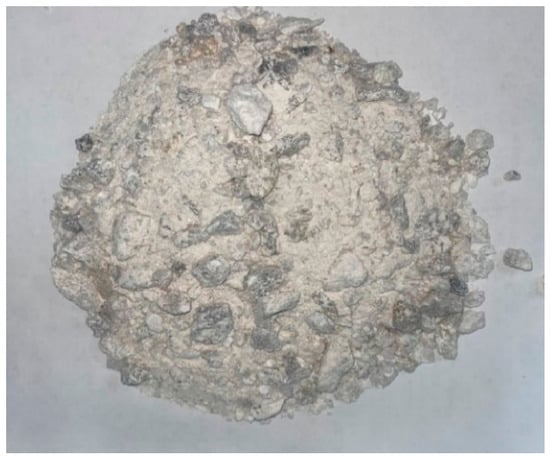
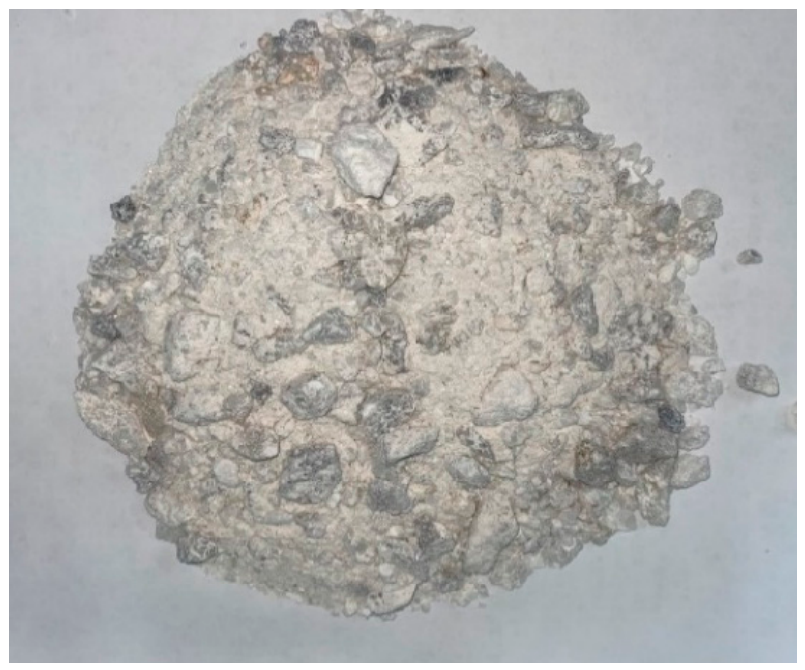
MLPW showed in Figure 1, generated during the manufacture of dimension stone and facing products from the Ekpendinsky marbleized limestone deposit, was used as the primary raw material in this study. The waste is produced during the cutting and finishing of marbleized limestone blocks and consists mainly of fine particles generated during sawing and polishing operations.
Figure 1.
Appearance of MLPW.
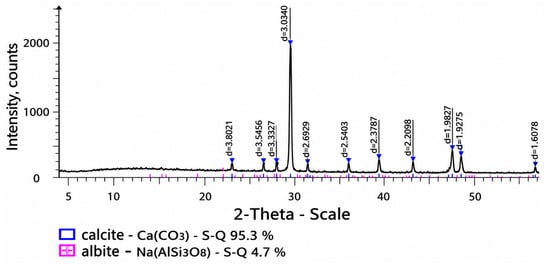
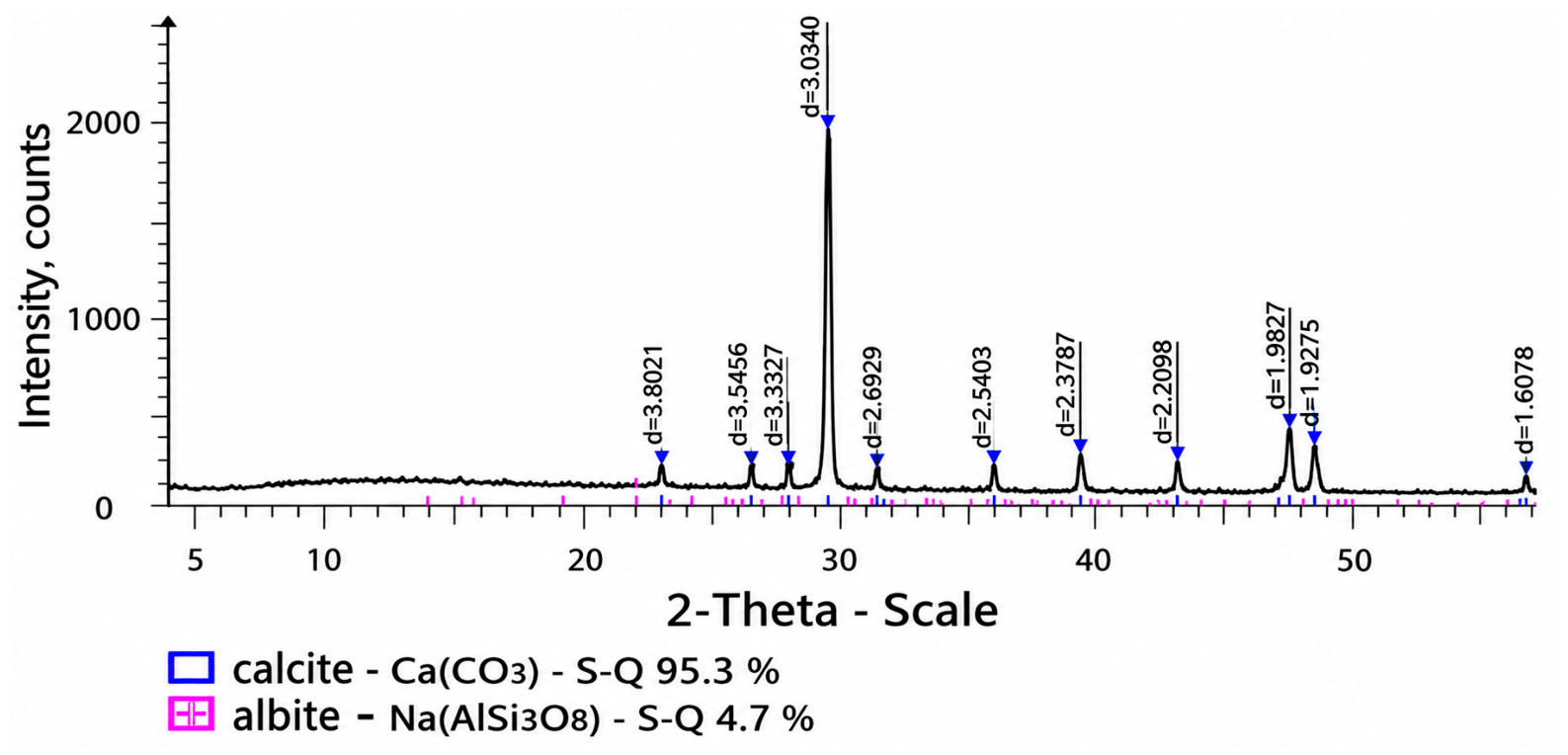
According to the X-ray diffraction (XRD) analysis (Figure 2), the mineralogical composition of the MLPW from the Ekpendinsky deposit is dominated by calcite (95.3 wt.%), with feldspar accounting for 4.7 wt.%. The chemical composition of the MLPW, expressed as oxide contents (wt.%), is as follows: CaO—53.4; SiO2—0.30; TiO2—0.052; K2O—0.026; Na2O—0.020; Al2O3—0.17; Fe2O3—0.06; MgO—0.40; and P2O5—0.008.
Figure 2.
X-ray diffraction (XRD) pattern of MLPW.
The particle size distribution of the MLPW was determined by sieve analysis using a standard set of sieves with mesh openings of 10, 5, 2.5, 1.25, 0.63, 0.315, and 0.16 mm. Particles larger than 5 mm were removed and were not used in the preparation of the hyperpressed brick specimens. Based on its fineness modulus, the MLPW was classified as medium-grained sand. The bulk density of the material was 1824 kg/m3.
Two types of Portland cement were used as binders: CEMIX white Portland cement PCB-1-500-D0 (M500) [17] and ZhambylCement CEM I 42.5 N gray Portland cement (M450) [18].
The MLPW was used without additional treatment after sieving through a 5 mm sieve to remove oversized particles and other impurities. The particle size distribution of the MLPW was determined by sieve analysis using a standard set of sieves with mesh openings of 5, 2.5, 1.25, 0.63, 0.315, and 0.16 mm.
After weighing the required amounts of MLPW and Portland cement, the dry constituents were mixed for 3 min. The predetermined amount of water was then added, and mixing was continued for an additional 2–3 min until a homogeneous mixture was obtained. To evaluate the properties of the developed materials, specimens in the form of miniature bricks (120 × 60 × 30 mm) were produced. The mixtures were compacted using an IP-1A-500 hydraulic press under compaction pressures of 28 MPa (approximately 28 MPa) and 41 MPa (approximately 41 MPa). The molded specimens were cured for 7 days in a sealed humid environment using a water-lock curing chamber to maintain a high relative humidity throughout the curing period.
The chemical composition of the MLPW was determined using an EDX-7000 X-ray fluorescence (XRF) spectrometer (Shimadzu, Kyoto, Japan).
The phase composition of the MLPW was characterized by X-ray diffraction (XRD) using a DRON-3 automated diffractometer (Burevestnik, Saint Petersburg, Russia) equipped with CuKα radiation and a β-filter. The diffraction patterns were recorded under the following operating conditions: tube voltage 35 kV, tube current 20 mA, θ–2θ scanning geometry, and a scanning rate of 2° min−1.
The obtained diffraction patterns were interpreted using the ICDD Powder Diffraction File (PDF-2, Release 2022) database in conjunction with HighScore Plus software (Malvern Panalytical, The Netherlands).
The microstructure of the hyperpressed brick specimens was examined using scanning electron microscopy (SEM) coupled with energy-dispersive X-ray spectroscopy (EDS). SEM analysis was performed to investigate the morphology and compactness of the cementitious matrix, the interfacial bonding between the binder and aggregate particles, and the distribution of hydration products, while EDS was employed to determine the elemental composition of selected microstructural regions.
Scanning electron microscopy (SEM) and energy-dispersive X-ray spectroscopy (EDS) analyses were performed on fracture surfaces of the specimens after compressive strength testing. The samples were sputter-coated with a thin conductive layer of gold prior to examination. SEM imaging and EDS mapping were carried out using a JEOL JCM-7000 Neoscope microscope (JEOL, Tokyo, Japan) operated at an accelerating voltage of 15–20 kV. EDS spectra and elemental maps were acquired from selected areas to obtain qualitative information on the elemental distribution.
To assess the suitability of the MLPW for the production of construction materials, the material was subjected to radiological testing to determine the specific activity of naturally occurring radionuclides. The measurements were carried out by an accredited radiological laboratory. Studies on the determination of the specific effective activity of natural radionuclides in MLPW were carried out in the accredited laboratory of LLC “TseLSIM” in accordance with the requirements of GOST (Government Standart) 30108-94 [19]. The measurement results showed that the values of the specific effective activity of natural radionuclides (226Ra, 232Th and 40K) are significantly below the established regulatory limit of 370 Bq/kg, corresponding to Class I of radiation safety. This confirms the radiation safety of MLPW and the possibility of its use as a raw material for the production of building materials intended for residential and public buildings.
Determination of bulk density. The bulk density of MLPW was determined from the mass and volume of a sample dried to constant mass, poured into a measuring vessel without compaction from a specified height. The bulk density of the MLPW, ρb (kg/m3), was calculated with an accuracy of 10 kg/m3 according to the formula given in reference [19]. The maximum permissible difference between the results of two tests shall not exceed 5%.
The compressive strength of the hyperpressed specimens was determined in accordance with the procedure described in GOST 8462-85 “Wall materials. Methods for determination of compressive and flexural strength” [20] (adapted for non-standard specimen size) and the general principles outlined in reference [21].
Miniature brick specimens measuring 120 × 60 × 30 mm were tested. Prior to testing, the load-bearing surfaces (120 × 60 mm) were carefully ground to ensure planeness and parallelism. The specimens were placed in the testing machine with the 120 × 60 mm faces oriented perpendicular to the loading direction (i.e., the force was applied to the largest faces).
Loading was performed on an IP-1A-500 hydraulic press at a constant rate of 0.5–1.0 MPa/s until complete failure of the specimen. The compressive strength was calculated as the maximum load divided by the actual loaded area (measured for each specimen). Failure was defined as the point at which the maximum load was reached and a visible through-crack or sudden load drop occurred.
No significant deviations from the above procedure were applied, except for the non-standard specimen dimensions (the method was scaled proportionally).
Brick strength grades (M350–M550) were assigned according to the compressive strength ranges specified in GOST 530-2012 “Ceramic brick and stone. General specifications” [22] and the corresponding classification traditionally used for hyperpressed and concrete masonry units in the post-Soviet regulatory practice.
For each mixture composition and compaction pressure, three replicate specimens were prepared from the same batch under identical mixing, molding, compaction, and curing conditions. The specimens were tested individually for compressive strength after 7 days of curing. The arithmetic mean and sample standard deviation (SD) were calculated from the individual measurements, and the results are presented as mean ± SD. The SD was calculated using (n − 1) degrees of freedom (n = 3). Consequently, the reported standard deviation mainly reflects within-batch variation. Since no inferential hypothesis testing was performed, differences between experimental groups are described only as observed increases or decreases. All mixture proportions given in this study (including those in Table 1, Table 2 and Table 3) are expressed as weight percentages of the total mixture (MLPW + cement + water = 100%).
Table 1.
Mixture compositions and physical and mechanical properties of the specimens.
Table 2.
Mixture compositions and physical and mechanical properties of the specimens.
Table 3.
Mixture compositions and physical and mechanical properties of the specimens produced with gray Portland cement.
3. Results
In this section, mixture compositions for the production of hyperpressed bricks were developed by preparing mixtures with different proportions of MLPW and white Portland cement (M500). The specimens were manufactured by high-pressure compaction under a pressing pressure of 28 MPa (corresponding to a compaction pressure of 28 MPa). The water-to-cement ratio (w/c) was maintained constant at 0.25 for all mixtures.
Table 1 presents the mixture compositions and the results of the physical and mechanical properties of the specimens after 7 days of curing under moist conditions.
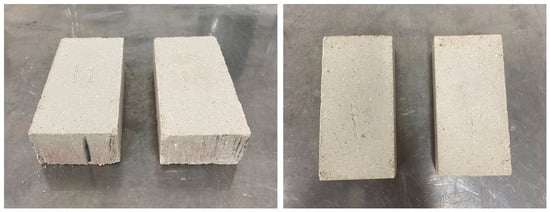
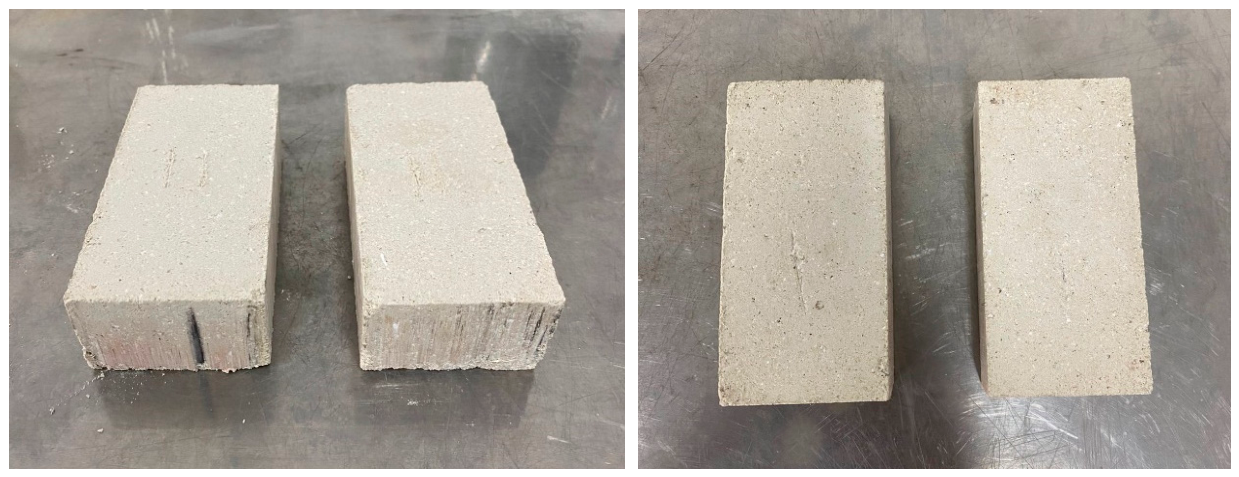
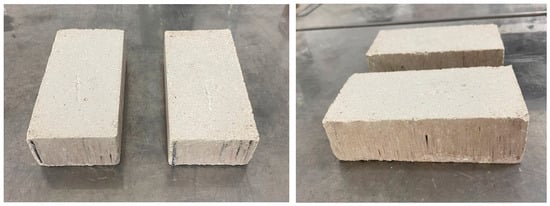
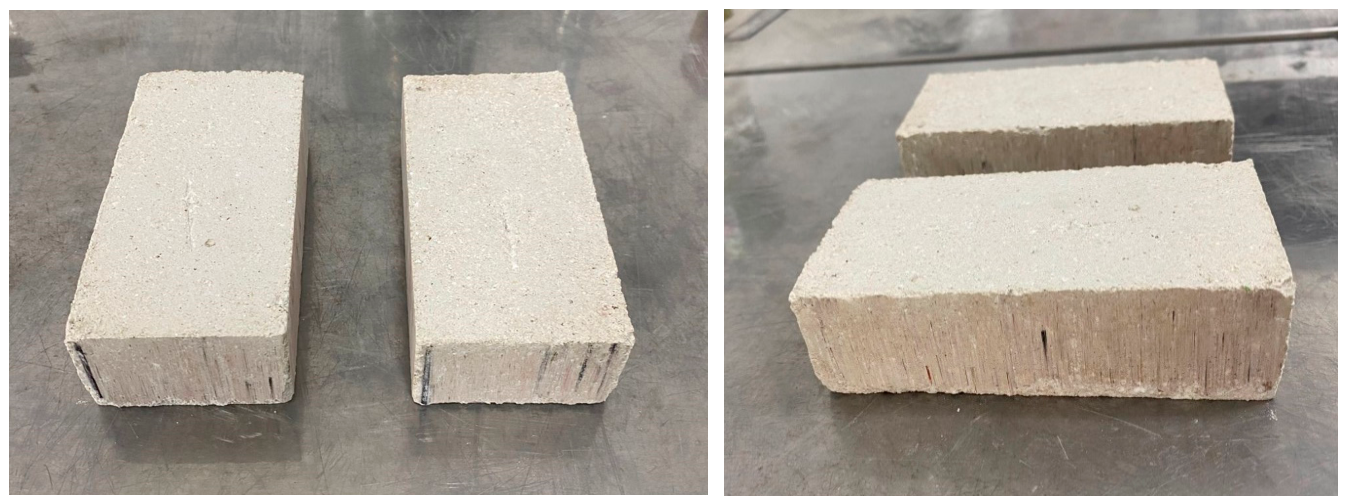
Figure 3 shows photographs of the hyperpressed brick specimens.
Figure 3.
Hyperpressed brick specimens molded under a compaction pressure of 28 MPa.
As can be seen from Table 1, the compressive strength values of the specimens are relatively high and correspond to brick grades M350 and M400. When considered as concrete specimens, they correspond to concrete strength classes B25, B27.5, and B30.
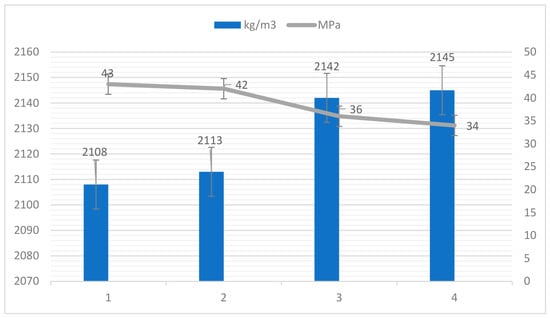
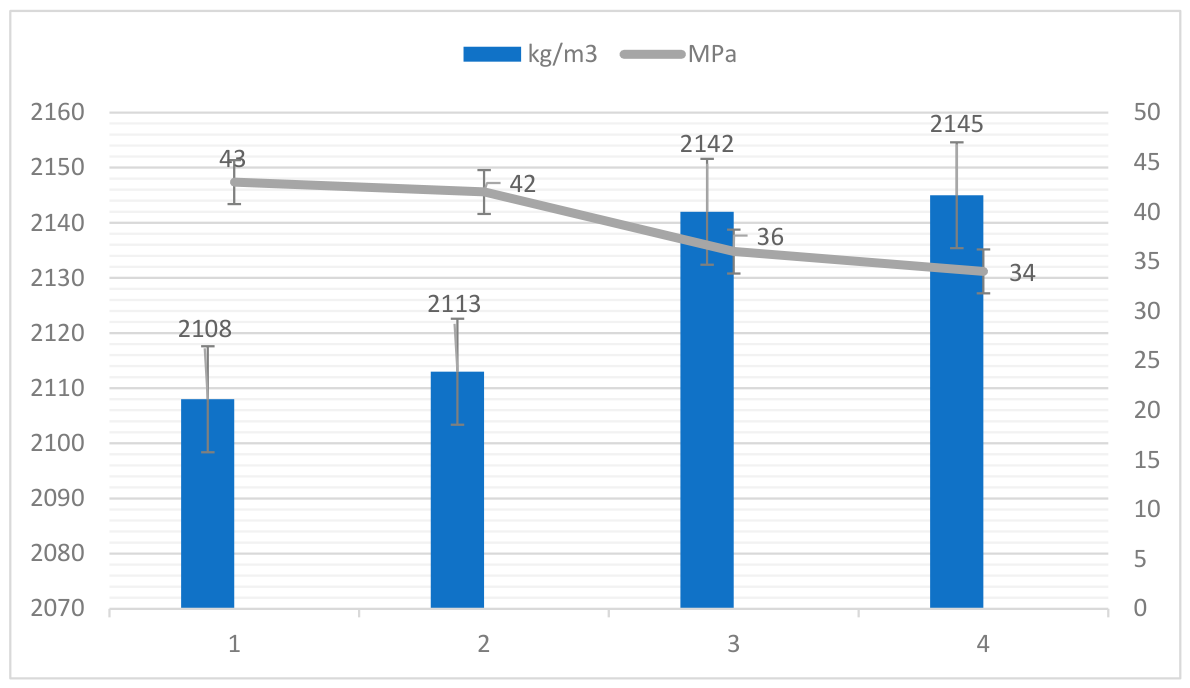
An increase in the content of MLPW in the mixtures, and consequently a decrease in the cement content, resulted in a reduction in compressive strength from 43.1 MPa to 34.1 MPa which is shown in Figure 4, while the average density increased from 2108.1 kg/m3 to 2145.1 kg/m3 (Figure 5). The latter is associated with the higher bulk density of the MLPW compared with that of cement.
Figure 4.
Average density and compressive strength of the specimens produced with white Portland cement and molded under a compaction pressure of 28 MPa.
Figure 5.
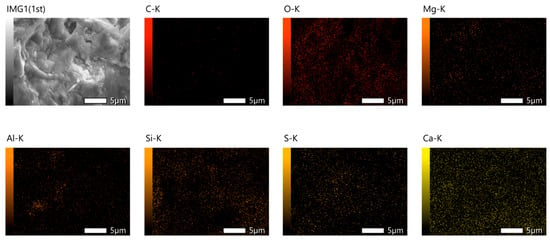
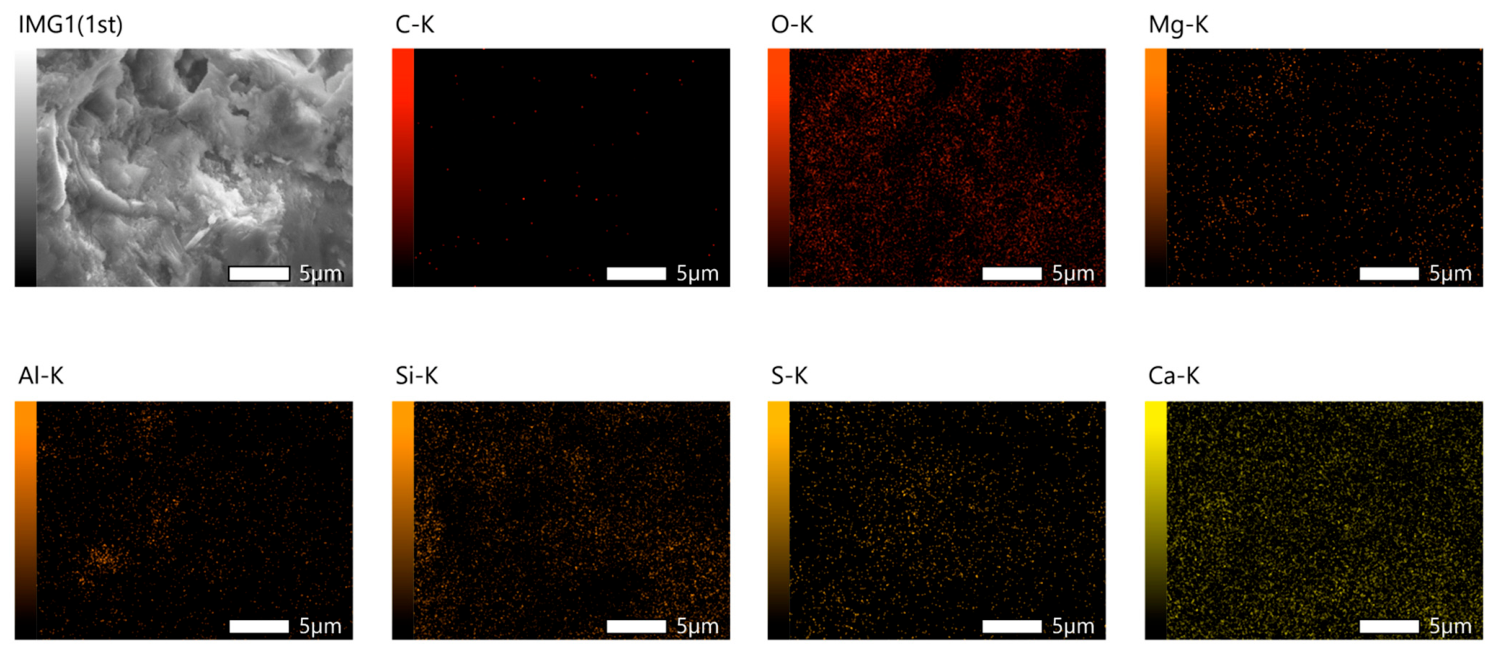
SEM micrograph and corresponding EDS elemental maps (C, O, Mg, Al, Si, S, Ca) of the specimen prepared with white Portland cement matrix, together with the EDS spectrum acquired from the analyzed area. Scale bars = 5 µm.
The specimens corresponding to Compositions 2 and 3 exhibited the most favorable strength characteristics. Among the tested formulations, those containing 75% and 80% MLPW (Compositions 2 and 3) exhibited the most favorable strength characteristics. The compressive strength of these specimens corresponded to brick grades M400 and M350, respectively.
EDS elemental mapping and spectral analysis of the composite specimen prepared with white Portland cement (CEMIX PCB-1-500-D0) and MLPW as filler (Figure 5) confirm the morphological observations. The dominant signals of Ca, Si and O, with a clear spatial correlation between calcium and silicon, are consistent with calcium silicate hydrate (C–S–H) gel. The atomic Ca/Si ratio estimated from the spectrum falls within the typical range for Portland cement C–S–H (approximately 1.5–2.0). Localized regions enriched in Al and S are suggestive of residual ettringite or AFm phases. Magnesium is present in minor amounts, while iron is virtually absent, in agreement with the composition of white Portland cement. These compositional data are consistent with C–S–H being the predominant hydration product forming the dense cementitious matrix.
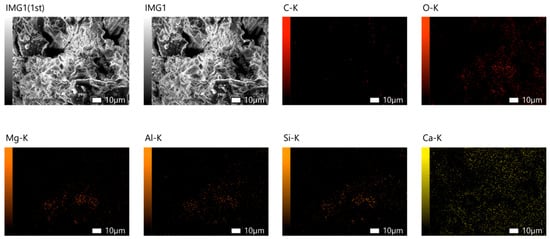
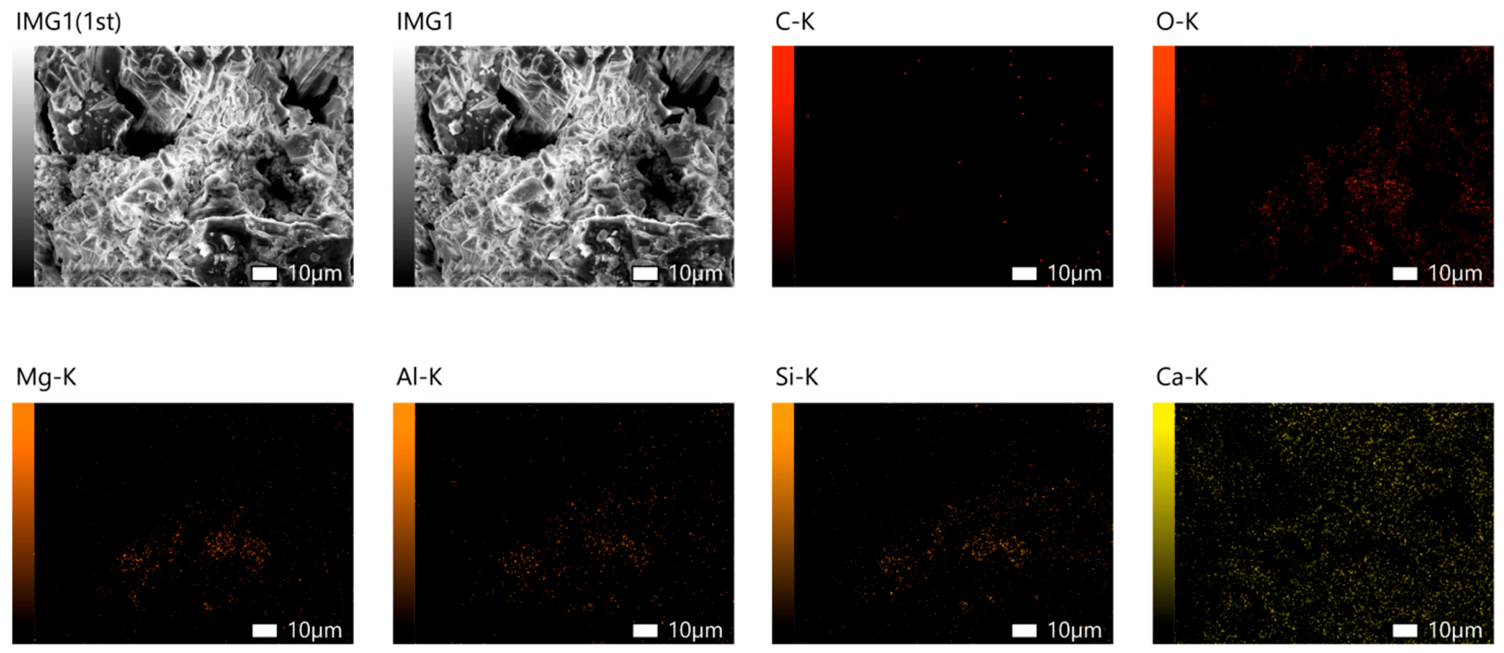
EDS elemental mapping and spectral analysis of the composite specimen prepared with gray Portland cement (ZhambylCement CEM I 42.5 N) and MLPW as filler (Figure 6) confirm the morphological observations. The spectrum is dominated by strong Ca and O signals, accompanied by a clear but less intense Si peak. The spatial distribution of calcium and silicon is consistent with the presence of calcium silicate hydrate (C–S–H) gel within a calcium-rich matrix. The higher Ca/Si intensity ratio compared with the white-cement specimen is consistent with a greater contribution of portlandite and/or the calcium carbonate filler (MLPW). Localized Al-enriched regions are suggestive of residual aluminate phases (ettringite or AFm). These compositional data are consistent with C–S–H being an important hydration product in the dense cementitious matrix.
Figure 6.
SEM micrographs and corresponding EDS elemental maps (C, O, Mg, Al, Si, Ca) of the hydrated composite prepared with gray Portland cement and MLPW, together with the EDS spectrum. Scale bars = 10 µm.
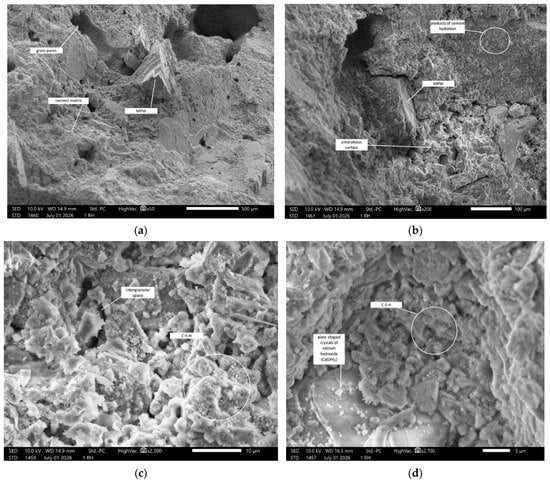
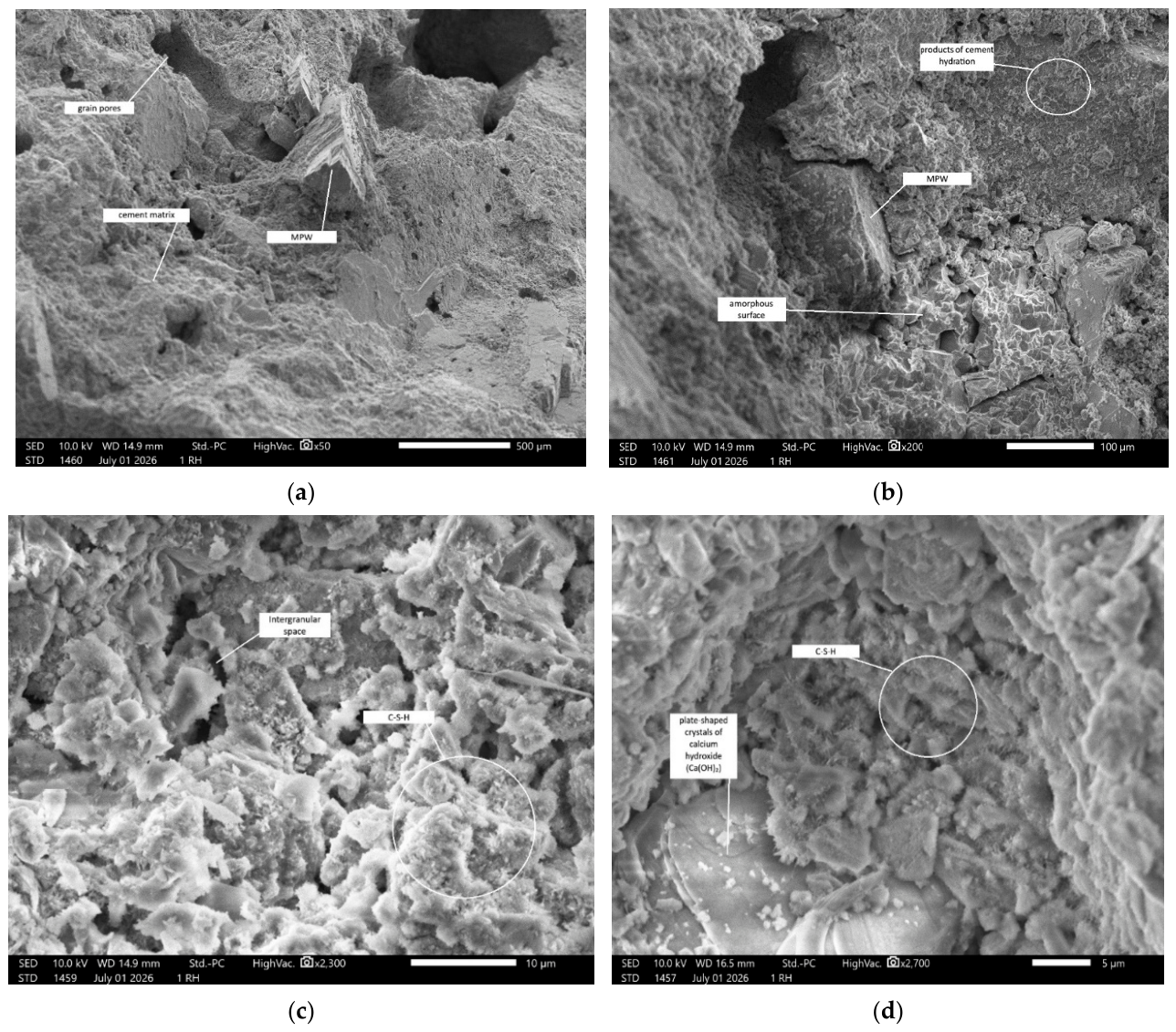
Figure 7 shows the microstructure of a hyperpressed brick specimen manufactured by compaction under a pressing pressure of 28 MPa and fractured during the compressive strength test.
Figure 7.
SEM micrographs of the microstructure of the hyperpressed brick specimen (Composition 2) manufactured by compaction under a pressing pressure of 28 MPa. (a) ×50 magnification; (b) ×200 magnification; (c) ×2300 magnification; (d) ×2700 magnification.
The SEM (Figure 7) image at low magnification shows the overall microstructure of the fractured hyperpressed brick specimen manufactured under a compaction pressure of 28 MPa. The matrix consists of a dense cement stone uniformly surrounding the particles of the MLPW. Despite the high degree of compaction, large and small intergranular pores are observed in several areas (Figure 7a,b). Their formation is associated with the local incomplete packing of aggregate particles and the non-uniform distribution of cement hydration products. The surface of the large MLPW particles exhibits the characteristic layered fracture morphology of calcite. No cracks typical of materials subjected to compressive failure are observed in the specimen. Overall, the microstructure is highly compact, which is attributed to the intensive compaction pressure providing close contact between the components of the composite.
The SEM (Figure 7) image clearly reveals a coarse aggregate particle with a relatively smooth surface, which is typical of carbonate rocks after mechanical fracture. The aggregate surface is almost completely covered by cement hydration products, indicating good bonding between the aggregate and the cementitious matrix. A dense layer of hardened cement paste has formed in the immediate vicinity of the aggregate particle. No visible gaps or signs of debonding are observed at the aggregate–matrix interface, indicating strong interfacial adhesion achieved as a result of the high compaction pressure.
Figure 7c (×2300, scale bar: 10 μm) shows the detailed microstructure of the cement matrix. The high-magnification SEM image reveals a dense cement stone structure whose morphology is consistent with calcium silicate hydrate (C–S–H) gel. The C–S–H phase is uniformly distributed throughout the matrix and interconnects the individual hydration products. Small intergranular spaces remain between the hydration products owing to the incomplete filling of micropores by the hydrated phases. Overall, the microstructure is dense and homogeneous. The hardened calcium silicate hydrate crystals completely bind the aggregate particles into a continuous monolithic structure, which accounts for the high compressive strength of the hyperpressed brick specimen.
Figure 7d (×2700, scale bar: 5 μm) illustrates the hydration products of the white Portland cement. At higher magnification, the principal cement hydration products are clearly distinguishable. The morphology is consistent with amorphous gel-like calcium silicate hydrate (C–S–H), which forms a dense three-dimensional network surrounding the aggregate particles. In addition a relatively small amount of plate-like crystals likely attributable to portlandite (Ca(OH)2), a typical product of free CaO hydration, is observed. The C–S–H gel fills the intergranular spaces and binds the individual portlandite crystals into a continuous monolithic structure, indicating the predominance of a fine-dispersed calcium silicate hydrate network that contributes to the high strength of the material.
In this section, the preparation of the molding mixtures and the proportions of the raw materials were identical to those used for the mixtures described in materials section. The specimens were molded at a constant water-to-cement ratio (w/c) of 0.25 and a compaction pressure of 41 MPa.
Table 2 presents the mixture compositions and the results of the determination of the physical and mechanical properties of the specimens after 7 days of curing under moist conditions.
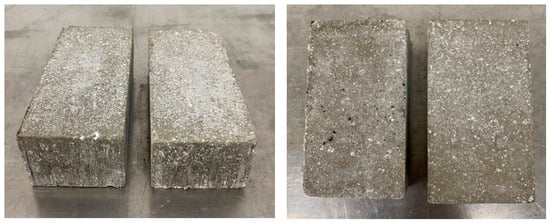
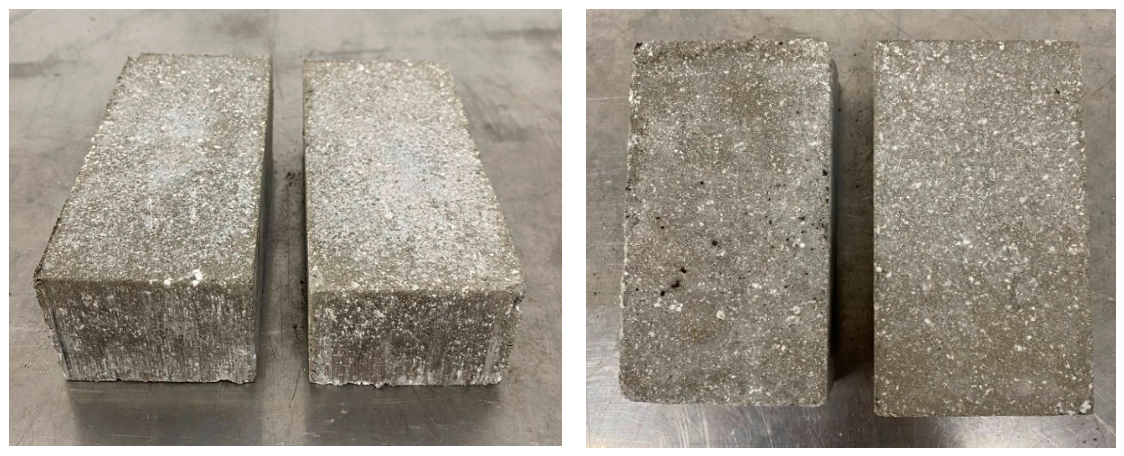
Figure 8 shows photographs of the hyperpressed brick specimens manufactured by compaction under a 41 MPa pressing pressure.
Figure 8.
Hyperpressed brick specimens molded under a compaction pressure of 41 MPa.
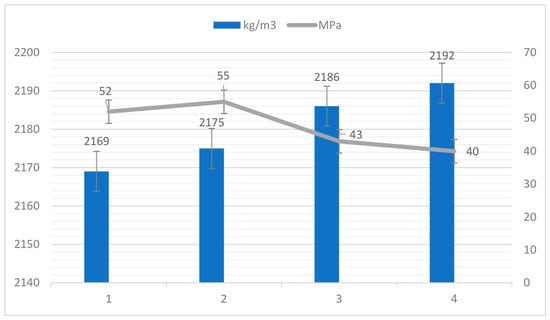
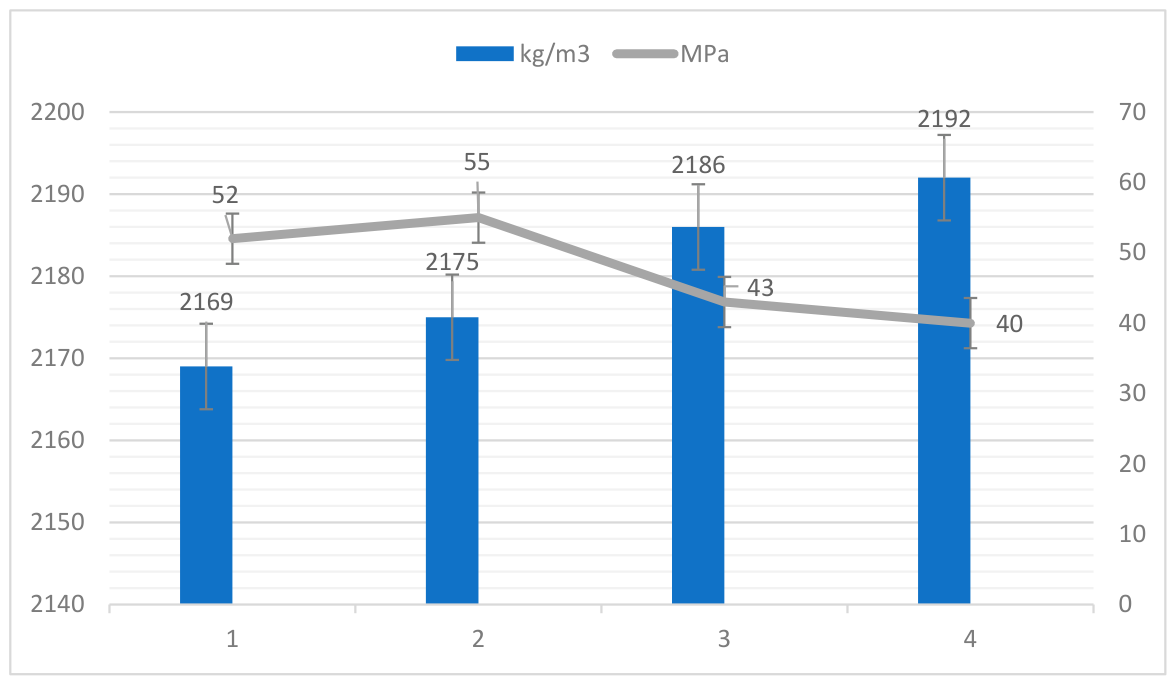
As can be seen from the data presented in Table 2 and Figure 9, increasing the compaction pressure from 28 MPa to 41 MPa resulted in a slight increase in the average density and an increase in the compressive strength of the specimens. Specifically, the average density increased by 43.3–61.5 kg/m3 (an increase of 2.02–2.90%) compared with the specimens manufactured under a compaction pressure of 28 MPa.
Figure 9.
Average density and compressive strength of the specimens produced with white Portland cement and molded under a compaction pressure of 41 MPa.
The average density of the specimens of all compositions exceeded 2100 kg/m3, which makes it possible to classify the obtained products as heavyweight concrete according to [23].
Compared with the specimens manufactured under a compaction pressure of 28 MPa, the compressive strength increased by 1.6–12.2 MPa, corresponding to an increase of 4.7–28.7%. Only a slight increase in strength was observed for Composition 4. In our opinion, this is associated with the low content of binder in the mixture of this composition.
As noted previously, Compositions 2 and 3 exhibited the most favorable strength characteristics. Compositions containing 75 and 80 wt.% MLPW (20 and 16 wt.% cement, respectively), and their compressive strength corresponded to brick grades M550 and M400, respectively.
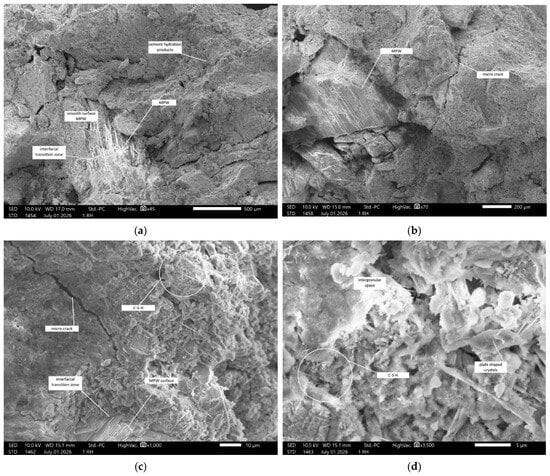
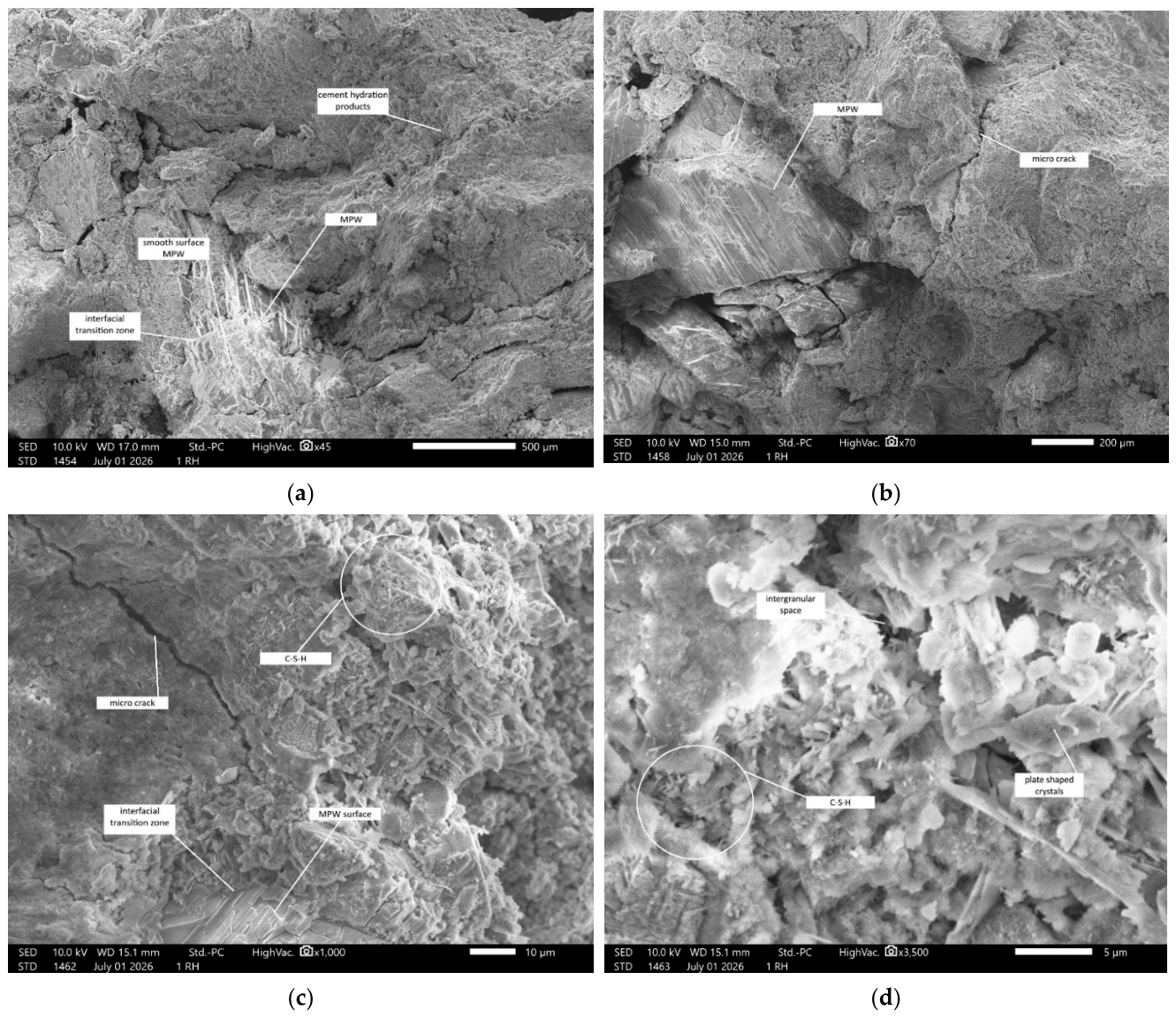
Figure 10 shows the microstructure of a hyperpressed brick specimen manufactured under a compaction pressure of 41 MPa and fractured during the compressive strength test.
Figure 10.
SEM micrographs of the microstructure of the hyperpressed brick specimen (Composition 2) manufactured by compaction under a pressing pressure of 41 MPa. (a) ×45 magnification; (b) ×70 magnification; (c) ×1000 magnification; (d) ×3500 magnification.
The SEM (Figure 10) at low magnification (×45, scale bar: 500 μm) shows the overall microstructure of the fractured hyperpressed brick specimen manufactured under a compaction pressure of 41 MPa. The marble aggregate particles exhibit relatively smooth surfaces and are densely surrounded by cement hydration products. The interfacial transition zone (ITZ) between the aggregate and the cement matrix is weakly pronounced, indicating good mechanical bonding between the components. The specimen is characterized by fracture cracks formed during the compressive strength test. The hydration products almost completely fill the space between the aggregate particles, forming a dense and continuous cementitious matrix. The absence of large pores confirms the high degree of densification achieved under the 41 MPa compaction pressure.
Image (Figure 10) (×70, scale bar: 200 μm) shows the interface between a coarse marble aggregate particle and the surrounding cement matrix. The aggregate surface is characterized by a relatively smooth texture resulting from the calcitic nature of the rock. Despite the comparatively low surface roughness of the aggregate, the cement hydration products exhibit good adhesion to its surface, as the applied compressive pressure did not disrupt the integrity of the interfacial transition zone (ITZ). Furthermore, this indicates that the effective bond was achieved not only through adhesion but also as a result of the high compaction pressure applied during the hyperpressing process. Narrow fracture cracks are observed within the cement matrix, having formed during the compressive strength test of the specimen.
At higher magnification, Figure 10c (×1000, scale bar: 10 μm) more clearly reveals the microstructure of the interfacial transition zone (ITZ) between the surface of the MLPW aggregate and the cement stone. The surface of the MLPW particles is covered with a dense layer of hydration products whose morphology is consistent with fibrous and gel-like calcium silicate hydrate (C–S–H). The interfacial transition zone exhibits a high degree of integration without pronounced voids, indicating strong mechanical bonding between the aggregate and the cement matrix. A localized microcrack is observed within the cement stone, most likely formed as a result of shrinkage stresses during drying or during specimen preparation for SEM analysis. This crack does not propagate along the phase boundary, indicating the high strength of the contact zone between the aggregate and the cement matrix.
The high-magnification SEM (Figure 10) (×3500, scale bar: 5 μm) illustrates the morphology of the hydration products of white Portland cement (M500). The cement matrix is predominantly composed of a phase consistent with amorphous calcium silicate hydrate (C–S–H) gel, which forms a dense three-dimensional network between the hydration products. In addition, plate-like crystals likely attributable to calcium hydroxide (Ca(OH)2), characteristic of Portland cement hydration, are observed. Small intergranular spaces remain between the individual hydration products; however, their limited size indicates a high degree of structural densification. The uniform distribution of calcium silicate hydrate (C–S–H) throughout the matrix, on the aggregate surfaces, and within the intergranular spaces produces a dense microstructure and contributes to the high compressive strength of the hyperpressed brick specimen.
Thus, mixture compositions for the production of hyperpressed bricks were developed, and the properties and microstructure of the resulting specimens were investigated. Manufacturing the specimens under a compaction pressure of 28 MPa produced compressive strengths ranging from 34.1 to 43.1 MPa, corresponding to concrete strength classes B25–B30. Increasing the compaction pressure to 41 MPa resulted in compressive strengths of 39.7–54.7 MPa, corresponding to concrete strength classes B27.5–B40. The specimens containing 75–80 wt.% MLPW exhibited the most favorable performance characteristics (Table 3). Microstructural analysis showed that compaction under higher pressure produced specimens with a denser microstructure and a stronger contact zone between the aggregate particles and the cement matrix. Thus, the results obtained in this study demonstrate the potential of the developed MLPW-based hyperpressed bricks in terms of their mechanical properties and microstructural features. However, a comprehensive assessment of their suitability for practical use in construction requires further investigation of additional performance and durability-related parameters.
The results of this study demonstrate that the production of high-strength hyperpressed products incorporating MLPW is governed by two principal factors. Among the investigated compaction pressures, 41 MPa resulted in the highest mechanical performance. Under the tested conditions, the white Portland cement of higher nominal strength class (M500) produced higher compressive strengths than the gray Portland cement (M450). The second factor is the cement grade, which should be not lower than M450. Under such a high compaction pressure, the mineral aggregate particles and the cement binder are forced into close contact, effectively filling the voids between them. At the same time, intensive internal friction and interparticle contact are generated, promoting strong bonding between the particles at both the molecular and crystalline levels.
In this section, the properties of hyperpressed brick specimens produced using gray Portland cement (M450) were investigated which is shown in Figure 11. To ensure comparable experimental conditions and results, the same mixture compositions previously used for the specimens produced with white Portland cement were adopted (Table 3). As demonstrated by the experimental results, the highest performance of the specimens produced with white cement was achieved at a compaction pressure of 41 MPa. Therefore, the same compaction pressure was used for manufacturing the specimens with gray Portland cement.
Figure 11.
Hyperpressed brick specimens produced with gray Portland cement and molded under a compaction pressure of 41 MPa.
Table 3 presents the mixture compositions and the results of the physical and mechanical properties of the specimens after 7 days of curing under moist conditions.
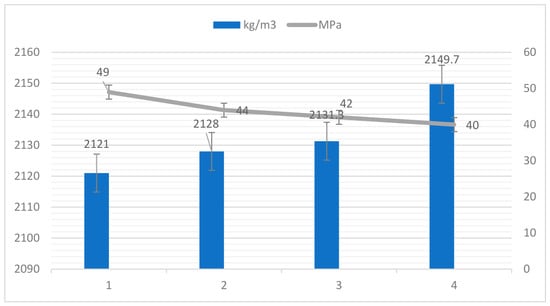
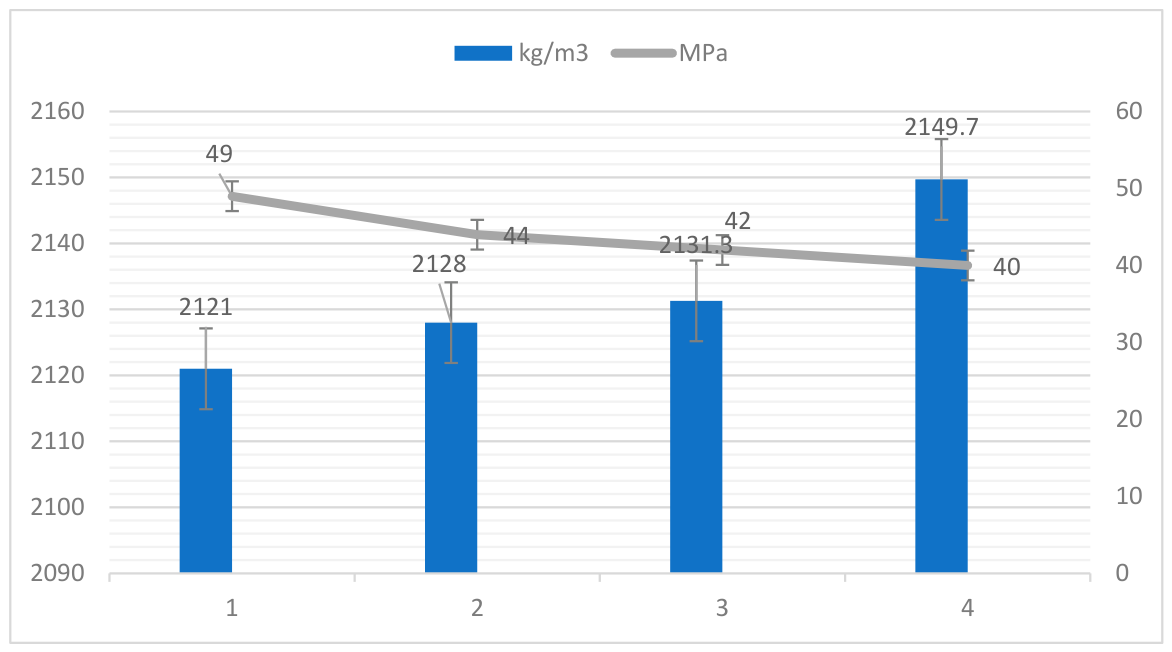
The experimental results presented in Table 3 show that, after 7 days of curing, the specimens achieved compressive strengths corresponding to brick grades M450 and M400, which also represent high strength levels for hyperpressed bricks. Figure 12 illustrates the relationship between the average density and compressive strength of the specimens produced using gray cement. The strength characteristics are slightly lower than those of the specimens produced with white Portland cement, which can be attributed to the higher strength grade of the latter. The increase in average density and the decrease in compressive strength follow the same trends as those observed for the specimens produced with white Portland cement.
Figure 12.
Average density and compressive strength of the specimens produced with gray Portland cement and molded under a compaction pressure of 41 MPa.
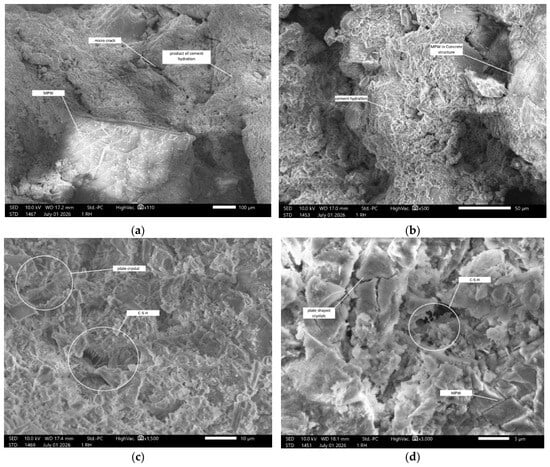
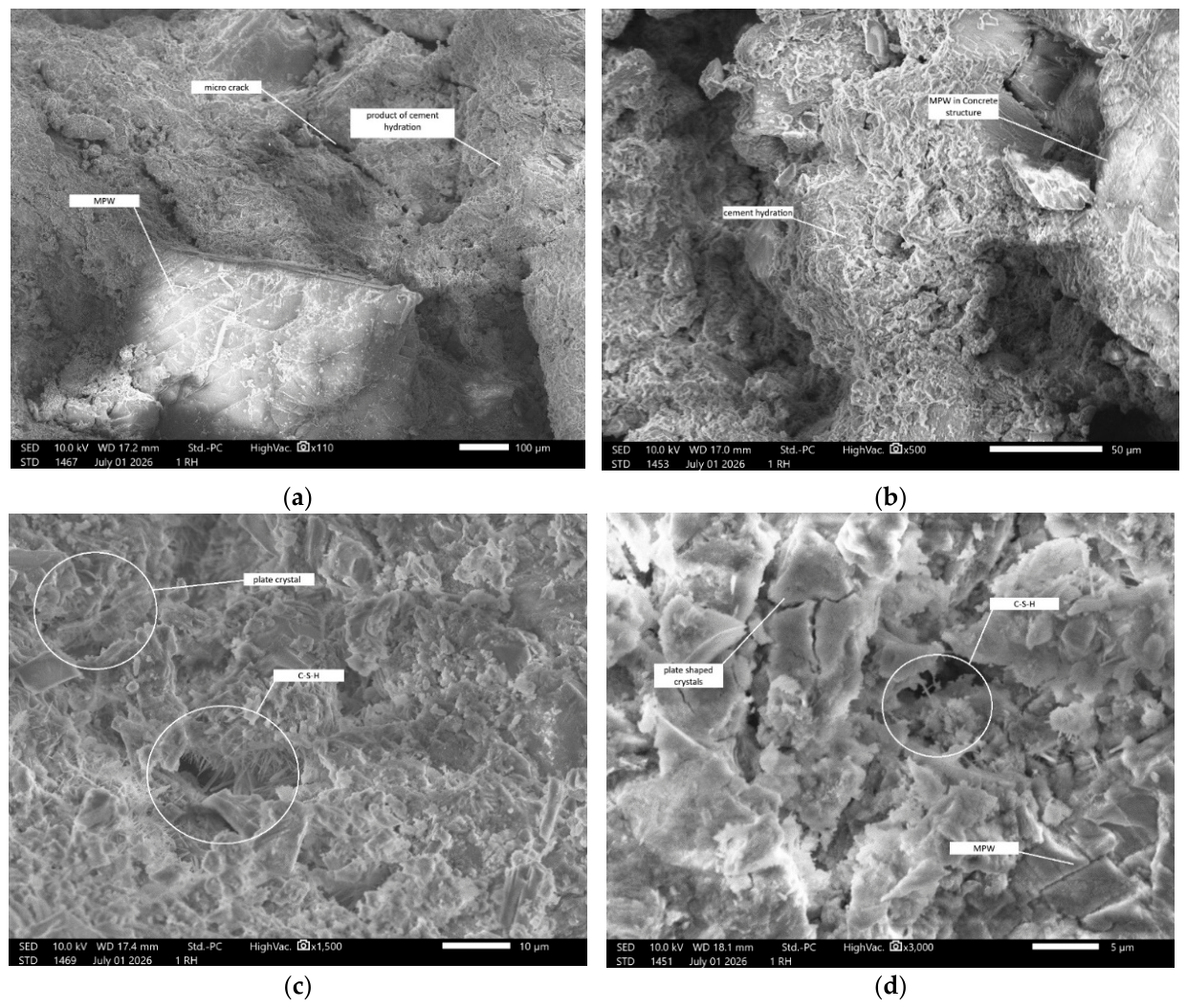
Figure 13 shows the microstructure of a hyperpressed brick specimen produced with gray Portland cement, manufactured under a compaction pressure of 41 MPa, and fractured during the compressive strength test.
Figure 13.
SEM micrographs of the microstructure of the hyperpressed brick produced with gray Portland cement. (a) ×110 magnification; (b) ×500 magnification; (c) ×1500 magnification; (d) ×3000 magnification.
The SEM (Figure 13) (×110, scale bar: 100 μm) shows the contact interface between the surface of the MLPW aggregate and the cement matrix. The surface of the MLPW particles is covered with cement hydration products, forming a continuous layer around the aggregate. A microcrack is observed within the cement stone, propagating predominantly through the cement matrix rather than along the phase boundary. This indicates that the adhesion between the aggregate and the cement matrix remains satisfactory, whereas the crack is most likely associated with shrinkage deformation or localized stress concentrations generated during the compressive failure of the specimen.
The SEM (Figure 13) (×500, scale bar: 50 μm) illustrates the interfacial transition zone (ITZ) between the marble aggregate and the cement matrix. The MLPW particles are almost completely encapsulated by cement hydration products, forming a continuous three-dimensional structure. The cement matrix exhibits a dense, fine-grained morphology with a minimal amount of open porosity. The hydration products are uniformly distributed around the aggregate surface, providing strong bonding between the two phases. Virtually no evidence of significant debonding between the cement matrix and the aggregate or the development of microcracks is observed, indicating the beneficial effect of the 41 MPa compaction pressure on the formation of a dense microstructure in the hyperpressed brick specimen.
The high-magnification (Figure 13) (×1500, scale bar: 10 μm) reveals the microstructure of the cement matrix. The matrix is predominantly composed of a phase consistent with gel-like calcium silicate hydrate (C–S–H), which forms a three-dimensional network interconnecting the individual particles of the material. In addition to C–S–H, plate-like crystals likely attributable to calcium hydroxide (Ca(OH)2), characteristic hydration products of Portland cement, are observed. In several localized regions, needle-like crystalline formations are also present, which may be attributable to ettringite, formed during the early stages of cement hydration and retained within the hardened cement matrix. Small pores remain between the hydration products, indicating a slightly less compact cement matrix than that observed in the specimens manufactured under higher compaction pressure.
The high-magnification image (Figure 13) (×3000, scale bar: 5 μm) shows the microstructure of the cement hydration products. The cement matrix is predominantly composed of a dense phase consistent with amorphous calcium silicate hydrate (C–S–H) gel, which surrounds the marble aggregate particles. In addition to the C–S–H gel, isolated plate-like hydrated crystals are uniformly distributed throughout the cement matrix. This combination of amorphous gel and plate-like crystalline hydrates contributes to structural densification and reduces capillary porosity. No large voids are observed between the hydration products, indicating a high degree of cement hydration and effective densification of the material.
The specific activities of the natural radionuclides in the MLPW were determined as follows:
226Ra = 18 ± 3 Bq/kg,
232Th = 9 ± 2 Bq/kg,
40K = 85 ± 12 Bq/kg.
The effective specific activity Aeff calculated in accordance with GOST 30108-94 was 37 ± 5 Bq/kg, which is substantially below the regulatory limit of 370 Bq/kg and corresponds to Class I of radiation safety. This confirms the radiation safety of MLPW and the possibility of its use as a raw material for the production of building materials intended for residential and public buildings.
4. Discussion
The obtained results demonstrate that the physical and mechanical performance of hyperpressed bricks is primarily governed by the degree of structural densification achieved through the applied compaction pressure. Increasing the compaction pressure from 28 to 41 MPa resulted in both a higher average density and an observed increase in compressive strength, indicating more efficient packing of MLPW particles and a reduction in the volume of intergranular voids. A similar relationship between structural densification and mechanical performance has been reported in previous studies [24], where the incorporation of waste glass promoted the formation of a denser ceramic matrix through pore reduction and enhanced particle bonding. Although the densification mechanisms differ, involving liquid-phase sintering in ceramics and high-pressure compaction in cement-based composites, both approaches demonstrate that increasing structural compactness is the primary factor responsible for improving mechanical performance.
An important outcome of the present study is the identification of a selected favorable range within the investigated compositions, corresponding to an MLPW content of 75–80 wt.%, at which a favorable combination of compressive strength and density was achieved. At lower MLPW contents, the potential for utilizing secondary mineral resources is not fully realized, whereas a further increase in waste content is accompanied by a reduction in cement content, resulting in an insufficient amount of hydration products to form a continuous cementitious matrix. This behavior is consistent with the findings reported for zeolite-modified cement composites [25], where the highest compressive strength was also obtained only at an optimum replacement level. The authors attributed this behavior to the achievement of an optimal balance among particle packing, hydration kinetics, and the amount of reactive cementitious material, whereas excessive replacement caused the dilution effect to dominate, leading to a reduction in strength. A similar mechanism is likely responsible for the behavior of the hyperpressed composites investigated in the present study.
The SEM observations further confirm the close relationship between microstructure and the mechanical performance of the developed materials. Specimens manufactured under a compaction pressure of 41 MPa exhibited a denser cementitious matrix, almost complete filling of the intergranular space by hydration products, a weakly pronounced interfacial transition zone (ITZ), and an absence of large pores. In contrast, the specimens produced at 28 MPa contained isolated intergranular voids and exhibited a less homogeneous microstructure. These observations indicate that increasing the compaction pressure not only mechanically densifies the composite but also promotes the formation of a more continuous network of hydration products, thereby improving the structural integrity of the cement matrix. Similar relationships between reduced porosity, a more homogeneous microstructure, and enhanced mechanical performance have previously been reported for waste-glass-modified ceramic materials [24] and zeolite-containing cementitious composites [25], where improvements in compressive strength were likewise associated with the formation of denser and more uniform microstructures.
Another factor influencing the mechanical performance of the hyperpressed bricks is the type of Portland cement used. Under identical mixture proportions and compaction conditions, the white Portland cement CEMIX PCB-1-500-D0 (M500) produced higher compressive strengths than the gray Portland cement ZhambylCement CEM I 42.5 N (M450). This difference is consistent with the higher nominal strength class of the white cement. It should be noted that the two binders were not subjected to additional experimental characterization (e.g., actual 28-day strength, fineness, or mineralogical composition of the specific batches). Therefore, the observed difference in performance cannot be attributed solely to cement activity, fineness, or other individual parameters.
Nevertheless, the results of the present study demonstrate that high-strength hyperpressed bricks can also be successfully produced using gray Portland cement (M450), provided that an appropriate compaction pressure is applied. This highlights the significant role of hyperpressing in achieving high mechanical performance even with a binder of lower nominal strength class.
Comparable approaches involving the utilization of local mineral wastes have also been reported for other types of construction materials. In particular, thermally modified diatomite has been successfully used as the main component of dry thermal-insulation construction mixtures [26]. Although the target products and densification mechanisms differ, both studies demonstrate the high potential of regional mineral resources for the development of sustainable building materials with reduced reliance on primary raw materials.
Overall, while the developed MLPW-based hyperpressed bricks exhibit promising mechanical properties and microstructural features, further investigation of durability-related parameters (including water absorption, frost resistance, and flexural strength) is required before their practical application in construction can be fully evaluated.
Overall, the obtained results demonstrate that the performance of hyperpressed bricks is controlled by the combined effects of compaction pressure, MLPW content, and the type of Portland cement used. Increasing the compaction pressure to 41 MPa provides the most favorable balance between particle packing, hydration development, and microstructural densification, while an MLPW content of 75–80 wt.% ensures both high mechanical performance and maximum utilization of secondary raw materials. The higher compressive strengths obtained with the white Portland cement (M500) compared with the gray Portland cement (M450) are consistent with the difference in their nominal strength classes. These findings are consistent with current trends in the development of sustainable construction materials based on the efficient utilization of industrial waste and confirm the potential of MLPW as the principal aggregate for the production of high-strength hyperpressed bricks. Consequently, the higher strengths obtained with the white cement should be interpreted primarily as a result of its higher nominal strength class under the specific conditions of this study, rather than as an inherent advantage of white cement over gray cement in general.
The obtained results are in good agreement with recent studies on the utilization of stone-processing wastes in masonry materials. In particular, the feasibility of producing high-strength building blocks from limestone stone waste sludge by cold compaction with a limited amount of Portland cement has been demonstrated [27]. Similar to the present work, those authors observed that increasing the compaction pressure significantly improved particle packing and mechanical performance, while an optimal waste content allowed a favorable balance between strength and the degree of secondary raw material utilization. The compressive strengths achieved in the present study under a compaction pressure of 41 MPa (up to 54.7 MPa) are consistent with the high values reported for hyperpressed limestone-based blocks.
Comparable positive outcomes have also been reported for marble cutting waste used in the production of stabilized unfired clay bricks [28] and for limestone waste incorporated into fired clay bricks [29]. In both cases, the addition of calcium carbonate-rich waste improved density and reduced shrinkage, although excessive replacement levels led to a decrease in compressive strength due to dilution of the binder phase. This trend is fully consistent with the behavior observed in the present MLPW-based hyperpressed bricks, where an MLPW content of 75–80 wt.% provided the most favorable combination of strength and density, while further increases in waste content resulted in strength reduction.
5. Conclusions
- At present, approximately 500,000 tons of waste have accumulated in disposal sites near Tekeli (Almaty Region) as a result of the extraction and sawing of marbleized limestone from the Ekpendinsky deposit. Therefore, the development of a technology for manufacturing facing wall materials based on MLPW, aimed at improving the appearance, decorative properties, and durability of residential buildings, is an important and relevant task.
- The mineralogical composition of the MLPW from the Ekpendinsky deposit consists of 95.3 wt.% calcite and 4.7 wt.% feldspar. No Ca(OH)2 was detected in the MLPW. Based on a fineness modulus of 3.1, the MLPW is classified as a medium sand.
- Four mixture formulations containing 70–85 wt.% MLPW and the corresponding amounts of white Portland cement (M500) or gray Portland cement (M450) (12–24 wt.%) were prepared at a constant water-to-cement ratio of 0.25. Hyperpressed brick specimens were molded under compaction pressures of 28 MPa and 41 MPa, followed by curing under moist conditions for 7 days.
- Increasing the compaction pressure from 28 MPa to 41 MPa resulted in higher average density and compressive strength. The average density increased by 43.3–61.5 kg/m3 (2.02–2.90%), while the compressive strength increased by 1.6–12.2 MPa (4.7–28.7%). Among the four tested formulations, progressive reduction in the cement content from 24% to 12% (accompanied by the corresponding increase in MLPW and decrease in water) led to a gradual rise in average density and a reduction in compressive strength. The formulations containing 20% and 16% cement (75% and 80% MLPW, respectively) exhibited the most favorable combination of strength and density.
- At present, there is no GOST standard specifically regulating hyperpressed bricks. In the present study, the specimens manufactured under a compaction pressure of 41 MPa exhibited an average density of 2169.6–2192.2 kg/m3 and compressive strengths of 39.7–54.7 MPa, corresponding to brick grades M400–M550 according to the applicable standards. The average density of all specimens exceeded 2100 kg/m3, allowing the products to be classified as heavyweight concrete.
- When gray Portland cement (M450) was used as the binder in the same four mixture formulations (identical proportions, w/c ratio of 0.25, and compaction pressure of 41 MPa), the specimens exhibited average densities of 2121.0–2149.7 kg/m3 and compressive strengths ranging from 39.8 to 48.6 MPa, corresponding to brick grades M400–M450. The variations in density and strength followed the same trends as those observed for the specimens produced with white Portland cement.
- The experimental results obtained for the physical properties of the hyperpressed brick specimens produced with both white and gray Portland cement are in good agreement with the results of the SEM microstructural analysis. The SEM micrographs obtained at different magnifications demonstrated that the highest degree of structural densification was achieved at a compaction pressure of 41 MPa.
- Fracture of the specimens during the compressive strength test occurred through the cement matrix rather than along the aggregate–cement interface. This indicates a high level of adhesion between the surface of the marbleized limestone aggregate and the cement matrix.
- The results of this study demonstrate that the production of high-strength hyperpressed products based on the tested MLPW–cement formulations is governed primarily by the compaction pressure. Among the two pressure levels investigated in this study (28 and 41 MPa), the higher pressure of 41 MPa produced the densest microstructure and the highest compressive strengths. Under the tested conditions (identical mixture formulations, w/c ratio and compaction pressure), it should be noted that the two cements were not independently characterized; therefore, the observed difference cannot be attributed solely to cement type.
- Based on the experimental results obtained, the feasibility of producing hyperpressed bricks using waste from the processing of marbleized limestone from the Ekpendinsky deposit was demonstrated. The resulting hyperpressed brick samples exhibited high mechanical properties comparable to those of hyperpressed products reported in published scientific studies. However, to comprehensively evaluate the suitability of the developed products for practical use in construction, additional experimental studies are needed, including determination of water absorption, frost resistance, flexural strength, and other performance and durability parameters.
Author Contributions
Conceptualization, Y.O. and M.Z.; methodology, Y.O.; software, Y.O., Y.K. (Yerlan Khamza) and A.M.; validation, Y.O., M.Z. and R.N.; formal analysis, Z.Z.; investigation, Y.K. (Yerlan Khamza) and Y.K. (Yerlan Kushekov); resources, R.N.; data curation, Y.O., M.Z. and A.M.; writing—original draft preparation, M.Z., Y.K. (Yerlan Khamza) and A.A.; writing—review and editing, Z.Z., A.A. and N.T.; visualization, Y.K. (Yerlan Khamza), Y.K. (Yerlan Kushekov) and N.T.; supervision, R.N.; project administration, Y.O.; funding acquisition, Y.O. and R.N. All authors have read and agreed to the published version of the manuscript.
Funding
This research was funded by the Committee of Science of the Ministry of Science and Higher Education of the Republic of Kazakhstan (Grant No. BR28713711—“Development of technologies and organization of production of innovative construction materials from industrial mining waste and local clay raw materials”).
Data Availability Statement
The original contributions presented in the study are included in the article; further inquiries can be directed to the corresponding authors.
Acknowledgments
The authors are grateful to the leaderships of the Satbayev University and the Science Committee of the Ministry of Science and Higher Education of the Republic of Kazakhstan for creating the conditions for carrying out this work.
Conflicts of Interest
The authors declare no conflicts of interest.
References
- Beregovoy, V.A.; Kokorin, A.I.; Kalinin, R.A.; Kokorina, I.A. Hyperpressed composites based on recycled cellular concrete waste. Defect Diffus. Forum 2021, 410, 784–789. [Google Scholar] [CrossRef] [Scilit]
- Popov, V.S.; Lukyanchikov, M.K.; Eroshenkov, A.A.; Roytman, E.Y.; Domashevsky, B.N.; Dmitriev, A.V. Method for Manufacturing Building Blocks, Press Mold and Production Line for Implementing the Method. Russian Patent RU 2087307 C1, 20 August 1997. Available online: https://patents.google.com/patent/RU2087307C1/ru (accessed on 27 August 2026).
- Hyperpressed Brick Technology. Available online: https://www.vgpress.ru/tekhnologiya-giperpressovannogo-kirpicha/ (accessed on 27 August 2026).
- Composition of Hyperpressed Brick. Available online: https://www.vgpress.ru/giperpressovanie/ (accessed on 27 August 2026).
- Hyperpressing Technology for Brick Production. Available online: https://proftechmash.ru (accessed on 27 August 2026).
- Alimov, L.A.; Voronin, V.V.; Golovin, N.G.; Zabegaev, A.V. Raw Mixture for Manufacturing Construction Products. Russian Patent RU 2164901 C1, 10 April 2001. Available online: https://patents.google.com/patent/RU2164901C1 (accessed on 27 August 2026).
- Talpa, B. Non-fired brick produced from technogenic carbonate raw materials of Southern Russia. Stroit. Mater. 2003, 11, 50–51. Available online: http://rifsm.ru/u/f/sm417.pdf (accessed on 27 August 2026).
- Rybin, E.A.; Antipova, N.V. Construction Brick, Method and Equipment Set for Its Production. Russian Patent RU 2243178 C1, 27 December 2004. Available online: https://patents.google.com/patent/RU2243178C1 (accessed on 27 August 2026).
- Tolmachev, S.N.; Kondratyeva, I.G.; Kovalenko, R.L. Structure and durability of hyperpressed construction products based on local raw materials. Bull. Kharkiv Natl. Automob. Highw. Univ. 2006, 34–35, 160–162. [Google Scholar]
- Talpa, B.V.; Kotlyar, V.D.; Bondaryuk, A.G. Raw Mixture for Manufacturing Non-Fired Products. Russian Patent RU 2373167 C1, 20 November 2009. Available online: https://patents.google.com/patent/RU2373167C1 (accessed on 27 August 2026).
- Foroponov, K.S. Pressed Brick Based on Soft Chalk and Chalk-Like Rocks of the Rostov Region. Ph.D. Thesis, Rostov State University of Civil Engineering, Rostov-on-Don, Russia, 2010; 23p. [Google Scholar]
- Salamanova, M.S. Pressed Cement Concrete Products Based on Fine-Grained Concrete with Modified Aggregate. Ph.D. Thesis, Dagestan State Technical University, Makhachkala, Russia, 2011; 23p. [Google Scholar]
- Yusubov, S.G. Raw Mixture for Manufacturing Hyperpressed Concrete Brick with Filler from Hard Polishable Rocks. Ukrainian Patent UA 82415 U, 25 July 2013. Available online: https://patents.google.com/patent/UA82415U (accessed on 27 August 2026).
- Vasilovskaya, N.G.; Endzhievskaya, I.G.; Voroshilov, I.S.; Borisenko, V.A. Method for Manufacturing Wall Products. Russian Patent RU 2588504 C1, 27 June 2016. Available online: https://patents.google.com/patent/RU2588504C1 (accessed on 27 August 2026).
- Yaglov, V.N.; Kostyuchenko, Y.A. Carbonate hyperpressed brick. In Proceedings of the 15th International Scientific and Technical Conference “Science for Education, Production and Economy”; Belarusian National Technical University: Minsk, Belarus, 2017; Volume 3, pp. 519–520. [Google Scholar]
- Ma, J.; Abdelaal, A.; Zhang, H.; Zhou, A.; Fu, Y.; Xie, Y.M. Ultra-compressed earth block stabilized by bio-binder for sustainable building construction. Case Stud. Constr. Mater. 2024, 21, e03523. [Google Scholar] [CrossRef] [Scilit]
- Cemix. CEMIX ProWhite–White Portland Cement. Available online: https://www.cemix.ru/cemix_prowhite/ (accessed on 27 August 2026).
- Jambyl Cement. Official Website of Jambyl Cement Production Company. Available online: https://jambylcement.kz (accessed on 27 August 2026).
- GOST 30108-94; Materialy i Izdeliya Stroitel’nye. Opredelenie udel’noj Effektivnoj Aktivnosti Estestvennykh Radionuklidov. Interstate Standard: Moscow, Russia, 1994.
- GOST 8462-85; Wall Materials. Methods for Determination of Ultimate Compressive and Bending Strength. Interstate Standard: Moscow, Russia, 1985.
- Komar, A.G. Construction Materials and Products; Vysshaya Shkola: Moscow, Russia, 1983; 487p. [Google Scholar]
- GOST 530-2012; Ceramic Brick and Stone. General Specifications. Standartinform: Moscow, Russia, 2012.
- GOST 25192-2012; Concrete. Classification and General Technical Requirements. Standartinform: Moscow, Russia, 2013.
- Orynbekov, Y.; Zhumadilova, Z.; Kuldeyev, E.; Tolegenova, A.; Zhuginissov, M.; Zhagifarov, A.; Nurlybayev, R.; Tengebayev, N. Influence of Waste Glass and Silica Fume Additives on the Properties and Microstructure of Clay-Based Ceramic Materials. Appl. Sci. 2026, 16, 6575. [Google Scholar] [CrossRef] [Scilit]
- Tolegenova, A.; Kurmanbekova, E.; Nagrockienė, D.; Akmalaiuly, K.; Zhagifarov, A.; Abzal, A.; Teshev, I.; Berdikul, N.; Khamza, Y. Integrated Evaluation of Natural Zeolite-Modified Cementitious Materials: Rheology, Exothermic Hydration, Strength, and Microstructure. J. Compos. Sci. 2026, 10, 334. [Google Scholar] [CrossRef] [Scilit]
- Nurlybayev, R.E.; Kuldeyev, E.I.; Yestemessova, A.S.; Altayeva, Z.N.; Orynbekov, Y.S.; Murzagulova, A.A.; Iskakov, A.A.; Abisheva, G.K.; Khamza, Y.Y. Thermal Insulation Dry Construction Mixture Based on Diatomite. Coatings 2025, 15, 811. [Google Scholar] [CrossRef] [Scilit]
- Scioti, A.; Fabbrocino, F.; Fatiguso, F. Sustainable Production of Building Blocks by Reusing Stone Waste Sludge. Appl. Sci. 2025, 15, 5031. [Google Scholar] [CrossRef] [Scilit]
- El-Mahllawy, M.S.; Kandeel, A.M.; Abdel Latif, M.L.; El Nagar, A.M. The Feasibility of Using Marble Cutting Waste in a Sustainable Building Clay Industry. Recycling 2018, 3, 39. [Google Scholar] [CrossRef] [Scilit]
- Thalmaier, G.; Cobȋrzan, N.; Balog, A.-A.; Constantinescu, H.; Ceclan, A.; Voinea, M.; Marinca, T.F. Assessment of Limestone Waste Addition for Fired Clay Bricks. Materials 2022, 15, 4263. [Google Scholar] [CrossRef] [Scilit] [PubMed]

Disclaimer/Publisher’s Note: The statements, opinions and data contained in all publications are solely those of the individual author(s) and contributor(s) and not of MDPI and/or the editor(s). MDPI and/or the editor(s) disclaim responsibility for any injury to people or property resulting from any ideas, methods, instructions or products referred to in the content. |
© 2026 by the authors. Licensee MDPI, Basel, Switzerland. This article is an open access article distributed under the terms and conditions of the Creative Commons Attribution (CC BY) license.