


Abstract
The benefit of spectacles depends on sustained use, but evidence on spectacle compliance among adults in low-resource settings is limited. This hospital-based cross-sectional study assessed self-reported compliance with prescribed spectacle wear, reasons for non-compliance, and associated factors among adults attending a tertiary eye care center in Nepal. Adults aged ≥18 years who had been prescribed spectacles at least 1 month earlier were recruited consecutively and interviewed using a structured questionnaire linked to clinical records. Associated factors were examined using multivariable logistic regression with variables selected a priori and penalized sensitivity analyses. Of 416 participants, 144 (34.6%; 95% CI 30.2–39.3%) reported compliance. Discomfort (15.8%), unclear vision (15.1%), appearance concerns (12.9%), and forgetfulness (11.8%) were the most frequent reasons for non-compliance. Compared with spectacles dispensed at the study hospital, spectacles from optical shops were consistently associated with lower odds of compliance (adjusted odds ratio [AOR] 0.07, 95% CI 0.03–0.20; 0.10 after adjusting for time since the last spectacle change), whereas the association for spectacles from other hospitals (AOR 0.42, 0.25–0.71) was attenuated after this adjustment (AOR 0.54, 0.30–0.96). The association with older age was not robust. Nearly two-thirds of adults did not report using their spectacles as prescribed; dispensing quality and follow-up warrant prospective evaluation.
1. Introduction
Visual impairment is a major public health problem that affects quality of life and socioeconomic development [1,2,3]. Uncorrected refractive error is the leading cause of distance vision impairment and the second leading cause of blindness worldwide [1,4]. If left uncorrected, refractive error can lead to financial and social difficulties for affected individuals and their families [5,6]. Although spectacles are an affordable and widely available treatment, barriers to detection, referral, and access to services persist [7,8]. Spectacles remain the most common intervention for myopia, hyperopia, astigmatism, and presbyopia [9,10,11].
However, providing spectacles does not guarantee that they are worn. Compliance with prescribed spectacle wear varies widely across populations and is influenced by biomedical, sociodemographic, and environmental factors [12,13,14,15]. Reported determinants include visual and refractive characteristics, sociodemographic factors, comfort and appearance concerns, and practical barriers [1,16].
Presbyopia, the age-related loss of accommodation that commonly becomes symptomatic after 40 years of age, adds a further dimension in adults. Uncorrected presbyopia impairs daily activities, occupational performance, and quality of life, and appropriate correction improves near function and productivity [17,18]. More generally, spectacle correction improves vision-related quality of life and functional outcomes [19,20,21,22,23]. Nevertheless, the reasons why people do not use their prescribed correction remain poorly documented, which hinders the design of evidence-based interventions [24,25]. Most studies of spectacle compliance have been conducted in children, and comparatively few have examined adults, in whom multifocal correction and presbyopia-specific needs are common [26,27].
In Nepal, available evidence has largely involved younger or population-based samples. A hospital-based study from Dhulikhel described refractive error and spectacle use among patients aged 3–39 years [28], a population-based survey in Koshi Province estimated refractive error coverage [29], and a mixed-methods study in Bagmati Province examined spectacle compliance among school adolescents [30]. To our knowledge, no study from Nepal has quantified compliance with prescribed spectacles among adults attending tertiary eye care while integrating self-reported use with clinical, refractive, and service-related characteristics, such as where spectacles were obtained.
This study therefore aimed to determine compliance with prescribed spectacle wear, patterns of spectacle use, and reasons for non-compliance among adults with refractive error attending a tertiary eye care center in Nepal, and to identify sociodemographic, clinical, refractive, and service-related factors associated with compliance.
2. Materials and Methods
2.1. Ethical Considerations
The study was approved by the Institutional Review Committee (IRC) of Lumbini Eye Institute and Research Center (Ref. No. 95/025/26) and conducted in accordance with the Declaration of Helsinki. Written informed consent was obtained from all participants before enrollment. Data were kept confidential and analyzed in de-identified form, and no procedure was performed solely for research purposes.
2.2. Study Design and Setting
We conducted a hospital-based, cross-sectional analytical study at Lumbini Eye Institute and Research Center (LEIRC), a tertiary eye care center in Siddharthanagar (Bhairahawa), Rupandehi, Nepal, from June to August 2026. The study is reported in accordance with the Strengthening the Reporting of Observational Studies in Epidemiology (STROBE) guideline for cross-sectional studies [31]. The completed STROBE checklist is provided as File S1.
2.3. Participants
The study population comprised Nepali adults aged ≥18 years attending the outpatient or refraction services who had been prescribed spectacles for refractive correction at LEIRC or elsewhere at least 1 month before the interview. Participants prescribed spectacles for myopia, hyperopia, astigmatism, anisometropia, or presbyopic near-vision correction were eligible, as were adults with uncomplicated pseudophakia requiring spectacle correction. Participants had to be able to provide informed consent and respond reliably to the questionnaire. Patients who were not Nepali, including those from India, were not eligible; their number was not recorded.
Patients were excluded if they had undergone refractive surgery, had significant cognitive or communication difficulties, or had ocular conditions expected to substantially reduce visual acuity in the better eye independently of refractive error, including advanced cataract, significant corneal opacity, retinal disease, optic neuropathy, or amblyopia.
2.4. Sample Size and Sampling
The minimum sample size was calculated using the single-population proportion formula, n = Z2p(1 − p)/d2, with Z = 1.96, an assumed proportion (p) of 0.50 to maximize sample size, and an absolute precision (d) of 0.05, giving 385 participants. Allowing 10% for non-response or incomplete data, the target sample size was 428.
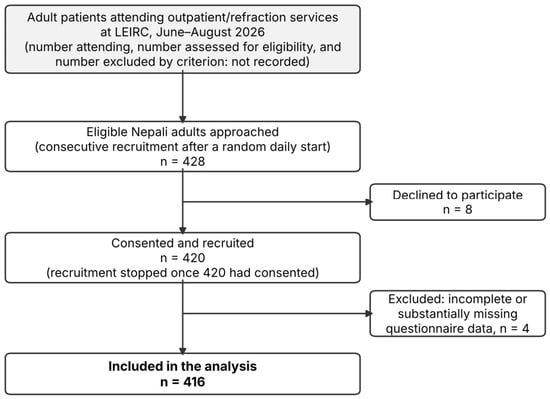
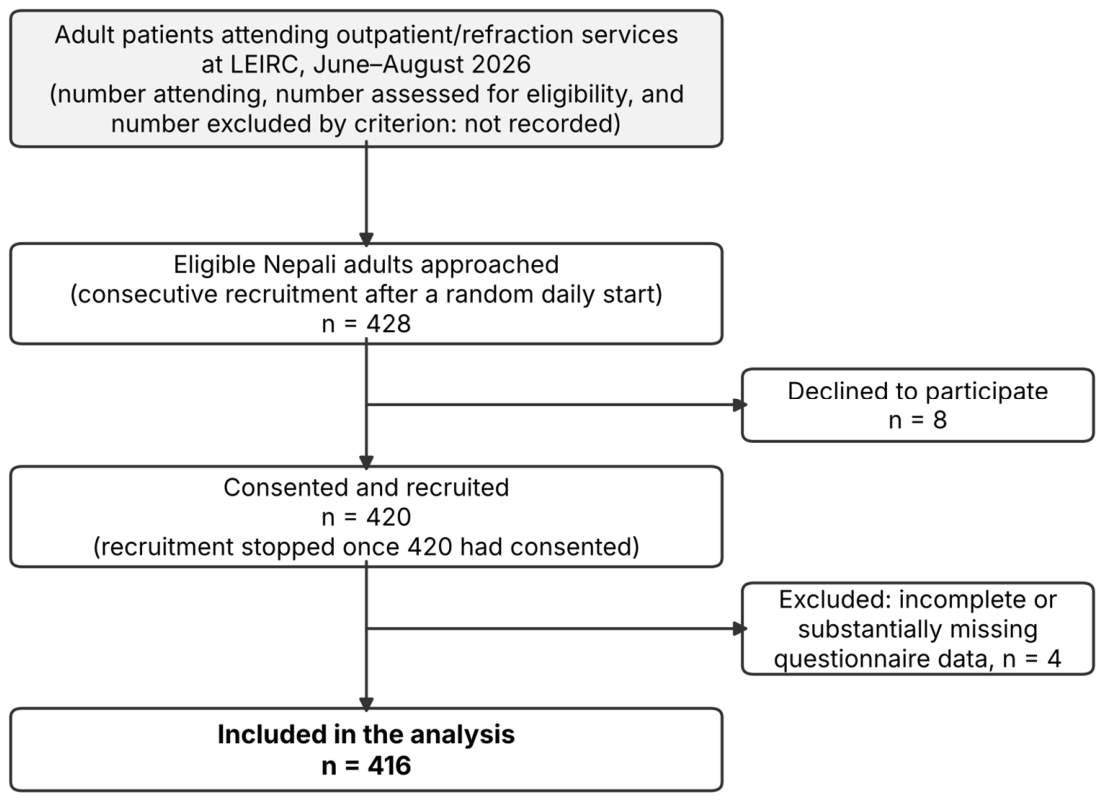
Eligible participants were recruited consecutively. On each data-collection day, a randomly selected eligible patient was approached first, after which subsequent eligible patients were approached consecutively. During the study period, 428 eligible patients were approached, of whom 8 declined to participate, resulting in 420 participants who consented and were recruited; recruitment was stopped once 420 participants had consented. Four participants were subsequently excluded because of incomplete or substantially missing questionnaire responses. Thus, 416 participants with complete data were included in the final analysis. The total number of patients attending the services, the number assessed for eligibility, and the number excluded under each criterion were not recorded (Figure 1).
Figure 1.
Flow of participants through the study. The number of patients attending the services, the number assessed for eligibility, and the number excluded under each eligibility criterion were not recorded.
2.5. Data Collection
Data were collected using a structured interviewer-administered questionnaire integrated with a clinical and spectacle-prescription data extraction form. The questionnaire was developed in English based on previous studies [1,16] and translated into Nepali by a professor of Nepali language; the Nepali version was back-translated into English by a professor of English language, and the process was supervised by a co-author (H.B.T.) to ensure clinical appropriateness and consistency. The Nepali version was administered to all participants. It was reviewed for content and pretested among 40 eligible patients (approximately 10% of the calculated sample size) who were not included in the final sample; only minor grammatical and linguistic adjustments were made, and these were not documented individually. The English and Nepali versions of the questionnaire are provided as Files S2 and S3.
Participants first underwent their routine clinical and refractive assessment. Uncorrected visual acuity (UCVA) and best-corrected visual acuity (BCVA) were measured for each eye with a Snellen chart at 6 m, and the spectacle prescription and lens status of each eye were extracted from the clinical records. Snellen acuities were converted to decimal and logarithm of the minimum angle of resolution (logMAR) notation, and the better eye was defined as the eye with the better acuity. The interview was then conducted in a private setting after written informed consent had been obtained. Interviews were conducted by three members of the research team (B.M.T., H.B.T., and S.S.), who were identified to participants as hospital or research staff but were not the clinicians who had examined the participant at that visit. Before data collection, the interviewers reviewed the questionnaire and procedures in a preparatory orientation session; no formal interviewer training was conducted. Spectacles brought to the visit were checked with a lensometer as part of routine care, but the measured powers were not recorded and could not be analyzed.
The questionnaire recorded age, sex, education, occupation, and monthly household income; type of spectacles prescribed; source of the spectacles; whether the participant had their spectacles at the visit; duration of spectacle use; usual daily hours of wear; time since the last spectacle change; and family history of spectacle use. Participants classified as non-compliant were asked for their main reason for not using their spectacles as prescribed. Completed forms were checked for completeness and consistency before data entry. Source of spectacles referred to the place where the spectacles in use had been obtained, that is, where they had been dispensed (“Where did you get your previous spectacles?”); where the refraction had been performed was not recorded. Of the six response options, participants selected only three (the study hospital, another hospital or eye clinic, or an optical shop); no participant selected an eye camp or outreach program, a pharmacy or general store, or “do not remember”. Monthly household income was reported as an open-ended amount for the whole household and grouped into categories during the analysis; sources of income, such as remittances, were not recorded. Daily hours of wear were recorded as reported; when participants gave a range (e.g., 3–4 h), its midpoint was recorded.
2.6. Outcome and Definitions
The primary outcome was compliance with prescribed spectacle wear, defined as self-reported use of the prescribed spectacles in accordance with the instructions provided by the eye care professional and the intended indication of the prescription (e.g., continuous wear, distance-only, near-only, or task-specific use). A fixed number of hours per day was not used as the criterion because the required duration of wear differs by prescription. However, the specific wearing instructions given to each participant were not recorded and, for spectacles obtained outside LEIRC, could not be verified; the outcome therefore reflects self-reported compliance as understood by the participant.
Spectacle compliance was assessed using the question: “Do you use your spectacles as prescribed?” Participants who answered “Yes” were classified as compliant, while those who answered “No” were classified as non-compliant. This classification was applied to all prescription types, including bifocal and near-only spectacles, based on the participant’s reported use of the spectacles as prescribed. Participants classified as non-compliant were asked to report their single main reason for non-adherence from a predefined list of reasons, with an option to specify another reason; no participant selected “other” or “social embarrassment/stigma”. For description, the reasons were grouped into four domains during the analysis; these domains were not pre-specified. Because daily hours of wear form part of the outcome construct, they were used only to describe patterns of use and to examine the consistency of the classification with reported daily wear; because both measures were self-reported, this consistency does not constitute validation.
Spherical equivalent (SE) was calculated for each eye as sphere + cylinder/2. Anisometropia was defined as an interocular SE difference of ≥1.00 D. Participants were classified as having presbyopia only when they required near correction without a distance refractive correction in either eye; in this group, the spectacle type recorded was that of the spectacles in use, which included bifocals and PALs. Education was grouped as low (illiterate or primary), moderate (lower secondary or secondary), or high (higher secondary or above). Because only 18 participants reported a monthly household income of NPR 50,001–80,000, this category was combined with NPR 30,001–50,000 in the regression models. At the mid-study exchange rate (NPR 153.0 per US dollar; Nepal Rastra Bank, 30 July 2026), the cut-offs of NPR 15,000, 30,000, 50,000, and 80,000 corresponded to approximately USD 98, 196, 327, and 523 per month; for reference, the national mean nominal household income in 2022/23 was NPR 551,148 per year (approximately NPR 45,900, or USD 300, per month) [32]. Spectacle type was grouped as single vision (distance or near), bifocal, or progressive addition lenses (PALs). Participants who were not engaged in any income-generating occupation, including those staying at home, were recorded as “unemployed”; homemakers were not recorded separately.
2.7. Statistical Analysis
Data were entered and cleaned in IBM SPSS Statistics version 26 (IBM Corp., Armonk, NY, USA), and regression analyses were performed in Python 3.13 using statsmodels 0.15; Firth regression was implemented in Python with NumPy and SciPy. Categorical variables are presented as frequencies and percentages, and continuous variables as mean ± standard deviation (SD) or median and interquartile range (IQR), according to their distribution. The proportion of compliant participants is reported with its Wilson 95% confidence interval (CI). Bivariate associations were assessed using Fisher’s exact test for 2 × 2 tables or the Fisher–Freeman–Halton test for larger tables (Monte Carlo p values based on 200,000 permutations), the Cochran–Armitage test for trend for ordinal variables (age group, education, and household income), and the Mann–Whitney U-test for continuous variables.
Multivariable binary logistic regression was used to identify factors independently associated with compliance (1 = compliant, 0 = non-compliant). Candidate variables were selected a priori from a conceptual framework of sociodemographic, clinical-refractive, and service-related determinants reported in previous studies [1,11,16,25], rather than on the basis of bivariate significance, and were entered simultaneously. Source of spectacles was regarded as the primary exposure of interest, and the other variables were included to adjust for sociodemographic and clinical differences between sources (Figure S1); their adjusted coefficients are reported for completeness but should not be interpreted as independent causal effects [33]. The primary model (Model 1) included age group, sex, education, household income, better-eye UCVA (per 0.1 logMAR), spectacle type, anisometropia, source of spectacles, and duration of spectacle use. With 144 compliant participants and 14 estimated parameters, the model had approximately 10 events per parameter [34].
Occupation was examined in a second model (Model 2) rather than in the primary model because several occupational categories were structurally confined to particular age or sex groups (all students were aged 18–39 years, all retired participants were men aged ≥53 years, and 87.8% of unemployed participants were women), so that its adjusted estimates could not be separated meaningfully from those of age, sex, and education. This decision was made after inspection of the distribution of occupation and was therefore not pre-specified. In the primary model, having spectacles at the visit and time since the last spectacle change were not included as explanatory variables, for two distinct reasons. Conceptually, both are more plausibly consequences than determinants of compliance, because participants who do not use their spectacles are less likely to carry or replace them. Statistically, no participant who had not changed spectacles for more than 3 years was compliant, which produces quasi-complete separation in maximum-likelihood estimation. Because time since the last change may nevertheless confound the association with source of spectacles, it was added in a further model (Model 3) estimated with Firth’s penalized likelihood, which provides finite estimates under separation [35,36].
Three sensitivity analyses were performed: (i) adding systemic disease, previous cataract surgery, and family history of spectacle use to Model 1; (ii) excluding participants whose better-eye BCVA was worse than 6/12 (n = 12), to address possible residual ocular comorbidity; and (iii) excluding duration of spectacle use, because of possible reverse causation. In addition, to address sparse data and separation [37], Models 1–3 were re-estimated with Firth’s penalized likelihood, with profile penalized-likelihood 95% CIs. Model 1 was also re-estimated with duration of use modeled with a restricted cubic spline (four knots) and after excluding participants with near correction only (n = 66), and the association with source of spectacles was examined with a Mantel–Haenszel analysis stratified by time since the last change. Adjusted predicted probabilities of compliance by occupation were obtained from the penalized Model 2 by marginal standardization, with 95% CIs from 500 bootstrap samples. Multicollinearity was assessed with generalized variance inflation factors (GVIF), computed from the correlation matrix of the model terms as described by Fox and Monette [38]; all values of GVIF1/(2df) were <1.5. Model performance was assessed with the likelihood-ratio test, Nagelkerke R2, the Hosmer–Lemeshow goodness-of-fit test, and the area under the receiver operating characteristic curve (AUC). Model adequacy was further examined with deviance and Pearson residuals, leverage, Cook’s distance, likelihood-ratio tests for nonlinearity of continuous predictors (restricted cubic spline terms), calibration by deciles of predicted risk, and bootstrap optimism correction (500 samples) of the AUC and calibration slope. Results are reported as crude odds ratios (CORs) and adjusted odds ratios (AORs) with 95% CIs. Two-sided p values < 0.05 were considered statistically significant.
3. Results
3.1. Participant Characteristics
Of 428 eligible patients approached, 420 consented to participate, and 416 (97.2% of those approached) with complete data were included in the analysis (Figure 1). Their mean age was 46.5 ± 15.4 years (range 18–82), and 237 (57.0%) were women. Overall, 180 (43.3%) participants were illiterate, and unemployed participants formed the largest occupational group (31.5%) (Table 1).
Table 1.
Sociodemographic characteristics of participants (N = 416).
3.2. Clinical Characteristics and Patterns of Spectacle Use
The median better-eye UCVA was 0.30 logMAR (IQR 0.18–0.60), and 285 (68.5%) participants achieved a BCVA of 6/6 in the better eye. Anisometropia of ≥1.00 D was present in 51 (12.3%) participants, and 66 (15.9%) required near correction only (Table 2).
Table 2.
Clinical and refractive characteristics of participants (N = 416).
Bifocal spectacles were the most commonly prescribed type (57.2%), followed by single-vision distance spectacles (35.8%). Spectacles had most often been obtained from another hospital or eye clinic (42.3%), followed by the study hospital (38.5%) and optical shops (19.2%). The median duration of spectacle use was 5.0 years (IQR 2.0–10.0), and the median daily wear was 4.0 h (IQR 2.0–8.0); 24 (5.8%) participants reported not wearing their spectacles at all, and 115 (27.6%) reported wearing them for ≥8 h per day (Table 3). Bifocals were used by 13.2% of participants aged 18–39 years, 74.4% of those aged 40–59 years, and 77.1% of those aged ≥60 years, and 20 of the 22 PAL wearers were aged 40–59 years. Participants whose spectacles came from optical shops more often had low education (82.5% vs. 61.4% for other hospitals and 63.1% for the study hospital) and near correction only (31.3% vs. 10.2% and 14.4%), and spectacles dispensed at the study hospital had more often been changed within the previous year (50.6% vs. 29.5% for other hospitals and 26.3% for optical shops; p < 0.001) (Table S4).
Table 3.
Pattern of spectacle use among participants (N = 416).
3.3. Compliance and Reasons for Non-Compliance
Overall, 144 participants (34.6%; 95% CI 30.2–39.3%) used their spectacles as prescribed, and 272 (65.4%) did not. The most frequent main reasons for non-compliance were discomfort (15.8%), unclear vision with spectacles (15.1%), cosmetic or appearance concerns (12.9%), and forgetfulness (11.8%). Grouped by domain, comfort- and adaptation-related complaints (discomfort, headache, or difficulty adapting) accounted for 93 (34.2%) responses, practical barriers (forgetfulness, broken or lost spectacles, or cost) for 70 (25.7%), attitudinal reasons or low perceived need (appearance, “my eyes are good,” or fear of dependence) for 57 (21.0%), and visual dissatisfaction (unclear vision or no perceived improvement) for 52 (19.1%) (Table 4).
Table 4.
Compliance with prescribed spectacle wear and main reasons for non-compliance.
The compliance classification was consistent with reported daily wear: 143 of 144 participants who reported compliance also reported wearing their spectacles for ≥6 h per day (the exception being a participant with near-only spectacles who reported 3 h of task-specific use), whereas 265 of 272 non-compliant participants reported <6 h (agreement 98.1%, 408/416). Because both measures were self-reported, this indicates internal consistency rather than validity, and it shows that the outcome mainly reflects sustained daily wear. Reported hours clustered at whole and half hours (most often 2, 4, 8, and 10 h), consistent with rounding and with midpoint recording of reported ranges; consequently, few participants reported more than 4 and fewer than 6 h.
3.4. Bivariate Associations
Compliance declined with age, from 49.6% among participants aged 18–39 years to 21.9% among those aged ≥60 years, and was lower among women than men (30.4% vs. 40.2%). It increased with education, from 20.0% among illiterate participants to 78.6% among those with a bachelor’s degree or above, and with household income. By occupation, compliance was highest among students (71.1%) and service workers (67.3%) and lowest among unemployed participants (15.3%) and farmers (17.2%) (Table 5). Linear trends across age groups, education levels, and income categories were all statistically significant (Cochran–Armitage p < 0.001).
Table 5.
Sociodemographic characteristics by compliance with prescribed spectacle wear (N = 416).
Compliance differed by spectacle type, being highest with PALs (77.3%) and lowest with bifocals (23.5%), and was lower among participants with presbyopia only than among those with distance refractive error (18.2% vs. 37.7%). Among participants with near correction only, compliance was reported by 2 of 7 (28.6%) using single-vision near spectacles, 4 of 52 (7.7%) using bifocals, and 6 of 7 using PALs. Only 5 of 80 participants (6.3%) who had obtained their spectacles from an optical shop were compliant, compared with 77 of 160 (48.1%) who had obtained them from the study hospital. Compliant participants had a longer duration of spectacle use and poorer better-eye UCVA than non-compliant participants; for UCVA, the medians were identical (0.30 logMAR), but the distribution differed (mean 0.49 ± 0.42 vs. 0.36 ± 0.33 logMAR; 90th percentile 1.18 vs. 0.78 logMAR) (Table 6).
Table 6.
Clinical, refractive, and spectacle-related characteristics by compliance with prescribed spectacle wear (N = 416).
3.5. Multivariable Analysis
The primary model (Model 1) was statistically significant (likelihood-ratio χ2 = 134.31, df = 14, p < 0.001), with a Nagelkerke R2 of 0.381, adequate calibration (Hosmer–Lemeshow χ2 = 7.20, df = 8, p = 0.515), and good discrimination (AUC 0.81; 0.79 after bootstrap optimism correction, with an optimism-corrected calibration slope of 0.83) (Table 7). Residual and influence diagnostics did not identify poorly fitted or highly influential observations (no absolute deviance residual > 3; maximum Cook’s distance 0.03; Pearson χ2/df = 1.01). The relationship with the log-odds of compliance was approximately linear for better-eye UCVA (P for nonlinearity = 0.66) but not for duration of use (p < 0.001), whose association was concentrated in the first years of use; modeling duration with a restricted cubic spline did not materially change the other estimates (Table 8). Source of spectacles was the factor most strongly associated with compliance: compared with spectacles obtained from the study hospital, the odds of compliance were lower for spectacles obtained from an optical shop (AOR 0.07, 95% CI 0.03–0.20) or another hospital or eye clinic (AOR 0.42, 95% CI 0.25–0.71). Participants aged ≥60 years had lower odds of compliance than those aged 18–39 years (AOR 0.20, 95% CI 0.07–0.56), although this association was not robust (see below), and each additional year of spectacle use was associated with higher odds (AOR 1.11, 95% CI 1.05–1.18). Moderate education was associated with higher odds than low education (AOR 1.97, 95% CI 1.04–3.76), although the overall association with education did not reach statistical significance (p = 0.062). Spectacle type was associated with compliance overall (p = 0.016), but neither the bifocal (AOR 0.64, 95% CI 0.30–1.34) nor the PAL estimate (AOR 3.88, 95% CI 0.93–16.26) was individually significant. Sex, household income, better-eye UCVA, and anisometropia were not independently associated with compliance.
Table 7.
Factors associated with compliance with prescribed spectacle wear: multivariable logistic regression (N = 416; 144 compliant).
Table 8.
Adjusted odds ratios for source of spectacles (reference: study hospital) and age ≥60 years (reference: 18–39 years) under alternative model specifications (N = 416 unless stated).
When occupation was added (Model 2; Nagelkerke R2 0.448, AUC 0.85, Hosmer–Lemeshow p = 0.499), it was strongly associated with compliance (likelihood-ratio test vs. Model 1: χ2 = 28.85, df = 6, p < 0.001). Compared with unemployed participants, the odds of compliance were higher among students (AOR 18.03, 95% CI 4.82–67.46), service workers (AOR 11.08, 95% CI 3.21–38.31), business workers (AOR 6.99, 95% CI 2.58–18.94), and laborers (AOR 5.48, 95% CI 1.63–18.44). In this model, the associations with age ≥60 years (AOR 0.61, 95% CI 0.19–2.02) and education were attenuated, whereas the associations with source of spectacles and duration of use were essentially unchanged. With approximately 7 events per parameter, these estimates are imprecise; with penalized estimation, the odds ratios were smaller (e.g., students 14.79 and service workers 9.44; Table S2), and the adjusted predicted probability of compliance ranged from 17.1% (95% CI 9.9–24.9%) among unemployed participants to 64.3% (47.5–81.5%) among students (Table S3).
In sensitivity analyses, the associations with source of spectacles and duration of use were consistent in all models (Table S1). The association with age ≥60 years persisted after adding systemic disease, previous cataract surgery, and family history (AOR 0.21) and after excluding participants with better-eye BCVA worse than 6/12 (AOR 0.22), but was attenuated when duration of spectacle use was removed (AOR 0.45, 95% CI 0.19–1.08). None of the additional clinical variables was associated with compliance.
Time since the last spectacle change differed by source (p < 0.001; Table S4). When it was added to the primary model (Model 3, Firth), the association with optical shops persisted (AOR 0.10, 95% CI 0.03–0.25), whereas that with other hospitals was attenuated (AOR 0.54, 0.30–0.96); in an analysis stratified by time since the last change, the corresponding odds ratios were 0.08 (0.03–0.21) and 0.76 (0.47–1.24). Spectacles changed more than 3 years earlier were very strongly associated with non-compliance (0 of 88 compliant; Firth AOR < 0.01, 95% CI < 0.01–0.03; Table S2). In contrast, the association with age ≥ 60 years was not robust: it was attenuated after adjustment for time since the last change (AOR 0.42, 0.12–1.38), after removal of duration of use (AOR 0.47, 0.20–1.09), and after inclusion of occupation (AOR 0.64, 0.20–2.01). The association with optical shops was consistent across all specifications, including after excluding participants with near correction only (AOR 0.10, 0.03–0.26) (Table 8).
4. Discussion
In this hospital-based study of adults with refractive error in Nepal, only about one-third (34.6%) reported using their spectacles as prescribed. Comfort and adaptation problems were the most common reasons for non-compliance. The factor most strongly and consistently associated with self-reported compliance was where the spectacles had been obtained: participants whose spectacles came from an optical shop had markedly lower odds of compliance than those whose spectacles were dispensed at the study hospital, after adjustment for sociodemographic and refractive characteristics and for time since the last spectacle change, and across all sensitivity analyses. The lower compliance with spectacles from other hospitals was partly explained by older spectacles. A shorter duration of use was associated with lower compliance, whereas the association with older age was not robust, and occupation was strongly associated with compliance but was closely intertwined with age, sex, and education.
The proportion of compliant participants was lower than that reported among adults in Morocco (57.6%) [1] and Egypt (approximately 62%) [25], and lower than that reported among elderly residents of homes for the aged in South India [26]. These comparisons should be interpreted cautiously because study settings, populations, and definitions of compliance differed. Our outcome relied on participants’ own judgment of whether they used their spectacles as prescribed and, in practice, mainly reflected sustained daily wear, and the population had a high proportion of illiterate participants (43.3%) and of multifocal prescriptions (62.5%), all of which may have contributed to the lower estimate.
The association between the source of spectacles and compliance is, to our knowledge, a novel finding in adults in Nepal, but its interpretation requires caution, and several explanations are possible. First, dispensing quality, including the accuracy of lenses relative to the prescription, optical centration, segment height for bifocals, frame fit, and counseling, may vary between providers; in a standardized-patient study in Cambodia, only 35.1% of spectacles met optimal quality criteria, and 18.3% of written prescriptions did not correspond to the spectacles dispensed [39]. However, spectacle power was not recorded in our study, and we cannot conclude that spectacles obtained outside the study hospital were of lower quality; this explanation remains a hypothesis. Second, the association may reflect continuity of care and selection: spectacles dispensed at the study hospital had been replaced more recently; patients who obtained their spectacles there may have been more likely to return for follow-up, and dissatisfied users of spectacles obtained elsewhere may have been more likely to attend a tertiary center. The reason for the visit was not recorded, so this form of selection could not be examined. Third, participants who obtained their spectacles from optical shops differed in education and refractive needs, and may also have had lower perceived need or greater financial constraints. Finally, interviews were conducted by hospital or research staff, which may have encouraged favorable reporting about spectacles dispensed at the study hospital. Adjustment for time since the last change attenuated the association for other hospitals but not for optical shops, among which only 5 of 80 participants reported compliance; nevertheless, these explanations cannot be distinguished with cross-sectional data, and studies that measure dispensing quality directly are needed.
Discomfort, unclear vision, appearance concerns, and forgetfulness were the most frequently reported reasons for non-compliance, consistent with findings among adults in Morocco and Ethiopia [1,11]. In Nepal, qualitative research among adults identified the inconvenience of wearing spectacles as a prominent issue [40], and appearance concerns have been reported among school adolescents [30]. When grouped, comfort- and adaptation-related complaints and visual dissatisfaction together accounted for more than half of the reasons given. These complaints were patient-reported and were not clinically verified, so refractive, dispensing, accommodative, or binocular causes can only be proposed as hypotheses. Visual symptoms have been associated with differences between the habitual and the subjective refraction and with accommodative and binocular dysfunctions [41,42], and such anomalies are common among symptomatic young adults in Nepal [43]; however, this evidence comes from younger, largely non-presbyopic samples and may not apply to our older population. Appearance concerns have also been reported among recipients of ready-made spectacles in other low-resource settings [44].
Older age was associated with lower compliance in the primary model, but this association was attenuated after adjustment for time since the last spectacle change, after removal of duration of use, and after inclusion of occupation, and it should not be interpreted as an independent effect of age. Compliance was lowest among bifocal wearers (23.5%) and among participants requiring near correction only (18.2%), although spectacle type was not individually significant after adjustment. Adaptation to multifocal lenses and the intermittent, task-specific nature of near-vision needs may contribute to this pattern. It is also possible that older adults who use their bifocals mainly for near tasks were classified as non-compliant when full-time wear had been advised. Consistent with this possibility, only 4 of 52 participants with near correction only who used bifocals reported compliance. Marmamula et al. reported higher compliance among elderly residents of homes for the aged in South India [26], which may reflect differences in setting and in how compliance was defined. The highest compliance was observed among PAL wearers, but this group was small (n = 22); the estimate was imprecise, and PAL users may differ from bifocal users in socioeconomic characteristics.
Education, household income, and occupation showed strong gradients in the bivariate analysis. Education remained moderately associated with compliance in the primary model, in line with findings from Morocco and Egypt [1,25], but this association and the association with age were attenuated once occupation was included. In our sample, occupation was structurally linked to age (all students were aged 18–39 years, and all retired participants were men aged ≥53 years) and sex (87.8% of unemployed participants were women; homemakers were not recorded separately). Occupation therefore appears to capture a combination of visual demands, life stage, and socioeconomic position rather than a single modifiable factor. The very large and imprecise odds ratios for occupational groups should be interpreted in this light; penalized estimates were smaller, and adjusted predicted probabilities provide a more interpretable summary (Table S3), and the occupational associations should not be read as causal.
Each additional year of spectacle use was associated with 11% higher odds of compliance, which agrees with the findings of Dahbi et al. among Moroccan adults [1]. The adjusted association was stronger than the crude association, because duration of use increased with age, which was itself associated with lower compliance. Reverse causation is also likely: individuals who tolerate and benefit from their spectacles continue to wear them and therefore accumulate a longer history of use. The association was not linear and was concentrated in the first years of use. Duration of use was retained in the primary model because it had been specified a priori; however, removing it, or adding time since the last change, attenuated the association with age, which illustrates why the adjusted coefficients of covariates other than the primary exposure should not be interpreted as independent effects [33]. Similarly, having spectacles at the visit and recent replacement of spectacles were strongly associated with compliance in the bivariate analysis, but these are more plausibly markers than causes of compliance and were therefore not included in the primary model. The absence of any compliant participant among those whose spectacles were older than 3 years is consistent with non-users not replacing their spectacles, although outdated prescriptions may also have contributed.
Better-eye UCVA was associated with compliance in the bivariate analysis, with poorer uncorrected vision among compliant participants, but this association was not independent of the other factors. Studies in children have reported that poorer uncorrected vision is associated with better spectacle compliance [12,13,45], and a recent study from Delhi identified distance UCVA in the worse eye as an independent factor [46]. The weaker association in our study may reflect the inclusion of presbyopic participants, whose distance UCVA does not capture their near-vision need. Anisometropia was not associated with compliance, but only 51 participants had anisometropia of ≥1.00 D, which limited statistical power.
From a clinical perspective, these findings suggest that prescribing refractive correction may not be sufficient to ensure sustained use. Potential areas for improvement, which were not evaluated in this study, include verifying the power, centration, and fit of spectacles, particularly when they are obtained outside the prescribing center; providing structured adaptation counseling for multifocal wearers and older adults; addressing appearance concerns through frame selection; and scheduling early follow-up so that problems with comfort or visual clarity are resolved rather than leading to discontinuation [1,11,22,40]. Their effectiveness should be evaluated in prospective studies before they can be recommended.
This study has several limitations. First, its cross-sectional design precludes causal inference; reverse causation is plausible for duration of use, time since the last change, and possibly source of spectacles, and selection related to the reason for the visit, which was not recorded, cannot be excluded. Second, compliance and reasons for non-compliance were self-reported and may be affected by recall and social desirability bias, which would tend to overestimate compliance; the interviewers were members of the research team identified as hospital or research staff, which may have encouraged favorable reporting, particularly about spectacles dispensed at the study hospital. Third, although compliance was not defined by a fixed number of hours, the classification closely matched reported daily wear of ≥6 h, and wearing instructions were not recorded, so that appropriate intermittent near use may have been classified as non-compliance; our findings therefore mainly reflect self-reported sustained daily wear; standardized and, where feasible, objective measures of spectacle use are needed in future studies. Fourth, the study was conducted at a single tertiary center, which limits generalizability to adults who do not seek tertiary eye care. In addition, because participants were recruited at the study hospital, those who had obtained their spectacles there may have been more likely to return for follow-up, and interviews conducted at the same institution may have encouraged favorable reporting; both mechanisms could have strengthened the observed association with the source of spectacles. Fifth, dispensing quality, spectacle power (lensometry findings were not recorded), the place of refraction, prescription accuracy, near visual acuity, accommodative and binocular function, cost of spectacles, and counseling were not assessed, and only one main reason for non-compliance was recorded; future studies could quantify symptoms with validated instruments, such as the Symptom Questionnaire for Visual Dysfunctions, which has been validated in the Nepalese population [47]. Sixth, the number of patients assessed for eligibility and the exclusions by criterion were not recorded, household income was reported as a single amount without information on income sources such as remittances, and the reason domains were defined post hoc. Finally, some subgroups were small, and the occupational categories were heterogeneous, which reduced the precision of some estimates.
The study also has strengths, including a high participation rate (98.1% of eligible patients consented), an adequate sample size, the integration of clinical records with interview data, an a priori modeling strategy, and sensitivity analyses, including penalized estimation, that support the robustness of the association with optical shops. It provides quantitative evidence on spectacle compliance among adults in Nepal that complements existing qualitative research [40].
5. Conclusions
Nearly two-thirds of adults attending this tertiary eye care center did not report using their spectacles as prescribed, mainly because of discomfort, unclear vision, appearance concerns, and forgetfulness. Spectacles obtained from optical shops were consistently associated with lower self-reported compliance, whereas the lower compliance with spectacles from other hospitals was partly explained by older spectacles, and the association with older age was not robust. Because the design was cross-sectional, these findings identify associations rather than causes. Dispensing quality, adaptation support, and follow-up are potential areas for improvement that should be evaluated in prospective studies.
Supplementary Materials
The following supporting information can be downloaded at: https://www.mdpi.com/article/10.3390/vision10050097/s1, Table S1: Sensitivity analyses of the primary model; Table S2: Full estimates of Model 3 and of the penalized Model 2; Table S3: Adjusted predicted probability of compliance by occupation; Table S4: Participant characteristics by source of spectacles; Figure S1: Conceptual diagram of the assumed relationships between source of spectacles, covariates, and compliance; File S1: STROBE checklist; File S2: Study questionnaire (English version); File S3: Study questionnaire (Nepali version).
Author Contributions
Conceptualization, B.M.T.; methodology, B.M.T., S.S., H.B.T. and M.C.-C.; formal analysis, B.M.T. and M.C.-C.; investigation, B.M.T., S.S. and H.B.T.; data curation, B.M.T.; writing—original draft preparation, B.M.T.; writing—review and editing, S.S., H.B.T. and M.C.-C. All authors have read and agreed to the published version of the manuscript.
Funding
This research received no external funding.
Institutional Review Board Statement
The study was conducted in accordance with the Declaration of Helsinki and approved by the Institutional Review Committee of Lumbini Eye Institute and Research Center (protocol code 95/025/26; date of approval: 17 May 2026).
Informed Consent Statement
Written informed consent was obtained from all subjects involved in the study.
Data Availability Statement
The datasets generated and analyzed during the current study are not publicly available because they contain participant-level clinical information and are subject to institutional and ethical restrictions. De-identified data are available from the corresponding author on reasonable request, subject to approval by the Institutional Review Committee of Lumbini Eye Institute and Research Center.
Acknowledgments
The authors thank all participants for their cooperation. During the preparation of this manuscript, the authors used Claude Opus 5 for the purposes of improving the language and readability of the text. The authors have reviewed and edited the output and take full responsibility for the content of this publication.
Conflicts of Interest
The authors declare no conflicts of interest.
Abbreviations
The following abbreviations are used in this manuscript:
| AOR | adjusted odds ratio |
| AUC | area under the receiver operating characteristic curve |
| BCVA | best-corrected visual acuity |
| CI | confidence interval |
| COR | crude odds ratio |
| D | diopters |
| GVIF | generalized variance inflation factor |
| IQR | interquartile range |
| LEIRC | Lumbini Eye Institute and Research Center |
| logMAR | logarithm of the minimum angle of resolution |
| NPR | Nepalese rupees |
| PAL | progressive addition lenses |
| SD | standard deviation |
| SE | spherical equivalent |
| STROBE | Strengthening the Reporting of Observational Studies in Epidemiology |
| UCVA | uncorrected visual acuity |
References
- Dahbi, A.; Chetoui, A.; Bentayeb, F.; Korziti, S.; Errachidi, A.; El Merabet, Y. Compliance and determinants of spectacle wear among Moroccan adults residing Beni-Mellal Khénifra region. Br. Ir. Orthopt. J. 2024, 20, 207–216. [Google Scholar] [CrossRef] [Scilit] [PubMed]
- Jan, C.; Xu, R.; Luo, D.; Xiong, X.; Song, Y.; Ma, J.; Stafford, R.S. Association of visual impairment with economic development among Chinese schoolchildren. JAMA Pediatr. 2019, 173, e190914. [Google Scholar] [CrossRef] [Scilit] [PubMed]
- Lin, J.C.; Yu, J.H. Assessment of quality of life among Taiwanese patients with visual impairment. J. Formos. Med. Assoc. 2012, 111, 572–579. [Google Scholar] [CrossRef] [Scilit] [PubMed]
- Bourne, R.R.A.; Stevens, G.A.; White, R.A.; Smith, J.L.; Flaxman, S.R.; Price, H.; Jonas, J.B.; Keeffe, J.; Leasher, J.; Naidoo, K.; et al. Causes of vision loss worldwide, 1990–2010: A systematic analysis. Lancet Glob. Health 2013, 1, e339–e349. [Google Scholar] [CrossRef] [Scilit] [PubMed]
- Hashemi, H.; Fotouhi, A.; Yekta, A.; Pakzad, R.; Ostadimoghaddam, H.; Khabazkhoob, M. Global and regional estimates of prevalence of refractive errors: Systematic review and meta-analysis. J. Curr. Ophthalmol. 2018, 30, 3–22. [Google Scholar] [CrossRef] [Scilit] [PubMed]
- Naidoo, K.S.; Jaggernath, J. Uncorrected refractive errors. Indian J. Ophthalmol. 2012, 60, 432–437. [Google Scholar] [CrossRef] [Scilit] [PubMed]
- Cochrane, G.M.; du Toit, R.; Le Mesurier, R.T. Management of refractive errors. BMJ 2010, 340, c1711. [Google Scholar] [CrossRef] [Scilit] [PubMed]
- Resnikoff, S.; Pascolini, D.; Mariotti, S.P.; Pokharel, G.P. Global magnitude of visual impairment caused by uncorrected refractive errors in 2004. Bull. World Health Organ. 2008, 86, 63–70. [Google Scholar] [CrossRef] [Scilit] [PubMed]
- World Health Organization. Blindness and Vision Impairment: Refractive Errors. Available online: https://www.who.int/news-room/questions-and-answers/item/blindness-and-vision-impairment-refractive-errors (accessed on 18 September 2026).
- Ayanniyi, A.A.; Adepoju, F.G.; Ayanniyi, R.O.; Morgan, R.E. Challenges, attitudes and practices of the spectacle wearers in a resource-limited economy. Middle East Afr. J. Ophthalmol. 2010, 17, 83–87. [Google Scholar] [CrossRef] [Scilit] [PubMed]
- Gebresellassie, M.G.; Sisay, H.; Desta, K. Spectacles under utilization and associated factors among adults in Hawassa, South Ethiopia, June, 2022. Clin. Optom. 2023, 15, 303–311. [Google Scholar] [CrossRef] [Scilit] [PubMed]
- Congdon, N.; Zheng, M.; Sharma, A.; Choi, K.; Song, Y.; Zhang, M.; Wang, M.; Zhou, Z.; Li, L.; Liu, X.; et al. Prevalence and determinants of spectacle nonwear among rural Chinese secondary schoolchildren: The Xichang Pediatric Refractive Error Study report 3. Arch. Ophthalmol. 2008, 126, 1717–1723. [Google Scholar] [CrossRef] [Scilit] [PubMed]
- Gogate, P.; Mukhopadhyaya, D.; Mahadik, A.; Naduvilath, T.J.; Sane, S.; Shinde, A.; Holden, B. Spectacle compliance amongst rural secondary school children in Pune District, India. Indian J. Ophthalmol. 2013, 61, 8–12. [Google Scholar] [CrossRef] [Scilit] [PubMed]
- Li, L.; Lam, J.; Lu, Y.; Ye, Y.; Lam, D.S.C.; Gao, Y.; Sharma, A.; Zhang, M.; Griffiths, S.; Congdon, N. Attitudes of students, parents, and teachers toward glasses use in rural China. Arch. Ophthalmol. 2010, 128, 759–765. [Google Scholar] [CrossRef] [Scilit] [PubMed]
- Manny, R.E.; Sinnott, L.T.; Jones-Jordan, L.A.; Messer, D.; Twelker, J.D.; Cotter, S.A.; Kleinstein, R.N.; Crescioni, M. Predictors of adequate correction following vision screening failure. Optom. Vis. Sci. 2012, 89, 892–900. [Google Scholar] [CrossRef] [Scilit] [PubMed]
- Morjaria, P.; McCormick, I.; Gilbert, C. Compliance and predictors of spectacle wear in schoolchildren and reasons for non-wear: A review of the literature. Ophthalmic Epidemiol. 2019, 26, 367–377. [Google Scholar] [CrossRef] [Scilit] [PubMed]
- Holden, B.A.; Fricke, T.R.; Ho, S.M.; Wong, R.; Schlenther, G.; Cronjé, S.; Burnett, A.; Papas, E.; Naidoo, K.S.; Frick, K.D. Global vision impairment due to uncorrected presbyopia. Arch. Ophthalmol. 2008, 126, 1731–1739. [Google Scholar] [CrossRef] [Scilit] [PubMed]
- Patel, I.; Munoz, B.; Burke, A.G.; Kayongoya, A.; McHiwa, W.; Schwarzwalder, A.W.; West, S.K. Impact of presbyopia on quality of life in a rural African setting. Ophthalmology 2006, 113, 728–734. [Google Scholar] [CrossRef] [Scilit] [PubMed]
- McClure, T.M.; Choi, D.; Wooten, K.; Nield, C.; Becker, T.M.; Mansberger, S.L. The impact of eyeglasses on vision-related quality of life in American Indian/Alaska Natives. Am. J. Ophthalmol. 2011, 151, 175–182.e2. [Google Scholar] [CrossRef] [Scilit] [PubMed]
- Reddy, P.A.; Congdon, N.; MacKenzie, G.; Gogate, P.; Wen, Q.; Jan, C.; Clarke, M.; Kassalow, J.; Gudwin, E.; O’Neill, C.; et al. Effect of providing near glasses on productivity among rural Indian tea workers with presbyopia (PROSPER): A randomised trial. Lancet Glob. Health 2018, 6, e1019–e1027. [Google Scholar] [CrossRef] [Scilit] [PubMed]
- Fenwick, E.K.; Ong, P.G.; Man, R.E.K.; Cheng, C.-Y.; Sabanayagam, C.; Wong, T.Y.; Lamoureux, E.L. Association of vision impairment and major eye diseases with mobility and independence in a Chinese population. JAMA Ophthalmol. 2016, 134, 1087–1093. [Google Scholar] [CrossRef] [Scilit] [PubMed]
- Killeen, O.J.; Cho, J.; Newman-Casey, P.A.; Kana, L.; Woodward, M.A. Barriers and facilitators to obtaining eyeglasses for vulnerable patients in a Michigan free clinic. Optom. Vis. Sci. 2021, 98, 243–249. [Google Scholar] [CrossRef] [Scilit] [PubMed]
- Owsley, C.; McGwin, G., Jr.; Scilley, K.; Meek, G.C.; Seker, D.; Dyer, A. Effect of refractive error correction on health-related quality of life and depression in older nursing home residents. Arch. Ophthalmol. 2007, 125, 1471–1477. [Google Scholar] [CrossRef] [Scilit] [PubMed]
- He, M.; Xu, J.; Yin, Q.; Ellwein, L.B. Need and challenges of refractive correction in urban Chinese school children. Optom. Vis. Sci. 2005, 82, 229–234. [Google Scholar] [CrossRef] [Scilit] [PubMed]
- Soliman, S.S.; Barakat, A.M.; Wasfy, T.E.; Abdelwanees, S. Noncompliance to spectacle wear among adults—Delta region, Egypt. J. Egypt. Ophthalmol. Soc. 2024, 117, 16–21. [Google Scholar] [CrossRef] [Scilit] [PubMed]
- Marmamula, S.; Bhoopalan, D.; Kumbham, T.R.; Yelagondula, V.K.; Keeffe, J. Prevalence, pattern, and compliance with spectacles use among the elderly in homes for the aged in South India: The Hyderabad Ocular Morbidity in Elderly Study (HOMES). Indian J. Ophthalmol. 2023, 71, 263–267. [Google Scholar] [CrossRef] [Scilit] [PubMed]
- Marmamula, S.; Ravuri, L.V.C.S.; Boon, M.Y.; Khanna, R.C. Spectacle coverage and spectacles use among elderly population in residential care in the South Indian state of Andhra Pradesh. BioMed Res. Int. 2013, 2013, 183502. [Google Scholar] [CrossRef] [Scilit] [PubMed]
- Kaiti, R.; Pradhan, A.; Dahal, H.N.; Shrestha, P. Pattern and prevalence of refractive error and secondary visual impairment in patients attending a tertiary hospital in Dhulikhel, Nepal. Kathmandu Univ. Med. J. 2018, 16, 114–119. [Google Scholar]
- Karn, R.R.; Marmamula, S.; Thakur, S.K.; Sitoula, R.P.; Shah, R.; Mehta, A.K.; Saha, R.; Saravanan, S.; Ali, R. Prevalence of visual impairment, uncorrected refractive errors and effective refractive error coverage in Koshi Province, Nepal—Rapid assessment of refractive errors. Eye 2024, 38, 2173–2178. [Google Scholar] [CrossRef] [Scilit] [PubMed]
- Khatri, B.; Shrestha, R.; Suwal, R.; Kayastha, M.; Sharma, S.; Khadka, D.; Upadhyay, M.P. Utilisation of eye health services and compliance with spectacles wear among community school adolescents: A mixed-methods study from Bagmati province of Nepal. BMJ Open 2024, 14, e087287. [Google Scholar] [CrossRef] [Scilit] [PubMed]
- von Elm, E.; Altman, D.G.; Egger, M.; Pocock, S.J.; Gøtzsche, P.C.; Vandenbroucke, J.P.; for the STROBE Initiative. The Strengthening the Reporting of Observational Studies in Epidemiology (STROBE) statement: Guidelines for reporting observational studies. Lancet 2007, 370, 1453–1457. [Google Scholar] [CrossRef] [Scilit] [PubMed]
- National Statistics Office. Nepal Living Standards Survey IV 2022/23: Statistical Report; National Statistics Office, Office of the Prime Minister and Council of Ministers, Government of Nepal: Kathmandu, Nepal, 2024.
- Westreich, D.; Greenland, S. The Table 2 fallacy: Presenting and interpreting confounder and modifier coefficients. Am. J. Epidemiol. 2013, 177, 292–298. [Google Scholar] [CrossRef] [Scilit] [PubMed]
- Peduzzi, P.; Concato, J.; Kemper, E.; Holford, T.R.; Feinstein, A.R. A simulation study of the number of events per variable in logistic regression analysis. J. Clin. Epidemiol. 1996, 49, 1373–1379. [Google Scholar] [CrossRef] [Scilit] [PubMed]
- Firth, D. Bias reduction of maximum likelihood estimates. Biometrika 1993, 80, 27–38. [Google Scholar] [CrossRef]
- Heinze, G.; Schemper, M. A solution to the problem of separation in logistic regression. Stat. Med. 2002, 21, 2409–2419. [Google Scholar] [CrossRef] [Scilit] [PubMed]
- Greenland, S.; Mansournia, M.A.; Altman, D.G. Sparse data bias: A problem hiding in plain sight. BMJ 2016, 352, i1981. [Google Scholar] [CrossRef] [Scilit] [PubMed]
- Fox, J.; Monette, G. Generalized collinearity diagnostics. J. Am. Stat. Assoc. 1992, 87, 178–183. [Google Scholar] [CrossRef]
- Burnett, A.; Meng, N.; Seiha, D.; Kong, N.; Chea, S.; Dean, M.; Horm, P.; Meas, K.S.; Varga, B.; Ho, S.M.; et al. Quality of refractive error care in Cambodia: An unannounced standardized patient study. Ophthalmic Epidemiol. 2025, 32, 25–33. [Google Scholar] [CrossRef] [Scilit] [PubMed]
- Kandel, H.; Khadka, J.; Shrestha, M.K.; Sharma, S.; Kandel, S.N.; Dhungana, P.; Pradhan, K.; Nepal, B.P.; Thapa, S.; Pesudovs, K. Uncorrected and corrected refractive error experiences of Nepalese adults: A qualitative study. Ophthalmic Epidemiol. 2018, 25, 147–161. [Google Scholar] [CrossRef] [Scilit] [PubMed]
- Cacho-Martínez, P.; Cantó-Cerdán, M.; Lara-Lacárcel, F.; García-Muñoz, Á. Assessing the role of visual dysfunctions in the association between visual symptomatology and the use of digital devices. J. Optom. 2024, 17, 100510. [Google Scholar] [CrossRef] [Scilit] [PubMed]
- Cacho-Martínez, P.; Cantó-Cerdán, M.; Carbonell-Bonete, S.; García-Muñoz, Á. Characterization of visual symptomatology associated with refractive, accommodative, and binocular anomalies. J. Ophthalmol. 2015, 2015, 895803. [Google Scholar] [CrossRef] [Scilit] [PubMed]
- Chhetri, S.; Poudel, R.; Adhikari, S.; Belbase, U.; Cantó-Cerdán, M.; Poudel, M.; Thapa, S. Prevalence and clinical profile of non-strabismic binocular vision anomalies in the Nepalese population: A hospital-based study. J. Optom. 2025, 18, 100575. [Google Scholar] [CrossRef] [Scilit] [PubMed]
- Vincent, J.E.; Netek, S.; Parry, A.; Mladenovich, D.; Thein, N.N.; Amendola, P.R. Reported wearing compliance of ready-made spectacles at 6 and 12 months. Optom. Vis. Sci. 2010, 87, 958–965. [Google Scholar] [CrossRef] [Scilit] [PubMed]
- Castanon Holguin, A.M.; Congdon, N.; Patel, N.; Ratcliffe, A.; Esteso, P.; Toledo Flores, S.; Gilbert, D.; Pereyra Rito, M.A.; Munoz, B. Factors associated with spectacle-wear compliance in school-aged Mexican children. Investig. Ophthalmol. Vis. Sci. 2006, 47, 925–928. [Google Scholar] [CrossRef] [Scilit] [PubMed]
- Prasannan, V.; Sabherwal, S.; Tibrewal, S.; Siddiqui, Z.; Majumdar, A.; Ganesh, S. Barriers to compliance with the use of free-of-cost spectacles prescribed through door-to-door screening of children in urban slums of Delhi. Indian J. Ophthalmol. 2025, 73, 702–707. [Google Scholar] [CrossRef] [Scilit] [PubMed]
- Belbase, U.; Chhetri, S.; Subedi, A.; Khadka, D.; Acharya, S.; Shah, A.K.; Cantó-Cerdán, M. Validation of the symptom questionnaire for visual dysfunctions (SQVD): A psychometric analysis within the Nepalese population. Clin. Exp. Optom. 2026, 27, 1–13. [Google Scholar] [CrossRef] [Scilit] [PubMed]

Disclaimer/Publisher’s Note: The statements, opinions and data contained in all publications are solely those of the individual author(s) and contributor(s) and not of MDPI and/or the editor(s). MDPI and/or the editor(s) disclaim responsibility for any injury to people or property resulting from any ideas, methods, instructions or products referred to in the content. |
© 2026 by the authors. Licensee MDPI, Basel, Switzerland. This article is an open access article distributed under the terms and conditions of the Creative Commons Attribution (CC BY) license.