


Abstract
Background: Fibromyalgia syndrome (FMS) is a chronic pain condition associated with central sensitisation and functional limitations. This review evaluated the effectiveness and safety of transcranial direct current stimulation (tDCS) combined with therapeutic exercise in individuals with FMS. Methods: A systematic review was conducted and prospectively registered in PROSPERO (CRD420261309459). MEDLINE, Scopus, PEDro, Google Scholar, and ScienceDirect were searched. Methodological quality and risk of bias were assessed using PEDro and RoB 2.0. Results: Ten studies involving n = 636 participants were included. Most applied anodal tDCS over the M1 at 2 mA for 20 min alongside therapeutic exercise. Several studies reported significant improvements in pain (p = 0.007; d = 0.73), motor performance (p = 0.002–0.016), fatigue (MD = −9.8; p = 0.028), and sleep quality (MD = −14.4; p = 0.002). However, these findings were not consistent across studies, with several trials reporting no significant additional benefits of active tDCS over sham stimulation (p > 0.05). Psychological outcomes were heterogeneous, and reported adverse events were predominantly mild and transient. Conclusions: tDCS combined with therapeutic exercise may improve pain and other clinical outcomes in FMS, although its additional benefits remain uncertain. Methodological limitations and intervention heterogeneity highlight the need for larger, standardised trials with longer follow-up.
1. Introduction
Fibromyalgia syndrome (FMS) is a chronic condition characterised by widespread musculoskeletal pain, persistent fatigue, sleep disturbance and marked psychological comorbidity, with a pain intensity that is disproportionate to any identifiable peripheral lesion [1,2]. Recent evidence estimates the prevalence of FMS at approximately 1–2%, with a pooled prevalence of 1.40%, whereas population-based data from Spain indicate a prevalence of approximately 2.45% [3,4]. Contemporary models conceptualise it as a nociplastic pain condition in which central sensitisation, impaired descending pain inhibition, and altered functional connectivity among the dorsolateral prefrontal cortex (DLPFC), insula, and primary motor cortex (M1) are thought to contribute to the persistence and variability of widespread pain [5,6,7,8].
Because no single pharmacological agent reliably controls the full symptom complex of FMS, and the drugs with the best evidence (e.g., duloxetine, pregabalin, amitriptyline) are frequently limited by modest effect sizes and tolerability problems [9], guidelines place non-pharmacological strategies—particularly supervised aerobic and strengthening exercise—at the centre of first-line management [10,11]. Exercise is inexpensive, low-risk and supported by consistent evidence for reducing pain and improving function in FMS; however, its effect on the centrally mediated features of the syndrome, such as pain catastrophising, fatigue and sleep quality, tends to be smaller and harder to sustain once supervised sessions end [12,13].
Transcranial direct current stimulation (tDCS) is a non-invasive neuromodulation technique that delivers a weak, constant electrical current through scalp electrodes to modulate cortical excitability [14,15,16]. Anodal stimulation over the M1 is thought to act on the somatosensory and descending pain-modulatory pathways, while stimulation of the DLPFC is more consistently associated with improvements in mood, fatigue and cognitive-affective dimensions of chronic pain [17,18]. A substantial body of trials and several systematic reviews and meta-analyses support the analgesic potential of tDCS as a stand-alone intervention in FMS, generally favouring anodal M1 stimulation at 2 mA for 20 min [19].
A biologically plausible, and increasingly tested, hypothesis is that tDCS and exercise act on overlapping neural substrates and may be synergistic rather than merely additive [20,21]. Aerobic exercise (AE) itself modulates corticospinal excitability and up-regulates neurotrophic signalling (e.g., brain-derived neurotrophic factor), while tDCS primes the same cortical networks for activity-dependent plasticity [22,23]. If this synergy holds, combining the two interventions could produce durable gains that neither intervention achieves alone, extending the reach of a treatment strategy that is already recommended, safe and widely accessible.
However, existing systematic reviews of tDCS in FMS have generally evaluated the technique as a stand-alone intervention, and only a minority of the trials they include specifically test tDCS in combination with planned and structured exercise [24,25]. Although FMS disproportionately affects women, several included studies enrolled participants of both sexes; therefore, this review focuses on adults with FMS while acknowledging the predominance of women in the available evidence [26].
Therefore, the aim was to synthesise the evidence from comparative intervention studies that compared active tDCS combined with therapeutic exercise against exercise alone, sham tDCS plus exercise, tDCS alone, or usual care/no intervention, in adults with FMS, with particular attention to pain intensity, functionality, fatigue, psychological outcomes and safety.
2. Materials and Methods
2.1. Research Questions
The review question was formulated using the PICO(T) framework, assessing active tDCS combined with therapeutic exercise in adults with FMS, compared with exercise alone, sham tDCS plus exercise, tDCS alone, or usual care/no intervention. Therefore, the research question was: does combining active tDCS with therapeutic exercise improve pain, function, fatigue, psychological outcomes, and safety in adults with FMS?.
2.2. Study Design
The systematic review was conducted following the Preferred Reporting Items for Systematic Reviews and Meta-Analyses (PRISMA) guidelines [27]. Compliance with PRISMA 2020 reporting standard is documented in Supplementary Table S1: PRISMA Checklist 2020. The protocol was prospectively registered in the International Prospective Register of Systematic Reviews (registration protocol number PROSPERO CRD420261309459; https://www.crd.york.ac.uk/PROSPERO/view/CRD420261309459) (accessed on 1 June 2026). A comprehensive literature search was performed to identify intervention studies evaluating active tDCS combined with therapeutic exercise in adults with FMS. Searches were conducted between 16 February and 30 September 2026 in MEDLINE (PubMed), Scopus, PEDro, Google Scholar, and ScienceDirect.
The search strategy combined controlled vocabulary and free-text terms related to FMS, tDCS, and exercise using Boolean operators. A representative search strategy was: (“fibromyalgia” OR “fibromyalgia syndrome”) AND (“transcranial direct current stimulation” OR “tDCS”) AND (“exercise” OR “therapeutic exercise” OR “aerobic exercise” OR “physical exercise”). Strategies were adapted to the specific requirements of each database while maintaining the same core concepts. Two reviewers independently (E.A.H. and M.G.U.) screened titles and abstracts, followed by full-text assessments of potentially eligible studies. Any disagreements were resolved through discussion and consensus. Database-specific search strategies are provided in Table 1.
Table 1.
Search strategy.
2.3. Eligibility Criteria
Studies were considered eligible according to the PICO(T) framework if they met the following criteria: (1) adults with FMS, irrespective of sex, diagnosed according to American College of Rheumatology (ACR) criteria [28,29,30]; (2) active tDCS targeting M1 or DLPFC combined with structured exercise; (3) a separate comparator group receiving sham tDCS plus exercise, exercise alone, tDCS alone, or usual care/no intervention; (4) assessment of clinical outcomes such as pain, fatigue, motor performance, sleep, psychological symptoms, quality of life (QoL), or adverse events (AEs); and (5) randomised or non-randomised controlled intervention studies published in English or Spanish within the previous 20 years. Reviews, non-extractable conference abstracts, case reports, animal or in vitro studies, uncontrolled case series, and studies without a combined tDCS-and-exercise intervention were excluded.
2.4. Study Selection and Data Extraction
Titles and abstracts were screened independently by two reviewers (E.A.H. and M.G.U.) against the eligibility criteria, and full texts of potentially eligible records were assessed in duplicate; disagreements were resolved by discussion or by a third reviewer (S.E.M.P.). Data were extracted using a standardised, PICO-based form capturing author and year, country, sample size, participant characteristics, tDCS parameters (e.g., target, current intensity, duration, number of sessions), exercise protocol, comparator, follow-up duration, outcome measures and principal findings.
2.5. Methodological Quality and Risk of Bias
Methodological quality of clinical trials was assessed using the PEDro scale [30], while risk of bias in RCTs was evaluated with the Cochrane RoB 2.0 tool [31,32]. All assessments were performed independently by two reviewers (S.E.M.P. and I.M.M.P.), with disagreements resolved by consensus.
2.6. Certainty of Evidence (GRADE)
The certainty of evidence was assessed using the Grading of Recommendations Assessment, Development and Evaluation (GRADE) approach [33], considering five domains: risk of bias, inconsistency, indirectness, imprecision, and publication bias. Evidence was classified as high, moderate, low, or very low certainty. The assessment was conducted by two reviewers (S.E.M.P. and I.M.M.P.), with disagreements resolved by consensus.
3. Results
3.1. Study Selection
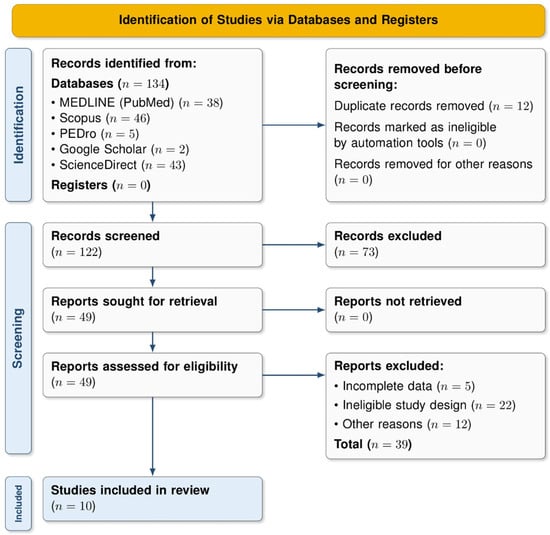
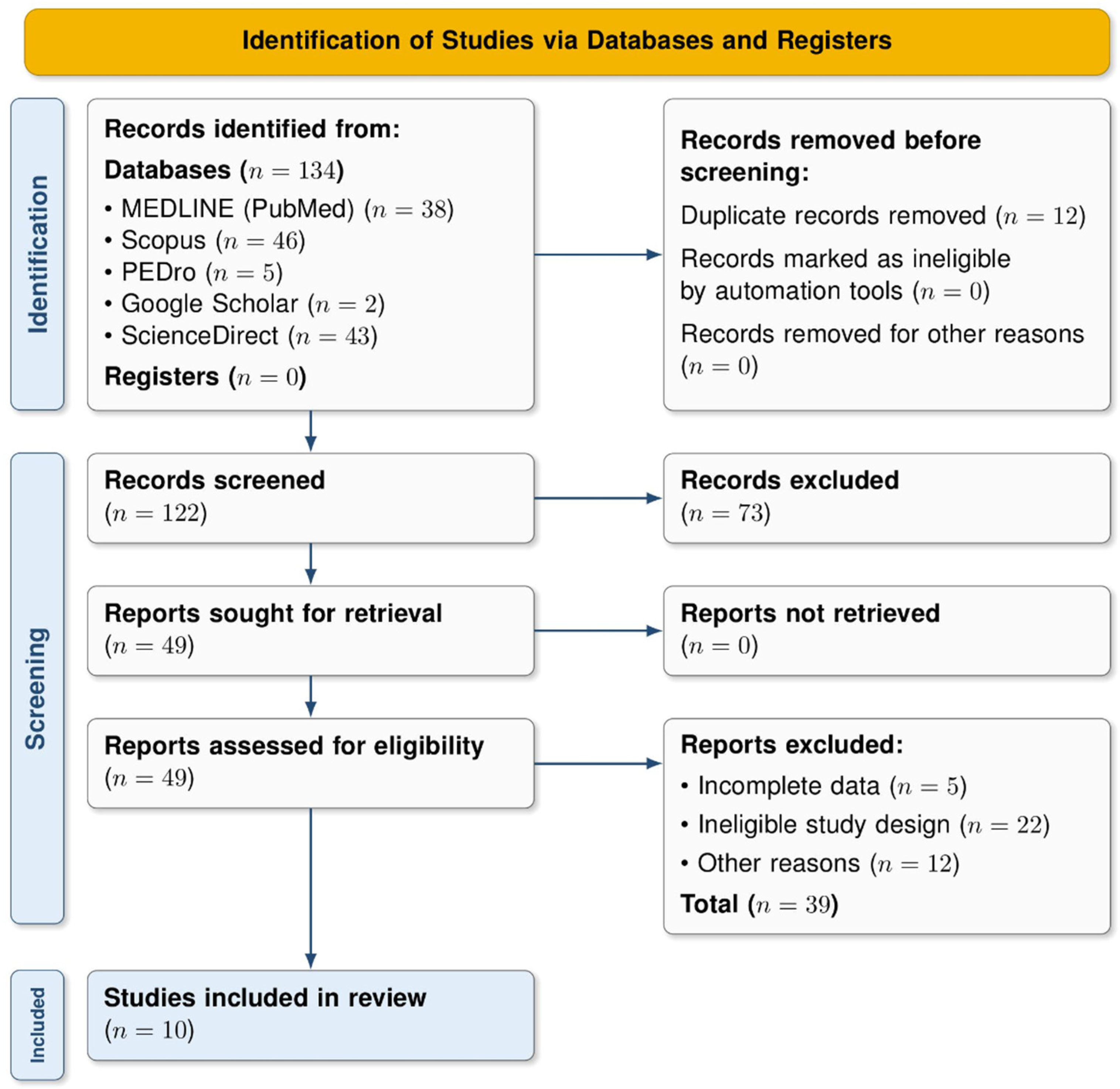
The systematic search identified 134 records across five databases: MEDLINE (PubMed) (n = 38), Scopus (n = 46), PEDro (n = 5), Google Scholar (n = 2), and ScienceDirect (n = 43). After removing 12 duplicates, 122 records were screened, of which 73 were excluded. Of the 49 full-text reports assessed for eligibility, 39 were excluded due to incomplete data (n = 5), ineligible study design (n = 22), or other reasons (n = 12). Ultimately, 10 clinical trials were included in the systematic review. The study selection process is presented in Figure 1, following the PRISMA 2020 guidelines.
Figure 1.
PRISMA flow diagram.
3.2. Characteristics of Included Studies
The 10 studies included in the review comprised a total of n = 636 participants, with sample sizes ranging from n = 10 to n = 120 [34,35,36,37,38,39,40,41,42,43]. Studies were conducted in Brazil [34,35,36,38,39,40], Spain [37,43], Iran [41], and the United States of America [42]. Women predominated across the included studies and constituted the entire sample in several trials, while participants of both sexes were reported in Mendonça et al. (2016) [35], Arroyo-Fernández et al. (2022) [37], Saeed Ali et al. (2025) [41], and Fregni et al. (2026) [42]. Most participants were adults aged between 18 and 65 yrs., although age characteristics varied across studies, including a trial specifically involving older adults [41]. FMS was diagnosed according to established clinical assessments and ACR criteria, as reported by the studies. The characteristics of all included studies are presented in Table 2.
All 10 included studies were classified as clinical trials, including a randomized crossover study conducted by da Silva et al. (2024) [38]. tDCS was most commonly applied over the left M1, generally using a stimulation intensity of 2 mA for 20 min per session [34,35,36,37,38,40]. Stimulation was combined with AE [35,37,42], strengthening and stretching exercises [34,37], functional exercise [36], walking [40,41], multidisciplinary rehabilitation [34], virtual reality (VR)-based motor tasks [38], pain neuroscience education (PNE) alongside exercise [39], Baduanjin Qigong [41], and therapeutic exercise [43].
Most sham-controlled trials compared active tDCS with exercise or rehabilitation against sham tDCS combined with the same or a comparable intervention. However, some studies included additional exercise-only, tDCS-only, or no-intervention control groups. Notably, Medeiros et al. (2025) [40] compared tDCS alone with tDCS combined with physical activity, without a sham stimulation group.
Alternative stimulation protocols included home-based anodal tDCS targeting the left DLPFC in Caumo et al. (2025) [39], M1 stimulation at a lower intensity of 1 mA in Saeed Ali et al. (2025) [41], and concurrent dual-site anodal tDCS in Velasco-Velasco et al. (2026) [43]. Stimulation schedules were heterogeneous, ranging from five sessions [35,36,37] to protocols lasting 4 wks. [39,40,42], 6 wks. [43], 10 wks. [34], and up to 12 wks. [41]. In the randomized crossover study by da Silva et al. (2024) [38], participants received 10 active and 10 sham stimulation sessions, separated by a 1-mos. washout period. The programmes also varied substantially in duration, ranging from approximately 2 wks. [37] to 4 wks. [35,39,40,42], 6 wks. [43], 8 wks. [36], 12 wks. [41], and up to 4 mos. [34].
3.3. Methodological Quality Assessment
Methodological quality ranged from poor to excellent, with PEDro scores varying between 3 and 10 (mean score: 7.1 out of 10). The highest methodological quality was observed in da Silva et al. (2024) and Caumo et al. (2025), both scoring 10/10, followed by Fregni et al. (2026) with 9/10 and Mendonça et al. (2016) with 8/10 [35,38,39,42]. Good methodological quality was also observed in Riberto et al. (2011) and Saeed Ali et al. (2025), both scoring 7/10, and in Arroyo-Fernández et al. (2022) and Velasco-Velasco et al. (2026), both scoring 6/10 [34,37,41,43]. Lower methodological quality was observed in Medeiros et al. (2025) and Matias et al. (2022), with scores of 5/10 and 3/10, respectively [36,40].
Overall, random allocation, adequate follow-up, and between-group statistical comparisons were the most consistently fulfilled methodological criteria, being satisfied in all ten studies (100%). In contrast, allocation concealment was reported in only three studies (30%), intention-to-treat analysis in five (50%), and therapist blinding in two (20%). Therapist blinding was therefore the most frequently unmet criterion. Further details are presented in Table 3.
Table 2.
Characteristics of included studies.
Table 3.
Methodological quality assessment of clinical trials (PEDro Scale).
3.4. Risk of Bias Assessment
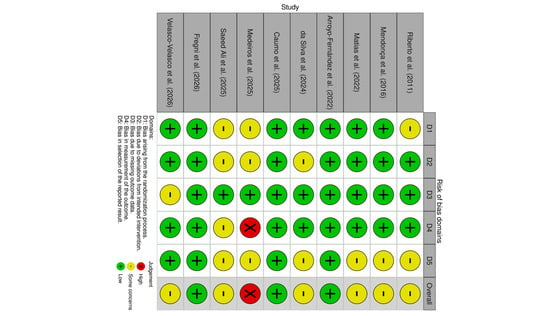
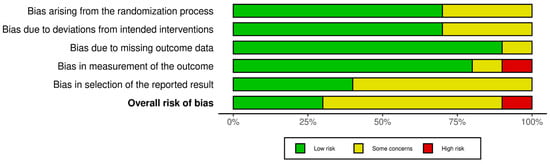
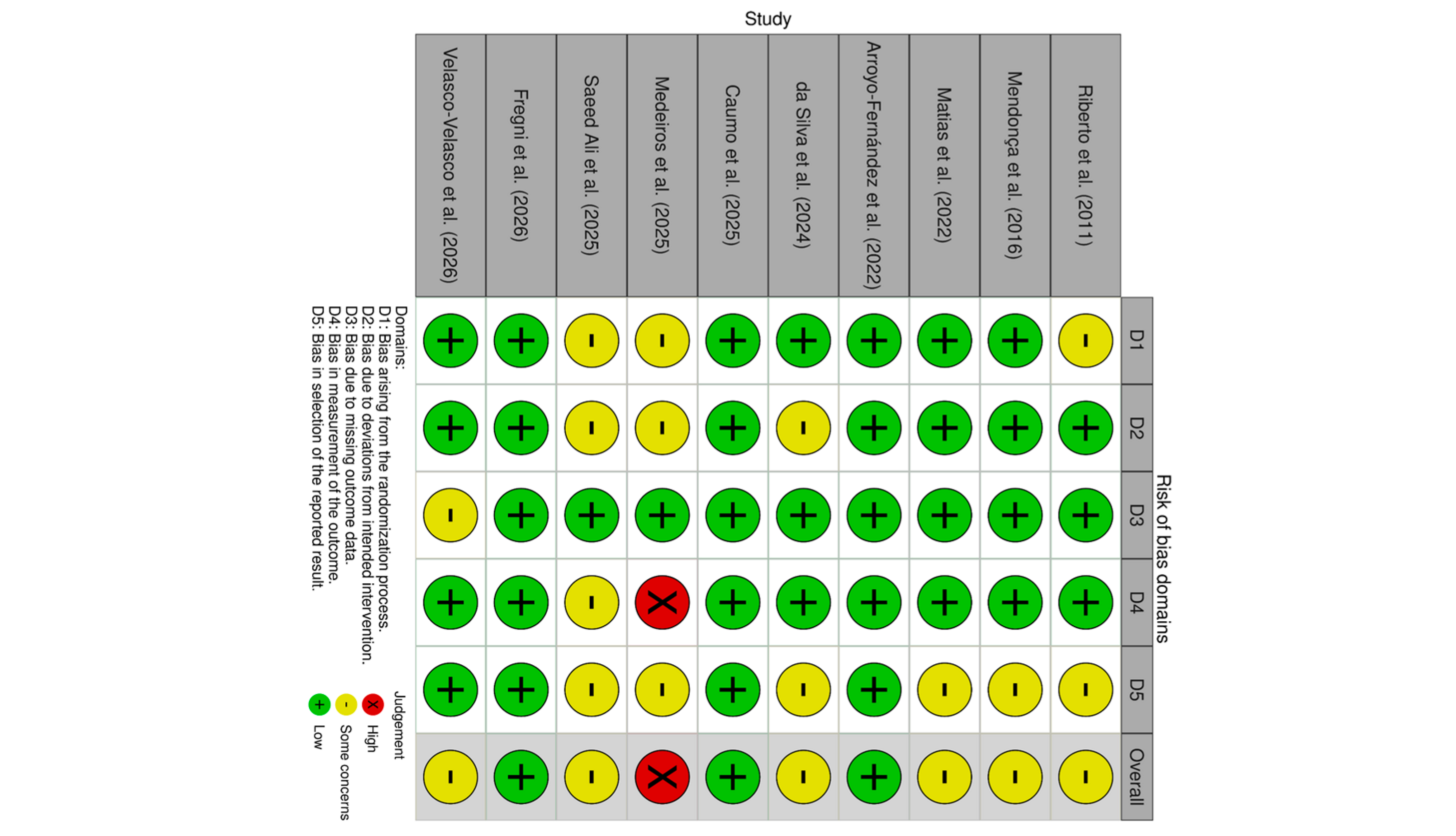
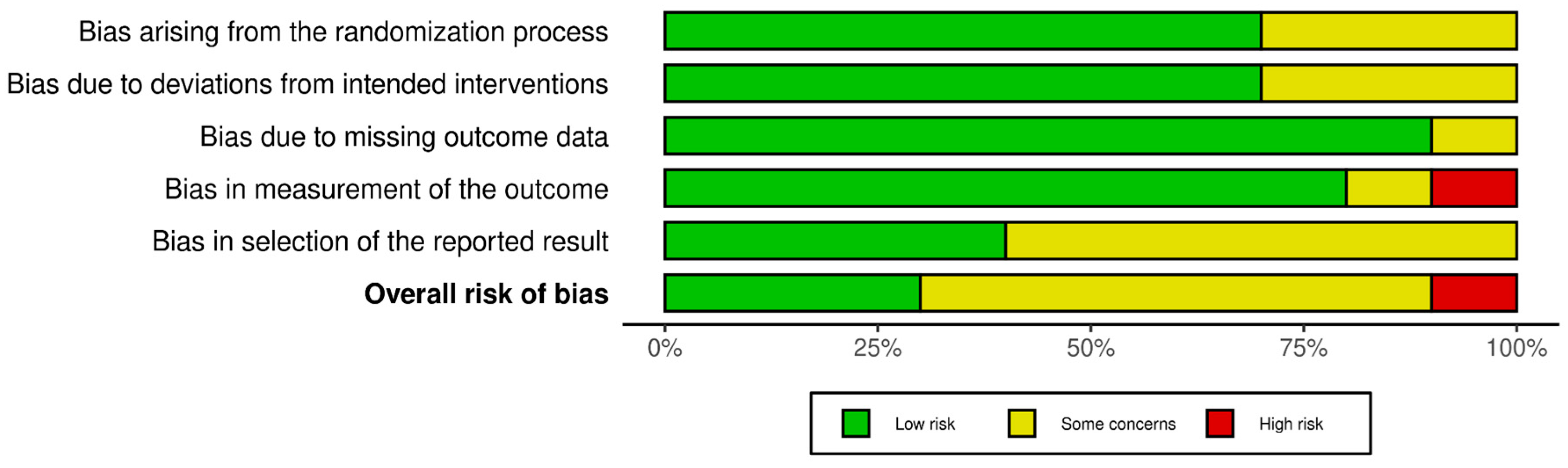
Using the RoB 2 tool [31,32], most individual domains were judged to be at low risk of bias across the n = 10 included studies. Overall, three studies were classified as having a low risk of bias [37,39,42], six presented some concerns [34,35,36,38,41,43], and one was judged to be at high risk of bias [40]. The greatest uncertainty was observed in bias in selection of the reported result (D5), with some concerns identified in six studies [34,35,36,38,40,41].
Additional concerns were identified regarding the randomization process (D1) [34,40,41], deviations from intended interventions (D2) [38,40,41], missing outcome data (D3) [43], and measurement of the outcome (D4) [41]. Notably, Medeiros et al. (2025) [40] was judged to be at high risk of bias in the measurement of the outcome domain (D4), resulting in an overall high risk-of-bias judgement. The domain-specific and overall risk-of-bias assessments are presented in Figure 2.
Figure 2.
Risk of Bias assessment using the RoB 2.0 tool. Green indicates a low risk of bias, yellow indicates some concerns, and red indicates a high risk of bias. Studies: Riberto et al. (2011) [34], Mendonça et al. (2016) [35], Matias et al. (2022) [36], Arroyo-Fernández et al. (2022) [37], da Silva et al. (2024) [38], Caumo et al. (2025) [39], Medeiros et al. (2025) [40], Saeed Ali et al. (2025) [41], Fregni et al. (2026) [42], and Velasco-Velasco et al. (2026) [43].
3.5. Certainty of Evidence (GRADE)
The GRADE assessment indicated low certainty of evidence for pain intensity [34,35,36,37,39,42], pain-related interference and disability [39,42], fibromyalgia impact [34,37,39,41,42], QoL [34,35,36,37,39,42,43], sleep quality [41,42,43], fatigue [42,43], CPM [39,42], temporal summation [42], and pain thresholds [35,39], whereas motor and functional performance showed very low certainty [36,38]. These ratings were mainly driven by inconsistency, imprecision, methodological heterogeneity, and, in some outcomes, risk of bias and indirectness. Further details are provided in Table 4.
Table 4.
Certainty of evidence (GRADE).
3.6. Synthesis of Included Studies
3.6.1. Pain Intensity
Included studies reported greater improvements in pain-related outcomes when active tDCS was combined with exercise or rehabilitation. Riberto et al. (2011) observed a significantly greater improvement in the SF-36 pain domain following active tDCS combined with multidisciplinary rehabilitation (p = 0.006), although no significant between-group differences were detected in VAS scores or PPT [34]. Similarly, Mendonça et al. (2016) showed greater reductions in pain intensity with tDCS combined with AE compared with AE alone (p = 0.007) or tDCS alone (p = 0.0056) [35].
Likewise, Medeiros et al. (2025) also reported greater pain reduction when tDCS was combined with walking compared with tDCS alone, with post-intervention VAS scores of 1.6 and 3.8, respectively (p < 0.01) [40]. Likewise, Caumo et al. (2025) found greater improvements with home-based anodal tDCS combined with exercise and PNE, reporting a 38.8% reduction in pain interference compared with 16.1% in the sham-tDCS group (MD = 22.68%; d = 0.73), alongside significant improvements in Brief Pain Inventory (BPI) pain scores [39].
In contrast, other studies did not show a significant additional analgesic benefit of active tDCS beyond exercise alone. Matias et al. (2022) reported significant within-group improvements in pain following both active and sham tDCS combined with exercise, without significant differences (p > 0.05) [36]. Similarly, Arroyo-Fernández et al. (2022) observed reduced pain intensity with active tDCS combined with exercise compared with a no-intervention control (MD = −14.43; 95% CI −25.27 to −3.58), although differences between active and sham stimulation were not statistically significant [37].
Furthermore, Fregni et al. (2026) reported improvements in pain across intervention groups without an additional clinical analgesic benefit from active motor-cortex tDCS compared with sham stimulation, despite significant improvements in conditioned pain modulation (CPM) (d = 0.66; p = 0.015) [42]. Overall, these findings suggest that although combining tDCS with exercise or rehabilitation may improve pain-related outcomes, its additional analgesic benefit over sham stimulation remains inconsistent across studies.
3.6.2. Functionality
Several studies suggested that combining tDCS with rehabilitation may improve functional outcomes. Riberto et al. (2011) observed a trend toward greater improvement in FIQ scores with active tDCS combined with multidisciplinary rehabilitation compared with sham stimulation, although the difference did not reach statistical significance (p = 0.056) [34]. Da Silva et al. (2024) reported improvements in motor performance during VR tasks following active tDCS combined with movement-based training, with improvements persisting during the subsequent sham phase, suggesting a possible carryover effect [38].
Similarly, Caumo et al. (2025) reported significant improvements in disability and overall functioning with home-based anodal tDCS combined with exercise and PNE compared with sham stimulation [39]. Saeed Ali et al. (2025) also identified significant between-group differences in FIQR total scores and symptom-related domains among interventions combining tDCS with Baduanjin Qigong or walking, suggesting potential benefits for fibromyalgia-related health status [41].
In contrast, Matias et al. (2022) reported improvements in functional outcomes in both active- and sham-tDCS groups receiving exercise, without significant between-group differences [36]. These findings suggest that exercise itself may contribute to functional improvements, while the additional benefit of active tDCS remains uncertain. Overall, although some studies reported favorable functional outcomes, methodological heterogeneity and inconsistent between-group findings limit definitive conclusions regarding the added effectiveness of tDCS combined with exercise.
3.6.3. Motor Performance
The clearest evidence of improved motor performance was reported by da Silva et al. (2024), who investigated tDCS combined with VR-based motor tasks [38]. Active anodal tDCS over the primary motor cortex was associated with improved performance during MoveHero tasks, with central hits increasing from 109 to 120 (p = 0.016) and lateral hits from 137 to 155 (p = 0.002). Improvements were also observed in movement accuracy and consistency, with absolute error decreasing from 214 to 200 ms (p = 0.014) and variable error from 293 to 239 ms (p = 0.006). In one crossover sequence, variable error decreased from 367.1 to 213.9 ms (p = 0.001). Notably, some improvements persisted during the subsequent sham phase, suggesting a possible carryover effect, although this limits the attribution of sustained benefits specifically to active stimulation [38].
In contrast, the remaining studies provided limited evidence regarding the specific effects of tDCS on motor performance. Most trials incorporated exercise, walking, physiotherapy, or Qigong without assessing motor accuracy, coordination, or task-specific performance. For instance, Matias et al. (2022) reported functional improvements in both active- and sham-tDCS groups, without significant between-group differences [36]. Although tDCS combined with VR-based motor training showed promising results, the limited number of studies assessing objective motor outcomes and potential carryover effects preclude definitive conclusions regarding its additional benefits.
3.6.4. Fatigue
The clearest evidence of an additional positive effect on fatigue was reported by Velasco-Velasco et al. (2026) [43]. Participants receiving dual-site anodal tDCS combined with therapeutic exercise showed significantly greater reductions in fatigue than those receiving sham tDCS plus exercise (MD = −9.8; p = 0.028) or exercise alone (MD = −9.9; p = 0.027) immediately after treatment. The benefit remained significant compared with the exercise-only control at follow-up (MD = −11.5; p = 0.01), suggesting a potentially sustained effect [43].
In contrast, Fregni et al. (2026) reported moderate improvements in fatigue across intervention groups, without significant differences between active and sham tDCS conditions [42]. Although PROMIS fatigue scores improved (mean change = −5.72 points; d = −0.60), the absence of a significant active-versus-sham difference prevented these improvements from being specifically attributed to tDCS [42,43].
3.6.5. Psychological Outcomes
Regarding psychological dimensions, studies reported improvements following combined therapies, although the additional effects of active tDCS were not consistently demonstrated. Mendonça et al. (2016) [35] reported between-group differences in anxiety and mood, with tDCS combined with AE producing greater improvements than either intervention alone. Depressive symptoms also showed a greater numerical improvement in the combined group, although the between-group difference did not reach statistical significance.
Conversely, Arroyo-Fernández et al. (2022) [37] reported reductions in pain catastrophizing and depressive symptoms following tDCS combined with exercise. Although improvements in catastrophizing were observed immediately after treatment and at 1-mos. follow-up, alongside reduced depressive symptoms at follow-up, no significant differences were found between active and sham stimulation. Similarly, Fregni et al. (2026) [42] observed improvements in Beck Depression Inventory scores (mean change = −3.27 points; d = −0.54), without significant between-group differences [35,37,42].
3.6.6. Safety
Overall, the included studies suggested a favorable short-term tolerability profile for tDCS when administered using conventional stimulation parameters. Riberto et al. (2011) reported no AEs during treatment [34], while Mendonça et al. (2016) documented only mild AEs, with no significant differences between groups [35]. Similarly, Medeiros et al. (2025) reported no serious AEs, with only mild and transient paresthesia at the stimulation site [40].
The larger home-based trial by Caumo et al. (2025) provided additional evidence regarding treatment feasibility and adherence, with compliance exceeding 90% in both active and sham groups [39]. Nevertheless, some participants discontinued treatment because of perceived lack of effectiveness or discomfort, suggesting variability in treatment acceptability.
Across reporting safety outcomes, no serious complications directly attributable to tDCS were identified. Reported AEs were predominantly mild, transient, and localized, including itching, tingling, paresthesia, and stimulation-site discomfort [34,35,39,40]. However, incomplete and heterogeneous AE reporting, with small sample sizes and limited follow-up periods, restricts definitive conclusions regarding long-term safety.
4. Discussion
4.1. Summary of Findings
The findings of this review suggest that tDCS may offer potential benefits as an adjunct to exercise in patients with FMS, although its effectiveness appears to depend on stimulation parameters and the characteristics of the accompanying interventions [34,35,36,37,38,39,40,41,42,43]. Improvements were reported in pain intensity, functionality, motor performance, fatigue, and psychological outcomes. Nevertheless, these benefits were not consistently superior to those achieved with exercise combined with sham stimulation, suggesting that exercise itself may account for a substantial proportion of the observed clinical improvements [36,37,42].
Pain-related outcomes were among the most frequently investigated, with some reporting effects, although the additional analgesic benefit of active tDCS remained inconsistent [34,35,36,37,39,42]. Functional and psychological improvements were also studied, but their specific attribution to active stimulation was less clear [35,36,37,39,42]. Promising findings emerged for motor performance [38] and fatigue [43], although the limited evidence and conflicting results [42] restrict their generalizability.
4.1.1. tDCS and Exercise for Pain Management in FMS
From a neurophysiological perspective, the analgesic effects of tDCS in individuals with FMS may be attributed, at least in part, to the modulation of altered central pain processing, particularly through changes in cortical excitability and descending pain inhibitory pathways [44,45,46]. Specifically, anodal stimulation of the M1 may influence the activity of interconnected thalamic, somatosensory, and limbic networks [47,48], as well as neuromodulation of glutamatergic and GABAergic transmission and NMDA receptor-dependent synaptic plasticity [49,50,51].
When combined with exercise, tDCS may enhance cortical responsiveness and neuroplasticity, potentially creating a more favorable neurophysiological environment for exercise-induced adaptations [49,52]. Concurrently, exercise may engage endogenous inhibitory mechanisms and provide repeated sensorimotor input [53,54,55]. Accordingly, tDCS may function primarily as a neuromodulatory adjunct, potentially enhancing the neuroplastic and analgesic effects of exercise rather than acting as an independent analgesic intervention [44,52].
This potential interaction may help explain the variability observed across studies, with some reporting additional pain relief following active tDCS combined with exercise [35,39], while others indicate a comparable improvement following sham stimulation [36,37,42]. However, differences in baseline pain modulation, cortical excitability, stimulation protocols, and individual responsiveness to exercise may further contribute to the observed heterogeneity after treatment exposure [44,45,46,53,54,55].
4.1.2. tDCS and Exercise for Functionality in FMS
Functional improvements were frequently reported across the included studies [34,35,36,37,38,39,40,41,42,43], although the additional contribution of active tDCS beyond exercise remained inconsistent [36,37,42]. This may reflect the multidimensional nature of functionality in FMS, which is influenced by pain, fatigue, movement confidence, physical capacity, and psychological factors [56,57]. Consequently, functional gains cannot necessarily be attributed to cortical stimulation alone, as exercise, physiotherapy, Qigong, VR, and PNE may independently contribute to improved physical functioning [56,57,58,59,60]. Identifying an additional effect of tDCS may therefore depend on whether stimulation enhances motor performance, learning, or rehabilitation-related adaptations [61,62].
These findings suggest that tDCS may be more positive when combined with interventions involving repeated motor practice, active engagement, and progressive physical retraining, rather than being applied indiscriminately alongside exercise [61,62,63]. Accordingly, tDCS could potentially act as a facilitator of exercise rather than a direct treatment for managing functional disability. Therefore, future trials should investigate which rehabilitation modalities, stimulation parameters, and task-specific interventions are most likely to produce clinically meaningful additional benefits [61,64].
4.1.3. tDCS and Exercise for Motor Performance in FMS
Findings related to motor performance are particularly relevant, as they suggest a potentially more specific mechanism underlying the effects of tDCS. Improvements observed during VR-based motor tasks indicate that tDCS may be particularly beneficial when stimulation is combined with active motor practice [38]. Under these conditions, modulation of cortical excitability may facilitate motor learning and support activity-dependent neuroplastic adaptations [58,59,63,64].
The persistence of some improvements beyond the active stimulation phase [38] may reflect motor learning or carryover effects rather than transient stimulation-induced changes. Although these findings are consistent with the proposed role of tDCS in motor learning, memory consolidation, and neuroplasticity [23,64], potential carryover effects in crossover designs complicate the attribution of sustained improvements specifically to active stimulation.
From a clinical perspective, these findings suggest that the effectiveness of tDCS may depend on the motor activities performed during or around stimulation. Studies combining tDCS with functional or structured exercise in FMS provide a rationale for combining pain neuromodulation with active training [36,37]. Accordingly, stimulation delivered concurrently with task-specific practice may offer greater benefits than stimulation administered independently of motor activity, although this hypothesis requires further investigation [58,64].
Nevertheless, objective motor performance was assessed in relatively few studies, and the available outcomes were heterogeneous and predominantly task-specific [36,37,38]. Thus, future trials should add standardized motor assessments and longer follow-up periods to determine whether improvements in motor performance translate into clinically meaningful benefits in daily activities, mobility, and functional participation.
4.1.4. tDCS and Exercise for Fatigue in FMS
Fatigue remains one of the most challenging symptoms to manage in FMS, and current findings suggest that the additional benefits of tDCS may depend on the stimulation protocol rather than being consistently observed across interventions. While Velasco-Velasco et al. (2026) reported significant fatigue reductions following dual-site anodal tDCS combined with exercise [43], Fregni et al. (2026) found no additional benefit of motor-cortex stimulation over sham tDCS [42]. These contrasting findings suggest that stimulation targets may influence intervention responsiveness, although differences in exercise protocols, treatment duration, and outcome assessment may also contribute to the observed variability.
The multifactorial nature of fatigue in FMS, involving interactions among pain, sleep-related disturbances, altered central pain processing, and psychological factors [65], together with autonomic dysregulation [66], provides a theoretical rationale for exploring stimulation approaches targeting multiple cortical regions. However, the potential superiority of multisite stimulation remains speculative, as direct comparisons between electrode montages are lacking.
Moreover, exercise itself can reduce fatigue in individuals with FMS [67], complicating the attribution of improvements specifically to tDCS. Future randomized trials directly comparing stimulation targets under standardized exercise conditions are needed to clarify if specific neuromodulation protocols provide clinically meaningful additional benefits for fatigue management.
4.1.5. tDCS and Exercise for Psychological Outcome in FMS
Improvements in anxiety, mood, depressive symptoms, and catastrophizing were reported across several studies, although the additional psychological benefits of active tDCS remained inconsistent [35,37,42]. These improvements may be partly mediated by reductions in pain, enhanced physical functioning, or engagement in exercise rather than direct neuromodulatory effects.
Given the limited evidence of the psychological effects of tDCS in FMS [68], stimulation should be considered a potential adjunct rather than a substitute for established psychological interventions [69]. Future trials should determine if combining tDCS with exercise provides clinically meaningful psychological benefits beyond those achieved through exercise alone.
4.1.6. tDCS and Exercise for Safety in FMS
The included studies suggested a favorable short-term tolerability profile for tDCS, with predominantly mild and transient AEs, including itching, tingling, paresthesia, and stimulation-site discomfort [34,35,39,40], consistent with previous safety reviews [70,71]. High treatment adherence in the home-based trial further supports its feasibility within rehabilitation programmes [39]. Nevertheless, inconsistent AE reporting, relatively small sample sizes, and limited follow-up periods restrict definitive conclusions regarding long-term safety [70]. Future studies should incorporate standardized AE monitoring and extended follow-up to establish the safety profile of repeated tDCS combined with exercise.
4.2. Limitations
Several limitations should be acknowledged. This study included n = 10 trials with substantial heterogeneity in tDCS parameters, protocols, and outcomes, limiting comparability and precluding a meaningful meta-analysis. Inconsistent blinding and allocation concealment may have introduced bias, while small sample sizes and short follow-up periods limit conclusions regarding long-term effectiveness and safety. The predominance of female participants further restricts generalisability to men with FMS.
Additionally, the limited database coverage and potential shortcomings in search and screening procedures may have resulted in missed studies, underscoring the importance of comprehensive search strategies and transparent methodological reporting [72]. Publication bias could not be reliably assessed because of the small number of studies reporting individual outcomes. Consequently, statistical analyses requiring pooled effect estimates were not performed.
4.3. Implications for Practice and Future Research
Evidence suggests that tDCS may represent a promising adjunct to exercise-based rehabilitation for managing FMS, although its additional benefits remain uncertain and standardised treatment protocols are lacking [34,35,36,37,38,39,40,41,42,43,68,69]. Future research should prioritise adequately powered, multicentre randomised controlled trials incorporating standardised stimulation and protocols, rigorous blinding, longer follow-up periods, and factorial designs to determine mechanisms of action and distinguish effects of both interventions [72]. Furthermore, identifying optimal stimulation parameters, exercise modalities, and patient subgroups most likely to benefit may facilitate more effective and personalised rehabilitation strategies [69].
5. Conclusions
Combining tDCS with therapeutic exercise may improve pain, functionality, motor performance, fatigue, and psychological outcomes in patients with FMS. However, its additional benefits over sham stimulation or exercise alone remain inconsistent. Although generally well tolerated in the short-term, tDCS should be considered a potential adjunct rather than a replacement for structured exercise. Further high-quality, sham-controlled trials are required to establish its effectiveness, optimize treatment protocols, and assess long-term outcomes.
Supplementary Materials
The following supporting information can be downloaded at: https://www.mdpi.com/article/10.3390/jfmk11040495/s1, Table S1: PRISMA Checklist 2020.
Author Contributions
Conceptualization, S.E.M.P. and I.M.M.P.; methodology, S.E.M.P. and I.M.M.P.; validation, S.E.M.P. and I.M.M.P.; formal analysis, S.E.M.P. and I.M.M.P.; investigation, S.E.M.P., I.M.M.P., E.A.H. and M.G.U.; resources, S.E.M.P. and I.M.M.P.; data curation, S.E.M.P. and I.M.M.P.; writing—original draft preparation, S.E.M.P., I.M.M.P., E.A.H. and M.G.U.; writing—review and editing, S.E.M.P. and I.M.M.P.; visualization, S.E.M.P. and I.M.M.P.; supervision, I.M.M.P.; project administration, I.M.M.P. All authors have read and agreed to the published version of the manuscript.
Funding
This research received no external funding.
Institutional Review Board Statement
Not applicable.
Informed Consent Statement
Not applicable.
Data Availability Statement
The protocol of the study is openly available in PROSPERO at https://www.crd.york.ac.uk/PROSPERO/view/CRD420261309459) (accessed on 1 June 2026), under the registration number CRD420261309459. The original data presented in the study are available within the article and the referenced publications.
Conflicts of Interest
The authors declare no conflicts of interest.
Abbreviations
The following abbreviations are used in this manuscript:
| ACR | American College of Rheumatology |
| AE | Aerobic exercise |
| AEs | Adverse events |
| DLPFC | Dorsolateral prefrontal cortex |
| FIQ | Fibromyalgia Impact Questionnaire |
| FIQR | Revised Fibromyalgia Impact Questionnaire |
| FMS | Fibromyalgia syndrome |
| GRADE | Grading of Recommendations Assessment, Development and Evaluation |
| M1 | Primary motor cortex |
| MD | Mean difference |
| PRISMA | Preferred Reporting Items for Systematic Reviews and Meta-Analyses |
| RCT | Randomised controlled trial |
| tDCS | Transcranial direct current stimulation |
| VAS | Visual analogue scale |
| VR | Virtual reality |
References
- Aoe, T. Fibromyalgia: A Multifactorial Pain Disorder. Int. J. Mol. Sci. 2026, 27, 4813. [Google Scholar] [CrossRef] [Scilit] [PubMed]
- Jurado-Priego, L.N.; Cueto-Ureña, C.; Ramírez-Expósito, M.J.; Martínez-Martos, J.M. Fibromyalgia: A Review of the Pathophysiological Mechanisms and Multidisciplinary Treatment Strategies. Biomedicines 2024, 12, 1543. [Google Scholar] [CrossRef] [Scilit] [PubMed]
- D’Souza, R.S.; Klasova, J.; Morsi, M.; Vincent, A.; Mohabbat, A.B.; Whitfield, S.; Radlicz, C.; Sheen, S.; Wang, D.; Zhitnitsky, M.; et al. The Prevalence of Fibromyalgia in the General Population and At-Risk Subpopulations: A Systematic Review and Meta-Analysis. Anesth. Analg. 2026, publish ahead of print. [Google Scholar] [CrossRef] [Scilit] [PubMed]
- Font Gayà, T.; Bordoy Ferrer, C.; Juan Mas, A.; Seoane-Mato, D.; Álvarez Reyes, F.; Delgado Sánchez, M.; Martínez Dubois, C.; Sánchez-Fernández, S.A.; Rojas Vargas, L.M.; García Morales, P.V.; et al. Prevalence of Fibromyalgia and Associated Factors in Spain. Clin. Exp. Rheumatol. 2020, 38, 47–52. [Google Scholar] [CrossRef] [Scilit] [PubMed]
- Carneiro, B.D.; Torres, S.; Costa-Pereira, J.T.; Pozza, D.H.; Tavares, I. Descending Pain Modulation in Fibromyalgia: A Short Review of Mechanisms and Biomarkers. Diagnostics 2025, 15, 2702. [Google Scholar] [CrossRef] [Scilit] [PubMed]
- Flutt, F.A.D.; de Melo Cortez, J.P.; Ramos, L.R.; Furlanetto, R.P.P.; Corrêa, D.G.; Villela, N.R. Structural and Functional Neuroimaging Findings in Fibromyalgia: A Systematic Review. Eur. J. Pain 2026, 30, e70331. [Google Scholar] [CrossRef] [Scilit] [PubMed]
- Tocchetto, B.F.; Moreira, A.C.J.; de Oliveira Franco, Á.; Torres, I.L.S.; Fregni, F.; Caumo, W. Seed-Based Resting-State Connectivity as a Neurosignature in Fibromyalgia and Depression: A Narrative Systematic Review. Front. Hum. Neurosci. 2025, 19, 1548617. [Google Scholar] [CrossRef] [Scilit] [PubMed]
- Lopes Alves, R.; Zortea, M.; Vicuña Serrano, P.; Laranjeira, V.D.S.; Franceschini Tocchetto, B.; Ramalho, L.; Fernanda da Silveira Alves, C.; Brugnera Tomedi, R.; Pereira de Almeida, R.; Machado Bruck, S.; et al. Modulation of Neural Networks and Symptom Correlated in Fibromyalgia: A Randomized Double-Blind Multi-Group Explanatory Clinical Trial of Home-Based Transcranial Direct Current Stimulation. PLoS ONE 2024, 19, e0288830. [Google Scholar] [CrossRef] [Scilit] [PubMed]
- Moore, A.; Bidonde, J.; Fisher, E.; Häuser, W.; Bell, R.F.; Perrot, S.; Makri, S.; Straube, S. Effectiveness of Pharmacological Therapies for Fibromyalgia Syndrome in Adults: An Overview of Cochrane Reviews. Rheumatology 2025, 64, 2385–2394. [Google Scholar] [CrossRef] [Scilit] [PubMed]
- Kundakci, B.; Hall, M.; Atzeni, F.; Branco, J.; Buskila, D.; Clauw, D.; Crofford, L.J.; Fitzcharles, M.-A.; Georgopoulos, V.; Gerwin, R.D.; et al. International, Multidisciplinary Delphi Consensus Recommendations on Non-Pharmacological Interventions for Fibromyalgia. Semin. Arthritis Rheum. 2022, 57, 152101. [Google Scholar] [CrossRef] [Scilit] [PubMed]
- Casanova-Rodríguez, D.; Ranchal-Sánchez, A.; Bertoletti Rodríguez, R.; Jurado-Castro, J.M. Aerobic Exercise Prescription for Pain Reduction in Fibromyalgia: A Systematic Review and Meta-Analysis. Eur. J. Pain 2025, 29, e4783, Erratum in Eur. J. Pain 2025, 29, e70105. https://doi.org/10.1002/ejp.4783. [Google Scholar] [CrossRef] [Scilit] [PubMed]
- Araya-Quintanilla, F.; Gutiérrez-Espinoza, H.; Salazar-Méndez, J.; Atenas-Nuñez, E.; Serrat, M.; Ramírez-Vélez, R. Pain Catastrophization and Fear of Movement Are Potential Moderators for Response to Treatment in Women with Fibromyalgia: Secondary Analyses of Randomized Controlled Trial. Arch. Phys. Med. Rehabil. 2026, 107, 383–390. [Google Scholar] [CrossRef] [Scilit]
- Wang, C.; Sun, J.; Liang, Z.; Cai, Y.; Zhang, M.; Tian, S.; Yang, W.; Cheng, S.; Duan, R.; Wang, X. Comparative Effectiveness of Exercise Modalities for Fibromyalgia: A Systematic Review and Bayesian Network Meta-Analysis. Eur. J. Pain 2025, 29, e70109. [Google Scholar] [CrossRef] [Scilit] [PubMed]
- Song, J.; Torres-Carmona, E.; Abdolizadeh, A.; Kambari, Y.; Amaev, A.; Ueno, F.; Koizumi, T.; Remington, G.; Deluca, V.; Graff-Guerrero, A.; et al. The Effect of Single-Session Transcranial Direct Current Stimulation on Cerebral Blood Flow: A Systematic Review and Meta-Analysis. Brain Topogr. 2025, 38, 60. [Google Scholar] [CrossRef] [Scilit] [PubMed]
- Tapsell, L.C.; Pinto, M.D.; Vallence, A.-M.; Whife, C.; Perez Armendariz, M.L.; Senger, S.; Andringa-Bate, J.; Hince, D.; Murphy, M.C. What Are the Optimal Transcranial Direct Current Stimulation Parameters and Design Elements to Modulate Corticospinal Excitability? A Systematic Review and Longitudinal Meta-Analysis. Neurol. Res. Pract. 2025, 7, 86. [Google Scholar] [CrossRef] [Scilit] [PubMed]
- Santander, T.; Leslie, S.; Li, L.J.; Skinner, H.E.; Simonson, J.M.; Sweeney, P.; Deen, K.P.; Miller, M.B.; Brunye, T.T. Towards Optimized Methodological Parameters for Maximizing the Behavioral Effects of Transcranial Direct Current Stimulation. Front. Hum. Neurosci. 2024, 18, 1305446. [Google Scholar] [CrossRef] [Scilit] [PubMed]
- Winterholler, C.; Coura, M.H.; Montoya, P. Clinical, Neurophysiological and Neurochemical Effects of Non-Invasive Electrical Brain Stimulation in Fibromyalgia Syndrome—A Systematic Review and Meta-Analysis. Front. Pain Res. 2025, 6, 1593746. [Google Scholar] [CrossRef] [Scilit] [PubMed]
- Zhang, Y.; Li, X.; Qiu, S.; Jin, R.; Peng, W. Preemptive Transcranial Direct Current Stimulation Mitigates Susceptibility to Persistent Pain. Commun. Biol. 2025, 8, 865. [Google Scholar] [CrossRef] [Scilit] [PubMed]
- Moshfeghinia, R.; Shekouh, D.; Mostafavi, S.; Hosseinzadeh, M.; Bahadori, A.R.; Abdollahifard, S.; Razmkon, A. The Effects of Transcranial Direct-Current Stimulation (tDCS) on Pain Intensity of Patients with Fibromyalgia: A Systematic Review and Meta-Analysis. BMC Neurol. 2023, 23, 395. [Google Scholar] [CrossRef] [Scilit] [PubMed]
- Marcos-Frutos, D.; López-Alonso, V.; Mera-González, I.; Sánchez-Molina, J.A.; Colomer-Poveda, D.; Márquez, G. Chronic Functional Adaptations Induced by the Application of Transcranial Direct Current Stimulation Combined with Exercise Programs: A Systematic Review of Randomized Controlled Trials. J. Clin. Med. 2023, 12, 6724. [Google Scholar] [CrossRef] [Scilit] [PubMed]
- Perrey, S. Reassessing Combined Exercise-tDCS Strategies in Chronic Pain. Lancet Reg. Health Am. 2026, 55, 101379. [Google Scholar] [CrossRef] [Scilit] [PubMed]
- Youssef, L.; Harroum, N.; Francisco, B.A.; Johnson, L.; Arvisais, D.; Pageaux, B.; Romain, A.J.; Hayward, K.S.; Neva, J.L. Neurophysiological Effects of Acute Aerobic Exercise in Young Adults: A Systematic Review and Meta-Analysis. Neurosci. Biobehav. Rev. 2024, 164, 105811. [Google Scholar] [CrossRef] [Scilit] [PubMed]
- Vestring, S.; Wolf, E.; Dinkelacker, J.; Frase, S.; Hessling-Zeinen, C.; Insan, S.; Kumlehn, M.M.; Feige, B.; Domschke, K.; Normann, C.; et al. Lasting Effects of Transcranial Direct Current Stimulation on the Inducibility of Synaptic Plasticity by Paired-Associative Stimulation in Humans. J. Neuroeng. Rehabil. 2024, 21, 162. [Google Scholar] [CrossRef] [Scilit] [PubMed]
- Xia, R.; Lu, S.; Zhao, L. Transcranial Direct Current Stimulation Combined with Exercise Therapy for Chronic Low Back Pain: A Systematic Review and Meta-Analysis. Front. Hum. Neurosci. 2026, 19, 1721182. [Google Scholar] [CrossRef] [Scilit] [PubMed]
- Yang, C.-L.; Qu, Y.; Huang, J.-P.; Wang, T.-T.; Zhang, H.; Chen, Y.; Tan, Y.-C. Efficacy and Safety of Transcranial Direct Current Stimulation in the Treatment of Fibromyalgia: A Systematic Review and Meta-Analysis. Neurophysiol. Clin. 2024, 54, 102944. [Google Scholar] [CrossRef] [Scilit] [PubMed]
- Wang, T.; Su, H.; Zhou, Y.; Du, L.; Lv, Y.; Yu, L. Effects of Exercise on Pain, Fatigue, and Quality of Life in People with Fibromyalgia: A Systematic Review and Meta-Analysis of Randomized Controlled Trials. Front. Med. 2026, 13, 1782714. [Google Scholar] [CrossRef] [Scilit] [PubMed]
- Page, M.J.; McKenzie, J.E.; Bossuyt, P.M.; Boutron, I.; Hoffmann, T.C.; Mulrow, C.D.; Shamseer, L.; Tetzlaff, J.M.; Akl, E.A.; Brennan, S.E.; et al. The PRISMA 2020 statement: An updated guideline for reporting systematic reviews. BMJ 2021, 372, n71. [Google Scholar] [CrossRef] [Scilit] [PubMed]
- Wolfe, F.; Smythe, H.A.; Yunus, M.B.; Bennett, R.M.; Bombardier, C.; Goldenberg, D.L.; Tugwell, P.; Campbell, S.M.; Abeles, M.; Clark, P.; et al. The American College of Rheumatology 1990 Criteria for the Classification of Fibromyalgia: Report of the Multicenter Criteria Committee. Arthritis Rheum. 1990, 33, 160–172. [Google Scholar] [CrossRef] [Scilit] [PubMed]
- Wolfe, F.; Clauw, D.J.; Fitzcharles, M.A.; Goldenberg, D.L.; Katz, R.S.; Mease, P.; Russell, A.S.; Russell, I.J.; Winfield, J.B.; Yunus, M.B. The American College of Rheumatology Preliminary Diagnostic Criteria for Fibromyalgia and Measurement of Symptom Severity. Arthritis Care Res. 2010, 62, 600–610. [Google Scholar] [CrossRef] [Scilit] [PubMed]
- Maher, C.G.; Sherrington, C.; Herbert, R.D.; Moseley, A.M.; Elkins, M. Reliability of the PEDro Scale for Rating Quality of Randomized Controlled Trials. Phys. Ther. 2003, 83, 713–721. [Google Scholar] [CrossRef] [Scilit]
- Sterne, J.A.C.; Savović, J.; Page, M.J.; Elbers, R.G.; Blencowe, N.S.; Boutron, I.; Cates, C.J.; Cheng, H.-Y.; Corbett, M.S.; Eldridge, S.M.; et al. RoB 2: A Revised Tool for Assessing Risk of Bias in Randomised Trials. BMJ 2019, 366, l4898. [Google Scholar] [CrossRef] [Scilit] [PubMed]
- Higgins, J.P.T.; Altman, D.G.; Gøtzsche, P.C.; Jüni, P.; Moher, D.; Oxman, A.D.; Savović, J.; Schulz, K.F.; Weeks, L.; Sterne, J.A.C. The Cochrane Collaboration’s tool for assessing risk of bias in randomised trials. BMJ 2011, 343, d5928. [Google Scholar] [CrossRef] [Scilit]
- Guyatt, G.H.; Oxman, A.D.; Vist, G.E.; Kunz, R.; Falck-Ytter, Y.; Alonso-Coello, P.; Schünemann, H.J.; GRADE Working Group. GRADE: An emerging consensus on rating quality of evidence and strength of recommendations. BMJ 2008, 336, 924–926. [Google Scholar] [CrossRef] [Scilit] [PubMed]
- Riberto, M.; Alfieri, F.M.; Pacheco, K.M.d.B.; Leite, V.D.; Kaihami, H.N.; Fregni, F.; Battistella, L.R. Efficacy of transcranial direct current stimulation coupled with a multidisciplinary rehabilitation program for the treatment of fibromyalgia. Open Rheumatol. J. 2011, 5, 45–50. [Google Scholar] [CrossRef] [Scilit] [PubMed]
- Mendonca, M.E.; Simis, M.; Grecco, L.C.; Battistella, L.R.; Baptista, A.F.; Fregni, F. Transcranial direct current stimulation combined with aerobic exercise to optimize analgesic responses in fibromyalgia: A randomized placebo-controlled clinical trial. Front. Hum. Neurosci. 2016, 10, 68. [Google Scholar] [CrossRef] [Scilit] [PubMed]
- Matias, M.G.L.; Maciel, D.G.; França, I.M.; Cerqueira, M.S.; Silva, T.C.L.A.; Okano, A.H.; Pegado, R.; Vieira, W.H.B. Transcranial direct current stimulation associated with functional exercise program for treating fibromyalgia: A randomized controlled trial. Arch. Phys. Med. Rehabil. 2022, 103, 245–254. [Google Scholar] [CrossRef] [Scilit] [PubMed]
- Arroyo-Fernández, R.; Avendaño-Coy, J.; Velasco-Velasco, R.; Palomo-Carrión, R.; Bravo-Esteban, E.; Ferri-Morales, A. Effectiveness of transcranial direct current stimulation combined with exercising in people with fibromyalgia: A randomized sham-controlled clinical trial. Arch. Phys. Med. Rehabil. 2022, 103, 1524–1532. [Google Scholar] [CrossRef] [Scilit] [PubMed]
- da Silva, T.N.; Ribeiro, V.F.; Apaza, M.C.C.; Romana, L.G.; de Moraes, Í.A.P.; Dias, E.D.; Roizenblatt, S.S.; Martinez, J.P.; Magalhães, F.H.; Massa, M.; et al. Effectiveness of transcranial direct current stimulation (tDCS) during a virtual reality task in women with fibromyalgia—A randomized clinical study. Brain Sci. 2024, 14, 928. [Google Scholar] [CrossRef] [Scilit] [PubMed]
- Caumo, W.; Franca, B.R.; Orzechowski, R.; Bueno, G.; de Souza, A.F.; da Silva, J.V.d.S.; Sanches, P.R.S.; Da Silva, D.P., Jr.; Torres, I.L.S.; Hirakata, V.N.; et al. Home-based transcranial direct current stimulation vs. placebo for fibromyalgia: A randomized clinical trial. JAMA Netw. Open 2025, 8, e2514262. [Google Scholar] [CrossRef] [Scilit] [PubMed]
- Medeiros, M.C.R.; Medeiros, M.T.; Mancebo, M. Fibromyalgia treated with transcranial direct current stimulation (tDCS) and physical exercise. Neuro Res. 2025, 7, 23. [Google Scholar] [CrossRef] [Scilit]
- Saeed Ali, H.; Khanmohammadi, R.; Arabameri, E.; Shaw, I.; Shaw, B.S. Effect of Baduanjin Qigong and transcranial direct current stimulation on quality of sleep and disease impact in elderly patients with fibromyalgia: A randomised, sham-controlled study. Clin. Exp. Rheumatol. 2025, 43, 1040–1048. [Google Scholar] [CrossRef] [Scilit] [PubMed]
- Fregni, F.; Castelo-Branco, L.; Cardenas-Rojas, A.; Daibes, M.; Silva, F.M.Q.; Pacheco-Barrios, K.; Lacerda, G.J.M.; Camargo, L.; Gianlorenco, A.C.; Caumo, W. A randomised, double-blind, sham-controlled, 2 × 2 factorial trial of aerobic vs. non-aerobic exercise and motor cortex transcranial direct current stimulation in fibromyalgia: Effects on clinical outcomes and descending pain modulation. Lancet Reg. Health Am. 2026, 53, 101314. [Google Scholar] [CrossRef] [Scilit] [PubMed]
- Velasco-Velasco, R.; Avendaño-Coy, J.; Labrador-García, E.; Bravo-Esteban, E.; Arroyo-Fernández, R. Dual-site transcranial direct current stimulation combined with exercising improves fatigue and sleep quality in people with fibromyalgia: A randomized sham-controlled clinical trial. Arch. Phys. Med. Rehabil. 2026, 107, 153–161. [Google Scholar] [CrossRef] [Scilit] [PubMed]
- O’Brien, A.T.; Deitos, A.; Triñanes Pego, Y.; Fregni, F.; Carrillo-de-la-Peña, M.T. Defective endogenous pain modulation in fibromyalgia: A meta-analysis of temporal summation and conditioned pain modulation paradigms. J. Pain 2018, 19, 819–836. [Google Scholar] [CrossRef] [Scilit] [PubMed]
- Duarte, D.; Castelo-Branco, L.E.C.; Uygur Kucukseymen, E.; Fregni, F. Developing an optimized strategy with transcranial direct current stimulation to enhance the endogenous pain control system in fibromyalgia. Expert Rev. Med. Devices 2018, 15, 863–873. [Google Scholar] [CrossRef] [Scilit] [PubMed]
- Wang, S.; Du, S.-H.; Wang, X.-Q.; Lu, J.-Y. Mechanisms of transcranial direct current stimulation (tDCS) for pain in patients with fibromyalgia syndrome. Front. Mol. Neurosci. 2024, 17, 1269636. [Google Scholar] [CrossRef] [Scilit] [PubMed]
- Lefaucheur, J.-P.; Antal, A.; Ahdab, R.; Ciampi de Andrade, D.; Fregni, F.; Khedr, E.M.; Nitsche, M.A.; Paulus, W. The use of repetitive transcranial magnetic stimulation (rTMS) and transcranial direct current stimulation (tDCS) to relieve pain. Brain Stimul. 2008, 1, 337–344. [Google Scholar] [CrossRef] [Scilit] [PubMed]
- Bai, Y.; Pacheco-Barrios, K.; Pacheco-Barrios, N.; Liang, G.; Fregni, F. Neurocircuitry basis of motor cortex-related analgesia as an emerging approach for chronic pain management. Nat. Ment. Health 2024, 2, 496–513. [Google Scholar] [CrossRef] [Scilit] [PubMed]
- Stagg, C.J.; Nitsche, M.A. Physiological basis of transcranial direct current stimulation. Neuroscientist 2011, 17, 37–53. [Google Scholar] [CrossRef] [Scilit] [PubMed]
- Liebetanz, D.; Nitsche, M.A.; Tergau, F.; Paulus, W. Pharmacological approach to the mechanisms of transcranial DC-stimulation-induced after-effects of human motor cortex excitability. Brain 2002, 125, 2238–2247. [Google Scholar] [CrossRef] [Scilit] [PubMed]
- Nitsche, M.A.; Liebetanz, D.; Schlitterlau, A.; Henschke, U.; Fricke, K.; Frommann, K.; Lang, N.; Henning, S.; Paulus, W.; Tergau, F. GABAergic modulation of DC stimulation-induced motor cortex excitability shifts in humans. Eur. J. Neurosci. 2004, 19, 2720–2726. [Google Scholar] [CrossRef] [Scilit] [PubMed]
- Stagg, C.J.; Antal, A.; Nitsche, M.A. Physiology of transcranial direct current stimulation. J. ECT 2018, 34, 144–152. [Google Scholar] [CrossRef] [Scilit] [PubMed]
- Nijs, J.; Kosek, E.; Van Oosterwijck, J.; Meeus, M. Dysfunctional endogenous analgesia during exercise in patients with chronic pain: To exercise or not to exercise? Pain Physician 2012, 15, ES205–ES213. [Google Scholar] [CrossRef] [Scilit]
- Neelapala, Y.V.R.; Mercuri, D.; Macedo, L.; Hanna, S.; Kobsar, D.; Carlesso, L. Mechanisms hypothesized for pain-relieving effects of exercise in fibromyalgia: A scoping review. Ther. Adv. Musculoskelet. Dis. 2023, 15, 1759720X231182894. [Google Scholar] [CrossRef] [Scilit] [PubMed]
- Alsouhibani, A.; Hoeger Bement, M. Impaired conditioned pain modulation was restored after a single exercise session in individuals with and without fibromyalgia. Pain Rep. 2022, 7, e996. [Google Scholar] [CrossRef] [Scilit] [PubMed]
- Häuser, W.; Klose, P.; Langhorst, J.; Moradi, B.; Steinbach, M.; Schiltenwolf, M.; Busch, A. Efficacy of different types of aerobic exercise in fibromyalgia syndrome: A systematic review and meta-analysis of randomised controlled trials. Arthritis Res. Ther. 2010, 12, R79. [Google Scholar] [CrossRef] [Scilit] [PubMed]
- Bidonde, J.; Busch, A.J.; Schachter, C.L.; Overend, T.J.; Kim, S.Y.; Góes, S.M.; Boden, C.; Foulds, H.J.A. Aerobic exercise training for adults with fibromyalgia. Cochrane Database Syst. Rev. 2017, 6, CD012700. [Google Scholar] [CrossRef] [Scilit] [PubMed]
- Wang, B.; Xiao, S.; Yu, C.; Zhou, J.; Fu, W. Effects of transcranial direct current stimulation combined with physical training on the excitability of the motor cortex, physical performance, and motor learning: A systematic review. Front. Neurosci. 2021, 15, 648354. [Google Scholar] [CrossRef] [Scilit] [PubMed]
- Qi, S.; Liang, Z.; Wei, Z.; Liu, Y.; Wang, X. Effects of transcranial direct current stimulation on motor skills learning in healthy adults through the activation of different brain regions: A systematic review. Front. Hum. Neurosci. 2022, 16, 1021375. [Google Scholar] [CrossRef] [Scilit] [PubMed]
- Du, M.; Hou, X.; Lu, S.; Kang, T.; Li, Y.; Wang, R. Effectiveness of traditional Chinese exercise in patients with fibromyalgia syndrome: A systematic review and meta-analysis of randomized clinical trials. Int. J. Rheum. Dis. 2023, 26, 2380–2389. [Google Scholar] [CrossRef] [Scilit] [PubMed]
- Rodríguez-Domínguez, Á.-J.; Rebollo-Salas, M.; Chillón-Martínez, R.; Cardellat-González, M.; Blanco-Heras, L.; Jiménez-Rejano, J.-J. Pain neuroscience education and resistance training in women with fibromyalgia: A randomized control pilot study. Pain Res. Manag. 2025, 2025, 7550108. [Google Scholar] [CrossRef] [Scilit] [PubMed]
- Skelly, A.C.; Chou, R.; Dettori, J.R.; Turner, J.A.; Friedly, J.L.; Rundell, S.D.; Fu, R.; Brodt, E.D.; Wasson, N.; Kantner, S.; et al. Noninvasive Nonpharmacological Treatment for Chronic Pain: A Systematic Review Update; Comparative Effectiveness Review No. 227; Agency for Healthcare Research and Quality: Rockville, MD, USA, 2020. [Google Scholar] [CrossRef] [Scilit]
- Morya, E.; Monte-Silva, K.; Bikson, M.; Esmaeilpour, Z.; Biazoli, C.E., Jr.; Fonseca, A.; Bocci, T.; Farzan, F.; Chatterjee, R.; Hausdorff, J.M.; et al. Beyond the target area: An integrative view of tDCS-induced motor cortex modulation in patients and athletes. J. Neuroeng. Rehabil. 2019, 16, 141. [Google Scholar] [CrossRef] [Scilit] [PubMed]
- Buch, E.R.; Santarnecchi, E.; Antal, A.; Born, J.; Celnik, P.A.; Classen, J.; Gerloff, C.; Hallett, M.; Hummel, F.C.; Nitsche, M.A.; et al. Effects of tDCS on motor learning and memory formation: A consensus and critical position paper. Clin. Neurophysiol. 2017, 128, 589–603. [Google Scholar] [CrossRef] [Scilit] [PubMed]
- Finan, P.H.; Zautra, A.J. Fibromyalgia and fatigue: Central processing, widespread dysfunction. PM&R 2010, 2, 431–437. [Google Scholar] [CrossRef] [Scilit] [PubMed]
- Hendrix, J.; Fanning, L.; Wyns, A.; Ahmed, I.; Patil, M.S.; Richter, E.; Van Campenhout, J.; Ickmans, K.; Mertens, R.; Nijs, J.; et al. Adrenergic dysfunction in patients with myalgic encephalomyelitis/chronic fatigue syndrome and fibromyalgia: A systematic review and meta-analysis. Eur. J. Clin. Investig. 2025, 55, e14318. [Google Scholar] [CrossRef] [Scilit] [PubMed]
- Estévez-López, F.; Maestre-Cascales, C.; Russell, D.; Álvarez-Gallardo, I.C.; Rodriguez-Ayllon, M.; Hughes, C.M.; Davison, G.W.; Sañudo, B.; McVeigh, J.G. Effectiveness of exercise on fatigue and sleep quality in fibromyalgia: A systematic review and meta-analysis of randomized trials. Arch. Phys. Med. Rehabil. 2021, 102, 752–761. [Google Scholar] [CrossRef] [Scilit] [PubMed]
- Tungushpayev, M.; Viderman, D. Effects of Transcranial Direct Current Stimulation on Pain and Pain-Related Outcomes: An Umbrella Review. Korean J. Pain 2025, 38, 449–471. [Google Scholar] [CrossRef] [Scilit]
- Macfarlane, G.J.; Kronisch, C.; Dean, L.E.; Atzeni, F.; Häuser, W.; Fluss, E.; Choy, E.; Kosek, E.; Amris, K.; Branco, J.; et al. EULAR revised recommendations for the management of fibromyalgia. Ann. Rheum. Dis. 2017, 76, 318–328. [Google Scholar] [CrossRef] [Scilit] [PubMed]
- Brunoni, A.R.; Amadera, J.; Berbel, B.; Volz, M.S.; Rizzerio, B.G.; Fregni, F. A systematic review on reporting and assessment of adverse effects associated with transcranial direct current stimulation. Int. J. Neuropsychopharmacol. 2011, 14, 1133–1145. [Google Scholar] [CrossRef] [Scilit] [PubMed]
- Bikson, M.; Grossman, P.; Thomas, C.; Zannou, A.L.; Jiang, J.; Adnan, T.; Mourdoukoutas, A.P.; Kronberg, G.; Truong, D.; Boggio, P.; et al. Safety of transcranial direct current stimulation: Evidence based update 2016. Brain Stimul. 2016, 9, 641–661. [Google Scholar] [CrossRef] [Scilit] [PubMed]
- Boutron, I.; Altman, D.G.; Moher, D.; Schulz, K.F.; Ravaud, P.; CONSORT NPT Group. CONSORT statement for randomized trials of nonpharmacologic treatments: A 2017 update and a CONSORT extension for nonpharmacologic trial abstracts. Ann. Intern. Med. 2017, 167, 40–47. [Google Scholar] [CrossRef] [Scilit] [PubMed]

Disclaimer/Publisher’s Note: The statements, opinions and data contained in all publications are solely those of the individual author(s) and contributor(s) and not of MDPI and/or the editor(s). MDPI and/or the editor(s) disclaim responsibility for any injury to people or property resulting from any ideas, methods, instructions or products referred to in the content. |
© 2026 by the authors. Licensee MDPI, Basel, Switzerland. This article is an open access article distributed under the terms and conditions of the Creative Commons Attribution (CC BY) license.